
All Topics  
Apalachee


   Email Print
   Bookmark   Link


Apalachee


The Apalachee are an Indian tribe
Native Americans in the United States

Native Americans in the United States are the Indigenous peoples of the Americas from the regions of North America now encompassed by the continental United States United States, including parts of Alaska and the island state of Hawaii....
 that lived in Apalachee Province
Apalachee Province

Apalachee Province was the area populated by the group of Native Americans in the United States peoples known as the Apalachee. They were the southern most extent of the Mississippian culture and located in what is now Leon County, Florida, Wakulla County, Florida and Jefferson County, Florida, Florida, United States....
, Florida
Florida

Florida is a U.S. state located in the Southeastern United States of the United States, bordering Alabama to the northwest and Georgia to the northeast....
, until the tribe was largely destroyed and dispersed in the 18th century. They lived between the Aucilla River
Aucilla River

The Aucilla River rises close to Thomasville, Georgia, Georgia , USA, and passes through the Big Bend region of Florida, emptying into the Gulf of Mexico at Apalachee Bay....
 and Ochlockonee River
Ochlockonee River

The Ochlockonee River is a fast running river originating in Georgia , and terminating in Florida....
, at the head of Apalachee Bay
Apalachee Bay

Apalachee Bay is an arm of the Gulf of Mexico occupying an indentation of the Florida coast to the west of where the Florida peninsula joins the United States mainland....
 and were first encountered by Spanish
Spanish people

Spanish people or Spaniards are a nation or ethnic group native to Spain, in the Iberian Peninsula of southwestern Europe. They are often considered an amalgam of different ethnic groups, rather than an ethnic group by itself....
 explorers in the 16th century.


Discussion
Ask a question about 'Apalachee'
Start a new discussion about 'Apalachee'
Answer questions from other users
Full Discussion Forum


Recent Posts


Encyclopedia


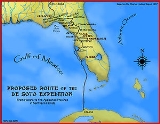
Flmap Apalachee Tribe
The Apalachee are an Indian tribe
Native Americans in the United States

Native Americans in the United States are the Indigenous peoples of the Americas from the regions of North America now encompassed by the continental United States United States, including parts of Alaska and the island state of Hawaii....
 that lived in Apalachee Province
Apalachee Province

Apalachee Province was the area populated by the group of Native Americans in the United States peoples known as the Apalachee. They were the southern most extent of the Mississippian culture and located in what is now Leon County, Florida, Wakulla County, Florida and Jefferson County, Florida, Florida, United States....
, Florida
Florida

Florida is a U.S. state located in the Southeastern United States of the United States, bordering Alabama to the northwest and Georgia to the northeast....
, until the tribe was largely destroyed and dispersed in the 18th century. They lived between the Aucilla River
Aucilla River

The Aucilla River rises close to Thomasville, Georgia, Georgia , USA, and passes through the Big Bend region of Florida, emptying into the Gulf of Mexico at Apalachee Bay....
 and Ochlockonee River
Ochlockonee River

The Ochlockonee River is a fast running river originating in Georgia , and terminating in Florida....
, at the head of Apalachee Bay
Apalachee Bay

Apalachee Bay is an arm of the Gulf of Mexico occupying an indentation of the Florida coast to the west of where the Florida peninsula joins the United States mainland....
 and were first encountered by Spanish
Spanish people

Spanish people or Spaniards are a nation or ethnic group native to Spain, in the Iberian Peninsula of southwestern Europe. They are often considered an amalgam of different ethnic groups, rather than an ethnic group by itself....
 explorers in the 16th century. The Apalachee spoke a Muskogean language
Muskogean languages

Muskogean is an indigenous language family of the Southeastern United States. The Muskogean languages are generally divided into two rough branches, Eastern and Western, though these distinctions are the subject of some debate....
 which is now extinct
Extinct language

An extinct language is a language which no longer has any speakers .Extinct languages may be contrasted with Language death: no longer spoken as a main language....
, documented by letters written in the Spanish Colonial period. There is a small remnant of the tribe living in Louisiana
Louisiana

The State of Louisiana is a U.S. state located in the U.S. Southern States of the United States of America. Its capital is Baton Rouge and largest city is New Orleans....
.

The "Appalachian" place-name is derived from the naming by the Narvaez Expedition
Narváez expedition

The Narv?ez expedition was a Spain attempt to install P?nfilo de Narv?ez as adelantado of Spanish Florida during the years 1527 – 1528....
 of a village near present day Tallahassee, Florida
Tallahassee, Florida

Tallahassee is the Capital of the Florida, USA, and the county seat of Leon County, Florida. Tallahassee became the capital of Florida in 1824....
 as "Apalchen", a Native American
Indigenous peoples of the Americas

The indigenous peoples of the Americas are the pre-Columbian inhabitants of the Americas, their descendants, and many ethnic groups who identify with those peoples....
 name soon altered by the Spanish to Apalachee and used as a name for the region and for the tribe spreading well inland to the north. Pánfilo de Narváez
Pánfilo de Narváez

P?nfilo de Narv?ez was a Spain conqueror and soldier in the Americas. He is most remembered as the leader of two expeditions, one to Mexico in 1520 to oppose Hern?ndo Cort?s, and another, disastrous, to Florida in 1527....
's expedition first entered Apalachee territory on June 15, 1528. Thus "Appalachian" is the fourth oldest surviving European place-name in the U.S.

Culture


Around 1100 agriculture
Agriculture

Agriculture refers to the production of food and goods through farming and forestry. Agriculture was the key development that led to the rise of civilization, with the animal husbandry of domestication animals and plants creating food surpluses that enabled the development of more Population density and Social stratification societies....
 became important in the area that became the Apalachee domain. This area was part of the Fort Walton Culture
Fort Walton Culture

Fort Walton Culture was a Mound builder Native Americans in the United States culture that flourished near Ft. Walton Beach, Florida, Florida in the Southeastern United States United States from approximately 1100~1550 AD....
, a Florida culture influenced by the Mississippian culture
Mississippian culture

The Mississippian culture was a Mound builder Native Americans in the United States culture that flourished in what is now the Midwestern United States, Eastern United States, and Southeastern United States United States from approximately 800 Common Era to 1500 Common Era, varying regionally....
. The Apalachee capital was Anhaica
Anhaica

.Anhaica was an Apalachee Indian town and capital of Apalachee Province located near Myers Park in the present-day city of Tallahassee, Florida, Florida....
 (present-day Tallahassee, Florida
Tallahassee, Florida

Tallahassee is the Capital of the Florida, USA, and the county seat of Leon County, Florida. Tallahassee became the capital of Florida in 1824....
) at the time of Hernando de Soto's
Hernando de Soto (explorer)

Hernando de Soto was a Spanish people Exploration and conquistador who, while leading the first European expedition deep into the territory of the modern-day United States, was the first European to discover the Mississippi River....
 visit in 1539-1540. The Apalachee lived in towns of various size, or on individual farmsteads of 1/2 acre or so in size. Smaller settlements might have a single mound
Mound

A mound is a general term for an artificial wikt:heaped pile of earth, gravel, sand, rock s, or debris. The most common use is in reference to natural earthen formation such as hills and mountains, particularly if they appear artificial....
 and a few houses. Larger towns (50 to 100 houses) would have several mounds. Villages and towns were often situated by lakes. The largest Apalachee community was at Lake Jackson
Lake Jackson (Tallahassee, Florida)

Lake Jackson is a shallow, Prairie Lake on the north side of Tallahassee, Florida in Leon County, Florida with two major depressions or sinkholes known as Porter Sink and Lime Sink....
 on the north side of present-day Tallahassee
Tallahassee, Florida

Tallahassee is the Capital of the Florida, USA, and the county seat of Leon County, Florida. Tallahassee became the capital of Florida in 1824....
. This community had several mounds, some of which are now protected in Lake Jackson Mounds Archaeological State Park
Lake Jackson Mounds Archaeological State Park

Lake Jackson Mounds Archaeological State Park is an archaeology site in northern Tallahassee, Florida, Florida, United States. It is located on the south shore of Lake Jackson ....
, and 200 or more houses. The Apalachee grew corn
Maize

Maize , known as corn in some countries, is a cereal domesticated in Mesoamerica and subsequently spread throughout the American continents....
, bean
Bean

Bean is a common name for large plant seeds of several genus of the Family Fabaceae used for human food or animal feed.The whole young pods of bean plants, if picked before the pods ripen and dry, can be tender enough to eat whole, whether cooked or raw....
s, squash
Squash (fruit)

Squashes generally refer to four species of the genus Cucurbita native to Mexico and Central America, also called marrows depending on variety or the nationality of the speaker....
, pumpkin
Pumpkin

Pumpkin is a gourd-like Squash of the genus Cucurbita and the family Cucurbitaceae . It is a common name of or can refer to cultivars of any one of the following species: Cucurbita pepo, Cucurbita mixta, Cucurbita maxima, and Cucurbita moschata....
s and sunflower
Sunflower

The sunflower is an annual plant in the family Asteraceae and native to the Americas, with a large flowering head . The stem can grow as high as 3 meters , and the flower head can reach 30 cm in diameter with the "large" seeds....
s. They gathered wild strawberries
Strawberry

Fragaria is the name of a genus of flowering plants in the rose family, Rosaceae, commonly known as strawberries for their edible fruits....
, the roots and shoots of the greenbrier vine, greens such as lambsquarters
Fat Hen

Fat hen or fat-hen is a common name for various plants with succulent or juicy leaves, often species that are used as a vegetable:* Aristolochia rotunda ...
, the roots of one or more unidentified aquatic plants used to make flour, hickory
Hickory

Trees in the genus Carya are commonly known as Hickory. The genus includes 17?19 species of deciduous trees with pinnately compound leaf and large nut ....
 nuts, acorn
Acorn

The acorn, or oak nut, is the nut of the oak tree . It is a nut , containing a single seed , enclosed in a tough, leathery shell, and borne in a cup-shaped cupule....
s, saw palmetto
Saw Palmetto

Serenoa repens, the saw palmetto, is the sole species currently classified in the genus Serenoa. It has been known by a number of synonyms, including Sabal serrulatum, under which name it still often appears in alternative medicine....
 berries and persimmon
Persimmon

A persimmon, known to the ancient Greeks as "the fruit of the gods" is the edible fruit of a number of species of trees of the genus Diospyros in the ebony wood family ....
s. They caught fish and turtle
Turtle

Turtles are reptiles of the Order Testudines , most of whose body is shielded by a special bone or cartilage animal shell developed from their ribs....
s in the lakes and rivers, and oyster
Oyster

The common name oyster is used for a number of different groups of bivalve mollusks, most of which live in marine habitats or brackish water....
s and fish on the Gulf Coast
Gulf Coast of the United States

The Gulf Coast region of the United States comprises the coasts of states which border the Gulf of Mexico. The states of Texas, Louisiana, Mississippi, Alabama, and Florida are known as the Gulf States....
. They hunted deer
White-tailed Deer

File:Wtdfishwild.jpgThe white-tailed deer , also known as the Virginia deer, or simply as the whitetail, is a medium-sized deer native to all but five states in the United States, Canada, Mexico, Central America, and northern portions of South America as far south as Peru....
, black bear
American black bear

The American Black Bear is the most common bear species native to North America. It lives throughout much of the continent, from northern Alaska south into Mexico and from the Atlantic Ocean to the Pacific Ocean....
s, rabbit
Rabbit

Rabbits are small mammals in the family Leporidae of the order Lagomorpha, found in several parts of the world. There are seven different genus in the family taxonomy as rabbits, including the European rabbit , Cottontail rabbit , and the Amami rabbit ....
s and duck
Duck

Duck is the common name for a number of species in the Anatidae family of birds. The ducks are divided between several subfamilies listed in full in the Anatidae article; they do not represent a clade but a form taxon, being the Anatidae not considered swans and goose....
s.

The Apalachee were part of a trade network that extended from the Gulf Coast to the Great Lakes
Great Lakes

The St. Lawrence River Great Lakes are a chain of fresh water lakes located in eastern North America, on the Canada ? United States border. Consisting of Lakes Lake Superior, Lake Michigan, Lake Huron, Lake Erie, and Lake Ontario, they form the largest group of freshwater lakes on Earth....
, and westward to what is now Oklahoma
Oklahoma

Oklahoma is a U.S. state and a sovereignty located in the South Central United States and Southern United States of the United States of America ....
. The Apalachee acquired copper
Copper

Copper is a chemical element with the symbol Cu and atomic number 29.It is a ductile metal with very high thermal and electrical conductivity....
 artifacts, sheets of mica
Mica

The mica group of sheet silicate minerals includes several closely related materials having highly perfect basal cleavage. All are monoclinic with a tendency towards pseudo-hexagonal crystals and are similar in chemical composition....
, greenstone
Greenstone

Pounamu is several types of hard, durable and highly valued nephrite jade and bowenite found in New Zealand. Pounamu is the Maori language name; the rocks are also known as "greenstone" in New Zealand English....
 and galena
Galena

Galena is the natural mineral form of lead sulfide. It is the most important lead ore mineral.Galena is one of the most abundant and widely distributed sulfide minerals....
 through this trade. The Apalachee probably paid for these imports with shells, pearls, shark teeth, preserved fish and sea turtle
Sea turtle

Sea turtles are turtles found in all the world's oceans except the Arctic Ocean. There are seven living species of sea turtles: Flatback Sea Turtle, Green Sea Turtle, Hawksbill turtle, Kemp's Ridley, leatherback sea turtle, Loggerhead Sea Turtle and Olive Ridley Sea Turtle....
 meat, salt and cassina
Yaupon Holly

Ilex vomitoria , is a species of holly native to southeastern North America, occurring in United States from Maryland south to Florida and west to Oklahoma and Texas, and in Mexico in Chiapas....
 leaves and twigs (used to make the black drink
Black drink

Black drink was the name given by colonists to a ritual beverage called Asi, brewed by Native Americans in the United States in the Southeastern United States....
).

The Apalachee made tools from stone, bone and shell. They made pottery, wove cloth and cured buckskin
Buckskin (leather)

Buckskin is the soft, pliable, porous preserved hide of an animal, usually deer, moose or Red Deer or even cowhide tanned to order, but potentially any animal's hide,....
. They built houses covered with palm
Arecaceae

Palm or Palmae or Panamea , the palm family, is a family of flowering plants belonging to the Monocotyledon order, Arecales. There are roughly 202 currently known Genus with around 2600 species, most of which are restricted to tropics, subtropics, and warm temperate climates....
 leaves or the bark of cypress
Taxodium

Taxodium is a genus of one to three species of extremely flood-tolerant conifers in the cypress family, Cupressaceae. Within the family, Taxodium is most closely related to Glyptostrobus and Cryptomeria ....
 or poplar
Poplar

Populus is a genus of between 25?35 species of deciduous flowering plants in the family Salicaceae, native to most of the Northern Hemisphere....
 trees. They stored food in pits in the ground lined with matting, and smoked or dried
Drying (food)

Drying is a method of food preservation that works by removing water from the food, which prevents the growth of microorganisms and decay. Drying food using the sun and wind to prevent spoilage has been known since ancient times....
 food on racks over fires. (When Hernando de Sotò
Hernando de Soto (explorer)

Hernando de Soto was a Spanish people Exploration and conquistador who, while leading the first European expedition deep into the territory of the modern-day United States, was the first European to discover the Mississippi River....
 seized the Apalachee town of Anhaico in 1539, he found enough stored food to feed his 600 men and 220 horses for five months.)

The Apalachee men wore a deerskin loincloth
Loincloth

A loincloth is a one-piece male garment, sometimes kept in place by a Belt , which covers the genitals and, at least partially, the buttocks....
. The women wore a skirt of Spanish moss
Spanish Moss

Spanish moss closely resembles its namesake . However, Spanish moss is not biologically related to either mosses or lichens. Instead, it is a flowering plant in the family Bromeliaceae that grows hanging from tree branches in full sun or partial shade....
 or other plant fibers. The men painted their bodies with red ochre
Red ochre

Red ochre and yellow ochre are pigments made from naturally tinted clay. It has been used worldwide since prehistoric times. Chemically, it is hydrated iron oxide....
 placed feathers in their hair when they prepared for battle. The men smoked tobacco
Tobacco

Tobacco is an agricultural product processed from the fresh leaves of plants in the genus Nicotiana. It can be consumed, used as an organic pesticide, and in the form of nicotine tartrate it is used in some medicines....
.

The Apalachee scalped
Scalping

Scalping is the act of removing the scalp, usually with the hair, as a portable proof or trophy of prowess in war. Scalping is also associated with frontier warfare in North America, and was widely practiced by Indigenous peoples of the Americas, colonists, and frontiersmen over centuries of violent conflict....
 opponents they killed and exhibited the scalps as a sign of their ability. Taking a scalp was a means of entering the warrior
Warrior

According to the Random House Dictionary, the term warrior has two meanings. The first Literal and figurative language use refers to "a person engaged or experienced in warfare." The second Literal and figurative language use refers to "a person who shows or has shown great vigor, courage, or aggressiveness, as in politics or athletics...
 class, and was celebrated with a scalp dance using headdresses made of bird beaks and animal fur. The village or clan of a slain warrior was expected to avenge his death.

The Apalachee played a ball game that was described in detail by Spaniards in the 17th century. Two teams kicked and hit a small ball, made by wrapping buckskin around dried mud, trying to hit a goal post. There was only one goal, with an eagle
Bald Eagle

The Bald Eagle is a bird of prey found in North America that is most recognizable as the List of national birds and national symbol of the United States....
's nest set on top. Players scored one point if they hit the post with the ball, and two points if the ball landed in the nest. Eleven points won the game. Spectators gambled heavily on the games.

Up to 50 men played on a team. The best players were highly prized, and villages gave them houses, planted their fields for them, and overlooked their misdeeds in an effort to keep such players on their teams. The giving of challenges for a game and the erection of goalposts involved rituals and ceremonies. The game had few rules and could be quite violent. Serious injuries and even deaths occurred in the games.

Spanish encounters

. Two Spanish
Spanish people

Spanish people or Spaniards are a nation or ethnic group native to Spain, in the Iberian Peninsula of southwestern Europe. They are often considered an amalgam of different ethnic groups, rather than an ethnic group by itself....
 expeditions encountered the Apalachee in the first half of the 16th century. The expedition of Pánfilo de Narváez
Pánfilo de Narváez

P?nfilo de Narv?ez was a Spain conqueror and soldier in the Americas. He is most remembered as the leader of two expeditions, one to Mexico in 1520 to oppose Hern?ndo Cort?s, and another, disastrous, to Florida in 1527....
 entered the Apalachee domain in 1528. Spanish cruelty towards the Apalachee was met with resistance, and the Narváez expedition
Narváez expedition

The Narv?ez expedition was a Spain attempt to install P?nfilo de Narv?ez as adelantado of Spanish Florida during the years 1527 – 1528....
 turned to the coast on Apalachee Bay, where it built five boats and attempted to sail to Mexico
Mexico

The United Mexican States , commonly known as Mexico , is a federalism constitutionalism republic in North America. It is bordered on the north by the United States; on the south and west by the Pacific Ocean; on the southeast by Guatemala, Belize, and the Caribbean Sea; and on the east by the Gulf of Mexico....
.

In 1539, Hernando de Sotò
Hernando de Soto (explorer)

Hernando de Soto was a Spanish people Exploration and conquistador who, while leading the first European expedition deep into the territory of the modern-day United States, was the first European to discover the Mississippi River....
 landed with a large contingent of men and horses on the west coast of the peninsula
Peninsula

A peninsula is a piece of Landform that is nearly surrounded by water but connected to mainland via an isthmus. Word origin: Latin paeninsula : paene, almost + insula, island....
 of Florida, searching for gold. The people he encountered told him that gold could be found in Apalachee. It is not known if this was a reference to the mountains of northern Georgia
Georgia (U.S. state)

Georgia is a U.S. state in the United States and was one of the original Thirteen Colonies that revolted against United Kingdom rule in the American Revolution....
, which is a source of gold, or to the copper artifacts that the Apalachee had acquired through trade. In any case, it served to send de Sotò and his men away.

Because of their prior experience with the Narváez expedition and the reports they heard of the fighting between the de Sotò expedition and the tribes it encountered, the Apalachee feared and hated the Spanish. The de Sotò expedition entered the Apalachee domain, and the Spanish soldiers are described as lancing every Indian encountered on both sides of the road. De Sotò and his men seized the Apalachee town of Anhaica and spent the winter of 1539-1540 there.

The Apalachee fought back with small raids and ambushes. Their arrows could penetrate two layers of chain mail
Chain Mail

"Chain Mail" is a Single by Manchester band James , released in March 1986 by Sire Records, the first after the band defected from Factory Records....
. They quickly learned to target the horses, which could give the Spanish a large advantage against the unmounted Apalachee. The Apalachee were described as being more pleased in killing one of these animals than they were in killing four Christians. In the spring of 1540, de Sotò and his men left the Apalachee domain and headed north into what is now the state of Georgia.

Spanish missions

About 1600 the Spanish
Spain

Spain or the Kingdom of Spain , is a country located in Southern Europe on the Iberian Peninsula.The Spanish constitution does not establish any official denomination of the country, even though Espa?a , Estado espa?ol and Naci?n espa?ola are used interchangeably....
 Franciscans founded a successful mission among them, but in 1704 (during Queen Anne's War
Queen Anne's War

Queen Anne's War was the second in a series of four French and Indian Wars fought between France and England . in North America for control of the continent and was the counterpart of the War of the Spanish Succession in Europe....
) forces from the Province of Carolina
Province of Carolina

The Province of Carolina from 1663 to 1712, was a North American Kingdom of Great Britain proprietary colony, controlled by the Lords Proprietor, a group of eight English noblemen led informally by member Anthony Ashley-Cooper, 1st Earl of Shaftesbury....
 in North America
North America

North America is the northern continent of the Americas, situated in the Earth's northern hemisphere and almost totally in the western hemisphere....
, made up mostly of Creek
Creek people

The Muscogee , their original name they use to identify themselves today, also known as the Creek, are an American Indians in the United States people originally from the Southern United States....
 and Yamasee
Yamasee

The Yamasee were a Native Americans in the United States tribe that lived in coastal region of present-day northern Florida and southern Georgia near the Savannah River....
 Indians, traveled southwards to Florida and attacked the Apalachee and the Spanish missionaries who lived amongst them, in what became known as the Apalachee Massacre
Apalachee Massacre

The Apalachee Massacre was an episode that took place during Queen Anne's War in 1704.In 1704, the ex-governor of South Carolina James Moore launched an invasion of the Apalachee territory in western Florida with 50 Englishmen and 1,000 Creek people....
. Some of the Apalachee were killed, others who were captured and sold into slavery kept their tribal identity for some time. Others were taken as slaves by the Creek and Yamasee Indians to be sold in the British Indian slave trade
Indian slavery

Indian slavery was the practice of using indigenous peoples of the Americas as slaves....
, and others fled westward accepting an offer to live in French-controlled Mobile
Mobile, Alabama

Mobile is the third most populous city in the Southern United States United States state of Alabama and is the county seat of Mobile County, Alabama....
. In 1763, most of these Apalachees relocated to Rapides Parish in Louisiana
Louisiana

The State of Louisiana is a U.S. state located in the U.S. Southern States of the United States of America. Its capital is Baton Rouge and largest city is New Orleans....
. The tribe's descendants are still in Rapides Parish Louisiana under the guidance of Chief Gilmer Bennett.

Present tribe


Today the tribal office located in Libuse, Louisiana
Libuse, Louisiana

Libuse is a populated place in Rapides Parish, Louisiana, Louisiana, United States. It was founded in 1914 by Czech people immigrants, and named after Libu?e....
, serves approximately 300 members. The tribe has been featured in The Wall Street Journal along with other news publications. The Public Broadcasting Service
Public Broadcasting Service

The Public Broadcasting Service is an United States non-profit public broadcasting television service with 354 member TV stations in the United States....
 show "History Detectives
History Detectives

History Detectives is a television program on PBS. A group of researchers help people to seek answers to various historical questions they have, usually centering around a family heirloom, an old house or other historic object or structure....
" aired a special about the tribe in 2006. Mission San Luis, a living history museum in Tallahassee, Florida, that re-creates one of the Spanish missions to the Apalachee, received the Preserve America Presidential Award in 2006.

See also

  • Muskogean languages
    Muskogean languages

    Muskogean is an indigenous language family of the Southeastern United States. The Muskogean languages are generally divided into two rough branches, Eastern and Western, though these distinctions are the subject of some debate....
  • List of sites and peoples visited by the Hernando de Soto Expedition
    List of sites and peoples visited by the Hernando de Soto Expedition

    This is a List of sites and peoples visited by the Hernando de Soto Expedition in the years 1539-1543. In May 1539, de Soto left Havana, Cuba with nine ships, over 620 men and 220 surviving horses and landed at Port Charlotte, Florida....
  • Queen Anne's War
    Queen Anne's War

    Queen Anne's War was the second in a series of four French and Indian Wars fought between France and England . in North America for control of the continent and was the counterpart of the War of the Spanish Succession in Europe....


External links

  • regional folk life