

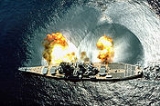
Gun

Encyclopedia
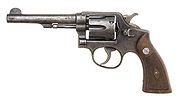
Projectile
A projectile is any object projected into space by the exertion of a force. Although a thrown baseball is technically a projectile too, the term more commonly refers to a weapon....
-firing weapon
Weapon
A weapon, arm, or armament is a tool or instrument used with the aim of causing damage or harm to living beings or artificial structures or systems...
. There are various definitions depending on the nation and branch of service. A "gun" may be distinguished from other firearm
Firearm
A firearm is a weapon that launches one, or many, projectile at high velocity through confined burning of a propellant. This subsonic burning process is technically known as deflagration, as opposed to supersonic combustion known as a detonation. In older firearms, the propellant was typically...
s in being a crew-served weapon such as a howitzer
Howitzer
A howitzer is a type of artillery piece characterized by a relatively short barrel and the use of comparatively small propellant charges to propel projectiles at relatively high trajectories, with a steep angle of descent...
or mortar
Mortar (weapon)
A mortar is an indirect fire weapon that fires explosive projectiles known as bombs at low velocities, short ranges, and high-arcing ballistic trajectories. It is typically muzzle-loading and has a barrel length less than 15 times its caliber....
, as opposed to a small arm like a rifle
Rifle
A rifle is a firearm designed to be fired from the shoulder, with a barrel that has a helical groove or pattern of grooves cut into the barrel walls. The raised areas of the rifling are called "lands," which make contact with the projectile , imparting spin around an axis corresponding to the...
or pistol
Pistol
When distinguished as a subset of handguns, a pistol is a handgun with a chamber that is integral with the barrel, as opposed to a revolver, wherein the chamber is separate from the barrel as a revolving cylinder. Typically, pistols have an effective range of about 100 feet.-History:The pistol...
, but there are exceptions, such as the U.S. Air Force
United States Air Force
The United States Air Force is the aerial warfare service branch of the United States Armed Forces and one of the American uniformed services. Initially part of the United States Army, the USAF was formed as a separate branch of the military on September 18, 1947 under the National Security Act of...
's GUU5/P. At one time, land-based artillery
Artillery
Originally applied to any group of infantry primarily armed with projectile weapons, artillery has over time become limited in meaning to refer only to those engines of war that operate by projection of munitions far beyond the range of effect of personal weapons...
tubes were called cannon
Cannon
A cannon is any piece of artillery that uses gunpowder or other usually explosive-based propellents to launch a projectile. Cannon vary in caliber, range, mobility, rate of fire, angle of fire, and firepower; different forms of cannon combine and balance these attributes in varying degrees,...
and sea-based naval cannon were called guns. The term "gun" evolved into a generic term for any tube-launched projectile-firing weapon used by sailor
Sailor
A sailor, mariner, or seaman is a person who navigates water-borne vessels or assists in their operation, maintenance, or service. The term can apply to professional mariners, military personnel, and recreational sailors as well as a plethora of other uses...
s, including boarding parties and marines.
In modern parlance, a gun is a projectile weapon using a hollow, tubular barrel
Gun barrel
A gun barrel is the tube, usually metal, through which a controlled explosion or rapid expansion of gases are released in order to propel a projectile out of the end at a high velocity....
with a closed end—the breech—as the means of directing the projectile (as well as other purposes, for example stabilizing the projectile's trajectory, aiming, as an expansion chamber for propellant, etc.), and firing in a generally flat trajectory.
The term "gun" has also taken on a more generic meaning, by which it has come to refer to any one of a number of trigger-initiated, hand-held, and hand-directed implements, especially with an extending bore, which thereby resemble the class of weapon in either form or concept. Examples of this usage include staple gun
Staple gun
A staple gun or powered stapler is a hand-held machine used to drive heavy metal staples into wood, plastic, or masonry. Staple guns are used for many different applications and to affix a variety of materials, including insulation, house wrap, roofing, wiring, carpeting, upholstery, and hobby and...
, nail gun
Nail gun
A nail gun, nailgun or nailer is a type of tool used to drive nails into wood or some other kind of material. It is usually driven by electromagnetism, compressed air , highly flammable gases such as butane or propane, or, for powder-actuated tools, a small explosive charge...
, glue gun, grease gun
Grease gun (tool)
A grease gun is a common workshop and garage tool used for lubrication. The purpose of the grease gun is to apply lubricant through an aperture to a specific point, usually on a grease fitting. The channels behind the grease nipple lead to where the lubrication is needed. The aperture may be of a...
. Occasionally, this tendency is ironically reversed, such as the case of the American M3 submachine gun
M3 submachine gun
The M3 was an American .45-caliber submachine gun adopted for U.S. Army service on 12 December 1942, as the United States Submachine Gun, Cal. .45, M3. The M3 was designed as a more cost-effective alternative to the Thompson, optimized for mass production...
which carries the nickname "Grease Gun".
Most guns are described by the type of barrel used, the means of firing, the purpose of the weapon, the caliber, or the commonly accepted name for a particular variation.
Barrel types include rifled
Rifling
Rifling is the process of making helical grooves in the barrel of a gun or firearm, which imparts a spin to a projectile around its long axis...
—a series of spiraled grooves or angles within the barrel—when the projectile requires an induced spin to stabilize it and smoothbore
Smoothbore
A smoothbore weapon is one which has a barrel without rifling. Smoothbores range from handheld firearms to powerful tank guns and large artillery mortars.-History of firearms and rifling:...
when the projectile is stabilized by other means or rifling is undesired or unnecessary. Typically, interior barrel diameter and the associated projectile size is a means to identify gun variations. Barrel diameter is reported in several ways. The more conventional measure is reporting the interior diameter of the barrel in decimal fractions of the inch or in millimeters. Some guns—such as shotgun
Shotgun
A shotgun is a firearm that is usually designed to be fired from the shoulder, which uses the energy of a fixed shell to fire a number of small spherical pellets called shot, or a solid projectile called a slug...
s—report the weapon's gauge
Gauge (bore diameter)
The gauge of a firearm is a unit of measurement used to express the diameter of the barrel. Gauge is determined from the weight of a solid sphere of lead that will fit the bore of the firearm, and is expressed as the multiplicative inverse of the sphere's weight as a fraction of a pound . Thus...
or—as in some British ordnance—the weight of the weapon's usual projectile.
A gun projectile may be a simple, single-piece item like a bullet, a casing containing a payload like a shotshell or explosive shell, or complex projectile like a sub-caliber projectile and sabot. The propellant may be air, an explosive solid, or an explosive liquid. Some variations like the Gyrojet
Gyrojet
The Gyrojet is a family of unique firearms developed in the 1960s named for the method of gyroscopically stabilizing its projectiles. Gyrojets fire small rockets, rather than inert bullets, which have little recoil and do not require a heavy barrel to resist the pressure of the combustion gases. ...
and certain other types combine the projectile and propellant into a single item.
Terminology
The use of the term "cannonCannon
A cannon is any piece of artillery that uses gunpowder or other usually explosive-based propellents to launch a projectile. Cannon vary in caliber, range, mobility, rate of fire, angle of fire, and firepower; different forms of cannon combine and balance these attributes in varying degrees,...
" is interchangeable with "gun" as words borrowed from the French language during the early 15th century, from Old French
Old French
Old French was the Romance dialect continuum spoken in territories that span roughly the northern half of modern France and parts of modern Belgium and Switzerland from the 9th century to the 14th century...
canon, itself a borrowing from the Italian cannone, a "large tube" augmentative of Latin canna "reed or cane". Recent scholarship indicates that the term "gun" may also have its origins in the Norse woman's name "Gunnildr", which was often shortened to "Gunna". The earliest recorded use of the term "gonne" was in a Latin document circa 1339. Other names for guns during this era were "schioppi" (Italian translation-"thunderers"), and "donrebusse" (Dutch translation-"thunder gun") which was incorporated into the English language as "blunderbuss". Artillerymen were often referred to as "gonners" and "artillers". Early guns and the men who used them were often associated with the devil and the gunner's craft was considered a black art
Black magic
Black magic is the type of magic that draws on assumed malevolent powers or is used with the intention to kill, steal, injure, cause misfortune or destruction, or for personal gain without regard to harmful consequences. As a term, "black magic" is normally used by those that do not approve of its...
, a point reinforced by the smell of sulfur
Sulfur
Sulfur or sulphur is the chemical element with atomic number 16. In the periodic table it is represented by the symbol S. It is an abundant, multivalent non-metal. Under normal conditions, sulfur atoms form cyclic octatomic molecules with chemical formula S8. Elemental sulfur is a bright yellow...
on battlefields created from the firing of guns along with the muzzle blast and accompanying flash
Muzzle flash
Muzzle blast is the term used to describe the release of high temperature, high pressure gases expelled from the muzzle of a firearm when it is discharged. Muzzle flash is the term used to describe the visible light of the muzzle blast. The blast and flash are caused by the combustion products of...
.
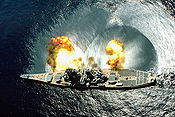
In military use, the term "gun" refers primarily to direct fire
Direct fire
Direct fire refers to the launching of a projectile directly at a target on a relatively flat trajectory. The firing weapon must have a sighting device and an unobstructed line of sight to the target, which means no objects or friendly units can be between it and the target...
weapons that capitalize on their velocity for penetration or range. In modern parlance, these weapons are breech-loaded and built primarily for long range fire with a low or almost flat ballistic arc. A variation is the howitzer
Howitzer
A howitzer is a type of artillery piece characterized by a relatively short barrel and the use of comparatively small propellant charges to propel projectiles at relatively high trajectories, with a steep angle of descent...
or gun-howitzer designed to offer the ability to fire both low or high-angle ballistic arcs. In this use, example guns include naval guns
Naval artillery
Naval artillery, or naval riflery, is artillery mounted on a warship for use in naval warfare. Naval artillery has historically been used to engage either other ships, or targets on land; in the latter role it is currently termed naval gunfire fire support...
. A less strict application of the word is to identify one artillery weapon system or non-machine gun projectile armament on aircraft.
The word cannon
Cannon
A cannon is any piece of artillery that uses gunpowder or other usually explosive-based propellents to launch a projectile. Cannon vary in caliber, range, mobility, rate of fire, angle of fire, and firepower; different forms of cannon combine and balance these attributes in varying degrees,...
is retained in some cases for the actual gun tube but not the weapon system. The title gunner is applied to the member of the team charged with operating, aiming, and firing a gun.
Autocannon
Autocannon
An autocannon or automatic cannon is a rapid-fire projectile weapon firing a shell as opposed to the bullet fired by a machine gun. Autocannons often have a larger caliber than a machine gun . Usually, autocannons are smaller than a field gun or other artillery, and are mechanically loaded for a...
are automatic guns designed primarily to fire shells and are mounted on a vehicle or other mount. Machine guns are similar, but usually designed to fire simple projectiles. In some calibers and some usages, these two definitions overlap.
A related military use of the word is in describing gun-type fission weapon
Gun-type fission weapon
Gun-type fission weapons are fission-based nuclear weapons whose design assembles their fissile material into a supercritical mass by the use of the "gun" method: shooting one piece of sub-critical material into another...
. In this instance, the "gun" is part of a nuclear weapon
Nuclear weapon
A nuclear weapon is an explosive device that derives its destructive force from nuclear reactions, either fission or a combination of fission and fusion. Both reactions release vast quantities of energy from relatively small amounts of matter. The first fission bomb test released the same amount...
and contains an explosively propelled sub-critical slug of fissile material within a barrel to be fired into a second sub-critical mass in order to initiate the fission reaction. Potentially confused with this usage are small nuclear devices capable of being fired by artillery or recoilless rifle.
Davy Crockett (nuclear device)
The M-28 or M-29 Davy Crockett Weapon System was a tactical nuclear recoilless gun for firing the M388 nuclear projectile that was deployed by the United States during the Cold War...
In civilian use, a related item used in agriculture is a captive bolt gun
Captive bolt pistol
A captive bolt pistol is a device used for stunning animals prior to slaughter....
. Such captive piston guns are often used to humanely stun farm animals for slaughter.
Shotgun
Shotgun
A shotgun is a firearm that is usually designed to be fired from the shoulder, which uses the energy of a fixed shell to fire a number of small spherical pellets called shot, or a solid projectile called a slug...
s are normally civilian weapons used primarily for hunting. These weapons are typically smooth bored and fire a shell containing small lead or steel balls. Variations use rifled barrels or fire other projectiles including solid lead slugs, a Taser
Taser
A Taser is an electroshock weapon that uses electrical current to disrupt voluntary control of muscles. Its manufacturer, Taser International, calls the effects "neuromuscular incapacitation" and the devices' mechanism "Electro-Muscular Disruption technology"...
XREP projectile capable of stunning a target, or other payloads. In military versions, these weapons are often used to burst door hinges or locks in addition to antipersonnel uses.
Types of guns
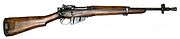
Military firearms
- Long gunLong gunThe term long gun is used to describe classes of firearm and cannon with longer barrels than other classes. In small arms, a long gun is designed to be fired braced against the shoulder, in contrast to a handgun, while in artillery a long gun would be contrasted with a howitzer or carronade.-Small...
- ArquebusArquebusThe arquebus , or "hook tube", is an early muzzle-loaded firearm used in the 15th to 17th centuries. The word was originally modeled on the German hakenbüchse; this produced haquebute...
- BlunderbussBlunderbussThe blunderbuss is a muzzle-loading firearm with a short, large caliber barrel, which is flared at the muzzle and frequently throughout the entire bore, and used with shot and other projectiles of relevant quantity and/or caliber. The blunderbuss could be considered to be an early form of shotgun,...
- MusketMusketA musket is a muzzle-loaded, smooth bore long gun, fired from the shoulder. Muskets were designed for use by infantry. A soldier armed with a musket had the designation musketman or musketeer....
- MusketoonMusketoonThe musketoon is a shorter barrelled version of the musket, and served in the roles of a shotgun or carbine. Musketoons could be of the same caliber as the issue musket, or of a much larger caliber, 1.0-2.5 inches . The musketoon is most commonly associated with naval use, and pirates in...
- Wall gunWall gunWall guns were large caliber smooth-bore muskets that were used in the 16th through 18th centuries by defending forces to break the advance of enemy troops. They were too heavy to be fired from the shoulder and so were usually rested on window ledges or low walls, hence the name. They were also...
- Grenade launcherGrenade launcherA grenade launcher or grenade discharger is a weapon that launches a grenade with more accuracy, higher velocity, and to greater distances than a soldier could throw it by hand....
- Musketoon
- Submachine gunSubmachine gunA submachine gun is an automatic carbine, designed to fire pistol cartridges. It combines the automatic fire of a machine gun with the cartridge of a pistol. The submachine gun was invented during World War I , but the apex of its use was during World War II when millions of the weapon type were...
- Personal defense weaponPersonal defense weaponA personal defense weapon is a compact semi-automatic or fully automatic firearm similar in most respects to a submachine gun, but firing an armor-piercing rifle round, giving a PDW better range, accuracy and armor-penetrating capability than submachine guns, which fire pistol-caliber cartridges...
- Personal defense weapon
- RifleRifleA rifle is a firearm designed to be fired from the shoulder, with a barrel that has a helical groove or pattern of grooves cut into the barrel walls. The raised areas of the rifling are called "lands," which make contact with the projectile , imparting spin around an axis corresponding to the...
- Lever action rifle
- Bolt action rifle
- Assault rifleAssault rifleAn assault rifle is a selective fire rifle that uses an intermediate cartridge and a detachable magazine. Assault rifles are the standard infantry weapons in most modern armies...
- Battle rifleBattle rifleA battle rifle is a military service rifle that fires a full power rifle cartridge, such as 7.62x51mm NATO. While the designation of battle rifle is usually given to post-World War II select fire infantry rifles such as the H&K G3, the FN FAL or the M14, this term can also apply to older military...
- CarbineCarbineA carbine , from French carabine, is a longarm similar to but shorter than a rifle or musket. Many carbines are shortened versions of full rifles, firing the same ammunition at a lower velocity due to a shorter barrel length....
- Service rifleService rifleThe service rifle of a given army or armed force is that which it issues as standard to its soldiers. In modern forces, this is typically a highly versatile and rugged assault rifle suitable for use in nearly all theatres and environments...
- Sniper rifleSniper rifleIn military and law enforcement terminology, a sniper rifle is a precision-rifle used to ensure more accurate placement of bullets at longer ranges than other small arms. A typical sniper rifle is built for optimal levels of accuracy, fitted with a telescopic sight and chambered for a military...
- ShotgunShotgunA shotgun is a firearm that is usually designed to be fired from the shoulder, which uses the energy of a fixed shell to fire a number of small spherical pellets called shot, or a solid projectile called a slug...
- Combat shotgunCombat shotgunA combat shotgun is a shotgun that is intended for use in an offensive role, typically by a military force. The earliest shotguns specifically designed for combat were the trench guns or trench shotguns issued in World War I...
- Semi-automatic shotgunSemi-automatic shotgunA semi-automatic shotgun is a form of shotgun that is able to fire a cartridge after every trigger squeeze, without any manual chambering of another round being required...
- Automatic shotgunAutomatic shotgunAn automatic shotgun is a form of shotgun that is able to fire cartridges continuously while the trigger is pressed, unlike semi-automatic weapons which require the user to depress the trigger for each projectile fired.- Design :...
- FlamethrowerFlamethrowerA flamethrower is a mechanical device designed to project a long controllable stream of fire.Some flamethrowers project a stream of ignited flammable liquid; some project a long gas flame. Most military flamethrowers use liquids, but commercial flamethrowers tend to use high-pressure propane and...
- Combat shotgun
- Arquebus
Machine guns
- Gatling gunGatling gunThe Gatling gun is one of the best known early rapid-fire weapons and a forerunner of the modern machine gun. It is well known for its use by the Union forces during the American Civil War in the 1860s, which was the first time it was employed in combat...
- MinigunMinigunThe Minigun is a 7.62 mm, multi-barrel heavy machine gun with a high rate of fire , employing Gatling-style rotating barrels with an external power source...
- Minigun
- Nordenfelt gunNordenfelt gunThe Nordenfelt Gun was a multiple barrel machine gun that had a row of up to twelve barrels. It was fired by pulling a lever back and forth. It was produced in a number of different calibres from rifle up to 25 mm...
- Metal storm
- MitrailleuseMitrailleuseMitrailleuse is the French word used to describe all rapid-firing weapons of rifle caliber. Therefore the word mitrailleuse, when used in the French language, applies to all machine guns including modern full automatic weapons. However in the English language the word mitrailleuse applies to...
- Submachine gunSubmachine gunA submachine gun is an automatic carbine, designed to fire pistol cartridges. It combines the automatic fire of a machine gun with the cartridge of a pistol. The submachine gun was invented during World War I , but the apex of its use was during World War II when millions of the weapon type were...
- Machine pistolMachine pistolA machine pistol is a handgun-style, often magazine-fed and self-loading firearm, capable of fully automatic or burst fire, and normally chambered for pistol cartridges. The term is a literal translation of Maschinenpistole, the German term for a hand-held automatic weapon...
- Machine pistol
- Machine gunMachine gunA machine gun is a fully automatic mounted or portable firearm, usually designed to fire rounds in quick succession from an ammunition belt or large-capacity magazine, typically at a rate of several hundred rounds per minute....
- General-purpose machine gun
- Light machine gunLight machine gunA light machine gun is a machine gun designed to be employed by an individual soldier, with or without an assistant, as an infantry support weapon. Light machine guns are often used as squad automatic weapons.-Characteristics:...
- Squad automatic weaponSquad automatic weaponA squad automatic weapon is a weapon used to give infantry squads or sections a portable source of automatic firepower. Weapons used in this role are selective-fire rifles, usually fitted with a bipod and heavier barrel to perform as Light machine guns...
- Infantry Automatic RifleInfantry Automatic RifleThe M27 Infantry Automatic Rifle is the name given to a lightweight, magazine-fed 5.56mm weapon sought by the United States Marine Corps, which is intended to enhance the automatic rifleman's maneuverability and displacement speed...
- Squad automatic weapon
- Medium machine gunMedium machine gunA medium machine gun or MMG, in modern terms, usually refers to a belt-fed automatic firearm firing a full-power rifle cartridge.-History:...
- Heavy machine gunHeavy machine gunThe heavy machine gun or HMG is a larger class of machine gun generally recognized to refer to two separate stages of machine gun development. The term was originally used to refer to the early generation of machine guns which came into widespread use in World War I...
Handguns
- HandgunHandgunA handgun is a firearm designed to be held and operated by one hand. This characteristic differentiates handguns as a general class of firearms from long guns such as rifles and shotguns ....
-
- Service pistolService pistolA service pistol is any handgun issued to military personnel.Typically service pistols are revolvers or semi-automatic pistols issued to officers, non-commissioned officers and rear-echelon support personnel for self defense, though service pistols may also be issued to special forces as a backup...
- Service pistol
- RevolverRevolverA revolver is a repeating firearm that has a cylinder containing multiple chambers and at least one barrel for firing. The first revolver ever made was built by Elisha Collier in 1818. The percussion cap revolver was invented by Samuel Colt in 1836. This weapon became known as the Colt Paterson...
- Service revolver
- Machine pistolMachine pistolA machine pistol is a handgun-style, often magazine-fed and self-loading firearm, capable of fully automatic or burst fire, and normally chambered for pistol cartridges. The term is a literal translation of Maschinenpistole, the German term for a hand-held automatic weapon...
-
Artillery guns
- Artillery gunArtilleryOriginally applied to any group of infantry primarily armed with projectile weapons, artillery has over time become limited in meaning to refer only to those engines of war that operate by projection of munitions far beyond the range of effect of personal weapons...
- CannonCannonA cannon is any piece of artillery that uses gunpowder or other usually explosive-based propellents to launch a projectile. Cannon vary in caliber, range, mobility, rate of fire, angle of fire, and firepower; different forms of cannon combine and balance these attributes in varying degrees,...
- CarronadeCarronadeThe carronade was a short smoothbore, cast iron cannon, developed for the Royal Navy by the Carron Company, an ironworks in Falkirk, Scotland, UK. It was used from the 1770s to the 1850s. Its main function was to serve as a powerful, short-range anti-ship and anti-crew weapon...
- FalconetFalconet (cannon)The falconet or falcon was a light cannon developed in the late 15th century. During the Middle Ages guns were decorated with engravings of reptiles, birds or beasts depending on their size. For example, a culverin would often feature snakes, as the handles on the early cannons were often decorated...
- Field gunField gunA field gun is an artillery piece. Originally the term referred to smaller guns that could accompany a field army on the march and when in combat could be moved about the battlefield in response to changing circumstances, as to opposed guns installed in a fort, or to siege cannon or mortars which...
- HowitzerHowitzerA howitzer is a type of artillery piece characterized by a relatively short barrel and the use of comparatively small propellant charges to propel projectiles at relatively high trajectories, with a steep angle of descent...
- Cannon
Hunting guns
- Elephant gunElephant gunAn elephant gun is a large caliber gun, rifled or otherwise, so named because they were originally developed for use by big-game hunters for elephants and other large dangerous game. They used black powder at first but then started using smokeless powder...
- Express rifleExpress rifleThe term express was first applied to hunting rifles and ammunition beginning in the middle 19th century, to indicate a rifle or ammunition capable of higher than typical velocities. The early express cartridges used a heavy charge of black powder to propel a lightweight, often hollow point...
- ShotgunShotgunA shotgun is a firearm that is usually designed to be fired from the shoulder, which uses the energy of a fixed shell to fire a number of small spherical pellets called shot, or a solid projectile called a slug...
- MuzzleloaderMuzzleloaderA muzzleloader is any firearm into which the projectile and usually the propellant charge is loaded from the muzzle of the gun . This is distinct from the more popular modern designs of breech-loading firearms...
- BreechloaderBreech-loading weaponA breech-loading weapon is a firearm in which the cartridge or shell is inserted or loaded into a chamber integral to the rear portion of a barrel....
Guns for training and entertainment
- Airsoft gun
- BB gunBB gunBB guns are a type of air gun designed to shoot projectiles named BBs after the birdshot pellet of approximately the same size. These projectiles are usually spherical but can also be pointed; those are usually used for bird hunting. Modern day BB guns usually have a smoothbore barrel, with a bore...
- Drill Purpose RifleDrill Purpose RifleThe Drill Purpose Rifle is a definition given to a rifle which has been altered so that it can no longer be fired. Instead it is used solely for drill purposes, training and teaching usually by cadet forces.-United Kingdom:...
- Paintball gun
- Replica gun
- Inert gun
- Spud gunSpud gun (toy)A spud gun is a small children's toy used to fire a fragment of potato. To use, one punctures the surface of a potato with the gun's hollow tip and pries out a small pellet, fitted snugly in the muzzle. Squeezing the grip causes a small build-up of air pressure inside the toy, which propels the...
- Water gunWater gunA water gun is a type of toy designed to shoot water. Similar to water balloons, the primary purpose of the toy is to soak another person in a game such as water warfare....
- Nerf gun
Operating principle
Generally, guns use compressed gas confined by the barrel to propel the bullet up to high speed, though devices operating in other ways are sometimes called guns. In guns that are firearmFirearm
A firearm is a weapon that launches one, or many, projectile at high velocity through confined burning of a propellant. This subsonic burning process is technically known as deflagration, as opposed to supersonic combustion known as a detonation. In older firearms, the propellant was typically...
s the high pressure gas is generated by combustion, usually of gun powder. This principle is similar to that of internal combustion engine
Internal combustion engine
The internal combustion engine is an engine in which the combustion of a fuel occurs with an oxidizer in a combustion chamber. In an internal combustion engine, the expansion of the high-temperature and high -pressure gases produced by combustion apply direct force to some component of the engine...
s, except that the bullet leaves the barrel, but the piston transfers its motion to other parts and returns down the cylinder. As in an internal combustion engine, the combustion propagates by deflagration
Deflagration
Deflagration is a term describing subsonic combustion that usually propagates through thermal conductivity; hot burning material heats the next layer of cold material and ignites it. Most "fire" found in daily life, from flames to explosions, is deflagration...
rather than by detonation
Detonation
Detonation involves a supersonic exothermic front accelerating through a medium that eventually drives a shock front propagating directly in front of it. Detonations are observed in both conventional solid and liquid explosives, as well as in reactive gases...
, and good gunpowder
Gunpowder
Gunpowder, also known since in the late 19th century as black powder, was the first chemical explosive and the only one known until the mid 1800s. It is a mixture of sulfur, charcoal, and potassium nitrate - with the sulfur and charcoal acting as fuels, while the saltpeter works as an oxidizer...
, like good motor fuel, is resistant to detonation. This is because much of the energy generated in detonation is in the form of a shock wave
Shock wave
A shock wave is a type of propagating disturbance. Like an ordinary wave, it carries energy and can propagate through a medium or in some cases in the absence of a material medium, through a field such as the electromagnetic field...
, which can propagate from the gas to the solid structure and heat or damage the structure, rather than staying as heat to propel the piston or bullet. The speed of a shock wave at such high temperature and pressure is much faster than that of any bullet.
See also
- Gun cultureGun cultureThe gun culture is a culture shared by people in the gun politics debate, generally those who advocate preserving gun rights and who are generally against more gun control...
- Gun lawGun lawA gun law is a law that pertains to firearms. Restrictions on gun ownership and use vary greatly both by country and the type of firearm used....
- Gun politicsGun politicsGun politics addresses safety issues and ideologies related to firearms through criminal and noncriminal use. Gun politics deals with rules, regulations, and restrictions on the use, ownership, and distribution of firearms.-National sovereignty:...
- Gun safetyGun safetyGun safety is a collection of rules and recommendations that can be applied when handling firearms. The purpose of gun safety is to eliminate or minimize the risks of unintentional death, injury or damage caused by improper handling of firearms....
- RailgunRailgunA railgun is an entirely electrical gun that accelerates a conductive projectile along a pair of metal rails using the same principles as the homopolar motor. Railguns use two sliding or rolling contacts that permit a large electric current to pass through the projectile. This current interacts...
- Stun gun