

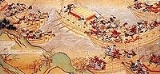
Naval history of Japan

Encyclopedia
The naval history of Japan can be said to begin in early interactions with states on the Asian continent in the early centuries of the 1st millennium
, reaching a pre-modern peak of activity during the 16th century, a time of cultural exchange with European powers and extensive trade with the Asian mainland. After over two centuries of relative seclusion
under the Tokugawa shogunate
, Japan's naval technologies were seen to be no match for Western navies when the country was forced by American intervention in 1854 to abandon its maritime restrictions. This and other events led to the Meiji Restoration
, a period of frantic modernization and industrialization accompanied by the re-ascendence of the Emperor
, making the Imperial Japanese Navy
the third largest navy in the world by 1920, and arguably the most modern at the brink of World War II
.
The Imperial Japanese Navy's history of successes, sometimes against much more powerful foes as in the 1894-1895 Sino-Japanese War
and the 1904-1905 Russo-Japanese War
, ended with the navy's almost complete annihilation in 1945 against the United States Navy
, and official dissolution at the end of the conflict. Japan's current navy falls under the umbrella of the Japan Self-Defense Forces
(JSDF) as the Japan Maritime Self-Defense Force
(JMSDF). It still one of the top navies in the world in term of budget, although it is denied any offensive role by the nation's Constitution and public opinion.
until around 20,000 BCE, both because of glaciation of sea water and the concomitant lowering of sea level by about 80 to 100 meters. This allowed for the transmission of fauna and flaura, including the establishment of the Jōmon culture. After that period however, Japan became an isolated island territory, depending entirely on sporadic naval activity for its interactions with the mainland. The shortest seapath to the mainland (besides the inhospitable northern path from Hokkaidō
to Sakhalin
) then involved two stretches of open water about 50 kilometers wide, between Korean peninsula
and the island of Tsushima
, and then from Tsushima to the major island of Kyūshū
.
Various influences have also been suggested from the direction of the Pacific Ocean, as various cultural and even genetic traits seem to point to partial Pacific origins, possibly in relation with the Austronesian
expansion.
(Encounters of the Eastern Barbarians, Wei Chronicles) recorded that some Japanese people claimed to be descendants of Taibo of Wu
, refugees after the fall of the Wu state in the 5th century BCE. History books do have records of Wu Taibo sending 4000 males and 4000 females to Japan .
in the 3rd century BCE, when rice-farming and metallurgy
were introduced, from the continent.
The 14 AD incursion of Silla
(新羅, Shiragi in Japanese), one of the Three Kingdoms of Korea
, is the earliest Japanese military action recorded in Samguk Sagi
. According to that record, Wa
(the proto-Japanese nation) sent one hundred ships and led an incursion on the coastal area of Silla before being driven off.
, Japan had intense naval interaction with the Asian continent, largely centered around diplomacy and trade with China, the Korean kingdoms, and other mainland states, since at latest the beginning of the Kofun period
in the 3rd century. According to the Nihon Shoki
, Empress Jingū
is claimed to have invaded Korea in the 3rd century, and to have returned victorious after three years. But no further archeleogical evidences can be find to be true.
The battle of Hakusukinoe
(白村江), one of the earliest historical events in Japan's naval history, outside the realm of legend or myth, took place in 663. Japan sent 32,000 troops and possibly as much as 1,000 ships to Korea to support the declining Baekje
kingdom (百済国) against Silla and T'ang Dynasty
China. They were defeated by the T'ang-Silla combined force.
 Naval battles of a very large scale, fought between Japanese clans and involving more than 1000 warships, are recorded from the 12th century. The decisive battle of the Genpei War
, and one of the most famous and important naval battles in pre-modern Japanese history, was the 1185 battle of Dan-no-ura
, which was fought between the fleets of the Minamoto and Taira clans. These battles consisted first of long-range archery exchanges, then giving way to hand-to-hand combat with swords and daggers. Ships were used largely as floating platforms for what were largely land-based melee tactics.
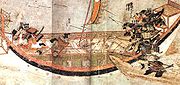 The first major references to Japanese naval actions against other Asian powers occur in the accounts of the Mongol invasions of Japan
by Kublai Khan
in 1281. Japan had no navy which could seriously challenge the Mongol navy, so most of the action took place on Japanese land. Groups of samurai
, transported on small coastal boats, are recorded to have boarded, taken over and burned several ships of the Mongol navy.
pirates became very active plundering the coast of the Chinese Empire
. Though the term wakō translates directly to "Japanese pirates," Japanese were far from the only sailors to harass shipping and ports in China and other parts of Asia in this period, and the term thus more accurately includes these non-Japanese as well. The first raid by wakō on record occurred in the summer of 1223, on the south coast of Goryeo
. At the peak of wakō activity around the end of the 14th century, fleets of 300 to 500 ships, transporting several hundred horsemen and several thousand soldiers, would raid the coast of China. For the next half-century, sailing principally from Iki Island
and Tsushima
, they engulfed coastal regions of the southern half of Goryeo. Between 1376 and 1385, no fewer than 174 instances of pirate raids were recorded in Korea. However when Josean was founded in Korea, wakō took a massive hit in one of their main homeland of Tsushima during the Oei Invasion. Wakō activity ended for the most part in the 1580s with its interdiction by Toyotomi Hideyoshi
.
Official trading missions, such as the Tenryūji-bune
, were also sent to China around 1341.
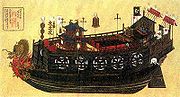 Various daimyō clans undertook major naval building efforts in the 16th century, during the Sengoku period
, when feudal rulers vying for supremacy built vast coastal navies of several hundred ships. The largest of these ships were called atakebune
. Around that time, Japan seems to have developed one of the first ironclad warships in history, when Oda Nobunaga
, a Japanese daimyo
, had six iron-covered Ō-atakebune ("Great Atakebune") made in 1576 . These ships were called , literally "iron armored ships" and were armed with multiple cannons and large caliber rifles to defeat the large, but all wooden, vessels of the enemy. With these ships, Nobunaga defeated the Mōri clan
navy at the mouth of the Kizu River, near Osaka
in 1578, and began a successful naval blockade. The Ō-atakebune are regarded as floating fortresses rather than true warships, however, and were only used in coastal actions.
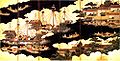 The first Europeans reached Japan in 1543 on Chinese junks, and Portuguese ships started to arrive in Japan soon after. At that time, there was already trade exchanges between Portugal and Goa
(since around 1515), consisting in 3 to 4 carracks leaving Lisbon
with silver
to purchase cotton
and spices in India. Out of these, only one carrack went on to China in order to purchase silk, also in exchange for Portuguese silver.
Accordingly, the cargo of the first Portuguese ships (usually about 4 smaller-sized ships every year) arriving in Japan almost entirely consisted of Chinese goods (silk, porcelain). The Japanese were very much looking forward to acquiring such goods, but had been prohited from any contacts with by the Emperor of China, as a punishment for wakō pirate raids. The Portuguese (who were called Nanban, lit. Southern Barbarians) therefore found the opportunity to act as intermediaries in Asian trade.
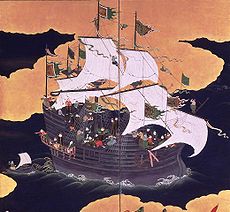 From the time of the acquisition of Macau
in 1557, and their formal recognition as trade partners by the Chinese, the Portuguese started to regulate trade to Japan, by selling to the highest bidder the annual "captaincy" (ito wappu) to Japan, in effect conferring exclusive trading rights for a single carrack
bound for Japan every year. The carracks were very large ships, usually between 1000 and 1500 tons, about double or triple the size of a large galleon
or junk.
That trade continued with few interruptions until 1638, when it was prohibited on the grounds that the priests and missionaries associated with the Portuguese traders were perceived as posing a threat to the shogunate's power and the nation's stability.
Portuguese trade was progressively more and more challenged by Chinese smugglers, Japanese Red Seal Ships
from around 1592 (about ten ships every year), Spanish ships from Manila
from around 1600 (about one ship a year), the Dutch from 1609, and the English from 1613 (about one ship per year). Some Japanese are known to have travelled abroad on foreign ships as well, such as Christopher and Cosmas
who crossed the Pacific on a Spanish galleon as early as 1587, and then sailed to Europe with Thomas Cavendish
.
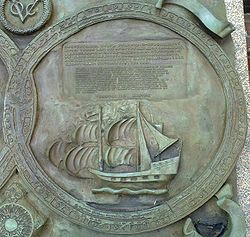 The Dutch, who, rather than Nanban were called , lit. "Red Hair" by the Japanese, first arrived in Japan in 1600, onbard the Liefde. Their pilot was William Adams
, the first Englishman to reach Japan. In 1605, two of the Liefdes crew were sent to Pattani
by Tokugawa Ieyasu
, to invite Dutch trade to Japan. The head of the Pattani Dutch trading post, Victor Sprinckel, refused on the grounds that he was too busy dealing with Portuguese opposition in Southeast Asia. In 1609, however, the Dutchman Jacques Specx
arrived with two ships in Hirado, and through Adams obtained trading privileges from Ieyasu.
The Dutch also engaged in piracy and naval combat to weaken Portuguese and Spanish shipping in the Pacific, and ultimately became the only Westerners to be allowed access to Japan. For two centuries beginning in 1638, they were restricted to the island of Dejima
in Nagasaki harbor.
organized invasions of Korea using some 9,200 ships. From the beginning of the War in 1592, the supreme commander of Hideyoshi's fleet was Kuki Yoshitaka
, whose flagship was the 33 meter-long Nihonmaru. Subordinate commanders included Wakisaka Yasuharu
and Katō Yoshiaki
. After their experience in the Ōei Invasion
and other operations against Japanese pirates, the Chinese and Korean navies were more skilled than the Japanese. They also had large, possibly ironclad ships, with large guns which formed effective anti-ship batteries. The Japanese had no such ships, nor did they develop any during the war. Instead, they relied throughout upon large numbers of smaller ships whose crews would attempt to board the enemy. Boarding was the main tactic of almost all navies until the modern era, and Japanese samurai excelled in close combat. The Japanese commonly used many light, swift, boarding ships called Kobaya in an array that resembled a rapid school of fish following the leading boat. This tactic's advantage was that once they succeeded in boarding one ship, they could hop aboard other enemy ships in the vicinity, in a wildfire fashion.
Japanese ships at the time were built with wooden planks and steel nails, which rusted in seawater after some time in service. The ships were built in a curved pentagonal shape with light wood for maximum speeds for their boarding tactics, but it undermined their capability to quickly change direction. Also, they were somewhat susceptible to capsizing in choppy seas and seastorms. The hulls of Japanese ships were not strong enough to support the weight and recoil of cannons. Rarely did Japanese ships have cannons, and those that did usually hung them from overhead beams with ropes and cloth. Instead, the Japanese relied heavily on their muskets and blades.
The Korean navy under Yi Sun-sin
conducted effective operations to interrupt Japanese supply routes. Japanese fleets repeatedly failed to board effectively. They suffered a series of disastrous defeats, and their failure enabled Korean resistance in Jeolla
province, in the south-east of Korea, to continue.
The Japanese renewed the war, sending fresh naval and land forces. Shimazu Yoshihiro
won the Battle of Chilcheollyang
. Korean Admiral Yi Eokgi and Won Gyun
of Korea were killed in this combat, and Korean naval forces were nearly annihilated. Hansan Island
was occupied by Japan, consolidating the Japanese hold on the west coast of Korea. To prevent Japan from invading China by way of the Korean peninsula west coast, China sent naval forces.
Yi Sun-sin
was soon restored to command of the remnants of the Korean navy. The Japanese tried to crush his fleet at the Battle of Myeongnyang
, but suffered another decisive defeat. The Ming Chinese fleet under Chen Lin
joined Yi Sun-sin's forces and continued to attack Japanese supply lines. Towards the end of the war, as the remaining Japanese tried to withdraw from Korea, they were beset by Korean and Chinese forces. To rescue his comrades, Shimazu Yoshihiro
attacked the allied fleet. At the Battle of Noryang, Shimazu defeated Chinese general Chen Lin
. And the Japanese army succeeded in escape from the Korean Peninsula Yi Sun-sin was killed in this action.
Japan's failure to gain control of the sea, and their resulting difficulty in resupplying troops on land, was one of the major reasons for the invasion's ultimate failure. After the death of Toyotomi Hideyoshi, the main proponent of the invasion, the Japanese ceased attacks on Korea.
, Lord of Satsuma
, invaded the southern islands of Ryūkyū
(modern Okinawa) with a fleet of 13 junks and 2,500 samurai
, thereby establishing suzerainty
over the islands. They faced little opposition from the Ryukyuans, who lacked any significant military capabilities, and who were ordered by King Shō Nei
to surrender peacefully rather than suffer the loss of precious lives.
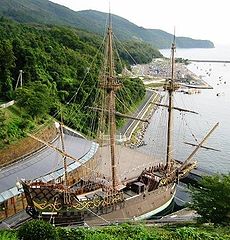 Japan built her first large ocean-going warships at the beginning of the 17th century, following contacts with the Western nations during the Nanban trade period.
Tokugawa Ieyasu ordered William Adams and his companions to build Japan's first Western-style sailing ship at Ito
, on the east coast of the Izu Peninsula
. An 80-ton vessel was completed and the Shogun ordered a larger ship, 120 tons, to be built the following year (both were slightly smaller than the Liefde, the ship in which William Adams came to Japan, which was 150 tons). According to Adams, Ieyasu "came aboard to see it, and the sight whereof gave him great content". The ship, named San Buena Ventura
, was lent to shipwrecked Spanish sailors for their return to Mexico in 1610.
, in agreement with the Tokugawa shogunate
, built Date Maru
, a 500 ton galleon
-type ship that transported a Japanese embassy to the Americas, and then continued to Europe.

From 1604, about 350 Red seal ships
, usually armed and incorporating some Western technologies, were authorized by the shogunate, mainly for Southeast Asia
n trade. Japanese ships and samurai helped in the defense of Malacca on the side of the Portuguese against the Dutch Admiral
Cornelis Matelief
in 1606. Several armed ships of the Japanese adventurer Yamada Nagamasa
would play a military role in the wars and court politics of Siam. William Adams, who participated in the Red Seal ship trade, would comment that "the people of this land (Japan) are very stout seamen".
in order to eradicate Spanish expansionism in Asia, and its support of Christians within Japan. In November 1637 it notified Nicolas Couckebacker, the head of the Dutch East India Company
in Japan, of its intentions. About 10,000 samurai were prepared for the expedition, and the Dutch agreed to provide four warships and two yachts to support the Japanese ships against Spanish galleons. The plans were cancelled at the last minute with the advent of the Christian Shimabara Rebellion
in Japan in December 1637.
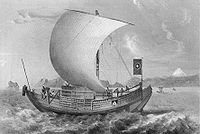 The Dutch's cooperation on these, and other matters, would help ensure they were the only Westerners allowed in Japan for the next two centuries.
Following these events, the shogunate imposed a system of maritime restrictions
(海禁, kaikin
), which forbade contacts with foreigners outside of designated channels and areas, banned Christianity
, and prohibited the construction of ocean-going ships on pain of death. The size of ships was restricted by law, and design specifications limiting seaworthiness (such as the provision for a gaping hole in the aft of the hull) were implemented. Sailors who happened to be stranded in foreign countries were prohibited from returning to Japan on pain of death.
A tiny Dutch delegation in Dejima, Nagasaki was the only allowed contact with the West, from which the Japanese were kept partly informed of western scientific and technological advances, establishing a body of knowledge known as Rangaku
. Extensive contacts with Korea and China were maintained through the Tsushima Domain, the Ryūkyū Kingdom under Satsuma's dominion, and the trading posts at Nagasaki. The Matsumae Domain on Hokkaidō managed contacts with the native Ainu people
s, and with Imperial Russia.
Many isolated attempts to end Japan's seclusion were made by expanding Western powers during the 19th century. American, Russian and French ships all attempted to engage in relationship with Japan, but were rejected.
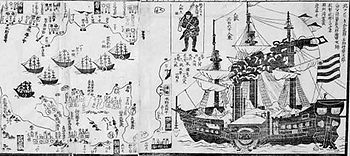 These largely unsuccessful attempts continued until, on July 8, 1853, Commodore Matthew Perry
of the U.S. Navy
with four warship
s: Mississippi
, Plymouth
,
Saratoga
, and Susquehanna
steamed into the Bay of Edo (Tokyo) and displayed the threatening power of his ships' Paixhans gun
s. He demanded that Japan open to trade with the West. These ships became known as the kurofune, or Black Ships
.
Barely one month after Perry, the Russian Admiral Yevfimy Putyatin
arrived in Nagasaki on August 12, 1853. He made a demonstration of a steam engine on his ship the Pallada, which led to Japan's first manufacture of a steam engine, created by Tanaka Hisashige.
The following year, Perry returned with seven ships and forced the shogun to sign the "Treaty of Peace and Amity", establishing formal diplomatic relations between Japan and the United States, known as the Convention of Kanagawa
(March 31, 1854). Within five years Japan had signed similar treaties with other western countries. The Harris Treaty was signed with the United States on July 29, 1858. These treaties were widely regarded by Japanese intellectuals as unequal, having been forced on Japan through gunboat diplomacy
, and as a sign of the West's desire to incorporate Japan into the imperialism
that had been taking hold of the continent. Among other measures, they gave the Western nations unequivocal control of tariffs on imports and the right of extraterritoriality
to all their visiting nationals. They would remain a sticking point in Japan's relations with the West up to the turn of the century.
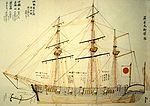 The study of Western shipbuilding
techniques resumed in the 1840s. This process intensified along with the increased activity of Western shipping along the coasts of Japan, due to the China trade and the development of whaling
.
From 1852, the government of the Shogun
(the Late Tokugawa shogunate
or "Bakumatsu") was warned by Holland of the plans of Commodore Perry
. Three months after Perry's first visit in 1853, the Bakufu cancelled the law prohibiting the construction of large ships (大船建造禁止令), and started organizing the construction of a fleet of Western-style sail warships, such as the Hou-Ou Maru
, the Shouhei Maru or the Asahi Maru
, usually asking each fief to build their own modern ships. These ships were built using Dutch
sailing manuals, and the know-how of a few returnees from the West, such as Nakahama Manjirō
. Also with the help of Nakahama Manjirō, the Satsuma fief built Japan's first steam ship, the Unkoumaru (雲行丸) in 1855.
The Bakufu also established defensive coastal fortifications, such as at Odaiba
.
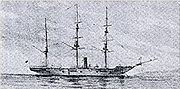 As soon as Japan agreed to open up to foreign influence, the Tokugawa
shogun
government initiated an active policy of assimilation of Western naval technologies. In 1855, with Dutch assistance, the Shogunate acquired its first steam warship, the Kankō Maru
, which was used for training, and established the Nagasaki Naval Training Center
. In 1857, it acquired its first screw-driven steam warship, the Kanrin Maru
.
In 1860, the Kanrin Maru was sailed to the United States by a group of Japanese, with the assistance of a single US Navy officer John M. Brooke, to deliver the first Japanese embassy to the United States.
Naval students were sent abroad to study Western naval techniques. The Bakufu had initially planned on ordering ships and sending students to the United States, but the American Civil War
led to a cancellation of plans. Instead, in 1862 the Bakufu placed its warship orders with the Netherlands and decided to send 15 trainees there. The students, led by Uchida Tsunejirō (内田恒次郎), left Nagasaki on September 11, 1862, and arrived in Rotterdam
on April 18, 1863, for a stay of 3 years. They included such figures as the future Admiral Enomoto Takeaki
, Sawa Tarosaemon (沢太郎左衛門), Akamatsu Noriyoshi (赤松則良), Taguchi Shunpei (田口俊平), Tsuda Shinichiro (津田真一郎) and the philosopher Nishi Amane
. This started a tradition of foreign-educated future leaders such Admirals Togo
and, later, Yamamoto.
 In 1863, Japan completed her first domestically-built steam warship, the Chiyodagata
, a 140 ton gunboat
commissioned into the Tokugawa Navy (Japan's first steamship was the Unkoumaru -雲行丸- built by the fief of Satsuma in 1855). The ship was manufactured by the future industrial giant, Ishikawajima
, thus initiating Japan's efforts to acquire and fully develop shipbuilding capabilities.
Following the humiliations at the hands of foreign navies in the Bombardment of Kagoshima
in 1863, and the Battle of Shimonoseki in 1864, the Shogunate stepped up efforts to modernize, relying more and more on French and British assistance. In 1865, the French naval engineer Léonce Verny
was hired to build Japan's first modern naval arsenals, at Yokosuka and Nagasaki. More ships were imported, such as the Jho Sho Maru, the Ho Sho Maru and the Kagoshima, all built by Thomas Blake Glover
in Aberdeen
.
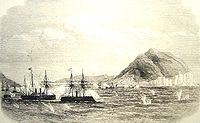 By the end of the Tokugawa shogunate in 1867, the Japanese navy already possessed eight Western-style steam warships around the flagship Kaiyou Maru
which were used against pro-imperial forces during the Boshin war
, under the command of Admiral Enomoto
. The conflict culminated with the Naval Battle of Hakodate
in 1869, Japan's first large-scale modern naval battle.
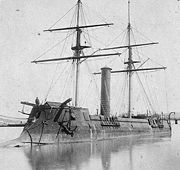
In 1869, Japan acquired its first ocean-going ironclad warship, the Kōtetsu, ordered by the Bakufu but received by the new Imperial government, barely ten years after such ships were first introduced in the West with the launch of the French La Gloire.
 The Imperial Japanese Navy
(IJN) was the navy
of Japan between 1867 and until 1947, when it was dissolved following Japan's constitutional
renouncement of the use of force as a means of settling international disputes.
From 1868, the restored Meiji Emperor continued with reforms to industrialize and militarize Japan in order to prevent it from being overwhelmed by the United States and European powers. The Imperial Japanese Navy was formally established in 1869. The new government drafted a very ambitious plan to create a Navy with 200 ships, organized into 10 fleets, but the plan was abandoned within a year due to lack of resources. Internally, domestic rebellions, and especially the Satsuma Rebellion
(1877) forced the government to focus on land warfare. Naval policy, expressed by the slogan Shusei Kokubou (Jp:守勢国防, lit. "Static Defense"), focused on coastal defenses, a standing army, and a coastal Navy, leading to a military organization under the Rikushu Kaiju (Jp:陸主海従, Army first, Navy second) principle.
During the 1870s and 1880s, the Japanese Navy remained an essentially coastal defense force, although the Meiji government continued to modernize it. In 1870 an Imperial decree determined that the British Navy should be the model for development, and the second British naval mission to Japan, the Douglas Mission (1873-79) led by Archibald Lucius Douglas
laid the foundations of naval officer training and education. (See Ian Gow, 'The Douglas Mission (1873-79) and Meiji Naval Education' in J.E. Hoare ed., Britain & Japan: Biographical Portraits Volume III, Japan Library 1999.) Togo Heihachiro
was trained by the British navy.
.jpg) During the 1880s, France took the lead in influence, due to its "Jeune Ecole" doctrine favoring small, fast warships, especially cruisers and torpedo boats, against bigger units. The Meiji government issued its First Naval Expansion bill in 1882, requiring the construction of 48 warships, of which 22 were to be torpedo boats. The naval successes of the French Navy
During the 1880s, France took the lead in influence, due to its "Jeune Ecole" doctrine favoring small, fast warships, especially cruisers and torpedo boats, against bigger units. The Meiji government issued its First Naval Expansion bill in 1882, requiring the construction of 48 warships, of which 22 were to be torpedo boats. The naval successes of the French Navy
against China in the Sino-French War
of 1883-85 seemed to validate the potential of torpedo boats, an approach which was also attractive to the limited resources of Japan. In 1885, the new Navy slogan became Kaikoku Nippon (Jp:海国日本, lit. "Maritime Japan").
In 1886, the leading French Navy engineer Emile Bertin was hired for four years to reinforce the Japanese Navy, and to direct the construction of the arsenals of Kure
and Sasebo
. He developed the Sanseikan class of cruisers, 3 units featuring a single but powerful main gun, the 12.6 inch Canet gun.
This period also allowed Japan to adopt new technologies such as torpedoes, torpedo-boats and mines, which were actively promoted by the French Navy (Howe, p281). Japan acquired its first torpedoes in 1884, and established a "Torpedo Training Center" at Yokosuka in 1886.
was officially declared on August 1, 1894, though some naval fighting had already taken place.
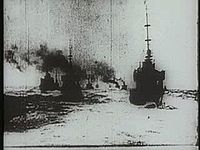 The Japanese navy devastated Qing's northern fleet off the mouth of the Yalu River
at the Battle of Yalu River
on September 17, 1894, in which the Chinese fleet lost 8 out of 12 warships. Although Japan turned out victorious, the two large German-made battleships of the Chinese Navy remained almost impervious to Japanese guns, highlighting the need for bigger capital ships in the Japanese Navy (the Ting Yuan was finally sunk by torpedoes, and the Chen-Yuan was captured with little damage). The next step of the Imperial Japanese Navy's expansion would thus involve a combination of heavily armed large warships, with smaller and innovative offensive units permitting aggressive tactics.
The Imperial Japanese Navy further intervened in China in 1900, by participating together with Western Powers to the suppression of the Chinese Boxer Rebellion
. The Navy supplied the largest number of warships (18, out of a total of 50 warships), and delivered the largest contingent of Army and Navy troops among the intervening nations (20,840 soldiers, out of total of 54,000).
 Following the Sino-Japanese War, and the humiliation of the forced return of the Liaotung peninsula to China under Russian pressure (the "Triple Intervention
"), Japan began to build up its military strength in preparation for further confrontations.
Japan promulgated a ten-year naval build-up program, under the slogan "Perseverance and determination" (Jp:臥薪嘗胆, Gashinshoutan), in which it commissioned 109 warships, for a total of 200,000 tons, and increased its Navy personnel from 15,100 to 40,800.
These dispositions culminated with the Russo-Japanese War
(1904-1905). At the Battle of Tsushima
, the Mikasa led the combined Japanese fleet into what has been called "the most decisive naval battle in history". The Russian fleet was almost completely annihilated: out of 38 Russian ships, 21 were sunk, 7 captured, 6 disarmed, 4,545 Russian servicemen died and 6,106 were taken prisoner. On the other hand, the Japanese only lost 116 men and 3 torpedo boats.
expansion and the start of the Second Sino-Japanese war
in 1937 had alienated the United States, and the country was seen as a rival of Japan.
To achieve Japan’s expansionist policies, the Imperial Japanese Navy also had to fight off the largest navies in the world (The 1922 Washington Naval Treaty
allotted a 5/5/3 ratio for the navies of Great Britain, the United States and Japan). She was therefore numerically inferior and her industrial base for expansion was limited (in particular compared to the United States). Her battle tactics therefore tended to rely on technical superiority (fewer, but faster, more powerful ships), and aggressive tactics (daring and speedy attacks overwhelming the enemy, a recipe for success in her previous conflicts). The Naval Treaties also provided an unintentional boost to Japan because the numerical restrictions on battleships prompted them to build more aircraft carriers to try to compensate for the United States' larger battleship fleet.
The Imperial Japanese Navy was administered by the Ministry of the Navy of Japan and controlled by the Chief of the Imperial Japanese Navy General Staff at Imperial General Headquarters. In order to combat the numerically superior American navy, the IJN devoted large amounts of resources to creating a force superior in quality to any navy at the time. Consequently, at the beginning of World War II
, Japan probably had the most sophisticated Navy in the world. Betting on the speedy success of aggressive tactics, Japan did not invest significantly on defensive organization: she should also have been able to protect her long shipping lines against enemy submarines, which she never managed to do, particularly under-investing in anti-submarine escort ships and escort aircraft carriers.
The Japanese Navy enjoyed spectacular success during the first part of the hostilities, but American forces ultimately managed to gain the upper hand through technological upgrades to its air and naval forces, and a vastly stronger industrial output. Japan's reluctance to use their submarine
fleet for commerce raiding and failure to secure their communications also added to their defeat. During the last phase of the war the Imperial Japanese Navy resorted to a series of desperate measures, including Kamikaze
(suicide) actions.
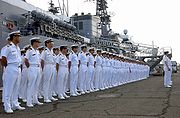 Following Japan's surrender to the United States at the conclusion of World War II
, and Japan's subsequent occupation, Japan's entire imperial military was dissolved in the new 1947 constitution
which states, "The Japanese people forever renounce war as a sovereign right of the nation and the threat or use of force as a means of settling international disputes." Japan's current navy falls under the umbrella of the Japan Self-Defense Forces
(JSDF) as the Japan Maritime Self-Defense Force
(JMSDF).
The Maritime Self-Defense Force (MSDF) had an authorized strength in 1992 of 46,000 and maintained some 44,400 personnel and operated 155 major combatants, including thirteen submarines, sixty-four destroyers and frigates, forty-three mine warfare ships and boats, eleven patrol craft, and six amphibious ships. It also flew some 205 fixed-wing aircraft and 134 helicopters. Most of these aircraft were used in antisubmarine and mine warfare operations.
1st millennium
File:1st millennium montage.png|From left, clockwise: Depiction of Jesus, the central figure in Christianity; The Colosseum, a landmark of the once Roman Empire; Gunpowder is invented during the latter part of the millennium, in China; Chess, a new board game, takes on popularity across the globe;...
, reaching a pre-modern peak of activity during the 16th century, a time of cultural exchange with European powers and extensive trade with the Asian mainland. After over two centuries of relative seclusion
Sakoku
was the foreign relations policy of Japan under which no foreigner could enter nor could any Japanese leave the country on penalty of death. The policy was enacted by the Tokugawa shogunate under Tokugawa Iemitsu through a number of edicts and policies from 1633–39 and remained in effect until...
under the Tokugawa shogunate
Tokugawa shogunate
The Tokugawa shogunate, also known as the and the , was a feudal regime of Japan established by Tokugawa Ieyasu and ruled by the shoguns of the Tokugawa family. This period is known as the Edo period and gets its name from the capital city, Edo, which is now called Tokyo, after the name was...
, Japan's naval technologies were seen to be no match for Western navies when the country was forced by American intervention in 1854 to abandon its maritime restrictions. This and other events led to the Meiji Restoration
Meiji Restoration
The , also known as the Meiji Ishin, Revolution, Reform or Renewal, was a chain of events that restored imperial rule to Japan in 1868...
, a period of frantic modernization and industrialization accompanied by the re-ascendence of the Emperor
Emperor of Japan
The Emperor of Japan is, according to the 1947 Constitution of Japan, "the symbol of the state and of the unity of the people." He is a ceremonial figurehead under a form of constitutional monarchy and is head of the Japanese Imperial Family with functions as head of state. He is also the highest...
, making the Imperial Japanese Navy
Imperial Japanese Navy
The Imperial Japanese Navy was the navy of the Empire of Japan from 1869 until 1947, when it was dissolved following Japan's constitutional renunciation of the use of force as a means of settling international disputes...
the third largest navy in the world by 1920, and arguably the most modern at the brink of World War II
World War II
World War II, or the Second World War , was a global conflict lasting from 1939 to 1945, involving most of the world's nations—including all of the great powers—eventually forming two opposing military alliances: the Allies and the Axis...
.
The Imperial Japanese Navy's history of successes, sometimes against much more powerful foes as in the 1894-1895 Sino-Japanese War
First Sino-Japanese War
The First Sino-Japanese War was fought between Qing Dynasty China and Meiji Japan, primarily over control of Korea...
and the 1904-1905 Russo-Japanese War
Russo-Japanese War
The Russo-Japanese War was "the first great war of the 20th century." It grew out of rival imperial ambitions of the Russian Empire and Japanese Empire over Manchuria and Korea...
, ended with the navy's almost complete annihilation in 1945 against the United States Navy
United States Navy
The United States Navy is the naval warfare service branch of the United States Armed Forces and one of the seven uniformed services of the United States. The U.S. Navy is the largest in the world; its battle fleet tonnage is greater than that of the next 13 largest navies combined. The U.S...
, and official dissolution at the end of the conflict. Japan's current navy falls under the umbrella of the Japan Self-Defense Forces
Japan Self-Defense Forces
The , or JSDF, occasionally referred to as JSF or SDF, are the unified military forces of Japan that were established after the end of the post–World War II Allied occupation of Japan. For most of the post-war period the JSDF was confined to the islands of Japan and not permitted to be deployed...
(JSDF) as the Japan Maritime Self-Defense Force
Japan Maritime Self-Defense Force
The , or JMSDF, is the naval branch of the Japan Self-Defense Forces, tasked with the naval defense of Japan. It was formed following the dissolution of the Imperial Japanese Navy after World War II....
(JMSDF). It still one of the top navies in the world in term of budget, although it is denied any offensive role by the nation's Constitution and public opinion.
Prehistory
Japan seems to have been connected to the Asian landmass during the last Ice AgeIce age
An ice age or, more precisely, glacial age, is a generic geological period of long-term reduction in the temperature of the Earth's surface and atmosphere, resulting in the presence or expansion of continental ice sheets, polar ice sheets and alpine glaciers...
until around 20,000 BCE, both because of glaciation of sea water and the concomitant lowering of sea level by about 80 to 100 meters. This allowed for the transmission of fauna and flaura, including the establishment of the Jōmon culture. After that period however, Japan became an isolated island territory, depending entirely on sporadic naval activity for its interactions with the mainland. The shortest seapath to the mainland (besides the inhospitable northern path from Hokkaidō
Hokkaido
, formerly known as Ezo, Yezo, Yeso, or Yesso, is Japan's second largest island; it is also the largest and northernmost of Japan's 47 prefectural-level subdivisions. The Tsugaru Strait separates Hokkaido from Honshu, although the two islands are connected by the underwater railway Seikan Tunnel...
to Sakhalin
Sakhalin
Sakhalin or Saghalien, is a large island in the North Pacific, lying between 45°50' and 54°24' N.It is part of Russia, and is Russia's largest island, and is administered as part of Sakhalin Oblast...
) then involved two stretches of open water about 50 kilometers wide, between Korean peninsula
Korean Peninsula
The Korean Peninsula is a peninsula in East Asia. It extends southwards for about 684 miles from continental Asia into the Pacific Ocean and is surrounded by the Sea of Japan to the south, and the Yellow Sea to the west, the Korea Strait connecting the first two bodies of water.Until the end of...
and the island of Tsushima
Tsushima Island
Tsushima Island is an island of the Japanese Archipelago situated in the middle of the Tsushima Strait at 34°25'N and 129°20'E. The main island of Tsushima was once a single island, but the island was divided into two in 1671 by the Ōfunakosiseto canal and into three in 1900 by the Manzekiseto canal...
, and then from Tsushima to the major island of Kyūshū
Kyushu
is the third largest island of Japan and most southwesterly of its four main islands. Its alternate ancient names include , , and . The historical regional name is referred to Kyushu and its surrounding islands....
.
Various influences have also been suggested from the direction of the Pacific Ocean, as various cultural and even genetic traits seem to point to partial Pacific origins, possibly in relation with the Austronesian
Austronesian people
The Austronesian-speaking peoples are various populations in Oceania and Southeast Asia that speak languages of the Austronesian family. They include Taiwanese aborigines; the majority ethnic groups of East Timor, Indonesia, Malaysia, the Philippines, Brunei, Madagascar, Micronesia, and Polynesia,...
expansion.
Early historical period
Ambassadorial visits to Japan by the later Northern Chinese dynasties Wei and JinJìn Dynasty (265-420)
The Jìn Dynasty , was a dynasty in Chinese history, lasting between the years 265 and 420 AD. There are two main divisions in the history of the Dynasty, the first being Western Jin and the second Eastern Jin...
(Encounters of the Eastern Barbarians, Wei Chronicles) recorded that some Japanese people claimed to be descendants of Taibo of Wu
Wu (state)
The State of Wu , also known as Gou Wu or Gong Wu , was one of the vassal states during the Western Zhou Dynasty and the Spring and Autumn Period. The State of Wu was located at the mouth of the Yangtze River east of the State of Chu. Considered a semi-barbarian state by ancient Chinese...
, refugees after the fall of the Wu state in the 5th century BCE. History books do have records of Wu Taibo sending 4000 males and 4000 females to Japan .
Yayoi Period
The first major naval contacts occurred in the Yayoi periodYayoi period
The is an Iron Age era in the history of Japan traditionally dated 300 BC to 300 AD. It is named after the neighbourhood of Tokyo where archaeologists first uncovered artifacts and features from that era. Distinguishing characteristics of the Yayoi period include the appearance of new...
in the 3rd century BCE, when rice-farming and metallurgy
Metallurgy
Metallurgy is a domain of materials science that studies the physical and chemical behavior of metallic elements, their intermetallic compounds, and their mixtures, which are called alloys. It is also the technology of metals: the way in which science is applied to their practical use...
were introduced, from the continent.
The 14 AD incursion of Silla
Silla
Silla was one of the Three Kingdoms of Korea, and one of the longest sustained dynasties in...
(新羅, Shiragi in Japanese), one of the Three Kingdoms of Korea
Three Kingdoms of Korea
The Three Kingdoms of Korea refer to the ancient Korean kingdoms of Goguryeo, Baekje and Silla, which dominated the Korean peninsula and parts of Manchuria for much of the 1st millennium...
, is the earliest Japanese military action recorded in Samguk Sagi
Samguk Sagi
Samguk Sagi is a historical record of the Three Kingdoms of Korea: Goguryeo, Baekje and Silla. The Samguk Sagi is written in Classical Chinese and its compilation was ordered by Goryeo's King Injong Samguk Sagi (History of the Three Kingdoms) is a historical record of the Three Kingdoms of...
. According to that record, Wa
Wa (Japan)
Japanese is the oldest recorded name of Japan. Chinese, Korean, and Japanese scribes regularly wrote Wa or Yamato "Japan" with the Chinese character 倭 until the 8th century, when the Japanese found fault with it, replacing it with 和 "harmony, peace, balance".- Historical references :The earliest...
(the proto-Japanese nation) sent one hundred ships and led an incursion on the coastal area of Silla before being driven off.
Yamato Period
During the Yamato periodYamato period
The is the period of Japanese history when the Japanese Imperial court ruled from modern-day Nara Prefecture, then known as Yamato Province.While conventionally assigned to the period 250–710 , the actual start of Yamato rule is disputed...
, Japan had intense naval interaction with the Asian continent, largely centered around diplomacy and trade with China, the Korean kingdoms, and other mainland states, since at latest the beginning of the Kofun period
Kofun period
The is an era in the history of Japan from around 250 to 538. It follows the Yayoi period. The word kofun is Japanese for the type of burial mounds dating from this era. The Kofun and the subsequent Asuka periods are sometimes referred to collectively as the Yamato period...
in the 3rd century. According to the Nihon Shoki
Nihon Shoki
The , sometimes translated as The Chronicles of Japan, is the second oldest book of classical Japanese history. It is more elaborate and detailed than the Kojiki, the oldest, and has proven to be an important tool for historians and archaeologists as it includes the most complete extant historical...
, Empress Jingū
Jingu of Japan
, also known as , was a legendary Japanese empress. The empress or consort to Emperor Chūai, she also served as Regent from the time of her husband's death in 209 until her son Emperor Ōjin acceded to the throne in 269...
is claimed to have invaded Korea in the 3rd century, and to have returned victorious after three years. But no further archeleogical evidences can be find to be true.
The battle of Hakusukinoe
Battle of Baekgang
The Battle of Baekgang, also known as Battle of Baekgang-gu or by the Japanese name Battle of Hakusukinoe , was a battle between Baekje restoration forces and their ally, Yamato Japan, against the allied forces of Silla and the Tang Dynasty of ancient China...
(白村江), one of the earliest historical events in Japan's naval history, outside the realm of legend or myth, took place in 663. Japan sent 32,000 troops and possibly as much as 1,000 ships to Korea to support the declining Baekje
Baekje
Baekje or Paekche was a kingdom located in southwest Korea. It was one of the Three Kingdoms of Korea, together with Goguryeo and Silla....
kingdom (百済国) against Silla and T'ang Dynasty
Tang Dynasty
The Tang Dynasty was an imperial dynasty of China preceded by the Sui Dynasty and followed by the Five Dynasties and Ten Kingdoms Period. It was founded by the Li family, who seized power during the decline and collapse of the Sui Empire...
China. They were defeated by the T'ang-Silla combined force.
Medieval period
Genpei War
The was a conflict between the Taira and Minamoto clans during the late-Heian period of Japan. It resulted in the fall of the Taira clan and the establishment of the Kamakura shogunate under Minamoto Yoritomo in 1192....
, and one of the most famous and important naval battles in pre-modern Japanese history, was the 1185 battle of Dan-no-ura
Battle of Dan-no-ura
The ' was a major sea battle of the Genpei War, occurring at Dan-no-ura, in the Shimonoseki Strait off the southern tip of Honshū. On March 24, 1185, the Genji clan fleet, led by Minamoto no Yoshitsune, defeated the Heike clan fleet, during a half-day engagement.The Taira were outnumbered, but...
, which was fought between the fleets of the Minamoto and Taira clans. These battles consisted first of long-range archery exchanges, then giving way to hand-to-hand combat with swords and daggers. Ships were used largely as floating platforms for what were largely land-based melee tactics.
Mongol invasions (1274–1281)
Mongol invasions of Japan
The ' of 1274 and 1281 were major military efforts undertaken by Kublai Khan to conquer the Japanese islands after the submission of Goryeo to vassaldom. Despite their ultimate failure, the invasion attempts are of macrohistorical importance, because they set a limit on Mongol expansion, and rank...
by Kublai Khan
Kublai Khan
Kublai Khan , born Kublai and also known by the temple name Shizu , was the fifth Great Khan of the Mongol Empire from 1260 to 1294 and the founder of the Yuan Dynasty in China...
in 1281. Japan had no navy which could seriously challenge the Mongol navy, so most of the action took place on Japanese land. Groups of samurai
Samurai
is the term for the military nobility of pre-industrial Japan. According to translator William Scott Wilson: "In Chinese, the character 侍 was originally a verb meaning to wait upon or accompany a person in the upper ranks of society, and this is also true of the original term in Japanese, saburau...
, transported on small coastal boats, are recorded to have boarded, taken over and burned several ships of the Mongol navy.
Wakō piracy (13th–16th century)
During the following centuries, wakōWokou
Wokou , which literally translates as "Japanese pirates" in English, were pirates of varying origins who raided the coastlines of China and Korea from the 13th century onwards...
pirates became very active plundering the coast of the Chinese Empire
Mid-Imperial China
Mid-Imperial China begins with the reunification of China by the short-lived Sui dynasty in 589. The Sui replaced the nine-rank system with the imperial examination and embarked on major public works such as connecting the various canals to form the Grand Canal...
. Though the term wakō translates directly to "Japanese pirates," Japanese were far from the only sailors to harass shipping and ports in China and other parts of Asia in this period, and the term thus more accurately includes these non-Japanese as well. The first raid by wakō on record occurred in the summer of 1223, on the south coast of Goryeo
Goryeo
The Goryeo Dynasty or Koryŏ was a Korean dynasty established in 918 by Emperor Taejo. Korea gets its name from this kingdom which came to be pronounced Korea. It united the Later Three Kingdoms in 936 and ruled most of the Korean peninsula until it was removed by the Joseon dynasty in 1392...
. At the peak of wakō activity around the end of the 14th century, fleets of 300 to 500 ships, transporting several hundred horsemen and several thousand soldiers, would raid the coast of China. For the next half-century, sailing principally from Iki Island
Iki Island
Iki Island is an island lying between the island of Kyūshū and the Tsushima islands in the Tsushima Strait, the eastern channel of the Korea Strait. It is currently part of Nagasaki Prefecture of Japan. The city of Iki is the centre of the local government. The island has three ports.The island’s...
and Tsushima
Tsushima Island
Tsushima Island is an island of the Japanese Archipelago situated in the middle of the Tsushima Strait at 34°25'N and 129°20'E. The main island of Tsushima was once a single island, but the island was divided into two in 1671 by the Ōfunakosiseto canal and into three in 1900 by the Manzekiseto canal...
, they engulfed coastal regions of the southern half of Goryeo. Between 1376 and 1385, no fewer than 174 instances of pirate raids were recorded in Korea. However when Josean was founded in Korea, wakō took a massive hit in one of their main homeland of Tsushima during the Oei Invasion. Wakō activity ended for the most part in the 1580s with its interdiction by Toyotomi Hideyoshi
Toyotomi Hideyoshi
was a daimyo warrior, general and politician of the Sengoku period. He unified the political factions of Japan. He succeeded his former liege lord, Oda Nobunaga, and brought an end to the Sengoku period. The period of his rule is often called the Momoyama period, named after Hideyoshi's castle...
.
Official trading missions, such as the Tenryūji-bune
Tenryuji-bune
The were two Japanese–Yuan trade ships launched in 1342 in order to procure funds for the construction of Tenryū-ji. They were approved by the Muromachi shogunate, and released to the command of a Hakata merchant named under the condition that he donate 5,000 kanmon to the temple irrespective...
, were also sent to China around 1341.
Sengoku period (15th–16th century)
Sengoku period
The or Warring States period in Japanese history was a time of social upheaval, political intrigue, and nearly constant military conflict that lasted roughly from the middle of the 15th century to the beginning of the 17th century. The name "Sengoku" was adopted by Japanese historians in reference...
, when feudal rulers vying for supremacy built vast coastal navies of several hundred ships. The largest of these ships were called atakebune
Atakebune
were large Japanese warships of the 16th and 17th century internecine Japanese wars for political control and unity of all Japan.Japan undertook major naval building efforts in the mid to late 16th century, during the Sengoku period, when feudal rulers vying for supremacy built vast coastal navies...
. Around that time, Japan seems to have developed one of the first ironclad warships in history, when Oda Nobunaga
Oda Nobunaga
was the initiator of the unification of Japan under the shogunate in the late 16th century, which ruled Japan until the Meiji Restoration in 1868. He was also a major daimyo during the Sengoku period of Japanese history. His opus was continued, completed and finalized by his successors Toyotomi...
, a Japanese daimyo
Daimyo
is a generic term referring to the powerful territorial lords in pre-modern Japan who ruled most of the country from their vast, hereditary land holdings...
, had six iron-covered Ō-atakebune ("Great Atakebune") made in 1576 . These ships were called , literally "iron armored ships" and were armed with multiple cannons and large caliber rifles to defeat the large, but all wooden, vessels of the enemy. With these ships, Nobunaga defeated the Mōri clan
Mori clan
The Mōri clan was a family of daimyō, descended from Ōe no Hiromoto and established themselves in Aki Province. Their name was derived from a shōen in Mōri, Aikō District, Sagami Province. The generation of Hiromoto began to name themselves Mōri.After the Jōkyū War, Mōri was appointed to the jitō...
navy at the mouth of the Kizu River, near Osaka
Osaka
is a city in the Kansai region of Japan's main island of Honshu, a designated city under the Local Autonomy Law, the capital city of Osaka Prefecture and also the biggest part of Keihanshin area, which is represented by three major cities of Japan, Kyoto, Osaka and Kobe...
in 1578, and began a successful naval blockade. The Ō-atakebune are regarded as floating fortresses rather than true warships, however, and were only used in coastal actions.
European contacts
Goa
Goa , a former Portuguese colony, is India's smallest state by area and the fourth smallest by population. Located in South West India in the region known as the Konkan, it is bounded by the state of Maharashtra to the north, and by Karnataka to the east and south, while the Arabian Sea forms its...
(since around 1515), consisting in 3 to 4 carracks leaving Lisbon
Lisbon
Lisbon is the capital city and largest city of Portugal with a population of 545,245 within its administrative limits on a land area of . The urban area of Lisbon extends beyond the administrative city limits with a population of 3 million on an area of , making it the 9th most populous urban...
with silver
Silver
Silver is a metallic chemical element with the chemical symbol Ag and atomic number 47. A soft, white, lustrous transition metal, it has the highest electrical conductivity of any element and the highest thermal conductivity of any metal...
to purchase cotton
Cotton
Cotton is a soft, fluffy staple fiber that grows in a boll, or protective capsule, around the seeds of cotton plants of the genus Gossypium. The fiber is almost pure cellulose. The botanical purpose of cotton fiber is to aid in seed dispersal....
and spices in India. Out of these, only one carrack went on to China in order to purchase silk, also in exchange for Portuguese silver.
Accordingly, the cargo of the first Portuguese ships (usually about 4 smaller-sized ships every year) arriving in Japan almost entirely consisted of Chinese goods (silk, porcelain). The Japanese were very much looking forward to acquiring such goods, but had been prohited from any contacts with by the Emperor of China, as a punishment for wakō pirate raids. The Portuguese (who were called Nanban, lit. Southern Barbarians) therefore found the opportunity to act as intermediaries in Asian trade.
Macau
Macau , also spelled Macao , is, along with Hong Kong, one of the two special administrative regions of the People's Republic of China...
in 1557, and their formal recognition as trade partners by the Chinese, the Portuguese started to regulate trade to Japan, by selling to the highest bidder the annual "captaincy" (ito wappu) to Japan, in effect conferring exclusive trading rights for a single carrack
Carrack
A carrack or nau was a three- or four-masted sailing ship developed in 15th century Western Europe for use in the Atlantic Ocean. It had a high rounded stern with large aftcastle, forecastle and bowsprit at the stem. It was first used by the Portuguese , and later by the Spanish, to explore and...
bound for Japan every year. The carracks were very large ships, usually between 1000 and 1500 tons, about double or triple the size of a large galleon
Galleon
A galleon was a large, multi-decked sailing ship used primarily by European states from the 16th to 18th centuries. Whether used for war or commerce, they were generally armed with the demi-culverin type of cannon.-Etymology:...
or junk.
That trade continued with few interruptions until 1638, when it was prohibited on the grounds that the priests and missionaries associated with the Portuguese traders were perceived as posing a threat to the shogunate's power and the nation's stability.
Portuguese trade was progressively more and more challenged by Chinese smugglers, Japanese Red Seal Ships
Red seal ships
were Japanese armed merchant sailing ships bound for Southeast Asian ports with a red-sealed patent issued by the early Tokugawa shogunate in the first half of the 17th century...
from around 1592 (about ten ships every year), Spanish ships from Manila
Manila
Manila is the capital of the Philippines. It is one of the sixteen cities forming Metro Manila.Manila is located on the eastern shores of Manila Bay and is bordered by Navotas and Caloocan to the north, Quezon City to the northeast, San Juan and Mandaluyong to the east, Makati on the southeast,...
from around 1600 (about one ship a year), the Dutch from 1609, and the English from 1613 (about one ship per year). Some Japanese are known to have travelled abroad on foreign ships as well, such as Christopher and Cosmas
Christopher and Cosmas
Christopher and Cosmas were two Japanese men, only known by their Christian names, who are recorded to have travelled across the Pacific on a Spanish galleon in 1587, and later accompanied the English navigator Thomas Cavendish to England, Brazil and the Southern Atlantic, where they disappeared...
who crossed the Pacific on a Spanish galleon as early as 1587, and then sailed to Europe with Thomas Cavendish
Thomas Cavendish
Sir Thomas Cavendish was an English explorer and a privateer known as "The Navigator" because he was the first who deliberately tried to emulate Sir Francis Drake and raid the Spanish towns and ships in the Pacific and return by circumnavigating the globe...
.
William Adams (sailor)
William Adams , also known in Japanese as Anjin-sama and Miura Anjin , was an English navigator who travelled to Japan and is believed to be the first Englishman ever to reach that country...
, the first Englishman to reach Japan. In 1605, two of the Liefdes crew were sent to Pattani
Pattani kingdom
Pattani or Sultanate of Pattani was a Malay sultanate that covered approximately the area of the modern Thai provinces of Pattani, Yala, Narathiwat and much of the northern part of modern Malaysia. The King of Patani is believed to have converted to Islam some time during the 11th century...
by Tokugawa Ieyasu
Tokugawa Ieyasu
was the founder and first shogun of the Tokugawa shogunate of Japan , which ruled from the Battle of Sekigahara in 1600 until the Meiji Restoration in 1868. Ieyasu seized power in 1600, received appointment as shogun in 1603, abdicated from office in 1605, but...
, to invite Dutch trade to Japan. The head of the Pattani Dutch trading post, Victor Sprinckel, refused on the grounds that he was too busy dealing with Portuguese opposition in Southeast Asia. In 1609, however, the Dutchman Jacques Specx
Jacques Specx
Jacques Specx was a Dutch merchant, who founded the trade on Japan and Korea in 1609. Jacques Specx received the support of William Adams to obtain extensive trading rights from the Shogun Tokugawa Ieyasu on August 24, 1609, which allowed him to establish a trading factory in Hirado on September...
arrived with two ships in Hirado, and through Adams obtained trading privileges from Ieyasu.
The Dutch also engaged in piracy and naval combat to weaken Portuguese and Spanish shipping in the Pacific, and ultimately became the only Westerners to be allowed access to Japan. For two centuries beginning in 1638, they were restricted to the island of Dejima
Dejima
was a small fan-shaped artificial island built in the bay of Nagasaki in 1634. This island, which was formed by digging a canal through a small peninsula, remained as the single place of direct trade and exchange between Japan and the outside world during the Edo period. Dejima was built to...
in Nagasaki harbor.
Invasions of Korea and the Ryūkyūs
In 1592 and again in 1598, Toyotomi HideyoshiToyotomi Hideyoshi
was a daimyo warrior, general and politician of the Sengoku period. He unified the political factions of Japan. He succeeded his former liege lord, Oda Nobunaga, and brought an end to the Sengoku period. The period of his rule is often called the Momoyama period, named after Hideyoshi's castle...
organized invasions of Korea using some 9,200 ships. From the beginning of the War in 1592, the supreme commander of Hideyoshi's fleet was Kuki Yoshitaka
Kuki Yoshitaka
' was a naval commander during Japan's Sengoku Period, under Oda Nobunaga, and later, Toyotomi Hideyoshi.In the 1570s, Kuki allied himself with Oda Nobunaga, and commanded his fleet, supporting land-based attacks on the Ikkō-ikki. In 1574, his aided ensured a victory for Nobunaga in his third...
, whose flagship was the 33 meter-long Nihonmaru. Subordinate commanders included Wakisaka Yasuharu
Wakisaka Yasuharu
' , sometimes referred to as Wakizaka Yasuharu, was a daimyo of Awaji Island who fought under a number of warlords over the course of Japan's Sengoku period....
and Katō Yoshiaki
Kato Yoshiaki
was a Japanese daimyo of the late Sengoku Period to early Edo Period who served as lord of the Aizu Domain. A retainer of Toyotomi Hideyoshi, he fought in the battle of Shizugatake in 1583, and soon became known as one of the shichi-hon-yari , or Seven Spears of Shizugatake, Hideyoshi's seven most...
. After their experience in the Ōei Invasion
Oei Invasion
The , known as the Gihae Eastern Expedition in Korea, was the 1419 military expedition from Joseon against pirate bases on Tsushima Island, which is located in the middle of the Korea Strait between the Korean Peninsula and Kyushu....
and other operations against Japanese pirates, the Chinese and Korean navies were more skilled than the Japanese. They also had large, possibly ironclad ships, with large guns which formed effective anti-ship batteries. The Japanese had no such ships, nor did they develop any during the war. Instead, they relied throughout upon large numbers of smaller ships whose crews would attempt to board the enemy. Boarding was the main tactic of almost all navies until the modern era, and Japanese samurai excelled in close combat. The Japanese commonly used many light, swift, boarding ships called Kobaya in an array that resembled a rapid school of fish following the leading boat. This tactic's advantage was that once they succeeded in boarding one ship, they could hop aboard other enemy ships in the vicinity, in a wildfire fashion.
Japanese ships at the time were built with wooden planks and steel nails, which rusted in seawater after some time in service. The ships were built in a curved pentagonal shape with light wood for maximum speeds for their boarding tactics, but it undermined their capability to quickly change direction. Also, they were somewhat susceptible to capsizing in choppy seas and seastorms. The hulls of Japanese ships were not strong enough to support the weight and recoil of cannons. Rarely did Japanese ships have cannons, and those that did usually hung them from overhead beams with ropes and cloth. Instead, the Japanese relied heavily on their muskets and blades.
The Korean navy under Yi Sun-sin
Yi Sun-sin
Yi Sun-shin was a Korean naval commander, famed for his victories against the Japanese navy during the Imjin war in the Joseon Dynasty, and is well-respected for his exemplary conduct on and off the battlefield not only by Koreans, but by Japanese Admirals as well...
conducted effective operations to interrupt Japanese supply routes. Japanese fleets repeatedly failed to board effectively. They suffered a series of disastrous defeats, and their failure enabled Korean resistance in Jeolla
Jeolla
Jeolla was a province in southwestern Korea, one of the historical Eight Provinces of Korea during the Joseon Dynasty. It consisted of the modern South Korean provinces of North Jeolla, South Jeolla and the Special City of Gwangju as well as Jeju Island...
province, in the south-east of Korea, to continue.
The Japanese renewed the war, sending fresh naval and land forces. Shimazu Yoshihiro
Shimazu Yoshihiro
was the second son of Shimazu Takahisa and younger brother of Shimazu Yoshihisa. It had traditionally been believed that he became the seventeenth head of the Shimazu clan after Yoshihisa, but it is currently believed that he let Yoshihisa keep his position....
won the Battle of Chilcheollyang
Battle of Chilcheollyang
The naval Battle of Chilcheollyang took place before dawn on August 27th, 1597 during the Imjin War in Chilcheollyang, which is a narrow strait near Geoje island. It took place during the second invasion of the Japanese...
. Korean Admiral Yi Eokgi and Won Gyun
Won Gyun
Won Gyun was a Korean general and admiral during the Joseon Dynasty. He is best known for his campaigns against Japanese during Hideyoshi's Invasions of Korea. Won was a member of Wonju Won family, which was well known for its members' military accomplishments. He was born in 1540 near Pyeongtaek,...
of Korea were killed in this combat, and Korean naval forces were nearly annihilated. Hansan Island
Hansan Island
Hansan Island , also known as Hansando, is in South Gyeongsang Province across a relatively narrow strait from Chungmu on the Tongyeong Peninsula.-History:...
was occupied by Japan, consolidating the Japanese hold on the west coast of Korea. To prevent Japan from invading China by way of the Korean peninsula west coast, China sent naval forces.
Yi Sun-sin
Yi Sun-sin
Yi Sun-shin was a Korean naval commander, famed for his victories against the Japanese navy during the Imjin war in the Joseon Dynasty, and is well-respected for his exemplary conduct on and off the battlefield not only by Koreans, but by Japanese Admirals as well...
was soon restored to command of the remnants of the Korean navy. The Japanese tried to crush his fleet at the Battle of Myeongnyang
Battle of Myeongnyang
In the Battle of Myeongnyang, on October 26, 1597, the Joseon admiral Yi Sun-sin fought the Japanese navy in the Myeongnyang Strait, near Jindo Island. With only the 13 ships remaining from Won Gyun's disastrous defeat at the Battle of Chilchonryang, Admiral Yi Sunsin held the strait against a...
, but suffered another decisive defeat. The Ming Chinese fleet under Chen Lin
Chen Lin (Ming)
Chen Lin Style Name: Chaojue was a Chinese general of the Ming Dynasty. Chen Lin was a native of modern-day Shaoguan in Guangdong province. He quelled the 1562 uprisings in Chaozhou and Yingde in Guangdong province and was subsequently promoted to the Shoubei of Guangdong...
joined Yi Sun-sin's forces and continued to attack Japanese supply lines. Towards the end of the war, as the remaining Japanese tried to withdraw from Korea, they were beset by Korean and Chinese forces. To rescue his comrades, Shimazu Yoshihiro
Shimazu Yoshihiro
was the second son of Shimazu Takahisa and younger brother of Shimazu Yoshihisa. It had traditionally been believed that he became the seventeenth head of the Shimazu clan after Yoshihisa, but it is currently believed that he let Yoshihisa keep his position....
attacked the allied fleet. At the Battle of Noryang, Shimazu defeated Chinese general Chen Lin
Chen Lin (Ming)
Chen Lin Style Name: Chaojue was a Chinese general of the Ming Dynasty. Chen Lin was a native of modern-day Shaoguan in Guangdong province. He quelled the 1562 uprisings in Chaozhou and Yingde in Guangdong province and was subsequently promoted to the Shoubei of Guangdong...
. And the Japanese army succeeded in escape from the Korean Peninsula Yi Sun-sin was killed in this action.
Japan's failure to gain control of the sea, and their resulting difficulty in resupplying troops on land, was one of the major reasons for the invasion's ultimate failure. After the death of Toyotomi Hideyoshi, the main proponent of the invasion, the Japanese ceased attacks on Korea.
Invasion of the Ryūkyūs
In 1609, Shimazu TadatsuneShimazu Tadatsune
was a tozama daimyo of Satsuma, the first to hold it as a formal fief under the Tokugawa shogunate, and the first Japanese to rule over the Ryūkyū Kingdom...
, Lord of Satsuma
Satsuma Province
was an old province of Japan that is now the western half of Kagoshima Prefecture on the island of Kyūshū. Its abbreviation is Sasshū .During the Sengoku Period, Satsuma was a fief of the Shimazu daimyo, who ruled much of southern Kyūshū from their castle at Kagoshima city.In 1871, with the...
, invaded the southern islands of Ryūkyū
Ryukyu Kingdom
The Ryūkyū Kingdom was an independent kingdom which ruled most of the Ryukyu Islands from the 15th century to the 19th century. The Kings of Ryūkyū unified Okinawa Island and extended the kingdom to the Amami Islands in modern-day Kagoshima Prefecture, and the Sakishima Islands near Taiwan...
(modern Okinawa) with a fleet of 13 junks and 2,500 samurai
Samurai
is the term for the military nobility of pre-industrial Japan. According to translator William Scott Wilson: "In Chinese, the character 侍 was originally a verb meaning to wait upon or accompany a person in the upper ranks of society, and this is also true of the original term in Japanese, saburau...
, thereby establishing suzerainty
Suzerainty
Suzerainty occurs where a region or people is a tributary to a more powerful entity which controls its foreign affairs while allowing the tributary vassal state some limited domestic autonomy. The dominant entity in the suzerainty relationship, or the more powerful entity itself, is called a...
over the islands. They faced little opposition from the Ryukyuans, who lacked any significant military capabilities, and who were ordered by King Shō Nei
Sho Nei
' was king of the Ryūkyū Kingdom from 1587–1620. He reigned during the 1609 invasion of Ryūkyū and was the first king of Ryūkyū to be a vassal to the Shimazu clan of Satsuma, a Japanese feudal domain....
to surrender peacefully rather than suffer the loss of precious lives.
Oceanic trade (16th–17th century)
William Adams
In 1604, ShogunShogun
A was one of the hereditary military dictators of Japan from 1192 to 1867. In this period, the shoguns, or their shikken regents , were the de facto rulers of Japan though they were nominally appointed by the emperor...
Tokugawa Ieyasu ordered William Adams and his companions to build Japan's first Western-style sailing ship at Ito
Ito, Shizuoka
is a city located on the eastern shore of the Izu Peninsula in Shizuoka, Japan. As of 2010, the city had an estimated population of 71,400 and the density of 578 persons per km². The total area was...
, on the east coast of the Izu Peninsula
Izu Peninsula
The is a large mountainous peninsula with deeply indented coasts to the west of Tokyo on the Pacific coast of the island of Honshū, Japan. Formerly the eponymous Izu Province, Izu peninsula is now a part of Shizuoka Prefecture...
. An 80-ton vessel was completed and the Shogun ordered a larger ship, 120 tons, to be built the following year (both were slightly smaller than the Liefde, the ship in which William Adams came to Japan, which was 150 tons). According to Adams, Ieyasu "came aboard to see it, and the sight whereof gave him great content". The ship, named San Buena Ventura
Japanese warship San Buena Ventura
San Buena Ventura was a 120 ton ship built in Japan under the direction of the English navigator and adventurer William Adams for the shogun Tokugawa Ieyasu....
, was lent to shipwrecked Spanish sailors for their return to Mexico in 1610.
Hasekura Tsunenaga
In 1613, the daimyō of SendaiSendai, Miyagi
is the capital city of Miyagi Prefecture, Japan, and the largest city in the Tōhoku Region. In 2005, the city had a population of one million, and was one of Japan's 19 designated cities...
, in agreement with the Tokugawa shogunate
Tokugawa shogunate
The Tokugawa shogunate, also known as the and the , was a feudal regime of Japan established by Tokugawa Ieyasu and ruled by the shoguns of the Tokugawa family. This period is known as the Edo period and gets its name from the capital city, Edo, which is now called Tokyo, after the name was...
, built Date Maru
Japanese warship San Juan Bautista
San Juan Bautista was one of Japan's first Japanese-built Western-style sail warships. She crossed the Pacific in 1614. She was of the Spanish galleon type, known in Japan as Nanban-Sen San Juan Bautista (“St. John the Baptist”) (originally called Date Maru, 伊達丸 in Japanese) was one of Japan's...
, a 500 ton galleon
Galleon
A galleon was a large, multi-decked sailing ship used primarily by European states from the 16th to 18th centuries. Whether used for war or commerce, they were generally armed with the demi-culverin type of cannon.-Etymology:...
-type ship that transported a Japanese embassy to the Americas, and then continued to Europe.
Red Seal ships
From 1604, about 350 Red seal ships
Red seal ships
were Japanese armed merchant sailing ships bound for Southeast Asian ports with a red-sealed patent issued by the early Tokugawa shogunate in the first half of the 17th century...
, usually armed and incorporating some Western technologies, were authorized by the shogunate, mainly for Southeast Asia
Southeast Asia
Southeast Asia, South-East Asia, South East Asia or Southeastern Asia is a subregion of Asia, consisting of the countries that are geographically south of China, east of India, west of New Guinea and north of Australia. The region lies on the intersection of geological plates, with heavy seismic...
n trade. Japanese ships and samurai helped in the defense of Malacca on the side of the Portuguese against the Dutch Admiral
Dutch East India Company
The Dutch East India Company was a chartered company established in 1602, when the States-General of the Netherlands granted it a 21-year monopoly to carry out colonial activities in Asia...
Cornelis Matelief
Cornelis Matelief de Jonge
Cornelis Matelief , was a Dutch admiral who was active in establishing Dutch power in Southeast Asia during the beginning of the 17th century . His fleet was officially on a trading mission, but its true intent was to try to destroy Portuguese power in the area. The ships had 1400 men on board,...
in 1606. Several armed ships of the Japanese adventurer Yamada Nagamasa
Yamada Nagamasa
was a Japanese adventurer who gained considerable influence in Ayutthaya kingdom at the beginning of the 17th century and became the governor of the Nakhon Si Thammarat in southern Thailand....
would play a military role in the wars and court politics of Siam. William Adams, who participated in the Red Seal ship trade, would comment that "the people of this land (Japan) are very stout seamen".
Planned invasion of the Philippines
The Tokugawa shogunate had, for some time, planned to invade the PhilippinesPhilippines
The Philippines , officially known as the Republic of the Philippines , is a country in Southeast Asia in the western Pacific Ocean. To its north across the Luzon Strait lies Taiwan. West across the South China Sea sits Vietnam...
in order to eradicate Spanish expansionism in Asia, and its support of Christians within Japan. In November 1637 it notified Nicolas Couckebacker, the head of the Dutch East India Company
Dutch East India Company
The Dutch East India Company was a chartered company established in 1602, when the States-General of the Netherlands granted it a 21-year monopoly to carry out colonial activities in Asia...
in Japan, of its intentions. About 10,000 samurai were prepared for the expedition, and the Dutch agreed to provide four warships and two yachts to support the Japanese ships against Spanish galleons. The plans were cancelled at the last minute with the advent of the Christian Shimabara Rebellion
Shimabara Rebellion
The was an uprising largely involving Japanese peasants, most of them Catholic Christians, in 1637–1638 during the Edo period.It was one of only a handful of instances of serious unrest during the relatively peaceful period of the Tokugawa shogunate's rule...
in Japan in December 1637.
Seclusion (1640–1840)
Following these events, the shogunate imposed a system of maritime restrictions
Sakoku
was the foreign relations policy of Japan under which no foreigner could enter nor could any Japanese leave the country on penalty of death. The policy was enacted by the Tokugawa shogunate under Tokugawa Iemitsu through a number of edicts and policies from 1633–39 and remained in effect until...
(海禁, kaikin
Hai jin
The Hǎi Jìn order was a ban on maritime activities imposed during China's Ming Dynasty and again at the time of the Qing Dynasty. Intended to curb piracy, the ban proved ineffective for that purpose...
), which forbade contacts with foreigners outside of designated channels and areas, banned Christianity
Christianity
Christianity is a monotheistic religion based on the life and teachings of Jesus as presented in canonical gospels and other New Testament writings...
, and prohibited the construction of ocean-going ships on pain of death. The size of ships was restricted by law, and design specifications limiting seaworthiness (such as the provision for a gaping hole in the aft of the hull) were implemented. Sailors who happened to be stranded in foreign countries were prohibited from returning to Japan on pain of death.
A tiny Dutch delegation in Dejima, Nagasaki was the only allowed contact with the West, from which the Japanese were kept partly informed of western scientific and technological advances, establishing a body of knowledge known as Rangaku
Rangaku
Rangaku is a body of knowledge developed by Japan through its contacts with the Dutch enclave of Dejima, which allowed Japan to keep abreast of Western technology and medicine in the period when the country was closed to foreigners, 1641–1853, because of the Tokugawa shogunate’s policy of national...
. Extensive contacts with Korea and China were maintained through the Tsushima Domain, the Ryūkyū Kingdom under Satsuma's dominion, and the trading posts at Nagasaki. The Matsumae Domain on Hokkaidō managed contacts with the native Ainu people
Ainu people
The , also called Aynu, Aino , and in historical texts Ezo , are indigenous people or groups in Japan and Russia. Historically they spoke the Ainu language and related varieties and lived in Hokkaidō, the Kuril Islands, and much of Sakhalin...
s, and with Imperial Russia.
Many isolated attempts to end Japan's seclusion were made by expanding Western powers during the 19th century. American, Russian and French ships all attempted to engage in relationship with Japan, but were rejected.
Matthew Perry (naval officer)
Matthew Calbraith Perry was the Commodore of the U.S. Navy and served commanding a number of US naval ships. He served several wars, most notably in the Mexican-American War and the War of 1812. He played a leading role in the opening of Japan to the West with the Convention of Kanagawa in 1854...
of the U.S. Navy
United States Navy
The United States Navy is the naval warfare service branch of the United States Armed Forces and one of the seven uniformed services of the United States. The U.S. Navy is the largest in the world; its battle fleet tonnage is greater than that of the next 13 largest navies combined. The U.S...
with four warship
Warship
A warship is a ship that is built and primarily intended for combat. Warships are usually built in a completely different way from merchant ships. As well as being armed, warships are designed to withstand damage and are usually faster and more maneuvrable than merchant ships...
s: Mississippi
USS Mississippi (1841)
USS Mississippi, a paddle frigate, was the first ship of the United States Navy to bear that name. She was named for the Mississippi River. Her sister ship was . Her keel was laid down by the Philadelphia Navy Yard in 1839; built under the personal supervision of Commodore Matthew Perry. She was...
, Plymouth
USS Plymouth (1844)
USS Plymouth was a sloop-of-war constructed and commissioned just prior to the Mexican-American War. She was heavily gunned, and traveled to Japan as part of Commodore Matthew C. Perry’s effort to force Japan to open her ports to international trade...
,
Saratoga
USS Saratoga (1842)
USS Saratoga, a sloop-of-war, was the third ship of the United States Navy to be named for the Battle of Saratoga of the American Revolutionary War. Her keel was laid down in the summer of 1841 by the Portsmouth Navy Yard...
, and Susquehanna
USS Susquehanna (1847)
USS Susquehanna, a sidewheel steam frigate, was the first ship of the United States Navy to be named for a river which rises in Lake Otsego in central New York and flows across Pennsylvania and the northeast corner of Maryland to empty into the Chesapeake Bay.Her keel was laid down by the New York...
steamed into the Bay of Edo (Tokyo) and displayed the threatening power of his ships' Paixhans gun
Gun
A gun is a muzzle or breech-loaded projectile-firing weapon. There are various definitions depending on the nation and branch of service. A "gun" may be distinguished from other firearms in being a crew-served weapon such as a howitzer or mortar, as opposed to a small arm like a rifle or pistol,...
s. He demanded that Japan open to trade with the West. These ships became known as the kurofune, or Black Ships
Black Ships
The Black Ships was the name given to Western vessels arriving in Japan in the 16th and 19th centuries.In 1543 Portuguese initiated the first contacts, establishing a trade route linking Goa to Nagasaki...
.
Barely one month after Perry, the Russian Admiral Yevfimy Putyatin
Yevfimy Putyatin
Yevfimy Vasilyevich Putyatin was a Russian admiral noted for his diplomatic missions to Japan and China which resulted in the signing of the Treaty of Shimoda in 1855.-Early life:...
arrived in Nagasaki on August 12, 1853. He made a demonstration of a steam engine on his ship the Pallada, which led to Japan's first manufacture of a steam engine, created by Tanaka Hisashige.
The following year, Perry returned with seven ships and forced the shogun to sign the "Treaty of Peace and Amity", establishing formal diplomatic relations between Japan and the United States, known as the Convention of Kanagawa
Convention of Kanagawa
On March 31, 1854, the or was concluded between Commodore Matthew C. Perry of the U.S. Navy and the Tokugawa shogunate.-Treaty of Peace and Amity :...
(March 31, 1854). Within five years Japan had signed similar treaties with other western countries. The Harris Treaty was signed with the United States on July 29, 1858. These treaties were widely regarded by Japanese intellectuals as unequal, having been forced on Japan through gunboat diplomacy
Gunboat diplomacy
In international politics, gunboat diplomacy refers to the pursuit of foreign policy objectives with the aid of conspicuous displays of military power — implying or constituting a direct threat of warfare, should terms not be agreeable to the superior force....
, and as a sign of the West's desire to incorporate Japan into the imperialism
Imperialism
Imperialism, as defined by Dictionary of Human Geography, is "the creation and/or maintenance of an unequal economic, cultural, and territorial relationships, usually between states and often in the form of an empire, based on domination and subordination." The imperialism of the last 500 years,...
that had been taking hold of the continent. Among other measures, they gave the Western nations unequivocal control of tariffs on imports and the right of extraterritoriality
Extraterritoriality
Extraterritoriality is the state of being exempt from the jurisdiction of local law, usually as the result of diplomatic negotiations. Extraterritoriality can also be applied to physical places, such as military bases of foreign countries, or offices of the United Nations...
to all their visiting nationals. They would remain a sticking point in Japan's relations with the West up to the turn of the century.
Modernization: Bakumatsu period (1853-1868)
Shipbuilding
Shipbuilding is the construction of ships and floating vessels. It normally takes place in a specialized facility known as a shipyard. Shipbuilders, also called shipwrights, follow a specialized occupation that traces its roots to before recorded history.Shipbuilding and ship repairs, both...
techniques resumed in the 1840s. This process intensified along with the increased activity of Western shipping along the coasts of Japan, due to the China trade and the development of whaling
Whaling
Whaling is the hunting of whales mainly for meat and oil. Its earliest forms date to at least 3000 BC. Various coastal communities have long histories of sustenance whaling and harvesting beached whales...
.
From 1852, the government of the Shogun
Shogun
A was one of the hereditary military dictators of Japan from 1192 to 1867. In this period, the shoguns, or their shikken regents , were the de facto rulers of Japan though they were nominally appointed by the emperor...
(the Late Tokugawa shogunate
Late Tokugawa shogunate
, literally "end of the curtain", are the final years of the Edo period when the Tokugawa shogunate came to an end. It is characterized by major events occurring between 1853 and 1867 during which Japan ended its isolationist foreign policy known as sakoku and transitioned from a feudal shogunate...
or "Bakumatsu") was warned by Holland of the plans of Commodore Perry
Matthew Perry (naval officer)
Matthew Calbraith Perry was the Commodore of the U.S. Navy and served commanding a number of US naval ships. He served several wars, most notably in the Mexican-American War and the War of 1812. He played a leading role in the opening of Japan to the West with the Convention of Kanagawa in 1854...
. Three months after Perry's first visit in 1853, the Bakufu cancelled the law prohibiting the construction of large ships (大船建造禁止令), and started organizing the construction of a fleet of Western-style sail warships, such as the Hou-Ou Maru
Japanese warship Hou-Ou Maru
The was one of Japan's first Western-style warship following the country's period of Seclusion. She was built by the governor of Uraga, Nakajima Saburosuke , following the 1846 visit of the American Commodore James Biddle, and the 1853 visit of Commodore Perry.Her construction started in 1853, and...
, the Shouhei Maru or the Asahi Maru
Japanese warship Asahi Maru
The Asahi Maru was one of the first Western-style sail warships of Japan following the period of Seclusion. She was ordered by the Tokugawa bakufu to the fief of Mito, her construction started in 1854, and she was completed in 1856....
, usually asking each fief to build their own modern ships. These ships were built using Dutch
Netherlands
The Netherlands is a constituent country of the Kingdom of the Netherlands, located mainly in North-West Europe and with several islands in the Caribbean. Mainland Netherlands borders the North Sea to the north and west, Belgium to the south, and Germany to the east, and shares maritime borders...
sailing manuals, and the know-how of a few returnees from the West, such as Nakahama Manjirō
Nakahama Manjiro
, also known as John Manjirō , was one of the first Japanese people to visit the United States and an important translator during the Opening of Japan.-Voyage to America:...
. Also with the help of Nakahama Manjirō, the Satsuma fief built Japan's first steam ship, the Unkoumaru (雲行丸) in 1855.
The Bakufu also established defensive coastal fortifications, such as at Odaiba
Odaiba
is a large artificial island in Tokyo Bay, Japan, across the Rainbow Bridge from central Tokyo. It was initially built for defensive purposes in the 1850s, dramatically expanded during the late 20th century as a seaport district, and has developed since the 1990s as a major commercial, residential...
.
Birth of a modern Navy
Tokugawa shogunate
The Tokugawa shogunate, also known as the and the , was a feudal regime of Japan established by Tokugawa Ieyasu and ruled by the shoguns of the Tokugawa family. This period is known as the Edo period and gets its name from the capital city, Edo, which is now called Tokyo, after the name was...
shogun
Shogun
A was one of the hereditary military dictators of Japan from 1192 to 1867. In this period, the shoguns, or their shikken regents , were the de facto rulers of Japan though they were nominally appointed by the emperor...
government initiated an active policy of assimilation of Western naval technologies. In 1855, with Dutch assistance, the Shogunate acquired its first steam warship, the Kankō Maru
Kanko Maru
The was Japan's first steam warship. The ship was a 3-masted top sail schooner , with an auxiliary coal-fired steam engine turning a side paddlewheel...
, which was used for training, and established the Nagasaki Naval Training Center
Nagasaki Naval Training Center
The was a naval training institute, between 1855 when it was established by the government of the Tokugawa shogunate, until 1859, when it was transferred to Tsukiji in Edo....
. In 1857, it acquired its first screw-driven steam warship, the Kanrin Maru
Japanese warship Kanrin Maru
Kanrin Maru was Japan's first sail and screw-driven steam corvette . She was ordered in 1853 from the Netherlands, the only Western country with which Japan had diplomatic relations throughout its period of sakoku , by the Shogun's government, the Bakufu...
.
In 1860, the Kanrin Maru was sailed to the United States by a group of Japanese, with the assistance of a single US Navy officer John M. Brooke, to deliver the first Japanese embassy to the United States.
Naval students were sent abroad to study Western naval techniques. The Bakufu had initially planned on ordering ships and sending students to the United States, but the American Civil War
American Civil War
The American Civil War was a civil war fought in the United States of America. In response to the election of Abraham Lincoln as President of the United States, 11 southern slave states declared their secession from the United States and formed the Confederate States of America ; the other 25...
led to a cancellation of plans. Instead, in 1862 the Bakufu placed its warship orders with the Netherlands and decided to send 15 trainees there. The students, led by Uchida Tsunejirō (内田恒次郎), left Nagasaki on September 11, 1862, and arrived in Rotterdam
Rotterdam
Rotterdam is the second-largest city in the Netherlands and one of the largest ports in the world. Starting as a dam on the Rotte river, Rotterdam has grown into a major international commercial centre...
on April 18, 1863, for a stay of 3 years. They included such figures as the future Admiral Enomoto Takeaki
Enomoto Takeaki
Viscount was a samurai and admiral of the Tokugawa navy of Bakumatsu period Japan, who remained faithful to the Tokugawa shogunate who fought against the new Meiji government until the end of the Boshin War...
, Sawa Tarosaemon (沢太郎左衛門), Akamatsu Noriyoshi (赤松則良), Taguchi Shunpei (田口俊平), Tsuda Shinichiro (津田真一郎) and the philosopher Nishi Amane
Nishi Amane
was a philosopher in Meiji period Japan who helped introduce Western philosophy into mainstream Japanese education.-Early life:Nishi was born in Tsuwano Domain of Iwami Province as the son of a samurai physician who practiced Chinese medicine...
. This started a tradition of foreign-educated future leaders such Admirals Togo
Togo Heihachiro
Fleet Admiral Marquis was a Fleet Admiral in the Imperial Japanese Navy and one of Japan's greatest naval heroes. He was termed by Western journalists as "the Nelson of the East".-Early life:...
and, later, Yamamoto.
Japanese gunboat Chiyodagata
was a gunboat of the Tokugawa Navy, and Japan's first domestically-built steam warship...
, a 140 ton gunboat
Gunboat
A gunboat is a naval watercraft designed for the express purpose of carrying one or more guns to bombard coastal targets, as opposed to those military craft designed for naval warfare, or for ferrying troops or supplies.-History:...
commissioned into the Tokugawa Navy (Japan's first steamship was the Unkoumaru -雲行丸- built by the fief of Satsuma in 1855). The ship was manufactured by the future industrial giant, Ishikawajima
Ishikawajima
Ishikawajima could refer to:*IHI Corporation, formerly known as Ishikawajima-Harima Heavy Industries*Ishikawajima Aircraft Company Limited*Ishikawajima Ne-20, Japan's first turbojet engine...
, thus initiating Japan's efforts to acquire and fully develop shipbuilding capabilities.
Following the humiliations at the hands of foreign navies in the Bombardment of Kagoshima
Bombardment of Kagoshima
The Bombardment of Kagoshima, also known as the , took place on 15–17 August 1863 during the Late Tokugawa shogunate. The British Royal Navy was fired on from the coastal batteries near town of Kagoshima and in retaliation bombarded the town...
in 1863, and the Battle of Shimonoseki in 1864, the Shogunate stepped up efforts to modernize, relying more and more on French and British assistance. In 1865, the French naval engineer Léonce Verny
Léonce Verny
François Léonce Verny, was a French officer and naval engineer who directed the construction of the Yokosuka Naval Arsenal in Japan, as well as many related modern infrastructure projects from 1865 to 1876, thus helping jump-start Japan's modernization.-Early life:Léonce Verny was born in Aubenas,...
was hired to build Japan's first modern naval arsenals, at Yokosuka and Nagasaki. More ships were imported, such as the Jho Sho Maru, the Ho Sho Maru and the Kagoshima, all built by Thomas Blake Glover
Thomas Blake Glover
Thomas Blake Glover, Order of the Rising Sun was a Scottish merchant in Bakumatsu and Meiji period Japan.-Early life :...
in Aberdeen
Aberdeen
Aberdeen is Scotland's third most populous city, one of Scotland's 32 local government council areas and the United Kingdom's 25th most populous city, with an official population estimate of ....
.
Japanese battleship Kaiyo Maru
Kaiyō Maru was one of Japan's first modern warships, powered by both sails and steam.-Construction:She was ordered in the Netherlands in 1863 by the Bakufu, the government of the Shogun, the Nederlandsche Handel-Maatschappij acting as agents. The ship was built at the yard of Cornelis Gips and...
which were used against pro-imperial forces during the Boshin war
Boshin War
The was a civil war in Japan, fought from 1868 to 1869 between forces of the ruling Tokugawa shogunate and those seeking to return political power to the imperial court....
, under the command of Admiral Enomoto
Enomoto Takeaki
Viscount was a samurai and admiral of the Tokugawa navy of Bakumatsu period Japan, who remained faithful to the Tokugawa shogunate who fought against the new Meiji government until the end of the Boshin War...
. The conflict culminated with the Naval Battle of Hakodate
Naval Battle of Hakodate
The was fought from 4–10 May 1869, between the remnants of the Tokugawa shogunate navy, consolidated into the armed forces of the rebel Ezo Republic, and the newly formed Imperial Japanese Navy...
in 1869, Japan's first large-scale modern naval battle.
In 1869, Japan acquired its first ocean-going ironclad warship, the Kōtetsu, ordered by the Bakufu but received by the new Imperial government, barely ten years after such ships were first introduced in the West with the launch of the French La Gloire.
Meiji restoration (1868): creation of the Imperial Japanese Navy
Imperial Japanese Navy
The Imperial Japanese Navy was the navy of the Empire of Japan from 1869 until 1947, when it was dissolved following Japan's constitutional renunciation of the use of force as a means of settling international disputes...
(IJN) was the navy
Navy
A navy is the branch of a nation's armed forces principally designated for naval and amphibious warfare; namely, lake- or ocean-borne combat operations and related functions...
of Japan between 1867 and until 1947, when it was dissolved following Japan's constitutional
Constitution of Japan
The is the fundamental law of Japan. It was enacted on 3 May, 1947 as a new constitution for postwar Japan.-Outline:The constitution provides for a parliamentary system of government and guarantees certain fundamental rights...
renouncement of the use of force as a means of settling international disputes.
From 1868, the restored Meiji Emperor continued with reforms to industrialize and militarize Japan in order to prevent it from being overwhelmed by the United States and European powers. The Imperial Japanese Navy was formally established in 1869. The new government drafted a very ambitious plan to create a Navy with 200 ships, organized into 10 fleets, but the plan was abandoned within a year due to lack of resources. Internally, domestic rebellions, and especially the Satsuma Rebellion
Satsuma Rebellion
The was a revolt of Satsuma ex-samurai against the Meiji government from January 29 to September 24, 1877, 9 years into the Meiji Era. It was the last, and the most serious, of a series of armed uprisings against the new government.-Background:...
(1877) forced the government to focus on land warfare. Naval policy, expressed by the slogan Shusei Kokubou (Jp:守勢国防, lit. "Static Defense"), focused on coastal defenses, a standing army, and a coastal Navy, leading to a military organization under the Rikushu Kaiju (Jp:陸主海従, Army first, Navy second) principle.
During the 1870s and 1880s, the Japanese Navy remained an essentially coastal defense force, although the Meiji government continued to modernize it. In 1870 an Imperial decree determined that the British Navy should be the model for development, and the second British naval mission to Japan, the Douglas Mission (1873-79) led by Archibald Lucius Douglas
Archibald Lucius Douglas
Admiral Sir Archibald Lucius Douglas, GCB, GCVO was a Royal Navy officer of the 19th century.-Naval career:Douglas was born in Quebec City in pre-Confederation Canada in 1842...
laid the foundations of naval officer training and education. (See Ian Gow, 'The Douglas Mission (1873-79) and Meiji Naval Education' in J.E. Hoare ed., Britain & Japan: Biographical Portraits Volume III, Japan Library 1999.) Togo Heihachiro
Togo Heihachiro
Fleet Admiral Marquis was a Fleet Admiral in the Imperial Japanese Navy and one of Japan's greatest naval heroes. He was termed by Western journalists as "the Nelson of the East".-Early life:...
was trained by the British navy.
French Navy
The French Navy, officially the Marine nationale and often called La Royale is the maritime arm of the French military. It includes a full range of fighting vessels, from patrol boats to a nuclear powered aircraft carrier and 10 nuclear-powered submarines, four of which are capable of launching...
against China in the Sino-French War
Sino-French War
The Sino–French War was a limited conflict fought between August 1884 and April 1885 to decide whether France should replace China in control of Tonkin . As the French achieved their war aims, they are usually considered to have won the war...
of 1883-85 seemed to validate the potential of torpedo boats, an approach which was also attractive to the limited resources of Japan. In 1885, the new Navy slogan became Kaikoku Nippon (Jp:海国日本, lit. "Maritime Japan").
In 1886, the leading French Navy engineer Emile Bertin was hired for four years to reinforce the Japanese Navy, and to direct the construction of the arsenals of Kure
Kure, Hiroshima
is a city in Hiroshima prefecture, Japan.As of October 1, 2010, the city has an estimated population of 240,820 and a population density of 681 persons per km². The total area is 353.74 km².- History :...
and Sasebo
Sasebo, Nagasaki
is a city located in Nagasaki Prefecture, Japan. As of 2011, the city has an estimated population of 259,800 and the density of 609 persons per km². The total area is 426.47 km². The locality is famed for its scenic beauty. The city includes a part of Saikai National Park...
. He developed the Sanseikan class of cruisers, 3 units featuring a single but powerful main gun, the 12.6 inch Canet gun.
This period also allowed Japan to adopt new technologies such as torpedoes, torpedo-boats and mines, which were actively promoted by the French Navy (Howe, p281). Japan acquired its first torpedoes in 1884, and established a "Torpedo Training Center" at Yokosuka in 1886.
Sino-Japanese War
Japan continued the modernization of its navy, especially as China was also building a powerful modern fleet with foreign, especially German, assistance, and the pressure was building between the two countries to take control of Korea. The Sino-Japanese warFirst Sino-Japanese War
The First Sino-Japanese War was fought between Qing Dynasty China and Meiji Japan, primarily over control of Korea...
was officially declared on August 1, 1894, though some naval fighting had already taken place.
Yalu River
The Yalu River or the Amnok River is a river on the border between North Korea and the People's Republic of China....
at the Battle of Yalu River
Battle of Yalu River (1894)
The Battle of the Yalu River , also called simply 'The Battle of Yalu' took place on September 17, 1894. It involved the Japanese and the Chinese navies, and was the largest naval engagement of the First Sino-Japanese War...
on September 17, 1894, in which the Chinese fleet lost 8 out of 12 warships. Although Japan turned out victorious, the two large German-made battleships of the Chinese Navy remained almost impervious to Japanese guns, highlighting the need for bigger capital ships in the Japanese Navy (the Ting Yuan was finally sunk by torpedoes, and the Chen-Yuan was captured with little damage). The next step of the Imperial Japanese Navy's expansion would thus involve a combination of heavily armed large warships, with smaller and innovative offensive units permitting aggressive tactics.
The Imperial Japanese Navy further intervened in China in 1900, by participating together with Western Powers to the suppression of the Chinese Boxer Rebellion
Boxer Rebellion
The Boxer Rebellion, also called the Boxer Uprising by some historians or the Righteous Harmony Society Movement in northern China, was a proto-nationalist movement by the "Righteous Harmony Society" , or "Righteous Fists of Harmony" or "Society of Righteous and Harmonious Fists" , in China between...
. The Navy supplied the largest number of warships (18, out of a total of 50 warships), and delivered the largest contingent of Army and Navy troops among the intervening nations (20,840 soldiers, out of total of 54,000).
Russo-Japanese War
Triple Intervention
The was a diplomatic intervention by Russia, Germany, and France on 23 April 1895 over the terms of the Treaty of Shimonoseki signed between Japan and Qing dynasty China that ended the First Sino-Japanese War.-Treaty of Shimonoseki:...
"), Japan began to build up its military strength in preparation for further confrontations.
Japan promulgated a ten-year naval build-up program, under the slogan "Perseverance and determination" (Jp:臥薪嘗胆, Gashinshoutan), in which it commissioned 109 warships, for a total of 200,000 tons, and increased its Navy personnel from 15,100 to 40,800.
These dispositions culminated with the Russo-Japanese War
Russo-Japanese War
The Russo-Japanese War was "the first great war of the 20th century." It grew out of rival imperial ambitions of the Russian Empire and Japanese Empire over Manchuria and Korea...
(1904-1905). At the Battle of Tsushima
Battle of Tsushima
The Battle of Tsushima , commonly known as the “Sea of Japan Naval Battle” in Japan and the “Battle of Tsushima Strait”, was the major naval battle fought between Russia and Japan during the Russo-Japanese War...
, the Mikasa led the combined Japanese fleet into what has been called "the most decisive naval battle in history". The Russian fleet was almost completely annihilated: out of 38 Russian ships, 21 were sunk, 7 captured, 6 disarmed, 4,545 Russian servicemen died and 6,106 were taken prisoner. On the other hand, the Japanese only lost 116 men and 3 torpedo boats.
World War II
In the years before World War II the IJN began to structure itself specifically to fight the United States. A long stretch of militaristicMilitarism
Militarism is defined as: the belief or desire of a government or people that a country should maintain a strong military capability and be prepared to use it aggressively to defend or promote national interests....
expansion and the start of the Second Sino-Japanese war
Second Sino-Japanese War
The Second Sino-Japanese War was a military conflict fought primarily between the Republic of China and the Empire of Japan. From 1937 to 1941, China fought Japan with some economic help from Germany , the Soviet Union and the United States...
in 1937 had alienated the United States, and the country was seen as a rival of Japan.
To achieve Japan’s expansionist policies, the Imperial Japanese Navy also had to fight off the largest navies in the world (The 1922 Washington Naval Treaty
Washington Naval Treaty
The Washington Naval Treaty, also known as the Five-Power Treaty, was an attempt to cap and limit, and "prevent 'further' costly escalation" of the naval arms race that had begun after World War I between various International powers, each of which had significant naval fleets. The treaty was...
allotted a 5/5/3 ratio for the navies of Great Britain, the United States and Japan). She was therefore numerically inferior and her industrial base for expansion was limited (in particular compared to the United States). Her battle tactics therefore tended to rely on technical superiority (fewer, but faster, more powerful ships), and aggressive tactics (daring and speedy attacks overwhelming the enemy, a recipe for success in her previous conflicts). The Naval Treaties also provided an unintentional boost to Japan because the numerical restrictions on battleships prompted them to build more aircraft carriers to try to compensate for the United States' larger battleship fleet.
The Imperial Japanese Navy was administered by the Ministry of the Navy of Japan and controlled by the Chief of the Imperial Japanese Navy General Staff at Imperial General Headquarters. In order to combat the numerically superior American navy, the IJN devoted large amounts of resources to creating a force superior in quality to any navy at the time. Consequently, at the beginning of World War II
World War II
World War II, or the Second World War , was a global conflict lasting from 1939 to 1945, involving most of the world's nations—including all of the great powers—eventually forming two opposing military alliances: the Allies and the Axis...
, Japan probably had the most sophisticated Navy in the world. Betting on the speedy success of aggressive tactics, Japan did not invest significantly on defensive organization: she should also have been able to protect her long shipping lines against enemy submarines, which she never managed to do, particularly under-investing in anti-submarine escort ships and escort aircraft carriers.
The Japanese Navy enjoyed spectacular success during the first part of the hostilities, but American forces ultimately managed to gain the upper hand through technological upgrades to its air and naval forces, and a vastly stronger industrial output. Japan's reluctance to use their submarine
Submarine
A submarine is a watercraft capable of independent operation below the surface of the water. It differs from a submersible, which has more limited underwater capability...
fleet for commerce raiding and failure to secure their communications also added to their defeat. During the last phase of the war the Imperial Japanese Navy resorted to a series of desperate measures, including Kamikaze
Kamikaze
The were suicide attacks by military aviators from the Empire of Japan against Allied naval vessels in the closing stages of the Pacific campaign of World War II, designed to destroy as many warships as possible....
(suicide) actions.
Self-Defense Forces
World War II
World War II, or the Second World War , was a global conflict lasting from 1939 to 1945, involving most of the world's nations—including all of the great powers—eventually forming two opposing military alliances: the Allies and the Axis...
, and Japan's subsequent occupation, Japan's entire imperial military was dissolved in the new 1947 constitution
Constitution of Japan
The is the fundamental law of Japan. It was enacted on 3 May, 1947 as a new constitution for postwar Japan.-Outline:The constitution provides for a parliamentary system of government and guarantees certain fundamental rights...
which states, "The Japanese people forever renounce war as a sovereign right of the nation and the threat or use of force as a means of settling international disputes." Japan's current navy falls under the umbrella of the Japan Self-Defense Forces
Japan Self-Defense Forces
The , or JSDF, occasionally referred to as JSF or SDF, are the unified military forces of Japan that were established after the end of the post–World War II Allied occupation of Japan. For most of the post-war period the JSDF was confined to the islands of Japan and not permitted to be deployed...
(JSDF) as the Japan Maritime Self-Defense Force
Japan Maritime Self-Defense Force
The , or JMSDF, is the naval branch of the Japan Self-Defense Forces, tasked with the naval defense of Japan. It was formed following the dissolution of the Imperial Japanese Navy after World War II....
(JMSDF).
The Maritime Self-Defense Force (MSDF) had an authorized strength in 1992 of 46,000 and maintained some 44,400 personnel and operated 155 major combatants, including thirteen submarines, sixty-four destroyers and frigates, forty-three mine warfare ships and boats, eleven patrol craft, and six amphibious ships. It also flew some 205 fixed-wing aircraft and 134 helicopters. Most of these aircraft were used in antisubmarine and mine warfare operations.
See also
- "Strike South" Group
- Fleet FactionFleet FactionThe was an unofficial and informal political faction within the Imperial Japanese Navy in the 1920s-1930s of officers opposed to the conditions imposed by the Washington Naval Treaty.-Background:...
- Navy political group - Treaty FactionTreaty FactionThe was an unofficial and informal political faction within the Imperial Japanese Navy in the 1920s-1930s of officers supporting the Washington Naval Treaty.-Background:...
- Navy political group - May 15 IncidentMay 15 IncidentThe ' was an attempted coup d'état in Japan, on May 15, 1932, launched by radical elements of the Imperial Japanese Navy, aided by cadets in the Imperial Japanese Army and civilian remnants of the League of Blood Incident. Prime Minister Inukai Tsuyoshi was assassinated by 11 young naval officers...
- coup d'état with Navy support - Imperial Way FactionImperial Way FactionThe was a political faction in the Imperial Japanese Army, active in the 1920s and 1930s and largely supported by junior officers aiming to establish a military government, that promoted totalitarian, militarist, and expansionist ideals...
- Japanese nationalismJapanese nationalismencompasses a broad range of ideas and sentiments harbored by the Japanese people over the last two centuries regarding their native country, its cultural nature, political form and historical destiny...
External links
- Nobunaga's ironclad navy
- Hiroshi Nishida's IJN site
- Imperial Japanese Navy Page
- JSDF video commercial
- the russojapanese war society homepage
- Imperial Japanese Navy Awards of the Golden Kite in World War 2, a Note