
See Also

Galleon

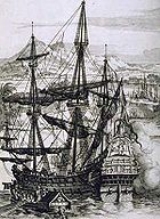
A galleon was a large, multi-decked sailing ship Sailing ship

Sailing ship is now used to refer to any large, wind [i]-powered, vessel [i]. ... 

 used primarily by the nations of Europe Europe

Europe is one of the seven traditional continent [i]s of the Earth [i]. ... 

 from the 16th 16th century

As a means of recording the passage of time [i], the 16th century was that century [i] which lasted from ... 

 to 18th 18th century

As a means of recording the passage of time [i], the 18th century refers to the century [i] that las ... 

 centuries. Whether used for war or commerce, they were generally armed with cannons Cannon

A cannon is any large tubular firearm [i] designed to fire a heavy projectile [i] over a considerable di ... 

. Galleons were an evolution of the caravel Caravel

A caravel is a small, highly maneuverable, three-masted [i] ship [i] used by the Portuguese [i] ... 

 and carrack Carrack

A carrack or nao was a three- or four-masted [i] sailing [i] ship developed in the Mediterranean [i] ... 

 , for the new great ocean going voyages. A lowering of the forecastle Forecastle

Forecastle also spelled fo'c's'le originally meant the upper deck [i] of a sailing ship [i], forwa ... 

 and elongation of the hull gave an unprecedented level of stability in the water, and reduced wind resistance at the front, leading to a faster, more maneuverable vessel. The galleon differed from the older types primarily by being longer, lower and narrower, with a square tuck stern instead of a round tuck, and by having a snout or head projecting forward from the bows below the level of the forecastle.

Discussions

  Discussion Features

   Ask a question about 'Galleon'

   Start a new discussion about 'Galleon'

   Answer questions about 'Galleon'

   'Galleon' discussion forum

Timeline

1600   Spanish Spain

Spain, officially the Kingdom of Spain , is a Europe [i]an parliamentary monarchy [i]. ... 

 galleon San Diego is sunk off the Philippines Philippines

The Philippines , officially the Republic of the Philippines , is an island nation [i] located in ... 

1602   James Lancaster's East India Company British East India Company

The British East India Company, sometimes referred to as "John Company", was a joint-stock company [i] ... 

 fleet arrives at Achin (now Aceh Aceh

ame = Nanggre Aceh Darussalam| ... 

), Sumatra Sumatra

Sumatra is the sixth largest island [i] of the world and is the largest island ... 

 to deal with the local ruler. Having defeated Portugal Portugal

Portugal, officially the Portuguese Republic is located in southwestern Europe [i] on the Iberian Peninsula [i] ... 

's ally, the ruler is happy to do business, and Lancaster seizes a large Portuguese Galleon and loots it.

1622   Spanish Spain

Spain, officially the Kingdom of Spain , is a Europe [i]an parliamentary monarchy [i]. ... 

 galleon ''Nuestra Seņora de Atocha Nuestra Seņora de Atocha

Nuestra Seora de Atocha was the most famous of a fleet of Spanish [i] ships that sunk in 1622 [i] ... 

'' sinks off the Florida Keys Florida Keys

[i], a string of about 1700 islands in the southeast [[United States]... 

, while carrying copper, ~35 tons of silver, 161 pieces of gold, tobacco, and indigo. (Wreck discovered 1985).


Encyclopedia


A galleon was a large, multi-decked sailing ship Sailing ship

Sailing ship is now used to refer to any large, wind [i]-powered, vessel [i]. ... 

 used primarily by the nations of Europe Europe

Europe is one of the seven traditional continent [i]s of the Earth [i]. ... 

 from the 16th 16th century

As a means of recording the passage of time [i], the 16th century was that century [i] which lasted from ... 

 to 18th 18th century

As a means of recording the passage of time [i], the 18th century refers to the century [i] that las ... 

 centuries. Whether used for war or commerce, they were generally armed with cannons Cannon

A cannon is any large tubular firearm [i] designed to fire a heavy projectile [i] over a considerable di ... 

.

Galleons were an evolution of the caravel Caravel

A caravel is a small, highly maneuverable, three-masted [i] ship [i] used by the Portuguese [i] ... 

 and carrack Carrack

A carrack or nao was a three- or four-masted [i] sailing [i] ship developed in the Mediterranean [i] ... 

 , for the new great ocean going voyages. A lowering of the forecastle Forecastle

Forecastle also spelled fo'c's'le originally meant the upper deck [i] of a sailing ship [i], forwa... 

 and elongation of the hull gave an unprecedented level of stability in the water, and reduced wind resistance at the front, leading to a faster, more maneuverable vessel. The galleon differed from the older types primarily by being longer, lower and narrower, with a square tuck stern instead of a round tuck, and by having a snout or head projecting forward from the bows below the level of the forecastle. In Portugal Portugal

Portugal, officially the Portuguese Republic is located in southwestern Europe [i] on the Iberian Peninsula [i] ... 

 at least, carracks were usually very large ships for their time , while galleons were mostly under 500 tons, although the Manila galleon Manila Galleon

The Manila galleons were Spanish [i] trading ships that sailed once or twice per year across the P ... 

s were to reach up to 2000 tons. Carracks tended to be lightly armed and used for transporting booty from the Far East, while galleons were purpose-built warships, and were stronger, more heavily armed, and also cheaper to build and were therefore a much better investment for use as warships. There are nationalistic disputes about the origin of the galleon, which are complicated by its evolutionary development, but each Atlantic sea-power developed types suited to their needs, while constantly learning from their rivals.

The galleon was powered entirely by sail Sail

A sail is any type of surface intended to generate thrust [i] by being placed in a wind [i] in essence ... 

, carried on three to five masts, with a lateen sail Lateen

[i] mounted at an angle on the [[mast|mast]... 

 continuing to be used on the last mast. They were used in both military and trade applications, most famously in the Spanish treasure fleet, and the Manila Galleons. In fact, galleons were so versatile that a single vessel may have been refitted for wartime and peacetime roles several times during its lifespan. The galleon was the prototype of all three or more masted, square rigged ships, for over two and a half centuries, including the later full-rigged ship Full rigged ship

A full rigged ship or fully rigged ship is a square rig [i]ged sailing vessel with three or more m ... 

.

The cores of the opposing English England

England is the largest and most populous constituent country [i] of the United Kingdom [i]. ... 

 and Spanish Spain

Spain, officially the Kingdom of Spain , is a Europe [i]an parliamentary monarchy [i].... 

 fleets in the 1588 confrontation of the Spanish Armada Spanish Armada

------

The Spanish Armada or "Great/Grand Armada" or "The Mother of all armada"(Old Spanish [i] ... 

 were galleons, with the modified English "race built" galleons developed by John Hawkins John Hawkins

[i], and [[slave trade]... 

 proving decisive, while the more traditional Spanish galleons proved incredibly durable in the battles and in the great storm on the voyage home .

Galleons were constructed from oak Oak

The term oak can be used as part of the common name of any of several hundred species of tree [i]s and shrub [i] ... 

 , pine Pine

Pines are coniferous [i] tree [i]s of the genus Pinus, in the family Pinaceae [i]. ... 

  and various hardwood Hardwood

The term hardwood designates wood [i] from broad-leaved or angiosperm [i] tree [i]s. ... 

s for hull and decking. Hulls were usually carvel Carvel

Carvel is an ice cream franchise [i] owned by FOCUS Brands, Inc. [i] – Carvel is well- ... 

-built. The expenses involved in galleon construction were enormous. Hundreds of expert tradesmen worked day and night for months before a galleon was seaworthy. Due to this, galleons were often funded by groups of wealthy businessmen who pooled resources for a new ship. Therefore, most galleons were originally consigned for trade, although those captured by rival nations were usually put into military service.

The most common gun used aboard a galleon was the demi-culverin, although gun sizes up to demi-cannon were possible.

Due to extensive time often spent at sea and poor conditions on board, much of the crew often perished during the voyage; therefore advanced rigging Rigging

Rigging denotes how a boat is outfitted.... 

 systems were developed so that the vessel could be sailed home by an active sailing crew a fraction of the size aboard at departure.

The galleon continued to be used until the early 18th century 18th century

As a means of recording the passage of time [i], the 18th century refers to the century [i] that las ... 

, when better designed and purpose-built vessels such as the brig Brig

In sailing [i], a brig is a vessel with two masts [i] at least one of which is square rig [i]ged. ... 

 and man of war rendered it obsolete for trade and warfare respectively.

Notable galleons

  • Golden Hind Golden Hind

    The Golden Hind was an English [i] galleon [i] best known for its global circumnavigation be ... 

    , the ship in which Sir Francis Drake Francis Drake

    Sir Francis Drake, Vice Admiral [i], was an English [i] privateer [i], navigator [i] ... 

     circumnavigated the globe

Further reading

  • The Galleon , Conway Maritime Press, ISBN 0-851-77546-2

External links