

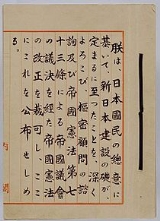
Constitution of Japan

Encyclopedia
The is the fundamental law of Japan
. It was enacted on 3 May, 1947 as a new constitution
for postwar Japan
.
of government and guarantees certain fundamental rights. Under its terms the Emperor of Japan
is "the symbol of the State and of the unity of the people" and exercises a purely ceremonial role without the possession of sovereignty
.
The constitution, also known as the or the , is most characteristic and famous for the renunciation of the right to wage war contained in Article 9 and to a lesser extent, the provision for de jure
popular sovereignty in conjunction with the monarchy.
The constitution was drawn up under the Allied occupation
that followed World War II
and was intended to replace Japan's previous militaristic
and absolute monarchy
system with a form of liberal democracy
. Currently, it is a rigid document and no subsequent amendment has been made to it since its adoption.
 The Constitution of the Empire of Japan
of 1890 (commonly called the "Meiji Constitution", after the emperor during whose reign it was composed), was the fundamental law of the former state. Enacted after the Meiji Restoration
in 1868, it provided for a form of mixed constitutional
and absolute monarchy
, based jointly on the Prussia
n and British
models. In theory, the Emperor of Japan
or Tenno was the supreme ruler, and the Cabinet
, whose Prime Minister
would be elected by a Privy Council
, were his followers; in practice, the Emperor was head of state but the Prime Minister was the actual head of government. Under the Meiji Constitution, the Prime Minister
and his Cabinet were not necessarily chosen from the elected members of the Diet
. Pursuing the regular amending procedure of the "Meiji Constitution", it was entirely revised to become the "Postwar Constitution" on 3 November 1946. The Postwar Constitution has been in force since 3 May 1947.
, Harry S Truman, and Chiang Kai-Shek
issued the Potsdam Declaration
, which demanded Japan's unconditional surrender. This declaration also defined the major goals of the postsurrender Allied occupation
: "The Japanese government shall remove all obstacles to the revival and strengthening of democratic tendencies among the Japanese people. Freedom of speech
, of religion
, and of thought, as well as respect for the fundamental human rights
shall be established" (Section 10). In addition, the document stated: "The occupying forces of the Allies shall be withdrawn from Japan as soon as these objectives have been accomplished and there has been established in accordance with the freely expressed will of the Japanese people a peacefully inclined and responsible government" (Section 12). The Allies sought not merely punishment or reparations from a militaristic foe, but fundamental changes in the nature of its political system. In the words of political scientist Robert E. Ward: "The occupation was perhaps the single most exhaustively planned operation of massive and externally directed political change in world history."
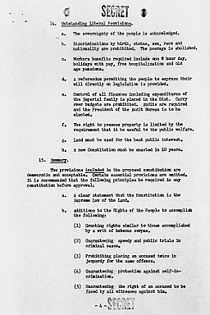 The wording of the Potsdam Declaration—"The Japanese Government shall remove all obstacles..."—and the initial postsurrender measures taken by Douglas MacArthur
, the Supreme Commander for the Allied Powers (SCAP), suggest that neither he nor his superiors in Washington intended to impose a new political system on Japan unilaterally. Instead, they wished to encourage Japan's new leaders to initiate democratic reforms on their own. But by early 1946, MacArthur's staff and Japanese officials were at odds over the most fundamental issue, the writing of a new constitution. Emperor Showa (known to the West as Hirohito
), Prime Minister
Shidehara Kijuro
and most of the cabinet members were extremely reluctant to take the drastic step of replacing the 1889 Meiji Constitution with a more liberal document. In late 1945, Shidehara appointed Joji Matsumoto
, state minister without portfolio, head of a blue-ribbon committee of constitutional scholars to suggest revisions. The Matsumoto Commission's recommendations, made public in February 1946, were quite conservative (described by one Japanese scholar in the late 1980s as "no more than a touching-up of the Meiji Constitution"). MacArthur rejected them outright and ordered his staff to draft a completely new document.
Much of it was drafted by two senior army officers with law degrees: Milo Rowell
and Courtney Whitney
, though others chosen by MacArthur also had a large say in the document. The articles about equality between men and women are reported to have been written by Beate Sirota
. Although the document's authors were non-Japanese, they took into account the Meiji Constitution, the demands of Japanese lawyers, and the opinions of pacifist political leaders such as Shidehara and Yoshida Shigeru. MacArthur gave the authors less than a week to complete the draft, which was presented to surprised Japanese officials on 13 February 1946. On 6 March 1946 the government publicly disclosed an outline of the pending constitution. On 10 April elections were held to the House of Representatives of the Ninetieth Imperial Diet, which would consider the proposed constitution. The election law having been changed, this was the first general election
in Japan in which women were permitted to vote.
The MacArthur draft, which proposed a unicameral legislature, was changed at the insistence of the Japanese to allow a bicameral legislature, both houses being elected. In most other important respects, however, the ideas embodied in the 13 February document were adopted by the government in its own draft proposal of 6 March. These included the constitution's most distinctive features: the symbolic role of the Emperor
, the prominence of guarantees of civil and human rights, and the renunciation of war.
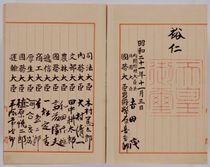
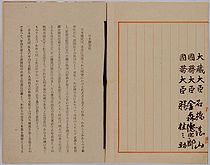 It was decided that in adopting the new document the Meiji Constitution would not be violated, but rather legal continuity would be maintained. Thus the 1946 constitution was adopted as an amendment to the Meiji Constitution in accordance with the provisions of Article 73 of that document. Under Article 73 the new constitution was formally submitted to the Imperial Diet
by the Emperor, through an imperial rescript issued on 20 June. The draft constitution was submitted and deliberated upon as the Bill for Revision of the Imperial Constitution. The old constitution required that the bill receive the support of a two-thirds majority in both houses of the Diet in order to become law. After both chambers had made some amendments the House of Peers
approved the document on 6 October; it was adopted in the same form by the House of Representatives
the following day, with only five members voting against, and finally became law when it received the Emperor's assent on 3 November. Under its own terms the constitution came into effect six months later on 3 May 1947.
-style presidential or federal system. Instead, the proposed constitution conformed to the British model of parliamentary government, which was seen by the liberals as the most viable alternative to the European absolutism
of the Meiji Constitution.
After 1952 conservatives and nationalists
attempted to revise the constitution to make it more "Japanese", but these attempts were frustrated for a number of reasons. One was the extreme difficulty of amending it. Amendments require approval by two-thirds of the members of both houses of the National Diet before they can be presented to the people in a referendum (Article 96). Also, opposition parties, occupying more than one-third of the Diet seats, were firm supporters of the constitutional status quo. Even for members of the ruling Liberal Democratic Party
(LDP), the constitution was advantageous. They had been able to fashion a policy-making process congenial to their interests within its framework. Yasuhiro Nakasone
, a strong advocate of constitutional revision during much of his political career, for example, downplayed the issue while serving as prime minister between 1982 and 1987.
Part of the purpose of this language is to refute the previous constitutional theory that sovereignty resided in the Emperor. The constitution asserts that the Emperor is merely a symbol and that he derives "his position from the will of the people with whom resides sovereign power" (Article 1). The text of the constitution also asserts the liberal
doctrine of fundamental human rights. In particular Article 97 states that
The constitution establishes a parliamentary system of government. The Emperor carries out most of the functions of a head of state
but his role is merely ceremonial and, unlike the forms of constitutional monarchy
found in some other nations, he possesses no reserve power
s. Legislative authority is vested in a bicameral National Diet
and, whereas previously the upper house
had consisted of members of the nobility, the new constitution provided that both chambers be directly elected. Executive authority is exercised by a Prime Minister
and cabinet
answerable to the legislature, while the judiciary is headed by a Supreme Court
.
. Although the Meiji Constitution
had a section devoted to the "rights and duties of subjects", which guaranteed "liberty of speech, writing, publication, public meetings, and associations", these rights were granted "within the limits of law". Freedom of religious belief was allowed "insofar as it does not interfere with the duties of subjects" (all Japanese were required to acknowledge the Emperor's divinity, and those, such as Christian
s, who refused to do so out of religious conviction were accused of lèse-majesté). Such freedoms are delineated in the postwar constitution without qualification.
Individual rights under the Japanese constitution are rooted in Article 13 where the constitution asserts the right of the people "to be respected as individuals" and, subject to "the public welfare", to "life, liberty
, and the pursuit of happiness." This article's core notion is jinkaku, which represents "the elements of character and personality that come together to define each person as an individual," and which represents the aspects of each individual's life that the government is obligated to respect in the exercise of its power.
Subsequent provisions provide for:
s can be made to any part of the constitution. However, a proposed amendment must first be approved by both houses of the Diet, by at least a super majority of two-thirds of each house (rather than just a simple majority
). It must then be submitted to a referendum
in which it is sufficient for it to be endorsed by a simple majority of votes cast. A successful amendment is finally promulgated by the Emperor, but the monarch cannot veto an amendment.
Some commentators have suggested that the difficulty of the amendment process was favoured by the constitution's American authors from a desire that the fundamentals of the regime they had imposed would be resistant to change. However, among Japanese themselves, any change to the document and to the post-war settlement it embodies is highly controversial. From the 1960s to the 1980s, constitutional revision was rarely debated. In the 1990s, right-leaning and conservative voices broke some taboos, for example, when the Yomiuri Shimbun
published a suggestion for constitutional revision in 1994. This period saw a number of right-leaning groups forming to aggressively push for constitutional revision, but also a significant number of organizations and individuals speaking out against revision and in support of "the peace constitution."
The debate has been highly polarized. The most controversial issues are proposed changes to Article 9, the "peace article" and provisions relating to the role of the Emperor. Progressive, left, center-left and peace movement related individuals and organizations, as well as the opposition parties, labor and youth groups advocate keeping (and even strengthening) the existing constitution in these areas, while right-leaning, nationalist and/or conservative groups and individuals advocate changes to increase the prestige of the Emperor (though not granting him political powers) and to allow a more aggressive stance of the self-defense force, e.g. by turning it officially into a military. Others areas of the constitution and connected laws discussed for potential revision relate to the status of women, the education system and the system of public corporations (including social welfare, non-profit and religious organizations as well as foundations), and structural reform of the election process, e.g. to allow for direct election of the prime minister. There are countless grassroots groups, associations, NGOs, think tanks, scholars, and politicians speaking out in favor of one or the other side of the issue.
In August 2005, the then Japanese Prime Minister, Junichiro Koizumi
, proposed an amendment to the constitution in order to increase Japan's Defence Forces' roles in international affairs. A draft of the proposed constitution was released by the Liberal Democratic Party
(LDP) on 22 November 2005 as part of the fiftieth anniversary of the party's founding. The proposed changes included:
This draft fanned the debate, with strong opposition coming even from non-governmental organisations of other countries, as well as established and newly formed grassroots Japanese organisations, such as Save Article 9. Per the current constitution, a proposal for constitutional changes must be passed by a two-thirds vote in the Diet, then be put to a national referendum. However, there was in 2005 no legislation in place for such a referendum.
Koizumi
's successor, Shinzo Abe
vowed to push aggressively for constitutional revision. A major step toward this was getting legislation passed to allow for a national referendum in April 2007. However, by that time there was little public support for changing the constitution, with a survey showing 34.5% of Japanese not wanting any changes, 44.5% wanting no changes to Article 9, and 54.6% supporting the current interpretation on self-defense. On the 60th anniversary of the constitution, on 3 May 2007, thousands took to the streets in support of Article 9
. The Chief Cabinet secretary and other top government officials interpreted the survey to mean that the public wants a pacifist Constitution that renounces war, and may need to be better informed about the details of the revision debate. The legislation passed by parliament specifies that a referendum on constitutional reform could take place at the earliest in 2010, and would need approval from a majority of voters.
International bodies such as the United Nations
Human Rights Committee
, which monitors compliance with the International Covenant on Civil and Political Rights
, and Amnesty International
have argued that many of the guarantees for individual rights contained in the Japanese constitution have not been effective in practice. Such critics have also argued that, contrary to Article 98, and its requirement that international law be treated as part of the domestic law of the state, human rights treaties to which Japan is a party are seldom enforced in Japanese courts.
Despite constitutional guarantees of the right to a fair trial, conviction rates in Japan approach 99%. In one study, the conviction rate in contested Japanese trials in 1994 was found to be 98.8%, while the comparable conviction rate in contested United States federal
trials in 1994 was 30.9%. The study concluded that this was due to the limited budgets for prosecutors in Japan compared to the United States, leading them to prosecute only the most solid cases, rather than due to bias by judges.
Japan
Japan is an island nation in East Asia. Located in the Pacific Ocean, it lies to the east of the Sea of Japan, China, North Korea, South Korea and Russia, stretching from the Sea of Okhotsk in the north to the East China Sea and Taiwan in the south...
. It was enacted on 3 May, 1947 as a new constitution
Constitution
A constitution is a set of fundamental principles or established precedents according to which a state or other organization is governed. These rules together make up, i.e. constitute, what the entity is...
for postwar Japan
Postwar Japan
Postwar Japan refers to the period in Japanese history immediately following the end of World War II in 1945 to the present day. Before and during the war Japan was known as an empire but is now officially the .-Occupation and democratization:...
.
Outline
The constitution provides for a parliamentary systemParliamentary system
A parliamentary system is a system of government in which the ministers of the executive branch get their democratic legitimacy from the legislature and are accountable to that body, such that the executive and legislative branches are intertwined....
of government and guarantees certain fundamental rights. Under its terms the Emperor of Japan
Emperor of Japan
The Emperor of Japan is, according to the 1947 Constitution of Japan, "the symbol of the state and of the unity of the people." He is a ceremonial figurehead under a form of constitutional monarchy and is head of the Japanese Imperial Family with functions as head of state. He is also the highest...
is "the symbol of the State and of the unity of the people" and exercises a purely ceremonial role without the possession of sovereignty
Sovereignty
Sovereignty is the quality of having supreme, independent authority over a geographic area, such as a territory. It can be found in a power to rule and make law that rests on a political fact for which no purely legal explanation can be provided...
.
The constitution, also known as the or the , is most characteristic and famous for the renunciation of the right to wage war contained in Article 9 and to a lesser extent, the provision for de jure
De jure
De jure is an expression that means "concerning law", as contrasted with de facto, which means "concerning fact".De jure = 'Legally', De facto = 'In fact'....
popular sovereignty in conjunction with the monarchy.
The constitution was drawn up under the Allied occupation
Occupied Japan
At the end of World War II, Japan was occupied by the Allied Powers, led by the United States with contributions also from Australia, India, New Zealand and the United Kingdom. This foreign presence marked the first time in its history that the island nation had been occupied by a foreign power...
that followed World War II
World War II
World War II, or the Second World War , was a global conflict lasting from 1939 to 1945, involving most of the world's nations—including all of the great powers—eventually forming two opposing military alliances: the Allies and the Axis...
and was intended to replace Japan's previous militaristic
Militarism
Militarism is defined as: the belief or desire of a government or people that a country should maintain a strong military capability and be prepared to use it aggressively to defend or promote national interests....
and absolute monarchy
Absolute monarchy
Absolute monarchy is a monarchical form of government in which the monarch exercises ultimate governing authority as head of state and head of government, his or her power not being limited by a constitution or by the law. An absolute monarch thus wields unrestricted political power over the...
system with a form of liberal democracy
Liberal democracy
Liberal democracy, also known as constitutional democracy, is a common form of representative democracy. According to the principles of liberal democracy, elections should be free and fair, and the political process should be competitive...
. Currently, it is a rigid document and no subsequent amendment has been made to it since its adoption.
Meiji Constitution
Meiji Constitution
The ', known informally as the ', was the organic law of the Japanese empire, in force from November 29, 1890 until May 2, 1947.-Outline:...
of 1890 (commonly called the "Meiji Constitution", after the emperor during whose reign it was composed), was the fundamental law of the former state. Enacted after the Meiji Restoration
Meiji Restoration
The , also known as the Meiji Ishin, Revolution, Reform or Renewal, was a chain of events that restored imperial rule to Japan in 1868...
in 1868, it provided for a form of mixed constitutional
Constitutional monarchy
Constitutional monarchy is a form of government in which a monarch acts as head of state within the parameters of a constitution, whether it be a written, uncodified or blended constitution...
and absolute monarchy
Absolute monarchy
Absolute monarchy is a monarchical form of government in which the monarch exercises ultimate governing authority as head of state and head of government, his or her power not being limited by a constitution or by the law. An absolute monarch thus wields unrestricted political power over the...
, based jointly on the Prussia
Prussia
Prussia was a German kingdom and historic state originating out of the Duchy of Prussia and the Margraviate of Brandenburg. For centuries, the House of Hohenzollern ruled Prussia, successfully expanding its size by way of an unusually well-organized and effective army. Prussia shaped the history...
n and British
United Kingdom
The United Kingdom of Great Britain and Northern IrelandIn the United Kingdom and Dependencies, other languages have been officially recognised as legitimate autochthonous languages under the European Charter for Regional or Minority Languages...
models. In theory, the Emperor of Japan
Emperor of Japan
The Emperor of Japan is, according to the 1947 Constitution of Japan, "the symbol of the state and of the unity of the people." He is a ceremonial figurehead under a form of constitutional monarchy and is head of the Japanese Imperial Family with functions as head of state. He is also the highest...
or Tenno was the supreme ruler, and the Cabinet
Cabinet (government)
A Cabinet is a body of high ranking government officials, typically representing the executive branch. It can also sometimes be referred to as the Council of Ministers, an Executive Council, or an Executive Committee.- Overview :...
, whose Prime Minister
Prime minister
A prime minister is the most senior minister of cabinet in the executive branch of government in a parliamentary system. In many systems, the prime minister selects and may dismiss other members of the cabinet, and allocates posts to members within the government. In most systems, the prime...
would be elected by a Privy Council
Privy council
A privy council is a body that advises the head of state of a nation, typically, but not always, in the context of a monarchic government. The word "privy" means "private" or "secret"; thus, a privy council was originally a committee of the monarch's closest advisors to give confidential advice on...
, were his followers; in practice, the Emperor was head of state but the Prime Minister was the actual head of government. Under the Meiji Constitution, the Prime Minister
Prime minister
A prime minister is the most senior minister of cabinet in the executive branch of government in a parliamentary system. In many systems, the prime minister selects and may dismiss other members of the cabinet, and allocates posts to members within the government. In most systems, the prime...
and his Cabinet were not necessarily chosen from the elected members of the Diet
Diet (assembly)
In politics, a diet is a formal deliberative assembly. The term is mainly used historically for the Imperial Diet, the general assembly of the Imperial Estates of the Holy Roman Empire, and for the legislative bodies of certain countries.-Etymology:...
. Pursuing the regular amending procedure of the "Meiji Constitution", it was entirely revised to become the "Postwar Constitution" on 3 November 1946. The Postwar Constitution has been in force since 3 May 1947.
The Potsdam Declaration
On 26 July 1945, Allied leaders Winston ChurchillWinston Churchill
Sir Winston Leonard Spencer-Churchill, was a predominantly Conservative British politician and statesman known for his leadership of the United Kingdom during the Second World War. He is widely regarded as one of the greatest wartime leaders of the century and served as Prime Minister twice...
, Harry S Truman, and Chiang Kai-Shek
Chiang Kai-shek
Chiang Kai-shek was a political and military leader of 20th century China. He is known as Jiǎng Jièshí or Jiǎng Zhōngzhèng in Mandarin....
issued the Potsdam Declaration
Potsdam Declaration
The Potsdam Declaration or the Proclamation Defining Terms for Japanese Surrender is a statement calling for the Surrender of Japan in World War II. On July 26, 1945, United States President Harry S...
, which demanded Japan's unconditional surrender. This declaration also defined the major goals of the postsurrender Allied occupation
Occupied Japan
At the end of World War II, Japan was occupied by the Allied Powers, led by the United States with contributions also from Australia, India, New Zealand and the United Kingdom. This foreign presence marked the first time in its history that the island nation had been occupied by a foreign power...
: "The Japanese government shall remove all obstacles to the revival and strengthening of democratic tendencies among the Japanese people. Freedom of speech
Freedom of speech
Freedom of speech is the freedom to speak freely without censorship. The term freedom of expression is sometimes used synonymously, but includes any act of seeking, receiving and imparting information or ideas, regardless of the medium used...
, of religion
Freedom of religion
Freedom of religion is a principle that supports the freedom of an individual or community, in public or private, to manifest religion or belief in teaching, practice, worship, and observance; the concept is generally recognized also to include the freedom to change religion or not to follow any...
, and of thought, as well as respect for the fundamental human rights
Human rights
Human rights are "commonly understood as inalienable fundamental rights to which a person is inherently entitled simply because she or he is a human being." Human rights are thus conceived as universal and egalitarian . These rights may exist as natural rights or as legal rights, in both national...
shall be established" (Section 10). In addition, the document stated: "The occupying forces of the Allies shall be withdrawn from Japan as soon as these objectives have been accomplished and there has been established in accordance with the freely expressed will of the Japanese people a peacefully inclined and responsible government" (Section 12). The Allies sought not merely punishment or reparations from a militaristic foe, but fundamental changes in the nature of its political system. In the words of political scientist Robert E. Ward: "The occupation was perhaps the single most exhaustively planned operation of massive and externally directed political change in world history."
Drafting process
Douglas MacArthur
General of the Army Douglas MacArthur was an American general and field marshal of the Philippine Army. He was a Chief of Staff of the United States Army during the 1930s and played a prominent role in the Pacific theater during World War II. He received the Medal of Honor for his service in the...
, the Supreme Commander for the Allied Powers (SCAP), suggest that neither he nor his superiors in Washington intended to impose a new political system on Japan unilaterally. Instead, they wished to encourage Japan's new leaders to initiate democratic reforms on their own. But by early 1946, MacArthur's staff and Japanese officials were at odds over the most fundamental issue, the writing of a new constitution. Emperor Showa (known to the West as Hirohito
Hirohito
, posthumously in Japan officially called Emperor Shōwa or , was the 124th Emperor of Japan according to the traditional order, reigning from December 25, 1926, until his death in 1989. Although better known outside of Japan by his personal name Hirohito, in Japan he is now referred to...
), Prime Minister
Prime Minister of Japan
The is the head of government of Japan. He is appointed by the Emperor of Japan after being designated by the Diet from among its members, and must enjoy the confidence of the House of Representatives to remain in office...
Shidehara Kijuro
Kijuro Shidehara
Baron was a prominent pre–World War II Japanese diplomat and the 44th Prime Minister of Japan from 9 October 1945 to 22 May 1946. He was a leading proponent of pacifism in Japan before and after World War II, and was also the last Japanese prime minister who was a member of the kazoku...
and most of the cabinet members were extremely reluctant to take the drastic step of replacing the 1889 Meiji Constitution with a more liberal document. In late 1945, Shidehara appointed Joji Matsumoto
Joji Matsumoto
was a Japanese lawyer of Meiji period specializing in commercial law.Matsumoto served as the Chief of Legislative Bureau from Sep 2, 1923 until Jan 7, 1924 in the second Yamamoto Cabinet. He then served as the Minister of Commerce and Industry from Feb 9, 1934 until Jul 8, 1934 in the Saitō Cabinet...
, state minister without portfolio, head of a blue-ribbon committee of constitutional scholars to suggest revisions. The Matsumoto Commission's recommendations, made public in February 1946, were quite conservative (described by one Japanese scholar in the late 1980s as "no more than a touching-up of the Meiji Constitution"). MacArthur rejected them outright and ordered his staff to draft a completely new document.
Much of it was drafted by two senior army officers with law degrees: Milo Rowell
Milo Rowell
Lt. Col. Milo E. Rowell was an American lawyer and Army officer best known for his role in drafting the Constitution of Japan....
and Courtney Whitney
Courtney Whitney
Major General Courtney Whitney was an American lawyer and Army commander during World War II who later served as a senior official during the occupation of Japan....
, though others chosen by MacArthur also had a large say in the document. The articles about equality between men and women are reported to have been written by Beate Sirota
Beate Sirota
Beate Sirota Gordon is a former Performing Arts Director of the Japan Society and of Asia Society, and was a member of the team that worked under Douglas MacArthur on the Constitution of Japan....
. Although the document's authors were non-Japanese, they took into account the Meiji Constitution, the demands of Japanese lawyers, and the opinions of pacifist political leaders such as Shidehara and Yoshida Shigeru. MacArthur gave the authors less than a week to complete the draft, which was presented to surprised Japanese officials on 13 February 1946. On 6 March 1946 the government publicly disclosed an outline of the pending constitution. On 10 April elections were held to the House of Representatives of the Ninetieth Imperial Diet, which would consider the proposed constitution. The election law having been changed, this was the first general election
General election
In a parliamentary political system, a general election is an election in which all or most members of a given political body are chosen. The term is usually used to refer to elections held for a nation's primary legislative body, as distinguished from by-elections and local elections.The term...
in Japan in which women were permitted to vote.
The MacArthur draft, which proposed a unicameral legislature, was changed at the insistence of the Japanese to allow a bicameral legislature, both houses being elected. In most other important respects, however, the ideas embodied in the 13 February document were adopted by the government in its own draft proposal of 6 March. These included the constitution's most distinctive features: the symbolic role of the Emperor
Emperor of Japan
The Emperor of Japan is, according to the 1947 Constitution of Japan, "the symbol of the state and of the unity of the people." He is a ceremonial figurehead under a form of constitutional monarchy and is head of the Japanese Imperial Family with functions as head of state. He is also the highest...
, the prominence of guarantees of civil and human rights, and the renunciation of war.
Adoption
Diet of Japan
The is Japan's bicameral legislature. It is composed of a lower house, called the House of Representatives, and an upper house, called the House of Councillors. Both houses of the Diet are directly elected under a parallel voting system. In addition to passing laws, the Diet is formally...
by the Emperor, through an imperial rescript issued on 20 June. The draft constitution was submitted and deliberated upon as the Bill for Revision of the Imperial Constitution. The old constitution required that the bill receive the support of a two-thirds majority in both houses of the Diet in order to become law. After both chambers had made some amendments the House of Peers
House of Peers (Japan)
The ' was the upper house of the Imperial Diet as mandated under the Constitution of the Empire of Japan ....
approved the document on 6 October; it was adopted in the same form by the House of Representatives
House of Representatives of Japan
The is the lower house of the Diet of Japan. The House of Councillors of Japan is the upper house.The House of Representatives has 480 members, elected for a four-year term. Of these, 180 members are elected from 11 multi-member constituencies by a party-list system of proportional representation,...
the following day, with only five members voting against, and finally became law when it received the Emperor's assent on 3 November. Under its own terms the constitution came into effect six months later on 3 May 1947.
Early proposals for amendment
The new constitution would not have been written the way it was had MacArthur and his staff allowed Japanese politicians and constitutional experts to resolve the issue as they wished. The document's foreign origins have, understandably, been a focus of controversy since Japan recovered its sovereignty in 1952. Yet in late 1945 and 1946, there was much public discussion on constitutional reform, and the MacArthur draft was apparently greatly influenced by the ideas of certain Japanese liberals. The MacArthur draft did not attempt to impose a United StatesUnited States
The United States of America is a federal constitutional republic comprising fifty states and a federal district...
-style presidential or federal system. Instead, the proposed constitution conformed to the British model of parliamentary government, which was seen by the liberals as the most viable alternative to the European absolutism
Enlightened absolutism
Enlightened absolutism is a form of absolute monarchy or despotism in which rulers were influenced by the Enlightenment. Enlightened monarchs embraced the principles of the Enlightenment, especially its emphasis upon rationality, and applied them to their territories...
of the Meiji Constitution.
After 1952 conservatives and nationalists
Japanese nationalism
encompasses a broad range of ideas and sentiments harbored by the Japanese people over the last two centuries regarding their native country, its cultural nature, political form and historical destiny...
attempted to revise the constitution to make it more "Japanese", but these attempts were frustrated for a number of reasons. One was the extreme difficulty of amending it. Amendments require approval by two-thirds of the members of both houses of the National Diet before they can be presented to the people in a referendum (Article 96). Also, opposition parties, occupying more than one-third of the Diet seats, were firm supporters of the constitutional status quo. Even for members of the ruling Liberal Democratic Party
Liberal Democratic Party (Japan)
The , frequently abbreviated to LDP or , is a centre-right political party in Japan. It is one of the most consistently successful political parties in the democratic world. The LDP ruled almost continuously for nearly 54 years from its founding in 1955 until its defeat in the 2009 election...
(LDP), the constitution was advantageous. They had been able to fashion a policy-making process congenial to their interests within its framework. Yasuhiro Nakasone
Yasuhiro Nakasone
is a Japanese politician who served as Prime Minister of Japan from November 27, 1982 to November 6, 1987. A contemporary of Brian Mulroney, Ronald Reagan, Helmut Kohl, François Mitterrand, Margaret Thatcher, and Mikhail Gorbachev, he is best known for pushing through the privatization of...
, a strong advocate of constitutional revision during much of his political career, for example, downplayed the issue while serving as prime minister between 1982 and 1987.
Structure
The constitution has a length of approximately 5,000 words. It consists of a preamble and 103 articles grouped into eleven chapters. These are:- I. The Emperor (1–8)
- II. Renunciation of War (9)
- III. Rights and Duties of the People (10–40)
- IV. The Diet (41–64)
- V. The Cabinet (65–75)
- VI. Judiciary (76–82)
- VII. Finance (83–91)
- VIII. Local Self–Government (92–95)
- IX. Amendments (96)
- X. Supreme Law (97–99)
- XI. Supplementary Provisions (100–103)
Founding principles
The constitution contains a firm declaration of the principle of popular sovereignty in the preamble. This is proclaimed in the name of the "Japanese people" and declares that "sovereign power resides with the people" and- government is a sacred trust of the people, the authority for which is derived from the people, the powers of which are exercised by the representatives of the people, and the benefits of which are enjoyed by the people.
Part of the purpose of this language is to refute the previous constitutional theory that sovereignty resided in the Emperor. The constitution asserts that the Emperor is merely a symbol and that he derives "his position from the will of the people with whom resides sovereign power" (Article 1). The text of the constitution also asserts the liberal
Liberalism
Liberalism is the belief in the importance of liberty and equal rights. Liberals espouse a wide array of views depending on their understanding of these principles, but generally, liberals support ideas such as constitutionalism, liberal democracy, free and fair elections, human rights,...
doctrine of fundamental human rights. In particular Article 97 states that
- the fundamental human rights by this Constitution guaranteed to the people of Japan are fruits of the age-old struggle of man to be free; they have survived the many exacting tests for durability and are conferred upon this and future generations in trust, to be held for all time inviolate.
Organs of government
- Main article: Government of JapanGovernment of JapanThe government of Japan is a constitutional monarchy where the power of the Emperor is very limited. As a ceremonial figurehead, he is defined by the 1947 constitution as "the symbol of the state and of the unity of the people". Power is held chiefly by the Prime Minister of Japan and other elected...
The constitution establishes a parliamentary system of government. The Emperor carries out most of the functions of a head of state
Head of State
A head of state is the individual that serves as the chief public representative of a monarchy, republic, federation, commonwealth or other kind of state. His or her role generally includes legitimizing the state and exercising the political powers, functions, and duties granted to the head of...
but his role is merely ceremonial and, unlike the forms of constitutional monarchy
Constitutional monarchy
Constitutional monarchy is a form of government in which a monarch acts as head of state within the parameters of a constitution, whether it be a written, uncodified or blended constitution...
found in some other nations, he possesses no reserve power
Reserve power
In a parliamentary or semi-presidential system of government, a reserve power is a power that may be exercised by the head of state without the approval of another branch of the government. Unlike a presidential system of government, the head of state is generally constrained by the cabinet or the...
s. Legislative authority is vested in a bicameral National Diet
Diet of Japan
The is Japan's bicameral legislature. It is composed of a lower house, called the House of Representatives, and an upper house, called the House of Councillors. Both houses of the Diet are directly elected under a parallel voting system. In addition to passing laws, the Diet is formally...
and, whereas previously the upper house
Upper house
An upper house, often called a senate, is one of two chambers of a bicameral legislature, the other chamber being the lower house; a legislature composed of only one house is described as unicameral.- Possible specific characteristics :...
had consisted of members of the nobility, the new constitution provided that both chambers be directly elected. Executive authority is exercised by a Prime Minister
Prime Minister of Japan
The is the head of government of Japan. He is appointed by the Emperor of Japan after being designated by the Diet from among its members, and must enjoy the confidence of the House of Representatives to remain in office...
and cabinet
Cabinet of Japan
The of Japan is the executive branch of the government of Japan. It consists of the Prime Minister and up to fourteen other members, called Ministers of State. The Prime Minister is designated by the Diet, and the remaining ministers are appointed and dismissed by the Prime Minister...
answerable to the legislature, while the judiciary is headed by a Supreme Court
Supreme Court of Japan
The Supreme Court of Japan , located in Chiyoda, Tokyo is the highest court in Japan. It has ultimate judicial authority to interpret the Japanese constitution and decide questions of national law...
.
Individual rights
"The rights and duties of the people" are prominently featured in the postwar constitution. Altogether, thirty-one of its 103 articles are devoted to describing them in considerable detail, reflecting the commitment to "respect for the fundamental human rights" of the Potsdam DeclarationPotsdam Declaration
The Potsdam Declaration or the Proclamation Defining Terms for Japanese Surrender is a statement calling for the Surrender of Japan in World War II. On July 26, 1945, United States President Harry S...
. Although the Meiji Constitution
Meiji Constitution
The ', known informally as the ', was the organic law of the Japanese empire, in force from November 29, 1890 until May 2, 1947.-Outline:...
had a section devoted to the "rights and duties of subjects", which guaranteed "liberty of speech, writing, publication, public meetings, and associations", these rights were granted "within the limits of law". Freedom of religious belief was allowed "insofar as it does not interfere with the duties of subjects" (all Japanese were required to acknowledge the Emperor's divinity, and those, such as Christian
Christian
A Christian is a person who adheres to Christianity, an Abrahamic, monotheistic religion based on the life and teachings of Jesus of Nazareth as recorded in the Canonical gospels and the letters of the New Testament...
s, who refused to do so out of religious conviction were accused of lèse-majesté). Such freedoms are delineated in the postwar constitution without qualification.
Individual rights under the Japanese constitution are rooted in Article 13 where the constitution asserts the right of the people "to be respected as individuals" and, subject to "the public welfare", to "life, liberty
Liberty
Liberty is a moral and political principle, or Right, that identifies the condition in which human beings are able to govern themselves, to behave according to their own free will, and take responsibility for their actions...
, and the pursuit of happiness." This article's core notion is jinkaku, which represents "the elements of character and personality that come together to define each person as an individual," and which represents the aspects of each individual's life that the government is obligated to respect in the exercise of its power.
Subsequent provisions provide for:
- EqualitySocial equalitySocial equality is a social state of affairs in which all people within a specific society or isolated group have the same status in a certain respect. At the very least, social equality includes equal rights under the law, such as security, voting rights, freedom of speech and assembly, and the...
: The constitution guarantees equality before the law and outlaws discrimination based on "political, economic or social relations" or "race, creed, sex, social status or family origin" (Article 14). The right to vote cannot be denied on the grounds of "race, creed, sex, social status, family origin, education, property or income" (Article 44). Equality between the sexes is explicitly guaranteed in relation to marriage (Article 24) and childhood education (Article 26). - Prohibition of peeragePeerageThe Peerage is a legal system of largely hereditary titles in the United Kingdom, which constitute the ranks of British nobility and is part of the British honours system...
: Article 14 forbids the state from recognising peerage. Honours may be conferred but they must not be hereditary or grant special privileges. - Democratic electionElectionAn election is a formal decision-making process by which a population chooses an individual to hold public office. Elections have been the usual mechanism by which modern representative democracy operates since the 17th century. Elections may fill offices in the legislature, sometimes in the...
s: Article 15 provides that "the people have the inalienable right to choose their public officials and to dismiss them". It guarantees universal adult (in Japan, persons age 20 and older) suffrage and the secret ballotSecret ballotThe secret ballot is a voting method in which a voter's choices in an election or a referendum are anonymous. The key aim is to ensure the voter records a sincere choice by forestalling attempts to influence the voter by intimidation or bribery. The system is one means of achieving the goal of...
. - Prohibition of slaverySlaverySlavery is a system under which people are treated as property to be bought and sold, and are forced to work. Slaves can be held against their will from the time of their capture, purchase or birth, and deprived of the right to leave, to refuse to work, or to demand compensation...
: Guaranteed by Article 18. Involuntary servitude is only permitted as punishment for a crime. - Separation of Religion and State: The state is prohibited from granting privileges or political authority to a religion, or conducting religious education (Article 20).
- Freedom of assemblyFreedom of assemblyFreedom of assembly, sometimes used interchangeably with the freedom of association, is the individual right to come together and collectively express, promote, pursue and defend common interests...
, associationFreedom of associationFreedom of association is the individual right to come together with other individuals and collectively express, promote, pursue and defend common interests....
, speechFreedom of speechFreedom of speech is the freedom to speak freely without censorship. The term freedom of expression is sometimes used synonymously, but includes any act of seeking, receiving and imparting information or ideas, regardless of the medium used...
, and secrecy of communications: All guaranteed without qualification by Article 21, which forbids censorshipCensorship in JapanIn Japan, Article 21 of the Japanese Constitution guarantees freedom of expression and prohibits formal censorship. What censorship does exist is often carried out through Article 175 of the Criminal Code of Japan...
. - Workers' rights: Work is declared both a right and obligation by Article 27 which also states that "standards for wages, hours, rest and other working conditions shall be fixed by law" and that children shall not be exploited. Workers have the right to participate in a trade unionTrade unionA trade union, trades union or labor union is an organization of workers that have banded together to achieve common goals such as better working conditions. The trade union, through its leadership, bargains with the employer on behalf of union members and negotiates labour contracts with...
(Article 28). - Right to property: Guaranteed subject to the "public welfare". The state may take property for public use if it pays just compensation (Article 29). The state also has the right to levy taxTaxTo tax is to impose a financial charge or other levy upon a taxpayer by a state or the functional equivalent of a state such that failure to pay is punishable by law. Taxes are also imposed by many subnational entities...
es (Article 30). - Right to due processDue processDue process is the legal code that the state must venerate all of the legal rights that are owed to a person under the principle. Due process balances the power of the state law of the land and thus protects individual persons from it...
: Article 31 provides that no one may be punished "except according to procedure established by law". Article 32, which provides that "No person shall be denied the right of access to the courts," originally drafted to recognize criminal due process rights, is now understood as source of due process rights for civil and administrative law cases. - Protection against unlawful detentionDetention (imprisonment)Detention is the process when a state, government or citizen lawfully holds a person by removing their freedom of liberty at that time. This can be due to criminal charges being raised against the individual as part of a prosecution or to protect a person or property...
: Article 33 provides that no one may be apprehended without an arrest warrant, save where caught in flagrante delicto. Article 34 guarantees habeas corpusHabeas corpusis a writ, or legal action, through which a prisoner can be released from unlawful detention. The remedy can be sought by the prisoner or by another person coming to his aid. Habeas corpus originated in the English legal system, but it is now available in many nations...
, right to counsel, and right to be informed of charges. Article 40 enshrines the right to sue the state for wrongful detention. - Right to a fair trialFair TrialFair Trial was a British Thoroughbred racehorse and Champion sire. He was bred and raced by John Arthur Dewar who also bred and raced Tudor Minstrel....
: Article 37 guarantees the right to a public trialPublic trialPublic trial or open trial is a trial open to public, as opposed to the secret trial. The term should not be confused with show trial.-United States:...
before an impartial tribunal with counsel for one's defence and compulsory access to witnesses. - Protection against self-incriminationSelf-incriminationSelf-incrimination is the act of accusing oneself of a crime for which a person can then be prosecuted. Self-incrimination can occur either directly or indirectly: directly, by means of interrogation where information of a self-incriminatory nature is disclosed; indirectly, when information of a...
: Article 38 provides that no one may be compelled to testify against themselves, that confessions obtained under duress are not admissible and that no one may be convicted solely on the basis of their own confession.
- Other guarantees:
- Right to petitionRight to petitionThe right to petition government for redress of grievances is the right to make a complaint to, or seek the assistance of, one's government, without fear of punishment or reprisals.-United States:...
government (Article 16) - Right to sueFiling (legal)In law, filing is the act of submitting a document to the clerk of a court for the court's immediate consideration, for storage in the court's files, or both. Courts will not consider motions unless an appropriate memorandum or brief is filed before the appropriate deadline...
the state (Article 17) - Freedom of thoughtFreedom of thoughtFreedom of thought is the freedom of an individual to hold or consider a fact, viewpoint, or thought, independent of others' viewpoints....
and conscience (Article 19) - Freedom of expression (Article 19)
- Freedom of choiceFreedom of choiceFor freedom of choice, see:*choice for information on theories that involve free will and human behavior.*Freedom of choice plans to integrate US schools .*Freedom of Choice, a 1980 synthpop landmark album by Devo...
(Article 19) - Freedom of religionFreedom of religionFreedom of religion is a principle that supports the freedom of an individual or community, in public or private, to manifest religion or belief in teaching, practice, worship, and observance; the concept is generally recognized also to include the freedom to change religion or not to follow any...
(Article 20) - Academic freedomAcademic freedomAcademic freedom is the belief that the freedom of inquiry by students and faculty members is essential to the mission of the academy, and that scholars should have freedom to teach or communicate ideas or facts without being targeted for repression, job loss, or imprisonment.Academic freedom is a...
(Article 23) - Prohibition of forced marriageForced marriageForced marriage is a term used to describe a marriage in which one or both of the parties is married without his or her consent or against his or her will...
(Article 24) - Right to free compulsory educationCompulsory educationCompulsory education refers to a period of education that is required of all persons.-Antiquity to Medieval Era:Although Plato's The Republic is credited with having popularized the concept of compulsory education in Western intellectual thought, every parent in Judea since Moses's Covenant with...
(Article 26) - Protection against entries, search and seizureSearch and seizureSearch and seizure is a legal procedure used in many civil law and common law legal systems whereby police or other authorities and their agents, who suspect that a crime has been committed, do a search of a person's property and confiscate any relevant evidence to the crime.Some countries have...
s (Article 35) - Prohibition of tortureTortureTorture is the act of inflicting severe pain as a means of punishment, revenge, forcing information or a confession, or simply as an act of cruelty. Throughout history, torture has often been used as a method of political re-education, interrogation, punishment, and coercion...
and cruel punishments (Article 36) - Prohibition of ex post facto laws (Article 39)
- Prohibition of double jeopardyDouble jeopardyDouble jeopardy is a procedural defense that forbids a defendant from being tried again on the same, or similar charges following a legitimate acquittal or conviction...
(Article 39)
- Right to petition
Other provisions
- Renunciation of war: Under Article 9 of the constitution the "Japanese people forever renounce war as a sovereign right of the nation and the threat or use of force as means of settling international disputes". To this end the article provides that "land, sea, and air forces, as well as other war potential, will never be maintained".
- Judicial review: Article 98 provides that the constitution takes precedence over any "law, ordinance, imperial rescript or other act of government" that offends against its provisions.
- International law: Article 98 provides that "the treaties concluded by Japan and established laws of nations shall be faithfully observed". In most nations it is for the legislature to determine to what extent, if at all, treatiesTreatyA treaty is an express agreement under international law entered into by actors in international law, namely sovereign states and international organizations. A treaty may also be known as an agreement, protocol, covenant, convention or exchange of letters, among other terms...
concluded by the state will be reflected in its domestic law. Under Article 98, however, in theory at least, international lawInternational lawPublic international law concerns the structure and conduct of sovereign states; analogous entities, such as the Holy See; and intergovernmental organizations. To a lesser degree, international law also may affect multinational corporations and individuals, an impact increasingly evolving beyond...
and the treaties Japan has ratified automatically form a part of domestic law.
Amendments and revisions
The constitution has not been amended since its 1947 enactment. Article 96 provides that amendmentConstitutional amendment
A constitutional amendment is a formal change to the text of the written constitution of a nation or state.Most constitutions require that amendments cannot be enacted unless they have passed a special procedure that is more stringent than that required of ordinary legislation...
s can be made to any part of the constitution. However, a proposed amendment must first be approved by both houses of the Diet, by at least a super majority of two-thirds of each house (rather than just a simple majority
Majority
A majority is a subset of a group consisting of more than half of its members. This can be compared to a plurality, which is a subset larger than any other subset; i.e. a plurality is not necessarily a majority as the largest subset may consist of less than half the group's population...
). It must then be submitted to a referendum
Referendum
A referendum is a direct vote in which an entire electorate is asked to either accept or reject a particular proposal. This may result in the adoption of a new constitution, a constitutional amendment, a law, the recall of an elected official or simply a specific government policy. It is a form of...
in which it is sufficient for it to be endorsed by a simple majority of votes cast. A successful amendment is finally promulgated by the Emperor, but the monarch cannot veto an amendment.
Some commentators have suggested that the difficulty of the amendment process was favoured by the constitution's American authors from a desire that the fundamentals of the regime they had imposed would be resistant to change. However, among Japanese themselves, any change to the document and to the post-war settlement it embodies is highly controversial. From the 1960s to the 1980s, constitutional revision was rarely debated. In the 1990s, right-leaning and conservative voices broke some taboos, for example, when the Yomiuri Shimbun
Yomiuri Shimbun
The is a Japanese newspaper published in Tokyo, Osaka, Fukuoka, and other major Japanese cities. It is one of the five national newspapers in Japan; the other four are the Asahi Shimbun, the Mainichi Shimbun, Nihon Keizai Shimbun, and the Sankei Shimbun...
published a suggestion for constitutional revision in 1994. This period saw a number of right-leaning groups forming to aggressively push for constitutional revision, but also a significant number of organizations and individuals speaking out against revision and in support of "the peace constitution."
The debate has been highly polarized. The most controversial issues are proposed changes to Article 9, the "peace article" and provisions relating to the role of the Emperor. Progressive, left, center-left and peace movement related individuals and organizations, as well as the opposition parties, labor and youth groups advocate keeping (and even strengthening) the existing constitution in these areas, while right-leaning, nationalist and/or conservative groups and individuals advocate changes to increase the prestige of the Emperor (though not granting him political powers) and to allow a more aggressive stance of the self-defense force, e.g. by turning it officially into a military. Others areas of the constitution and connected laws discussed for potential revision relate to the status of women, the education system and the system of public corporations (including social welfare, non-profit and religious organizations as well as foundations), and structural reform of the election process, e.g. to allow for direct election of the prime minister. There are countless grassroots groups, associations, NGOs, think tanks, scholars, and politicians speaking out in favor of one or the other side of the issue.
In August 2005, the then Japanese Prime Minister, Junichiro Koizumi
Junichiro Koizumi
is a Japanese politician who served as Prime Minister of Japan from 2001 to 2006. He retired from politics when his term in parliament ended.Widely seen as a maverick leader of the Liberal Democratic Party , he became known as an economic reformer, focusing on Japan's government debt and the...
, proposed an amendment to the constitution in order to increase Japan's Defence Forces' roles in international affairs. A draft of the proposed constitution was released by the Liberal Democratic Party
Liberal Democratic Party (Japan)
The , frequently abbreviated to LDP or , is a centre-right political party in Japan. It is one of the most consistently successful political parties in the democratic world. The LDP ruled almost continuously for nearly 54 years from its founding in 1955 until its defeat in the 2009 election...
(LDP) on 22 November 2005 as part of the fiftieth anniversary of the party's founding. The proposed changes included:
- New wording for the Preamble.
- First paragraph of Article 9, renouncing war, is retained. The second paragraph, forbidding the maintenance of "land, sea, and air forces, as well as other war potential" is replaced by an Article 9-2 which permits a "defence force", under control of the Prime Minister, which defends the nation and may participate in international activities. This new section uses the term "軍" (gun, army or military), which has been avoided under the current constitution. Also, addition in Article 76 of military courts. Members of the Japanese Self-Defense Forces are currently tried as civilians by civilian courts.
- Modified wording in Article 13, regarding respect for individual rights.
- Changes in Article 20, which gives the state limited permission within "the scope of socially acceptable protocol" for "ethno-cultural practices". Changes Article 89 to permit corresponding state funding of religious institutions.
- Changes to Articles 92 and 95, concerning local self-government and relations between local and national governments.
- Changes to Article 96, reducing the vote requirement for constitutional amendments in the Diet from two thirds to a simple majority. A national referendum would still be required.
This draft fanned the debate, with strong opposition coming even from non-governmental organisations of other countries, as well as established and newly formed grassroots Japanese organisations, such as Save Article 9. Per the current constitution, a proposal for constitutional changes must be passed by a two-thirds vote in the Diet, then be put to a national referendum. However, there was in 2005 no legislation in place for such a referendum.
Koizumi
Junichiro Koizumi
is a Japanese politician who served as Prime Minister of Japan from 2001 to 2006. He retired from politics when his term in parliament ended.Widely seen as a maverick leader of the Liberal Democratic Party , he became known as an economic reformer, focusing on Japan's government debt and the...
's successor, Shinzo Abe
Shinzo Abe
was the 90th Prime Minister of Japan, elected by a special session of the National Diet on 26 September 2006. He was Japan's youngest post–World War II prime minister and the first born after the war. Abe served as prime minister for nearly twelve months, before resigning on 12 September 2007...
vowed to push aggressively for constitutional revision. A major step toward this was getting legislation passed to allow for a national referendum in April 2007. However, by that time there was little public support for changing the constitution, with a survey showing 34.5% of Japanese not wanting any changes, 44.5% wanting no changes to Article 9, and 54.6% supporting the current interpretation on self-defense. On the 60th anniversary of the constitution, on 3 May 2007, thousands took to the streets in support of Article 9
Article 9 of the Japanese Constitution
Article 9 of the Japanese Constitution is a clause in the National Constitution of Japan that prohibits an act of war by the state. The Constitution came into effect on May 3, 1947, immediately following World War II. In its text, the state formally renounces war as a sovereign right and bans...
. The Chief Cabinet secretary and other top government officials interpreted the survey to mean that the public wants a pacifist Constitution that renounces war, and may need to be better informed about the details of the revision debate. The legislation passed by parliament specifies that a referendum on constitutional reform could take place at the earliest in 2010, and would need approval from a majority of voters.
Human rights guarantees in practice
- See also: Human rights in JapanHuman rights in JapanJapan is a constitutional monarchy. According to Ministry of Justice figures, the Japanese Legal Affairs Bureau offices and civil liberties volunteers dealt with 359,971 human rights related complaints and 18,786 reports of suspected human rights violations during 2003...
International bodies such as the United Nations
United Nations
The United Nations is an international organization whose stated aims are facilitating cooperation in international law, international security, economic development, social progress, human rights, and achievement of world peace...
Human Rights Committee
Human Rights Committee
The United Nations Human Rights Committee is a United Nations body of 18 experts that meets three times a year for four-week sessions to consider the five-yearly reports submitted by 162 UN member states on their compliance with the International Covenant on Civil and Political Rights,...
, which monitors compliance with the International Covenant on Civil and Political Rights
International Covenant on Civil and Political Rights
The International Covenant on Civil and Political Rights is a multilateral treaty adopted by the United Nations General Assembly on December 16, 1966, and in force from March 23, 1976...
, and Amnesty International
Amnesty International
Amnesty International is an international non-governmental organisation whose stated mission is "to conduct research and generate action to prevent and end grave abuses of human rights, and to demand justice for those whose rights have been violated."Following a publication of Peter Benenson's...
have argued that many of the guarantees for individual rights contained in the Japanese constitution have not been effective in practice. Such critics have also argued that, contrary to Article 98, and its requirement that international law be treated as part of the domestic law of the state, human rights treaties to which Japan is a party are seldom enforced in Japanese courts.
Despite constitutional guarantees of the right to a fair trial, conviction rates in Japan approach 99%. In one study, the conviction rate in contested Japanese trials in 1994 was found to be 98.8%, while the comparable conviction rate in contested United States federal
United States federal courts
The United States federal courts make up the judiciary branch of federal government of the United States organized under the United States Constitution and laws of the federal government.-Categories:...
trials in 1994 was 30.9%. The study concluded that this was due to the limited budgets for prosecutors in Japan compared to the United States, leading them to prosecute only the most solid cases, rather than due to bias by judges.
See also
- Post-World War IIWorld War IIWorld War II, or the Second World War , was a global conflict lasting from 1939 to 1945, involving most of the world's nations—including all of the great powers—eventually forming two opposing military alliances: the Allies and the Axis...
Basic Law for the Federal Republic of GermanyBasic Law for the Federal Republic of GermanyThe Basic Law for the Federal Republic of Germany is the constitution of Germany. It was formally approved on 8 May 1949, and, with the signature of the Allies of World War II on 12 May, came into effect on 23 May, as the constitution of those states of West Germany that were initially included... - Bushi-Dō
- Post-World War IIWorld War IIWorld War II, or the Second World War , was a global conflict lasting from 1939 to 1945, involving most of the world's nations—including all of the great powers—eventually forming two opposing military alliances: the Allies and the Axis...
Constitution of ItalyConstitution of ItalyThe Constitution of the Italian Republic was enacted by the Constituent Assembly on 22 December 1947, with 453 votes in favour and 62 against. The text, which has since been amended 13 times, was promulgated in the extraordinary edition of Gazzetta Ufficiale No. 298 on 27 December 1947... - Constitutional economicsConstitutional economicsConstitutional economics is a research program in economics and constitutionalism that has been described as extending beyond the definition of 'the economic analysis of constitutional law' in explaining the choice "of alternative sets of legal-institutional-constitutional rules that constrain the...
- ConstitutionalismConstitutionalismConstitutionalism has a variety of meanings. Most generally, it is "a complex of ideas, attitudes, and patterns of behavior elaborating the principle that the authority of government derives from and is limited by a body of fundamental law"....
- Japanese Buddhism
- Judicial reviewJudicial reviewJudicial review is the doctrine under which legislative and executive actions are subject to review by the judiciary. Specific courts with judicial review power must annul the acts of the state when it finds them incompatible with a higher authority...
- ShintōShintoor Shintoism, also kami-no-michi, is the indigenous spirituality of Japan and the Japanese people. It is a set of practices, to be carried out diligently, to establish a connection between present day Japan and its ancient past. Shinto practices were first recorded and codified in the written...
- Rule according to higher lawRule according to higher lawThe rule according to a higher law means that no written law may be enforced by the government unless it conforms with certain unwritten, universal principles of fairness, morality, and justice...
External links
- Full text of Constitution from the Cabinet
- Birth of the Constitution of Japan
- Beate Sirota Gordon (Blog about Beate Sirota Gordon and the documentary film "The Gift from Beate")
- Constitutional Revision Research Project of the Reischauer Institute of Japanese Studies at Harvard University