

Wokou

Encyclopedia
Wokou which literally translates as "Japanese pirates" in English, were pirates of varying origins who raided the coastlines of China
China
Chinese civilization may refer to:* China for more general discussion of the country.* Chinese culture* Greater China, the transnational community of ethnic Chinese.* History of China* Sinosphere, the area historically affected by Chinese culture...
and Korea
Korea
Korea ) is an East Asian geographic region that is currently divided into two separate sovereign states — North Korea and South Korea. Located on the Korean Peninsula, Korea is bordered by the People's Republic of China to the northwest, Russia to the northeast, and is separated from Japan to the...
from the 13th century onwards. Originally, the Wokou were mainly soldiers, ronin
Ronin
A or rounin was a Bushi with no lord or master during the feudal period of Japan. A samurai became masterless from the death or fall of his master, or after the loss of his master's favor or privilege....
, merchants and smugglers from Japan
Japan
Japan is an island nation in East Asia. Located in the Pacific Ocean, it lies to the east of the Sea of Japan, China, North Korea, South Korea and Russia, stretching from the Sea of Okhotsk in the north to the East China Sea and Taiwan in the south...
; however in later centuries most of the pirates actually originated in China.
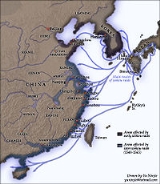
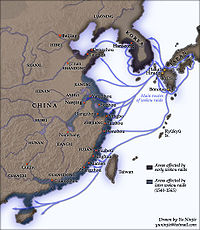
The early phase of Wokou activity began in the 13th century and extended to the second half of the 14th century. Pirates from Japan
Japan
Japan is an island nation in East Asia. Located in the Pacific Ocean, it lies to the east of the Sea of Japan, China, North Korea, South Korea and Russia, stretching from the Sea of Okhotsk in the north to the East China Sea and Taiwan in the south...
focused their raids on the Korean peninsula and spread across the Yellow Sea
Yellow Sea
The Yellow Sea is the name given to the northern part of the East China Sea, which is a marginal sea of the Pacific Ocean. It is located between mainland China and the Korean Peninsula. Its name comes from the sand particles from Gobi Desert sand storms that turn the surface of the water golden...
to China. Ming
Ming Dynasty
The Ming Dynasty, also Empire of the Great Ming, was the ruling dynasty of China from 1368 to 1644, following the collapse of the Mongol-led Yuan Dynasty. The Ming, "one of the greatest eras of orderly government and social stability in human history", was the last dynasty in China ruled by ethnic...
China implemented a policy to forbid civil trade with Japan while maintaining governmental trade, known as Haijin. The Ming court believed that limiting non-government trade would in turn expel the Wokou. Instead, it forced many Chinese merchants to trade with Japan illegally to protect their own interests. This led to the second major phase of Wokou activity which occurred in the early to mid-16th century, where Japanese pirates colluded with their Chinese counterparts and expanded their forces. During this period the composition and leadership of the Wokou changed significantly to include greater numbers of Chinese. At their height in the 1550s, the Wōkòu operated throughout the seas of East Asia
East Asia
East Asia or Eastern Asia is a subregion of Asia that can be defined in either geographical or cultural terms...
, even sailing up large river systems such as the Yangtze
Yangtze River
The Yangtze, Yangzi or Cháng Jiāng is the longest river in Asia, and the third-longest in the world. It flows for from the glaciers on the Tibetan Plateau in Qinghai eastward across southwest, central and eastern China before emptying into the East China Sea at Shanghai. It is also one of the...
.
The term Wokou is a combination of "Wō" (倭) referring to Japanese, and "kòu" , meaning "bandit; enemy; invasion". The general meaning of 倭 is "dwarf", but also was used by official China for "Japan" as 倭國 (literally "dwarf nations") until the 8th century Wa (Japan)
Wa (Japan)
Japanese is the oldest recorded name of Japan. Chinese, Korean, and Japanese scribes regularly wrote Wa or Yamato "Japan" with the Chinese character 倭 until the 8th century, when the Japanese found fault with it, replacing it with 和 "harmony, peace, balance".- Historical references :The earliest...
. The earliest textual reference to the term "Wokou" as a Japanese invader comes from the Korean Gwanggaeto Stele
Gwanggaeto Stele
The stele of King Gwanggaeto of Goguryeo was erected in 414 by King Jangsu as a memorial to his deceased father. It is one of the major primary sources extant for the history of Goguryeo, one of the Three Kingdoms of Korea, and supplies invaluable historical detail on his reign as well as insights...
erected in 414. In modern times, the term Wokou has been used in China
China
Chinese civilization may refer to:* China for more general discussion of the country.* Chinese culture* Greater China, the transnational community of ethnic Chinese.* History of China* Sinosphere, the area historically affected by Chinese culture...
and Korea
Korea
Korea ) is an East Asian geographic region that is currently divided into two separate sovereign states — North Korea and South Korea. Located on the Korean Peninsula, Korea is bordered by the People's Republic of China to the northwest, Russia to the northeast, and is separated from Japan to the...
as a derogatory or propagandic term for Japan
Japan
Japan is an island nation in East Asia. Located in the Pacific Ocean, it lies to the east of the Sea of Japan, China, North Korea, South Korea and Russia, stretching from the Sea of Okhotsk in the north to the East China Sea and Taiwan in the south...
ese invaders.
Constituents
According to the Annals of Joseon DynastyAnnals of Joseon Dynasty
The Annals of the Joseon Dynasty are the annual records of the Joseon Dynasty of Korea, which were kept from 1413 to 1865. The annals, or sillok, comprise 1,893 volumes and are thought to cover the longest continual period of a single dynasty in the world...
in 1395, wokou were commanded by a number of small and medium-sized feudal lords
Daimyo
is a generic term referring to the powerful territorial lords in pre-modern Japan who ruled most of the country from their vast, hereditary land holdings...
of the coastal areas of Japan
Japan
Japan is an island nation in East Asia. Located in the Pacific Ocean, it lies to the east of the Sea of Japan, China, North Korea, South Korea and Russia, stretching from the Sea of Okhotsk in the north to the East China Sea and Taiwan in the south...
and consisted of petty farmers and fishermen. Wokou were said to number around 20–400 ships. The lack of political stability in Japan at the time (see Sengoku period
Sengoku period
The or Warring States period in Japanese history was a time of social upheaval, political intrigue, and nearly constant military conflict that lasted roughly from the middle of the 15th century to the beginning of the 17th century. The name "Sengoku" was adopted by Japanese historians in reference...
) was one of the primary causes of the appearance of wokou.
Controversy regarding Wokou imitators
There are theories regarding imitation wokou, where non-Japanese bandits disguised themselves as Japanese and conducted similar pirate raids. The Stories of Japan in the History of MingHistory of Ming
The History of Ming is one of the official Chinese historical works known as the Twenty-Four Histories of China. It consists of 332 volumes and covers the history of Ming Dynasty from 1368 to 1644, which was written by a number of officials commissioned by the court of Qing Dynasty, with the lead...
(明史日本傳) states that in relation to one particularly extensive raid, "real Japanese comprise of about three in every ten, the remaining seven are the followers".
Some Japanese scholars claim that some wokou were Korean, due to one interesting sentence that exists within a Korean text. In the Annals of the Joseon Dynasty, Sejong Sillok (Hangul
Hangul
Hangul,Pronounced or ; Korean: 한글 Hangeul/Han'gŭl or 조선글 Chosŏn'gŭl/Joseongeul the Korean alphabet, is the native alphabet of the Korean language. It is a separate script from Hanja, the logographic Chinese characters which are also sometimes used to write Korean...
: ; Hanja
Hanja
Hanja is the Korean name for the Chinese characters hanzi. More specifically, it refers to those Chinese characters borrowed from Chinese and incorporated into the Korean language with Korean pronunciation...
: ), Sunmong Lee said, "I hear that in the late period of the Goryeo Dynasty, Wokou were roaming over this land and peasants could not stand against them. However, even though only 1 or 2 out of 10 incidents were caused by real Japanese (Hangul: 왜인, Hanja: 倭人), some of our peasants wore the clothes of Japan, formed a group and caused trouble... in order to stop all evils, there is nothing more urgent than Hopae (a Goryeo means for personal identification)." This is the 'only one' record that documents some imitation wokou as Korean. Because of this record, Some Japanese scholars claim that a portion of the wokou were Korean. However, this particular piece of the record is also somewhat dubious, as Sunmong Lee was not an investigator working against the wokou, and was not alive during the Goryeo Dynasty period. His particular record is based on a rumor he heard, "I hear that.." implying that the speaker is relating hearsay rather than facts. There are no other records indicating any Koreans as imitations of wokou raiders, which indicate that the frequency of Korean wokou imitators was not nearly as high as Sunmong Lee's rumor suggests. In any case, most of the early wokou were of Japanese origin. Incidents relating to imitation wokou (of unknown nationality) were only 0.57% (3 from 529) within the full period of Goryeo dynasty. (Rest 99.43% Wokou incidents from Japanese)
Sunmong Lee’s speech cannot be used to support this theory since it was based on hearsay, not on any source of facts, and that it was mainly intended to make the Korean king at the time strongly aware of the seriousness of public security and the importance of Hopae. The main body of the speech concentrates on how the public security is being contaminated and requires special attention. Different terms were used to distinguish between Wokou and imitation Wokou, 倭寇 and 假倭 respectively. Goryeo-sa states only 3 incidents were caused by imitation Wokou. In addition, There are no Chinese and Japanese, Korean records that document wokou imitators as Korean.
Former Wokou raids
The first raid by Wokou on record occurred in the summer of 1223, on the south coast of GoryeoGoryeo
The Goryeo Dynasty or Koryŏ was a Korean dynasty established in 918 by Emperor Taejo. Korea gets its name from this kingdom which came to be pronounced Korea. It united the Later Three Kingdoms in 936 and ruled most of the Korean peninsula until it was removed by the Joseon dynasty in 1392...
Korea. The history book Goryeosa states that "Japanese (pirates) attacked Gumju". Two more minor attacks are recorded for 1226, and continued intermittently for the next four decades. Most of the Wokou originated from Tsushima
Tsushima Province
was an old province of Japan on Tsushima Island which occupied the area corresponding to modern-day Tsushima, Nagasaki. It was sometimes called .-Political History:...
and Hizen
Hizen Province
was an old province of Japan in the area of Saga and Nagasaki prefectures. It was sometimes called , with Higo Province. Hizen bordered on the provinces of Chikuzen and Chikugo. The province was included in Saikaidō...
. Under diplomatic pressure from the Goryeo government, the Kamakura shogunate
Kamakura shogunate
The Kamakura shogunate was a military dictatorship in Japan headed by the shoguns from 1185 to 1333. It was based in Kamakura. The Kamakura period draws its name from the capital of the shogunate...
made an effort to keep seafaring military groups under control. In 1227 Mutō Sukeyori (武藤資賴), the shogunate's commissioner in Kyūshū
Kyushu
is the third largest island of Japan and most southwesterly of its four main islands. Its alternate ancient names include , , and . The historical regional name is referred to Kyushu and its surrounding islands....
, had ninety suspected brigands decapitated in front of a Goryeo envoy. In 1263, after Tsushima Wokou raided Ungjin
Ungjin
Ungjin, also known as Gomnaru is a former city on the Korean Peninsula. It was located in modern-day Gongju, South Chungcheong province, South Korea. It was the capital of Baekje from AD 475 to 538, during a period when Baekje was under threat from Goguryeo, the previous capital of Wiryeseong ...
, Japanese negotiators reconfirmed the policies of limiting trade and prohibiting piracy.
The period around the Mongol invasions of Japan
Mongol invasions of Japan
The ' of 1274 and 1281 were major military efforts undertaken by Kublai Khan to conquer the Japanese islands after the submission of Goryeo to vassaldom. Despite their ultimate failure, the invasion attempts are of macrohistorical importance, because they set a limit on Mongol expansion, and rank...
was a low point for Wokou activity. This was partly due to the higher degree of military preparedness in Goryeo. They fortified Gumju in 1251 and in 1265. The Kamakura shogunate, for its part, increased its authority in Kyūshū and was better able to mobilise and control former Wokou groups against the threat of Mongol invasion.
As the Kamakura shogunate and Goryeo state both declined following the Mongol invasions, the Wokou again became active. In 1323, for example, a large-scale raid took place in Korean Jeolla
Jeolla
Jeolla was a province in southwestern Korea, one of the historical Eight Provinces of Korea during the Joseon Dynasty. It consisted of the modern South Korean provinces of North Jeolla, South Jeolla and the Special City of Gwangju as well as Jeju Island...
province. Raids such as this developed into full-scale pirate attacks by the end of the 14th century.
The Wokou resumed their activities in earnest in 1350, driven by chaotic conditions and the lack of a strong authority in Japan. For the next half-century, sailing principally from Iki
Iki Province
was a province of Japan in the area of Nagasaki Prefecture. The province which occupied the entire area of Iki Island. It is also known as .- Political History :...
and Tsushima
Tsushima Province
was an old province of Japan on Tsushima Island which occupied the area corresponding to modern-day Tsushima, Nagasaki. It was sometimes called .-Political History:...
, they engulfed the southern half of Goryeo
Goryeo
The Goryeo Dynasty or Koryŏ was a Korean dynasty established in 918 by Emperor Taejo. Korea gets its name from this kingdom which came to be pronounced Korea. It united the Later Three Kingdoms in 936 and ruled most of the Korean peninsula until it was removed by the Joseon dynasty in 1392...
. The worst period was the decade between 1376 and 1385, when no fewer than 174 instances of pirate raids were recorded in Korea. Some involved bands of as many as three thousand penetrating deep into the Korean interior. The raiders repeatedly looted the Korean capital Gaeseong, and on occasion reached as far north as the mouth of the Taedong River
Taedong River
The Taedong River is a large river in North Korea. It rises in the Rangrim Mountains of the country's north. It then flows southwest into Korea Bay at Namp'o. In between, it runs through the country's capital, Pyongyang. Along the river are landmarks such as the Juche Tower and Kim Il-sung...
and the general area of Pyongyang
Pyongyang
Pyongyang is the capital of the Democratic People's Republic of Korea, commonly known as North Korea, and the largest city in the country. Pyongyang is located on the Taedong River and, according to preliminary results from the 2008 population census, has a population of 3,255,388. The city was...
. They looted grain stores and took people away for slavery and ransom. The conditions caused by the Wokou greatly contributed to the downfall of the Goryeo Dynasty in 1392. General Yi Seonggye, founder of the Joseon Dynasty
Joseon Dynasty
Joseon , was a Korean state founded by Taejo Yi Seong-gye that lasted for approximately five centuries. It was founded in the aftermath of the overthrow of the Goryeo at what is today the city of Kaesong. Early on, Korea was retitled and the capital was relocated to modern-day Seoul...
, rose to prominence due to his successes against the Wokou.
Goryeo's King U sought redress in 1375 from the Muromachi shogunate and the cooperation of the shogunal deputy (tandai
Tandai
The term is a Kamakura and Muromachi period colloquialism for any very important governmental, judiciary or military post in a determinate area. During the Kamakura shogunate, examples of tandai in the east of the country were the shikken and the rensho, in the west of the country and in Kyūshū...
探題) in Kyūshū, Imagawa Ryōshun. In 1377 the great statesman Jeong Mong-ju
Jeong Mong-ju
Jeong Mongju , often known by his pen name Poeun, was a Korean civil minister and scholar during the late period of the Goryeo dynasty.-Biography:He was born in Yeongcheon, Gyeongsang province to a family from the Yeongil Jeong clan...
was received warmly by Ryōshun. Several hundred prisoners captured by Wokou were returned to Goryeo. Nevertheless Kyūshū was under the sway of the Southern Court, and neither the shogunate nor its deputy could suppress the pirates as requested despite promises to the contrary. In 1381, for instance, the Muromachi shogunate issued an order prohibiting the akutō (悪党, loosely translated as "outlaws," literally "bad gangs" or "evil political-parties/factions") of the provinces from crossing over to Goryeo and "committing outrages." In 1389 and in 1419, the Koreans attacked the pirate bases on Tsushima. The routes of the Korean attack were guided by the captivated Wokou "池文". The Korean navy killed 114 pirates, caught 21 Wokou, rescued 131 kidnapped Chinese at the Wokou home town, then the pirate raids would be stopped (Ōei Invasion
Oei Invasion
The , known as the Gihae Eastern Expedition in Korea, was the 1419 military expedition from Joseon against pirate bases on Tsushima Island, which is located in the middle of the Korea Strait between the Korean Peninsula and Kyushu....
.).
The Wokou bands were also active in China, where the earliest record of Japanese pirates is from 1302. The economic embargo forced upon Japan by the Qing and later the Ming Dynasty
Ming Dynasty
The Ming Dynasty, also Empire of the Great Ming, was the ruling dynasty of China from 1368 to 1644, following the collapse of the Mongol-led Yuan Dynasty. The Ming, "one of the greatest eras of orderly government and social stability in human history", was the last dynasty in China ruled by ethnic...
made pirate trade the only way to secure Chinese goods, as trade through the Ryūkyū Kingdom
Ryukyu Kingdom
The Ryūkyū Kingdom was an independent kingdom which ruled most of the Ryukyu Islands from the 15th century to the 19th century. The Kings of Ryūkyū unified Okinawa Island and extended the kingdom to the Amami Islands in modern-day Kagoshima Prefecture, and the Sakishima Islands near Taiwan...
was halted by China. Eventually, in 1609 Satsuma seized the kingdom. In 1358, and again in 1363, the raids continued along the entire eastern seaboard, but particularly on the coast of what is now Shandong
Shandong
' is a Province located on the eastern coast of the People's Republic of China. Shandong has played a major role in Chinese history from the beginning of Chinese civilization along the lower reaches of the Yellow River and served as a pivotal cultural and religious site for Taoism, Chinese...
. Toward the end of the Yuan Dynasty
Yuan Dynasty
The Yuan Dynasty , or Great Yuan Empire was a ruling dynasty founded by the Mongol leader Kublai Khan, who ruled most of present-day China, all of modern Mongolia and its surrounding areas, lasting officially from 1271 to 1368. It is considered both as a division of the Mongol Empire and as an...
, the Wokou threat began to intensify. The first Wokou raid of the Ming Dynasty occurred in 1369, in Zhejiang
Zhejiang
Zhejiang is an eastern coastal province of the People's Republic of China. The word Zhejiang was the old name of the Qiantang River, which passes through Hangzhou, the provincial capital...
province.
In response, the Hongwu Emperor
Hongwu Emperor
The Hongwu Emperor , known variably by his given name Zhu Yuanzhang and by his temple name Taizu of Ming , was the founder and first emperor of the Ming Dynasty of China...
sent his commanders to construct a number of forts along the coast and dispatched two envoys to Prince Kanenaga, the Southern Court
Emperor Go-Daigo
Emperor Go-Daigo was the 96th emperor of Japan, according to the traditional order of succession....
's "General of the Western Pacification Command" in Kyūshū. The first, in 1369, threatened an invasion of Japan unless the Wokou raids were stopped. Unimpressed, Prince Kaneyoshi had the Ming envoy killed and refused the demands. However, when the second envoy arrived in 1370, he submitted to the Ming as a "subject." He sent an embassy the next year, returning more than seventy men and women who had been captured at Mingzhou (Ningbo
Ningbo
Ningbo is a seaport city of northeastern Zhejiang province, Eastern China. Holding sub-provincial administrative status, the municipality has a population of 7,605,700 inhabitants at the 2010 census whom 3,089,180 in the built up area made of 6 urban districts. It lies south of the Hangzhou Bay,...
) and Taizhou
Taizhou, Zhejiang
Taizhou is a prefecture-level city in middle eastern Zhejiang province, People's Republic of China...
.
Ming Dynasty tribute system
Taejo of Joseon
Taejo of Joseon , born Yi Seong-gye, whose changed name is Yi Dan, was the founder and the first king of the Joseon Dynasty of Korea, and the main figure in overthrowing the Goryeo Dynasty...
, who made his fame by repelling Wokou, founded the Joseon Dynasty
Joseon Dynasty
Joseon , was a Korean state founded by Taejo Yi Seong-gye that lasted for approximately five centuries. It was founded in the aftermath of the overthrow of the Goryeo at what is today the city of Kaesong. Early on, Korea was retitled and the capital was relocated to modern-day Seoul...
, supplanting the Goryeo
Goryeo
The Goryeo Dynasty or Koryŏ was a Korean dynasty established in 918 by Emperor Taejo. Korea gets its name from this kingdom which came to be pronounced Korea. It united the Later Three Kingdoms in 936 and ruled most of the Korean peninsula until it was removed by the Joseon dynasty in 1392...
regime on the Korean peninsula
Korean Peninsula
The Korean Peninsula is a peninsula in East Asia. It extends southwards for about 684 miles from continental Asia into the Pacific Ocean and is surrounded by the Sea of Japan to the south, and the Yellow Sea to the west, the Korea Strait connecting the first two bodies of water.Until the end of...
. In the same year, the conflict between the Southern and Northern courts in Japan was finally resolved under the auspices of Shogun Ashikaga Yoshimitsu
Ashikaga Yoshimitsu
was the 3rd shogun of the Ashikaga shogunate who ruled from 1368 to 1394 during the Muromachi period of Japan. Yoshimitsu was the son of the second shogun Ashikaga Yoshiakira....
.
Fang Guozhen and Zhang Shicheng
Zhang Shicheng
Zhang Shicheng (1321-1367)was one of the leaders of the Red Turban Rebellion in the late Yuan Dynasty China. Later he established the Kingdom of Dazhou with reigning name Tianyou .-Life:...
, who held sway in Jiangsu
Jiangsu
' is a province of the People's Republic of China, located along the east coast of the country. The name comes from jiang, short for the city of Jiangning , and su, for the city of Suzhou. The abbreviation for this province is "苏" , the second character of its name...
and Zhejiang areas, established bases on the coastal islands. They linked up with the Wokou. There may also have been some Wokou involvement in the rebellion of Hu Weiyong and Liu Xian in 1380.
The Ming reinforced the policy of forbidding Chinese to go overseas and controlled trade with Japan through the tribute system, both policies aimed at monopolising trade and protecting against piracy.
Though diplomatic initiatives brought by China and Korea were successful in gaining the cooperation of the Ashikaga Shogunate
Ashikaga shogunate
The , also known as the , was a Japanese feudal military regime, ruled by the shoguns of the Ashikaga clan.This period is also known as the Muromachi period and gets its name from Muromachi Street of Kyoto where the third shogun Ashikaga Yoshimitsu established his residence...
at its height, it did not put down the Wokou.
They went on raiding China in force until at least 1419. In that year, a large pirate fleet of more than thirty ships assembled in Tsushima and headed north along Korea's Yellow Sea coast. Kept under observation, it was finally ambushed and defeated off Wanghaiguo in Liaodong by a provincial military commander, who was said to have taken between 700 and 1500 heads. After that, the Wokou steered clear of Liaodong, though they hit other areas of China sporadically.
Tsushima Expedition by Korean Joseon Dynasty
In Korea, the Wokou were stemmed by action from regional notables of western Japan, whom the Koreans influenced with concessions. From the end of the Goryeo Dynasty to the beginning of the Joseon DynastyJoseon Dynasty
Joseon , was a Korean state founded by Taejo Yi Seong-gye that lasted for approximately five centuries. It was founded in the aftermath of the overthrow of the Goryeo at what is today the city of Kaesong. Early on, Korea was retitled and the capital was relocated to modern-day Seoul...
, the coastal regions of Korea were often the subject of Wokou raids. The Joseon Dynasty ordered a strengthening of Korean naval defenses, a strategic response to the constant threat posed by the pirates.
Joseon also asked the Ashikaga Shogunate
Ashikaga shogunate
The , also known as the , was a Japanese feudal military regime, ruled by the shoguns of the Ashikaga clan.This period is also known as the Muromachi period and gets its name from Muromachi Street of Kyoto where the third shogun Ashikaga Yoshimitsu established his residence...
and its deputy on Kyūshū
Kyushu
is the third largest island of Japan and most southwesterly of its four main islands. Its alternate ancient names include , , and . The historical regional name is referred to Kyushu and its surrounding islands....
to suppress the activity of the pirates, favoring legitimate traders. In exchange for certain privileges, it gave authority to Sō Sadashige over ships sailing from Japan to Korea (the Sō clan
So clan
The Sō were a Japanese clan claiming descent from Taira Tomomori. The clan governed and held Tsushima Island from the 13th-century through the late 19th-century, from the Kamakura period until the end of the Edo period and the Meiji restoration....
was the de facto ruler of Tsushima Province
Tsushima Province
was an old province of Japan on Tsushima Island which occupied the area corresponding to modern-day Tsushima, Nagasaki. It was sometimes called .-Political History:...
). After his death, the power was seized from Sadashige's infant son Sadamori (Tsutsukumaru) by Soda Saemontarō, a powerful pirate leader. Suffering from famine, pirates on Tsushima invaded Ming China in 1419. On the way to China, they raided Korea's Chungcheong
Chungcheong
Chungcheong was one of the eight provinces of Korea during the Joseon Dynasty. Chungcheong was located in the southwest of Korea...
and Hwanghae
Hwanghae
Hwanghae was one of the Eight Provinces of Korea during the Joseon Dynasty. Hwanghae was located in the northwest of Korea. The provincial capital was Haeju.The regional name for the province was Haesŏ .-History:...
provinces after their requests for food were dismissed.
After receiving reports of these incidents, the Korean court proposed an expedition to Tsushima. On June 9, 1419, King Taejong
Taejong of Joseon
King Taejong was the third king of the Joseon Dynasty in Korea and the father of King Sejong the Great.-Founding of Joseon:...
declared war against Tsushima and Wokou, citing that it belonged to Joseon Korea. The Ōei Invasion
Oei Invasion
The , known as the Gihae Eastern Expedition in Korea, was the 1419 military expedition from Joseon against pirate bases on Tsushima Island, which is located in the middle of the Korea Strait between the Korean Peninsula and Kyushu....
resulted in their conquering Tsushima Island
Tsushima Island
Tsushima Island is an island of the Japanese Archipelago situated in the middle of the Tsushima Strait at 34°25'N and 129°20'E. The main island of Tsushima was once a single island, but the island was divided into two in 1671 by the Ōfunakosiseto canal and into three in 1900 by the Manzekiseto canal...
. Following negotiations with Korea, the Sō clan agreed to make efforts to stop coastal pirate raids in exchange for limited trading privileges and access to three coastal Korean ports.
Later Wokou raids
The 1550s and 1560s saw a resurgence of the Wokou tide. The period of greatest Wokou activity was during the Jiajing and WanliWanli
Wanli may refer to:* Wanli Emperor , Chinese emperor of the Ming Dynasty* Wanli District , district of Nanchang, Jiangxi, People's Republic of China* Wanli District, New Taipei , a district in New Taipei City, Republic of China...
eras, also some of the weakest in Ming history. In the period from 1369 to 1466, the Wokou raided Zhejiang 34 times, on average once every three years. By comparison, in the period 1523 to 1588, they made 66 raids, on average once a year.
In contrast with previous Wokou, however, the pirate bands of the middle 16th century no longer consisted preponderantly of Japanese. Although Wokou remained the common label by which they were identified, most of these bandits were in fact Chinese.
The term often used for Japanese pirates was bahan (Portuguese transcription: bafan). The term is written as bafan or pofan ("tattered sails"). According to the Zhouhai Tubian, Satsuma
Satsuma Province
was an old province of Japan that is now the western half of Kagoshima Prefecture on the island of Kyūshū. Its abbreviation is Sasshū .During the Sengoku Period, Satsuma was a fief of the Shimazu daimyo, who ruled much of southern Kyūshū from their castle at Kagoshima city.In 1871, with the...
, Higo
Higo Province
Higo Province was an old province of Japan in the area that is today Kumamoto Prefecture on the island of Kyūshū. It was sometimes called , with Hizen Province. Higo bordered on Chikugo, Bungo, Hyūga, Ōsumi, and Satsuma Provinces....
, and Nagato
Nagato Province
, often called , was a province of Japan. It was at the extreme western end of Honshū, in the area that is today Yamaguchi Prefecture. Nagato bordered on Iwami and Suō Provinces....
were the Japanese provinces that were the most prolific breeding grounds of the pirates; next came Ōsumi
Osumi Province
was an old province of Japan in the area that is today the eastern part of Kagoshima Prefecture. It was sometimes called . Ōsumi bordered on Hyūga and Satsuma Provinces.Osumi's ancient capital was near modern Kokubu...
, Chikuzen
Chikuzen Province
was an old province of Japan in the area that is today part of Fukuoka Prefecture in Kyūshū. It was sometimes called , with Chikugo Province. Chikuzen bordered Buzen, Bungo, Chikugo, and Hizen Provinces....
, Chikugo
Chikugo Province
is the name of a former province of Japan in the area that is today the southern part of Fukuoka Prefecture on Kyūshū. It was sometimes called , with Chikuzen Province...
, Hakata
Hakata
Hakata may refer to:*Hakata-ku, Fukuoka, a ward in Fukuoka Prefecture, Japan.**Hakata ningyō , traditional Japanese clay dolls, originally from Hakata*Hakata Station, a large train station in Fukuoka...
, Hyuga
Hyuga Province
was an old province of Japan on the east coast of Kyūshū, corresponding to the modern Miyazaki Prefecture. It was sometimes called or . Hyūga bordered on Bungo, Higo, Ōsumi, and Satsuma Province.The ancient capital was near Saito.-Historical record:...
, Settsu
Settsu Province
was a province of Japan, which today comprises the eastern part of Hyōgo Prefecture and the northern part of Osaka Prefecture. It was also referred to as or .Osaka and Osaka Castle were the main center of the province.-History:...
, Harima
Harima Province
or Banshu was a province of Japan in the part of Honshū that is the southwestern part of present-day Hyōgo Prefecture. Harima bordered on Tajima, Tamba, Settsu, Bizen, and Mimasaka Provinces. Its capital was Himeji....
, and the island of Tanegashima
Tanegashima
is an island lying to the south of Kyushu, in southern Japan, and is part of Kagoshima Prefecture. The island is the second largest of the Ōsumi Islands....
. Natives of Buzen
Buzen Province
was an old province of Japan in northern Kyūshū in the area of Fukuoka Prefecture and Ōita Prefecture. It was sometimes called , with Bungo Province. Buzen bordered on Bungo and Chikuzen Provinces....
, Bungo
Bungo Province
was a province of Japan in eastern Kyūshū in the area of Ōita Prefecture. It was sometimes called , with Buzen Province. Bungo bordered Buzen, Hyūga, Higo, Chikugo, and Chikuzen Provinces.-History:...
and Izumi
Izumi Province
was a province of Japan. It is also referred to as . It lay in Kinai, and its area today composes the south-western part of Osaka Prefecture . The Ōshōji in Sakai was the border with Settsu Province, until the beginning of the Meiji period, when the boundary was changed to be at the Yamato River...
also took part in raids on occasion, often when the opportunity of joining a Satsuma expedition to China presented itself.
An inequitable taxation and property system, combined with endemic corruption, forced many Chinese farmers in Fujian
Fujian
' , formerly romanised as Fukien or Huguing or Foukien, is a province on the southeast coast of mainland China. Fujian is bordered by Zhejiang to the north, Jiangxi to the west, and Guangdong to the south. Taiwan lies to the east, across the Taiwan Strait...
, Guangdong
Guangdong
Guangdong is a province on the South China Sea coast of the People's Republic of China. The province was previously often written with the alternative English name Kwangtung Province...
and Zhejiang to seek livelihoods on the sea. The Ming ban on ocean-going, selectively enforced by local authorities, made these people dissidents. Sometimes pirates and sometimes merchants, they used their local knowledge to make successful raiding expeditions. In 1533 the Ming Ministry of War complained that armed fleets were pillaging at will along the coast. Pirates often also engaged in illegal smuggling operations and raided rival merchant marine. During the 1540s the disparate groups of Chinese pirates and traders became more organised. They gathered on islands off the eastern coastline and colluded with the Japanese.
In this way, the acts of piracy and overseas trade were interconnected. In 1523, for example, the Hosokawa
Hosokawa clan
The ' was a Japanese samurai clan, descended from Emperor Seiwa and a branch of the Minamoto clan, by the Ashikaga clan. It produced many prominent officials in the Ashikaga shogunate's administration. In the Edo period, the Hosokawa clan was one of the largest landholding daimyo families in Japan...
trading party in Ningbo
Ningbo
Ningbo is a seaport city of northeastern Zhejiang province, Eastern China. Holding sub-provincial administrative status, the municipality has a population of 7,605,700 inhabitants at the 2010 census whom 3,089,180 in the built up area made of 6 urban districts. It lies south of the Hangzhou Bay,...
attacked its rival mission from the Ōuchi clan and then proceeded to loot the city. It seized a number of ships, and set sail. The Ming commander sent in pursuit was killed in a sea battle.
Proposals to appoint a governor with jurisdiction over coastal defense first appeared in 1524 after the Ningbo affair. Supporters argued that the Japanese were as much a threat as the Mongols and that administrative arrangements in effect on the northern borders should therefore be applied to the coast as well. In 1529, after a garrison on the coast had rioted and fled to join pirate bands, a censor was sent to inspect coastal defenses, to coordinate the suppression of piracy, and to punish the leaders of the riot. In 1531 this official was transferred and not replaced.
Zhu Wan
From 1539, the tribute trade system broke down altogether. The size of Japanese fleets sailing from Japan to trade with private Chinese merchants grew each year and so did the associated violence. The typical Wokou attack at this time was for the sea-based raiders to make swift assaults from their island strongholds and then retreat to their ships. In many cases violent altercations were the result of conflict over payment of debts by wealthy families to their trading creditors. One of the Xie family's estates in ShaoxingShaoxing
Shaoxing is a prefecture-level city in northeastern Zhejiang province, People's Republic of China. Located on the south bank of the Qiantang River estuary, it borders Ningbo to the east, Taizhou to the southeast, Jinhua to the southwest, and Hangzhou to the west. It was once known as "越"...
was looted and burned in the summer of 1547 for this reason.
In November 1547 Zhu Wan (朱纨) was put in charge of the of Zhejiang and Fujian, to eradicate the perceived cause of piracy - overseas trade. In February 1548 a large body of pirates raided the coastal counties of Ningbo and Taizhou, killing, burning, and looting without encountering any effective resistance. Zhu arrived in Ningbo in April and shortly thereafter, he led an attack on a Wokou harbour at Shuangyu Island. In March 1549 he attacked a large merchant fleet anchored off the coast of southern Fujian.
Despite Zhu's successes, he was dismissed from office and committed suicide in January 1550 during impeachment proceedings. His coastal defense fleet was dispersed.
An interesting European view of the events can be found in the account of Galeote Pereira
Galeote Pereira
Galeote Pereira was a 16th century Portuguese soldier of fortune who has left us one of the earliest accounts by a westerner of life in China's Ming Dynasty, indeed the first detailed observation of that civilisation by a non-cleric since that of Marco Polo....
(one of the Portuguese sailors captured in March 1549), and the book of the Dominican Gaspar da Cruz
Gaspar da Cruz
Gaspar da Cruz was a Portuguese Dominican friar born in Évora, who traveled to Asia and wrote one of the first detailed European accounts about China.-Biography:Gaspar da Cruz was admitted to the Order of Preachers convent of Azeitão...
(1569), who apparently had access not only to Pereira's story but to other reports as well.
Wang Zhi
By the 1550s the Chinese merchant Wang ZhiWang Zhi
Wang Zhi was a Chinese pirate and trader of the 16th century, one of the chief named and known figures among the wokou prevalent at the time...
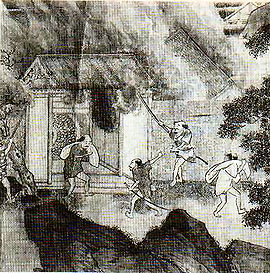
had organised a large trading consortium and commanded a well-armed fleet with sailors and soldiers to protect it. Between 1539 and 1552 he cooperated with local military intendants on several occasions, expecting relaxation of the ban on overseas trade. When the ban was instead tightened in 1551, Wang began organising large attacks on official establishments, granaries, county and district treasuries, and on the surrounding countryside, which was thoroughly pillaged. Brigandage along the coast of Zhejiang became so widespread and common that towns and villages had to erect palisades for security.
In the spring of 1552 raiding parties of several hundred people attacked all along the coast of Zhejiang. In the summer of 1553 Wang Zhi assembled a large fleet of hundreds of ships to raid the coast of Zhejiang from Taizhou north. Several garrisons were briefly taken, and several district seats were besieged. Early in 1554 fortified bases were established along the coast of Zhejiang from which larger raiding parties set out on long inland campaigns. By 1555 they were approaching the great cities of the Yangzi Delta, Hangzhou
Hangzhou
Hangzhou , formerly transliterated as Hangchow, is the capital and largest city of Zhejiang Province in Eastern China. Governed as a sub-provincial city, and as of 2010, its entire administrative division or prefecture had a registered population of 8.7 million people...
, Suzhou
Suzhou
Suzhou , previously transliterated as Su-chou, Suchow, and Soochow, is a major city located in the southeast of Jiangsu Province in Eastern China, located adjacent to Shanghai Municipality. The city is situated on the lower reaches of the Yangtze River and on the shores of Taihu Lake and is a part...
, and Nanjing
Nanjing
' is the capital of Jiangsu province in China and has a prominent place in Chinese history and culture, having been the capital of China on several occasions...
. Wokou raiders had established fortified bases in various towns and forts on the coast of Zhejiang and garrisoned them with a combined force of 20,000 men.
The two Chinese commanders most active in resisting the Wokou were Qi Jiguang
Qi Jiguang
Qi Jiguang was a Chinese military general and national hero during the Ming Dynasty. He was best remembered for his courage and leadership in the fight against Japanese pirates along the east coast of China, as well as his reinforcement work on the Great Wall of China.-Early life:Qi Jiguang was...
and Yu Dayou
Yu Dayou
Yú Dàyóu was a Chinese general during the Ming Dynasty, best known for the suppression of wokou piracy along China's southeastern coast....
. Both men were from coastal provinces and had good knowledge of naval warfare. Qi organised a force of some 4000, known as the "Qi Family Army", made up mostly of farmers and miners. He won a succession of victories in 1555 in defending Taizhou. Yu Dayou's first significant victory was in 1553, when his marines stormed the island of Putuoshan and expelled the Wokou camp there. Two years later, he killed some two thousand Wokou north of Jiaxing
Jiaxing
Jiaxing is a prefecture-level city in northern Zhejiang province of Eastern China. Lying on the Grand Canal of China, Jiaxing borders Hangzhou to the southwest, Huzhou to the west, Shanghai to the northeast, and the province of Jiangsu to the north....
, winning the greatest victory in the Wokou wars.
Hideyoshi
When Toyotomi HideyoshiToyotomi Hideyoshi
was a daimyo warrior, general and politician of the Sengoku period. He unified the political factions of Japan. He succeeded his former liege lord, Oda Nobunaga, and brought an end to the Sengoku period. The period of his rule is often called the Momoyama period, named after Hideyoshi's castle...
assumed the Regency of Japan in the 1580s, the Ming and the Regent worked together to stop the raids, and were very successful. However, once Hideyoshi ended the bloodline of the Hōjō clan
Late Hojo clan
The ' was one of the most powerful warrior clans in Japan in the Sengoku period and held domains primarily in the Kantō region.The clan is traditionally reckoned to be started by Ise Shinkurō, who came from a branch of the prestigious Ise clan, a family in the direct employment of the Ashikaga...
in Japan, he demanded from the Joseon Dynasty in Korea the right of passage to invade China. Korea refused, and Hideyoshi invaded Korea and Manchuria; the subsequent series of battles are known as the Japanese invasions of Korea (1592–1598). The term Wokou was used by both Chinese and Korean troops in reference to the invasion force of Toyotomi Hideyoshi. Although initially successful in the invasion, Japan was to suffer great losses at sea by the Korean navy under the command of Admiral Yi Sun-sin
Yi Sun-sin
Yi Sun-shin was a Korean naval commander, famed for his victories against the Japanese navy during the Imjin war in the Joseon Dynasty, and is well-respected for his exemplary conduct on and off the battlefield not only by Koreans, but by Japanese Admirals as well...
of Jeolla
Jeolla
Jeolla was a province in southwestern Korea, one of the historical Eight Provinces of Korea during the Joseon Dynasty. It consisted of the modern South Korean provinces of North Jeolla, South Jeolla and the Special City of Gwangju as well as Jeju Island...
(Korean province). As supplies and reinforcements were prevented from landing, the samurai armies were eventually forced into retreat by the combined Chinese and Korean armies.
Decline of the Wokou
The presence of the Wokou eventually declined. There are several theories about the cause of the decline.Maritime trade
As a general rule, most of the Wokou began returning to more traditional seafaring activities as enforcement of the bans on maritime trade subsided. There is anecdotal evidence that the Portuguese were given permission to settle MacauMacau
Macau , also spelled Macao , is, along with Hong Kong, one of the two special administrative regions of the People's Republic of China...
in the 1550s in exchange for cooperation with the Ming authorities against the Wokou. There are two accounts of anti-piracy activity by the Portuguese. The first dates from the 1520s and is recounted in a letter to Zhu Wan, one of the leaders of the anti-piracy campaigns. The second account is better documented and discusses a 1564 joint Chinese-Portuguese action in the Pearl River Delta
Pearl River Delta
The Pearl River Delta , Zhujiang Delta or Zhusanjiao in Guangdong province, People's Republic of China is the low-lying area surrounding the Pearl River estuary where the Pearl River flows into the South China Sea...
.
Portuguese influence
The acceptance of the Portuguese resulted in the relaxing of anti-trade restrictions, particularly in the region surrounding CantonGuangzhou
Guangzhou , known historically as Canton or Kwangchow, is the capital and largest city of the Guangdong province in the People's Republic of China. Located in southern China on the Pearl River, about north-northwest of Hong Kong, Guangzhou is a key national transportation hub and trading port...
. The presence of the better armed Portuguese ships may have served to decrease pirate activity. Additionally, the accommodation with the Portuguese contributed to the demise of the tribute-trade system, which increased opportunities for legitimate Chinese traders as well. Another factor was that the Portuguese were able to sell tropical goods from Indonesia
Indonesia
Indonesia , officially the Republic of Indonesia , is a country in Southeast Asia and Oceania. Indonesia is an archipelago comprising approximately 13,000 islands. It has 33 provinces with over 238 million people, and is the world's fourth most populous country. Indonesia is a republic, with an...
and India
India
India , officially the Republic of India , is a country in South Asia. It is the seventh-largest country by geographical area, the second-most populous country with over 1.2 billion people, and the most populous democracy in the world...
at a better price than the Wokou, many of whom were smugglers before pirates. The cost of illegal activity made the Wokou unable to compete with the Portuguese and drove the Wokou back into legitimate seafaring activities.
Korean influence
Korea's peace and official trade policy led to control of the Wokou in the late 15th century to early 16th century. After the Korean expedition of TsushimaTsushima
-Places:* Tsushima, Nagasaki, a city in Nagasaki Prefecture * Tsushima Basin, also known as Ulleung Basin, located at the juncture of the Sea of Japan and the Korea Strait* Tsushima Island, part of Nagasaki Prefecture...
in 1419, Wokou activity in Korea declined. In 1426, King Sejong changed his offensive policy to a peaceful policy, and opened three ports for official trade with Japan. In 1443, Korea and Japan signed the Treaty of Gyehae
Treaty of Gyehae
Also called in Japan, the Gyehae Treaty was signed in 1443 between the Joseon dynasty and Sō Sadamori as a means of controlling Japanese piracy and legitimizing trade between Tsushima island and three Korean ports.-Precedents:...
as a means of controlling Japanese piracy and legitimizing trade between Tsushima Island and a Korean port, and decided to set up the Japanese special trading region called Waegwan
Waegwan
Waegwan is the seat of government for Chilgok County, North Gyeongsang province, South Korea. It consists primarily of the administrative district of Waegwan-eup. It is situated on both sides of the Nakdong River, which is traversed by railroad, automobile and pedestrian bridges.Waegwan is home...
(倭館). Through the Joseon dynasty
Joseon Dynasty
Joseon , was a Korean state founded by Taejo Yi Seong-gye that lasted for approximately five centuries. It was founded in the aftermath of the overthrow of the Goryeo at what is today the city of Kaesong. Early on, Korea was retitled and the capital was relocated to modern-day Seoul...
policies, Wokou activity was brought under control, allowing for a peaceful relationship between Korea and Japan.
In 1510, Japanese traders initiated an uprising against Joseon's stricter policies on Japanese traders from Tsushima and Iki coming to Busan
Busan
Busan , formerly spelled Pusan is South Korea's second largest metropolis after Seoul, with a population of around 3.6 million. The Metropolitan area population is 4,399,515 as of 2010. It is the largest port city in South Korea and the fifth largest port in the world...
, Ulsan
Ulsan
Ulsan , officially the Ulsan Metropolitan City, is South Korea's seventh largest metropolis with a population of over 1.1 million. It is located in the south-east of the country, neighboring Busan to the south and facing Gyeongju to the north and the Sea of Japan to the east.Ulsan is the...
and Jinhae
Jinhae
Jinhae is a district in Changwon City, South Korea. This region is served by the Korean National Railroad, and is famous for its annual cherry blossom festival every spring....
to trade. The So Clan supported the uprising, but it was soon crushed by Korean army. The uprising was later came to be known as the "Japanese riots in three-ports" (삼포왜란, 三浦倭亂).
The Treaty of Imsin, restrictive treaty, was re-imposed under the direction of King Jungjong
Jungjong of Joseon
Jungjong of Joseon , born Yi Yeok, ruled during the 16th century in what is now Korea. He succeeded his half-brother, Yeonsangun, because of the latter's tyranical misrule, which culminated in a coup placing Jungjong on the throne.-Jo Gwang-jo's reforms:On the day Yeonsangun was deposed, soldiers...
in 1512, but only under strictly limited terms, and only twenty-five ships were allowed to visit Joseon annually until "Japanese riots in Saryangjin" (사량진왜변, 蛇梁鎭倭變) in 1544. In 1547, Treaty of Jeongmi was imposed, and Korea was on the alert for troubles by Japanese. In 1555, Wokou raided the coastal of Jeolla
Jeolla
Jeolla was a province in southwestern Korea, one of the historical Eight Provinces of Korea during the Joseon Dynasty. It consisted of the modern South Korean provinces of North Jeolla, South Jeolla and the Special City of Gwangju as well as Jeju Island...
province, but it was soon crushed by Korean army again. The So Clan apologized to Korea for the riot of some pirates' acts, and requested the reopening of diplomatic relations. The Korean court complied with the request, and this relationship was maintained until Japanese invasions of Korea (1592–1598).
Japanese influence
Toyotomi HideyoshiToyotomi Hideyoshi
was a daimyo warrior, general and politician of the Sengoku period. He unified the political factions of Japan. He succeeded his former liege lord, Oda Nobunaga, and brought an end to the Sengoku period. The period of his rule is often called the Momoyama period, named after Hideyoshi's castle...
served as a great deterrent to Wokou activities. Two regulations in particular damaged the Wokou raids, the first of which was the sword hunt
Sword hunt
Several times in Japanese history, the new ruler sought to ensure his position by calling a '. Armies would scour the entire country, confiscating the weapons of the enemies of the new regime. In this manner, the new ruler sought to ensure that no one could take the country by force as he had just...
put in motion in 1588. The Sword Hunt was a major confiscation of all weaponry in the storage of peasants and turned over to the daimyo
Daimyo
is a generic term referring to the powerful territorial lords in pre-modern Japan who ruled most of the country from their vast, hereditary land holdings...
. This took away the possibility of making war by people suspected by Hideyoshi. Obscure daimyos whose loyalty was in question or religious establishments that possessed the capabilities to arm a rebellion were all purged in an operation that has parallels with the Dissolution of the Monasteries
Dissolution of the Monasteries
The Dissolution of the Monasteries, sometimes referred to as the Suppression of the Monasteries, was the set of administrative and legal processes between 1536 and 1541 by which Henry VIII disbanded monasteries, priories, convents and friaries in England, Wales and Ireland; appropriated their...
. In effect, this took away the means by which Wokou could arm and supply themselves. The other, lesser known, ordinance was a move aimed directly at the Wokou. Representatives of the daimyo sought to obtain written oaths that no seafarer undertook piracy. If any daimyo should fail to obey this order and allow Wokou to continue their craft, his fief
Han (Japan)
The or domain was the name of the estate belonging to a warrior in Japan after the 17th century. The fiefs of the daimyos of the samurai class of Japan during the Edo period were called han.-Edo period:...
would be confiscated.
Notable individuals
- Akibatsu, a wokou chieftain
- Matsuura TakanobuMatsuura Takanobuor Taqua Nombo was a 16th century Japanese samurai and 25th hereditary lord of the Matsuura clan of Hirado. He should not be confused with Matsuura Takanobu , the 4th daimyo of Hirado Domain under the Tokugawa shogunate....
(松浦隆信) - Wang Zhi, a Chinese "wokou", notable for allegedly being aboard the ship of Fernão Mendes PintoFernão Mendes PintoFernão Mendes Pinto was a Portuguese explorer and writer. His exploits are known through the posthumous publication of his memoir Pilgrimage in 1614, an autobiographical work whose truthfulness is nearly impossible to assess...
- Li Dan, a wokou merchant
- Zheng ZhilongZheng ZhilongZheng Zhilong also known as Nicholas Iquan Gaspard, a native of Nan'an, Fujian, China. He was a Chinese merchant, pirate and admiral for the Ming Empire. He was the father of Zheng Chenggong , also a military leader. Under the Qing Dynasty, Zheng was elevated to the rank of Count of the Second Rank...
a Chinese "wokou" which later became a countCountA count or countess is an aristocratic nobleman in European countries. The word count came into English from the French comte, itself from Latin comes—in its accusative comitem—meaning "companion", and later "companion of the emperor, delegate of the emperor". The adjective form of the word is...
under the Qing DynastyQing DynastyThe Qing Dynasty was the last dynasty of China, ruling from 1644 to 1912 with a brief, abortive restoration in 1917. It was preceded by the Ming Dynasty and followed by the Republic of China....
; father of KoxingaKoxingaKoxinga is the customary Western spelling of the popular appellation of Zheng Chenggong , a military leader who was born in 1624 in Hirado, Japan to Zheng Zhilong, a Chinese merchant/pirate, and his Japanese wife and died in 1662 on the island of Formosa .A Ming loyalist and the arch commander of... - Yan Siqi
See also
- Gihae Eastern Expedition
- List of China-related topics
- List of Japan-related topics
- List of Korea-related topics
- List of tributaries of Imperial China
- History of ChinaHistory of ChinaChinese civilization originated in various regional centers along both the Yellow River and the Yangtze River valleys in the Neolithic era, but the Yellow River is said to be the Cradle of Chinese Civilization. With thousands of years of continuous history, China is one of the world's oldest...
- History of JapanHistory of JapanThe history of Japan encompasses the history of the islands of Japan and the Japanese people, spanning the ancient history of the region to the modern history of Japan as a nation state. Following the last ice age, around 12,000 BC, the rich ecosystem of the Japanese Archipelago fostered human...
- History of KoreaHistory of KoreaThe Korean Peninsula was inhabited from the Lower Paleolithic about 400,000-500,000 years ago. Archeological evidence indicates that the presence of modern humans in northeast Asia dates to 39,000 years ago. The earliest known Korean pottery dates to around 8000 BC, and the Neolithic period began...
- Piracy in the Strait of MalaccaPiracy in the Strait of MalaccaPiracy in the Strait of Malacca has historically been an unresolved threat to ship owners and the mariners who ply the 900 km-long sea lane...
- Japanese whaling
Literature
Primary sources:- Zheng Ruohui, Zhouhai Tubian (籌海図編)
- Hŭi-gyŏng Song, Shōsuke Murai Rōshōdō Nihon kōroku : Chōsen shisetsu no mita chūsei Nihon (老松堂日本行錄 : 朝鮮使節の見た中世日本) Iwanami Shoten, Tōkyō, 1987. ISBN 9784003345412
Secondary sources:
- So, Kwan-wai. Japanese Piracy in Ming China During the sixteenth Century. Michigan State University PressMichigan State University PressMichigan State University Press, founded in 1947, is the scholarly publishing arm of Michigan State University. During the past six decades it has become a vital part of the institution's land-grant mission and is a catalyst for positive intellectual, social, and technological change through the...
, East Lansing, 1975. ISBN 0870131796 - Boxer, C.R. “Piracy in the South China Sea”, History TodayHistory TodayHistory Today is an illustrated history magazine. Published monthly in London since January 1951, it is the world's leading, and possibly oldest, history magazine. Its successful mission has always been to present serious and authoritative history to as wide a public as possible...
, XXX, 12 (December), p. 40-44. - Stephen TurnbullStephen Turnbull (historian)Stephen Richard Turnbull is a historian specializing in eastern military history, especially the samurai of Japan. The books he wrote are mainly on Japanese and Mongolian subjects.He attended Cambridge University where he gained his first degree...
"Samurai: The World of the Warrior" Osprey PublishingOsprey PublishingOsprey Publishing is an Oxford-based publishing company specializing in military history. Predominantly an illustrated publisher, many of their books contain full-colour artwork plates, maps and photographs, and the company produces over a dozen ongoing series, each focusing on a specific aspect of...
, Oxford, 2003, p. 155-157. ISBN 1841767409 (Includes an English translation of Galeote PereiraGaleote PereiraGaleote Pereira was a 16th century Portuguese soldier of fortune who has left us one of the earliest accounts by a westerner of life in China's Ming Dynasty, indeed the first detailed observation of that civilisation by a non-cleric since that of Marco Polo....
's report and Gaspar da CruzGaspar da CruzGaspar da Cruz was a Portuguese Dominican friar born in Évora, who traveled to Asia and wrote one of the first detailed European accounts about China.-Biography:Gaspar da Cruz was admitted to the Order of Preachers convent of Azeitão...
' book, with C.R. Boxer's comments)
External links
- "Tribute and Trade", KoreanHistoryProject.org