

Kamikaze

Encyclopedia
The ˌkamiˈkaːzɛ were suicide attack
s by military aviators
from the Empire of Japan
against Allied
naval vessels in the closing stages of the Pacific campaign
of World War II
, designed to destroy as many warship
s as possible.
Kamikaze pilots would attempt to crash their aircraft into enemy ships in what was called a "Body Attack" (体当たり; 体当り) taiatari— in planes often laden with explosives, bomb
s, torpedo
es and full fuel tank
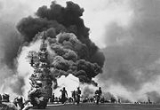
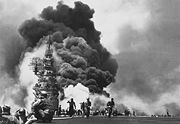
s. The aircraft's normal functions (to deliver torpedoes or bombs or shoot down other aircraft) were put aside, and the planes were converted to what were essentially manned missiles in an attempt to reap the benefits of greatly increased accuracy and payload over that of normal bombs. The goal of crippling as many Allied ships as possible, particularly aircraft carriers, was considered critical enough to warrant the combined sacrifice of pilots and aircraft.
These attacks, which began in October 1944, followed several critical military defeats for the Japanese. They had long lost aerial dominance due to outdated aircraft and the loss of experienced pilots. On a macroeconomic scale, Japan experienced a decreasing capacity to wage war, and a rapidly declining industrial capacity
relative to the United States. The Japanese government expressed its reluctance to surrender. In combination, these factors led to the use of kamikaze tactics as Allied forces advanced towards the Japanese home islands
.
 While the term "kamikaze" usually refers to the aerial strikes, the term has sometimes been applied to various other intentional suicide attacks. The Japanese military also used or made plans for Japanese Special Attack Units
, including those involving submarines, human torpedoes
, speedboats and divers
. Nazi Germany formed their own group of suicide aircraft pilots called the Leonidas Squadron
, but the German commanders demonstrated a greater reluctance to use them.
Although kamikaze was the most common and best-known form of Japanese suicide attack during World War II, they were similar to the "banzai charge
" used by Japanese infantrymen (foot soldiers). The main difference between kamikaze and banzai is that death was inherent to the success of a kamikaze attack, whereas a banzai charge was only potentially fatal – that is, the infantrymen hoped to survive but did not expect to. Western sources often incorrectly consider Operation Ten-Go
as a kamikaze operation, since it occurred at the Battle of Okinawa
along with the mass waves of kamikaze planes; however, banzai is the more accurate term, since the aim of the mission was for battleship Yamato
to beach herself and provide support to the island defenders, as opposed to ramming and detonating among enemy naval forces. The tradition of death instead of defeat, capture, and perceived shame was deeply entrenched in Japanese military culture. It was one of the primary traditions in the samurai
life and the Bushido
code: loyalty
and honor until death.
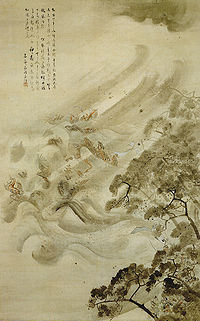 The Japanese word Kamikaze is usually translated as "divine wind" (kami
is the word for "god", "spirit", or "divinity", and kaze for "wind"). The word kamikaze originated as the name of major typhoon
s in 1274 and 1281, which dispersed Mongolian invasion
fleets.
In Japanese, the formal term used for units carrying out suicide attacks during 1944–45 is tokubetsu kōgeki tai (特別攻撃隊), which literally means "special attack unit". This is usually abbreviated to tokkōtai (特攻隊). More specifically, air suicide attack units from the Imperial Japanese Navy
were officially called shinpū tokubetsu kōgeki tai (神風特別攻撃隊, "divine wind special attack units"). Shinpū is the on-reading (on'yomi or Chinese-derived pronunciation) of the same characters
that form the word kamikaze in Japanese. During World War II, the pronunciation kamikaze was used in Japan only informally in relation to suicide attacks, but after the war this usage gained acceptance worldwide and was re-imported into Japan. As a result, the special attack units are sometimes known in Japan as kamikaze tokubetsu kōgeki tai.
Since the end of the war, the term kamikaze has sometimes been used for other kinds of attack in which an attacker is deliberately sacrificed. These include a variety of suicide attacks, in other historical contexts, such as the proposed use of Selbstopfer aircraft by Nazi Germany
and various suicide attack
s by terrorist organizations around the world (such as the 11 September 2001 attacks), although kamikaze pilots attacked only military buildings/ships, while terrorists attack mostly civilian facilities. In English, the word kamikaze may also be used in a hyperbolic
or metaphor
ical fashion to refer to non-fatal actions which result in significant loss for the attacker, such as injury or the end of a career.
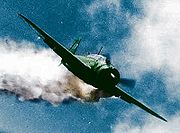
 Prior to the formation of kamikaze units, deliberate crashes had been used as a last resort when a pilot's plane was severely damaged and he did not want to risk being captured, or he wanted to do as much damage to the enemy as possible since he was crashing anyway; this was the case in both the Japanese and Allied air forces. According to Axell & Kase, these suicides "were individual, impromptu decisions by men who were mentally prepared to die." In most cases, there is little evidence that these hits were more than accidental collisions, of the kind that sometimes happen in intense sea-air battles. One example of this occurred on 7 December 1941 during the attack on Pearl Harbor
. First Lieutenant
Fusata Iida’s plane had been hit and was leaking fuel, when he apparently used it to make a suicide attack on Kaneohe Naval Air Station
. Before taking off, he had told his men that if his plane was badly damaged he would crash it into a "worthy enemy target".
The carrier battles in 1942, particularly Midway
, had inflicted irreparable damage on the Imperial Japanese Navy Air Service
(IJNAS), such that they could no longer put together a large number of fleet carriers with well-trained aircrews. Japanese planners had assumed a quick war and were ill-prepared to replace the losses of ships, pilots, and sailors; at Midway, the Japanese lost as many aircrewmen in a single day as their pre-war training program had produced in a year. The following Solomons
and New Guinea campaign
s, notably the Battles of Eastern Solomons
and Santa Cruz, further decimated their veteran aircrews and replacing their combat experience proved impossible. During 1943–44, U.S. forces were steadily advancing towards Japan. Japan's fighter planes were becoming outnumbered and outclassed by newer U.S.-made planes, especially the F6F Hellcat
and F4U Corsair
. Tropical diseases, as well as shortages of spare parts and fuel
, made operations more and more difficult for the IJNAS. By the Battle of the Philippine Sea
in 1944, the Japanese now had to make do with obsolete aircraft and inexperienced aviators, against the better-trained and more experienced US Navy airmen, and its radar
-directed combat air patrol
s. The Japanese lost over 400 carrier-based planes and pilots, effectively putting an end to their carriers' potency, an action referred to by the Allies as the "Great Marianas Turkey Shoot".
On 19 June 1944, planes from the carrier approached a US task group. According to some accounts, two made suicide attacks, one of which hit .
The important Japanese base of Saipan
fell to the Allied forces on 15 July 1944. Its capture provided adequate forward bases which enabled U.S. air forces using the B-29 Superfortress
to strike the Japanese home islands. After the fall of Saipan, the Japanese high command predicted that the Allies would try to capture the Philippines
, which were strategically important because of their location between the oilfields of Southeast Asia and Japan.
In August 1944, it was announced by the Domei news agency that a flight instructor named Takeo Tagata was training pilots in Taiwan
for suicide missions.
Another source claims that the first kamikaze mission occurred on 13 September 1944. A group of pilots from the army's 31st Fighter Squadron on Negros Island decided to launch a suicide attack the following morning. First Lieutenant
Takeshi Kosai and a sergeant were selected. Two 100 kg (220.5 lb) bombs were attached to two fighters, and the pilots took off before dawn, planning to crash into carriers. They never returned, and there is no record of an enemy plane hitting an Allied ship that day.
According to some sources, on 14 October 1944, was hit by a deliberately-crashed Japanese plane. However, there is no evidence that the attacker planned to crash.
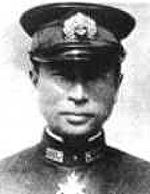 Rear Admiral
Masafumi Arima
, the commander of the 26th Air Flotilla (part of the 11th Air Fleet), is also sometimes credited with inventing the kamikaze tactic. Arima personally led an attack by about 100 Yokosuka D4Y
Suisei ("Judy") dive bomber
s against a large Essex-class aircraft carrier
, near Leyte Gulf, on (or about, accounts vary) 15 October 1944. Arima was killed and part of a plane hit Franklin. The Japanese high command and propagandists
seized on Arima's example: he was promoted posthumous
ly to Admiral
and was given official credit for making the first kamikaze attack. However, it is not clear that this was a planned suicide attack, and official Japanese accounts of Arima's attack bore little resemblance to the actual events.
On 17 October 1944, Allied forces assaulted Suluan Island, beginning the Battle of Leyte Gulf
. The Imperial Japanese Navy's 1st Air Fleet, based at Manila
, was assigned the task of assisting the Japanese ships which would attempt to destroy Allied forces in Leyte Gulf. However, the 1st Air Fleet at that time only had 40 aircraft: 34 A6M Zero
carrier-based fighters, three Nakajima B6N
Tenzan ("Jill") torpedo bomber
s, one Mitsubishi G4M
("Betty") and two Yokosuka P1Y
Ginga ("Frances") land-based bombers, and one additional reconnaissance plane. The task facing the Japanese air forces seemed impossible. The 1st Air Fleet commandant, Vice Admiral
Takijirō Ōnishi decided to form a suicide attack force, the Special Attack Unit. In a meeting at Mabalacat Airfield
(known to the U.S. military as Clark Air Base) near Manila, on 19 October, Onishi told officers of the 201st Flying Group headquarters: "I don't think there would be any other certain way to carry out the operation [to hold the Philippines], than to put a 250 kg bomb on a Zero and let it crash into a U.S. carrier, in order to disable her for a week."
Asaiki Tamai
asked a group of 23 talented student pilots, all of whom he had trained, to volunteer for the special attack force. All of the pilots raised both of their hands, volunteering to join the operation. Later, Tamai asked Lieutenant Yukio Seki
to command the special attack force. Seki is said to have closed his eyes, lowered his head and thought for 10 seconds, before saying: "Please do appoint me to the post." Seki became the 24th kamikaze pilot to be chosen. However, Seki later said: "Japan's future is bleak if it is forced to kill one of its best pilots." and "I am not going on this mission for the Emperor or for the Empire... I am going because I was ordered to."
The names of four sub-units within the Kamikaze Special Attack Force were Unit Shikishima, Unit Yamato, Unit Asahi, and Unit Yamazakura. These names were taken from a patriotic death poem
(called jisei no ku in waka
or tanka
), Shikishima no Yamato-gokoro wo hito towaba, asahi ni niou yamazakura bana by the Japanese classical scholar, Motoori Norinaga
. The poem reads:
A less literal translation is:
Ōnishi, addressing this unit, told that their nobility of spirit would keep the homeland from ruin even in defeat.
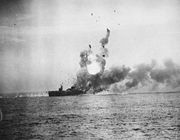
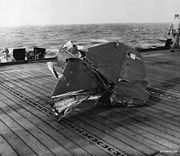
 Several suicide attacks, carried out during the invasion of Leyte, by Japanese pilots from units other than the Special Attack Force, have been described as the first kamikaze attack. Early on 21 October, a Japanese aircraft, possibly a Aichi D3A
dive-bomber or a Mitsubishi Ki-51
(of the 6th Flying Brigade, Imperial Japanese Army Air Force) deliberately crashed into the foremast of the heavy cruiser . The attack killed 30 personnel, including the cruiser's Captain, Emile Dechaineux
and wounded 64, including the Australian force commander Commodore John Collins. The Australian official history of the war claimed that this was the first kamikaze attack on an Allied ship, although other sources disagree because it was not a planned attack by a member of the Special Attack Force, but was most likely performed on the pilot's own initiative.
The sinking of the ocean tug on 24 October is listed in some sources as the first ship lost to a kamikaze strike, but the attack occurred before 25 October, and the aircraft used, a Mitsubishi G4M
, was not flown by the original four Special Attack Squadrons.
On 25 October 1944, during the Battle of Leyte Gulf
, the Kamikaze Special Attack Force carried out its first mission. Five Zeros, led by Seki, and escorted to the target by leading Japanese ace Hiroyoshi Nishizawa
, attacked several escort carriers. One Zero attempted to hit the bridge of but instead exploded on the port catwalk and cartwheeled into the sea. Two others dove at but were destroyed by anti-aircraft
fire. The last two ran at . One, under heavy fire and trailing smoke, aborted the attempt on White Plains and instead banked toward , plowing into the flight deck. Its bomb caused fires that resulted in the bomb magazine exploding, sinking the carrier. By day's end on 26 October, 55 kamikazes from the special attack force had also damaged the large escort carriers , which had also been struck
by a Kamikaze at 0804 forward of its aft elevator on 25 October, , and the smaller escorts USS White Plains, , and Kitkun Bay. In total, seven carriers had been hit, as well as 40 other ships (five sunk, 23 heavily damaged, and 12 moderately damaged).
When Japan began to be subject to intense strategic bombing
by B-29s, the Japanese military attempted to use suicide attacks against this threat. During the northern hemisphere winter of 1944–45, the IJAAF formed the 47th Air Regiment, also known as the Shinten Special Unit (Shinten Seiku Ta) at Narimasu Airfield, Nerima, Tokyo
, to defend the Tokyo Metropolitan Area. The unit was equipped with Nakajima Ki-44
Shoki ("Tojo") fighters, with which they were to ram United States Army Air Forces
(USAAF) B-29s in their attacks on Japan. However, this proved much less successful and practical since an airplane is a much faster, more maneuverable, and smaller target than a warship. The B-29 also had formidable defensive weaponry, so suicide attacks against the plane demanded considerable piloting skill to be successful. That worked against the very purpose of using expendable pilots and even encouraging capable pilots to bail out before impact was ineffective because vital personnel were often lost when they mistimed their exits and were killed as a result.
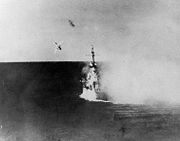
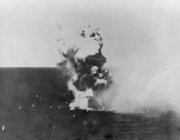 Kamikaze attacks were being planned at far-flung Japanese bases. On 8 January, Onishi formed a second official naval kamikaze unit, in Formosa
. The unit, Niitaka used Zeroes and "Judys", and was based at Takao Airfield
. On 29 January 1945, seven Kawasaki Ki-48
"Lilys" from the Japanese Army Shichisi Mitate Special group, took off from Palembang, Sumatra
to strike the British Pacific Fleet
. Vice Admiral Kimpei Teraoka and Captain Riishi Sugiyama of the 601st Air Group organized another second special unit, Mitate at Iwo Jima
on 16 February, as a U.S. invasion force approached. On 11 March, the U.S. carrier was hit and moderately damaged at Ulithi Atoll, in the Caroline Islands, by a kamikaze that had flown almost 4000 km (2,485.5 mi) from Japan, in a mission called Operation Tan No. 2
. On 20 March, the submarine survived a hit from an aircraft, just off Japan.
Purpose-built kamikaze planes, as opposed to converted fighters and dive-bombers, were also being constructed. Ensign
Mitsuo Ohta had suggested that piloted glider bomb
s, carried within range of targets by a mother plane, should be developed. The First Naval Air Technical Bureau (Kugisho), in Yokosuka, refined Ohta's idea. Yokosuka MXY7 Ohka
rocket planes, launched from bombers, were first deployed in kamikaze attacks from March 1945. U.S. personnel gave them the derisive nickname "Baka Bombs" (baka is Japanese for "idiot" or "stupid"). A specially-designed propeller plane, the Nakajima Ki-115
Tsurugi, was a simple, easily-built aircraft, intended to use up existing stocks of engines, in a wooden airframe. The landing gear
was non-retractable: it was jettisoned shortly after take-off for a suicide mission and then re-used on other planes. During 1945, the Japanese military began stockpiling hundreds of Tsurugi, other propeller planes, Ohkas, and suicide boats, for use against Allied forces expected to invade Japan. Few were ever used.
, a U.S. Navy aviator, who was already famous for developing effective aerial tactics against the Japanese such as the Thach Weave
, developed a defensive strategy against kamikazes called the "big blue blanket
". This recommended larger combat air patrol
s (CAP), further from the carriers than had previously been the case, a line of picket destroyer
s and destroyer escort
s at least 80 km (49.7 mi) from the main body of the fleet to provide earlier radar
interception, and improved coordination between fighter direction officers on carriers. This plan also called for round-the-clock fighter patrols over Allied fleets, though the U.S. Navy had cut back training of fighter pilots, so there were not enough Navy pilots available to counter the kamikaze threat. A final element included intensive fighter sweeps over Japanese airfields, and bombing of Japanese runways with delayed action fuse
s to make repairs more difficult.
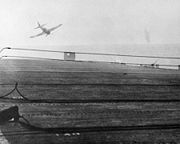 Late in 1944, the British Pacific Fleet
(BPF) used the good high altitude performance of their Supermarine Seafire
s on combat air patrol duties. Seafires were heavily involved in countering the kamikaze attacks during the Iwo Jima landings
and beyond. The Seafires' best day was 15 August 1945, shooting down eight attacking aircraft for a single loss.
Poor training tended to make kamikaze pilots easy targets for experienced Allied pilots, who also flew superior aircraft. The U.S. Fast Carrier Task Force
alone could bring over 1,000 fighter aircraft into play. Allied pilots became adept at destroying enemy aircraft before they struck ships.
Allied gunners had begun to develop techniques to negate kamikaze attacks. Light rapid fire anti-aircraft weapons such as the 40 mm Bofors and Oerlikon 20 mm cannon
s were still highly effective, however heavy anti-aircraft guns such as the 5"/38 caliber gun (127 mm) had the punch to blow kamikazes out of the air, which was often necessary since even a heavily damaged kamikaze could complete its mission. The Ohkas with their high speed presented a very difficult problem for anti-aircraft fire, since their high speed made a fire control solution
extremely difficult. By 1945, large amounts of anti-aircraft shells with radio frequency proximity fuze
s became available, these were on average seven times more effective than regular shells, and the USN recommended their use against kamikaze attacks.
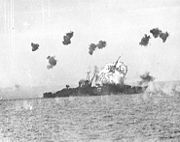 The peak in kamikaze attacks came during the period of April–June 1945, at the Battle of Okinawa
. On 6 April 1945, waves of planes made hundreds of attacks in Operation Kikusui ("floating chrysanthemums"). At Okinawa, kamikaze attacks focused at first on Allied destroyer
s on picket
duty, and then on the carriers in the middle of the fleet. Suicide attacks by planes or boats at Okinawa sank or put out of action at least 30 U.S. warships, and at least three U.S. merchant ships, along with some from other Allied forces. The attacks expended 1,465 planes. Many warships of all classes were damaged, some severely, but no aircraft carriers, battleship
s or cruiser
s were sunk by kamikaze at Okinawa. Most of the ships lost were destroyers or smaller vessels, especially those on picket duty. The destroyer earned the nickname "The Ship That Would Not Die" after surviving sixteen kamikaze attacks, including five hits during this battle.
U.S. carriers, with their wooden flight decks, appeared to suffer more damage
from kamikaze hits than the reinforced steel-decked carriers from the British Pacific Fleet
. US carriers also suffered considerably heavier casualties from kamikaze strikes, for instance 389 men were killed in one attack on and this is greater than the combined number of fatal casualties suffered on all six RN armoured carriers from all forms of attack for the entire war; eight kamikaze hits on five RN carriers resulted in only twenty fatal casualties while a combined total of 15 bomb hits, most of 500 kg weight or greater, and one torpedo hit on 4 carriers caused 193 fatal casualties earlier in the war – striking proof of the protective value of the armoured flight deck. The resilience of well-armoured vessels was shown on 4 May, just after 11:30, when there was a wave of suicide attacks against the BPF. One Japanese plane made a steep dive from "a great height" at the carrier and was engaged by AA guns. Although it was hit by gunfire, the kamikaze crashed into the flight deck, making a crater 3 m (9.8 ft) long, 0.6 m (2 ft) wide and 0.6 m (2 ft) deep. A long steel splinter speared down, through the hangar deck and the main boiler room (where it ruptured a steam line), before coming to rest in a fuel tank near the aircraft park, where it started a major fire. Eight personnel were killed and 47 were wounded. One Corsair and 10 Avenger
s were destroyed. However, the fires were gradually brought under control, and the crater in the deck was repaired with concrete and steel plate. By 17:00, Corsairs were able to land. On 9 May, Formidable was again damaged by a kamikaze, as were the carrier and the battleship . The British were able to clear the flight deck and resume flight operations in just hours, while their American counterparts took a few days or even months, as observed by a USN liaison officer on who commented: "When a kamikaze hits a U.S. carrier it means 6 months of repair at Pearl [Harbor
]. When a kamikaze hits a Limey carrier it’s just a case of "Sweepers, man your brooms."”
Sometimes twin-engined aircraft were used in planned kamikaze attacks. For example, Mitsubishi Ki-67
Hiryū ("Peggy") medium bombers, based on Formosa, undertook kamikaze attacks on Allied forces off Okinawa.
Rear Admiral
Matome Ugaki, the second in command of the Combined Pacific Fleet, directed the last official kamikaze attack, sending "Judies" from the 701st Air Group against the Allied fleet at Okinawa on 15 August 1945.
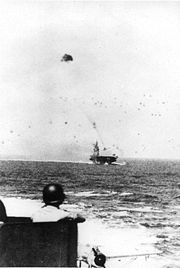 As the end of the war approached, the Allies did not suffer significantly more serious losses, despite having far more ships and facing a greater intensity of kamikaze attacks. Although causing some of the heaviest casualties on US carriers in 1945, the IJN had sacrificed 2,525 kamikaze pilots and the IJAAF 1,387; far more than they had lost in 1942 where they sunk or crippled three carriers (albeit without inflicting significant casualties). In 1942 when US Navy vessels were scarce, the temporary absence of key warships from the combat zone would tie up operational initiatives. However, by 1945, the US Navy was large enough that damaged ships could be detached back home for repair without significantly hampering the fleet's operational capability. The only surface losses were destroyers and smaller ships that lacked the capability to sustain heavy damage. Overall, the kamikazes were unable to turn the tide of the war and stop the Allied invasion. The destructive potential of the kamikaze sustained postwar funding of Operation Bumblebee until the RIM-8 Talos
guided missile became operational in 1959.
In the immediate aftermath of kamikaze strikes, British carriers with their armoured flight decks appeared to recover more quickly compared to their US counterparts. However, post-war analysis showed that some British carriers such as HMS Formidable did suffer structural damage that led them to be written off and scrapped, as beyond economic repair, but Britain's dire post war finances and the constantly declining size of the Royal Navy undoubtedly played a role in deciding not to repair damaged carriers. By contrast, even the most seriously damaged American carriers such USS Bunker Hill were successfully repaired to operational condition, although they saw no service after World War II as they were considered surplus.
The number of ships sunk is a matter of debate. According to a wartime Japanese propaganda announcement, the missions sank 81 ships and damaged 195, and according to a Japanese tally, kamikaze attacks accounted for up to 80% of the U.S. losses in the final phase of the war in the Pacific. In a 2004 book, World War II, the historians Wilmott, Cross and Messenger stated that more than 70 U.S. vessels were "sunk or damaged beyond repair" by kamikazes.
According to a U.S Air Force
webpage:
Australian journalists Denis and Peggy Warner, in a 1982 book with Japanese naval historian Seno Sadao (The Sacred Warriors: Japan’s Suicide Legions), arrived at a total of 57 ships sunk by kamikazes. However, Bill Gordon, an American Japanologist who specialises in kamikazes, states in a 2007 article that 47 ships were sunk by kamikaze aircraft. Gordon says that the Warners and Seno included ten ships that did not sink. His list consists of:
Over 300 Allied warships were damaged by kamikaze attacks.
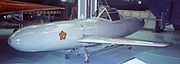 It was claimed by the Japanese forces at the time that there were many volunteers for the suicidal forces. Captain Motoharu Okamura
commented that "there were so many volunteers for suicide missions that he referred to them as a swarm of bees," explaining: "Bees die after they have stung." Okamura is credited with being the first to propose the kamikaze attacks. He had expressed his desire to lead a volunteer group of suicide attacks some four months before Admiral Takijiro Ohnishi, commander of the Japanese naval air forces in the Philippines, presented the idea to his staff. While Vice Admiral Shigeru Fukudome
, commander of the second air fleet, was inspecting the 341st Air Group, Captain Okamura took the chance to express his ideas on crash-dive tactics. “In our present situation I firmly believe that the only way to swing the war in our favor is to resort to crash-dive attacks with our planes. There is no other way. There will be more than enough volunteers for this chance to save our country, and I would like to command such an operation. Provide me with 300 planes and I will turn the tide of war.” When the volunteers arrived for duty in the corps there were twice as many persons as aircraft. "After the war, some commanders would express regret for allowing superfluous crews to accompany sorties, sometimes squeezing themselves aboard bombers and fighters so as to encourage the suicide pilots and, it seems, join in the exultation of sinking a large enemy vessel." Many of the kamikaze pilots believed their death would pay the debt they owed and show the love they had for their families, friends, and emperor. "So eager were many minimally trained pilots to take part in suicide missions that when their sorties were delayed or aborted, the pilots became deeply despondent. Many of those who were selected for a bodycrashing mission were described as being extraordinarily blissful immediately before their final sortie."
As time wore on, however, modern critics questioning the nationalist portrayal of kamikaze pilots as noble soldiers willing to sacrifice their lives for the country have emerged. In 2006, Tsuneo Watanabe
, Editor-in-Chief of the Yomiuri Shimbun
, criticized Japanese nationalists' glorification of kamikaze attacks:
http://articles.latimes.com/2004/sep/25/world/fg-kamikaze25
Pilots were given a manual which detailed how they were supposed to think, prepare, and attack. From this manual, pilots were told to "attain a high level of spiritual training," and to "keep [their] health in the very best condition." These things, among others, were meant to put the pilot into the mindset in which he would be mentally ready to die.
The tokkōtai pilot's manual also explained how a pilot may turn back if the pilot could not locate a target and that "[a pilot] should not waste [his] life lightly." However, one pilot who continually came back to base was shot after his ninth return.
The manual was very detailed in how a pilot should attack. A pilot would dive towards his target and "aim for a point between the bridge tower and the smoke stacks". Entering a smoke stack was also said to be "effective". Pilots were told not to aim at a ship's bridge tower or gun turret but instead to look for elevators or the flight deck to crash into. For horizontal attacks, the pilot was to "aim at the middle of the vessel, slightly higher than the waterline" or to "aim at the entrance to the aircraft hangar, or the bottom of the stack" if the former was too difficult.
The tokkōtai pilot's manual told pilots never to close their eyes. This was because if a pilot closed his eyes he would lower the chances of hitting his target. In the final moments before the crash, the pilot was to yell "Hissatsu" (必殺) at the top of his lungs which translates to "Certain Kill".
beliefs. Among other things, Emperor
worship was stressed after Shinto was established as a state religion during the Meiji Restoration
. As time went on, Shinto was used increasingly in the promotion of nationalist sentiment. In 1890, the Imperial Rescript on Education
was passed, under which students were required to ritually recite its oath to offer themselves "courageously to the State" as well as protect the Imperial family. The ultimate offering was to give up one’s life. It was an honor to die for Japan and the Emperor. Axell and Kase pointed out: "The fact is that innumerable soldiers, sailors and pilots were determined to die, to become eirei, that is ‘guardian spirits’ of the country. [...] Many Japanese felt that to be enshrined at Yasukuni was a special honour because the Emperor twice a year visited the shrine to pay homage. Yasukuni is the only shrine, deifying common men, which the Emperor would visit to pay his respects". Young Japanese people were indoctrinated from an earliest age with these ideals.
Following the commencement of the kamikaze tactic, newspapers and books ran advertisements, articles, and stories regarding the suicide bombers, to aid in recruiting and support. In October 1944, the Nippon Times quoted Lieutenant Sekio Nishina: "The spirit of the Special Attack Corps is the great spirit that runs in the blood of every Japanese…. The crashing action which simultaneously kills the enemy and oneself without fail is called the Special Attack…. Every Japanese is capable of becoming a member of the Special Attack Corps". Publishers also played up the idea that the kamikaze were enshrined at Yasukuni and ran exaggerated stories of kamikaze bravery – there were even fairy tales for little children that promoted the kamikaze. A Foreign Office official named Toshikazu Kase said: "It was customary for GHQ [in Tokyo] to make false announcements of victory in utter disregard of facts, and for the elated and complacent public to believe them".
While many stories were falsified, some were true, such as the story of Kiyu Ishikawa who saved a Japanese ship when he crashed his plane into a torpedo
that an American submarine
had launched. The sergeant major was posthumously promoted to second lieutenant by the emperor and was enshrined at Yasukuni. Stories like these, which showed the kind of praise and honor death produced, encouraged young Japanese to volunteer for the Special Attack Corps and instilled a desire in the youth to die as a kamikaze.
Ceremonies were carried out before kamikaze pilots departed on their final mission. They were given the flag of Japan
or the rising sun flag
(Japanese naval ensign), inscribed with inspirational and spiritual words, Nambu pistol
or katana
and drank sake before they took off generally. They put on a hachimaki
headband with the rising sun, and a senninbari
, a "belt of a thousand stitches" sewn by a thousand women who made one stitch each. They also composed and read a death poem
, a tradition stemming from the samurai
, who did it before committing seppuku
. Pilots carried prayer
s from their families and were given military decoration
s.
 While commonly perceived that volunteers signed up in droves for kamikaze missions, it has also been contended that there was extensive coercion and peer pressure involved in recruiting soldiers for the sacrifice. Their motivations in "volunteering" were complex and not simply about patriotism or bringing honour to their families. And at least one of these pilots was a conscripted Korean with a Japanese name, adopted under the pre-war Soshi-kaimei
ordinance that compelled Koreans to take Japanese personal names. Out of the 1,036 IJA kamikaze pilots who died in sorties from Chiran
and other Japanese air bases, during the Battle of Okinawa, 11 were Koreans.
According to legend, young pilots on kamikaze missions often flew southwest from Japan over the 922 m (3,024.9 ft) Mount Kaimon. The mountain is also called "Satsuma Fuji" (meaning a mountain like Mount Fuji
but located in the Satsuma Province
region). Suicide mission pilots looked over their shoulders to see this, the most southern mountain on the Japanese mainland, while they were in the air, said farewell to their country, and saluted the mountain.
Residents on Kikaishima Island
, east of Amami Ōshima
, say that pilots from suicide mission units dropped flowers from the air as they departed on their final missions. According to legend, the hills above Kikaishima airport have beds of cornflower
that bloom in early May.
Kamikaze pilots that were unable to complete their mission (due to mechanical failure, interception, etc.) were stigmatized in the years following the war. This stigma began to diminish some 50 years after the war as scholars and publishers have distributed the survivor's stories.
With the passing of time, some prominent Japanese military figures who survived the war became critical of the policy. Saburo Sakai
, an IJN ace
said:
Suicide attack
A suicide attack is a type of attack in which the attacker expects or intends to die in the process.- Historical :...
s by military aviators
Military aviation
Military aviation is the use of aircraft and other flying machines for the purposes of conducting or enabling warfare, including national airlift capacity to provide logistical supply to forces stationed in a theater or along a front. Air power includes the national means of conducting such...
from the Empire of Japan
Empire of Japan
The Empire of Japan is the name of the state of Japan that existed from the Meiji Restoration on 3 January 1868 to the enactment of the post-World War II Constitution of...
against Allied
Allies of World War II
The Allies of World War II were the countries that opposed the Axis powers during the Second World War . Former Axis states contributing to the Allied victory are not considered Allied states...
naval vessels in the closing stages of the Pacific campaign
Pacific War
The Pacific War, also sometimes called the Asia-Pacific War refers broadly to the parts of World War II that took place in the Pacific Ocean, its islands, and in East Asia, then called the Far East...
of World War II
World War II
World War II, or the Second World War , was a global conflict lasting from 1939 to 1945, involving most of the world's nations—including all of the great powers—eventually forming two opposing military alliances: the Allies and the Axis...
, designed to destroy as many warship
Warship
A warship is a ship that is built and primarily intended for combat. Warships are usually built in a completely different way from merchant ships. As well as being armed, warships are designed to withstand damage and are usually faster and more maneuvrable than merchant ships...
s as possible.
Kamikaze pilots would attempt to crash their aircraft into enemy ships in what was called a "Body Attack" (体当たり; 体当り) taiatari— in planes often laden with explosives, bomb
Bomb
A bomb is any of a range of explosive weapons that only rely on the exothermic reaction of an explosive material to provide an extremely sudden and violent release of energy...
s, torpedo
Torpedo
The modern torpedo is a self-propelled missile weapon with an explosive warhead, launched above or below the water surface, propelled underwater towards a target, and designed to detonate either on contact with it or in proximity to it.The term torpedo was originally employed for...
es and full fuel tank
Fuel tank
A fuel tank is safe container for flammable fluids. Though any storage tank for fuel may be so called, the term is typically applied to part of an engine system in which the fuel is stored and propelled or released into an engine...
s. The aircraft's normal functions (to deliver torpedoes or bombs or shoot down other aircraft) were put aside, and the planes were converted to what were essentially manned missiles in an attempt to reap the benefits of greatly increased accuracy and payload over that of normal bombs. The goal of crippling as many Allied ships as possible, particularly aircraft carriers, was considered critical enough to warrant the combined sacrifice of pilots and aircraft.
These attacks, which began in October 1944, followed several critical military defeats for the Japanese. They had long lost aerial dominance due to outdated aircraft and the loss of experienced pilots. On a macroeconomic scale, Japan experienced a decreasing capacity to wage war, and a rapidly declining industrial capacity
Output (economics)
Output in economics is the "quantity of goods or services produced in a given time period, by a firm, industry, or country," whether consumed or used for further production.The concept of national output is absolutely essential in the field of macroeconomics...
relative to the United States. The Japanese government expressed its reluctance to surrender. In combination, these factors led to the use of kamikaze tactics as Allied forces advanced towards the Japanese home islands
Japanese Archipelago
The , which forms the country of Japan, extends roughly from northeast to southwest along the northeastern coast of the Eurasia mainland, washing upon the northwestern shores of the Pacific Ocean...
.
Japanese Special Attack Units
During World War II, Japanese Special Attack Units , also called shimbu-tai, were specialized units of the Imperial Japanese Navy and Imperial Japanese Army normally used for suicide missions...
, including those involving submarines, human torpedoes
Kaiten
The Kaiten were manned torpedos and suicide craft, they were used by the Imperial Japanese Navy in the final stages of World War II.-History:...
, speedboats and divers
Fukuryu
Suicide divers were a part of the Japanese Special Attack Units prepared to resist the invasion of the Home islands by Allied forces. They were armed with a mine containing of explosive, fitted to a bamboo pole. They would dive and stick the pole into the hull of an enemy ship, destroying...
. Nazi Germany formed their own group of suicide aircraft pilots called the Leonidas Squadron
Leonidas Squadron
The Leonidas Squadron, formally known as 5th Staffel of Kampfgeschwader 200 was a unit which was originally formed to fly the Fieseler Fi 103R , a manned version of the V-1 flying bomb that was never used in combat because Werner Baumbach, the commander of KG 200, and his superiors considered it an...
, but the German commanders demonstrated a greater reluctance to use them.
Although kamikaze was the most common and best-known form of Japanese suicide attack during World War II, they were similar to the "banzai charge
Banzai charge
Banzai charge was a term applied during World War II by the Allied forces to human wave attacks mounted by infantry forces of the Imperial Japanese Army...
" used by Japanese infantrymen (foot soldiers). The main difference between kamikaze and banzai is that death was inherent to the success of a kamikaze attack, whereas a banzai charge was only potentially fatal – that is, the infantrymen hoped to survive but did not expect to. Western sources often incorrectly consider Operation Ten-Go
Operation Ten-Go
was the last major Japanese naval operation in the Pacific Theater of World War II. Other renderings of this operation's title in English include Operation Heaven One and Ten-ichi-gō....
as a kamikaze operation, since it occurred at the Battle of Okinawa
Battle of Okinawa
The Battle of Okinawa, codenamed Operation Iceberg, was fought on the Ryukyu Islands of Okinawa and was the largest amphibious assault in the Pacific War of World War II. The 82-day-long battle lasted from early April until mid-June 1945...
along with the mass waves of kamikaze planes; however, banzai is the more accurate term, since the aim of the mission was for battleship Yamato
Japanese battleship Yamato
, named after the ancient Japanese Yamato Province, was the lead ship of the Yamato class of battleships that served with the Imperial Japanese Navy during World War II. She and her sister ship, Musashi, were the heaviest and most powerfully armed battleships ever constructed, displacing...
to beach herself and provide support to the island defenders, as opposed to ramming and detonating among enemy naval forces. The tradition of death instead of defeat, capture, and perceived shame was deeply entrenched in Japanese military culture. It was one of the primary traditions in the samurai
Samurai
is the term for the military nobility of pre-industrial Japan. According to translator William Scott Wilson: "In Chinese, the character 侍 was originally a verb meaning to wait upon or accompany a person in the upper ranks of society, and this is also true of the original term in Japanese, saburau...
life and the Bushido
Bushido
, meaning "Way of the Warrior-Knight", is a Japanese word which is used to describe a uniquely Japanese code of conduct and a way of the samurai life, loosely analogous to the concept of chivalry. It originates from the samurai moral code and stresses frugality, loyalty, martial arts mastery, and...
code: loyalty
Loyalty
Loyalty is faithfulness or a devotion to a person, country, group, or cause There are many aspects to...
and honor until death.
Definition and etymology
Kami
is the Japanese word for the spirits, natural forces, or essence in the Shinto faith. Although the word is sometimes translated as "god" or "deity", some Shinto scholars argue that such a translation can cause a misunderstanding of the term...
is the word for "god", "spirit", or "divinity", and kaze for "wind"). The word kamikaze originated as the name of major typhoon
Kamikaze (typhoon)
The Kamikaze , were two winds or storms that are said to have saved Japan from two Mongol fleets under Kublai Khan. These fleets attacked Japan in 1274 and again in 1281...
s in 1274 and 1281, which dispersed Mongolian invasion
Mongol invasions of Japan
The ' of 1274 and 1281 were major military efforts undertaken by Kublai Khan to conquer the Japanese islands after the submission of Goryeo to vassaldom. Despite their ultimate failure, the invasion attempts are of macrohistorical importance, because they set a limit on Mongol expansion, and rank...
fleets.
In Japanese, the formal term used for units carrying out suicide attacks during 1944–45 is tokubetsu kōgeki tai (特別攻撃隊), which literally means "special attack unit". This is usually abbreviated to tokkōtai (特攻隊). More specifically, air suicide attack units from the Imperial Japanese Navy
Imperial Japanese Navy
The Imperial Japanese Navy was the navy of the Empire of Japan from 1869 until 1947, when it was dissolved following Japan's constitutional renunciation of the use of force as a means of settling international disputes...
were officially called shinpū tokubetsu kōgeki tai (神風特別攻撃隊, "divine wind special attack units"). Shinpū is the on-reading (on'yomi or Chinese-derived pronunciation) of the same characters
Kanji
Kanji are the adopted logographic Chinese characters hanzi that are used in the modern Japanese writing system along with hiragana , katakana , Indo Arabic numerals, and the occasional use of the Latin alphabet...
that form the word kamikaze in Japanese. During World War II, the pronunciation kamikaze was used in Japan only informally in relation to suicide attacks, but after the war this usage gained acceptance worldwide and was re-imported into Japan. As a result, the special attack units are sometimes known in Japan as kamikaze tokubetsu kōgeki tai.
Since the end of the war, the term kamikaze has sometimes been used for other kinds of attack in which an attacker is deliberately sacrificed. These include a variety of suicide attacks, in other historical contexts, such as the proposed use of Selbstopfer aircraft by Nazi Germany
Nazi Germany
Nazi Germany , also known as the Third Reich , but officially called German Reich from 1933 to 1943 and Greater German Reich from 26 June 1943 onward, is the name commonly used to refer to the state of Germany from 1933 to 1945, when it was a totalitarian dictatorship ruled by...
and various suicide attack
Suicide attack
A suicide attack is a type of attack in which the attacker expects or intends to die in the process.- Historical :...
s by terrorist organizations around the world (such as the 11 September 2001 attacks), although kamikaze pilots attacked only military buildings/ships, while terrorists attack mostly civilian facilities. In English, the word kamikaze may also be used in a hyperbolic
Hyperbole
Hyperbole is the use of exaggeration as a rhetorical device or figure of speech. It may be used to evoke strong feelings or to create a strong impression, but is not meant to be taken literally....
or metaphor
Metaphor
A metaphor is a literary figure of speech that uses an image, story or tangible thing to represent a less tangible thing or some intangible quality or idea; e.g., "Her eyes were glistening jewels." Metaphor may also be used for any rhetorical figures of speech that achieve their effects via...
ical fashion to refer to non-fatal actions which result in significant loss for the attacker, such as injury or the end of a career.
Background
Attack on Pearl Harbor
The attack on Pearl Harbor was a surprise military strike conducted by the Imperial Japanese Navy against the United States naval base at Pearl Harbor, Hawaii, on the morning of December 7, 1941...
. First Lieutenant
First Lieutenant
First lieutenant is a military rank and, in some forces, an appointment.The rank of lieutenant has different meanings in different military formations , but the majority of cases it is common for it to be sub-divided into a senior and junior rank...
Fusata Iida’s plane had been hit and was leaking fuel, when he apparently used it to make a suicide attack on Kaneohe Naval Air Station
Marine Corps Base Hawaii
Marine Corps Base Hawaii , formerly Marine Corps Air Station, Kaneohe Bay and originally Naval Air Station Kaneohe Bay, is a U.S. Marine Corps base facility and air station located on the Mokapu Peninsula of windward O'ahu in the City & County of Honolulu. As of the 2000 Census, the base had a...
. Before taking off, he had told his men that if his plane was badly damaged he would crash it into a "worthy enemy target".
The carrier battles in 1942, particularly Midway
Battle of Midway
The Battle of Midway is widely regarded as the most important naval battle of the Pacific Campaign of World War II. Between 4 and 7 June 1942, approximately one month after the Battle of the Coral Sea and six months after Japan's attack on Pearl Harbor, the United States Navy decisively defeated...
, had inflicted irreparable damage on the Imperial Japanese Navy Air Service
Imperial Japanese Navy Air Service
The Imperial Japanese Navy Air Service was the air arm of the Imperial Japanese Navy during World War II, the organization was responsible for the operation of naval aircraft and the conduct of aerial warfare in the Pacific War.It was controlled by the Navy Staff of the Imperial Japanese Navy and...
(IJNAS), such that they could no longer put together a large number of fleet carriers with well-trained aircrews. Japanese planners had assumed a quick war and were ill-prepared to replace the losses of ships, pilots, and sailors; at Midway, the Japanese lost as many aircrewmen in a single day as their pre-war training program had produced in a year. The following Solomons
Solomon Islands campaign
The Solomon Islands campaign was a major campaign of the Pacific War of World War II. The campaign began with Japanese landings and occupation of several areas in the British Solomon Islands and Bougainville, in the Territory of New Guinea, during the first six months of 1942...
and New Guinea campaign
New Guinea campaign
The New Guinea campaign was one of the major military campaigns of World War II.Before the war, the island of New Guinea was split between:...
s, notably the Battles of Eastern Solomons
Battle of the Eastern Solomons
The naval Battle of the Eastern Solomons The naval Battle of the Eastern Solomons The naval Battle of the Eastern Solomons (also known as the Battle of the Stewart Islands and, in Japanese sources, as the , took place on 24–25 August 1942, and was the third carrier battle of the Pacific campaign...
and Santa Cruz, further decimated their veteran aircrews and replacing their combat experience proved impossible. During 1943–44, U.S. forces were steadily advancing towards Japan. Japan's fighter planes were becoming outnumbered and outclassed by newer U.S.-made planes, especially the F6F Hellcat
F6F Hellcat
The Grumman F6F Hellcat was a carrier-based fighter aircraft developed to replace the earlier F4F Wildcat in United States Navy service. Although the F6F resembled the Wildcat, it was a completely new design powered by a 2,000 hp Pratt & Whitney R-2800. Some tagged it as the "Wildcat's big...
and F4U Corsair
F4U Corsair
The Vought F4U Corsair was a carrier-capable fighter aircraft that saw service primarily in World War II and the Korean War. Demand for the aircraft soon overwhelmed Vought's manufacturing capability, resulting in production by Goodyear and Brewster: Goodyear-built Corsairs were designated FG and...
. Tropical diseases, as well as shortages of spare parts and fuel
Fuel
Fuel is any material that stores energy that can later be extracted to perform mechanical work in a controlled manner. Most fuels used by humans undergo combustion, a redox reaction in which a combustible substance releases energy after it ignites and reacts with the oxygen in the air...
, made operations more and more difficult for the IJNAS. By the Battle of the Philippine Sea
Battle of the Philippine Sea
The Battle of the Philippine Sea was a decisive naval battle of World War II which effectively eliminated the Imperial Japanese Navy's ability to conduct large-scale carrier actions. It took place during the United States' amphibious invasion of the Mariana Islands during the Pacific War...
in 1944, the Japanese now had to make do with obsolete aircraft and inexperienced aviators, against the better-trained and more experienced US Navy airmen, and its radar
Radar
Radar is an object-detection system which uses radio waves to determine the range, altitude, direction, or speed of objects. It can be used to detect aircraft, ships, spacecraft, guided missiles, motor vehicles, weather formations, and terrain. The radar dish or antenna transmits pulses of radio...
-directed combat air patrol
Combat air patrol
Combat air patrol is a type of flying mission for fighter aircraft.A combat air patrol is an aircraft patrol provided over an objective area, over the force protected, over the critical area of a combat zone, or over an air defense area, for the purpose of intercepting and destroying hostile...
s. The Japanese lost over 400 carrier-based planes and pilots, effectively putting an end to their carriers' potency, an action referred to by the Allies as the "Great Marianas Turkey Shoot".
On 19 June 1944, planes from the carrier approached a US task group. According to some accounts, two made suicide attacks, one of which hit .
The important Japanese base of Saipan
Battle of Saipan
The Battle of Saipan was a battle of the Pacific campaign of World War II, fought on the island of Saipan in the Mariana Islands from 15 June-9 July 1944. The Allied invasion fleet embarking the expeditionary forces left Pearl Harbor on 5 June 1944, the day before Operation Overlord in Europe was...
fell to the Allied forces on 15 July 1944. Its capture provided adequate forward bases which enabled U.S. air forces using the B-29 Superfortress
B-29 Superfortress
The B-29 Superfortress is a four-engine propeller-driven heavy bomber designed by Boeing that was flown primarily by the United States Air Forces in late-World War II and through the Korean War. The B-29 was one of the largest aircraft to see service during World War II...
to strike the Japanese home islands. After the fall of Saipan, the Japanese high command predicted that the Allies would try to capture the Philippines
Philippines
The Philippines , officially known as the Republic of the Philippines , is a country in Southeast Asia in the western Pacific Ocean. To its north across the Luzon Strait lies Taiwan. West across the South China Sea sits Vietnam...
, which were strategically important because of their location between the oilfields of Southeast Asia and Japan.
In August 1944, it was announced by the Domei news agency that a flight instructor named Takeo Tagata was training pilots in Taiwan
Taiwan
Taiwan , also known, especially in the past, as Formosa , is the largest island of the same-named island group of East Asia in the western Pacific Ocean and located off the southeastern coast of mainland China. The island forms over 99% of the current territory of the Republic of China following...
for suicide missions.
Another source claims that the first kamikaze mission occurred on 13 September 1944. A group of pilots from the army's 31st Fighter Squadron on Negros Island decided to launch a suicide attack the following morning. First Lieutenant
First Lieutenant
First lieutenant is a military rank and, in some forces, an appointment.The rank of lieutenant has different meanings in different military formations , but the majority of cases it is common for it to be sub-divided into a senior and junior rank...
Takeshi Kosai and a sergeant were selected. Two 100 kg (220.5 lb) bombs were attached to two fighters, and the pilots took off before dawn, planning to crash into carriers. They never returned, and there is no record of an enemy plane hitting an Allied ship that day.
According to some sources, on 14 October 1944, was hit by a deliberately-crashed Japanese plane. However, there is no evidence that the attacker planned to crash.
Rear Admiral
Rear admiral is a naval commissioned officer rank above that of a commodore and captain, and below that of a vice admiral. It is generally regarded as the lowest of the "admiral" ranks, which are also sometimes referred to as "flag officers" or "flag ranks"...
Masafumi Arima
Masafumi Arima
was an admiral in the Imperial Japanese Navy in World War II. A pilot, he is sometimes credited with being the first to use the kamikaze attack, although official accounts may have been invented for propaganda purposes.-Biography:...
, the commander of the 26th Air Flotilla (part of the 11th Air Fleet), is also sometimes credited with inventing the kamikaze tactic. Arima personally led an attack by about 100 Yokosuka D4Y
Yokosuka D4Y
The D4Y Navy Type 2 Carrier Dive bomber was operated by the Imperial Japanese Navy. Its Allied reporting name was "Judy". The D4Y was one of the fastest dive-bombers of the war, and only the delays in its development hindered its service, while its predecessor, the slower fixed gear Aichi D3A...
Suisei ("Judy") dive bomber
Dive bomber
A dive bomber is a bomber aircraft that dives directly at its targets in order to provide greater accuracy for the bomb it drops. Diving towards the target reduces the distance the bomb has to fall, which is the primary factor in determining the accuracy of the drop...
s against a large Essex-class aircraft carrier
Essex class aircraft carrier
The Essex class was a class of aircraft carriers of the United States Navy, which constituted the 20th century's most numerous class of capital ships with 24 vessels built in both "short-hull" and "long-hull" versions. Thirty-two were originally ordered; however as World War II wound down, six were...
, near Leyte Gulf, on (or about, accounts vary) 15 October 1944. Arima was killed and part of a plane hit Franklin. The Japanese high command and propagandists
Propaganda
Propaganda is a form of communication that is aimed at influencing the attitude of a community toward some cause or position so as to benefit oneself or one's group....
seized on Arima's example: he was promoted posthumous
Posthumous name
A posthumous name is an honorary name given to royalty, nobles, and sometimes others, in East Asia after the person's death, and is used almost exclusively instead of one's personal name or other official titles during his life...
ly to Admiral
Admiral
Admiral is the rank, or part of the name of the ranks, of the highest naval officers. It is usually considered a full admiral and above vice admiral and below admiral of the fleet . It is usually abbreviated to "Adm" or "ADM"...
and was given official credit for making the first kamikaze attack. However, it is not clear that this was a planned suicide attack, and official Japanese accounts of Arima's attack bore little resemblance to the actual events.
On 17 October 1944, Allied forces assaulted Suluan Island, beginning the Battle of Leyte Gulf
Battle of Leyte Gulf
The Battle of Leyte Gulf, also called the "Battles for Leyte Gulf", and formerly known as the "Second Battle of the Philippine Sea", is generally considered to be the largest naval battle of World War II and, by some criteria, possibly the largest naval battle in history.It was fought in waters...
. The Imperial Japanese Navy's 1st Air Fleet, based at Manila
Manila
Manila is the capital of the Philippines. It is one of the sixteen cities forming Metro Manila.Manila is located on the eastern shores of Manila Bay and is bordered by Navotas and Caloocan to the north, Quezon City to the northeast, San Juan and Mandaluyong to the east, Makati on the southeast,...
, was assigned the task of assisting the Japanese ships which would attempt to destroy Allied forces in Leyte Gulf. However, the 1st Air Fleet at that time only had 40 aircraft: 34 A6M Zero
A6M Zero
The Mitsubishi A6M Zero was a long-range fighter aircraft operated by the Imperial Japanese Navy Air Service from 1940 to 1945. The A6M was designated as the , and also designated as the Mitsubishi A6M Rei-sen and Mitsubishi Navy 12-shi Carrier Fighter. The A6M was usually referred to by the...
carrier-based fighters, three Nakajima B6N
Nakajima B6N
The Nakajima B6N Tenzan was the Imperial Japanese Navy's standard carrier-borne torpedo bomber during the final years of World War II and the successor to the B5N "Kate"...
Tenzan ("Jill") torpedo bomber
Torpedo bomber
A torpedo bomber is a bomber aircraft designed primarily to attack ships with aerial torpedoes which could also carry out conventional bombings. Torpedo bombers existed almost exclusively prior to and during World War II when they were an important element in many famous battles, notably the...
s, one Mitsubishi G4M
Mitsubishi G4M
The Mitsubishi G4M 一式陸上攻撃機, 一式陸攻 Isshiki rikujō kōgeki ki, Isshikirikkō was the main twin-engine, land-based bomber used by the Imperial Japanese Navy Air Service in World War II. The Allies gave the G4M the reporting name Betty...
("Betty") and two Yokosuka P1Y
Yokosuka P1Y
|-See also:-References:NotesBibliography* Francillon, Ph.D., René J. Japanese Aircraft of the Pacific War. London: Putnam 7 Company Ltd., 1970. ISBN 0-370-00033-1 ....
Ginga ("Frances") land-based bombers, and one additional reconnaissance plane. The task facing the Japanese air forces seemed impossible. The 1st Air Fleet commandant, Vice Admiral
Vice Admiral
Vice admiral is a senior naval rank of a three-star flag officer, which is equivalent to lieutenant general in the other uniformed services. A vice admiral is typically senior to a rear admiral and junior to an admiral...
Takijirō Ōnishi decided to form a suicide attack force, the Special Attack Unit. In a meeting at Mabalacat Airfield
Clark Air Base
Clark Air Base is a former United States Air Force base on Luzon Island in the Philippines, located 3 miles west of Angeles City, about 40 miles northwest of Metro Manila. Clark Air Base was an American military facility from 1903 to 1991...
(known to the U.S. military as Clark Air Base) near Manila, on 19 October, Onishi told officers of the 201st Flying Group headquarters: "I don't think there would be any other certain way to carry out the operation [to hold the Philippines], than to put a 250 kg bomb on a Zero and let it crash into a U.S. carrier, in order to disable her for a week."
First kamikaze unit
CommanderCommander
Commander is a naval rank which is also sometimes used as a military title depending on the individual customs of a given military service. Commander is also used as a rank or title in some organizations outside of the armed forces, particularly in police and law enforcement.-Commander as a naval...
Asaiki Tamai
Asaiki Tamai
Asaiki Tamai was a colonel in the Imperial Japanese Navy during World War II.-Early life:...
asked a group of 23 talented student pilots, all of whom he had trained, to volunteer for the special attack force. All of the pilots raised both of their hands, volunteering to join the operation. Later, Tamai asked Lieutenant Yukio Seki
Yukio Seki
was a Japanese naval aviator of the Imperial Japanese Navy during World War II. As a kamikaze pilot Lieutenant Seki led one of the three fighter groups of the second official kamikaze attack in World War II . Seki's final action took place on October 25, 1944, during the Battle of Leyte Gulf...
to command the special attack force. Seki is said to have closed his eyes, lowered his head and thought for 10 seconds, before saying: "Please do appoint me to the post." Seki became the 24th kamikaze pilot to be chosen. However, Seki later said: "Japan's future is bleak if it is forced to kill one of its best pilots." and "I am not going on this mission for the Emperor or for the Empire... I am going because I was ordered to."
The names of four sub-units within the Kamikaze Special Attack Force were Unit Shikishima, Unit Yamato, Unit Asahi, and Unit Yamazakura. These names were taken from a patriotic death poem
Death poem
A death poem is a poem written near the time of one's own death. It is a tradition for literate people to write one in a number of different cultures, especially in Joseon Korea and Japan.-History:...
(called jisei no ku in waka
Waka (poetry)
Waka or Yamato uta is a genre of classical Japanese verse and one of the major genres of Japanese literature...
or tanka
Tanka
Tanka may refer to:* Tanka, a form of Japanese waka * Tanka prose, a literary genre which combines tanka poems and prose* Thangka, a pictorial representation in Tibetan Buddhism...
), Shikishima no Yamato-gokoro wo hito towaba, asahi ni niou yamazakura bana by the Japanese classical scholar, Motoori Norinaga
Motoori Norinaga
was a Japanese scholar of Kokugaku active during the Edo period. He is probably the best known and most prominent of all scholars in this tradition.-Life:...
. The poem reads:
A less literal translation is:
Ōnishi, addressing this unit, told that their nobility of spirit would keep the homeland from ruin even in defeat.
Leyte Gulf: the first attacks
Aichi D3A
The , Allied reporting name "Val") was a World War II carrier-borne dive bomber of the Imperial Japanese Navy . It was the primary dive bomber in the Imperial Japanese Navy, and participated in almost all actions, including Pearl Harbor....
dive-bomber or a Mitsubishi Ki-51
Mitsubishi Ki-51
|-See also:-References:NotesBibliography* Francillon, Ph.D., René J. Japanese Aircraft of the Pacific War. London: Putnam & Company Ltd., 1970. ISBN 0-370-00033-1 .-External links:* * *...
(of the 6th Flying Brigade, Imperial Japanese Army Air Force) deliberately crashed into the foremast of the heavy cruiser . The attack killed 30 personnel, including the cruiser's Captain, Emile Dechaineux
Emile Dechaineux
Emile Frank Verlaine Dechaineux, DSC was an Australian mariner who achieved the rank of Captain in the Royal Australian Navy during World War II. He was killed by a Japanese aircraft in what is believed to be the first ever kamikaze attack, in the lead-up to the Battle of Leyte...
and wounded 64, including the Australian force commander Commodore John Collins. The Australian official history of the war claimed that this was the first kamikaze attack on an Allied ship, although other sources disagree because it was not a planned attack by a member of the Special Attack Force, but was most likely performed on the pilot's own initiative.
The sinking of the ocean tug on 24 October is listed in some sources as the first ship lost to a kamikaze strike, but the attack occurred before 25 October, and the aircraft used, a Mitsubishi G4M
Mitsubishi G4M
The Mitsubishi G4M 一式陸上攻撃機, 一式陸攻 Isshiki rikujō kōgeki ki, Isshikirikkō was the main twin-engine, land-based bomber used by the Imperial Japanese Navy Air Service in World War II. The Allies gave the G4M the reporting name Betty...
, was not flown by the original four Special Attack Squadrons.
On 25 October 1944, during the Battle of Leyte Gulf
Battle of Leyte Gulf
The Battle of Leyte Gulf, also called the "Battles for Leyte Gulf", and formerly known as the "Second Battle of the Philippine Sea", is generally considered to be the largest naval battle of World War II and, by some criteria, possibly the largest naval battle in history.It was fought in waters...
, the Kamikaze Special Attack Force carried out its first mission. Five Zeros, led by Seki, and escorted to the target by leading Japanese ace Hiroyoshi Nishizawa
Hiroyoshi Nishizawa
Lieutenant Junior Grade was an ace of the Imperial Japanese Navy Air Service during World War II.It is possible that Nishizawa was the most successful Japanese fighter ace of the war; he personally claimed to have had 87 aerial victories at the time of his death...
, attacked several escort carriers. One Zero attempted to hit the bridge of but instead exploded on the port catwalk and cartwheeled into the sea. Two others dove at but were destroyed by anti-aircraft
Anti-aircraft warfare
NATO defines air defence as "all measures designed to nullify or reduce the effectiveness of hostile air action." They include ground and air based weapon systems, associated sensor systems, command and control arrangements and passive measures. It may be to protect naval, ground and air forces...
fire. The last two ran at . One, under heavy fire and trailing smoke, aborted the attempt on White Plains and instead banked toward , plowing into the flight deck. Its bomb caused fires that resulted in the bomb magazine exploding, sinking the carrier. By day's end on 26 October, 55 kamikazes from the special attack force had also damaged the large escort carriers , which had also been struck
by a Kamikaze at 0804 forward of its aft elevator on 25 October, , and the smaller escorts USS White Plains, , and Kitkun Bay. In total, seven carriers had been hit, as well as 40 other ships (five sunk, 23 heavily damaged, and 12 moderately damaged).
Main wave of attacks
Early successes – such as the sinking of St. Lo – were followed by an immediate expansion of the program, and over the next few months over 2,000 planes made such attacks.When Japan began to be subject to intense strategic bombing
Strategic bombing
Strategic bombing is a military strategy used in a total war with the goal of defeating an enemy nation-state by destroying its economic ability and public will to wage war rather than destroying its land or naval forces...
by B-29s, the Japanese military attempted to use suicide attacks against this threat. During the northern hemisphere winter of 1944–45, the IJAAF formed the 47th Air Regiment, also known as the Shinten Special Unit (Shinten Seiku Ta) at Narimasu Airfield, Nerima, Tokyo
Nerima, Tokyo
is one of the 23 special wards of Tokyo, Japan. In English, it calls itself Nerima City.As of August 1, 2007, the ward has an estimated population of 703,005 , and a density of 14,443 persons per km². 12,897 foreign residents are registered in the ward. 18.4% of the ward's population is over the...
, to defend the Tokyo Metropolitan Area. The unit was equipped with Nakajima Ki-44
Nakajima Ki-44
The Nakajima Ki-44 Shōki was a single-engine fighter aircraft used by the Imperial Japanese Army Air Force in World War II. The type first flew in August 1940 and entered service in 1942...
Shoki ("Tojo") fighters, with which they were to ram United States Army Air Forces
United States Army Air Forces
The United States Army Air Forces was the military aviation arm of the United States of America during and immediately after World War II, and the direct predecessor of the United States Air Force....
(USAAF) B-29s in their attacks on Japan. However, this proved much less successful and practical since an airplane is a much faster, more maneuverable, and smaller target than a warship. The B-29 also had formidable defensive weaponry, so suicide attacks against the plane demanded considerable piloting skill to be successful. That worked against the very purpose of using expendable pilots and even encouraging capable pilots to bail out before impact was ineffective because vital personnel were often lost when they mistimed their exits and were killed as a result.
Taiwan
Taiwan , also known, especially in the past, as Formosa , is the largest island of the same-named island group of East Asia in the western Pacific Ocean and located off the southeastern coast of mainland China. The island forms over 99% of the current territory of the Republic of China following...
. The unit, Niitaka used Zeroes and "Judys", and was based at Takao Airfield
Kaohsiung International Airport
Kaohsiung International Airport , also known as Kaohsiung Siaogang Airport for the Siaogang District where it is located, is a medium-sized commercial airport located in Kaohsiung City, Taiwan...
. On 29 January 1945, seven Kawasaki Ki-48
Kawasaki Ki-48
The Kawasaki Ki-48, 九九式双発軽爆撃機 'Sokei', Army Type 99 Twin-engined Light Bomber, was a Japanese twin-engine light bomber that was used during World War II. Its Allied reporting name was "Lily".-Development:...
"Lilys" from the Japanese Army Shichisi Mitate Special group, took off from Palembang, Sumatra
Sumatra
Sumatra is an island in western Indonesia, westernmost of the Sunda Islands. It is the largest island entirely in Indonesia , and the sixth largest island in the world at 473,481 km2 with a population of 50,365,538...
to strike the British Pacific Fleet
British Pacific Fleet
The British Pacific Fleet was a British Commonwealth naval force which saw action against Japan during World War II. The fleet was composed of British Commonwealth naval vessels. The BPF formally came into being on 22 November 1944...
. Vice Admiral Kimpei Teraoka and Captain Riishi Sugiyama of the 601st Air Group organized another second special unit, Mitate at Iwo Jima
Iwo Jima
Iwo Jima, officially , is an island of the Japanese Volcano Islands chain, which lie south of the Ogasawara Islands and together with them form the Ogasawara Archipelago. The island is located south of mainland Tokyo and administered as part of Ogasawara, one of eight villages of Tokyo...
on 16 February, as a U.S. invasion force approached. On 11 March, the U.S. carrier was hit and moderately damaged at Ulithi Atoll, in the Caroline Islands, by a kamikaze that had flown almost 4000 km (2,485.5 mi) from Japan, in a mission called Operation Tan No. 2
Operation Tan No. 2
Operation Tan No. 2 was a long-range Kamikaze mission directed at the main Allied naval fleet anchorage at Ulithi atoll in the western Pacific on March 11, 1945 during the Pacific campaign of World War II. The Japanese hoped to take the U.S...
. On 20 March, the submarine survived a hit from an aircraft, just off Japan.
Purpose-built kamikaze planes, as opposed to converted fighters and dive-bombers, were also being constructed. Ensign
Ensign (rank)
Ensign is a junior rank of a commissioned officer in the armed forces of some countries, normally in the infantry or navy. As the junior officer in an infantry regiment was traditionally the carrier of the ensign flag, the rank itself acquired the name....
Mitsuo Ohta had suggested that piloted glider bomb
Glide bomb
A glide bomb is an aerial bomb modified with aerodynamic surfaces to modify its flight path from a purely ballistic one to a flatter, gliding, one. This extends the range between the launch aircraft and the target. Glide bombs are often fitted with control systems, allowing the controlling aircraft...
s, carried within range of targets by a mother plane, should be developed. The First Naval Air Technical Bureau (Kugisho), in Yokosuka, refined Ohta's idea. Yokosuka MXY7 Ohka
Ohka
The Yokosuka MXY-7 Ohka was a purpose-built, rocket powered human-guided anti-shipping kamikaze attack plane employed by Japan towards the end of World War II...
rocket planes, launched from bombers, were first deployed in kamikaze attacks from March 1945. U.S. personnel gave them the derisive nickname "Baka Bombs" (baka is Japanese for "idiot" or "stupid"). A specially-designed propeller plane, the Nakajima Ki-115
Nakajima Ki-115
|-See also:-References:NotesBibliography* Francillon, Ph.D., René J. Japanese Aircraft of the Pacific War. London: Putnam & Company Ltd., 1979. ISBN 0-370-30251-6....
Tsurugi, was a simple, easily-built aircraft, intended to use up existing stocks of engines, in a wooden airframe. The landing gear
Undercarriage
The undercarriage or landing gear in aviation, is the structure that supports an aircraft on the ground and allows it to taxi, takeoff and land...
was non-retractable: it was jettisoned shortly after take-off for a suicide mission and then re-used on other planes. During 1945, the Japanese military began stockpiling hundreds of Tsurugi, other propeller planes, Ohkas, and suicide boats, for use against Allied forces expected to invade Japan. Few were ever used.
Allied defensive tactics
In early 1945, Commander John ThachJohn Thach
John Smith "Jimmy" Thach was a World War II naval aviator, air combat tactician, and United States Navy admiral. Thach developed the Thach Weave, a combat flight formation that could counter enemy fighters of superior performance, and later the big blue blanket, an aerial defense against Kamikaze...
, a U.S. Navy aviator, who was already famous for developing effective aerial tactics against the Japanese such as the Thach Weave
Thach Weave
The Thach Weave or Beam Defense Position is an aerial combat tactic developed by naval aviator John S. Thach of the United States Navy soon after the United States' entry into World War II....
, developed a defensive strategy against kamikazes called the "big blue blanket
Big blue blanket
The big blue blanket was a system devised by John Thach during World War II for protecting warships from attack by Japanese kamikazes.-History and tactics:...
". This recommended larger combat air patrol
Combat air patrol
Combat air patrol is a type of flying mission for fighter aircraft.A combat air patrol is an aircraft patrol provided over an objective area, over the force protected, over the critical area of a combat zone, or over an air defense area, for the purpose of intercepting and destroying hostile...
s (CAP), further from the carriers than had previously been the case, a line of picket destroyer
Destroyer
In naval terminology, a destroyer is a fast and maneuverable yet long-endurance warship intended to escort larger vessels in a fleet, convoy or battle group and defend them against smaller, powerful, short-range attackers. Destroyers, originally called torpedo-boat destroyers in 1892, evolved from...
s and destroyer escort
Destroyer escort
A destroyer escort is the classification for a smaller, lightly armed warship designed to be used to escort convoys of merchant marine ships, primarily of the United States Merchant Marine in World War II. It is employed primarily for anti-submarine warfare, but also provides some protection...
s at least 80 km (49.7 mi) from the main body of the fleet to provide earlier radar
Radar
Radar is an object-detection system which uses radio waves to determine the range, altitude, direction, or speed of objects. It can be used to detect aircraft, ships, spacecraft, guided missiles, motor vehicles, weather formations, and terrain. The radar dish or antenna transmits pulses of radio...
interception, and improved coordination between fighter direction officers on carriers. This plan also called for round-the-clock fighter patrols over Allied fleets, though the U.S. Navy had cut back training of fighter pilots, so there were not enough Navy pilots available to counter the kamikaze threat. A final element included intensive fighter sweeps over Japanese airfields, and bombing of Japanese runways with delayed action fuse
Delay-action bomb
A delay-action bomb is an aerial bomb designed to explode some time after impact, with the bomb's fuzes set to delay the explosion for times ranging from very brief to several weeks...
s to make repairs more difficult.
British Pacific Fleet
The British Pacific Fleet was a British Commonwealth naval force which saw action against Japan during World War II. The fleet was composed of British Commonwealth naval vessels. The BPF formally came into being on 22 November 1944...
(BPF) used the good high altitude performance of their Supermarine Seafire
Supermarine Seafire
The Supermarine Seafire was a naval version of the Supermarine Spitfire specially adapted for operation from aircraft carriers. The name Seafire was arrived at by collapsing the longer name Sea Spitfire.-Origins of the Seafire:...
s on combat air patrol duties. Seafires were heavily involved in countering the kamikaze attacks during the Iwo Jima landings
Battle of Iwo Jima
The Battle of Iwo Jima , or Operation Detachment, was a major battle in which the United States fought for and captured the island of Iwo Jima from the Empire of Japan. The U.S...
and beyond. The Seafires' best day was 15 August 1945, shooting down eight attacking aircraft for a single loss.
Poor training tended to make kamikaze pilots easy targets for experienced Allied pilots, who also flew superior aircraft. The U.S. Fast Carrier Task Force
Fast Carrier Task Force
The Fast Carrier Task Force was the main striking force of the United States Navy in the Pacific Ocean theatre of World War II.The Fast Carrier Task Force was known under two designations. The Navy made use of two sets of upper command structures for planning the upcoming operations...
alone could bring over 1,000 fighter aircraft into play. Allied pilots became adept at destroying enemy aircraft before they struck ships.
Allied gunners had begun to develop techniques to negate kamikaze attacks. Light rapid fire anti-aircraft weapons such as the 40 mm Bofors and Oerlikon 20 mm cannon
Oerlikon 20 mm cannon
The Oerlikon 20 mm cannon is a series of autocannons, based on an original design by Reinhold Becker of Germany, very early in World War I, and widely produced by Oerlikon Contraves and others...
s were still highly effective, however heavy anti-aircraft guns such as the 5"/38 caliber gun (127 mm) had the punch to blow kamikazes out of the air, which was often necessary since even a heavily damaged kamikaze could complete its mission. The Ohkas with their high speed presented a very difficult problem for anti-aircraft fire, since their high speed made a fire control solution
Mark 8, Fire Control Computer
The Mark 8 Fire Control Computer was developed by Bell Laboratories during World War II. It was initially requested by the USN Bureau of Ordnance as an alternative to the Ford Instruments Mark I Fire Control Computer, in case supplies of the Mk I were interrupted or were unable to be manufactured...
extremely difficult. By 1945, large amounts of anti-aircraft shells with radio frequency proximity fuze
Proximity fuze
A proximity fuze is a fuze that is designed to detonate an explosive device automatically when the distance to target becomes smaller than a predetermined value or when the target passes through a given plane...
s became available, these were on average seven times more effective than regular shells, and the USN recommended their use against kamikaze attacks.
Final phase
Battle of Okinawa
The Battle of Okinawa, codenamed Operation Iceberg, was fought on the Ryukyu Islands of Okinawa and was the largest amphibious assault in the Pacific War of World War II. The 82-day-long battle lasted from early April until mid-June 1945...
. On 6 April 1945, waves of planes made hundreds of attacks in Operation Kikusui ("floating chrysanthemums"). At Okinawa, kamikaze attacks focused at first on Allied destroyer
Destroyer
In naval terminology, a destroyer is a fast and maneuverable yet long-endurance warship intended to escort larger vessels in a fleet, convoy or battle group and defend them against smaller, powerful, short-range attackers. Destroyers, originally called torpedo-boat destroyers in 1892, evolved from...
s on picket
Radar picket
A radar picket is a radar-equipped ship, submarine, aircraft, or vehicle used to increase the radar detection range around a force to protect it from surprise attack. Often several detached radar units encircle a force to provide increased cover in all directions.-World War II:Radar picket ships...
duty, and then on the carriers in the middle of the fleet. Suicide attacks by planes or boats at Okinawa sank or put out of action at least 30 U.S. warships, and at least three U.S. merchant ships, along with some from other Allied forces. The attacks expended 1,465 planes. Many warships of all classes were damaged, some severely, but no aircraft carriers, battleship
Battleship
A battleship is a large armored warship with a main battery consisting of heavy caliber guns. Battleships were larger, better armed and armored than cruisers and destroyers. As the largest armed ships in a fleet, battleships were used to attain command of the sea and represented the apex of a...
s or cruiser
Cruiser
A cruiser is a type of warship. The term has been in use for several hundreds of years, and has had different meanings throughout this period...
s were sunk by kamikaze at Okinawa. Most of the ships lost were destroyers or smaller vessels, especially those on picket duty. The destroyer earned the nickname "The Ship That Would Not Die" after surviving sixteen kamikaze attacks, including five hits during this battle.
U.S. carriers, with their wooden flight decks, appeared to suffer more damage
Comparison of armoured to unarmoured flight deck designs
An armoured flight deck is an aircraft carrier flight deck that incorporates substantial armour in its design.Comparison is often made between some of designs of the Royal Navy and the United States Navy...
from kamikaze hits than the reinforced steel-decked carriers from the British Pacific Fleet
British Pacific Fleet
The British Pacific Fleet was a British Commonwealth naval force which saw action against Japan during World War II. The fleet was composed of British Commonwealth naval vessels. The BPF formally came into being on 22 November 1944...
. US carriers also suffered considerably heavier casualties from kamikaze strikes, for instance 389 men were killed in one attack on and this is greater than the combined number of fatal casualties suffered on all six RN armoured carriers from all forms of attack for the entire war; eight kamikaze hits on five RN carriers resulted in only twenty fatal casualties while a combined total of 15 bomb hits, most of 500 kg weight or greater, and one torpedo hit on 4 carriers caused 193 fatal casualties earlier in the war – striking proof of the protective value of the armoured flight deck. The resilience of well-armoured vessels was shown on 4 May, just after 11:30, when there was a wave of suicide attacks against the BPF. One Japanese plane made a steep dive from "a great height" at the carrier and was engaged by AA guns. Although it was hit by gunfire, the kamikaze crashed into the flight deck, making a crater 3 m (9.8 ft) long, 0.6 m (2 ft) wide and 0.6 m (2 ft) deep. A long steel splinter speared down, through the hangar deck and the main boiler room (where it ruptured a steam line), before coming to rest in a fuel tank near the aircraft park, where it started a major fire. Eight personnel were killed and 47 were wounded. One Corsair and 10 Avenger
TBF Avenger
The Grumman TBF Avenger was a torpedo bomber developed initially for the United States Navy and Marine Corps, and eventually used by several air or naval arms around the world....
s were destroyed. However, the fires were gradually brought under control, and the crater in the deck was repaired with concrete and steel plate. By 17:00, Corsairs were able to land. On 9 May, Formidable was again damaged by a kamikaze, as were the carrier and the battleship . The British were able to clear the flight deck and resume flight operations in just hours, while their American counterparts took a few days or even months, as observed by a USN liaison officer on who commented: "When a kamikaze hits a U.S. carrier it means 6 months of repair at Pearl [Harbor
Pearl Harbor
Pearl Harbor, known to Hawaiians as Puuloa, is a lagoon harbor on the island of Oahu, Hawaii, west of Honolulu. Much of the harbor and surrounding lands is a United States Navy deep-water naval base. It is also the headquarters of the U.S. Pacific Fleet...
]. When a kamikaze hits a Limey carrier it’s just a case of "Sweepers, man your brooms."”
Sometimes twin-engined aircraft were used in planned kamikaze attacks. For example, Mitsubishi Ki-67
Mitsubishi Ki-67
The Mitsubishi Ki-67 Hiryū was a twin-engine medium bomber produced by Mitsubishi and used by the Imperial Japanese Army Air Force in World War II. Its Army designation was "Type 4 Heavy Bomber" .-Design:The Ki-67 was the result of a 1941 Japanese army specification for a successor to the Nakajima...
Hiryū ("Peggy") medium bombers, based on Formosa, undertook kamikaze attacks on Allied forces off Okinawa.
Rear Admiral
Rear Admiral
Rear admiral is a naval commissioned officer rank above that of a commodore and captain, and below that of a vice admiral. It is generally regarded as the lowest of the "admiral" ranks, which are also sometimes referred to as "flag officers" or "flag ranks"...
Matome Ugaki, the second in command of the Combined Pacific Fleet, directed the last official kamikaze attack, sending "Judies" from the 701st Air Group against the Allied fleet at Okinawa on 15 August 1945.
Effects
RIM-8 Talos
The Bendix RIM-8 Talos was a long-range naval surface-to-air missile, and was among the earliest surface-to-air missiles to equip United States Navy ships. The Talos used radar beam riding for guidance to the vicinity of its target, and semiactive radar homing for terminal guidance...
guided missile became operational in 1959.
In the immediate aftermath of kamikaze strikes, British carriers with their armoured flight decks appeared to recover more quickly compared to their US counterparts. However, post-war analysis showed that some British carriers such as HMS Formidable did suffer structural damage that led them to be written off and scrapped, as beyond economic repair, but Britain's dire post war finances and the constantly declining size of the Royal Navy undoubtedly played a role in deciding not to repair damaged carriers. By contrast, even the most seriously damaged American carriers such USS Bunker Hill were successfully repaired to operational condition, although they saw no service after World War II as they were considered surplus.
The number of ships sunk is a matter of debate. According to a wartime Japanese propaganda announcement, the missions sank 81 ships and damaged 195, and according to a Japanese tally, kamikaze attacks accounted for up to 80% of the U.S. losses in the final phase of the war in the Pacific. In a 2004 book, World War II, the historians Wilmott, Cross and Messenger stated that more than 70 U.S. vessels were "sunk or damaged beyond repair" by kamikazes.
According to a U.S Air Force
United States Air Force
The United States Air Force is the aerial warfare service branch of the United States Armed Forces and one of the American uniformed services. Initially part of the United States Army, the USAF was formed as a separate branch of the military on September 18, 1947 under the National Security Act of...
webpage:
- Approximately 2,800 Kamikaze attackers sunk 34 Navy ships, damaged 368 others, killed 4,900 sailors, and wounded over 4,800. Despite radarRadarRadar is an object-detection system which uses radio waves to determine the range, altitude, direction, or speed of objects. It can be used to detect aircraft, ships, spacecraft, guided missiles, motor vehicles, weather formations, and terrain. The radar dish or antenna transmits pulses of radio...
detection and cuing, airborne interception and attrition, and massive anti-aircraft barrages, a distressing 14 percent of Kamikazes survived to score a hit on a ship; nearly 8.5 percent of all ships hit by Kamikazes sank.
Australian journalists Denis and Peggy Warner, in a 1982 book with Japanese naval historian Seno Sadao (The Sacred Warriors: Japan’s Suicide Legions), arrived at a total of 57 ships sunk by kamikazes. However, Bill Gordon, an American Japanologist who specialises in kamikazes, states in a 2007 article that 47 ships were sunk by kamikaze aircraft. Gordon says that the Warners and Seno included ten ships that did not sink. His list consists of:
- three escort carriers: , , and
- 14 destroyers, including the last ship to be sunk, on 29 July 1945, off Okinawa
- three high-speed transport ships
- five Landing Ship, Tank
- four Landing Ship Medium
- three Landing Ship Medium (Rocket)
- one auxiliary tanker
- three Canadian Victory shipVictory shipThe Victory ship was a type of cargo ship produced in large numbers by North American shipyards during World War II to replace shipping losses caused by German submarines...
s - three Liberty shipLiberty shipLiberty ships were cargo ships built in the United States during World War II. Though British in conception, they were adapted by the U.S. as they were cheap and quick to build, and came to symbolize U.S. wartime industrial output. Based on vessels ordered by Britain to replace ships torpedoed by...
s - two high-speed minesweepers
- one Auk class minesweeperAuk class minesweeperThe Auk class were Allied minesweepers serving with the United States Navy and the British Royal Navy during the Second World War. In total, there were 95 Auks built.-Design and development:...
- one submarine chaserSubmarine chaserA submarine chaser is a small and fast naval vessel specially intended for anti-submarine warfare. Although similar vessels were designed and used by many nations, this designation was most famously used by ships built by the United States of America...
- two PT boatPT boatPT Boats were a variety of motor torpedo boat , a small, fast vessel used by the United States Navy in World War II to attack larger surface ships. The PT boat squadrons were nicknamed "the mosquito fleet". The Japanese called them "Devil Boats".The original pre–World War I torpedo boats were...
s - two Landing Craft Support
Over 300 Allied warships were damaged by kamikaze attacks.
Recruitment
Motoharu Okamura
was a Japanese naval aviator who served as a test pilot in the 1930s, and served as the commander of the 341st Kokutai for kamikaze attacks in June 1944....
commented that "there were so many volunteers for suicide missions that he referred to them as a swarm of bees," explaining: "Bees die after they have stung." Okamura is credited with being the first to propose the kamikaze attacks. He had expressed his desire to lead a volunteer group of suicide attacks some four months before Admiral Takijiro Ohnishi, commander of the Japanese naval air forces in the Philippines, presented the idea to his staff. While Vice Admiral Shigeru Fukudome
Shigeru Fukudome
- Notes :...
, commander of the second air fleet, was inspecting the 341st Air Group, Captain Okamura took the chance to express his ideas on crash-dive tactics. “In our present situation I firmly believe that the only way to swing the war in our favor is to resort to crash-dive attacks with our planes. There is no other way. There will be more than enough volunteers for this chance to save our country, and I would like to command such an operation. Provide me with 300 planes and I will turn the tide of war.” When the volunteers arrived for duty in the corps there were twice as many persons as aircraft. "After the war, some commanders would express regret for allowing superfluous crews to accompany sorties, sometimes squeezing themselves aboard bombers and fighters so as to encourage the suicide pilots and, it seems, join in the exultation of sinking a large enemy vessel." Many of the kamikaze pilots believed their death would pay the debt they owed and show the love they had for their families, friends, and emperor. "So eager were many minimally trained pilots to take part in suicide missions that when their sorties were delayed or aborted, the pilots became deeply despondent. Many of those who were selected for a bodycrashing mission were described as being extraordinarily blissful immediately before their final sortie."
As time wore on, however, modern critics questioning the nationalist portrayal of kamikaze pilots as noble soldiers willing to sacrifice their lives for the country have emerged. In 2006, Tsuneo Watanabe
Tsuneo Watanabe
is a Japanese businessman. He leads Yomiuri Shimbun, and he has a great influence on Japanese sports and Japanese politics. Informally he's nicknamed as Nabetsune, although he hates it.-Controversies:...
, Editor-in-Chief of the Yomiuri Shimbun
Yomiuri Shimbun
The is a Japanese newspaper published in Tokyo, Osaka, Fukuoka, and other major Japanese cities. It is one of the five national newspapers in Japan; the other four are the Asahi Shimbun, the Mainichi Shimbun, Nihon Keizai Shimbun, and the Sankei Shimbun...
, criticized Japanese nationalists' glorification of kamikaze attacks:
http://articles.latimes.com/2004/sep/25/world/fg-kamikaze25
"It's all a lie that they left filled with braveness and joy, crying, 'Long live the emperor!' They were sheep at a slaughterhouse. Everybody was looking down and tottering. Some were unable to stand up and were carried and pushed into the plane by maintenance soldiers."
Training
Tokkōtai pilot training, as described by Kasuga Takeo, generally "consisted of incredibly strenuous training, coupled with cruel and torturous corporal punishment as a daily routine." Irokawa Daikichi, who trained at Tsuchiura Naval Air Base, recalled that he "was struck on the face so hard and frequently that [his] face was no longer recognizable." He also wrote: "I was hit so hard that I could no longer see and fell on the floor. The minute I got up, I was hit again by a club so that I would confess." This brutal "training" was justified by the idea that it would instill a "soldier's fighting spirit." However, daily beatings and corporal punishment eliminated patriotism among many pilots.Pilots were given a manual which detailed how they were supposed to think, prepare, and attack. From this manual, pilots were told to "attain a high level of spiritual training," and to "keep [their] health in the very best condition." These things, among others, were meant to put the pilot into the mindset in which he would be mentally ready to die.
The tokkōtai pilot's manual also explained how a pilot may turn back if the pilot could not locate a target and that "[a pilot] should not waste [his] life lightly." However, one pilot who continually came back to base was shot after his ninth return.
The manual was very detailed in how a pilot should attack. A pilot would dive towards his target and "aim for a point between the bridge tower and the smoke stacks". Entering a smoke stack was also said to be "effective". Pilots were told not to aim at a ship's bridge tower or gun turret but instead to look for elevators or the flight deck to crash into. For horizontal attacks, the pilot was to "aim at the middle of the vessel, slightly higher than the waterline" or to "aim at the entrance to the aircraft hangar, or the bottom of the stack" if the former was too difficult.
The tokkōtai pilot's manual told pilots never to close their eyes. This was because if a pilot closed his eyes he would lower the chances of hitting his target. In the final moments before the crash, the pilot was to yell "Hissatsu" (必殺) at the top of his lungs which translates to "Certain Kill".
Cultural background
In 1944–45, the Japanese were heavily influenced by ShintoShinto
or Shintoism, also kami-no-michi, is the indigenous spirituality of Japan and the Japanese people. It is a set of practices, to be carried out diligently, to establish a connection between present day Japan and its ancient past. Shinto practices were first recorded and codified in the written...
beliefs. Among other things, Emperor
Emperor of Japan
The Emperor of Japan is, according to the 1947 Constitution of Japan, "the symbol of the state and of the unity of the people." He is a ceremonial figurehead under a form of constitutional monarchy and is head of the Japanese Imperial Family with functions as head of state. He is also the highest...
worship was stressed after Shinto was established as a state religion during the Meiji Restoration
Meiji Restoration
The , also known as the Meiji Ishin, Revolution, Reform or Renewal, was a chain of events that restored imperial rule to Japan in 1868...
. As time went on, Shinto was used increasingly in the promotion of nationalist sentiment. In 1890, the Imperial Rescript on Education
Imperial Rescript on Education
The ' was signed by Emperor Meiji of Japan on 30 October 1890 to articulate government policy on the guiding principles of education on the Empire of Japan...
was passed, under which students were required to ritually recite its oath to offer themselves "courageously to the State" as well as protect the Imperial family. The ultimate offering was to give up one’s life. It was an honor to die for Japan and the Emperor. Axell and Kase pointed out: "The fact is that innumerable soldiers, sailors and pilots were determined to die, to become eirei, that is ‘guardian spirits’ of the country. [...] Many Japanese felt that to be enshrined at Yasukuni was a special honour because the Emperor twice a year visited the shrine to pay homage. Yasukuni is the only shrine, deifying common men, which the Emperor would visit to pay his respects". Young Japanese people were indoctrinated from an earliest age with these ideals.
Following the commencement of the kamikaze tactic, newspapers and books ran advertisements, articles, and stories regarding the suicide bombers, to aid in recruiting and support. In October 1944, the Nippon Times quoted Lieutenant Sekio Nishina: "The spirit of the Special Attack Corps is the great spirit that runs in the blood of every Japanese…. The crashing action which simultaneously kills the enemy and oneself without fail is called the Special Attack…. Every Japanese is capable of becoming a member of the Special Attack Corps". Publishers also played up the idea that the kamikaze were enshrined at Yasukuni and ran exaggerated stories of kamikaze bravery – there were even fairy tales for little children that promoted the kamikaze. A Foreign Office official named Toshikazu Kase said: "It was customary for GHQ [in Tokyo] to make false announcements of victory in utter disregard of facts, and for the elated and complacent public to believe them".
While many stories were falsified, some were true, such as the story of Kiyu Ishikawa who saved a Japanese ship when he crashed his plane into a torpedo
Torpedo
The modern torpedo is a self-propelled missile weapon with an explosive warhead, launched above or below the water surface, propelled underwater towards a target, and designed to detonate either on contact with it or in proximity to it.The term torpedo was originally employed for...
that an American submarine
Submarine
A submarine is a watercraft capable of independent operation below the surface of the water. It differs from a submersible, which has more limited underwater capability...
had launched. The sergeant major was posthumously promoted to second lieutenant by the emperor and was enshrined at Yasukuni. Stories like these, which showed the kind of praise and honor death produced, encouraged young Japanese to volunteer for the Special Attack Corps and instilled a desire in the youth to die as a kamikaze.
Ceremonies were carried out before kamikaze pilots departed on their final mission. They were given the flag of Japan
Flag of Japan
The national flag of Japan is a white rectangular flag with a large red disk in the center. This flag is officially called in Japanese, but is more commonly known as ....
or the rising sun flag
Rising Sun Flag
The is the military flag of Japan. It was used as the war flag of the Imperial Japanese Army and the ensign of the Imperial Japanese Navy until the end of World War II...
(Japanese naval ensign), inscribed with inspirational and spiritual words, Nambu pistol
Nambu pistol
was a semi-automatic pistol used by the Imperial Japanese Army and Navy during the First and Second World Wars. The pistol had two variants, the Type A , and the Type 14 .-History:...
or katana
Katana
A Japanese sword, or , is one of the traditional bladed weapons of Japan. There are several types of Japanese swords, according to size, field of application and method of manufacture.-Description:...
and drank sake before they took off generally. They put on a hachimaki
Hachimaki
A hachimaki is a stylized headband in Japanese culture, usually made of red or white cloth, worn as a symbol of perseverance or effort by the wearer. These are worn on many occasions, for example, by sports spectators, by women giving birth, students in cram school, office workers, expert...
headband with the rising sun, and a senninbari
Senninbari
A or Thousand stitch belt is a strip of cloth, approximately one meter in length, decorated with 1000 stitches, given as an amulet by women to soldiers on their way to war as a part of the Shinto culture of Imperial Japan.-Construction, and types:...
, a "belt of a thousand stitches" sewn by a thousand women who made one stitch each. They also composed and read a death poem
Death poem
A death poem is a poem written near the time of one's own death. It is a tradition for literate people to write one in a number of different cultures, especially in Joseon Korea and Japan.-History:...
, a tradition stemming from the samurai
Samurai
is the term for the military nobility of pre-industrial Japan. According to translator William Scott Wilson: "In Chinese, the character 侍 was originally a verb meaning to wait upon or accompany a person in the upper ranks of society, and this is also true of the original term in Japanese, saburau...
, who did it before committing seppuku
Seppuku
is a form of Japanese ritual suicide by disembowelment. Seppuku was originally reserved only for samurai. Part of the samurai bushido honor code, seppuku was either used voluntarily by samurai to die with honor rather than fall into the hands of their enemies , or as a form of capital punishment...
. Pilots carried prayer
Prayer
Prayer is a form of religious practice that seeks to activate a volitional rapport to a deity through deliberate practice. Prayer may be either individual or communal and take place in public or in private. It may involve the use of words or song. When language is used, prayer may take the form of...
s from their families and were given military decoration
Military decoration
A military decoration is a decoration given to military personnel or units for heroism in battle or distinguished service. They are designed to be worn on military uniform....
s.
Soshi-kaimei
Sōshi-kaimei was a policy created by Jiro Minami, Governor-General of Korea under the Empire of Japan, implemented upon Japanese subjects from Korea . As defined by Ordinance No...
ordinance that compelled Koreans to take Japanese personal names. Out of the 1,036 IJA kamikaze pilots who died in sorties from Chiran
Chiran Special Attack Peace Museum
The airbase at Chiran, south Kyūshū, Japan, served as the departure point for hundreds of Special Attack or kamikaze sorties launched in the final months of World War II. A peace museum dedicated to the pilots, the , now marks the site.-Airbase:...
and other Japanese air bases, during the Battle of Okinawa, 11 were Koreans.
According to legend, young pilots on kamikaze missions often flew southwest from Japan over the 922 m (3,024.9 ft) Mount Kaimon. The mountain is also called "Satsuma Fuji" (meaning a mountain like Mount Fuji
Mount Fuji
is the highest mountain in Japan at . An active stratovolcano that last erupted in 1707–08, Mount Fuji lies about south-west of Tokyo, and can be seen from there on a clear day. Mount Fuji's exceptionally symmetrical cone is a well-known symbol of Japan and it is frequently depicted in art and...
but located in the Satsuma Province
Satsuma Province
was an old province of Japan that is now the western half of Kagoshima Prefecture on the island of Kyūshū. Its abbreviation is Sasshū .During the Sengoku Period, Satsuma was a fief of the Shimazu daimyo, who ruled much of southern Kyūshū from their castle at Kagoshima city.In 1871, with the...
region). Suicide mission pilots looked over their shoulders to see this, the most southern mountain on the Japanese mainland, while they were in the air, said farewell to their country, and saluted the mountain.
Residents on Kikaishima Island
Kikai Island
is the historical island where Shunkan, Taira no Yasuyori, and Fujiwara no Naritsune were exiled following the Shishigatani Incident of 1177. It belonged to Satsuma Province....
, east of Amami Ōshima
Amami Oshima
is a semi-tropical island in the Amami Islands, which is part of the larger Nansei Islands in Japan. Ōshima literally means big island, and it is the largest of the Amami Islands. It lies roughly halfway between the islands of Okinawa and Kyūshū. Briefly part of the Ryūkyū Kingdom, in 1624 it was...
, say that pilots from suicide mission units dropped flowers from the air as they departed on their final missions. According to legend, the hills above Kikaishima airport have beds of cornflower
Cornflower
Centaurea cyanus is a small annual flowering plant in the family Asteraceae, native to Europe. "Cornflower" is also erroneously used for chicory, and more correctly for a few other Centaurea species; to distinguish C...
that bloom in early May.
Kamikaze pilots that were unable to complete their mission (due to mechanical failure, interception, etc.) were stigmatized in the years following the war. This stigma began to diminish some 50 years after the war as scholars and publishers have distributed the survivor's stories.
With the passing of time, some prominent Japanese military figures who survived the war became critical of the policy. Saburo Sakai
Saburo Sakai
Sub-Lieutenant was a Japanese naval aviator and flying ace of the Imperial Japanese Navy during World War II. Sakai was the Imperial Navy's fourth-ranking ace and Japan's second leading fighter pilot to survive the war ....
, an IJN ace
Flying ace
A flying ace or fighter ace is a military aviator credited with shooting down several enemy aircraft during aerial combat. The actual number of aerial victories required to officially qualify as an "ace" has varied, but is usually considered to be five or more...
said:
"A kamikaze is a surprise attack, according to our ancient war tactics. Surprise attacks will be successful the first time, maybe two or three times. But what fool would continue the same attacks for ten months? Emperor Hirohito must have realized it. He should have said 'Stop.'
"Even now, many faces of my students come up when I close my eyes. So many students are gone. Why did headquarters continue such silly attacks for ten months! Fools! GendaMinoru Gendawas a well-known Japanese military aviator and politician. He is best known for planning the Pearl Harbor attack.- Early life :Minoru Genda was the second son of a farmer from Hiroshima. Two brothers were graduates of Tokyo University, another brother graduated from Chiba Medical College, and his...
, who went to America—all those men lied that all men volunteered for kamikaze units. They lied."
Quotations
Film
- Saigo no Tokkotai aka The Last Kamikaze (1970) – Directed by Yahagi Toshihiko and Starring Koji TsurutaKoji Tsurutawas a Japanese actor who appeared in almost 260 feature films.-Career:Born in Shizuoka Prefecture as Eiichi Ono, Tsuruta was studying at Kansai University when he was drafted into the Japanese Imperial Navy. After the war he joined Kōkichi Takada's theater troupe and made his film debut at Shochiku...
, Ken TakakuraKen Takakura, born , is a Japanese actor best known for his brooding style and the stoic presence he brings to his roles.Takakura gained his streetwise swagger and tough-guy persona watching yakuza turf battles over the lucrative black market and racketeering in postwar Fukuoka...
and Shinichi Chiba - Masami Takahashi, Last Kamikaze Testimonials from WWII Suicide Pilots (Watertown, MA: Documentary Educational Resources, 2008).
- Risa Morimoto, Wings of Defeat (Harriman, NY: New Day Films, 2007).
See also
- Banzai chargeBanzai chargeBanzai charge was a term applied during World War II by the Allied forces to human wave attacks mounted by infantry forces of the Imperial Japanese Army...
- BushidōBushido, meaning "Way of the Warrior-Knight", is a Japanese word which is used to describe a uniquely Japanese code of conduct and a way of the samurai life, loosely analogous to the concept of chivalry. It originates from the samurai moral code and stresses frugality, loyalty, martial arts mastery, and...
- Giretsu
- Living torpedoesLiving torpedoesLiving torpedoes was a social and military phenomenon which began in the Second Polish Republic in mid-1939, when the threat from Nazi Germany became real. The idea for creating the human torpedo unit was very similar to the famous Japanese kamikaze pilots — males and females willing to sacrifice...
- RammingRammingIn warfare, ramming is a technique that was used in air, sea and land combat. The term originated from battering ram, a siege weapon used to bring down fortifications by hitting it with the force of the ram's momentum...
- Suicide weaponSuicide weaponA suicide weapon is a weapon that is specially designed for a suicide attack. It is typically based on explosives.In a wider sense, a suicide weapon is any weapon used in a suicide attack, and any object used as such, for example an aircraft.Examples:...
- "Umi YukabaUmi Yukabais a Japanese patriotic song based on a waka poem by Ōtomo no Yakamochi in the Man'yōshū. As set to music in 1937 by it was popular during and after World War II.-Lyrics:Mizutsuku kabaneYama yukabaKusa musu kabaneOkimi no he ni koso shiname...
" - Vehicle explosionVehicle explosionA vehicle explosion is the destruction of, or damage to, a vehicle caused by an explosion. They may be caused by an accident or be used as a weapon.-Car bomb:...
- Rammkommando "ELBE"Rammkommando "ELBE"Sonderkommando "ELBE" was the name of a World War II Luftwaffe task force assigned to bring down Allied bombers by ramming German aircraft into the bombers to suspend allied tactical bombing for four to six weeks to create a significant amount of the Messerschmitt Me 262 jet fighter...
- Shiggy KonnoShiggy Konno, more often known by his nickname of Shiggy Konno, was a noted figure in post-war rugby union in Japan for over fifty years. He was a strong advocate of amateurism in the game.-Biography:Konno had been educated in the UK, and was a fluent English speaker...
- Chiran Special Attack Peace MuseumChiran Special Attack Peace MuseumThe airbase at Chiran, south Kyūshū, Japan, served as the departure point for hundreds of Special Attack or kamikaze sorties launched in the final months of World War II. A peace museum dedicated to the pilots, the , now marks the site.-Airbase:...
- Leonidas SquadronLeonidas SquadronThe Leonidas Squadron, formally known as 5th Staffel of Kampfgeschwader 200 was a unit which was originally formed to fly the Fieseler Fi 103R , a manned version of the V-1 flying bomb that was never used in combat because Werner Baumbach, the commander of KG 200, and his superiors considered it an...
- Nazi suicide pilot unit
External links
- Kamikaze Images – Explores different Western and Japanese portrayals and perceptions of kamikaze pilots.
- Personal website of Mr Nobu
- Dayofthekamikaze.com
- An ex-kamikaze pilot creates a new world
- "Gyokusai"
- "Who became Kamikaze Pilots..."
- www.tokkotai.or.jp
- "The kamikaze pilot who chose life before empire"
- Excerpt from Kamikaze Diaries
- The End of Kamikaze (Japanese)
- Day of the Kamikaze, Smithsonian Networks
- "Ascent of the Fireflies", TIME about Tome Torihama called "Kamikaze Mom"
- TOEI movie "I will die only for you above all" (Orewa Kimi no tamenikoso Shiniyuku) about Tome Torihama ("Kamikaze Mom"), the Chiran high school girls and young Army kamikaze pilots flying Ki-43 Hayabusa fighters, DVD (2007)
- WW2DB: Kamikaze Doctrine
- What motivated the Kamikazes? on WW2History.com
- The Rising Sun Pins Its Hope on Jap Suicide Killers propaganda article in June 1945 issue of Popular SciencePopular SciencePopular Science is an American monthly magazine founded in 1872 carrying articles for the general reader on science and technology subjects. Popular Science has won over 58 awards, including the ASME awards for its journalistic excellence in both 2003 and 2004...