

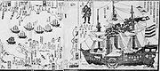
Black Ships

Encyclopedia
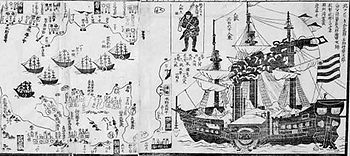
In 1543 Portuguese initiated the first contacts, establishing a trade route linking Goa
Goa
Goa , a former Portuguese colony, is India's smallest state by area and the fourth smallest by population. Located in South West India in the region known as the Konkan, it is bounded by the state of Maharashtra to the north, and by Karnataka to the east and south, while the Arabian Sea forms its...
to Nagasaki
Nagasaki
is the capital and the largest city of Nagasaki Prefecture on the island of Kyushu in Japan. Nagasaki was founded by the Portuguese in the second half of the 16th century on the site of a small fishing village, formerly part of Nishisonogi District...
. The large carrack
Carrack
A carrack or nau was a three- or four-masted sailing ship developed in 15th century Western Europe for use in the Atlantic Ocean. It had a high rounded stern with large aftcastle, forecastle and bowsprit at the stem. It was first used by the Portuguese , and later by the Spanish, to explore and...
s engaged in this trade had the hull painted black with pitch
Pitch (resin)
Pitch is the name for any of a number of viscoelastic, solid polymers. Pitch can be made from petroleum products or plants. Petroleum-derived pitch is also called bitumen. Pitch produced from plants is also known as resin. Products made from plant resin are also known as rosin.Pitch was...
, and the term came to represent all western vessels. In 1639, after suppressing a rebellion blamed on the Christian influence, the ruling Tokugawa shogunate
Tokugawa shogunate
The Tokugawa shogunate, also known as the and the , was a feudal regime of Japan established by Tokugawa Ieyasu and ruled by the shoguns of the Tokugawa family. This period is known as the Edo period and gets its name from the capital city, Edo, which is now called Tokyo, after the name was...
retreated into an isolationist policy, the Sakoku
Sakoku
was the foreign relations policy of Japan under which no foreigner could enter nor could any Japanese leave the country on penalty of death. The policy was enacted by the Tokugawa shogunate under Tokugawa Iemitsu through a number of edicts and policies from 1633–39 and remained in effect until...
. During this “locked state,” contact with Japan by Westerners was restricted to Dejima
Dejima
was a small fan-shaped artificial island built in the bay of Nagasaki in 1634. This island, which was formed by digging a canal through a small peninsula, remained as the single place of direct trade and exchange between Japan and the outside world during the Edo period. Dejima was built to...
island at Nagasaki
Nagasaki
is the capital and the largest city of Nagasaki Prefecture on the island of Kyushu in Japan. Nagasaki was founded by the Portuguese in the second half of the 16th century on the site of a small fishing village, formerly part of Nishisonogi District...
.
In 1844, William II of the Netherlands
William II of the Netherlands
William II was King of the Netherlands, Grand Duke of Luxembourg, and Duke of Limburg from 7 October 1840 until his death in 1849.- Early life and education :...
urged Japan to open, but was rejected. On July 8, 1853, the U.S. Navy with four warships steamed into the bay at Edo, requesting that Japan open to trade with the West. Their arrival marked the reopening of the country after more than two hundred years of self-imposed isolation.
In particular, Kurofune refers to Mississippi
USS Mississippi (1841)
USS Mississippi, a paddle frigate, was the first ship of the United States Navy to bear that name. She was named for the Mississippi River. Her sister ship was . Her keel was laid down by the Philadelphia Navy Yard in 1839; built under the personal supervision of Commodore Matthew Perry. She was...
, Plymouth
USS Plymouth (1844)
USS Plymouth was a sloop-of-war constructed and commissioned just prior to the Mexican-American War. She was heavily gunned, and traveled to Japan as part of Commodore Matthew C. Perry’s effort to force Japan to open her ports to international trade...
, Saratoga
USS Saratoga (1842)
USS Saratoga, a sloop-of-war, was the third ship of the United States Navy to be named for the Battle of Saratoga of the American Revolutionary War. Her keel was laid down in the summer of 1841 by the Portsmouth Navy Yard...
, and Susquehanna
USS Susquehanna (1847)
USS Susquehanna, a sidewheel steam frigate, was the first ship of the United States Navy to be named for a river which rises in Lake Otsego in central New York and flows across Pennsylvania and the northeast corner of Maryland to empty into the Chesapeake Bay.Her keel was laid down by the New York...
, that arrived on July 14, 1853 at Uraga
Uraga
is a subdivision of the city of Yokosuka, Kanagawa Prefecture, Japan. It is located on the south eastern side of the Miura Peninsula, at the northern end of the Uraga Channel, at the entrance of Tokyo Bay.-History:...
Harbor (part of present-day Yokosuka
Yokosuka, Kanagawa
is a city located in Kanagawa, Japan. As of 2010, the city had an estimated population of 419,067 and a population density of 4,160 people per km². It covered an area of 100.62 km²...
) in Kanagawa Prefecture
Kanagawa Prefecture
is a prefecture located in the southern Kantō region of Japan. The capital is Yokohama. Kanagawa is part of the Greater Tokyo Area.-History:The prefecture has some archaeological sites going back to the Jōmon period...
, Japan
Japan
Japan is an island nation in East Asia. Located in the Pacific Ocean, it lies to the east of the Sea of Japan, China, North Korea, South Korea and Russia, stretching from the Sea of Okhotsk in the north to the East China Sea and Taiwan in the south...
under the command of United States
United States
The United States of America is a federal constitutional republic comprising fifty states and a federal district...
Commodore
Commodore (USN)
Commodore was an early title and later a rank in the United States Navy and United States Coast Guard and a current honorary title in the U.S. Navy with an intricate history. Because the U.S. Congress was originally unwilling to authorize more than four ranks until 1862, considerable importance...
Matthew Perry. Black refers to the black color of the older sailing vessels, and the black smoke from the coal
Coal
Coal is a combustible black or brownish-black sedimentary rock usually occurring in rock strata in layers or veins called coal beds or coal seams. The harder forms, such as anthracite coal, can be regarded as metamorphic rock because of later exposure to elevated temperature and pressure...
-fired power plants of the American ships. In this sense, the Kurofune became a symbol of the ending of isolation.
First kurofune ships: nau do trato
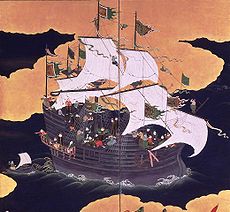
Goa
Goa , a former Portuguese colony, is India's smallest state by area and the fourth smallest by population. Located in South West India in the region known as the Konkan, it is bounded by the state of Maharashtra to the north, and by Karnataka to the east and south, while the Arabian Sea forms its...
, via Malacca
Malacca
Malacca , dubbed The Historic State or Negeri Bersejarah among locals) is the third smallest Malaysian state, after Perlis and Penang. It is located in the southern region of the Malay Peninsula, on the Straits of Malacca. It borders Negeri Sembilan to the north and the state of Johor to the south...
to Nagasaki
Nagasaki
is the capital and the largest city of Nagasaki Prefecture on the island of Kyushu in Japan. Nagasaki was founded by the Portuguese in the second half of the 16th century on the site of a small fishing village, formerly part of Nishisonogi District...
. Large carracks engaged in the flourishing "Nanban trade
Nanban trade
The or the in Japanese history extends from the arrival of the first Europeans to Japan in 1543, to their near-total exclusion from the archipelago in 1614, under the promulgation of the "Sakoku" Seclusion Edicts.- Etymology :...
", introducing modern firearms to Japan, arquebuses, a major innovation of the Sengoku period
Sengoku period
The or Warring States period in Japanese history was a time of social upheaval, political intrigue, and nearly constant military conflict that lasted roughly from the middle of the 15th century to the beginning of the 17th century. The name "Sengoku" was adopted by Japanese historians in reference...
a time of intense internal warfare, and also refined sugar, optics and other inventions. Later, they engaged in triangular trade
Triangular trade
Triangular trade, or triangle trade, is a historical term indicating among three ports or regions. Triangular trade usually evolves when a region has export commodities that are not required in the region from which its major imports come...
, exchanging silver from Japan with silk from China via Macau
Macau
Macau , also spelled Macao , is, along with Hong Kong, one of the two special administrative regions of the People's Republic of China...
.
Large carrack
Carrack
A carrack or nau was a three- or four-masted sailing ship developed in 15th century Western Europe for use in the Atlantic Ocean. It had a high rounded stern with large aftcastle, forecastle and bowsprit at the stem. It was first used by the Portuguese , and later by the Spanish, to explore and...
s of 1200 to 1600 tons - named nau
Nau
Nau or NAU may refer to:*Nau , an outdoor apparel company*Northern Arizona University*North American Union*National American University*National Aviation University *Lepidium oleraceum, a plant endemic to New Zealand...
do trato, silver naus, and China's naus by the Portuguese - engaged in this trade had the hull painted black with pitch
Pitch
Pitch may refer to:* Pitch , a viscous substance produced by plants or formed from petroleum* Pitch * sales pitch** elevator pitch, a very short sales pitch such as that made during an elevator ride* Pitch accent-Music and acoustics:...
, and the term came to name all western vessels. The name was inscribed in the Nippo Jisho
Nippo Jisho
The Nippo Jisho or Vocabvlario da Lingoa de Iapam was a Japanese to Portuguese dictionary published in Nagasaki, Japan in 1603. It contains entries for 32,293 Japanese words in Portuguese. Only four copies of the original 1603 edition exist...
, the first western Japanese dictionary compiled in 1603.
In 1549 missionary Francis Xavier
Francis Xavier
Francis Xavier, born Francisco de Jasso y Azpilicueta was a pioneering Roman Catholic missionary born in the Kingdom of Navarre and co-founder of the Society of Jesus. He was a student of Saint Ignatius of Loyola and one of the first seven Jesuits, dedicated at Montmartre in 1534...
started a Jesuit mission in Japan. Christianity spread, mingled with the new trade, making some 300,000 converts among peasants and some daimyō
Daimyo
is a generic term referring to the powerful territorial lords in pre-modern Japan who ruled most of the country from their vast, hereditary land holdings...
(warlords). In 1637 the Shimabara Rebellion
Shimabara Rebellion
The was an uprising largely involving Japanese peasants, most of them Catholic Christians, in 1637–1638 during the Edo period.It was one of only a handful of instances of serious unrest during the relatively peaceful period of the Tokugawa shogunate's rule...
blamed on the Christian influence was suppressed. Portuguese traders and Jesuit missionaries faced progressively tighter restrictions, and were confined to the island of Dejima
Dejima
was a small fan-shaped artificial island built in the bay of Nagasaki in 1634. This island, which was formed by digging a canal through a small peninsula, remained as the single place of direct trade and exchange between Japan and the outside world during the Edo period. Dejima was built to...
before being expelled in 1639.
The Tokugawa shogunate
Tokugawa shogunate
The Tokugawa shogunate, also known as the and the , was a feudal regime of Japan established by Tokugawa Ieyasu and ruled by the shoguns of the Tokugawa family. This period is known as the Edo period and gets its name from the capital city, Edo, which is now called Tokyo, after the name was...
retreated back into a policy of isolationism
Isolationism
Isolationism is the policy or doctrine of isolating one's country from the affairs of other nations by declining to enter into alliances, foreign economic commitments, international agreements, etc., seeking to devote the entire efforts of one's country to its own advancement and remain at peace by...
, the Sakoku
Sakoku
was the foreign relations policy of Japan under which no foreigner could enter nor could any Japanese leave the country on penalty of death. The policy was enacted by the Tokugawa shogunate under Tokugawa Iemitsu through a number of edicts and policies from 1633–39 and remained in effect until...
(鎖国?, "locked country") forbidding contact with most outside countries. Only a limited-scale trade and diplomatic relations with China
China
Chinese civilization may refer to:* China for more general discussion of the country.* Chinese culture* Greater China, the transnational community of ethnic Chinese.* History of China* Sinosphere, the area historically affected by Chinese culture...
, Korea
Korea
Korea ) is an East Asian geographic region that is currently divided into two separate sovereign states — North Korea and South Korea. Located on the Korean Peninsula, Korea is bordered by the People's Republic of China to the northwest, Russia to the northeast, and is separated from Japan to the...
, the Ryukyu Islands
Ryukyu Kingdom
The Ryūkyū Kingdom was an independent kingdom which ruled most of the Ryukyu Islands from the 15th century to the 19th century. The Kings of Ryūkyū unified Okinawa Island and extended the kingdom to the Amami Islands in modern-day Kagoshima Prefecture, and the Sakishima Islands near Taiwan...
and the Netherlands
Netherlands
The Netherlands is a constituent country of the Kingdom of the Netherlands, located mainly in North-West Europe and with several islands in the Caribbean. Mainland Netherlands borders the North Sea to the north and west, Belgium to the south, and Germany to the east, and shares maritime borders...
was maintained. The Sakoku
Sakoku
was the foreign relations policy of Japan under which no foreigner could enter nor could any Japanese leave the country on penalty of death. The policy was enacted by the Tokugawa shogunate under Tokugawa Iemitsu through a number of edicts and policies from 1633–39 and remained in effect until...
policy remained in effect until 1853 with the arrival of Commodore Matthew Perry and the opening of Japan.
Gunboat diplomacy
Commodore Perry's superior military force was a factor in negotiating a treaty allowing American tradeTrade
Trade is the transfer of ownership of goods and services from one person or entity to another. Trade is sometimes loosely called commerce or financial transaction or barter. A network that allows trade is called a market. The original form of trade was barter, the direct exchange of goods and...
with Japan, thus effectively ending the period of more than 200 years in which trading with Japan had been permitted to the Dutch
Netherlands
The Netherlands is a constituent country of the Kingdom of the Netherlands, located mainly in North-West Europe and with several islands in the Caribbean. Mainland Netherlands borders the North Sea to the north and west, Belgium to the south, and Germany to the east, and shares maritime borders...
and Chinese
China
Chinese civilization may refer to:* China for more general discussion of the country.* Chinese culture* Greater China, the transnational community of ethnic Chinese.* History of China* Sinosphere, the area historically affected by Chinese culture...
exclusively.
The following year, at the Convention of Kanagawa
Convention of Kanagawa
On March 31, 1854, the or was concluded between Commodore Matthew C. Perry of the U.S. Navy and the Tokugawa shogunate.-Treaty of Peace and Amity :...
, Perry returned with eight ships and was presented by the shogun
Shogun
A was one of the hereditary military dictators of Japan from 1192 to 1867. In this period, the shoguns, or their shikken regents , were the de facto rulers of Japan though they were nominally appointed by the emperor...
's officials with the "Treaty of Peace and Amity", establishing formal diplomatic relations between Japan and the United States. Within five years, Japan had signed similar treaties with other western countries
Western world
The Western world, also known as the West and the Occident , is a term referring to the countries of Western Europe , the countries of the Americas, as well all countries of Northern and Central Europe, Australia and New Zealand...
. The Harris Treaty was signed with the United States on July 29, 1858.
The surprise and confusion these ships inspired are described in this famous kyoka (a humorous poem similar to the 5-line waka
Waka (poetry)
Waka or Yamato uta is a genre of classical Japanese verse and one of the major genres of Japanese literature...
):
| 泰平の | Taihei no |
| 眠りを覚ます | Nemuri o samasu |
| 上喜撰 | Jōkisen |
| たった四杯で | Tatta shihai de |
| 夜も眠れず | Yoru mo nemurezu |
This poem is a complex set of pun
Pun
The pun, also called paronomasia, is a form of word play which suggests two or more meanings, by exploiting multiple meanings of words, or of similar-sounding words, for an intended humorous or rhetorical effect. These ambiguities can arise from the intentional use and abuse of homophonic,...
s (in Japanese, kakekotoba
Kakekotoba
A or pivot word is a rhetorical device used in the Japanese poetic form waka. This trope uses the phonetic reading of a grouping of kanji to suggest several interpretations: first on the literal level , then on subsidiary homophonic levels...
or "pivot words"). Taihei (泰平) means "tranquil"; Jōkisen (上喜撰) is the name of a costly brand of green tea
Green tea
Green tea is made solely from the leaves of Camellia sinensis that have undergone minimal oxidation during processing. Green tea originates from China and has become associated with many cultures throughout Asia. It has recently become more widespread in the West, where black tea is traditionally...
containing large amounts of caffeine
Caffeine
Caffeine is a bitter, white crystalline xanthine alkaloid that acts as a stimulant drug. Caffeine is found in varying quantities in the seeds, leaves, and fruit of some plants, where it acts as a natural pesticide that paralyzes and kills certain insects feeding on the plants...
; and shihai (四杯) means "four cups", so a literal translation of the poem is:
- Awoken from sleep
- of a peaceful quiet world
- by Jokisen tea;
- with only four cups of it
- one can't sleep even at night.
However, there is an alternate translation, based on the pivot words. Taihei can refer to the "Pacific Ocean
Pacific Ocean
The Pacific Ocean is the largest of the Earth's oceanic divisions. It extends from the Arctic in the north to the Southern Ocean in the south, bounded by Asia and Australia in the west, and the Americas in the east.At 165.2 million square kilometres in area, this largest division of the World...
" (太平); jōkisen also means "steam-powered ships" (蒸気船); and shihai also means "four vessels". The poem, therefore, has a hidden meaning:
- The steam-powered ships
- break the halcyon slumber
- of the Pacific;
- a mere four boats are enough
- to make us lose sleep at night.
'Black Ships' (Kurofune) is also the title of the first Japanese Opera, composed by Kosaku Yamada
Kosaku Yamada
was a Japanese composer and conductor.In many Western reference books his name is given as Kósçak Yamada. During his music study in the Imperial German capital of Berlin from 1910-13 he hated the times when people laughed at him because his "normal" transliteration of his first name "Kosaku"...
, "based on the story of Tojin Okichi, a geisha
Geisha
, Geiko or Geigi are traditional, female Japanese entertainers whose skills include performing various Japanese arts such as classical music and dance.-Terms:...
caught up in the turmoil that swept Japan in the waning years of the Tokugawa shogunate" and premiered in 1940.
See Also
A TV miniseries starring Richard ChamberlainRichard Chamberlain
George Richard Chamberlain is an American actor of stage and screen who became a teen idol in the title role of the television show Dr. Kildare .-Early life:...
entitled Shōgun
Shogun (TV miniseries)
Shōgun is an American television miniseries based on the namesake novel by James Clavell. As with the novel, the title is often shown as Shōgun in order to conform to Hepburn romanization. The miniseries was broadcast over five nights, between September 15 and September 19, 1980 on NBC in the...
(1980) - It was based on a book by James Clavell (1975)
Shogun (novel)
Shōgun is a 1975 novel by James Clavell. It is the first novel of the author's Asian Saga. A major bestseller, by 1990 the book had sold 15 million copies worldwide...
of the same name which described the fictional experiences of an Englishman shipwrecked in Japan during the 17th century, near the end of Japan's first experience with foreigners.
Another film concerning Perry's arrival in Japan was The Bushido Blade
Bushido Blade (film)
The Bushido Blade is a 1981 film, directed by Tsugunobu Kotani, about a samurai sword being entrusted to Commodore Matthew Perry for the President of the United States by the Emperor of Japan that was stolen by a band of thieves who oppose the treaty about to be signed...
(1981) starring actor Richard Boone
Richard Boone
Richard Allen Boone was an American actor who starred in over 50 films and was notable for his roles in Westerns and for starring in the TV series Have Gun – Will Travel.-Early life:...
as Admiral Perry.
See also
- Treaty of ShimodaTreaty of ShimodaThe Treaty of Shimoda of 1855, formally Treaty of Commerce and Navigation between Japan and Russia , was signed between the Russian Vice-Admiral Euphimy Vasil'evich Putiatin and Toshiakira Kawaji of Japan in the city of Shimoda, Izu Province, Japan, on February 7, 1855...
- French Military Mission to Japan (1867-1868)
- Gunboat diplomacyGunboat diplomacyIn international politics, gunboat diplomacy refers to the pursuit of foreign policy objectives with the aid of conspicuous displays of military power — implying or constituting a direct threat of warfare, should terms not be agreeable to the superior force....
- Dutch missions to EdoDutch missions to EdoThe Dutch East India Company missions to Edo were regular tribute missions to the court of the Tokugawa Shogun in Edo to reassure the ties between the Bakufu and the Opperhoofd...
- Manifest destinyManifest DestinyManifest Destiny was the 19th century American belief that the United States was destined to expand across the continent. It was used by Democrat-Republicans in the 1840s to justify the war with Mexico; the concept was denounced by Whigs, and fell into disuse after the mid-19th century.Advocates of...
- SakokuSakokuwas the foreign relations policy of Japan under which no foreigner could enter nor could any Japanese leave the country on penalty of death. The policy was enacted by the Tokugawa shogunate under Tokugawa Iemitsu through a number of edicts and policies from 1633–39 and remained in effect until...
- Unequal TreatiesUnequal Treaties“Unequal treaty” is a term used in specific reference to a number of treaties imposed by Western powers, during the 19th and early 20th centuries, on Qing Dynasty China and late Tokugawa Japan...
- United States Korean Expedition of 1871
- Pacific OverturesPacific OverturesPacific Overtures is a musical with music and lyrics by Stephen Sondheim, a libretto by John Weidman, and additional material by Hugh Wheeler. The musical is set in 1853 Japan and follows the difficult Westernization of Japan, through the lives of two friends caught in the change...
- Madama ButterflyMadama ButterflyMadama Butterfly is an opera in three acts by Giacomo Puccini, with an Italian libretto by Luigi Illica and Giuseppe Giacosa. Puccini based his opera in part on the short story "Madame Butterfly" by John Luther Long, which was dramatized by David Belasco...
, a representation of the roughly the same times in a European perspective
External links
- Black Ship Festival celebrating the arrival of the Blackships and the opening of Japan to the world.
- New National Theatre Tokyo
- Opera Japonica