

Meiji Constitution

Encyclopedia
The , known informally as the , was the organic law
of the Japanese empire
, in force from November 29, 1890 until May 2, 1947.
in 1868, it provided for a form of constitutional monarchy
based on the Prussia
n model, in which the Emperor of Japan
was an active ruler and wielded considerable political power (over foreign policy and diplomacy) which was shared with an elected Diet
. The Diet primarily dictated domestic policy matters.
After the Meiji Restoration, which restored direct political power to the emperor for the first time in over a millennium, Japan underwent a period of sweeping political and social reform and westernization aimed at strengthening Japan to the level of the nations of the Western world. The immediate consequence of the Constitution was the opening of the first Parliamentary government in Asia.
The Meiji Constitution established clear limits to the power of the executive branch and the absolutism
of the Emperor. It also created an independent judiciary. However, it was ambiguous in wording, and in many places self-contradictory. The leaders of the government and the political parties
were left with the task of interpretation as to whether the Meiji Constitution could be used to justify authoritarian or liberal-democratic rule. It was the struggle between these tendencies that dominated the government of the Empire of Japan.
The Meiji Constitution was used as a model for the 1931 Ethiopian Constitution by the Ethiopian intellectual Tekle Hawariat Tekle Mariyam
. This was one of the reasons why the progressive Ethiopian intelligentsia associated with Tekle Hawariat were known as "Japanizers".
By the surrender
on 2 September 1945, the Empire of Japan was deprived of sovereignty by the Allies
, and the Meiji Constitution was suspended. During the Occupation of Japan, the Meiji Constitution was replaced by a new document, the postwar Constitution of Japan
, which replaced the imperial rule with a form of Western-style liberal democracy
.
. Originally, a Chinese-inspired legal system and constitution known as ritsuryō
was enacted in the 6th century (in the late Asuka period
and early Nara period
); it described a government based on an elaborate and theoretically rational meritocratic
bureaucracy, serving under the ultimate authority of the emperor
and organised following Chinese models. In theory the last ritsuryō code, the Yōrō Code
enacted in 752, was still in force at the time of the Meiji Restoration.
However, in practice the ritsuryō system of government had become largely an empty formality as early as in the middle of the Heian period
in the 10th and 11th centuries, a development which was completed by the establishment of the Kamakura Shogunate
in 1185. The high positions in the ritsuryō system remained as sinecures, and the emperor was de-powered and set aside as a symbolic figure who ‘reigned, but did not rule’ (on the theory that the living god should not have to defile himself with matters of earthly government).
The idea of a written constitution had been a subject of heated debate within and without the government since the beginnings of the Meiji government. The conservative Meiji oligarchy
viewed anything resembling democracy
or republicanism
with suspicion and trepidation, and favored a gradualist approach. The Freedom and People's Rights Movement
demanded the immediate establishment of an elected national assembly
, and the promulgation of a constitution.
was appointed to chair a government bureau to research various forms of constitutional government, and in 1882, Itō led an overseas mission to observe and study various systems first-hand. The United States Constitution
was rejected as "too liberal" and the British
system as being too unwieldy and granting too much power to Parliament
. The French
and Spanish
models were rejected as tending toward despotism
. The legal structures of the Empire of Germany, particularly that of Prussia
proved to be of the most interest to the Constitutional Study Mission.
He also rejected some notions as unfit for Japan, as they stemmed from European constitutional practice and Christianity. He therefore added references to the kokutai
or "national polity" as the justification of the emperor's authority through his divine descent and the unbroken line of emperors, and the unique relationship between subject and sovereign.
The Council of State was replaced in 1885 with a cabinet headed by Itō as Prime Minister
. The positions of Chancellor, Minister of the Left
, and Minister of the Right
, which had existed since the seventh century, were abolished. In their place, the Privy Council
was established in 1888 to evaluate the forthcoming constitution, and to advise Emperor Meiji.
The draft committee included Inoue Kowashi
, Kaneko Kentarō
, Itō Miyoji
and Iwakura Tomomi
, along with a number of foreign advisors
, in particular the German legal scholars Rudolf von Gneist and Lorenz von Stein
. The central issue was the balance between sovereignty vested in the person of the Emperor, and an elected representative legislature with powers that would limit or restrict the power of the sovereign. After numerous drafts from 1886–1888, the final version was submitted to Emperor Meiji in April 1888. The Meiji Constitution was drafted in secret by the committee, without public debate.
, a new representative assembly
, convened on the day the Meiji Constitution came into force. The organizational structure of the Diet reflected both Prussian and British influences, most notably in the inclusion of the House of Peers
(which resembled the Prussian Herrenhaus
and the British House of Lords
), and in the formal Speech from the Throne
delivered by the Emperor on Opening Day. The second chapter of the constitution, detailing the rights of citizens, bore a resemblance to similar articles in both European and North American constitutions of the day.
, legislative and judiciary
) of government, albeit subject to the "consent of the Imperial Diet". Laws were issued and justice administered by the courts "in the name of the Emperor".
Separate provisions of the Constitution are contradictory as to whether the Constitution or the Emperor is supreme.
 The Emperor of Japan had the right to exercise executive authority, and to appoint and dismiss all government officials. The Emperor also had the sole rights to declare war, make peace, conclude treaties, dissolve the lower house of Diet, and issue Imperial ordinances in place of laws when the Diet was not in session. Most importantly, command over the Imperial Japanese Army
and Imperial Japanese Navy
was directly held by the Emperor, and not the Diet. The Meiji Constitution provided for a cabinet consisting of Ministers of State who answered to the Emperor rather than the Diet, and to the establishment of the Privy Council
. Not mentioned in the Constitution were the genrō
, an inner circle of advisors to the Emperor, who wielded considerable influence.
Under the Meiji Constitution, a legislature was established with two Houses. The Upper House, or House of Peers
consisted of members of the Imperial Family, hereditary peerage
and members appointed by the Emperor. The Lower House, or House of Representatives was elected by direct male suffrage (with property qualifications). Legislative authority was shared with the Diet, and both the Emperor and the Diet had to agree in order for a measure to become law. On the other hand, the Diet was given the authority to initiate legislation, approve all laws, and approve the budget.
However, according to Article 73 of the Meiji Constitution, the amendment should be authorized by the Emperor. Indeed, the 1947 Constitution was authorized by the Emperor (as was declared in the letter of promulgation), which is in apparent conflict of the 1947 Constitution, according to which that constitution was made and authorized by the nation ("the principle of popular sovereignty").
To dissipate such inconsitentices, some peculiar doctrine of "August Revolution" was proposed by Toshiyoshi Miyazawa of the University of Tokyo, but without much persuasiveness.
Organic law
An organic or fundamental law is a law or system of laws which forms the foundation of a government, corporation or other organization's body of rules. A constitution is a particular form of organic law for a sovereign state....
of the Japanese empire
Empire of Japan
The Empire of Japan is the name of the state of Japan that existed from the Meiji Restoration on 3 January 1868 to the enactment of the post-World War II Constitution of...
, in force from November 29, 1890 until May 2, 1947.
Outline
After the Meiji RestorationMeiji Restoration
The , also known as the Meiji Ishin, Revolution, Reform or Renewal, was a chain of events that restored imperial rule to Japan in 1868...
in 1868, it provided for a form of constitutional monarchy
Constitutional monarchy
Constitutional monarchy is a form of government in which a monarch acts as head of state within the parameters of a constitution, whether it be a written, uncodified or blended constitution...
based on the Prussia
Prussia
Prussia was a German kingdom and historic state originating out of the Duchy of Prussia and the Margraviate of Brandenburg. For centuries, the House of Hohenzollern ruled Prussia, successfully expanding its size by way of an unusually well-organized and effective army. Prussia shaped the history...
n model, in which the Emperor of Japan
Emperor of Japan
The Emperor of Japan is, according to the 1947 Constitution of Japan, "the symbol of the state and of the unity of the people." He is a ceremonial figurehead under a form of constitutional monarchy and is head of the Japanese Imperial Family with functions as head of state. He is also the highest...
was an active ruler and wielded considerable political power (over foreign policy and diplomacy) which was shared with an elected Diet
Diet (assembly)
In politics, a diet is a formal deliberative assembly. The term is mainly used historically for the Imperial Diet, the general assembly of the Imperial Estates of the Holy Roman Empire, and for the legislative bodies of certain countries.-Etymology:...
. The Diet primarily dictated domestic policy matters.
After the Meiji Restoration, which restored direct political power to the emperor for the first time in over a millennium, Japan underwent a period of sweeping political and social reform and westernization aimed at strengthening Japan to the level of the nations of the Western world. The immediate consequence of the Constitution was the opening of the first Parliamentary government in Asia.
The Meiji Constitution established clear limits to the power of the executive branch and the absolutism
Absolute monarchy
Absolute monarchy is a monarchical form of government in which the monarch exercises ultimate governing authority as head of state and head of government, his or her power not being limited by a constitution or by the law. An absolute monarch thus wields unrestricted political power over the...
of the Emperor. It also created an independent judiciary. However, it was ambiguous in wording, and in many places self-contradictory. The leaders of the government and the political parties
Political Parties
Political Parties: A Sociological Study of the Oligarchical Tendencies of Modern Democracy is a book by sociologist Robert Michels, published in 1911 , and first introducing the concept of iron law of oligarchy...
were left with the task of interpretation as to whether the Meiji Constitution could be used to justify authoritarian or liberal-democratic rule. It was the struggle between these tendencies that dominated the government of the Empire of Japan.
The Meiji Constitution was used as a model for the 1931 Ethiopian Constitution by the Ethiopian intellectual Tekle Hawariat Tekle Mariyam
Tekle Hawariat Tekle Mariyam
Tekle Hawariat Tekle Mariyam was an Ethiopian politician and intellectual of russophile. He was the primary author of Ethiopia's July 16, 1931 constitution, which was influenced by the Japanese Meiji Constitution.- Life :Bahru Zewde includes Tekle Hawariat in the first generation of Ethiopians...
. This was one of the reasons why the progressive Ethiopian intelligentsia associated with Tekle Hawariat were known as "Japanizers".
By the surrender
Surrender of Japan
The surrender of Japan in 1945 brought hostilities of World War II to a close. By the end of July 1945, the Imperial Japanese Navy was incapable of conducting operations and an Allied invasion of Japan was imminent...
on 2 September 1945, the Empire of Japan was deprived of sovereignty by the Allies
Allies of World War II
The Allies of World War II were the countries that opposed the Axis powers during the Second World War . Former Axis states contributing to the Allied victory are not considered Allied states...
, and the Meiji Constitution was suspended. During the Occupation of Japan, the Meiji Constitution was replaced by a new document, the postwar Constitution of Japan
Constitution of Japan
The is the fundamental law of Japan. It was enacted on 3 May, 1947 as a new constitution for postwar Japan.-Outline:The constitution provides for a parliamentary system of government and guarantees certain fundamental rights...
, which replaced the imperial rule with a form of Western-style liberal democracy
Liberal democracy
Liberal democracy, also known as constitutional democracy, is a common form of representative democracy. According to the principles of liberal democracy, elections should be free and fair, and the political process should be competitive...
.
Background
Prior to the adoption of the Meiji Constitution, Japan had in practice no written constitutionConstitution
A constitution is a set of fundamental principles or established precedents according to which a state or other organization is governed. These rules together make up, i.e. constitute, what the entity is...
. Originally, a Chinese-inspired legal system and constitution known as ritsuryō
Ritsuryo
is the historical law system based on the philosophies of Confucianism and Chinese Legalism in Japan. The political system in accord to Ritsuryō is called "Ritsuryō-sei"...
was enacted in the 6th century (in the late Asuka period
Asuka period
The , was a period in the history of Japan lasting from 538 to 710 , although its beginning could be said to overlap with the preceding Kofun period...
and early Nara period
Nara period
The of the history of Japan covers the years from AD 710 to 794. Empress Gemmei established the capital of Heijō-kyō . Except for 5 years , when the capital was briefly moved again, it remained the capital of Japanese civilization until Emperor Kammu established a new capital, Nagaoka-kyō, in 784...
); it described a government based on an elaborate and theoretically rational meritocratic
Meritocracy
Meritocracy, in the first, most administrative sense, is a system of government or other administration wherein appointments and responsibilities are objectively assigned to individuals based upon their "merits", namely intelligence, credentials, and education, determined through evaluations or...
bureaucracy, serving under the ultimate authority of the emperor
Emperor of Japan
The Emperor of Japan is, according to the 1947 Constitution of Japan, "the symbol of the state and of the unity of the people." He is a ceremonial figurehead under a form of constitutional monarchy and is head of the Japanese Imperial Family with functions as head of state. He is also the highest...
and organised following Chinese models. In theory the last ritsuryō code, the Yōrō Code
Yoro Code
The was one iteration of several codes or governing rules compiled in early Nara period in Classical Japan. Major work on the Yōrō Code was completed in 718....
enacted in 752, was still in force at the time of the Meiji Restoration.
However, in practice the ritsuryō system of government had become largely an empty formality as early as in the middle of the Heian period
Heian period
The is the last division of classical Japanese history, running from 794 to 1185. The period is named after the capital city of Heian-kyō, or modern Kyōto. It is the period in Japanese history when Buddhism, Taoism and other Chinese influences were at their height...
in the 10th and 11th centuries, a development which was completed by the establishment of the Kamakura Shogunate
Kamakura shogunate
The Kamakura shogunate was a military dictatorship in Japan headed by the shoguns from 1185 to 1333. It was based in Kamakura. The Kamakura period draws its name from the capital of the shogunate...
in 1185. The high positions in the ritsuryō system remained as sinecures, and the emperor was de-powered and set aside as a symbolic figure who ‘reigned, but did not rule’ (on the theory that the living god should not have to defile himself with matters of earthly government).
The idea of a written constitution had been a subject of heated debate within and without the government since the beginnings of the Meiji government. The conservative Meiji oligarchy
Meiji oligarchy
The Meiji oligarchy was the name used to describe the new ruling class of Meiji period Japan. In Japanese, the Meiji oligarchy is called the ....
viewed anything resembling democracy
Democracy
Democracy is generally defined as a form of government in which all adult citizens have an equal say in the decisions that affect their lives. Ideally, this includes equal participation in the proposal, development and passage of legislation into law...
or republicanism
Republicanism
Republicanism is the ideology of governing a nation as a republic, where the head of state is appointed by means other than heredity, often elections. The exact meaning of republicanism varies depending on the cultural and historical context...
with suspicion and trepidation, and favored a gradualist approach. The Freedom and People's Rights Movement
Freedom and People's Rights Movement
The was a Japanese political and social movement for democracy in 1880s....
demanded the immediate establishment of an elected national assembly
National Assembly
National Assembly is either a legislature, or the lower house of a bicameral legislature in some countries. The best known National Assembly, and the first legislature to be known by this title, was that established during the French Revolution in 1789, known as the Assemblée nationale...
, and the promulgation of a constitution.
Drafting
On October 21, 1881, Itō HirobumiIto Hirobumi
Prince was a samurai of Chōshū domain, Japanese statesman, four time Prime Minister of Japan , genrō and Resident-General of Korea. Itō was assassinated by An Jung-geun, a Korean nationalist who was against the annexation of Korea by the Japanese Empire...
was appointed to chair a government bureau to research various forms of constitutional government, and in 1882, Itō led an overseas mission to observe and study various systems first-hand. The United States Constitution
United States Constitution
The Constitution of the United States is the supreme law of the United States of America. It is the framework for the organization of the United States government and for the relationship of the federal government with the states, citizens, and all people within the United States.The first three...
was rejected as "too liberal" and the British
Great Britain
Great Britain or Britain is an island situated to the northwest of Continental Europe. It is the ninth largest island in the world, and the largest European island, as well as the largest of the British Isles...
system as being too unwieldy and granting too much power to Parliament
Parliament
A parliament is a legislature, especially in those countries whose system of government is based on the Westminster system modeled after that of the United Kingdom. The name is derived from the French , the action of parler : a parlement is a discussion. The term came to mean a meeting at which...
. The French
France
The French Republic , The French Republic , The French Republic , (commonly known as France , is a unitary semi-presidential republic in Western Europe with several overseas territories and islands located on other continents and in the Indian, Pacific, and Atlantic oceans. Metropolitan France...
and Spanish
Spain
Spain , officially the Kingdom of Spain languages]] under the European Charter for Regional or Minority Languages. In each of these, Spain's official name is as follows:;;;;;;), is a country and member state of the European Union located in southwestern Europe on the Iberian Peninsula...
models were rejected as tending toward despotism
Despotism
Despotism is a form of government in which a single entity rules with absolute power. That entity may be an individual, as in an autocracy, or it may be a group, as in an oligarchy...
. The legal structures of the Empire of Germany, particularly that of Prussia
Prussia
Prussia was a German kingdom and historic state originating out of the Duchy of Prussia and the Margraviate of Brandenburg. For centuries, the House of Hohenzollern ruled Prussia, successfully expanding its size by way of an unusually well-organized and effective army. Prussia shaped the history...
proved to be of the most interest to the Constitutional Study Mission.
He also rejected some notions as unfit for Japan, as they stemmed from European constitutional practice and Christianity. He therefore added references to the kokutai
Kokutai
Kokutai is a politically loaded word in the Japanese language, translatable as "sovereign", "national identity; national essence; national character" or "national polity; body politic; national entity; basis for the Emperor's sovereignty; Japanese constitution". "Sovereign" is perhaps the most...
or "national polity" as the justification of the emperor's authority through his divine descent and the unbroken line of emperors, and the unique relationship between subject and sovereign.
The Council of State was replaced in 1885 with a cabinet headed by Itō as Prime Minister
Prime Minister of Japan
The is the head of government of Japan. He is appointed by the Emperor of Japan after being designated by the Diet from among its members, and must enjoy the confidence of the House of Representatives to remain in office...
. The positions of Chancellor, Minister of the Left
Sadaijin
, most commonly translated as "Minister of the Left", was a government position in Japan in the late Nara and Heian periods. The position was consolidated in the Taihō Code of 702. The Asuka Kiyomihara Code of 689 marks the initial appearance of the Sadaijin in the context of a central...
, and Minister of the Right
Udaijin
Udaijin , most commonly translated as the "Minister of the Right", was a government position in Japan in the late Nara and Heian periods. The position was consolidated in the Taihō Code of 702. The Asuka Kiyomihara Code of 689 marks the initial appearance of the Udaijin in the context of a central...
, which had existed since the seventh century, were abolished. In their place, the Privy Council
Privy Council (Japan)
was an advisory council to the Emperor of Japan that operated from 1888 to 1947.-Functions:Modeled in part upon the Privy Council of the United Kingdom, this body advised the throne on matters of grave importance including:...
was established in 1888 to evaluate the forthcoming constitution, and to advise Emperor Meiji.
The draft committee included Inoue Kowashi
Inoue Kowashi
Viscount was a statesman in Meiji period Japan.- Early life :Inoue was born into a samurai family in Higo Province , as the third son of Karō Iida Gongobei. In 1866 Kowashi was adopted by Inoue Shigesaburō, another retainer of the Nagaoka daimyō...
, Kaneko Kentarō
Kaneko Kentaro
was a statesman and diplomat in Meiji period Japan.- Early life :Kaneko was born into a samurai family of Fukuoka Domain . At the age of 9, he began his studies at Shuyukan...
, Itō Miyoji
Ito Miyoji
Count was a statesman in Meiji period Japan.-Biography:Itō was born into a local samurai administrator's family in Nagasaki, Hizen Province . From his early days, he showed a mastery of foreign languages...
and Iwakura Tomomi
Iwakura Tomomi
was a Japanese statesman in the Meiji period. The former 500 Yen banknote issued by the Bank of Japan carried his portrait.-Early life:Iwakura was born in Kyoto as the second son of a low-ranking courtier and nobleman . In 1836 he was adopted by another nobleman, , from whom he received his family...
, along with a number of foreign advisors
O-yatoi gaikokujin
The Foreign government advisors in Meiji Japan, known in Japanese as oyatoi gaikokujin , were those foreign advisors hired by the Japanese government for their specialized knowledge to assist in the modernization of Japan at the end of the Bakufu and during the Meiji era. The term is sometimes...
, in particular the German legal scholars Rudolf von Gneist and Lorenz von Stein
Lorenz von Stein
Lorenz von Stein was a German economist, sociologist, and public administration scholar from Eckernförde. As an advisor to Meiji period Japan, his conservative political views influenced the wording of the Constitution of the Empire of Japan.- Biography :Stein was born in the seaside town of Borby...
. The central issue was the balance between sovereignty vested in the person of the Emperor, and an elected representative legislature with powers that would limit or restrict the power of the sovereign. After numerous drafts from 1886–1888, the final version was submitted to Emperor Meiji in April 1888. The Meiji Constitution was drafted in secret by the committee, without public debate.
Promulgation
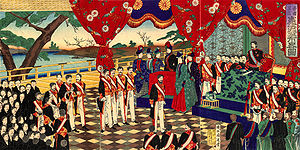
The new constitution was promulgated by Emperor Meiji on February 11, 1889 but came into effect on November 29, 1890. The first Imperial DietDiet of Japan
The is Japan's bicameral legislature. It is composed of a lower house, called the House of Representatives, and an upper house, called the House of Councillors. Both houses of the Diet are directly elected under a parallel voting system. In addition to passing laws, the Diet is formally...
, a new representative assembly
Representative assembly
A representative assembly is a political institution in which a number of persons representing the population or privileged orders within the population of a state come together to debate, negotiate with the executive and legislate...
, convened on the day the Meiji Constitution came into force. The organizational structure of the Diet reflected both Prussian and British influences, most notably in the inclusion of the House of Peers
House of Peers (Japan)
The ' was the upper house of the Imperial Diet as mandated under the Constitution of the Empire of Japan ....
(which resembled the Prussian Herrenhaus
Prussian House of Lords
The Prussian House of Lords was the first chamber of the Parliament of the Kingdom of Prussia from 1850-1918. The second chamber was the Prussian House of Representatives . The House of Lords was created on January 31, 1850 with the adoption of the Constitution of the Kingdom of Prussia...
and the British House of Lords
House of Lords
The House of Lords is the upper house of the Parliament of the United Kingdom. Like the House of Commons, it meets in the Palace of Westminster....
), and in the formal Speech from the Throne
Speech from the Throne
A speech from the throne is an event in certain monarchies in which the reigning sovereign reads a prepared speech to a complete session of parliament, outlining the government's agenda for the coming session...
delivered by the Emperor on Opening Day. The second chapter of the constitution, detailing the rights of citizens, bore a resemblance to similar articles in both European and North American constitutions of the day.
Main provisions
Structure
The Meiji Constitution consists of 76 articles in seven chapters, together amounting to around 2,500 words. It is also usually reproduced with its Preamble, the Imperial Oath Sworn in the Sanctuary in the Imperial Palace, and the Imperial Rescript on the Promulgation of the Constitution, which together come to nearly another 1,000 words. The seven chapters are:- I. The Emperor (1-17)
- II. Rights and Duties of Subjects (18-32)
- III. The Imperial Diet (33-54)
- IV. The Ministers of State and the Privy Council (55-56)
- V. The Judicature (57-61)
- VI. Finance (62-72)
- VII. Supplementary Rules (73-76)
Imperial sovereignty
Unlike its modern successor, the Meiji Constitution was founded on the principle that sovereignty resided in person of the Emperor, by virtue of his divine ancestry "unbroken for ages eternal", rather than in the people. Article 4 states that the "Emperor is the head of the Empire, combining in himself the rights of sovereignty". The Emperor, nominally at least, united within himself all three branches (executiveExecutive (government)
Executive branch of Government is the part of government that has sole authority and responsibility for the daily administration of the state bureaucracy. The division of power into separate branches of government is central to the idea of the separation of powers.In many countries, the term...
, legislative and judiciary
Judiciary
The judiciary is the system of courts that interprets and applies the law in the name of the state. The judiciary also provides a mechanism for the resolution of disputes...
) of government, albeit subject to the "consent of the Imperial Diet". Laws were issued and justice administered by the courts "in the name of the Emperor".
Separate provisions of the Constitution are contradictory as to whether the Constitution or the Emperor is supreme.
- Article 3 declares him to be "sacred and inviolable", a formula which was construed by hard-line monarchists to mean that he retained the right to withdraw the constitution, or to ignore its provisions.
- Article 4 binds the Emperor to exercise his powers "according to the provisions of the present Constitution".
- Article 11 declares that the Emperor commands the armyImperial Japanese Army-Foundation:During the Meiji Restoration, the military forces loyal to the Emperor were samurai drawn primarily from the loyalist feudal domains of Satsuma and Chōshū...
and navyImperial Japanese NavyThe Imperial Japanese Navy was the navy of the Empire of Japan from 1869 until 1947, when it was dissolved following Japan's constitutional renunciation of the use of force as a means of settling international disputes...
. Heads of the army and navy interpreted this article “The army and navy obey only the Emperor, do not have to obey the cabinet and diet.” Interpretation of this article caused political dispute during the imperial period. - Article 55, however, confirmed that the Emperor’s commands (including Imperial Ordinance, Edicts, Rescripts, etc.) had no legal force within themselves, but required the signature of a “Minister of State”. On the other hand, these “Ministers of State” were appointed by (and could be dismissed by), the Emperor alone, and not by the Prime Minister or the Diet.
Rights and Duties of Subjects
- Duties: The constitution asserts the duty of Japanese subjects to uphold the constitution (preamble), pay taxes (Article 21) and serve in the armed forces if conscripted (Article 20).
- Qualified rights: The constitution provides for a number of rights that subjects may enjoy only where the law does not provide otherwise. These included the right to:
- Freedom of movement (Article 22).
- Not have one's house searched or entered (Article 25).
- Privacy of correspondence (Article 26).
- Private property (Article 27)Land Tax Reform (Japan 1873)The Japanese Land Tax Reform of 1873, or was started by the Meiji Government in 1873, or the 6th year of the Meiji era. It was a major restructuring of the previous land taxation system, and established the right of private land ownership in Japan for the first time.-Previous land taxation...
. - Freedom of speechFreedom of speechFreedom of speech is the freedom to speak freely without censorship. The term freedom of expression is sometimes used synonymously, but includes any act of seeking, receiving and imparting information or ideas, regardless of the medium used...
, assemblyFreedom of assemblyFreedom of assembly, sometimes used interchangeably with the freedom of association, is the individual right to come together and collectively express, promote, pursue and defend common interests...
and associationFreedom of associationFreedom of association is the individual right to come together with other individuals and collectively express, promote, pursue and defend common interests....
(Article 29).
- Less conditional rights
- Right to "be appointed to civil or military or any other public offices equally" (Article 19).
- 'Procedural' due processDue processDue process is the legal code that the state must venerate all of the legal rights that are owed to a person under the principle. Due process balances the power of the state law of the land and thus protects individual persons from it...
(Article 23). - Right to trial before a judge (Article 24).
- Freedom of religionFreedom of religionFreedom of religion is a principle that supports the freedom of an individual or community, in public or private, to manifest religion or belief in teaching, practice, worship, and observance; the concept is generally recognized also to include the freedom to change religion or not to follow any...
(Guaranteed by Article 28 "within limits not prejudicial to peace and order, and not antagonistic to their duties as subjects"). - Right to petitionRight to petitionThe right to petition government for redress of grievances is the right to make a complaint to, or seek the assistance of, one's government, without fear of punishment or reprisals.-United States:...
government (Article 30).
Organs of government
Imperial Japanese Army
-Foundation:During the Meiji Restoration, the military forces loyal to the Emperor were samurai drawn primarily from the loyalist feudal domains of Satsuma and Chōshū...
and Imperial Japanese Navy
Imperial Japanese Navy
The Imperial Japanese Navy was the navy of the Empire of Japan from 1869 until 1947, when it was dissolved following Japan's constitutional renunciation of the use of force as a means of settling international disputes...
was directly held by the Emperor, and not the Diet. The Meiji Constitution provided for a cabinet consisting of Ministers of State who answered to the Emperor rather than the Diet, and to the establishment of the Privy Council
Privy Council (Japan)
was an advisory council to the Emperor of Japan that operated from 1888 to 1947.-Functions:Modeled in part upon the Privy Council of the United Kingdom, this body advised the throne on matters of grave importance including:...
. Not mentioned in the Constitution were the genrō
Genro
was an unofficial designation given to certain retired elder Japanese statesmen, considered the "founding fathers" of modern Japan, who served as informal extraconstitutional advisors to the emperor, during the Meiji, Taishō and early Shōwa periods in Japanese history.The institution of genrō...
, an inner circle of advisors to the Emperor, who wielded considerable influence.
Under the Meiji Constitution, a legislature was established with two Houses. The Upper House, or House of Peers
House of Peers (Japan)
The ' was the upper house of the Imperial Diet as mandated under the Constitution of the Empire of Japan ....
consisted of members of the Imperial Family, hereditary peerage
Kazoku
The was the hereditary peerage of the Empire of Japan that existed between 1869 and 1947.-Origins:Following the Meiji Restoration of 1868, the ancient court nobility of Kyoto regained some of its lost status...
and members appointed by the Emperor. The Lower House, or House of Representatives was elected by direct male suffrage (with property qualifications). Legislative authority was shared with the Diet, and both the Emperor and the Diet had to agree in order for a measure to become law. On the other hand, the Diet was given the authority to initiate legislation, approve all laws, and approve the budget.
Amendments
Amendments to the constitution were provided for by Article 73. This stipulated that to become law a proposed amendment had first to be submitted to the Diet by the Emperor, by means of an imperial order or rescript. To be approved by the Diet an amendment had to be adopted in both chambers by a two-thirds majority of the total number of members of each (rather than merely two-thirds of the total number of votes cast). Once it had been approved by the Diet an amendment was then promulgated into law by the Emperor, who had an absolute right of veto. No amendment to the constitution was permitted during the time of a regency. Despite these provisions, no amendments were made to the imperial constitution from the time it was adopted until its demise in 1947. When the Meiji Constitution was replaced, in order to ensure legal continuity, its successor was adopted in the form of a constitutional amendment.However, according to Article 73 of the Meiji Constitution, the amendment should be authorized by the Emperor. Indeed, the 1947 Constitution was authorized by the Emperor (as was declared in the letter of promulgation), which is in apparent conflict of the 1947 Constitution, according to which that constitution was made and authorized by the nation ("the principle of popular sovereignty").
To dissipate such inconsitentices, some peculiar doctrine of "August Revolution" was proposed by Toshiyoshi Miyazawa of the University of Tokyo, but without much persuasiveness.
External links
- The Constitution of the Empire of Japan National Diet LibraryNational Diet LibraryThe is the only national library in Japan. It was established in 1948 for the purpose of assisting members of the in researching matters of public policy. The library is similar in purpose and scope to the U.S...
- Meiji Constitution National Archives of Japan: Digital Archive