


Marco Polo Bridge Incident

Encyclopedia
The Marco Polo Bridge Incident (盧溝橋事變; also known as 七七事變, 七七盧溝橋事變 or the Lugouqiao Incident) was a battle
between the Republic of China
's National Revolutionary Army
and the Imperial Japanese Army
, often used as the marker for the start of the Second Sino-Japanese War (1937–1945)
.
The eleven-arch granite
bridge, Lugouqiao
, is an architecturally
significant structure, restored by the Kangxi Emperor
(1662–1722). Often signifying the opening of Japan's comprehensive invasion of mainland China, both this 7 July and 18 September (Mukden Incident
) are still remembered as days of national humiliation by most Chinese.
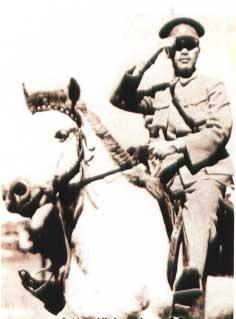 The battle is known by different names.
and China had been fanned since the Invasion of Manchuria in 1931 and subsequent creation of a nominally independent state, Manchukuo
, with Puyi
, the last monarch of the Qing Dynasty
, as its sovereign. Although the Kuomintang
(KMT) government of China refused to recognize Manchukuo, a truce between Japan and Republican China had been negotiated in 1931. However, at the end of 1932 the Japanese Army invaded Rehe Province (Jehol Province). This was annexed into Manchukuo in 1933.
Per the He–Umezu Agreement of 9 June 1935, China recognized the "neutrality" of eastern Hebei
and Chahar provinces, though both were practically under Japanese occupation. Later that year, Japan officially established the East Hebei Autonomous Council
, turning these regions into a puppet state and buffer-zone. By the start of 1937 all the areas north, east and west of Beijing were controlled by Japan.
Under the terms of the Boxer Protocol
of 7 September 1901, China had granted nations with legations in Beijing the right to station guards at twelve specific points along railways connecting Beijing with Tianjin. This was to ensure open communications between the capital and the port. By a supplementary agreement on 15 July 1902, these forces were allowed to conduct maneuvers without informing the authorities of other nations in China.
By July 1937, Japan had expanded to maintain forces estimated between 7000–15,000 men, mostly along the railways. This number of men and amount of material was several times the size of those detachments deployed by European powers, and greatly in excess of the limits set by the Boxer Protocol.
Marco Polo Bridge, located outside of the walled town of Wanping (宛平鎮) to the southwest of Beijing was the choke point of the Pinghan Railway (Beijing-Wuhan
), and guarded the only passage linking Beijing to Kuomintang
-controlled areas in the south. Prior to July 1937, the Japanese military had repeatedly demanded the withdrawal of all Chinese forces stationed in this area, and had attempted to purchase nearby land to build an airfield. The Chinese refused, as Japanese control of the bridge and Wanping town would completely isolate Beijing from the Kuomintang-controlled south.
Chinese troops, thinking an attack was underway, fired a few ineffectual rifle shots, leading to a brief exchange of fire at approximately 23:00. When a Japanese soldier failed to return to his post, his company commander, Major Kiyonao Ichiki, thought that the Chinese had captured him, and reported the incident to his regimental commander, Colonel Renya Mutaguchi
. Chinese regimental commander Ji Xingwen (219th Regiment, 37th Division, 29th Route Army) received a telephone message from the Japanese demanding permission to enter Wanping to search for the missing soldier.
At 23:40, General Qin Dechun, acting commander of the 29th Route Army and Chairman of the Hebei-Chahar Political Council
was contacted by Japanese military intelligence with the same demand. He responded that in his opinion, the Japanese had violated China's sovereignty by conducting maneuvers without advance notice, and refused the Japanese demand for entry into Wanping. However, Qin said that he would order Chinese troops stationed at Wanping to conduct a search on their own behalf with an attached Japanese officer. The Japanese were satisfied with the reply, but while both sides prepared their investigators, a unit of Japanese infantry attempted to breach Wanping's defences and were repulsed. An ultimatum by the Japanese was issued two hours later. As a precautionary measure, Qin contacted 37th Divisional commander General Feng Zhian to place his troops on heightened alert.
ners arrived from nearby Fengtai. The Chinese also rushed an extra division of troops to the area. At around 04:50, two Japanese investigators were allowed into Wanping. However, notwithstanding the presence of the Japanese investigators within the town, the Japanese Army opened fire with machine guns at around 05:00. Japanese infantry backed with armored vehicles attacked the Marco Polo Bridge, along with a modern railroad bridge to the southeast of town.
Colonel Ji Xingwen led the Chinese defenses with about 100 men, with orders to hold the bridge at all costs. After inflicting severe casualties, the Japanese forces partially overran the bridge and its vicinity in the afternoon, but the reinforced Chinese soon outnumbered the Japanese. Taking advantage of mist and rain on the morning of 9 July, the Chinese were able to retake the bridge by 06:00. At this point, the Japanese military and members of the Foreign Service began negotiations in Beijing with the Chinese Nationalist government.
A verbal agreement with General Qin was reached, whereby an apology would be given by the Chinese; punishment would be dealt to those responsible; control of Wanping would be turned over to the Hopei civilian constabulary and not with the 219th Regiment; and better control of "communists" in the area. This was agreed upon, though Japanese Garrison Infantry Brigade commander General Masakazu Kawabe
initially rejected the truce and continued to shell Wanping against his superiors' orders for the next three hours until prevailed upon to cease and to move his forces to the northeast.
's statements threatened continued Japanese mobilization, even though Japan had begun pulling back its troops on the evening of the 11 July.
A lull in tension occurred when Lieutenant General Kanichiro Tashiro
, commander of Japanese China Garrison Army, died of a heart attack on 12 July, and was replaced by Lieutenant General Kiyoshi Katsuki
. Efforts to defuse the escalating conflict failed, largely due to actions by the Japanese Northern China Area Army
commanders and militarists
within the Imperial Japanese Army General Staff. Wanping was shelled on 20 July and full scale fighting erupted at Langfang
on 25 July. After launching a bitter and bloody attack on the Japanese lines on the 27 July, General Sung was defeated and forced to retreat behind the Yongding River by the next day.
The Japanese gave Sung and his troops "free passage", then moved in to pacify areas surrounding Beijing and Tianjin. However, the Japanese Army had been given orders not to advance further than the Yongding River. In a sudden volte-face
, the Konoe government's foreign minister opened negotiations with Chiang Kai-Shek's government in Nanjing and stated: "Japan wants Chinese cooperation, not Chinese land." Nevertheless, negotiations failed to move further than preparation as, on 9 August 1937, a Japanese naval officer was shot in Shanghai instigating the war proper.
 The heightened tensions of the Marco Polo bridge Incident led directly into full scale war with the Battle of Beiping-Tianjin
at the end of July and the Battle of Shanghai
in August.
There are some disputes among historians over the incident, some historians believe the incident was an unintentional accident and some believe that the incident may have been fabricated by the Japanese Army in order to provide a pretext for the invasion of China. A thesis supported by the expansionist colonial ambitions of Japan at the time, a common sentiment felt by many Japanese at the time that "Asia should be ruled by Asians" in replacing European colonial rulers with Japanese rulers throughout Asia.
The missing Japanese soldier was later found to be unharmed. One far-right Japanese historian has alleged that the incident was staged by the Chinese Communist Party, who hoped that the incident would lead to a war of attrition between the Japanese army and the Kuomintang (Guomingdang).
. Moreover, the Chinese garrison in the Lugouqiao area was completely outnumbered and outgunned; it consisted only of about 100 soldiers. To make things worse, generalissimo Chiang Kai-shek was reluctant to provide assistance as he had grudges with the 29th Route Army commander, Song Zhe-Yuan.
was a combined force of infantry, tank
s, mechanized forces, artillery
and cavalry
, which had been stationed in China since the time of the Boxer Rebellion
. Its headquarters and bulk for its forces were in Tianjin, with a major detachment in Beijing to protect the Japanese embassy.
Battle
Generally, a battle is a conceptual component in the hierarchy of combat in warfare between two or more armed forces, or combatants. In a battle, each combatant will seek to defeat the others, with defeat determined by the conditions of a military campaign...
between the Republic of China
Republic of China (1912–1949)
In 1911, after over two thousand years of imperial rule, a republic was established in China and the monarchy overthrown by a group of revolutionaries. The Qing Dynasty, having just experienced a century of instability, suffered from both internal rebellion and foreign imperialism...
's National Revolutionary Army
National Revolutionary Army
The National Revolutionary Army , pre-1928 sometimes shortened to 革命軍 or Revolutionary Army and between 1928-1947 as 國軍 or National Army was the Military Arm of the Kuomintang from 1925 until 1947, as well as the national army of the Republic of China during the KMT's period of party rule...
and the Imperial Japanese Army
Imperial Japanese Army
-Foundation:During the Meiji Restoration, the military forces loyal to the Emperor were samurai drawn primarily from the loyalist feudal domains of Satsuma and Chōshū...
, often used as the marker for the start of the Second Sino-Japanese War (1937–1945)
Second Sino-Japanese War
The Second Sino-Japanese War was a military conflict fought primarily between the Republic of China and the Empire of Japan. From 1937 to 1941, China fought Japan with some economic help from Germany , the Soviet Union and the United States...
.
The eleven-arch granite
Granite
Granite is a common and widely occurring type of intrusive, felsic, igneous rock. Granite usually has a medium- to coarse-grained texture. Occasionally some individual crystals are larger than the groundmass, in which case the texture is known as porphyritic. A granitic rock with a porphyritic...
bridge, Lugouqiao
Lugou Bridge
The Lugou Bridge , also known as the Marco Polo Bridge in English, is a famous stone bridge located 15 km southwest of the Beijing city center across the Yongding River—a main tributary of Hai River The Lugou Bridge (Simplified: 卢沟桥; Traditional: 盧溝橋; Pinyin: Lúgōu Qiáo), also known as...
, is an architecturally
Architecture
Architecture is both the process and product of planning, designing and construction. Architectural works, in the material form of buildings, are often perceived as cultural and political symbols and as works of art...
significant structure, restored by the Kangxi Emperor
Kangxi Emperor
The Kangxi Emperor ; Manchu: elhe taifin hūwangdi ; Mongolian: Энх-Амгалан хаан, 4 May 1654 –20 December 1722) was the fourth emperor of the Qing Dynasty, the first to be born on Chinese soil south of the Pass and the second Qing emperor to rule over China proper, from 1661 to 1722.Kangxi's...
(1662–1722). Often signifying the opening of Japan's comprehensive invasion of mainland China, both this 7 July and 18 September (Mukden Incident
Mukden Incident
The Mukden Incident, also known as the Manchurian Incident, was a staged event that was engineered by Japanese military personnel as a pretext for invading the northern part of China known as Manchuria in 1931....
) are still remembered as days of national humiliation by most Chinese.
Nomenclature
- In the WestWestern worldThe Western world, also known as the West and the Occident , is a term referring to the countries of Western Europe , the countries of the Americas, as well all countries of Northern and Central Europe, Australia and New Zealand...
- The Marco Polo Bridge Incident
- Battle of Lugou Bridge
- In China
- Incident of July 7 (七七事變/七七事变 pinyinPinyinPinyin is the official system to transcribe Chinese characters into the Roman alphabet in China, Malaysia, Singapore and Taiwan. It is also often used to teach Mandarin Chinese and spell Chinese names in foreign publications and used as an input method to enter Chinese characters into...
: Qīqī Shìbiàn) - Lugou Bridge Incident (盧溝橋事變/卢沟桥事变 Lúgōuqiáo Shìbiàn)
- July 7 Lugou Bridge Incident (七七盧溝橋事變/七七卢沟桥事变 Qīqī Lúgōuqiáo Shìbiàn)
- Incident of July 7 (七七事變/七七事变 pinyin
- In Japan:
- In North Korea:
- Incident of July 7 (칠칠사건 Ch'ilch'il sagŏn)
Far background
Tensions between the Empire of JapanEmpire of Japan
The Empire of Japan is the name of the state of Japan that existed from the Meiji Restoration on 3 January 1868 to the enactment of the post-World War II Constitution of...
and China had been fanned since the Invasion of Manchuria in 1931 and subsequent creation of a nominally independent state, Manchukuo
Manchukuo
Manchukuo or Manshū-koku was a puppet state in Manchuria and eastern Inner Mongolia, governed under a form of constitutional monarchy. The region was the historical homeland of the Manchus, who founded the Qing Empire in China...
, with Puyi
Puyi
Puyi , of the Manchu Aisin Gioro clan, was the last Emperor of China, and the twelfth and final ruler of the Qing Dynasty. He ruled as the Xuantong Emperor from 1908 until his abdication on 12 February 1912. From 1 to 12 July 1917 he was briefly restored to the throne as a nominal emperor by the...
, the last monarch of the Qing Dynasty
Qing Dynasty
The Qing Dynasty was the last dynasty of China, ruling from 1644 to 1912 with a brief, abortive restoration in 1917. It was preceded by the Ming Dynasty and followed by the Republic of China....
, as its sovereign. Although the Kuomintang
Kuomintang
The Kuomintang of China , sometimes romanized as Guomindang via the Pinyin transcription system or GMD for short, and translated as the Chinese Nationalist Party is a founding and ruling political party of the Republic of China . Its guiding ideology is the Three Principles of the People, espoused...
(KMT) government of China refused to recognize Manchukuo, a truce between Japan and Republican China had been negotiated in 1931. However, at the end of 1932 the Japanese Army invaded Rehe Province (Jehol Province). This was annexed into Manchukuo in 1933.
Per the He–Umezu Agreement of 9 June 1935, China recognized the "neutrality" of eastern Hebei
Hebei
' is a province of the People's Republic of China in the North China region. Its one-character abbreviation is "" , named after Ji Province, a Han Dynasty province that included what is now southern Hebei...
and Chahar provinces, though both were practically under Japanese occupation. Later that year, Japan officially established the East Hebei Autonomous Council
East Hebei Autonomous Council
The East Hebei Autonomous Council also known as the East Ji Autonomous Council and the East Hopei Autonomous Anti-Communist Council, was a short-lived Japanese puppet state in northern China in the late 1930s.-History:...
, turning these regions into a puppet state and buffer-zone. By the start of 1937 all the areas north, east and west of Beijing were controlled by Japan.
Under the terms of the Boxer Protocol
Boxer Protocol
The Boxer Protocol was signed on September 7, 1901 between the Qing Empire of China and the Eight-Nation Alliance that had provided military forces plus Belgium, Spain and the Netherlands after China's defeat in the intervention to put down the Boxer Rebellion at the hands of the...
of 7 September 1901, China had granted nations with legations in Beijing the right to station guards at twelve specific points along railways connecting Beijing with Tianjin. This was to ensure open communications between the capital and the port. By a supplementary agreement on 15 July 1902, these forces were allowed to conduct maneuvers without informing the authorities of other nations in China.
By July 1937, Japan had expanded to maintain forces estimated between 7000–15,000 men, mostly along the railways. This number of men and amount of material was several times the size of those detachments deployed by European powers, and greatly in excess of the limits set by the Boxer Protocol.
Marco Polo Bridge, located outside of the walled town of Wanping (宛平鎮) to the southwest of Beijing was the choke point of the Pinghan Railway (Beijing-Wuhan
Wuhan
Wuhan is the capital of Hubei province, People's Republic of China, and is the most populous city in Central China. It lies at the east of the Jianghan Plain, and the intersection of the middle reaches of the Yangtze and Han rivers...
), and guarded the only passage linking Beijing to Kuomintang
Kuomintang
The Kuomintang of China , sometimes romanized as Guomindang via the Pinyin transcription system or GMD for short, and translated as the Chinese Nationalist Party is a founding and ruling political party of the Republic of China . Its guiding ideology is the Three Principles of the People, espoused...
-controlled areas in the south. Prior to July 1937, the Japanese military had repeatedly demanded the withdrawal of all Chinese forces stationed in this area, and had attempted to purchase nearby land to build an airfield. The Chinese refused, as Japanese control of the bridge and Wanping town would completely isolate Beijing from the Kuomintang-controlled south.
Near background
From June 1937, Japanese troops carried out intensive military training maneuvers in the vicinity of the western end of the Marco Polo Bridge. These were held every night (other foreign garrison troops seldom held night maneuvers), and the Chinese government requested that advance notice be given so that local inhabitants would not be disturbed. The Japanese agreed to this condition. However, on the night of July 7, 1937, night maneuvers were carried out without prior notice, greatly alarming the local Chinese forces.Chinese troops, thinking an attack was underway, fired a few ineffectual rifle shots, leading to a brief exchange of fire at approximately 23:00. When a Japanese soldier failed to return to his post, his company commander, Major Kiyonao Ichiki, thought that the Chinese had captured him, and reported the incident to his regimental commander, Colonel Renya Mutaguchi
Renya Mutaguchi
- Notes :...
. Chinese regimental commander Ji Xingwen (219th Regiment, 37th Division, 29th Route Army) received a telephone message from the Japanese demanding permission to enter Wanping to search for the missing soldier.
At 23:40, General Qin Dechun, acting commander of the 29th Route Army and Chairman of the Hebei-Chahar Political Council
Hebei-Chahar Political Council
The Hebei–Chahar Political Council, or Hebei-Chahar Political Commission, was established at Beijing under Gen. Song Zheyuan, 1935-12-08....
was contacted by Japanese military intelligence with the same demand. He responded that in his opinion, the Japanese had violated China's sovereignty by conducting maneuvers without advance notice, and refused the Japanese demand for entry into Wanping. However, Qin said that he would order Chinese troops stationed at Wanping to conduct a search on their own behalf with an attached Japanese officer. The Japanese were satisfied with the reply, but while both sides prepared their investigators, a unit of Japanese infantry attempted to breach Wanping's defences and were repulsed. An ultimatum by the Japanese was issued two hours later. As a precautionary measure, Qin contacted 37th Divisional commander General Feng Zhian to place his troops on heightened alert.
The Incident
At around 03:30 on the morning of 8 July, Japanese reinforcements in the form of four mountain guns and a company of machine gunMachine gun
A machine gun is a fully automatic mounted or portable firearm, usually designed to fire rounds in quick succession from an ammunition belt or large-capacity magazine, typically at a rate of several hundred rounds per minute....
ners arrived from nearby Fengtai. The Chinese also rushed an extra division of troops to the area. At around 04:50, two Japanese investigators were allowed into Wanping. However, notwithstanding the presence of the Japanese investigators within the town, the Japanese Army opened fire with machine guns at around 05:00. Japanese infantry backed with armored vehicles attacked the Marco Polo Bridge, along with a modern railroad bridge to the southeast of town.
Colonel Ji Xingwen led the Chinese defenses with about 100 men, with orders to hold the bridge at all costs. After inflicting severe casualties, the Japanese forces partially overran the bridge and its vicinity in the afternoon, but the reinforced Chinese soon outnumbered the Japanese. Taking advantage of mist and rain on the morning of 9 July, the Chinese were able to retake the bridge by 06:00. At this point, the Japanese military and members of the Foreign Service began negotiations in Beijing with the Chinese Nationalist government.
A verbal agreement with General Qin was reached, whereby an apology would be given by the Chinese; punishment would be dealt to those responsible; control of Wanping would be turned over to the Hopei civilian constabulary and not with the 219th Regiment; and better control of "communists" in the area. This was agreed upon, though Japanese Garrison Infantry Brigade commander General Masakazu Kawabe
Masakazu Kawabe
was a general in the Imperial Japanese Army. He held important commands in the Imperial Japanese Army during the Second Sino-Japanese War, and during World War II in the Burma Campaign and defense of the Japanese homeland late in the war...
initially rejected the truce and continued to shell Wanping against his superiors' orders for the next three hours until prevailed upon to cease and to move his forces to the northeast.
Aftermath
If the truce and ceasefire had remained in place, with both forces returning their original positions, the Marco Polo Bridge Incident would have ended as a minor skirmish. However, from midnight of July 9, Japanese and Chinese violations of the ceasefire began to increase, and a buildup of reinforcements on both sides continued, with four divisions of Chinese troops moved to the border, and three on the Japanese side. Confronted with the threat of another battle, General Kanji Ishiwara requested the Japanese government make public statements on the matter – which ironically were more hard-line than what the Kwantung Army had wished for. Prime Minister Fumimaro KonoeFumimaro Konoe
Prince was a politician in the Empire of Japan who served as the 34th, 38th and 39th Prime Minister of Japan and founder/leader of the Taisei Yokusankai.- Early life :...
's statements threatened continued Japanese mobilization, even though Japan had begun pulling back its troops on the evening of the 11 July.
A lull in tension occurred when Lieutenant General Kanichiro Tashiro
Kanichiro Tashiro
- Notes :...
, commander of Japanese China Garrison Army, died of a heart attack on 12 July, and was replaced by Lieutenant General Kiyoshi Katsuki
Kiyoshi Katsuki
-External links:* at imperialarmy.hp.infoseek.co.jp- Notes :...
. Efforts to defuse the escalating conflict failed, largely due to actions by the Japanese Northern China Area Army
Japanese Northern China Area Army
The was a field army of the Imperial Japanese Army during the Second Sino-Japanese War.-History:The Japanese North China Area Army was formed on August 21, 1937 under the control of the Imperial General Headquarters. It was transferred to the newly formed China Expeditionary Army on September 23,...
commanders and militarists
Japanese militarism
refers to the ideology in the Empire of Japan that militarism should dominate the political and social life of the nation, and that the strength of the military is equal to the strength of a nation.-Rise of militarism :...
within the Imperial Japanese Army General Staff. Wanping was shelled on 20 July and full scale fighting erupted at Langfang
Langfang
Langfang , Hebei province, China, is a prefecture-level city located approximately midway between Beijing and Tianjin with a total population of 3.85 million and an urban area population of 763,700. Its total area is around 6,429 km²...
on 25 July. After launching a bitter and bloody attack on the Japanese lines on the 27 July, General Sung was defeated and forced to retreat behind the Yongding River by the next day.
The Japanese gave Sung and his troops "free passage", then moved in to pacify areas surrounding Beijing and Tianjin. However, the Japanese Army had been given orders not to advance further than the Yongding River. In a sudden volte-face
Volte-face
Volte-face is a total change of position, as in policy or opinion; an about-face.The expression comes through French, from Italian voltafaccia and Portuguese volte face, composed of volta and faccia ....
, the Konoe government's foreign minister opened negotiations with Chiang Kai-Shek's government in Nanjing and stated: "Japan wants Chinese cooperation, not Chinese land." Nevertheless, negotiations failed to move further than preparation as, on 9 August 1937, a Japanese naval officer was shot in Shanghai instigating the war proper.
Consequences
Battle of Beiping-Tianjin
The Battle of Beiping-Tianjin , also known as the “Peiking-Tientsin Operation” or by the Japanese as the was a series of battles of the Second Sino-Japanese War fought in the proximity of Beiping and Tianjin...
at the end of July and the Battle of Shanghai
Battle of Shanghai
The Battle of Shanghai, known in Chinese as Battle of Songhu, was the first of the twenty-two major engagements fought between the National Revolutionary Army of the Republic of China and the Imperial Japanese Army of the Empire of Japan during the Second Sino-Japanese War...
in August.
There are some disputes among historians over the incident, some historians believe the incident was an unintentional accident and some believe that the incident may have been fabricated by the Japanese Army in order to provide a pretext for the invasion of China. A thesis supported by the expansionist colonial ambitions of Japan at the time, a common sentiment felt by many Japanese at the time that "Asia should be ruled by Asians" in replacing European colonial rulers with Japanese rulers throughout Asia.
The missing Japanese soldier was later found to be unharmed. One far-right Japanese historian has alleged that the incident was staged by the Chinese Communist Party, who hoped that the incident would lead to a war of attrition between the Japanese army and the Kuomintang (Guomingdang).
National Revolutionary Army (Kuomintang)
In comparison to their Japanese counterparts, the 29th Route Army, and generally all of the NRA for that matter, was poorly equipped and under-trained. Most soldiers were armed only with a rifle and a DadaoDadao
The dadao one of the varieties of dao or Chinese saber, is also known as the Chinese great sword. Based on agricultural knives, dadao have broad blades generally between two and three feet long, long hilts meant for "hand and a half" or two-handed use, and generally a weight-forward balance...
. Moreover, the Chinese garrison in the Lugouqiao area was completely outnumbered and outgunned; it consisted only of about 100 soldiers. To make things worse, generalissimo Chiang Kai-shek was reluctant to provide assistance as he had grudges with the 29th Route Army commander, Song Zhe-Yuan.
| Name | Military Post(s) | Non-Military Post(s) |
|---|---|---|
| General Song Zheyuan Song Zheyuan Sòng Zhéyuán was a Chinese general during the Chinese Civil War and Sino-Japanese War .- Early life and education :... (宋哲元; Wade-Giles Wade-Giles Wade–Giles , sometimes abbreviated Wade, is a romanization system for the Mandarin Chinese language. It developed from a system produced by Thomas Wade during the mid-19th century , and was given completed form with Herbert Giles' Chinese–English dictionary of 1892.Wade–Giles was the most... : Sung Che-yuan) |
Commander of 29th Route Army | Chairman of Hopeh Legislative Committee Head of Peking security forces |
| General Qin Dechun (秦德純; Wade-Giles Wade-Giles Wade–Giles , sometimes abbreviated Wade, is a romanization system for the Mandarin Chinese language. It developed from a system produced by Thomas Wade during the mid-19th century , and was given completed form with Herbert Giles' Chinese–English dictionary of 1892.Wade–Giles was the most... : Chin Teh-chun) |
Vice-Commander of 29th Army | Mayor of Peking |
| General Tong Lin'ge Tong Linge Tong Linge or Tung Ling-ko , was the Manchu ethnicity Chinese Deputy Commander of 29th Corps or 29th Route Army in 1937 during the Marco Polo Bridge Incident and Battle of Beiping-Tianjin.... (佟麟閣; |
Vice-Commander of 29th Army | |
| General Liu Ruming Liu Ruming Liu Ruming, Liu Ju-ming, 刘汝明, Chinese general during the Warlord Era, Second Sino-Japanese War and Chinese Civil War.- Overview :... (劉汝明) |
Commander of the 143rd Division | Chairman of Chahar Chahar (province) Chahar , also known as Chaha'er, Chakhar, or Qahar, was a province of China in existence from 1912 to 1936, mostly covering territory in what is part of eastern Inner Mongolia. It was named after the Chahar Mongolians.... Province |
| General Feng Zhian (馮治安) |
Commander of the 37th Division | Chairman of Hopeh Province |
| General Zhao Dengyu Zhao Dengyu Zhao Dengyu or Chao Teng-yu was a Chinese general, distinguished for his service at the beginning of theSecond Sino-Japanese War.... (趙登禹; Wade-Giles Wade-Giles Wade–Giles , sometimes abbreviated Wade, is a romanization system for the Mandarin Chinese language. It developed from a system produced by Thomas Wade during the mid-19th century , and was given completed form with Herbert Giles' Chinese–English dictionary of 1892.Wade–Giles was the most... : Chao Teng-yu) |
Commander of the 132nd Division | |
| General Zhang Zizhong Zhang Zizhong Zhāng Zìzhōng was a Chinese general of the National Revolutionary Army during the Second Sino-Japanese War. Born in Linqing in Shandong province, he was the highest-ranked officer and the only Army group commander of the NRA to die in the war... (張自忠; Wade-Giles Wade-Giles Wade–Giles , sometimes abbreviated Wade, is a romanization system for the Mandarin Chinese language. It developed from a system produced by Thomas Wade during the mid-19th century , and was given completed form with Herbert Giles' Chinese–English dictionary of 1892.Wade–Giles was the most... : Chang Tze-chung) |
Commander of the 38th Division | Mayor of Tientsin |
| Colonel Ji Xingwen (吉星文) |
Commander of the 219th Regiment under the 110th Brigade of the 37th Division |
|
Imperial Japanese Army
The Japanese China Garrison ArmyJapanese China Garrison Army
The was formed 1 June 1901 as the , as part of Japan's contribution to the international coalition in China during the Boxer Rebellion. It was renamed the China Garrison Army on 14 April 1912.-History:...
was a combined force of infantry, tank
Tank
A tank is a tracked, armoured fighting vehicle designed for front-line combat which combines operational mobility, tactical offensive, and defensive capabilities...
s, mechanized forces, artillery
Artillery
Originally applied to any group of infantry primarily armed with projectile weapons, artillery has over time become limited in meaning to refer only to those engines of war that operate by projection of munitions far beyond the range of effect of personal weapons...
and cavalry
Cavalry
Cavalry or horsemen were soldiers or warriors who fought mounted on horseback. Cavalry were historically the third oldest and the most mobile of the combat arms...
, which had been stationed in China since the time of the Boxer Rebellion
Boxer Rebellion
The Boxer Rebellion, also called the Boxer Uprising by some historians or the Righteous Harmony Society Movement in northern China, was a proto-nationalist movement by the "Righteous Harmony Society" , or "Righteous Fists of Harmony" or "Society of Righteous and Harmonious Fists" , in China between...
. Its headquarters and bulk for its forces were in Tianjin, with a major detachment in Beijing to protect the Japanese embassy.
| Name | Position | Location |
|---|---|---|
| Lieutenant General Kanichiro Tashiro Kanichiro Tashiro - Notes :... (田代皖一郎) |
Commander China Garrison Army | Tientsin |
| Major General Masakazu Kawabe Masakazu Kawabe was a general in the Imperial Japanese Army. He held important commands in the Imperial Japanese Army during the Second Sino-Japanese War, and during World War II in the Burma Campaign and defense of the Japanese homeland late in the war... (河辺正三) |
Commander China Garrison Infantry Brigade | Peking |
| Colonel Renya Mutaguchi Renya Mutaguchi - Notes :... (牟田口廉也) |
Commander 1st Infantry Regiment | Peking |
| Major Kiyonao Ichiki (一木清直) |
Commander, 3rd Battalion, 1st Infantry Regiment | W of Marco Polo Bridge, 510 men |
See also
- National Revolutionary ArmyNational Revolutionary ArmyThe National Revolutionary Army , pre-1928 sometimes shortened to 革命軍 or Revolutionary Army and between 1928-1947 as 國軍 or National Army was the Military Arm of the Kuomintang from 1925 until 1947, as well as the national army of the Republic of China during the KMT's period of party rule...
- History of the Republic of ChinaHistory of the Republic of ChinaThe History of the Republic of China begins after the Qing Dynasty in 1912, when the formation of the Republic of China put an end to over two thousand years of Imperial rule. The Qing Dynasty, also known as the Manchu Dynasty, ruled from 1644 to 1912...
- Military of the Republic of ChinaMilitary of the Republic of ChinaThe Republic of China Armed Forces encompass the Army, Navy, Air Force, and Military Police Force of the Republic of China . It is a military establishment, which accounted for 16.8% of the central budget in the fiscal year of 2003...
- Chiang Kai-shekChiang Kai-shekChiang Kai-shek was a political and military leader of 20th century China. He is known as Jiǎng Jièshí or Jiǎng Zhōngzhèng in Mandarin....
- History of BeijingHistory of BeijingThe city of Beijing has a long and rich history that dates back over 3,000 years. Prior to the unification of China by the First Emperor in 221 BC, Beijing was for centuries the capital of the ancient state of Yan. During the first millennia of imperial rule, Beijing was a provincial city in...