
Home      Discussion      Topics      Dictionary      Almanac
Signup       Login
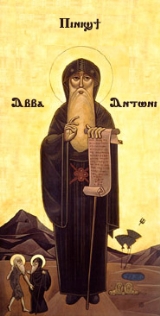
Anthony the Great

Anthony the Great

Overview
Anthony the Great or Antony the Great (c. 251–356), (Coptic
Coptic language
Coptic or Coptic Egyptian is the current stage of the Egyptian language, a northern Afro-Asiatic language spoken in Egypt until at least the 17th century. Egyptian began to be written using the Greek alphabet in the 1st century...

 Ⲁⲃⲃⲁ Ⲁⲛⲧⲱⲛⲓ), also known as Saint Anthony, Anthony the Abbot, Anthony of Egypt, Anthony of the Desert, Anthony the Anchorite, Abba Antonius (Ἀββᾶς Ἀντώνιος), and Father of All Monks, was a Christian
Christianity
Christianity is a monotheistic religion based on the life and teachings of Jesus as presented in canonical gospels and other New Testament writings...

 saint
Saint
A saint is a holy person. In various religions, saints are people who are believed to have exceptional holiness.In Christian usage, "saint" refers to any believer who is "in Christ", and in whom Christ dwells, whether in heaven or in earth...

 from Egypt
Egypt
Egypt , officially the Arab Republic of Egypt, Arabic: , is a country mainly in North Africa, with the Sinai Peninsula forming a land bridge in Southwest Asia. Egypt is thus a transcontinental country, and a major power in Africa, the Mediterranean Basin, the Middle East and the Muslim world...

, a prominent leader among the Desert Fathers
Desert Fathers
The Desert Fathers were hermits, ascetics, monks, and nuns who lived mainly in the Scetes desert of Egypt beginning around the third century AD. The most well known was Anthony the Great, who moved to the desert in 270–271 and became known as both the father and founder of desert monasticism...

. He is celebrated in many churches on his feast days: 30 January in the Eastern Orthodox Church
Eastern Orthodox Church
The Orthodox Church, officially called the Orthodox Catholic Church and commonly referred to as the Eastern Orthodox Church, is the second largest Christian denomination in the world, with an estimated 300 million adherents mainly in the countries of Belarus, Bulgaria, Cyprus, Georgia, Greece,...

 and the Coptic Orthodox Church; 17 January in the Roman Catholic Church
Roman Catholic Church
The Catholic Church, also known as the Roman Catholic Church, is the world's largest Christian church, with over a billion members. Led by the Pope, it defines its mission as spreading the gospel of Jesus Christ, administering the sacraments and exercising charity...

 and the Coptic Catholic Church
Coptic Catholic Church
The Coptic Catholic Church is an Alexandrian Rite particular Church in full communion with the Pope of Rome. Historically, Coptic Catholics represent a schism from the Coptic Orthodox Church, leaving that church in order to come into full communion with the Bishop of Rome.The current Coptic...

.
Discussion
Ask a question about 'Anthony the Great'
Start a new discussion about 'Anthony the Great'
Answer questions from other users
Full Discussion Forum
 
Quotations

A time is coming when men will go mad, and when they see someone who is not mad, they will attack him, saying, "You are mad; you are not like us."

Our life and our death are with our neighbour. If we gain our brother we have gained God; but if we scandalise our brother, we have sinned against Christ.

I no longer fear God, I love him.

I saw all the snares that the enemy spreads over the whole world and I said, groaning, "What can get through such snares?" Then I heard a voice saying to me, "Humility."

Encyclopedia
Anthony the Great or Antony the Great (c. 251–356), (Coptic
Coptic language
Coptic or Coptic Egyptian is the current stage of the Egyptian language, a northern Afro-Asiatic language spoken in Egypt until at least the 17th century. Egyptian began to be written using the Greek alphabet in the 1st century...

 Ⲁⲃⲃⲁ Ⲁⲛⲧⲱⲛⲓ), also known as Saint Anthony, Anthony the Abbot, Anthony of Egypt, Anthony of the Desert, Anthony the Anchorite, Abba Antonius (Ἀββᾶς Ἀντώνιος), and Father of All Monks, was a Christian
Christianity
Christianity is a monotheistic religion based on the life and teachings of Jesus as presented in canonical gospels and other New Testament writings...

 saint
Saint
A saint is a holy person. In various religions, saints are people who are believed to have exceptional holiness.In Christian usage, "saint" refers to any believer who is "in Christ", and in whom Christ dwells, whether in heaven or in earth...

 from Egypt
Egypt
Egypt , officially the Arab Republic of Egypt, Arabic: , is a country mainly in North Africa, with the Sinai Peninsula forming a land bridge in Southwest Asia. Egypt is thus a transcontinental country, and a major power in Africa, the Mediterranean Basin, the Middle East and the Muslim world...

, a prominent leader among the Desert Fathers
Desert Fathers
The Desert Fathers were hermits, ascetics, monks, and nuns who lived mainly in the Scetes desert of Egypt beginning around the third century AD. The most well known was Anthony the Great, who moved to the desert in 270–271 and became known as both the father and founder of desert monasticism...

. He is celebrated in many churches on his feast days: 30 January in the Eastern Orthodox Church
Eastern Orthodox Church
The Orthodox Church, officially called the Orthodox Catholic Church and commonly referred to as the Eastern Orthodox Church, is the second largest Christian denomination in the world, with an estimated 300 million adherents mainly in the countries of Belarus, Bulgaria, Cyprus, Georgia, Greece,...

 and the Coptic Orthodox Church; 17 January in the Roman Catholic Church
Roman Catholic Church
The Catholic Church, also known as the Roman Catholic Church, is the world's largest Christian church, with over a billion members. Led by the Pope, it defines its mission as spreading the gospel of Jesus Christ, administering the sacraments and exercising charity...

 and the Coptic Catholic Church
Coptic Catholic Church
The Coptic Catholic Church is an Alexandrian Rite particular Church in full communion with the Pope of Rome. Historically, Coptic Catholics represent a schism from the Coptic Orthodox Church, leaving that church in order to come into full communion with the Bishop of Rome.The current Coptic...

.

The biography of Anthony's life by Athanasius of Alexandria
Athanasius of Alexandria
Athanasius of Alexandria [b. ca. – d. 2 May 373] is also given the titles St. Athanasius the Great, St. Athanasius I of Alexandria, St Athanasius the Confessor and St Athanasius the Apostolic. He was the 20th bishop of Alexandria. His long episcopate lasted 45 years Athanasius of Alexandria [b....

 helped to spread the concept of monasticism
Monasticism
Monasticism is a religious way of life characterized by the practice of renouncing worldly pursuits to fully devote one's self to spiritual work...

, particularly in Western Europe through Latin
Latin
Latin is an Italic language originally spoken in Latium and Ancient Rome. It, along with most European languages, is a descendant of the ancient Proto-Indo-European language. Although it is considered a dead language, a number of scholars and members of the Christian clergy speak it fluently, and...

 translations. He is often erroneously considered the first monk, but as his biography and other sources make clear, there were many ascetics before him. Anthony was, however, the first known ascetic going into the wilderness(from between AD 270–271), a geographical shift that seems to have contributed to his renown.

Anthony is appealed to against infectious diseases, particularly skin diseases. "Saint Anthony's fire" has described different afflictions including ergotism
Ergotism
Ergotism is the effect of long-term ergot poisoning, traditionally due to the ingestion of the alkaloids produced by the Claviceps purpurea fungus which infects rye and other cereals, and more recently by the action of a number of ergoline-based drugs. It is also known as ergotoxicosis, ergot...

, erysipelas
Erysipelas
Erysipelas is an acute streptococcus bacterial infection of the deep epidermis with lymphatic spread.-Risk factors:...

 and shingles
Herpes zoster
Herpes zoster , commonly known as shingles and also known as zona, is a viral disease characterized by a painful skin rash with blisters in a limited area on one side of the body, often in a stripe...

.

Life


Most of what is known about the life of Anthony comes from the Life of Anthony. Written in Greek around 360 by Athanasius of Alexandria
Athanasius of Alexandria
Athanasius of Alexandria [b. ca. – d. 2 May 373] is also given the titles St. Athanasius the Great, St. Athanasius I of Alexandria, St Athanasius the Confessor and St Athanasius the Apostolic. He was the 20th bishop of Alexandria. His long episcopate lasted 45 years Athanasius of Alexandria [b....

. It depicts Anthony as an illiterate and holy man who through his existence in a primordial landscape has an absolute connection to the divine truth, which always is synonymous with that of Athanasius as the biographer. Sometime before 374, it was translated into Latin by Evagrius of Antioch
Evagrius of Antioch
Evagrius of Antioch was a claimant to the See of Antioch from 388 to 392. He succeeded Paulinus and had the support of the Eustathian party, and was a rival to Flavian during the so-called Meletian schism.- History :...

. The Latin translation helped the Life become one of the best known works of literature in the Christian world, a status it would hold through the Middle Ages
Middle Ages
The Middle Ages is a periodization of European history from the 5th century to the 15th century. The Middle Ages follows the fall of the Western Roman Empire in 476 and precedes the Early Modern Era. It is the middle period of a three-period division of Western history: Classic, Medieval and Modern...

. In addition to the Life, several surviving homilies and epistles of varying authenticity provide some additional autobiographical detail.

Anthony was born in Cooma near Herakleopolis Magna
Herakleopolis Magna
Heracleopolis or Herakleopolis Magna is the Greek name of the capital of the Twentieth nome of ancient Egypt. It was called Henen-nesut, Nen-nesu, or Hwt-nen-nesu in ancient Egyptian, meaning 'house of the royal child.' Later, it was called Hnas in Coptic, and Ahnas in medieval Arabic writings...

 in Lower Egypt
Lower Egypt
Lower Egypt is the northern-most section of Egypt. It refers to the fertile Nile Delta region, which stretches from the area between El-Aiyat and Zawyet Dahshur, south of modern-day Cairo, and the Mediterranean Sea....

 in 251 to wealthy landowner parents. When he was about 18 years old, his parents died and left him with the care of his unmarried sister.

There are various legends associating him with pigs: one is that for a time he worked as a swineherd
Swineherd
A swineherd is a person who looks after pigs. The term has fallen out of popular use in favour of pig farmer.-Swineherds in literature:* Hans Christian Andersen wrote a Fairy tale called, "The Swineherd"....

.http://www.h-net.org/~nilas/seasons/stanthony.htmlhttp://saints.sqpn.com/saint-anthony-the-abbot/http://users.netnitco.net/~legend01/pig.htm

In 285, at the age of 34, he decided to follow the words of Jesus
Jesus
Jesus of Nazareth , commonly referred to as Jesus Christ or simply as Jesus or Christ, is the central figure of Christianity...

, who had said: "If you want to be perfect, go, sell what you have and give to the poor, and you will have treasures in heaven; and come, follow Me.", which is part of the Evangelical counsels
Evangelical counsels
The three evangelical counsels or counsels of perfection in Christianity are chastity, poverty , and obedience . As Jesus of Nazareth stated in the Canonical gospels , they are counsels for those who desire to become "perfect"...

. Taking these words quite literally, Anthony gave away some of the family estate to his neighbors, sold the remaining property, donated the funds thus raised to the poor, placed his sister with a group of Christian virgins
Consecrated virgin
In the Catholic Church a consecrated virgin is a woman who has been conscrated by the church to a life of perpetual virginity in the service of God. Consecrated virgins are to spend their time in works of penance and mercy, in apostolic activity and in prayer, according to their state of life and...

, a sort of proto-nunnery at the time, and himself became the disciple of a local hermit.

The appellation "Father of Monasticism
Monasticism
Monasticism is a religious way of life characterized by the practice of renouncing worldly pursuits to fully devote one's self to spiritual work...

" is misleading, as Christian monasticism
Christian monasticism
Christian monasticism is a practice which began to develop early in the history of the Christian Church, modeled upon scriptural examples and ideals, including those in the Old Testament, but not mandated as an institution in the scriptures. It has come to be regulated by religious rules Christian...

 was already being practiced in the deserts of Egypt
Egypt
Egypt , officially the Arab Republic of Egypt, Arabic: , is a country mainly in North Africa, with the Sinai Peninsula forming a land bridge in Southwest Asia. Egypt is thus a transcontinental country, and a major power in Africa, the Mediterranean Basin, the Middle East and the Muslim world...

. Ascetics
Asceticism
Asceticism describes a lifestyle characterized by abstinence from various sorts of worldly pleasures often with the aim of pursuing religious and spiritual goals...

 commonly retired to isolated locations on the outskirts of cities. Anthony is notable for being one of the first ascetics to attempt living in the desert proper, completely cut off from civilization. His anchoretic
Hermit
A hermit is a person who lives, to some degree, in seclusion from society.In Christianity, the term was originally applied to a Christian who lives the eremitic life out of a religious conviction, namely the Desert Theology of the Old Testament .In the...

 lifestyle was remarkably harsher than that of his predecessors. By the 2nd century there were also famous Christian ascetics, such as Saint Thecla
Thecla
Thecla was a saint of the early Christian Church, and a reported follower of Paul the Apostle. The only known record of her comes from the apocryphal Acts of Paul and Thecla, probably composed in the 2nd century.-Biography:...

. Saint Anthony decided to follow this tradition and headed out into the alkaline desert region called Nitria in Latin (Wadi El Natrun
Wadi El Natrun
Wadi El Natrun is a valley located in Beheira Governorate, Egypt, including a town with the same name. The name refers to the presence of eight different lakes in the region that produce natron salt. In Christian literature, the region is also referred to as the Nitrian Desert...

 today), about 95 km (59 mi) west of Alexandria, some of the most rugged terrain of the Western Desert
Libyan Desert
The Libyan Desert covers an area of approximately 1,100,000 km2, it extends approximately 1100 km from east to west, and 1,000 km from north to south, in about the shape of a rectangle...

. Here he remained for some 13 years.

Also note that the Therapeutae
Therapeutae
The Therapeutae were a Jewish sect in which flourished in Alexandria and other parts of the Diaspora of Hellenistic Judaism in the final years of the Second Temple period. The primary source is the account De vita contemplativa by the Jewish philosopher Philo of Alexandria who appears to have...

, pagan ascetic hermits and loosely organized cenobitic
Cenobitic
Cenobitic monasticism is a monastic tradition that stresses community life. Often in the West, the community belongs to a religious order and the life of the cenobitic monk is regulated by a religious rule, a collection of precepts...

 communities described by the Hellenized Jewish philosopher Philo of Alexandria in the first century, were long established in the harsh environments by the Lake Mareotis close to Alexandria, and in other less-accessible regions. Philo understood that for "this class of persons may be met with in many places, for both Greece and barbarian countries want to enjoy whatever is perfectly good."

According to Athanasius, the devil fought St. Anthony by afflicting him with boredom, laziness, and the phantoms of women, which he overcame by the power of prayer, providing a theme for Christian art
Christian art
Christian art is sacred art produced in an attempt to illustrate, supplement and portray in tangible form the principles of Christianity, though other definitions are possible. Most Christian groups use or have used art to some extent, although some have had strong objections to some forms of...

. After that, he moved to a tomb, where he resided and closed the door on himself, depending on some local villagers who brought him food. When the devil perceived his ascetic life and his intense worship, he was envious and beat him mercilessly, leaving him unconscious. When his friends from the local village came to visit him and found him in this condition, they carried him to a church.

After he recovered, he made a second effort and went back into the desert to a farther mountain by the Nile
Nile
The Nile is a major north-flowing river in North Africa, generally regarded as the longest river in the world. It is long. It runs through the ten countries of Sudan, South Sudan, Burundi, Rwanda, Democratic Republic of the Congo, Tanzania, Kenya, Ethiopia, Uganda and Egypt.The Nile has two major...

 called Pispir, now Der el Memun, opposite Crocodilopolis
Crocodilopolis
Crocodilopolis or Krokodilopolis or Ptolemais Euergetis or Arsinoe or Krialon was an ancient city in the Heptanomis, Egypt, the capital of Arsinoites nome, on the western bank of the Nile, between the river and the Lake Moeris, southwest of Memphis, in lat. 29° N...

. There he lived strictly enclosed in an old abandoned Roman
Ancient Rome
Ancient Rome was a thriving civilization that grew on the Italian Peninsula as early as the 8th century BC. Located along the Mediterranean Sea and centered on the city of Rome, it expanded to one of the largest empires in the ancient world....

 fort for some twenty years. According to Athanasius, the devil again resumed his war against Saint Anthony, only this time the phantoms were in the form of wild beasts, wolves, lions, snakes and scorpions. They appeared as if they were about to attack him or cut him into pieces. But the saint would laugh at them scornfully and say, "If any of you have any authority over me, only one would have been sufficient to fight me." At his saying this, they disappeared as though in smoke, and God gave him the victory over the devil. While in the fort he only communicated with the outside world by a crevice through which food would be passed and he would say a few words. Saint Anthony would prepare a quantity of bread that would sustain him for six months. He did not allow anyone to enter his cell; whoever came to him stood outside and listened to his advice.
Then one day he emerged from the fort with the help of villagers to break down the door. By this time most had expected him to have wasted away, or gone insane in his solitary confinement, but he emerged healthy, serene, and enlightened. Everyone was amazed that he had been through these trials and emerged spiritually rejuvenated. He was hailed as a hero and from this time forth the legend of Anthony began to spread and grow.

Anthony went to the Fayyum
Al Fayyum
Faiyum is a city in Middle Egypt. Located 130 km southwest of Cairo, it is the capital of the modern Faiyum Governorate. The town occupies part of the ancient site of Crocodilopolis...

 and confirmed the brethren there in the Christian
Christian
A Christian is a person who adheres to Christianity, an Abrahamic, monotheistic religion based on the life and teachings of Jesus of Nazareth as recorded in the Canonical gospels and the letters of the New Testament...

 faith, then returned to his old Roman fort. In 311, Anthony wished to become a martyr
Martyr
A martyr is somebody who suffers persecution and death for refusing to renounce, or accept, a belief or cause, usually religious.-Meaning:...

 and went to Alexandria
Alexandria
Alexandria is the second-largest city of Egypt, with a population of 4.1 million, extending about along the coast of the Mediterranean Sea in the north central part of the country; it is also the largest city lying directly on the Mediterranean coast. It is Egypt's largest seaport, serving...

. He visited those who were imprisoned for the sake of Christ
Christ
Christ is the English term for the Greek meaning "the anointed one". It is a translation of the Hebrew , usually transliterated into English as Messiah or Mashiach...

 and comforted them. When the Governor saw that he was confessing his Christianity
Christianity
Christianity is a monotheistic religion based on the life and teachings of Jesus as presented in canonical gospels and other New Testament writings...

 publicly, not caring what might happen to him, he ordered him not to show up in the city. However, the Saint did not heed his threats. He faced him and argued with him in order that he might arouse his anger so that he might be tortured and martyred, but it did not happen.

He left Alexandria to return to the old Roman fort upon the end of the persecutions. Here, many came to visit him and to hear his teachings. He saw that these visits kept him away from his worship. As a result, he went further into the Eastern Desert
Eastern Desert
The Eastern Desert is the section of Sahara Desert east of the Nile River, between the river and the Red Sea. It extends from Egypt in the north to Eritrea in the south, and also comprises parts of Sudan and Ethiopia.-Features:...

 of Egypt
Egypt
Egypt , officially the Arab Republic of Egypt, Arabic: , is a country mainly in North Africa, with the Sinai Peninsula forming a land bridge in Southwest Asia. Egypt is thus a transcontinental country, and a major power in Africa, the Mediterranean Basin, the Middle East and the Muslim world...

. He travelled to the inner wilderness for three days, until he found a spring of water and some palm trees, and then he chose to settle there. On this spot now stands the monastery of Saint Anthony the Great. There, he anticipated the rule of Benedict of Nursia
Benedict of Nursia
Saint Benedict of Nursia is a Christian saint, honored by the Roman Catholic Church as the patron saint of Europe and students.Benedict founded twelve communities for monks at Subiaco, about to the east of Rome, before moving to Monte Cassino in the mountains of southern Italy. There is no...

 who lived about 200 years later; "pray and work", by engaging himself and his disciple or disciples in manual labor. Anthony himself cultivated a garden and wove mats of rushes
Juncus
Juncus is a genus in the plant family Juncaceae. It consists of some 200 to 300 or more species of grassy plants commonly called rushes...

. He and his disciples were regularly sought out for words of enlightenment. These statements were later collected into the book of Sayings of the Desert Fathers. Anthony himself is said to have spoken to those of a spiritual disposition personally, leaving the task of addressing the more worldly visitors to Macarius
Macarius of Alexandria
Saint Macarius of Alexandria was a monk in the Nitrian Desert. He was a slightly younger contemporary of Macarius of Egypt, and is thus also known as Macarius the Younger. He was also known as ho politikos. He was an extreme ascetic, and numerous miracles were ascribed to him...

. On occasions, he would go to the monastery on the outskirts of the desert by the Nile
Nile
The Nile is a major north-flowing river in North Africa, generally regarded as the longest river in the world. It is long. It runs through the ten countries of Sudan, South Sudan, Burundi, Rwanda, Democratic Republic of the Congo, Tanzania, Kenya, Ethiopia, Uganda and Egypt.The Nile has two major...

 to visit the brethren, then return to his inner monastery
Monastery
Monastery denotes the building, or complex of buildings, that houses a room reserved for prayer as well as the domestic quarters and workplace of monastics, whether monks or nuns, and whether living in community or alone .Monasteries may vary greatly in size – a small dwelling accommodating only...

.

The backstory of one of the surviving epistles, directed to Constantine I, recounts how the fame of Saint Anthony spread abroad and reached Emperor Constantine. The Emperor wrote to him offering him praise and asking him to pray for him. The brethren were pleased with the Emperor's letter, but Anthony did not pay any attention to it, and he said to them, "The books of God, the King of Kings and the Lord of Lords, commands us every day, but we do not heed what they tell us, and we turn our backs on them." Under the persistence of the brethren who told him, "Emperor Constantine loves the church," he accepted to write him a letter blessing him, and praying for the peace and safety of the empire and the church.

According to Athanasius, Saint Anthony heard a voice telling him, "Go out and see." He went out and saw an angel who wore a girdle with a cross, one resembling the holy Eskiem (Tonsure
Tonsure
Tonsure is the traditional practice of Christian churches of cutting or shaving the hair from the scalp of clerics, monastics, and, in the Eastern Orthodox Church, all baptized members...

 or Schema), and on his head was a head cover (Kolansowa). He was sitting while braiding palm leaves, then he stood up to pray, and again he sat to weave. A voice came to him saying, "Anthony, do this and you will rest." Henceforth, he started to wear this tunic that he saw, and began to weave palm leaves, and never got bored again. Saint Anthony prophesied about the persecution that was about to happen to the church and the control of the heretics over it, the church victory and its return to its formal glory, and the end of the age. When Saint Macarius
Macarius of Alexandria
Saint Macarius of Alexandria was a monk in the Nitrian Desert. He was a slightly younger contemporary of Macarius of Egypt, and is thus also known as Macarius the Younger. He was also known as ho politikos. He was an extreme ascetic, and numerous miracles were ascribed to him...

 visited Saint Anthony, Saint Anthony clothed him with the monk's garb, and foretold him what would be of him. When the day drew near of the departure of Saint Paul the First Hermit
Paul of Thebes
Paul of Thebes, commonly known as Saint Paul the First Hermit or St Paul the Anchorite is regarded as the first Christian hermit...

 in the desert, Saint Anthony went to him and buried him, after clothing him in a tunic which was a present from St Athanasius the Apostolic
Athanasius of Alexandria
Athanasius of Alexandria [b. ca. – d. 2 May 373] is also given the titles St. Athanasius the Great, St. Athanasius I of Alexandria, St Athanasius the Confessor and St Athanasius the Apostolic. He was the 20th bishop of Alexandria. His long episcopate lasted 45 years Athanasius of Alexandria [b....

, the 20th Patriarch of Alexandria.

In 338, he was summoned by Athanasius of Alexandria to help refute the teachings of Arius
Arius
Arius was a Christian presbyter in Alexandria, Egypt of Libyan origins. His teachings about the nature of the Godhead, which emphasized the Father's divinity over the Son , and his opposition to the Athanasian or Trinitarian Christology, made him a controversial figure in the First Council of...

.

Final days


When Saint Anthony felt that the day of his departure had approached, he commanded his disciples to give his staff to Saint Macarius
Macarius of Egypt
Macarius of Egypt was an Egyptian Christian monk and hermit. He is also known as Macarius the Elder, Macarius the Great and The Lamp of the Desert.-Life:...

, and to give one sheepskin
Sheepskin (material)
Sheepskin is the hide of a sheep, sometimes also called lambskin. Unlike common leather, sheepskin is tanned with the fleece intact, as in a pelt.-Uses:...

 cloak to Saint Athanasius and the other sheepskin cloak to Saint Serapion, his disciple. He further instructed his disciples to bury his body in an unmarked, secret grave
Grave (burial)
A grave is a location where a dead body is buried. Graves are usually located in special areas set aside for the purpose of burial, such as graveyards or cemeteries....

.

He probably spoke only his native language, Coptic
Coptic language
Coptic or Coptic Egyptian is the current stage of the Egyptian language, a northern Afro-Asiatic language spoken in Egypt until at least the 17th century. Egyptian began to be written using the Greek alphabet in the 1st century...

, but his sayings were spread in a Greek
Greek language
Greek is an independent branch of the Indo-European family of languages. Native to the southern Balkans, it has the longest documented history of any Indo-European language, spanning 34 centuries of written records. Its writing system has been the Greek alphabet for the majority of its history;...

 translation. He himself left no writings. His biography was written by Saint Athanasius and titled Life of Saint Anthony the Great. Many stories are also told about him in various collections of sayings of the Desert Fathers
Desert Fathers
The Desert Fathers were hermits, ascetics, monks, and nuns who lived mainly in the Scetes desert of Egypt beginning around the third century AD. The most well known was Anthony the Great, who moved to the desert in 270–271 and became known as both the father and founder of desert monasticism...

.

Though Anthony himself did not organize or create a monastery, a community grew around him based on his example of living an ascetic
Asceticism
Asceticism describes a lifestyle characterized by abstinence from various sorts of worldly pleasures often with the aim of pursuing religious and spiritual goals...

 and isolated life. Athanasius' biography helped propagate Anthony's ideals. Athanasius writes, "For monks, the life of Anthony is a sufficient example of asceticism
Asceticism
Asceticism describes a lifestyle characterized by abstinence from various sorts of worldly pleasures often with the aim of pursuing religious and spiritual goals...

."

Temptation


Famously, Anthony is said to have faced a series of supernatural temptation
Temptation
A temptation is an act that looks appealing to an individual. It is usually used to describe acts with negative connotations and as such, tends to lead a person to regret such actions, for various reasons: legal, social, psychological , health, economic, etc...

s during his pilgrimage to the desert. The first to report on the temptation was his contemporary Athanasius of Alexandria
Athanasius of Alexandria
Athanasius of Alexandria [b. ca. – d. 2 May 373] is also given the titles St. Athanasius the Great, St. Athanasius I of Alexandria, St Athanasius the Confessor and St Athanasius the Apostolic. He was the 20th bishop of Alexandria. His long episcopate lasted 45 years Athanasius of Alexandria [b....

. However, some modern scholars have argued that the demons and temptations that Anthony is reported to have faced may have been related to Athanasius by some of the simpler pilgrims who had visited him, who may have been conveying what they had been told in a manner more dramatic than it had been conveyed to them. It is possible these events, like the paintings, are full of rich metaphor or in the case of the animals of the desert, perhaps a vision or dream. Some of the stories included in Saint Anthony's biography are perpetuated now mostly in paintings, where they give an opportunity for artists to depict their more lurid or bizarre interpretations. Many artists, including Martin Schongauer
Martin Schongauer
Martin Schongauer was a German engraver and painter. He was the most important German printmaker before Albrecht Dürer....

, Hieronymus Bosch, Max Ernst
Max Ernst
Max Ernst was a German painter, sculptor, graphic artist, and poet. A prolific artist, Ernst was one of the primary pioneers of the Dada movement and Surrealism.-Early life:...

, and Salvador Dalí
Salvador Dalí
Salvador Domènec Felip Jacint Dalí i Domènech, Marquis de Púbol , commonly known as Salvador Dalí , was a prominent Spanish Catalan surrealist painter born in Figueres,Spain....

, have depicted these incidents from the life of Anthony; in prose, the tale was retold and embellished by Gustave Flaubert
Gustave Flaubert
Gustave Flaubert was a French writer who is counted among the greatest Western novelists. He is known especially for his first published novel, Madame Bovary , and for his scrupulous devotion to his art and style.-Early life and education:Flaubert was born on December 12, 1821, in Rouen,...

 in The Temptation of Saint Anthony. Emphasis on these stories, however, did not really begin until the Middle Ages
Middle Ages
The Middle Ages is a periodization of European history from the 5th century to the 15th century. The Middle Ages follows the fall of the Western Roman Empire in 476 and precedes the Early Modern Era. It is the middle period of a three-period division of Western history: Classic, Medieval and Modern...

, when the psychology of the individual became of greater interest. Below are some of these controversial tales.

The satyr and the centaur


Saint Anthony was on a journey in the desert to find his predecessor, Saint Paul of Thebes
Paul of Thebes
Paul of Thebes, commonly known as Saint Paul the First Hermit or St Paul the Anchorite is regarded as the first Christian hermit...

. Saint Anthony had been under the impression that he was the first person to ever dwell in the desert; however, due to a vision, Saint Anthony was called into the desert to find his predecessor, Saint Paul. On his way there he ran into two demons in the forms of a centaur
Centaur
In Greek mythology, a centaur or hippocentaur is a member of a composite race of creatures, part human and part horse...

 and a satyr
Satyr
In Greek mythology, satyrs are a troop of male companions of Pan and Dionysus — "satyresses" were a late invention of poets — that roamed the woods and mountains. In myths they are often associated with pipe-playing....

. Many works of art depict Saint Anthony meeting with this centaur and satyr. Western theology considers these demons to have been temptations. At any rate, he was stopped by these demons and asked, "Who are you?" To that the satyr replied, "I am a mortal, one of those whom the gentiles call Fauns, Satyrs and Incubi, I am on a mission from my flock. We request thee to pray for us unto the common God, whom ye know to have come for the salvation of the world, and whose praise is sounded all over the earth." Rejoicing at the glory of Christ, St. Anthony, turning his face towards Alexandria... In the end, the centaur showed Saint Anthony the way to his destination.

Silver and gold


Another time Saint Anthony was traveling in the desert he found a plate of silver coins in his path. He pondered for a moment as to why a plate of silver coins would be out in the desert where no one else travels. Then he realized the devil must have laid it out there to tempt him. To that he said, "Ha! Devil, thou weenest to tempt me and deceive me, but it shall not be in thy power." Once he said this, the plate of silver vanished. Saint Anthony continued walking along and saw a pile of gold in his way which the devil had laid there to deceive him. Saint Anthony cast the pile of gold into a fire, and it vanished just like the silver coins did. After these events, Saint Anthony had a vision where the whole world was full of snares and traps. He cried to the Lord, "Oh good Lord, who may escape from these snares?" A voice said back to him, "humility shall escape them without more. "

Demons in the cave


One time Saint Anthony tried hiding in a cave to escape the demons that plagued him. There were so many little demons in the cave though that Saint Anthony's servant had to carry him out because they had beaten him to death. When the hermits were gathered to Saint Anthony's corpse to mourn his death, Saint Anthony was revived. He demanded that his servants take him back to that cave where the demons had beaten him. When he got there he called out to the demons, and they came back as wild beasts to rip him to shreds. All of a sudden a bright light flashed, and the demons ran away. Saint Anthony knew that the light must have come from God, and he asked God where was he before when the demons attacked him. God replied, "I was here but I would see and abide to see thy battle, and because thou hast manly fought and well maintained thy battle, I shall make thy name to be spread through all the world."

Veneration


He was secretly buried on the mountain-top where he had chosen to live. His remains were reportedly discovered in 361, and transferred to Alexandria
Alexandria
Alexandria is the second-largest city of Egypt, with a population of 4.1 million, extending about along the coast of the Mediterranean Sea in the north central part of the country; it is also the largest city lying directly on the Mediterranean coast. It is Egypt's largest seaport, serving...

. Some time later, they were taken from Alexandria to Constantinople
Constantinople
Constantinople was the capital of the Roman, Eastern Roman, Byzantine, Latin, and Ottoman Empires. Throughout most of the Middle Ages, Constantinople was Europe's largest and wealthiest city.-Names:...

, so that they might escape the destruction being perpetrated by invading Saracen
Saracen
Saracen was a term used by the ancient Romans to refer to a people who lived in desert areas in and around the Roman province of Arabia, and who were distinguished from Arabs. In Europe during the Middle Ages the term was expanded to include Arabs, and then all who professed the religion of Islam...

s. Later, in the eleventh century, the emperor gave them to the French
France
The French Republic , The French Republic , The French Republic , (commonly known as France , is a unitary semi-presidential republic in Western Europe with several overseas territories and islands located on other continents and in the Indian, Pacific, and Atlantic oceans. Metropolitan France...

 count
Count
A count or countess is an aristocratic nobleman in European countries. The word count came into English from the French comte, itself from Latin comes—in its accusative comitem—meaning "companion", and later "companion of the emperor, delegate of the emperor". The adjective form of the word is...

 Jocelin. Jocelin had them transferred to La-Motte-Saint-Didier, which was then renamed Saint-Antoine-en-Dauphiné. There, Anthony is credited with assisting in a number of miraculous healings, primarily from ergotism
Ergotism
Ergotism is the effect of long-term ergot poisoning, traditionally due to the ingestion of the alkaloids produced by the Claviceps purpurea fungus which infects rye and other cereals, and more recently by the action of a number of ergoline-based drugs. It is also known as ergotoxicosis, ergot...

, which became known as "St. Anthony's Fire". He was credited by two local noblemen of assisting them in recovery from the disease. They then founded the Hospital Brothers of St. Anthony
Hospital Brothers of St. Anthony
The Hospital Brothers of St. Anthony, Order of St. Anthony or Canons Regular of St. Anthony of Vienne , also Antonines, were a Roman Catholic congregation founded in 1095 or so, with the purpose of caring for those suffering from the common medieval disease of St...

 in honour of him. Veneration of Anthony in the East is more restrained. There are comparatively few icons and paintings of him. He is regarded as the "first master of the desert and the pinnacle of holy monks", however, and there are monastic communities of the Maronite, Chaldean, and Orthodox churches which state that they follow his monastic rule. During the Middle Ages
Middle Ages
The Middle Ages is a periodization of European history from the 5th century to the 15th century. The Middle Ages follows the fall of the Western Roman Empire in 476 and precedes the Early Modern Era. It is the middle period of a three-period division of Western history: Classic, Medieval and Modern...

, Anthony, along with Quirinus of Neuss, Cornelius and Hubertus
Hubertus
Saint Hubertus or Hubert , called the "Apostle of the Ardennes" was the first Bishop of Liège...

, was venerated as one of the Four Holy Marshals
Four Holy Marshals
The Four Holy Marshals are four saints venerated in the Rhineland, especially at Cologne, Liège, Aachen, and Eifel. They are conceived as standing particularly close to throne of God, and thus powerful intercessors...

 (Vier Marschälle Gottes) in the Rhineland
Rhineland
Historically, the Rhinelands refers to a loosely-defined region embracing the land on either bank of the River Rhine in central Europe....

.

Coptic literature


Examples of purely Coptic literature
Coptic literature
Coptic literature is the body of writings in the Coptic language of Egypt, the last stage of the indigenous Egyptian language. It comprises mostly Christian texts dating after the 2nd century AD, but also includes Old Coptic writings that predate the Christian era.There have been only a few...

 are the works of Saint Anthony and Saint Pachomius
Pachomius
Saint Pakhom , also known as Pachome and Pakhomius , is generally recognized as the founder of Christian cenobitic monasticism. In the Coptic churches his feast day is celebrated on May 9...

, who only spoke Coptic, and the sermons and preachings of Saint Shenouda the Archmandrite, who chose to only write in Coptic. Saint Shenouda was a popular leader who only spoke to the Egyptians in Egyptian language
Egyptian language
Egyptian is the oldest known indigenous language of Egypt and a branch of the Afroasiatic language family. Written records of the Egyptian language have been dated from about 3400 BC, making it one of the oldest recorded languages known. Egyptian was spoken until the late 17th century AD in the...

 (Coptic
Coptic language
Coptic or Coptic Egyptian is the current stage of the Egyptian language, a northern Afro-Asiatic language spoken in Egypt until at least the 17th century. Egyptian began to be written using the Greek alphabet in the 1st century...

), the language of the repressed, not in Greek, the language of the rulers.

The earliest original writings in Coptic language
Coptic language
Coptic or Coptic Egyptian is the current stage of the Egyptian language, a northern Afro-Asiatic language spoken in Egypt until at least the 17th century. Egyptian began to be written using the Greek alphabet in the 1st century...

 were the letters by Saint Anthony. During the 3rd and 4th centuries many ecclesiastics and monks wrote in Coptic.

See also


  • Coptic Saints
    Coptic saints
    Egypt was one of the first countries to know Christianity, with Saint Mark the Evangelist bringing Christianity to the country around 55 AD.The Egyptian Christians, also known as the Copts, have produced thousands of saints, many of whom are recognised simultaneously in the Oriental Orthodox...

  • Hermit
    Hermit
    A hermit is a person who lives, to some degree, in seclusion from society.In Christianity, the term was originally applied to a Christian who lives the eremitic life out of a religious conviction, namely the Desert Theology of the Old Testament .In the...

  • Monastery of Saint Anthony
    Monastery of Saint Anthony
    The Monastery of Saint Anthony is a Coptic Orthodox monastery standing in an oasis in the Eastern Desert of Egypt, in the southern part of the Suez Governorate. Hidden deep in the Red Sea mountains, it is located southeast of Cairo. It is one of the oldest monasteries in the world, together with...

    , Egypt
    Egypt
    Egypt , officially the Arab Republic of Egypt, Arabic: , is a country mainly in North Africa, with the Sinai Peninsula forming a land bridge in Southwest Asia. Egypt is thus a transcontinental country, and a major power in Africa, the Mediterranean Basin, the Middle East and the Muslim world...

  • Patron saints of ailments, illness and dangers
    Patron saints of ailments, illness and dangers
    A list of patron saints of ailments, illness and dangers:-A:*Abd-al-Masih - sterile women *Saint Abel - patron of the blind and the lame*Abhai - poisonous reptiles*Agapitus of Palestrina -invoked against colic*Agatha - breast cancer...

  • Poustinia
    Poustinia
    A poustinia is a small sparsely furnished cabin or room where one goes to pray and fast alone in the presence of God. The word poustinia has its origin in the Russian word for desert...

  • The Temptation of St. Anthony
    The Temptation of St. Anthony
    The temptation of St. Anthony is an often-repeated subject in history of art and literature, concerning the supernatural temptation reportedly faced by Saint Anthony the Great during his sojourn in the Egyptian desert...

  • St. Anthony Hall
    St. Anthony Hall
    St. Anthony Hall, also known as Saint Anthony Hall and The Order of St. Anthony, is a national college literary society also known as the Fraternity of Delta Psi at colleges in the United States of America. St...


Historical and critical

  • E. C. Butler, (1898, 1904). Lausiac History
    Lausiac History
    The Lausiac History is a seminal work archiving theDesert Fathers The Lausiac History (Historia Lausiaca) is a seminal work archiving theDesert Fathers The Lausiac History (Historia Lausiaca) is a seminal work archiving theDesert Fathers (early Christian monks who lived in the Egyptian...

     of Palladius, Part I. pp. 197, 215-228; Part II. pp. ix.-xii. (See Palladius of Galatia
    Palladius of Galatia
    Palladius of Galatia was bishop of Helenopolis in Bithynia, and a devoted disciple of Saint John Chrysostom. He is best remembered for his work, the Lausiac History; he was also, in all probability, the author of the Dialogue on the Life of Chrysostom....

    ).
  • P.H.E. Bertrand, Die Evagriusübersetzung der Vita Antonii: Rezeption - Überlieferung - Edition. Unter besonderer Berücksichtigung der Vitas Patrum-Tradition. Utrecht 2005. [dissertation] [free available: http://igitur-archive.library.uu.nl/dissertations/2006-0221-200251/index.htm
  • Catholic Encyclopedia 1908: "St. Anthony the Great"
  • Coptic Monastery of St Anthony the Great website

Texts attributed to St Anthony


Further reading

  • Barnes, T.D. 1986. Angel of Light or Mystic Initiate? The Problem of the Life of Antony in Journal of Theological Studies 37: 353-68.
  • Dragas George Dion 2005. Saint Athanasius of Alexandria: Original Research and New Perspectives. Rollinsford: Orthodox Research Institute.
  • Endsjø, Dag Øistein
    Dag Øistein Endsjø
    Dag Øistein Endsjø is a Norwegian professor in religious studies at the University of Bergen, Norway. and a human rights activist...

     2008. Primordial landscapes, incorruptible bodies. Desert asceticism and the Christian appropriation of Greek ideas on geography, bodies, and immortality. New York: Peter Lang 2008.
  • Kelsey, Neal 1992. The Body as Desert in The Life of St. Anthony in Semeia 57: 131-51.
  • Louth, Andrew 1988. “St. Athanasius and the Greek Life of Antony” in Journal of Theological Studies 39: 504-9.
  • Pettersen, Alvyn 1989. “Athanasius' Presentation of Antony of the Desert's Admiration for his Body” in Studia Patristica 21: 438-47.
  • Reitzenstein, Richard 1914. Des Athanasius Werk über das Leben des Antonius: Ein philologischer Beitrag zur Geschichte des Mönchtums. *Heidelberg: Heidelberger Akad. der Wissenschaften.
  • Roldanus J. 1993. “Origène, Antoine et Athanase: Leur interconnexion dans la Vie et les Lettres” in Studia Patristica 26: 389-414.
  • Williams, Michael A. 1982. “The Life of Antony and the Domestication of Charismatic Wisdom” in Journal of the American Academy of Religion Studies 48: 23-45.

External links