

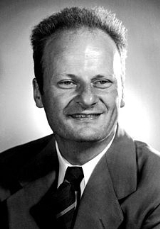
Hans Bethe

Encyclopedia
Hans Albrecht Bethe (ˈhans ˈalbʁɛçt ˈbeːtə; July 2, 1906 – March 6, 2005) was a German-American
nuclear
physicist
, and Nobel laureate in physics
for his work on the theory of stellar nucleosynthesis
. A versatile theoretical physicist, Bethe also made important contributions to quantum electrodynamics
, nuclear physics
, solid-state physics
and astrophysics
. During World War II
, he was head of the Theoretical Division at the secret Los Alamos
laboratory which developed the first atomic bombs. There he played a key role in calculating the critical mass of the weapons, and did theoretical work on the implosion method used in both the Trinity test
and the "Fat Man
" weapon dropped on Nagasaki, Japan. For most of his career, Bethe was a professor at Cornell University
.
During the early 1950s, Bethe also played an important role in the development of the larger hydrogen bomb, though he had originally joined the project with the hope of proving it could not be made. Bethe later campaigned together with Albert Einstein
in the Emergency Committee of Atomic Scientists
against nuclear testing
and the nuclear arms race
. He influenced the White House
to sign the ban of atmospheric nuclear tests
in 1963 and the 1972 Anti-Ballistic Missile Treaty
, SALT I. His scientific research never ceased even into the later years of his life and he was publishing papers well into his nineties. He is one of the few scientists who can claim a major paper in his field every decade of his career, which spanned nearly 70 years. Freeman Dyson
called Bethe the "supreme problem solver of the 20th century."
, Germany
. Although his mother was Jewish, he was raised a Christian
in the religion of his father. Bethe studied physics
at JWG University, Frankfurt, and went on to earn his doctorate from the University of Munich with supervisor Arnold Sommerfeld
, after which he did postdoctoral stints in Cambridge
and at Enrico Fermi
's laboratory in Rome. He was influenced by Fermi's simplicity and Sommerfeld's rigor in approaching problems, and these qualities influenced his own later research.
In 1929, Bethe made an important contribution to solid state physics and chemistry, with his formulation of the basic concepts of crystal field theory
. His paper is regarded as the starting point for all serious later discussions of the topic. In 1930, he devised a formula for the energy loss of swift charged particles in matter called the Bethe formula
, which is as important now as it was then.
Bethe left Germany in 1933 when the Nazis came to power and he lost his job at the University of Tübingen, moving first to England where he held a provisory position of Lecturer
for the year 1933-1934 at the University of Manchester
and in the fall of 1934, a fellowship at the University of Bristol
. In England, Bethe worked with the theoretician Rudolf Peierls
on a comprehensive theory of the deuteron.
In 1935 Bethe moved to the United States, and joined the faculty at Cornell University
, a position which he occupied for the rest of his career. During 1948-1949 he was a Visiting Professor at Columbia University
. At Cornell, Bethe became known as one of the leading theoretical physicists of his generation, and along with upcoming physicists such as cyclotron
pioneer Milton Stanley Livingston, and later, after the war, experimentalist Robert R. Wilson
and theoretician Robert Bacher
, put Cornell on the world physics map. Together with Robert Bacher
and Livingston, Bethe published a series of three articles which summarized most of what was known on the subject of nuclear physics until that time, an account that became informally known as "Bethe's Bible", and remained the standard work on the subject for many years. In this account, he also continued where others left off, filling in gaps from the older literature. From 1935-1938, he studied nuclear reaction
s and reaction cross sections
, carbon-oxygen-nitrogen cycle
, leading to his important contribution to stellar nucleosynthesis
. This research was later useful to Bethe in more quantitatively developing Niels Bohr
's theory of the compound nucleus
.
Bethe became a naturalized citizen of the United States in 1941. He was an honorary member of the International Academy of Science.
 When the war began, Bethe wanted to contribute to the war effort. Following the advice of the Caltech aerodynamicist Theodore von Kármán
, Bethe collaborated with his friend Edward Teller
, then at George Washington University
, on a theory of shock waves which are generated by the passage of a projectile through a gas. This work was later useful to researchers investigating ballistic reentry
. Bethe also worked on a theory of armor penetration, which was immediately classified by the Army, making it inaccessible to Bethe, who was not an American citizen at the time.
During the summer of 1942 he served as part of a special session at the University of California, Berkeley
at the invitation of Robert Oppenheimer
, which outlined the first designs for the atomic bomb. Initially, Bethe was skeptical of the possibility of making a nuclear weapon from uranium. In the late 1930s, he wrote a theoretical paper arguing against fission, but was convinced by Teller to join the Manhattan Project. When Oppenheimer was put in charge of forming a secret weapons design laboratory, Los Alamos
, he appointed Bethe Director of the Theoretical Division, a move that irked Teller, who had coveted the job for himself.
Bethe's work at Los Alamos included calculating the critical mass
of uranium-235
and the multiplication of nuclear fission
in an exploding atomic bomb. Along with Richard Feynman
, he developed a formula for calculating the explosive yield of the bomb. After November 1943, when the laboratory had been reoriented to solve the implosion problem of the plutonium
bomb, Bethe spent much of his time studying the hydrodynamic aspects of implosion, a job which he continued into 1944. In 1945, he worked on the neutron
initiator, and later on radiation propagation from an exploding atomic bomb.
During the project, Klaus Fuchs
, an German scientist spying for the Russians, was also in Bethe's division (often doing work which had originally been assigned to Teller). Like everyone else, Bethe had no knowledge that Fuchs was a spy.
When the first atomic bomb (an implosion design) was detonated in the New Mexico desert on July 16, 1945, at the Trinity test
, Bethe's immediate concern was for its efficient operation, and not its moral implications. He is reported to have commented: "I am not a philosopher."
, Bethe signed up and played a key role in the weapon's development. Though he would see the project through to its end, in Bethe's account he personally hoped that it would be impossible to create the hydrogen bomb. He would later remark in 1968 on the apparent contradiction in his stance, having first opposed the development of the weapon and later helping to create it:
As for his own role in the project, and its relation to the famous Teller-Ulam
priority dispute, Bethe later said that:
In 1954, Bethe testified on behalf of Oppenheimer during the latter's high-profile security clearance hearing. Specifically, Bethe argued that Oppenheimer's stances against developing the hydrogen bomb in the late 1940s had not hindered its actual development, a topic which was seen as a key motivating factor behind the hearing. Bethe contended that the developments which led to the successful Teller-Ulam design
were a matter of serendipity and not a question of manpower or logical development of previously existing ideas. During the hearing, Bethe and his wife also tried hard to convince Edward Teller
against testifying. However, Teller did not agree, and his testimony played a major role in the revocation of Oppenheimer's security clearance. While Bethe and Teller had been on very good terms during the pre-war years, the conflict between them during the Manhattan Project
, and especially during the Oppenheimer episode, permanently marred their relation.
, published an article criticising in detail the anti-ICBM defense system proposed by the Department of Defense
. The two physicists described in the article that nearly any measure taken by the US would be easily thwarted with the deployment of relatively simple decoys. Bethe was one of the primary voices in the scientific community behind the signing of the 1963 Partial Test Ban Treaty
prohibiting further atmospheric testing of nuclear weapons.
During the 1980s and 1990s, Bethe campaigned for the peaceful use of nuclear energy
. After the Chernobyl disaster
, Bethe put together a committee of experts that analysed the incident, and concluded that a similar episode would not happen in any good US reactor, as the Russian reactor suffered from a fundamentally faulty design and human error also had significantly contributed to the accident. Throughout his life Bethe remained a strong advocate for electricity from nuclear energy.
In the 1980s he and other physicists opposed the Strategic Defense Initiative
missile system conceived by the Ronald Reagan
administration. In 1995, at the age of 88, Bethe wrote an open letter calling on all scientists to "cease and desist" from working on any aspect of nuclear weapons development and manufacture. In 2004, he signed a letter along with 47 other Nobel laureates endorsing John Kerry
for President of the United States.
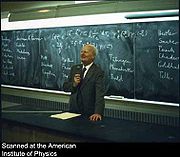 In 1967, Bethe was awarded the Nobel Prize in Physics
"for his contributions to the theory of nuclear reactions, especially his discoveries concerning the energy production in stars". His postulate was that the source of this stellar nucleosynthesis
was thermonuclear reactions
in which hydrogen
is converted into helium
.
Bethe was also noted for his theories on atomic properties. In the late 1940s, he provided the first way out of the infinities that plagued the explanation of the so called Lamb shift. Although his calculation was a non-relativistic one, it was a definite starting point. This work provided the impetus for the pioneering later work done by Richard Feynman
, Julian Schwinger
and others which marked the beginning of modern quantum electrodynamics
.
Bethe continued to do research on supernovae, neutron stars, black holes, and other problems in theoretical astrophysics into his late nineties. In doing this, he collaborated with Gerald Brown of the State University of New York at Stony Brook
. In his 80s, he wrote an important article about the solar neutrino problem
in which he dealt with the conversion of electron neutrino
s into muon neutrino
s that was proposed to explain the discrepancy between theory and experiment. Physicist Kurt Gottfried
says that he does not know anyone in the history of modern physics who has done work of such calibre in his 80s.
Bethe's hobbies included a passion for history and also stamp-collecting. About the latter, he wryly remarked that it was the only instance where all the countries in the world could coexist by each other's side in peace. He loved the outdoors, and was an enthusiastic mountain climber all his life. Bethe was also known for his sense of humor, and once published a parody in 1931, On the Quantum Theory of the Temperature of Absolute Zero where he calculated the fine structure constant from the absolute zero temperature in Celsius units, causing a scandal in the scientific world. This second parody paper was intended to characterize a certain class of papers in theoretical physics of the day, which were purely speculative and based on spurious numerical arguments such as Sir Arthur Eddington's
claim to have calculated the fine structure constant from fundamental quantities in an earlier paper. He has also, wrongly, been credited for allowing his name to be used in the Alpher-Bethe-Gamow paper
in which he did not participate; in fact, George Gamow
added Bethe's name without consulting him, and against Ralph Alpher's wishes.
Bethe died in his home in Ithaca, New York
on March 6, 2005 of congestive heart failure. At the time of his death, he was the John Wendell Anderson Professor of Physics Emeritus at Cornell University
. He also was, reaching the age of 98, the third-oldest Nobel laureate ever. Since his death, Cornell has announced that the third of five new residential college
s, each of which will be named after a distinguished former member of the Cornell faculty, will be named the Hans Bethe House
.
While lecturing at Duke University in 1937, Hans Bethe met Rose Ewald, who was a daughter of his former professor Paul Peter Ewald
. They were married in September 1939. The Bethes, who had two children, Henry and Monica, spent most of their lives in Ithaca.
Named after him
German American
German Americans are citizens of the United States of German ancestry and comprise about 51 million people, or 17% of the U.S. population, the country's largest self-reported ancestral group...
nuclear
Nuclear physics
Nuclear physics is the field of physics that studies the building blocks and interactions of atomic nuclei. The most commonly known applications of nuclear physics are nuclear power generation and nuclear weapons technology, but the research has provided application in many fields, including those...
physicist
Physicist
A physicist is a scientist who studies or practices physics. Physicists study a wide range of physical phenomena in many branches of physics spanning all length scales: from sub-atomic particles of which all ordinary matter is made to the behavior of the material Universe as a whole...
, and Nobel laureate in physics
Nobel Prize in Physics
The Nobel Prize in Physics is awarded once a year by the Royal Swedish Academy of Sciences. It is one of the five Nobel Prizes established by the will of Alfred Nobel in 1895 and awarded since 1901; the others are the Nobel Prize in Chemistry, Nobel Prize in Literature, Nobel Peace Prize, and...
for his work on the theory of stellar nucleosynthesis
Stellar nucleosynthesis
Stellar nucleosynthesis is the collective term for the nuclear reactions taking place in stars to build the nuclei of the elements heavier than hydrogen. Some small quantity of these reactions also occur on the stellar surface under various circumstances...
. A versatile theoretical physicist, Bethe also made important contributions to quantum electrodynamics
Quantum electrodynamics
Quantum electrodynamics is the relativistic quantum field theory of electrodynamics. In essence, it describes how light and matter interact and is the first theory where full agreement between quantum mechanics and special relativity is achieved...
, nuclear physics
Nuclear physics
Nuclear physics is the field of physics that studies the building blocks and interactions of atomic nuclei. The most commonly known applications of nuclear physics are nuclear power generation and nuclear weapons technology, but the research has provided application in many fields, including those...
, solid-state physics
Solid-state physics
Solid-state physics is the study of rigid matter, or solids, through methods such as quantum mechanics, crystallography, electromagnetism, and metallurgy. It is the largest branch of condensed matter physics. Solid-state physics studies how the large-scale properties of solid materials result from...
and astrophysics
Astrophysics
Astrophysics is the branch of astronomy that deals with the physics of the universe, including the physical properties of celestial objects, as well as their interactions and behavior...
. During World War II
World War II
World War II, or the Second World War , was a global conflict lasting from 1939 to 1945, involving most of the world's nations—including all of the great powers—eventually forming two opposing military alliances: the Allies and the Axis...
, he was head of the Theoretical Division at the secret Los Alamos
Los Alamos National Laboratory
Los Alamos National Laboratory is a United States Department of Energy national laboratory, managed and operated by Los Alamos National Security , located in Los Alamos, New Mexico...
laboratory which developed the first atomic bombs. There he played a key role in calculating the critical mass of the weapons, and did theoretical work on the implosion method used in both the Trinity test
Trinity test
Trinity was the code name of the first test of a nuclear weapon. This test was conducted by the United States Army on July 16, 1945, in the Jornada del Muerto desert about 35 miles southeast of Socorro, New Mexico, at the new White Sands Proving Ground, which incorporated the Alamogordo Bombing...
and the "Fat Man
Fat Man
"Fat Man" is the codename for the atomic bomb that was detonated over Nagasaki, Japan, by the United States on August 9, 1945. It was the second of the only two nuclear weapons to be used in warfare to date , and its detonation caused the third man-made nuclear explosion. The name also refers more...
" weapon dropped on Nagasaki, Japan. For most of his career, Bethe was a professor at Cornell University
Cornell University
Cornell University is an Ivy League university located in Ithaca, New York, United States. It is a private land-grant university, receiving annual funding from the State of New York for certain educational missions...
.
During the early 1950s, Bethe also played an important role in the development of the larger hydrogen bomb, though he had originally joined the project with the hope of proving it could not be made. Bethe later campaigned together with Albert Einstein
Albert Einstein
Albert Einstein was a German-born theoretical physicist who developed the theory of general relativity, effecting a revolution in physics. For this achievement, Einstein is often regarded as the father of modern physics and one of the most prolific intellects in human history...
in the Emergency Committee of Atomic Scientists
Emergency Committee of Atomic Scientists
The Emergency Committee of Atomic Scientists was founded by Albert Einstein and Leó Szilárd in 1946. Its aims were to warn the public of the dangers associated with the development of nuclear weapons, promote the peaceful use of nuclear energy, and ultimately work towards world peace, which was...
against nuclear testing
Nuclear testing
Nuclear weapons tests are experiments carried out to determine the effectiveness, yield and explosive capability of nuclear weapons. Throughout the twentieth century, most nations that have developed nuclear weapons have tested them...
and the nuclear arms race
Nuclear arms race
The nuclear arms race was a competition for supremacy in nuclear warfare between the United States, the Soviet Union, and their respective allies during the Cold War...
. He influenced the White House
White House
The White House is the official residence and principal workplace of the president of the United States. Located at 1600 Pennsylvania Avenue NW in Washington, D.C., the house was designed by Irish-born James Hoban, and built between 1792 and 1800 of white-painted Aquia sandstone in the Neoclassical...
to sign the ban of atmospheric nuclear tests
Partial Test Ban Treaty
The treaty banning nuclear weapon tests in the atmosphere, in outer space and under water, often abbreviated as the Partial Test Ban Treaty , Limited Test Ban Treaty , or Nuclear Test Ban Treaty is a treaty prohibiting all test detonations of nuclear weapons...
in 1963 and the 1972 Anti-Ballistic Missile Treaty
Anti-Ballistic Missile Treaty
The Anti-Ballistic Missile Treaty was a treaty between the United States and the Soviet Union on the limitation of the anti-ballistic missile systems used in defending areas against missile-delivered nuclear weapons....
, SALT I. His scientific research never ceased even into the later years of his life and he was publishing papers well into his nineties. He is one of the few scientists who can claim a major paper in his field every decade of his career, which spanned nearly 70 years. Freeman Dyson
Freeman Dyson
Freeman John Dyson FRS is a British-born American theoretical physicist and mathematician, famous for his work in quantum field theory, solid-state physics, astronomy and nuclear engineering. Dyson is a member of the Board of Sponsors of the Bulletin of the Atomic Scientists...
called Bethe the "supreme problem solver of the 20th century."
Early years
Bethe was born in StrasburgStrasburg
-Places:*Strasbourg, a city in Alsace *Straßburg, Austria, in Carinthia*Strasburg, Germany, Mecklenburg-Western Pomerania*the former name of Brodnica, became Polish after World War I*Strassburg, the German name for Aiud, Alba...
, Germany
German Empire
The German Empire refers to Germany during the "Second Reich" period from the unification of Germany and proclamation of Wilhelm I as German Emperor on 18 January 1871, to 1918, when it became a federal republic after defeat in World War I and the abdication of the Emperor, Wilhelm II.The German...
. Although his mother was Jewish, he was raised a Christian
Christian
A Christian is a person who adheres to Christianity, an Abrahamic, monotheistic religion based on the life and teachings of Jesus of Nazareth as recorded in the Canonical gospels and the letters of the New Testament...
in the religion of his father. Bethe studied physics
Physics
Physics is a natural science that involves the study of matter and its motion through spacetime, along with related concepts such as energy and force. More broadly, it is the general analysis of nature, conducted in order to understand how the universe behaves.Physics is one of the oldest academic...
at JWG University, Frankfurt, and went on to earn his doctorate from the University of Munich with supervisor Arnold Sommerfeld
Arnold Sommerfeld
Arnold Johannes Wilhelm Sommerfeld was a German theoretical physicist who pioneered developments in atomic and quantum physics, and also educated and groomed a large number of students for the new era of theoretical physics...
, after which he did postdoctoral stints in Cambridge
Cambridge
The city of Cambridge is a university town and the administrative centre of the county of Cambridgeshire, England. It lies in East Anglia about north of London. Cambridge is at the heart of the high-technology centre known as Silicon Fen – a play on Silicon Valley and the fens surrounding the...
and at Enrico Fermi
Enrico Fermi
Enrico Fermi was an Italian-born, naturalized American physicist particularly known for his work on the development of the first nuclear reactor, Chicago Pile-1, and for his contributions to the development of quantum theory, nuclear and particle physics, and statistical mechanics...
's laboratory in Rome. He was influenced by Fermi's simplicity and Sommerfeld's rigor in approaching problems, and these qualities influenced his own later research.
In 1929, Bethe made an important contribution to solid state physics and chemistry, with his formulation of the basic concepts of crystal field theory
Crystal field theory
Crystal field theory is a model that describes the electronic structure of transition metal compounds, all of which can be considered coordination complexes. CFT successfully accounts for some magnetic properties, colours, hydration enthalpies, and spinel structures of transition metal complexes,...
. His paper is regarded as the starting point for all serious later discussions of the topic. In 1930, he devised a formula for the energy loss of swift charged particles in matter called the Bethe formula
Bethe formula
In nuclear physics and theoretical physics, charged particles moving through matter interact with the electrons of atoms in the material. The interaction excites or ionizes the atoms. This leads to an energy loss of the traveling particle...
, which is as important now as it was then.
Bethe left Germany in 1933 when the Nazis came to power and he lost his job at the University of Tübingen, moving first to England where he held a provisory position of Lecturer
Lecturer
Lecturer is an academic rank. In the United Kingdom, lecturer is a position at a university or similar institution, often held by academics in their early career stages, who lead research groups and supervise research students, as well as teach...
for the year 1933-1934 at the University of Manchester
University of Manchester
The University of Manchester is a public research university located in Manchester, United Kingdom. It is a "red brick" university and a member of the Russell Group of research-intensive British universities and the N8 Group...
and in the fall of 1934, a fellowship at the University of Bristol
University of Bristol
The University of Bristol is a public research university located in Bristol, United Kingdom. One of the so-called "red brick" universities, it received its Royal Charter in 1909, although its predecessor institution, University College, Bristol, had been in existence since 1876.The University is...
. In England, Bethe worked with the theoretician Rudolf Peierls
Rudolf Peierls
Sir Rudolf Ernst Peierls, CBE was a German-born British physicist. Rudolf Peierls had a major role in Britain's nuclear program, but he also had a role in many modern sciences...
on a comprehensive theory of the deuteron.
In 1935 Bethe moved to the United States, and joined the faculty at Cornell University
Cornell University
Cornell University is an Ivy League university located in Ithaca, New York, United States. It is a private land-grant university, receiving annual funding from the State of New York for certain educational missions...
, a position which he occupied for the rest of his career. During 1948-1949 he was a Visiting Professor at Columbia University
Columbia University
Columbia University in the City of New York is a private, Ivy League university in Manhattan, New York City. Columbia is the oldest institution of higher learning in the state of New York, the fifth oldest in the United States, and one of the country's nine Colonial Colleges founded before the...
. At Cornell, Bethe became known as one of the leading theoretical physicists of his generation, and along with upcoming physicists such as cyclotron
Cyclotron
In technology, a cyclotron is a type of particle accelerator. In physics, the cyclotron frequency or gyrofrequency is the frequency of a charged particle moving perpendicularly to the direction of a uniform magnetic field, i.e. a magnetic field of constant magnitude and direction...
pioneer Milton Stanley Livingston, and later, after the war, experimentalist Robert R. Wilson
Robert R. Wilson
Robert Rathbun Wilson was an American physicist who was a group leader of the Manhattan Project, a sculptor, and an architect of Fermi National Laboratory , where he was also the director from 1967–1978....
and theoretician Robert Bacher
Robert Bacher
Robert Fox Bacher was an American nuclear physicist and one of the leaders of the Manhattan Project.-Early life and career:...
, put Cornell on the world physics map. Together with Robert Bacher
Robert Bacher
Robert Fox Bacher was an American nuclear physicist and one of the leaders of the Manhattan Project.-Early life and career:...
and Livingston, Bethe published a series of three articles which summarized most of what was known on the subject of nuclear physics until that time, an account that became informally known as "Bethe's Bible", and remained the standard work on the subject for many years. In this account, he also continued where others left off, filling in gaps from the older literature. From 1935-1938, he studied nuclear reaction
Nuclear reaction
In nuclear physics and nuclear chemistry, a nuclear reaction is semantically considered to be the process in which two nuclei, or else a nucleus of an atom and a subatomic particle from outside the atom, collide to produce products different from the initial particles...
s and reaction cross sections
Cross section (physics)
A cross section is the effective area which governs the probability of some scattering or absorption event. Together with particle density and path length, it can be used to predict the total scattering probability via the Beer-Lambert law....
, carbon-oxygen-nitrogen cycle
CNO cycle
The CNO cycle is one of two sets of fusion reactions by which stars convert hydrogen to helium, the other being the proton–proton chain. Unlike the proton–proton chain reaction, the CNO cycle is a catalytic cycle. Theoretical models show that the CNO cycle is the dominant source of energy in stars...
, leading to his important contribution to stellar nucleosynthesis
Stellar nucleosynthesis
Stellar nucleosynthesis is the collective term for the nuclear reactions taking place in stars to build the nuclei of the elements heavier than hydrogen. Some small quantity of these reactions also occur on the stellar surface under various circumstances...
. This research was later useful to Bethe in more quantitatively developing Niels Bohr
Niels Bohr
Niels Henrik David Bohr was a Danish physicist who made foundational contributions to understanding atomic structure and quantum mechanics, for which he received the Nobel Prize in Physics in 1922. Bohr mentored and collaborated with many of the top physicists of the century at his institute in...
's theory of the compound nucleus
Bohr model
In atomic physics, the Bohr model, introduced by Niels Bohr in 1913, depicts the atom as a small, positively charged nucleus surrounded by electrons that travel in circular orbits around the nucleus—similar in structure to the solar system, but with electrostatic forces providing attraction,...
.
Bethe became a naturalized citizen of the United States in 1941. He was an honorary member of the International Academy of Science.
Manhattan Project
Theodore von Karman
Theodore von Kármán was a Hungarian-American mathematician, aerospace engineer and physicist who was active primarily in the fields of aeronautics and astronautics. He is responsible for many key advances in aerodynamics, notably his work on supersonic and hypersonic airflow characterization...
, Bethe collaborated with his friend Edward Teller
Edward Teller
Edward Teller was a Hungarian-American theoretical physicist, known colloquially as "the father of the hydrogen bomb," even though he did not care for the title. Teller made numerous contributions to nuclear and molecular physics, spectroscopy , and surface physics...
, then at George Washington University
George Washington University
The George Washington University is a private, coeducational comprehensive university located in Washington, D.C. in the United States...
, on a theory of shock waves which are generated by the passage of a projectile through a gas. This work was later useful to researchers investigating ballistic reentry
Ballistic reentry
A ballistic reentry is a type of atmospheric reentry of an artificial vehicle that relies solely on drag within the atmosphere to slow the vehicle....
. Bethe also worked on a theory of armor penetration, which was immediately classified by the Army, making it inaccessible to Bethe, who was not an American citizen at the time.
During the summer of 1942 he served as part of a special session at the University of California, Berkeley
University of California, Berkeley
The University of California, Berkeley , is a teaching and research university established in 1868 and located in Berkeley, California, USA...
at the invitation of Robert Oppenheimer
Robert Oppenheimer
Julius Robert Oppenheimer was an American theoretical physicist and professor of physics at the University of California, Berkeley. Along with Enrico Fermi, he is often called the "father of the atomic bomb" for his role in the Manhattan Project, the World War II project that developed the first...
, which outlined the first designs for the atomic bomb. Initially, Bethe was skeptical of the possibility of making a nuclear weapon from uranium. In the late 1930s, he wrote a theoretical paper arguing against fission, but was convinced by Teller to join the Manhattan Project. When Oppenheimer was put in charge of forming a secret weapons design laboratory, Los Alamos
Los Alamos National Laboratory
Los Alamos National Laboratory is a United States Department of Energy national laboratory, managed and operated by Los Alamos National Security , located in Los Alamos, New Mexico...
, he appointed Bethe Director of the Theoretical Division, a move that irked Teller, who had coveted the job for himself.
Bethe's work at Los Alamos included calculating the critical mass
Critical mass
A critical mass is the smallest amount of fissile material needed for a sustained nuclear chain reaction. The critical mass of a fissionable material depends upon its nuclear properties A critical mass is the smallest amount of fissile material needed for a sustained nuclear chain reaction. The...
of uranium-235
Uranium-235
- References :* .* DOE Fundamentals handbook: Nuclear Physics and Reactor theory , .* A piece of U-235 the size of a grain of rice can produce energy equal to that contained in three tons of coal or fourteen barrels of oil. -External links:* * * one of the earliest articles on U-235 for the...
and the multiplication of nuclear fission
Nuclear fission
In nuclear physics and nuclear chemistry, nuclear fission is a nuclear reaction in which the nucleus of an atom splits into smaller parts , often producing free neutrons and photons , and releasing a tremendous amount of energy...
in an exploding atomic bomb. Along with Richard Feynman
Richard Feynman
Richard Phillips Feynman was an American physicist known for his work in the path integral formulation of quantum mechanics, the theory of quantum electrodynamics and the physics of the superfluidity of supercooled liquid helium, as well as in particle physics...
, he developed a formula for calculating the explosive yield of the bomb. After November 1943, when the laboratory had been reoriented to solve the implosion problem of the plutonium
Plutonium
Plutonium is a transuranic radioactive chemical element with the chemical symbol Pu and atomic number 94. It is an actinide metal of silvery-gray appearance that tarnishes when exposed to air, forming a dull coating when oxidized. The element normally exhibits six allotropes and four oxidation...
bomb, Bethe spent much of his time studying the hydrodynamic aspects of implosion, a job which he continued into 1944. In 1945, he worked on the neutron
Neutron
The neutron is a subatomic hadron particle which has the symbol or , no net electric charge and a mass slightly larger than that of a proton. With the exception of hydrogen, nuclei of atoms consist of protons and neutrons, which are therefore collectively referred to as nucleons. The number of...
initiator, and later on radiation propagation from an exploding atomic bomb.
During the project, Klaus Fuchs
Klaus Fuchs
Klaus Emil Julius Fuchs was a German theoretical physicist and atomic spy who in 1950 was convicted of supplying information from the American, British and Canadian atomic bomb research to the USSR during and shortly after World War II...
, an German scientist spying for the Russians, was also in Bethe's division (often doing work which had originally been assigned to Teller). Like everyone else, Bethe had no knowledge that Fuchs was a spy.
When the first atomic bomb (an implosion design) was detonated in the New Mexico desert on July 16, 1945, at the Trinity test
Trinity test
Trinity was the code name of the first test of a nuclear weapon. This test was conducted by the United States Army on July 16, 1945, in the Jornada del Muerto desert about 35 miles southeast of Socorro, New Mexico, at the new White Sands Proving Ground, which incorporated the Alamogordo Bombing...
, Bethe's immediate concern was for its efficient operation, and not its moral implications. He is reported to have commented: "I am not a philosopher."
Hydrogen bomb
After the war, Bethe argued that a crash project for the hydrogen bomb should not be attempted, though after President Harry Truman announced the beginning of such a crash project, and the outbreak of the Korean WarKorean War
The Korean War was a conventional war between South Korea, supported by the United Nations, and North Korea, supported by the People's Republic of China , with military material aid from the Soviet Union...
, Bethe signed up and played a key role in the weapon's development. Though he would see the project through to its end, in Bethe's account he personally hoped that it would be impossible to create the hydrogen bomb. He would later remark in 1968 on the apparent contradiction in his stance, having first opposed the development of the weapon and later helping to create it:
As for his own role in the project, and its relation to the famous Teller-Ulam
Teller-Ulam design
The Teller–Ulam design is the nuclear weapon design concept used in most of the world's nuclear weapons. It is colloquially referred to as "the secret of the hydrogen bomb" because it employs hydrogen fusion, though in most applications the bulk of its destructive energy comes from uranium fission,...
priority dispute, Bethe later said that:
In 1954, Bethe testified on behalf of Oppenheimer during the latter's high-profile security clearance hearing. Specifically, Bethe argued that Oppenheimer's stances against developing the hydrogen bomb in the late 1940s had not hindered its actual development, a topic which was seen as a key motivating factor behind the hearing. Bethe contended that the developments which led to the successful Teller-Ulam design
Teller-Ulam design
The Teller–Ulam design is the nuclear weapon design concept used in most of the world's nuclear weapons. It is colloquially referred to as "the secret of the hydrogen bomb" because it employs hydrogen fusion, though in most applications the bulk of its destructive energy comes from uranium fission,...
were a matter of serendipity and not a question of manpower or logical development of previously existing ideas. During the hearing, Bethe and his wife also tried hard to convince Edward Teller
Edward Teller
Edward Teller was a Hungarian-American theoretical physicist, known colloquially as "the father of the hydrogen bomb," even though he did not care for the title. Teller made numerous contributions to nuclear and molecular physics, spectroscopy , and surface physics...
against testifying. However, Teller did not agree, and his testimony played a major role in the revocation of Oppenheimer's security clearance. While Bethe and Teller had been on very good terms during the pre-war years, the conflict between them during the Manhattan Project
Manhattan Project
The Manhattan Project was a research and development program, led by the United States with participation from the United Kingdom and Canada, that produced the first atomic bomb during World War II. From 1942 to 1946, the project was under the direction of Major General Leslie Groves of the US Army...
, and especially during the Oppenheimer episode, permanently marred their relation.
Political stances
In 1968, Bethe, along with IBM physicist Richard GarwinRichard Garwin
Richard Lawrence Garwin , is an American physicist. He received his bachelor's degree from the Case Institute of Technology in 1947 and obtained his Doctor of Philosophy from the University of Chicago in 1949, where he worked in the lab of Enrico Fermi.Garwin is IBM Fellow Emeritus at the Thomas J...
, published an article criticising in detail the anti-ICBM defense system proposed by the Department of Defense
United States Department of Defense
The United States Department of Defense is the U.S...
. The two physicists described in the article that nearly any measure taken by the US would be easily thwarted with the deployment of relatively simple decoys. Bethe was one of the primary voices in the scientific community behind the signing of the 1963 Partial Test Ban Treaty
Partial Test Ban Treaty
The treaty banning nuclear weapon tests in the atmosphere, in outer space and under water, often abbreviated as the Partial Test Ban Treaty , Limited Test Ban Treaty , or Nuclear Test Ban Treaty is a treaty prohibiting all test detonations of nuclear weapons...
prohibiting further atmospheric testing of nuclear weapons.
During the 1980s and 1990s, Bethe campaigned for the peaceful use of nuclear energy
Nuclear power
Nuclear power is the use of sustained nuclear fission to generate heat and electricity. Nuclear power plants provide about 6% of the world's energy and 13–14% of the world's electricity, with the U.S., France, and Japan together accounting for about 50% of nuclear generated electricity...
. After the Chernobyl disaster
Chernobyl disaster
The Chernobyl disaster was a nuclear accident that occurred on 26 April 1986 at the Chernobyl Nuclear Power Plant in Ukraine , which was under the direct jurisdiction of the central authorities in Moscow...
, Bethe put together a committee of experts that analysed the incident, and concluded that a similar episode would not happen in any good US reactor, as the Russian reactor suffered from a fundamentally faulty design and human error also had significantly contributed to the accident. Throughout his life Bethe remained a strong advocate for electricity from nuclear energy.
In the 1980s he and other physicists opposed the Strategic Defense Initiative
Strategic Defense Initiative
The Strategic Defense Initiative was proposed by U.S. President Ronald Reagan on March 23, 1983 to use ground and space-based systems to protect the United States from attack by strategic nuclear ballistic missiles. The initiative focused on strategic defense rather than the prior strategic...
missile system conceived by the Ronald Reagan
Ronald Reagan
Ronald Wilson Reagan was the 40th President of the United States , the 33rd Governor of California and, prior to that, a radio, film and television actor....
administration. In 1995, at the age of 88, Bethe wrote an open letter calling on all scientists to "cease and desist" from working on any aspect of nuclear weapons development and manufacture. In 2004, he signed a letter along with 47 other Nobel laureates endorsing John Kerry
John Kerry
John Forbes Kerry is the senior United States Senator from Massachusetts, the 10th most senior U.S. Senator and chairman of the Senate Foreign Relations Committee. He was the presidential nominee of the Democratic Party in the 2004 presidential election, but lost to former President George W...
for President of the United States.
Later work
Nobel Prize in Physics
The Nobel Prize in Physics is awarded once a year by the Royal Swedish Academy of Sciences. It is one of the five Nobel Prizes established by the will of Alfred Nobel in 1895 and awarded since 1901; the others are the Nobel Prize in Chemistry, Nobel Prize in Literature, Nobel Peace Prize, and...
"for his contributions to the theory of nuclear reactions, especially his discoveries concerning the energy production in stars". His postulate was that the source of this stellar nucleosynthesis
Stellar nucleosynthesis
Stellar nucleosynthesis is the collective term for the nuclear reactions taking place in stars to build the nuclei of the elements heavier than hydrogen. Some small quantity of these reactions also occur on the stellar surface under various circumstances...
was thermonuclear reactions
Nuclear fusion
Nuclear fusion is the process by which two or more atomic nuclei join together, or "fuse", to form a single heavier nucleus. This is usually accompanied by the release or absorption of large quantities of energy...
in which hydrogen
Hydrogen
Hydrogen is the chemical element with atomic number 1. It is represented by the symbol H. With an average atomic weight of , hydrogen is the lightest and most abundant chemical element, constituting roughly 75% of the Universe's chemical elemental mass. Stars in the main sequence are mainly...
is converted into helium
Helium
Helium is the chemical element with atomic number 2 and an atomic weight of 4.002602, which is represented by the symbol He. It is a colorless, odorless, tasteless, non-toxic, inert, monatomic gas that heads the noble gas group in the periodic table...
.
Bethe was also noted for his theories on atomic properties. In the late 1940s, he provided the first way out of the infinities that plagued the explanation of the so called Lamb shift. Although his calculation was a non-relativistic one, it was a definite starting point. This work provided the impetus for the pioneering later work done by Richard Feynman
Richard Feynman
Richard Phillips Feynman was an American physicist known for his work in the path integral formulation of quantum mechanics, the theory of quantum electrodynamics and the physics of the superfluidity of supercooled liquid helium, as well as in particle physics...
, Julian Schwinger
Julian Schwinger
Julian Seymour Schwinger was an American theoretical physicist. He is best known for his work on the theory of quantum electrodynamics, in particular for developing a relativistically invariant perturbation theory, and for renormalizing QED to one loop order.Schwinger is recognized as one of the...
and others which marked the beginning of modern quantum electrodynamics
Quantum electrodynamics
Quantum electrodynamics is the relativistic quantum field theory of electrodynamics. In essence, it describes how light and matter interact and is the first theory where full agreement between quantum mechanics and special relativity is achieved...
.
Bethe continued to do research on supernovae, neutron stars, black holes, and other problems in theoretical astrophysics into his late nineties. In doing this, he collaborated with Gerald Brown of the State University of New York at Stony Brook
State University of New York at Stony Brook
The State University of New York at Stony Brook, also known as Stony Brook University, is a public research university located in Stony Brook, New York, on the North Shore of Long Island, about east of Manhattan....
. In his 80s, he wrote an important article about the solar neutrino problem
Solar neutrino problem
The solar neutrino problem was a major discrepancy between measurements of the numbers of neutrinos flowing through the Earth and theoretical models of the solar interior, lasting from the mid-1960s to about 2002...
in which he dealt with the conversion of electron neutrino
Electron neutrino
The electron neutrino is a subatomic lepton elementary particle which has no net electric charge. Together with the electron it forms the first generation of leptons, hence its name electron neutrino...
s into muon neutrino
Muon neutrino
The muon neutrino is a subatomic lepton elementary particle which has the symbol and no net electric charge. Together with the muon it forms the second generation of leptons, hence its name muon neutrino. It was first hypothesized in the early 1940s by several people, and was discovered in 1962 by...
s that was proposed to explain the discrepancy between theory and experiment. Physicist Kurt Gottfried
Kurt Gottfried
Kurt Gottfried is professor emeritus of physics at Cornell University and chairman of the Union of Concerned Scientists. He is also co-editor of Crisis Stability And Nuclear War....
says that he does not know anyone in the history of modern physics who has done work of such calibre in his 80s.
Bethe's hobbies included a passion for history and also stamp-collecting. About the latter, he wryly remarked that it was the only instance where all the countries in the world could coexist by each other's side in peace. He loved the outdoors, and was an enthusiastic mountain climber all his life. Bethe was also known for his sense of humor, and once published a parody in 1931, On the Quantum Theory of the Temperature of Absolute Zero where he calculated the fine structure constant from the absolute zero temperature in Celsius units, causing a scandal in the scientific world. This second parody paper was intended to characterize a certain class of papers in theoretical physics of the day, which were purely speculative and based on spurious numerical arguments such as Sir Arthur Eddington's
Arthur Stanley Eddington
Sir Arthur Stanley Eddington, OM, FRS was a British astrophysicist of the early 20th century. He was also a philosopher of science and a popularizer of science...
claim to have calculated the fine structure constant from fundamental quantities in an earlier paper. He has also, wrongly, been credited for allowing his name to be used in the Alpher-Bethe-Gamow paper
Alpher-Bethe-Gamow paper
In physical cosmology, the Alpher–Bethe–Gamow paper, or αβγ paper, was created by Ralph Alpher, then a physics PhD student, and his advisor George Gamow. The work, which would become the subject of Alpher's PhD dissertation, argued that the Big Bang would create hydrogen, helium and heavier...
in which he did not participate; in fact, George Gamow
George Gamow
George Gamow , born Georgiy Antonovich Gamov , was a Russian-born theoretical physicist and cosmologist. He discovered alpha decay via quantum tunneling and worked on radioactive decay of the atomic nucleus, star formation, stellar nucleosynthesis, Big Bang nucleosynthesis, cosmic microwave...
added Bethe's name without consulting him, and against Ralph Alpher's wishes.
Bethe died in his home in Ithaca, New York
Ithaca, New York
The city of Ithaca, is a city in upstate New York and the county seat of Tompkins County, as well as the largest community in the Ithaca-Tompkins County metropolitan area...
on March 6, 2005 of congestive heart failure. At the time of his death, he was the John Wendell Anderson Professor of Physics Emeritus at Cornell University
Cornell University
Cornell University is an Ivy League university located in Ithaca, New York, United States. It is a private land-grant university, receiving annual funding from the State of New York for certain educational missions...
. He also was, reaching the age of 98, the third-oldest Nobel laureate ever. Since his death, Cornell has announced that the third of five new residential college
Residential college
A residential college is an organisational pattern for a division of a university that places academic activity in a community setting of students and faculty, usually at a residence and with shared meals, the college having a degree of autonomy and a federated relationship with the overall...
s, each of which will be named after a distinguished former member of the Cornell faculty, will be named the Hans Bethe House
Cornell West Campus
West Campus is a residential section of Cornell University's Ithaca, New York campus located west of Libe Slope and between the Fall Creek gorge and the Cascadilla gorge. It now primarily houses transfer students, second year, and upperclassmen. West Campus is currently part of a residential...
.
While lecturing at Duke University in 1937, Hans Bethe met Rose Ewald, who was a daughter of his former professor Paul Peter Ewald
Paul Peter Ewald
Paul Peter Ewald was a German-born U.S. crystallographer and physicist, a pioneer of X-ray diffraction methods.-Education:...
. They were married in September 1939. The Bethes, who had two children, Henry and Monica, spent most of their lives in Ithaca.
Honors and awards
Awards and honors- Fellow of the American Academy of Arts and SciencesAmerican Academy of Arts and SciencesThe American Academy of Arts and Sciences is an independent policy research center that conducts multidisciplinary studies of complex and emerging problems. The Academy’s elected members are leaders in the academic disciplines, the arts, business, and public affairs.James Bowdoin, John Adams, and...
(1947) - Henry Draper MedalHenry Draper MedalThe Henry Draper Medal is awarded by the United States National Academy of Sciences "for investigations in astronomical physics". Named after Henry Draper, the medal is awarded with a gift of USD $15,000...
of the National Academy of SciencesUnited States National Academy of SciencesThe National Academy of Sciences is a corporation in the United States whose members serve pro bono as "advisers to the nation on science, engineering, and medicine." As a national academy, new members of the organization are elected annually by current members, based on their distinguished and...
(1947) - Max Planck medalMax Planck medalThe Max Planck medal is an award for extraordinary achievements in theoretical physics. It is awarded annually by the Deutsche Physikalische Gesellschaft , the world's largest organization of physicists.-List of recipients:...
(1955) - Franklin MedalFranklin MedalThe Franklin Medal was a science and engineering award presented by the Franklin Institute, of Philadelphia, PA, USA.-Laureates:*1915 - Thomas Alva Edison *1915 - Heike Kamerlingh Onnes *1916 - John J...
(1959) - Eddington MedalEddington MedalThe Eddington Medal, named after Sir Arthur Eddington, is awarded by the Royal Astronomical Society nominally once every two years for investigations of outstanding merit in theoretical astrophysics.- Recipients :* 1953 Georges Lemaître...
of the Royal Astronomical SocietyRoyal Astronomical SocietyThe Royal Astronomical Society is a learned society that began as the Astronomical Society of London in 1820 to support astronomical research . It became the Royal Astronomical Society in 1831 on receiving its Royal Charter from William IV...
(1961) - Enrico Fermi AwardEnrico Fermi AwardThe Enrico Fermi Award is an award honoring scientists of international stature for their lifetime achievement in the development, use, or production of energy. It is administered by the U.S. government's Department of Energy...
(1961) - Rumford PrizeRumford PrizeFounded in 1796, the Rumford Prize, awarded by the American Academy of Arts and Sciences, is one of the oldest scientific prizes in the United States. The prize recognizes contributions by scientists to the fields of heat and light...
(1963) - Nobel Prize in PhysicsNobel Prize in PhysicsThe Nobel Prize in Physics is awarded once a year by the Royal Swedish Academy of Sciences. It is one of the five Nobel Prizes established by the will of Alfred Nobel in 1895 and awarded since 1901; the others are the Nobel Prize in Chemistry, Nobel Prize in Literature, Nobel Peace Prize, and...
(1967) - National Medal of ScienceNational Medal of ScienceThe National Medal of Science is an honor bestowed by the President of the United States to individuals in science and engineering who have made important contributions to the advancement of knowledge in the fields of behavioral and social sciences, biology, chemistry, engineering, mathematics and...
(1975) - Lomonosov Gold MedalLomonosov Gold MedalThe Lomonosov Gold Medal, named after Russian scientist and polymath Mikhail Lomonosov, is awarded each year since 1959 for outstanding achievements in the natural sciences and the humanities by the USSR Academy of Sciences and later the Russian Academy of Sciences . Two medals are awarded...
(1989) - Oersted MedalOersted MedalThe Oersted Medal recognizes notable contributions to the teaching of physics. Established in 1936, it is awarded by the American Association of Physics Teachers. The award is named for Hans Christian Ørsted. It is the Association's most prestigious award....
(1993) - Bruce MedalBruce MedalThe Catherine Wolfe Bruce Gold Medal is awarded every year by the Astronomical Society of the Pacific for outstanding lifetime contributions to astronomy. It is named after Catherine Wolfe Bruce, an American patroness of astronomy, and was first awarded in 1898...
(2001) - Benjamin Franklin Medal for Distinguished Achievement in the Sciences of the American Philosophical SocietyAmerican Philosophical SocietyThe American Philosophical Society, founded in 1743, and located in Philadelphia, Pa., is an eminent scholarly organization of international reputation, that promotes useful knowledge in the sciences and humanities through excellence in scholarly research, professional meetings, publications,...
(2005)
Named after him
- AsteroidAsteroidAsteroids are a class of small Solar System bodies in orbit around the Sun. They have also been called planetoids, especially the larger ones...
30828 Bethe30828 Bethe30828 Bethe is a main-belt asteroid discovered on October 12, 1990 by Freimut Börngen and Lutz D. Schmadel at Tautenburg. It is named after German-American Nobel laureate Hans Bethe.- External links :*... - Hans Bethe PrizeHans Bethe PrizeThe Hans A. Bethe Prize, is presented annually by the American Physical Society.The prize honors outstanding work in theory, experiment or observation in the areas of astrophysics, nuclear physics, nuclear astrophysics, or closely related fields...
of the American Physical SocietyAmerican Physical SocietyThe American Physical Society is the world's second largest organization of physicists, behind the Deutsche Physikalische Gesellschaft. The Society publishes more than a dozen scientific journals, including the world renowned Physical Review and Physical Review Letters, and organizes more than 20... - Hans Bethe House at Cornell UniversityCornell UniversityCornell University is an Ivy League university located in Ithaca, New York, United States. It is a private land-grant university, receiving annual funding from the State of New York for certain educational missions...
- Bethe ansatzBethe ansatzIn physics, the Bethe ansatz is a method for finding the exact solutions of certain one-dimensional quantum many-body models. It was invented by Hans Bethe in 1931 to find the exact eigenvalues and eigenvectors of the one-dimensional antiferromagnetic Heisenberg model Hamiltonian...
, a method for finding the exact solutions of certain one-dimensional quantum many-body models - Hans Bethe Center, 322 4th St. NE, Washington, DC 20002. The Center is home to the Council for a Livable WorldCouncil for a Livable WorldCouncil for a Livable World is a Washington, D.C.-based non-profit, advocacy organization dedicated to eliminating the U.S. arsenal of nuclear weapons...
, where Bethe was a longtime board member. - Bethe Center for Theoretical Physics, University of BonnUniversity of BonnThe University of Bonn is a public research university located in Bonn, Germany. Founded in its present form in 1818, as the linear successor of earlier academic institutions, the University of Bonn is today one of the leading universities in Germany. The University of Bonn offers a large number...
, Germany - Bethe-Salpeter equationBethe-Salpeter equationThe Bethe–Salpeter equation, named after Hans Bethe and Edwin Salpeter, describes the bound states of a two-body quantum field theoretical system in a relativistically covariant formalism...
- Bethe formulaBethe formulaIn nuclear physics and theoretical physics, charged particles moving through matter interact with the electrons of atoms in the material. The interaction excites or ionizes the atoms. This leads to an energy loss of the traveling particle...
See also
- Bethe-Salpeter equationBethe-Salpeter equationThe Bethe–Salpeter equation, named after Hans Bethe and Edwin Salpeter, describes the bound states of a two-body quantum field theoretical system in a relativistically covariant formalism...
- Bethe formulaBethe formulaIn nuclear physics and theoretical physics, charged particles moving through matter interact with the electrons of atoms in the material. The interaction excites or ionizes the atoms. This leads to an energy loss of the traveling particle...
- Bethe latticeBethe latticeA Bethe lattice or Cayley tree , introduced by Hans Bethe in 1935, is a connected cycle-free graph where each node is connected to z neighbours, where z is called the coordination number. It can be seen as a tree-like structure emanating from a central node, with all the nodes arranged in shells...
- List of German inventors and discoverers
- List of Jewish Nobel laureates
- The Day After TrinityThe Day After TrinityThe Day After Trinity is a 1980 documentary film directed and produced by Jon H. Else in association with KTEH public television in San Jose, California. The film tells the story of J...
(1980)
Publications
- Bethe, H. A. "Theory of High Frequency Rectification by Silicon Crystals", Massachusetts Institute of TechnologyMassachusetts Institute of TechnologyThe Massachusetts Institute of Technology is a private research university located in Cambridge, Massachusetts. MIT has five schools and one college, containing a total of 32 academic departments, with a strong emphasis on scientific and technological education and research.Founded in 1861 in...
(MIT) Radiation Laboratory, United States Department of EnergyUnited States Department of EnergyThe United States Department of Energy is a Cabinet-level department of the United States government concerned with the United States' policies regarding energy and safety in handling nuclear material...
(through predecessor agency the Atomic Energy CommissionUnited States Atomic Energy CommissionThe United States Atomic Energy Commission was an agency of the United States government established after World War II by Congress to foster and control the peace time development of atomic science and technology. President Harry S...
), (October 29, 1942). - Bethe, H. A. "Theoretical Estimate of Maximum Possible Nuclear Explosion", Knolls Atomic Power Laboratory-Schenectady, N.Y., United States Department of EnergyUnited States Department of EnergyThe United States Department of Energy is a Cabinet-level department of the United States government concerned with the United States' policies regarding energy and safety in handling nuclear material...
(through predecessor agency the Atomic Energy CommissionUnited States Atomic Energy CommissionThe United States Atomic Energy Commission was an agency of the United States government established after World War II by Congress to foster and control the peace time development of atomic science and technology. President Harry S...
), (January 31, 1950). - Bethe, H. A.; Rajaraman, R. "Three-body Problem in Nuclear Matter", University of Southern California-Los Angeles, United States Department of EnergyUnited States Department of EnergyThe United States Department of Energy is a Cabinet-level department of the United States government concerned with the United States' policies regarding energy and safety in handling nuclear material...
(through predecessor agency the Atomic Energy CommissionUnited States Atomic Energy CommissionThe United States Atomic Energy Commission was an agency of the United States government established after World War II by Congress to foster and control the peace time development of atomic science and technology. President Harry S...
), (1967). - Bethe, H. A. "Note on Inverse Bremsstrahlung in a Strong Electromagnetic Field", Los Alamos National LaboratoryLos Alamos National LaboratoryLos Alamos National Laboratory is a United States Department of Energy national laboratory, managed and operated by Los Alamos National Security , located in Los Alamos, New Mexico...
(LANL), United States Department of EnergyUnited States Department of EnergyThe United States Department of Energy is a Cabinet-level department of the United States government concerned with the United States' policies regarding energy and safety in handling nuclear material...
(through predecessor agency the Atomic Energy CommissionUnited States Atomic Energy CommissionThe United States Atomic Energy Commission was an agency of the United States government established after World War II by Congress to foster and control the peace time development of atomic science and technology. President Harry S...
), (September 1972). - Bethe, H. A. "Pauli Principle and Pion Scattering", Los Alamos National LaboratoryLos Alamos National LaboratoryLos Alamos National Laboratory is a United States Department of Energy national laboratory, managed and operated by Los Alamos National Security , located in Los Alamos, New Mexico...
(LANL), United States Department of EnergyUnited States Department of EnergyThe United States Department of Energy is a Cabinet-level department of the United States government concerned with the United States' policies regarding energy and safety in handling nuclear material...
(through predecessor agency the Atomic Energy CommissionUnited States Atomic Energy CommissionThe United States Atomic Energy Commission was an agency of the United States government established after World War II by Congress to foster and control the peace time development of atomic science and technology. President Harry S...
), (October 1972). - Bethe, H. A. "Fusion Hybrid Reactor", Sandia National LaboratoriesSandia National LaboratoriesThe Sandia National Laboratories, managed and operated by the Sandia Corporation , are two major United States Department of Energy research and development national laboratories....
, United States Department of EnergyUnited States Department of EnergyThe United States Department of Energy is a Cabinet-level department of the United States government concerned with the United States' policies regarding energy and safety in handling nuclear material...
, (August 1981).
External links
- Three Lectures by Hans Bethe, from the Cornell University
- Biography and Bibliographic Resources, from the Office of Scientific and Technical InformationOffice of Scientific and Technical InformationThe Office of Scientific and Technical Information is a component of the Office of Science within the U.S. Department of Energy...
, United States Department of EnergyUnited States Department of EnergyThe United States Department of Energy is a Cabinet-level department of the United States government concerned with the United States' policies regarding energy and safety in handling nuclear material... - Hans Bethe at Nobel lectures
- Hans Bethe at World of Science
- Hans Bethe at Britannica Nobel Prizes
- Text of the Eddington Medal award speech
- Bruce Medal page
- Three Lectures by Hans Bethe videos on Quantum Mechanics given at Cornell University in 1999.
- ObituariesObituaryAn obituary is a news article that reports the recent death of a person, typically along with an account of the person's life and information about the upcoming funeral. In large cities and larger newspapers, obituaries are written only for people considered significant...
- Hans Bethe obituary from (WikinewsWikinewsWikinews is a free-content news source wiki and a project of the Wikimedia Foundation. The site works through collaborative journalism. Wikipedia co-founder Jimmy Wales has distinguished Wikinews from Wikipedia by saying "on Wikinews, each story is to be written as a news story as opposed to an...
) - Hans Bethe obituary from Scientific journal NatureNature (journal)Nature, first published on 4 November 1869, is ranked the world's most cited interdisciplinary scientific journal by the Science Edition of the 2010 Journal Citation Reports...
- Hans Bethe obituary from The Economist magazineThe EconomistThe Economist is an English-language weekly news and international affairs publication owned by The Economist Newspaper Ltd. and edited in offices in the City of Westminster, London, England. Continuous publication began under founder James Wilson in September 1843...
- Hans Bethe obituary from The Guardian NewspaperThe GuardianThe Guardian, formerly known as The Manchester Guardian , is a British national daily newspaper in the Berliner format...
- Hans Bethe obituary from (Wikinews
- Hans Bethe And His Physics
- his contributions to the theory of nuclear reactions, especially his discoveries concerning the energy production in stars.
- Annotated bibliography for Hans Bethe from the Alsos Digital Library for Nuclear Issues
- Obituary by R. (Dougy) Rajaraman
- Oral History interview transcript with Hans Bethe 17 January 1967, American Institute of Physics, Niels Bohr Library and Archives
- Oral History interview transcript with Hans Bethe 27 October 1966, 17 November 1967, & 8 May 1972, American Institute of Physics, Niels Bohr Library and Archives
- Oral History interview transcript with Hans Bethe 29 April 1981, American Institute of Physics, Niels Bohr Library and Archives
- Video of a talk titled "Writing the Biography of a Living Scientist: Hans Bethe," delivered by S.S. Schweber
- Hans Bethe tells his life story at Web of Stories