
See Also

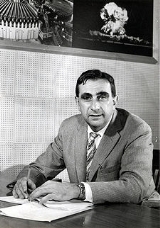
Edward Teller

Edward Teller was a Hungarian Hungary

Hungary , officially the Republic of Hungary , is a landlocked [i] country in Central Europe [i], ... 

-born American United States

The United States of America, also known as the United States, the U.S., the U.S.A., a... 

 nuclear physicist Physicist

A physicist is a scientist [i] who studies or practices physics [i]. ... 

, known colloquially as "the father of the hydrogen bomb Nuclear weapon

A nuclear weapon derives its destructive force from nuclear reaction [i]s of fission [i] ... 

." Of Jewish Jew

Jews are followers of Judaism [i] or, more generally, members of the Jewish people , an ethno [i] ... 

 descent, Teller emigrated to the United States United States

The United States of America, also known as the United States, the U.S., the U.S.A., a... 

 in the 1930s 1930s

... 

, and was an early member of the Manhattan Project Manhattan Project

The Manhattan Project refers to the effort to develop the first nuclear weapon [i]s during World War II [i] ... 

 charged with developing the first atomic bombs. During this time he made a serious push to develop the first fusion Nuclear fusion

In physics [i], nuclear fusion is the process by which multiple nuclei [i] join together ... 

-based weapons as well, but these were deferred until after World War II World War II

World War II, or the Second World War, was a worldwide [i] conflict [i] fought betwe ... 

. After his controversial testimony in the security clearance hearing of his former Los Alamos Los Alamos National Laboratory

Los Alamos National Laboratory is a United States Department of Energy [i] national laboratory [i] ... 

 colleague Robert Oppenheimer Robert Oppenheimer

J. Robert Oppenheimer was an American [i] theoretical physicist [i], ... 

, Teller became ostracized by much of the scientific community.

Discussions

  Discussion Features

   Ask a question about 'Edward Teller'

   Start a new discussion about 'Edward Teller'

   Answer questions about 'Edward Teller'

   'Edward Teller' discussion forum

Timeline

1908   Born

2003   Died


Quotations

When you fight for a desperate cause and have good reasons to fight, you usually win.

Cited by Robert C. Martin in the September 2005 issue of Software Development magazine, page 60

       More Quotes >>


Encyclopedia


Edward Teller was a Hungarian Hungary

Hungary , officially the Republic of Hungary , is a landlocked [i] country in Central Europe [i], ... 

-born American United States

The United States of America, also known as the United States, the U.S., the U.S.A., a... 

 nuclear physicist Physicist

A physicist is a scientist [i] who studies or practices physics [i]. ... 

, known colloquially as "the father of the hydrogen bomb Nuclear weapon

A nuclear weapon derives its destructive force from nuclear reaction [i]s of fission [i] ... 

."

Of Jewish Jew

Jews are followers of Judaism [i] or, more generally, members of the Jewish people , an ethno [i]... 

 descent, Teller emigrated to the United States United States

The United States of America, also known as the United States, the U.S., the U.S.A., a... 

 in the 1930s 1930s

... 

, and was an early member of the Manhattan Project Manhattan Project

The Manhattan Project refers to the effort to develop the first nuclear weapon [i]s during World War II [i] ... 

 charged with developing the first atomic bombs. During this time he made a serious push to develop the first fusion Nuclear fusion

In physics [i], nuclear fusion is the process by which multiple nuclei [i] join together ... 

-based weapons as well, but these were deferred until after World War II World War II

World War II, or the Second World War, was a worldwide [i] conflict [i] fought betwe ... 

. After his controversial testimony in the security clearance hearing of his former Los Alamos Los Alamos National Laboratory

Los Alamos National Laboratory is a United States Department of Energy [i] national laboratory [i] ... 

 colleague Robert Oppenheimer Robert Oppenheimer

J. Robert Oppenheimer was an American [i] theoretical physicist [i], ... 

, Teller became ostracized by much of the scientific community. He continued to find support from the U.S. government and military research establishment. He was a co-founder of Lawrence Livermore National Laboratory Lawrence Livermore National Laboratory

The Lawrence Livermore National Laboratory is a United States Department of Energy [i] national laboratory [i] ... 

, and was both its director and associate director for many years.

In his later years he became especially known for his advocacy of controversial technological solutions to both military and civilian problems, including a plan to excavate an artificial harbor in Alaska Alaska

Alaska is a U.S. state [i], located on the northwest tier [i] of North America [i] ... 

 using thermonuclear Nuclear fusion

In physics [i], nuclear fusion is the process by which multiple nuclei [i] join together ... 

 explosives. He was a prominent advocate of Ronald Reagan Ronald Reagan

Ronald Wilson Reagan was the 40th President [i] of the United States [i] ... 

's Strategic Defense Initiative Strategic Defense Initiative

The Strategic Defense Initiative , commonly called Star Wars [i] after the popular science fiction [i] ... 

, and he was later accused of over-selling the technical feasibility of the program. Over the course of his long life, Teller was known both for his scientific ability and his difficult interpersonal relations, and is considered one of the key influences on the character Dr. Strangelove Dr. Strangelove or: How I Learned to Stop Worrying and Love the Bomb

Dr. Strangelove or: How I Learned to Stop Worrying and Love the Bomb is a 1964 [i] Stanley Kubrick [i] ... 

 in the 1964 movie of the same name.

Early life and education


Teller was born in Budapest Budapest

Budapest is the capital [i] city of Hungary [i] and the country's principal political [i]... 

, Austria-Hungary Austria-Hungary

Austria-Hungary, also known as the Austro-Hungarian Empire, Dual Monarchy or k.u.k. [i] ... 

 to a Jewish family. As a child, he was slow to speak, and his grandfather warned that he might be retarded. However, when he spoke, he did so in complete sentences. He left Hungary in 1926 and received his higher education in Germany Germany

Germany , officially the Federal Republic of Germany , is a country [i] in central Europe [i]. ... 

. The political climate and revolutions in Hungary during his youth instilled a deep hatred for both Communism Communism

Communism is an ideology that seeks to establish a future classless [i], stateless [i] ... 

 and Fascism Fascism

Fascism is a radical [i] political ideology [i] that combines elements of corporatism [i], authoritarianism [i] ... 

 in Teller. When he was a young student, his leg was severed in a streetcar accident in Munich Munich

colspan="2" bgcolor="BBDDFF" | Munich
... 

, requiring him to wear a prosthetic Prosthesis

In medicine [i], a prosthesis is an artificial [i] extension that replaces a missing body part [i]. ... 

 foot and leaving him with a life-long limp. Teller graduated in chemical engineering at the University of Karlsruhe and received his Ph.D. in physics Physics

Physics , the most fundamental physical science [i], is concerned with the underlying principles of the ... 

 under Werner Heisenberg Werner Heisenberg

Werner Karl Heisenberg was a celebrated German [i] physicist [i] and Nobel laureate [i] ... 

 in 1930 at the University of Leipzig. Teller's Ph.D. dissertation dealt with one of the first accurate quantum mechanical Quantum mechanics

Quantum mechanics is a first quantized [i] quantum theory [i] that supersedes classical mechanics [i] ... 

 treatments of the hydrogen molecular ion Hydrogen

|-
| Triple point [i] || 13.8033 K, 7.042 kPa
... 

. In 1930 he befriended young Russian physicists George Gamow and Lev Landau Lev Landau

Lev Davidovich Landau was a prominent Soviet [i] physicist [i] who made fundamental contrib ... 

, who then visited Western Europe.

He spent two years at the University of Göttingen and left Germany in 1933 through the aid of the Jewish Rescue Committee. He went briefly to England England

England is the largest and most populous constituent country [i] of the United Kingdom [i]. ... 

 and moved for a year to Copenhagen Copenhagen

Copenhagen is the capital [i] of Denmark [i] and the country's largest city , at present made up of 16 ... 

, where he worked under Niels Bohr Niels Bohr

Niels Bohr was a Danish [i] physicist [i] who made fundamental contributions to understanding ... 

. In February 1934, he married "Mici" Harkanyi, the sister of a longtime friend.

In 1935, thanks to George Gamow's incentive, Teller was invited to the United States to become a Professor of Physics at the George Washington University George Washington University

The George Washington University is a private, coeducational, non-sectarian university located in Washington, D.C. [i] ... 

, where he worked with Gamow until 1941. Prior to the discovery of fission Nuclear fission

For the generation of electrical power by fission, see Nuclear power plant [i]
... 

 in 1939, Teller was engaged as a theoretical physicist working in the fields of quantum, molecular, and nuclear physics. In 1941, after becoming a naturalized Naturalization

In law [i], naturalization is the act whereby a person voluntarily and actively acquires a nationality [i] ... 

 citizen of the United States, his interest turned to the use of nuclear energy, both fusion and fission.

Perhaps Teller's most important contribution to science was the elucidation of the Jahn-Teller Effect  which describes the geometrical Geometry

Geometry arose as the field of knowledge dealing with spatial relationships.... 

 distortion that electron Electron

The electron is a fundamental [i] subatomic particle [i] that carries an electric charge [i]... 

 clouds undergo in certain situations; this plays prominently in the description of chemical reaction Chemical reaction

A chemical reaction is a process that results in the interconversion of chemical substance [i]s . ... 

s of metals, and in particular the coloration of certain metallic dyes. In collaboration with Brunauer and Emmet, Teller also made an important contribution to surface physics and chemistry; the so-called Brunauer-Emmett-Teller isotherm.

When World War II began, Teller wanted to contribute to the war effort. On the advice of the well-known Caltech California Institute of Technology

The California Institute of Technology is a private [i], coeducation [i]al university lo ... 

 aerodynamicist and fellow Hungarian émigré Theodore von Kármán Theodore von Karman

Theodore von Krmn was a Hungarian [i]-American [i] engineer [i] and physicist [i]... 

, Teller collaborated with his friend Hans Bethe Hans Bethe

Hans Albrecht Bethe, was a German [i]-American [i] physicist [i] who won the Nobel Prize in Physics [i] ... 

 in developing a theory of shock-wave propagation. In later years, their explanation of the behavior of the gas behind such a wave proved valuable to scientists who were studying missile Missile

A missile is a projectile [i] propelled as a weapon at a target. ... 

 re-entry.

Work on the Manhattan Project


In 1942, Teller was invited to be part of Robert Oppenheimer Robert Oppenheimer

J. Robert Oppenheimer was an American [i] theoretical physicist [i], ... 

's summer planning seminar at UC Berkeley University of California, Berkeley

The University of California, Berkeley is the oldest and flagship campus of the ten-campus University of California [i] ... 

 for the origins of the Manhattan Project Manhattan Project

The Manhattan Project refers to the effort to develop the first nuclear weapon [i]s during World War II [i] ... 

, the Allied effort to develop the first nuclear weapon Nuclear weapon

A nuclear weapon derives its destructive force from nuclear reaction [i]s of fission [i] ... 

s. A few weeks earlier, Teller had been meeting with his friend and colleague Enrico Fermi Enrico Fermi

Enrico Fermi was an Italian [i] physicist [i] most noted for his work on beta decay [i], the deve ... 

 about the prospects of atomic warfare Nuclear warfare

Nuclear war, or atomic war, is war [i] in which nuclear weapon [i]s are used.... 

, and Fermi had nonchalantly suggested that perhaps a weapon based on nuclear fission Nuclear fission

For the generation of electrical power by fission, see Nuclear power plant [i]
... 

 could be used to set off an even larger nuclear fusion Nuclear fusion

In physics [i], nuclear fusion is the process by which multiple nuclei [i] join together ... 

 reaction. Even though he initially quickly explained to Fermi why he thought the idea wouldn't work, Teller was fascinated by the possibility and was quickly bored with the idea of "just" an atomic bomb . At the Berkeley session, Teller diverted discussion from the fission weapon to the possibility of a fusion weapon—what he called the "Super" .

Teller became part of the Theoretical Physics division at the then-secret Los Alamos laboratory Los Alamos National Laboratory

Los Alamos National Laboratory is a United States Department of Energy [i] national laboratory [i] ... 

 during the war, and continued to push his ideas for a fusion weapon even though it had been put on a low priority during the war . Because of his interest in the H-bomb, and his frustration at having been passed over for director of the theoretical division , Teller refused to engage in the calculations for the implosion of the fission bomb. This caused tensions with other researchers, as additional scientists had to be employed to do that work—including Klaus Fuchs Klaus Fuchs

Emil Julius Klaus Fuchs was a German [i]-born theoretical physicist [i] and... 

, who later was revealed to be a Soviet spy. Apparently, Teller also managed to irk his neighbors by playing the piano late in the night. However, Teller made some valuable contributions to bomb research, especially in the elucidation of the implosion Implosion

Implosion is a process in which objects are destroyed by collapsing in on themselves.... 

 mechanism.

In 1946, Teller participated in a conference in which the properties of thermonuclear fuels such as deuterium and the possible design of a hydrogen bomb was discussed. It was concluded that Teller's assessment of a hydrogen bomb had been too favourable, and that both the quantity of deuterium needed, as well as the radiation losses during deuterium burning, would shed doubt on its workability. Addition of expensive tritium to the thermonuclear mixture would likely lower its ignition temperature, but even so, nobody knew at that time how much tritium would be needed, and whether even tritium addition would encourage heat propagation. At the end of the conference, in spite of opposition by some members such as Robert Serber Robert Serber

Robert Serber was a physicist who participated in the Manhattan Project [i].
... 

, Teller submitted an optimistic report in which he said that a hydrogen bomb was feasible, and that further work should be encouraged on its development. Klaus Fuchs Klaus Fuchs

Emil Julius Klaus Fuchs was a German [i]-born theoretical physicist [i] and... 

 had also participated in this conference, and transmitted this information to Moscow. The model of Teller's 'classical Super' was so uncertain, that Oppenheimer would later say that he wished the Russians were building their own hydrogen bomb based on that design, so that it would almost certainly retard their progress on it.
In 1946, Teller left Los Alamos to return to the University of Chicago University of Chicago

The University of Chicago is a private university [i] located principally in the Hyde Park [i]... 

.

The hydrogen bomb


Following the Soviet Union Soviet Union

The Union of Soviet Socialist Republics , more commonly known as the Soviet Union, was a Communist state [i] ... 

's first test detonation of an atomic bomb in 1949, President Truman Harry S. Truman

Harry S. [i] Truman was the thirty-third President of the United States [i]; as ... 

 announced a crash development program for a hydrogen bomb. Teller returned to Los Alamos in 1950 to work on the project. Teller quickly grew impatient with the progress of the program, insisted on involving more theorists, and accused his colleagues of lacking imagination. This worsened his relations with other researchers. None of his designs , however, were yet workable. Bethe thought that had Teller not pressed for an early H-bomb test, the Russians' own development might possibly have been slowed down, particularly as the information which Klaus Fuchs Klaus Fuchs

Emil Julius Klaus Fuchs was a German [i]-born theoretical physicist [i] and... 

 gave them contained many incorrect technical details which rendered a workable H-bomb unfeasible. Russian scientists who had worked on the Soviet hydrogen bomb have claimed that they could see that the early ideas were infeasible as well as anyone else who had looked at them did, and also claimed that they developed their H-bomb wholly independently.

In 1950, calculations by the Polish Poles

The Poles are a western Slavic [i] people [i] inhabiting the country of Poland [i] and a numb ... 

 mathematician Stanislaw Ulam Stanislaw Marcin Ulam

Stanislaw Marcin Ulam was a Polish [i] mathematician [i] who participated in the Manhattan Project [i] ... 

 and his collaborator Cornelius Everett, along with confirmations by Fermi, had shown that not only was Teller's earlier estimate of the quantity of tritium Tritium

Tritium is a radioactive isotope [i] of hydrogen [i]. ... 

 needed for the H-bomb a low one, but that even with a higher amount of tritium, the energy losses in the fusion process would be too great to enable the fusion reaction to propagate. However, in 1951, after still many years of fruitless labor on the "Super," an innovative idea from Ulam was seized upon by Teller and developed into the first workable design for a megaton-range hydrogen bomb. The exact contribution provided respectively from Ulam and Teller to what became known as the Teller-Ulam design Teller-Ulam design

The TellerUlam design is a nuclear weapon design [i] which is used in megaton [i]-range thermonuclear weapons [i] ... 

 is not definitively known in the public domain—the degree of credit assigned to Teller by his contemporaries is almost exactly commensurate with how well they thought of Teller generally. In an interview with Scientific American Scientific American

Scientific American is a popular-science [i] magazine [i], published since August 28 [i]... 

from 1999, Teller told the reporter:

"I contributed; Ulam did not. I'm sorry I had to answer it in this abrupt way. Ulam was rightly dissatisfied with an old approach. He came to me with a part of an idea which I already had worked out and difficulty getting people to listen to. He was willing to sign a paper. When it then came to defending that paper and really putting work into it, he refused. He said, 'I don't believe in it.'"


The issue is controversial. Bethe spoke of Teller’s "stroke of genius Genius

A genius is a person with distinguished mental abilities.... 

" in the invention of the H-bomb as early as 1954. And as late as 1997 Bethe repeated his view that “the crucial invention was made in 1951, by Teller.” Other scientists have claimed that Teller would have never gotten any closer without the assistance of Ulam and others.

The breakthrough — the details of which are still classified — was apparently the separation of the fission and fusion components of the weapons, and to use the radiation produced by the fission bomb to first compress the fusion fuel before igniting it. However, compression alone would not have been enough and the other crucial idea — staging the bomb by separating the primary and secondary — seems to have been exclusively contributed by Ulam. Also, Ulam's idea seems to have been to use mechanical shock from the primary to encourage fusion in the secondary, while Teller quickly realised that radiation from the primary would do the job much earlier and more efficiently. Some members of the laboratory later expressed that the idea to use the radiation would have eventually occurred to anyone working on the physical processes involved, and that the obvious reason why Teller thought of radiation right away was because he was already working on the "Greenhouse Operation Greenhouse

Operation Greenhouse was the fifth American nuclear test series, the second conducted in 1951 [i] and th ... 

" tests for the spring of 1951, in which the effect of the energy from a fission bomb on a mixture of deuterium and tritium was going to be investigated.

Whatever the actual components of the so-called Teller-Ulam design and the respective contributions of those who worked on it, after it was proposed it was immediately seen by the scientists working on the project as the answer which had been so long sought. Those who previously had doubted whether a fission-fusion bomb would be feasible at all were converted into believing that it was only a matter of time before both the USA and the USSR had developed multi-megaton weapons. Even Oppenheimer, who was originally opposed to the project, called the idea "technically sweet."


Though he had helped to come up with the design and had been a long-time proponent of the concept, Teller was not chosen to head the development project . In 1952 he left Los Alamos and joined the newly established Livermore Lawrence Livermore National Laboratory

The Lawrence Livermore National Laboratory is a United States Department of Energy [i] national laboratory [i] ... 

 branch of the University of California Radiation Laboratory Lawrence Berkeley National Laboratory

The Ernest Orlando Lawrence Berkeley National Laboratory , formerly the Berkeley Radiation Laboratory... 

, which had been created largely through his urging. After the detonation of "Ivy Mike Ivy Mike

Ivy Mike was the code name given to the first successful test of a fusion [i] device, det ... 

", the first thermonuclear weapon to utilize the Teller-Ulam configuration, on November 1 1952, Teller became known in the press as the "father of the hydrogen bomb." Teller himself refrained from attending the test — he claimed not to feel welcome at the Pacific Proving Grounds Pacific Proving Grounds

The Pacific Proving Grounds was the name used to describe a number of sites in the Marshall Islands [i], ... 

 — and instead saw its results on a seismograph Seismometer

Seismometer are used by seismologist [i]s to measure and record seismic wave [i]s. ... 

 in the basement of a hall in Berkeley.

By analyzing the fallout from this test, the Soviets could have easily deduced that the new design had used compression as the key initiator. However this was later denied by the Soviet bomb researchers, who later claimed that they were not yet at that time organized to collect fallout data from U.S. tests. Because of official secrecy, little information about the bomb's development was released by the government, and press reports often attributed the entire weapon's design and development to Teller and his new Livermore Laboratory .

Many of Teller's colleagues were irritated that he seemed to enjoy taking full credit for something he had only a part in, and in response, with encouragement from Enrico Fermi, Teller authored an article titled "The Work of Many People," which appeared in Science magazine in February 1955, emphasizing that he was not alone in the weapon's development .

Teller was often known for getting engrossed in projects which were theoretically interesting but practically unfeasible About his work on the hydrogen bomb, Bethe said:

"Nobody blamed Teller because the calculations of 1946 were wrong, especially because adequate computing machines were not available at Los Alamos. But he was blamed at Los Alamos for leading the laboratory, and indeed the whole country, into an adventurous programme on the basis of calculations, which he himself must have known to have been very incomplete."


During the Manhattan Project, Teller also advocated for the development of a bomb using uranium hydride Uranium

Uranium is a chemical element [i] in the periodic table [i] that has the symbol U and atomic number [i] ... 

, which many of his fellow theorists said would be unlikely to work. At Livermore, Teller continued work on the hydride bomb, and the result was a dud. Ulam once wrote to a colleague about an idea he had shared with Teller: "Edward is full of enthusiasm about these possibilities; this is perhaps an indication they will not work." Fermi once said that Teller was the only monomaniac he knew who had several manias.

The Oppenheimer controversy


The rift between Teller and many of his colleagues was widened in 1954 when he testified against Robert Oppenheimer, former head of Los Alamos and member of the Atomic Energy Commission, at Oppenheimer's security clearance hearing. Teller had clashed with Oppenheimer many times at Los Alamos over issues relating both to fission and fusion research, and during Oppenheimer's trial he was the only member of the scientific community to label Oppenheimer a security risk.

Asked at the hearing by prosecutor Roger Robb whether he was planning "to suggest that Dr. Oppenheimer is disloyal to the United States," Teller replied that:

I do not want to suggest anything of the kind. I know Oppenheimer as an intellectually most alert and a very complicated person, and I think it would be presumptuous and wrong on my part if I would try in any way to analyze his motives. But I have always assumed, and I now assume that he is loyal to the United States. I believe this, and I shall believe it until I see very conclusive proof to the opposite.


However, he was immediately asked whether he believed that Oppenheimer was a "security risk," to which he testified:

In a great number of cases I have seen Dr. Oppenheimer act — I understood that Dr. Oppenheimer acted — in a way which for me was exceedingly hard to understand. I thoroughly disagreed with him in numerous issues and his actions frankly appeared to me confused and complicated. To this extent I feel that I would like to see the vital interests of this country in hands which I understand better, and therefore trust more. In this very limited sense I would like to express a feeling that I would feel personally more secure if public matters would rest in other hands.


Teller also testified that Oppenheimer's opinion about the thermonuclear program seemed to be based more on the scientific feasibility of the weapon than anything else. He additionally testified that Oppenheimer's direction of Los Alamos was "a very outstanding achievement" both as a scientist and an administrator, lauding his "very quick mind" and that he made "just a most wonderful and excellent director."

After this, however, he detailed ways in which he felt that Oppenheimer had hindered his efforts towards an active thermonuclear development program, and at length criticized Oppenheimer's decisions not to invest more work onto the question at different points in his career. The most damning piece of testimony, as seen by contemporaries and later historians, was his statement that:

If it is a question of wisdom and judgment, as demonstrated by actions since 1945, then I would say one would be wiser not to grant clearance.


Oppenheimer's security clearance was eventually stripped, and Teller was treated as a pariah by many of his former colleagues. In response, Teller began to run with a more military and governmental crowd, becoming the scientific darling of conservative Conservatism

Conservatism is a political philosophy [i] that necessitates a defense of established values or the stat ... 

 politicians and thinkers for his advocacy of American scientific and technological supremacy. After the fact, Teller consistently denied that he was intending to damn Oppenheimer, and even claimed that he was attempting to exonerate him. Documentary evidence has suggested that this was likely not the case, however. Six days before the testimony, Teller met with an AEC liaison officer and suggested "deepening the charges" in his testimony.

Government work and political advocacy


Teller was Director of the Lawrence Livermore National Laboratory Lawrence Livermore National Laboratory

The Lawrence Livermore National Laboratory is a United States Department of Energy [i] national laboratory [i] ... 

 , which he helped to found , and after that he continued as an Associate Director. He also served concurrently as a Professor of Physics at the University of California, Berkeley University of California, Berkeley

The University of California, Berkeley is the oldest and flagship campus of the ten-campus University of California [i] ... 

. He was a tireless advocate of a strong nuclear program and argued for continued testing and development — in fact, he stepped down from the directorship of Livermore so that he could better lobby against the proposed test ban Partial Test Ban Treaty

The Treaty Banning Nuclear Weapon Tests In The Atmosphere, In Outer Space And Under Water, often abbrevi... 

. He testified against the test ban both before Congress as well as on television.

After the Oppenheimer controversy, Teller became ostracized by much of the academic scientific community. He was however still quite welcome in the government and military science circles. Along with his traditional advocacy for nuclear energy development, a strong nuclear arsenal, and a vigorous nuclear testing program, he also helped to develop nuclear reactor Nuclear reactor

A nuclear reactor is a device in which nuclear chain reaction [i]s are initiated, controlled, and sustai ... 

 safety standards and helped to design reactors in which a nuclear meltdown would be hypothetically impossible.

In 1975 he retired from both the lab and Berkeley, and was named Director Emeritus of the Livermore Laboratory and appointed Senior Research Fellow at the Hoover Institution Hoover Institution

The Hoover Institution on War, Revolution, and Peace is a public policy [i] think tank [i] and library f ... 

.

Teller with the Council for National Policy Council for National Policy

The Council for National Policy, is an umbrella organization and networking group for conservative activ... 

, a semi-secret right-wing think-tank. He served on the Council's board of directors in 1982.

Operation Plowshare and Project Chariot


Teller was one of the strongest and best-known advocates for investigating non-military uses Peaceful nuclear explosions

Peaceful nuclear explosions are nuclear explosion [i]s conducted for non-military purposes, such as acti ... 

 of nuclear explosives, known as Operation Plowshare Operation Plowshare

Operation Plowshare, better known as Project Plowshare, not to be confused with the anti-nuclear Plowshares Movement [i] ... 

. One of the most controversial projects he proposed was a plan to use a multi-megaton hydrogen bomb to dig a deep-water harbor more than a mile long and half a mile wide to use for shipment of resources from coal and oil fields near Point Hope Point Hope, Alaska

Point Hope is a city in North Slope Borough [i], Alaska [i], United States [i] ... 

, Alaska Alaska

Alaska is a U.S. state [i], located on the northwest tier [i] of North America [i] ... 

. The Atomic Energy Commission accepted Teller's proposal in 1958 and it was designated Project Chariot. While the AEC was scouting out the Alaskan site, and having withdrawn the land from the public domain, Teller publicly advocated the economic benefits of the plan, but was unable to convince local government leaders that the plan was financially viable.

Other scientists criticized the project as being potentially unsafe for the local wildlife and the Inupiat people living near the designated area, who were not officially told of the plan until 1960. Additionally, it turned out that the harbor would be ice-bound for nine months out of the year. In the end, due to the financial infeasibility of the project and the concerns over radiation-related health issues, the project was cancelled in 1962.

A related experiment which also had Teller's endorsement was a plan to extract oil from the Athabasca oil sands Athabasca Oil Sands

The Athabasca Oil Sands are a large deposit of oil-rich bitumen [i] located in northern Alberta [i], Canada [i] ... 

 in northern Alberta Alberta

Alberta is one of Canada [i]'s provinces [i]. ... 

 with nuclear explosions. The plan actually received the endorsement of the Alberta government, but was rejected by the Government of Canada Government of Canada

The Government of Canada is the name of the federal government [i] of Canada [i]. ... 

 under Prime Minister Prime Minister of Canada

The Prime Minister [i] of Canada [i] , is the head of the Government of Canada [i].... 

 John Diefenbaker John Diefenbaker

John George Diefenbaker, CH [i], PC [i] ... 

. In addition to being opposed to having nuclear weapons in Canada Canada

Canada is the world's second-largest [i] country by total area, occupying most ... 

, Diefenbaker was concerned that such a project would intensify Soviet espionage in Northern Canada Northern Canada

*Tree line [i]
  • Geography of Canada [i]

... 

.

Three Mile Island


Teller suffered a heart attack Myocardial infarction

Acute myocardial infarction , commonly known as a heart attack, is a disease that occurs when the ... 

 in 1979, which he blamed on Jane Fonda Jane Fonda

Jane Seymour Fonda is an American [i] actress [i], writer [i], political activist [i] ... 

; after the Three Mile Island Three Mile Island accident

On March 28 [i], 1979 [i], the Unit 2 nuclear power plant [i] on Three Mile Island suffered a partial co ... 

 accident, the actress had outspokenly lobbied against nuclear power Nuclear reactor

A nuclear reactor is a device in which nuclear chain reaction [i]s are initiated, controlled, and sustai ... 

 while promoting her latest movie, The China Syndrome The China Syndrome

The China Syndrome is a 1979 [i] thriller film [i] which tells the story of a reporter ... 

In response, Teller acted quickly to lobby in favor of nuclear energy, testifying to its safety and reliability, and after such a flurry of activity suffered the attack. Teller authored a two-page spread in the Wall Street Journal The Wall Street Journal

The Wall Street Journal is an influential international daily newspaper [i] published in New York City [i] ... 

which appeared on July 31 1979, under the headline "I was the only victim of Three-Mile Island", which opened with:

"On May 7, a few weeks after the accident at Three-Mile Island, I was in Washington. I was there to refute some of that propaganda Propaganda

Propaganda is a specific type of message [i] presentation directly aimed at influencing the opinion [i]s ... 

 that Ralph Nader Ralph Nader

Ralph Nader is an American [i] attorney and political activist [i]. ... 

, Jane Fonda and their kind are spewing to the news media in their attempt to frighten people away from nuclear power. I am 71 years old, and I was working 20 hours a day. The strain was too much. The next day, I suffered a heart attack. You might say that I was the only one whose health was affected by that reactor near Harrisburg. No, that would be wrong. It was not the reactor. It was Jane Fonda. Reactors are not dangerous."


The next day,
The New York Times The New York Times

The New York Times is a newspaper [i] published in New York City [i] by Arthur Ochs Sulzberger Jr. [i] ... 

 ran an editorial criticizing the ad, noting that it was sponsored by Dresser Industries, the firm which had manufactured one of the defective valves which contributed to the Three Mile Island accident.

Strategic Defense Initiative


In the 1980s 1980s

The 1980s [i] officially refers to the years from 1980 [i] to 1989 [i]. ... 

, Teller began a strong campaign for what was later called the Strategic Defense Initiative Strategic Defense Initiative

The Strategic Defense Initiative , commonly called Star Wars [i] after the popular science fiction [i] ... 

 , derided by critics as "Star Wars," the concept of using lasers or satellites to destroy incoming Russia Russia

Russia , also the Russian Federation , is a country [i] that stretches over a vast expanse of Eurasia [i] ... 

n ICBM Intercontinental ballistic missile

An intercontinental ballistic missile, or ICBM, is a very long-range ballistic missile [i] typica ... 

s. Teller lobbied with government agencies—and got the sanction of President Ronald Reagan Ronald Reagan

Ronald Wilson Reagan was the 40th President [i] of the United States [i] ... 

—for his plan to develop a system using elaborate satellite Satellite

A satellite is any object that orbit [i]s another object . ... 

s which used atomic weapons to fire X-ray lasers at incoming missiles— as part of a broader scientific research program into defenses against nuclear weapons. However, scandal erupted when Teller were accused of deliberately overselling the program and perhaps had encouraged the dismissal of a laboratory director who had attempted to correct the error. His claims led to a joke which circulated in the scientific community, that a new unit of unfounded optimism was designated as the teller; one teller was so large that most events had to be measured in nanotellers or picotellers. Many prominent scientists claimed that the system was futile. Bethe, along with IBM IBM

company_name = International Business Machines Corporation |
... 

 physicist Richard Garwin and Cornell University Cornell University

Cornell University is a private [i] research university [i] located in Ithaca, New York [i] ... 

 colleague Kurt Gottfried, wrote an article in Scientific American which analyzed the system and concluded that any putative enemy could disable such a system by the use of suitable decoys. The project's funding was eventually scaled back.

Many scientists opposed strategic defense on moral or political rather than purely technical grounds. They argued that, even if an effective system could be produced, it would undermine the system of Mutually Assured Destruction that had prevented all-out war between the western democracies and the communist bloc. An effective defense, they contended, would make such a war "winnable" and therefore more likely.

The concept experienced a revival in the late 90's and early part of the twenty-first century, though. This was partially due to advancing technology, but mostly to the changing nature of the nuclear strategic environment. Instead of a stand-off between thousands of weapons deployed by two well-funded and highly advanced superpowers, the world had transitioned to a multi-polar world where many nations of varying wealth and political stability, deployed small numbers of nuclear weapons. In this context, nations able to afford only a handful of ICBM— or even one— could pose a major threat to the US. Furthermore, in the hands of political or religious extremists, the counterthreat of nuclear annihilation was perceived as less likely to deter potential attackers. Teller's plan offered a way to increase the risk for emerging nuclear powers contemplating a first-strike, while forcing nations with more economic and technological might to enter a costly arms race between defense and countermeasure. Under US President Bush George W. Bush

This page is monitored by many people and bots, and joke edits are removed quickly.
... 

, the missile defense program National Missile Defense

National Missile Defense is a military strategy and associated systems to shield an entire country again... 

 experienced a revitalization, and the US withdrew from the Anti-ballistic Missile Treaty to pursue defenses against nuclear weapons.

Despite his hawkish reputation, Teller made a public point of noting that he regretted the use of the first atomic bombs on civilian cities during World War II, and before the bombing of Hiroshima Hiroshima

The Japanese city of is the capital of Hiroshima Prefecture [i], and the largest city in the Chugoku region [i]... 

 he had indeed lobbied Oppenheimer to use the weapons first in a "demonstration" which could be witnessed by the Japanese Japanese people

The are the people having identity [i] as a Japan [i]ese. ... 

 high-command and citizenry before using them to incur thousands of deaths. The "father of the hydrogen bomb" would use this quasi-anti-nuclear stance to promote technologies such as SDI, arguing that they were needed to make sure that nuclear weapons could never be used again .

Legacy


In his early career, Teller made many important contributions to nuclear and molecular physics, spectroscopy Spectroscopy

Spectroscopy is the study of matter by investigating light, sound, or particles that is emitted, absorbe... 

 , and surface Surface

In mathematics [i], specifically in topology [i], a surface is a two-dimensional manifold [i].... 

 physics. His extension of Fermi's theory of beta decay provided an important stepping stone in the applications of this theory. The Jahn-Teller effect and the BET theory have retained their original formulation and are still mainstays in physics and chemistry. Teller also made contributions to Thomas-Fermi theory, the precursor of density functional theory, a standard modern tool in the quantum mechanical treatment of complex molecules. In 1953, along with Nicholas Metropolis and Marshall Rosenbluth, Teller co-authored a paper which is a standard starting point for the applications of the Monte Carlo method to statistical mechanics.

Teller's vigorous advocacy for strength through nuclear weapons, especially when so many of his wartime colleagues later expressed regret about the arms race, made him an easy target for the "mad scientist Mad scientist

A mad scientist is a stock character [i] of popular fiction [i], either villain [i]ous or ... 

" stereotype . In 1991 he was awarded one of the first Ig Nobel Prize Ig Nobel Prize

The Ig Nobel Prizes are a parody [i] of the Nobel Prize [i]s and are given each year in early autumn &md ... 

s for Peace in recognition of his "lifelong efforts to change the meaning of peace as we know it". He was also rumored to be one of the inspirations for the character of Dr. Strangelove in Stanley Kubrick Stanley Kubrick

Stanley Kubrick was an American film director [i] and producer [i], genera ... 

's 1964 satirical Satire

Satire is a technique [i] of writing or art which exposes the follies of its subject ... 

 film of the same name . In the aforementioned Scientific American interview from 1999, he was reported as having bristled at the question: "My name is not Strangelove. I don't know about Strangelove. I'm not interested in Strangelove. What else can I say?... Look. Say it three times more, and I throw you out of this office." Nobel Prize winning physicist Isidor I. Rabi Isidor Isaac Rabi

Isidor Isaac Rabi was an American [i] physicist [i].
... 

 once suggested that "It would have been a better world without Teller."

Although he left Hungary Hungary

Hungary , officially the Republic of Hungary , is a landlocked [i] country in Central Europe [i], ... 

 decades ago, Teller never forgot his heritage or his language. After the fall of communism Communism

Communism is an ideology that seeks to establish a future classless [i], stateless [i] ... 

 in Hungary in 1989, he made several visits to his country of origin, and paid careful attention to the political changes there. For example, during the 2002 elections in Hungary, he sent a letter to the right wing political party Fidesz Fidesz – Hungarian Civic Union

The Fidesz – Hungarian Civic Union is a large centre-right conservative [i] and Christian Democratic [i] ... 

, to assure them that he sympathized with them. Barely a month after Teller's death, a Hungarian journalist from a leftist newspaper publicized a supposed letter from Teller, in which he expressed his hate against the party. However his friends and his secretary found it impossible that he would write such things. Soon thereafter it came out that the letter was a fake.

Teller died in Stanford, California Stanford, California

Stanford is a census-designated place [i] in Santa Clara County [i], California [i] ... 

 on September 9 2003. He was a fellow of the American Academy of Arts and Sciences American Academy of Arts and Sciences

* American Academy of Arts and Letters [i]
... 

, the American Association for the Advancement of Science American Association for the Advancement of Science

The American Association for the Advancement of Science is an organization that promotes cooperation bet... 

, and the American Nuclear Society. Among the honors he received were the Albert Einstein Award, the Enrico Fermi Award, and the National Medal of Science National Medal of Science

The National Medal of Science, also called the Presidential Medal of Science, is an honor given by... 

. He was also named as part of the group of "U.S. Scientists" who were Time magazine Time (magazine)

Time is a weekly American [i] newsmagazine [i], similar to Newsweek [i] and U.S. News & World Report [i] ... 

's People of the Year Person of the Year

Person of the Year is an annual issue of U.S.... 

 in 1960, and an asteroid, 5006 Teller, is named after him. He was awarded with the Presidential Medal of Freedom Presidential Medal of Freedom

The Presidential Medal of Freedom is one of the two highest civilian award [i] ... 

 by President George W. Bush George W. Bush

This page is monitored by many people and bots, and joke edits are removed quickly.
... 

 less than two months before his death.

Notes


References

  • Broad, William J. Teller’s War: The Top-Secret Story Behind the Star Wars Deception. New York: Simon & Schuster, 1992.
  • Herken, Gregg. Brotherhood of the Bomb: The Tangled Lives and Loyalties of Robert Oppenheimer, Ernest Lawrence, and Edward Teller. New York: Henry Holt, 2002.
  • O'Neill, Dan. The Firecracker Boys. New York: St. Martin’s Press, 1994.
  • Rhodes, Richard. Dark Sun: The Making of the Hydrogen Bomb. New York: Simon and Schuster, 1995.

Further reading

Written by Teller
  • Our Nuclear Future; Facts, Dangers, and Opportunities
  • Basic Concepts of Physics
  • The Legacy of Hiroshima
  • Energy from Heaven and Earth
  • The Pursuit of Simplicity
  • Better a Shield Than a Sword: Perspectives on Defense and Technology
  • Conversations on the Dark Secrets of Physics
  • Memoirs: A Twentieth-Century Journey in Science and Politics

Books about Teller
  • William J. Broad, Teller’s war: the top-secret story behind the Star Wars deception .
  • Gregg Herken, Brotherhood of the bomb: the tangled lives and loyalties of Robert Oppenheimer, Ernest Lawrence .
  • Peter Goodchild, Edward Teller: the real Dr. Strangelove .

External links

  • Academy of Achievement Profile http://www.achievement.org/autodoc/page/tel0pro-1
  • Academy of Achievement Biography http://www.achievement.org/autodoc/page/tel0bio-1
  • Academy of Achievement Interview http://www.achievement.org/autodoc/page/tel0int-1
  • Academy of Achievement Photo Gallery http://www.achievement.org/autodoc/page/tel0gal-1
  • – Outlines years of FBI agents trying to establish whether or not he was the same person as another Edward Teller who taught at a Marxist school in New York.
  • interview with Richard Rhodes
  • – Review of a revisionist histories of the atomic bomb efforts which unmask Teller's role in Oppenheimer's downfall and his false claim to be father of the H-Bomb .
  • – includes a discussion of Teller's role.