
| |
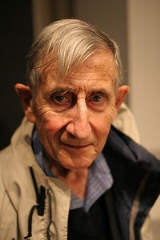
Freeman John Dyson FRS (born December 15, 1923) is a British-born American theoretical physicist and mathematician, famous for his work in quantum field theory, solid-state physics, and nuclear engineering. He is a practising Christian, as well as a lifelong opponent of nationalism and a proponent of nuclear disarmament and international cooperation. Dyson is a member of the Board of Sponsors of The Bulletin of the Atomic Scientists.
n's father was the English composer George Dyson. Despite sharing a last name, he is not related to early 20th century astronomer Frank Watson Dyson.

Discussion
Ask a question about 'Freeman Dyson'
Start a new discussion about 'Freeman Dyson'
Answer questions from other users
|
Recent Posts

Quotations
It is characteristic of all deep human problems that they are not to be approached without some humor and some bewilderment.
Sharing the food is to me more important than arguing about beliefs. Jesus, according to the gospels, thought so too.
The laws of nature are constructed in such a way as to make the universe as interesting as possible.
Imagined Worlds (1997)
There is a great satisfaction in building good tools for other people to use.
A good scientist is a person with original ideas. A good engineer is a person who makes a design that works with as few original ideas as possible. There are no prima donnas in engineering.
Religion will always remain a powerful force in the history of our species. To me, the meaning of progress in religion is simply this, that as we move from the past to the future the good works inspired by religion should more and more prevail over the evil.

Encyclopedia
Freeman John Dyson FRS (born December 15, 1923) is a British-born American theoretical physicist and mathematician, famous for his work in quantum field theory, solid-state physics, and nuclear engineering. He is a practising Christian, as well as a lifelong opponent of nationalism and a proponent of nuclear disarmament and international cooperation. Dyson is a member of the Board of Sponsors of The Bulletin of the Atomic Scientists.
Biography
Personal
Dyson's father was the English composer George Dyson. Despite sharing a last name, he is not related to early 20th century astronomer Frank Watson Dyson. However, as a small boy, Freeman Dyson was aware of Frank Watson Dyson; Freeman credits the popularity of someone with the same last name with inadvertently helping to spark his interest in science. Dyson received an honorary Sc.D. from Bates College in 1990.
Dyson's mother was trained as a lawyer but worked, after Dyson was born, as a social worker.
His wife, Imme Dyson, is an accomplished masters runner.
Dyson has six children. One daughter is Esther Dyson, the noted digital technology consultant; Esther Dyson is his daughter by a previous marriage to mathematician Verena Huber-Dyson, and sister to digital technology historian George Dyson.; one of whose books is Project Orion: The Atomic Spaceship 1957-1965.
On Esther Dyson, his daughter:
Career
Dyson worked as an analyst for RAF Bomber Command at RAF Wyton during World War II, where he would come to create what would be later known as operational research. After the war, he obtained a BA in mathematics from Cambridge University (1945) and was a Fellow of Trinity College, Cambridge from 1946 to 1949. In 1947 he moved to the US, on a fellowship at Cornell University and thence joined the faculty there as a physics professor in 1951 without a PhD. He was elected a FRS in 1952 In 1953, he took up a post at the Institute for Advanced Study in Princeton, NJ. In 1957, he became a naturalised citizen of the United States.
Dyson is best known for demonstrating in 1949 the equivalence of the formulations of quantum electrodynamics that existed by that time -- Richard Feynman's diagrammatic path integral formulation and the operator method developed by Julian Schwinger and Sin-Itiro Tomonaga. A by-product of that demonstration was the invention of the Dyson series.
Dyson also did work in a variety of topics in mathematics, such as topology, analysis, number theory and random matrices.
From 1957 to 1961 he worked on the Orion Project, which proposed the possibility of space-flight using nuclear pulse propulsion. A prototype was demonstrated using conventional explosives, but a treaty which he was involved in and supported, banned the testing of nuclear weapons other than underground, and this caused the project to be abandoned.
In 1958 he led the design team for the TRIGA, a small, inherently safe nuclear reactor used throughout the world in hospitals and universities for the production of isotopes.
A seminal work by Dyson came in 1966 when, together with A. Lenard and independently of Elliott H. Lieb and Walter Thirring, he proved rigorously that the exclusion principle plays the main role in the stability of bulk matter . Hence, it is not the electromagnetic repulsion between electrons and nuclei that is responsible for two wood blocks that are left on top of each other not coalescing into a single piece, but rather it is the exclusion principle applied to electrons and protons that generates the classical macroscopic normal force. In condensed matter physics, Dyson also did studies in the phase transition of the Ising model in 1 dimension and spin waves
Dyson was awarded the Lorentz Medal in 1966 and Max Planck medal in 1969.
In 1977, Dyson supervised Princeton undergraduate John Aristotle Phillips in a term paper that outlined a credible design for a nuclear weapon. This earned Phillips the nickname The A-Bomb Kid.
In the 1984–85 academic year he gave the Gifford lectures at Aberdeen, which resulted in the book Infinite In All Directions.
In 1989, Dyson taught at Duke University as a Fritz London Memorial Lecturer. In the same year, he was elected as an Honorary Fellow of Trinity College, University of Cambridge.
Dyson has published a number of collections of speculations and observations about technology, science, and the future. In 1996 he was awarded the Lewis Thomas Prize for Writing about Science.
In 1998, Dyson joined the board of the Solar Electric Light Fund. In 2000, Dyson was awarded the Templeton Prize for Progress in Religion.
, Dyson is the president of the Space Studies Institute, the space research organisation founded by Gerard K. O'Neill.
In 2003, Dyson was awarded the Telluride Tech Festival Award of Technology in Telluride, Colorado.
Dyson is a long-time member of the JASON defence advisory group.
Concepts
Biotechnology and genetic engineering
Dyson cheerfully admits his record as a prophet is mixed, but "it is better to be wrong than to be vague."
Dyson sphere
In 1960 Dyson wrote a short paper for the journal Science, entitled "Search for Artificial Stellar Sources of Infrared Radiation". In it, he theorised that a technologically advanced extraterrestrial civilization might completely surround its native star with artificial structures in order to maximise the capture of the star's available energy. Eventually, the civilisation would completely enclose the star, intercepting electromagnetic radiation with wavelengths from visible light downwards and radiating waste heat outwards as infrared radiation. Therefore, one method of searching for extraterrestrial civilisations would be to look for large objects radiating in the infrared range of the electromagnetic spectrum.
Dyson conceived that such structures would be clouds of asteroid-sized space habitats, though science fiction writers have preferred a solid structure: either way, such an artifact is often referred to as a Dyson sphere, although Dyson himself used the term "shell". Dyson says that he used the word "artificial biosphere" in the article meaning a habitat, not a shape.
Dyson tree Dyson has also proposed the creation of a Dyson tree, a genetically-engineered plant capable of growing on a comet. He suggested that comets could be engineered to contain hollow spaces filled with a breathable atmosphere, thus providing self-sustaining habitats for humanity in the outer solar system.
Space colonies Freeman Dyson has been interested in space travel since he was a child, reading such science fiction classics as Olaf Stapledon's Star Maker. As a young man, he worked for General Atomics on the nuclear-powered Orion spacecraft. He hoped Project Orion would put men on Mars by 1965, Saturn by 1970. He's been unhappy for a quarter-century on how the government conducts space travel:
He still hopes for cheap space travel, but is resigned to waiting for private entrepreneurs to develop something new—and cheap.
Space exploration
Dyson's transform
Dyson also has some credits in pure mathematics. His concept "Dyson's transform" led to one of the most important lemmas of Olivier Ramaré's theorem that every even integer can be written as a sum of no more than six primes.
Views
Global warming Dyson agrees that anthropogenic global warming exists, and has written
However, he has argued that existing simulation models of climate fail to account for some important factors, and hence the results will contain too much error to reliably predict future trends.
He is among signatories of a letter to the UN criticizing the IPCC . The letter includes the statements "The average rate of warming of 0.1 to 0. 2 degrees Celsius per decade recorded by satellites during the late 20th century falls within known natural rates of warming and cooling over the last 10,000 years" and "there has been no net global warming since 1998". Both statements have been criticised as inconsistent with the data.
He has also argued against the ostracisation of scientists whose views depart from the acknowledged mainstream of scientific opinion on climate change, stating that heretics have historically been an important force in driving scientific progress.
He also believes that directing money towards fighting global poverty and providing medical aid will bring greater benefits to society than attempting to combat climate change.
Dyson was an early proponent of Carbon sequestration by plants by planting gigantic areas of trees as long ago as 1976. He revisited this subject in 2007 where he asserted that the "fuss about global warming is grossly exaggerated", having calculated that "the problem of carbon dioxide in the atmosphere is a problem of land management, not a problem of meteorology." The failures of climate scientists to understand this was due to his belief that "No computer model of atmosphere and ocean can hope to predict the way we shall manage our land."
Dyson has questioned the predictive value of current computational models of climate change, urging instead more extensive use of local observations.
Dyson regards the term "global warming" as a misnomer when taken literally, pointing out that warming will not occur uniformly throughout the world, but will instead be subject to regional variations:
More recently, he has endorsed the now common usage of "global warming" as synonymous with global anthropogenic climate change, referring to recent
Regarding political efforts to reduce the causes of climate change, Dyson argues that other global problems should take priority.
Bureaucracy
At the British Bomber Command, Dyson and colleagues proposed ripping out two gun turrets from the RAF Lancaster bombers, to cut the catastrophic losses to German fighters in the Battle of Berlin. A Lancaster without turrets could fly faster and be much more manoeuvrable.
Warfare and weapons
On hearing the news of the bombing of Hiroshima:
The role of failure
On English academics
Science and Religion
Dyson strongly opposes reductionism. He is a non-denominational Christian and has attended various churches from Presbyterian to Roman Catholic. Regarding doctrinal or christological issues, he has said "I am neither a saint nor a theologian. To me, good works are more important than theology."
Dyson disagrees with the famous remark by his fellow-physicist Steven Weinberg that "Good people will do good things, and bad people will do bad things. But for good people to do bad things—that takes religion."
Popular culture As noted above, the Dyson sphere is a favourite of science-fiction authors. See Dyson spheres in fiction.
The protagonist in the Half-Life video game series, Gordon Freeman, is named after Dyson.
Critiques
Dyson's views on global warming have been critiqued as failing to understand the size of carbon sequestration needed.
See also
Bibliography
By Dyson
- Symmetry Groups in Nuclear and Particle Physics, 1966 (Academic-oriented text)
- Disturbing the Universe, 1979
- Weapons and Hope, 1984
- Origins of Life, 1986
- Infinite in All Directions, 1988
- From Eros to Gaia, 1992
- Selected Papers of Freeman Dyson, 1996
- Imagined Worlds, Harvard University Press 1997, ISBN 978-0-674-53908-2
- The Sun, The Genome and The Internet, 1999
- L'mportanza di essere imprevedibile, Di Renzo Editore, 2003
- The Scientist as Rebel, 2006
- Advanced Quantum Mechanics, World Scientific, 2007. Dyson's 1951 Cornell lecture notes transcribed by David Derbes.
- A Many-Colored Glass: Reflections on the Place of Life in the Universe, University of Virginia Press, 2007
About Dyson
- Brower, Kenneth, 1978. The Starship and the Canoe, Holt Rinehart and Winston.
- Schweber, Sylvan S., 1994. QED and the men who made it : Dyson, Feynman, Schwinger, and Tomonaga. Princeton Univ. Press.
External links
|