

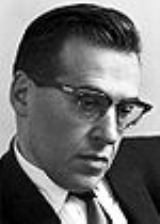
Julian Schwinger

Encyclopedia
Julian Seymour Schwinger (February 12, 1918 – July 16, 1994) was an American
theoretical physicist. He is best known for his work on the theory
of quantum electrodynamics
, in particular for developing a relativistically invariant perturbation theory, and for renormalizing QED to one loop order.
Schwinger is recognized as one of the greatest physicists of the twentieth century, responsible for much of modern quantum field theory, including a variational approach, and the equations of motion for quantum fields. He developed the first electroweak model, and the first example of confinement in 1+1 dimensions. He is responsible for the theory of multiple neutrinos, Schwinger terms, and the theory of the spin 3/2 field.
and then the City College of New York
as an undergraduate before transferring to Columbia University
, where he received his B.A. in 1936 and his Ph.D. (overseen by I.I. Rabi) in 1939 at the age of 21. He worked at the University of California, Berkeley
(under J. Robert Oppenheimer) and was later appointed to a position at Purdue University
.
at MIT
instead of at the Los Alamos National Laboratory
during World War II
. He provided theoretical support for the development of radar
. After the war, Schwinger left Purdue for Harvard University
, where he taught from 1945 to 1974.
Schwinger developed an affinity for Green's function
s from his radar work, and he used these methods to formulate quantum field theory in terms of local Green's functions in a relativistically invariant way. This allowed him to calculate unambiguously the first corrections to the electron magnetic moment in quantum electrodynamics
. Earlier non-covariant work had arrived at infinite answers, but the extra symmetry in his methods allowed Schwinger to isolate the correct finite corrections.
Schwinger developed renormalization
, formulating quantum electrodynamics
unambiguously to one-loop order.
In the same era, he introduced non-perturbative methods into quantum field theory, by calculating the rate at which electron
-positron
pairs are created by tunneling in an electric field, a process now known as the "Schwinger effect". This effect could not be seen in any finite order in perturbation theory.
Schwinger's foundational work on quantum field theory constructed the modern framework of field correlation functions and their equations of motion
. His approach started with a quantum action and allowed bosons and fermions to be treated equally for the first time, using a differential form of Grassman integration. He gave elegant proofs for the spin-statistics theorem
and the CPT theorem
, and noted that the field algebra led to anomalous Schwinger terms in various classical identities, because of short distance singularities. These were foundational results in field theory, instrumental for the proper understanding of anomalies
.
In other notable early work, Rarita and Schwinger formulated the abstract Pauli
and Fierz
theory of the spin 3/2 field in a concrete form, as a vector of Dirac spinors. In order for the spin-3/2 field to interact consistently, some form of supersymmetry is required, and Schwinger later regretted that he had not followed up on this work far enough to discover supersymmetry.
Schwinger discovered that neutrino
s come in multiple varieties, one for the electron
and one for the muon
. Nowadays there are known to be three light neutrinos; the third is the partner of the tau lepton
.
In the 1960s, Schwinger formulated and analyzed what is now known as the Schwinger model
, quantum electrodynamics in one space and one time dimension, the first example of a confining theory
. He was also the first to suggest an electroweak gauge theory, an SU(2) gauge group spontaneously broken to electromagnetic U(1) at long distances. This was extended by his student Sheldon Glashow into the accepted pattern of electroweak unification. He attempted to formulate a theory of quantum electrodynamics with point magnetic monopoles, a program which met with limited success because monopoles are strongly interacting when the quantum of charge is small.
Having supervised more than seventy doctoral dissertations, Schwinger is known as one of the most prolific graduate advisors in physics. Four of his students won Nobel prizes: Roy Glauber, Benjamin Roy Mottelson, Sheldon Glashow and Walter Kohn
(in chemistry).
Schwinger had a mixed relationship with his colleagues, largely because of his source theory. Schwinger considered source theory as a substitute for field theory, although it is only a different point of view, a version of effective field theory
. It treats quantum fields as long-distance phenomena, and does not require a well defined continuum limit. Source theory was considered overly formal and lacking in distinctness from quantum field theory, and the criticisms by his Harvard colleagues led Schwinger to leave the faculty in 1972 for UCLA
. It is a story widely told that Steven Weinberg
, who inherited Schwinger's paneled office in Lyman Laboratory, there found a pair of old shoes, with the implied message, "think you can fill these?". At UCLA, and for the rest of his career, Schwinger continued to develop source theory reformulations of quantum field theoretic results.
After 1989 Schwinger took a keen interest in the non-mainstream research of low-energy nuclear fusion reactions (AKA cold fusion
). He wrote eight theory papers about it. He resigned from the American Physical Society
after their refusal to publish his papers. He felt that cold fusion research was being suppressed and academic freedom violated. He wrote: "The pressure for conformity is enormous. I have experienced it in editors’ rejection of submitted papers, based on venomous criticism of anonymous referees. The replacement of impartial reviewing by censorship will be the death of science."
In his last publications, Schwinger proposed a theory of sonoluminescence
as a long distance quantum radiative phenomenon associated not with atoms, but with fast-moving surfaces in the collapsing bubble, where there are discontinuities in the dielectric constant. Standard explanations, now supported by experiments, focus on superheated gas atoms inside the bubble as the source of the light , but Schwinger's methods tie back to his old quantum electrodynamic papers.
Schwinger was jointly awarded the Nobel Prize in Physics
in 1965 for his work on quantum electrodynamics
(QED), along with Richard Feynman
and Shinichiro Tomonaga. Schwinger's awards and honors were numerous even before his Nobel win. They include the first Albert Einstein Award
(1951), the U.S. National Medal of Science
(1964), honorary D.Sc. degrees from Purdue University (1961) and Harvard University (1962), and the Nature of Light Award of the U.S. National Academy of Sciences
(1949).
. Schwinger was more formally inclined and favored symbolic manipulations in quantum field theory
. He worked with local field operators, and found relations between them, and he felt that physicists should understand the algebra of local fields, no matter how paradoxical.
By contrast, Feynman was more intuitive, believing that the physics could be extracted entirely from the Feynman diagram
s, which gave a particle picture. Schwinger commented on Feynman diagrams in the following way,
Schwinger disliked Feynman diagrams because he felt that they made the student focus on the particles and forget about local fields, which in his view inhibited understanding. He went so far as to ban them altogether from his class, although he understood them perfectly well and was observed to use them in private.
Despite sharing the Nobel Prize, Schwinger and Feynman had a different approach to quantum electrodynamics and to quantum field theory in general. Feynman used a regulator, while Schwinger was able to formally renormalize to one loop without an explicit regulator. Schwinger believed in the formalism of local fields, while Feynman had faith in the particle paths. They followed each other's work closely, and each respected the other. On Feynman's death, Schwinger described him as
; is engraved above his name on his tombstone. These symbols refer to his calculation of the correction ("anomalous") to the magnetic moment of the electron
.
United States
The United States of America is a federal constitutional republic comprising fifty states and a federal district...
theoretical physicist. He is best known for his work on the theory
Theory
The English word theory was derived from a technical term in Ancient Greek philosophy. The word theoria, , meant "a looking at, viewing, beholding", and referring to contemplation or speculation, as opposed to action...
of quantum electrodynamics
Quantum electrodynamics
Quantum electrodynamics is the relativistic quantum field theory of electrodynamics. In essence, it describes how light and matter interact and is the first theory where full agreement between quantum mechanics and special relativity is achieved...
, in particular for developing a relativistically invariant perturbation theory, and for renormalizing QED to one loop order.
Schwinger is recognized as one of the greatest physicists of the twentieth century, responsible for much of modern quantum field theory, including a variational approach, and the equations of motion for quantum fields. He developed the first electroweak model, and the first example of confinement in 1+1 dimensions. He is responsible for the theory of multiple neutrinos, Schwinger terms, and the theory of the spin 3/2 field.
Biography
Schwinger was born in New York City where he attended Townsend Harris High SchoolTownsend Harris High School
Townsend Harris High School is a public magnet high school for the humanities in the borough of Queens in New York City. Students and alumni often refer to themselves as "Harrisites." Townsend Harris consistently ranks as among the top 100 High Schools in the United States. It currently operates as...
and then the City College of New York
City College of New York
The City College of the City University of New York is a senior college of the City University of New York , in New York City. It is also the oldest of the City University's twenty-three institutions of higher learning...
as an undergraduate before transferring to Columbia University
Columbia University
Columbia University in the City of New York is a private, Ivy League university in Manhattan, New York City. Columbia is the oldest institution of higher learning in the state of New York, the fifth oldest in the United States, and one of the country's nine Colonial Colleges founded before the...
, where he received his B.A. in 1936 and his Ph.D. (overseen by I.I. Rabi) in 1939 at the age of 21. He worked at the University of California, Berkeley
University of California, Berkeley
The University of California, Berkeley , is a teaching and research university established in 1868 and located in Berkeley, California, USA...
(under J. Robert Oppenheimer) and was later appointed to a position at Purdue University
Purdue University
Purdue University, located in West Lafayette, Indiana, U.S., is the flagship university of the six-campus Purdue University system. Purdue was founded on May 6, 1869, as a land-grant university when the Indiana General Assembly, taking advantage of the Morrill Act, accepted a donation of land and...
.
Career
After having worked with Oppenheimer, Schwinger chose to work at the Radiation LaboratoryRadiation Laboratory
The Radiation Laboratory, commonly called the Rad Lab, was located at the Massachusetts Institute of Technology in Cambridge, Massachusetts and functioned from October 1940 until December 31, 1945...
at MIT
Massachusetts Institute of Technology
The Massachusetts Institute of Technology is a private research university located in Cambridge, Massachusetts. MIT has five schools and one college, containing a total of 32 academic departments, with a strong emphasis on scientific and technological education and research.Founded in 1861 in...
instead of at the Los Alamos National Laboratory
Los Alamos National Laboratory
Los Alamos National Laboratory is a United States Department of Energy national laboratory, managed and operated by Los Alamos National Security , located in Los Alamos, New Mexico...
during World War II
World War II
World War II, or the Second World War , was a global conflict lasting from 1939 to 1945, involving most of the world's nations—including all of the great powers—eventually forming two opposing military alliances: the Allies and the Axis...
. He provided theoretical support for the development of radar
Radar
Radar is an object-detection system which uses radio waves to determine the range, altitude, direction, or speed of objects. It can be used to detect aircraft, ships, spacecraft, guided missiles, motor vehicles, weather formations, and terrain. The radar dish or antenna transmits pulses of radio...
. After the war, Schwinger left Purdue for Harvard University
Harvard University
Harvard University is a private Ivy League university located in Cambridge, Massachusetts, United States, established in 1636 by the Massachusetts legislature. Harvard is the oldest institution of higher learning in the United States and the first corporation chartered in the country...
, where he taught from 1945 to 1974.
Schwinger developed an affinity for Green's function
Green's function
In mathematics, a Green's function is a type of function used to solve inhomogeneous differential equations subject to specific initial conditions or boundary conditions...
s from his radar work, and he used these methods to formulate quantum field theory in terms of local Green's functions in a relativistically invariant way. This allowed him to calculate unambiguously the first corrections to the electron magnetic moment in quantum electrodynamics
Quantum electrodynamics
Quantum electrodynamics is the relativistic quantum field theory of electrodynamics. In essence, it describes how light and matter interact and is the first theory where full agreement between quantum mechanics and special relativity is achieved...
. Earlier non-covariant work had arrived at infinite answers, but the extra symmetry in his methods allowed Schwinger to isolate the correct finite corrections.
Schwinger developed renormalization
Renormalization
In quantum field theory, the statistical mechanics of fields, and the theory of self-similar geometric structures, renormalization is any of a collection of techniques used to treat infinities arising in calculated quantities....
, formulating quantum electrodynamics
Quantum electrodynamics
Quantum electrodynamics is the relativistic quantum field theory of electrodynamics. In essence, it describes how light and matter interact and is the first theory where full agreement between quantum mechanics and special relativity is achieved...
unambiguously to one-loop order.
In the same era, he introduced non-perturbative methods into quantum field theory, by calculating the rate at which electron
Electron
The electron is a subatomic particle with a negative elementary electric charge. It has no known components or substructure; in other words, it is generally thought to be an elementary particle. An electron has a mass that is approximately 1/1836 that of the proton...
-positron
Positron
The positron or antielectron is the antiparticle or the antimatter counterpart of the electron. The positron has an electric charge of +1e, a spin of ½, and has the same mass as an electron...
pairs are created by tunneling in an electric field, a process now known as the "Schwinger effect". This effect could not be seen in any finite order in perturbation theory.
Schwinger's foundational work on quantum field theory constructed the modern framework of field correlation functions and their equations of motion
Schwinger-Dyson equation
The Schwinger–Dyson equation , also Dyson-Schwinger equations, named after Julian Schwinger and Freeman Dyson, are general relations between Green functions in quantum field theories...
. His approach started with a quantum action and allowed bosons and fermions to be treated equally for the first time, using a differential form of Grassman integration. He gave elegant proofs for the spin-statistics theorem
Spin-statistics theorem
In quantum mechanics, the spin-statistics theorem relates the spin of a particle to the particle statistics it obeys. The spin of a particle is its intrinsic angular momentum...
and the CPT theorem
CPT theorem
In quantum field theory the CPT theorem states that any canonical quantum field theory is invariant under the CPT operation, which is a combination of three discrete transformations: charge conjugation C, parity transformation P, and time reversal T...
, and noted that the field algebra led to anomalous Schwinger terms in various classical identities, because of short distance singularities. These were foundational results in field theory, instrumental for the proper understanding of anomalies
Anomaly (physics)
In quantum physics an anomaly or quantum anomaly is the failure of a symmetry of a theory's classical action to be a symmetry of any regularization of the full quantum theory. In classical physics an anomaly is the failure of a symmetry to be restored in the limit in which the symmetry-breaking...
.
In other notable early work, Rarita and Schwinger formulated the abstract Pauli
Wolfgang Pauli
Wolfgang Ernst Pauli was an Austrian theoretical physicist and one of the pioneers of quantum physics. In 1945, after being nominated by Albert Einstein, he received the Nobel Prize in Physics for his "decisive contribution through his discovery of a new law of Nature, the exclusion principle or...
and Fierz
Markus Fierz
Markus Eduard Fierz was a Swiss physicist, particularly remembered for his formulation of Spin-statistics theorem, and for his contributions to the development of quantum theory, particle physics, and statistical mechanics...
theory of the spin 3/2 field in a concrete form, as a vector of Dirac spinors. In order for the spin-3/2 field to interact consistently, some form of supersymmetry is required, and Schwinger later regretted that he had not followed up on this work far enough to discover supersymmetry.
Schwinger discovered that neutrino
Neutrino
A neutrino is an electrically neutral, weakly interacting elementary subatomic particle with a half-integer spin, chirality and a disputed but small non-zero mass. It is able to pass through ordinary matter almost unaffected...
s come in multiple varieties, one for the electron
Electron
The electron is a subatomic particle with a negative elementary electric charge. It has no known components or substructure; in other words, it is generally thought to be an elementary particle. An electron has a mass that is approximately 1/1836 that of the proton...
and one for the muon
Muon
The muon |mu]] used to represent it) is an elementary particle similar to the electron, with a unitary negative electric charge and a spin of ½. Together with the electron, the tau, and the three neutrinos, it is classified as a lepton...
. Nowadays there are known to be three light neutrinos; the third is the partner of the tau lepton
Tau lepton
The tau , also called the tau lepton, tau particle or tauon, is an elementary particle similar to the electron, with negative electric charge and a spin of . Together with the electron, the muon, and the three neutrinos, it is classified as a lepton...
.
In the 1960s, Schwinger formulated and analyzed what is now known as the Schwinger model
Schwinger model
In physics, the Schwinger model, named after Julian Schwinger, is the model describing 2D Euclidean quantum electrodynamics with a Dirac fermion. This model exhibits a spontaneous symmetry breaking of the U symmetry due to a chiral condensate due to a pool of instantons. The photon in this model...
, quantum electrodynamics in one space and one time dimension, the first example of a confining theory
Confinement
Confinement may refer to either* Civil confinement for psychiatric patients* Color confinement, the physical principle explaining the non-observation of color charged particles like free quarks* Solitary confinement, a strict form of imprisonment...
. He was also the first to suggest an electroweak gauge theory, an SU(2) gauge group spontaneously broken to electromagnetic U(1) at long distances. This was extended by his student Sheldon Glashow into the accepted pattern of electroweak unification. He attempted to formulate a theory of quantum electrodynamics with point magnetic monopoles, a program which met with limited success because monopoles are strongly interacting when the quantum of charge is small.
Having supervised more than seventy doctoral dissertations, Schwinger is known as one of the most prolific graduate advisors in physics. Four of his students won Nobel prizes: Roy Glauber, Benjamin Roy Mottelson, Sheldon Glashow and Walter Kohn
Walter Kohn
Walter Kohn is an Austrian-born American theoretical physicist.He was awarded, with John Pople, the Nobel Prize in chemistry in 1998. The award recognized their contributions to the understandings of the electronic properties of materials...
(in chemistry).
Schwinger had a mixed relationship with his colleagues, largely because of his source theory. Schwinger considered source theory as a substitute for field theory, although it is only a different point of view, a version of effective field theory
Effective field theory
In physics, an effective field theory is, as any effective theory, an approximate theory, that includes appropriate degrees of freedom to describe physical phenomena occurring at a chosen length scale, while ignoring substructure and degrees of freedom at shorter distances .-The renormalization...
. It treats quantum fields as long-distance phenomena, and does not require a well defined continuum limit. Source theory was considered overly formal and lacking in distinctness from quantum field theory, and the criticisms by his Harvard colleagues led Schwinger to leave the faculty in 1972 for UCLA
University of California, Los Angeles
The University of California, Los Angeles is a public research university located in the Westwood neighborhood of Los Angeles, California, USA. It was founded in 1919 as the "Southern Branch" of the University of California and is the second oldest of the ten campuses...
. It is a story widely told that Steven Weinberg
Steven Weinberg
Steven Weinberg is an American theoretical physicist and Nobel laureate in Physics for his contributions with Abdus Salam and Sheldon Glashow to the unification of the weak force and electromagnetic interaction between elementary particles....
, who inherited Schwinger's paneled office in Lyman Laboratory, there found a pair of old shoes, with the implied message, "think you can fill these?". At UCLA, and for the rest of his career, Schwinger continued to develop source theory reformulations of quantum field theoretic results.
After 1989 Schwinger took a keen interest in the non-mainstream research of low-energy nuclear fusion reactions (AKA cold fusion
Cold fusion
Cold fusion, also called low-energy nuclear reaction , refers to the hypothesis that nuclear fusion might explain the results of a group of experiments conducted at ordinary temperatures . Both the experimental results and the hypothesis are disputed...
). He wrote eight theory papers about it. He resigned from the American Physical Society
American Physical Society
The American Physical Society is the world's second largest organization of physicists, behind the Deutsche Physikalische Gesellschaft. The Society publishes more than a dozen scientific journals, including the world renowned Physical Review and Physical Review Letters, and organizes more than 20...
after their refusal to publish his papers. He felt that cold fusion research was being suppressed and academic freedom violated. He wrote: "The pressure for conformity is enormous. I have experienced it in editors’ rejection of submitted papers, based on venomous criticism of anonymous referees. The replacement of impartial reviewing by censorship will be the death of science."
In his last publications, Schwinger proposed a theory of sonoluminescence
Sonoluminescence
Sonoluminescence is the emission of short bursts of light from imploding bubbles in a liquid when excited by sound.-History:The effect was first discovered at the University of Cologne in 1934 as a result of work on sonar. H. Frenzel and H. Schultes put an ultrasound transducer in a tank of...
as a long distance quantum radiative phenomenon associated not with atoms, but with fast-moving surfaces in the collapsing bubble, where there are discontinuities in the dielectric constant. Standard explanations, now supported by experiments, focus on superheated gas atoms inside the bubble as the source of the light , but Schwinger's methods tie back to his old quantum electrodynamic papers.
Schwinger was jointly awarded the Nobel Prize in Physics
Nobel Prize in Physics
The Nobel Prize in Physics is awarded once a year by the Royal Swedish Academy of Sciences. It is one of the five Nobel Prizes established by the will of Alfred Nobel in 1895 and awarded since 1901; the others are the Nobel Prize in Chemistry, Nobel Prize in Literature, Nobel Peace Prize, and...
in 1965 for his work on quantum electrodynamics
Quantum electrodynamics
Quantum electrodynamics is the relativistic quantum field theory of electrodynamics. In essence, it describes how light and matter interact and is the first theory where full agreement between quantum mechanics and special relativity is achieved...
(QED), along with Richard Feynman
Richard Feynman
Richard Phillips Feynman was an American physicist known for his work in the path integral formulation of quantum mechanics, the theory of quantum electrodynamics and the physics of the superfluidity of supercooled liquid helium, as well as in particle physics...
and Shinichiro Tomonaga. Schwinger's awards and honors were numerous even before his Nobel win. They include the first Albert Einstein Award
Albert Einstein Award
The Albert Einstein Award was an award in theoretical physics that was established to recognize high achievement in the natural sciences. It was endowed by the Lewis and Rosa Strauss Memorial Fund in honor of Albert Einstein's 70th birthday...
(1951), the U.S. National Medal of Science
National Medal of Science
The National Medal of Science is an honor bestowed by the President of the United States to individuals in science and engineering who have made important contributions to the advancement of knowledge in the fields of behavioral and social sciences, biology, chemistry, engineering, mathematics and...
(1964), honorary D.Sc. degrees from Purdue University (1961) and Harvard University (1962), and the Nature of Light Award of the U.S. National Academy of Sciences
United States National Academy of Sciences
The National Academy of Sciences is a corporation in the United States whose members serve pro bono as "advisers to the nation on science, engineering, and medicine." As a national academy, new members of the organization are elected annually by current members, based on their distinguished and...
(1949).
Schwinger and Feynman
As a famous physicist, Schwinger was often compared to another legendary physicist of his generation, Richard FeynmanRichard Feynman
Richard Phillips Feynman was an American physicist known for his work in the path integral formulation of quantum mechanics, the theory of quantum electrodynamics and the physics of the superfluidity of supercooled liquid helium, as well as in particle physics...
. Schwinger was more formally inclined and favored symbolic manipulations in quantum field theory
Quantum field theory
Quantum field theory provides a theoretical framework for constructing quantum mechanical models of systems classically parametrized by an infinite number of dynamical degrees of freedom, that is, fields and many-body systems. It is the natural and quantitative language of particle physics and...
. He worked with local field operators, and found relations between them, and he felt that physicists should understand the algebra of local fields, no matter how paradoxical.
By contrast, Feynman was more intuitive, believing that the physics could be extracted entirely from the Feynman diagram
Feynman diagram
Feynman diagrams are a pictorial representation scheme for the mathematical expressions governing the behavior of subatomic particles, first developed by the Nobel Prize-winning American physicist Richard Feynman, and first introduced in 1948...
s, which gave a particle picture. Schwinger commented on Feynman diagrams in the following way,
Schwinger disliked Feynman diagrams because he felt that they made the student focus on the particles and forget about local fields, which in his view inhibited understanding. He went so far as to ban them altogether from his class, although he understood them perfectly well and was observed to use them in private.
Despite sharing the Nobel Prize, Schwinger and Feynman had a different approach to quantum electrodynamics and to quantum field theory in general. Feynman used a regulator, while Schwinger was able to formally renormalize to one loop without an explicit regulator. Schwinger believed in the formalism of local fields, while Feynman had faith in the particle paths. They followed each other's work closely, and each respected the other. On Feynman's death, Schwinger described him as
Death
Schwinger is buried at Mount Auburn CemeteryMount Auburn Cemetery
Mount Auburn Cemetery was founded in 1831 as "America's first garden cemetery", or the first "rural cemetery", with classical monuments set in a rolling landscaped terrain...
;
is engraved above his name on his tombstone. These symbols refer to his calculation of the correction ("anomalous") to the magnetic moment of the electronAnomalous magnetic dipole moment
In quantum electrodynamics, the anomalous magnetic moment of a particle is a contribution of effects of quantum mechanics, expressed by Feynman diagrams with loops, to the magnetic moment of that particle...
.
Publications
- Feshbach, H., Schwinger, J. & J. A. Harr. "Effect of Tensor Range in Nuclear Two-Body Problems", Computation Laboratory of Harvard UniversityHarvard UniversityHarvard University is a private Ivy League university located in Cambridge, Massachusetts, United States, established in 1636 by the Massachusetts legislature. Harvard is the oldest institution of higher learning in the United States and the first corporation chartered in the country...
, United States Department of EnergyUnited States Department of EnergyThe United States Department of Energy is a Cabinet-level department of the United States government concerned with the United States' policies regarding energy and safety in handling nuclear material...
(through predecessor agency the Atomic Energy CommissionUnited States Atomic Energy CommissionThe United States Atomic Energy Commission was an agency of the United States government established after World War II by Congress to foster and control the peace time development of atomic science and technology. President Harry S...
), (November 1949). - Schwinger, J. "On Angular Momentum", Harvard UniversityHarvard UniversityHarvard University is a private Ivy League university located in Cambridge, Massachusetts, United States, established in 1636 by the Massachusetts legislature. Harvard is the oldest institution of higher learning in the United States and the first corporation chartered in the country...
, Nuclear Development Associates, Inc., United States Department of EnergyUnited States Department of EnergyThe United States Department of Energy is a Cabinet-level department of the United States government concerned with the United States' policies regarding energy and safety in handling nuclear material...
(through predecessor agency the Atomic Energy CommissionUnited States Atomic Energy CommissionThe United States Atomic Energy Commission was an agency of the United States government established after World War II by Congress to foster and control the peace time development of atomic science and technology. President Harry S...
), (January 26, 1952). - Schwinger, J. "The Theory of Quantized Fields. II", Harvard UniversityHarvard UniversityHarvard University is a private Ivy League university located in Cambridge, Massachusetts, United States, established in 1636 by the Massachusetts legislature. Harvard is the oldest institution of higher learning in the United States and the first corporation chartered in the country...
, United States Department of EnergyUnited States Department of EnergyThe United States Department of Energy is a Cabinet-level department of the United States government concerned with the United States' policies regarding energy and safety in handling nuclear material...
(through predecessor agency the Atomic Energy CommissionUnited States Atomic Energy CommissionThe United States Atomic Energy Commission was an agency of the United States government established after World War II by Congress to foster and control the peace time development of atomic science and technology. President Harry S...
), (1951). - Schwinger, J. "The Theory of Quantizied Fields. III", Harvard UniversityHarvard UniversityHarvard University is a private Ivy League university located in Cambridge, Massachusetts, United States, established in 1636 by the Massachusetts legislature. Harvard is the oldest institution of higher learning in the United States and the first corporation chartered in the country...
, United States Department of EnergyUnited States Department of EnergyThe United States Department of Energy is a Cabinet-level department of the United States government concerned with the United States' policies regarding energy and safety in handling nuclear material...
(through predecessor agency the Atomic Energy CommissionUnited States Atomic Energy CommissionThe United States Atomic Energy Commission was an agency of the United States government established after World War II by Congress to foster and control the peace time development of atomic science and technology. President Harry S...
), (May 1953). - Einstein's Legacy (1986) Scientific American Library
See also
- Schwinger functionSchwinger functionIn quantum field theory, the Wightman distributions can be analytically continued to analytic functions in Euclidean space with the domain restricted to the ordered set of points in Euclidean space with no coinciding points...
- Schwinger modelSchwinger modelIn physics, the Schwinger model, named after Julian Schwinger, is the model describing 2D Euclidean quantum electrodynamics with a Dirac fermion. This model exhibits a spontaneous symmetry breaking of the U symmetry due to a chiral condensate due to a pool of instantons. The photon in this model...
- Schwinger-Dyson equationSchwinger-Dyson equationThe Schwinger–Dyson equation , also Dyson-Schwinger equations, named after Julian Schwinger and Freeman Dyson, are general relations between Green functions in quantum field theories...
s - Schwinger's quantum action principle
- Rarita-Schwinger action
- Lippmann-Schwinger equation
- Schwinger parametrization
- MacMahon Master theoremMacMahon Master theoremThe MacMahon Master theorem is a result in enumerative combinatorics and linear algebra, both branches of mathematics. It was discovered by Percy MacMahon and proved in his monograph Combinatory analysis...
Further reading
- Mehra, Jagdish, and Milton, Kimball A. (2000) Climbing the Mountain: the scientific biography of Julian Schwinger. Oxford University Press. Revised version published as (2007) "Julian Schwinger: From Nuclear Physics and Quantum Electrodynamics to Source Theory and Beyond," Physics in Perspective 9: 70-114.
- Schweber, Sylvan (1994) QED and the men who made it: Dyson, Feynman, Schwinger, and Tomonaga. Princeton Univ. Press: chpt. 7. ISBN 9780691033273.
- Ng, Y. Jack, ed. (1996) Julian Schwinger: The Physicist, the Teacher, and the Man. Singapore: World Scientific. ISBN 9810225318.
External links
- Photograph, Biography and Bibliographic Resources, from the Office of Scientific and Technical InformationOffice of Scientific and Technical InformationThe Office of Scientific and Technical Information is a component of the Office of Science within the U.S. Department of Energy...
, United States Department of EnergyUnited States Department of EnergyThe United States Department of Energy is a Cabinet-level department of the United States government concerned with the United States' policies regarding energy and safety in handling nuclear material... - Julian Schwinger
- Nobel Museum Biography
- fundamental work in quantum electrodynamics, with deep-ploughing consequences for the physics of elementary particles