
All Topics  
Arthur Stanley Eddington


Arthur Stanley Eddington


Biography
Early years Eddington was born in KendalKendal

Kendal is a small town in Cumbria, England....
, EnglandEngland

England is the largest and most populous constituent country of the United Kingdom....
, son of Quaker parents, Arthur Henry Eddington and Sarah Ann Shout. His father taught at a Quaker training college in Lancashire before moving to Kendal to become headmaster of Stramongate School. He died in the typhoid epidemic which swept England in 1884. When his father died, his mother was left to bring up her two children with relatively little income. The family moved to Weston-super-MareWeston-super-Mare

Weston-super-Mare is an English seaside resort town in North Somerset, population 71,758....
 where at first Stanley (as his mother and sister always called him) was educated at home before spending three years at a preparatory school.

In 1893 Stanley entered Brynmelyn School. He proved to be a brilliant scholar and excelled in mathematics and English literature.


Discussion
Ask a question about 'Arthur Stanley Eddington'
Start a new discussion about 'Arthur Stanley Eddington'
Answer questions from other users
Full Discussion Forum


Quotations


I think that science would never have achieved much progress if it had always imagined unknown obstacles hidden round every corner. At least we may peer gingerly round the corner, and perhaps we shall find there is nothing very formidable after all.

Stars and Atoms (1927); lecture 1


Encyclopedia


Biography


Early years

Eddington was born in KendalKendal

Kendal is a small town in Cumbria, England....
, EnglandEngland

England is the largest and most populous constituent country of the United Kingdom....
, son of Quaker parents, Arthur Henry Eddington and Sarah Ann Shout. His father taught at a Quaker training college in Lancashire before moving to Kendal to become headmaster of Stramongate School. He died in the typhoid epidemic which swept England in 1884. When his father died, his mother was left to bring up her two children with relatively little income. The family moved to Weston-super-MareWeston-super-Mare

Weston-super-Mare is an English seaside resort town in North Somerset, population 71,758....
 where at first Stanley (as his mother and sister always called him) was educated at home before spending three years at a preparatory school.

In 1893 Stanley entered Brynmelyn School. He proved to be a brilliant scholar and excelled in mathematics and English literature. His records won him a 60 pounds scholarship in 1898, and he was able to attend Owens CollegeVictoria University of Manchester

The Victoria University of Manchester was a university in Manchester in England....
 in ManchesterManchester

The City of Manchester is a major city and metropolitan borough in the North of England, historically notable for its centra...
 once he turned 16 later that year. He spent the first year in a general course, but turned to physicsPhysics

Physics , the most fundamental physical science, is concerned with the underlying principles of the natural world....
 for the next three years. Eddington was greatly influenced by his physics and mathematics teachers, Arthur SchusterArthur Schuster

Arthur Schuster was a versatile physicist known for his work in spectroscopy, electrochemistry, optics, X-radiography and t...
 and Horace LambHorace Lamb

Sir Horace Lamb FRS was a British applied mathematician and author of several influential texts on classical physics, among ...
. At Manchester, Eddington lived at Dalton Hall, where he came under the lasting influence of the Quaker mathematician J.W. Graham. His progress continued to be rapid, winning him several additional scholarships and allowing him to graduate with a B.Sc. in physics with First Class Honours in 1902.

Based on his performance at Owens, he was awarded a 75 pound scholarship at Trinity CollegeTrinity College, Cambridge

Trinity College is a constituent college of the University of Cambridge in Cambridge, England....
, CambridgeUniversity of Cambridge

name = University of Cambridge|latin_name = Universitas Cantabrigiensis...
, which he entered in 1902. He was coached by the famous mathematician R.A. Herman, and in 1904 became the first second-year student to place as Senior Wrangler. After receiving his B.A. in 1905, he began research on thermionic emissionThermionic emission

Thermionic emission is the flow of electrons from a metal or metal oxide surface, caused by thermal vibrational energy overc...
 in the Cavendish LaboratoryCavendish Laboratory

The Cavendish Laboratory is the University of Cambridge's Department of Physics, and is part of the university's School of P...
. This did not go well, and meanwhile he spent time teaching mathematics to first year engineering students, without much satisfaction. But fortunately this hiatus was brief.

Relativity


During World War IWorld War I

World War I, also known as the First World War, the Great War and "The War to End All Wars" was a global m...
 Eddington was Secretary of the Royal Astronomical SocietyRoyal Astronomical Society

The Royal Astronomical Society began as the Astronomical Society of London in 1820 to support astronomical research....
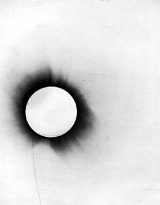
, which meant he was the first to receive a series of letters and papers from Willem de Sitter regarding Einstein’s theory of general relativity. Eddington was fortunate in being not only one of the few astronomers with the mathematical skills to understand general relativity, but also (due to his international and pacifist views) one of the few who would have been interested in pursuing a theory developed by a German physicist. He quickly became the chief supporter and expositor of relativity in Britain. He and Astronomer Royal Frank Dyson organized two expeditions to observe a solar eclipse in 1919 to make the first empirical test of Einstein’s theory: the measurement of the deflection of light by the sun's gravitational field. In fact, it was Dyson’s argument for the indispensability of Eddington’s expertise in this test that allowed him to escape prison during the war.


After the war, Eddington travelled to the island of PríncipePríncipe

Prncipe is the smaller of the two major islands of So Tom and Prncipe....
 near Africa to watch the solar eclipseSolar eclipse

A solar eclipse occurs when the Moon passes between Earth and the Sun, thereby totally or partially obscuring Earth's view o...
 of May 29 1919. During the eclipse, he took pictures of the stars in the region around the Sun. According to the theory of general relativityGeneral relativity

General relativity is the geometrical theory of gravitation published by Albert Einstein in 1915....
, stars near the Sun would appear to have been slightly shifted because their light had been curved by its gravitational field. This effect is noticeable only during an eclipse, since otherwise the Sun's brightness obscures the stars. Eddington showed that Newtonian gravitation could also be interpreted to predict half that predicted by Einstein. Somewhat confusingly, this same half-shift was predicted by Einstein with an incomplete version of general relativity.

Eddington's observations published next year (Dyson, F.W., Eddington, A.S., & Davidson, C.R. 1920 A Determination of the Deflection of Light by the Sun's Gravitational Field, from Observations Made at the Total Eclipse of May 29, 1919 Mem. R. Astron. Soc., 220, 291-333) confirmed Einstein's theory, and were hailed at the time as a conclusive proof of general relativity over the Newtonian model. The news was reported in newspapers all over the world as a major story. Afterward, Eddington embarked on a campaign to popularize relativity and the expedition as landmarks both in scientific development and international scientific relations.

It has been claimed that Eddington's observations were of poor quality and he had unjustly discounted simultaneous observations at Sobral, Brazil which appeared closer to the Newtonian model;. The quality of the 1919 results were of poor quality compared to later observations, but were sufficient to persuade contemporary astronomers. The rejection of the results from the Brazil expedition were due to a defect in the telescopes used, which, again, was completely accepted and well-understood by contemporary astronomers. The myth that Eddington's results were fraudulent is a modern invention, and there is little evidence to support it.

Throughout this period Eddington lectured on relativity, and was particularly well known for his ability to explain the concepts in lay terms as well as scientific. He collected many of these into the Mathematical Theory of Relativity in 1923, which Albert EinsteinAlbert Einstein

Albert Einstein was a German-born theoretical physicist....
 suggested was "the finest presentation of the subject in any language." He was an early apologist of Einstein's General Relativity, and an interesting anecdote well illustrates his personal intellectual investment: Ludwig Silberstein approached Eddington at the Royal SocietyRoyal Society Overview

The Royal Society of London for the Improvement of Natural Knowledge, known simply as the Royal Society, was founded i...
's (November 6) 1919 meeting wherein he had defended Einstein's Relativity with his Brazil-Principe Solar Eclipse calculations with some degree of skepticality and ruefully charged Arthur as one who claimed to be one of three men who actually understood the theory. When Eddington refrained from replying, he insisted Arthur not be "so shy", whereupon Eddington replied, "Oh, no! I was wondering who the third one might be!"

Popular and philosophical writings


During the 1920s and 30s Eddington gave innumerable lectures, interviews, and radio broadcasts on relativity (in addition to his textbook Mathematical Theory of Relativity), and later, quantum mechanics. Many of these were gathered into books, including Nature of the Physical World and New Pathways in Science. Albert EinsteinAlbert Einstein

Albert Einstein was a German-born theoretical physicist....
 called Eddington's books "the finest presentation of the subject in any language." His skillful use of literary allusions and humor helped make these famously difficult subjects quite accessible. His humor is well demonstrated by an anecdote: Ludwig Silberstein, a physicist who thought of himself as an expert on relativity, once approached Eddington saying that it had been said that Eddington was one of only three men who actually understood the theory (Silberstein of course was including himself and Einstein as the other two). Eddington refrained from replying, and Silberstein insisted that he not be "so shy", whereupon Eddington replied, "Oh, no! I was wondering who the third one might be!"

Eddington's books and lectures were immensely popular with the public, not only because of Eddington’s clear and entertaining exposition, but also for his willingness to discuss the philosophical and religious implications of the new physics. He argued for a deeply-rooted philosophical harmony between scientific investigation and religious mysticism, and also that the positivist nature of modern physics (i.e., relativity and quantum physics) provided new room for personal religious experience and free will. Unlike many other spiritual scientists, he rejected the idea that science could provide proof of religious propositions. He promoted the infinite monkey theoremInfinite monkey theorem

The infinite monkey theorem states that a monkey hitting keys at random on a typewriter keyboard for an infinite amount of t...
 in his 1928 book The Nature of the Physical World, with the phrase "If an army of monkeys were strumming on typewriters, they might write all the books in the British MuseumBritish Museum

The British Museum in London is one of the world's largest and most important museums of human history and culture....
". His popular writings made him, quite literally, a household name in Great Britain between the world wars.

Cosmology


Eddington was also heavily involved with the development of the first generation of general relativistic cosmological models. He had been investigating the instability of the Einstein universe when he learned of both Lemaitre'sFacts About Georges Lemaître

Father Georges-Henri Lematre was a Belgian Roman Catholic priest, honorary prelate, professor of physics and astronomer....
 1927 paper postulating an expanding or contracting universe and Hubble's work on the recession on the spiral nebulae. He soon became an enthusiastic supporter of an expanding universe cosmology, pointing to the nebular recession as evidence of a curved space-time. However, he never accepted the argument that an expanding universe required a beginning. He rejected what would later be known as Big BangBig Bang

In physical cosmology, the Big Bang is the scientific theory of how the universe emerged from a tremendously dense and hot s...
 cosmologies as 'too unaesthetically abrupt.' He felt the cosmical constant must have played the crucial role in the universe's evolution from an Einsteinian steady state to its current expanding state, and most of his cosmological investigations focused on the constant's significance and characteristics.

Fundamental theory

During the 1920s until his death, he increasingly concentrated on what he called "fundamental theoryTheory of everything

A theory of everything is a hypothetical theory of theoretical physics that fully explains and links together all known phy...
" which was intended to be a unification of quantum theoryQuantum mechanics

Quantum mechanics is a first quantized quantum theory that supersedes classical mechanics at the atomic and subatomic levels...
, relativityTheory of relativity

The theory of relativity, or simply relativity, refers specifically to two theories: Albert Einstein's special relativ...
 and gravitationGravitation

In physics, gravitation or gravity is the tendency of objects with mass to accelerate toward each other....
. At first he progressed along "traditional" lines, but turned increasingly to an almost numerologicalNumerology

Numerology refers to any of several systems, traditions or beliefs in a mystical or esoteric relationship between numbers an...
 analysis of the dimensionless ratios of fundamental constants.

His basic approach was to combine several fundamental constants in order to produce a dimensionless number. In many cases these would result in numbers close to 1040, its square, or its square root. He was convinced that the mass of the protonProton

In physics, the proton is a subatomic particle with an electric charge of one positive fundamental unit , a diameter of abo...
 and the charge of the electronElectron

The electron is a fundamental subatomic particle that carries an electric charge....
, were a natural and complete specification for constructing a Universe and that their values were not accidental. One of the discoverers of quantum mechanics, Paul DiracPaul Dirac

Paul Adrien Maurice Dirac, OM, FRS was a British theoretical physicist and a founder of the field of quantum physics....
, also pursued this line of investigation, which has become known as the Dirac large numbers hypothesisDirac large numbers hypothesis

The Dirac large numbers hypothesis refers to an observation made by Paul Dirac in 1937 relating ratios of size scales in the...
, and some scientists even today believe it has something to it.

A particularly damaging statement in his defence of these concepts involved the fine structure constant a. At the time it was measured to be very close to 1/136, and he argued that the value should in fact be exactly 1/136 for various reasons. Later measurements placed the value much closer to 1/137, at which point he switched his line of reasoning (arguing that the number of degrees of freedomDegrees of freedom (physics and chemistry)

Degrees of freedom is a general term used in explaining dependence on parameters, and implying the possibility of counti...
 had been miscounted) and claimed that the value should in fact be exactly 1/137, the Eddington numberEddington number

In 1938, the British astronomer Arthur Eddington hit on the idea that the fine structure constant a, which had been measured at ap...
. Wags at the time started calling him "Arthur Adding-one". At this point most other researchers stopped taking his concepts very seriously. The is estimated at 1/137.035999679(94).

Eddington believed he had discovered an algebraic basis for fundamental physics, which he termed "E-frames" (representing a particular groupGroup (mathematics) Overview

In mathematics, a group is a set together with a binary operation satisfying certain axioms, detailed below....
). While his theory has long been abandoned by the general physics community, similar algebraic notions underlie many modern attempts at a grand unified theory.

He did not complete this line of research before his death in 1944, and his book entitled Fundamental Theory was published posthumously in 1948. Eddington died in CambridgeCambridge

The city of Cambridge is an old English university town and the administrative centre of the county of Cambridgeshire....
, EnglandEngland

England is the largest and most populous constituent country of the United Kingdom....
.

Eddington number (cycling)

Eddington is credited with devising a measure of a cyclist's long distance riding achievements. The Eddington Number in this context is defined as E, the number of days a cyclist has cycled more than E miles . For example an Eddington Number of 70 would imply that a cyclist has cycled more than 70 miles in a day on 70 occasions. Achieving a high Eddington number is difficult since moving from, say, 70 to 75 will probably require more than five new long distance rides since any rides between 70 and 74 miles will no longer be included in the reckoning.

The construct of the Eddington Number for cycling is identical to the h-indexH-index

The h-index is an index suggested in 2005 by Jorge E....
 that quantifies both the actual scientific productivity and the apparent scientific impact of a scientist.

Honours

Awards
  • Bruce MedalFacts About Bruce Medal

    The Catherine Wolfe Bruce gold medal is awarded every year by the Astronomical Society of the Pacific for outstanding lifeti...
     (1924)
  • Henry Draper MedalHenry Draper Medal

    The Henry Draper Medal was established by the widow of Henry Draper, and is awarded by the US National Academy of Sciences f...
     (1924)
  • Gold Medal of the Royal Astronomical SocietyGold Medal of the Royal Astronomical Society

    The Gold Medal is the highest award of the Royal Astronomical Society....
     (1924)
  • Royal MedalRoyal Medal

    The Royal Medals of the Royal Society of London, also as The Queen's Medals, were established by King George IV....
     of the Royal SocietyRoyal Society

    The Royal Society of London for the Improvement of Natural Knowledge, known simply as the Royal Society, was founded i...
     (1928)
  • Knighted (1930)
  • Order of Merit (1938)

Named after him
  • Eddington CraterEddington (crater)

    Eddington is the lava-flooded remnant of a lunar impact crater, located on the western part of Oceanus Procellarum....
     on the MoonMoon

    The Moon is Earth's only natural satellite....
  • asteroidAsteroid

    Asteroid, minor planet, and planetoid are synonyms, and are used to indicate a diverse group of small celestial bodies that ...
     2761 Eddington2761 Eddington

    2761 Eddington is a Main-belt Asteroid discovered on January 01, 1981 by Bowell, E....
  • Royal Astronomical SocietyRoyal Astronomical Society

    The Royal Astronomical Society began as the Astronomical Society of London in 1820 to support astronomical research....
    's Eddington MedalEddington Medal Overview

    The Eddington Medal, named after Sir Arthur Eddington, is awarded by the Royal Astronomical Society nominally once every two...
  • Eddington missionEddington mission

    The Eddington mission was a European Space Agency project that would have searched for Earth-like planets by 2008....
    , now cancelled

Books by Eddington

  • 1914. Stellar Movements and the Structure of the Universe. London: Macmillan.
  • 1918. Report on the relativity theory of gravitation. London, Fleetway press, Ltd.
  • 1920. Space, Time and Gravitation: An Outline of the General Relativity Theory. Cambridge University Press. ISBN 0-521-33709-7
  • 1923, 1952. The Mathematical Theory of RelativityList of publications in physics

    Sorry, no overview for this topic
    . Cambridge University Press.
  • 1926. . Oxford: British Association.
  • 1926. The Internal Constitution of Stars. Cambridge University PressCambridge University Press

    Cambridge University Press is a publisher given a Royal Charter by Henry VIII in 1534, and one of the two privileged presses...
    . ISBN 0-521-33708-9
  • 1928. The Nature of the Physical World. MacMillan. 1935 replica edition: ISBN 0-8414-3885-4, University of Michigan 1981 edition: ISBN 0-472-06015-5 (1926–27 Gifford lecturesGifford Lectures

    The Gifford Lectures were established by the will of Adam Lord Gifford....
    )
  • 1929. Science and the Unseen World. Macmillan. ISBN 0-8495-1426-6, 2004 reprint: ISBN 1-4179-1728-8
  • 19nn. The Expanding Universe: Astronomy's 'Great Debate', 1900-1931. Cambridge University Press. ISBN 0-521-34976-1
  • 1930. Why I Believe in God: Science and Religion, as a Scientist Sees It
  • 1935. New Pathways in Science. Cambridge University Press.
  • 1936. Relativity Theory of Protons and Electrons. Cambridge Univ. Press.
  • 1939. Philosophy of Physical Science. Cambridge University Press. ISBN 0-7581-2054-0 (1938 Tarner lectures at Cambridge))
  • 1925. The Domain of Physical Science. 2005 reprint: ISBN 1-4253-5842-X
  • 1948. Fundamental Theory. Cambridge University Press.

In popular culture

Eddington will be played by actor David TennantDavid Tennant

David Tennant, the stage name of David MacDonald, is a Scottish actor, from Bathgate, West Lothian, best known as the ...
 in the upcoming television film Einstein and EddingtonEinstein and Eddington

Einstein and Eddington is an upcoming British drama television film produced by Company Pictures and the BBC, in associa...
, a co-production of the BBC and HBOHBO

network_name = HBO| network_logo = | headquarters = New York, NY...
.

See also

  • AstronomyFacts About Astronomy

    Astronomy is the science of celestial objects and phenomena that originate outside the Earth's atmosphere ....
    : Eddington limit, Chandrasekhar limitChandrasekhar limit

    The Chandrasekhar limit is the maximum mass possible for a white dwarf star supported by electron degeneracy pressure, and ...
    , Gravitational lensGravitational lens

    A gravitational lens is formed when the light from a very distant, bright source is "bent" around a massive object between...
    , Stellar nucleosynthesisStellar nucleosynthesis

    Stellar nucleosynthesis is the collective term for the nuclear reactions taking place in stars to build the nuclei of the he...
    , Timeline of stellar astronomyTimeline of stellar astronomy

    Timeline of stellar astronomy* 134 BC - Hipparchus creates the magnitude scale of stellar apparent luminosities...
    , AstronomersList of astronomers

    Famous astronomers and astrophysicists include: ...
    , AstrophysicistsList of astrophysicists

    An astrophysicist is a person who professionally studies and conducts research in astrophysics....
  • ScienceScience

    Science in the broadest sense refers to any system of knowledge attained by verifiable means....
    : Pathological scienceFacts About Pathological science

    Pathological science is a neologism that describes the process in science in which "people are tricked into false results .....
    , Fundamental physical constant, Timeline of gravitational physics and relativityTimeline of gravitational physics and relativity

    Timeline of gravitational physics and general relativity...
    , General relativityGeneral relativity

    General relativity is the geometrical theory of gravitation published by Albert Einstein in 1915....
    , Special relativitySpecial relativity

    The special theory of relativity was proposed in 1905 by Albert Einstein in his article "On the Electrodynamics of Moving Bo...
    , Luminiferous aetherLuminiferous aether

    In the late 19th century luminiferous aether was the term used to describe a medium for the propagation of light....
    , ExperimentsList of famous experiments

    The following is a list of historically important scientific experiments and observations....
    , Fundamental theory, Eddington numberEddington number

    In 1938, the British astronomer Arthur Eddington hit on the idea that the fine structure constant a, which had been measured at ap...
    , Eddington-Dirac number, Time's arrowTime's Arrow

    Time's Arrow can mean several things:...
    .
  • Organizations: Trinity College, CambridgeTrinity College, Cambridge

    Trinity College is a constituent college of the University of Cambridge in Cambridge, England....
    , Religious Society of FriendsReligious Society of Friends

    The Religious Society of Friends began in England in the 17th century by people who were dissatisfied with the existing deno...
    , Royal Astronomical SocietyRoyal Astronomical Society

    The Royal Astronomical Society began as the Astronomical Society of London in 1820 to support astronomical research....
  • Other: Georges LemaîtreGeorges Lemaître

    Father Georges-Henri Lematre was a Belgian Roman Catholic priest, honorary prelate, professor of physics and astronomer....
    , Infinite monkey theoremInfinite monkey theorem

    The infinite monkey theorem states that a monkey hitting keys at random on a typewriter keyboard for an infinite amount of t...
    , One hundred thirty-seven, NumerologyNumerology

    Numerology refers to any of several systems, traditions or beliefs in a mystical or esoteric relationship between numbers an...
    , Eddington (disambiguation), List of English peopleList of English people

    This is a partial list of English people of note and of some notable individuals born in England, alphabetically within cate...
    , List of astronomical topicsList of astronomical topics

    This page aims to list articles on Wikipedia that are related to astronomy, astrophysics and cosmology....
  • List of science and religion scholarsList of science and religion scholars

    Throughout the 20th century there has been a considerable amount of scholarship termed Science and Religion....


Obituaries