
Encyclopedia
- This article is a discussion of neutrons in general. For the specific case of a neutron found outside the nucleus, see free neutron.
| Neutron |
|---|
| Classification |
|---|
|
| |
| Properties |
|---|
| |
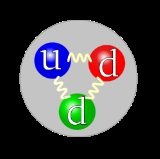
| Mass: | 1.674 927 29 × 10-27 kg | | | 939.565 560 MeV/c² | | | Radius: | about 0.8 × 10⁻¹⁵ m | | | Electric charge: | 0 C | | Spin: | ½ | | Magnetic dipole moment: | -1.91304273 µN | | Quark composition: | 2 Down, 1 Up | | | |
|
In
physics, the
neutron is a
subatomic particle with no net electric charge and a
mass of 939.573 MeV/
c² . Its spin is ½. Its
antiparticle is called the
antineutron. The neutron, along with the proton, is a nucleon.
The
nucleus of most
atoms consists of protons and neutrons. The number of neutrons determines the isotope of an element. Isotopes are atoms of the same element that have the same atomic number but different masses due to a different number of neutrons.
A neutron is classified as a
baryon, and consists of two down
quarks and one up
quark.
Stability
Outside the nucleus, free neutrons are unstable and have a mean lifetime of 885.7±0.8 seconds , decaying by emitting an
electron and
antineutrino to become a proton:s decay mode, known as
beta decay, can also occur within certain unstable nuclei. Particles inside the nucleus are typically resonances between neutrons and protons, which transform into one another by the emission and absorption of
pions.
Interactions
The neutron interacts through all four fundamental interactions: the electromagnetism,
weak nuclear, strong nuclear and
gravitational interactions.
Although the neutron has zero net charge, it may interact electromagnetically in two ways: first, the neutron has a
magnetic moment of the same order as the
proton; second, it is composed of electrically charged
quarks. Thus, the electromagnetic interaction is primarily important to the neutron in deep inelastic scattering and in
magnetic interactions.
The neutron experiences the weak interaction through
beta decay into a proton,
electron and
electron antineutrino. It experiences the gravitational force as does any energetic body; however, gravity is so weak that it may be neglected in most
particle physics experiments.
The most important force to neutrons is the strong interaction. This interaction is responsible for the binding of the neutron's three
quarks into a single particle. The residual strong force is also responsible for the binding of
nuclei: the nuclear force. The nuclear force plays the leading role when neutrons pass through matter. Unlike charged particles or photons, the neutron cannot lose energy by ionizing atoms. Rather, the neutron goes on its way unchecked until it makes a head-on collision with an atomic nucleus. For this reason, neutron radiation is extremely penetrating and dangerous.
Detection
The common means of detecting a charged particle by looking for a track of ionization does not work for neutrons directly. Neutrons that elastically scatter off atoms can create an ionization track that is detectable, but the experiments are not as simple to carry out; other means for detecting neutrons, consisting of allowing them to interact with atomic nuclei, are more commonly used.
A common method for detecting neutrons involves converting the energy released from such reactions into electrical signals. The nuclides
3He,
6Li,
10B,
233U,
235U,
237Np and
239Pu are useful for this purpose. A good discussion on neutron detection is found in chapter 14 of the book
Radiation Detection and Measurement by Glenn F. Knoll .
Uses
The neutron plays an important role in many nuclear reactions. For example, neutron capture often results in neutron activation, inducing
radioactivity. In particular, knowledge of neutrons and their behavior has been important in the development of
nuclear reactors and
nuclear weapons.
Cold, thermal and hot neutron radiation is commonly employed in neutron scattering facilities, where the radiation is used in a similar way one uses
X-rays for the analysis of condensed matter. Neutrons are complementary to the latter in terms of atomic contrasts by different scattering cross sections; sensitivity to magnetism; energy range for inelastic neutron spectroscopy; and deep penetration into matter.
The development of based on total internal reflection within hollow glass capillary tubes or by reflection from dimpled aluminum plates has driven ongoing research into and .
One use of neutron emitters is the detection of light nuclei, particularly the hydrogen found in
water molecules. When a fast neutron collides with a light nucleus, it loses a large fraction of its energy. By measuring the rate at which slow neutrons return to the probe after reflecting off of hydrogen nuclei, a neutron probe may determine the water content in soil.
Sources
Due to the fact that free neutrons are unstable, they can be obtained only from nuclear disintegrations, nuclear reactions, and high-energy reactions . Free neutron beams are obtained from neutron sources by neutron transport. For access to intense neutron sources, researchers must go to specialist facilties, such as the
ISIS facility in the
UK, which is currently the world's most intense pulsed neutron and
muon source.
Neutrons' lack of total electric charge prevents engineers or experimentalists from being able to steer or accelerate them. Charged particles can be accelerated, decelerated, or deflected by
electric or
magnetic fields. However, these methods have almost no effect on neutrons .
Discovery
In 1930
Walther Bothe and H. Becker in
Germany found that if the very energetic
alpha particles emitted from
polonium fell on certain of the light elements, specifically
beryllium,
boron, or
lithium, an unusually penetrating radiation was produced. At first this radiation was thought to be gamma radiation although it was more penetrating than any gamma rays known, and the details of experimental results were very difficult to interpret on this basis. The next important contribution was reported in 1932 by
Irène Joliot-Curie and Frédéric Joliot in
Paris. They showed that if this unknown radiation fell on paraffin or any other
hydrogen-containing compound it ejected protons of very high energy. This was not in itself inconsistent with the assumed gamma ray nature of the new radiation, but detailed quantitative analysis of the data became increasingly difficult to reconcile with such a hypothesis. Finally the physicist
James Chadwick in
England performed a series of experiments showing that the gamma ray hypothesis was untenable. He suggested that in fact the new radiation consisted of uncharged particles of approximately the mass of the
proton, and he performed a series of experiments verifying his suggestion. Such uncharged particles were eventually called
neutrons, apparently from the
Latin root for
neutral and the Greek ending
-on .
Current developments
The existence of stable clusters of four neutrons, or tetraneutrons, has been hypothesised by a team led by Francisco-Miguel Marqués at the
CNRS Laboratory for Nuclear Physics based on observations of the disintegration of
beryllium-14 nuclei. This is particularly interesting, because current theory suggests that such clusters should not be stable, and therefore should not exist.
An experiment at the
Institut Laue-Langevin has attempted to measure an electric dipole, or separation of charges, within the neutron, and is consistent with an electric dipole moment of zero. These results are important in developing theories that go beyond the
Standard Model. See , and the .
Antineutron
The antineutron is the
antiparticle of the neutron. It was discovered by Bruce Cork in the year 1956, a year after the antiproton was discovered.
CPT-symmetry puts strong constraints on the relative properties of particles and
antiparticles and, therefore, is open to stringent tests. The fractional difference in the masses of the neutron and antineutron is ×10
-5. Since the difference is only about 2 standard deviations away from zero, this does not give any convincing evidence of CPT-violation.e also
Fields concerning neutrons
Types of neutrons
Objects containing neutrons
Neutron sources
Processes involving neutrons
- neutron transport
- neutron diffraction
- neutron bomb
References