


CNO cycle

Encyclopedia
Nuclear fusion
Nuclear fusion is the process by which two or more atomic nuclei join together, or "fuse", to form a single heavier nucleus. This is usually accompanied by the release or absorption of large quantities of energy...
reactions
Nuclear reaction
In nuclear physics and nuclear chemistry, a nuclear reaction is semantically considered to be the process in which two nuclei, or else a nucleus of an atom and a subatomic particle from outside the atom, collide to produce products different from the initial particles...
by which star
Star
A star is a massive, luminous sphere of plasma held together by gravity. At the end of its lifetime, a star can also contain a proportion of degenerate matter. The nearest star to Earth is the Sun, which is the source of most of the energy on Earth...
s convert hydrogen
Hydrogen
Hydrogen is the chemical element with atomic number 1. It is represented by the symbol H. With an average atomic weight of , hydrogen is the lightest and most abundant chemical element, constituting roughly 75% of the Universe's chemical elemental mass. Stars in the main sequence are mainly...
to helium
Helium
Helium is the chemical element with atomic number 2 and an atomic weight of 4.002602, which is represented by the symbol He. It is a colorless, odorless, tasteless, non-toxic, inert, monatomic gas that heads the noble gas group in the periodic table...
, the other being the proton–proton chain. Unlike the proton–proton chain reaction, the CNO cycle is a catalytic cycle
Catalytic cycle
A catalytic cycle in chemistry is a term for a multistep reaction mechanism that involves a catalyst . The catalytic cycle is the main method for describing the role of catalysts in biochemistry, organometallic chemistry, materials science, etc. Often such cycles show the conversion of a...
. Theoretical models show that the CNO cycle is the dominant source of energy in stars more massive than about 1.3 times the mass of the sun. The proton–proton chain is more important in stars the mass of the sun or less. This difference stems from temperature dependency differences between the two reactions; pp-chain reactions start occurring at temperatures around , making it the dominant force in smaller stars. The CNO chain starts occurring at approximately , but its energy output rises much more rapidly with increasing temperatures. At approximately , the CNO cycle starts becoming the dominant source of energy. The Sun has a core temperature of around and only of nuclei being produced in the Sun are born in the CNO cycle. The CNO-I process was independently proposed by Carl von Weizsäcker
Carl Friedrich von Weizsäcker
Carl Friedrich Freiherr von Weizsäcker was a German physicist and philosopher. He was the longest-living member of the research team which performed nuclear research in Germany during the Second World War, under Werner Heisenberg's leadership...
and Hans Bethe
Hans Bethe
Hans Albrecht Bethe was a German-American nuclear physicist, and Nobel laureate in physics for his work on the theory of stellar nucleosynthesis. A versatile theoretical physicist, Bethe also made important contributions to quantum electrodynamics, nuclear physics, solid-state physics and...
in 1938 and 1939, respectively.
In the CNO cycle, four proton
Proton
The proton is a subatomic particle with the symbol or and a positive electric charge of 1 elementary charge. One or more protons are present in the nucleus of each atom, along with neutrons. The number of protons in each atom is its atomic number....
s fuse, using carbon, nitrogen and oxygen isotopes as a catalyst, to produce one alpha particle
Alpha particle
Alpha particles consist of two protons and two neutrons bound together into a particle identical to a helium nucleus, which is classically produced in the process of alpha decay, but may be produced also in other ways and given the same name...
, two positron
Positron
The positron or antielectron is the antiparticle or the antimatter counterpart of the electron. The positron has an electric charge of +1e, a spin of ½, and has the same mass as an electron...
s and two electron neutrino
Neutrino
A neutrino is an electrically neutral, weakly interacting elementary subatomic particle with a half-integer spin, chirality and a disputed but small non-zero mass. It is able to pass through ordinary matter almost unaffected...
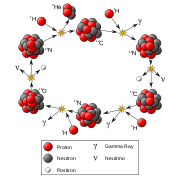
s. Although there are various paths and catalysts involved in the CNO cycles, simply speaking all these cycles have the same net result:
- 4 → + 2 + 2 + 3 + 26.8 MeV
The positrons will almost instantly annihilate
Electron-positron annihilation
Electron–positron annihilation occurs when an electron and a positron collide. The result of the collision is the annihilation of the electron and positron, and the creation of gamma ray photons or, at higher energies, other particles:...
with electrons, releasing energy in the form of gamma ray
Gamma ray
Gamma radiation, also known as gamma rays or hyphenated as gamma-rays and denoted as γ, is electromagnetic radiation of high frequency . Gamma rays are usually naturally produced on Earth by decay of high energy states in atomic nuclei...
s. The neutrinos escape from the star carrying away some energy. The carbon, nitrogen, and oxygen isotopes are in effect one nucleus that goes through a number of transformations in an endless loop.
Cold CNO Cycles =
Under typical conditions found in stellar plasmas, catalytic hydrogen burning by the CNO cycles is limited by proton captures. Specifically, the timescale for beta-decay of radioactive nuclei
Radionuclide
A radionuclide is an atom with an unstable nucleus, which is a nucleus characterized by excess energy available to be imparted either to a newly created radiation particle within the nucleus or to an atomic electron. The radionuclide, in this process, undergoes radioactive decay, and emits gamma...
produced is faster than the timescale for fusion. Because of the long timescales involved, the cold CNO cycles convert hydrogen to helium slowly, allowing them to power stars in quiescent equilibrium for very many years.
CNO-I
The first proposed catalytic cycle for the conversion of hydrogen into helium was at first simply called the carbon–nitrogen cycle (CN cycle), also honorarily referred to as the Bethe–Weizsäcker cycle, because it does not involve a stable isotope of oxygen. Bethe's original calculations suggested the CN-cycle was the Sun's primary source of energy, owing to the belief at the time that the Sun's composition is 10% nitrogen; the solar abundance of nitrogen is now known to be less than half a percent. This cycle is now recognized as the first part of the larger CNO nuclear burning network. The main reactions of the CNO-I cycle are →→→→→→:| → | 1.95 MeV | |||||||
| → | 1.20 MeV | (half-life Half-life Half-life, abbreviated t½, is the period of time it takes for the amount of a substance undergoing decay to decrease by half. The name was originally used to describe a characteristic of unstable atoms , but it may apply to any quantity which follows a set-rate decay.The original term, dating to... of 9.965 minutes) |
||||||
| → | 7.54 MeV | |||||||
| → | 7.35 MeV | |||||||
| → | 1.73 MeV | (half-life of 122.24 seconds) | ||||||
| → | 4.96 MeV |
where the Carbon-12 nucleus used in the first reaction is regenerated in the last reaction. After the two positrons emitted
Positron emission
Positron emission or beta plus decay is a type of beta decay in which a proton is converted, via the weak force, to a neutron, releasing a positron and a neutrino....
annihilate
Annihilation
Annihilation is defined as "total destruction" or "complete obliteration" of an object; having its root in the Latin nihil . A literal translation is "to make into nothing"....
with two ambient electrons producing an additional 2.04 MeV, the total energy released in one cycle is 26.73 MeV; it should be noted that in some texts, authors are erroneously including the positron annihilation energy in with the beta-decay
Beta decay
In nuclear physics, beta decay is a type of radioactive decay in which a beta particle is emitted from an atom. There are two types of beta decay: beta minus and beta plus. In the case of beta decay that produces an electron emission, it is referred to as beta minus , while in the case of a...
Q-value and then neglecting the equal amount of energy released by annihilation, leading to possible confusion. All values are calculated with reference to the Atomic Mass Evaluation 2003.
The limiting (slowest) reaction in the CNO-I cycle is the proton capture on ; it was recently experimentally measured down to stellar energies, revising the calculated age of globular clusters
Globular cluster
A globular cluster is a spherical collection of stars that orbits a galactic core as a satellite. Globular clusters are very tightly bound by gravity, which gives them their spherical shapes and relatively high stellar densities toward their centers. The name of this category of star cluster is...
by around 1 billion years.
The neutrinos
Neutrino
A neutrino is an electrically neutral, weakly interacting elementary subatomic particle with a half-integer spin, chirality and a disputed but small non-zero mass. It is able to pass through ordinary matter almost unaffected...
emitted in beta decay will have a spectrum of energy ranges, because although momentum is conserved, the momentum can be shared in any way between the positron and neutrino, with either being emitted at rest and the other taking away the full energy, or anything in between, so long as all the energy from the Q-value is used. Because the mass of the electron and neutrino are much less than the mass of the daughter nucleus, for the precision of values given here, the recoil of the nucleus can be neglected. Thus the neutrino emitted during the decay of nitrogen-13 can have an energy from zero up to 1.20 MeV, and the neutrino emitted during the decay of oxygen-15 can have an energy from zero up to 1.73 MeV. On average, about 1.7 MeV of the total energy output is taken away by neutrinos for each loop of the cycle, leaving about 25 MeV available for producing luminosity.
CNO-II
In a minor branch of the reaction, occurring in the Sun's inner part, the core, just 0.04% of the time, the final reaction shown above does not produce carbon-12 and an alpha particle, but instead produces oxygen-16 and a photon and continues →→→→→→:- {| border="0"
|- style="height:2em;"
| ||+ || ||→ || ||+ || || || ||+ ||12.13 MeV
|- style="height:2em;"
| ||+ || ||→ || ||+ || || || ||+ ||0.60 MeV
|- style="height:2em;"
| || || ||→ || ||+ || ||+ || ||+ ||2.76 MeV||(half-life of 64.49 seconds)
|- style="height:2em;"
| ||+ || ||→ || ||+ || || || ||+ ||1.19 MeV
|- style="height:2em;"
| ||+ || ||→ || ||+ || || || ||+ ||7.35 MeV
|- style="height:2em;"
| || || ||→ || ||+ || ||+ || ||+ ||2.75 MeV||(half-life of 122.24 seconds)
|}
Like the carbon, nitrogen, and oxygen involved in the main branch, the fluorine
Fluorine
Fluorine is the chemical element with atomic number 9, represented by the symbol F. It is the lightest element of the halogen column of the periodic table and has a single stable isotope, fluorine-19. At standard pressure and temperature, fluorine is a pale yellow gas composed of diatomic...
produced in the minor branch is merely catalytic and at steady state, does not accumulate in the star.
CNO-III
This subdominant branch is significant only for massive stars. The reactions are started when one of the reactions in CNO-II results in fluorine-18 and gamma instead of nitrogen-14 and alpha, and continues →→→→→→:| → | 5.61 MeV | |||||||
| → | 1.656 MeV | (half-life of 109.771 minutes) | ||||||
| → | 3.98 MeV | |||||||
| → | 12.13 MeV | |||||||
| → | 0.60 MeV | |||||||
| → | 2.76 MeV | (half-life of 64.49 seconds) |
CNO-IV
Like the CNO-III, this branch is also only significant in massive stars. The reactions are started when one of the reactions in CNO-III results in fluorine-19 and gamma instead of nitrogen-15 and alpha, and continues →→→→→→:| → | 8.114 MeV | |||||||
| → | 0.60 MeV | |||||||
| → | 2.76 MeV | (half-life of 64.49 seconds) | ||||||
| → | 5.61 MeV | |||||||
| → | 1.656 MeV | (half-life of 109.771 minutes) | ||||||
| → | 7.994 MeV | |||||||
Hot CNO Cycles =
Under conditions of higher temperature and pressure, such as those found in novae
Nova
A nova is a cataclysmic nuclear explosion in a star caused by the accretion of hydrogen on to the surface of a white dwarf star, which ignites and starts nuclear fusion in a runaway manner...
and x-ray bursts
X-ray burster
X-ray bursters are one class of X-ray binary stars exhibiting periodic and rapid increases in luminosity peaked in the X-ray regime of the electromagnetic spectrum...
, the rate of proton captures exceeds the rate of beta-decay, pushing the burning to the proton drip line
Nuclear drip line
In nuclear physics, the boundaries for nuclear particle-stability are conceptualized as drip lines. The nuclear landscape is understood by plotting boxes, each of which represents a unique nuclear species, on a graph with the number of neutrons increasing on the abscissa and number of protons...
. The essential idea is that a radioactive species will capture a proton more quickly than it can beta decay, opening new nuclear burning pathways that are otherwise inaccessible. Because of the higher temperatures involved, these catalytic cycles are typically referred the hot CNO cycles; because the timescales are limited by beta decays instead of proton captures, they are also called the beta-limited CNO cycles.
HCNO-I
The difference between the CNO-I cycle and the HCNO-I cycle is that captures a proton instead of decaying, leading to the total sequence →→→→→→:| → | 1.95 MeV | |||||||
| → | 4.63 MeV | |||||||
| → | 5.14 MeV | (half-life Half-life Half-life, abbreviated t½, is the period of time it takes for the amount of a substance undergoing decay to decrease by half. The name was originally used to describe a characteristic of unstable atoms , but it may apply to any quantity which follows a set-rate decay.The original term, dating to... of 70.641 seconds) |
||||||
| → | 7.35 MeV | |||||||
| → | 2.75 MeV | (half-life of 122.24 seconds) | ||||||
| → | 4.96 MeV |
HCNO-II
The notable difference between the CNO-II cycle and the HCNO-II cycle is that captures a proton instead of decaying, and helium is produced in a subsequent reaction on , leading to the total sequence →→→→→→:| → | 12.13 MeV | |||||||
| → | 0.60 MeV | |||||||
| → | 3.92 MeV | |||||||
| → | 4.44 MeV | (half-life of 1.672 seconds) | ||||||
| → | 2.88 MeV | |||||||
| → | 2.75 MeV | (half-life of 122.24 seconds) |
HCNO-III
An alternative to the HCNO-II cycle is that captures a proton moving towards higher mass and using the same helium production mechanism as the CNO-IV cycle as →→→→→→:| → | 6.41 MeV | |||||||
| → | 17.22 MeV | (half-life of 122.24 seconds) | ||||||
| → | 8.114 MeV | |||||||
| → | 0.60 MeV | |||||||
| → | 3.92 MeV | |||||||
| → | 4.44 MeV | (half-life of 1.672 seconds) |
Use in astronomy =
While the total number of "catalytic" CNO nuclei is conserved in the cycle, in stellar evolution
Stellar evolution
Stellar evolution is the process by which a star undergoes a sequence of radical changes during its lifetime. Depending on the mass of the star, this lifetime ranges from only a few million years to trillions of years .Stellar evolution is not studied by observing the life of a single...
the relative proportions of the nuclei are altered. When the cycle is run to equilibrium, the ratio of the carbon-12/carbon-13 nuclei is driven to 3.5, and nitrogen-14 becomes the most numerous nucleus, regardless of initial composition. During a star's evolution, convective mixing episodes bring material in which the CNO cycle has operated from the star's interior to the surface, altering the observed composition of the star. Red giant
Red giant
A red giant is a luminous giant star of low or intermediate mass in a late phase of stellar evolution. The outer atmosphere is inflated and tenuous, making the radius immense and the surface temperature low, somewhere from 5,000 K and lower...
stars are observed to have lower carbon-12/carbon-13 and carbon-12/nitrogen-14 ratios than main sequence
Main sequence
The main sequence is a continuous and distinctive band of stars that appears on plots of stellar color versus brightness. These color-magnitude plots are known as Hertzsprung–Russell diagrams after their co-developers, Ejnar Hertzsprung and Henry Norris Russell...
stars, which is considered to be convincing evidence for the operation of the CNO cycle.
The presence of the heavier elements carbon, nitrogen and oxygen places an upper bound of approximately 150 solar masses on the maximum size of massive stars. It is thought that the "metal
Metallicity
In astronomy and physical cosmology, the metallicity of an object is the proportion of its matter made up of chemical elements other than hydrogen and helium...
-poor" early universe could have had stars, called Population III stars, up to 250 solar masses without interference from the CNO cycle at the beginning of their lifetime.