
Encyclopedia
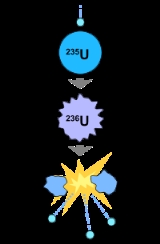
For the generation of electrical power by fission, see Nuclear power plantNuclear fission - also known as atomic fission - is a process in nuclear physics in which the
nucleus of an atom splits into two or more smaller nuclei as
fission products, and usually some by-product particles. Hence, fission is a form of elemental transmutation. The by-products include free
neutrons,
photons usually in the form
gamma rays, and other nuclear fragments such as
beta particles and
alpha particles. Fission of heavy elements is an
exothermic reaction and can release substantial amounts of useful
energy both as gamma rays and as kinetic energy of the fragments .
Nuclear fission is used to produce energy for
nuclear power and to drive explosion of
nuclear weapons. Fission is useful as a power source because some materials, called
nuclear fuels, both generate neutrons as part of the fission process and also undergo triggered fission when impacted by a free neutron. Nuclear fuels can be part of a self-sustaining chain reaction that releases energy at a controlled rate in a
nuclear reactor or at a very rapid uncontrolled rate in a
nuclear weapon.
The amount of free energy contained in nuclear fuel is millions of times the amount of free energy contained in a similar mass of chemical fuel such as
gasoline, making nuclear fission a very tempting source of energy; however, the
waste products of nuclear fission are highly
radioactive and remain so for millennia, giving rise to a
nuclear waste problem. Concerns over nuclear waste accumulation and over the immense destructive potential of nuclear weapons counterbalance the desirable qualities of fission as an energy source, and give rise to intense ongoing political debate over nuclear power.
Physical overview
- Nuclear fission differs from other forms of
radioactive decay in that it can be harnessed and controlled via a chain reaction: free
neutrons released by each fission event can trigger yet more events, which in turn release more neutrons and cause more fissions.
Chemical isotopes that can sustain a fission chain reaction are called
nuclear fuels, and are said to be fissile. The most common nuclear fuels are
235U and
239Pu . These fuels break apart into a range of chemical elements with atomic masses near 100 . Most nuclear fuels undergo spontaneous fission only very slowly, decaying mainly via an
alpha/
beta decay chain over periods of millennia to eons. In a
nuclear reactor or nuclear weapon, most fission events are induced by bombardment with another particle such as a neutron.
-
- Typical fission events release several hundred MeV of energy for each fuel atom that undergoes fission, which is why nuclear fission is used as an
energy source. By contrast, most
chemical oxidation reactions release at most a few tens of eV per event, so nuclear fuel contains at least ten million times more usable energy than does chemical fuel. The energy of nuclear fission is released as kinetic energy of the fission products and fragments, and as
electromagnetic radiation in the form of
gamma rays; in a nuclear reactor, the energy is converted to
heat as the particles and gamma rays collide with the atoms that make up the reactor and its working fluid, usually
water or occasionally heavy water.
-
- Nuclear fission of heavy elements produces energy because the specific
binding energy of intermediate-mass nuclei with atomic numbers and atomic masses close to
61Ni and
56Fe is greater than the specific binding energy of very heavy nuclei, so that energy is released when heavy nuclei are broken apart.
- The total mass of the fission products from a single reaction, after their kinetic energy has been dissipated, is less than the mass of the original fuel nucleus. The excess mass
?m is associated with the released energy which carries it away, according to Einstein's relation
E=mc², where the mass is
?m. In comparison, the specific binding energies of many lighter elements [elements 1 through approximately 12 ] are also significantly less than that of intermediate-mass nuclei, so if the lighter elements undergo
nuclear fusion , this process also releases heat energy .
-
-
-
- The variation in specific binding energy with atomic number is due to the interplay of the two fundamental forces acting on the component nucleons that make up the nucleus. Nuclei are bound by an attractive strong nuclear force between nucleons, which overcomes the
electrostatic repulsion between protons. However, the strong nuclear force acts only over extremely short ranges, since it follows a
Yukawa potential. For this reason large nuclei are less tightly bound per unit mass than small nuclei, and breaking a very large nucleus into two or more intermediate-sized nuclei releases energy. In practice, as noted, most of this energy appears as kinetic energy as the two smaller nuclei mutually repel and fly away from each other at high speed.
-
- In nuclear fission events the nuclei may break into any combination of lighter nuclei, but the most common event is not fission to equal mass nuclei of about mass 120; the most common event is a slightly unequal fission in which one daughter nucleus has a mass of about 90 to 100
u and the other the remaining 130 to 140
u . Unequal fissions are energetically more favorable because this allows one product to be closer to the energetic minimum near mass 60
u , while the other nucleus with mass 135
u is still not far out of the range of the most tightly bound nuclei .
-
-
- Because of the short range of the strong binding force, large nuclei must contain proportionally more neutrons than do light elements, which are most stable with a 1-1 ratio of protons and neutrons. Extra neutrons stabilize heavy elements because they add to strong-force binding without adding to proton-proton repulsion; however this process works better for heavier elements which have room in outer nuclear orbitals for the necessary extra neutrons. Fission products have, on average, about the same ratio of neutrons and protons as their parent nucleus, and are therefore usually unstable because they have proportionally too many neutrons compared to stable isotopes of similar mass. This is the fundamental cause of the problem of
radioactive high level waste from nuclear reactors. Fission products tend to be
beta emitters,
emitting fast-moving
electrons to conserve electric charge as excess neutrons convert to protons inside the nucleus of the fission product atoms.
-
- The most common nuclear fuels,
235U and
239Pu, are not major radiologic hazards by themselves:
235U has a half-life of approximately 700 million years, and although
239Pu has a half-life of only about 24,000 years, it is a pure
alpha particle emitter and hence not particularly dangerous unless ingested. Once a
fuel element has been used, the remaining fuel material is intimately mixed with highly radioactive fission products that emit energetic
beta particles and
gamma rays. Some fission products have half-lives as short as seconds; others have half-lives of tens of thousands of years, requiring long-term storage in facilities such as
Yucca mountain until the fission products decay into non-radioactive stable isotopes.
-
-
Spontaneous and induced fission; chain reactions
- Many heavy elements, such as
uranium,
thorium, and
plutonium, undergo both spontaneous fission, a form of
radioactive decay and
induced fission,a form of
nuclear reaction. Elemental isotopes that undergo induced fission when struck by a free
neutron are called fissionable; isotopes that undergo fission when struck by a
thermal, slow moving neutron are also called fissile. A few particularly fissile and readily obtainable isotopes are called
nuclear fuels because they can sustain a chain reaction and can be obtained in large enough quantities to be useful.
-
- All fissionable and fissile isotopes undergo a small amount of spontaneous fission which releases a few free neutrons into any sample of nuclear fuel. The neutrons typically escape rapidly from the fuel and become a free neutron, with a half-life of about 15 minutes before they decay to protons and beta rays. The neutrons usually impact and are absorbed by other nuclei in the vicinity before this happens. However, some neutrons will impact fuel nuclei and induce further fissions, releasing yet more neutrons. If enough nuclear fuel is assembled into one place, or if the escaping neutrons are sufficiently contained, then these freshly generated neutrons outnumber the neutrons that escape from the assembly, and a
sustained nuclear chain reaction will take place.
-
- An assembly that supports a sustained nuclear chain reaction is called a
critical assembly or, if the assembly is almost entirely made of a nuclear fuel, a
critical mass. The word "critical" refers to a cusp in the behavior of the
differential equation that governs the number of free neutrons present in the fuel: if less than a critical mass is present, then the amount of neutrons is determined by
radioactive decay, but if a critical mass or more is present, then the amount of neutrons is controlled instead by the physics of the chain reaction. The actual
mass of a
critical mass of nuclear fuel depends strongly on the geometry and surrounding materials.
-
- Not all fissionable isotopes can sustain a chain reaction. For example,
238U, the most abundant form of uranium, is fissionable but not fissile: it undergoes induced fission when impacted by an energetic neutron with over 1 MeV of kinetic energy. But too few of the neutrons produced by
238U fission are energetic enough to induce further fissions in
238U, so no chain reaction is possible with this isotope. Instead, bombarding
238U with slow neutrons causes it to absorb them and decay by
beta emission to
239Pu; that process is used to manufacture
239Pu in breeder reactors, but does not contribute to a neutron chain reaction.
-
- Fissionable, non-fissile isotopes can be used as fission energy source even without a chain reaction. Bombarding
238U with fast neutrons induces fissions, releasing energy as long as the external neutron source is present. That effect is used to augment the energy released by modern
thermonuclear weapons, by jacketing the weapon with
238U to react with neutrons released by
nuclear fusion at the center of the device.
-
-
Fission reactors
- Critical fission reactors are the most common type of
nuclear reactor. In a critical fission reactor, neutrons produced by fission of fuel atoms are used to induce yet more fissions, to sustain a controllable amount of energy release. Devices that produce engineered but non-self-sustaining fission reactions are
subcritical fission reactors. Such devices use
radioactive decay or
particle accelerators to trigger fissions.
-
- Critical fission reactors are built for three primary purposes, which typically involve different engineering trade-offs to take advantage of either the heat or the neutrons produced by the fission chain reaction:
- *
power reactors are intended to produce heat for nuclear power, either as part of a generating station or a local power system such as a
nuclear submarine.
- *
research reactors are intended to produce neutrons and/or activate radioactive sources for scientific, medical, engineering, or other research purposes.
- *
breeder reactors are intended to produce nuclear fuels in bulk from more abundant isotopes. The most common type makes
239Pu from the naturally very abundant
238U .
-
- While, in principle, all fission reactors can act in all three capacities, in practice the tasks lead to conflicting engineering goals and most reactors have been built with only one of the above tasks in mind. . Power reactors generally convert the kinetic energy of fission products into heat, which is used to heat a working fluid and drive a
heat engine that generates mechanical or electrical power. The working fluid is usually water with a steam turbine, but some designs use other materials such as gaseous
helium. Research reactors produce neutrons that are used in various ways, with the heat of fission being treated as an unavoidable waste product. Breeder reactors are a specialized form of research reactor, with the caveat that the sample being irradiated is usually the fuel itself, a mixture of
238U and
235U.
-
- For a more detailed description of the physics and operating principles of critical fission reactors, see nuclear reactor physics. For a description of their social, political, and environmental aspects, see
nuclear reactor.
-
-
Fission bombs
- One class of
nuclear weapon, a
fission bomb, otherwise known as an
atomic bomb or
atom bomb, is a fission reactor designed to liberate as much energy as possible as rapidly as possible, before the released energy causes the reactor to explode . Development of nuclear weapons was the motivation behind early research into nuclear fission: the
Manhattan Project of the
U.S. military during
World War Two carried out most of the early scientific work on fission chain reactions, culminating in the
Little Boy and
Fat Man bombs that were exploded over
Hiroshima and
Nagasaki,
Japan in August of 1945.
-
- Even the first fission bombs were thousands of times more
explosive than a comparable mass of
chemical explosive. For example, Little Boy weighed a total of about four tons , and yielded an explosion equivalent to about 15,000 tons of
TNT, destroying a large part of the city of
Hiroshima. Modern nuclear weapons are literally hundreds of times more energetic for their weight than the first pure fission atomic bombs, so that a modern single missile warhead bomb weighing less than 1/8th as much as Little Boy has a yield of 475,000 tons of TNT, and could bring destruction to 10 times the city area.
-
- While the fundamental physics of the fission chain reaction in a nuclear weapon is similar to the physics of a controlled nuclear reactor, the two types of device must be engineered quite differently . It would be extremely difficult to convert a
nuclear reactor to cause a true nuclear explosion , and similarly difficult to extract useful power from a nuclear explosive .
-
- The strategic importance of nuclear weapons is a major reason why the
technology of nuclear fission is politically sensitive. Viable fission bomb designs are within the capabilities of bright undergraduates , but nuclear fuel to realize the designs is thought to be difficult to obtain .
History
The results of the bombardment of uranium by neutrons had proved interesting and puzzling. First studied by
Enrico Fermi and his colleagues in 1934, they were not properly interpreted until several years later.
On January 16 1939,
Niels Bohr of
Copenhagen,
Denmark, arrived in the
United States to spend several months in
Princeton, New Jersey, and was particularly anxious to discuss some abstract problems with
Albert Einstein. Just before Bohr left Denmark, two of his colleagues,
Otto Robert Frisch and
Lise Meitner , had told him their guess that the absorption of a neutron by a uranium nucleus sometimes caused that nucleus to split into approximately equal parts with the release of enormous quantities of energy, a process that they dubbed "
nuclear fission" .
The occasion for this hypothesis was the important discovery of Otto Hahn and Fritz Strassmann in Germany which proved that an isotope of barium was produced by neutron bombardment of uranium. Bohr had promised to keep the Meitner/Frisch interpretation secret until their paper was published to preserve priority, but on the boat he discussed it with Léon Rosenfeld, but forgot to tell him to keep it secret. Rosenfeld immediately upon arrival told everyone at
Princeton University, and from them the news spread by word of mouth to neighboring physicists including
Enrico Fermi at
Columbia University. As a result of conversations among Fermi, John R. Dunning, and G. B. Pegram, a search was undertaken at Columbia for the heavy pulses of ionization that would be expected from the flying fragments of the
uranium nucleus. On January 26, 1939, there was a conference on theoretical physics at
Washington, D.C., sponsored jointly by the
George Washington University and the Carnegie Institution of Washington.
Fermi left New York to attend this meeting before the Columbia fission experiments had been tried. At the meeting Bohr and Fermi discussed the problem of fission, and in particular Fermi mentioned the possibility that neutrons might be emitted during the process. Although this was only a guess, its implication of the possibility of a
nuclear chain reaction was obvious. "Chain reactions" at that time were a known phenomenon in
chemistry, but the analogous process in nuclear physics using neutrons had been foreseen as early as 1933 by
Leo Szilard, although Szilard at that time had no idea with what materials the process might be initiated. Now, with the discovery of neutron-induced fission of heavy elements, a number of sensational articles were published in the press on the subject of nuclear chain reactions. Before the meeting in Washington was over, several other experiments to confirm fission had been initiated, and positive experimental confirmation was reported from four laboratories in the February 15 1939, issue of the Physical Review. By this time Bohr had heard that similar experiments had been made in his laboratory in Copenhagen about January 15. Frédéric Joliot in
Paris had also published his first results in the
Comptes Rendus of January 30 1939. From this time on there was a steady flow of papers on the subject of fission, so that by the time L. A. Turner of Princeton wrote a review article on the subject in the Reviews of Modern Physics nearly one hundred papers had appeared. Complete analysis and discussion of these papers have appeared in Turner's article and elsewhere.
A major focus of early fission research was on producing a controllable nuclear chain reaction, which would mark the first harnessing of nuclear power. This led to the development of Chicago Pile-1, the world's first man-made critical nuclear reactor , and then to the
Manhattan project to develop a nuclear weapon.
Producing a fission chain reaction in uranium fuel is far from trivial. Early nuclear reactors did not use isotopically enriched uranium, and in consequence they were required to use large quantities of highly purified graphite as neutron moderation materials. Use of ordinary water in nuclear reactors requires enriched fuel--- the partial separation and relative enrichment of the rare
235U isotope from the far more common
238U isotope. Typically, reactors also require inclusion of extremely chemically pure neutron moderator materials such as
deuterium ,
helium,
beryllium, or carbon, usually as the
graphite .
Production of such materials at industrial scale had to be solved for nuclear power generation and weapons production to be accomplished. Up to 1940, the total amount of uranium metal produced in the USA was not more than a few grams and even this was of doubtful purity; of metallic beryllium not more than a few kilograms; concentrated deuterium oxide not more than a few kilograms; and finally carbon had never been produced in quantity with anything like the purity required of a moderator.
The problem of producing large amounts of high purity uranium was solved by Frank Spedding using the
thermite process. Ames Laboratory was established in 1942 to produce the large amounts of natural uranium that would be necessary for the research to come. The success of the Chicago Pile-1 which used unenriched uranium, like all of the atomic "piles" which produced the plutonium for the atomic bomb, was also due specifically to Szilard's realization that very pure graphite could be used for the moderator of even natural uranium "piles". In wartime Germany, failure to appreciate the qualities of very pure graphite led to reactor designs dependent on heavy water, which in turn was denied the Germans by allied attacks in Norway, where heavy water was produced. These difficulties prevented the Nazis from building a nuclear reactor capable of criticality during the war.
Unknown until 1972, when French physicist Francis Perrin discovered the
Oklo Fossil Reactors, nature had beaten humans to the punch by engaging in large-scale uranium fission chain reactions, some 2,000 million years in the past. This ancient process was able to use normal water as a moderator, only because 2,000 million years in the past, natural uranium was "enriched" with the shorter-lived fissile isotope
235U, as compared with the natural uranium available today.
For more detail on the early development of
nuclear reactors and
nuclear weapons, see
Manhattan Project.
External links
-
-
- Historical account complete with audio and teacher's guides from the American Institute of Physics History Center
- Nuclear Fission Explained
- What is Nuclear Fission?
-
- A simple explanation of the process of nuclear fission