
All Topics  
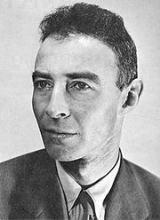
Robert Oppenheimer

 
Robert Oppenheimer

   Email Print
   Bookmark   Link


Robert Oppenheimer


Julius Robert Oppenheimer (April 22, 1904 – February 18, 1967) was an American theoretical physicist
Theoretical physics

Theoretical physics employs mathematical models and abstractions of physics in an attempt to explain experimental data taken of the natural world....
 and professor of physics
Physics

Physics is the natural science which examines basic concepts such as energy, force, and spacetime and all that derives from these, such as mass, charge, matter and its Motion ....
 at the University of California, Berkeley
University of California, Berkeley

The University of California, Berkeley is a public university research university located in Berkeley, California, California, United States. The oldest of the ten major campuses affiliated with the University of California, Berkeley offers some 300 undergraduate and graduate degree programs in a wide range of disciplines....
. He is best known for his role as the scientific director of the Manhattan Project
Manhattan Project

The Manhattan Project was the project to develop the first atomic weapon during World War II; involving the United States, the United Kingdom, and Canada....
: the World War II
World War II

World War II, or the Second World War , was a global military conflict which involved a Participants in World War II, including all of the great powers, organised into two opposing military alliances: the Allies of World War II and the Axis powers....
 effort to develop the first nuclear weapon
Nuclear weapon

A nuclear weapon is an explosive device that derives its destructive force from nuclear reactions, either nuclear fission or a combination of fission and nuclear fusion....
s at the secret Los Alamos National Laboratory
Los Alamos National Laboratory

Los Alamos National Laboratory is a United States Department of Energy United States Department of Energy National Labs, managed and operated by Los Alamos National Security, LLC , located in Los Alamos, New Mexico....
 in New Mexico
New Mexico

New Mexico is a U. S. State located in the Southwestern United States of the United States. Inhabited by Native Americans in the United States populations for many centuries, it has also has been part of the Spanish Empire viceroyalty of New Spain, part of Mexico, and a U.S....
. For this reason he is remembered as "The Father of the Atomic Bomb". In reference to the Trinity test
Trinity test

Trinity was the first Nuclear testing of technology for a nuclear weapon. It was conducted by the United States on July 16, 1945, at a location 35 miles southeast of Socorro, New Mexico, New Mexico, on what is now White Sands Missile Range, headquartered near Alamogordo, New Mexico....
 in New Mexico, where his Los Alamos team first tested the bomb, Oppenheimer famously recalled the Bhagavad Gita
Bhagavad Gita

The Bhagavad Gita is an important Sanskrit Hindu scripture. It is revered as a sacred scripture of Hinduism, and considered as one of the most important religious classics of the world....
: "If the radiance of a thousand suns were to burst at once into the sky, that would be like the splendor of the mighty one." and "Now I am become Death, the destroyer of worlds."

After the war Oppenheimer was a chief advisor to the newly created United States Atomic Energy Commission
United States Atomic Energy Commission

The United States Atomic Energy Commission was an agency of the United States government established after World War II by United States Congress to foster and control the peace time development of atomic science and technology....
 and used that position to lobby for international control
Arms control

Arms control is an umbrella term for restrictions upon the development, production, stockpiling, proliferation, and usage of weapons, especially weapons of mass destruction....
 of atomic energy
Atomic energy

Atomic energy is energy produced by atoms.*Nuclear energy, the energy resulting of potential difference of the nuclear force*Nuclear reaction, a process in which two nuclei or nuclear particles collide, to produce different products than the initial products; see also nuclear fission and nuclear fusion....
 and to avert the nuclear arms race
Nuclear arms race

The nuclear arms race was a competition for supremacy in nuclear warfare between the United States, the Soviet Union, and their respective allies during the Cold War....
 with the Soviet Union
Soviet Union

The Union of Soviet Socialist Republics was a Constitution of the Soviet Union socialist state that existed in Eurasia from 1922 to 1991.The name is a translation of the , romanization of Russian Soyuz Sovetskikh Sotsialisticheskikh Respublik, abbreviated ????, SSSR....
.


Discussion
Ask a question about 'Robert Oppenheimer'
Start a new discussion about 'Robert Oppenheimer'
Answer questions from other users
Full Discussion Forum


Quotations


I need physics more than friends.

Letter to his brother

It worked.

His exclamation after the Trinity atomic bomb test, according to his brother (1945)

In some sort of crude sense which no vulgarity, no humor, no overstatement can quite extinguish, the physicists have known sin; and this is a knowledge which they cannot lose.

Physics in the Contemporary World, lecture at M.I.T. (November 25, 1947)

It's not that I don't feel bad about it. It's just that I don't feel worse today than what I felt yesterday.

Response to question on his feelings about the atomic bombings, while visiting Japan in 1960.


Encyclopedia


Julius Robert Oppenheimer (April 22, 1904 – February 18, 1967) was an American theoretical physicist
Theoretical physics

Theoretical physics employs mathematical models and abstractions of physics in an attempt to explain experimental data taken of the natural world....
 and professor of physics
Physics

Physics is the natural science which examines basic concepts such as energy, force, and spacetime and all that derives from these, such as mass, charge, matter and its Motion ....
 at the University of California, Berkeley
University of California, Berkeley

The University of California, Berkeley is a public university research university located in Berkeley, California, California, United States. The oldest of the ten major campuses affiliated with the University of California, Berkeley offers some 300 undergraduate and graduate degree programs in a wide range of disciplines....
. He is best known for his role as the scientific director of the Manhattan Project
Manhattan Project

The Manhattan Project was the project to develop the first atomic weapon during World War II; involving the United States, the United Kingdom, and Canada....
: the World War II
World War II

World War II, or the Second World War , was a global military conflict which involved a Participants in World War II, including all of the great powers, organised into two opposing military alliances: the Allies of World War II and the Axis powers....
 effort to develop the first nuclear weapon
Nuclear weapon

A nuclear weapon is an explosive device that derives its destructive force from nuclear reactions, either nuclear fission or a combination of fission and nuclear fusion....
s at the secret Los Alamos National Laboratory
Los Alamos National Laboratory

Los Alamos National Laboratory is a United States Department of Energy United States Department of Energy National Labs, managed and operated by Los Alamos National Security, LLC , located in Los Alamos, New Mexico....
 in New Mexico
New Mexico

New Mexico is a U. S. State located in the Southwestern United States of the United States. Inhabited by Native Americans in the United States populations for many centuries, it has also has been part of the Spanish Empire viceroyalty of New Spain, part of Mexico, and a U.S....
. For this reason he is remembered as "The Father of the Atomic Bomb". In reference to the Trinity test
Trinity test

Trinity was the first Nuclear testing of technology for a nuclear weapon. It was conducted by the United States on July 16, 1945, at a location 35 miles southeast of Socorro, New Mexico, New Mexico, on what is now White Sands Missile Range, headquartered near Alamogordo, New Mexico....
 in New Mexico, where his Los Alamos team first tested the bomb, Oppenheimer famously recalled the Bhagavad Gita
Bhagavad Gita

The Bhagavad Gita is an important Sanskrit Hindu scripture. It is revered as a sacred scripture of Hinduism, and considered as one of the most important religious classics of the world....
: "If the radiance of a thousand suns were to burst at once into the sky, that would be like the splendor of the mighty one." and "Now I am become Death, the destroyer of worlds."

After the war Oppenheimer was a chief advisor to the newly created United States Atomic Energy Commission
United States Atomic Energy Commission

The United States Atomic Energy Commission was an agency of the United States government established after World War II by United States Congress to foster and control the peace time development of atomic science and technology....
 and used that position to lobby for international control
Arms control

Arms control is an umbrella term for restrictions upon the development, production, stockpiling, proliferation, and usage of weapons, especially weapons of mass destruction....
 of atomic energy
Atomic energy

Atomic energy is energy produced by atoms.*Nuclear energy, the energy resulting of potential difference of the nuclear force*Nuclear reaction, a process in which two nuclei or nuclear particles collide, to produce different products than the initial products; see also nuclear fission and nuclear fusion....
 and to avert the nuclear arms race
Nuclear arms race

The nuclear arms race was a competition for supremacy in nuclear warfare between the United States, the Soviet Union, and their respective allies during the Cold War....
 with the Soviet Union
Soviet Union

The Union of Soviet Socialist Republics was a Constitution of the Soviet Union socialist state that existed in Eurasia from 1922 to 1991.The name is a translation of the , romanization of Russian Soyuz Sovetskikh Sotsialisticheskikh Respublik, abbreviated ????, SSSR....
. After provoking the ire of many politicians with his outspoken political opinions during the Red Scare, he had his security clearance
Security clearance

For use by the United Nations, see Security Clearance A security clearance is a status granted to individuals allowing them access to classified information, e.g., state secrets....
 revoked in a much-publicized and politicized hearing in 1954. Though stripped of his direct political influence Oppenheimer continued to lecture, write, and work in physics
Physics

Physics is the natural science which examines basic concepts such as energy, force, and spacetime and all that derives from these, such as mass, charge, matter and its Motion ....
. A decade later President
President of the United States

The President of the United States is the head of state and head of government of the United States and is the highest political official in the United States by influence and recognition....
 John F. Kennedy
John F. Kennedy

John Fitzgerald "Jack" Kennedy , often referred to by his initials JFK, was the List of Presidents of the United States President of the United States, serving from 1961 until John F....
 awarded him (and President Lyndon B. Johnson
Lyndon B. Johnson

Lyndon Baines Johnson , often referred to as LBJ, was the List of Presidents of the United States President of the United States and List of Vice Presidents of the United States Vice President of the United States ....
 presented him) the Enrico Fermi Award
Enrico Fermi Award

The Enrico Fermi Award is an award honoring scientists of international stature for their lifetime achievement in the development, use, or production of energy....
 as a gesture of political rehabilitation
Political rehabilitation

Political rehabilitation is the process by which a member of a political organization or government who has fallen into disgrace is restored to public life....
.

As a scientist
Scientist

A scientist, in the broadest sense, refers to any person that engages in a system activity to acquire knowledge or an individual that engages in such practices and traditions that are linked to schools of thought or philosophy....
 Oppenheimer is remembered most for being the chief founder of the American school of theoretical physics while at the University of California, Berkeley
University of California, Berkeley

The University of California, Berkeley is a public university research university located in Berkeley, California, California, United States. The oldest of the ten major campuses affiliated with the University of California, Berkeley offers some 300 undergraduate and graduate degree programs in a wide range of disciplines....
. As director of the Institute for Advanced Study
Institute for Advanced Study

The Institute for Advanced Study, located in Princeton, New Jersey, United States, is a center for theoretical research. The Institute is perhaps best known as the academic home of Albert Einstein, John von Neumann, and Kurt G?del, after their immigration to the United States....
 he would hold Einstein's old position of Senior Professor of Theoretical Physics. Oppenheimer's notable achievements in physics include the Born-Oppenheimer approximation
Born-Oppenheimer approximation

In quantum chemistry, the computation of the energy and wavefunction of an average-size molecule is a formidable task that is alleviated by the Born-Oppenheimer approximation....
, work on electron
Electron

The electron is a subatomic particle that carries a negative electric charge. It has elementary particle and is believed to be a point particle....
-positron
Positron

The positron or antielectron is the antiparticle or the antimatter counterpart of the electron. The positron has an electric charge of +1, a spin of 1/2, and the same mass as an electron....
 theory, the Oppenheimer-Phillips process
Oppenheimer-Phillips process

The Oppenheimer-Phillips process or strip reaction is a special type of nuclear reaction.In this reaction, a nucleus reacts with the neutron of a deuterium core but the proton possible that would otherwise lack the energy to overcome the Coulomb barrier....
, quantum tunneling, relativistic
Special relativity

Special relativity is the physical theory of measurement in inertial frames of reference proposed in 1905 by Albert Einstein in the paper "Annus Mirabilis Papers#Special relativity"....
, quantum mechanics
Quantum mechanics

Quantum mechanics is a set of principles underlying the most fundamental known description of all physical systems at the microscopic scale . Notable amongst these principles are both a dual wave-like and particle-like behavior of matter and radiation, and prediction of probabilities in situations where classical physics predicts certaintie...
, quantum field theory
Quantum field theory

Quantum field theory or QFT provides a theoretical framework for constructing quantum mechanics models of systems classically described by field or of Many-body problem....
, black hole
Black hole

In general relativity, a black hole is a region of space in which the gravitational field is so powerful that nothing, including electromagnetic radiation , can escape its pull after having fallen past its event horizon....
s, and cosmic ray
Cosmic ray

Cosmic rays are energetic particles originating from space that impinge on Earth's atmosphere. Almost 90% of all the incoming cosmic ray particles are protons, about 9% are helium nuclei and about 1% are electrons ....
s.

Childhood and education


Robert Oppenheimer was born to Jewish parents: Julius S. Oppenheimer, a wealthy textile importer, who had immigrated to the United States
United States

The United States of America is a Federal government constitutional republic comprising U.S. state and a federal district. The country is situated mostly in central North America, where its Contiguous United States and Washington, D.C., the Capital districts and territories, lie between the Pacific Ocean and Atlantic Oceans, Borders of the U...
 from Germany
Germany

Germany , officially the Federal Republic of Germany , is a country in Central Europe. It is bordered to the north by the North Sea, Denmark, and the Baltic Sea; to the east by Poland and the Czech Republic; to the south by Austria and Switzerland; and to the west by France, Luxembourg, Belgium, and the Netherlands....
 in 1888; and Ella Friedman, a painter. He had one younger brother, Frank
Frank Oppenheimer

Frank Friedman Oppenheimer was an United States of America physicist who worked on the Manhattan Project, was a target of McCarthyism, and was later the founder of the Exploratorium in San Francisco....
, eight years his junior, who also became a physicist.

Oppenheimer studied at the Ethical Culture Society School
Ethical Culture Fieldston School

The Ethical Culture Fieldston School, known as Fieldston, is a private independent school in New York City and a member of the Ivy Preparatory School League....
. It was founded by Felix Adler to promote a form of ethical training based on the Ethical Culture
Ethical Culture

Ethical Culture was established by Felix Adler in 1876. The Ethical Culture Movement is an ethical, educational, and religion movement. Individual chapter organizations are generically referred to as Ethical Societies, though their names may include "Ethical Society," "Ethical Culture Society," "Society for Ethical Culture," "Et...
 movement. Informally its motto was "Deeds before creeds." At the school he studied mathematics, science, Greek, French literature, and other subjects. Oppenheimer was a versatile scholar. He was interested in the humanities, in psychotherapy
Psychotherapy

Psychotherapy is an intentional interpersonal relationship used by trained psychotherapists to aid a wiktionary:Client in problems of living. It aims to increase the individual's sense of health and reduce their subjective sense of discomfort....
, and in science. He entered Harvard College
Harvard College

Harvard College is the undergraduate section and oldest school of Harvard University, a private university in the United States founded in 1636 by the Massachusetts legislature....
 one year late because he had suffered an attack of colitis
Ulcerative colitis

Ulcerative colitis is a form of inflammatory bowel disease . Ulcerative colitis is a form of colitis, a disease of the intestine, specifically the large intestine or colon , that includes characteristic Peptic ulcer, or open sores, in the colon....
. To recuperate he went with a former English
English language

English is a West Germanic language that originated in Anglo-Saxon England and has lingua franca status in many parts of the world as a result of the military, economic, scientific, political and cultural influence of the British Empire in the 18th, 19th and early 20th centuries and that of the United States from the mid 20th century onwa...
 teacher to New Mexico
New Mexico

New Mexico is a U. S. State located in the Southwestern United States of the United States. Inhabited by Native Americans in the United States populations for many centuries, it has also has been part of the Spanish Empire viceroyalty of New Spain, part of Mexico, and a U.S....
. There he fell in love with horseback riding
Horse

The horse is a hoofed mammal, a subspecies of one of seven extant species of the family Equidae. The horse has evolution of the horse over the past 45 to 55 million years from a small multi-toed creature into the large, odd-toed ungulate animal of today....
, the mountains, and the plateau of the Southwest. At Harvard he majored in chemistry
Chemistry

Chemistry is the science concerned with the composition, structure, and properties of matter, as well as the changes it undergoes during chemical reactions....
. He also continued his studies of Greek architecture, classics, art, and literature. He made up for the delay caused by his illness by taking six courses each term and graduating summa cum laude in just three years.

In his first year as an undergraduate at Harvard, Oppenheimer was admitted to graduate standing in physics on the basis of independent study. As an undergraduate he never took a class in physics. During a course on thermodynamics
Thermodynamics

In physics, thermodynamics is the study of the conversion of heat energy into different forms of energy ; different energy conversions into heat energy; and its relation to macroscopic variables such as temperature, pressure, and volume....
 taught by Percy Bridgman
Percy Williams Bridgman

Percy Williams Bridgman was an American List of physicists who won the 1946 Nobel Prize in Physics for his work on the physics of high pressures....
 Oppenheimer found himself drawn to experimental physics. In 1933 he learned Sanskrit
Sanskrit

Sanskrit is a historical Indo-Aryan language, one of the liturgical languages of Hinduism and Buddhism, and one of the 22 official languages of India....
 and met the indologist Arthur W. Ryder at Berkeley. He read the Bhagavad Gita
Bhagavad Gita

The Bhagavad Gita is an important Sanskrit Hindu scripture. It is revered as a sacred scripture of Hinduism, and considered as one of the most important religious classics of the world....
 in the original language. Later he cited it as one of the most influential books to shape his philosophy of life.

Europe

After graduating from Harvard, Oppenheimer was encouraged to go to Europe
Europe

Europe is, conventionally, one of the world's seven continents. Comprising the westernmost peninsula of Eurasia, Europe is generally divided from Asia to its east by the water divide of the Ural Mountains, the Ural , the Caspian Sea, and by the Caucasus Mountains to the southeast....
 for future study as a world-class education in modern physics was not then available in the United States. He was accepted for postgraduate work at Ernest Rutherford
Ernest Rutherford

Ernest Rutherford, 1st Baron Rutherford of Nelson, Order of Merit , Royal Society was a New Zealand-born British chemist who became known as the father of nuclear physics....
's famed Cavendish Laboratory
Cavendish Laboratory

The Cavendish Laboratory is the University of Cambridge's Department of Physics, and is part of the university's School of Physical Sciences. It was opened in 1874 as a teaching laboratory and was initially located on the New Museums Site, Free School Lane, in the centre of Cambridge....
 at Cambridge
University of Cambridge

The University of Cambridge , located in Cambridge, England, is the List of oldest universities in continuous operation university in the Anglosphere....
 under the eminent but ageing J.J. Thomson.

Oppenheimer's clumsiness in the laboratory made it apparent that his forte was not experimental but rather theoretical physics. So he left in 1926 for the University of Göttingen to study under Max Born
Max Born

Max Born was a Germany physicist and mathematician who was instrumental in the development of quantum mechanics. He also made contributions to solid-state physics and optics and supervised the work of a number of notable physicists in the 1920s and 30s....
. Göttingen was one of the top centers for theoretical physics in the world. Oppenheimer made a number of friends who would go on to great success, such as Werner Heisenberg
Werner Heisenberg

Werner Heisenberg was a German Theoretical physics who made foundational contributions to quantum mechanics and is best known for asserting the uncertainty principle of quantum theory....
, Pascual Jordan
Pascual Jordan

Pascual Jordan was a theoretical and mathematical physicist who made significant contributions to quantum mechanics and quantum field theory. He contributed much to the mathematical form of matrix mechanics, and developed quantum field theory for fermions....
, Wolfgang Pauli
Wolfgang Pauli

Wolfgang Ernst Pauli was an Austrian theoretical physicist noted for his work on spin , and for the discovery of the Pauli exclusion principle underpinning the structure of matter and the whole of chemistry....
, Paul Dirac
Paul Dirac

Paul Adrien Maurice Dirac, Order of Merit , Royal Society was a United Kingdom theoretical physicist. Dirac made fundamental contributions to the early development of both quantum mechanics and quantum electrodynamics....
, Enrico Fermi
Enrico Fermi

Enrico Fermi was an Italian physicist most noted for his work on the development of the first nuclear reactor, and for his contributions to the development of Quantum mechanics, nuclear physics and particle physics, and statistical mechanics....
 and Edward Teller
Edward Teller

Edward Teller was a Jewish-Hungarian-American theoretical physics physicist, known colloquially as "the father of the hydrogen bomb", even though he claimed that he did not care for the title....
. At Göttingen Oppenheimer was known for being a quick student. However, he was also known for being too enthusiastic in discussions, sometimes to the point of taking over seminar sessions, a fact that irritated some of Max Born's pupils so much that they signed a petition to make Oppenheimer stay quiet during class (Born left it out on his desk where Oppenheimer could read it, and it was effective without a word needing to be said). In 1927 Oppenheimer obtained his Ph.D.
Doctor of Philosophy

Doctor of Philosophy, abbreviated Ph.D. or PhD for the Latin , meaning "teacher of philosophy", is an postgraduate academic degree awarded by University....
 at the young age of 22 at the University of Göttingen, supervised by Born. After the oral exam for his Ph.D., the professor administering it is reported to have said, "Phew, I'm glad that's over. He was on the point of questioning me." At Göttingen, Oppenheimer published more than a dozen articles, including many important contributions to the then newly-developed quantum theory
Quantum mechanics

Quantum mechanics is a set of principles underlying the most fundamental known description of all physical systems at the microscopic scale . Notable amongst these principles are both a dual wave-like and particle-like behavior of matter and radiation, and prediction of probabilities in situations where classical physics predicts certaintie...
. Most notably he and Born published a famous paper on the so-called "Born-Oppenheimer approximation
Born-Oppenheimer approximation

In quantum chemistry, the computation of the energy and wavefunction of an average-size molecule is a formidable task that is alleviated by the Born-Oppenheimer approximation....
," which separates nuclear motion from electronic motion in the mathematical treatment of molecules, an action which allows nuclear motion to be neglected in order to simplify calculations.

Early professional work

In September 1927, Oppenheimer returned to Harvard as a young maven
Maven

A maven is a trusted expert in a particular field, who seeks to pass knowledge on to others. The word maven "comes from the Yiddish, and it means one who accumulates knowledge."...
 of mathematical physics
Mathematical physics

Mathematical physics is the scientific discipline concerned with the interface of mathematics and physics. There is no real consensus about what does or does not constitute mathematical physics....
 and a National Research Council Fellow, and in early 1928 he studied at the California Institute of Technology
California Institute of Technology

The California Institute of Technology is a private university research university located in Pasadena, California, United States. Caltech maintains a strong emphasis on the natural sciences and engineering....
.

While at Caltech he received numerous invitations for teaching positions, and accepted an assistant professorship in physics at the University of California, Berkeley
University of California, Berkeley

The University of California, Berkeley is a public university research university located in Berkeley, California, California, United States. The oldest of the ten major campuses affiliated with the University of California, Berkeley offers some 300 undergraduate and graduate degree programs in a wide range of disciplines....
. In his words, "it was a desert", yet paradoxically a fertile place of opportunity. He maintained a joint appointment with Caltech, where he spent every spring term to avoid isolation from mainstream research. At Caltech, Oppenheimer struck a close friendship with Linus Pauling
Linus Pauling

Linus Carl Pauling was an United States scientist, peace activist, author and list of educators. He was one of the most influential chemists in history and ranks among the most important scientists in any field of the 20th century....
 and they planned to mount a joint attack on the nature of the chemical bond, a field in which Pauling was a pioneer—apparently Oppenheimer would supply the mathematics and Pauling would interpret the results. However, this collaboration, and their friendship, was nipped in the bud when Pauling began to suspect that the theorist was becoming too close to his wife, Ava Helen
Ava Helen Pauling

Ava Helen Pauling was an United States human rights activist and wife of Nobel Prize winner Linus Pauling. Throughout her life, she was involved in various social movements including women's rights, Desegregation, and World peace....
. Once when Pauling was at work, Oppenheimer had come to their place and blurted out an invitation to Ava Helen to join him on a tryst in Mexico
Mexico

The United Mexican States , commonly known as Mexico , is a federalism constitutionalism republic in North America. It is bordered on the north by the United States; on the south and west by the Pacific Ocean; on the southeast by Guatemala, Belize, and the Caribbean Sea; and on the east by the Gulf of Mexico....
. She flatly refused and reported this incident to Pauling. This, and her apparent nonchalance about the incident, disquieted him, and he immediately cut off his relationship with the professor. Oppenheimer later invited Pauling to be the head of the Chemistry Division of the atomic bomb project
Manhattan Project

The Manhattan Project was the project to develop the first atomic weapon during World War II; involving the United States, the United Kingdom, and Canada....
 but Pauling refused, saying that he was a pacifist
Pacifism

Pacifism is the opposition to war or violence as a means of settling disputes or gaining advantage. Pacifism covers a spectrum of views ranging from the belief that international disputes can and should be peacefully resolved; to calls for the abolition of the institutions of the military and war; to opposition to any organization of society...
.

In the autumn of 1928, Oppenheimer visited Paul Ehrenfest
Paul Ehrenfest

Paul Ehrenfest was an Austrian physicist and mathematician, who obtained Netherlands citizenship on March 24, 1922. He made major contributions to the field of statistical mechanics and its relations with quantum physics, including the theory of phase transition and the Ehrenfest theorem....
's institute at the University of Leiden, the Netherlands
Netherlands

The Netherlands is a country that is part of the Kingdom of the Netherlands. It is a parliamentary democratic constitutional monarchy. The Netherlands is located in North-West Europe, and bordered by the North Sea to the north and west, Belgium to the south, and Germany to the east....
, where he impressed those there by giving lectures in Dutch
Dutch language

Dutch is a West Germanic languages spoken by over 22 million people as a first language, and about 5 million people as a second language."1% of the EU population claims to speak Dutch well enough in order to have a conversation." Outside the European Union the number of second language speakers of Dutch is very small. Most native...
 despite having little experience with the language. There he was given the nickname of "Opje," which was later Anglicized by his students as "Oppie". From Leiden he continued on to the ETH
Eth

Eth is a Letter used in Old English language, Icelandic alphabet, Faroese language#alphabet , and Dalecarlian language. It was also used in Scandinavia during the Middle Ages, but was subsequently replaced with dh and later d....
 in Zurich to work with Wolfgang Pauli
Wolfgang Pauli

Wolfgang Ernst Pauli was an Austrian theoretical physicist noted for his work on spin , and for the discovery of the Pauli exclusion principle underpinning the structure of matter and the whole of chemistry....
 on problems relating to quantum theory and the continuous spectrum before heading back to the United States. Oppenheimer highly respected and liked Pauli, and some of his own style and his critical approach to problems was said to be inspired by Pauli. During his time with Ehrenfest and Pauli, Oppenheimer polished his mathematical skills.

Before his Berkeley professorship began, Oppenheimer was diagnosed with a mild case of tuberculosis
Tuberculosis

Tuberculosis is a common and often deadly infectious disease caused by mycobacterium, mainly Mycobacterium tuberculosis . Tuberculosis usually attacks the lungs but can also affect the central nervous system, the lymphatic system, the circulatory system, the genitourinary system, the gastrointestinal system, bones, joints, and even the...
 and, with his brother Frank
Frank Oppenheimer

Frank Friedman Oppenheimer was an United States of America physicist who worked on the Manhattan Project, was a target of McCarthyism, and was later the founder of the Exploratorium in San Francisco....
, spent some weeks at a ranch in New Mexico, which he leased and eventually purchased. When he heard the ranch was available for lease, he exclaimed, "Hot dog!"—and later on the name of the ranch became "Perro Caliente," which is the translation of "hot dog" into Spanish. Later, Oppenheimer used to say that "physics and desert country" were his "two great loves", loves that would be combined when he directed the atomic bomb project at Los Alamos in New Mexico.

He recovered from his tuberculosis and returned to Berkeley where he prospered as an advisor and collaborator to a generation of physicists who admired him for his intellectual virtuosity and broad interests. Nobel Prize
Nobel Prize in Physics

The Nobel Prize in Physics is awarded once a year by the Royal Swedish Academy of Sciences. It is one of the five Nobel Prizes established by the will of Alfred Nobel in 1895 and awarded since 1901; the others are the Nobel Prize in chemistry, Nobel Prize in literature, Nobel Peace Prize, and Nobel Prize in physiology or medicine....
 winner Hans Bethe
Hans Bethe

Hans Albrecht Bethe was a Germany-United States physicist, and Nobel laureate in Nobel Prize in Physics for his work on the theory of stellar nucleosynthesis....
 later said about him:

He also worked closely with (and became good friends with) Nobel Prize winning experimental physicist Ernest O. Lawrence and his cyclotron
Cyclotron

A cyclotron is a type of particle accelerator. Cyclotrons accelerate charged particles using a high-frequency, alternating voltage . A perpendicular magnetic field causes the particles to spiral almost in a circle so that they re-encounter the accelerating voltage many times....
 pioneers, helping the experimentalists understand the data their machines were producing at the Lawrence's Radiation Laboratory
Lawrence Berkeley National Laboratory

The Ernest Orlando Lawrence Berkeley National Laboratory , is a United States Department of Energy United States Department of Energy National Labs conducting unclassified scientific research....
.

Oppenheimer became known as a founding father of the American school of theoretical physics, and developed a reputation for his erudition in physics, his eclecticism, his quick mind, his interest in languages and Eastern philosophy, and the eloquence and clarity with which he thought. But he was also emotionally troubled throughout his life, and professed to experiencing periods of depression. "I need physics more than friends," he once informed his brother. A tall, thin chain smoker
Chain smoking

Chain smoking is the practice of lighting a new cigarette for personal consumption immediately after one that is finished, sometimes using the finished cigarette to light the next one....
 who often neglected to eat during periods of intellectual discomfort and concentration, Oppenheimer was marked by many of his friends as having a self-destructive tendency and, during numerous periods of his life, worried his colleagues and associates with his melancholy and insecurity. When he was studying in Cambridge and had taken a vacation to meet up with his friend Francis Ferguson in Paris, a disturbing event had taken place. During a conversation in which Oppenheimer was narrating his frustration with experimental physics to Ferguson, he had suddenly leapt up and tried to strangle him. Although Ferguson easily fended off the attack, the episode had convinced Ferguson of his friend's deep psychological troubles. Oppenheimer developed numerous affectations, seemingly in an attempt to convince those around him—or possibly himself—of his self-worth. He was said to be mesmerizing, hypnotic in private interaction but often frigid in more public settings. His associates fell into two camps: one that saw him as an aloof and impressive genius and an aesthete; another that saw him as a pretentious and insecure poseur. His students almost always fell into the former category, adopting "Oppie's" affectations, from his way of walking to talking and beyond—even trying to replicate his inclination for reading entire texts in their originally transcribed languages.

Oppenheimer Los Alamos Portrait

Scientific work


Oppenheimer did important research in theoretical astronomy (especially as it relates to general relativity
General relativity

General relativity or the general theory of relativity is the Geometry Theoretical physics of gravitation published by Albert Einstein in 1916....
 and nuclear theory), nuclear physics
Nuclear physics

Nuclear physics is the field of physics that studies the building blocks and interactions of atomic nuclei.The most commonly known applications of nuclear physics are nuclear power and nuclear weapons, but the research field is also the basis for a far wider range of applications, including in the medical sector , in materials engineering...
, spectroscopy
Spectroscopy

Spectroscopy was originally the study of the interaction between radiation and matter as a function of wavelength . In fact, historically, spectroscopy referred to the use of visible light dispersed according to its wavelength, e.g....
, and quantum field theory
Quantum field theory

Quantum field theory or QFT provides a theoretical framework for constructing quantum mechanics models of systems classically described by field or of Many-body problem....
  (including its extension into quantum electrodynamics
Quantum electrodynamics

Quantum electrodynamics is a relativity theory quantum field theory of electrodynamics. QED was developed by a number of physicists, beginning in the late 1920s....
). The formalism of relativistic
Special relativity

Special relativity is the physical theory of measurement in inertial frames of reference proposed in 1905 by Albert Einstein in the paper "Annus Mirabilis Papers#Special relativity"....
 quantum mechanics
Quantum mechanics

Quantum mechanics is a set of principles underlying the most fundamental known description of all physical systems at the microscopic scale . Notable amongst these principles are both a dual wave-like and particle-like behavior of matter and radiation, and prediction of probabilities in situations where classical physics predicts certaintie...
 also attracted his attention, although because of the then existing well-known problem of the self-energy
Self-energy

In theoretical physics and quantum field theory a particle's self-energy represents the contribution to the particle's energy, or effective mass, due to interactions between the particle and the system it is part of....
 of the electron, he doubted the validity of quantum electrodynamics at high energies. His best-known contribution, made as a graduate student, is the Born-Oppenheimer approximation
Born-Oppenheimer approximation

In quantum chemistry, the computation of the energy and wavefunction of an average-size molecule is a formidable task that is alleviated by the Born-Oppenheimer approximation....
 mentioned above. He also made important contributions to the theory of cosmic ray
Cosmic ray

Cosmic rays are energetic particles originating from space that impinge on Earth's atmosphere. Almost 90% of all the incoming cosmic ray particles are protons, about 9% are helium nuclei and about 1% are electrons ....
 showers and did work that eventually led toward descriptions of quantum tunneling. His work on the Oppenheimer-Phillips process
Oppenheimer-Phillips process

The Oppenheimer-Phillips process or strip reaction is a special type of nuclear reaction.In this reaction, a nucleus reacts with the neutron of a deuterium core but the proton possible that would otherwise lack the energy to overcome the Coulomb barrier....
, involved in artificial radioactivity under bombardment by deuterons, has served as an important step in nuclear physics. In the late 1930s, he, along with the help of Hartland Snyder, was the first to write papers suggesting the existence of what we today call black holes. In these papers, he demonstrated that there was a size limit (the so called Tolman-Oppenheimer-Volkoff limit
Tolman-Oppenheimer-Volkoff limit

The Tolman-Oppenheimer-Volkoff limit is an upper bound to the mass of stars composed of Degenerate_matter#Neutron_degeneracy . It is analogous to the Chandrasekhar limit for white dwarf stars....
) to stars beyond which they would not remain stable as neutron stars, and would undergo gravitational collapse. After the Born-Oppenheimer approximation paper, these papers remain his most cited ones, and they were key in the rejuvenation of astrophysical research in the United States in the 1950s, mainly by John Wheeler
John Wheeler

John Wheeler may refer to:* John Archibald Wheeler , physicist* John Wheeler , English businessman* John Wheeler , American Emmy Award-winning audio/video engineer...
. As early as 1930, he also wrote a paper essentially predicting the existence of the positron
Positron

The positron or antielectron is the antiparticle or the antimatter counterpart of the electron. The positron has an electric charge of +1, a spin of 1/2, and the same mass as an electron....
 (which had been postulated by Paul Dirac
Paul Dirac

Paul Adrien Maurice Dirac, Order of Merit , Royal Society was a United Kingdom theoretical physicist. Dirac made fundamental contributions to the early development of both quantum mechanics and quantum electrodynamics....
), a formulation that he however did not carry to its natural outcome, because of his skepticism about the validity of the Dirac equation
Dirac equation

In physics, the Dirac equation is a theory of relativity quantum mechanics wave equation formulated by British physicist Paul Dirac in 1928 and provides a description of elementary particle spin-? particles, such as electrons, consistent with both the principles of quantum mechanics and the theory of special relativity....
. As evidenced above, his work predicts many later finds, which include, further, the neutron
Neutron

The neutron is a subatomic particle with no net electric charge and a mass slightly larger than that of a proton.Neutrons are usually found in atomic nucleus....
, meson
Meson

In particle physics, mesons are subatomic particles composed of one quark and one antiquark. They are part of the hadron particle family ? particles made of quarks....
, and neutron star
Neutron star

A neutron star is a type of compact star that can result from the gravitational collapse of a massive star during a Type II supernova, Type Ib and Ic supernovae supernova event....
. He was known also to have midwifed Robert Marshak
Robert Marshak

Robert Eugene Marshak was an American physicist dedicated to learning, research, and education.Marshak was born in the Bronx, New York City. His parents, Harry Marshak and Rose Marshak, were immigrants to New York from Minsk....
's innovative 2-meson hypothesis
Hypothesis

A hypothesis consists either of a suggested explanation for an observable phenomenon or of a reasoned proposal predicting a possible causal correlation among multiple phenomena....
 which led to Cecil Frank Powell
Cecil Frank Powell

Cecil Frank Powell was a British physicist, and Nobel Prize in Physics Nobel laureates for his development of the nuclear emulsion of studying nuclear processes and for the resulting discovery of the pion , a heavy subatomic particle while working at Bristol University....
's breakthrough—and a Nobel Prize later (mentioned in the new Pulitzer Prize
Pulitzer Prize

The Pulitzer Prize is an United States award regarded as the highest national honor in newspaper journalism, literary achievements and musical composition....
 biography book, American Prometheus
American Prometheus

American Prometheus: The Triumph and Tragedy of J. Robert Oppenheimer is a biography of J. Robert Oppenheimer by Kai Bird and Martin J. Sherwin published by Alfred A....
, by Kai Bird
Kai Bird

Kai Bird is an United States Pulitzer Prize-winning author and columnist, best known for his biography of political figures.Bird was born in 1951 in Eugene, Oregon, but he spent his childhood in Jerusalem, Beirut, Dhahran, Cairo and Bombay....
 and Martin J. Sherwin
Martin J. Sherwin

Martin J. Sherwin is a Pulitzer Prize-winning United States historian. His scholarship mostly concerns the history of the development of atomic energy and nuclear proliferation....
). Even beyond the immense abstruseness of the topics he was expert in, Oppenheimer's papers were considered difficult to understand. Oppenheimer was very fond of using elegant, if extremely complex, mathematical techniques to demonstrate physical principles though he was sometimes criticized for making mathematical mistakes, presumably out of haste.

Many people thought that Oppenheimer's discoveries and research were not commensurate with his inherent abilities and talents. They still considered him an outstanding physicist, but they did not place him at the very top rank of theorists who fundamentally challenged the frontiers of knowledge. One reason for this could have been his diverse interests, which kept him from completely focusing on any individual topic for long enough to bring it to full fruition. His close confidant and colleague, Nobel Prize winner Isidor Rabi, later gave his own interpretation:

In spite of this, some people (such as the Nobel Prize winner physicist Luis Alvarez
Luis Alvarez

Luis W. Alvarez was an United States physics and inventor, who spent nearly all of his long professional career on the faculty of the University of California, Berkeley....
) have suggested that if he had lived long enough to see his predictions substantiated by experiment, Oppenheimer might have won a Nobel Prize for his work on gravitational collapse
Gravitational collapse

Gravitational collapse in astronomy is the inward fall of a massive body under the influence of the force of gravity. It occurs when all other forces fail to supply a sufficiently high pressure to counterbalance gravity and keep the massive body in hydrostatic equilibrium....
, concerning neutron stars and black holes. In retrospect, some physicists and historians consider this to be his most important contribution, though it was not taken up by other scientists in his own lifetime. Interestingly, when the physicist and historian Abraham Pais
Abraham Pais

Abraham Pais was a Netherlands-born United States physicist and science historian. Pais earned his Ph.D. from University of Utrecht just prior to a Nazi ban on Jews participation in Dutch universities during World War II....
 once asked Oppenheimer about what he considered to be his most important scientific contributions, Oppenheimer cited his work on electrons and positrons, but did not mention anything about his work on gravitational contraction.

Radical politics

During the 1920s, Oppenheimer kept aloof of worldly matters. He claimed that he only learned of the Stock Market Crash of 1929 some time after it occurred. Only when he became involved with Jean Tatlock
Jean Tatlock

Jean Frances Tatlock M.D. , was an United States psychiatrist, physician, and a member of the Communist Party. She is most noted for her romantic relationship with Manhattan Project scientific leader J....
, the daughter of a Berkeley literature professor, in 1936, did he show an interest in politics. Like many young intellectuals in the 1930s he became a supporter of social reforms which were later alleged to be communist
Communism

Communism is a socioeconomic structure and political ideology that promotes the establishment of an egalitarianism, classlessness, stateless society based on common ownership and control of the means of production and property in general....
 ideas. After inheriting over $300,000 (equivalent to about $4.3 million in 2006 dollars) upon his father's death in 1937, he donated to many progressive efforts which were later branded as "left-wing" during the McCarthy
Joseph McCarthy

Joseph Raymond McCarthy was an United States politician who served as a Republican Party United States Senate from the state of Wisconsin from 1947 until his death in 1957....
 era. The majority of his allegedly radical work consisted of hosting fundraisers for the Republican
Second Spanish Republic

The Second Spanish Republic was the system of government in Spain between April 14 1931, when King of Spain Alfonso XIII of Spain left the country following local and municipal elections in which republican candidates won the majority of votes in urban areas and April 1 1939, when the last of the Republican forces surrendered to Nationalist...
 cause in the Spanish Civil War
Spanish Civil War

The Spanish Civil War was a major conflict in Spain that started after an attempted coup d'?tat by a group of Spanish Army generals, supported by the conservative Spanish Confederation of the Autonomous Right , Carlist groups and the fascistic Falange, against the government of the Second Spanish Republic, then under the leadership of pr...
, and other anti-fascist
Fascism

Fascism is a Political radicalism, Authoritarianism Nationalism ideology that aims to create a single-party state with a government led by a dictator who seeks national unity and development by requiring individuals to subordinate self-interest to the collective interest of the nation or Race ....
 activity. He never openly joined the Communist Party
Communist Party USA

The Communist Party of the United States of America is a Marxist-Leninist political party in the United States.The CPUSA is based in New York City, its newspaper, originally The Daily Worker, is today the People's Weekly World, and its monthly magazine is Political Affairs Magazine....
, though he did pass money to liberal
Liberalism

Liberalism is a broad class of political philosophy that considers individualism liberty and equality to be the most important political goals....
 causes by way of acquaintances who were alleged to be Party members. Historian Gregg Herken claims to have evidence that Oppenheimer interacted with the Communist Party during the 1930s and early 1940s.

Many of Oppenheimer closest relations were active in the Communist Party in the 30s or 40s, including his brother Frank, Frank’s wife Jackie, Oppenheimer’s wife Kitty Oppenheimer, who was the widow of Communist Party member Joe Dallet, killed in the Spanish Civil War, his mistress, Jean Tatlock
Jean Tatlock

Jean Frances Tatlock M.D. , was an United States psychiatrist, physician, and a member of the Communist Party. She is most noted for her romantic relationship with Manhattan Project scientific leader J....
, and his landlady.

In addition, several of Oppenheimer’s graduate students at Berkeley, including Joe Weinberg, Giovanni Rossi Lomanitz
Giovanni Rossi Lomanitz

Ross Lomanitz was an United States physicist.He was born in Bryan, Texas and grew up in Oklahoma. His father was an agricultural chemist and named his son after the Italian socialist Giovanni Rossi , who had founded an agricultural commune in Brazil in the 1890s....
, David Bohm
David Bohm

David Joseph Bohm was an United States-born Quantum mechanics physicist who made significant contributions in the fields of theoretical physics, philosophy and neuropsychology, and to the Manhattan Project....
 and Philip Morrison
Philip Morrison

Philip Morrison, was Institute Professor Emeritus and Professor of Physics Emeritus at the Massachusetts Institute of Technology .Morrison grew up in Pittsburgh, Pennsylvania and graduated from its public schools....
 were Communist Party members.

Oppenheimer laughingly agreed with a security agent's quip during an interview that he [Oppenheimer] was “a member of just about every Communist Front organization on the West Coast”. However, he did not know he was being taped, nor that his words would be quoted out of context, and used as evidence against in his security hearing a decade later. He was a subscriber to the People’s World, a Communist Party organ, and he testified in 1954, “I was associated with the Communist movement.”

In 1937–42, in the midst of the Great Purge
Great Purge

Great Purge was a series of campaigns of political repression and persecution in the Soviet Union orchestrated by Joseph Stalin in 1936-1938. Also described as a "Soviet holocaust" by several authors, it involved the purge of the Communist Party of the Soviet Union, repression of kulaks, Red Army leadership, and the persecution of unaffiliat...
 and Hitler-Stalin pact, Oppenheimer was a member at Berkeley of what he called a "discussion group," which was later identified by fellow members Haakon Chevalier
Haakon Chevalier

Haakon Maurice Chevalier was an author, translator, and professor of French literature at the University of California, Berkeley best known for his friendship with physicist Robert Oppenheimer whom he met at Berkeley in 1937....
 and Gordon Griffiths as a “closed” (secret) unit of the Communist Party for Berkeley faculty. Oppenheimer was the only member of this group who was not a Communist.

The Federal Bureau of Investigation
Federal Bureau of Investigation

The Federal Bureau of Investigation is the primary unit in the United States United States Department of Justice, serving as both a Law enforcement agency body and a domestic intelligence agency....
 recorded that J. Robert Oppenheimer attended a meeting in the home of self-proclaimed Communist Haakon Chevalier
Haakon Chevalier

Haakon Maurice Chevalier was an author, translator, and professor of French literature at the University of California, Berkeley best known for his friendship with physicist Robert Oppenheimer whom he met at Berkeley in 1937....
, that Communist Party
Communist Party USA

The Communist Party of the United States of America is a Marxist-Leninist political party in the United States.The CPUSA is based in New York City, its newspaper, originally The Daily Worker, is today the People's Weekly World, and its monthly magazine is Political Affairs Magazine....
’s California state chairman William Schneiderman, and Isaac Folkoff
Isaac Folkoff

Isaac Folkoff was a senior member of the California Communist Party and West Coast liaison between Chronology of Soviet secret police agencies and the Communist Party USA ....
, West Coast liaison between the Communist Party and Soviet intelligence
NKVD

The NKVD or People's Commissariat for Internal Affairs was the leading secret police organization of the Soviet Union that was responsible for Soviet political repressions during the Stalinism era....
 attended in Fall 1940, during the Hitler-Stalin pact. Shortly thereafter, the FBI added Oppenheimer to its Custodial Detention Index
Custodial Detention Index

Custodial Detention Index was based on a massive list of US residents compiled by FBI during 1939-1941, in the frame of a program called variously "Custodial Detention" and/or "Alien Enemy Control"....
, listed as “Nationalistic Tendency: Communist.”

A 1943 FBI report summary of recent surveillance reported that Hannah Peters, organizer of the Doctor's Branch of the Professional Section of the Communist Party, told Communist Party National Committee member Steve Nelson
Steve Nelson (activist)

Stjepan MesarosSteve Nelson is an alias of Stephen Mesarosh or Stjepan Mesaros who was born in Chaglich, Croatia in 1903 - a Croat of Hungary extraction....
, the party organizer
Party organizer

A party organizer or local party organizer is a position in some political parties in charge of the establishing a party organization in a certain locality....
 for Alameda County, "that Dr. OPPIE, believed by the informant to be J. ROBERT OPPENHEIMER ... could not be active in the Party at the present time." Also, that Alameda County Communist Party Secretary Bernadette Doyle proposed that the Alameda County Communist Party confer with the State Committee of the Communist Party regarding "the two OPPIES, inasmuch as they were regularly registered [as members of the Communist Party] and everyone in the county knew they were Communists. It is believed that the two OPPIES mentioned above had reference to subject J. ROBERT OPPENHEIMER and his brother FRANK OPPENHEIMER."

In a 1944 letter to Soviet Commissar for Internal Affairs Lavrenty Beria, NKVD
NKVD

The NKVD or People's Commissariat for Internal Affairs was the leading secret police organization of the Soviet Union that was responsible for Soviet political repressions during the Stalinism era....
 chief Boris Merkulov reported:

Merkulov added:

Many debates over Oppenheimer's Party membership or lack thereof have turned on very fine points; almost all historians agree he had strong socialist sympathies during this time, and interacted with Party members, though there is considerable dispute over whether he was officially a member of the Party or not. Oppenheimer himself at his 1954 security clearance hearings denied being a member of the Communist Party, but identified himself as a fellow traveler, which he defined as someone who agrees with many of the goals of Communism, but without being willing to blindly follow orders from any Communist party apparatus.

Marriage and family life

In November 1940, Oppenheimer married Katherine ("Kitty") Puening Harrison, a radical Berkeley student and former Communist Party member. Harrison had been married three times previously. Her first marriage, to a musician with drug addiction problems, lasted for only a few months. Her second husband, Joe Dallet, was killed in the Spanish civil war and was an active member of the Communist party. She divorced her third husband, a southern California doctor, to marry Oppenheimer.

By May 1941 they had their first child, Peter. Oppenheimer joked that the 8 lb. baby, born 7 months after their marriage, should be named "Pronto." Their second child, Katherine (called Toni), was born in 1944, while Oppenheimer was scientific director of the Manhattan Project
Manhattan Project

The Manhattan Project was the project to develop the first atomic weapon during World War II; involving the United States, the United Kingdom, and Canada....
.

During his marriage, Oppenheimer continued his involvement with Jean Tatlock
Jean Tatlock

Jean Frances Tatlock M.D. , was an United States psychiatrist, physician, and a member of the Communist Party. She is most noted for her romantic relationship with Manhattan Project scientific leader J....
, though it is not clear if they continued their love affair. Later their continued contact became an issue in Oppenheimer's security clearance hearings, due to Tatlock's communist associations.

The Manhattan Project


Oppenheimer Los Alamos Mugshot
When World War II
World War II

World War II, or the Second World War , was a global military conflict which involved a Participants in World War II, including all of the great powers, organised into two opposing military alliances: the Allies of World War II and the Axis powers....
 started, Oppenheimer became involved in the efforts to develop an atomic bomb, which were already taking up much of the time and facilities of Lawrence's Radiation Laboratory
Radiation Laboratory

The Radiation Laboratory or often Rad Lab at Massachusetts Institute of Technology was in operation from October 1940 until December 31, 1945....
 at Berkeley. In 1941, Lawrence, Vannevar Bush
Vannevar Bush

Vannevar Bush was an United States engineer and science administrator known for his work on analog computer, his political role in the development of the atomic bomb, and the idea of the memex, which was seen decades later as a pioneering concept for the World Wide Web....
, Arthur Compton
Arthur Compton

Arthur Holly Compton was an American physicist and Nobel Prize in Physics in physics for his discovery of the Compton effect. He served as Chancellor of Washington University in St....
, and James Conant
James Conant

James Conant may refer to:* James Bryant Conant , American chemist and educational administrator* James F. Conant , American philosopher...
 worked to wrest the bomb project from the S-1 Uranium Committee
S-1 Uranium Committee

The S-1 Uranium Committee was a Committee of the National Defense Research Committee that superseded the Briggs Advisory Committee on Uranium and later evolved into the Manhattan Project....
, because they felt it was proceeding too slowly. Oppenheimer was invited to take over work on fast neutron calculations, a task that he threw himself into with full vigor. At this time he renounced what he called his "left-wing wanderings" to concentrate on his responsibilities, though he continued to maintain friendships with many who were quite radical.

In 1942, the U.S. Army was given jurisdiction over the bomb effort, which was renamed as the Manhattan Engineering District, or Manhattan Project
Manhattan Project

The Manhattan Project was the project to develop the first atomic weapon during World War II; involving the United States, the United Kingdom, and Canada....
. General Leslie R. Groves
Leslie Groves

Lieutenant General Leslie Richard Groves was a United States Army Engineer Officer who oversaw the construction of the Pentagon and was the primary military leader in charge of the Manhattan Project to develop the atomic bomb during World War II....
 was appointed project director, and Groves, in turn, selected Oppenheimer as the project's scientific director. Groves knew Oppenheimer would be viewed as a security risk, but thought that Oppenheimer was the best man to direct a diverse team of scientists and would be unaffected by his past political leanings.

Los Alamos

One of Oppenheimer's first acts was to host a summer school for bomb theory at his building in Berkeley. The mix of European physicists and his own students—a group including Robert Serber
Robert Serber

Robert Serber was an United states physicist who participated in the Manhattan Project.Robert Serber was born in Philadelphia. He earned his B.S....
, Emil Konopinski
Emil Konopinski

Emil John Konopinski was an United States nuclear scientist of Poland origin. His parents were Joseph and Sophia Sniegowska.He was a professor of physics at Indiana University....
, Felix Bloch
Felix Bloch

Felix Bloch was a Switzerland physicist, working mainly in the U.S....
, Hans Bethe
Hans Bethe

Hans Albrecht Bethe was a Germany-United States physicist, and Nobel laureate in Nobel Prize in Physics for his work on the theory of stellar nucleosynthesis....
, and Edward Teller
Edward Teller

Edward Teller was a Jewish-Hungarian-American theoretical physics physicist, known colloquially as "the father of the hydrogen bomb", even though he claimed that he did not care for the title....
—busied themselves calculating what needed to be done, and in what order, to make the bomb. Teller put forward the remote possibility that the bomb would generate enough heat to ignite the atmosphere. While such an event was soon shown to be impossible by Bethe, Oppenheimer nevertheless was concerned enough to meet with Arthur Compton
Arthur Compton

Arthur Holly Compton was an American physicist and Nobel Prize in Physics in physics for his discovery of the Compton effect. He served as Chancellor of Washington University in St....
 in Michigan
Michigan

Michigan is a Midwestern United States U.S. state of the United States of America. It was named after Lake Michigan, whose name is a French adaptation of the Anishinaabe language term mishigama, meaning "large water" or "large lake"....
 to discuss the situation. At the time, research for the project was going on at many different universities and laboratories across the country, presenting a problem for both security and cohesion. Oppenheimer and Groves decided that they needed a centralized, secret research laboratory. Scouting for a site in late 1942, Oppenheimer was drawn to New Mexico, not far from his ranch (the final site picked would be 40 miles from Perro Caliente). After Groves turned down a proposed site in a walled canyon, Oppenheimer suggested a site which he knew well: a flat mesa
Mesa

A mesa is an elevated area of land with a flat top and sides that are usually steep cliffs. It takes its name from its characteristic table-top shape....
 near Santa Fe
Santa Fe, New Mexico

Santa Fe is the Capital of the U.S. state of New Mexico. It is the List of cities in New Mexico and is the county seat of . Santa Fe had a population of 62,203 at the United States Census, 2000; the estimate for July 1, 2006, is 72,056....
, New Mexico
New Mexico

New Mexico is a U. S. State located in the Southwestern United States of the United States. Inhabited by Native Americans in the United States populations for many centuries, it has also has been part of the Spanish Empire viceroyalty of New Spain, part of Mexico, and a U.S....
, which was the site of a private boys' school called The Los Alamos Ranch School (Sp. Los Alamos means "The Cottonwoods"). Minutes after seeing the mesa site, Groves was convinced, and approached the owners to sell it. The Los Alamos
Los Alamos National Laboratory

Los Alamos National Laboratory is a United States Department of Energy United States Department of Energy National Labs, managed and operated by Los Alamos National Security, LLC , located in Los Alamos, New Mexico....
 laboratory was thus hastily built on the site of the school, taking over some of its buildings, but building many others in great haste. There Oppenheimer assembled a group of the top physicists of the time, which he referred to as the "luminaries." Enrico Fermi
Enrico Fermi

Enrico Fermi was an Italian physicist most noted for his work on the development of the first nuclear reactor, and for his contributions to the development of Quantum mechanics, nuclear physics and particle physics, and statistical mechanics....
, Richard Feynman
Richard Feynman

Richard Phillips Feynman was an United States physicist known for the path integral formulation of quantum mechanics, the theory of quantum electrodynamics and the physics of the superfluidity of supercooled liquid helium, as well as work in particle physics ....
 (then an unknown post-doctoral student), John von Neumann
John von Neumann

John von Neumann was a Hungarian American mathematician who made major contributions to a vast range of fields, including set theory, functional analysis, quantum mechanics, ergodic theory, continuous geometry, economics and game theory, computer science, numerical analysis, hydrodynamics , and statistics, as well as many other mathematical...
, Robert R. Wilson
Robert R. Wilson

Robert Rathbun Wilson was an American physicist who was a group leader of the Manhattan Project, a sculpture, and an architect of Fermilab , where he was also the director from 1967?1978....
, and Victor Weisskopf, as well as Bethe and Teller, were already famous or would soon become famous.

Los Alamos Colloquium
Oppenheimer at first had difficulty with organizational division of large groups, but soon rapidly learned the art of large-scale administration after he took up permanent residence on the mesa. He was noted for his mastery of all scientific aspects of the project and for his efforts to control the inevitable cultural conflicts between scientists and the military. He was an iconic figure to his fellow scientists, as much a figurehead of what they were working towards as a scientific director. Victor Weisskopf put it thus:

All the while, Oppenheimer was under investigation by both the FBI and the Manhattan Project's internal security arm for his past left-wing associations. He was also followed by Army security agents during an unannounced trip to California
California

California is a U.S. state on the West Coast of the United States of the United States, along the Pacific Ocean. It is bordered by Oregon to the north, Nevada to the east, Arizona to the southeast, and to the south the Mexico state of Baja California....
 in 1943 to meet his former girlfriend, Jean Tatlock, where he spent the night in her apartment.

The Chevalier incident

In August 1943, Oppenheimer volunteered to Manhattan Project
Manhattan Project

The Manhattan Project was the project to develop the first atomic weapon during World War II; involving the United States, the United Kingdom, and Canada....
 security agents that three men at Los Alamos
Los Alamos

Los Alamos usually refers to the Los Alamos National Laboratory in New Mexico, United States.It may also refer to:*Los Alamos, California*Los Alamos, New Mexico — the city where the laboratory is located...
 had been solicited for nuclear secrets on behalf of the Soviet Union
Soviet Union

The Union of Soviet Socialist Republics was a Constitution of the Soviet Union socialist state that existed in Eurasia from 1922 to 1991.The name is a translation of the , romanization of Russian Soyuz Sovetskikh Sotsialisticheskikh Respublik, abbreviated ????, SSSR....
, by a person he did not know who worked for Shell Oil
Shell Oil

Shell Oil can refer to one of the following:*Royal Dutch Shell, one of the world's leading energy companies, based in the Netherlands and the UK...
, and who had Communist connections. He gave that person's name: George Eltenton. However, when pressed on the issue in later interviews with General Groves, who ordered him to give the names of these men and promised to keep their identity from the FBI, he finally identified the only contact who had approached him, as his friend Haakon Chevalier
Haakon Chevalier

Haakon Maurice Chevalier was an author, translator, and professor of French literature at the University of California, Berkeley best known for his friendship with physicist Robert Oppenheimer whom he met at Berkeley in 1937....
, a Berkeley professor of French literature
French literature

French literature is, generally speaking, literature written in the French language, particularly by citizens of France; it may also refer to literature written by people living in France who speak other traditional languages of France....
 who he said had mentioned the matter privately at a dinner at Oppenheimer's house. Oppenheimer would be asked again in 1947 for interviews related to the "Chevalier incident," and he gave contradictory and equivocating statements, telling government agents that actually only one scientist had been approached at Los Alamos, and that person was himself. This was by Chevalier, who at the time had supposedly said that he had a potential conduit through Eltenton for information which could be passed to the Soviets. Oppenheimer claimed to have invented the other contacts in order to conceal the identity of Chevalier, whose identity he believed would be immediately apparent if he named only one contact, but whom he believed to be innocent of any disloyalty. General Groves during the war had thought Oppenheimer too important to the ultimate Allied goals to oust him over this suspicious behavior; he was, Groves reported, "absolutely essential to the project." However, by 1947, Oppenheimer had now told two conflicting versions of this story, had both of them taped without his knowledge and importantly was taped in a later interview as admitting to have made up a deliberate lie in this first report.

All of this would remain suppressed by the US government for another seven years. Meanwhile, Oppenheimer would continue to work for the government as an advisor on top secret nuclear weapons projects.

Trinity

The joint work of the scientists at Los Alamos resulted in the first nuclear explosion
Nuclear explosion

A nuclear explosion occurs as a result of the rapid release of energy from an intentionally high-speed nuclear reaction. The driving reaction may be nuclear fission, nuclear fusion or a multistage cascading combination of the two, though to date all fusion based weapons have used a fission device to initiate fusion, and a pure fusion weapon...
 near Alamogordo on July 16, 1945, the site of which Oppenheimer named "Trinity
Trinity test

Trinity was the first Nuclear testing of technology for a nuclear weapon. It was conducted by the United States on July 16, 1945, at a location 35 miles southeast of Socorro, New Mexico, New Mexico, on what is now White Sands Missile Range, headquartered near Alamogordo, New Mexico....
", Oppenheimer later said this name was from one of John Donne
John Donne

John Donne was an England Literature in English#Jacobean literature poet, preacher and a major representative of the metaphysical poets of the period....
's Holy Sonnets. According to the historian Gregg Herken, this naming could have been an allusion to Jean Tatlock, who had committed suicide a few months previously, and had in the 1930s introduced Oppenheimer to Donne's work. Oppenheimer later recalled that while witnessing the explosion he thought of a verse from the Hindu holy book, the Bhagavad Gita
Bhagavad Gita

The Bhagavad Gita is an important Sanskrit Hindu scripture. It is revered as a sacred scripture of Hinduism, and considered as one of the most important religious classics of the world....
: Years later he would explain that another verse had also entered his head at that time: It is the famous verse, which begins as "Kalo Asmi" and was quoted by Oppenheimer after the successful detonation of the first nuclear weapon. He translated it as "Now I am become Death, the destroyer of worlds."

Trinity Ground Zero
Oppenheimer later would be persuaded to quote again in 1965 for a television broadcast: According to his brother, at the time Oppenheimer simply exclaimed, "It worked." A contemporary account by Brigadier General Thomas Farrell
Thomas Farrell

General Thomas Francis Farrell was the Deputy Commanding General and Chief of Field Operations of the Manhattan Project, acting as executive officer to General Leslie Groves....
, who was present in the control bunker at the site with Oppenheimer, summarized his reaction as follows:

News of the successful test was rushed to President Harry S. Truman
Harry S. Truman

Harry S. Truman was the List of Presidents of the United States President of the United States . As the List of Vice Presidents of the United States Vice President of the United States, he succeeded Franklin D....
, then at the Potsdam Conference
Potsdam Conference

The Potsdam Conference was held at Cecilienhof, the home of William, German Crown Prince, in Potsdam, Germany, from July 16 to August 2, 1945....
, who authorized the atomic bombings of Hiroshima and Nagasaki
Atomic bombings of Hiroshima and Nagasaki

The atomic bombings of Hiroshima and Nagasaki were nuclear warfares near the end of World War II against the Empire of Japan by the United States at the executive order of President of the United States Harry S....
, Japan. Oppenheimer later became an important figure in the debates on the repercussions of this act.

Postwar activities

Overnight, Oppenheimer became a national spokesman for science, and emblematic of a new type of technocratic power. Nuclear physics became a powerful force as all governments of the world began to realize the strategic and political power that came with nuclear weapons and their horrific implications. Like many scientists of his generation, he felt that security from atomic bombs would come only from some form of transnational organization (such as the newly formed United Nations
United Nations

The United Nations is an international organization whose stated aims are to facilitate cooperation in international law, international security, economic development, Social change, human rights and achieving world peace....
), which could institute a program to stifle a nuclear arms race
Nuclear arms race

The nuclear arms race was a competition for supremacy in nuclear warfare between the United States, the Soviet Union, and their respective allies during the Cold War....
.

Atomic Energy Commission

After the Atomic Energy Commission
United States Atomic Energy Commission

The United States Atomic Energy Commission was an agency of the United States government established after World War II by United States Congress to foster and control the peace time development of atomic science and technology....
 (AEC) was created in 1946, as a civilian agency in control of nuclear research and weapons issues, Oppenheimer was immediately appointed as the Chairman of its General Advisory Committee (GAC) and left the directorship of Los Alamos. From this position he advised on a number of nuclear-related issues, including project funding, laboratory construction, and even international policy—though the GAC's advice was not always implemented.

As a member of the Board of Consultants to a committee appointed by President Truman to advise the United Nations Atomic Energy Commission
United Nations Atomic Energy Commission

The United Nations Atomic Energy Commission was founded on 24 January 1946 by the first resolution of the United Nations General Assembly "to deal with the problems raised by the discovery of atomic energy."...
, Oppenheimer strongly influenced the Acheson-Lilienthal Report
Acheson-Lilienthal Report

The Report on the International Control of Atomic Energy was written by a committee chaired by Dean Acheson and David Lilienthal in 1946 and is generally known as the Acheson-Lilienthal Report or Plan....
. In this report, the committee advocated creation of an international Atomic Development Authority, which would own all fissionable material, and the means of its production, such as mines and laboratories, and atomic power plants where it could be used for peaceful energy production. Bernard Baruch
Bernard Baruch

Bernard Mannes Baruch was an American financier, stock market speculator, statesman, and presidential advisor. After his success in business, he devoted his time toward advising Democratic presidents Woodrow Wilson and Franklin D....
 was appointed to translate this report into a proposal to the United Nations, resulting in the Baruch Plan
Baruch Plan

The Baruch Plan was a proposal by the United States government, written largely by Bernard Baruch but based on the Acheson-Lilienthal Report, to the United Nations Atomic Energy Commission in its first meeting in June 1946 to:...
 of 1946. The Baruch Plan introduced many additional provisions regarding enforcement, in particular requiring inspection of the USSR's uranium resources. The Baruch Plan was seen as an attempt to maintain the United States' nuclear monopoly, and was rejected by the USSR. With this, it became clear to Oppenheimer that an arms race was unavoidable, due to the mutual distrust of the U.S. and the USSR.

While still Chairman of the GAC, Oppenheimer lobbied vigorously for international arms control and funding for basic science, and attempted to influence policy away from a heated arms race. When the government questioned whether to pursue a crash program to develop an atomic weapon based on nuclear fusion
Nuclear fusion

In nuclear physics and nuclear chemistry, nuclear fusion is the process by which multiple like-charged atomic nuclei join together to form a heavier nucleus....
—the hydrogen bomb—Oppenheimer initially recommended against it, though he had been in favor of developing such a weapon in the early days of the Manhattan Project. He was motivated partly by ethical concerns, feeling that such a weapon could only be used strategically against civilian targets, resulting in millions of deaths. But he was also motivated by practical concerns; as at the time there was no workable design for a hydrogen bomb, Oppenheimer felt that resources would be better spent creating a large force of fission weapons; he and others were especially concerned about nuclear reactors being diverted away from producing plutonium to produce tritium. He was overridden by President Truman, who announced a crash program after the Soviet Union tested their first atomic bomb in 1949. Oppenheimer and other GAC opponents of the project, especially James Conant, felt personally shunned and considered retiring from the committee. They stayed on, though their views on the hydrogen bomb were well known.

In 1951, however, Edward Teller and mathematician Stanislaw Ulam developed what became known as the Teller-Ulam design
Teller-Ulam design

The Teller?Ulam design is a nuclear weapon design which is used in megaton-range thermonuclear weapons, and is more colloquially referred to as "the secret of the hydrogen bomb"....
 for a hydrogen bomb. This new design seemed technically feasible, and Oppenheimer changed his opinion about developing the weapon. As he later recalled:

Oppenheimer's critics have accused him of equivocating between 1949, when he opposed the development of the hydrogen bomb, and 1951, when he supported it. Some have made this a case for reinforcing their opinions about his moral inconsistency. Historian Priscilla McMillan has argued, however, that if Oppenheimer has been accused of being morally inconsistent, then so should Rabi and Fermi, who had also opposed the program in 1949. Most of the GAC members were against a crash hydrogen bomb development program then, and in fact, Conant, Fermi and Rabi had submitted even more strongly worded reports against it than Oppenheimer. McMillan's argument is that because the hydrogen bomb appeared to be well within reach in 1951, everybody had to assume that the Russians could also do it, and that was the main reason why they changed their stance in favor of developing it. Thus this change in opinion should not be viewed as a change in morality, but a change in opinions purely based on technical possibilities.

The first true hydrogen bomb, dubbed "Ivy Mike
Ivy Mike

Ivy Mike was the codename given to the first US test of a nuclear fusion device where a major part of the explosive yield came from fusion. It was detonated on November 1, 1952 by the United States at on Enewetak, an atoll in the Pacific Ocean, as part of Operation Ivy....
," was tested in 1952 with a yield of 10.4 megatons, more than 650 times the strength of the weapons developed by Oppenheimer during World War II.

Security hearings

In his role as a political advisor, Oppenheimer made numerous enemies. The FBI under J. Edgar Hoover
J. Edgar Hoover

John Edgar Hoover , generally known as J. Edgar Hoover, was the first Director of the Federal Bureau of Investigation of the Federal Bureau of Investigation of the United States....
 had been following his activities since before the war, when he showed Communist sympathies as a radical professor. They were willing to furnish Oppenheimer's political enemies with incriminating evidence about Communist ties. These enemies included Lewis Strauss, an AEC commissioner who had long harbored resentment against Oppenheimer both for his activity in opposing the hydrogen bomb and for his humiliation of Strauss before Congress some years earlier, regarding Strauss's opposition to the export of radioactive isotopes to other nations. Strauss and Senator Brien McMahon
Brien McMahon

Brien McMahon was born James O'Brien McMahon.McMahon was an United States lawyer and politician who served in the United States Senate from 1945 to 1952....
, author of the 1946 Atomic Energy Act, pushed President Eisenhower
Dwight D. Eisenhower

Dwight David ?Ike? Eisenhower was the List of Presidents of the United States President of the United States from 1953 until 1961 and a General of the Army in the United States Army....
 to revoke Oppenheimer's security clearance. This came following controversies about whether some of Oppenheimer's students, including David Bohm
David Bohm

David Joseph Bohm was an United States-born Quantum mechanics physicist who made significant contributions in the fields of theoretical physics, philosophy and neuropsychology, and to the Manhattan Project....
, Joseph Weinberg, and Bernard Peters, had been Communists at the time they had worked with him at Berkeley.

Robert Oppenheimer was forced to testify in front of the House Un-American Activities Committee
House Un-American Activities Committee

The House Committee on Un-American Activities was an investigative United States Congressional committee of the United States House of Representatives....
, where he admitted that he had associations with the Communist Party in the 1930s, but he refused to name members. Frank Oppenheimer
Frank Oppenheimer

Frank Friedman Oppenheimer was an United States of America physicist who worked on the Manhattan Project, was a target of McCarthyism, and was later the founder of the Exploratorium in San Francisco....
 was subsequently fired from his university position, could not find work in physics for many years, and became instead a cattle rancher in Colorado
Colorado

The State of Colorado is a U.S. state located in the Mountain States of the United States of America. Colorado may also be considered to be a part of the Western United States and Southwestern United States regions of the United States....
, and later the founder of the San Francisco Exploratorium
Exploratorium

The Exploratorium is a public science museum museum, located in the Marina District at the Palace of Fine Arts in San Francisco, California. It is one of San Francisco's most popular museums, drawing over 500,000 people each year....
.

Oppenheimer had also found himself in the middle of more than one controversy and power struggle, in the years from 1949 to 1953. Edward Teller
Edward Teller

Edward Teller was a Jewish-Hungarian-American theoretical physics physicist, known colloquially as "the father of the hydrogen bomb", even though he claimed that he did not care for the title....
, who had been so uninterested in work on the atomic bomb at Los Alamos during the war that Oppenheimer had (instead of firing him) actually given him time instead to work on his own project of the hydrogen bomb, had eventually left Los Alamos to help found, in 1951, a second laboratory at what would become the Lawrence Livermore National Laboratory
Lawrence Livermore National Laboratory

The Lawrence Livermore National Laboratory in Livermore, California is a scientific research laboratory founded by the University of California in 1952....
. There, he could be free of Los Alamos control to develop the hydrogen bomb. This laboratory would go on to develop long-range jet-bomber delivered themonuclear "strategic weapons" (city-destroyers) which would necessarily be under control of the new Air Force
Air force

An air force, also known in some countries as an air army or historically an army air corps , is in the broadest sense, the national armed force or armed service that primarily conducts aerial warfare....
. By contrast, Oppenheimer had for some years pushed for smaller "tactical" nuclear weapons which would be more useful in a limited theater against enemy troops, and which would be under control of the Army
Army

An army , in the broadest sense, is the land-based armed forces of a nation. It may also include other branches of the military such as an air force....
. As these two branches of the service fought for control of nuclear weapons, often allied with different political parties, the Air Force, with Teller pushing its program, had begun to gain ascendence in the Republican controlled government, after the election of Eisenhower in 1952.

Edward Teller (1958) Llnl
In the 1953 Executive Sessions of the “McCarthy Hearings” on Security and the United Nations (made public in 2003), Paul Crouch, Communist Party organizer for Alameda County from April 1941 to early January 1942, testified that J. Robert Oppenheimer had been a Communist at that time:

In 1953, partly as the result of evidence provided by the U.S. Army's Signals Intelligence Service, Oppenheimer was accused of being a security risk, and President Dwight D. Eisenhower
Dwight D. Eisenhower

Dwight David ?Ike? Eisenhower was the List of Presidents of the United States President of the United States from 1953 until 1961 and a General of the Army in the United States Army....
 asked him to resign. Oppenheimer refused and requested a hearing to assess his loyalty; in the meantime, his security clearance was suspended. The public hearing that followed focused on Oppenheimer's past Communist ties and his association during the Manhattan Project with suspected disloyal or Communist scientists. One of the key elements in this hearing was Oppenheimer's earliest testimony about George Eltenton's approach to various Los Alamos scientists, a story that Oppenheimer confessed he had fabricated to protect his friend Haakon Chevalier
Haakon Chevalier

Haakon Maurice Chevalier was an author, translator, and professor of French literature at the University of California, Berkeley best known for his friendship with physicist Robert Oppenheimer whom he met at Berkeley in 1937....
. (Unknown to Oppenheimer, both versions were recorded during his interrogations of a decade before, and, in a breach of standard trial procedure, which went unappealed, he was surprised on the witness stand with transcripts of these, which he had had no chance to review). In fact, Oppenheimer had never told Chevalier that he had finally named him, and the testimony had led to Chevalier losing his job. (Both Chevalier and Eltenton confirmed mentioning that they had a way to get information to the Soviets, Eltenton admitting he said this to Chevalier, and Chevalier admitting he mentioned it to Oppenheimer, but both put the matter in terms of gossip and denying any thought or suggestion of treason or thoughts of espionage, either in planning or in deed. Neither was ever convicted of any crime.)

Teller testified against Oppenheimer, saying that he considered him loyal, but of such questionable judgement that he should be relieved of clearance on the basis of bad decision-making. This led to outrage by the scientific community and Teller's virtual expulsion from academic science. General Groves, threatened by the FBI as having been potentially part of a coverup about the Chevalier contact in 1943, testified against Oppenheimer also.

Many top scientists, as well as government and military figures, testified on Oppenheimer's behalf. Inconsistencies in his testimony and his erratic behavior on the stand (at one point, saying he had given a "cock and bull story" and that this was because he "was an idiot") convinced some that he was unstable, unreliable and a possible security risk. Oppenheimer's clearance was revoked one day before it was slated to lapse anyway. Physicist I.I. Rabi's comment was that Oppenheimer was merely a government consultant at the time anyway, and that if the government "didn't want to consult the guy, then don't consult him." However, the prosecution would not settle for anything less than public humiliation of Oppenheimer.

During his hearing, Oppenheimer testified willingly on the left-wing behavior of many of his scientific colleagues. Cornell University
Cornell University

Cornell University located in Ithaca, New York, USA, is a private university with four Statutory college. Its two medical campuses are in New York City and Education City, Qatar....
 historian Richard Polenberg has speculated that if Oppenheimer's clearance had not been stripped (it would have expired in a matter of days anyhow, as he knew while testifying), he would have been remembered as someone who had "named names" to save his own reputation. As it happened, Oppenheimer was seen by most of the scientific community as a martyr
Martyr

The term martyr is most commonly used today to describe an individual who sacrifices his or her life in order to further a cause or belief for many....
 to McCarthyism
McCarthyism

McCarthyism is the politically motivated practice of making accusations of disloyalty, subversion, or treason without proper regard for evidence....
, an eclectic liberal who was unjustly attacked by warmongering enemies, symbolic of the shift of scientific creativity from academia into the military. Wernher von Braun
Wernher von Braun

Wernher Magnus Maximilian Freiherr von Braun , a Germans rocket physicist and astronautics engineer, became one of the leading figures in the development of rocket technology in Germany and the United States....
 summed up his opinion about the matter with a quip to a Congressional committee: "In England, Oppenheimer would have been knighted."

Institute for Advanced Study

Einstein Oppenheimer
In 1947, Oppenheimer left Berkeley, citing difficulties with the administration during the war, and took up the directorship of the Institute for Advanced Study
Institute for Advanced Study

The Institute for Advanced Study, located in Princeton, New Jersey, United States, is a center for theoretical research. The Institute is perhaps best known as the academic home of Albert Einstein, John von Neumann, and Kurt G?del, after their immigration to the United States....
 at Princeton
Princeton, New Jersey

Princeton, New Jersey is located in Mercer County, New Jersey, New Jersey, United States. Princeton University has been sited in the town since 1756....
, New Jersey
New Jersey

New Jersey is a state in the Mid-Atlantic States and Northeastern United States regions of the United States. It is bordered on the north by New York, on the east by the Hudson River and the Atlantic Ocean, on the southwest by Delaware, and on the west by Pennsylvania....
. He later held Albert Einstein
Albert Einstein

Albert Einstein was a Germany-born theoretical physics. He is best known for his theory of relativity and specifically mass?energy equivalence, expressed by the equation E = mc2....
's old position of senior professor of theoretical physics
Theoretical physics

Theoretical physics employs mathematical models and abstractions of physics in an attempt to explain experimental data taken of the natural world....
.

After 1953, deprived of political power, Oppenheimer continued to lecture, write, and work on physics. He toured Europe and Japan, giving talks about the history of science, the role of science in society, and the nature of the universe. On May 3, 1962 he was elected a Fellow of the Royal Society. In 1963, at the urging of many of Oppenheimer's political friends who had ascended to power, President John F. Kennedy
John F. Kennedy

John Fitzgerald "Jack" Kennedy , often referred to by his initials JFK, was the List of Presidents of the United States President of the United States, serving from 1961 until John F....
 awarded Oppenheimer the Enrico Fermi Award
Enrico Fermi Award

The Enrico Fermi Award is an award honoring scientists of international stature for their lifetime achievement in the development, use, or production of energy....
 as a gesture of political rehabilitation. Edward Teller, the winner of the previous year's award, had also recommended Oppenheimer receive it. A little over a week after Kennedy's assassination, his successor, President Lyndon Johnson, presented Oppenheimer with the award, "for contributions to theoretical physics as a teacher and originator of ideas, and for leadership of the Los Alamos Laboratory and the atomic energy program during critical years." Oppenheimer told Johnson: "I think it is just possible, Mr. President, that it has taken some charity and some courage for you to make this award today." The rehabilitation implied by the award was partly symbolic, as Oppenheimer still lacked a security clearance and could have no effect on official policy, but the award came with a $50,000 tax free stipend, and its award to Oppenheimer outraged many prominent Republicans in Congress. The late President Kennedy's widow Jacqueline, still living in the White House, made it a point to meet with Oppenheimer to tell him how much her husband had wanted him to have the medal. While still a congressman in 1959, JFK had been instrumental in voting to narrowly deny Oppenheimer's enemy Lewis Strauss, a coveted government position as Secretary of Commerce, effectively ending Strauss' political career. This was partly due to lobbying on the basis of the scientific community on behalf of Oppenheimer, as was the Fermi prize later.

In his final years, Oppenheimer continued his work at the Institute for Advanced Study, bringing together intellectuals at the height of their powers and from a variety of disciplines to solve the most pertinent questions of the age. He directed and encouraged the research of many well-known scientists, including Freeman Dyson
Freeman Dyson

Freeman John Dyson Fellow of the Royal Society is a British-born American theoretical physicist and mathematician, famous for his work in quantum field theory, solid-state physics, and nuclear engineering....
, and the duo of Yang
Chen Ning Yang

Chen-Ning Franklin Yang is a China-born United States physicist who worked on statistical mechanics and particle physics. He, together with Tsung-Dao Lee, received the 1957 Nobel prize in physics for their work on parity nonconservation of weak interaction....
 and Lee
Tsung-Dao Lee

Tsung-Dao Lee is a China-born United States physicist, well known for his work on Parity #Parity violation, Lee Model, particle physics, relativistic heavy ion physics, nontopological solitons and soliton stars....
, who won a Nobel Prize for their discovery of parity
Parity (physics)

In physics, a parity transformation is the flip in the sign of one spatial coordinate. In three dimensions, it is also commonly described by the simultaneous flip in the sign of all spatial coordinates:...
 non-conservation. He also instituted temporary memberships for scholars from the humanities, such as T. S. Eliot
T. S. Eliot

'Thomas Stearns Eliot', Order of Merit , was a poet, dramatist, and literary critic. He received the Nobel Prize in Literature in 1948. Among his most famous writings are the poems The Love Song of J....
 and George Kennan
George F. Kennan

George Frost Kennan was an American advisor, diplomat, political scientist, and historian, best known as "the father of containment" and as a key figure in the emergence of the Cold War....
. Some of these activities were resented by a few members of the mathematics faculty, who wanted the institute to stay a bastion of pure scientific research. Abraham Pais said that Oppenheimer himself thought that one of his failures at the institute was a failure to bring together scholars from the natural sciences and the humanities.

Oppenheimer's lectures in America, Europe, and Canada
Canada

Canada is a country occupying most of northern North America, extending from the Atlantic Ocean in the east to the Pacific Ocean in the west and northward into the Arctic Ocean....
 were published in a number of books. Still, he thought the effort had little effect on actual policy.

Final years

Oppenheimer Beach
After the 1954 security hearings, Oppenheimer started to retreat to a simpler life. In 1957, he purchased a piece of land on Gibney Beach in the island of St John in the Virgin Islands
Virgin Islands

The Virgin Islands are an archipelago, part of the Leeward Islands in the Caribbean Sea. The Leeward Islands are the northern islands of the Lesser Antilles, where the Caribbean Sea meets the western Atlantic Ocean....
. He built a spartan holiday home on the beach, where he would spend holidays, usually months at a time, with his wife Kitty. Oppenheimer also spent a considerable amount of time sailing with his wife.

Increasingly concerned about the potential danger to humanity arising from scientific discoveries, Oppenheimer joined with Albert Einstein
Albert Einstein

Albert Einstein was a Germany-born theoretical physics. He is best known for his theory of relativity and specifically mass?energy equivalence, expressed by the equation E = mc2....
, Bertrand Russell
Bertrand Russell

Bertrand Arthur William Russell, 3rd Earl Russell, Order of Merit , Fellow of the Royal Society , was a British people philosopher, mathematical logic, mathematician, historian, advocate for social reform, and pacifism....
, Joseph Rotblat
Joseph Rotblat

Sir Joseph Rotblat, Order of St Michael and St George, Order of the British Empire, Fellow of the Royal Society, was a Poland-born and United Kingdom-naturalised physicist....
 and other eminent scientists and academics to establish what would eventually become the World Academy of Art and Science
World Academy of Art and Science

The World Academy of Art and Science is an international non-governmental scientific organization, an informal and non-official world network of individual fellows elected for distinguished accomplishments in the fields of natural and social sciences, arts and the humanities....
 in 1960. Significantly, however, after his public humiliation, Oppenheimer did not sign the major open protests against nuclear weapons of the 1950s, including the Russell-Einstein Manifesto
Russell-Einstein Manifesto

The Russell-Einstein Manifesto was issued in London on July 9, 1955 by Bertrand Russell in the midst of the Cold War. It highlighted the dangers posed by nuclear weapons and called for world leaders to seek peaceful resolutions to international conflict....
 of 1955. He also did not attend the first Pugwash Conferences on Science and World Affairs
Pugwash Conferences on Science and World Affairs

The Pugwash Conferences on Science and World Affairs is an international organization that brings together scholars and public figures to work toward reducing the danger of armed conflict and to seek solutions to global security threats....
 in 1957, though invited. However, in his speeches and public writings, Oppenheimer continually stressed the difficulty of managing the power of knowledge in a world in which the freedom of science to exchange ideas was more and more hobbled by political concerns.

A chain smoker since early adulthood, Robert Oppenheimer was diagnosed with throat cancer
Head and neck cancer

The term head and neck cancer refers to a group of biologically similar cancers originating from the upper aerodigestive tract, including the lip, oral cavity , nasal cavity, paranasal sinuses, pharynx, and larynx....
 in late 1965, and after inconclusive surgery, underwent radiation treatment by cobalt gamma rays and high energy electrons, then finally chemotherapy
Chemotherapy

Chemotherapy, in its most general sense, refers to treatment of disease by chemicals that kill cells, specifically those of micro-organisms or cancer....
 late in 1966. These were not curative, and the tumour spread to his palate, affecting his swallowing, hearing, and breathing. He died at his home in Princeton, New Jersey
Princeton, New Jersey

Princeton, New Jersey is located in Mercer County, New Jersey, New Jersey, United States. Princeton University has been sited in the town since 1756....
, USA in February 1967, at age 62. His funeral was attended by many of his scientific, political, and military associates, and eulogies were delivered by Hans Bethe and George F. Kennan among others. He was cremated and his wife placed his ashes in an urn and dropped them into the sea, within sight of the coast at the location of his beach house.

Upon the death of Mrs. Oppenheimer (Kitty died of an intestinal infection complicated by pulmonary embolism in October 1972), Oppenheimer's ranch in New Mexico
New Mexico

New Mexico is a U. S. State located in the Southwestern United States of the United States. Inhabited by Native Americans in the United States populations for many centuries, it has also has been part of the Spanish Empire viceroyalty of New Spain, part of Mexico, and a U.S....
 was inherited by his son Peter, while the beach property in St. John was inherited by their daughter Toni. Toni, who had been refused security clearance for her chosen vocation as a U.N. translator, committed suicide by hanging in the beach house in St. John in January 1977, and left it in her will to "the people of St. John for a public park and recreation area." The original house, built too close to the coast, succumbed to a hurricane, but today, the Virgin Islands Government maintains a Community Center in the area, which can be rented. The northern portion of the beach is colloquially known to this day as "Oppenheimer Beach".

Legacy


As a scientist, Oppenheimer is remembered by his students and colleagues as being a brilliant researcher and engaging teacher, the founder of modern theoretical physics in the United States. Many have asked why Oppenheimer never won a Nobel Prize
Nobel Prize

The Nobel Prize , established in the 1895 will of Swedish chemist Alfred Nobel; it was first awarded in Nobel Prize in Physics, Nobel Prize in Chemistry, Nobel Prize in Physiology or Medicine, Nobel Prize in Literature, and Nobel Peace Prize in 1901....
. Scholars respond that his scientific attentions often changed rapidly and he never worked long enough on any one topic to achieve enough headway to merit the Nobel Prize. His lack of a Prize would not be odd (many great scientists never won Nobel Prizes) had not so many of his associates (Einstein, Fermi, Bethe, Lawrence, Dirac, Rabi, Feynman, etc.) won them. Some scientists and historians have speculated that his investigations towards black holes may have warranted the Nobel, had he lived long enough to see them brought into fruition by later astrophysicists.

Groves Oppenheimer
As a military and public policy advisor, Oppenheimer was a technocratic
Technocracy (bureaucratic)

Technocracy is a form of government in which engineers, scientists, and other technical experts are in control. Technocracy is a governmental or organizational system where decision makers are selected based upon how highly knowledgeable they are, rather than how much political capital they hold....
 leader in a shift in the interactions between science and the military and the emergence of "Big Science
Big Science

Big Science is a term used by scientists and history of science and technology to describe a series of changes in science which occurred in Industry nations during and after World War II, as scientific progress increasingly came to rely on large-scale projects usually funded by national governments or groups of governments....
." During World War II, scientists became involved in military research to an unprecedented degree (some research of this sort had occurred during World War I
World War I

World War I, or the First World War , was a global military conflict which involved the Great powers, organized into two opposing military alliances: the Allies of World War I and the Central Powers....
, but it was far smaller in scope). Because of the threat fascism
Fascism

Fascism is a Political radicalism, Authoritarianism Nationalism ideology that aims to create a single-party state with a government led by a dictator who seeks national unity and development by requiring individuals to subordinate self-interest to the collective interest of the nation or Race ....
 posed to Western civilization, scientists volunteered in great numbers both for technological and organizational assistance to the Allied effort, resulting in such powerful tools as radar
Radar

Radar is a system that uses electromagnetic radiation waves to identify the range, altitude, direction, or speed of both moving and fixed objects such as aircraft, ships, motor vehicles, weather formations, and terrain....
, the proximity fuse, and operations research
Operations research

Operations Research in the USA, South Africa and Australia, and Operational Research in Europe and Canada, is an interdisciplinary branch of applied mathematics and formal science that uses methods such as mathematical modeling, statistics, and algorithms to arrive at optimal or near optimal solutions to complex problems....
. As a cultured, intellectual, theoretical physicist who became a disciplined military organizer, Oppenheimer represented the shift away from the idea that scientists had their "head in the clouds" and that knowledge on such previously esoteric subjects as the composition of the atomic nucleus had no "real-world" applications.

When Oppenheimer was ejected from his position of political influence in 1954, he symbolized for many the folly of scientists thinking they could control how others would use their research. Oppenheimer has been seen as symbolizing the dilemmas involving the moral responsibility of the scientist in the nuclear world.

Most popular depictions of Oppenheimer view his security struggles as a confrontation between right-wing militarists (symbolized by Edward Teller) and left-wing intellectuals (symbolized by Oppenheimer) over the moral question of weapons of mass destruction. Many historians have contested this as an oversimplification. The hearings were motivated both by politics, as Oppenheimer was seen as a representative of the previous administration, and also by personal considerations stemming from his enmity with Lewis Strauss. Furthermore, the ostensible reason for the hearing and the issue that aligned Oppenheimer with the liberal intellectuals, Oppenheimer's opposition to hydrogen bomb development, was based as much on technical grounds as on moral ones. Once the technical considerations were resolved, he supported "the Super" because he believed that the Soviet Union too would inevitably construct one. Nevertheless, the trope of Oppenheimer as a martyr has proven indelible, and to speak of Oppenheimer has often been to speak of the limits of science and politics; however, more complicated is the actual history.

One particular example of the view of Oppenheimer as martyr is found in German
Germany

Germany , officially the Federal Republic of Germany , is a country in Central Europe. It is bordered to the north by the North Sea, Denmark, and the Baltic Sea; to the east by Poland and the Czech Republic; to the south by Austria and Switzerland; and to the west by France, Luxembourg, Belgium, and the Netherlands....
 playwright Heinar Kipphardt's 1964 play, In the Matter J. Robert Oppenheimer. Even Oppenheimer himself had difficulty with this portrayal—after reading a transcript of Kipphardt's play soon after it began to be performed, Oppenheimer threatened to sue the playwright. Later he told an interviewer:

Despite Oppenheimer's remorseful, or at least conflicted, attitudes, Oppenheimer was a vocal supporter of using the first atomic weapons on "built-up areas" in the days before the bombings of Hiroshima and Nagasaki. Rather than consistently opposing the "Red-baiting" of the late 1940s and early 1950s, he had testified against many of his former colleagues and students, both before and during his hearing. In one incident, Oppenheimer's damning testimony against former student Bernard Peters was selectively leaked to the press. Historians have interpreted this as an attempt by Oppenheimer to please his colleagues in the government (and perhaps to divert attention from his own previous left-wing ties and especially from those of his brother, who had earlier been a target of the anti-Red lobby). In the end it became a liability: under cross-examination, it became clear that if Oppenheimer had really doubted Peters' loyalty, then his recommending him for the Manhattan Project was reckless, or at least contradictory.

The question of the scientists' responsibility towards humanity, so manifest in the dropping of the atomic bombs and Oppenheimer's public questioning, in addition to Kipphardt's play, inspired Bertolt Brecht
Bertolt Brecht

was a Germany poet, playwright, and theatre director. An influential theatre practitioner of the Twentieth-century theatre, Brecht made equally significant contributions to dramaturgy and Theatre, the latter particularly through the seismic impact of the tours undertaken by the Berliner Ensemble?the post-war theatre company operated by Brec...
's drama Galileo (from 1955), left its imprint on Friedrich Dürrenmatt
Friedrich Dürrenmatt

Friedrich D?rrenmatt was a Switzerland German literature and theater. He was a proponent of epic theater whose plays reflected the recent experiences of World War II....
's Die Physiker
Die Physiker

The Physicists is a Satire drama often recognized as the most impressive yet most easily understood work of the Switzerland writer Friedrich D?rrenmatt....
, and is the basis of the opera Doctor Atomic
Doctor Atomic

Doctor Atomic is an opera by the contemporary minimalist American composer John Coolidge Adams, with libretto by Peter Sellars. It premiered at the San Francisco Opera on October 1, 2005....
 by John Adams (2005), which was commissioned to portray Oppenheimer as a modern Faust
Faust

Faust or Faustus is the protagonist of a classic German folklore who makes a pact with the Devil in exchange for knowledge. Faust's tale is the basis for many literary, artistic, cinematic, and musical works, such as those by Christopher Marlowe, Johann Wolfgang von Goethe, Thomas Mann, Hector Berlioz, Franz Liszt, Charles Gounod, Gu...
.

In addition to his use by authors of fiction, Oppenheimer's life has been explored in numerous biographies. Notable recent titles include American Prometheus: The Triumph and Tragedy of J. Robert Oppenheimer, by Kai Bird and Martin J. Sherwin
Martin J. Sherwin

Martin J. Sherwin is a Pulitzer Prize-winning United States historian. His scholarship mostly concerns the history of the development of atomic energy and nuclear proliferation....
 (2005), and J. Robert Oppenheimer: And the American Century by David Cassidy
David Cassidy

David Bruce Cassidy is an United States prolific character actor of stage, singer and guitarist. He is best known for his role as Shirley Jones's eldest son, Keith Partridge, in the 1970s Musical film/sitcom The Partridge Family from 1970 to 1974 He enjoyed a successful pop career in the 1970s, and still performs today....
. The 1980 BBC miniseries Oppenheimer
Oppenheimer (TV miniseries)

Oppenheimer is a television miniseries about J. Robert Oppenheimer, produced by the British Broadcasting Corporation. It began broadcast in the United Kingdom on 29 October 1980 and in the United States on 11 May 1982....
, won three BAFTA Television Awards and was nominated for Golden Globe
Golden Globe Award

The Golden Globe Awards are presented annually by the Hollywood Foreign Press Association to recognize outstanding achievements in the entertainment industry, both domestic and foreign, and to focus wide public attention upon the best in film and television program....
 and Emmy Awards.

Works

  • Science and the Common Understanding (New York: Simon and Schuster, 1954).
  • The Open Mind (New York: Simon and Schuster, 1955).
  • The flying trapeze: Three crises for physicists (London: Oxford University Press, 1964).
  • Uncommon sense (Cambridge, MA: Birkhäuser Boston, 1984). (posthumous)
  • Atom and void: Essays on science and community (Princeton, NJ: Princeton University Press, 1989). (posthumous)


See also

  • History of nuclear weapons
    History of nuclear weapons

    The history of nuclear weapons chronicles the development of nuclear weapons. Nuclear weapons are devices that possess enormous destructive potential derived from nuclear fission or nuclear fusion reactions....
  • Soviet atomic bomb project
    Soviet atomic bomb project

    The Soviet project to develop an atomic bomb began during World War II in the Soviet Union. The USSR tested its first nuclear weapon in 1949....
  • German nuclear energy project
    German nuclear energy project

    The German nuclear energy project in Nazi Germany was informally known as the Uranverein and it began in April 1939, just months after the discovery of nuclear fission in January 1939....


Further reading

  • Thorpe, Charles. Oppenheimer: The Tragic Intellect (University Of Chicago Press, 2006) ISBN 0-226-79845-3
  • Cassidy, David C. J. Robert Oppenheimer and the American Century (New York: Pi Press, 2005). ISBN 0-13-147996-2
  • Davis, Nuel Pharr. Lawrence and Oppenheimer (New York: Simon and Schuster, 1968).
  • Goodchild, Peter. J. Robert Oppenheimer Shatterer of Worlds (Fromm International Publishing Company, 1985). ISBN 0-88064-021-9
  • Hijiya, James A. "The Gita of Robert Oppenheimer" Proceedings of the American Philosophical Society, 144:2 (June 2000). (on Oppenheimer's famous quote)
  • Michelmore, Peter. The Swift Years: The Robert Oppenheimer Story (Dodd Mead, 1969) ISBN 0-396-06024-2
  • Romerstein, Herbert and Eric Breindel, The Venona Secrets, Regnery Publishing, Inc., 2000
  • Rummel, Jack. Robert Oppenheimer: Dark Prince (New York: Facts on File, 1992). ISBN 0-8160-2598-3
  • Schweber, S.S. In the Shadow of the Bomb: Oppenheimer, Bethe, and the Moral Responsibility of the Scientist, (Princeton: Princeton University Press, 2000). ISBN 0-691-04989-0
  • Schweber, S.S. "J. Robert Oppenheimer: Proteus Unbound", Science in Context 16 (1/2), 219–242, 2003 (, Retrieved on 2007-03-13)
  • U.S. Atomic Energy Commission, In the Matter of J. Robert Oppenheimer (Washington, D.C.: 1954).
  • York, Herbert. The Advisors: Oppenheimer, Teller, and the Superbomb (Stanford: Stanford University Press, 1976).
  • McMillan, Priscilla. The Ruin of J. Robert Oppenheimer: And the Birth of the Modern Arms Race (Viking Adult, July 2005; Penguin, March 2006)


External links

  • contains a full list of Oppenheimer's scientific publications.
  • Talk at UC Berkeley, November 6, 1946 (online audio file)
  • Powers, Thomas, "" New York Review of Books, September 2005. Review of several revisionist histories of the struggles to develop the atomic and hydrogen bombs, and Oppenheimer's role therein.
  • (video file, "Now I am become death, destroyer of worlds.")
  • , notes and documents on the question (still in historical debate) by the historian Gregg Herken
  • , David Martin, January 25, 2009
  • at Find A Grave
    Find A Grave

    Find A Grave is a website providing access and input to an online database of cemetery records....
  • Two collections of digitized materials related to Oppenheimer's connection to Linus Pauling
    Linus Pauling

    Linus Carl Pauling was an United States scientist, peace activist, author and list of educators. He was one of the most influential chemists in history and ranks among the most important scientists in any field of the 20th century....
    , research and .