
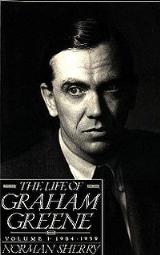
Henry Graham Greene OMThe Order of Merit
is an order recognizing distinguished service in the armed forces, science, art, literature, or for the promotion of culture...
,
CHThe Order of the Companions of Honour is an order of the Commonwealth realms. It was founded by King George V in June 1917, as a reward for outstanding achievements in the arts, literature, music, science, politics, industry, or religion....
(2 October 1904 – 3 April 1991) was an
EnglishEngland is a country that is part of the United Kingdom. It shares land borders with Scotland to the north and Wales to the west; the Irish Sea is to the north west, the Celtic Sea to the south west and the North Sea to the east, with the English Channel to the south separating it from continental...
authorAn author is defined both as "the person who originates or gives existence to anything" and that authorship determines responsibility for what is created...
,
playwrightA playwright, also known as a dramatist, is a person who writes dramatic literature or drama. These works are usually written to be performed in front of a live audience by actors...
and literary critic. His works explore the
ambivalentAmbivalence is a state of having simultaneous, conflicting feelings toward a person or thing. Stated another way, ambivalence is the experience of having thoughts and emotions of both positive and negative valence toward someone or something. A common example of ambivalence is the feeling of both...
moralMorality has three principal meanings.In its first, descriptive usage, morality means a code of conduct or belief concerning matters of what is moral or immoral...
and
politicalPolitics is a process by which groups of people make decisions. The term is generally applied to behavior within civil governments, but politics has been observed in all human group interactions, including corporate, academic and religious institutions...
issues of the modern world. Greene was notable for his ability to combine serious literary acclaim with widespread popularity.
Although Greene objected strongly to being described as a Catholic novelist rather than as a novelist who happened to be Catholic, Catholic
religiousA religion is a system of human thought which usually includes a set of narratives, symbols, beliefs and practices that give meaning to the practitioner's experiences of life through reference to a higher power, deity or deities, or ultimate truth...
themesA broad idea, message, or lesson that is conveyed by a work. The message may be about life, society, or human nature. Themes often explore timeless and universal ideas and may be implied rather than stated explicitly...
are at the root of much of his writing, especially the four major Catholic
novelsA novel is a long narrative in literary prose. The genre has historical roots both in the fields of the medieval and early modern romance and in the tradition of the novella. The latter supplied the present generic term in the late 18th century....
:
Brighton Rock,
The Power and the GloryThe Power and the Glory is a novel by British author Graham Greene. The title is an allusion to the doxology often added to the end of the Lord's Prayer: "For thine is the kingdom, the power, and the glory, now and forever , amen." This novel has also been published under the name The...
,
The Heart of the MatterThe Heart of the Matter is a novel by British author Graham Greene. It was the winner in 1948 of the James Tait Black Memorial Prize for fiction...
and
The End of the AffairThe End of the Affair is a novel by British author Graham Greene, as well as the title of two feature films that were adapted for the screen based on the novel....
. Several works such as
The Confidential AgentThe Confidential Agent is a thriller novel by British author Graham Greene. "D", a patriot from a country suffering a civil war is in England to secure a coal contract with Lord Benditch that will greatly assist the loyalist cause. It was adapted to the radio program Escape on April 2, 1949...
,
The Third ManThe Third Man also spelled The 3rd Man, is a 1949 British film noir directed by Carol Reed and starring Joseph Cotten, Alida Valli, Orson Welles, and Trevor Howard. The screenplay was written by novelist Graham Greene. Greene's novella of the same name, written in preparation for writing the...
,
The Quiet AmericanThe Quiet American is a novel by British author Graham Greene. It was adapted into films in 1958 and 2002.-Background:The Quiet American is one of Greene's later books, written in 1955, and draws on his experiences as a SIS agent spying for Britain in World War II in Sierra Leone in the early...
,
Our Man in HavanaOur Man In Havana is a novel by British author Graham Greene. Certain aspects of the plot, in particular the importance of secret military constructions, appear to predict the Cuban Missile Crisis, which took place in 1962....
and
The Human FactorThe Human Factor is an espionage novel by Graham Greene, first published in 1978 and adapted into a 1979 film, directed by Otto Preminger using a screenplay by Tom Stoppard.-Plot summary:...
also show an avid interest in the workings of international politics and
espionageEspionage or spying involves an individual obtaining information that is considered secret or confidential without the permission of the holder of the information. Espionage is inherently clandestine, as the legitimate holder of the information may change plans or take other countermeasures once it...
.
Greene suffered from
bipolar disorderBipolar disorder, also known as manic depressive disorder, manic depression or bipolar affective disorder, is a serious mental disorder that describes a category of mood disorders defined by the presence of one or more episodes of abnormally elevated mood clinically referred to as mania or, if...
, which had a profound effect on his writing and personal life. In a letter to his wife Vivien he told her that he had "a character profoundly antagonistic to ordinary domestic life", and that "unfortunately, the disease is also one's material".
Biography
Early years
Greene was born in
BerkhamstedBerkhamsted is a historic town which is situated in the west of Hertfordshire, between the towns of Tring and Hemel Hempstead. It is in the administrative district of Dacorum....
,
HertfordshireHertfordshire , abbreviated Herts, is a ceremonial and non-metropolitan county in the East region of England. The county town is Hertford....
, the fourth of six children. His younger brother,
HughSir Hugh Carleton Greene KCMG, OBE was a British journalist and television executive. He was the director-general of the BBC from 1960 to 1969, and is generally credited with modernising an organisation that had fallen behind in the wake of the launch of ITV in 1955.-Early life and work:Hugh was...
, became
Director-General of the BBCThe Director-General of the British Broadcasting Corporation is chief executive and editor-in-chief of the BBC.The position was formerly appointed by the Board of Governors of the BBC and is now appointed by the BBC Trust....
, his elder brother,
RaymondCharles Raymond Greene was a Doctor of Medicine and mountaineer, brother of the novelist Graham Greene and the broadcaster Hugh Greene....
, an eminent physician and mountaineer.
His parents, Charles Henry and Marion Greene, née Raymond,
were first cousinsA cousin couple is a pair of cousins who are involved in a romantic or sexual relationship. In some jurisdictions and cultures, such marriages are legal, accepted, or even actively encouraged, while in others cousin-cousin relationships are regarded as incest and marriages are prohibited...
, members of a large, influential family, that included the Greene King brewery owners, bankers, and businessmen. Charles Greene was Second Master at Berkhamsted School, the
headmasterA head teacher, headteacher, head master or head mistress is the most senior teacher and leader of a school in the United Kingdom and elsewhere....
of which was Dr. Thomas Fry, who was married to a cousin of Charles. Another cousin was the right-wing pacifist
Ben GreeneBen Greene was a British Labour Party politician and pacifist. He was interned during World War II because of his fascist associations and appealed his detention to the House of Lords. In the leading case of Liversidge v...
, whose politics led to his
internmentInternment is the imprisonment or confinement of people, commonly in large groups, without trial. The Oxford English Dictionary gives the meaning as: "The action of ‘interning’; confinement within the limits of a country or place"...
during World War II.
In 1910 Charles Greene succeeded Dr. Fry as headmaster. Graham attended the school. Bullied, and profoundly depressed as a
boarderA boarding school is a school where some or all pupils not only study, but also live during term time, with their fellow students and possibly teachers. The word 'boarding' is used in the sense of "bed and board", that is, food and lodging...
, he made several
suicideSuicide is the intentional killing of one's self. Many dictionaries also note the metaphorical sense of "willful destruction of one's self-interest"...
attempts, some, as he claimed in his
autobiographyAn autobiography is a book about the life of a person, written by that person.-Origin of the term:...
, by
Russian rouletteRussian roulette is a potentially lethal game of chance in which participants place a single round in a revolver, spin the cylinder, place the muzzle against their head and pull the trigger...
. In 1920 at age 16 he was
psychoanalysedPsychoanalysis is a body of ideas developed by Austrian physician Sigmund Freud and continued by others. It is primarily devoted to the study of human psychological functioning and behavior, although it also can be applied to societies.
...
for six months in London, afterwards returning to school as a day boy. School friends included
Claud CockburnFrancis Claud Cockburn was a radical English journalist controversial for communist sympathies. He was the cousin of novelist Evelyn Waugh....
and
Peter QuennellPeter Courtney Quennell was an English biographer, literary historian, editor, essayist, poet, and critic....
.
In 1925, while an
undergraduateUndergraduate education is education taken prior to gaining a first degree, hence in many subjects in many educational systems, undergraduate education is post-secondary education up to the level of a bachelor's degree, such as in the United States, where a university entry level is known as...
at
Balliol College, OxfordBalliol College , founded in 1263, is one of the constituent colleges of the University of Oxford in England.Traditionally, the undergraduates are amongst the most politically active in the university, and the college's alumni include three former prime ministers. H. H...
, his first work, a poorly received volume of
poetryPoetry is a form of literary art in which language is used for its aesthetic and evocative qualities in addition to, or in lieu of, its apparent meaning...
entitled
Babbling April, was published.
Career
After graduating with a
second-class degreeThe British undergraduate degree classification system is a grading scheme for undergraduate degrees in the United Kingdom...
in history, Greene unsuccessfully took up
journalismJournalism is the craft of conveying news, descriptive material and comment via a widening spectrum of media. These include newspapers, magazines, radio and television, the internet and even, more recently, the mobile phone...
, first on the
NottinghamNottingham is a city and unitary authority in the East Midlands. It is located in the ceremonial county of Nottinghamshire, England and is one of only eight members of the English Core Cities Group....
Journal, and then as a
sub-editorCopy editing is the work that an editor does to improve the formatting, style, and accuracy of a manuscript...
on
The TimesThe Times is a daily national newspaper published in the United Kingdom since 1785 when it was known as The Daily Universal Register....
. While in Nottingham he started corresponding with
Vivien Dayrell-BrowningVivien Greene was the widow of the distinguished novelist Graham Greene and an authority on doll houses....
, a
CatholicThe word Catholic is derived from the Greek adjective , meaning "universal". In the context of Christian ecclesiology, it has a rich history and several usages. For some, the term "Catholic Church" refers to the church in full communion with the Bishop of Rome, made up of the Latin Rite and the 22...
convert, who had written him to correct him on a point of Catholic
doctrine
Doctrine is a codification of beliefs or "a body of teachings" or "instructions", taught principles or positions, as the body of teachings in a branch of knowledge or belief system...
. Greene converted to Catholicism in 1926 (described in
A Sort of Life) and was baptised in February the same year. He married Vivien in 1927; and they had two children, Lucy (b. 1933) and Francis (b. 1936). In 1948 Greene abandoned Vivien. He had affairs with a number of women, yet remained married. Vivien was the only Mrs Graham Greene.
Novels and other works
Greene's first published novel was
The Man WithinThe Man Within is the first novel by author Graham Greene. It tells the story of Francis Andrews, a reluctant smuggler, who betrays his colleagues and the aftermath of his betrayal...
(1929). Favourable reception emboldened him to quit his sub-editor job at
The Times and work as a full-time novelist. However, the next two books,
The Name of Action (1930) and
Rumour at Nightfall (1932), were unsuccessful; and he later disowned them. His first true success was
Stamboul TrainStamboul Train is a novel by author Graham Greene. A thriller set on an Orient Express train, it was renamed Orient Express when it was published in the United States.-Plot introduction:...
(1932), adapted as the film
Orient Express (1934). Most of his novels would be so adapted.
He supplemented his novelist's income with freelance journalism, book and film reviews for
The Spectator, and co-editing the magazine
Night and DayNight and Day may refer to:in Literature* Night and Day , by Virginia Woolf* Night and Day , by Robert B. Parkerin Music* "Night and Day ", written by Cole Porter* Night and Day , by Joe Jackson...
, which folded in 1937, shortly after Greene's film review of
Wee Willie WinkieWee Willie Winkie is a 1937 American adventure film directed by John Ford. The screenplay by Julien Josephson and Ernest Pascal was based on a story by Rudyard Kipling. The film stars Shirley Temple, Victor McLaglen, and Cesar Romero in a story about the British presence in nineteenth century India...
, featuring nine-year-old
Shirley TempleShirley Jane Temple , known for most of her adult life by her married name, Shirley Temple Black, is an actress, singer, and tap dancer, who is best known for being an American child actress of the 1930s...
, cost the magazine a lost libel lawsuit. Greene's review claimed that Temple displayed "a dubious coquetry" which appealed to "middle-aged men and clergymen". It is now considered one of the first criticisms of the sexualisation of children for entertainment. The criminal libel could have led to Greene's imprisonment; and its avoidance, according to Greene's friend
Alberto CavalcantiAlberto de Almeida Cavalcanti was a Brazilian-born film director and producer.-Early life:Cavalcanti was born in Rio de Janeiro, the son of a prominent mathematician. He was a precociously intelligent child, and by the age of 15 was studying law at university. Following an argument with a...
in an unpublished autobiography, was the motivation for the visit to Mexico, which was to inspire
The Power and the GloryThe Power and the Glory is a novel by British author Graham Greene. The title is an allusion to the doxology often added to the end of the Lord's Prayer: "For thine is the kingdom, the power, and the glory, now and forever , amen." This novel has also been published under the name The...
. Mexico did not have an
extraditionExtradition is the official process whereby one nation or state requests and obtains from another nation or state the surrender of a suspected or convicted criminal. Between nation states, extradition is regulated by treaties...
treaty with the U.K. at the time.
Greene originally divided his fiction into two
genreA genre is a loose set of criteria for a category of composition; the term is often used to categorize literature and speech, but is also used for any other form of art or utterance...
s: thrillers (mystery and
suspenseSuspense is a feeling of uncertainty and anxiety about the outcome of certain actions, most often referring to an audience's perceptions in a dramatic work. Suspense is not exclusive to fiction, though. Suspense may operate in any situation where there is a lead up to a big event or dramatic...
books), such as
The Ministry of FearThe Ministry of Fear is a 1943 novel written by Graham Greene, describing London's life during the Second World War. It was made into the 1944 film Ministry of Fear, starring Ray Milland....
, which he described as entertainments, often with notable philosophic edges, and literary works, such as
The Power and the GloryThe Power and the Glory is a novel by British author Graham Greene. The title is an allusion to the doxology often added to the end of the Lord's Prayer: "For thine is the kingdom, the power, and the glory, now and forever , amen." This novel has also been published under the name The...
, which he described as novels, on which he thought his literary reputation was to be based.
As his career lengthened, both Greene and his readers found the distinction between entertainments and novels increasingly problematic. The last book Greene termed an entertainment was
Our Man in HavanaOur Man In Havana is a novel by British author Graham Greene. Certain aspects of the plot, in particular the importance of secret military constructions, appear to predict the Cuban Missile Crisis, which took place in 1962....
in 1958. When
Travels with My AuntTravels with My Aunt is a novel written by British author Graham Greene.The novel follows the travels of Henry Pulling, a retired bank manager, and his eccentric Aunt Augusta as they find their way across Europe, and eventually even further afield...
was published eleven years later, many reviewers noted that Greene had designated it a novel, even though, as a work decidedly comic in tone, it appeared closer to his last two entertainments,
Loser Takes AllLoser takes all is a 1955 novel by British author Graham Greene.-Plot summary:Mr. Bertram and Cary are about to get married. An unambitious assistant accountant, Bertram's plans for marriage are not particularly exciting...
and
Our Man in HavanaOur Man In Havana is a novel by British author Graham Greene. Certain aspects of the plot, in particular the importance of secret military constructions, appear to predict the Cuban Missile Crisis, which took place in 1962....
, than to any of the novels. Greene, they speculated, seemed to have dropped the category of entertainment. This was soon confirmed. In the
Collected Edition of Greene's works published in 22 volumes between 1970 and 1982, the distinction between novels and entertainments is no longer maintained. All are novels.
Greene also wrote short stories and plays, which were well-received, although he was always first and foremost a novelist. He collected the 1948
James Tait Black Memorial PrizeFounded in 1919, the James Tait Black Memorial Prizes are among the oldest and most prestigious book prizes awarded for literature written in the English language and are Britain's oldest literary awards...
for
The Heart of the MatterThe Heart of the Matter is a novel by British author Graham Greene. It was the winner in 1948 of the James Tait Black Memorial Prize for fiction...
. His long, successful career and great readership (for a serious literary novelist) led to hope he would be awarded the
Nobel Prize in LiteratureThe Nobel Prize in Literature is awarded annually, since 1901, to an author from any country who has, in the words from the will of Alfred Nobel, produced "in the field of literature the most outstanding work in an ideal direction"...
. Although considered in 1974, he was not awarded it. Greene's friend and occasional publisher,
Michael KordaMichael Korda is a novelist who was Editor-in-Chief of Simon & Schuster in New York City.He is the son of English actress Gertrude Musgrove and artist and film production designer Vincent Korda and the nephew of Hungarian-born film magnate Sir Alexander Korda and brother Zoltan...
, wrote in his
memoirAs a literary genre, a memoir , forms a subclass of autobiography – although the terms 'memoir' and 'autobiography' are almost interchangeable in modern parlance. Memoir is autobiographical writing, but not all autobiographical writing follows the criteria for memoir, as listed here...
,
Another Life (1999), that Greene believed he was always one vote short of the prize, withheld by one judge, who disliked his Catholicism and
left-wingIn politics, left-wing, political left, leftist and the Left are terms used to describe a number of positions and ideologies. They are most commonly used to refer to support for changing traditional social orders or for creating a more egalitarian distribution of wealth and privilege...
sympathies, and "who seemed determined to outlive him".
Greene was awarded Britain's
Order of MeritThe Order of Merit
is an order recognizing distinguished service in the armed forces, science, art, literature, or for the promotion of culture...
in 1986.
In 2009
The Strand Magazine began to publish in serial form a newly discovered Greene novel entitled
The Empty Chair. The manuscript was written in longhand when Greene was 22 and newly converted to Catholicism.
Travel
Throughout his life Greene travelled far from England, to what he called the world's wild and remote places. The travels led to him being recruited into
MI6The Secret Intelligence Service , colloquially known as MI6 is the United Kingdom's external intelligence agency, part of the country's intelligence community. Under the direction of the Joint Intelligence Committee , it works alongside the Security Service , Government Communications Headquarters...
by his sister, Elisabeth, who worked for the organisation; and he was posted to
Sierra LeoneSierra Leone , officially the Republic of Sierra Leone, is a country in West Africa. It is bordered by Guinea in the north, Liberia in the southeast, and the Atlantic Ocean in the southwest. Sierra Leone covers a total area of and has a population estimated at 6.4 million...
during the Second World War.
Kim PhilbyHarold Adrian Russell "Kim" Philby or H.A.R. Philby , was a high-ranking member of British intelligence who worked as a spy for and later defected to the Soviet Union...
, who would later be revealed as a Soviet
double agentDouble agent is a counterintelligence term for someone who pretends to spy on a target organization on behalf of a controlling organization, but in fact is loyal to the target organization...
, was Greene's supervisor and friend at MI6. As a novelist he wove the characters he met and the places where he lived into the fabric of his novels.
Greene first left Europe at 30 years of age in 1935 on a trip to
LiberiaLiberia , officially the Republic of Liberia, is a country on the west coast of Africa, bordered by Sierra Leone, Guinea, Côte d'Ivoire, and the Atlantic Ocean. As of the 2008 Census, the nation is home to 3,476,608 people and covers ....
that produced the
travel bookTravel literature is travel writing of literary value. Travel literature typically records the experiences of an author touring a place for the pleasure of travel. An individual work is sometimes called a travelogue or itinerary. Travel literature may be cross-cultural or transnational in focus, or...
Journey Without MapsJourney Without Maps is a travel account by Graham Greene, about a 350-mile, 4-week walk through the interior of Liberia in 1935. It was Greene's first trip outside of Europe. He hoped to leave civilization and find the "heart of darkness" in Africa...
. His 1938 trip to Mexico, to see the effects of the government's campaign of forced
anti-CatholicAnti-Catholicism is a generic term for discrimination, hostility or prejudice directed at the Catholic Church and/or its clergy or its members, often rooted in hatred or misunderstanding of their religion or culture...
secularisation, was paid for by
LongmanLongman was a publishing company founded in London, England in 1724. It is now an imprint of Pearson Education.-Second and third generations:...
's, thanks to his friendship with
Tom BurnsThomas Ferrier Burns , publisher and magazine editor, was an important figure in mid-20th-century Catholic publishing in Britain.-Life:...
. That voyage produced two books, the factual
The Lawless RoadsThe Lawless Roads is a travel account by Graham Greene, based on his 1938 trip to Mexico, to see the effects of the government's campaign of forced anti-Catholic secularisation and how the inhabitants had reacted to the brutal anticlerical purges of President Plutarco Elías Calles.A Catholic and...
(published as
Another Mexico in the U.S.) and the novel
The Power and the GloryThe Power and the Glory is a novel by British author Graham Greene. The title is an allusion to the doxology often added to the end of the Lord's Prayer: "For thine is the kingdom, the power, and the glory, now and forever , amen." This novel has also been published under the name The...
. In 1953 the
Holy OfficeThe Congregation for the Doctrine of the Faith , previously known as the Supreme Sacred Congregation of the Roman and Universal Inquisition, and sometimes simply called the Holy Office is the oldest of the nine congregations of the Roman Curia. Among the most active of these major Curial...
informed Greene that
The Power and the GloryThe Power and the Glory is a novel by British author Graham Greene. The title is an allusion to the doxology often added to the end of the Lord's Prayer: "For thine is the kingdom, the power, and the glory, now and forever , amen." This novel has also been published under the name The...
was damaging to the reputation of the
priesthoodThe ministerial orders of the Catholic Church includes the orders of bishops, deacons and presbyters, which in Latin is sacerdos. The ordained priesthood and common priesthood are different in function and essence....
; but later, in a private audience with Greene,
Pope Paul VIPope Paul VI , born Giovanni Battista Enrico Antonio Maria Montini , reigned as Pope of the Roman Catholic Church and Sovereign of Vatican City from 1963 to 1978. Succeeding Pope John XXIII, who had convened the Second Vatican Council, he decided to continue it...
told him that, although parts of his novels would offend some Catholics, he should not pay attention to the criticism. Greene travelled to the
HaitiHaiti , officially the Republic of Haiti , is a Creole- and French-speaking Caribbean country. Along with the Dominican Republic, it occupies the island of Hispaniola, in the Greater Antillean archipelago...
of
François DuvalierDr. François Duvalier, known as "Papa Doc" , was the President of Haiti from 1957 to 1971. In 1964 he announced himself President for Life. He ruled until his death in 1971 in a regime marked by autocracy, corruption and state-sponsored terrorism through his private militia known as Tonton Macoutes...
, alias "Papa Doc", where occurred the story of
The ComediansThe Comedians is a novel by Graham Greene, first published in 1966. Set in Haiti under the rule of François "Papa Doc" Duvalier and his secret police, the Tonton Macoute, The Comedians tells the story of a tired hotel owner, Brown, and his increasing fatalism as he watches Haiti descend into...
(1966). The owner of the
Hotel OloffsonThe Hotel Oloffson is an inn in central Port-au-Prince, Haiti. The main structure of the hotel is a 19th century Gothic gingerbread mansion set in a lush tropical garden. The mansion was built as a residence for the powerful Sam family, including two former presidents of Haiti...
in
Port-au-PrincePort-au-Prince is the capital and largest city of the Caribbean nation of Haiti.The city of Port-au-Prince faces the Gulf of Gonâve, at . The bay on which the city lies, which acts as a natural harbor, has sustained economic activity since the civilizations of the Arawaks...
, where Greene frequently stayed, named a room in his honour.
Final years
After his apparently benign involvement in a financial scandal, Greene had to leave Britain in 1966, moving to
AntibesAntibes is a resort town in the Alpes-Maritimes department in south-eastern France, on the Mediterranean Sea in the Côte d'Azur, located between Cannes and Nice...
, to be close to Yvonne Cloetta, whom he had known since 1959, a relationship that endured until his death. In 1981 he was awarded the
Jerusalem PrizeThe Jerusalem Prize for the Freedom of the Individual in Society is a biennial literary award given to writers whose work has dealt with themes of human freedom, society, politics, and government...
, awarded to writers concerned with the freedom of the individual in society. One of his final works, the pamphlet
J'Accuse — The Dark Side of Nice (1982), concerns a legal matter embroiling him and his extended family in
NiceNice is a city in southern France located on the Mediterranean coast, between Marseille, France, and Genoa, Italy, with 347 060 inhabitants in the 2006 estimate...
. He declared that
organized crimeOrganized crime or criminal organizations can be defined as a transnational grouping of highly centralized enterprises run by criminals for the purpose of engaging in illegal activity, most commonly for the purpose of generating a monetary profit...
flourished in Nice, because the city's upper levels of civic government had protected judicial and police corruption. The accusation provoked a libel lawsuit that he lost. In 1994, after his death, he was vindicated, when the former mayor of Nice,
Jacques MédecinJacques Médecin was a French politician. A member of the Gaullist RPR, he served as mayor of the city of Nice from 1966 to 1990. He was a son of the long-serving mayor of Nice, Jean Médecin. Criticized for proposals that were seen as racist, he argued that he shared almost "99% of the views" of...
, was imprisoned for corruption and associated crimes.
He lived the last years of his life in
VeveyVevey is a town in Switzerland in the canton Vaud, on the north shore of Lake Geneva., not far from Lausanne. It was historically known as Viviscus or Vibiscum. It was mentioned for the first time by the ancient Greek astronomer and philosopher Ptolemy, who gave it the name Ouikos.It is the seat of...
, on
Lake GenevaLake Geneva or Lake Léman is the largest natural freshwater lake in western Europe . In addition it is the largest body of freshwater in continental Europe in term of volume . 60% of it comes under the jurisdiction of Switzerland , and 40% under France...
, in Switzerland, the same town
Charlie ChaplinSir Charles Spencer Chaplin, KBE was an English comedic actor and film director. Chaplin became one of the most famous actors as well as a notable filmmaker, composer and musician in the early to mid Classical Hollywood era of American cinema.Chaplin acted in, directed, scripted, produced and...
was living in at this time. He visited Chaplin often, and the two were good friends. His book
Doctor Fischer of Geneva or the Bomb PartyDoctor Fischer of Geneva or The bomb party , is a short novel by the English novelist Graham Greene.-Plot summary:The story is narrated by Alfred Jones, a translator for a large chocolate company in Switzerland. Jones, in his 50s, lost his left hand while working as a fireman during The Blitz...
(1980) bases its themes on combined philosophic and geographic influences. He had ceased attending
MassIn physics, mass commonly refers to any of three properties of matter, which have been shown experimentally to be equivalent: inertial mass, active gravitational mass and passive gravitational mass...
and
confessionThe confession of one's sins is a religious practice important to many faiths, e.g., Roman Catholicism and Eastern Orthodoxy.- Christianity :...
in the 1950s, but in his final years began to receive the sacraments again from Father Leopoldo Durán, a Spanish priest, who became a friend. He died at age 86 in 1991 and was buried in
Corsier-sur-VeveyCorsier-sur-Vevey is a municipality in the district of Vevey in the canton of Vaud in Switzerland. It hosts the headquarters of the International Federation of Associated Wrestling Styles, the international governing body for amateur wrestling....
cemetery.
His official biographer,
Norman SherryNorman Sherry is an English born American novelist, biographer, and educator who is most well known for his three-volume biography of the British novelist Graham Greene. He has an older brother Thomas Taylor Sherry and a twin brother called Alan Sherry...
, published the third and final volume of
The Life of Graham Greene in October 2004. Sherry followed Greene's footsteps, at times suffering the diseases that Greene suffered and in the same place. The biography reveals that Greene continued reporting to British intelligence until his death, allowing literary scholars and readers to entertain the provocative question of whether Graham Greene was a novelist who also was a spy, or a spy for whom a life-long novelist's career was the perfect cover.
Greene's literary agent was Jean LeRoy of
Pearn, Pollinger & HighamPearn, Pollinger & Higham was an English literary agent based in London during the 20th century. They were agents for Graham Greene and Paul Scott, among others....
.
Writing style and themes
The literary style of Graham Greene was described by
Evelyn WaughArthur Evelyn St. John Waugh was an English writer, best known for such darkly humorous and satirical novels as Decline and Fall, Vile Bodies, Scoop, A Handful of Dust, and The Loved One, as well as for serious works, such as Brideshead Revisited and the Sword of Honour trilogy that clearly...
in
CommonwealCommonweal is a New York City-based American journal of opinion edited and managed by lay Catholics. Founded in 1924 by Micheal Williams and the Calvert Associates, Commonweal is the oldest Catholic journal of opinion in the United States...
as "not a specifically literary style at all. The words are functional, devoid of sensuous attraction, of ancestry, and of independent life". Commenting on this lean, realistic prose and its readability, Richard Jones wrote in the
Virginia Quarterly Review that "nothing deflects Greene from the main business of holding the reader's attention." His cinematic visual sense led to most of his novels being made into films, such as
Brighton Rock Brighton Rock is a 1947 British drama film directed by John Boulting based on the novel of the same name by Graham Greene. The film is considered one of the most successful British films noir...
in 1947,
The End of the AffairThe End of the Affair is a novel by British author Graham Greene, as well as the title of two feature films that were adapted for the screen based on the novel....
in 1955 and 1999, and
The Quiet AmericanThe Quiet American is a novel by British author Graham Greene. It was adapted into films in 1958 and 2002.-Background:The Quiet American is one of Greene's later books, written in 1955, and draws on his experiences as a SIS agent spying for Britain in World War II in Sierra Leone in the early...
in
1958The Quiet American was the first film adaptation of Graham Greene's bestselling novel, released in 1958.The film, directed by Joseph L...
and
2002The Quiet American is a 2002 film adaptation of Graham Greene's bestselling novel of the same name. It was directed by Phillip Noyce and starred Michael Caine, Brendan Fraser, and Do Thi Hai Yen....
. He also wrote several original
screenplayA screenplay or script is a written work that is made especially for a film or television program. Screenplays can be original works or adaptations from existing pieces of writing. A play for television is known as a teleplay.- Format and style :...
s. In 1949, after writing the
novellaA novella is a written, fictional, prose narrative longer than a novelette but shorter than a novel. While there is disagreement as to what length defines a novella, the Science Fiction and Fantasy Writers of America Nebula Awards for science fiction define the novella as having a word count...
as "raw material", he wrote the screenplay for the now-classic
film noirFilm noir is a cinematic term used primarily to describe stylish Hollywood crime dramas, particularly those that emphasize cynical attitudes and sexual motivations. Hollywood's classic film noir period is generally regarded as stretching from the early 1940s to the late 1950s...
,
The Third ManThe Third Man also spelled The 3rd Man, is a 1949 British film noir directed by Carol Reed and starring Joseph Cotten, Alida Valli, Orson Welles, and Trevor Howard. The screenplay was written by novelist Graham Greene. Greene's novella of the same name, written in preparation for writing the...
, featuring
Orson WellesGeorge Orson Welles was an American film director, writer, actor and producer, who worked extensively in film, theatre, television, and radio. Welles was also an accomplished magician, starring in troop variety spectacles in the war years...
. In 1983 Greene's novel,
The Honorary ConsulThe Honorary Consul is a British thriller novel by Graham Greene, published in 1973. It was one of the author's favourite works.- Plot summary :...
, published ten years earlier, was made into a famous Hollywood movie, entitled
Beyond the Limit in the U.S., featuring
Michael CaineSir Michael Caine, CBE is an English film actor. Caine has appeared in more than 100 films, and is one of only two actors to have been nominated for an Academy Award for acting in every decade since the 1960s Sir Michael Caine, CBE (born Maurice Joseph Micklewhite, Jr.; 14 March 1933) is an...
and
Richard GereRichard Tiffany Gere is an American actor. He began acting in the 1970s, and came to prominence in 1980 for his role in the film American Gigolo, which established him as a leading man and a sex symbol...
.
Michael KordaMichael Korda is a novelist who was Editor-in-Chief of Simon & Schuster in New York City.He is the son of English actress Gertrude Musgrove and artist and film production designer Vincent Korda and the nephew of Hungarian-born film magnate Sir Alexander Korda and brother Zoltan...
, the famous author and Hollywood script-writer, contributed the foreword and introduction to this novel in a commemorative edition. Greene concentrated on portraying the characters' internal lives - their mental, emotional, and spiritual depths. His stories often occurred in poor, hot, and dusty tropical backwaters, in countries such as
MexicoThe United Mexican States , commonly known as Mexico , is a federal constitutional republic in North America. It is bordered on the north by the United States; on the south and west by the Pacific Ocean; on the southeast by Guatemala, Belize, and the Caribbean Sea; and on the east by the Gulf of...
,
West AfricaWest Africa or Western Africa is the westernmost region of the African continent. Geopolitically, the UN definition of Western Africa includes the following 16 countries distributed over an area of approximately 5 million square km:*Benin...
,
VietnamVietnam , officially the Socialist Republic of Vietnam , is the easternmost country on the Indochina Peninsula in Southeast Asia. It is bordered by China to the north, Laos to the northwest, Cambodia to the southwest, and the South China Sea to the east...
,
CubaThe Republic of Cuba is an island country in the Caribbean. It consists of the island of Cuba, the Isla de la Juventud, and several archipelagos. Havana is the largest city in Cuba and the country's capital. Santiago de Cuba is the second largest city. Cuba is home to over 11 million people and is...
,
HaitiHaiti , officially the Republic of Haiti , is a Creole- and French-speaking Caribbean country. Along with the Dominican Republic, it occupies the island of Hispaniola, in the Greater Antillean archipelago...
, and
ArgentinaArgentina, officially the Argentine Republic , is the second largest country in South America, constituted as a federation of 23 provinces and an autonomous city, Buenos Aires. It is the eighth largest country in the world by land area and the largest among Spanish-speaking nations, though Mexico,...
, which led to the coining of the expression "Greeneland" to describe such settings.
His novels often have religious themes at the centre. In his
literary criticismLiterary criticism is the study, discussion, evaluation, and interpretation of literature. Modern literary criticism is often informed by literary theory, which is the philosophical discussion of its methods and goals...
he attacked the
modernistModernist literature is the literary expression of the tendencies of Modernism, especially High modernism.Modernism as a literary movement reached its height in Europe between 1900 and the middle 1920s. Modernist literature addressed aesthetic problems similar to those examined in non-literary...
writers
Virginia WoolfAdeline Virginia Woolf was an English novelist, essayist, epistler, publisher, feminist, and writer of short stories, regarded as one of the foremost modernist literary figures of the twentieth century....
and
E. M. ForsterEdward Morgan Forster OM, CH , was an English novelist, short story writer, essayist and librettist. He is known best for his ironic and well-plotted novels examining class difference and hypocrisy and also the attitudes towards gender and homosexuality in early 20th-century British society...
, for having lost the religious sense, which, he argued, resulted in dull, superficial characters, who "wandered about like cardboard symbols through a world that is paper-thin". Only in recovering the religious element, the awareness of the drama of the struggle in the
soulThe soul, in many religions, spiritual traditions, and philosophies, is the spiritual and eternal part of a living being, commonly held to be separable in existence from the body; distinct from the physical part. It is typically thought to consist of ones consciousness and personality, and can be...
carrying the infinite consequences of
salvationIn religion, salvation is the concept that God or other Higher Power, as part of Divine Providence, "saves" humanity from spiritual death or eternal damnation by providing for them an eternal life...
and
damnation"Damnation" is the concept of condemnation by God such that results in a being's punishment. The word "damn" or "GodDamn" is widely used as a moderate profanity.-Religious:...
, and of the ultimate
metaphysicalMetaphysics investigates principles of reality transcending those of any particular science. Cosmology and ontology are traditional branches of metaphysics. It is concerned with explaining the fundamental nature of being and the world...
realities of good and evil,
sinSin is a term used mainly in a religious context to describe an act that violates a moral rule, or the state of having committed such a violation. Commonly, the moral code of conduct is decreed by a divine entity, i.e...
and
graceIn Christianity, grace is "unmerited favor" from God. Divine grace is a description of the character of God, which is displayed by God's gifts to humanity. Grace describes the means by which humans are granted salvation...
, could the novel recover its dramatic power. Suffering and unhappiness are omnipresent in the world Greene depicts; and Catholicism is presented against a background of unvarying human evil, sin, and
doubtDoubt, a status between belief and disbelief, involves uncertainty or distrust or lack of sureness of an alleged fact, an action, a motive, or a decision. Doubt brings into question some notion of a perceived "reality", and may involve delaying or rejecting relevant action out of concerns for...
.
V. S. PritchettSir Victor Sawdon Pritchett CH CBE , was a British writer and critic. He was particularly known for his short stories, collected in a number of volumes...
praised Greene as the first English novelist since
Henry JamesHenry James, O.M. was an American author who expatriated to England, and who acquired British nationality near the end of his life. One of the key figures of 19th century literary realism, James was born in the United States, the son of theologian Henry James, Sr., and brother of the philosopher...
to present, and grapple with, the reality of evil.
The novels often powerfully portray the
ChristianA Christian is a person who adheres to Christianity, an Abrahamic, monotheistic, religion based on the life and teachings of Jesus of Nazareth, who Christians believe was the Messiah prophesied in the Old Testament/Hebrew Bible, and the Son of God.The term "Christian" is also used adjectivally to...
drama of the struggles within the individual soul from the Catholic perspective. Greene was criticised for certain tendencies in an unorthodox direction — in the world, sin is omnipresent to the degree that the vigilant struggle to avoid sinful conduct is doomed to failure, hence not central to
holinessHoliness, or sanctity, is in general the state of being holy or sacred...
. Friend and fellow Catholic
Evelyn WaughArthur Evelyn St. John Waugh was an English writer, best known for such darkly humorous and satirical novels as Decline and Fall, Vile Bodies, Scoop, A Handful of Dust, and The Loved One, as well as for serious works, such as Brideshead Revisited and the Sword of Honour trilogy that clearly...
attacked that as a revival of the
QuietistQuietism is a Christian philosophy that swept through France, Italy and Spain during the 17th century, but it had much earlier origins. The mystics known as Quietists insist, with more or less emphasis, on intellectual stillness and interior passivity as essential conditions of perfection...
heresyHeresy is proposing some unorthodox change to an established system of belief, especially a religion, that conflicts with the previously established opinion of scholars of that belief such as canon. It is sometimes confused with apostasy which is disaffiliation from orthodoxy and blasphemy which is...
. This aspect of his work also was criticised by the
theologianThe term "theology" literally means the study of God, deriving from the Greek word theos, meaning 'God', and the suffix -ology from the Greek word logos meaning "discourse", "theory", or "reasoning"...
Hans Urs von BalthasarHans Urs von Balthasar was a Swiss theologian and priest who was nominated to be a cardinal of the Catholic Church. He is considered one of the most important theologians of the 20th century.- Life and significance :...
, as giving sin a mystique.
Greene responded that constructing a vision of pure faith and goodness in the novel was beyond his talents. Praise of Greene from an orthodox Catholic point of view by Edward Short is in
Crisis Magazine, and a mainstream Catholic critique is presented by
Joseph PearceJoseph Pearce is an English-born writer, Writer in Residence and Professor of Literature at Ave Maria University in Naples, Florida; previously he had a comparable position, from 2001, at Ave Maria College in Ypsilanti, Michigan. He is known for a number of literary biographies. He became a Roman...
.
Catholicism's prominence decreased in the later writings. The
supernaturalThe term supernatural or supranatural pertains to an order of existence beyond the scientifically visible universe. Religious miracles are typically supernatural claims, as are spells and curses, divination, the belief that there is an afterlife for the dead, and innumerable others...
realities that haunted the earlier work declined and were replaced by a
humanisticHumanism is a perspective common to a wide range of ethical stances that attaches importance to human dignity, concerns, and capabilities, particularly rationality. Although the word has many senses, its meaning comes into focus when contrasted to the supernatural or to appeals to authority...
perspective, a change reflected in his public criticism of orthodox Catholic teaching. Left-wing political critiques assumed greater importance in his novels: for example, years before the
Vietnam WarThe Vietnam War or the Second Indochina War was a Cold War military conflict that occurred in Vietnam, Laos, and Cambodia from 1959 to 30 April 1975...
, in
The Quiet AmericanThe Quiet American is a novel by British author Graham Greene. It was adapted into films in 1958 and 2002.-Background:The Quiet American is one of Greene's later books, written in 1955, and draws on his experiences as a SIS agent spying for Britain in World War II in Sierra Leone in the early...
he prophetically attacked the naive and counterproductive attitudes that were to characterize
American policy in VietnamThe Vietnam War or the Second Indochina War was a Cold War military conflict that occurred in Vietnam, Laos, and Cambodia from 1959 to 30 April 1975...
. The tormented believers he portrayed were more likely to have faith in
CommunismCommunism is a socioeconomic structure and political ideology that promotes the establishment of an egalitarian, classless, stateless society based on common ownership and control of the means of production and property in general. Karl Marx posited that communism would be the final stage in human...
than in Catholicism.
In his later years Greene was a strong critic of
American imperialismAmerican Empire is a controversial term referring to the political, economic, military and cultural influence of the United States. The concept of an American Empire was first popularized in the aftermath of the Spanish-American War of 1898...
, and supported the Cuban leader
Fidel CastroFidel Alejandro Castro Ruz is a Cuban politician, one of the primary leaders of the Cuban Revolution, the Prime Minister of Cuba from February 1959 to December 1976, and then the President of the Council of State of Cuba until his resignation from the office in February 2008...
, whom he had met. For Greene and politics, see also
Anthony BurgessJohn Burgess Wilson was an English author, poet, playwright, composer, linguist, translator and critic....
'
Politics in the Novels of Graham Greene. In
Ways of Escape, reflecting on his Mexican trip, he complained that Mexico's government was insufficiently left-wing compared with Cuba's. In Greene's opinion, "
ConservatismConservatism is the diverse political and social philosophy that supports tradition and the status quo, or that calls for a return to the values and society of an earlier age, the status quo ante. However, the term has been used by politicians and political commentators with a variety of meanings...
and Catholicism should be .... impossible bedfellows".
Despite his seriousness, Graham Greene greatly enjoyed
parodyA parody , in contemporary usage, is a work created to mock, comment on, or poke fun at an original work, its subject, author, style, or some other target, by means of humorous, satiric or ironic imitation...
, even of himself. In 1949, when the
New StatesmanThe New Statesman is a British left-wing political magazine published weekly in London. Founded in 1913, and connected with leading members of the Fabian Society, the magazine reached a circulation peak in the late 1960s....
held a contest for parodies of Greene's writing style, he submitted an entry under the
nom de plumeA pen name, nom de plume, or literary double, is a pseudonym adopted by an author. A pen name may be used to make the author's name more distinctive, to disguise his or her gender, to distance an author from some or all of his or her works, to protect the author from retribution for his or her...
"N. Wilkinson" and won second prize. First prize was awarded to his younger brother,
HughSir Hugh Carleton Greene KCMG, OBE was a British journalist and television executive. He was the director-general of the BBC from 1960 to 1969, and is generally credited with modernising an organisation that had fallen behind in the wake of the launch of ITV in 1955.-Early life and work:Hugh was...
. Graham Greene's entry comprised the first two paragraphs of a novel, apparently set in
ItalyItaly , officially the Italian Republic , is a country located on the Italian Peninsula in Southern Europe and on the two largest islands in the Mediterranean Sea, Sicily and Sardinia. Italy shares its northern, Alpine boundary with France, Switzerland, Austria and Slovenia...
,
The Stranger's Hand: An Entertainment. Greene's friend,
Mario SoldatiMario Soldati was an Italian writer, film director.-Biography:Soldati studied Humanities in his native city, Turin, and History of Art in Rome. He started publishing novels in 1929 although his fame came with America primo amore, published in 1935, a diary about the time he spent teaching at...
, a
PiedmontesePiedmont is one of the 20 regions of Italy. It has an area of 25,399 km
2 and a population of about 4.4 million. The capital is Turin. The main local language is Piedmontese. Occitan is also spoken by a minority in the so-called Occitan Valleys...
novelist and film director, believed that it had the makings of a suspense film about
YugoslavYugoslavia is a term that describes three political entities that existed successively on the Balkan Peninsula in Europe, during most of the 20th century.The first country to be known by this...
spies in postwar
VeniceVenice is a city in northern Italy, the capital of the region Veneto, a population of 271,367 . Together with Padua, the city is included in the Padua-Venice Metropolitan Area . The city historically was an independent nation...
. Upon Soldati's prompting, Greene continued writing the story as the basis for a film script. Apparently, however, he lost interest in the project, leaving it as a substantial fragment that was published posthumously in
The Graham Greene Film Reader (1993) and
No Man's Land (2005). The script for
The Stranger's Hand was penned by veteran screenwriter Guy Elmes on the basis of Greene's unfinished story, and cinematically rendered by Soldati. In 1965 Greene again entered a similar
New Statesman competition pseudonymously, and won an honourable mention.
Further reading
- Allain, Marie-Françoise, 1983. The Other Man: Conversations with Graham Greene. Bodley Head.
- Bergonzi, Bernard
Bernard Bergonzi is a British literary scholar, critic and poet. He is Emeritus Professor of English at the University of Warwick and an expert on T. S. Eliot.He was born in London and studied at the University of Oxford...
, 2006. A Study in Greene: Graham Greene and the Art of the Novel. Oxford University Press.
- Bosco, Mark
Mark Bosco, S.J. is a Jesuit priest, professor of Theology and English studies at Loyola University Chicago, in Chicago, Illinois, as well as the Director of the Honors Program. Bosco is an eminent scholar in the works of Roman Catholic writers Flannery O’Connor and Graham Greene...
, 2005. Graham Greene's Catholic Imagination. Oxford University Press.
- Cassis, A. F. (ed.), 1994. Graham Greene: Man of Paradox. Loyola University Press.
- Cloetta, Yvonne, 2004. In Search of a Beginning: My Life with Graham Greene, translated by Euan Cameron. Bloomsbury.
- Diemert, Brian, 1996. Graham Greene's Thrillers and the 1930s. McGill-Queen's Univerity Press.
- Duran, Leopoldo, 1994. Graham Greene: Friend and Brother, translated by Euan Cameron. HarperCollins.
- Greene, Richard (ed.), 2007. Graham Greene: A Life in Letters. Little, Brown.
- Hazzard, Shirley
Shirley Hazzard is an author of fiction and non-fiction. She was born in Australia, but holds citizenship in Great Britain and the United States.-Life:...
, 2000. Greene on Capri. Farrar, Straus & Giroux.
- Kelly, Richard Michael, 1984. Graham Greene. Ungar.
- --------, 1992. Graham Greene: A Study of the Short Fiction. Twayne.
- O'Prey, Paul
Professor Paul O'Prey is a British academic. He is Vice-Chancellor of Roehampton University in London.Previously he was Director of Academic Affairs at the University of Bristol, where he took a lead in formulating academic strategy...
, 1988. A Reader's Guide to Graham Greene. Thames and Hudson.
- Shelden, Michael, 1994. Graham Greene: The Man Within. William Heinemann. Random House ed., 1995, ISBN 0-679-42883-6
- Sherry, Norman
Norman Sherry is an English born American novelist, biographer, and educator who is most well known for his three-volume biography of the British novelist Graham Greene. He has an older brother Thomas Taylor Sherry and a twin brother called Alan Sherry...
, 1989. The Life of Graham Greene: Vol. 1, 1904-1939. Random House UK, ISBN 0-224-02654-2. Viking, ISBN 0-670-81376-1. Penguin reprint 2004, ISBN 0-14-200420-0
- --------, 1994. The Life of Graham Greene: Vol. 2, 1939-1955. Viking. ISBN 0-670-86056-5. Penguin reprint 2004: ISBN 0-14-200421-9
- --------, 2004. The Life of Graham Greene: Vol. 3, 1955-1991. Viking. ISBN 0-670-03142-9
- Watts, Cedric, 1996. A Preface to Greene. Longman.
- West, W. J., 1997. The Quest for Graham Greene. Weidenfeld & Nicolson.
External links