

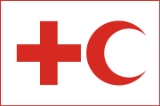
International Federation of Red Cross and Red Crescent Societies

Encyclopedia

Humanitarianism
In its most general form, humanitarianism is an ethic of kindness, benevolence and sympathy extended universally and impartially to all human beings. Humanitarianism has been an evolving concept historically but universality is a common element in its evolution...
institution that is part of the International Red Cross and Red Crescent Movement
International Red Cross and Red Crescent Movement
The International Red Cross and Red Crescent Movement is an international humanitarian movement with approximately 97 million volunteers, members and staff worldwide which was founded to protect human life and health, to ensure respect for all human beings, and to prevent and alleviate human...
along with the ICRC
International Committee of the Red Cross
The International Committee of the Red Cross is a private humanitarian institution based in Geneva, Switzerland. States parties to the four Geneva Conventions of 1949 and their Additional Protocols of 1977 and 2005, have given the ICRC a mandate to protect the victims of international and...
and 186 distinct National Societies. Founded in 1919 and based in Geneva
Geneva
Geneva In the national languages of Switzerland the city is known as Genf , Ginevra and Genevra is the second-most-populous city in Switzerland and is the most populous city of Romandie, the French-speaking part of Switzerland...
, Switzerland
Switzerland
Switzerland name of one of the Swiss cantons. ; ; ; or ), in its full name the Swiss Confederation , is a federal republic consisting of 26 cantons, with Bern as the seat of the federal authorities. The country is situated in Western Europe,Or Central Europe depending on the definition....
, it coordinates activities between the National Societies in order "to improve the lives of vulnerable people by mobilizing the power of humanity". On an international level, the Federation leads and organizes, in close cooperation with the National Societies, relief assistance missions responding to large-scale emergencies.
Founding
In 1919, representatives from the National Red Cross Societies of Britain, France, Italy, Japan, and the US came together in Paris to found the League of Red Cross Societies (LORCS) whose stated goal was "to strengthen and unite, for health activities, already-existing Red Cross Societies and to promote the creation of new Societies". The original idea was Henry Davison's, then president of the American Red CrossAmerican Red Cross
The American Red Cross , also known as the American National Red Cross, is a volunteer-led, humanitarian organization that provides emergency assistance, disaster relief and education inside the United States. It is the designated U.S...
and he was assisted by the British general Sir David Henderson who became the Director-General. This move, led by the American Red Cross, expanded the international activities of the Red Cross Movement beyond the strict mission of the ICRC to include relief assistance in response to emergency situations which were not caused by armed conflict (such as man-made or natural disasters). The American Red Cross already had great disaster relief mission experience extending back to its foundation.
The formation of the League, as an additional international Red Cross organization alongside the ICRC, was not without controversy for a number of reasons. The ICRC had, to some extent, valid concerns about a possible rivalry between both organizations. The foundation of the League was seen as an attempt to undermine the leadership position of the ICRC within the movement and to gradually transfer tasks and competencies to a multilateral institution. In addition to that, all founding members of the League were National Societies from countries of the Entente
Triple Entente
The Triple Entente was the name given to the alliance among Britain, France and Russia after the signing of the Anglo-Russian Entente in 1907....
or from associated partners of the Entente. The original statutes of the League from May 1919 contained further regulations which gave the five founding societies a privileged status and, due to the efforts of Henry P. Davison, the right to permanently exclude the National Red Cross Societies from the countries of the Central Powers
Central Powers
The Central Powers were one of the two warring factions in World War I , composed of the German Empire, the Austro-Hungarian Empire, the Ottoman Empire, and the Kingdom of Bulgaria...
, namely Germany
Germany
Germany , officially the Federal Republic of Germany , is a federal parliamentary republic in Europe. The country consists of 16 states while the capital and largest city is Berlin. Germany covers an area of 357,021 km2 and has a largely temperate seasonal climate...
, Austria
Austria
Austria , officially the Republic of Austria , is a landlocked country of roughly 8.4 million people in Central Europe. It is bordered by the Czech Republic and Germany to the north, Slovakia and Hungary to the east, Slovenia and Italy to the south, and Switzerland and Liechtenstein to the...
, Hungary
Hungary
Hungary , officially the Republic of Hungary , is a landlocked country in Central Europe. It is situated in the Carpathian Basin and is bordered by Slovakia to the north, Ukraine and Romania to the east, Serbia and Croatia to the south, Slovenia to the southwest and Austria to the west. The...
, Bulgaria
Bulgaria
Bulgaria , officially the Republic of Bulgaria , is a parliamentary democracy within a unitary constitutional republic in Southeast Europe. The country borders Romania to the north, Serbia and Macedonia to the west, Greece and Turkey to the south, as well as the Black Sea to the east...
and Turkey
Turkey
Turkey , known officially as the Republic of Turkey , is a Eurasian country located in Western Asia and in East Thrace in Southeastern Europe...
, and in addition to that the National Red Cross Society of Russia
Russia
Russia or , officially known as both Russia and the Russian Federation , is a country in northern Eurasia. It is a federal semi-presidential republic, comprising 83 federal subjects...
. These rules were contrary to the Red Cross principles of universality and equality among all national societies, a situation which furthered the concerns of the ICRC.
Missions begin
The first relief assistance mission organized by the League was an aid mission for the victims of a famine and subsequent typhus epidemic in PolandPoland
Poland , officially the Republic of Poland , is a country in Central Europe bordered by Germany to the west; the Czech Republic and Slovakia to the south; Ukraine, Belarus and Lithuania to the east; and the Baltic Sea and Kaliningrad Oblast, a Russian exclave, to the north...
. Only five years after its foundation, the League had already issued 47 donation appeals for missions in 34 countries, an impressive indication of the need for this type of Red Cross work. The total sum raised by these appeals reached 685 million Swiss Francs, which were used to bring emergency supplies to the victims of famines in Russia
Russia
Russia or , officially known as both Russia and the Russian Federation , is a country in northern Eurasia. It is a federal semi-presidential republic, comprising 83 federal subjects...
, Germany
Germany
Germany , officially the Federal Republic of Germany , is a federal parliamentary republic in Europe. The country consists of 16 states while the capital and largest city is Berlin. Germany covers an area of 357,021 km2 and has a largely temperate seasonal climate...
, and Albania
Albania
Albania , officially known as the Republic of Albania , is a country in Southeastern Europe, in the Balkans region. It is bordered by Montenegro to the northwest, Kosovo to the northeast, the Republic of Macedonia to the east and Greece to the south and southeast. It has a coast on the Adriatic Sea...
; earthquakes in Chile
Chile
Chile ,officially the Republic of Chile , is a country in South America occupying a long, narrow coastal strip between the Andes mountains to the east and the Pacific Ocean to the west. It borders Peru to the north, Bolivia to the northeast, Argentina to the east, and the Drake Passage in the far...
, Persia, Japan
Japan
Japan is an island nation in East Asia. Located in the Pacific Ocean, it lies to the east of the Sea of Japan, China, North Korea, South Korea and Russia, stretching from the Sea of Okhotsk in the north to the East China Sea and Taiwan in the south...
, Colombia
Colombia
Colombia, officially the Republic of Colombia , is a unitary constitutional republic comprising thirty-two departments. The country is located in northwestern South America, bordered to the east by Venezuela and Brazil; to the south by Ecuador and Peru; to the north by the Caribbean Sea; to the...
, Ecuador
Ecuador
Ecuador , officially the Republic of Ecuador is a representative democratic republic in South America, bordered by Colombia on the north, Peru on the east and south, and by the Pacific Ocean to the west. It is one of only two countries in South America, along with Chile, that do not have a border...
, Costa Rica
Costa Rica
Costa Rica , officially the Republic of Costa Rica is a multilingual, multiethnic and multicultural country in Central America, bordered by Nicaragua to the north, Panama to the southeast, the Pacific Ocean to the west and the Caribbean Sea to the east....
, and Turkey
Turkey
Turkey , known officially as the Republic of Turkey , is a Eurasian country located in Western Asia and in East Thrace in Southeastern Europe...
; and refugee flows in Greece
Greece
Greece , officially the Hellenic Republic , and historically Hellas or the Republic of Greece in English, is a country in southeastern Europe....
and Turkey. The first large-scale disaster mission of the League came after the 1923 earthquake in Japan which killed about 200,000 people and left countless more wounded and without shelter. Due to the League's coordination, the Red Cross Society of Japan received goods from its sister societies reaching a total value of about $100 million. Another important new field initiated by the League was the creation of youth Red Cross work within the National Societies.
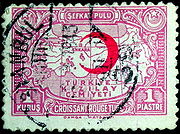
Russian Civil War
The Russian Civil War was a multi-party war that occurred within the former Russian Empire after the Russian provisional government collapsed to the Soviets, under the domination of the Bolshevik party. Soviet forces first assumed power in Petrograd The Russian Civil War (1917–1923) was a...
from 1917 to 1922 marked the first time the Movement was involved in an internal conflict, although still without an explicit mandate from the Geneva Conventions. The League, with support from more than 25 National Societies, organized assistance missions and the distribution of food and other aid goods for civil populations affected by hunger and disease. The ICRC worked with the Russian Red Cross Society and later the Society of the Soviet Union
Soviet Union
The Soviet Union , officially the Union of Soviet Socialist Republics , was a constitutionally socialist state that existed in Eurasia between 1922 and 1991....
, constantly emphasizing the ICRC's neutrality. In 1928, the "International Council" was founded to coordinate cooperation between the ICRC and the League, a task which was later taken over by the "Standing Commission". In the same year, a common statute for the Movement was adopted, defining the respective roles of the ICRC and the League within the Movement.
During the Abyssinian War
Second Italo-Abyssinian War
The Second Italo–Abyssinian War was a colonial war that started in October 1935 and ended in May 1936. The war was fought between the armed forces of the Kingdom of Italy and the armed forces of the Ethiopian Empire...
between Ethiopia
Ethiopia
Ethiopia , officially known as the Federal Democratic Republic of Ethiopia, is a country located in the Horn of Africa. It is the second-most populous nation in Africa, with over 82 million inhabitants, and the tenth-largest by area, occupying 1,100,000 km2...
and Italy
Italy
Italy , officially the Italian Republic languages]] under the European Charter for Regional or Minority Languages. In each of these, Italy's official name is as follows:;;;;;;;;), is a unitary parliamentary republic in South-Central Europe. To the north it borders France, Switzerland, Austria and...
from 1935 to 1936, the League contributed aid supplies worth about 1.7 million Swiss Francs. Because the Italian fascist regime under Benito Mussolini
Benito Mussolini
Benito Amilcare Andrea Mussolini was an Italian politician who led the National Fascist Party and is credited with being one of the key figures in the creation of Fascism....
refused any cooperation with the Red Cross, these goods were delivered solely to Ethiopia. During the war, an estimated 29 people lost their lives while being under explicit protection of the Red Cross symbol, most of them due to attacks by the Italian Army. During the Civil War in Spain
Spanish Civil War
The Spanish Civil WarAlso known as The Crusade among Nationalists, the Fourth Carlist War among Carlists, and The Rebellion or Uprising among Republicans. was a major conflict fought in Spain from 17 July 1936 to 1 April 1939...
from 1936 to 1939 the League once again joined forces with the ICRC with the support of 41 National Societies. In 1939 on the brink of the Second World War, the League relocated its headquarters from Paris to Geneva to take advantage of Swiss neutrality.
After World War II
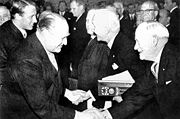
In the 1960s, there was a marked increase in the number of recognized national Red Cross and Red Crescent Societies due to decolonization
Decolonization
Decolonization refers to the undoing of colonialism, the unequal relation of polities whereby one people or nation establishes and maintains dependent Territory over another...
. By the end of the 1960s, there were more than 100 societies around the world. On December 10, 1963, the Federation (still known as the League of Red Cross Societies) and the ICRC jointly received the Nobel Peace Prize.
In 1983, the League was renamed to the "League of Red Cross and Red Crescent Societies" to reflect the growing number of National Societies operating under the Red Crescent symbol. Three years later, the seven fundamental principles of the Movement as adopted in 1965 were incorporated into its statutes. The name of the League was changed again in 1991 to its current official designation the "International Federation of Red Cross and Red Crescent Societies". In 1997, the ICRC and the Federation signed the Seville Agreement
Seville Agreement
The Seville Agreement was an agreement drafted within the Red Cross Movement in 1997 to specify which organization within the Movement would take the lead in certain field operations. It was the latest of several "peace treaties" that sought to end turf wars between the ICRC and the Federation...
which further defines the responsibilities of both organizations within the Movement.
In 2004, the Federation began its largest mission to date after the tsunami disaster in South Asia
2004 Indian Ocean earthquake
The 2004 Indian Ocean earthquake was an undersea megathrust earthquake that occurred at 00:58:53 UTC on Sunday, December 26, 2004, with an epicentre off the west coast of Sumatra, Indonesia. The quake itself is known by the scientific community as the Sumatra-Andaman earthquake...
. More than 40 National Societies have worked with more than 22,000 volunteers to bring relief to the countless victims left without food and shelter and endangered by the risk of epidemics.
Activities and responsibilities
The Federation coordinates between National Red Cross and Red Crescent Societies throughout the world. The Federation along with ICRC supports the foundation of new National Societies in countries where no official society exists. A National Society is admitted as a member to the Federation only after it is recognized by the ICRC.The Federation cooperates with the National Societies of the affected countries - called the Host National Society (HNS) - as well as the National Societies of other countries willing to offer assistance - called Partner National Societies (PNS). Among the 187 National Societies admitted to the General Assembly of the Federation as full members or observers, about 25-30 regularly work as PNS in other countries. The most active are the American Red Cross
American Red Cross
The American Red Cross , also known as the American National Red Cross, is a volunteer-led, humanitarian organization that provides emergency assistance, disaster relief and education inside the United States. It is the designated U.S...
, the British Red Cross
British Red Cross
The British Red Cross Society is the United Kingdom branch of the worldwide impartial humanitarian organisation the International Red Cross and Red Crescent Movement. The society was formed in 1870, and is a registered charity with over 31,000 volunteers and 2,600 staff. At the heart of their work...
, the German Red Cross
German Red Cross
The German Red Cross , or the DRK, is the national Red Cross Society in Germany.With over 4.5 million members, it is the third largest Red Cross society in the world. The German Red Cross offers a wide range of services within and outside Germany...
, and the Red Cross Societies of Sweden and Norway
Norwegian Red Cross
The Norwegian Red Cross was founded September 22, 1865 by prime minister Frederik Stang. In 1907 the Norwegian Ministry of Defence authorized the organization for voluntary medical aid in war...
. Another major mission of the Federation which has gained attention in recent years is its commitment to work towards a codified, worldwide ban on the use of land mine
Land mine
A land mine is usually a weight-triggered explosive device which is intended to damage a target—either human or inanimate—by means of a blast and/or fragment impact....
s and to bring medical, psychological, and social support for people injured by land mines.
The stated tasks of the Federation can be summarized as follows:
- to promote humanitarian principles and values.
- to support National Societies.
- to support projects where funds are available.
Organization
The Federation has its secretariat in GenevaGeneva
Geneva In the national languages of Switzerland the city is known as Genf , Ginevra and Genevra is the second-most-populous city in Switzerland and is the most populous city of Romandie, the French-speaking part of Switzerland...
. It also runs five zone offices and has a number of delegations around the world. The Secretariat is known for frequent staff changes and re-organisation of its structure. There has been two major reorganisations during the last two years. The CEO Bekele Geleta enjoys full support from President Konoe and the Governing Board. The secretariat is structured into four divisions. The highest body of the Federation is the General Assembly which convenes every two years with delegates from all National Societies. Among other tasks, the General Assembly elects the President. . Some members of the board including vice president Bengt has come under media scrutiny for various allegation. Many National Societies including the American Red Cross have also come under various allegation in matters such as blood safety and for mis-management of funds. The Governing Board consists of the president and the vice presidents of the Federation, the chairman of the Finance Commission, and twenty representatives from elected National Societies.
Presidents of the Federation
As of 2009, the president of the IFRC is Tadateru Konoe (Japanese Red CrossJapanese Red Cross
The ' is the Japanese affiliate of the International Red Cross.The Imperial Family of Japan traditionally has supported the society, with Empress as Honorary President and other royal family members as vice-presidents. Its headquarters is located in Tokyo and local chapters are set up in all 47...
). The vice presidents are Paul Bierch (Kenya
Kenya
Kenya , officially known as the Republic of Kenya, is a country in East Africa that lies on the equator, with the Indian Ocean to its south-east...
), Jaslin Uriah Salmon (Jamaica
Jamaica
Jamaica is an island nation of the Greater Antilles, in length, up to in width and 10,990 square kilometres in area. It is situated in the Caribbean Sea, about south of Cuba, and west of Hispaniola, the island harbouring the nation-states Haiti and the Dominican Republic...
), Mohamed El Maadid (Qatar
Qatar
Qatar , also known as the State of Qatar or locally Dawlat Qaṭar, is a sovereign Arab state, located in the Middle East, occupying the small Qatar Peninsula on the northeasterly coast of the much larger Arabian Peninsula. Its sole land border is with Saudi Arabia to the south, with the rest of its...
) and Bengt Westerberg
Bengt Westerberg
Bengt Carl Gustaf Westerberg was a Swedish politician. He is the son of Carl-Erik Westerberg and his wife Barbro...
(Sweden
Sweden
Sweden , officially the Kingdom of Sweden , is a Nordic country on the Scandinavian Peninsula in Northern Europe. Sweden borders with Norway and Finland and is connected to Denmark by a bridge-tunnel across the Öresund....
).
Former presidents (until 1977 titled "Chairman") have been:
- 1919–1922: Henry Davison (USA)
- 1922–1935: John Barton PayneJohn Barton PayneJohn Barton Payne was United States Secretary of the Interior from 1920 through 1921 under Woodrow Wilson.-Life and career:...
(USA) - 1935–1938: Cary Travers GraysonCary Travers GraysonAdmiral Cary Travers Grayson was a surgeon in the United States Navy who served a variety of roles from personal aide to President Woodrow Wilson to chairman of the American Red Cross.-Career:Grayson was born to Dr...
(USA) - 1938–1944: Norman DavisNorman DavisNorman H. Davis , was a U.S. diplomat. He was born in Bedford, Tennessee. He served as President Wilson's Assistant Secretary of Treasury and later as Undersecretary of State....
(USA) - 1944–1945: Jean de MuraltJean de MuraltJean de Muralt was a Swiss lawyer and the chairman of the International League of Red Cross and Red Crescent Societies from 1944 to 1945 ....
(SwitzerlandSwitzerlandSwitzerland name of one of the Swiss cantons. ; ; ; or ), in its full name the Swiss Confederation , is a federal republic consisting of 26 cantons, with Bern as the seat of the federal authorities. The country is situated in Western Europe,Or Central Europe depending on the definition....
) - 1945–1950: Basil O'ConnorBasil O'ConnorBasil O'Connor was an American lawyer. In co-operation with US-President Franklin D. Roosevelt he started two foundations for the rehabiltation of polio patients and the research on polio prevention and treatment...
(USA) - 1950–1959: Emil SandströmEmil SandströmEmil Sandström was a Swedish lawyer. He was the chairman of the International Federation of Red Cross and Red Crescent Societies from 1950 to 1959.-Life:...
(Sweden) - 1959–1965: John MacAulayJohn MacAulayJohn Alexander MacAulay, CC was a Canadian lawyer, businessman, and a volunteer worker in the Canadian Red Cross Society....
(CanadaCanadaCanada is a North American country consisting of ten provinces and three territories. Located in the northern part of the continent, it extends from the Atlantic Ocean in the east to the Pacific Ocean in the west, and northward into the Arctic Ocean...
)
- 1965–1977: José Barroso ChávezJosé Barroso ChávezJosé Barroso Chávez was a Red Cross official.He graduated from La Salle University. He was the President of the International Federation of Red Cross and Red Crescent Societies from 1965 to 1977...
(MexicoMexicoThe United Mexican States , commonly known as Mexico , is a federal constitutional republic in North America. It is bordered on the north by the United States; on the south and west by the Pacific Ocean; on the southeast by Guatemala, Belize, and the Caribbean Sea; and on the east by the Gulf of...
) - 1977–1981: Adetunji Adefarasin (NigeriaNigeriaNigeria , officially the Federal Republic of Nigeria, is a federal constitutional republic comprising 36 states and its Federal Capital Territory, Abuja. The country is located in West Africa and shares land borders with the Republic of Benin in the west, Chad and Cameroon in the east, and Niger in...
) - 1981–1987: Enrique de la MataEnrique de la MataEnrique de la Mata is a Spanish parliamentarian, lawyer and minister. He was the President of the International Federation of Red Cross and Red Crescent Societies from 1981 to 1987....
(SpainSpainSpain , officially the Kingdom of Spain languages]] under the European Charter for Regional or Minority Languages. In each of these, Spain's official name is as follows:;;;;;;), is a country and member state of the European Union located in southwestern Europe on the Iberian Peninsula...
) - 1987–1997: Mario Enrique Villarroel LanderMario Enrique Villarroel LanderMario Enrique Villarroel Lander is a Venezuelan lawyer.After studying jurisprudence at the Central University of Venezuela, he graduated as LL. D. in criminology. He is currently the professor for criminal law at the Universidad Santa María in Caracas and president of the Venezuelan Red Cross...
(VenezuelaVenezuelaVenezuela , officially called the Bolivarian Republic of Venezuela , is a tropical country on the northern coast of South America. It borders Colombia to the west, Guyana to the east, and Brazil to the south...
) - 1997–2001: Astrid Nøklebye HeibergAstrid Nøklebye HeibergAstrid Nøklebye Heiberg is a Norwegian politician for the Conservative Party, and a professor of medicine. She was the state secretary to the Minister of Social Affairs 1981-1985, and Minister of Administration and Consumer Affairs in 1986.Heiberg was vice-chairwoman of the Conservative Party from...
(NorwayNorwayNorway , officially the Kingdom of Norway, is a Nordic unitary constitutional monarchy whose territory comprises the western portion of the Scandinavian Peninsula, Jan Mayen, and the Arctic archipelago of Svalbard and Bouvet Island. Norway has a total area of and a population of about 4.9 million...
) - 2001–2009: Juan Manuel del Toro y Rivera (SpainSpainSpain , officially the Kingdom of Spain languages]] under the European Charter for Regional or Minority Languages. In each of these, Spain's official name is as follows:;;;;;;), is a country and member state of the European Union located in southwestern Europe on the Iberian Peninsula...
) - 2009–present: Tadateru Konoé (JapanJapanJapan is an island nation in East Asia. Located in the Pacific Ocean, it lies to the east of the Sea of Japan, China, North Korea, South Korea and Russia, stretching from the Sea of Okhotsk in the north to the East China Sea and Taiwan in the south...
)
Funding and financial matters
The main parts of the budget of the Federation are funded by contributions from the National Societies and through revenues from investments. The criteria for the statutory contributions of each member society are established by the Finance Commission and approved by the General Assembly. Any additional funding, especially for unforeseen relief assistance missions, is raised by appeals published by the Federation and comes from voluntary donations by National Societies, governments, other organizations, corporations, and individuals.Emblem, mottos, and mission statement
The emblem of the Federation is the combination of a red cross and a red crescent on a white background, surrounded by a red rectangular frame without any additional text. The red cross, the original symbol of the Movement, is on the left while the red crescent appears to the right. Per Humanitatem ad Pacem is the primary motto of the Federation (Article 1 of the Constitution of the Federation). The mission statement of the International Movement as formulated in the "Strategy 2010" document of the Federation is to improve the lives of vulnerable people by mobilizing the power of humanity. From 1999 to 2004, the common slogan for all activities of the International Movement was The Power of Humanity. In December 2003, the 28th International Conference in Geneva adopted the conference motto Protecting Human Dignity as the new slogan for the entire Movement.Relationships within the Movement
American Red Cross
The American Red Cross , also known as the American National Red Cross, is a volunteer-led, humanitarian organization that provides emergency assistance, disaster relief and education inside the United States. It is the designated U.S...
threatened to supplant the ICRC with its creation of the League as "a real international Red Cross" after the First World War
World War I
World War I , which was predominantly called the World War or the Great War from its occurrence until 1939, and the First World War or World War I thereafter, was a major war centred in Europe that began on 28 July 1914 and lasted until 11 November 1918...
. Several agreements about the respective roles of the organizations helped to smooth relations, beginning with the agreement of 1928, the 1997 Seville Agreement
Seville Agreement
The Seville Agreement was an agreement drafted within the Red Cross Movement in 1997 to specify which organization within the Movement would take the lead in certain field operations. It was the latest of several "peace treaties" that sought to end turf wars between the ICRC and the Federation...
and most recently the Supplementary Measures of 2005. The Seville Agreement gives the Federation the lead in any emergency situation which does not take place as part of an armed conflict (in which case the ICRC takes charge). Organizational discord has now largely subsided Currently, the Secretariat has a Movement Cooperation Unit dedicated to organizing interaction and cooperation with the ICRC.
External links
- International Red Cross and Red Crescent Movement
- International Federation of Red Cross and Red Crescent Societies (IFRC)