


World Meteorological Organization

Encyclopedia
The World Meteorological Organization (WMO) is an intergovernmental organization with a membership of 189 Member States and Territories. It originated from the International Meteorological Organization
(IMO), which was founded in 1873. Established in 1950, WMO became the specialised agency of the United Nations
for meteorology
(weather
and climate
), operational hydrology
and related geophysical sciences
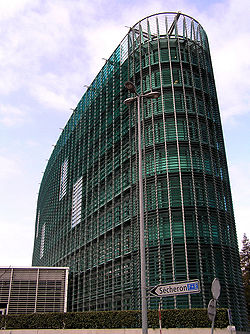
. It has its headquarters in Geneva
, Switzerland and is a member of the United Nations Development Group. The current president is David Grimes and the current Secretary-General is Michel Jarraud.
WMO has a membership of 189 member states and territories (since 4 December 2009). The Convention of the World Meteorological Organization was signed 11 October 1947 and established upon ratification in 1950. WMO became the specialized agency of the United Nations in 1951 for meteorology (weather and climate), operational hydrology and related geophysical sciences. It originated from the International Meteorological Organization
(IMO), which was founded in 1873.
The WMO hierarchy:
Since its establishment, WMO has played a unique and powerful role in contributing to the safety and welfare of humanity. Under WMO leadership and within the framework of WMO programs, National Meteorological and Hydrological Services contribute substantially to the protection of life and property against natural disasters, to safeguarding the environment and to enhancing the economic and social well-being of all sectors of society in areas such as food security, water resources and transport.
The WMO and United Nations Environment Programme (UNEP) jointly created the Intergovernmental Panel on Climate Change
(IPCC). It is also directly responsible for the creation of the Global Atmosphere Watch
(GAW). The IPCC has received the Nobel Peace Prize
in 2007 "for their efforts to build up and disseminate greater knowledge about man-made climate change, and to lay the foundations for the measures that are needed to counteract such change."
WMO promotes cooperation in the establishment of networks for making meteorological, climatological, hydrological and geophysical observations, as well as the exchange, processing and standardization of related data, and assists technology transfer, training and research. It also fosters collaboration between the National Meteorological and Hydrological Services of its Members and furthers the application of meteorology to public weather services, agriculture, aviation, shipping, the environment, water issues and the mitigation of the impacts of natural disasters.
WMO facilitates the free and unrestricted exchange of data and information, products and services in real- or near-real time on matters relating to safety and security of society, economic welfare and the protection of the environment. It contributes to policy formulation in these areas at national and international levels.
In the specific case of weather-, climate and water-related hazards, which account for nearly 90% of all natural disasters, WMO's programs provide vital information for the advance warnings that save lives and reduce damage to property and the environment. WMO also contributes to reducing the impacts of human-induced disasters, such as those associated with chemical and nuclear accidents, forest fire and volcanic ash. Studies have shown that, apart from the incalculable benefit to human well-being, every dollar invested in meteorological and hydrological services produces an economic return many times greater, often ten times or more.
WMO plays a leading role in international efforts to monitor and protect the environment through its programs. In collaboration with other UN agencies and the National Meteorological and Hydrological Services, WMO supports the implementation of a number of environmental conventions and is instrumental in providing advice and assessments to governments on related matters. These activities contribute towards ensuring the sustainable development and well-being of nations.
WMO publishes the International Cloud Atlas
, the international standard cloud atlas
since 1896.
, CLIMAT
and TEMP
, are character-based and their coding is position-based. Newer WMO code forms are designed for portability, extensibility and universality. These are BUFR
, CREX, and, for gridded geo-positioned data, GRIB
.
-3 (WCC-3) was held from 31 August to 4 September 2009 in Geneva, Switzerland, under the auspices of WMO. Its goal was to address advancements in seasonal to multi-decadal climate predictions and to spur their applications to decision-making in socio-economic sectors, including food, water, energy, health, tourism and development sectors. The Conference aimed to contribute to the achievement of the United Nations Millennium Development Goals
and broader UN climate goals through support for climate adaptation.
and Niue
. Additionally there are 6 member territories.
The non-member states are Andorra
, Grenada
, Equatorial Guinea
, Liechtenstein
, Marshall Islands
, Nauru
, Palau
, Saint Kitts and Nevis
, Saint Vincent and the Grenadines
, San Marino
, Tuvalu
, Vatican City
and the states with limited recognition.
The member territories are: the British
Caribbean Territories (joint meteorological organization and membership), French Polynesia
, Hong Kong
, Macau
, Netherlands Antilles
and Aruba
(joint meteorological service and membership), New Caledonia
International Meteorological Organization
The International Meteorological Organization was the first organization formed with the purpose of exchanging weather information among the countries of the world. It was born from the realization that weather systems move across country boundaries and knowledge of pressure, temperature,...
(IMO), which was founded in 1873. Established in 1950, WMO became the specialised agency of the United Nations
United Nations
The United Nations is an international organization whose stated aims are facilitating cooperation in international law, international security, economic development, social progress, human rights, and achievement of world peace...
for meteorology
Meteorology
Meteorology is the interdisciplinary scientific study of the atmosphere. Studies in the field stretch back millennia, though significant progress in meteorology did not occur until the 18th century. The 19th century saw breakthroughs occur after observing networks developed across several countries...
(weather
Weather
Weather is the state of the atmosphere, to the degree that it is hot or cold, wet or dry, calm or stormy, clear or cloudy. Most weather phenomena occur in the troposphere, just below the stratosphere. Weather refers, generally, to day-to-day temperature and precipitation activity, whereas climate...
and climate
Climate
Climate encompasses the statistics of temperature, humidity, atmospheric pressure, wind, rainfall, atmospheric particle count and other meteorological elemental measurements in a given region over long periods...
), operational hydrology
Hydrology
Hydrology is the study of the movement, distribution, and quality of water on Earth and other planets, including the hydrologic cycle, water resources and environmental watershed sustainability...
and related geophysical sciences
Geophysics
Geophysics is the physics of the Earth and its environment in space; also the study of the Earth using quantitative physical methods. The term geophysics sometimes refers only to the geological applications: Earth's shape; its gravitational and magnetic fields; its internal structure and...
. It has its headquarters in Geneva
Geneva
Geneva In the national languages of Switzerland the city is known as Genf , Ginevra and Genevra is the second-most-populous city in Switzerland and is the most populous city of Romandie, the French-speaking part of Switzerland...
, Switzerland and is a member of the United Nations Development Group. The current president is David Grimes and the current Secretary-General is Michel Jarraud.
The organization
The World Meteorological Organization (WMO) is a specialized agency of the United Nations. It is the UN system's authoritative voice on the state and behavior of the Earth's atmosphere, its interaction with the oceans, the climate it produces and the resulting distribution of water resources.WMO has a membership of 189 member states and territories (since 4 December 2009). The Convention of the World Meteorological Organization was signed 11 October 1947 and established upon ratification in 1950. WMO became the specialized agency of the United Nations in 1951 for meteorology (weather and climate), operational hydrology and related geophysical sciences. It originated from the International Meteorological Organization
International Meteorological Organization
The International Meteorological Organization was the first organization formed with the purpose of exchanging weather information among the countries of the world. It was born from the realization that weather systems move across country boundaries and knowledge of pressure, temperature,...
(IMO), which was founded in 1873.
The WMO hierarchy:
- The World Meteorological Congress determines the policy of WMO and meets every four years. Each Member country is represented by a Permanent Representative with WMO. The Permanent Representative should be the director of the National Meteorological or Hydrometeorological Service.
- The Executive Council implements Congress decisions and meets once a year.
- Six regional associations for addressing regional concerns:
- Region I Africa
- Region II Asia
- Region III South America
- Region IV North America, Central America and the Caribbean
- Region V South-West Pacific
- Region VI Europe
- (Antarctica is outside the regions)
- Eight technical commissions provide technical recommendations for WMO and the national services.
- The secretariat headed by the Secretary-General coordinates the activities of WMO with a regular staff of some 250 employees.
Activities
As weather, climate and the water cycle know no national boundaries, international cooperation at a global scale is essential for the development of meteorology and operational hydrology as well as to reap the benefits from their application. WMO provides the framework for such international cooperation.Since its establishment, WMO has played a unique and powerful role in contributing to the safety and welfare of humanity. Under WMO leadership and within the framework of WMO programs, National Meteorological and Hydrological Services contribute substantially to the protection of life and property against natural disasters, to safeguarding the environment and to enhancing the economic and social well-being of all sectors of society in areas such as food security, water resources and transport.
The WMO and United Nations Environment Programme (UNEP) jointly created the Intergovernmental Panel on Climate Change
Intergovernmental Panel on Climate Change
The Intergovernmental Panel on Climate Change is a scientific intergovernmental body which provides comprehensive assessments of current scientific, technical and socio-economic information worldwide about the risk of climate change caused by human activity, its potential environmental and...
(IPCC). It is also directly responsible for the creation of the Global Atmosphere Watch
Global Atmosphere Watch
The Global Atmosphere Watch is a worldwide system established by the World Meteorological Organization a United Nations agency to monitor trends in the Earth's atmosphere...
(GAW). The IPCC has received the Nobel Peace Prize
Nobel Peace Prize
The Nobel Peace Prize is one of the five Nobel Prizes bequeathed by the Swedish industrialist and inventor Alfred Nobel.-Background:According to Nobel's will, the Peace Prize shall be awarded to the person who...
in 2007 "for their efforts to build up and disseminate greater knowledge about man-made climate change, and to lay the foundations for the measures that are needed to counteract such change."
WMO promotes cooperation in the establishment of networks for making meteorological, climatological, hydrological and geophysical observations, as well as the exchange, processing and standardization of related data, and assists technology transfer, training and research. It also fosters collaboration between the National Meteorological and Hydrological Services of its Members and furthers the application of meteorology to public weather services, agriculture, aviation, shipping, the environment, water issues and the mitigation of the impacts of natural disasters.
WMO facilitates the free and unrestricted exchange of data and information, products and services in real- or near-real time on matters relating to safety and security of society, economic welfare and the protection of the environment. It contributes to policy formulation in these areas at national and international levels.
In the specific case of weather-, climate and water-related hazards, which account for nearly 90% of all natural disasters, WMO's programs provide vital information for the advance warnings that save lives and reduce damage to property and the environment. WMO also contributes to reducing the impacts of human-induced disasters, such as those associated with chemical and nuclear accidents, forest fire and volcanic ash. Studies have shown that, apart from the incalculable benefit to human well-being, every dollar invested in meteorological and hydrological services produces an economic return many times greater, often ten times or more.
WMO plays a leading role in international efforts to monitor and protect the environment through its programs. In collaboration with other UN agencies and the National Meteorological and Hydrological Services, WMO supports the implementation of a number of environmental conventions and is instrumental in providing advice and assessments to governments on related matters. These activities contribute towards ensuring the sustainable development and well-being of nations.
WMO publishes the International Cloud Atlas
International Cloud Atlas
International Cloud Atlas is a cloud atlas first published in 1896 and remaining in print since then. Its initial purposes included to aid in the training of meteorologists and to promote more consistent use of vocabulary describing clouds, both important for early weather forecasting...
, the international standard cloud atlas
Cloud atlas
A cloud atlas is a pictorial key to the nomenclature of clouds. Early cloud atlases were an important element in the training of meteorologists and in weather forecasting, and the author of a 1923 atlas stated that "increasing use of the air as a means of transportation will require and lead to a...
since 1896.
Meteorological codes
In keeping with its mandate to promote the standardization of meteorological observations, the WMO maintains numerous code forms for the representation and exchange of meteorological, oceanographical, and hydrological data. The traditional code forms, such as SYNOPSYNOP
SYNOP is a numerical code used for reporting weather observations made by manned and automated weather stations. SYNOP reports are typically sent every six hours on shortwave using RTTY...
, CLIMAT
CLIMAT
CLIMAT is a code for reporting monthly climatological data assembled at land-based meteorological surface observation sites to data centres. CLIMAT-coded messages contain information on several meteorological variables that are important to monitor characteristics, changes, and variability of climate...
and TEMP
TEMP (meteorology)
TEMP is a set of World Meteorological Organization alphanumerical codes used for reporting weather observations of the upper regions of the atmosphere made by weather balloons released from the surface level . The WMO designates the FM-35 numerical code for surface TEMPs and the FM-36 numerical...
, are character-based and their coding is position-based. Newer WMO code forms are designed for portability, extensibility and universality. These are BUFR
BUFR
The Binary Universal Form for the Representation of meteorological data is a binary data format maintained by the World Meteorological Organization . The latest version is BUFR Edition 4...
, CREX, and, for gridded geo-positioned data, GRIB
GRIB
GRIB is a mathematically concise data format commonly used in meteorology to store historical and forecast weather data...
.
World Meteorological Day
- World Meteorological Day is held annually on March 23.
Awards and prizes
- International Meteorological Organization Prize
- Vilho VaisalaVaisalaVaisala is a Finnish company that develops, manufactures and markets products and services for environmental and industrial measurement.The major customer groups and markets are national meteorological and hydrological services, aviation authorities, defense forces, road authorities, the weather...
Award - Norbert Gerbier-Mumm International Award
- WMO Research Award for Young Scientists
WMO conference on climate prediction and information for decision-making
World Climate ConferenceWorld Climate Conference
The world climate conferences are a series of international meetings, organized by the World Meteorological Organization , about global climate issues. The first two conferences largely focused on climate change in addition to climate research and forecasting...
-3 (WCC-3) was held from 31 August to 4 September 2009 in Geneva, Switzerland, under the auspices of WMO. Its goal was to address advancements in seasonal to multi-decadal climate predictions and to spur their applications to decision-making in socio-economic sectors, including food, water, energy, health, tourism and development sectors. The Conference aimed to contribute to the achievement of the United Nations Millennium Development Goals
Millennium Development Goals
The Millennium Development Goals are eight international development goals that all 193 United Nations member states and at least 23 international organizations have agreed to achieve by the year 2015...
and broader UN climate goals through support for climate adaptation.
Membership
As of 2009 member states of the organization are 181 of the UN members, Cook IslandsCook Islands
The Cook Islands is a self-governing parliamentary democracy in the South Pacific Ocean in free association with New Zealand...
and Niue
Niue
Niue , is an island country in the South Pacific Ocean. It is commonly known as the "Rock of Polynesia", and inhabitants of the island call it "the Rock" for short. Niue is northeast of New Zealand in a triangle between Tonga to the southwest, the Samoas to the northwest, and the Cook Islands to...
. Additionally there are 6 member territories.
The non-member states are Andorra
Andorra
Andorra , officially the Principality of Andorra , also called the Principality of the Valleys of Andorra, , is a small landlocked country in southwestern Europe, located in the eastern Pyrenees mountains and bordered by Spain and France. It is the sixth smallest nation in Europe having an area of...
, Grenada
Grenada
Grenada is an island country and Commonwealth Realm consisting of the island of Grenada and six smaller islands at the southern end of the Grenadines in the southeastern Caribbean Sea...
, Equatorial Guinea
Equatorial Guinea
Equatorial Guinea, officially the Republic of Equatorial Guinea where the capital Malabo is situated.Annobón is the southernmost island of Equatorial Guinea and is situated just south of the equator. Bioko island is the northernmost point of Equatorial Guinea. Between the two islands and to the...
, Liechtenstein
Liechtenstein
The Principality of Liechtenstein is a doubly landlocked alpine country in Central Europe, bordered by Switzerland to the west and south and by Austria to the east. Its area is just over , and it has an estimated population of 35,000. Its capital is Vaduz. The biggest town is Schaan...
, Marshall Islands
Marshall Islands
The Republic of the Marshall Islands , , is a Micronesian nation of atolls and islands in the middle of the Pacific Ocean, just west of the International Date Line and just north of the Equator. As of July 2011 the population was 67,182...
, Nauru
Nauru
Nauru , officially the Republic of Nauru and formerly known as Pleasant Island, is an island country in Micronesia in the South Pacific. Its nearest neighbour is Banaba Island in Kiribati, to the east. Nauru is the world's smallest republic, covering just...
, Palau
Palau
Palau , officially the Republic of Palau , is an island nation in the Pacific Ocean, east of the Philippines and south of Tokyo. In 1978, after three decades as being part of the United Nations trusteeship, Palau chose independence instead of becoming part of the Federated States of Micronesia, a...
, Saint Kitts and Nevis
Saint Kitts and Nevis
The Federation of Saint Kitts and Nevis , located in the Leeward Islands, is a federal two-island nation in the West Indies. It is the smallest sovereign state in the Americas, in both area and population....
, Saint Vincent and the Grenadines
Saint Vincent and the Grenadines
Saint Vincent and the Grenadines is an island country in the Lesser Antilles chain, namely in the southern portion of the Windward Islands, which lie at the southern end of the eastern border of the Caribbean Sea where the latter meets the Atlantic Ocean....
, San Marino
San Marino
San Marino, officially the Republic of San Marino , is a state situated on the Italian Peninsula on the eastern side of the Apennine Mountains. It is an enclave surrounded by Italy. Its size is just over with an estimated population of over 30,000. Its capital is the City of San Marino...
, Tuvalu
Tuvalu
Tuvalu , formerly known as the Ellice Islands, is a Polynesian island nation located in the Pacific Ocean, midway between Hawaii and Australia. Its nearest neighbours are Kiribati, Nauru, Samoa and Fiji. It comprises four reef islands and five true atolls...
, Vatican City
Vatican City
Vatican City , or Vatican City State, in Italian officially Stato della Città del Vaticano , which translates literally as State of the City of the Vatican, is a landlocked sovereign city-state whose territory consists of a walled enclave within the city of Rome, Italy. It has an area of...
and the states with limited recognition.
The member territories are: the British
British overseas territories
The British Overseas Territories are fourteen territories of the United Kingdom which, although they do not form part of the United Kingdom itself, fall under its jurisdiction. They are remnants of the British Empire that have not acquired independence or have voted to remain British territories...
Caribbean Territories (joint meteorological organization and membership), French Polynesia
French Polynesia
French Polynesia is an overseas country of the French Republic . It is made up of several groups of Polynesian islands, the most famous island being Tahiti in the Society Islands group, which is also the most populous island and the seat of the capital of the territory...
, Hong Kong
Hong Kong
Hong Kong is one of two Special Administrative Regions of the People's Republic of China , the other being Macau. A city-state situated on China's south coast and enclosed by the Pearl River Delta and South China Sea, it is renowned for its expansive skyline and deep natural harbour...
, Macau
Macau
Macau , also spelled Macao , is, along with Hong Kong, one of the two special administrative regions of the People's Republic of China...
, Netherlands Antilles
Netherlands Antilles
The Netherlands Antilles , also referred to informally as the Dutch Antilles, was an autonomous Caribbean country within the Kingdom of the Netherlands, consisting of two groups of islands in the Lesser Antilles: Aruba, Bonaire and Curaçao , in Leeward Antilles just off the Venezuelan coast; and Sint...
and Aruba
Aruba
Aruba is a 33 km-long island of the Lesser Antilles in the southern Caribbean Sea, located 27 km north of the coast of Venezuela and 130 km east of Guajira Peninsula...
(joint meteorological service and membership), New Caledonia
New Caledonia
New Caledonia is a special collectivity of France located in the southwest Pacific Ocean, east of Australia and about from Metropolitan France. The archipelago, part of the Melanesia subregion, includes the main island of Grande Terre, the Loyalty Islands, the Belep archipelago, the Isle of...
See also
- Aircraft Meteorological Data Relay (AMDAR)
- Cloud atlasCloud atlasA cloud atlas is a pictorial key to the nomenclature of clouds. Early cloud atlases were an important element in the training of meteorologists and in weather forecasting, and the author of a 1923 atlas stated that "increasing use of the air as a means of transportation will require and lead to a...
- Global Atmospheric Research ProgrammeGlobal Atmospheric Research ProgrammeThe Global Atmospheric Research Programme was a fifteen year international research programme led by the World Meteorological Organization and the International Council of Scientific Unions. It began in 1967 and organised several important field experiments including GARP Atlantic Tropical...
(GARP) - International Cloud AtlasInternational Cloud AtlasInternational Cloud Atlas is a cloud atlas first published in 1896 and remaining in print since then. Its initial purposes included to aid in the training of meteorologists and to promote more consistent use of vocabulary describing clouds, both important for early weather forecasting...
- Maria do Rosàrio Veiga
External links
- Founding charter
- WMO country codes from the International Comprehensive Ocean-Atmosphere Data SetInternational Comprehensive Ocean-Atmosphere Data SetThe International Comprehensive Ocean-Atmosphere Data Set, or ICOADS, is a digital database of 261 million weather observations made by ships, weather ships, and weather buoys spanning the years 1667 to 2007. The database was initially constructed in 1985 and continues to be expanded upon and...
- WCC-3