


Watch

Encyclopedia
A watch is a small timepiece, typically worn either on the wrist or attached on a chain and carried in a pocket, with wristwatches being the most common type of watch used today. They evolved in the 17th century from spring powered clocks, which appeared in the 15th century. The first watches were strictly mechanical. As technology progressed, the mechanisms used to measure time have, in some cases, been replaced by use of quartz vibrations or electromagnetic pulses and are called quartz movements. The first digital electronic watch was developed in 1970.
Before wristwatches became popular in the 1920s, most watches were pocket watch
es, which often had covers and were carried in a pocket and attached to a watch chain or watch fob. In early 1900s, the wristwatch, originally called a Wristlet, was reserved for women and considered more of a passing fad than a serious timepiece. Real gentlemen, who carried pocket watches, were actually quoted as saying they would "sooner wear a skirt as wear a wristwatch". This all changed in World War I
when soldiers on the battlefield found using a pocket watch to be impractical, so they attached the pocket watch to their wrist by a cupped leather strap. It is also believed that Girard-Perregaux
equipped the German Imperial Navy in a similar fashion as early as the 1880s, which were used while synchronizing naval attacks and firing artillery.
Most inexpensive and medium-priced watches used mainly for timekeeping are electronic watches with quartz movements. Expensive, collectible
watches valued more for their workmanship
and aesthetic appeal than for simple timekeeping, often have purely mechanical movements and are powered by springs, even though mechanical movements are less accurate than more affordable quartz movements. In addition to the time, modern watches often display the day, date, month and year, and electronic watches may have many other functions. Watches that provide additional time-related features such as timer
s, chronograph
s and alarm functions are not uncommon. Some modern designs even go as far as using GPS technology or heart-rate monitoring capabilities.
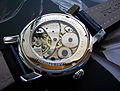 A movement
in watchmaking is the mechanism that measures the passage of time and displays the current time (and possibly other information including date, month and day). Movements may be entirely mechanical, entirely electronic (potentially with no moving parts), or a blend of the two. Most watches intended mainly for timekeeping today have electronic movements, with mechanical hands on the watch face indicating the time.
es are designed to leave the mechanism visible for aesthetic purposes.
Mechanical movements use an escapement
mechanism to control and limit the unwinding and winding parts of a spring, converting what would otherwise be a simple unwinding into a controlled and periodic energy release. Mechanical movements also use a balance wheel
together with the balance spring
(also known as a hairspring) to control motion of the gear system of the watch in a manner analogous to the pendulum
of a pendulum clock
. The tourbillon
, an optional part for mechanical movements, is a rotating frame for the escapement, which is used to cancel out or reduce the effects of gravitational bias to the timekeeping. Due to the complexity of designing a tourbillon, they are very expensive, and only found in "prestige" watches.
The pin-lever escapement (called the Roskopf movement after its inventor, Georges Frederic Roskopf
), which is a cheaper version of the fully levered movement, was manufactured in huge quantities by many Swiss manufacturers as well as Timex, until it was replaced by quartz movements.
Tuning-fork watches use a type of electromechanical movement. Introduced by Bulova
in 1960, they use a tuning fork with a precise frequency (most often 360 hertz
) to drive a mechanical watch. The task of converting electronically pulsed fork vibration into rotary movement is done via two tiny jeweled fingers, called pawls. Tuning-fork watches were rendered obsolete when electronic quartz watches were developed, because quartz watches were cheaper to produce and even more accurate.
Traditional mechanical watch movements use a spiral spring called a mainspring
as a power source. In manual watches the spring must be rewound periodically by the user by turning the watch crown. Antique pocketwatches were wound by inserting a separate key into a hole in the back of the watch and turning it. Most modern watches are designed to run 40 hours on a winding and thus must be wound daily, but some run for several days and a few have 192-hour mainsprings and are wound weekly.
A self-winding or automatic watches is one that rewinds the mainspring of a mechanical movement by the natural motions of the wearer's body. The first self-winding mechanism was invented for pocketwatches in 1770 by
Abraham-Louis Perrelet, but the first "self-winding", or "automatic", wristwatch was the invention of a British watch repairer named John Harwood
in 1923. This type of watch allows for constant winding without special action from the wearer; it works by an eccentric weight, called a winding rotor, which rotates with the movement of the wearer's wrist. The back-and-forth motion of the winding rotor couples to a ratchet
to automatically wind the mainspring. Self-winding watches usually can also be wound manually so they can be kept running when not worn or if the wearer's wrist motions are inadequate to keep the watch wound.
crystal to provide a stable time base for a mostly electronic movement. The crystal forms a quartz oscillator which resonates
at a specific and highly stable frequency, and which can be used to accurately pace a timekeeping mechanism. For this reason, electronic watches are often called quartz watches. Most quartz movements are primarily electronic but are geared to drive mechanical hands on the face of the watch in order to provide a traditional analog display of the time, which is still preferred by some consumers.
In 1959 Seiko
gave an order to Epson (a daughter company of Seiko and the actual brain behind the quartz revolution) to start developing a quartz wristwatch. The project was codenamed 59A and by the 1964 Tokyo Summer Olympics, Seiko had a working prototype of a portable quartz watch which took part in time measurements throughout the event.
The first prototypes of an electronic quartz wristwatch (not just portable quartz watches as the Seiko timekeeping devices at the Tokyo Olympics in 1964) were made by the CEH research laboratory in Neuchâtel, Switzerland. From 1965 through 1967 pioneering development work was done on a miniaturized 8192 Hz quartz oscillator, a thermo-compensation module and an inhouse-made, dedicated integrated circuit (unlike the hybrid circuits used in the later Seiko Astron wristwatch). As a result, the BETA 1 prototype set new timekeeping performance records at the International Chronometric Competition held at the Observatory of Neuchâtel in 1967.
The first quartz watch to enter production was the Seiko
35 SQ Astron
, which hit the shelves on December 25, 1969. One particularly interesting decision made by Seiko at that time was to not patent the whole movement of the quartz wristwatch, thus allowing other manufacturers to benefit from the Seiko technology. This played a major role in the popularity and quick development of the quartz watch, which in less than a decade was dominant in the watch market, nearly ending an almost 100 years of mechanical wristwatch heritage. The modern quartz movements are produced in very large quantities, and even the cheapest wristwatches typically have quartz movements. Whereas mechanical movements can typically be off by several seconds a day, an inexpensive quartz movement in a child's wristwatch may still be accurate to within half a second per day—ten times better than a mechanical movement.
After a consolidation of the mechanical watch industry in Switzerland during the 1970s, mass production of quartz wristwatches took off under the leadership of the Swatch
Group of companies, a Swiss conglomerate with vertical control of the production of Swiss watches and related products.
For quartz wristwatches, subsidiaries of Swatch manufactured watch batteries (Renata), oscillators (Oscilloquartz
) and integrated circuits (Ebauches Electronic SA). The launch of the new SWATCH brand in 1983, was marked by bold new styling, design and marketing. Today, the Swatch Group is the world's largest watch company.
Seiko's efforts to combine the quartz and mechanical movements bore fruit after 20 years of research, leading to the introduction of the Seiko
Spring Drive
, first in a limited domestic market production in 1999 and to the world in September 2005. The Spring Drive manages to keep time within quartz standards without the use of a battery, using a traditional mechanical gear train powered by a spring, while at the same time doesn't have the need of a balance wheel either.
Radio time signal watches are a type of electronic quartz watch which synchronizes (time transfer
) its time with an external time source such as in atomic clock
s, time signals from GPS navigation satellites, the German DCF77
signal in Europe, WWVB
in the US, and others. Movements of this type may -among others- synchronize not only the time of day but also the date, the leap-year
status of the current year, and the current state of daylight saving time
(on or off). However, other than the radio receiver these watches are normal quartz watches in all other aspects.
Electronic watches require electricity as a power source. Some mechanical movements and hybrid electronic-mechanical movements also require electricity. Usually the electricity is provided by a replaceable battery
. The first use of electrical power in watches was as a substitute for the mainspring, in order to remove the need for winding. The first electrically powered watch, the Hamilton Electric 500, was released in 1957 by the Hamilton Watch Company
of Lancaster, Pennsylvania
.
Watch batteries (strictly speaking cells, as a battery is composed of multiple cells) are specially designed for their purpose. They are very small and provide tiny amounts of power continuously for very long periods (several years or more). In most cases, replacing the battery requires a trip to a watch-repair shop or watch dealer; this is especially true for watches that are designed to be water-resistant, as special tools and procedures are required to ensure that the watch remains water-resistant after battery replacement. Silver-oxide and lithium batteries are popular today; mercury batteries, formerly quite common, are no longer used, for environmental reasons. Cheap batteries may be alkaline, of the same size as silver-oxide cells but providing shorter life. Rechargeable batteries are used in some solar powered watches.
Some electronic watches are also powered by the movement of the wearer of the watch. For instance, Seiko's Kinetic powered quartz watches
make use of the motion of the wearer's arm turning a rotating weight which causes a tiny generator
to supply power to charge a rechargeable battery that runs the watch. The concept is similar to that of self-winding spring movements, except that electrical power is generated instead of mechanical spring tension.
Solar powered watch
es are powered by light. A photovoltaic cell on the face (dial) of the watch converts light to electricity, which in turn is used to charge a rechargeable battery or capacitor
. The movement of the watch draws its power from the rechargeable battery
or capacitor. As long as the watch is regularly exposed to fairly strong light (such as sunlight), it never needs battery replacement, and some models need only a few minutes of sunlight to provide weeks of energy (as in the Citizen Eco-Drive
). Some of the early solar watches of the 1970s had innovative and unique designs to accommodate the array of solar cells needed to power them (Synchronar, Nepro, Sicura and some models by Cristalonic, Alba, Seiko and Citizen). As the decades progressed and the efficiency of the solar cells increased while the power requirements of the movement and display decreased, solar watches began to be designed to look like other conventional watches.
A rarely used power source is the temperature difference between the wearer's arm and the surrounding environment (as applied in the Citizen Eco-Drive
Thermo).
watches. All of the hands are normally mechanical, physically rotating on the dial, although a few watches have been produced with "hands" that are simulated by a liquid-crystal display
.
Analog display of the time is nearly universal in watches sold as jewelry or collectibles, and in these watches, the range of different styles of hands, numbers, and other aspects of the analog dial is very broad. In watches sold for timekeeping, analog display remains very popular, as many people find it easier to read than digital display; but in timekeeping watches the emphasis is on clarity and accurate reading of the time under all conditions (clearly marked digits, easily visible hands, large watch faces, etc.). They are specifically designed for the left wrist with the stem (the knob used for changing the time) on the right side of the watch; this makes it easy to change the time without removing the watch from the wrist. This is the case if one is right-handed and the watch is worn on the left wrist (as is traditionally done). If one is left-handed and wears the watch on the right wrist, one has to remove the watch from the wrist to reset the time or to wind the watch.
Analog watches as well as clocks are often marketed showing a display time of approximately 10:09 or 10:10. This creates a visually pleasing smile-like face on upper half of the watch, in addition to enclosing the manufacturer's name. Digital displays often show a time of 12:08, where the increases in the numbers from left to right culminating in the fully lit numerical display of the 8 also gives a positive feeling.
Analog watch displays can be used to indicate cardinal direction
due to the relation between the position of the hour hand and the position of the Sun in the sky. By rotating the watch so that the hour hand points toward the Sun, the point halfway between the hour hand and 12 o'clock will indicate south when observing from a position in the Northern hemisphere. In the Southern hemisphere, the point halfway between the hour hand pointed at the sun and 12 o'clock on the dial indicates North.

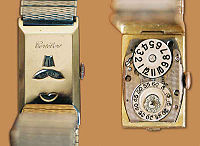 A digital display simply shows the time as a number, e.g., 12:08 instead of a short hand pointing towards the number 12 and a long hand 8/60 of the way round the dial. The digits are usually shown as a seven-segment display
.
The first digital mechanical pocket watches appeared in late 19th century. In the 1920s the first digital mechanical wristwatches appeared.
The first digital electronic watch, a Pulsar
LED prototype in 1970, was developed jointly by Hamilton Watch Company
and Electro-Data. John Bergey, the head of Hamilton's Pulsar division, said that he was inspired to make a digital timepiece by the then-futuristic digital clock that Hamilton themselves made for the 1968 science fiction film 2001: A Space Odyssey
. On April 4, 1972, the Pulsar was finally ready, made in 18-carat gold and sold for $2,100. It had a red light-emitting diode
(LED) display.
Digital LED watches were very expensive and out of reach to the common consumer until 1975, when Texas Instruments
started to mass produce LED watches inside a plastic case. These watches, which first retailed for only $20, reduced to $10 in 1976, saw Pulsar lose $6 million and the Pulsar brand sold to Seiko
.
Most watches with LED displays required that the user press a button to see the time displayed for a few seconds, because LEDs used so much power that they could not be kept operating continuously. Usually the LED display color would be red. Watches with LED displays were popular for a few years, but soon the LED displays were superseded by liquid crystal display
s (LCDs), which used less battery power and were much more convenient in use, with the display always visible and no need to push a button before seeing the time. The first LCD watch with a six-digit LCD was the 1973 Seiko
06LC, although various forms of early LCD watches with a four-digit display were marketed as early as 1972 including the 1972 Gruen Teletime LCD Watch, and the Cox Electronic Systems Quarza. In Switzerland, Ebauches Electronic SA presented a prototype eight-digit LCD wristwatch showing time and date at the MUBA Fair, Basle, in March 1973, using a Twisted Nematic LCD manufactured by Brown, Boveri & Cie
, Switzerland, which became the supplier of LCDs to Casio
for the CASIOTRON watch in 1974.
From the 1980s onward, digital watch technology vastly improved. In 1982 Seiko produced a watch with a small television screen built in, and Casio produced a digital watch with a thermometer as well as another that could translate 1,500 Japanese words into English. In 1985, Casio produced the CFX-400 scientific calculator watch. In 1987 Casio produced a watch that could dial your telephone number and Citizen revealed one that would react to your voice. In 1995 Timex released a watch which allowed the wearer to download and store data from a computer to his wrist. Some watches, such as the Timex Datalink USB, feature dot matrix
displays. Since their apex during the late 1980s to mid 1990s high technology fad, digital watches have mostly become simpler, less expensive time pieces with little variety between models.
Despite these many advances, almost all watches with digital displays are used as timekeeping watches. Expensive watches for collectors rarely have digital displays since there is little demand for them. Less craftsmanship is required to make a digital watch face and most collectors find that analog dials (especially with complications
) vary in quality more than digital dials due to the details and finishing of the parts that make up the dial (thus making the differences between a cheap and expensive watch more evident).
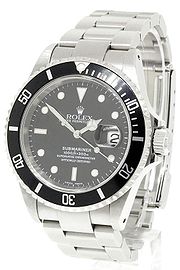 All watches provide the time of day, giving at least the hour and minute, and usually the second. Most also provide the current date, and often the day of the week as well. However, many watches also provide a great deal of information beyond the basics of time and date. Some watches include alarm
s. Other elaborate and more expensive watches, both pocket and wrist models, also incorporate striking mechanisms
or repeater functions, so that the wearer could learn the time by the sound emanating from the watch. This announcement or striking feature is an essential characteristic of true clocks and distinguishes such watches from ordinary timepieces
. This feature is available on most digital watches.
A complicated watch has one or more functions beyond the basic function of displaying the time and the date; such a functionality is called a complication
. Two popular complications are the chronograph
complication, which is the ability of the watch movement to function as a stopwatch
, and the moonphase complication, which is a display of the lunar phase
. Other more expensive complications include Tourbillon
, Perpetual calendar
, Minute repeater
, and Equation of time
. A truly complicated watch has many of these complications at once (see Calibre 89
from Patek Philippe for instance). Some watches can both indicate the direction of Mecca
and have alarms that can be set for all daily prayer requirements. Among watch enthusiasts, complicated watches are especially collectible. Some watches include a second 12-hour display for UTC (as Pontos Grand Guichet GMT).
The similar-sounding terms chronograph and chronometer are often confused, although they mean altogether different things. A chronograph has a stopwatch
complication, as explained above, while a chronometer watch
has a high quality mechanical or a thermo-compensated quartz movement that has been tested and certified to operate within a certain standard of accuracy by the COSC
(Contrôle Officiel Suisse des Chronomètres). The concepts are different but not mutually exclusive; so a watch can be a chronograph, a chronometer, both, or neither.
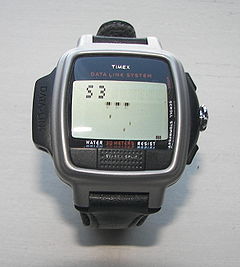 Many computerized wristwatches have been developed, but none have had long-term sales success, because they have awkward user interface
s due to the tiny screens and buttons, and a short battery life. As miniaturized electronics became cheaper, watches have been developed containing calculator
s, tonometers, barometer
s, altimeter
s, a compass
using both hands to show the N/S direction, video games, digital camera
s, keydrives, GPS receivers and cellular phones. In the early 1980s Seiko
marketed a watch with a television in it. Such watches have also had the reputation as unsightly and thus mainly geek
toys. Several companies have however attempted to develop a computer
contained in a wristwatch (see also wearable computer
).
Braille watch
es have analog displays with raised bumps around the face to allow blind users to tell the time. Their digital equivalents use synthesised speech to speak the time on command.
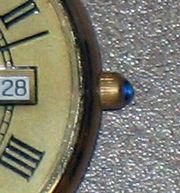 Wristwatches are often appreciated as jewelry or as collectible
works of art
rather than just as timepieces. This has created several different markets for wristwatches, ranging from very inexpensive but accurate watches (intended for no other purpose than telling the correct time) to extremely expensive watches that serve mainly as personal adornment (featuring jewel bearing
s to hold gemstone
s) or as examples of high achievement in miniaturization and precision mechanical engineering.
Traditionally, men's dress watches appropriate for informal
(business), semi-formal
, and formal
attire are gold
, thin, simple, and plain, but recent conflation of dressiness and high price has led to a belief among some that expensive rugged, complicated
, or sports watches are also dressy because of their high cost. Some dress watches have a cabochon
on the crown and many women's dress watches have facet
ed gemstone
s on the face, bezel
, or bracelet. Some are made entirely of facetted sapphire
(corundum
).
Many fashion and department store
s offer a variety of less-expensive, trendy, "costume
" watches (usually for women), many of which are similar in quality to basic quartz timepieces but which feature bolder designs. In the 1980s, the Swiss Swatch
company hired graphic designers to redesign a new annual collection of non-repairable watches.
Most companies that produce watches specialize in one or some of these markets. Companies such as Patek Philippe, Blancpain
and Jaeger-LeCoultre
specialize in simple and complicated mechanical dress watches; companies such as Omega SA, Ball Watch Company
, TAG Heuer
, Sinn, Breitling
, Panerai
and Rolex
specialize in rugged, reliable mechanical watches for sport and aviation use. Companies such as Casio
, Timex, and Seiko
specialize in watches as affordable timepieces or multifunctional computers.
Counterfeit watch
es which mimic expensive fashions watches are estimated to cost the watchmaker industry per year.
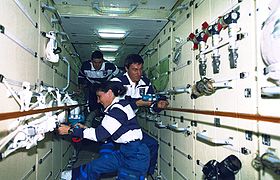
 Zero gravity
environment and other extreme conditions encountered by astronaut
s in space
requires the use of specially tested watches. On April 12, 1961, Yuri Gagarin
wore a Shturmanskie (a transliteration of Штурманские which actually means "navigator's") wristwatch during his historic first flight into space. The Shturmanskie was manufactured at the First Moscow Factory
. Since 1964, the watches of the First Moscow Factory
have been marked by the trademark "ПОЛЕТ", transliterated as "POLJOT", which means "flight" in Russian
and is a tribute to the many space trips its watches have accomplished. In the late 1970s, Poljot
launched a new chrono
movement, the 3133. With a 23 jewel movement and manual winding (43 hours), it was a modified Russian version of the Swiss Valjoux
7734 of the early 1970s. Poljot
3133 were taken into space by astronaut
s from Russia, France, Germany and Ukraine
. On the arm of Valeriy Polyakov
, a Poljot
3133 chronograph movement-based watch set a space record
for the longest space flight in history.
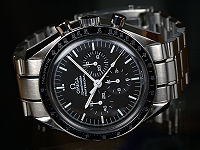
 During the 1960s, a large range of watches were tested for durability and precision under extreme temperature
changes and vibrations. The Omega Speedmaster Professional was selected by NASA, the U.S. space agency. Heuer
became the first Swiss watch in space thanks to a Heuer Stopwatch, worn by John Glenn
in 1962 when he piloted the Friendship 7 on the first manned U.S. orbital mission. The Breitling
Navitimer Cosmonaute was designed with a 24-hour analog dial to avoid confusion between AM and PM, which are meaningless in space. It was first worn in space by U.S. astronaut Scott Carpenter
on May 24, 1962 in the Aurora 7 mercury capsule. Since 1994 Fortis
is the exclusive supplier for manned space missions authorized by the Russian Federal Space Agency
. China National Space Administration
(CNSA) astronauts wear the Fiyta spacewatches. At BaselWorld
, 2008, Seiko
announced the creation of the first watch ever designed specifically for a space walk, Spring Drive Spacewalk. Timex Datalink
is flight certified by NASA
for space missions and is one of the watches qualified by NASA for space travel.Both the Casio G-Shock DW-5600C and 5600E are Flight-Qualified for NASA space travel. The various Datalink models were used both by cosmonauts and astronauts.
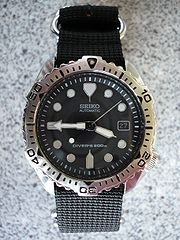 Watches may be crafted to become water resistant. These watches are sometimes called diving watches when they are suitable for scuba diving
or saturation diving
. The International Organization for Standardization
issued a standard for water resistant watches which also prohibits the term "waterproof" to be used with watches, which many countries have adopted.
Water resistance is achieved by the gasket
s which forms a watertight seal, used in conjunction with a sealant applied on the case to help keep water out. The material of the case must also be tested in order to pass as water resistant.
None of the tests defined by ISO 2281 for the Water Resistant mark are suitable to qualify a watch for scuba diving. Such watches are designed for everyday life and must be water resistant during exercises such as swimming. They can be worn in different temperature and pressure conditions but are under no circumstances designed for scuba diving.
The standards for diving watches are regulated by the ISO 6425 international standard. The watches are tested in static or still water under 125% of the rated (water)pressure, thus a watch with a 200 metre rating will be water resistant if it is stationary and under 250 metres of static water. The testing of the water resistance is fundamentally different from non-dive watches, because every watch has to be fully tested. Besides water resistance standards to a minimum of 100 metre depth rating ISO 6425 also provides eight minimum requirements for mechanical diver's watches for scuba diving (quartz and digital watches have slightly differing readability requirements). For diver's watches for mixed-gas saturation diving two additional requirements have to be met.
Watches are classified by their degree of water resistance, which roughly translates to the following (1 metre = 3.281 feet):
Some watches use bar
instead of meters, which may then be multiplied by 10, and then subtracted by 10. This is because 1 bar is equal to one atmosphere or 10 metres of water (therefore 1 bar at the surface and one more each 10 metres). to be approximately equal to the rating based on metres. Therefore, a 5 bar watch is equivalent to a 40 metre watch. Some watches are rated in atmospheres
(atm), which are roughly equivalent to bar.
Before wristwatches became popular in the 1920s, most watches were pocket watch
Pocket watch
A pocket watch is a watch that is made to be carried in a pocket, as opposed to a wristwatch, which is strapped to the wrist. They were the most common type of watch from their development in the 16th century until wristwatches became popular after World War I during which a transitional design,...
es, which often had covers and were carried in a pocket and attached to a watch chain or watch fob. In early 1900s, the wristwatch, originally called a Wristlet, was reserved for women and considered more of a passing fad than a serious timepiece. Real gentlemen, who carried pocket watches, were actually quoted as saying they would "sooner wear a skirt as wear a wristwatch". This all changed in World War I
World War I
World War I , which was predominantly called the World War or the Great War from its occurrence until 1939, and the First World War or World War I thereafter, was a major war centred in Europe that began on 28 July 1914 and lasted until 11 November 1918...
when soldiers on the battlefield found using a pocket watch to be impractical, so they attached the pocket watch to their wrist by a cupped leather strap. It is also believed that Girard-Perregaux
Girard-Perregaux
Girard-Perregaux is a high-end Swiss watch manufacture with its origins dating back to 1791. It is situated in La Chaux-de-Fonds, Switzerland and is a part of the Sowind group, a subsidiary of PPR.- History :...
equipped the German Imperial Navy in a similar fashion as early as the 1880s, which were used while synchronizing naval attacks and firing artillery.
Most inexpensive and medium-priced watches used mainly for timekeeping are electronic watches with quartz movements. Expensive, collectible
Collectible
A collectable or collectible is any object regarded as being of value or interest to a collector . There are numerous types of collectables and terms to denote those types. An antique is a collectable that is old...
watches valued more for their workmanship
Workmanship
Workmanship is an EP by Joy Electric released exclusively as a 7" vinyl record album through Republic of Texas Recordings. Workmanship was completely written and recorded by Ronnie Martin on a Minimoog Voyager synthesizer...
and aesthetic appeal than for simple timekeeping, often have purely mechanical movements and are powered by springs, even though mechanical movements are less accurate than more affordable quartz movements. In addition to the time, modern watches often display the day, date, month and year, and electronic watches may have many other functions. Watches that provide additional time-related features such as timer
Timer
A timer is a specialized type of clock. A timer can be used to control the sequence of an event or process. Whereas a stopwatch counts upwards from zero for measuring elapsed time, a timer counts down from a specified time interval, like an hourglass.Timers can be mechanical, electromechanical,...
s, chronograph
Chronograph
A chronograph is a timepiece or watch with both timekeeping and stopwatch functions as well as other functions. Pocket watch chronographs were produced as early as the 18th century but did not become popular until the 1820s...
s and alarm functions are not uncommon. Some modern designs even go as far as using GPS technology or heart-rate monitoring capabilities.
Movement
Movement (clockwork)
In horology, a movement is the internal mechanism of a clock or watch, as opposed to the case, which encloses and protects the movement, and the face which displays the time. The term originated with mechanical timepieces, whose movements are made of many moving parts...
in watchmaking is the mechanism that measures the passage of time and displays the current time (and possibly other information including date, month and day). Movements may be entirely mechanical, entirely electronic (potentially with no moving parts), or a blend of the two. Most watches intended mainly for timekeeping today have electronic movements, with mechanical hands on the watch face indicating the time.
Mechanical movements
Compared to electronic movements, mechanical watches are less accurate, often with errors of seconds per day, and they are sensitive to position, temperature and magnetism. They are also costly to produce, require regular maintenance and adjustment, and are more prone to failure. Nevertheless, the craftsmanship of mechanical watches still attracts interest from part of the watch-buying public. Skeleton watchSkeleton watch
A skeleton watch is a mechanical watch , in which all of the moving parts are visible through either the front of the watch, the back of the watch or a small cut outlining the dial....
es are designed to leave the mechanism visible for aesthetic purposes.
Mechanical movements use an escapement
Escapement
In mechanical watches and clocks, an escapement is a device that transfers energy to the timekeeping element and enables counting the number of oscillations of the timekeeping element...
mechanism to control and limit the unwinding and winding parts of a spring, converting what would otherwise be a simple unwinding into a controlled and periodic energy release. Mechanical movements also use a balance wheel
Balance wheel
The balance wheel is the timekeeping device used in mechanical watches and some clocks, analogous to the pendulum in a pendulum clock. It is a weighted wheel that rotates back and forth, being returned toward its center position by a spiral spring, the balance spring or hairspring...
together with the balance spring
Balance spring
A balance spring, or hairspring, is a part used in mechanical timepieces. The balance spring, attached to the balance wheel, controls the speed at which the wheels of the timepiece turn, and thus the rate of movement of the hands...
(also known as a hairspring) to control motion of the gear system of the watch in a manner analogous to the pendulum
Pendulum
A pendulum is a weight suspended from a pivot so that it can swing freely. When a pendulum is displaced from its resting equilibrium position, it is subject to a restoring force due to gravity that will accelerate it back toward the equilibrium position...
of a pendulum clock
Pendulum clock
A pendulum clock is a clock that uses a pendulum, a swinging weight, as its timekeeping element. The advantage of a pendulum for timekeeping is that it is a resonant device; it swings back and forth in a precise time interval dependent on its length, and resists swinging at other rates...
. The tourbillon
Tourbillon
In horology, a tourbillon is an addition to the mechanics of a watch escapement. Developed around 1795 by the French-Swiss watchmaker Abraham-Louis Breguet from an earlier idea by the English chronometer maker John Arnold a tourbillon aims to counter the effects of gravity by mounting the...
, an optional part for mechanical movements, is a rotating frame for the escapement, which is used to cancel out or reduce the effects of gravitational bias to the timekeeping. Due to the complexity of designing a tourbillon, they are very expensive, and only found in "prestige" watches.
The pin-lever escapement (called the Roskopf movement after its inventor, Georges Frederic Roskopf
Georges Frederic Roskopf
Georges F. Roskopf , the inventor of the pin-pallet escapement, was born in Germany and became a naturalized Swiss citizen.- Early life and introduction :...
), which is a cheaper version of the fully levered movement, was manufactured in huge quantities by many Swiss manufacturers as well as Timex, until it was replaced by quartz movements.
Tuning-fork watches use a type of electromechanical movement. Introduced by Bulova
Bulova
Bulova is a corporation making luxury watches and clocks. It has its headquarters in Woodside, Queens, New York City.Bulova was founded and incorporated as the J. Bulova Company in 1875 by Joseph Bulova , an immigrant from Bohemia...
in 1960, they use a tuning fork with a precise frequency (most often 360 hertz
Hertz
The hertz is the SI unit of frequency defined as the number of cycles per second of a periodic phenomenon. One of its most common uses is the description of the sine wave, particularly those used in radio and audio applications....
) to drive a mechanical watch. The task of converting electronically pulsed fork vibration into rotary movement is done via two tiny jeweled fingers, called pawls. Tuning-fork watches were rendered obsolete when electronic quartz watches were developed, because quartz watches were cheaper to produce and even more accurate.
Traditional mechanical watch movements use a spiral spring called a mainspring
Mainspring
A mainspring is a spiral torsion spring of metal ribbon that is the power source in mechanical watches and some clocks. Winding the timepiece, by turning a knob or key, stores energy in the mainspring by twisting the spiral tighter. The force of the mainspring then turns the clock's wheels as it...
as a power source. In manual watches the spring must be rewound periodically by the user by turning the watch crown. Antique pocketwatches were wound by inserting a separate key into a hole in the back of the watch and turning it. Most modern watches are designed to run 40 hours on a winding and thus must be wound daily, but some run for several days and a few have 192-hour mainsprings and are wound weekly.
A self-winding or automatic watches is one that rewinds the mainspring of a mechanical movement by the natural motions of the wearer's body. The first self-winding mechanism was invented for pocketwatches in 1770 by
Abraham-Louis Perrelet, but the first "self-winding", or "automatic", wristwatch was the invention of a British watch repairer named John Harwood
John Harwood
John Harwood is an American journalist who is the Chief Washington Correspondent for CNBC and a writer for The New York Times. He writes a weekly column entitled "The Caucus" that appears on Monday about Washington politics and policy...
in 1923. This type of watch allows for constant winding without special action from the wearer; it works by an eccentric weight, called a winding rotor, which rotates with the movement of the wearer's wrist. The back-and-forth motion of the winding rotor couples to a ratchet
Ratchet (device)
A ratchet is a device that allows continuous linear or rotary motion in only one direction while preventing motion in the opposite direction. Because most socket wrenches today use ratcheting handles, the term "ratchet" alone is often used to refer to a ratcheting wrench, and the terms "ratchet"...
to automatically wind the mainspring. Self-winding watches usually can also be wound manually so they can be kept running when not worn or if the wearer's wrist motions are inadequate to keep the watch wound.
Electronic movements
Electronic movements have few or no moving parts, as they use the piezoelectric effect in a tiny quartzQuartz
Quartz is the second-most-abundant mineral in the Earth's continental crust, after feldspar. It is made up of a continuous framework of SiO4 silicon–oxygen tetrahedra, with each oxygen being shared between two tetrahedra, giving an overall formula SiO2. There are many different varieties of quartz,...
crystal to provide a stable time base for a mostly electronic movement. The crystal forms a quartz oscillator which resonates
Resonance
In physics, resonance is the tendency of a system to oscillate at a greater amplitude at some frequencies than at others. These are known as the system's resonant frequencies...
at a specific and highly stable frequency, and which can be used to accurately pace a timekeeping mechanism. For this reason, electronic watches are often called quartz watches. Most quartz movements are primarily electronic but are geared to drive mechanical hands on the face of the watch in order to provide a traditional analog display of the time, which is still preferred by some consumers.
In 1959 Seiko
Seiko
, more commonly known simply as Seiko , is a Japanese watch company.-History and ongoing developments:The company was founded in 1881, when Kintarō Hattori opened a watch and jewelry shop called in the Ginza area of Tokyo, Japan. Eleven years later, in 1892, he began to produce clocks under the...
gave an order to Epson (a daughter company of Seiko and the actual brain behind the quartz revolution) to start developing a quartz wristwatch. The project was codenamed 59A and by the 1964 Tokyo Summer Olympics, Seiko had a working prototype of a portable quartz watch which took part in time measurements throughout the event.
The first prototypes of an electronic quartz wristwatch (not just portable quartz watches as the Seiko timekeeping devices at the Tokyo Olympics in 1964) were made by the CEH research laboratory in Neuchâtel, Switzerland. From 1965 through 1967 pioneering development work was done on a miniaturized 8192 Hz quartz oscillator, a thermo-compensation module and an inhouse-made, dedicated integrated circuit (unlike the hybrid circuits used in the later Seiko Astron wristwatch). As a result, the BETA 1 prototype set new timekeeping performance records at the International Chronometric Competition held at the Observatory of Neuchâtel in 1967.
The first quartz watch to enter production was the Seiko
Seiko
, more commonly known simply as Seiko , is a Japanese watch company.-History and ongoing developments:The company was founded in 1881, when Kintarō Hattori opened a watch and jewelry shop called in the Ginza area of Tokyo, Japan. Eleven years later, in 1892, he began to produce clocks under the...
35 SQ Astron
Astron (wristwatch)
The Astron wristwatch, formally known as the Seiko Quartz-Astron 35SQ, was the world's first "quartz clock" wristwatch, i.e., one based on a quartz crystal oscillator...
, which hit the shelves on December 25, 1969. One particularly interesting decision made by Seiko at that time was to not patent the whole movement of the quartz wristwatch, thus allowing other manufacturers to benefit from the Seiko technology. This played a major role in the popularity and quick development of the quartz watch, which in less than a decade was dominant in the watch market, nearly ending an almost 100 years of mechanical wristwatch heritage. The modern quartz movements are produced in very large quantities, and even the cheapest wristwatches typically have quartz movements. Whereas mechanical movements can typically be off by several seconds a day, an inexpensive quartz movement in a child's wristwatch may still be accurate to within half a second per day—ten times better than a mechanical movement.
After a consolidation of the mechanical watch industry in Switzerland during the 1970s, mass production of quartz wristwatches took off under the leadership of the Swatch
Swatch
Swatch is a brand name for a line of wrist watches from the Swatch Group, a Swiss conglomerate with vertical control of the production of Swiss watches and related products...
Group of companies, a Swiss conglomerate with vertical control of the production of Swiss watches and related products.
For quartz wristwatches, subsidiaries of Swatch manufactured watch batteries (Renata), oscillators (Oscilloquartz
Oscilloquartz
Oscilloquartz, a company of the Swatch Group, is a manufacturer of frequency sources, such as quartz crystal oscillators , GPS& GLONASS receivers or caesium clocks for telecommunications applications and has been producing similar products for about 60 years. It also providers synchronization...
) and integrated circuits (Ebauches Electronic SA). The launch of the new SWATCH brand in 1983, was marked by bold new styling, design and marketing. Today, the Swatch Group is the world's largest watch company.
Seiko's efforts to combine the quartz and mechanical movements bore fruit after 20 years of research, leading to the introduction of the Seiko
Seiko
, more commonly known simply as Seiko , is a Japanese watch company.-History and ongoing developments:The company was founded in 1881, when Kintarō Hattori opened a watch and jewelry shop called in the Ginza area of Tokyo, Japan. Eleven years later, in 1892, he began to produce clocks under the...
Spring Drive
Spring Drive
The Spring Drive is a novel watch movement that was developed by Seiko Epson through collaboration with Seiko Instruments and Seiko Holdings.It uses a mainspring, barrel, automatic winder and stem winding like in a mechanical watch to store the watch energy...
, first in a limited domestic market production in 1999 and to the world in September 2005. The Spring Drive manages to keep time within quartz standards without the use of a battery, using a traditional mechanical gear train powered by a spring, while at the same time doesn't have the need of a balance wheel either.
Radio time signal watches are a type of electronic quartz watch which synchronizes (time transfer
Time transfer
Time transfer is a scheme where multiple sites share a precise reference time. Time transfer solves problems such as astronomical observatories correlating observed flashes or other phenomenon with each other, as well as cell phone towers coordinating handoffs as a phone moves from one cell to...
) its time with an external time source such as in atomic clock
Atomic clock
An atomic clock is a clock that uses an electronic transition frequency in the microwave, optical, or ultraviolet region of the electromagnetic spectrum of atoms as a frequency standard for its timekeeping element...
s, time signals from GPS navigation satellites, the German DCF77
DCF77
DCF77 is a longwave time signal and standard-frequency radio station. Its primary and backup transmitter are located in Mainflingen, about 25 km south-east of Frankfurt am Main, Germany. It is operated by Media Broadcast GmbH , on behalf of the Physikalisch-Technische Bundesanstalt, Germany's...
signal in Europe, WWVB
WWVB
WWVB is a NIST time signal radio station near Fort Collins, Colorado, co-located with WWV. WWVB is the station that radio-controlled clocks in most of North America use to synchronize themselves. The signal transmitted from WWVB is a continuous 60 kHz carrier wave, derived from a set of atomic...
in the US, and others. Movements of this type may -among others- synchronize not only the time of day but also the date, the leap-year
Leap year
A leap year is a year containing one extra day in order to keep the calendar year synchronized with the astronomical or seasonal year...
status of the current year, and the current state of daylight saving time
Daylight saving time
Daylight saving time —also summer time in several countries including in British English and European official terminology —is the practice of temporarily advancing clocks during the summertime so that afternoons have more daylight and mornings have less...
(on or off). However, other than the radio receiver these watches are normal quartz watches in all other aspects.
Electronic watches require electricity as a power source. Some mechanical movements and hybrid electronic-mechanical movements also require electricity. Usually the electricity is provided by a replaceable battery
Battery (electricity)
An electrical battery is one or more electrochemical cells that convert stored chemical energy into electrical energy. Since the invention of the first battery in 1800 by Alessandro Volta and especially since the technically improved Daniell cell in 1836, batteries have become a common power...
. The first use of electrical power in watches was as a substitute for the mainspring, in order to remove the need for winding. The first electrically powered watch, the Hamilton Electric 500, was released in 1957 by the Hamilton Watch Company
Hamilton Watch Company
The Hamilton Watch Company was originally formed to produce high quality pocket watches and wristwatches mid-range and luxury. Hamilton would become a corporate conglomerate diversified in other operations...
of Lancaster, Pennsylvania
Lancaster, Pennsylvania
Lancaster is a city in the south-central part of the Commonwealth of Pennsylvania. It is the county seat of Lancaster County and one of the older inland cities in the United States, . With a population of 59,322, it ranks eighth in population among Pennsylvania's cities...
.
Watch batteries (strictly speaking cells, as a battery is composed of multiple cells) are specially designed for their purpose. They are very small and provide tiny amounts of power continuously for very long periods (several years or more). In most cases, replacing the battery requires a trip to a watch-repair shop or watch dealer; this is especially true for watches that are designed to be water-resistant, as special tools and procedures are required to ensure that the watch remains water-resistant after battery replacement. Silver-oxide and lithium batteries are popular today; mercury batteries, formerly quite common, are no longer used, for environmental reasons. Cheap batteries may be alkaline, of the same size as silver-oxide cells but providing shorter life. Rechargeable batteries are used in some solar powered watches.
Some electronic watches are also powered by the movement of the wearer of the watch. For instance, Seiko's Kinetic powered quartz watches
Automatic quartz
Automatic quartz is a collective term describing watch movements that combine a self-winding rotor mechanism to generate electricity with a piezoelectric quartz crystal as its timing element. Such movements aim to provide the advantages of quartz without the environmental impact of batteries...
make use of the motion of the wearer's arm turning a rotating weight which causes a tiny generator
Electrical generator
In electricity generation, an electric generator is a device that converts mechanical energy to electrical energy. A generator forces electric charge to flow through an external electrical circuit. It is analogous to a water pump, which causes water to flow...
to supply power to charge a rechargeable battery that runs the watch. The concept is similar to that of self-winding spring movements, except that electrical power is generated instead of mechanical spring tension.
Solar powered watch
Solar powered watch
A solar-powered watch is a watch that is powered entirely or partly by a solar panel.Some of the early solar watches of the 1970s had innovative and unique designs to accommodate the array of solar cells needed to power them...
es are powered by light. A photovoltaic cell on the face (dial) of the watch converts light to electricity, which in turn is used to charge a rechargeable battery or capacitor
Capacitor
A capacitor is a passive two-terminal electrical component used to store energy in an electric field. The forms of practical capacitors vary widely, but all contain at least two electrical conductors separated by a dielectric ; for example, one common construction consists of metal foils separated...
. The movement of the watch draws its power from the rechargeable battery
Rechargeable battery
A rechargeable battery or storage battery is a group of one or more electrochemical cells. They are known as secondary cells because their electrochemical reactions are electrically reversible. Rechargeable batteries come in many different shapes and sizes, ranging anything from a button cell to...
or capacitor. As long as the watch is regularly exposed to fairly strong light (such as sunlight), it never needs battery replacement, and some models need only a few minutes of sunlight to provide weeks of energy (as in the Citizen Eco-Drive
Eco-Drive
Eco-Drive is the series name of a line of mainly light powered watches manufactured by the Citizen Watch Co., Ltd. The first Eco-Drive watches were sold in 1995.-Light as power source:...
). Some of the early solar watches of the 1970s had innovative and unique designs to accommodate the array of solar cells needed to power them (Synchronar, Nepro, Sicura and some models by Cristalonic, Alba, Seiko and Citizen). As the decades progressed and the efficiency of the solar cells increased while the power requirements of the movement and display decreased, solar watches began to be designed to look like other conventional watches.
A rarely used power source is the temperature difference between the wearer's arm and the surrounding environment (as applied in the Citizen Eco-Drive
Eco-Drive
Eco-Drive is the series name of a line of mainly light powered watches manufactured by the Citizen Watch Co., Ltd. The first Eco-Drive watches were sold in 1995.-Light as power source:...
Thermo).
Analog
Traditionally, watches have displayed the time in analog form, with a numbered dial upon which are mounted at least a rotating hour hand and a longer, rotating minute hand. Many watches also incorporate a third hand that shows the current second of the current minute. Watches powered by quartz usually have a second hand that snaps every second to the next marker. Watches powered by a mechanical movement have a "sweep second hand", the name deriving from its uninterrupted smooth (sweeping) movement across the markers, although this is actually a misnomer in most cases; the hand merely moves in smaller steps, typically 1/5 of a second, corresponding to the beat (half period) of the balance wheel. In some escapements (for example the duplex escapement), the hand advances every two beats (full period) of the balance wheel, typically 1/2 second in those watches, or even every four beats (two periods, 1 second), in the double duplex escapement. A truly sweeping second hand is achieved with the tri-synchro regulator of Spring DriveSpring Drive
The Spring Drive is a novel watch movement that was developed by Seiko Epson through collaboration with Seiko Instruments and Seiko Holdings.It uses a mainspring, barrel, automatic winder and stem winding like in a mechanical watch to store the watch energy...
watches. All of the hands are normally mechanical, physically rotating on the dial, although a few watches have been produced with "hands" that are simulated by a liquid-crystal display
Liquid crystal display
A liquid crystal display is a flat panel display, electronic visual display, or video display that uses the light modulating properties of liquid crystals . LCs do not emit light directly....
.
Analog display of the time is nearly universal in watches sold as jewelry or collectibles, and in these watches, the range of different styles of hands, numbers, and other aspects of the analog dial is very broad. In watches sold for timekeeping, analog display remains very popular, as many people find it easier to read than digital display; but in timekeeping watches the emphasis is on clarity and accurate reading of the time under all conditions (clearly marked digits, easily visible hands, large watch faces, etc.). They are specifically designed for the left wrist with the stem (the knob used for changing the time) on the right side of the watch; this makes it easy to change the time without removing the watch from the wrist. This is the case if one is right-handed and the watch is worn on the left wrist (as is traditionally done). If one is left-handed and wears the watch on the right wrist, one has to remove the watch from the wrist to reset the time or to wind the watch.
Analog watches as well as clocks are often marketed showing a display time of approximately 10:09 or 10:10. This creates a visually pleasing smile-like face on upper half of the watch, in addition to enclosing the manufacturer's name. Digital displays often show a time of 12:08, where the increases in the numbers from left to right culminating in the fully lit numerical display of the 8 also gives a positive feeling.
Analog watch displays can be used to indicate cardinal direction
Cardinal direction
The four cardinal directions or cardinal points are the directions of north, east, south, and west, commonly denoted by their initials: N, E, S, W. East and west are at right angles to north and south, with east being in the direction of rotation and west being directly opposite. Intermediate...
due to the relation between the position of the hour hand and the position of the Sun in the sky. By rotating the watch so that the hour hand points toward the Sun, the point halfway between the hour hand and 12 o'clock will indicate south when observing from a position in the Northern hemisphere. In the Southern hemisphere, the point halfway between the hour hand pointed at the sun and 12 o'clock on the dial indicates North.
Digital
Seven-segment display
A seven-segment display , or seven-segment indicator, is a form of electronic display device for displaying decimal numerals that is an alternative to the more complex dot-matrix displays...
.
The first digital mechanical pocket watches appeared in late 19th century. In the 1920s the first digital mechanical wristwatches appeared.
The first digital electronic watch, a Pulsar
Pulsar (watch)
Pulsar is a brand of watch and a division of Seiko Watch Corporation of America . While Pulsar was the world's first electronic digital watch, today Pulsar watches are usually analog...
LED prototype in 1970, was developed jointly by Hamilton Watch Company
Hamilton Watch Company
The Hamilton Watch Company was originally formed to produce high quality pocket watches and wristwatches mid-range and luxury. Hamilton would become a corporate conglomerate diversified in other operations...
and Electro-Data. John Bergey, the head of Hamilton's Pulsar division, said that he was inspired to make a digital timepiece by the then-futuristic digital clock that Hamilton themselves made for the 1968 science fiction film 2001: A Space Odyssey
2001: A Space Odyssey (film)
2001: A Space Odyssey is a 1968 epic science fiction film produced and directed by Stanley Kubrick, and co-written by Kubrick and Arthur C. Clarke, partially inspired by Clarke's short story The Sentinel...
. On April 4, 1972, the Pulsar was finally ready, made in 18-carat gold and sold for $2,100. It had a red light-emitting diode
Light-emitting diode
A light-emitting diode is a semiconductor light source. LEDs are used as indicator lamps in many devices and are increasingly used for other lighting...
(LED) display.
Digital LED watches were very expensive and out of reach to the common consumer until 1975, when Texas Instruments
Texas Instruments
Texas Instruments Inc. , widely known as TI, is an American company based in Dallas, Texas, United States, which develops and commercializes semiconductor and computer technology...
started to mass produce LED watches inside a plastic case. These watches, which first retailed for only $20, reduced to $10 in 1976, saw Pulsar lose $6 million and the Pulsar brand sold to Seiko
Seiko
, more commonly known simply as Seiko , is a Japanese watch company.-History and ongoing developments:The company was founded in 1881, when Kintarō Hattori opened a watch and jewelry shop called in the Ginza area of Tokyo, Japan. Eleven years later, in 1892, he began to produce clocks under the...
.
Most watches with LED displays required that the user press a button to see the time displayed for a few seconds, because LEDs used so much power that they could not be kept operating continuously. Usually the LED display color would be red. Watches with LED displays were popular for a few years, but soon the LED displays were superseded by liquid crystal display
Liquid crystal display
A liquid crystal display is a flat panel display, electronic visual display, or video display that uses the light modulating properties of liquid crystals . LCs do not emit light directly....
s (LCDs), which used less battery power and were much more convenient in use, with the display always visible and no need to push a button before seeing the time. The first LCD watch with a six-digit LCD was the 1973 Seiko
Seiko
, more commonly known simply as Seiko , is a Japanese watch company.-History and ongoing developments:The company was founded in 1881, when Kintarō Hattori opened a watch and jewelry shop called in the Ginza area of Tokyo, Japan. Eleven years later, in 1892, he began to produce clocks under the...
06LC, although various forms of early LCD watches with a four-digit display were marketed as early as 1972 including the 1972 Gruen Teletime LCD Watch, and the Cox Electronic Systems Quarza. In Switzerland, Ebauches Electronic SA presented a prototype eight-digit LCD wristwatch showing time and date at the MUBA Fair, Basle, in March 1973, using a Twisted Nematic LCD manufactured by Brown, Boveri & Cie
Brown, Boveri & Cie
Brown, Boveri & Cie was a Swiss group of electrical engineering companies.It was founded in Baden, Switzerland, in 1891 by Charles Eugene Lancelot Brown and Walter Boveri who worked at the Maschinenfabrik Oerlikon. In 1970 BBC took over the Maschinenfabrik Oerlikon...
, Switzerland, which became the supplier of LCDs to Casio
Casio
is a multinational electronic devices manufacturing company founded in 1946, with its headquarters in Shibuya, Tokyo, Japan. Casio is best known for its electronic products, such as calculators, audio equipment, PDAs, cameras, musical instruments, and watches...
for the CASIOTRON watch in 1974.
From the 1980s onward, digital watch technology vastly improved. In 1982 Seiko produced a watch with a small television screen built in, and Casio produced a digital watch with a thermometer as well as another that could translate 1,500 Japanese words into English. In 1985, Casio produced the CFX-400 scientific calculator watch. In 1987 Casio produced a watch that could dial your telephone number and Citizen revealed one that would react to your voice. In 1995 Timex released a watch which allowed the wearer to download and store data from a computer to his wrist. Some watches, such as the Timex Datalink USB, feature dot matrix
Dot matrix
A dot matrix is a 2-dimensional array of LED used to represent characters, symbols and images.Typically the dot matrix is used in older computer printers and many digital display devices. In printers, the dots are usually the darkened areas of the paper...
displays. Since their apex during the late 1980s to mid 1990s high technology fad, digital watches have mostly become simpler, less expensive time pieces with little variety between models.
Despite these many advances, almost all watches with digital displays are used as timekeeping watches. Expensive watches for collectors rarely have digital displays since there is little demand for them. Less craftsmanship is required to make a digital watch face and most collectors find that analog dials (especially with complications
Complication (horology)
In horology , complication refers to any feature in a timepiece beyond the simple display of hours, minutes, and seconds.A timepiece indicating only hours, minutes, and seconds is otherwise known as a simple movement...
) vary in quality more than digital dials due to the details and finishing of the parts that make up the dial (thus making the differences between a cheap and expensive watch more evident).
Functions
Alarm
An alarm device or system of alarm devices gives an audible or visual alarm signal about a problem or condition.Alarm devices include:* burglar alarms, designed to warn of burglaries; this is often a silent alarm: the police or guards are warned without indication to the burglar, which increases...
s. Other elaborate and more expensive watches, both pocket and wrist models, also incorporate striking mechanisms
Striking clock
A striking clock is a clock that sounds the hours audibly on a bell or gong. In 12 hour striking, used most commonly in striking clocks today, the clock strikes once at 1 AM, twice at 2 AM, continuing in this way up to twelve times at 12 noon, then starts over, striking once at 1 PM, twice at 2...
or repeater functions, so that the wearer could learn the time by the sound emanating from the watch. This announcement or striking feature is an essential characteristic of true clocks and distinguishes such watches from ordinary timepieces
Clock
A clock is an instrument used to indicate, keep, and co-ordinate time. The word clock is derived ultimately from the Celtic words clagan and clocca meaning "bell". A silent instrument missing such a mechanism has traditionally been known as a timepiece...
. This feature is available on most digital watches.
A complicated watch has one or more functions beyond the basic function of displaying the time and the date; such a functionality is called a complication
Complication (horology)
In horology , complication refers to any feature in a timepiece beyond the simple display of hours, minutes, and seconds.A timepiece indicating only hours, minutes, and seconds is otherwise known as a simple movement...
. Two popular complications are the chronograph
Chronograph
A chronograph is a timepiece or watch with both timekeeping and stopwatch functions as well as other functions. Pocket watch chronographs were produced as early as the 18th century but did not become popular until the 1820s...
complication, which is the ability of the watch movement to function as a stopwatch
Stopwatch
A stopwatch is a handheld timepiece designed to measure the amount of time elapsed from a particular time when activated to when the piece is deactivated. A large digital version of a stopwatch designed for viewing at a distance, as in a sports stadium, is called a stopclock.The timing functions...
, and the moonphase complication, which is a display of the lunar phase
Lunar phase
A lunar phase or phase of the moon is the appearance of the illuminated portion of the Moon as seen by an observer, usually on Earth. The lunar phases change cyclically as the Moon orbits the Earth, according to the changing relative positions of the Earth, Moon, and Sun...
. Other more expensive complications include Tourbillon
Tourbillon
In horology, a tourbillon is an addition to the mechanics of a watch escapement. Developed around 1795 by the French-Swiss watchmaker Abraham-Louis Breguet from an earlier idea by the English chronometer maker John Arnold a tourbillon aims to counter the effects of gravity by mounting the...
, Perpetual calendar
Perpetual calendar
A perpetual calendar is a calendar which is good for a span of many years, such as the Runic calendar.- General information :...
, Minute repeater
Minute repeater
A repeater is a complication in a mechanical watch or clock that audibly chimes the hours and often minutes at the press of a button. There are many types of repeater, from the simple repeater which merely strikes the number of hours, to the minute repeater which chimes the time down to the...
, and Equation of time
Equation of time
The equation of time is the difference between apparent solar time and mean solar time. At any given instant, this difference will be the same for every observer...
. A truly complicated watch has many of these complications at once (see Calibre 89
Calibre 89
The Patek Philippe Calibre 89 is a commemorative pocket watch created in 1989, to celebrate the company's 150th anniversary. Declared by Patek Philippe as "the most complicated watch in the world", it weighs 1.1 kg, exhibits 24 hands and has 1,728 components in total, including a thermometer and a...
from Patek Philippe for instance). Some watches can both indicate the direction of Mecca
Mecca
Mecca is a city in the Hijaz and the capital of Makkah province in Saudi Arabia. The city is located inland from Jeddah in a narrow valley at a height of above sea level...
and have alarms that can be set for all daily prayer requirements. Among watch enthusiasts, complicated watches are especially collectible. Some watches include a second 12-hour display for UTC (as Pontos Grand Guichet GMT).
The similar-sounding terms chronograph and chronometer are often confused, although they mean altogether different things. A chronograph has a stopwatch
Stopwatch
A stopwatch is a handheld timepiece designed to measure the amount of time elapsed from a particular time when activated to when the piece is deactivated. A large digital version of a stopwatch designed for viewing at a distance, as in a sports stadium, is called a stopclock.The timing functions...
complication, as explained above, while a chronometer watch
Chronometer watch
A chronometer watch is a specific type of watch tested and certified to meet certain precision standards. In Switzerland, only timepieces certified by the COSC may use the word 'Chronometer' on them....
has a high quality mechanical or a thermo-compensated quartz movement that has been tested and certified to operate within a certain standard of accuracy by the COSC
COSC
COSC aka C.O.S.C. is Contrôle Officiel Suisse des Chronomètres, the Official Swiss Chronometer Testing Institute, which is the institute responsible for certifying the accuracy and precision of wristwatches in Switzerland.-Background:...
(Contrôle Officiel Suisse des Chronomètres). The concepts are different but not mutually exclusive; so a watch can be a chronograph, a chronometer, both, or neither.
User interface
The user interface, in the industrial design field of human–machine interaction, is the space where interaction between humans and machines occurs. The goal of interaction between a human and a machine at the user interface is effective operation and control of the machine, and feedback from the...
s due to the tiny screens and buttons, and a short battery life. As miniaturized electronics became cheaper, watches have been developed containing calculator
Calculator watch
A calculator watch is a watch with a calculator built into it.- History :Calculator watches first appeared in the Mid 1970s introduced by Pulsar and Hewlett Packard. Several watch manufacturers have made calculator watches over the years, but the Japanese electronics company Casio produced the...
s, tonometers, barometer
Barometer
A barometer is a scientific instrument used in meteorology to measure atmospheric pressure. Pressure tendency can forecast short term changes in the weather...
s, altimeter
Altimeter
An altimeter is an instrument used to measure the altitude of an object above a fixed level. The measurement of altitude is called altimetry, which is related to the term bathymetry, the measurement of depth underwater.-Pressure altimeter:...
s, a compass
Compass
A compass is a navigational instrument that shows directions in a frame of reference that is stationary relative to the surface of the earth. The frame of reference defines the four cardinal directions – north, south, east, and west. Intermediate directions are also defined...
using both hands to show the N/S direction, video games, digital camera
Digital camera
A digital camera is a camera that takes video or still photographs, or both, digitally by recording images via an electronic image sensor. It is the main device used in the field of digital photography...
s, keydrives, GPS receivers and cellular phones. In the early 1980s Seiko
Seiko
, more commonly known simply as Seiko , is a Japanese watch company.-History and ongoing developments:The company was founded in 1881, when Kintarō Hattori opened a watch and jewelry shop called in the Ginza area of Tokyo, Japan. Eleven years later, in 1892, he began to produce clocks under the...
marketed a watch with a television in it. Such watches have also had the reputation as unsightly and thus mainly geek
Geek
The word geek is a slang term, with different meanings ranging from "a computer expert or enthusiast" to "a carnival performer who performs sensationally morbid or disgusting acts", with a general pejorative meaning of "a peculiar or otherwise dislikable person, esp[ecially] one who is perceived to...
toys. Several companies have however attempted to develop a computer
Computer
A computer is a programmable machine designed to sequentially and automatically carry out a sequence of arithmetic or logical operations. The particular sequence of operations can be changed readily, allowing the computer to solve more than one kind of problem...
contained in a wristwatch (see also wearable computer
Wearable computer
Wearable computers are miniature electronic devices that are worn by the bearer under, with or on top of clothing. This class of wearable technology has been developed for general or special purpose information technologies and media development...
).
Braille watch
Braille Watch
A braille watch is a portable timepiece used by the visually impaired to tell time. It is used by touching the dial and noticing the embossments. Both analog and digital versions are available...
es have analog displays with raised bumps around the face to allow blind users to tell the time. Their digital equivalents use synthesised speech to speak the time on command.
Fashion
Collectible
A collectable or collectible is any object regarded as being of value or interest to a collector . There are numerous types of collectables and terms to denote those types. An antique is a collectable that is old...
works of art
Art
Art is the product or process of deliberately arranging items in a way that influences and affects one or more of the senses, emotions, and intellect....
rather than just as timepieces. This has created several different markets for wristwatches, ranging from very inexpensive but accurate watches (intended for no other purpose than telling the correct time) to extremely expensive watches that serve mainly as personal adornment (featuring jewel bearing
Jewel bearing
A jewel bearing is a plain bearing in which a metal spindle turns in a jewel-lined pivot hole. The hole is typically shaped like a torus and is slightly larger than the shaft diameter. The jewel material is usually synthetic sapphire...
s to hold gemstone
Gemstone
A gemstone or gem is a piece of mineral, which, in cut and polished form, is used to make jewelry or other adornments...
s) or as examples of high achievement in miniaturization and precision mechanical engineering.
Traditionally, men's dress watches appropriate for informal
Informal attire
Informal attire, also called international business attire or Western business attire is a dress code, typified by a suit and necktie, for men. On the scale of formality, informal attire is more formal than casual but less formal than semi-formal. It is more presentational than semi-casual, but...
(business), semi-formal
Semi-formal
In Western clothing semi-formal is a grouping of dress codes, indicating the sort of clothes worn to events with a level of protocol between informal and formal...
, and formal
Formal wear
Formal wear and formal dress are the general terms for clothing suitable for formal social events, such as a wedding, formal garden party or dinner, débutante cotillion, dance, or race...
attire are gold
Gold
Gold is a chemical element with the symbol Au and an atomic number of 79. Gold is a dense, soft, shiny, malleable and ductile metal. Pure gold has a bright yellow color and luster traditionally considered attractive, which it maintains without oxidizing in air or water. Chemically, gold is a...
, thin, simple, and plain, but recent conflation of dressiness and high price has led to a belief among some that expensive rugged, complicated
Complication (horology)
In horology , complication refers to any feature in a timepiece beyond the simple display of hours, minutes, and seconds.A timepiece indicating only hours, minutes, and seconds is otherwise known as a simple movement...
, or sports watches are also dressy because of their high cost. Some dress watches have a cabochon
Cabochon
A cabochon , from the Middle French caboche , is a gemstone which has been shaped and polished as opposed to faceted. The resulting form is usually a convex top with a flat bottom. Cutting en cabochon is usually applied to opaque gems, while faceting is usually applied to transparent stones...
on the crown and many women's dress watches have facet
Facet
Facets are flat faces on geometric shapes. The organization of naturally occurring facets was key to early developments in crystallography, since they reflect the underlying symmetry of the crystal structure...
ed gemstone
Gemstone
A gemstone or gem is a piece of mineral, which, in cut and polished form, is used to make jewelry or other adornments...
s on the face, bezel
Bezel
Bezel may refer to:* Bezel setting, or bezel, the rim which encompasses and fastens a jewel, watch crystal, lens or other object* The sloping facets of the crown of a cut gem such as in diamond cutting...
, or bracelet. Some are made entirely of facetted sapphire
Sapphire
Sapphire is a gemstone variety of the mineral corundum, an aluminium oxide , when it is a color other than red or dark pink; in which case the gem would instead be called a ruby, considered to be a different gemstone. Trace amounts of other elements such as iron, titanium, or chromium can give...
(corundum
Corundum
Corundum is a crystalline form of aluminium oxide with traces of iron, titanium and chromium. It is a rock-forming mineral. It is one of the naturally clear transparent materials, but can have different colors when impurities are present. Transparent specimens are used as gems, called ruby if red...
).
Many fashion and department store
Department store
A department store is a retail establishment which satisfies a wide range of the consumer's personal and residential durable goods product needs; and at the same time offering the consumer a choice of multiple merchandise lines, at variable price points, in all product categories...
s offer a variety of less-expensive, trendy, "costume
Costume jewelry
Costume jewelry is jewelry manufactured as ornamentation to complement a particular fashionable costume or garment. Costume jewelry came into being in the 1930s as a cheap, disposable accessory meant to be worn with a specific outfit...
" watches (usually for women), many of which are similar in quality to basic quartz timepieces but which feature bolder designs. In the 1980s, the Swiss Swatch
Swatch
Swatch is a brand name for a line of wrist watches from the Swatch Group, a Swiss conglomerate with vertical control of the production of Swiss watches and related products...
company hired graphic designers to redesign a new annual collection of non-repairable watches.
Most companies that produce watches specialize in one or some of these markets. Companies such as Patek Philippe, Blancpain
Blancpain
Blancpain is a luxury Swiss watch manufacturer, founded in 1735 by Jehan-Jaques Blancpain. Blancpain went into bankruptcy and stopped production for a long period but was saved by Jean-Claude Biver, an executive with Omega. Blancpain is owned by the Swatch Group. Since 2002, Marc Hayek, the...
and Jaeger-LeCoultre
Jaeger-LeCoultre
Jaeger-LeCoultre is a high-end luxury watch and clock manufacturer based in Le Sentier, Vaud, Switzerland. In addition, Jaeger-LeCoultre also has a long tradition of supplying movements and parts to other prestigious watch companies in Switzerland. Since 1996, Jaeger-LeCoultre has been a fully...
specialize in simple and complicated mechanical dress watches; companies such as Omega SA, Ball Watch Company
Webb C. Ball
Webster Clay Ball was a jeweler and watchmaker born in Fredericktown, Ohio. After a two-year apprenticeship to a jeweler, Ball settled in Cleveland, Ohio to join a jewelry store...
, TAG Heuer
TAG Heuer
TAG Heuer is a Swiss luxury watchmaker known for its sports watches and chronographs. It is a division of luxury goods company LVMH Moët Hennessy • Louis Vuitton. The company motto is "Swiss Avant-Garde Since 1860"...
, Sinn, Breitling
Breitling
Breitling is a luxury brand of Swiss watches produced by Breitling SA, a private company headquartered in Grenchen, Canton of Solothurn . The company exclusively offered Certified Chronometers in all models since 2000...
, Panerai
Panerai
Officine Panerai Marketing e Communicazioni Srl, a wholly owned subsidiary of Compagnie Financière Richemont S.A., designs, manufactures, markets and sells watches under the Officine Panerai brand through authorized dealers and company-owned boutiques worldwide. Giovanni Panerai founded Officine...
and Rolex
Rolex
Rolex SA is a Swiss watchmaking manufacturer of high-quality, luxury wristwatches. Rolex watches are popularly regarded as status symbols and BusinessWeek magazine ranks Rolex No.71 on its 2007 annual list of the 100 most valuable global brands...
specialize in rugged, reliable mechanical watches for sport and aviation use. Companies such as Casio
Casio
is a multinational electronic devices manufacturing company founded in 1946, with its headquarters in Shibuya, Tokyo, Japan. Casio is best known for its electronic products, such as calculators, audio equipment, PDAs, cameras, musical instruments, and watches...
, Timex, and Seiko
Seiko
, more commonly known simply as Seiko , is a Japanese watch company.-History and ongoing developments:The company was founded in 1881, when Kintarō Hattori opened a watch and jewelry shop called in the Ginza area of Tokyo, Japan. Eleven years later, in 1892, he began to produce clocks under the...
specialize in watches as affordable timepieces or multifunctional computers.
Counterfeit watch
Counterfeit watch
A counterfeit watch is an illegal copy of an authentic watch. According to estimates by the Swiss Customs Service, there are some 30 to 40 million counterfeit watches put into circulation each year. For example, the number and value of Customs’ seizures rose from CHF 400,000 and 18 seizures in 1995...
es which mimic expensive fashions watches are estimated to cost the watchmaker industry per year.
Space
Weightlessness
Weightlessness is the condition that exists for an object or person when they experience little or no acceleration except the acceleration that defines their inertial trajectory, or the trajectory of pure free-fall...
environment and other extreme conditions encountered by astronaut
Astronaut
An astronaut or cosmonaut is a person trained by a human spaceflight program to command, pilot, or serve as a crew member of a spacecraft....
s in space
Outer space
Outer space is the void that exists between celestial bodies, including the Earth. It is not completely empty, but consists of a hard vacuum containing a low density of particles: predominantly a plasma of hydrogen and helium, as well as electromagnetic radiation, magnetic fields, and neutrinos....
requires the use of specially tested watches. On April 12, 1961, Yuri Gagarin
Yuri Gagarin
Yuri Alekseyevich Gagarin was a Soviet pilot and cosmonaut. He was the first human to journey into outer space, when his Vostok spacecraft completed an orbit of the Earth on April 12, 1961....
wore a Shturmanskie (a transliteration of Штурманские which actually means "navigator's") wristwatch during his historic first flight into space. The Shturmanskie was manufactured at the First Moscow Factory
Poljot
Poljot , is a brand of Soviet/Russian wristwatches, produced since 1964 by the First Moscow Watch Factory . The flagship brand of the USSR's watch industry, Poljot produced numerous historical watches used in many important space missions, including the world's first space watch worn by Yuri Gagarin...
. Since 1964, the watches of the First Moscow Factory
Poljot
Poljot , is a brand of Soviet/Russian wristwatches, produced since 1964 by the First Moscow Watch Factory . The flagship brand of the USSR's watch industry, Poljot produced numerous historical watches used in many important space missions, including the world's first space watch worn by Yuri Gagarin...
have been marked by the trademark "ПОЛЕТ", transliterated as "POLJOT", which means "flight" in Russian
Russian language
Russian is a Slavic language used primarily in Russia, Belarus, Uzbekistan, Kazakhstan, Tajikistan and Kyrgyzstan. It is an unofficial but widely spoken language in Ukraine, Moldova, Latvia, Turkmenistan and Estonia and, to a lesser extent, the other countries that were once constituent republics...
and is a tribute to the many space trips its watches have accomplished. In the late 1970s, Poljot
Poljot
Poljot , is a brand of Soviet/Russian wristwatches, produced since 1964 by the First Moscow Watch Factory . The flagship brand of the USSR's watch industry, Poljot produced numerous historical watches used in many important space missions, including the world's first space watch worn by Yuri Gagarin...
launched a new chrono
Chronometer
Chronometer may refer to:* Chronometer watch, a watch tested and certified to meet certain precision standards* Hydrochronometer, a water clock* Marine chronometer, a timekeeper used for celestial navigation...
movement, the 3133. With a 23 jewel movement and manual winding (43 hours), it was a modified Russian version of the Swiss Valjoux
Valjoux
Valjoux is a Swiss manufacturer of mechanical watch movements. It is known primarily for chronograph ébauche movements that are used in a number of mid- to high-range mechanical watches: The company has been a part of ETA for a number of years and is a member of the Swatch Group...
7734 of the early 1970s. Poljot
Poljot
Poljot , is a brand of Soviet/Russian wristwatches, produced since 1964 by the First Moscow Watch Factory . The flagship brand of the USSR's watch industry, Poljot produced numerous historical watches used in many important space missions, including the world's first space watch worn by Yuri Gagarin...
3133 were taken into space by astronaut
Astronaut
An astronaut or cosmonaut is a person trained by a human spaceflight program to command, pilot, or serve as a crew member of a spacecraft....
s from Russia, France, Germany and Ukraine
Ukraine
Ukraine is a country in Eastern Europe. It has an area of 603,628 km², making it the second largest contiguous country on the European continent, after Russia...
. On the arm of Valeriy Polyakov
Valeriy Polyakov
Valeri Vladimirovich Polyakov is a former Russian cosmonaut. He is the holder of the record for the longest single spaceflight in human history,staying aboard the Mir space station for more than 14 months during one trip....
, a Poljot
Poljot
Poljot , is a brand of Soviet/Russian wristwatches, produced since 1964 by the First Moscow Watch Factory . The flagship brand of the USSR's watch industry, Poljot produced numerous historical watches used in many important space missions, including the world's first space watch worn by Yuri Gagarin...
3133 chronograph movement-based watch set a space record
World record
A world record is usually the best global performance ever recorded and verified in a specific skill or sport. The book Guinness World Records collates and publishes notable records of all types, from first and best to worst human achievements, to extremes in the natural world and beyond...
for the longest space flight in history.
Temperature
Temperature is a physical property of matter that quantitatively expresses the common notions of hot and cold. Objects of low temperature are cold, while various degrees of higher temperatures are referred to as warm or hot...
changes and vibrations. The Omega Speedmaster Professional was selected by NASA, the U.S. space agency. Heuer
TAG Heuer
TAG Heuer is a Swiss luxury watchmaker known for its sports watches and chronographs. It is a division of luxury goods company LVMH Moët Hennessy • Louis Vuitton. The company motto is "Swiss Avant-Garde Since 1860"...
became the first Swiss watch in space thanks to a Heuer Stopwatch, worn by John Glenn
John Glenn
John Herschel Glenn, Jr. is a former United States Marine Corps pilot, astronaut, and United States senator who was the first American to orbit the Earth and the third American in space. Glenn was a Marine Corps fighter pilot before joining NASA's Mercury program as a member of NASA's original...
in 1962 when he piloted the Friendship 7 on the first manned U.S. orbital mission. The Breitling
Breitling
Breitling is a luxury brand of Swiss watches produced by Breitling SA, a private company headquartered in Grenchen, Canton of Solothurn . The company exclusively offered Certified Chronometers in all models since 2000...
Navitimer Cosmonaute was designed with a 24-hour analog dial to avoid confusion between AM and PM, which are meaningless in space. It was first worn in space by U.S. astronaut Scott Carpenter
Scott Carpenter
Malcolm Scott Carpenter is an American engineer, former test pilot, astronaut, and aquanaut. He is best known as one of the original seven astronauts selected for NASA's Project Mercury in April 1959....
on May 24, 1962 in the Aurora 7 mercury capsule. Since 1994 Fortis
Fortis Uhren AG
Fortis is a watchmaker founded and based in Grenchen Switzerland that was established by Walter Vogt in 1912.- History :12 years after its establishment, Walter Vogt set up production with John Harwood, the inventor of the automatic wristwatch. In 1926, Fortis released the first self-winding...
is the exclusive supplier for manned space missions authorized by the Russian Federal Space Agency
Russian Federal Space Agency
The Russian Federal Space Agency , commonly called Roscosmos and abbreviated as FKA and RKA , is the government agency responsible for the Russian space science program and general aerospace research. It was previously the Russian Aviation and Space Agency .Headquarters of Roscosmos are located...
. China National Space Administration
China National Space Administration
The China National Space Administration is the national space agency of the People's Republic of China responsible for the national space program. It is responsible for planning and development of space activities...
(CNSA) astronauts wear the Fiyta spacewatches. At BaselWorld
BaselWorld
Baselworld Watch and Jewellery Show is a trade show for the watch and jewellery industry organized annually in the city of Basel, Switzerland. The international show unites about 2,100 exhibitors from over 45 countries, including the leading watch and jewelry brands, as well as companies...
, 2008, Seiko
Seiko
, more commonly known simply as Seiko , is a Japanese watch company.-History and ongoing developments:The company was founded in 1881, when Kintarō Hattori opened a watch and jewelry shop called in the Ginza area of Tokyo, Japan. Eleven years later, in 1892, he began to produce clocks under the...
announced the creation of the first watch ever designed specifically for a space walk, Spring Drive Spacewalk. Timex Datalink
Timex Datalink
Timex Datalink or Timex Data Link was a line of watches manufactured by Timex. As the name implies datalink watches are capable of data transfer through linking with a computer...
is flight certified by NASA
NASA
The National Aeronautics and Space Administration is the agency of the United States government that is responsible for the nation's civilian space program and for aeronautics and aerospace research...
for space missions and is one of the watches qualified by NASA for space travel.Both the Casio G-Shock DW-5600C and 5600E are Flight-Qualified for NASA space travel. The various Datalink models were used both by cosmonauts and astronauts.
Scuba diving
Scuba diving
Scuba diving is a form of underwater diving in which a diver uses a scuba set to breathe underwater....
or saturation diving
Saturation diving
Saturation diving is a diving technique that allows divers to reduce the risk of decompression sickness when they work at great depth for long periods of time....
. The International Organization for Standardization
International Organization for Standardization
The International Organization for Standardization , widely known as ISO, is an international standard-setting body composed of representatives from various national standards organizations. Founded on February 23, 1947, the organization promulgates worldwide proprietary, industrial and commercial...
issued a standard for water resistant watches which also prohibits the term "waterproof" to be used with watches, which many countries have adopted.
Water resistance is achieved by the gasket
Gasket
thumb|sright|250px|Some seals and gaskets1. [[o-ring]]2. fiber [[Washer |washer]]3. paper gaskets4. [[cylinder head]] [[head gasket|gasket]]...
s which forms a watertight seal, used in conjunction with a sealant applied on the case to help keep water out. The material of the case must also be tested in order to pass as water resistant.
None of the tests defined by ISO 2281 for the Water Resistant mark are suitable to qualify a watch for scuba diving. Such watches are designed for everyday life and must be water resistant during exercises such as swimming. They can be worn in different temperature and pressure conditions but are under no circumstances designed for scuba diving.
The standards for diving watches are regulated by the ISO 6425 international standard. The watches are tested in static or still water under 125% of the rated (water)pressure, thus a watch with a 200 metre rating will be water resistant if it is stationary and under 250 metres of static water. The testing of the water resistance is fundamentally different from non-dive watches, because every watch has to be fully tested. Besides water resistance standards to a minimum of 100 metre depth rating ISO 6425 also provides eight minimum requirements for mechanical diver's watches for scuba diving (quartz and digital watches have slightly differing readability requirements). For diver's watches for mixed-gas saturation diving two additional requirements have to be met.
Watches are classified by their degree of water resistance, which roughly translates to the following (1 metre = 3.281 feet):
| Water resistance rating | Suitability | Remarks |
| Water Resistant 30 m or 50 m | Suitable for washing hands. 50 m suitable for showering and light swimming. | not suitable for swimming or diving. |
| Water Resistant 100 m | Suitable for recreational surfing, swimming, snorkeling, sailing and water sports. | not suitable for diving. |
| Water Resistant 200 m | Suitable for professional marine activity and serious surface water sports. | suitable for diving. |
| Diver's 100 m | Minimum ISO standard (ISO 6425) for scuba diving Scuba diving Scuba diving is a form of underwater diving in which a diver uses a scuba set to breathe underwater.... at depths not requiring helium gas. |
Diver's 100 m and 150 m watches are generally old(er) watches. |
| Diver's 200 m or 300 m | Suitable for scuba diving at depths not requiring helium gas. | Typical ratings for contemporary diver's watches. |
| Diver's 300+ m helium safe | Suitable for saturation diving Saturation diving Saturation diving is a diving technique that allows divers to reduce the risk of decompression sickness when they work at great depth for long periods of time.... (helium enriched environment). |
Watches designed for helium mixed-gas diving will have additional markings to point this out. |
Some watches use bar
Bar (unit)
The bar is a unit of pressure equal to 100 kilopascals, and roughly equal to the atmospheric pressure on Earth at sea level. Other units derived from the bar are the megabar , kilobar , decibar , centibar , and millibar...
instead of meters, which may then be multiplied by 10, and then subtracted by 10. This is because 1 bar is equal to one atmosphere or 10 metres of water (therefore 1 bar at the surface and one more each 10 metres). to be approximately equal to the rating based on metres. Therefore, a 5 bar watch is equivalent to a 40 metre watch. Some watches are rated in atmospheres
Atmosphere (unit)
The standard atmosphere is an international reference pressure defined as 101325 Pa and formerly used as unit of pressure. For practical purposes it has been replaced by the bar which is 105 Pa...
(atm), which are roughly equivalent to bar.
Sport
One of the fastest growing segments of the Watch industry is the "Sport" watch. Made for both function and style these watches often contain extra features like compasses, altimeters, barometers, and thermometers. Some of the higher end sport watches will even have a heart rate monitor.See also
- American Watchmakers-Clockmakers InstituteAmerican Watchmakers-Clockmakers InstituteThe American Watchmakers-Clockmakers Institute is a not-for-profit trade association based in the United States that is dedicated to the advancement of the modern watch industry, from which it receives a significant portion of its funding. While the AWCI is an American organization, it also has...
- List of watch manufacturers
- Marine chronometerMarine chronometerA marine chronometer is a clock that is precise and accurate enough to be used as a portable time standard; it can therefore be used to determine longitude by means of celestial navigation...
- National Association of Watch and Clock CollectorsNational Association of Watch and Clock CollectorsThe National Association of Watch and Clock Collectors is an American non-profit organization with about 18,000 members.The NAWCC was founded in 1943 by members of the Horological Society of New York and the Philadelphia Watchmakers' Guild who wished to create a national organization...
- TachymeterTachymeterA tachymeter or tacheometer is a type of theodolite used for rapid measurements and determines, electronically or electro-optically, the distance to target, and is highly automated in its operations. Such tachymeters are often used in surveying...
- WatchTime MagazineWatchTime Magazine-History:WatchTime was founded in New York City in 1999 by the Ebner Publishing Group of Ulm, Germany. Ebner is a diversified publishing company and Europe's leading publisher of consumer wristwatch magazines...
Further reading
- De Carle, Donald, (Illustrations by E. A. Ayres), Practical Watch Repairing, 3rd edition, New York : Skyhorse Pub., 2008. ISBN 9781602393578
External links
- Philadelphia Exhibition 1876 Report to the Federal High Council by Ed. Favre-Perret (1877)
- American and Swiss Watchmaking in 1876 by Jacques David
- The Watch Factories of America Past and Present by Henry G. Abbott (1888)
- Watchmaking and the American System of Manufacturing (2009)
- Federation of the Swiss Watch Industry FH
- UK patent GB218487, Improvements relating to wrist watches, 1923 patent resulting from John Harwood's invention of a practical self-winding watch mechanism.
- The Most Expensive Watches