
All Topics  
Vaison-la-Romaine

 
Vaison La Romaine

   Email Print
   Bookmark   Link


Vaison-la-Romaine


Vaison-la-Romaine (Latin: Vasio Vocontiorum) is a small town and former bishopric in Provence
Provence

Provence is a region of southeastern France on the Mediterranean adjacent to Italy. It is part of the administrative regions of France of Provence-Alpes-C?te d'Azur....
. It is part of a commune
Communes of France

The commune is the lowest level of administrative divisions in the France. The French word commune appeared in the 12th century, from Medieval Latin Medieval commune, meaning a small gathering of people sharing a common life, from Latin communis, things held in common....
 of the same name, in the Vaucluse
Vaucluse

The Vaucluse is a departments of France in the southeast of France, named after the famous spring, the Fontaine-de-Vaucluse....
 département, a part of the ancient French province
Provinces of France

The Kingdom of France was organised into provinces until March 4, 1790, when the establishment of the d?partement in France system superseded provinces....
 of Comtat Venaissin
Comtat Venaissin

The Comtat Venaissin, often called the Comtat for short , is the former name of the region around the city of Avignon in what is now the Provence-Alpes-C?te d'Azur region of France....
. The historic section is in two parts, the Colline du Château on a height on one side of the Ouvèze
Ouvèze

The Ouv?ze is river in southern France, left tributary of the Rh?ne River. It rises in the southern French Prealps , in the commune of Montauban-sur-l'Ouv?ze....
, the "upper city" and on the opposite bank, the "lower city" centered on the Colline de la Villasse.

area was inhabited in the Bronze Age
Bronze Age

The Bronze Age is, with respect to a given prehistory, the period in that society when the most advanced metalworking included smelting copper and tin from naturally-occurring outcroppings of copper and tin ores, creating a bronze alloy by melting those metals together, and casting them into bronze artifact s....
.


Discussion
Ask a question about 'Vaison-la-Romaine'
Start a new discussion about 'Vaison-la-Romaine'
Answer questions from other users
Full Discussion Forum


Encyclopedia


Vaison-la-Romaine (Latin: Vasio Vocontiorum) is a small town and former bishopric in Provence
Provence

Provence is a region of southeastern France on the Mediterranean adjacent to Italy. It is part of the administrative regions of France of Provence-Alpes-C?te d'Azur....
. It is part of a commune
Communes of France

The commune is the lowest level of administrative divisions in the France. The French word commune appeared in the 12th century, from Medieval Latin Medieval commune, meaning a small gathering of people sharing a common life, from Latin communis, things held in common....
 of the same name, in the Vaucluse
Vaucluse

The Vaucluse is a departments of France in the southeast of France, named after the famous spring, the Fontaine-de-Vaucluse....
 département, a part of the ancient French province
Provinces of France

The Kingdom of France was organised into provinces until March 4, 1790, when the establishment of the d?partement in France system superseded provinces....
 of Comtat Venaissin
Comtat Venaissin

The Comtat Venaissin, often called the Comtat for short , is the former name of the region around the city of Avignon in what is now the Provence-Alpes-C?te d'Azur region of France....
. The historic section is in two parts, the Colline du Château on a height on one side of the Ouvèze
Ouvèze

The Ouv?ze is river in southern France, left tributary of the Rh?ne River. It rises in the southern French Prealps , in the commune of Montauban-sur-l'Ouv?ze....
, the "upper city" and on the opposite bank, the "lower city" centered on the Colline de la Villasse.

History

The area was inhabited in the Bronze Age
Bronze Age

The Bronze Age is, with respect to a given prehistory, the period in that society when the most advanced metalworking included smelting copper and tin from naturally-occurring outcroppings of copper and tin ores, creating a bronze alloy by melting those metals together, and casting them into bronze artifact s....
. The first inhabitants whom we can identify were Ligures
Ligures

The Ligures were an ancient people who gave their name to Liguria, which once stretched from Northern Italy into southern Gaul. According to Plutarch they called themselves Ambrones which means ?people of the water?....
. At the end of the fourth century BCE, the upper city of Vaison became the capital of a Celtic tribe, the Vocontii
Vocontii

The Vocontii were a Gallic people living on the east bank of the Rh?ne River....
 or Voconces. After the Roman conquest (125-118 BCE) the Vocontii retained a certain degree of autonomy; they had two capitals, Luc-en-Diois
Luc-en-Diois

Luc-en-Diois is a commune in France in the Dr?me Departments of France in southeastern France. The city is situated on the Dr?me River....
 (in modern Drôme
Drôme

Dr?me is a Departments of France in southeastern France named after the Dr?me River....
 département), apparently the religious center, and Vaison. Their continued authority in the gradual Romanization
Romanization

In linguistics, romanization is the representation of a written word or spoken speech with the Latin alphabet, or a system for doing so, where the original word or language uses a different writing system ....
 of the Celtic oppidum
Oppidum

Oppidum is a Latin word meaning the main settlement in any administrative area of ancient Rome. The word is derived from the earlier Latin ob-pedum, "enclosed space," possibly from the Proto-Indo-European language *ped?m-, "occupied space" or "footprint."...
 meant that the city plan incurred no disruptive re-founding along rigid Roman orthography. The city's modern archaeologist Christian Goudineau has suggested that early examples were set by Vocontian aristocrats who moved down from the oppidum and established villas
Roman villa

A Roman villa is a villa that was built or lived in during the Roman republic and the Roman Empire. A villa was originally a Rome country house built for the upper class....
 along the river, around which the Gallo-Roman city accreted. In the Roman period it became one of the richest cities of Gallia Narbonensis
Gallia Narbonensis

Gallia Narbonensis was a Roman province located in what is now Languedoc and Provence, in southern France. Narbonese Gaul "lay between the Alps, the Mediterranean Sea, and the C?vennes Mountains....
, with numerous geometric mosaic pavements a fine small theatre on a rocky hillslope, probably built during the reign of Tiberius
Tiberius

Tiberius Julius Caesar Augustus, born Tiberius Claudius Nero , was the second Roman Emperor, from the death of Augustus in AD 14 until his own death in 37....
, whose statue was found in a prominent place on its site. The Polyclitan Diadumenos
Diadumenos

The Diadumenos , together with the Doryphoros and Discophoros, are the three most famous figural types of Polyclitus , forming three basic patterns of Ancient Greek sculpture that all present strictly idealised representations of young men in a convincingly naturalistic manner....
 now in the British Museum
British Museum

The British Museum is a museum of human history and culture situated in London. Its collections, which number more than 7 million Object , are amongst the largest and most comprehensive in the world and originate from all continents, illustrating and documenting the story of human culture from its beginning to the present....
 was discovered in the theatre in the nineteenth century. At Vasio Pompeius Trogus, the Augustan historian, was born.

The barbarian invasions were presaged by a pillaging and burning in 276, from which Roman Vasio recovered, but in the fifth century the benches of the theatre began to be reused as Christian tombstones. Vaison belonged the Burgundians
Burgundians

File:Roman Empire 125.svgThe Burgundians were an East Germanic language Germanic tribes which may have emigrated from mainland Scandinavia to the island of Bornholm, whose old form in Old Norse still was Burgundarholmr , and from there to mainland Europe....
, was taken by the Ostrogoths in 527, then by Clotaire I
Clotaire I

Chlothar I , called the Old , King of the Franks, was one of the four sons of Clovis I. He was born about 497 in Soissons .On the death of his father in 511, he received, as his share of the kingdom, the town of Soissons, which he made his capital; the cities of Laon, Noyon, Cambrai, and Maastricht; and the lower course of the Meuse...
, King of the Franks in 545, and became part of Provence
Provence

Provence is a region of southeastern France on the Mediterranean adjacent to Italy. It is part of the administrative regions of France of Provence-Alpes-C?te d'Azur....


The disputes which broke out in the twelfth century between the counts of Provence, who had refortified the ancient "upper town" and the bishops, each of whom were in possession of half the town, were injurious to its prosperity; they were ended by a treaty negotiated in 1251 by the future pope Clement IV
Pope Clement IV

Pope Clement IV , born Gui Faucoi called in later life le Gros , was elected Pope February 5, 1265, in a Papal conclave held at Perugia that took four months, while cardinals argued over whether to call in Charles of Anjou, the youngest brother of Louis IX of France , to carry on the papal war against the last of the house of Hohe...
, a native of Saint-Gilles-du-Gard
Saint-Gilles, Gard

Saint-Gilles or Saint-Gilles-du-Gard is a Communes of France in the Gard Departments of France in southern France.It is the second most populous commune in the N?mes metropolitan area....
.

At disturbed times of the Middle Ages, the inhabitants emigrated to the higher ground on the left bank of Ouvèze
Ouvèze

The Ouv?ze is river in southern France, left tributary of the Rh?ne River. It rises in the southern French Prealps , in the commune of Montauban-sur-l'Ouv?ze....
, with the shelter of the ramparts and a strong castle. From the eighteenth century most of the population had moved back down to the plains by the river.

Ecclesiastical history


St. Albinus (d. 262) was incorrectly placed by the Carthusian
Carthusian

The Carthusian Order, also called the Order of St. Bruno, is a Roman Catholic religious order of Enclosed religious orders Monasticism. The order was founded by Bruno of Cologne in 1084 and includes both monks and nuns....
 Polycarpe de la Riviere among the bishops of Vaison. The oldest historical bishop of the see was Daphnus, who assisted at the Council of Arles in 314.

Others were St. Quinidius (Quenin, 556-79), who valiantly resisted the claims of the patricius Mummolus
Mummolus

Mummolus, Mommolus, or Mummulus, born Eunius to one Peonius, Count of Auxerre. He was a Gallo-Roman patrician and prefect who served Guntram, King of Burgundy, as a general....
, conqueror of the Lombards
Lombards

The Lombards were a Germanic peoples originally from Northern Europe who settled in the valley of the Danube and from there invaded Byzantine Italian peninsula in 568 under the leadership of Alboin....
; Joseph-Marie de Suares (1633-66), who died in Rome while filling the office of librarian of the Vatican, and who left numerous works.

St. Rusticala (b. at Vaison, 551; d. 628) was abbess of the monastery of St. Caesarius at Arles
Arles

Arles is a city in the south of France, in the Bouches-du-Rh?ne Departments of France, of which it is a Subprefectures in France, in the former Provinces of France of Provence....
. Two rather important councils as regards Gallican ecclesiastical discipline were held at Vaison in 442 and 529, the latter under the presidency of St. Caesarius.

The bishopric was suppressed by the Napoleonic Concordat of 1801, and its territory divided between the dioceses of Avignon
Avignon

Avignon is a Communes of France in the Vaucluse Departments of France in southeastern France with an estimated mid-2004 population of 89,300 in the city itself and a population of 290,466 in the aire urbaine at the 1999 census....
 and Valence
Valence, Drôme

Valence is a communes of France in southeastern France, the capital of the Departments of France of Dr?me, situated on the left bank of the Rh?ne River, 65 miles south of Lyon on the railway to Marseille....
.

The recovery of Roman Vaison started about 1907 was for a generation under the control of Canon Joseph Sautel (died 1955), whose concern was the recovery of the 'best period' of the first century CE, in pursuit of which he ignored and eliminated later remains, with picturesque and highly visitable restorations. Its chief modern interpreter has been Christian Goudineau.

Sights

Bridgevaison
Vaisonexcavations
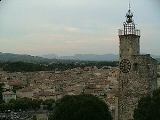
One of the most interesting aspects of the town is its geography, and its Roman
Ancient Rome

Ancient Rome was a civilization that grew out of a small agricultural community founded on the Italian Peninsula as early as the 10th century BC....
 ruins. The Roman ruins and the modern town are in the valley on the banks of the river Ouvèze
Ouvèze

The Ouv?ze is river in southern France, left tributary of the Rh?ne River. It rises in the southern French Prealps , in the commune of Montauban-sur-l'Ouv?ze....
 which is crossed by an ancient bridge from the first century
Roman Bridge (Vaison-la-Romaine)

The Roman Bridge at Vaison-la-Romaine is a bridge over the river Ouv?ze in the southern French town of Vaison-la-Romaine. The bridge was built by the Romans in the 1st century, its single arch spanning 17.20 m....
.

The medieval town is high on the rocky cliff. The valley floor was safe from attack in Roman and modern times. In the Middle Ages attacks were frequent, and the town retreated up-hill to a more defensible position.

The apse
Apse

In architecture, the apse is a semicircular recess covered with a hemispherical Vault . In Romanesque architecture, Byzantine architecture and Gothic architecture Christian abbey, cathedral and church architecture, the term is applied to the semi-circular or polygonal section of the sanctuary at the liturgical east end beyond the altar....
 of the Church of St. Quenin, dedicated to Saint Quinidius, seems to date from the eighth century; it is one of the oldest in France.

As a whole the cathedral
Vaison Cathedral

Vaison Cathedral is a Roman Catholic cathedral in Vaison-la-Romaine, France.It was formerly the seat of the Bishopric of Vaison, abolished under the Concordat of 1801.hello...
 dates from the 11th century, but the apse and the apsidal chapels are from the Merovingian period.

Twin towns

Vaison is twinned
Town twinning

Town twinning, also known as sister cities, is a concept whereby towns or city in geographically and politically distinct areas are paired, with the goal of fostering human contact and cultural links between their inhabitants....
 with Martigny in Switzerland.

See also

  • Belisama
    Belisama

    In Celtic mythology, Belisama was a goddess worshipped in Gaul and Ancient Britain. She was connected with lakes and rivers, fire, crafts and light....
  • Dentelles de Montmirail
    Dentelles de Montmirail

    The Dentelles de Montmirail are a small Mountain range in Provence in France, in the d?partement in France of Vaucluse, located just to the south of Vaison-la-Romaine....
  • Council of Vaison
    Council of Vaison

    The Council of Vaison may refer to several events held at Vaison.* A council held circa 350.* A council held in 442.* The Third Council of Vaison held in 529....
  • Vgo
    Vgo

    Vgo, or Ugo, for "Hughes", was a stone mason active in Provence during the twelfth century. He left his signature on several Romanesque architecture religious edifices in Provence and mainly in Tricastin:...


External links

  • (in French)


Further reading

  • Rivet , A. L. F. '1988. Gallia Narbonensis: Southern Gaul in Roman Times, part II: "Civitates", (London: Batsford). A brief summary of the archaeology.