

Voter turnout

Encyclopedia
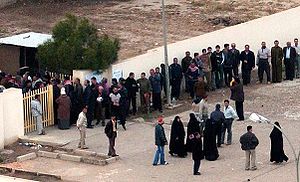
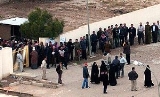
Voter turnout is the percentage of eligible voters
Voting
Voting is a method for a group such as a meeting or an electorate to make a decision or express an opinion—often following discussions, debates, or election campaigns. It is often found in democracies and republics.- Reasons for voting :...
who cast a ballot
Ballot
A ballot is a device used to record choices made by voters. Each voter uses one ballot, and ballots are not shared. In the simplest elections, a ballot may be a simple scrap of paper on which each voter writes in the name of a candidate, but governmental elections use pre-printed to protect the...
in an election
Election
An election is a formal decision-making process by which a population chooses an individual to hold public office. Elections have been the usual mechanism by which modern representative democracy operates since the 17th century. Elections may fill offices in the legislature, sometimes in the...
(eligible voters can change in every country, and should not be confused with the total adult population). After increasing for many decades, there has been a trend of decreasing voter turnout in most established democracies
Democracy
Democracy is generally defined as a form of government in which all adult citizens have an equal say in the decisions that affect their lives. Ideally, this includes equal participation in the proposal, development and passage of legislation into law...
since the 1960s. In general, low turnout may be due to disenchantment
Disenchantment
Disenchantment is a term in the social sciences used to describe the cultural rationalization and devaluation of mysticism apparent in modern society...
, indifference
Apathy
Apathy is a state of indifference, or the suppression of emotions such as concern, excitement, motivation and passion. An apathetic individual has an absence of interest in or concern about emotional, social, spiritual, philosophical or physical life.They may lack a sense of purpose or meaning in...
, or contentment. Low turnout is often considered to be undesirable, and there is much debate over the factors that affect turnout and how to increase it. In spite of significant study into the issue, scholars are divided on reasons for the decline. Its cause has been attributed to a wide array of economic
Economics
Economics is the social science that analyzes the production, distribution, and consumption of goods and services. The term economics comes from the Ancient Greek from + , hence "rules of the house"...
, demographic
Demographics
Demographics are the most recent statistical characteristics of a population. These types of data are used widely in sociology , public policy, and marketing. Commonly examined demographics include gender, race, age, disabilities, mobility, home ownership, employment status, and even location...
, cultural, technological
Technology
Technology is the making, usage, and knowledge of tools, machines, techniques, crafts, systems or methods of organization in order to solve a problem or perform a specific function. It can also refer to the collection of such tools, machinery, and procedures. The word technology comes ;...
, and institutional factors. There have been many efforts to increase turnout and encourage voting.
Different countries
Country
A country is a region legally identified as a distinct entity in political geography. A country may be an independent sovereign state or one that is occupied by another state, as a non-sovereign or formerly sovereign political division, or a geographic region associated with a previously...
have very different average voter turnouts. For example, in the United States 2008 presidential election
United States presidential election, 2008
The United States presidential election of 2008 was the 56th quadrennial presidential election. It was held on November 4, 2008. Democrat Barack Obama, then the junior United States Senator from Illinois, defeated Republican John McCain, the senior U.S. Senator from Arizona. Obama received 365...
turnout was 63% and 68% among African Americans (generally credited to Barack Obama
Barack Obama
Barack Hussein Obama II is the 44th and current President of the United States. He is the first African American to hold the office. Obama previously served as a United States Senator from Illinois, from January 2005 until he resigned following his victory in the 2008 presidential election.Born in...
's candidacy). In Australia
Australia
Australia , officially the Commonwealth of Australia, is a country in the Southern Hemisphere comprising the mainland of the Australian continent, the island of Tasmania, and numerous smaller islands in the Indian and Pacific Oceans. It is the world's sixth-largest country by total area...
, which has compulsory voting
Compulsory voting
Compulsory voting is a system in which electors are obliged to vote in elections or attend a polling place on voting day. If an eligible voter does not attend a polling place, he or she may be subject to punitive measures such as fines, community service, or perhaps imprisonment if fines are unpaid...
, and Malta
Malta
Malta , officially known as the Republic of Malta , is a Southern European country consisting of an archipelago situated in the centre of the Mediterranean, south of Sicily, east of Tunisia and north of Libya, with Gibraltar to the west and Alexandria to the east.Malta covers just over in...
, which does not, participation reaches 95%. These differences are caused by a mix of cultural and institutional factors.
Reasons for Voting
In any large election the chance of any one vote determining the outcome is low;. Some studies show that a single vote in a voting scheme such as the Electoral College in the United States has an even lower chance of determining the outcome. Other studies claim that the Electoral College actually increases voting power. Studies using game theoryGame theory
Game theory is a mathematical method for analyzing calculated circumstances, such as in games, where a person’s success is based upon the choices of others...
, which takes into account the ability of voters to interact
Interaction
Interaction is a kind of action that occurs as two or more objects have an effect upon one another. The idea of a two-way effect is essential in the concept of interaction, as opposed to a one-way causal effect...
, have also found that the expected turnout for any large election should be zero.
The basic formula for determining whether someone will vote is

Here, P is the probability
Probability
Probability is ordinarily used to describe an attitude of mind towards some proposition of whose truth we arenot certain. The proposition of interest is usually of the form "Will a specific event occur?" The attitude of mind is of the form "How certain are we that the event will occur?" The...
that an individual's vote will affect the outcome of an election, and B is the perceived benefit that would be received if that person's favored political party
Political party
A political party is a political organization that typically seeks to influence government policy, usually by nominating their own candidates and trying to seat them in political office. Parties participate in electoral campaigns, educational outreach or protest actions...
or candidate were elected. D originally stood for democracy or civic duty, but today represents any social or personal gratification
Utility
In economics, utility is a measure of customer satisfaction, referring to the total satisfaction received by a consumer from consuming a good or service....
an individual gets from voting. C is the time, effort, and financial cost involved in voting. Since P is virtually zero in most elections, PB is also near zero, and D is thus the most important element in motivating people to vote. For a person to vote, these factors must outweigh C.
Riker and Ordeshook developed the modern understanding of D. They listed five major forms of gratification that people receive for voting: complying with the social obligation to vote; affirming one's allegiance to the political system; affirming a partisan preference (also known as expressive voting, or voting for a candidate to express support, not to achieve any outcome); affirming one's importance to the political system; and, for those who find politics interesting and entertaining, researching and making a decision. Other political scientists have since added other motivators and questioned some of Riker and Ordeshook's assumptions. All of these concepts are inherently imprecise, making it difficult to discover exactly why people choose to vote.
Recently, several scholars have considered the possibility that B includes not only a personal interest in the outcome, but also a concern for the welfare of others in the society (or at least other members of one's favorite group or party). In particular, experiments in which subject altruism
Altruism
Altruism is a concern for the welfare of others. It is a traditional virtue in many cultures, and a core aspect of various religious traditions, though the concept of 'others' toward whom concern should be directed can vary among cultures and religions. Altruism is the opposite of...
was measured using a dictator game
Dictator game
The dictator game is a game in experimental economics, similar to the ultimatum game. Experimental results offer evidence against the rationally self-interested individual concept of economic behavior, though precisely what to conclude from the evidence is controversial.-Description:In the...
showed that concern for the well-being of others is a major factor in predicting turnout and political participation. Note that this motivation is distinct from D, because voters must think others benefit from the outcome of the election, not their act of voting in and of itself.
The significance of voter turnout
It is often considered that high voter turnouts are desirable, though among political scientists and economists specialising in public choice, the issue is still debated. A high turnout is generally seen as evidence of the legitimacyLegitimacy (political science)
In political science, legitimacy is the popular acceptance of a governing law or régime as an authority. Whereas “authority” denotes a specific position in an established government, the term “legitimacy” denotes a system of government — wherein “government” denotes “sphere of influence”...
of the current system. Dictator
Dictator
A dictator is a ruler who assumes sole and absolute power but without hereditary ascension such as an absolute monarch. When other states call the head of state of a particular state a dictator, that state is called a dictatorship...
s have often fabricated high turnouts in showcase elections
Show election
A show election, also known as a sham election or rubber stamp election, is an election that is held purely for show, that is, without any significant political purpose...
for this purpose. For instance, Saddam Hussein
Saddam Hussein
Saddam Hussein Abd al-Majid al-Tikriti was the fifth President of Iraq, serving in this capacity from 16 July 1979 until 9 April 2003...
's 2002 referendum was claimed to have had 100% participation. Opposition parties sometimes boycott votes they feel are unfair or illegitimate, or if the election is for a government that is considered illegitimate. For example, the Holy See
Holy See
The Holy See is the episcopal jurisdiction of the Catholic Church in Rome, in which its Bishop is commonly known as the Pope. It is the preeminent episcopal see of the Catholic Church, forming the central government of the Church. As such, diplomatically, and in other spheres the Holy See acts and...
instructed Italian Catholics to boycott national elections for several decades after the creation of the State of Italy. In some countries, there are threats of violence against those who vote, such as during the 2005 Iraq elections, an example of voter suppression
Voter suppression
Voter suppression is a strategy to influence the outcome of an election by discouraging or preventing people from exercising their right to vote. It is distinguished from political campaigning in that campaigning attempts to change likely voting behavior by changing the opinions of potential voters...
. However, some political scientists question the view that high turnout is an implicit endorsement of the system. Mark N. Franklin contends that in European Union elections opponents of the federation, and of its legitimacy, are just as likely to vote as proponents.
Assuming that low turnout is a reflection of disenchantment or indifference, a poll with very low turnout may not be an accurate reflection of the will of the people
Popular sovereignty
Popular sovereignty or the sovereignty of the people is the political principle that the legitimacy of the state is created and sustained by the will or consent of its people, who are the source of all political power. It is closely associated with Republicanism and the social contract...
. On the other hand, if low turnout is a reflection of contentment of voters about likely winners or parties, then low turnout is as legitimate as high turnout, as long as the right to vote exists. Still, low turnouts can lead to unequal representation among various parts of the population. In developed countries, non-voters tend to be concentrated in particular demographic and socioeconomic groups, especially the young
Youth
Youth is the time of life between childhood and adulthood . Definitions of the specific age range that constitutes youth vary. An individual's actual maturity may not correspond to their chronological age, as immature individuals could exist at all ages.-Usage:Around the world, the terms "youth",...
and the poor
Poverty
Poverty is the lack of a certain amount of material possessions or money. Absolute poverty or destitution is inability to afford basic human needs, which commonly includes clean and fresh water, nutrition, health care, education, clothing and shelter. About 1.7 billion people are estimated to live...
. However, in India
India
India , officially the Republic of India , is a country in South Asia. It is the seventh-largest country by geographical area, the second-most populous country with over 1.2 billion people, and the most populous democracy in the world...
, which boasts an electorate of more than 670 million people, the opposite is true. The poor, who comprise the majority of the demographic, are more likely to vote than the rich and the middle classes, and turnout is higher in rural areas than urban areas. In low-turnout countries, these groups are often significantly under-represented in elections. This has the potential to skew policy. For instance, a high voter turnout among seniors
Old age
Old age consists of ages nearing or surpassing the average life span of human beings, and thus the end of the human life cycle...
coupled with a low turnout among the young may lead to more money for seniors' health care
Health care
Health care is the diagnosis, treatment, and prevention of disease, illness, injury, and other physical and mental impairments in humans. Health care is delivered by practitioners in medicine, chiropractic, dentistry, nursing, pharmacy, allied health, and other care providers...
, and less for youth employment schemes. Some nations thus have rules that render an election invalid if too few people vote, such as Serbia
Serbia
Serbia , officially the Republic of Serbia , is a landlocked country located at the crossroads of Central and Southeast Europe, covering the southern part of the Carpathian basin and the central part of the Balkans...
, where three successive presidential elections were rendered invalid in 2003.
Socio-economic factors
| USA (1988) | India (1988) |
|---|---|
| Turnout | |
| 50.1 % | 62 % |
| Income (Quinitile) | |
| Lowest 20%: 36.4 % | 57 % |
| 52 | 65 |
| 59 | 73 |
| 67 | 60 |
| Highest 20%: 63.1 | 47 |
| Education | |
| No High School 38 % | Illiterate 57 % |
| Some High School 43 | Up to Middle 83 |
| High School Graduate 57 | College 57 |
| Some College 66 | Post-graduate 41 |
| College Grad 79 | |
| Post-Graduate 84 | |
| Community (1996) | |
| White 56 | Hindu 60 |
| Black 50 | Hindu (OBC) 58 |
| Latino 27 | SC 75 |
| ST 59 | |
| Muslim 70 | |
| Sikh 89 | |
In each nation, some parts of society are more likely to vote than others. In high-turnout nations, these differences tend to be limited: as turnout approaches 90% it becomes difficult to find differences of much significance between voters and nonvoters, but in low turnout nations the differences between voters and non-voters can be quite marked. These differences appear to persist over time—the best predictor of individual turnout is whether or not a person voted in the previous election. As a result, many scholars think of turnout as habitual behavior that can be learned or unlearned, especially among young adults.
However, socioeconomic factors significantly affect whether or not individuals may develop such habits. The most important socioeconomic factor in voter turnout is education
Education
Education in its broadest, general sense is the means through which the aims and habits of a group of people lives on from one generation to the next. Generally, it occurs through any experience that has a formative effect on the way one thinks, feels, or acts...
. The more educated a person is, the more likely he or she is to vote, even when controlled for other factors such as income
Income
Income is the consumption and savings opportunity gained by an entity within a specified time frame, which is generally expressed in monetary terms. However, for households and individuals, "income is the sum of all the wages, salaries, profits, interests payments, rents and other forms of earnings...
and class
Social class
Social classes are economic or cultural arrangements of groups in society. Class is an essential object of analysis for sociologists, political scientists, economists, anthropologists and social historians. In the social sciences, social class is often discussed in terms of 'social stratification'...
that are closely associated with education level. Income has some effect independently: wealthier people are more likely to vote, regardless of their educational background. There is some debate over the effects of ethnicity, race, and gender
Gender
Gender is a range of characteristics used to distinguish between males and females, particularly in the cases of men and women and the masculine and feminine attributes assigned to them. Depending on the context, the discriminating characteristics vary from sex to social role to gender identity...
. In the past, these factors unquestionably influenced turnout in many nations. Nowadays, the consensus among political scientists is that these factors have little effect in Western democracies when education and income differences are taken into account. However, since different ethnic groups typically have different levels of education and income, there are important differences in turnout between such groups in many societies. Other demographic factors have an important influence: young people are far less likely to vote than the elderly; and single people are less likely to vote than those who are married. Occupation has little effect on turnout, with the notable exception of higher voting rates among government employees in many countries.
There can also be regional differences in voter turnout. One issue that arises in continent-spanning nations, such as Australia, Canada
Canada
Canada is a North American country consisting of ten provinces and three territories. Located in the northern part of the continent, it extends from the Atlantic Ocean in the east to the Pacific Ocean in the west, and northward into the Arctic Ocean...
, the United States and Russia
Russia
Russia or , officially known as both Russia and the Russian Federation , is a country in northern Eurasia. It is a federal semi-presidential republic, comprising 83 federal subjects...
, is that of time zone
Time zone
A time zone is a region on Earth that has a uniform standard time for legal, commercial, and social purposes. In order for the same clock time to always correspond to the same portion of the day as the Earth rotates , different places on the Earth need to have different clock times...
s. Canada banned the broadcasting of election results in any region where the polls have not yet closed; this ban was upheld by the Supreme Court of Canada
Supreme Court of Canada
The Supreme Court of Canada is the highest court of Canada and is the final court of appeals in the Canadian justice system. The court grants permission to between 40 and 75 litigants each year to appeal decisions rendered by provincial, territorial and federal appellate courts, and its decisions...
. In several recent Australian national elections, the citizens of Western Australia knew which party would form the new government up to an hour before the polling booths in their State closed.
Hereditary factors
While socioeconomic factors are undoubtedly important for turnout, new evidence suggests that genetic factors may also be important. Scholars recently used twin studies of validated turnout in Los Angeles and self-reported turnout in the National Longitudinal Study of Adolescent HealthNational Longitudinal Study of Adolescent Health
The National Longitudinal Study of Adolescent Health is the only nationally representative study of adolescent sexuality, which has spawned over one thousand peer-reviewed publications on many issues related to adolescent health and sexuality, and other adolescent health risk behaviors.The Add...
to establish that the decision to vote in the United States has very strong heritability
Heritability
The Heritability of a population is the proportion of observable differences between individuals that is due to genetic differences. Factors including genetics, environment and random chance can all contribute to the variation between individuals in their observable characteristics...
. If so, it could help to explain why parental turnout is such a strong predictor of voting in young people – people inherit genes as well as behaviors from their parents. It might also help to explain why voting appears to be habitual – if there is an innate predisposition to vote or abstain, this would explain why past voting behavior is such a good predictor of future voter reaction.
In addition to the twin study
Twin study
Twin studies help disentangle the relative importance of environmental and genetic influences on individual traits and behaviors. Twin research is considered a key tool in behavioral genetics and related fields...
method, scholars have used gene association studies to analyze voter turnout. Two genes that influence social behavior have been directly associated with voter turnout, specifically those regulating the serotonin
Serotonin
Serotonin or 5-hydroxytryptamine is a monoamine neurotransmitter. Biochemically derived from tryptophan, serotonin is primarily found in the gastrointestinal tract, platelets, and in the central nervous system of animals including humans...
system in the brain via the production of monoamine oxidase
Monoamine oxidase
L-Monoamine oxidases are a family of enzymes that catalyze the oxidation of monoamines. They are found bound to the outer membrane of mitochondria in most cell types in the body. The enzyme was originally discovered by Mary Bernheim in the liver and was named tyramine oxidase...
and 5HTT.
Differences between elections
Within countries there can be important differences in turnout between individual elections. Elections where control of the national executiveExecutive (government)
Executive branch of Government is the part of government that has sole authority and responsibility for the daily administration of the state bureaucracy. The division of power into separate branches of government is central to the idea of the separation of powers.In many countries, the term...
is not at stake generally have much lower turnouts—often half that for general elections. Municipal and provincial elections, and by-elections to fill casual vacancies, typically have lower turnouts, as do elections for the parliament of the supranational European Union
European Union
The European Union is an economic and political union of 27 independent member states which are located primarily in Europe. The EU traces its origins from the European Coal and Steel Community and the European Economic Community , formed by six countries in 1958...
, which is separate from the executive branch of the EU's government. In the United States, midterm congressional elections
Off-year elections
Off-year elections refer to general elections in the United States that are held in odd-numbered years. These elections feature rarely any election to a federal office, few state legislative elections, and very few gubernatorial elections. Instead, the vast majority of these off-year elections are...
attract far lower turnouts than Congressional elections held concurrently with Presidential ones. Runoff elections also tend to attract lower turnouts.
In theory, one of the factors that is most likely to increase turnout is a close race. With an intensely polarized electorate and all polls showing a close finish between President
President of the United States
The President of the United States of America is the head of state and head of government of the United States. The president leads the executive branch of the federal government and is the commander-in-chief of the United States Armed Forces....
George W. Bush
George W. Bush
George Walker Bush is an American politician who served as the 43rd President of the United States, from 2001 to 2009. Before that, he was the 46th Governor of Texas, having served from 1995 to 2000....
and Democratic
Democratic Party (United States)
The Democratic Party is one of two major contemporary political parties in the United States, along with the Republican Party. The party's socially liberal and progressive platform is largely considered center-left in the U.S. political spectrum. The party has the lengthiest record of continuous...
challenger John F. Kerry, the turnout in the 2004 U.S. presidential election
United States presidential election, 2004
The United States presidential election of 2004 was the United States' 55th quadrennial presidential election. It was held on Tuesday, November 2, 2004. Republican Party candidate and incumbent President George W. Bush defeated Democratic Party candidate John Kerry, the then-junior U.S. Senator...
, was close to 60%, resulting in a record number of popular votes for both candidates; despite losing the election, Kerry even surpassed Ronald Reagan
Ronald Reagan
Ronald Wilson Reagan was the 40th President of the United States , the 33rd Governor of California and, prior to that, a radio, film and television actor....
's 1984 record in terms of the number of popular votes received. However, this race also demonstrates the influence that contentious social issues can have on voter turnout; for example, the voter turnout rate in 1860 wherein anti-slavery
Slavery
Slavery is a system under which people are treated as property to be bought and sold, and are forced to work. Slaves can be held against their will from the time of their capture, purchase or birth, and deprived of the right to leave, to refuse to work, or to demand compensation...
candidate Abraham Lincoln won the election was the second-highest on record (81.2 percent, second only to 1876, with 81.8 percent). Nonetheless, there is evidence to support the argument that predictable election results—where one vote is not seen to be able to make a difference—have resulted in lower turnouts, such as Bill Clinton's 1996 re-election
United States presidential election, 1996
The United States presidential election of 1996 was a contest between the Democratic national ticket of President Bill Clinton of Arkansas and Vice President Al Gore of Tennessee and the Republican national ticket of former Senator Bob Dole of Kansas for President and former Housing Secretary Jack...
(which featured the lowest voter turnout in the United States since 1924), the United Kingdom general election of 2001
United Kingdom general election, 2001
The United Kingdom general election, 2001 was held on Thursday 7 June 2001 to elect 659 members to the British House of Commons. It was dubbed "the quiet landslide" by the media, as the Labour Party was re-elected with another landslide result and only suffered a net loss of 6 seats...
, and the 2005 Spanish referendum on the European Constitution
Spanish referendum on the European Constitution
The Spanish referendum on the Treaty establishing a Constitution for Europe is a consultative referendum that was held on 20 February 2005 to decide whether Spain should ratify the proposed Constitution of the European Union....
; all of these elections produced decisive results on a low turnout.
Bad weather can reduce turnouts, as can the season and the day of the week (although many nations hold all their elections on the same weekday). Weekend and summer elections find more of the population on holiday or uninterested in politics, and have lower turnouts. When nations set fixed election dates, these are usually midweek during the spring or autumn to maximize turnout. Variations in turnout between elections tend to be insignificant. It is extremely rare for factors such as competitiveness, weather, and time of year to cause an increase or decrease in turnout of more than five percentage points, far smaller than the differences between groups within society, and far smaller than turnout differentials between nations.
International differences
| Country | Compulsory | № | Turnout |
|---|---|---|---|
| Y | 14 | 81% | |
| N | 6 | 94% | |
| Y | 2 | 93%† | |
| N | 9 | 92% | |
| Y | 12 | 91% | |
| N | 9 | 90% | |
| N | 7 | 90% | |
| N | 10 | 89% | |
| N | 12 | 88% | |
| N | 14 | 87% | |
| N | 9 | 86% | |
| N | 14 | 86% | |
| Y | 10 | 86% | |
| N* | 7 | 85% | |
| N | 2 | 85% | |
| Y | 12 | 83% | |
| Y | 3 | 83% | |
| N** | 7 | 83% | |
| N | 8 | 81% | |
| N | 9 | 81% | |
| N | 2 | 81% | |
| N | 2 | 80% | |
| N | 9 | 80% | |
| N | 9 | 79% | |
| N | 10 | 78% | |
| N | 9 | 76% | |
| N | 9 | 76% | |
| N | 11 | 75% | |
| N | 11 | 74% | |
| N | 12 | 74% | |
| N | 6 | 73% | |
| N | 12 | 71% | |
| N | 2 | 69% | |
| N | 2 | 66% | |
| N | 2 | 61% | |
| N | 6 | 58% | |
| N | 8 | 54% | |
| N | 2 | 51% | |
| N | 18 | 48%*** | |
| *Compulsory voting until 1998 | |||
| **Excludes pre-1968 elections, when voting was compulsory. | |||
| ***Turnout rates during the period ranged from 55% for general election years, to 40% to off-year elections (those for which the presidency was not on the ballot). |
|||
| Statistics from Mark N. Franklin's "Electoral Participation", found in Controversies in Voting Behavior (2001). Includes only "free" elections. |
|||
| †Excludes pre-1989 elections. Sources: Electoral Service, Election Qualifying Court. |
|||
Voter turnout varies considerably between countries. It tends to be lower in the United States, Asia and Latin America than most of Europe, Canada and Oceania. Western Europe averages a 77% turnout, and South and Central America around 54% since 1945. The differences between nations tend to be greater than those between classes, ethnic groups, or regions within nations. Confusingly, some of the factors that cause internal differences do not seem to apply on a global level. For instance, nations with better-educated populaces do not have higher turnouts.
There are two main causes of these international differences—culture and institutions—although there is much debate over the relative impact of the various factors.
Cultural factors
Wealth and literacy have some effect on turnout, but are not reliable measures. Countries such as AngolaAngola
Angola, officially the Republic of Angola , is a country in south-central Africa bordered by Namibia on the south, the Democratic Republic of the Congo on the north, and Zambia on the east; its west coast is on the Atlantic Ocean with Luanda as its capital city...
and Ethiopia
Ethiopia
Ethiopia , officially known as the Federal Democratic Republic of Ethiopia, is a country located in the Horn of Africa. It is the second-most populous nation in Africa, with over 82 million inhabitants, and the tenth-largest by area, occupying 1,100,000 km2...
have long had high turnouts, but so have the wealthy states of Europe. The United Nations
United Nations
The United Nations is an international organization whose stated aims are facilitating cooperation in international law, international security, economic development, social progress, human rights, and achievement of world peace...
Human Development Index
Human Development Index
The Human Development Index is a composite statistic used to rank countries by level of "human development" and separate "very high human development", "high human development", "medium human development", and "low human development" countries...
shows some correlation between higher standards of living and higher turnout. The age of a democracy is also an important factor. Elections require considerable involvement by the population, and it takes some time to develop the cultural habit of voting, and the associated understanding of and confidence in the electoral process. This factor may explain the lower turnouts in the newer democracies of Eastern Europe and Latin America. Much of the impetus to vote comes from a sense of civic duty, which takes time and certain social conditions to develop. that can take decades to develop:
- trust in government;
- degree of partisanship among the population;
- interest in politics, and
- belief in the efficacy of voting.
Demographics also have an effect. Older people tend to vote more than youths, so societies where the average age is somewhat higher, such as Europe; have higher turnouts than somewhat younger countries such as the United States. Populations that are more mobile and those that have lower marriage rates tend to have lower turnout. In countries that are highly multicultural and multilingual, it can be difficult for national election campaigns to engage all sectors of the population.
The nature of elections also varies between nations. In the United States, negative campaigning
Negative campaigning
Negative campaigning, also known more colloquially as "mudslinging", is trying to win an advantage by referring to negative aspects of an opponent or of a policy rather than emphasizing one's own positive attributes or preferred policies...
and character attacks are more common than elsewhere, potentially suppressing turnouts. The focus placed on get out the vote
Get out the vote
"Get out the vote" are terms used to describe two categories of political activity, both aimed at increasing the number of votes cast in one or more elections.- Non-partisan contexts :...
efforts and mass-marketing can have important effects on turnout. Partisanship is an important impetus to turnout, with the highly partisan more likely to vote. Turnout tends to be higher in nations where political allegiance is closely linked to class, ethnic, linguistic, or religious loyalties. Countries where multiparty systems have developed also tend to have higher turnouts. Nations with a party specifically geared towards the working class
Working class
Working class is a term used in the social sciences and in ordinary conversation to describe those employed in lower tier jobs , often extending to those in unemployment or otherwise possessing below-average incomes...
will tend to have higher turnouts among that class than in countries where voters have only big tent
Big tent
In politics, a big tent party or catch-all party is a political party seeking to attract people with diverse viewpoints. The party does not require adherence to some ideology as a criterion for membership...
parties, which try to appeal to all the voters, to choose from.
Institutional factors
Institutional factors have a significant impact on voter turnout. Rules and laws are also generally easier to change than attitudes, so much of the work done on how to improve voter turnout looks at these factors. Making voting compulsoryCompulsory voting
Compulsory voting is a system in which electors are obliged to vote in elections or attend a polling place on voting day. If an eligible voter does not attend a polling place, he or she may be subject to punitive measures such as fines, community service, or perhaps imprisonment if fines are unpaid...
has a direct and dramatic effect on turnout. Simply making it easier for candidates to stand through easier nomination rules
Nomination rules
Nomination rules in elections regulate the conditions under which a candidate or political party is entitled to stand for election. The criteria to stand as a candidate depends on the individual legal system, however they may include the age of a candidate, citizenship, endorsement by a political...
is believed to increase voting. Conversely, adding barriers, such as a separate registration
Voter registration
Voter registration is the requirement in some democracies for citizens and residents to check in with some central registry specifically for the purpose of being allowed to vote in elections. An effort to get people to register is known as a voter registration drive.-Centralized/compulsory vs...
process, can suppress turnout. The salience of an election, the effect that a vote will have on policy, and its proportionality, how closely the result reflects the will of the people, are two structural factors that also likely have important effects on turnout.
Voter registration
The modalities of how electoral registration is conducted can also affect turnout. For example until "rolling registration" was introduced in the United Kingdom, there was no possibility of the electoral register being updated during its currency, or even amending genuine mistakes after a certain cut off date. The register was compiled in October, and would come into force the next February, and would remain valid until the next January. The electoral register would become progressively more out of date during its period of validity, as electors moved or died (also people studying or working away from home often had difficulty voting). This meant that elections taking place later in the year tended to have lower turnouts than those earlier in the year. The introduction of rolling registration where the register is updated monthly has reduced but not entirely eliminated this issue since the process of amending the register is not automatic, and some individuals do not join the electoral register until the annual October compilation process.Another country with a highly efficient registration process is France. At the age of eighteen, all youth are automatically registered. Only new residents and citizens who have moved are responsible for bearing the costs and inconvenience of updating their registration. Similarly, in Nordic countries
Nordic countries
The Nordic countries make up a region in Northern Europe and the North Atlantic which consists of Denmark, Finland, Iceland, Norway and Sweden and their associated territories, the Faroe Islands, Greenland and Åland...
, all citizens and residents are included in the official population register, which is simultaneously a tax list, voter registration, and membership in the universal health system. Residents are required by law to report any change of address to register within a short time after moving. This is also the system in Germany
Germany
Germany , officially the Federal Republic of Germany , is a federal parliamentary republic in Europe. The country consists of 16 states while the capital and largest city is Berlin. Germany covers an area of 357,021 km2 and has a largely temperate seasonal climate...
(but without the membership in the health system).
The elimination of registration as a separate bureaucratic step can result in higher voter turnout. This is reflected in statistics from the United States Bureau of Census, 1982–1983. States that have same day registration, or no registration requirements, have a higher voter turnout than the national average. At the time of that report, the four states that allowed election day registration were Minnesota, Wisconsin, Maine, and Oregon. Since then, Idaho and Maine have changed to allow same day registration. North Dakota is the only state that requires no registration.
Compulsory voting
One of the strongest factors affecting voter turnout is whether voting is compulsoryCompulsory voting
Compulsory voting is a system in which electors are obliged to vote in elections or attend a polling place on voting day. If an eligible voter does not attend a polling place, he or she may be subject to punitive measures such as fines, community service, or perhaps imprisonment if fines are unpaid...
. In Australia, voter registration and attendance at a polling booth have been mandatory since the 1920s. These rules are strictly enforced, and the country has one of the world's highest voter turnouts. Several other countries have similar laws, generally with somewhat reduced levels of enforcement. If a Bolivia
Bolivia
Bolivia officially known as Plurinational State of Bolivia , is a landlocked country in central South America. It is the poorest country in South America...
n voter fails to participate in an election, the citizen may be denied withdrawal of their salary from the bank for three months. In Mexico
Mexico
The United Mexican States , commonly known as Mexico , is a federal constitutional republic in North America. It is bordered on the north by the United States; on the south and west by the Pacific Ocean; on the southeast by Guatemala, Belize, and the Caribbean Sea; and on the east by the Gulf of...
and Brazil
Brazil
Brazil , officially the Federative Republic of Brazil , is the largest country in South America. It is the world's fifth largest country, both by geographical area and by population with over 192 million people...
, existing sanctions for non-voting are minimal or are rarely enforced. When enforced, compulsion has a dramatic effect on turnout. In Venezuela
Venezuela
Venezuela , officially called the Bolivarian Republic of Venezuela , is a tropical country on the northern coast of South America. It borders Colombia to the west, Guyana to the east, and Brazil to the south...
and the Netherlands
Netherlands
The Netherlands is a constituent country of the Kingdom of the Netherlands, located mainly in North-West Europe and with several islands in the Caribbean. Mainland Netherlands borders the North Sea to the north and west, Belgium to the south, and Germany to the east, and shares maritime borders...
compulsory voting has been rescinded, resulting in substantial decreases in turnout. In Greece
Greece
Greece , officially the Hellenic Republic , and historically Hellas or the Republic of Greece in English, is a country in southeastern Europe....
voting is compulsory, however there are practically no sanctions for those who do not vote. In Belgium
Belgium
Belgium , officially the Kingdom of Belgium, is a federal state in Western Europe. It is a founding member of the European Union and hosts the EU's headquarters, and those of several other major international organisations such as NATO.Belgium is also a member of, or affiliated to, many...
voting is compulsory, too, but not strongly enforced.
Salience
Mark N. Franklin argues that salience, the perceived effect that an individual vote will have on how the country is run, has a significant effect on turnout. He presents SwitzerlandSwitzerland
Switzerland name of one of the Swiss cantons. ; ; ; or ), in its full name the Swiss Confederation , is a federal republic consisting of 26 cantons, with Bern as the seat of the federal authorities. The country is situated in Western Europe,Or Central Europe depending on the definition....
as an example of a nation with low salience. The nation's administration is highly decentralized, so that the federal government has limited powers. The government invariably consists of a coalition of parties, and the power wielded by a party is far more closely linked to its position relative to the coalition than to the number of votes it received. Important decisions are placed before the population in a referendum
Referendum
A referendum is a direct vote in which an entire electorate is asked to either accept or reject a particular proposal. This may result in the adoption of a new constitution, a constitutional amendment, a law, the recall of an elected official or simply a specific government policy. It is a form of...
. Individual votes for the federal legislature are thus unlikely to have a significant effect on the nation, which probably explains the low average turnouts in that country. By contrast Malta
Malta
Malta , officially known as the Republic of Malta , is a Southern European country consisting of an archipelago situated in the centre of the Mediterranean, south of Sicily, east of Tunisia and north of Libya, with Gibraltar to the west and Alexandria to the east.Malta covers just over in...
, with one of the world's highest voter turnouts, has a single legislature that holds a near monopoly on political power. Malta has a two-party system
Two-party system
A two-party system is a system where two major political parties dominate voting in nearly all elections at every level of government and, as a result, all or nearly all elected offices are members of one of the two major parties...
in which a small swing in votes can completely alter the executive. On the other hand, countries with a two party system can experience low turnout if large numbers of potential voters perceive little real difference between the main parties. Voters' perceptions of fairness also have an important effect on salience. If voters feel that the result of an election is more likely to be determined by fraud and corruption than by the will of the people, fewer people will vote.
Proportionality
Another institutional factor that may have an important effect is proportionality, i.e., how closely the legislature reflects the views of the populace. A pure proportional representationProportional representation
Proportional representation is a concept in voting systems used to elect an assembly or council. PR means that the number of seats won by a party or group of candidates is proportionate to the number of votes received. For example, under a PR voting system if 30% of voters support a particular...
system is fully proportional to the votes of the populace and a voter can be sure that he will be represented in parliament even if it is only the opposition bench; the only exception to this rule is for voters of parties that get less than a certain required percentage as a precondition to make it into parliament. Some countries have such electoral thresholds in place, e. g. Germany 5%. By contrast, a plurality system will almost always see districts in which one party is so dominant that there is little reason for voters of other parties to vote because votes for "losing" parties are in a sense lost.
Proportional systems tend to produce multiparty governments (coalition government
Coalition government
A coalition government is a cabinet of a parliamentary government in which several political parties cooperate. The usual reason given for this arrangement is that no party on its own can achieve a majority in the parliament...
s). This may reduce salience, since the voters have little influence over which parties are included in the coalition. For instance, after the 2005 German election, the creation of the executive not only expressed the will of the voters of the majority party but also was the result of political deal-making. Although there is no guarantee, this is lessened as the parties usually state with whom they will favour a coalition after the elections.
Political scientists are divided on whether proportional representation increases voter turnout, though in countries with proportioanal representation voter turnout is higher. There are other systems that attempt to preserve both salience and proportionality, for example, the Mixed member proportional representation
Mixed member proportional representation
Mixed-member proportional representation, also termed mixed-member proportional voting and commonly abbreviated to MMP, is a voting system originally used to elect representatives to the German Bundestag, and nowadays adopted by numerous legislatures around the world...
system in New Zealand
New Zealand
New Zealand is an island country in the south-western Pacific Ocean comprising two main landmasses and numerous smaller islands. The country is situated some east of Australia across the Tasman Sea, and roughly south of the Pacific island nations of New Caledonia, Fiji, and Tonga...
(in operation since 1996), in Germany and several other countries. However, these tend to be complex electoral systems, and in some cases complexity appears to suppress voter turnout. The dual system in Germany, though, seems to have had no negative impact on voter turnout.
Ease of voting
Ease of voting is a factor in rates of turnout. In the United States and most Latin American nations, voters must go through separate voter registrationVoter registration
Voter registration is the requirement in some democracies for citizens and residents to check in with some central registry specifically for the purpose of being allowed to vote in elections. An effort to get people to register is known as a voter registration drive.-Centralized/compulsory vs...
procedures before they are allowed to vote. This two-step process quite clearly decreases turnout. U.S. states with no, or easier, registration requirements have larger turnouts. Other methods of improving turnout include making voting easier through more available absentee polling and improved access to polls, such as increasing the number of possible voting locations, lowering the average time voters have to spend waiting in line, or requiring companies to give workers some time off on voting day. In some areas, generally those where some polling centres are relatively inaccessible, such as India
India
India , officially the Republic of India , is a country in South Asia. It is the seventh-largest country by geographical area, the second-most populous country with over 1.2 billion people, and the most populous democracy in the world...
, elections often take several days. Some countries have considered internet voting as a possible solution. In other countries, like France
France
The French Republic , The French Republic , The French Republic , (commonly known as France , is a unitary semi-presidential republic in Western Europe with several overseas territories and islands located on other continents and in the Indian, Pacific, and Atlantic oceans. Metropolitan France...
, voting is held on the weekend, when most voters are away from work. Therefore, the need for time off from work as a factor in voter turnout is greatly reduced.
Many countries have looked into internet voting as a possible solution for low voter turnout. Some countries like the UK, France and Switzerland use internet voting. However, it has only been used sparingly by a few states in the US. This is due largely to security concerns, although the US Department of Defense has been looking into making internet voting secure. The idea would be that voter turnout would increase because people could cast their vote from the comfort of their own homes. The United States is looking into implementing this plan slowly, and it would happen state by state.
Voter fatigue
Voter fatigue can lower turnout. If there are many elections in close succession, voter turnout will decrease as the public tires of participating. In low-turnout Switzerland, the average voter is invited to go to the polls an average of seven times a year; the United States has frequent elections, with two votes per year on average, if one includes all levels of government as well as primariesPrimary election
A primary election is an election in which party members or voters select candidates for a subsequent election. Primary elections are one means by which a political party nominates candidates for the next general election....
. Holding multiple elections at the same time can increase turnout; however, presenting voters with massive multipage ballots, as occurs in some parts of the United States, can reduce turnouts.
Voter suppression
In some countries voter turnout is low because citizens are prevented from voting. Prevention could be due to legal, racial, or political reasons. In many cases suppression is done to ensure the people in power remain in power. In other states, supporters of candidates who are unable to either get nominatedNomination rules
Nomination rules in elections regulate the conditions under which a candidate or political party is entitled to stand for election. The criteria to stand as a candidate depends on the individual legal system, however they may include the age of a candidate, citizenship, endorsement by a political...
or have their nominated candidature listed on the ballot paper
Ballot access
Ballot access rules, called nomination rules outside the United States, regulate the conditions under which a candidate or political party is either entitled to stand for election or to appear on voters' ballots...
often self-suppress in protest.
This suppression can be in the form of unfair tests or requirements to vote. For example, In the southern United States before and during the civil rights movement, white southerners used many methods to prevent minorities from voting. These included literacy tests, a poll tax, and if all else failed intimidation by threats of violence. The Civil Rights Act of 1964 put a stop to literacy tests and any other methods of preventing people from voting. Excluding convicted from voting and re-including them only on case-by-case decisions by State Governors, as is the case in numereous U.S. states, can lead to voter suppression and can induce biaised voting, as there can be a class biais in the state's decision.
Measuring turnout
Differing methods of measuring voter turnout can contribute to reported differences between nations. There are difficulties in measuring both the numerator, the number of voters who cast votes, and the denominator, the number of voters eligible to vote.For the numerator, it is often assumed that the number of voters who went to the polls should equal the number of ballots cast, which in turn should equal the number of votes counted, but this is not the case. Not all voters who arrive at the polls necessarily cast ballots. Some may be turned away because they are ineligible, some may be turned away improperly, and some who sign the voting register may not actually cast ballots. Furthermore, voters who do cast ballots may abstain, deliberately voting for nobody, or they may spoil their votes, either accidentally or as an act of protest.
In the United States, it has been common to report turnout as the sum of votes for the top race on the ballot, because not all jurisdictions report the actual number of people who went to the polls nor the number of undervotes or overvotes. Overvote rates of around 0.3 percent are typical of well-run elections, but in Gadsden County Florida, the overvote rate was 11 percent in November 2000.
For the denominator, it is often assumed that the number of eligible voters was well defined, but again, this is not the case. In the United States, for example, there is no accurate registry of exactly who is eligible to vote, since only about 70–75% of people choose to register themselves. Thus, turnout has to be calculated based on population estimates. Some political scientists have argued that these measures do not properly account for the large number of illegal aliens
Alien (law)
In law, an alien is a person in a country who is not a citizen of that country.-Categorization:Types of "alien" persons are:*An alien who is legally permitted to remain in a country which is foreign to him or her. On specified terms, this kind of alien may be called a legal alien of that country...
, disenfranchised felon
Felony
A felony is a serious crime in the common law countries. The term originates from English common law where felonies were originally crimes which involved the confiscation of a convicted person's land and goods; other crimes were called misdemeanors...
s and persons who are considered 'mentally incompetent' in the United States, and that American voter turnout is higher than is normally reported. Professor Michael P. McDonald constructed an estimation of the turnout against the 'Voting Eligible Population', instead of the 'Voting Age Population'. For the American presidential elections of 2004, turnout could then be expressed as 60.32% of VEP, rather than 55.27% of VAP.
In New Zealand, registration is supposed to be universal. This does not eliminate uncertainty in the eligible population because this system has been shown to be unreliable, with a large number of eligible but unregistered citizens, creating inflated turnout figures.
A second problem with turnout measurements lies in the way turnout is computed. One can count the number of voters, or one can count the number of ballots, and in a vote-for-one race, one can sum the number of votes for each candidate. These are not necessarily identical because not all voters who sign in at the polls necessarily cast ballots, although they ought to, and because voters may cast spoil their votes. In the United States, it has been common to report turnout as the sum of votes for the top race on the ballot, because not all jurisdictions report the actual number of people who went to the polls nor the number of undervotes or overvotes. Overvote rates of around 0.3 percent are typical of well-run elections, but in Gadsden County Florida, the overvote rate was 11 percent in November 2000.
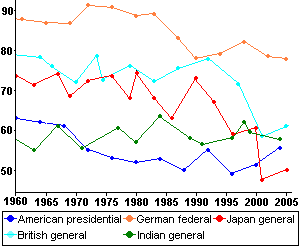
Trends of decreasing turnout
Boycott
A boycott is an act of voluntarily abstaining from using, buying, or dealing with a person, organization, or country as an expression of protest, usually for political reasons...
s, demonstration
Protest
A protest is an expression of objection, by words or by actions, to particular events, policies or situations. Protests can take many different forms, from individual statements to mass demonstrations...
s, and to donate to political campaigns.
Before the late 20th century, suffrage
Suffrage
Suffrage, political franchise, or simply the franchise, distinct from mere voting rights, is the civil right to vote gained through the democratic process...
— the right to vote — was so limited in most nations that turnout figures have little relevance to today. One exception was the United States, which had near universal white male suffrage by 1840. The U.S. saw a steady rise in voter turnout during the century, reaching its peak in the years after the Civil War
American Civil War
The American Civil War was a civil war fought in the United States of America. In response to the election of Abraham Lincoln as President of the United States, 11 southern slave states declared their secession from the United States and formed the Confederate States of America ; the other 25...
. Turnout declined from the 1890s until the 1930s, then increased again until 1960 before beginning its current long decline. In Europe, voter turnouts steadily increased from the introduction of universal suffrage before peaking in the mid to late 1960s, with modest declines since then. These declines have been smaller than those in the United States, and in some European countries turnout have remained stable and even slightly increased. Globally, voter turnout has decreased by about five percentage points over the last four decades.
Reasons for decline
Many causes have been proposed for this decline; a combination of factors is most likely. When asked why they do not vote, many people report that they have too little free time. However, over the last several decades, studies have consistently shown that the amount of leisure time has not decreased. The perception that one is busier is common, and might be just as important as a real decrease in leisure time. Geographic mobility has increased over the last few decades. There are often barriers to voting in a district where one is a recent arrival, and a new arrival is likely to know little about the local candidate and local issues. Francis FukuyamaFrancis Fukuyama
Yoshihiro Francis Fukuyama is an American political scientist, political economist, and author. He is a Senior Fellow at the Center on Democracy, Development and the Rule of Law at Stanford. Before that he served as a professor and director of the International Development program at the School of...
has blamed the welfare state
Welfare state
A welfare state is a "concept of government in which the state plays a key role in the protection and promotion of the economic and social well-being of its citizens. It is based on the principles of equality of opportunity, equitable distribution of wealth, and public responsibility for those...
, arguing that the decrease in turnout has come shortly after the government became far more involved in people's lives. He argues in Trust: The Social Virtues and The Creation of Prosperity that the social capital
Social capital
Social capital is a sociological concept, which refers to connections within and between social networks. The concept of social capital highlights the value of social relations and the role of cooperation and confidence to get collective or economic results. The term social capital is frequently...
essential to high voter turnouts is easily dissipated by government actions. However, on an international level those states with the most extensive social programs tend to be the ones with the highest turnouts. Richard Sclove argues, in Democracy and Technology, that technological developments in society such as "automobilization," suburban living, and "an explosive proliferation of home entertainment devices" have contributed to a loss of community, which in turn has weakened participation in civic life.
Trust in government and in politicians has decreased in many nations. However, the first signs of decreasing voter turnout occurred in the early 1960s, which was before the major upheavals of the late 1960s and 1970s. Robert D. Putnam argues that the collapse in civil engagement is due to the introduction of television. In the 1950s and 1960s television quickly became the main leisure activity in developed nations. It replaced earlier more social entertainments such as bridge clubs, church groups, and bowling leagues. Putnam argues that as people retreated within their homes and general social participation declined so too did voting. Rosenstone and Hansen contend that the decline in turnout is the product of a change in campaigning strategies as a result of the so-called new media. Before the introduction of television, almost all of a party's resources would be directed towards intensive local campaigning and get out the vote
Get out the vote
"Get out the vote" are terms used to describe two categories of political activity, both aimed at increasing the number of votes cast in one or more elections.- Non-partisan contexts :...
initiatives. In the modern era, these resources have been redirected to expensive media campaigns in which the potential voter is a passive participant. During the same period, negative campaigning
Negative campaigning
Negative campaigning, also known more colloquially as "mudslinging", is trying to win an advantage by referring to negative aspects of an opponent or of a policy rather than emphasizing one's own positive attributes or preferred policies...
has become ubiquitous in the United States and elsewhere. Attack ad
Attack ad
In political campaigns, an attack ad is an advertisement whose message is meant as a personal attack against another candidate or political party...
s and smear campaigns give voters a negative impression of the entire political process. The evidence for this is mixed: elections involving highly unpopular incumbents generally have high turnout; some studies have found that mudslinging and character attacks reduce turnout, but that substantive attacks on a party's record can increase it.
The decline in voter turnout is almost wholly concentrated among non-seniors. Those who began voting prior to 1960 maintain the same high turnout rates of that era. For each subsequent generation, starting with the one that came of age in the 1960s, turnout has steadily declined. Recent programs to increase the rates of voting among young people—such as MTV's "Rock the Vote
Rock the Vote
Rock the Vote is a non-profit organization in the United States of America whose mission is to engage and build the political power of young people....
" and the "Vote or Die" initiatives in the United States—may have marginally increased turnouts of those between the ages of 18 and 25 to vote. On a related note, the 2004 American election saw young adults vote in greater numbers since any election where 18-year-olds were eligible to vote, a statistic Michael Moore
Michael Moore
Michael Francis Moore is an American filmmaker, author, social critic and activist. He is the director and producer of Fahrenheit 9/11, which is the highest-grossing documentary of all time. His films Bowling for Columbine and Sicko also place in the top ten highest-grossing documentaries...
claims may have been driven by his Slacker Uprising 2004 tour. A number of governments and electoral commissions
Election management body
An election management body or EMB is the authority in a nation charged with administering the electoral process. EMBs can be independent, mixed, judicial or governmental. The EMB may also be responsible for electoral boundary delimitation...
have also launched efforts to boost turnout. For instance Elections Canada
Elections Canada
Elections Canada is an independent, non-partisan agency reporting directly to the Parliament of Canada. Its ongoing responsibility is to ensure that Canadians can exercise their choices in federal elections and referenda through an open and impartial process...
has launched mass media campaigns to encourage voting prior to elections, as have bodies in Taiwan and the United Kingdom.
Ineligibility
Much of the above analysis is predicated on voter turnout as measured as a percentage of the voting-age population. In a 2001 article in the American Political Science ReviewAmerican Political Science Review
The American Political Science Review is the flagship publication of the American Political Science Association and is the most prestigious journal in political science according to the ISI 2004 Journal Citation Report...
, Michael McDonald and Samuel Popkin argued, that at least in the United States, voter turnout since 1972 has not actually declined when calculated for those eligible to vote, what they term the voting-eligible population. In 1972, noncitizens and ineligible felons (depending on state law) constituted about 2% of the voting-age population. By 2004, ineligible voters constituted nearly 10%. Ineligible voters are not evenly distributed across the country - 20% of California's voting-age population is ineligible to vote - which confounds comparisons of states. Furthermore, they argue that an examination of the Census Bureau's Current Population Survey shows that turnout is low but not declining among the youth, when the high youth turnout of 1972 (the first year 18–20 year olds were eligible to vote in most states) is removed from the trendline.