
| |
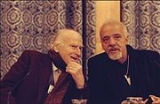
Paulo Coelho (born August 24, 1947) is a Brazilian lyricist and novelist.
o Coelho was born in Rio de Janeiro, Brazil. His father, Pedro, was an engineer, and his mother Lydia was a home-maker. He attended a Jesuit school. As a teenager, Coelho wanted to become a writer. Upon telling his mother this, she responded with "My dear, your father is an engineer. He's a logical, reasonable man with a very clear vision of the world.

Discussion
Ask a question about 'Paulo Coelho'
Start a new discussion about 'Paulo Coelho'
Answer questions from other users
|
Quotations
...And that dream, day by day, became less important. May be cause it wasn't really his dream
Don't think about what you've left behind.
"The Alchemist"
If I am really part of your dream, you will come back one day.
Fatima
It is said that the darkest hour of the night comes just before the dawn.
It's not often that money saves a person's life.
"The Alchemist"
May love be your guide in every moment of your life.

Encyclopedia
Paulo Coelho (born August 24, 1947) is a Brazilian lyricist and novelist.
Biography
Paulo Coelho was born in Rio de Janeiro, Brazil. His father, Pedro, was an engineer, and his mother Lydia was a home-maker. He attended a Jesuit school. As a teenager, Coelho wanted to become a writer. Upon telling his mother this, she responded with "My dear, your father is an engineer. He's a logical, reasonable man with a very clear vision of the world. Do you actually know what it means to be a writer?" After researching, Coelho concluded that a writer "always wears glasses and never combs his hair" and has a "duty and an obligation never to be understood by his own generation," amongst other things. At 17, Coelho's introversion and opposition to follow a traditional path led to his parents committing him to a mental institution from which he escaped three times before being released at the age of 20. Coelho later remarked that "It wasn't that they wanted to hurt me, but they didn't know what to do... They did not do that to destroy me, they did that to save me.
At his parents' wishes, Coelho enrolled in law school and abandoned his dream to become a writer. One year later, he dropped out and lived life as a hippy, traveling through South America, North Africa, Mexico, and Europe and becoming immersed in the drug culture of the 1960s. Upon his return to Brazil, Coelho worked as a songwriter, composing lyrics for Elis Regina, Rita Lee, and Brazilian icon Raul Seixas. In 1974, Coelho was arrested and tortured for "subversive" activities by the ruling militia, who viewed his lyrics as left-wing and dangerous.
In 1986, Coelho walked the 500-plus mile Road of Santiago de Compostela in northwestern Spain, a turning point in his life. On the path, Coelho had a spiritual awakening, which he described autobiographically in The Pilgrimage. In an interview, Coelho stated "[In 1986], I was very happy in the things I was doing. I was doing something that gave me food and water -- to use the metaphor in The Alchemist, I was working, I had a person who I loved, I had money, but I was not fulfilling my dream. My dream was, and still is, to be a writer." Coelho would leave his lucrative career as a songwriter and pursue writing full-time.
Writing career
In 1982 Coelho published his first book, Hell Archives, which failed to make any kind of impact. In 1985 he contributed to the Practical Manual of Vampirism, although he later tried to take it off the shelves since he considered it “of bad quality." After making the the pilgrimage to Santiago de Compostela in 1986, Coelho wrote The Pilgrimage. The following year, Coelho wrote The Alchemist and published it through a small Brazilian publishing house who made an initial print run of 900 copies and decided not to reprint. He subsequently found a bigger publishing house, and with the publication of his next book Brida, The Alchemist became a Brazilian bestseller. The Alchemist has gone on to sell more than 65 million copies, becoming one of the best-selling books in history, and has been translated into more than 67 languages, winning the Guinness World Record for most translated book by a living author.
Since the publication of The Alchemist, Coelho has generally written one novel every two years including By the River Piedra I Sat Down and Wept, The Fifth Mountain, Veronika Decides to Die, The Devil and Miss Prym, Eleven Minutes, Like the Flowing River, The Valkyries and The Witch of Portobello. He has stated that he only starts writing a book after finding a white feather in the month of January of every odd year. This dates back to The Pilgrimage; while trying to overcome procrastinating launching his writing career, Coelho said "If I see a white feather today, that is a sign that God is giving me that I have to write a new book." Coelho found a white feather in the window of a shop, and began writing that day.
In total, Coelho has published 26 books. Two of them -- The Pilgrimage and The Valkyries -- are autobiographical, while the majority of the rest are fictional, although rooted in his life experiences. Others, like Maktub and The Manual of the Warrior of Light, are collections of essays, newspaper columns, or selected teachings. In total, Coelho has sold more than 100 million books in over 150 countries worldwide, and his works have been translated into 67 languages. He is the all-time bestselling Portuguese author.
Adaptations
Several of Coelho's books have been adapted into other mediums.
In 2003, Warner Bros. bought the rights to the film adaptation of The Alchemist. The project stalled and the movie never materialized, reportedly for problems with the script. At the 2008 Cannes Film Festival, Harvey Weinstein announced that he had bought the rights to the film and will serve as its producer. Laurence Fishburne is set to direct, and to play the eponymous character. The movie will have a reported budget of $60 million. Veronika Decides to Die has also been adapted into a screenplay by Das Films with Muse Productions and Velvet Steamroller Entertainment. The film began shooting on May 12, 2008 with Emily Young directing and Sarah Michelle Gellar starring.
In June 2007, Paulo Coelho announced The Experimental Witch Project, a collaborative project based on The Witch of Portobello. In the book, the life story of the main character, Athena, is told in the form of interviews with 15 characters. Coelho asked aspiring filmmakers to upload their interpretations of one of the narratives to Myspace or YouTube. The winners were awarded $4,638 and will have their content edited into a 52-minute TV movie.
Acclaim and criticism Although his work has sold very well, his election to the Brazilian Academy of Letters proved controversial. Seen by some Brazilian literary critics as a lesser author whose material is too simplistic and similar to that of self-help books. Criticism of his work arises mostly from his plain, direct style and borrowing of ideas from other authors. For example the ending of "The Alchemist" is borrowed from the fabel "The treasure under the bridge" by Nachman of Breslov.
File Sharing
Paulo Coelho is a strong advocate of spreading his books through peer-to-peer file sharing networks. A fan posted a Russian translation of one of his novels online. Sales of his book jumped from 3,000 to one million in three years, with no additional promotion or publicity from his publishers. Coelho took to pirating his own books on Pirate Coelho which provides free translations of many of his books He was caught by the head of HarperCollins, Jane Friedman, who noticed that one of the unauthorized versions Coelho linked to had notes from his own manuscript. The two reached a compromise: each month a new novel can be read for free on the publisher's website. Due to the openness regarding his content, author Jeff Jarvis named Coelho 'the Googliest author' in his book What Would Google Do.
Personal life
Coelho and his wife of 26 years, Christina Oiticica, split time living in France and Rio de Janeiro, Brazil. He was raised as a Jesuit but converted to Catholicism later in life. He notes that although he attends mass, he disagrees with the Pope on several issues, both political and social.
In 1996, Coelho founded the Paulo Coelho Institute, which provides aid to children and elderly people with financial problems. In September 2007, Coelho was named a Messenger of Peace to the United Nations.
- Member of the Board of the Shimon Peres Center for Peace
- UNESCO special counsellor for “Intercultural Dialogues and Spiritual Convergences”
- Board Member of the Schwab Foundation for Social Entrepreneurship
- Member of the Brasilian Academy of Letters
- Member of INI International Advisory Council - HARVARD INTERNATIONAL NEGOTIATION INITIATIVE
- Member of the Board, Doha Center of Media Freedom
- Advisory Board Member, Maybach Foundation
Bibliography
Note: Although the biography section of Coelho's website states that his first book was published in 1982, the Official Fan Club Paulo Coelho website lists two additional books published in 1974: The Manifest of Krig-há and Theater For Education.
External links
|