

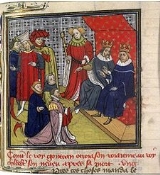
Guntram

Encyclopedia
Saint Guntram (also called Gontram, Gontran, Gunthram, or Gunthchramn) was the king of Burgundy
from 561 to 592. He was a son (third eldest, second eldest surviving) of Chlothar I and Ingunda. On his father's death (561), he became king of a fourth of the kingdom of the Franks
, and made his capital at Orléans
.
He had something of that fraternal love which his brothers lacked and the preeminent chronicler of the period, Gregory of Tours
, often calls him good king Guntram, as noted here, where Gregory discusses the fate of Guntram's three marriages:
As implied above, Guntram had a period of intemperance. He was eventually overcome with remorse for the sins of his past life, and spent his remaining years repenting of them, both for himself and for his nation. In atonement, he fasted, prayed, wept, and offered himself to God. Throughout the balance of his prosperous reign he attempted to govern by Christian principles. According to Gregory, he was the protector of the oppressed, caregiver to the sick, and the tender parent to his subjects. He was open-handed with his wealth, especially in times of plague and famine. He strictly and justly enforced the law without respect to person, yet was ever ready to forgive offences against himself, including two attempted assassinations. Guntram munificently built and endowed many churches and monasteries. Gregory of Tours relates many miracles performed by the king, both before and after his death, some of which he claims to have witnessed himself.
In 567, his elder brother Charibert I
died and his lands (the Kingdom of Paris
) were divided between the surviving brothers: Guntram, Sigebert I
, and Chilperic I
. They shared his realm, agreeing at first to hold Paris in common. Charibert's widow, Theudechild, proposed a marriage with Guntram, the eldest remaining brother, though a council held at Paris as recently as 557 had outlawed such tradition as incestuous. Guntram decided to house her more safely, though unwillingly, in a nunnery at Arles
.
In 573, he was caught in a civil war
with his brother Sigebert I of Austrasia
and in 575, called upon the aid of their brother Chilperic I of Soissons
. He reversed his allegiance later—due to the character of Chilperic, if we may give him the benefit of the doubt in light of Gregory's commendation—and Chilperic retreated. He thereafter remained an ally of Sigebert and his wife and sons until his death. When Sigebert was assassinated later that year (575), Chilperic invaded the kingdom, but Guntram sent his general Mummolus
(always Guntrams main weapon, for he was the greatest general in Gaul
at the time) to remove him and Mummolus defeated Chilperic's general Desiderius
and the Neustrian's forces retreated from Austrasia.
In 577, Chlothar and Clodomir, his two surviving children, died of dysentery
and he adopted as his son and heir, Childebert II
, his nephew, Sigebert's son, whose kingdom he had saved two years prior. However, Childebert did not always prove faithful to his uncle. In 581, Chilperic took many of Guntram's cities and in 583, he allied with Childebert and attacked Guntram. This time Guntram made peace with Chilperic and Childebert retreated. In 584, he returned Childebert's infidelity by invading his land and capturing Tours
and Poitiers
, but he had to leave to attend the baptism of Chlothar II, his other nephew, who now ruled in Neustria. Supposed to take place on the feast of Saint Martin
, July 4, in Orléans, it never did and Guntram turned to invade Septimania
. Peace was soon made.
In 584 or 585, one Gundowald
claimed to be an illegitimate son of Chlothar I and proclaimed himself king, taking some major cities in southern Gaul
, such as Poitiers
and Toulouse
, which belonged to Guntram. Guntram marched against him, calling him nothing more than a miller's son named Ballomer. Gundowald fled to Comminges
and Guntram's army set down to besiege the citadel. They couldn't take it, but didn't need to: Gundowald's followers gave him over and he was executed.
In 587, Fredegund
attempted to assassinate him, but failed. He went, on November 28, to Trier
to make a treaty with Childebert; Brunhilda, his sister-in-law, Sigebert's wife, whose ally he had always been; Chlodosind, Childebert's sister; Faileuba, Childebert's queen; Magneric
, bishop of Trier; and Ageric, bishop of Verdun. This was called the Treaty of Andelot
and it lasted until Guntram's death.
Also in 587, Guntram compelled obedience from Waroch
, the Breton
ruler of the Vannetais. He forced the renewal of the oath of 578 in writing and demanded 1,000 solidi in compensation for raiding the Nantais. In 588, the compensation was not yet paid, as Waroch promised it to both Guntram and Chlothar II, who probably had suzerainty over Vannes.
In 589 or 590, Guntram sent an expedition against Waroch under Beppolem and Ebrachain, mutual enemies. Ebrachain was also enemy of Fredegund, who sent the Saxons
of Bayeux to aid Waroch. Beppolem fought alone for three days before dying, at which point Waroch tried to flee to the Channel Islands
, but Ebrachain destroyed his ships and forced him to accept a peace, the renewal of the oath, and the giving up of a nephew as a hostage. This was all to no effect. The Bretons maintained their independent-mindedness.
In 589, Guntram made a final advance on Septimania, to no avail. He fought against the barbarians who menaced the kingdom and quelled an uprising of his niece Basina at a Poitevin nunnery with the aid of many of his bishops (590).
He died at Chalon-sur-Saône
in 592, and his kingdom was taken over by his nephew, Childebert II. He was buried in the church of Saint Marcellus
, which he had founded in Chalon. Almost immediately Guntram was proclaimed a saint by his subjects and his feast day is celebrated by the Catholic Church on March 28. The Huguenot
s, who scattered his ashes in the 16th century, left only his skull untouched in their fury. It is now kept there in a silver case.
Kingdom of Burgundy
Burgundy is a historic region in Western Europe that has existed as a political entity in a number of forms with very different boundaries. Two of these entities - the first around the 6th century, the second around the 11th century - have been called the Kingdom of Burgundy; a third was very...
from 561 to 592. He was a son (third eldest, second eldest surviving) of Chlothar I and Ingunda. On his father's death (561), he became king of a fourth of the kingdom of the Franks
Franks
The Franks were a confederation of Germanic tribes first attested in the third century AD as living north and east of the Lower Rhine River. From the third to fifth centuries some Franks raided Roman territory while other Franks joined the Roman troops in Gaul. Only the Salian Franks formed a...
, and made his capital at Orléans
Orléans
-Prehistory and Roman:Cenabum was a Gallic stronghold, one of the principal towns of the Carnutes tribe where the Druids held their annual assembly. It was conquered and destroyed by Julius Caesar in 52 BC, then rebuilt under the Roman Empire...
.
He had something of that fraternal love which his brothers lacked and the preeminent chronicler of the period, Gregory of Tours
Gregory of Tours
Saint Gregory of Tours was a Gallo-Roman historian and Bishop of Tours, which made him a leading prelate of Gaul. He was born Georgius Florentius, later adding the name Gregorius in honour of his maternal great-grandfather...
, often calls him good king Guntram, as noted here, where Gregory discusses the fate of Guntram's three marriages:
The good king Guntram first took a concubine Veneranda, a slave belonging to one of his people, by whom he had a son Gundobad. Later he married Marcatrude, daughter of Magnar, and sent his son Gundobad to Orléans. But after she had a son Marcatrude was jealous, and proceeded to bring about Gundobad's death. She sent poison, they say, and poisoned his drink. And upon his death, by God's judgment she lost the son she had and incurred the hate of the king, was dismissed by him, and died not long after. After her he took Austerchild, also named Bobilla. He had by her two sons, of whom the older was called Clothar and the younger Chlodomer.
As implied above, Guntram had a period of intemperance. He was eventually overcome with remorse for the sins of his past life, and spent his remaining years repenting of them, both for himself and for his nation. In atonement, he fasted, prayed, wept, and offered himself to God. Throughout the balance of his prosperous reign he attempted to govern by Christian principles. According to Gregory, he was the protector of the oppressed, caregiver to the sick, and the tender parent to his subjects. He was open-handed with his wealth, especially in times of plague and famine. He strictly and justly enforced the law without respect to person, yet was ever ready to forgive offences against himself, including two attempted assassinations. Guntram munificently built and endowed many churches and monasteries. Gregory of Tours relates many miracles performed by the king, both before and after his death, some of which he claims to have witnessed himself.
In 567, his elder brother Charibert I
Charibert I
Charibert I was the Merovingian King of Paris, the second-eldest son of Chlothar I and Ingund. His elder brother was Gunthar, who died sometime before their father's death....
died and his lands (the Kingdom of Paris
Paris
Paris is the capital and largest city in France, situated on the river Seine, in northern France, at the heart of the Île-de-France region...
) were divided between the surviving brothers: Guntram, Sigebert I
Sigebert I
Sigebert I was the king of Austrasia from the death of his father in 561 to his own death. He was the third surviving son out of four of Clotaire I and Ingund...
, and Chilperic I
Chilperic I
Chilperic I was the king of Neustria from 561 to his death. He was one of the sons of the Frankish king Clotaire I and Queen Aregund....
. They shared his realm, agreeing at first to hold Paris in common. Charibert's widow, Theudechild, proposed a marriage with Guntram, the eldest remaining brother, though a council held at Paris as recently as 557 had outlawed such tradition as incestuous. Guntram decided to house her more safely, though unwillingly, in a nunnery at Arles
Arles
Arles is a city and commune in the south of France, in the Bouches-du-Rhône department, of which it is a subprefecture, in the former province of Provence....
.
In 573, he was caught in a civil war
Civil war
A civil war is a war between organized groups within the same nation state or republic, or, less commonly, between two countries created from a formerly-united nation state....
with his brother Sigebert I of Austrasia
Austrasia
Austrasia formed the northeastern portion of the Kingdom of the Merovingian Franks, comprising parts of the territory of present-day eastern France, western Germany, Belgium, Luxembourg and the Netherlands. Metz served as its capital, although some Austrasian kings ruled from Rheims, Trier, and...
and in 575, called upon the aid of their brother Chilperic I of Soissons
Soissons
Soissons is a commune in the Aisne department in Picardy in northern France, located on the Aisne River, about northeast of Paris. It is one of the most ancient towns of France, and is probably the ancient capital of the Suessiones...
. He reversed his allegiance later—due to the character of Chilperic, if we may give him the benefit of the doubt in light of Gregory's commendation—and Chilperic retreated. He thereafter remained an ally of Sigebert and his wife and sons until his death. When Sigebert was assassinated later that year (575), Chilperic invaded the kingdom, but Guntram sent his general Mummolus
Mummolus
Mummolus, Mommolus, or Mummulus, born Eunius to one Peonius, Count of Auxerre. He was a Gallo-Roman patrician and prefect who served Guntram, King of Burgundy, as a general....
(always Guntrams main weapon, for he was the greatest general in Gaul
Gaul
Gaul was a region of Western Europe during the Iron Age and Roman era, encompassing present day France, Luxembourg and Belgium, most of Switzerland, the western part of Northern Italy, as well as the parts of the Netherlands and Germany on the left bank of the Rhine. The Gauls were the speakers of...
at the time) to remove him and Mummolus defeated Chilperic's general Desiderius
Desiderius of Aquitaine
Desiderius was a Gallo-Roman dux in the Kingdom of the Franks during the reigns of Chilperic I and Guntram. He served Chilperic as Duke of Aquitaine and was his greatest general....
and the Neustrian's forces retreated from Austrasia.
In 577, Chlothar and Clodomir, his two surviving children, died of dysentery
Dysentery
Dysentery is an inflammatory disorder of the intestine, especially of the colon, that results in severe diarrhea containing mucus and/or blood in the faeces with fever and abdominal pain. If left untreated, dysentery can be fatal.There are differences between dysentery and normal bloody diarrhoea...
and he adopted as his son and heir, Childebert II
Childebert II
.Childebert II was the Merovingian king of Austrasia, which included Provence at the time, from 575 until his death in 595, the eldest and succeeding son of Sigebert I, and the king of Burgundy from 592 to his death, as the adopted and succeeding son of his uncle Guntram.-Childhood:When his father...
, his nephew, Sigebert's son, whose kingdom he had saved two years prior. However, Childebert did not always prove faithful to his uncle. In 581, Chilperic took many of Guntram's cities and in 583, he allied with Childebert and attacked Guntram. This time Guntram made peace with Chilperic and Childebert retreated. In 584, he returned Childebert's infidelity by invading his land and capturing Tours
Tours
Tours is a city in central France, the capital of the Indre-et-Loire department.It is located on the lower reaches of the river Loire, between Orléans and the Atlantic coast. Touraine, the region around Tours, is known for its wines, the alleged perfection of its local spoken French, and for the...
and Poitiers
Poitiers
Poitiers is a city on the Clain river in west central France. It is a commune and the capital of the Vienne department and of the Poitou-Charentes region. The centre is picturesque and its streets are interesting for predominant remains of historical architecture, especially from the Romanesque...
, but he had to leave to attend the baptism of Chlothar II, his other nephew, who now ruled in Neustria. Supposed to take place on the feast of Saint Martin
Martin of Tours
Martin of Tours was a Bishop of Tours whose shrine became a famous stopping-point for pilgrims on the road to Santiago de Compostela. Around his name much legendary material accrued, and he has become one of the most familiar and recognizable Christian saints...
, July 4, in Orléans, it never did and Guntram turned to invade Septimania
Septimania
Septimania was the western region of the Roman province of Gallia Narbonensis that passed under the control of the Visigoths in 462, when Septimania was ceded to their king, Theodoric II. Under the Visigoths it was known as simply Gallia or Narbonensis. It corresponded roughly with the modern...
. Peace was soon made.
In 584 or 585, one Gundowald
Gundowald
Gundoald or Gundovald, also called Ballomer, was a usurper king of Aquitaine in either 584 or 585. He claimed to be an illegitimate son of Clotaire I and, with the financial support of the Emperor Maurice, took some major cities in southern Gaul, including Poitiers and Toulouse, which belonged to...
claimed to be an illegitimate son of Chlothar I and proclaimed himself king, taking some major cities in southern Gaul
Gaul
Gaul was a region of Western Europe during the Iron Age and Roman era, encompassing present day France, Luxembourg and Belgium, most of Switzerland, the western part of Northern Italy, as well as the parts of the Netherlands and Germany on the left bank of the Rhine. The Gauls were the speakers of...
, such as Poitiers
Poitiers
Poitiers is a city on the Clain river in west central France. It is a commune and the capital of the Vienne department and of the Poitou-Charentes region. The centre is picturesque and its streets are interesting for predominant remains of historical architecture, especially from the Romanesque...
and Toulouse
Toulouse
Toulouse is a city in the Haute-Garonne department in southwestern FranceIt lies on the banks of the River Garonne, 590 km away from Paris and half-way between the Atlantic Ocean and the Mediterranean Sea...
, which belonged to Guntram. Guntram marched against him, calling him nothing more than a miller's son named Ballomer. Gundowald fled to Comminges
Comminges
The Comminges is an ancient region of southern France in the foothills of the Pyrenees, corresponding closely to the arrondissement of Saint-Gaudens in the department of Haute-Garonne...
and Guntram's army set down to besiege the citadel. They couldn't take it, but didn't need to: Gundowald's followers gave him over and he was executed.
In 587, Fredegund
Fredegund
Fredegund was the Queen consort of Chilperic I, the Merovingian Frankish king of Soissons.All her wealth and power came to her through her association with Chilperic...
attempted to assassinate him, but failed. He went, on November 28, to Trier
Trier
Trier, historically called in English Treves is a city in Germany on the banks of the Moselle. It is the oldest city in Germany, founded in or before 16 BC....
to make a treaty with Childebert; Brunhilda, his sister-in-law, Sigebert's wife, whose ally he had always been; Chlodosind, Childebert's sister; Faileuba, Childebert's queen; Magneric
Magneric
Magneric was a Frankish bishop of Trier. He is a Catholic and Orthodox saint, with feast day July 25.He was a friend of Gregory of Tours, and is mentioned in his History of the Franks. St Géry is said to be one of his disciples....
, bishop of Trier; and Ageric, bishop of Verdun. This was called the Treaty of Andelot
Treaty of Andelot
The Treaty of Andelot , was signed at Andelot-Blancheville in 587 between King Guntram of Burgundy and Queen Brunhilda of Austrasia. Based on the terms of the accord, Brunhilda agreed that Guntram adopt her son Childebert II as his successor and ally himself with Childebert against the revolted...
and it lasted until Guntram's death.
Also in 587, Guntram compelled obedience from Waroch
Waroch
Waroch was an early Breton ruler of the Vannetais. Waroch gave his name to the traditional Breton province of Broërec . However, it is possible that there were several successive local leaders with this name....
, the Breton
Brittany
Brittany is a cultural and administrative region in the north-west of France. Previously a kingdom and then a duchy, Brittany was united to the Kingdom of France in 1532 as a province. Brittany has also been referred to as Less, Lesser or Little Britain...
ruler of the Vannetais. He forced the renewal of the oath of 578 in writing and demanded 1,000 solidi in compensation for raiding the Nantais. In 588, the compensation was not yet paid, as Waroch promised it to both Guntram and Chlothar II, who probably had suzerainty over Vannes.
In 589 or 590, Guntram sent an expedition against Waroch under Beppolem and Ebrachain, mutual enemies. Ebrachain was also enemy of Fredegund, who sent the Saxons
Saxons
The Saxons were a confederation of Germanic tribes originating on the North German plain. The Saxons earliest known area of settlement is Northern Albingia, an area approximately that of modern Holstein...
of Bayeux to aid Waroch. Beppolem fought alone for three days before dying, at which point Waroch tried to flee to the Channel Islands
Channel Islands
The Channel Islands are an archipelago of British Crown Dependencies in the English Channel, off the French coast of Normandy. They include two separate bailiwicks: the Bailiwick of Guernsey and the Bailiwick of Jersey...
, but Ebrachain destroyed his ships and forced him to accept a peace, the renewal of the oath, and the giving up of a nephew as a hostage. This was all to no effect. The Bretons maintained their independent-mindedness.
In 589, Guntram made a final advance on Septimania, to no avail. He fought against the barbarians who menaced the kingdom and quelled an uprising of his niece Basina at a Poitevin nunnery with the aid of many of his bishops (590).
He died at Chalon-sur-Saône
Chalon-sur-Saône
Chalon-sur-Saône is a commune in the Saône-et-Loire department in the region of Bourgogne in eastern France.It is a sub-prefecture of the department. It is the largest city in the department; however, the department capital is the smaller city of Mâcon....
in 592, and his kingdom was taken over by his nephew, Childebert II. He was buried in the church of Saint Marcellus
Saint Marcellus
Saint Marcellus may refer to:*Pope Marcellus I*Marcellus of Capua*Marcellus of Tangier...
, which he had founded in Chalon. Almost immediately Guntram was proclaimed a saint by his subjects and his feast day is celebrated by the Catholic Church on March 28. The Huguenot
Huguenot
The Huguenots were members of the Protestant Reformed Church of France during the 16th and 17th centuries. Since the 17th century, people who formerly would have been called Huguenots have instead simply been called French Protestants, a title suggested by their German co-religionists, the...
s, who scattered his ashes in the 16th century, left only his skull untouched in their fury. It is now kept there in a silver case.
Sources
- Howorth, Henry H. "The Ethnology of Germany. Part 3: The Migration of the Saxons." The Journal of the Anthropological Institute of Great Britain and Ireland, Vol. 7. (1878), pp 293–320.
- Dahmus, Joseph Henry. Seven Medieval Queens. 1972.
- Gregory of ToursGregory of ToursSaint Gregory of Tours was a Gallo-Roman historian and Bishop of Tours, which made him a leading prelate of Gaul. He was born Georgius Florentius, later adding the name Gregorius in honour of his maternal great-grandfather...
. The History of the Franks, Volume II: Text. trans. O. M. Dalton. Clarendon Press: 1967. - History of the Franks: Books I-X. translated by Ernest Brehaut. Available at Medieval Sourcebook.