

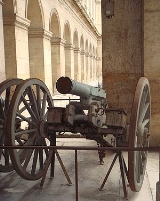
Mitrailleuse

Encyclopedia
Mitrailleuse is the French word used to describe all rapid-firing weapons of rifle caliber. Therefore the word mitrailleuse, when used in the French language
, applies to all machine guns including modern full automatic weapons. However in the English language the word mitrailleuse applies to volley guns with multiple barrels of rifle caliber. The earliest true mitrailleuse was invented in 1851 by Belgian Army
Captain Fafschamps, 10 years before the advent of the Gatling gun
. It was followed by the Belgian Montigny mitrailleuse
in 1863. Then the French 25 barrel "Canon à Balles", better known as the Reffye mitrailleuse, was adopted in great secrecy in 1866. It became the first rapid-firing weapon deployed as standard equipment by any army in a major conflict. This happened during the Franco-Prussian War
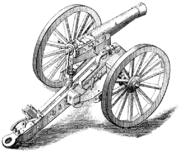
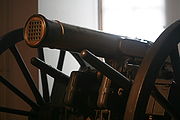
of 1870–71. A steel block containing twenty-five 13 mm (.51 caliber) center-fire cartridges was locked against the breech before firing. With the rotation of a crank, the 25 rounds were discharged in rapid succession. The sustainable firing rate of the Reffye mitrailleuse was 100 rounds per minute. The effective reach of the Reffye mitrailleuse extended to about 2000 yards, a distance placing their batteries beyond the reach of Dreyse needle rifle fire. Reffye mitrailleuses were deployed in 6 gun batteries and were manned by artillery personnel. They were not infantry support weapons but rather a form of special artillery.
Although innovative and capable of good ballistic performance, the Reffye mitrailleuse failed as a tactical weapon because its basic concept and operational usage were flawed. Furthermore only 210 Reffye mitrailleus were in existence at the beginning of the Franco-Prussian War in 1870. Their field use was discontinued by the French Army after 1871. In contrast, the Gatling gun became widely successful and even survives in powered form to this day. The word 'mitrailleuse' nonetheless became the generic term for a machine gun
in the French language, although the mitrailleuse itself was manually-operated.
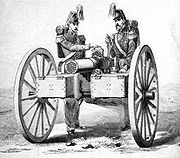 The first "mitrailleuse" was a manually-fired 50-barrel volley gun
originally developed in Belgium
in 1851, 10 years before the advent of the Gatling gun, by the Belgian Army
Captain Fafschamps, who made a rough prototype and drawings of his invention. The system was improved during the 1850s by Louis Christophe and the Belgian engineer Joseph Montigny
, with the completion of the 37-barrel Montigny mitrailleuse
in 1863. From 1859, Joseph Montigny proposed his design to Napoleon III, which led to the development of the French Reffye mitrailleuse, designed by Jean-Baptiste Verchère de Reffye
with the collaboration of Montigny, and which was adopted by the French Army
in 1865. Initially kept under wraps as a secret weapon, it became widely used in battle by French artillery during the Franco-Prussian War
(1870–71). Smaller numbers of other designs, including the Gatling gun, were also purchased by the French government during the latter part of that conflict. The Reffye mitrailleuse had initially been built in small numbers and in secrecy: only about 200 were available for field deployment in July 1870 at the beginning of the conflict. This also kept regular French field artillery in a neglected position in the eyes of French emperor Napoleon III, with dire consequences during the Franco-Prussian War of 1870–71.
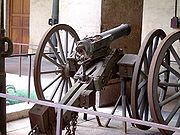
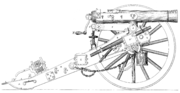 Several variants of the mitrailleuse concept were developed, with common elements to all of their designs. They were characterized by a number of rifled
barrels clustered together and mounted on a conventional artillery
chassis or (in the case of one model) a tripod. The ammunition was secured in a single block and placed into the breech, behind the open ends of the barrels. All of the barrels were loaded simultaneously by a manual closing lever or large horizontal screw. A second lever could be worked rapidly (or in some models, a crank could be turned) to fire each barrel in succession. This earned the weapon its French nickname of moulin à café (coffee grinder). (A very similar name was earned by the hand-cranked, mechanically-loaded, continuous-firing, multi-revolving-barreled "coffee mill gun" in America during the American Civil War
).
The ammunition plate or block had to be removed by hand before another loaded plate could be inserted. Unlike in the Gatling gun and later rapid-firing automatic weapons, the entire loading and firing process was manual. The mitrailleuse's major innovation was that it greatly increased the speed of these processes when compared to standard infantry rifles of the era.
The different variants of the mitrailleuse concept were distinguished by their number of barrels and their different calibers, as the following table summarizes.
Most variants of the mitrailleuse were mounted on an artillery-style carriage. This made it heavy and cumbersome to handle on the battlefield, with gun and carriage weighing up to 900 kg (2000 lb). Approximately one third of the Reffye mitrailleuses were fitted with a protective steel armor plate to shield the operator from hostile gunfire. This appeared rather late (1871), presumably in response to conditions on the battlefield in the Franco-Prussian War.
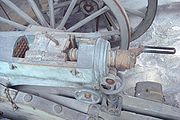
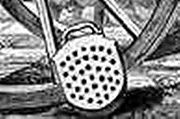
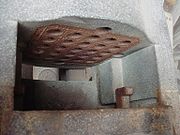
 The mitrailleuse's dependence on manual loading meant that its firing rate depended greatly on the skill of its operators. A skillfully-manned Reffye mitrailleuse could sustain 4 volleys ( 100 rounds) per minute in ordinary operation and reach 5 volleys (125 rounds) per minute during emergencies. The rapidity of discharge of each individual volley (25 rounds) was controlled by the gunner's action on a small manual crank on the right side of the breech. In other words, the weapon's 25 barrels were not discharged all at once but in rapid succession. Because of its heavy weight (1500 lbs) the Reffye mitrailleuse did not recoil during firing and thus did not need to be re-sighted on its target after each volley. This absence of recoil during firings was promoted by Reffye as a considerable advantage over conventional field artillery . Each regular battery of Reffye mitrailleuses lined up 6 guns firing together, more or less side by side.
 The Reffye mitrailleuse used a 13 mm ( .512 inch) centerfire cartridge, designed by Gaupillat, which represented the state of the art in ammunition design at the time (Huon,1986). It was rather similar to an elongated modern shotgun shell: centerfire with a rimmed brass head and a dark blue hardened cardboard body. The 770 gr, 13 mm (0.512 inch) patched bullet was propelled by a compressed black powder charge at a muzzle velocity of 1560 ft/s (475.5 m/s), three and a half times more powerful than Chassepot or Dreyse rifle ammunition. This was, by far, the most potent rifle caliber ammunition in existence at the time. The Reffye mitrailleuse did not fire the 11 mm Chassepot combustible paper cartridge
.
The 13 mm centerfire mitrailleuse cartridges were loaded into interchangeable steel breech blocks ( unlike the Montigny mitrailleuse whose ammunition was held by the cartridge base in plates ). When firing the mitrailleuse, three breech blocks were kept in continuous use: one being fired, one being pressed down on the extractor and one being loaded from a single pre-packaged 25 rounds box.
The weapon's barrel could be moved sideways, back and forth, with a rotating handle for sweeping fire. The angle was narrow, however, and the barrel could not swing far enough from side to side to produce effective sweeping fire at short distances. The weapon's field of fire was so narrow that Prussian soldiers were often hit by several bullets at once. During an early engagement of the Franco-Prussian War, at Forbach in Alsace on August 6, 1870, a Prussian general officer (Gen. Bruno von François) was brought down by a very closely spaced volley of 4 bullets. According to the Prussian regimental record, those four mitrailleuse bullets had been fired from 600 meters away. French artillery attempted to rectify this problem by developing special ammunition capable of firing three bullets from the same cartridge for short-range point defense.
 The mitrailleuse is best known for its service with the French Army but in fact it was first used in Belgium
in the 1850s as a static weapon to defend the moats of fortresses. It was a 50 barrel needle fire, paper cartridge weapon which had been designed by a Captain T.H.J. Fafschamps. Then, after 1863, it was improved with only 37 barrels, 11 X 70R mm centerfire ammunition (Huon,1986) and the weapon's placement on a wheeled artillery carriage. This transformation was carried out as an industrial venture by Christophe and Joseph Montigny
of Fontaine-l'Evêque
near Brussels
who sought to sell the new weapon to the rest of Europe.
The French military became interested in the Christophe and Montigny mitrailleuse in 1863 and the French Army's Artillery Committee undertook an investigation into the possible adoption of the Belgian weapon. However it was decided to do otherwise and to create a proprietary mitrailleuse weapon by sole French industrial means. In May 1864, General Edmond Leboeuf
submitted a preliminary report entitled Note sur le Canon à balles to the Emperor Napoleon III. Full-scale manufacture began in September 1865, in great secrecy, under the leadership of Lieutenant-Colonel Verchère de Reffye (1821–1880). Assembly and some manufacturing took place at the workshops in Meudon
but many parts came from the private industrial sector. Production was slow due to limited funding (the army had already spent much of its five-year budget on the Mle 1866 Chassepot
rifle), forcing Napoleon III to pay for development and manufacture out of secret funds. The new weapon was thoroughly tested in 1868 at the military firing range at Satory, near Versailles
, in conditions of great secrecy. Due to a fear of spies, test guns were concealed in tents while being fired at distant targets. The mitrailleuse performed mechanically with remarkable efficiency and much was expected of it in a combat situation.
A total of 215 mitrailleuses and five million rounds of ammunition had been manufactured by July 1870, but only 190 were operational and available for field service when war with Prussia
broke out.
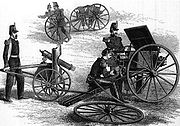 The French Army used the mitrailleuse as an artillery weapon, rather than an infantry support weapon – a role later to be filled by the machine gun. As a matter of fact, the official name of the Reffye mitrailleuse in the French Army was "le Canon à Balles", a designation that translates literally as: "the cannon which fires bullets":
Having been developed by the artillery they were, naturally, manned by artillerymen and attached to artillery groups equipped with regular four-pounder field guns. Each mitrailleuse battery comprised six guns, each with a crew of six. One man on the front right fired the gun while another man on the front left swiveled the gun sideways for sweeping fire. The four other men attended to aiming, loading, and unloading. Auguste Verchère de Reffye himself consistently viewed the Mitrailleuse as an artillery weapon:
The battlefield use of the mitrailleuse as artillery was a fatally flawed concept. In order to avoid being hit by Dreyse
rifle
fire, the mitrailleuse batteries were systematically deployed beyond about 1,400 m (1,500 yards) from the enemy lines. Although the maximum range of the mitrailleuses was 3,400 m (3,700 yards), the distances at which they were typically engaged in action rarely exceeded 2,000 m (2100 yards). This was much less than that of conventional French field artillery with which the mitrailleuses were deployed. However it was still too far, given the facts that range-finding and target acquisition, with the two open sights on the mitrailleuse, were extremely difficult at such long distances. For instance, mitrailleuse bullet impacts on the ground were impossible to observe in the far distance unless enemy ranks had been disrupted by hits from them. It may be noted that modern machine guns are typically used at ranges far shorter than their maximum range – the M60 machine gun
, for instance, is normally used at an effective range of 1,100 m (1,200 yards), compared to its maximum range of 3,725 m (4,074 yards). The mitrailleuse, by contrast, was often used at the outer edges of its range and without optical range finding equipment. These deficiencies in the operational usage of the Reffye mitrailleuse proved disastrous in the Franco-Prussian War.
 The outbreak of war with Prussia on 15 July 1870 led to a somewhat chaotic mobilization of the French Army. The mitrailleuse batteries faced particularly acute problems. Although they had been organized, on paper, into proper batteries, on the outbreak of war the guns were still in storage at Meudon and in the forts of Montrouge, Issy, and Mont-Valerien around Paris
. The crews had been designated but had not yet been assembled. Many had little or no training in the use of the weapons and so were unaware of its sighting and ranging characteristics. Detailed instruction manuals had been printed in January 1870, but had only been distributed at the very beginning of the hostilities. Such was the secrecy surrounding the weapon that not only did few artillery commanders know how to deploy it effectively, many did not even know that it existed. Marshal MacMahon, commander of the Army of Châlons
, claimed that he had never even seen a mitrailleuse until one was wheeled past him at the Battle of Sedan
on 2 September 1870, nearly two months after war had been declared.
Mitrailleuses were used in many of the major engagements of the war, but their small numbers – only 190 of the Reffye variant in the entire French army – greatly restricted their effectiveness in the field. Their flawed operational usage was a serious problem on the battlefield. While the mitrailleuses were inherently accurate, in a ballistic sense, they were often unable to zero in on targets quickly enough in the far distance. Furthermore, individual 25 round salvos were also too tightly grouped and lacked lateral dispersion even at long distances. To make matters worse, the complex firing mechanism was vulnerable to damage at the hands of inexperienced crews. Fouling of the mechanism by black powder combustion residues and thus difficulties in closing the breech were reported as a problem after prolonged firings.
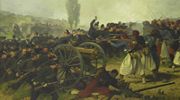 In a few instances where the Reffye mitrailleuses were put to good use, they showed that they could have a significant impact. Captain Barbe's mitrailleuse battery at the Battle of Gravelotte
devastated massed Prussian infantry when they had quickly found the range on their targets, contributing to the exceptionally high Prussian death toll in that battle. Other examples of effective mitrailleuse fire have also been described for the battles of Saint Privat and Mars-la-Tour. For the most part, however, mitrailleuses proved ineffective. It was concluded after the war that Chassepot rifle fire had caused a far greater number of Prussian casualties than the Reffye mitrailleuses. However, about 100,000 Chassepot rifles were engaged in combat in contrast with the less than 200 Reffye mitrailleuses used in battle at any given time.
The Prussians and foreign observers were not impressed by the performance of the mitrailleuse. In the case of the Prussians, their views were undoubtedly colored by propaganda. They had very few machine guns or volley guns of their own and, not least for reasons of maintaining morale in the face of a new weapon technology, they scorned the effectiveness of the mitrailleuse. They nonetheless saw the weapon as a threat and Prussian artillery always made it a priority to engage and destroy the mitrailleuse batteries. The weapon's characteristic "snarling rasp" does appear to have made some impression – the Prussian troops called the mitrailleuse the "Höllenmaschine" ("Hell Machine, Infernal Machine")
Its failure to have much effect in the field led to a belief that rapid-fire weapons were useless. United States Army
General William Babcock Hazen
, who observed the war, commented that "The French mitrailleuse had failed to live up to expectations. The Germans hold it in great contempt, and it will hardly become a permanent military arm." Strictly speaking, manually-operated volley guns such as the Reffye mitrailleuse were a technological dead-end, and they were soon replaced by fully automatic machine guns.
After Napoleon III's abdication following the disastrous French defeat in the Battle of Sedan
, French war powers fell into the hand of a republican government led by Leon Gambetta
. He vigorously organized national defense and the continued manufacture of war equipment. Most of the conventional weapon manufacturing was located in provincial France, but some mitrailleuse repair and even construction continued inside Paris during the city's four-month siege
.
The manufacture of the mitrailleuse and its ammunition was resumed under the direction of De Reffye in the coastal city of Nantes
in western France. An additional 122 mitrailleuses were manufactured in Nantes to replace the nearly 200 mitrailleuses that had already been destroyed and/or captured.
(José Maria Leyva), a prominent leader of his people from 1874-1887.
 After the armistice with Prussia in May 1871, one of the last recorded uses of Reffye mitrailleuses was by troops under the command of Adolphe Thiers
, when a battery executed captured Communards
in the Bois de Boulogne
, following the suppression of the Paris Commune
. Similar incidents involving the Reffye mitrailleuse are reported to have taken place at the Caserne Lobau, a barracks in the center of Paris.
A fairly large number of the French Army's Reffye mitrailleuses (268 altogether) survived the Franco-Prussian War. An additional 122 Reffye mitrailleuses, which had been captured during the 1870-71 campaign, were sold back to France by Germany through a London military surplus dealer in 1875. By 1885, many of the mitrailleuses in the overall remaining French inventory were designated to static point-defence
duties, for the purpose of providing flanking fire in the moats of fortresses. The last surviving Reffye mitrailleuses were removed from forts in eastern France as late as 1908. The Reffye mitrailleuses were never offered for sale by the French government, either before or after the Franco-Prussian War (1870–71). They are often confused with other types of manually operated volley guns, such as the Belgian-made Montigny mitrailleuse, or even with the Gatling gun.
Following their campaign against Arabi Pasha in Egypt
during 1882, the British
recorded having seized several mitrailleuses. None of these seemed to have been used in combat.
 The long-term effects of the mitrailleuse's poor performance have been the subject of some dispute among historians. In Machine guns: An Illustrated History, J. Willbanks argues that the weapon's ineffectiveness in the Franco-Prussian War resulted in long-standing opposition among European armies to adopting machine gun weapons, particularly in Continental Europe
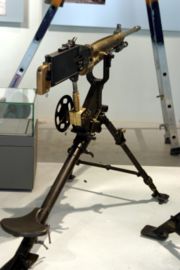
. It is true that the French army did not adopt an automatic machine-gun until 1897, when they chose the Hotchkiss machine gun
, later to be followed by the Hotchkiss M1914 machine gun
. The French armed forces also adopted another automatic machine gun, the St. Etienne Mle 1907
. It has been suggested that the relative slowness displayed by the French services to adopt machine guns was the result of wariness occasioned by the failure of the mitrailleuse. There is some justification to that, for the Maxim gun
had repeatedly been tested by the French armed services ever since its inception.
In the immediate aftermath of the war, the French put a much greater emphasis on improving their conventional artillery. The failure of French artillery during the 1870-71 campaign served as a strong motivation to develop the De Bange field artillery piece (1877) and eventually the well-known Canon de 75 modèle 1897
field gun. At a normal 15 shells per minute rate of fire, one single 75 mm gun could deliver 4,350 lethal shrapnel balls within one minute, up to 6 km away, versus the 75 bullets per minute that were delivered at up to 2 km distance by one Reffye mitrailleuse. Weapon system efficiency had increased by 2 orders of magnitude in 30 years.
 Despite such improvements in longer-range artillery, there still remained a need to develop better short- and medium-range infantry support weapons. During the period from 1871 to the 1890s, a variety of new European- and American-designed manual machine guns were adopted by many European armies. Large numbers of Gatling guns were purchased from the United States
and were used by Western European powers in colonial war
s in Africa
, India
, and Asia
. Twenty-five Gatling guns also saw active service in French hands during the Franco-Prussian war, in early 1871. They performed particularly well at an engagement at Le Mans
in western France. Furthermore the French armed services purchased, for their Navy and eastern fortifications, a large number of manual, rapid fire 37 mm multi-barrel guns (so-called Hotchkiss "canon-revolvers") made in France after 1879 by the firm of American expatriate Benjamin B. Hotchkiss
. By the 1890s however, European armies begun to retire their Gatling guns and other manual machine-guns in favor of fully automatic machine guns, such as the Maxim gun
, the Colt-Browning M1895
, and, in 1897, the Hotchkiss machine gun
. Such weapons became universal – and notorious – with the outbreak of the First World War in 1914.
, derives its name from the term Mini-Mitrailleuse - literally "tiny machine gun".
In Dutch, the word mitrailleur is widely used as a synonym for a machine gun. Obviously, this word is derived from the original mitrailleuse by changing the gender of the French word.
The term is also used in Norwegian
. Although spelled slightly differently as mitraljøse, the pronunciation is similar. In Norway, the term nowadays is used to refer to a machine gun (the MG3, labeled as mitr-3, to be specific) mounted on a tripod. This is similar to the German term Schweres Maschinengewehr, which refers to a regular machine gun mounted on a tripod (since the introduction of General purpose machine guns).
A related word, metralhadora, is used in Portuguese
. Although it is derived from the French mitrailleuse, its pronunciation is different. It describes any automatic firearm. Similarly, in Spanish ametralladora is the word for a machine gun, metralleta, connected to French mitraillette for a sub-machine gun.
The word also survived in Romania
, where the generic term for a machine gun is mitralieră, while in Slovenian
, Croatian
and Serbian
it's mitraljez.
The word mitrailleuse is surely the source for the modern Italian term: Mitragliatrice, describing a machine gun, as well.
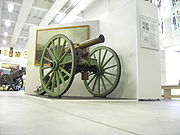 Two original Reffye mitrailleuses can be seen in Paris at the Musée de l'Armée
in the Hotel Des Invalides. Although sheltered from the rain they are outdoors and have irreversibly suffered from exposure to the elements for over a century. Furthermore, one of the two "Musee de l'Armee" mitrailleuses has recently been equipped with a modern square steel shield which is not authentic and never existed on the Reffye mitrailleuses ("Canon a balles") used during the Franco-Prussian War. Other better preserved mitrailleuses can be seen in the Musée royal de l’Armée et d'Histoire Militaire
in Brussels
and at the Musee Militaire Vaudois, 1110, Morges, Switzerland. Additionally, a well preserved Reffye mitrailleuse is also displayed in the collections of the Dreiecklandmuseum, 79423, Heitersheim (near Freiburg im Breisgau), Germany. Yet another extremely well preserved mitailleuse is displayed in the Historical Museum of the German Army in Dresden, Germany.
French language
French is a Romance language spoken as a first language in France, the Romandy region in Switzerland, Wallonia and Brussels in Belgium, Monaco, the regions of Quebec and Acadia in Canada, and by various communities elsewhere. Second-language speakers of French are distributed throughout many parts...
, applies to all machine guns including modern full automatic weapons. However in the English language the word mitrailleuse applies to volley guns with multiple barrels of rifle caliber. The earliest true mitrailleuse was invented in 1851 by Belgian Army
Belgian Army
The Land Component is organised using the concept of capacities, whereby units are gathered together according to their function and material. Within this framework, there are five capacities: the command capacity, the combat capacity, the support capacity, the services capacity and the training...
Captain Fafschamps, 10 years before the advent of the Gatling gun
Gatling gun
The Gatling gun is one of the best known early rapid-fire weapons and a forerunner of the modern machine gun. It is well known for its use by the Union forces during the American Civil War in the 1860s, which was the first time it was employed in combat...
. It was followed by the Belgian Montigny mitrailleuse
Montigny mitrailleuse
The Montigny mitrailleuse was an early type of crank-operated machine-gun developed by the Belgian gun works of Joseph Montigny between 1859 and 1870...
in 1863. Then the French 25 barrel "Canon à Balles", better known as the Reffye mitrailleuse, was adopted in great secrecy in 1866. It became the first rapid-firing weapon deployed as standard equipment by any army in a major conflict. This happened during the Franco-Prussian War
Franco-Prussian War
The Franco-Prussian War or Franco-German War, often referred to in France as the 1870 War was a conflict between the Second French Empire and the Kingdom of Prussia. Prussia was aided by the North German Confederation, of which it was a member, and the South German states of Baden, Württemberg and...
of 1870–71. A steel block containing twenty-five 13 mm (.51 caliber) center-fire cartridges was locked against the breech before firing. With the rotation of a crank, the 25 rounds were discharged in rapid succession. The sustainable firing rate of the Reffye mitrailleuse was 100 rounds per minute. The effective reach of the Reffye mitrailleuse extended to about 2000 yards, a distance placing their batteries beyond the reach of Dreyse needle rifle fire. Reffye mitrailleuses were deployed in 6 gun batteries and were manned by artillery personnel. They were not infantry support weapons but rather a form of special artillery.
Although innovative and capable of good ballistic performance, the Reffye mitrailleuse failed as a tactical weapon because its basic concept and operational usage were flawed. Furthermore only 210 Reffye mitrailleus were in existence at the beginning of the Franco-Prussian War in 1870. Their field use was discontinued by the French Army after 1871. In contrast, the Gatling gun became widely successful and even survives in powered form to this day. The word 'mitrailleuse' nonetheless became the generic term for a machine gun
Machine gun
A machine gun is a fully automatic mounted or portable firearm, usually designed to fire rounds in quick succession from an ammunition belt or large-capacity magazine, typically at a rate of several hundred rounds per minute....
in the French language, although the mitrailleuse itself was manually-operated.
Origin
Volley gun
A volley gun is a gun with several barrels for firing a number of shots, either simultaneously or in sequence. They differ from modern machine guns in that they lack automatic loading and automatic fire and are limited by the number of barrels bundled together.In practice the large ones were not...
originally developed in Belgium
Belgium
Belgium , officially the Kingdom of Belgium, is a federal state in Western Europe. It is a founding member of the European Union and hosts the EU's headquarters, and those of several other major international organisations such as NATO.Belgium is also a member of, or affiliated to, many...
in 1851, 10 years before the advent of the Gatling gun, by the Belgian Army
Belgian Army
The Land Component is organised using the concept of capacities, whereby units are gathered together according to their function and material. Within this framework, there are five capacities: the command capacity, the combat capacity, the support capacity, the services capacity and the training...
Captain Fafschamps, who made a rough prototype and drawings of his invention. The system was improved during the 1850s by Louis Christophe and the Belgian engineer Joseph Montigny
Joseph Montigny
Joseph Montigny was a Belgian gunsmith, from Fontaine l'Evèque near Brussels, and the developer of the Montigny mitrailleuse, an early European machine gun, in 1863. The design was based on the early 1850s prototype of a volley gun by the Belgian officer Fafschamps...
, with the completion of the 37-barrel Montigny mitrailleuse
Montigny mitrailleuse
The Montigny mitrailleuse was an early type of crank-operated machine-gun developed by the Belgian gun works of Joseph Montigny between 1859 and 1870...
in 1863. From 1859, Joseph Montigny proposed his design to Napoleon III, which led to the development of the French Reffye mitrailleuse, designed by Jean-Baptiste Verchère de Reffye
Jean-Baptiste Verchère de Reffye
Jean-Baptiste Verchère de Reffye was a French artillery general of the 19th century, and superintendent of the works at Meudon. He was a former ordnance officer for Napoleon III...
with the collaboration of Montigny, and which was adopted by the French Army
French Army
The French Army, officially the Armée de Terre , is the land-based and largest component of the French Armed Forces.As of 2010, the army employs 123,100 regulars, 18,350 part-time reservists and 7,700 Legionnaires. All soldiers are professionals, following the suspension of conscription, voted in...
in 1865. Initially kept under wraps as a secret weapon, it became widely used in battle by French artillery during the Franco-Prussian War
Franco-Prussian War
The Franco-Prussian War or Franco-German War, often referred to in France as the 1870 War was a conflict between the Second French Empire and the Kingdom of Prussia. Prussia was aided by the North German Confederation, of which it was a member, and the South German states of Baden, Württemberg and...
(1870–71). Smaller numbers of other designs, including the Gatling gun, were also purchased by the French government during the latter part of that conflict. The Reffye mitrailleuse had initially been built in small numbers and in secrecy: only about 200 were available for field deployment in July 1870 at the beginning of the conflict. This also kept regular French field artillery in a neglected position in the eyes of French emperor Napoleon III, with dire consequences during the Franco-Prussian War of 1870–71.
Design
Rifling
Rifling is the process of making helical grooves in the barrel of a gun or firearm, which imparts a spin to a projectile around its long axis...
barrels clustered together and mounted on a conventional artillery
Artillery
Originally applied to any group of infantry primarily armed with projectile weapons, artillery has over time become limited in meaning to refer only to those engines of war that operate by projection of munitions far beyond the range of effect of personal weapons...
chassis or (in the case of one model) a tripod. The ammunition was secured in a single block and placed into the breech, behind the open ends of the barrels. All of the barrels were loaded simultaneously by a manual closing lever or large horizontal screw. A second lever could be worked rapidly (or in some models, a crank could be turned) to fire each barrel in succession. This earned the weapon its French nickname of moulin à café (coffee grinder). (A very similar name was earned by the hand-cranked, mechanically-loaded, continuous-firing, multi-revolving-barreled "coffee mill gun" in America during the American Civil War
American Civil War
The American Civil War was a civil war fought in the United States of America. In response to the election of Abraham Lincoln as President of the United States, 11 southern slave states declared their secession from the United States and formed the Confederate States of America ; the other 25...
).
The ammunition plate or block had to be removed by hand before another loaded plate could be inserted. Unlike in the Gatling gun and later rapid-firing automatic weapons, the entire loading and firing process was manual. The mitrailleuse's major innovation was that it greatly increased the speed of these processes when compared to standard infantry rifles of the era.
The different variants of the mitrailleuse concept were distinguished by their number of barrels and their different calibers, as the following table summarizes.
| Variant name | Barrels | Barrel arrangement | Caliber | Date1 | Notes |
| Fafschamps | 50 | Clustered | 1851 | Needle fire, paper cartridges. Prototype and drawings | |
| Christophe-Montigny | 37 | Clustered | 11 mm (0.4 in) |
1863 | Privately developed and used primarily by the Belgian Army |
| Reffye | 25 | In five rows (5 x 5) | 13 mm (0.5 in) |
1865 | Widely used by the French Army during the Franco-Prussian War |
| Bollée | 30 | Two circular rings (18 in the outer ring, 12 in the inner) | 13 mm (0.5 in Inch An inch is the name of a unit of length in a number of different systems, including Imperial units, and United States customary units. There are 36 inches in a yard and 12 inches in a foot... ) |
1870 | Used by the French Army of the Loire during the Franco-Prussian War |
| Chevalier et Grenier | 16 | Two horizontal rows (2 x 8) | 11 mm (0.4 in) |
1870 | |
| Gabert | 04 | ??? | 11 mm (0.4 in) |
1870 | Tripod-mounted, unlike the other carriage-mounted variants |
| Notes: [1] Date developed | |||||
Most variants of the mitrailleuse were mounted on an artillery-style carriage. This made it heavy and cumbersome to handle on the battlefield, with gun and carriage weighing up to 900 kg (2000 lb). Approximately one third of the Reffye mitrailleuses were fitted with a protective steel armor plate to shield the operator from hostile gunfire. This appeared rather late (1871), presumably in response to conditions on the battlefield in the Franco-Prussian War.
Ammunition and firing rates
Paper cartridge
Paper cartridge refers to one of various types of small arms ammunition used before the advent of the metallic cartridge. These cartridges consisted of a paper cylinder or cone containing the bullet, gunpowder, and, in some cases, a primer or a lubricating and anti-fouling agent...
.
The 13 mm centerfire mitrailleuse cartridges were loaded into interchangeable steel breech blocks ( unlike the Montigny mitrailleuse whose ammunition was held by the cartridge base in plates ). When firing the mitrailleuse, three breech blocks were kept in continuous use: one being fired, one being pressed down on the extractor and one being loaded from a single pre-packaged 25 rounds box.
The weapon's barrel could be moved sideways, back and forth, with a rotating handle for sweeping fire. The angle was narrow, however, and the barrel could not swing far enough from side to side to produce effective sweeping fire at short distances. The weapon's field of fire was so narrow that Prussian soldiers were often hit by several bullets at once. During an early engagement of the Franco-Prussian War, at Forbach in Alsace on August 6, 1870, a Prussian general officer (Gen. Bruno von François) was brought down by a very closely spaced volley of 4 bullets. According to the Prussian regimental record, those four mitrailleuse bullets had been fired from 600 meters away. French artillery attempted to rectify this problem by developing special ammunition capable of firing three bullets from the same cartridge for short-range point defense.
Development
Belgium
Belgium , officially the Kingdom of Belgium, is a federal state in Western Europe. It is a founding member of the European Union and hosts the EU's headquarters, and those of several other major international organisations such as NATO.Belgium is also a member of, or affiliated to, many...
in the 1850s as a static weapon to defend the moats of fortresses. It was a 50 barrel needle fire, paper cartridge weapon which had been designed by a Captain T.H.J. Fafschamps. Then, after 1863, it was improved with only 37 barrels, 11 X 70R mm centerfire ammunition (Huon,1986) and the weapon's placement on a wheeled artillery carriage. This transformation was carried out as an industrial venture by Christophe and Joseph Montigny
Joseph Montigny
Joseph Montigny was a Belgian gunsmith, from Fontaine l'Evèque near Brussels, and the developer of the Montigny mitrailleuse, an early European machine gun, in 1863. The design was based on the early 1850s prototype of a volley gun by the Belgian officer Fafschamps...
of Fontaine-l'Evêque
Fontaine-l'Evêque
Fontaine-l'Évêque is a Walloon municipality located in the Belgian province of Hainaut. On January 1, 2006 Fontaine-l'Évêque had a total population of 16,687. The total area is 28.41 km² which gives a population density of 587 inhabitants per km²....
near Brussels
Brussels
Brussels , officially the Brussels Region or Brussels-Capital Region , is the capital of Belgium and the de facto capital of the European Union...
who sought to sell the new weapon to the rest of Europe.
The French military became interested in the Christophe and Montigny mitrailleuse in 1863 and the French Army's Artillery Committee undertook an investigation into the possible adoption of the Belgian weapon. However it was decided to do otherwise and to create a proprietary mitrailleuse weapon by sole French industrial means. In May 1864, General Edmond Leboeuf
Edmond Leboeuf
Edmond Leboeuf was a marshal of France. He was born at Paris, passed through the École polytechnique and the school of Metz, and distinguished himself as an artillery officer in Algerian warfare, becoming colonel in 1852...
submitted a preliminary report entitled Note sur le Canon à balles to the Emperor Napoleon III. Full-scale manufacture began in September 1865, in great secrecy, under the leadership of Lieutenant-Colonel Verchère de Reffye (1821–1880). Assembly and some manufacturing took place at the workshops in Meudon
Meudon
Meudon is a municipality in the southwestern suburbs of Paris, France. It is in the département of Hauts-de-Seine. It is located from the center of Paris.-Geography:...
but many parts came from the private industrial sector. Production was slow due to limited funding (the army had already spent much of its five-year budget on the Mle 1866 Chassepot
Chassepot
The Chassepot, officially known as Fusil modèle 1866, was a bolt action military breechloading rifle, famous as the arm of the French forces in the Franco-Prussian War of 1870 and 1871. It replaced an assortment of Minie muzzleloading rifles many of which were converted in 1867 to breech loading...
rifle), forcing Napoleon III to pay for development and manufacture out of secret funds. The new weapon was thoroughly tested in 1868 at the military firing range at Satory, near Versailles
Versailles
Versailles , a city renowned for its château, the Palace of Versailles, was the de facto capital of the kingdom of France for over a century, from 1682 to 1789. It is now a wealthy suburb of Paris and remains an important administrative and judicial centre...
, in conditions of great secrecy. Due to a fear of spies, test guns were concealed in tents while being fired at distant targets. The mitrailleuse performed mechanically with remarkable efficiency and much was expected of it in a combat situation.
A total of 215 mitrailleuses and five million rounds of ammunition had been manufactured by July 1870, but only 190 were operational and available for field service when war with Prussia
Prussia
Prussia was a German kingdom and historic state originating out of the Duchy of Prussia and the Margraviate of Brandenburg. For centuries, the House of Hohenzollern ruled Prussia, successfully expanding its size by way of an unusually well-organized and effective army. Prussia shaped the history...
broke out.
Operational doctrine
Having been developed by the artillery they were, naturally, manned by artillerymen and attached to artillery groups equipped with regular four-pounder field guns. Each mitrailleuse battery comprised six guns, each with a crew of six. One man on the front right fired the gun while another man on the front left swiveled the gun sideways for sweeping fire. The four other men attended to aiming, loading, and unloading. Auguste Verchère de Reffye himself consistently viewed the Mitrailleuse as an artillery weapon:
The battlefield use of the mitrailleuse as artillery was a fatally flawed concept. In order to avoid being hit by Dreyse
Needle gun
The Dreyse needle-gun was a military breechloading rifle, famous as the main infantry weapon of the Prussians, who adopted it for service in 1848 as the Dreyse Zündnadelgewehr, or Prussian Model 1848...
rifle
Rifle
A rifle is a firearm designed to be fired from the shoulder, with a barrel that has a helical groove or pattern of grooves cut into the barrel walls. The raised areas of the rifling are called "lands," which make contact with the projectile , imparting spin around an axis corresponding to the...
fire, the mitrailleuse batteries were systematically deployed beyond about 1,400 m (1,500 yards) from the enemy lines. Although the maximum range of the mitrailleuses was 3,400 m (3,700 yards), the distances at which they were typically engaged in action rarely exceeded 2,000 m (2100 yards). This was much less than that of conventional French field artillery with which the mitrailleuses were deployed. However it was still too far, given the facts that range-finding and target acquisition, with the two open sights on the mitrailleuse, were extremely difficult at such long distances. For instance, mitrailleuse bullet impacts on the ground were impossible to observe in the far distance unless enemy ranks had been disrupted by hits from them. It may be noted that modern machine guns are typically used at ranges far shorter than their maximum range – the M60 machine gun
M60 machine gun
The M60 is a family of American general-purpose machine guns firing 7.62×51mm NATO cartridges from a disintegrating belt of M13 links...
, for instance, is normally used at an effective range of 1,100 m (1,200 yards), compared to its maximum range of 3,725 m (4,074 yards). The mitrailleuse, by contrast, was often used at the outer edges of its range and without optical range finding equipment. These deficiencies in the operational usage of the Reffye mitrailleuse proved disastrous in the Franco-Prussian War.
Franco-Prussian War (1870–71)
Paris
Paris is the capital and largest city in France, situated on the river Seine, in northern France, at the heart of the Île-de-France region...
. The crews had been designated but had not yet been assembled. Many had little or no training in the use of the weapons and so were unaware of its sighting and ranging characteristics. Detailed instruction manuals had been printed in January 1870, but had only been distributed at the very beginning of the hostilities. Such was the secrecy surrounding the weapon that not only did few artillery commanders know how to deploy it effectively, many did not even know that it existed. Marshal MacMahon, commander of the Army of Châlons
Army of Châlons
The Army of Châlons was a French army which took part in the Franco-Prussian War of 1870–71. It was formed in August 1870 from parts of the Army of the Rhine not blockaded at Metz...
, claimed that he had never even seen a mitrailleuse until one was wheeled past him at the Battle of Sedan
Battle of Sedan
The Battle of Sedan was fought during the Franco-Prussian War on 1 September 1870. It resulted in the capture of Emperor Napoleon III and large numbers of his troops and for all intents and purposes decided the war in favour of Prussia and its allies, though fighting continued under a new French...
on 2 September 1870, nearly two months after war had been declared.
Mitrailleuses were used in many of the major engagements of the war, but their small numbers – only 190 of the Reffye variant in the entire French army – greatly restricted their effectiveness in the field. Their flawed operational usage was a serious problem on the battlefield. While the mitrailleuses were inherently accurate, in a ballistic sense, they were often unable to zero in on targets quickly enough in the far distance. Furthermore, individual 25 round salvos were also too tightly grouped and lacked lateral dispersion even at long distances. To make matters worse, the complex firing mechanism was vulnerable to damage at the hands of inexperienced crews. Fouling of the mechanism by black powder combustion residues and thus difficulties in closing the breech were reported as a problem after prolonged firings.
Battle of Gravelotte
The Battle of Gravelotte was a battle of the Franco-Prussian War named after Gravelotte, a village in Lorraine between Metz and the former French–German frontier.-Terrain and armies:...
devastated massed Prussian infantry when they had quickly found the range on their targets, contributing to the exceptionally high Prussian death toll in that battle. Other examples of effective mitrailleuse fire have also been described for the battles of Saint Privat and Mars-la-Tour. For the most part, however, mitrailleuses proved ineffective. It was concluded after the war that Chassepot rifle fire had caused a far greater number of Prussian casualties than the Reffye mitrailleuses. However, about 100,000 Chassepot rifles were engaged in combat in contrast with the less than 200 Reffye mitrailleuses used in battle at any given time.
The Prussians and foreign observers were not impressed by the performance of the mitrailleuse. In the case of the Prussians, their views were undoubtedly colored by propaganda. They had very few machine guns or volley guns of their own and, not least for reasons of maintaining morale in the face of a new weapon technology, they scorned the effectiveness of the mitrailleuse. They nonetheless saw the weapon as a threat and Prussian artillery always made it a priority to engage and destroy the mitrailleuse batteries. The weapon's characteristic "snarling rasp" does appear to have made some impression – the Prussian troops called the mitrailleuse the "Höllenmaschine" ("Hell Machine, Infernal Machine")
Its failure to have much effect in the field led to a belief that rapid-fire weapons were useless. United States Army
United States Army
The United States Army is the main branch of the United States Armed Forces responsible for land-based military operations. It is the largest and oldest established branch of the U.S. military, and is one of seven U.S. uniformed services...
General William Babcock Hazen
William Babcock Hazen
William Babcock Hazen was a career United States Army officer who served in the Indian Wars, as a Union general in the American Civil War, and as Chief Signal Officer of the U.S. Army...
, who observed the war, commented that "The French mitrailleuse had failed to live up to expectations. The Germans hold it in great contempt, and it will hardly become a permanent military arm." Strictly speaking, manually-operated volley guns such as the Reffye mitrailleuse were a technological dead-end, and they were soon replaced by fully automatic machine guns.
After Napoleon III's abdication following the disastrous French defeat in the Battle of Sedan
Battle of Sedan
The Battle of Sedan was fought during the Franco-Prussian War on 1 September 1870. It resulted in the capture of Emperor Napoleon III and large numbers of his troops and for all intents and purposes decided the war in favour of Prussia and its allies, though fighting continued under a new French...
, French war powers fell into the hand of a republican government led by Leon Gambetta
Léon Gambetta
Léon Gambetta was a French statesman prominent after the Franco-Prussian War.-Youth and education:He is said to have inherited his vigour and eloquence from his father, a Genovese grocer who had married a Frenchwoman named Massabie. At the age of fifteen, Gambetta lost the sight of his right eye...
. He vigorously organized national defense and the continued manufacture of war equipment. Most of the conventional weapon manufacturing was located in provincial France, but some mitrailleuse repair and even construction continued inside Paris during the city's four-month siege
Siege of Paris
The Siege of Paris, lasting from September 19, 1870 – January 28, 1871, and the consequent capture of the city by Prussian forces led to French defeat in the Franco-Prussian War and the establishment of the German Empire as well as the Paris Commune....
.
The manufacture of the mitrailleuse and its ammunition was resumed under the direction of De Reffye in the coastal city of Nantes
Nantes
Nantes is a city in western France, located on the Loire River, from the Atlantic coast. The city is the 6th largest in France, while its metropolitan area ranks 8th with over 800,000 inhabitants....
in western France. An additional 122 mitrailleuses were manufactured in Nantes to replace the nearly 200 mitrailleuses that had already been destroyed and/or captured.
Use against the Yaqui in Mexico
The mitrailleuse is also reported to have been used by the Mexican Federal Forces against the Yaqui Indians under the command of CajeméCajemé
Cajemé / Kahe'eme , born José Maria Bonifacio Leiva Perez was a Yaqui leader who lived in the Mexican state of Sonora from 1835 to 1887....
(José Maria Leyva), a prominent leader of his people from 1874-1887.
After the war
Adolphe Thiers
Marie Joseph Louis Adolphe Thiers was a French politician and historian. was a prime minister under King Louis-Philippe of France. Following the overthrow of the Second Empire he again came to prominence as the French leader who suppressed the revolutionary Paris Commune of 1871...
, when a battery executed captured Communards
Communards
The Communards were members and supporters of the short-lived 1871 Paris Commune formed in the wake of the Franco-Prussian War and France's defeat....
in the Bois de Boulogne
Bois de Boulogne
The Bois de Boulogne is a park located along the western edge of the 16th arrondissement of Paris, near the suburb of Boulogne-Billancourt and Neuilly-sur-Seine...
, following the suppression of the Paris Commune
Paris Commune
The Paris Commune was a government that briefly ruled Paris from March 18 to May 28, 1871. It existed before the split between anarchists and Marxists had taken place, and it is hailed by both groups as the first assumption of power by the working class during the Industrial Revolution...
. Similar incidents involving the Reffye mitrailleuse are reported to have taken place at the Caserne Lobau, a barracks in the center of Paris.
A fairly large number of the French Army's Reffye mitrailleuses (268 altogether) survived the Franco-Prussian War. An additional 122 Reffye mitrailleuses, which had been captured during the 1870-71 campaign, were sold back to France by Germany through a London military surplus dealer in 1875. By 1885, many of the mitrailleuses in the overall remaining French inventory were designated to static point-defence
Point-defence
Point-defence is the defence of a single object or a limited area, e.g. a ship, building or an airfield, now usually against air attacks and guided missiles...
duties, for the purpose of providing flanking fire in the moats of fortresses. The last surviving Reffye mitrailleuses were removed from forts in eastern France as late as 1908. The Reffye mitrailleuses were never offered for sale by the French government, either before or after the Franco-Prussian War (1870–71). They are often confused with other types of manually operated volley guns, such as the Belgian-made Montigny mitrailleuse, or even with the Gatling gun.
Following their campaign against Arabi Pasha in Egypt
Egypt
Egypt , officially the Arab Republic of Egypt, Arabic: , is a country mainly in North Africa, with the Sinai Peninsula forming a land bridge in Southwest Asia. Egypt is thus a transcontinental country, and a major power in Africa, the Mediterranean Basin, the Middle East and the Muslim world...
during 1882, the British
United Kingdom
The United Kingdom of Great Britain and Northern IrelandIn the United Kingdom and Dependencies, other languages have been officially recognised as legitimate autochthonous languages under the European Charter for Regional or Minority Languages...
recorded having seized several mitrailleuses. None of these seemed to have been used in combat.
Impact of the mitrailleuse on military development
Continental Europe
Continental Europe, also referred to as mainland Europe or simply the Continent, is the continent of Europe, explicitly excluding European islands....
. It is true that the French army did not adopt an automatic machine-gun until 1897, when they chose the Hotchkiss machine gun
Hotchkiss machine gun
Hotchkiss machine gun:*Hotchkiss M1909, light machine gun also known as the "Hotchkiss Mark I" in British service*Hotchkiss M1914, medium machine gun*Hotchkiss M1922, light machine gun*13.2 mm Hotchkiss machine gun, heavy machine gun...
, later to be followed by the Hotchkiss M1914 machine gun
Hotchkiss M1914 machine gun
The Mle 1914 Hotchkiss machine gun became the standard machine gun of the French Army during World War I. It was manufactured by the French arms company Hotchkiss et Cie, which had been established in the 1860s by American industrialist Benjamin B. Hotchkiss...
. The French armed forces also adopted another automatic machine gun, the St. Etienne Mle 1907
St. Étienne Mle 1907
The St. Étienne Mle 1907 was a French air-cooled machine gun which was widely used in the early years of the First World War. It was not derived from the Hotchkiss machine gun, as often stated erroneously, but was instead a distinctly different mechanical design...
. It has been suggested that the relative slowness displayed by the French services to adopt machine guns was the result of wariness occasioned by the failure of the mitrailleuse. There is some justification to that, for the Maxim gun
Maxim gun
The Maxim gun was the first self-powered machine gun, invented by the American-born British inventor Sir Hiram Maxim in 1884. It has been called "the weapon most associated with [British] imperial conquest".-Functionality:...
had repeatedly been tested by the French armed services ever since its inception.
In the immediate aftermath of the war, the French put a much greater emphasis on improving their conventional artillery. The failure of French artillery during the 1870-71 campaign served as a strong motivation to develop the De Bange field artillery piece (1877) and eventually the well-known Canon de 75 modèle 1897
Canon de 75 modèle 1897
The French 75mm field gun was a quick-firing field artillery piece adopted in March 1898. Its official French designation was: Matériel de 75mm Mle 1897. It was commonly known as the French 75, simply the 75 and Soixante-Quinze .The French 75 is widely regarded as the first modern artillery piece...
field gun. At a normal 15 shells per minute rate of fire, one single 75 mm gun could deliver 4,350 lethal shrapnel balls within one minute, up to 6 km away, versus the 75 bullets per minute that were delivered at up to 2 km distance by one Reffye mitrailleuse. Weapon system efficiency had increased by 2 orders of magnitude in 30 years.
United States
The United States of America is a federal constitutional republic comprising fifty states and a federal district...
and were used by Western European powers in colonial war
Colonial war
Colonial war is a blanket term relating to the various conflicts that arose as the result of overseas territories being settled by foreignpowers creating a colony...
s in Africa
Africa
Africa is the world's second largest and second most populous continent, after Asia. At about 30.2 million km² including adjacent islands, it covers 6% of the Earth's total surface area and 20.4% of the total land area...
, India
India
India , officially the Republic of India , is a country in South Asia. It is the seventh-largest country by geographical area, the second-most populous country with over 1.2 billion people, and the most populous democracy in the world...
, and Asia
Asia
Asia is the world's largest and most populous continent, located primarily in the eastern and northern hemispheres. It covers 8.7% of the Earth's total surface area and with approximately 3.879 billion people, it hosts 60% of the world's current human population...
. Twenty-five Gatling guns also saw active service in French hands during the Franco-Prussian war, in early 1871. They performed particularly well at an engagement at Le Mans
Le Mans
Le Mans is a city in France, located on the Sarthe River. Traditionally the capital of the province of Maine, it is now the capital of the Sarthe department and the seat of the Roman Catholic diocese of Le Mans. Le Mans is a part of the Pays de la Loire region.Its inhabitants are called Manceaux...
in western France. Furthermore the French armed services purchased, for their Navy and eastern fortifications, a large number of manual, rapid fire 37 mm multi-barrel guns (so-called Hotchkiss "canon-revolvers") made in France after 1879 by the firm of American expatriate Benjamin B. Hotchkiss
Benjamin B. Hotchkiss
Benjamin Berkeley Hotchkiss was one of the leading American ordnance engineers of his day.-American career:...
. By the 1890s however, European armies begun to retire their Gatling guns and other manual machine-guns in favor of fully automatic machine guns, such as the Maxim gun
Maxim gun
The Maxim gun was the first self-powered machine gun, invented by the American-born British inventor Sir Hiram Maxim in 1884. It has been called "the weapon most associated with [British] imperial conquest".-Functionality:...
, the Colt-Browning M1895
M1895 Colt-Browning machine gun
The Colt-Browning M1895, nicknamed potato digger due to its unusual operating mechanism, is an air-cooled, belt-fed, gas-operated machine gun that fires from a closed bolt with a cyclic rate of 450 rounds per minute...
, and, in 1897, the Hotchkiss machine gun
Hotchkiss machine gun
Hotchkiss machine gun:*Hotchkiss M1909, light machine gun also known as the "Hotchkiss Mark I" in British service*Hotchkiss M1914, medium machine gun*Hotchkiss M1922, light machine gun*13.2 mm Hotchkiss machine gun, heavy machine gun...
. Such weapons became universal – and notorious – with the outbreak of the First World War in 1914.
Modern uses of the term mitrailleuse
The machine gun is still called mitrailleuse in French, following the pattern set by the adoption of the Mitrailleuse Hotchkiss in 1897. The FN 5.56 mm NATO machine gun, the MinimiFN Minimi
The Minimi is a Belgian 5.56mm light machine gun developed by Fabrique Nationale in Herstal by Ernest Vervier. First introduced in 1974, it has entered service with the armed forces of over thirty countries...
, derives its name from the term Mini-Mitrailleuse - literally "tiny machine gun".
In Dutch, the word mitrailleur is widely used as a synonym for a machine gun. Obviously, this word is derived from the original mitrailleuse by changing the gender of the French word.
The term is also used in Norwegian
Norwegian language
Norwegian is a North Germanic language spoken primarily in Norway, where it is the official language. Together with Swedish and Danish, Norwegian forms a continuum of more or less mutually intelligible local and regional variants .These Scandinavian languages together with the Faroese language...
. Although spelled slightly differently as mitraljøse, the pronunciation is similar. In Norway, the term nowadays is used to refer to a machine gun (the MG3, labeled as mitr-3, to be specific) mounted on a tripod. This is similar to the German term Schweres Maschinengewehr, which refers to a regular machine gun mounted on a tripod (since the introduction of General purpose machine guns).
A related word, metralhadora, is used in Portuguese
Portuguese language
Portuguese is a Romance language that arose in the medieval Kingdom of Galicia, nowadays Galicia and Northern Portugal. The southern part of the Kingdom of Galicia became independent as the County of Portugal in 1095...
. Although it is derived from the French mitrailleuse, its pronunciation is different. It describes any automatic firearm. Similarly, in Spanish ametralladora is the word for a machine gun, metralleta, connected to French mitraillette for a sub-machine gun.
The word also survived in Romania
Romania
Romania is a country located at the crossroads of Central and Southeastern Europe, on the Lower Danube, within and outside the Carpathian arch, bordering on the Black Sea...
, where the generic term for a machine gun is mitralieră, while in Slovenian
Slovenian language
Slovene or Slovenian is a South Slavic language spoken by approximately 2.5 million speakers worldwide, the majority of whom live in Slovenia. It is the first language of about 1.85 million people and is one of the 23 official and working languages of the European Union...
, Croatian
Croatian language
Croatian is the collective name for the standard language and dialects spoken by Croats, principally in Croatia, Bosnia and Herzegovina, the Serbian province of Vojvodina and other neighbouring countries...
and Serbian
Serbian language
Serbian is a form of Serbo-Croatian, a South Slavic language, spoken by Serbs in Serbia, Bosnia and Herzegovina, Montenegro, Croatia and neighbouring countries....
it's mitraljez.
The word mitrailleuse is surely the source for the modern Italian term: Mitragliatrice, describing a machine gun, as well.
Preserved mitrailleuses
Musée de l'Armée
The Musée de l'Armée is a museum at Les Invalides in Paris, France. Originally built as a hospital and home for disabled soldiers by Louis XIV, it now houses the Tomb of Napoleon and the museum of the Army of France...
in the Hotel Des Invalides. Although sheltered from the rain they are outdoors and have irreversibly suffered from exposure to the elements for over a century. Furthermore, one of the two "Musee de l'Armee" mitrailleuses has recently been equipped with a modern square steel shield which is not authentic and never existed on the Reffye mitrailleuses ("Canon a balles") used during the Franco-Prussian War. Other better preserved mitrailleuses can be seen in the Musée royal de l’Armée et d'Histoire Militaire
Royal Museum of the Armed Forces and of Military History
The Royal Museum of the Armed Forces and Military History The Royal Museum of the Armed Forces and Military History The Royal Museum of the Armed Forces and Military History (or simply the Royal Military Museum (RRM) is a museum that occupies the two northernmost halls of the historic complex in...
in Brussels
Brussels
Brussels , officially the Brussels Region or Brussels-Capital Region , is the capital of Belgium and the de facto capital of the European Union...
and at the Musee Militaire Vaudois, 1110, Morges, Switzerland. Additionally, a well preserved Reffye mitrailleuse is also displayed in the collections of the Dreiecklandmuseum, 79423, Heitersheim (near Freiburg im Breisgau), Germany. Yet another extremely well preserved mitailleuse is displayed in the Historical Museum of the German Army in Dresden, Germany.
External links
- The Mitrailleuse - key characteristic, combat experience a hby Dr. Patrick Marder. A highly detailed,thoroughly documented account published on the Web.
- The Mitrailleuse - development, combat experience
- Animations and description of operation (Requires Quicktime, and not suitable for slow-speed links).