

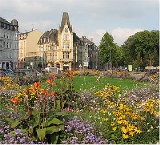
Thionville

Encyclopedia
Thionville is a commune
in the Moselle
department in Lorraine
in north-eastern France
. The city is located on the left bank of the river Moselle, opposite its suburb Yutz
.
, but the economic slowdown of the 1970s affected the town and the surrounding area, causing a population decrease. The population rose again in the 1990s and in suburban Hettange-Grande
in the east, although the population of the western part of the new agglomeration is decreasing around Hayange
. The agglomeration is still losing population but the decrease has been slowed down.
Due to Thionville's proximity to Luxembourg
(15 kilometres from the border), the town's population and quality of life have both increased since the end of the 1990s.
, the region was inhabited by the Germanic Alamanni
and became part of the medieval Holy Roman Empire
, known as Diedenhofen in German.
The Synod of Thionville
was held here from 2 February 835. It reinstated Emperor Louis the Pious
and reversed his former conviction of crimes — none of which he actually committed — and deposed the Archbishop of Rheims, Ebbo. The Synod was composed of 43 bishops. On 28 February 835 in Mainz
, Ebbo admitted that Louis had not committed the crimes of which he had been indicted and for which he had been deposed as Holy Roman Emperor
.
Eskil
, Archbishop of Lund, was imprisoned at Thionville (at the instigation of the Archbishop of Bremen?) on his return from his 1153 pilgrimage to Rome.
The Siege of Thionville in June 1639 occurred as part of the Thirty Years' War
. In 1659 Diedenhofen was annexed by France.
The writer François-René de Chateaubriand
was left for dead during Condé's military émigré expedition against Thionville in 1792
After the Franco-Prussian War
of 1870, the area of Alsace-Lorraine
was annexed by the newly created German Empire
in 1871 by the Treaty of Frankfurt
and became a Reichsland. Thionville became Diedenhofen again, a prosperous German city. Some large neo-Romanesque buildings typical of the German Empire were constructed in the city. German Army decided to build a fortress line from Mulhouse to Luxembourg
to protect their new Reichsland. The centerpiece of this line was the great Moselstellung, a fortress system protecting Metz
and Thionville.
The fortifications around Thionville centered on three main forts: the Fort de Guentrange
on the northwest side of Thionville, Fort de Koenigsmacker
to the northeast, and the Fort d'Illange
to the south. Each position was surrounded by several ditches, with shelters and observation cupolas. A large barbed wire belt defended by machine gun completed the defensive system.
Following the armistice with Germany ending the First World War, the French army entered Thionville in November 1918 and the city was returned to France at the Treaty of Versailles
in 1919.
Jean-Marie Demange, who had served as the town's mayor for thirteen years, committed suicide in 2008 after killing his wife with two gunshots in the head.
railway station offers connections with Luxembourg, Metz, Nancy, Paris, Strasbourg, Brussels, Zürich and several regional destinations. The A31
motorway connects Thionville with Luxembourg and Metz.
Thionville is divided into two cantons. Thionville Est, which includes the city, and Thionville Ouest.
Communes of France
The commune is the lowest level of administrative division in the French Republic. French communes are roughly equivalent to incorporated municipalities or villages in the United States or Gemeinden in Germany...
in the Moselle
Moselle
Moselle is a department in the east of France named after the river Moselle.- History :Moselle is one of the original 83 departments created during the French Revolution on March 4, 1790...
department in Lorraine
Lorraine (région)
Lorraine is one of the 27 régions of France. The administrative region has two cities of equal importance, Metz and Nancy. Metz is considered to be the official capital since that is where the regional parliament is situated...
in north-eastern France
France
The French Republic , The French Republic , The French Republic , (commonly known as France , is a unitary semi-presidential republic in Western Europe with several overseas territories and islands located on other continents and in the Indian, Pacific, and Atlantic oceans. Metropolitan France...
. The city is located on the left bank of the river Moselle, opposite its suburb Yutz
Yutz
Yutz is a commune in the Moselle department in Lorraine in north-eastern France. It was created in 1971 by merging the old communes of Basse-Yutz and Haute-Yutz....
.
Demographics
The population of Thionville boomed in the Industrial RevolutionIndustrial Revolution
The Industrial Revolution was a period from the 18th to the 19th century where major changes in agriculture, manufacturing, mining, transportation, and technology had a profound effect on the social, economic and cultural conditions of the times...
, but the economic slowdown of the 1970s affected the town and the surrounding area, causing a population decrease. The population rose again in the 1990s and in suburban Hettange-Grande
Hettange-Grande
Hettange-Grande is a commune in the Moselle department in Lorraine in north-eastern France.-Geography:Hettange-Grande is located close to the borders between France, Germany, and Luxembourg.-History:...
in the east, although the population of the western part of the new agglomeration is decreasing around Hayange
Hayange
Hayange is a commune in the Moselle department in Lorraine in north-eastern France.Outlying villages include Marspich and Saint-Nicolas-en-Forêt, Konacker and Ranguevaux.-Economy:...
. The agglomeration is still losing population but the decrease has been slowed down.
Due to Thionville's proximity to Luxembourg
Luxembourg
Luxembourg , officially the Grand Duchy of Luxembourg , is a landlocked country in western Europe, bordered by Belgium, France, and Germany. It has two principal regions: the Oesling in the North as part of the Ardennes massif, and the Gutland in the south...
(15 kilometres from the border), the town's population and quality of life have both increased since the end of the 1990s.
History
After the fall of the Western Roman EmpireWestern Roman Empire
The Western Roman Empire was the western half of the Roman Empire after its division by Diocletian in 285; the other half of the Roman Empire was the Eastern Roman Empire, commonly referred to today as the Byzantine Empire....
, the region was inhabited by the Germanic Alamanni
Alamanni
The Alamanni, Allemanni, or Alemanni were originally an alliance of Germanic tribes located around the upper Rhine river . One of the earliest references to them is the cognomen Alamannicus assumed by Roman Emperor Caracalla, who ruled the Roman Empire from 211 to 217 and claimed thereby to be...
and became part of the medieval Holy Roman Empire
Holy Roman Empire
The Holy Roman Empire was a realm that existed from 962 to 1806 in Central Europe.It was ruled by the Holy Roman Emperor. Its character changed during the Middle Ages and the Early Modern period, when the power of the emperor gradually weakened in favour of the princes...
, known as Diedenhofen in German.
The Synod of Thionville
Synod of Thionville
The Synod of Thionville was an important synod of ecclesiastic dignitaries of the Carolingian Empire in 835.Three years after the sons of the emperor rose in rebellion against their father, Emperor Louis the Pious, in 830, Ebbo, Archbishop of Rheims, had turned against him and on 13 November, 833,...
was held here from 2 February 835. It reinstated Emperor Louis the Pious
Louis the Pious
Louis the Pious , also called the Fair, and the Debonaire, was the King of Aquitaine from 781. He was also King of the Franks and co-Emperor with his father, Charlemagne, from 813...
and reversed his former conviction of crimes — none of which he actually committed — and deposed the Archbishop of Rheims, Ebbo. The Synod was composed of 43 bishops. On 28 February 835 in Mainz
Mainz
Mainz under the Holy Roman Empire, and previously was a Roman fort city which commanded the west bank of the Rhine and formed part of the northernmost frontier of the Roman Empire...
, Ebbo admitted that Louis had not committed the crimes of which he had been indicted and for which he had been deposed as Holy Roman Emperor
Holy Roman Emperor
The Holy Roman Emperor is a term used by historians to denote a medieval ruler who, as German King, had also received the title of "Emperor of the Romans" from the Pope...
.
Eskil
Eskil of Lund
Eskil was a 12th century Archbishop of Lund, in Skåne, Denmark .He was one of the most capable and prominent princes of the Church in Scandinavia...
, Archbishop of Lund, was imprisoned at Thionville (at the instigation of the Archbishop of Bremen?) on his return from his 1153 pilgrimage to Rome.
The Siege of Thionville in June 1639 occurred as part of the Thirty Years' War
Thirty Years' War
The Thirty Years' War was fought primarily in what is now Germany, and at various points involved most countries in Europe. It was one of the most destructive conflicts in European history....
. In 1659 Diedenhofen was annexed by France.
The writer François-René de Chateaubriand
François-René de Chateaubriand
François-René, vicomte de Chateaubriand was a French writer, politician, diplomat and historian. He is considered the founder of Romanticism in French literature.-Early life and exile:...
was left for dead during Condé's military émigré expedition against Thionville in 1792
After the Franco-Prussian War
Franco-Prussian War
The Franco-Prussian War or Franco-German War, often referred to in France as the 1870 War was a conflict between the Second French Empire and the Kingdom of Prussia. Prussia was aided by the North German Confederation, of which it was a member, and the South German states of Baden, Württemberg and...
of 1870, the area of Alsace-Lorraine
Alsace-Lorraine
The Imperial Territory of Alsace-Lorraine was a territory created by the German Empire in 1871 after it annexed most of Alsace and the Moselle region of Lorraine following its victory in the Franco-Prussian War. The Alsatian part lay in the Rhine Valley on the west bank of the Rhine River and east...
was annexed by the newly created German Empire
German Empire
The German Empire refers to Germany during the "Second Reich" period from the unification of Germany and proclamation of Wilhelm I as German Emperor on 18 January 1871, to 1918, when it became a federal republic after defeat in World War I and the abdication of the Emperor, Wilhelm II.The German...
in 1871 by the Treaty of Frankfurt
Treaty of Frankfurt
The Treaty of Frankfurt may refer to one of three treaties signed at Frankfurt, as follows:*Treaty of Frankfurt - Treaty between Maximilian of Austria and the envoys of King Charles VIII of France...
and became a Reichsland. Thionville became Diedenhofen again, a prosperous German city. Some large neo-Romanesque buildings typical of the German Empire were constructed in the city. German Army decided to build a fortress line from Mulhouse to Luxembourg
Luxembourg
Luxembourg , officially the Grand Duchy of Luxembourg , is a landlocked country in western Europe, bordered by Belgium, France, and Germany. It has two principal regions: the Oesling in the North as part of the Ardennes massif, and the Gutland in the south...
to protect their new Reichsland. The centerpiece of this line was the great Moselstellung, a fortress system protecting Metz
Metz
Metz is a city in the northeast of France located at the confluence of the Moselle and the Seille rivers.Metz is the capital of the Lorraine region and prefecture of the Moselle department. Located near the tripoint along the junction of France, Germany, and Luxembourg, Metz forms a central place...
and Thionville.
The fortifications around Thionville centered on three main forts: the Fort de Guentrange
Fort de Guentrange
The Fort de Guentrange dominates Thionville in the Moselle department of France. It was built by Germany in next to the town of the same name the late 19th century after the annexation of the Moselle following the Franco-Prussian War...
on the northwest side of Thionville, Fort de Koenigsmacker
Fort de Koenigsmacker
The Fort de Koenigsmacker is a fortification located to the northeast of Thionville in the Moselle department of France. It was built by Germany next to the town of the same name in the early 20th century after the annexation of the Moselle following the Franco-Prussian War...
to the northeast, and the Fort d'Illange
Fort d'Illange
The Fort d'Illange is a fortification located to the south of Thionville in the Moselle department of France. It was built by Germany next to the town of Illange in the early 20th century after the annexation of the Moselle following the Franco-Prussian War...
to the south. Each position was surrounded by several ditches, with shelters and observation cupolas. A large barbed wire belt defended by machine gun completed the defensive system.
Following the armistice with Germany ending the First World War, the French army entered Thionville in November 1918 and the city was returned to France at the Treaty of Versailles
Treaty of Versailles
The Treaty of Versailles was one of the peace treaties at the end of World War I. It ended the state of war between Germany and the Allied Powers. It was signed on 28 June 1919, exactly five years after the assassination of Archduke Franz Ferdinand. The other Central Powers on the German side of...
in 1919.
Jean-Marie Demange, who had served as the town's mayor for thirteen years, committed suicide in 2008 after killing his wife with two gunshots in the head.
Economy
The following industries are present in or near Thionville:- IronIronIron is a chemical element with the symbol Fe and atomic number 26. It is a metal in the first transition series. It is the most common element forming the planet Earth as a whole, forming much of Earth's outer and inner core. It is the fourth most common element in the Earth's crust...
and steelSteelSteel is an alloy that consists mostly of iron and has a carbon content between 0.2% and 2.1% by weight, depending on the grade. Carbon is the most common alloying material for iron, but various other alloying elements are used, such as manganese, chromium, vanadium, and tungsten...
plant - Chemical plantChemical plantA chemical plant is an industrial process plant that manufactures chemicals, usually on a large scale. The general objective of a chemical plant is to create new material wealth via the chemical or biological transformation and or separation of materials. Chemical plants use special equipment,...
- CementCementIn the most general sense of the word, a cement is a binder, a substance that sets and hardens independently, and can bind other materials together. The word "cement" traces to the Romans, who used the term opus caementicium to describe masonry resembling modern concrete that was made from crushed...
factory
Transport
The Gare de ThionvilleGare de Thionville
Gare de Thionville is a railway station serving the town Thionville, Moselle department, northeastern France.-Services:-References:*...
railway station offers connections with Luxembourg, Metz, Nancy, Paris, Strasbourg, Brussels, Zürich and several regional destinations. The A31
A31 autoroute
The A31 autoroute is a French autoroute. It runs from the Franco-Luxembourg border to Beaune where it joins the A6. The north of the autoroute is free, up to the town of Toul, but it is a toll road south of there...
motorway connects Thionville with Luxembourg and Metz.
Administration
Incorporations:- Veymerange, in 1967
- Volkrange, in 1970
- Garche (not contiguous with the rest of the commune), Kœking and Œutrange in 1970
Thionville is divided into two cantons. Thionville Est, which includes the city, and Thionville Ouest.
- Thionville Est: 19,063 (46.6% of the total population)
- Thionville Ouest: 21,844 (53.4% of the total population)