

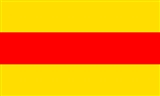
Grand Duchy of Baden

Encyclopedia
The Grand Duchy of Baden was a historical state in the southwest of Germany
, on the east bank of the Rhine. It existed between 1806 and 1918.
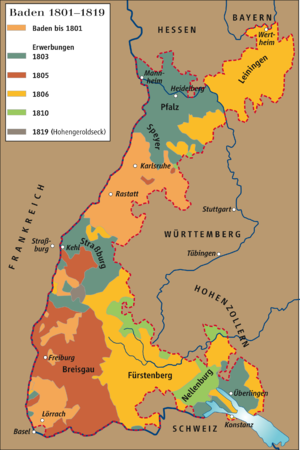
came into existence in the 12th century as the Margraviate of Baden and subsequently split into different lines, which were unified in 1771. In 1803 Baden was raised to Electoral dignity within the Holy Roman Empire
. Baden became the much-enlarged Grand Duchy of Baden through the dissolution of the Holy Roman Empire
in 1806. In 1815 it joined the German Confederation
. During the Revolutions of 1848 in the German states
, Baden was a center of revolutionist activities. In 1849 it was the only German state that became a republic for a short while, under the leadership of Lorenzo Brentano
. Finally the revolution in Baden was suppressed mainly by Prussian troops.
The Grand Duchy of Baden remained a sovereign country until it joined the German Empire
in 1871. After the revolution of 1918 Baden became part of the Weimar Republic
as the Republic of Baden
.
with executive power vested in the Grand Duke while the legislative authority was shared by him with a representative assembly
(Landtag
) consisting of two chambers.
The upper chamber included all the princes of the ruling family of full age, the heads of all the mediatized families, the Archbishop of Freiburg, the president of the Protestant Evangelical Church, a deputy from each of the universities and the technical high school, eight members elected by the territorial nobility for four years, three representatives elected by the chamber of commerce
, two by that of agriculture, one by the trades, two mayors of municipalities, and eight members (two of them legal functionaries) nominated by the Grand Duke.
The lower chamber consisted of 73 popular representatives, of whom 24 were elected by the burgesses of certain communities, and 49 by rural communities. Every citizen of 25 years of age, who had not been convicted and was not a pauper, had a vote. The elections were, however, indirect. The citizens selected the Wahlmänner (deputy electors
), the latter selecting the representatives. The chambers met at least every two years. The lower chambers were elected for four years, half the members retiring every two years.
The executive consisted of four departments: The interior, foreign and grand-ducal affairs, finance, and justice, and ecclesiastical affairs and education.
The chief sources of revenue were direct and indirect tax
es, the railways and domains. The railways were operated by the state, and formed the only source of major public debt, about 22 million pounds sterling.
The supreme courts lay in Karlsruhe
, Freiburg
, Offenburg
, Heidelberg
, Mosbach
, Waldshut
, Konstanz
, and Mannheim
, whence appeals passed to the Reichsgericht
(the supreme tribunal) in Leipzig
.
Germany
Germany , officially the Federal Republic of Germany , is a federal parliamentary republic in Europe. The country consists of 16 states while the capital and largest city is Berlin. Germany covers an area of 357,021 km2 and has a largely temperate seasonal climate...
, on the east bank of the Rhine. It existed between 1806 and 1918.
History
BadenBaden
Baden is a historical state on the east bank of the Rhine in the southwest of Germany, now the western part of the Baden-Württemberg of Germany....
came into existence in the 12th century as the Margraviate of Baden and subsequently split into different lines, which were unified in 1771. In 1803 Baden was raised to Electoral dignity within the Holy Roman Empire
Holy Roman Empire
The Holy Roman Empire was a realm that existed from 962 to 1806 in Central Europe.It was ruled by the Holy Roman Emperor. Its character changed during the Middle Ages and the Early Modern period, when the power of the emperor gradually weakened in favour of the princes...
. Baden became the much-enlarged Grand Duchy of Baden through the dissolution of the Holy Roman Empire
Holy Roman Empire
The Holy Roman Empire was a realm that existed from 962 to 1806 in Central Europe.It was ruled by the Holy Roman Emperor. Its character changed during the Middle Ages and the Early Modern period, when the power of the emperor gradually weakened in favour of the princes...
in 1806. In 1815 it joined the German Confederation
German Confederation
The German Confederation was the loose association of Central European states created by the Congress of Vienna in 1815 to coordinate the economies of separate German-speaking countries. It acted as a buffer between the powerful states of Austria and Prussia...
. During the Revolutions of 1848 in the German states
Revolutions of 1848 in the German states
The Revolutions of 1848 in the German states, also called the March Revolution – part of the Revolutions of 1848 that broke out in many countries of Europe – were a series of loosely coordinated protests and rebellions in the states of the German Confederation, including the Austrian Empire...
, Baden was a center of revolutionist activities. In 1849 it was the only German state that became a republic for a short while, under the leadership of Lorenzo Brentano
Lorenzo Brentano
Lorenzo Brentano was a journalist and a U.S. Representative from Illinois.-Biography:Born as Lorenz Peter Carl Brentano in Mannheim, Grand Duchy of Baden, Germany, Brentano received a thorough classical training and studied jurisprudence at the Universities of Heidelberg and Freiburg...
. Finally the revolution in Baden was suppressed mainly by Prussian troops.
The Grand Duchy of Baden remained a sovereign country until it joined the German Empire
German Empire
The German Empire refers to Germany during the "Second Reich" period from the unification of Germany and proclamation of Wilhelm I as German Emperor on 18 January 1871, to 1918, when it became a federal republic after defeat in World War I and the abdication of the Emperor, Wilhelm II.The German...
in 1871. After the revolution of 1918 Baden became part of the Weimar Republic
Weimar Republic
The Weimar Republic is the name given by historians to the parliamentary republic established in 1919 in Germany to replace the imperial form of government...
as the Republic of Baden
Republic of Baden
The Republic of Baden was a state of Germany during the time of the Weimar Republic, formed after the abolition of the Grand Duchy of Baden in 1918...
.
Constitution and Government
The Grand Duchy of Baden was a hereditary monarchyMonarchy
A monarchy is a form of government in which the office of head of state is usually held until death or abdication and is often hereditary and includes a royal house. In some cases, the monarch is elected...
with executive power vested in the Grand Duke while the legislative authority was shared by him with a representative assembly
Representative assembly
A representative assembly is a political institution in which a number of persons representing the population or privileged orders within the population of a state come together to debate, negotiate with the executive and legislate...
(Landtag
Landtag
A Landtag is a representative assembly or parliament in German-speaking countries with some legislative authority.- Name :...
) consisting of two chambers.
The upper chamber included all the princes of the ruling family of full age, the heads of all the mediatized families, the Archbishop of Freiburg, the president of the Protestant Evangelical Church, a deputy from each of the universities and the technical high school, eight members elected by the territorial nobility for four years, three representatives elected by the chamber of commerce
Chamber of commerce
A chamber of commerce is a form of business network, e.g., a local organization of businesses whose goal is to further the interests of businesses. Business owners in towns and cities form these local societies to advocate on behalf of the business community...
, two by that of agriculture, one by the trades, two mayors of municipalities, and eight members (two of them legal functionaries) nominated by the Grand Duke.
The lower chamber consisted of 73 popular representatives, of whom 24 were elected by the burgesses of certain communities, and 49 by rural communities. Every citizen of 25 years of age, who had not been convicted and was not a pauper, had a vote. The elections were, however, indirect. The citizens selected the Wahlmänner (deputy electors
Indirect election
Indirect election is a process in which voters in an election don't actually choose between candidates for an office but rather elect persons who will then make the choice. It is one of the oldest form of elections and is still used today for many upper houses and presidents...
), the latter selecting the representatives. The chambers met at least every two years. The lower chambers were elected for four years, half the members retiring every two years.
The executive consisted of four departments: The interior, foreign and grand-ducal affairs, finance, and justice, and ecclesiastical affairs and education.
The chief sources of revenue were direct and indirect tax
Tax
To tax is to impose a financial charge or other levy upon a taxpayer by a state or the functional equivalent of a state such that failure to pay is punishable by law. Taxes are also imposed by many subnational entities...
es, the railways and domains. The railways were operated by the state, and formed the only source of major public debt, about 22 million pounds sterling.
The supreme courts lay in Karlsruhe
Karlsruhe
The City of Karlsruhe is a city in the southwest of Germany, in the state of Baden-Württemberg, located near the French-German border.Karlsruhe was founded in 1715 as Karlsruhe Palace, when Germany was a series of principalities and city states...
, Freiburg
Freiburg
Freiburg im Breisgau is a city in Baden-Württemberg, Germany. In the extreme south-west of the country, it straddles the Dreisam river, at the foot of the Schlossberg. Historically, the city has acted as the hub of the Breisgau region on the western edge of the Black Forest in the Upper Rhine Plain...
, Offenburg
Offenburg
Offenburg is a city located in the state of Baden-Württemberg, Germany. With about 60,000 inhabitants, it is the largest city and the capital of the Ortenaukreis.Offenburg also houses University of Applied Sciences Offenburg...
, Heidelberg
Heidelberg
-Early history:Between 600,000 and 200,000 years ago, "Heidelberg Man" died at nearby Mauer. His jaw bone was discovered in 1907; with scientific dating, his remains were determined to be the earliest evidence of human life in Europe. In the 5th century BC, a Celtic fortress of refuge and place of...
, Mosbach
Mosbach
Mosbach is the capital of the Neckar-Odenwald district in the north of Baden-Württemberg, Germany, about 58 km east of Heidelberg. Its geographical position is 49.21'N 9.9'E....
, Waldshut
Waldshut-Tiengen
Waldshut-Tiengen is a city in southwestern Baden-Württemberg right at the Swiss border. It is the district seat and at the same time the biggest city in Waldshut district and a "middle centre" in the area of the "high centre" Lörrach/Weil am Rhein to whose middle area most towns and communities in...
, Konstanz
Konstanz
Konstanz is a university city with approximately 80,000 inhabitants located at the western end of Lake Constance in the south-west corner of Germany, bordering Switzerland. The city houses the University of Konstanz.-Location:...
, and Mannheim
Mannheim
Mannheim is a city in southwestern Germany. With about 315,000 inhabitants, Mannheim is the second-largest city in the Bundesland of Baden-Württemberg, following the capital city of Stuttgart....
, whence appeals passed to the Reichsgericht
Reichsgericht
The Reichsgericht was the highest court of the Deutsches Reich. It was established on October 1, 1879 when the Reichsjustizgesetze came into effect, building a widely regarded body of jurisprudence....
(the supreme tribunal) in Leipzig
Leipzig
Leipzig Leipzig has always been a trade city, situated during the time of the Holy Roman Empire at the intersection of the Via Regia and Via Imperii, two important trade routes. At one time, Leipzig was one of the major European centres of learning and culture in fields such as music and publishing...
.
Grand Dukes of Baden
- 1806–1811: Charles Frederick (* 1728; † 1811)
- 1811–1818: CharlesKarl, Grand Duke of BadenCharles, Grand Duke of Baden became ruler of Baden on June 11, 1811 and ruled until his death. He was born in Karlsruhe....
(* 1786; † 1818) - 1818–1830: Louis I (* 1763; † 1830)
- 1830–1852: LeopoldLeopold, Grand Duke of BadenLeopold I, Grand Duke of Baden succeeded in 1830 as the fourth Grand Duke of Baden....
(* 1790; † 1852) - 1852–1858: Louis II (* 1824; † 1858)
- 1858–1907: Frederick I (* 1826; † 1907), (since 1852 Regent, since 1856 with the title Grand Duke)
- 1907–1918: Frederick II (* 1857; † 1928)
Minister of state 1809–1918
- 1809–1810: Sigismund von ReitzensteinSigismund von ReitzensteinFreiherr Sigismund Karl Johann von Reitzenstein was the first minister of state of the Grand Duchy of Baden....
- 1810–1810: Conrad Karl Friedrich von Andlau-Birseck
- 1810–1812: Christian Heinrich Gayling von Altheim
- 1812–1817: Karl Christian von Berckheim
- 1817–1818: Sigismund von Reitzenstein
- 1818–1831: Wilhelm Ludwig Leopold Reinhard von Berstett
- 1832–1833: Sigismund von Reitzenstein
- 1833–1838: Ludwig Georg von Winter
- 1838–1839: Karl Friedrich NebeniusKarl Friedrich NebeniusKarl Friedrich Nebenius was a Baden minister and author of their 1818 constitution.- Life :Nebenius was born on 29 September 1784 in Rhodt in the state of Rhineland-Palatinate in Germany...
- 1839–1843: Friedrich Landolin Karl von Blittersdorf
- 1843–1845: Christian Friedrich von Boeckh
- 1845–1846: Karl Friedrich Nebenius
- 1846–1848: Johann Baptist Bekk
- 1848–1849: Karl Georg Hoffmann
- 1849–1850: Friedrich Adolf Klüber
- 1850–1856: Ludwig Rüdt von Collenberg-Bödigheim
- 1856–1860: Franz von Stengel
- 1861–1866: Anton von Stabel
- 1866–1868: Karl MathyKarl MathyKarl Mathy , was a Badensian statesman.He was born at Mannheim. He studied law and politics at Heidelberg, and entered the Baden government department of finance in 1829...
- 1868–1876: Julius JollyJulius JollyProfessor Julius Jolly was a German scholar and translator of Indian law and medicine.Jolly was born in Heidelberg, the son of physicist Philipp Johann Gustav von Jolly , and studied comparative linguistics, Sanskrit, and Iranian languages in Berlin and Leipzig...
- 1876–1893: Ludwig Karl Friedrich Turban
- 1893–1901: Franz Wilhelm Nokk
- 1901–1905: Carl Ludwig Wilhelm Arthur von Brauer
- 1905–1917: Alexander von Dusch
- 1917–1918: Heinrich von Bodman
See also
- BadenBadenBaden is a historical state on the east bank of the Rhine in the southwest of Germany, now the western part of the Baden-Württemberg of Germany....
, for the pre-19th century state - Baden-WürttembergBaden-WürttembergBaden-Württemberg is one of the 16 states of Germany. Baden-Württemberg is in the southwestern part of the country to the east of the Upper Rhine, and is the third largest in both area and population of Germany's sixteen states, with an area of and 10.7 million inhabitants...
, for the modern German federal state - History of BadenHistory of BadenThe history of Baden as a state began in the 12th century, as a fief of the Holy Roman Empire. A fairly inconsequential margraviate that was divided between various branches of its ruling family for much of its history, it gained both status and territory during the Napoleonic era, when it was...
- Coat of arms of BadenCoat of arms of BadenThe coat of arms of Baden comes from the personal arms of the Margraves and Grand Dukes of Baden, the traditional rulers of the region. Following the revolution and abolition of the Grand Duchy in 1918, the arms and griffin supporters were usurped from the Grand Dukes by the new republic to...
- Republic of BadenRepublic of BadenThe Republic of Baden was a state of Germany during the time of the Weimar Republic, formed after the abolition of the Grand Duchy of Baden in 1918...
, for the state that existed from 1918–1945 - Rulers of Baden, for a list of sovereigns and presidents
- Revolutions of 1848 in the German statesRevolutions of 1848 in the German statesThe Revolutions of 1848 in the German states, also called the March Revolution – part of the Revolutions of 1848 that broke out in many countries of Europe – were a series of loosely coordinated protests and rebellions in the states of the German Confederation, including the Austrian Empire...
- Freiwilliges Feldjäger-Korps von SchmidtFreiwilliges Feldjäger-Korps von SchmidtFreiwilliges Feldjäger-Korps von Schmidt was a group of Prussian volunteer infantrymen that formed in late 1813 when the Grand Duchy of Baden joined the cause of the Allies after the Battle of Leipzig. Most of the men were students of the university of Heidelberg. It was founded on the...