


Enlightenment Spain

Encyclopedia
The Age of Enlightenment
(in Spanish, Ilustración) came to Spain
in the eighteenth century with a new Bourbon dynasty after the decay of the Spanish economy, bureaucracy, and empire in the latter years of the former Habsburg dynasty. This period of reform and 'enlightened despotism' focused on modernising the Spanish government, infrastructure, and institutions, culminating in the rule of King Charles III
and the work of his minister, José Moñino, count of Floridablanca.
The century began with the War of the Spanish Succession
over the ascension of a relation of Louis XIV of France
to the throne of Spain and ended with the Napoleonic Wars
in which Spain would become a bloody battleground. Charles III's successors, fraught by war, foreign intervention, unrest in the empire, corruption, and the pain of reform, would face an increasingly restive and unstable Spain, the painful consequences of which would become the civil wars
that dominated Spain in the nineteenth century
.
, were dominated by the politics of who would succeed the unfortunate monarch, the last Spanish king of the Habsburg dynasty. Economic troubles, the decay of the Spanish bureaucracy, a series of defeats in wars against France
, and the erosion of imperial institutions in the seventeenth century had left Charles the king of a declining empire, and his physical and mental weakness provided him with little ability to reverse the course of his country. Even so, the vastness of the Spanish Empire
in the New World
, along with her naval resources, had made Spain a vital part of European power politics. If the throne of Spain was to succeed to a relative of the king of France, or if the two countries were to be united, the balance of power in Europe might shift in France's favor. If it remained in the hands of another member of the anti-French, Austria
n Habsburg dynasty, the status quo would remain. Therefore, European politics during the seventeenth century became dominated by establishing an orderly succession in Spain that would not alter the balance between Europe's great powers.
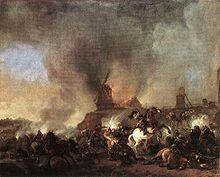 Charles II, who was the unfortunate result of generations of Habsburg inbreeding, decreed in one of his last official acts that his crown would pass to his nephew, Philip of Anjou
, the Bourbon grandson of King Louis XIV of France
, and the heir to the French throne. Castilian
legitimists, who valued the succession of the closest heir of the king over the continuation of Habsburg rule, supported the king's plan. Spanish officials were also concerned with Spain remaining an independent country, rather than another part of the French or Austrian empires. Even so, on hearing the news that his grandson had become King of Spain, Louis XIV proclaimed, "The Pyrenees
are no more."http://countrystudies.us/spain/11.htm
The Austrian Habsburg claimant to the Spanish throne, Archduke Charles of Austria
, argued that he had been cheated out of the throne of Spain unfairly. England
and the Netherlands
, who had backed Duke Joseph Ferdinand of Bavaria as the successor to the Spanish throne as a means of preventing either Spain or France from becoming more powerful, accepted Philip of Anjou as king of Spain but eventually chose to support Austria after Louis XIV did not respect the fact that France was not to take too much advantage of a Bourbon on the Spanish throne. Austria, with the backing of England and the Netherlands, chose to go to war over the issue after France rejected a plan of partition, launching the War of the Spanish Succession
.
The Spanish cortes remained divided on the issue, and when war was declared in 1702, the war between Europe's great powers also became a civil war in Spain. Valencia, Catalonia
, and Aragon
pronounced in favor of the Austrian candidate as king, fearing that Philip of Anjou would attempt to change the decentralized administration of the country that afforded the Catalans and Aragonese considerable autonomy from Madrid
. An English-Dutch army, marching from Portugal
, attacked Spain in 1705, but was for a time repulsed. The war elsewhere seemed to go well for France and her candidate for the Spanish throne initially, but at the Battle of Blenheim
in 1704, Austria was saved from defeat by an English expedition under the Duke of Marlborough
. Ten years of difficult fighting in Germany
, Italy
, Iberia
, the Low Countries
, and even the New World
(where it became known as Queen Anne's War
) followed. Madrid itself was occupied in 1706 and 1710, and much of the Spanish countryside was devastated by campaigns fought across its soil, both by foreign soldiers, its own army and the revolting Aragonese, Catalans, and Valencians.
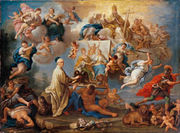 A compromise peace came with the Treaty of Utrecht
in 1713 between France and most of the great powers. France and the Allies agreed that Louis XIV's grandson, Philip, would become King Philip V of Spain
, but that the thrones of France and Spain were never to be united. While France's territories remained largely intact, Spain was forced to cede her European empire in the peace; her Italian possessions, including Naples
, Milan
, and Sardinia
, were given up to Austria
, along with Sicily
, which was ceded to Savoy
. Spain was also forced to give up the Spanish Netherlands to Austria
, and the island of Minorca
and Gibraltar
to Britain. In later years, however, many of these Italian territories, notably Naples
and Sicily
would revert back to Spanish control. In exchange for accepting the loss of these European territories of the Spanish Empire, Philip was able to keep the remainder of the Spanish empire. Even after the peace was signed, however, the Catalans
- who had been operating independently against Philip during the war, operating under the banner "Privilegis o Mort" (Privileges or Death)http://countrystudies.us/spain/11.htm - continued to resist after the British withdrew; Barcelona
was not retaken by Spanish forces until late in 1714. This date (September 11, 1714) is commemorated as the National Day of Catalonia
. However, much of the country was in a state of economic instability due to the conflict, no matter which candidate to the Spanish throne was supported.
The loss of so much of the territory promised to him by Charles II's decree and Philip's personal ambition put him at unease with the treaty. Philip's wife Elizabeth - a member of the ducal house of Parma
- and her favorite minister, Cardinal Giulio Alberoni
, desired to have their claims in Italy and those of Philip's restored. An alliance of France, Britain, and the Netherlands condemned Spain's ambitions which threatened the peace of Europe; in 1717, Philip invaded Sardinia
, one of the territories lost to Austria after the War of the Spanish Succession
. The invasion of Sicily
thereafter prompted the formation of the Quadruple Alliance of Britain, France, Austria, and the Netherlands to oppose Philip's ambitions. In 1720, embarrassed by the failure of Spanish arms at sea and on land in the War of the Quadruple Alliance
, Philip dismissed Alberoni and signed a peace treaty with Austria, with both sides recognizing the Treaty of Utrecht.
 The Spanish again attempted to regain some of their lost territory in the Anglo-Spanish War
of 1727-1729. An alliance was concluded in 1725 with the Austrians, who agreed to help the Spanish in retaking key naval bases in the Mediterranean - Minorca
and Gibraltar
- from the British. In response, an alliance was forged by the British Secretary of State, Charles Townshend, 2nd Viscount Townshend
, with France and the Netherlands; when Philip did finally lay siege to Gibraltar, Austria declined to intervene against the powerful alliance, and Spain was left alone once again. Britain elected to devastate Spain's New World empire and her gold shipments, hoping to prevent Philip from buying the Austrians into intervention; the plan succeeded, and Philip was forced to sue for peace in 1729. Elizabeth Farnese did get one of her wishes, though; the Italian duchies of Parma
, Piacenza
, and Tuscany
were restored to her family.
After 1729, Philip was more reserved in his use of Spanish power and sought the close support of allies, in particular France: a more cautious strategy that yielded positive results. Philip sought a friendly axis with his relatives in France in the War of the Polish Succession
, where he succeeded in regaining Naples
and Sicily
for his son, the future Charles III of Spain
. The Family Compact with Louis XV of France
was signed in 1733, bringing the two states closer together after the embarrassments of the Quadruple Alliance. Friction with Britain prompted by the War of Jenkins' Ear
(1739-1741) pushed Philip into a closer alliance with France in the years leading to the War of the Austrian Succession
, in which Philip obtained further concessions from Austria for his family in Italy. This restored Spanish power in Italy to much of its pre-war extent, and added new territories that had not previously been part of the Spanish Empire in Italy.
Late in his reign, Philip elected to place the reformation of his government in the hands of his ministers. The youthful and ambitious Zenón de Somodevilla had been created Marquis of Ensenada in 1736 for his successful diplomacy after the War of the Polish Succession, and seven years afterwards, in 1743, he was made Philip (and Elizabeth's) favorite at court, and for the remainder of Philip's reign, Ensenada effectively ruled Spain. Ensenada sought a cautious but independent foreign policy that distanced his country from either France or Britain, and desired a stable, peaceful atmosphere in which Spain could reform her institutions.
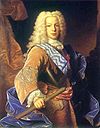 The end of the War of the Austrian Succession
had awarded Ensenada a victory that cemented his support in Spain. However, two years before the war ended, King Philip
, his strongest supporter, died, and was succeeded by his son Ferdinand VI
. Ferdinand - Philip's son by his first marriage to Princess Maria Luisa of Savoy
- had suffered under the domineering influence of his stepmother as a child, and as king, he was constantly unsure of his own abilities. Elizabeth Farnese, the queen who had effectively controlled Philip V, left the court on her husband's death. Like his father, though, Ferdinand was extremely devoted to his wife, and she dictated much of his policy and political decisions; at the time of Ferdinand's coronation in 1746, it was said that "Queen Barbara has succeeded Queen Elizabeth."http://www.xs4all.nl/~kvenjb/madmonarchs/ferdinand6/ferdinand6_bio.htm For her part, Queen Maria Barbara de Braganza, a member of the Portuguese
royal family, advocated a policy of neutrality that coincided with the opinions of her leading courtiers, far different from the irredentist policy of Elizabeth.
Ferdinand's rule reaped good fortune and the rewards of Philip V's reforms. He was a charitable ruler, relieving drought-stricken Andalusia
from all taxes in 1755 and devoting large sums of money to the reconstruction of that part of the country. As king, he deferred many of his judgements to his leading ministers.
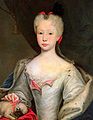 Ensenada continued to be the leading member of court in the early part of Ferdinand's reign. After the successful alliance with France in the War of the Austrian Succession, he advised strengthening that bond as a means of protecting Spain's vulnerable security and checking British interests in her empire. He was opposed by an anglophile faction at court led by Jose de Carvajal y Láncaster
, a mixed British-Spanish gentleman descended from the House of Lancaster
. Carvajal believed that the key to Spain's defense and modernization was a closer alliance with Britain, whose naval power could complement Spain's empire and whose commercial strength could encourage economic development in Spain. Carvajal's most enduring accomplishment was the 1750 agreement with Portugal, which ended a long, low-level conflict in Banda Oriental
(southern Uruguay
) between the two countries.
The agreement with Portugal, however, was to have important political consequences for Spain. The agreement traded seven Jesuit-established and -operated missions in southern Uruguay for Portuguese-founded and -controlled Uruguay
. The plan (opposed by both the Jesuits and the British) led to resistance led by the Jesuits and their native Guarani allies in the area. Both Spain and Portugal responded in force to the crisis, suppressing the Jesuits and Guarani in the War of the Seven Reductions. The war broke a traditionally friendly relationship between the Spanish government and the Jesuits and launched a period of anti-Jesuit policies both in Spain and Portugal that would be continued by Charles III of Spain
.
A scandal at court, resulting from a conspiracy between Carvajal and the British ambassador, led to the embarrassment of Ensenada and his disrepute at court. When Carvajal died in 1754, Philip and his wife dismissed Ensenada, fearing that the Marquis's French sympathies would lead to an alliance with Louis XV of France
and war, without Carvajal's British sympathies to counterbalance him. An Irishman
, Ricardo Wall, was appointed to replace Ensenada as chief minister. Wall, a staunch defender of Spain's neutral policy, successfully kept the country out of war for the remainder of Ferdinand's reign, in spite of the outbreak of the largest European war since the Thirty Years' War
, the Seven Years' War
.
Although his wife had always feared that Ferdinand would die before her and leave her destitute - she had amassed huge personal wealth as a safeguard against this - it was his wife Maria Barbara who would precede him, dying in 1758. Deeply distraught by her death, Ferdinand became apathetic to his duties as king, and indeed, suicidal. He died a year later, in 1759.
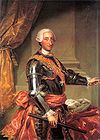 Ferdinand's successor was Charles III
, son of Philip V
by his second wife, Elizabeth Farnese. Charles had been named Duke of Parma
at his mother's demand at the age of sixteen. His experience there gave him a place to experiment with the practice of enlightened despotism. He exhibited a martial spirit early on, acquiring Naples
and Sicily
by force of arms and becoming "King of the Two Sicilies
," though his tastes were generally more peaceful. On arriving in Spain, he did not share Carvajal
's taste for an alliance with Britain; he had borne the island nation a certain mistrust ever since a British fleet had forced his neutrality in the War of the Austrian Succession
.
He had been introduced to reform by his mentor in Sicily, Bernardo Tanucci
. Although Tanucci remained behind in the Two Sicilies to advise Charles's son, King Ferdinand I of the Two Sicilies
, as the two thrones could not be united by consequence of treaty, Charles carried with him a cadre of Italian reformers who saw potential in the Spanish bureaucracy for modernization. The architect of the first phase of Charles III's reforms was one such Italian, Leopoldo de Gregorio - a man of humble origins whose ability as a military supplier for the Neapolitan army impressed the king and raised him to royal prominence. Created "Marquis of Esquilache" in 1755, Gregorio was one of Spain's leading statesman from the arrival of Charles III to the Marquis's death in 1785.
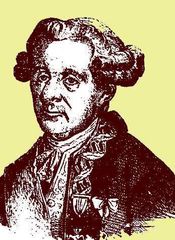 Although the Seven Years' War
had broken out in 1756, Spain had managed to remain strictly neutral under the ministry of Ricardo Wall, who continued to lead Spain's government in the early years of Charles III. Charles, however, bore a grudge against the English and as the war became increasingly desperate for France, he went against his chief minister's wishes and intervened on France's behalf in 1762. Spain fared poorly in the war, and the British occupied Havana
and Manila
within a year. Florida
was ceded to the British and Spain recognized British control over Minorca
and Gibraltar
in 1763, although Louisiana
was given to Spain to compensate her for her losses. After the Treaty of Paris (1763)
, however, Spain could focus on internal development.
By far the largest landholder in Spain, the Church had been treated with great charity by the Spanish kings of the seventeenth century - Philip IV
in particular donated large tracts of territory in religious piety. Much of this land went unused, and a great deal of the remainder of the country was owned by gentlemanly hidalgo
s who lived primarily off of the state. The system had grown long obsolete, and a growing population (Spain's population would increase from eight to twelve million between 1700 and the French Revolution
) had put great pressure on the government to reform. Like neighboring Portugal
, Spain's antiquated bureaucracy had grown dependent on the income and production from its colonies to support an unmanageably large class of landowning, nonproductive gentlemen and clergy.
The Enlightenment
had been a force of anticlericalism in Europe, and Charles, in applying its lessons to Spain, saw it similarly. Ferdinand IV
had undertaken to reduce the power of the Jesuits in Spain and had arranged for Spain's kings to appoint her own bishops, a power that France's kings had held since the fifteenth century. Charles, who advocated a radical policy and rapid modernization of the country, expelled the Jesuit Order from Spain completely in 1767 (see Suppression of the Jesuits
). The Inquisition
was scaled back, but not completely eradicated; as late as 1787, a woman was burned as a witch.
Land reform and agricultural reform placed a new burden on Spanish society and alienated both clergymen and landed gentleman in Spain. Charles chose to ally with the merchantmen of his country and a growing middle class that came with a new prosperity during his rule. An advocate of free trade
, Charles reduced the tariff barriers that had been the core of Spanish trade policy for centuries. The Marquis of Esquilache successfully liberalized the grain trade in 1765.
Although he believed in centralized government and continued the reforms of his predecessors to reduce the autonomy of the regional governments, Charles approved of establishing prototype chambers of commerce (see Sociedad Económica de los Amigos del País
) to encourage local economic development and initiative. The national infrastructure was improved to foster the development of Spanish manufacturing, and a unified monetary system was implemented.
The reforms were not without costs, however, and in 1766, in the context of a worldwide grain shortage and the difficulties of the recently liberalized grain trade, riots broke out in Madrid and other cities in Spain against rising grain prices. The "Motin de Esquilache
" drove the king from his capital and embarrassed the king's chief minister. An Aragon
ese official, Pedro Pablo Aranda, gained prominence during the crisis and led the government in the king's absence.
Aranda, as the leader of the Aragonese faction at court, favored a more decentralized system of government. Esquilache, who formerly had the king's ear, was sent abroad as an ambassador, and for a time Aranda was the leading figure in Spanish politics. A criminal prosecutor named José Moñino gained prominence as the investigator of the riots and as an outspoken supporter of the king's reformist policies. Esquilache arranged to have him made ambassador to Rome
in 1767; in 1773 Moñino succeeded in having the Pope
revoke the papal charter of the Jesuit Order. For this success, Moñino was created Count of Floridablanca.
The new count was named chief minister in 1777 and undertook the material reform of the Spanish bureaucracy. His chief bureaucratic successes were the creation of a true cabinet system of government in 1778 and the creation of Spain's first national bank, the National Bank of San Carlos, in 1782. Recognizing the damage done to Spain's education system after the expulsion of the Jesuits, Floridablanca undertook drastic reform to hire new teachers and modernize Spain's education system. Floridablanca's most enduring accomplishment was the freedom of trade in Spain's empire in the New World
to foreigners.
Although Floridablanca - like Carvajal before him - admired British governance and believed that a cordial relationship with George III of the United Kingdom
was the best policy for Spain, the American Revolutionary War
was too great an opportunity for King Charles, and Spain went to war against Britain alongside France and the Netherlands
in 1779, after providing monetary assistance to the rebels. Bernardo de Galvez, the governor of Spanish Louisiana, led the campaign to retake the forts lost to the British since 1762; Pensacola, Florida was retaken in 1782, and the Bahamas were seized later that year. The Treaty of Paris (1783)
restored much of what Spain had lost in the Seven Years' War
, including Florida
.
died on 14 December 1788. Seven months later, French
revolutionaries stormed the Bastille
, launching the French Revolution
.
Charles III's eldest son was both epileptic and retarded and was passed over for the throne in favor of his second eldest, Charles IV
. Charles IV was seen by many of his time as being as uninterested in politics as Ferdinand VI
had been. His chief interest upon his arrival in Spain (he had grown up in Naples
) was hunting, and for all of his rule, his policies were dominated by the will of his wife.
His wife Maria Luisa of Parma
, however, took as her lover Manuel de Godoy
, a soldier from a humble family, was dashingly handsome, particularly when Maria Louisa compared him to Charles IV. He had made the queen's acquaintance in 1788, months before she became queen, and by the time of her accession, she had become completely enamored. The king was very fond of Godoy, even though he was fully aware of his wife's adultery
, and Godoy became Spain's chief minister in 1792.
The chief minister at the time of Charles IV's accession, José Moñino, count of Floridablanca, was not easily ousted and had many supporters in the court, particularly in Castile. Floridablanca's chief opponent in Spanish politics was Pedro Pablo Aranda, the leader of the Aragonese faction. Godoy made an alliance with Aranda, with whom Godoy sympathized, against Floridablanca. With the outbreak of the French Revolution and the execution of Louis XVI
in 1792, Floridablanca's liberalism faced greater skepticism. Aranda and Godoy had Floridablanca imprisoned in 1792 on charges of embezzlement
, of which he was later acquitted.
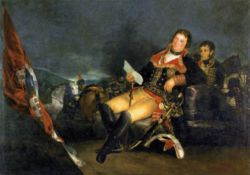 The spirit of reform that had made the reign of Charles III an era of renewed prosperity for Spain was extinguished in the reign of Charles IV. His queen and her lover were uninterested in the improvement of the Spanish bureaucracy and regarded Floridablanca as an exponent of the very sort of liberalism
that was tearing France apart. The Aragonese faction led by Aranda, allied to many of the causes that had opposed Charles III's reforms, managed to undo much of the changes brought about in Charles III's tenure.
After the execution of Louis XVI in 1793, 20,000 men were mobilized and marched to the French border. The army, however, had been allowed to languish in Charles III's reign, and it was ill-equipped and ill-trained to cope with a French invasion. Navarre
was quickly seized by the French, although the Spanish managed to hold their ground in Catalonia
and even invaded French Languedoc
. Godoy, unimpressed with Spain's military effectiveness, decided to come to terms with the new French Republic, and in 1795 signed the Treaty of Basel
, guaranteeing peace with France with the cession of Santo Domingo
to the Republic.
Godoy, having abandoned his allies in the United Kingdom
and Austria
, faced a decision: whether to continue to fight the Revolutionary France that had already defeated Spain once before, or to join the French side and hope for better times. The Spanish, after initially opposing the French, signed the Treaty of San Ildefonso
in 1796, allying Spain to France, in exchange for French support for Charles IV's relations ruling the Italian duchy of Parma
. In response, the British blockade
d Spain in 1797 and separated her colonial empire from the mother country. By the end of 1798, the Spanish fleet had been defeated by the British, and Minorca
and Trinidad
were occupied. In 1800, the Spanish returned Louisiana
to France, which had been given to them in compensation for their losses at the end of the Seven Years' War
.
The Portuguese
, who opposed the French, continued to trade with the British in spite of a series of French demands that they close their ports to British ships. In 1801, the Spanish delivered an ultimatum on behalf of France, and in the following border war, occupied the town of Olivenza
(Olivença) before the Portuguese agreed to the Spanish and French demands. The town - which is disputed to the present day - continues to be administered by Spain though Portugal contends that the Congress of Vienna
restored it to Portugal.
The Treaty of Amiens
in 1802 provided for a temporary truce in hostilities, only to be broken in 1804 when the British captured a Spanish treasure fleet off Cadiz
. The French planned an invasion of England in the coming year; the Spanish fleet was to be an integral part in assisting this invasion. At the Battle of Trafalgar
in 1805, the Spanish navy and the French Mediterranean fleet, attempting to join forces with the French fleets in the north for the invasion, were attacked by Admiral Lord Nelson at the head of a British fleet in one of history's greatest naval engagements. The disastrous defeat that the Spanish and French suffered assured British control of the seas for a century, and seriously shook the resolve of the Spanish who began to doubt the usefulness of their alliance to France.
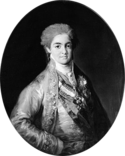 After Trafalgar, Godoy withdrew from the Continental System
that Napoleon had devised to combat Britain, only to join it again in 1807 after Napoleon had defeated the Prussia
ns. Napoleon, however, had lost his faith in Godoy and King Charles; there was also growing support in Spain for the king's son, Ferdinand, who opposed the increasingly unpopular Godoy. Ferdinand, however, favored an alliance with Britain, and Napoleon doubted the trustworthiness of any Spanish royalty.
In 1808, Spain and France agreed to the partition of Portugal, which had renewed to support of the British after Trafalgar. The French and Spanish quickly occupied the country. Prince Ferdinand traveled to France, and rumors spread that he was asking for Napoleon to oust Godoy from power; the Spanish King sided with his favorite. Riots broke out in the country against Godoy, and he was arrested by a mob. To save him, the king abdicated in favor of his son Ferdinand. Napoleon, however, had lost confidence in the Spanish monarchy and when Ferdinand traveled to France to obtain the French emperor's support, Napoleon pressured Ferdinand to abdicate. He was replaced by Joseph Bonaparte
, Napoleon's brother. The Spanish chose to resist.
, Charles IV
, and his wife retired first to France, then to Italy, and left Spanish politics permanently.
The installation of Joseph Bonaparte
as King of Spain sparked a revolution in Spain. On the 3 May 1808, a revolt in Madrid
was bloodily suppressed by the French army, which now found itself attempting the occupation of both Portugal
and Spain. The incident and the perceived brutality of the French response created a rallying point for Spanish revolutionaries; the executions were captured famously by the Spanish painter Francisco Goya
. The Spanish army, on the whole, pronounced itself in favor of Ferdinand and joined the British and Portuguese in a united front against the French.
 Regional juntas were set up that declared Joseph's monarchy invalid; the clergy rallied against the "godless" French. The juntas collectively asked Britain for aid, and London
was only too happy to oblige. The Junta in Seville
declared itself the Supreme Junta for Spain in 1808, and most regional juntas (and the colonies in the New World) assented to the supremacy of the Seville Junta, which became a provisional government for Spain in the absence of Ferdinand. A new French offensive the following year forced it to withdraw to Cadiz
, where it would remain until close to the end of the war.
King Joseph had attempted to reconcile with the Spanish early on; at Bayonne
, after the forced abdication of Ferdinand, Joseph gathered an assembly of Spanish notables to draft a constitution for his new Bonapartist regime in Spain. The most prominent members in Spanish politics - including the Count of Floridablanca - declined to attend. The cabinet and constitution that Joseph did present was viewed as illegitimate. Joseph entered Madrid on 25 July 1808, after the rebellion against his government was already well under way.
A series of victories against the French in 1808 prompted Napoleon himself to invade Spain in 1809, forcing the British and their allies to evacuate the peninsula in only two months' time. Satisfied, Napoleon placed command of the war in the hands of one of his marshals
, Nicolas Jean de Dieu Soult
. With the destruction of the Spanish army in 1808, Spanish resistance transformed into fierce guerrilla warfare
. Although numerically superior to the regular British, Portuguese, and Spanish armies, so effective were the Spanish guerillas that of 350,000 men of the French Armée de l'Espagne, 200,000 were employed in the protection of France's vulnerable lines of supply stretching across the breadth of Spain.
Many Spanish liberals
- carrying the tradition of Charles III
and his ministers - saw in a close relationship with France the hope for modernity and progress in their country. Called "afrancesado
s," they viewed the end of the Inquisition
and the establishment of a more secular, liberal monarchy with affection, but as the French occupation dragged on, popularity for French rule even among liberals waned. By 1812, many of these afrancesados had become members of the Spanish guerilla war. The Spanish Constitution of 1812
(the Cadiz Constitution) was drafted by the Supreme Junta. The constitution, written by an assembly dominated by liberal reformers, described a constitutional monarchy
. The inquisition would be abolished, though Roman Catholicism was still the state religion and heresy a crime. The constitution - Spain's first - provided for freedom of speech
, freedom of association
, and universal manhood suffrage
. In response to the constitution, France temporarily annexed Catalonia
.
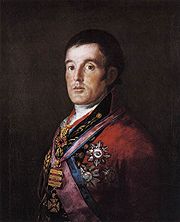 The British, under the command of Sir Arthur Wellesley
, invaded Spain from Portugal in 1810. A Spanish force, pulled together from the remnants of the Spanish army and volunteer fighters, joined him and successfully defeated the French under the personal command of Joseph Bonaparte at the Battle of Talavera. For his victory, Wellesley was made Duke of Wellington, although not long after Talavera he was forced to retreat into Portugal once more. Although Wellington took Madrid
on 6 August 1812, he retreated not long after back to Portugal. With the stretched and harassed French forces depleted when Napoleon redeployed troops for what would be a disastrous offensive against Russia, Wellington saw an opportunity and attacked again in 1813. At the Battle of Vitoria
, on 21 June 1813, the French under the personal command of King Joseph were again defeated, and were subsequently forced as far back as the Pyrenees
in early July. Fighting continued in the mountains throughout the winter, though in the spring of 1814 the Allies advanced into southern France.
Ferdinand was released by the French after the fall of Napoleon in 1814. On arriving in Spain, the most important question was whether he would swear by the Constitution of 1812, that the Supreme Junta had composed in his stead. The constitution, which also limited the king's powers considerably in favor of a unicameral legislature, was deeply unpopular among the conservative Spanish clergy, and among the people of Spain who associated much of it with the French who had only months before been evicted from their country. Ferdinand refused to accept the liberal constitution, and continued his rule in Spain as Charles IV had; as an absolute monarch and it was during his reign that Spain would go on to lose most of her American Colonies.
Age of Enlightenment
The Age of Enlightenment was an elite cultural movement of intellectuals in 18th century Europe that sought to mobilize the power of reason in order to reform society and advance knowledge. It promoted intellectual interchange and opposed intolerance and abuses in church and state...
(in Spanish, Ilustración) came to Spain
Spain
Spain , officially the Kingdom of Spain languages]] under the European Charter for Regional or Minority Languages. In each of these, Spain's official name is as follows:;;;;;;), is a country and member state of the European Union located in southwestern Europe on the Iberian Peninsula...
in the eighteenth century with a new Bourbon dynasty after the decay of the Spanish economy, bureaucracy, and empire in the latter years of the former Habsburg dynasty. This period of reform and 'enlightened despotism' focused on modernising the Spanish government, infrastructure, and institutions, culminating in the rule of King Charles III
Charles III of Spain
Charles III was the King of Spain and the Spanish Indies from 1759 to 1788. He was the eldest son of Philip V of Spain and his second wife, the Princess Elisabeth Farnese...
and the work of his minister, José Moñino, count of Floridablanca.
The century began with the War of the Spanish Succession
War of the Spanish Succession
The War of the Spanish Succession was fought among several European powers, including a divided Spain, over the possible unification of the Kingdoms of Spain and France under one Bourbon monarch. As France and Spain were among the most powerful states of Europe, such a unification would have...
over the ascension of a relation of Louis XIV of France
Louis XIV of France
Louis XIV , known as Louis the Great or the Sun King , was a Bourbon monarch who ruled as King of France and Navarre. His reign, from 1643 to his death in 1715, began at the age of four and lasted seventy-two years, three months, and eighteen days...
to the throne of Spain and ended with the Napoleonic Wars
Napoleonic Wars
The Napoleonic Wars were a series of wars declared against Napoleon's French Empire by opposing coalitions that ran from 1803 to 1815. As a continuation of the wars sparked by the French Revolution of 1789, they revolutionised European armies and played out on an unprecedented scale, mainly due to...
in which Spain would become a bloody battleground. Charles III's successors, fraught by war, foreign intervention, unrest in the empire, corruption, and the pain of reform, would face an increasingly restive and unstable Spain, the painful consequences of which would become the civil wars
Carlist Wars
The Carlist Wars in Spain were the last major European civil wars in which contenders fought to establish their claim to a throne. Several times during the period from 1833 to 1876 the Carlists — followers of Infante Carlos and his descendants — rallied to the cry of "God, Country, and King" and...
that dominated Spain in the nineteenth century
Mid-nineteenth century Spain
Spain in the 19th century was a country in turmoil. Occupied by Napoleon from 1808 to 1814, a massively destructive "war of independence" ensued, driven by an emergent Spanish nationalism. An era of reaction against the liberal ideas associated with revolutionary France followed the war,...
.
War of Succession (1700-1715)
The last few years of the rule of the mentally challenged and childless Charles IICharles II of Spain
Charles II was the last Habsburg King of Spain and the ruler of large parts of Italy, the Spanish territories in the Southern Low Countries, and Spain's overseas Empire, stretching from the Americas to the Spanish East Indies...
, were dominated by the politics of who would succeed the unfortunate monarch, the last Spanish king of the Habsburg dynasty. Economic troubles, the decay of the Spanish bureaucracy, a series of defeats in wars against France
France
The French Republic , The French Republic , The French Republic , (commonly known as France , is a unitary semi-presidential republic in Western Europe with several overseas territories and islands located on other continents and in the Indian, Pacific, and Atlantic oceans. Metropolitan France...
, and the erosion of imperial institutions in the seventeenth century had left Charles the king of a declining empire, and his physical and mental weakness provided him with little ability to reverse the course of his country. Even so, the vastness of the Spanish Empire
Spanish Empire
The Spanish Empire comprised territories and colonies administered directly by Spain in Europe, in America, Africa, Asia and Oceania. It originated during the Age of Exploration and was therefore one of the first global empires. At the time of Habsburgs, Spain reached the peak of its world power....
in the New World
New World
The New World is one of the names used for the Western Hemisphere, specifically America and sometimes Oceania . The term originated in the late 15th century, when America had been recently discovered by European explorers, expanding the geographical horizon of the people of the European middle...
, along with her naval resources, had made Spain a vital part of European power politics. If the throne of Spain was to succeed to a relative of the king of France, or if the two countries were to be united, the balance of power in Europe might shift in France's favor. If it remained in the hands of another member of the anti-French, Austria
Austria
Austria , officially the Republic of Austria , is a landlocked country of roughly 8.4 million people in Central Europe. It is bordered by the Czech Republic and Germany to the north, Slovakia and Hungary to the east, Slovenia and Italy to the south, and Switzerland and Liechtenstein to the...
n Habsburg dynasty, the status quo would remain. Therefore, European politics during the seventeenth century became dominated by establishing an orderly succession in Spain that would not alter the balance between Europe's great powers.
Philip V of Spain
Philip V was King of Spain from 15 November 1700 to 15 January 1724, when he abdicated in favor of his son Louis, and from 6 September 1724, when he assumed the throne again upon his son's death, to his death.Before his reign, Philip occupied an exalted place in the royal family of France as a...
, the Bourbon grandson of King Louis XIV of France
Louis XIV of France
Louis XIV , known as Louis the Great or the Sun King , was a Bourbon monarch who ruled as King of France and Navarre. His reign, from 1643 to his death in 1715, began at the age of four and lasted seventy-two years, three months, and eighteen days...
, and the heir to the French throne. Castilian
Crown of Castile
The Crown of Castile was a medieval and modern state in the Iberian Peninsula that formed in 1230 as a result of the third and definitive union of the crowns and parliaments of the kingdoms of Castile and León upon the accession of the then King Ferdinand III of Castile to the vacant Leonese throne...
legitimists, who valued the succession of the closest heir of the king over the continuation of Habsburg rule, supported the king's plan. Spanish officials were also concerned with Spain remaining an independent country, rather than another part of the French or Austrian empires. Even so, on hearing the news that his grandson had become King of Spain, Louis XIV proclaimed, "The Pyrenees
Pyrenees
The Pyrenees is a range of mountains in southwest Europe that forms a natural border between France and Spain...
are no more."http://countrystudies.us/spain/11.htm
The Austrian Habsburg claimant to the Spanish throne, Archduke Charles of Austria
Charles VI, Holy Roman Emperor
Charles VI was the penultimate Habsburg sovereign of the Habsburg Empire. He succeeded his elder brother, Joseph I, as Holy Roman Emperor, King of Bohemia , Hungary and Croatia , Archduke of Austria, etc., in 1711...
, argued that he had been cheated out of the throne of Spain unfairly. England
England
England is a country that is part of the United Kingdom. It shares land borders with Scotland to the north and Wales to the west; the Irish Sea is to the north west, the Celtic Sea to the south west, with the North Sea to the east and the English Channel to the south separating it from continental...
and the Netherlands
Netherlands
The Netherlands is a constituent country of the Kingdom of the Netherlands, located mainly in North-West Europe and with several islands in the Caribbean. Mainland Netherlands borders the North Sea to the north and west, Belgium to the south, and Germany to the east, and shares maritime borders...
, who had backed Duke Joseph Ferdinand of Bavaria as the successor to the Spanish throne as a means of preventing either Spain or France from becoming more powerful, accepted Philip of Anjou as king of Spain but eventually chose to support Austria after Louis XIV did not respect the fact that France was not to take too much advantage of a Bourbon on the Spanish throne. Austria, with the backing of England and the Netherlands, chose to go to war over the issue after France rejected a plan of partition, launching the War of the Spanish Succession
War of the Spanish Succession
The War of the Spanish Succession was fought among several European powers, including a divided Spain, over the possible unification of the Kingdoms of Spain and France under one Bourbon monarch. As France and Spain were among the most powerful states of Europe, such a unification would have...
.
The Spanish cortes remained divided on the issue, and when war was declared in 1702, the war between Europe's great powers also became a civil war in Spain. Valencia, Catalonia
Catalonia
Catalonia is an autonomous community in northeastern Spain, with the official status of a "nationality" of Spain. Catalonia comprises four provinces: Barcelona, Girona, Lleida, and Tarragona. Its capital and largest city is Barcelona. Catalonia covers an area of 32,114 km² and has an...
, and Aragon
Aragon
Aragon is a modern autonomous community in Spain, coextensive with the medieval Kingdom of Aragon. Located in northeastern Spain, the Aragonese autonomous community comprises three provinces : Huesca, Zaragoza, and Teruel. Its capital is Zaragoza...
pronounced in favor of the Austrian candidate as king, fearing that Philip of Anjou would attempt to change the decentralized administration of the country that afforded the Catalans and Aragonese considerable autonomy from Madrid
Madrid
Madrid is the capital and largest city of Spain. The population of the city is roughly 3.3 million and the entire population of the Madrid metropolitan area is calculated to be 6.271 million. It is the third largest city in the European Union, after London and Berlin, and its metropolitan...
. An English-Dutch army, marching from Portugal
Portugal
Portugal , officially the Portuguese Republic is a country situated in southwestern Europe on the Iberian Peninsula. Portugal is the westernmost country of Europe, and is bordered by the Atlantic Ocean to the West and South and by Spain to the North and East. The Atlantic archipelagos of the...
, attacked Spain in 1705, but was for a time repulsed. The war elsewhere seemed to go well for France and her candidate for the Spanish throne initially, but at the Battle of Blenheim
Battle of Blenheim
The Battle of Blenheim , fought on 13 August 1704, was a major battle of the War of the Spanish Succession. Louis XIV of France sought to knock Emperor Leopold out of the war by seizing Vienna, the Habsburg capital, and gain a favourable peace settlement...
in 1704, Austria was saved from defeat by an English expedition under the Duke of Marlborough
Duke of Marlborough
Duke of Marlborough , is a hereditary title in the Peerage of England. The first holder of the title was John Churchill , the noted English general, and indeed an unqualified reference to the Duke of Marlborough in a historical text will almost certainly refer to him.-History:The dukedom was...
. Ten years of difficult fighting in Germany
Germany
Germany , officially the Federal Republic of Germany , is a federal parliamentary republic in Europe. The country consists of 16 states while the capital and largest city is Berlin. Germany covers an area of 357,021 km2 and has a largely temperate seasonal climate...
, Italy
Italy
Italy , officially the Italian Republic languages]] under the European Charter for Regional or Minority Languages. In each of these, Italy's official name is as follows:;;;;;;;;), is a unitary parliamentary republic in South-Central Europe. To the north it borders France, Switzerland, Austria and...
, Iberia
Iberian Peninsula
The Iberian Peninsula , sometimes called Iberia, is located in the extreme southwest of Europe and includes the modern-day sovereign states of Spain, Portugal and Andorra, as well as the British Overseas Territory of Gibraltar...
, the Low Countries
Low Countries
The Low Countries are the historical lands around the low-lying delta of the Rhine, Scheldt, and Meuse rivers, including the modern countries of Belgium, the Netherlands, Luxembourg and parts of northern France and western Germany....
, and even the New World
New World
The New World is one of the names used for the Western Hemisphere, specifically America and sometimes Oceania . The term originated in the late 15th century, when America had been recently discovered by European explorers, expanding the geographical horizon of the people of the European middle...
(where it became known as Queen Anne's War
Queen Anne's War
Queen Anne's War , as the North American theater of the War of the Spanish Succession was known in the British colonies, was the second in a series of French and Indian Wars fought between France and England, later Great Britain, in North America for control of the continent. The War of the...
) followed. Madrid itself was occupied in 1706 and 1710, and much of the Spanish countryside was devastated by campaigns fought across its soil, both by foreign soldiers, its own army and the revolting Aragonese, Catalans, and Valencians.
Treaty of Utrecht
The Treaty of Utrecht, which established the Peace of Utrecht, comprises a series of individual peace treaties, rather than a single document, signed by the belligerents in the War of Spanish Succession, in the Dutch city of Utrecht in March and April 1713...
in 1713 between France and most of the great powers. France and the Allies agreed that Louis XIV's grandson, Philip, would become King Philip V of Spain
Philip V of Spain
Philip V was King of Spain from 15 November 1700 to 15 January 1724, when he abdicated in favor of his son Louis, and from 6 September 1724, when he assumed the throne again upon his son's death, to his death.Before his reign, Philip occupied an exalted place in the royal family of France as a...
, but that the thrones of France and Spain were never to be united. While France's territories remained largely intact, Spain was forced to cede her European empire in the peace; her Italian possessions, including Naples
Naples
Naples is a city in Southern Italy, situated on the country's west coast by the Gulf of Naples. Lying between two notable volcanic regions, Mount Vesuvius and the Phlegraean Fields, it is the capital of the region of Campania and of the province of Naples...
, Milan
Milan
Milan is the second-largest city in Italy and the capital city of the region of Lombardy and of the province of Milan. The city proper has a population of about 1.3 million, while its urban area, roughly coinciding with its administrative province and the bordering Province of Monza and Brianza ,...
, and Sardinia
Sardinia
Sardinia is the second-largest island in the Mediterranean Sea . It is an autonomous region of Italy, and the nearest land masses are the French island of Corsica, the Italian Peninsula, Sicily, Tunisia and the Spanish Balearic Islands.The name Sardinia is from the pre-Roman noun *sard[],...
, were given up to Austria
Austria
Austria , officially the Republic of Austria , is a landlocked country of roughly 8.4 million people in Central Europe. It is bordered by the Czech Republic and Germany to the north, Slovakia and Hungary to the east, Slovenia and Italy to the south, and Switzerland and Liechtenstein to the...
, along with Sicily
Sicily
Sicily is a region of Italy, and is the largest island in the Mediterranean Sea. Along with the surrounding minor islands, it constitutes an autonomous region of Italy, the Regione Autonoma Siciliana Sicily has a rich and unique culture, especially with regard to the arts, music, literature,...
, which was ceded to Savoy
Savoy
Savoy is a region of France. It comprises roughly the territory of the Western Alps situated between Lake Geneva in the north and Monaco and the Mediterranean coast in the south....
. Spain was also forced to give up the Spanish Netherlands to Austria
Austria
Austria , officially the Republic of Austria , is a landlocked country of roughly 8.4 million people in Central Europe. It is bordered by the Czech Republic and Germany to the north, Slovakia and Hungary to the east, Slovenia and Italy to the south, and Switzerland and Liechtenstein to the...
, and the island of Minorca
Minorca
Min Orca or Menorca is one of the Balearic Islands located in the Mediterranean Sea belonging to Spain. It takes its name from being smaller than the nearby island of Majorca....
and Gibraltar
Gibraltar
Gibraltar is a British overseas territory located on the southern end of the Iberian Peninsula at the entrance of the Mediterranean. A peninsula with an area of , it has a northern border with Andalusia, Spain. The Rock of Gibraltar is the major landmark of the region...
to Britain. In later years, however, many of these Italian territories, notably Naples
Kingdom of Naples
The Kingdom of Naples, comprising the southern part of the Italian peninsula, was the remainder of the old Kingdom of Sicily after secession of the island of Sicily as a result of the Sicilian Vespers rebellion of 1282. Known to contemporaries as the Kingdom of Sicily, it is dubbed Kingdom of...
and Sicily
Kingdom of Sicily
The Kingdom of Sicily was a state that existed in the south of Italy from its founding by Roger II in 1130 until 1816. It was a successor state of the County of Sicily, which had been founded in 1071 during the Norman conquest of southern Italy...
would revert back to Spanish control. In exchange for accepting the loss of these European territories of the Spanish Empire, Philip was able to keep the remainder of the Spanish empire. Even after the peace was signed, however, the Catalans
Catalonia
Catalonia is an autonomous community in northeastern Spain, with the official status of a "nationality" of Spain. Catalonia comprises four provinces: Barcelona, Girona, Lleida, and Tarragona. Its capital and largest city is Barcelona. Catalonia covers an area of 32,114 km² and has an...
- who had been operating independently against Philip during the war, operating under the banner "Privilegis o Mort" (Privileges or Death)http://countrystudies.us/spain/11.htm - continued to resist after the British withdrew; Barcelona
Barcelona
Barcelona is the second largest city in Spain after Madrid, and the capital of Catalonia, with a population of 1,621,537 within its administrative limits on a land area of...
was not retaken by Spanish forces until late in 1714. This date (September 11, 1714) is commemorated as the National Day of Catalonia
National Day of Catalonia
On September 11, Catalonia commemorates the 1714 Siege of Barcelona defeat during the War of the Spanish Succession. As correction for their support to the claim of Habsburg Archduke Charles to the throne of Spain, institutions and rights of the territories of the Crown of Aragon were abolished by...
. However, much of the country was in a state of economic instability due to the conflict, no matter which candidate to the Spanish throne was supported.
Reform (1715-1746)
Philip proved an effective administrator, centralizing the Spanish authority by eliminating regional parliaments and beginning a process of harmonizing laws among the various regions of Spain's empire. His selection of capable French and Italian ministers to key positions in the government reined in independent, isolated, and corrupt ministries that had flourished in the later period of Habsburg rule. However, Philip - a manic depressant often dominated in his policies by his wife Elizabeth Farnese - adopted an aggressive foreign policy that invested Spain in a series of costly wars throughout his reign.The loss of so much of the territory promised to him by Charles II's decree and Philip's personal ambition put him at unease with the treaty. Philip's wife Elizabeth - a member of the ducal house of Parma
Parma
Parma is a city in the Italian region of Emilia-Romagna famous for its ham, its cheese, its architecture and the fine countryside around it. This is the home of the University of Parma, one of the oldest universities in the world....
- and her favorite minister, Cardinal Giulio Alberoni
Giulio Alberoni
Giulio Alberoni was an Italian cardinal andstatesman in the service of Philip V of Spain.-Early years:He was born near Piacenza, probably at the village of Fiorenzuola d'Arda in the Duchy of Parma....
, desired to have their claims in Italy and those of Philip's restored. An alliance of France, Britain, and the Netherlands condemned Spain's ambitions which threatened the peace of Europe; in 1717, Philip invaded Sardinia
Sardinia
Sardinia is the second-largest island in the Mediterranean Sea . It is an autonomous region of Italy, and the nearest land masses are the French island of Corsica, the Italian Peninsula, Sicily, Tunisia and the Spanish Balearic Islands.The name Sardinia is from the pre-Roman noun *sard[],...
, one of the territories lost to Austria after the War of the Spanish Succession
War of the Spanish Succession
The War of the Spanish Succession was fought among several European powers, including a divided Spain, over the possible unification of the Kingdoms of Spain and France under one Bourbon monarch. As France and Spain were among the most powerful states of Europe, such a unification would have...
. The invasion of Sicily
Sicily
Sicily is a region of Italy, and is the largest island in the Mediterranean Sea. Along with the surrounding minor islands, it constitutes an autonomous region of Italy, the Regione Autonoma Siciliana Sicily has a rich and unique culture, especially with regard to the arts, music, literature,...
thereafter prompted the formation of the Quadruple Alliance of Britain, France, Austria, and the Netherlands to oppose Philip's ambitions. In 1720, embarrassed by the failure of Spanish arms at sea and on land in the War of the Quadruple Alliance
War of the Quadruple Alliance
The War of the Quadruple Alliance was a result of the ambitions of King Philip V of Spain, his wife, Elisabeth Farnese, and his chief minister Giulio Alberoni to retake territories in Italy and to claim the French throne. It saw the defeat of Spain by an alliance of Britain, France, Austria , and...
, Philip dismissed Alberoni and signed a peace treaty with Austria, with both sides recognizing the Treaty of Utrecht.
Anglo-Spanish War (1727)
The Anglo-Spanish War of 1727–1729 was a limited war that took place between Great Britain and Spain during the Eighteenth Century, and consisted of a failed British attempt to blockade Porto Bello and a failed Spanish attempt to capture Gibraltar...
of 1727-1729. An alliance was concluded in 1725 with the Austrians, who agreed to help the Spanish in retaking key naval bases in the Mediterranean - Minorca
Minorca
Min Orca or Menorca is one of the Balearic Islands located in the Mediterranean Sea belonging to Spain. It takes its name from being smaller than the nearby island of Majorca....
and Gibraltar
Gibraltar
Gibraltar is a British overseas territory located on the southern end of the Iberian Peninsula at the entrance of the Mediterranean. A peninsula with an area of , it has a northern border with Andalusia, Spain. The Rock of Gibraltar is the major landmark of the region...
- from the British. In response, an alliance was forged by the British Secretary of State, Charles Townshend, 2nd Viscount Townshend
Charles Townshend, 2nd Viscount Townshend
Charles Townshend, 2nd Viscount Townshend Bt, KG, PC was a British Whig statesman. He served for a decade as Secretary of State, directing British foreign policy...
, with France and the Netherlands; when Philip did finally lay siege to Gibraltar, Austria declined to intervene against the powerful alliance, and Spain was left alone once again. Britain elected to devastate Spain's New World empire and her gold shipments, hoping to prevent Philip from buying the Austrians into intervention; the plan succeeded, and Philip was forced to sue for peace in 1729. Elizabeth Farnese did get one of her wishes, though; the Italian duchies of Parma
Parma
Parma is a city in the Italian region of Emilia-Romagna famous for its ham, its cheese, its architecture and the fine countryside around it. This is the home of the University of Parma, one of the oldest universities in the world....
, Piacenza
Piacenza
Piacenza is a city and comune in the Emilia-Romagna region of northern Italy. It is the capital of the province of Piacenza...
, and Tuscany
Tuscany
Tuscany is a region in Italy. It has an area of about 23,000 square kilometres and a population of about 3.75 million inhabitants. The regional capital is Florence ....
were restored to her family.
After 1729, Philip was more reserved in his use of Spanish power and sought the close support of allies, in particular France: a more cautious strategy that yielded positive results. Philip sought a friendly axis with his relatives in France in the War of the Polish Succession
War of the Polish Succession
The War of the Polish Succession was a major European war for princes' possessions sparked by a Polish civil war over the succession to Augustus II, King of Poland that other European powers widened in pursuit of their own national interests...
, where he succeeded in regaining Naples
Naples
Naples is a city in Southern Italy, situated on the country's west coast by the Gulf of Naples. Lying between two notable volcanic regions, Mount Vesuvius and the Phlegraean Fields, it is the capital of the region of Campania and of the province of Naples...
and Sicily
Sicily
Sicily is a region of Italy, and is the largest island in the Mediterranean Sea. Along with the surrounding minor islands, it constitutes an autonomous region of Italy, the Regione Autonoma Siciliana Sicily has a rich and unique culture, especially with regard to the arts, music, literature,...
for his son, the future Charles III of Spain
Charles III of Spain
Charles III was the King of Spain and the Spanish Indies from 1759 to 1788. He was the eldest son of Philip V of Spain and his second wife, the Princess Elisabeth Farnese...
. The Family Compact with Louis XV of France
Louis XV of France
Louis XV was a Bourbon monarch who ruled as King of France and of Navarre from 1 September 1715 until his death. He succeeded his great-grandfather at the age of five, his first cousin Philippe II, Duke of Orléans, served as Regent of the kingdom until Louis's majority in 1723...
was signed in 1733, bringing the two states closer together after the embarrassments of the Quadruple Alliance. Friction with Britain prompted by the War of Jenkins' Ear
War of Jenkins' Ear
The War of Jenkins' Ear was a conflict between Great Britain and Spain that lasted from 1739 to 1748, with major operations largely ended by 1742. Its unusual name, coined by Thomas Carlyle in 1858, relates to Robert Jenkins, captain of a British merchant ship, who exhibited his severed ear in...
(1739-1741) pushed Philip into a closer alliance with France in the years leading to the War of the Austrian Succession
War of the Austrian Succession
The War of the Austrian Succession – including King George's War in North America, the Anglo-Spanish War of Jenkins' Ear, and two of the three Silesian wars – involved most of the powers of Europe over the question of Maria Theresa's succession to the realms of the House of Habsburg.The...
, in which Philip obtained further concessions from Austria for his family in Italy. This restored Spanish power in Italy to much of its pre-war extent, and added new territories that had not previously been part of the Spanish Empire in Italy.
Late in his reign, Philip elected to place the reformation of his government in the hands of his ministers. The youthful and ambitious Zenón de Somodevilla had been created Marquis of Ensenada in 1736 for his successful diplomacy after the War of the Polish Succession, and seven years afterwards, in 1743, he was made Philip (and Elizabeth's) favorite at court, and for the remainder of Philip's reign, Ensenada effectively ruled Spain. Ensenada sought a cautious but independent foreign policy that distanced his country from either France or Britain, and desired a stable, peaceful atmosphere in which Spain could reform her institutions.
Balancing act (1746-1759)
War of the Austrian Succession
The War of the Austrian Succession – including King George's War in North America, the Anglo-Spanish War of Jenkins' Ear, and two of the three Silesian wars – involved most of the powers of Europe over the question of Maria Theresa's succession to the realms of the House of Habsburg.The...
had awarded Ensenada a victory that cemented his support in Spain. However, two years before the war ended, King Philip
Philip V of Spain
Philip V was King of Spain from 15 November 1700 to 15 January 1724, when he abdicated in favor of his son Louis, and from 6 September 1724, when he assumed the throne again upon his son's death, to his death.Before his reign, Philip occupied an exalted place in the royal family of France as a...
, his strongest supporter, died, and was succeeded by his son Ferdinand VI
Ferdinand VI of Spain
Ferdinand VI , called the Learnt, was King of Spain from 9 July 1746 until his death. He was the fourth son of the previous monarch Philip V and his first wife Maria Luisa of Savoy...
. Ferdinand - Philip's son by his first marriage to Princess Maria Luisa of Savoy
Maria Luisa of Savoy
Maria Luisa of Savoy was a Savoyard princess and the first wife of Philip V of Spain. She acted as Regent of Spain and had great influence over her husband...
- had suffered under the domineering influence of his stepmother as a child, and as king, he was constantly unsure of his own abilities. Elizabeth Farnese, the queen who had effectively controlled Philip V, left the court on her husband's death. Like his father, though, Ferdinand was extremely devoted to his wife, and she dictated much of his policy and political decisions; at the time of Ferdinand's coronation in 1746, it was said that "Queen Barbara has succeeded Queen Elizabeth."http://www.xs4all.nl/~kvenjb/madmonarchs/ferdinand6/ferdinand6_bio.htm For her part, Queen Maria Barbara de Braganza, a member of the Portuguese
Portugal
Portugal , officially the Portuguese Republic is a country situated in southwestern Europe on the Iberian Peninsula. Portugal is the westernmost country of Europe, and is bordered by the Atlantic Ocean to the West and South and by Spain to the North and East. The Atlantic archipelagos of the...
royal family, advocated a policy of neutrality that coincided with the opinions of her leading courtiers, far different from the irredentist policy of Elizabeth.
Ferdinand's rule reaped good fortune and the rewards of Philip V's reforms. He was a charitable ruler, relieving drought-stricken Andalusia
Andalusia
Andalusia is the most populous and the second largest in area of the autonomous communities of Spain. The Andalusian autonomous community is officially recognised as a nationality of Spain. The territory is divided into eight provinces: Huelva, Seville, Cádiz, Córdoba, Málaga, Jaén, Granada and...
from all taxes in 1755 and devoting large sums of money to the reconstruction of that part of the country. As king, he deferred many of his judgements to his leading ministers.
José de Carvajal y Lancáster
José de Carvajal y Lancáster was a Spanish statesman.He was son of the duke of Linares and his mother was descendant of Jorge de Lancastre, a natural son of King John II of Portugal. After graduating at the University of Salamanca, he was appointed oidor of the Chancillería of Valladolid and...
, a mixed British-Spanish gentleman descended from the House of Lancaster
House of Lancaster
The House of Lancaster was a branch of the royal House of Plantagenet. It was one of the opposing factions involved in the Wars of the Roses, an intermittent civil war which affected England and Wales during the 15th century...
. Carvajal believed that the key to Spain's defense and modernization was a closer alliance with Britain, whose naval power could complement Spain's empire and whose commercial strength could encourage economic development in Spain. Carvajal's most enduring accomplishment was the 1750 agreement with Portugal, which ended a long, low-level conflict in Banda Oriental
Banda Oriental
The Banda Oriental del Uruguay was the South American territory east of the Uruguay River and north of the Río de la Plata, coinciding approximately with the modern nation of Uruguay, the Brazilian State of Rio Grande do Sul and some parts of Santa Catarina...
(southern Uruguay
Uruguay
Uruguay ,officially the Oriental Republic of Uruguay,sometimes the Eastern Republic of Uruguay; ) is a country in the southeastern part of South America. It is home to some 3.5 million people, of whom 1.8 million live in the capital Montevideo and its metropolitan area...
) between the two countries.
The agreement with Portugal, however, was to have important political consequences for Spain. The agreement traded seven Jesuit-established and -operated missions in southern Uruguay for Portuguese-founded and -controlled Uruguay
Uruguay
Uruguay ,officially the Oriental Republic of Uruguay,sometimes the Eastern Republic of Uruguay; ) is a country in the southeastern part of South America. It is home to some 3.5 million people, of whom 1.8 million live in the capital Montevideo and its metropolitan area...
. The plan (opposed by both the Jesuits and the British) led to resistance led by the Jesuits and their native Guarani allies in the area. Both Spain and Portugal responded in force to the crisis, suppressing the Jesuits and Guarani in the War of the Seven Reductions. The war broke a traditionally friendly relationship between the Spanish government and the Jesuits and launched a period of anti-Jesuit policies both in Spain and Portugal that would be continued by Charles III of Spain
Charles III of Spain
Charles III was the King of Spain and the Spanish Indies from 1759 to 1788. He was the eldest son of Philip V of Spain and his second wife, the Princess Elisabeth Farnese...
.
A scandal at court, resulting from a conspiracy between Carvajal and the British ambassador, led to the embarrassment of Ensenada and his disrepute at court. When Carvajal died in 1754, Philip and his wife dismissed Ensenada, fearing that the Marquis's French sympathies would lead to an alliance with Louis XV of France
Louis XV of France
Louis XV was a Bourbon monarch who ruled as King of France and of Navarre from 1 September 1715 until his death. He succeeded his great-grandfather at the age of five, his first cousin Philippe II, Duke of Orléans, served as Regent of the kingdom until Louis's majority in 1723...
and war, without Carvajal's British sympathies to counterbalance him. An Irishman
Ireland
Ireland is an island to the northwest of continental Europe. It is the third-largest island in Europe and the twentieth-largest island on Earth...
, Ricardo Wall, was appointed to replace Ensenada as chief minister. Wall, a staunch defender of Spain's neutral policy, successfully kept the country out of war for the remainder of Ferdinand's reign, in spite of the outbreak of the largest European war since the Thirty Years' War
Thirty Years' War
The Thirty Years' War was fought primarily in what is now Germany, and at various points involved most countries in Europe. It was one of the most destructive conflicts in European history....
, the Seven Years' War
Seven Years' War
The Seven Years' War was a global military war between 1756 and 1763, involving most of the great powers of the time and affecting Europe, North America, Central America, the West African coast, India, and the Philippines...
.
Although his wife had always feared that Ferdinand would die before her and leave her destitute - she had amassed huge personal wealth as a safeguard against this - it was his wife Maria Barbara who would precede him, dying in 1758. Deeply distraught by her death, Ferdinand became apathetic to his duties as king, and indeed, suicidal. He died a year later, in 1759.
Enlightened despotism (1759-1788)
Charles III of Spain
Charles III was the King of Spain and the Spanish Indies from 1759 to 1788. He was the eldest son of Philip V of Spain and his second wife, the Princess Elisabeth Farnese...
, son of Philip V
Philip V of Spain
Philip V was King of Spain from 15 November 1700 to 15 January 1724, when he abdicated in favor of his son Louis, and from 6 September 1724, when he assumed the throne again upon his son's death, to his death.Before his reign, Philip occupied an exalted place in the royal family of France as a...
by his second wife, Elizabeth Farnese. Charles had been named Duke of Parma
Parma
Parma is a city in the Italian region of Emilia-Romagna famous for its ham, its cheese, its architecture and the fine countryside around it. This is the home of the University of Parma, one of the oldest universities in the world....
at his mother's demand at the age of sixteen. His experience there gave him a place to experiment with the practice of enlightened despotism. He exhibited a martial spirit early on, acquiring Naples
Naples
Naples is a city in Southern Italy, situated on the country's west coast by the Gulf of Naples. Lying between two notable volcanic regions, Mount Vesuvius and the Phlegraean Fields, it is the capital of the region of Campania and of the province of Naples...
and Sicily
Sicily
Sicily is a region of Italy, and is the largest island in the Mediterranean Sea. Along with the surrounding minor islands, it constitutes an autonomous region of Italy, the Regione Autonoma Siciliana Sicily has a rich and unique culture, especially with regard to the arts, music, literature,...
by force of arms and becoming "King of the Two Sicilies
Kingdom of the Two Sicilies
The Kingdom of the Two Sicilies, commonly known as the Two Sicilies even before formally coming into being, was the largest and wealthiest of the Italian states before Italian unification...
," though his tastes were generally more peaceful. On arriving in Spain, he did not share Carvajal
José de Carvajal y Lancáster
José de Carvajal y Lancáster was a Spanish statesman.He was son of the duke of Linares and his mother was descendant of Jorge de Lancastre, a natural son of King John II of Portugal. After graduating at the University of Salamanca, he was appointed oidor of the Chancillería of Valladolid and...
's taste for an alliance with Britain; he had borne the island nation a certain mistrust ever since a British fleet had forced his neutrality in the War of the Austrian Succession
War of the Austrian Succession
The War of the Austrian Succession – including King George's War in North America, the Anglo-Spanish War of Jenkins' Ear, and two of the three Silesian wars – involved most of the powers of Europe over the question of Maria Theresa's succession to the realms of the House of Habsburg.The...
.
He had been introduced to reform by his mentor in Sicily, Bernardo Tanucci
Bernardo Tanucci
Bernardo Tanucci was an Italian statesman, who brought enlightened government to the backward Kingdom of the Two Sicilies for Charles III and his son Ferdinand IV.-Biography:...
. Although Tanucci remained behind in the Two Sicilies to advise Charles's son, King Ferdinand I of the Two Sicilies
Ferdinand I of the Two Sicilies
Ferdinand I reigned variously over Naples, Sicily, and the Two Sicilies from 1759 until his death. He was the third son of King Charles III of Spain by his wife Maria Amalia of Saxony. On 10 August 1759, Charles succeeded his elder brother, Ferdinand VI, as King Charles III of Spain...
, as the two thrones could not be united by consequence of treaty, Charles carried with him a cadre of Italian reformers who saw potential in the Spanish bureaucracy for modernization. The architect of the first phase of Charles III's reforms was one such Italian, Leopoldo de Gregorio - a man of humble origins whose ability as a military supplier for the Neapolitan army impressed the king and raised him to royal prominence. Created "Marquis of Esquilache" in 1755, Gregorio was one of Spain's leading statesman from the arrival of Charles III to the Marquis's death in 1785.
Seven Years' War
The Seven Years' War was a global military war between 1756 and 1763, involving most of the great powers of the time and affecting Europe, North America, Central America, the West African coast, India, and the Philippines...
had broken out in 1756, Spain had managed to remain strictly neutral under the ministry of Ricardo Wall, who continued to lead Spain's government in the early years of Charles III. Charles, however, bore a grudge against the English and as the war became increasingly desperate for France, he went against his chief minister's wishes and intervened on France's behalf in 1762. Spain fared poorly in the war, and the British occupied Havana
Havana
Havana is the capital city, province, major port, and leading commercial centre of Cuba. The city proper has a population of 2.1 million inhabitants, and it spans a total of — making it the largest city in the Caribbean region, and the most populous...
and Manila
Manila
Manila is the capital of the Philippines. It is one of the sixteen cities forming Metro Manila.Manila is located on the eastern shores of Manila Bay and is bordered by Navotas and Caloocan to the north, Quezon City to the northeast, San Juan and Mandaluyong to the east, Makati on the southeast,...
within a year. Florida
Florida
Florida is a state in the southeastern United States, located on the nation's Atlantic and Gulf coasts. It is bordered to the west by the Gulf of Mexico, to the north by Alabama and Georgia and to the east by the Atlantic Ocean. With a population of 18,801,310 as measured by the 2010 census, it...
was ceded to the British and Spain recognized British control over Minorca
Minorca
Min Orca or Menorca is one of the Balearic Islands located in the Mediterranean Sea belonging to Spain. It takes its name from being smaller than the nearby island of Majorca....
and Gibraltar
Gibraltar
Gibraltar is a British overseas territory located on the southern end of the Iberian Peninsula at the entrance of the Mediterranean. A peninsula with an area of , it has a northern border with Andalusia, Spain. The Rock of Gibraltar is the major landmark of the region...
in 1763, although Louisiana
Louisiana
Louisiana is a state located in the southern region of the United States of America. Its capital is Baton Rouge and largest city is New Orleans. Louisiana is the only state in the U.S. with political subdivisions termed parishes, which are local governments equivalent to counties...
was given to Spain to compensate her for her losses. After the Treaty of Paris (1763)
Treaty of Paris (1763)
The Treaty of Paris, often called the Peace of Paris, or the Treaty of 1763, was signed on 10 February 1763, by the kingdoms of Great Britain, France and Spain, with Portugal in agreement. It ended the French and Indian War/Seven Years' War...
, however, Spain could focus on internal development.
By far the largest landholder in Spain, the Church had been treated with great charity by the Spanish kings of the seventeenth century - Philip IV
Philip IV of Spain
Philip IV was King of Spain between 1621 and 1665, sovereign of the Spanish Netherlands, and King of Portugal until 1640...
in particular donated large tracts of territory in religious piety. Much of this land went unused, and a great deal of the remainder of the country was owned by gentlemanly hidalgo
Hidalgo (Spanish nobility)
A hidalgo or fidalgo is a member of the Spanish and Portuguese nobility. In popular usage it has come to mean the non-titled nobility. Hidalgos were exempt from paying taxes, but did not necessarily own real property...
s who lived primarily off of the state. The system had grown long obsolete, and a growing population (Spain's population would increase from eight to twelve million between 1700 and the French Revolution
French Revolution
The French Revolution , sometimes distinguished as the 'Great French Revolution' , was a period of radical social and political upheaval in France and Europe. The absolute monarchy that had ruled France for centuries collapsed in three years...
) had put great pressure on the government to reform. Like neighboring Portugal
Portugal
Portugal , officially the Portuguese Republic is a country situated in southwestern Europe on the Iberian Peninsula. Portugal is the westernmost country of Europe, and is bordered by the Atlantic Ocean to the West and South and by Spain to the North and East. The Atlantic archipelagos of the...
, Spain's antiquated bureaucracy had grown dependent on the income and production from its colonies to support an unmanageably large class of landowning, nonproductive gentlemen and clergy.
The Enlightenment
Age of Enlightenment
The Age of Enlightenment was an elite cultural movement of intellectuals in 18th century Europe that sought to mobilize the power of reason in order to reform society and advance knowledge. It promoted intellectual interchange and opposed intolerance and abuses in church and state...
had been a force of anticlericalism in Europe, and Charles, in applying its lessons to Spain, saw it similarly. Ferdinand IV
Ferdinand VI of Spain
Ferdinand VI , called the Learnt, was King of Spain from 9 July 1746 until his death. He was the fourth son of the previous monarch Philip V and his first wife Maria Luisa of Savoy...
had undertaken to reduce the power of the Jesuits in Spain and had arranged for Spain's kings to appoint her own bishops, a power that France's kings had held since the fifteenth century. Charles, who advocated a radical policy and rapid modernization of the country, expelled the Jesuit Order from Spain completely in 1767 (see Suppression of the Jesuits
Suppression of the Jesuits
The Suppression of the Jesuits in the Portuguese Empire, France, the Two Sicilies, Parma and the Spanish Empire by 1767 was a result of a series of political moves rather than a theological controversy. By the brief Dominus ac Redemptor Pope Clement XIV suppressed the Society of Jesus...
). The Inquisition
Inquisition
The Inquisition, Inquisitio Haereticae Pravitatis , was the "fight against heretics" by several institutions within the justice-system of the Roman Catholic Church. It started in the 12th century, with the introduction of torture in the persecution of heresy...
was scaled back, but not completely eradicated; as late as 1787, a woman was burned as a witch.
Land reform and agricultural reform placed a new burden on Spanish society and alienated both clergymen and landed gentleman in Spain. Charles chose to ally with the merchantmen of his country and a growing middle class that came with a new prosperity during his rule. An advocate of free trade
Free trade
Under a free trade policy, prices emerge from supply and demand, and are the sole determinant of resource allocation. 'Free' trade differs from other forms of trade policy where the allocation of goods and services among trading countries are determined by price strategies that may differ from...
, Charles reduced the tariff barriers that had been the core of Spanish trade policy for centuries. The Marquis of Esquilache successfully liberalized the grain trade in 1765.
Although he believed in centralized government and continued the reforms of his predecessors to reduce the autonomy of the regional governments, Charles approved of establishing prototype chambers of commerce (see Sociedad Económica de los Amigos del País
Sociedad Económica de los Amigos del País
The Sociedades Económicas de Amigos del País were private associations established in various cities throughout Enlightenment Spain, and to a lesser degree in some of her colonies .-History:The Sociedades Económicas were founded as part of a movement to...
) to encourage local economic development and initiative. The national infrastructure was improved to foster the development of Spanish manufacturing, and a unified monetary system was implemented.
The reforms were not without costs, however, and in 1766, in the context of a worldwide grain shortage and the difficulties of the recently liberalized grain trade, riots broke out in Madrid and other cities in Spain against rising grain prices. The "Motin de Esquilache
Esquilache Riots
The Esquilache Riots occurred in March 1766 during the rule of Charles III of Spain. Caused mostly by the growing discontent in Madrid about the rising costs of bread and other staples, they were sparked off by a series of measures regarding Spaniards' apparel that had been enacted by Leopoldo de...
" drove the king from his capital and embarrassed the king's chief minister. An Aragon
Aragon
Aragon is a modern autonomous community in Spain, coextensive with the medieval Kingdom of Aragon. Located in northeastern Spain, the Aragonese autonomous community comprises three provinces : Huesca, Zaragoza, and Teruel. Its capital is Zaragoza...
ese official, Pedro Pablo Aranda, gained prominence during the crisis and led the government in the king's absence.
Aranda, as the leader of the Aragonese faction at court, favored a more decentralized system of government. Esquilache, who formerly had the king's ear, was sent abroad as an ambassador, and for a time Aranda was the leading figure in Spanish politics. A criminal prosecutor named José Moñino gained prominence as the investigator of the riots and as an outspoken supporter of the king's reformist policies. Esquilache arranged to have him made ambassador to Rome
Rome
Rome is the capital of Italy and the country's largest and most populated city and comune, with over 2.7 million residents in . The city is located in the central-western portion of the Italian Peninsula, on the Tiber River within the Lazio region of Italy.Rome's history spans two and a half...
in 1767; in 1773 Moñino succeeded in having the Pope
Pope
The Pope is the Bishop of Rome, a position that makes him the leader of the worldwide Catholic Church . In the Catholic Church, the Pope is regarded as the successor of Saint Peter, the Apostle...
revoke the papal charter of the Jesuit Order. For this success, Moñino was created Count of Floridablanca.
The new count was named chief minister in 1777 and undertook the material reform of the Spanish bureaucracy. His chief bureaucratic successes were the creation of a true cabinet system of government in 1778 and the creation of Spain's first national bank, the National Bank of San Carlos, in 1782. Recognizing the damage done to Spain's education system after the expulsion of the Jesuits, Floridablanca undertook drastic reform to hire new teachers and modernize Spain's education system. Floridablanca's most enduring accomplishment was the freedom of trade in Spain's empire in the New World
New World
The New World is one of the names used for the Western Hemisphere, specifically America and sometimes Oceania . The term originated in the late 15th century, when America had been recently discovered by European explorers, expanding the geographical horizon of the people of the European middle...
to foreigners.
Although Floridablanca - like Carvajal before him - admired British governance and believed that a cordial relationship with George III of the United Kingdom
George III of the United Kingdom
George III was King of Great Britain and King of Ireland from 25 October 1760 until the union of these two countries on 1 January 1801, after which he was King of the United Kingdom of Great Britain and Ireland until his death...
was the best policy for Spain, the American Revolutionary War
American Revolutionary War
The American Revolutionary War , the American War of Independence, or simply the Revolutionary War, began as a war between the Kingdom of Great Britain and thirteen British colonies in North America, and ended in a global war between several European great powers.The war was the result of the...
was too great an opportunity for King Charles, and Spain went to war against Britain alongside France and the Netherlands
Netherlands
The Netherlands is a constituent country of the Kingdom of the Netherlands, located mainly in North-West Europe and with several islands in the Caribbean. Mainland Netherlands borders the North Sea to the north and west, Belgium to the south, and Germany to the east, and shares maritime borders...
in 1779, after providing monetary assistance to the rebels. Bernardo de Galvez, the governor of Spanish Louisiana, led the campaign to retake the forts lost to the British since 1762; Pensacola, Florida was retaken in 1782, and the Bahamas were seized later that year. The Treaty of Paris (1783)
Treaty of Paris (1783)
The Treaty of Paris, signed on September 3, 1783, ended the American Revolutionary War between Great Britain on the one hand and the United States of America and its allies on the other. The other combatant nations, France, Spain and the Dutch Republic had separate agreements; for details of...
restored much of what Spain had lost in the Seven Years' War
Seven Years' War
The Seven Years' War was a global military war between 1756 and 1763, involving most of the great powers of the time and affecting Europe, North America, Central America, the West African coast, India, and the Philippines...
, including Florida
Florida
Florida is a state in the southeastern United States, located on the nation's Atlantic and Gulf coasts. It is bordered to the west by the Gulf of Mexico, to the north by Alabama and Georgia and to the east by the Atlantic Ocean. With a population of 18,801,310 as measured by the 2010 census, it...
.
Trouble abroad (1788-1808)
King Charles IIICharles III of Spain
Charles III was the King of Spain and the Spanish Indies from 1759 to 1788. He was the eldest son of Philip V of Spain and his second wife, the Princess Elisabeth Farnese...
died on 14 December 1788. Seven months later, French
France
The French Republic , The French Republic , The French Republic , (commonly known as France , is a unitary semi-presidential republic in Western Europe with several overseas territories and islands located on other continents and in the Indian, Pacific, and Atlantic oceans. Metropolitan France...
revolutionaries stormed the Bastille
Bastille
The Bastille was a fortress in Paris, known formally as the Bastille Saint-Antoine. It played an important role in the internal conflicts of France and for most of its history was used as a state prison by the kings of France. The Bastille was built in response to the English threat to the city of...
, launching the French Revolution
French Revolution
The French Revolution , sometimes distinguished as the 'Great French Revolution' , was a period of radical social and political upheaval in France and Europe. The absolute monarchy that had ruled France for centuries collapsed in three years...
.
Charles III's eldest son was both epileptic and retarded and was passed over for the throne in favor of his second eldest, Charles IV
Charles IV of Spain
Charles IV was King of Spain from 14 December 1788 until his abdication on 19 March 1808.-Early life:...
. Charles IV was seen by many of his time as being as uninterested in politics as Ferdinand VI
Ferdinand VI of Spain
Ferdinand VI , called the Learnt, was King of Spain from 9 July 1746 until his death. He was the fourth son of the previous monarch Philip V and his first wife Maria Luisa of Savoy...
had been. His chief interest upon his arrival in Spain (he had grown up in Naples
Naples
Naples is a city in Southern Italy, situated on the country's west coast by the Gulf of Naples. Lying between two notable volcanic regions, Mount Vesuvius and the Phlegraean Fields, it is the capital of the region of Campania and of the province of Naples...
) was hunting, and for all of his rule, his policies were dominated by the will of his wife.
His wife Maria Luisa of Parma
Maria Luisa of Parma
Maria Luisa of Parma was Queen consort of Spain from 1788 to 1808 as the wife of King Charles IV of Spain. She was the youngest daughter of Duke Philip of Parma and his wife, Louise-Élisabeth of France, the eldest daughter of King Louis XV.She was christened Luisa Maria Teresa Ana, but was known...
, however, took as her lover Manuel de Godoy
Manuel de Godoy
Don Manuel Francisco Domingo de Godoy y Álvarez de Faria, de los Ríos y Sánchez-Zarzosa, also Manuel de Godoy y Álvarez de Faria de los Ríos Sánchez Zarzosa , was Prime Minister of Spain from 1792 to 1797 and from 1801 to 1808...
, a soldier from a humble family, was dashingly handsome, particularly when Maria Louisa compared him to Charles IV. He had made the queen's acquaintance in 1788, months before she became queen, and by the time of her accession, she had become completely enamored. The king was very fond of Godoy, even though he was fully aware of his wife's adultery
Adultery
Adultery is sexual infidelity to one's spouse, and is a form of extramarital sex. It originally referred only to sex between a woman who was married and a person other than her spouse. Even in cases of separation from one's spouse, an extramarital affair is still considered adultery.Adultery is...
, and Godoy became Spain's chief minister in 1792.
The chief minister at the time of Charles IV's accession, José Moñino, count of Floridablanca, was not easily ousted and had many supporters in the court, particularly in Castile. Floridablanca's chief opponent in Spanish politics was Pedro Pablo Aranda, the leader of the Aragonese faction. Godoy made an alliance with Aranda, with whom Godoy sympathized, against Floridablanca. With the outbreak of the French Revolution and the execution of Louis XVI
Louis XVI of France
Louis XVI was a Bourbon monarch who ruled as King of France and Navarre until 1791, and then as King of the French from 1791 to 1792, before being executed in 1793....
in 1792, Floridablanca's liberalism faced greater skepticism. Aranda and Godoy had Floridablanca imprisoned in 1792 on charges of embezzlement
Embezzlement
Embezzlement is the act of dishonestly appropriating or secreting assets by one or more individuals to whom such assets have been entrusted....
, of which he was later acquitted.
Liberalism
Liberalism is the belief in the importance of liberty and equal rights. Liberals espouse a wide array of views depending on their understanding of these principles, but generally, liberals support ideas such as constitutionalism, liberal democracy, free and fair elections, human rights,...
that was tearing France apart. The Aragonese faction led by Aranda, allied to many of the causes that had opposed Charles III's reforms, managed to undo much of the changes brought about in Charles III's tenure.
After the execution of Louis XVI in 1793, 20,000 men were mobilized and marched to the French border. The army, however, had been allowed to languish in Charles III's reign, and it was ill-equipped and ill-trained to cope with a French invasion. Navarre
Navarre
Navarre , officially the Chartered Community of Navarre is an autonomous community in northern Spain, bordering the Basque Country, La Rioja, and Aragon in Spain and Aquitaine in France...
was quickly seized by the French, although the Spanish managed to hold their ground in Catalonia
Catalonia
Catalonia is an autonomous community in northeastern Spain, with the official status of a "nationality" of Spain. Catalonia comprises four provinces: Barcelona, Girona, Lleida, and Tarragona. Its capital and largest city is Barcelona. Catalonia covers an area of 32,114 km² and has an...
and even invaded French Languedoc
Languedoc
Languedoc is a former province of France, now continued in the modern-day régions of Languedoc-Roussillon and Midi-Pyrénées in the south of France, and whose capital city was Toulouse, now in Midi-Pyrénées. It had an area of approximately 42,700 km² .-Geographical Extent:The traditional...
. Godoy, unimpressed with Spain's military effectiveness, decided to come to terms with the new French Republic, and in 1795 signed the Treaty of Basel
Peace of Basel
The Peace of Basel of 1795 consists of three peace treaties involving France .* The first of the three treaties of 1795, France made peace with Prussia on 5 April; , * The Second was with Spain on 22 July, ending the War of the Pyrenees; and*...
, guaranteeing peace with France with the cession of Santo Domingo
Santo Domingo
Santo Domingo, known officially as Santo Domingo de Guzmán, is the capital and largest city in the Dominican Republic. Its metropolitan population was 2,084,852 in 2003, and estimated at 3,294,385 in 2010. The city is located on the Caribbean Sea, at the mouth of the Ozama River...
to the Republic.
Godoy, having abandoned his allies in the United Kingdom
United Kingdom
The United Kingdom of Great Britain and Northern IrelandIn the United Kingdom and Dependencies, other languages have been officially recognised as legitimate autochthonous languages under the European Charter for Regional or Minority Languages...
and Austria
Austria
Austria , officially the Republic of Austria , is a landlocked country of roughly 8.4 million people in Central Europe. It is bordered by the Czech Republic and Germany to the north, Slovakia and Hungary to the east, Slovenia and Italy to the south, and Switzerland and Liechtenstein to the...
, faced a decision: whether to continue to fight the Revolutionary France that had already defeated Spain once before, or to join the French side and hope for better times. The Spanish, after initially opposing the French, signed the Treaty of San Ildefonso
Second Treaty of San Ildefonso
The Second Treaty of San Ildefonso was signed on August 19, 1796 between the Spanish Empire and the First French Republic. Based on the terms of the agreement, France and Spain would become allies and combine their forces against the British Empire.-See also:...
in 1796, allying Spain to France, in exchange for French support for Charles IV's relations ruling the Italian duchy of Parma
Parma
Parma is a city in the Italian region of Emilia-Romagna famous for its ham, its cheese, its architecture and the fine countryside around it. This is the home of the University of Parma, one of the oldest universities in the world....
. In response, the British blockade
Blockade
A blockade is an effort to cut off food, supplies, war material or communications from a particular area by force, either in part or totally. A blockade should not be confused with an embargo or sanctions, which are legal barriers to trade, and is distinct from a siege in that a blockade is usually...
d Spain in 1797 and separated her colonial empire from the mother country. By the end of 1798, the Spanish fleet had been defeated by the British, and Minorca
Minorca
Min Orca or Menorca is one of the Balearic Islands located in the Mediterranean Sea belonging to Spain. It takes its name from being smaller than the nearby island of Majorca....
and Trinidad
Trinidad
Trinidad is the larger and more populous of the two major islands and numerous landforms which make up the island nation of Trinidad and Tobago. It is the southernmost island in the Caribbean and lies just off the northeastern coast of Venezuela. With an area of it is also the fifth largest in...
were occupied. In 1800, the Spanish returned Louisiana
Louisiana
Louisiana is a state located in the southern region of the United States of America. Its capital is Baton Rouge and largest city is New Orleans. Louisiana is the only state in the U.S. with political subdivisions termed parishes, which are local governments equivalent to counties...
to France, which had been given to them in compensation for their losses at the end of the Seven Years' War
Seven Years' War
The Seven Years' War was a global military war between 1756 and 1763, involving most of the great powers of the time and affecting Europe, North America, Central America, the West African coast, India, and the Philippines...
.
The Portuguese
Portugal
Portugal , officially the Portuguese Republic is a country situated in southwestern Europe on the Iberian Peninsula. Portugal is the westernmost country of Europe, and is bordered by the Atlantic Ocean to the West and South and by Spain to the North and East. The Atlantic archipelagos of the...
, who opposed the French, continued to trade with the British in spite of a series of French demands that they close their ports to British ships. In 1801, the Spanish delivered an ultimatum on behalf of France, and in the following border war, occupied the town of Olivenza
Olivenza
Olivenza or Olivença is a town in the autonomous community of Extremadura, situated on a disputed section of the border between Portugal and Spain...
(Olivença) before the Portuguese agreed to the Spanish and French demands. The town - which is disputed to the present day - continues to be administered by Spain though Portugal contends that the Congress of Vienna
Congress of Vienna
The Congress of Vienna was a conference of ambassadors of European states chaired by Klemens Wenzel von Metternich, and held in Vienna from September, 1814 to June, 1815. The objective of the Congress was to settle the many issues arising from the French Revolutionary Wars, the Napoleonic Wars,...
restored it to Portugal.
The Treaty of Amiens
Treaty of Amiens
The Treaty of Amiens temporarily ended hostilities between the French Republic and the United Kingdom during the French Revolutionary Wars. It was signed in the city of Amiens on 25 March 1802 , by Joseph Bonaparte and the Marquess Cornwallis as a "Definitive Treaty of Peace"...
in 1802 provided for a temporary truce in hostilities, only to be broken in 1804 when the British captured a Spanish treasure fleet off Cadiz
Cádiz
Cadiz is a city and port in southwestern Spain. It is the capital of the homonymous province, one of eight which make up the autonomous community of Andalusia....
. The French planned an invasion of England in the coming year; the Spanish fleet was to be an integral part in assisting this invasion. At the Battle of Trafalgar
Battle of Trafalgar
The Battle of Trafalgar was a sea battle fought between the British Royal Navy and the combined fleets of the French Navy and Spanish Navy, during the War of the Third Coalition of the Napoleonic Wars ....
in 1805, the Spanish navy and the French Mediterranean fleet, attempting to join forces with the French fleets in the north for the invasion, were attacked by Admiral Lord Nelson at the head of a British fleet in one of history's greatest naval engagements. The disastrous defeat that the Spanish and French suffered assured British control of the seas for a century, and seriously shook the resolve of the Spanish who began to doubt the usefulness of their alliance to France.
Continental System
The Continental System or Continental Blockade was the foreign policy of Napoleon I of France in his struggle against the United Kingdom of Great Britain and Ireland during the Napoleonic Wars. It was a large-scale embargo against British trade, which began on November 21, 1806...
that Napoleon had devised to combat Britain, only to join it again in 1807 after Napoleon had defeated the Prussia
Prussia
Prussia was a German kingdom and historic state originating out of the Duchy of Prussia and the Margraviate of Brandenburg. For centuries, the House of Hohenzollern ruled Prussia, successfully expanding its size by way of an unusually well-organized and effective army. Prussia shaped the history...
ns. Napoleon, however, had lost his faith in Godoy and King Charles; there was also growing support in Spain for the king's son, Ferdinand, who opposed the increasingly unpopular Godoy. Ferdinand, however, favored an alliance with Britain, and Napoleon doubted the trustworthiness of any Spanish royalty.
In 1808, Spain and France agreed to the partition of Portugal, which had renewed to support of the British after Trafalgar. The French and Spanish quickly occupied the country. Prince Ferdinand traveled to France, and rumors spread that he was asking for Napoleon to oust Godoy from power; the Spanish King sided with his favorite. Riots broke out in the country against Godoy, and he was arrested by a mob. To save him, the king abdicated in favor of his son Ferdinand. Napoleon, however, had lost confidence in the Spanish monarchy and when Ferdinand traveled to France to obtain the French emperor's support, Napoleon pressured Ferdinand to abdicate. He was replaced by Joseph Bonaparte
Joseph Bonaparte
Joseph-Napoléon Bonaparte was the elder brother of Napoleon Bonaparte, who made him King of Naples and Sicily , and later King of Spain...
, Napoleon's brother. The Spanish chose to resist.
War of independence (1808-1814)
The Spanish people rallied around the cause of Prince Ferdinand, who, even as a prisoner in France, was made into a national hero in what became a "war of independence" for Spain. GodoyManuel de Godoy
Don Manuel Francisco Domingo de Godoy y Álvarez de Faria, de los Ríos y Sánchez-Zarzosa, also Manuel de Godoy y Álvarez de Faria de los Ríos Sánchez Zarzosa , was Prime Minister of Spain from 1792 to 1797 and from 1801 to 1808...
, Charles IV
Charles IV of Spain
Charles IV was King of Spain from 14 December 1788 until his abdication on 19 March 1808.-Early life:...
, and his wife retired first to France, then to Italy, and left Spanish politics permanently.
The installation of Joseph Bonaparte
Joseph Bonaparte
Joseph-Napoléon Bonaparte was the elder brother of Napoleon Bonaparte, who made him King of Naples and Sicily , and later King of Spain...
as King of Spain sparked a revolution in Spain. On the 3 May 1808, a revolt in Madrid
Madrid
Madrid is the capital and largest city of Spain. The population of the city is roughly 3.3 million and the entire population of the Madrid metropolitan area is calculated to be 6.271 million. It is the third largest city in the European Union, after London and Berlin, and its metropolitan...
was bloodily suppressed by the French army, which now found itself attempting the occupation of both Portugal
Portugal
Portugal , officially the Portuguese Republic is a country situated in southwestern Europe on the Iberian Peninsula. Portugal is the westernmost country of Europe, and is bordered by the Atlantic Ocean to the West and South and by Spain to the North and East. The Atlantic archipelagos of the...
and Spain. The incident and the perceived brutality of the French response created a rallying point for Spanish revolutionaries; the executions were captured famously by the Spanish painter Francisco Goya
Francisco Goya
Francisco José de Goya y Lucientes was a Spanish romantic painter and printmaker regarded both as the last of the Old Masters and the first of the moderns. Goya was a court painter to the Spanish Crown, and through his works was both a commentator on and chronicler of his era...
. The Spanish army, on the whole, pronounced itself in favor of Ferdinand and joined the British and Portuguese in a united front against the French.
London
London is the capital city of :England and the :United Kingdom, the largest metropolitan area in the United Kingdom, and the largest urban zone in the European Union by most measures. Located on the River Thames, London has been a major settlement for two millennia, its history going back to its...
was only too happy to oblige. The Junta in Seville
Seville
Seville is the artistic, historic, cultural, and financial capital of southern Spain. It is the capital of the autonomous community of Andalusia and of the province of Seville. It is situated on the plain of the River Guadalquivir, with an average elevation of above sea level...
declared itself the Supreme Junta for Spain in 1808, and most regional juntas (and the colonies in the New World) assented to the supremacy of the Seville Junta, which became a provisional government for Spain in the absence of Ferdinand. A new French offensive the following year forced it to withdraw to Cadiz
Cádiz
Cadiz is a city and port in southwestern Spain. It is the capital of the homonymous province, one of eight which make up the autonomous community of Andalusia....
, where it would remain until close to the end of the war.
King Joseph had attempted to reconcile with the Spanish early on; at Bayonne
Bayonne
Bayonne is a city and commune in south-western France at the confluence of the Nive and Adour rivers, in the Pyrénées-Atlantiques department, of which it is a sub-prefecture...
, after the forced abdication of Ferdinand, Joseph gathered an assembly of Spanish notables to draft a constitution for his new Bonapartist regime in Spain. The most prominent members in Spanish politics - including the Count of Floridablanca - declined to attend. The cabinet and constitution that Joseph did present was viewed as illegitimate. Joseph entered Madrid on 25 July 1808, after the rebellion against his government was already well under way.
A series of victories against the French in 1808 prompted Napoleon himself to invade Spain in 1809, forcing the British and their allies to evacuate the peninsula in only two months' time. Satisfied, Napoleon placed command of the war in the hands of one of his marshals
Marshal of France
The Marshal of France is a military distinction in contemporary France, not a military rank. It is granted to generals for exceptional achievements...
, Nicolas Jean de Dieu Soult
Nicolas Jean de Dieu Soult
Nicolas Jean-de-Dieu Soult, 1st Duke of Dalmatia , the Hand of Iron, was a French general and statesman, named Marshal of the Empire in 1804. He was one of only six officers in French history to receive the distinction of Marshal General of France...
. With the destruction of the Spanish army in 1808, Spanish resistance transformed into fierce guerrilla warfare
Guerrilla warfare
Guerrilla warfare is a form of irregular warfare and refers to conflicts in which a small group of combatants including, but not limited to, armed civilians use military tactics, such as ambushes, sabotage, raids, the element of surprise, and extraordinary mobility to harass a larger and...
. Although numerically superior to the regular British, Portuguese, and Spanish armies, so effective were the Spanish guerillas that of 350,000 men of the French Armée de l'Espagne, 200,000 were employed in the protection of France's vulnerable lines of supply stretching across the breadth of Spain.
Many Spanish liberals
Liberalism
Liberalism is the belief in the importance of liberty and equal rights. Liberals espouse a wide array of views depending on their understanding of these principles, but generally, liberals support ideas such as constitutionalism, liberal democracy, free and fair elections, human rights,...
- carrying the tradition of Charles III
Charles III of Spain
Charles III was the King of Spain and the Spanish Indies from 1759 to 1788. He was the eldest son of Philip V of Spain and his second wife, the Princess Elisabeth Farnese...
and his ministers - saw in a close relationship with France the hope for modernity and progress in their country. Called "afrancesado
Afrancesado
Afrancesado was the term used to denote Spanish and Portuguese partisans of Enlightenment ideas, Liberalism, or the French Revolution, who were supporters of the French occupation of Iberia and of the First French Empire.-Origins:...
s," they viewed the end of the Inquisition
Spanish Inquisition
The Tribunal of the Holy Office of the Inquisition , commonly known as the Spanish Inquisition , was a tribunal established in 1480 by Catholic Monarchs Ferdinand II of Aragon and Isabella I of Castile. It was intended to maintain Catholic orthodoxy in their kingdoms, and to replace the Medieval...
and the establishment of a more secular, liberal monarchy with affection, but as the French occupation dragged on, popularity for French rule even among liberals waned. By 1812, many of these afrancesados had become members of the Spanish guerilla war. The Spanish Constitution of 1812
Spanish Constitution of 1812
The Spanish Constitution of 1812 was promulgated 19 March 1812 by the Cádiz Cortes, the national legislative assembly of Spain, while in refuge from the Peninsular War...
(the Cadiz Constitution) was drafted by the Supreme Junta. The constitution, written by an assembly dominated by liberal reformers, described a constitutional monarchy
Constitutional monarchy
Constitutional monarchy is a form of government in which a monarch acts as head of state within the parameters of a constitution, whether it be a written, uncodified or blended constitution...
. The inquisition would be abolished, though Roman Catholicism was still the state religion and heresy a crime. The constitution - Spain's first - provided for freedom of speech
Freedom of speech
Freedom of speech is the freedom to speak freely without censorship. The term freedom of expression is sometimes used synonymously, but includes any act of seeking, receiving and imparting information or ideas, regardless of the medium used...
, freedom of association
Freedom of association
Freedom of association is the individual right to come together with other individuals and collectively express, promote, pursue and defend common interests....
, and universal manhood suffrage
Suffrage
Suffrage, political franchise, or simply the franchise, distinct from mere voting rights, is the civil right to vote gained through the democratic process...
. In response to the constitution, France temporarily annexed Catalonia
Catalonia
Catalonia is an autonomous community in northeastern Spain, with the official status of a "nationality" of Spain. Catalonia comprises four provinces: Barcelona, Girona, Lleida, and Tarragona. Its capital and largest city is Barcelona. Catalonia covers an area of 32,114 km² and has an...
.
Arthur Wellesley, 1st Duke of Wellington
Field Marshal Arthur Wellesley, 1st Duke of Wellington, KG, GCB, GCH, PC, FRS , was an Irish-born British soldier and statesman, and one of the leading military and political figures of the 19th century...
, invaded Spain from Portugal in 1810. A Spanish force, pulled together from the remnants of the Spanish army and volunteer fighters, joined him and successfully defeated the French under the personal command of Joseph Bonaparte at the Battle of Talavera. For his victory, Wellesley was made Duke of Wellington, although not long after Talavera he was forced to retreat into Portugal once more. Although Wellington took Madrid
Madrid
Madrid is the capital and largest city of Spain. The population of the city is roughly 3.3 million and the entire population of the Madrid metropolitan area is calculated to be 6.271 million. It is the third largest city in the European Union, after London and Berlin, and its metropolitan...
on 6 August 1812, he retreated not long after back to Portugal. With the stretched and harassed French forces depleted when Napoleon redeployed troops for what would be a disastrous offensive against Russia, Wellington saw an opportunity and attacked again in 1813. At the Battle of Vitoria
Battle of Vitoria
At the Battle of Vitoria an allied British, Portuguese, and Spanish army under General the Marquess of Wellington broke the French army under Joseph Bonaparte and Marshal Jean-Baptiste Jourdan near Vitoria in Spain, leading to eventual victory in the Peninsular War.-Background:In July 1812, after...
, on 21 June 1813, the French under the personal command of King Joseph were again defeated, and were subsequently forced as far back as the Pyrenees
Pyrenees
The Pyrenees is a range of mountains in southwest Europe that forms a natural border between France and Spain...
in early July. Fighting continued in the mountains throughout the winter, though in the spring of 1814 the Allies advanced into southern France.
Ferdinand was released by the French after the fall of Napoleon in 1814. On arriving in Spain, the most important question was whether he would swear by the Constitution of 1812, that the Supreme Junta had composed in his stead. The constitution, which also limited the king's powers considerably in favor of a unicameral legislature, was deeply unpopular among the conservative Spanish clergy, and among the people of Spain who associated much of it with the French who had only months before been evicted from their country. Ferdinand refused to accept the liberal constitution, and continued his rule in Spain as Charles IV had; as an absolute monarch and it was during his reign that Spain would go on to lose most of her American Colonies.
InSpanish
- Ubieto Arteta, Antonio (1997). Historia ilustrada de Espana, v.5: El Barroco espanol y el reformismo borbonico. Madrid : Debate ; Valencia : Circulo de Lectores. ISBN 84-226-6342-2
- Ubieto Arteta, Antonio (1997). Historia ilustrada de Espana, v.6: Guerra, revolucion y Restauracion. 1808-1833. Madrid : Debate ; Valencia : Circulo de Lectores. ISBN 84-226-6343-0
- Guimera, Agustin (1996). El reformismo borbonico : una vision interdisciplinar. Madrid : Alianza : Consejo Superior de Investigaciones Cientificas. ISBN 84-206-2863-8
- Fernandez, Roberto (Fernandez Diaz) (2001). Carlos III. Madrid : Arlanza Ediciones. ISBN 84-95503-21-2
- Egido Martinez, Teofanes (2001). Carlos IV. Madrid : Arlanza Ediciones. ISBN 84-95503-22-0
- Santos, José (2002). Martín Sarmiento : Ilustración, educación y utopía en la España del siglo XVIII. La Coruña: Fundación Barrié de la Maza. ISBN 84-9752-009-2
External links
- Library of Congress Country studies: Spain
- KMLA History of Spain
- Artehistoria, providing biographies, histories, and lots of pictures (in Spanish)
- Portal Fuenterebollo, providing information on specific Spanish historical figures. In Spanish.