

Suppression of the Jesuits

Encyclopedia
The Suppression of the Jesuits in the Portuguese Empire
, France
, the Two Sicilies, Parma
and the Spanish Empire
by 1767 was a result of a series of political moves rather than a theological controversy. By the brief Dominus ac Redemptor
(21 July 1773) Pope Clement XIV
suppressed the Society of Jesus
. However in non-Catholic nations, particularly in Prussia
and Russia
, where papal authority was not recognized, the order was ignored. The scholarly Jesuit Society of Bollandists
moved from Antwerp to Brussels
, where they continued their work in the monastery of the Coudenberg
; in 1788, the Bollandist Society was suppressed by the Austria
n government of the Low Countries
.
Monarchs in many European states grew progressively wary of what they saw as undue interference from a foreign entity. The expulsion of Jesuits from their states had the added benefit of allowing governments to impound the Society's accumulated wealth and possessions.
Various states took advantage of different events in order to take action. The series of political struggles between various monarchs, particularly France and Portugal, began with disputes over territory in 1750 and culminated in suspension of diplomatic relations and dissolution of the Society by the Pope over most of Europe, and even some executions. The Portuguese Empire
, France
, the Two Sicilies, Parma
and the Spanish Empire
were involved to one degree or another.
The conflicts began with trade disputes, in 1750 in Portugal, in 1755 in France, and in the late 1750s in the Two Sicilies. In 1758 the government of Joseph I of Portugal took advantage of the waning powers of Pope Benedict XIV
and deported Jesuits from America after relocating the Jesuits and their native workers, and then fighting a brief conflict, formally suppressing the order in 1759. In 1762 the Parlement Français, (a court, not a legislature), ruled against the Society in a huge bankruptcy case under pressure from a host of groups - from within the Church, but also secular intellectuals and the king's mistress
. Austria and the Two Sicilies suppressed the order by decree in 1767.
After 1815, with the Restoration, the Catholic Church began to play a more welcome role in European political life once more. Nation by nation the Jesuits became re-established.
The modern view is that the suppression of the order was the result of a series of political and economic conflicts rather than a theological controversy and the assertion of nation-state independence against the Catholic Church. The expulsion of the Society of Jesus
from the Roman Catholic
nations of Europe and their colonial empires is also seen as one of the early manifestations of the new secularist zeitgeist
of the Enlightenment
. It peaked with the anti-clericalism of the French Revolution
. The suppression was also seen as being an attempt by monarchs to gain control of revenues and trade that were previously dominated by the Society of Jesus. Catholic historians often point to a personal conflict between Clement XIII (1758–1769) and his supporters within the church and the crown cardinals backed by France.
, where the Society of Jesus had a major commercial stake. They did not and could not engage in trade, buying and selling to make a profit, any more than any other religious order could do, but their large mission plantations included large local populations that worked under the usual conditions of tropical colonial agriculture of the 18th century, not easily distinguishable from the hacienda
system. As the Catholic Encyclopedia expressed it in 1908, "this was allowed, partly to provide for the current expenses of the mission, partly in order to protect the simple, childlike natives from the common plague of dishonest intermediaries."
Father Antoine La Vallette
, Superior of the Martinique missions, managed these transactions with great success, and like secular proprietors of plantations he needed to borrow money to expand the large undeveloped resources of the colony. But on the outbreak of war with England
, ships carrying goods of an estimated value of 2,000,000 livres were captured, and La Vallette suddenly went bankrupt for a very large sum. His creditors turned to the Order's Procurator at Paris
to demand payment, but the Procurator refused responsibility for the debts of an independent mission— though he offered to negotiate for a settlement. The creditors went to the courts, and an order was made in 1760, obliging the Society to pay, and giving leave to distrain in the case of non-payment.
The Fathers, on the advice of their lawyers, appealed to the Parlement of Paris. This turned out to be an imprudent step. For not only did the Parlement support the lower court, May 8, 1761, but having once gotten the case into its hands, the Jesuits' enemies in that assembly determined to strike a blow at the Order.
Enemies of every sort combined. The Jansenists were numerous among the enemies of the orthodox party. The Sorbonne
joined the Gallican
s, the Philosophes, and the Encyclopédistes
. Louis XV
was weak; his wife and children were in favor of the Jesuits; his able first minister, the Duc de Choiseul
, played into the hands of the Parlement, and the royal mistress, Madame de Pompadour
, to whom the Jesuits had refused absolution, for she was living in sin with the King of France, was a determined opponent. The determination of the Parlement of Paris in time bore down all opposition.
The attack on the Jesuits was opened by the Jansenist sympathizer, the Abbé Chauvelin, April 17, 1762, who denounced the Constitution of the Jesuits, which was publicly examined and exposed in a hostile press. The Parlement issued its Extraits des assertions assembled from passages from Jesuit theologians and canonists, in which they were alleged to teach every sort of immorality and error. On August 6, 1762, the final arrêt was issued condemning the Society to extinction, but the king's intervention brought eight months' delay and meantime a compromise was suggested by the Court. If the French Jesuits would separate from the order, under a French vicar, with French customs, as with the Gallican church
, the Crown would still protect them. In spite of the dangers of refusal the Jesuits would not consent. On April 1, 1763 the colleges were closed, and by a further arrêt of March 9, 1764, the Jesuits were required to renounce their vows under pain of banishment. At the end of November 1764, the king signed an edict dissolving the Society throughout his dominions, for they were still protected by some provincial parlements, as in Franche-Comté
, Alsace
, and Artois
. But in the draft of the edict, he canceled numerous clauses that implied that the Society was guilty, and writing to Choiseul, he concluded "If I adopt the advice of others for the peace of my realm, you must make the changes I propose, or I will do nothing. I say no more, lest I should say too much."
was the smallest Bourbon court. So aggressive in its anti-clericalism was the Parmesan reaction to the news of the expulsion of the Jesuits from Naples, that Clement XIII addressed to it (January 30, 1768) a public warning, threatening the Duchy with ecclesiastical censures, not a tactful move. At this all the Bourbon courts turned in fury against the Holy See
, and demanded the entire dissolution of the Jesuits. As a preliminary, Parma at once drove the Jesuits out of its territories, confiscating all their possessions.
on May 17, 1768. Between 1769 and 1771 the Jesuits in the Philippines were transported to Spain and from there deported to Italy.
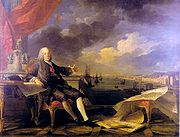 The expulsion of the Jesuits from Portugal has been reduced by the Catholic Encyclopedia
to a personal quarrel with the prime minister of Joseph I of Portugal, the reformist and autocratic Sebastião José de Carvalho e Melo, Marquis de Pombal. Whether Pombal's or Portugal's, the quarrel with the Jesuits began over an exchange of South American colonial territory with Spain. By a secret treaty of 1750, Portugal relinquished to Spain the contested colony of San Sacramento at the mouth of the Uruguay River
in exchange for the Seven Reductions of Paraguay, the autonomous Jesuit missions that had been nominal Spanish colonial territory. The native Guarani, who lived in the mission territories, were ordered to quit their country and settle across the Uruguay, an early example of population transfer
. Owing to the harsh conditions, the Guarani rose in arms against the transfer, and the so-called Guarani War
ensued. It was a disaster for the Guarani, in which the Portuguese believed the Jesuits had a hand. In Portugal a battle of inflammatory pamphlets denouncing or defending the Order escalated. The Jesuit fathers, suspected of attempting to build an independent empire in the New World, were forbidden to continue the local administration of their former missions, and the Portuguese Jesuits were removed from Court.
On April 1, 1758, the aged Pope Benedict XIV
issued a brief appointing the Portuguese Cardinal Saldanha
, recommended by Pombal, to investigate royal allegations against the Jesuits. Benedict was skeptical as to the gravity of the alleged abuses. He ordered a "minute inquiry", but so as to safeguard the reputation of the Society, all serious matters were to be referred back to him. Benedict died the following month on May 3. On May 15, Saldanha, having received the papal brief only a fortnight before, declared that the Jesuits were guilty of having exercised "illicit, public, and scandalous commerce", both in Portugal and in its colonies. He had not visited Jesuit houses as ordered, and pronounced on the issues which the pope had reserved to himself. Pombal moved quickly during the papal sede vacante
: in three weeks' time, he ordered the Jesuits stripped of all Portuguese possessions. Before Cardinal Rezzonico had been made pope, as Clement XIII
, on July 6, 1758, the Portuguese dispossession of the Society was a fait accompli.
The last straw for the Court of Portugal was the attempted assassination of the king on September 3, 1758, of which the Jesuits were supposed to have had prior knowledge (see Távora affair
). Among those arrested and executed was Gabriel Malagrida
, the Jesuit confessor of Leonor of Távora. The Jesuits were expelled from the kingdom, and important non-Portuguese members of the Order were imprisoned. In 1759, the Order was civilly suppressed. The Portuguese ambassador was recalled from Rome
and the papal nuncio sent home in disgrace. Relations between Portugal and Rome were broken off until 1770.
, was carried through in secrecy, and the ministers of Charles III
kept their deliberations to themselves, as did the king who acted upon "urgent, just, and necessary reasons, which I reserve in my royal mind;". The correspondence of Bernardo Tanucci
, the anti-clerical minister of Charles III in Naples
contain all the ideas which from time to time guided Spanish policy. Charles conducted his government through Count Aranda, a reader of Voltaire
, and other liberals. At a council meeting of January 29, 1767, the expulsion of the Society of Jesus was settled. Secret orders, which were to be opened at midnight between the first and second of April, 1767, were sent to the magistrates of every town where a Jesuit resided. The plan worked smoothly. That morning, 6000 Jesuits were marching like convicts to the coast, where they were deported, first to the Papal States
, and ultimately to Corsica
, which was a dependency of Genoa
.
Due to the isolation of the Spanish Missions of California, the decree for expulsion did not arrive in June of 1767, as in the rest of New Spain
, but was delayed until the new governor, Portolà
, arrived with the news on November 30. Jesuits from the fourteen operating missions at the moment reunited in Loreto
, whence they left for exile on February 3, 1768. It took until 1768 for the Royal order to reach the Jesuit missions in the south of the Philippines
, but by the end of the year, the Jesuits had been dispossessed throughout the Spanish dominions.
Tanucci pursued a similar policy in Bourbon
Naples. On November 3 the Jesuits, without a trial or even an accusation, were simply marched across the frontier into the Papal States, and threatened with death if they returned.
The change in the Spanish colonies in the New World was particularly great, as the far-flung settlements were often dominated by missions. Almost overnight in the mission towns of Sonora and Arizona, the "black robes" (as the Jesuits were often known) disappeared and the "gray robes" (Franciscans) replaced them.
and Chiloé Archipelago
. In Central Chile the suppression of the order lead among other things to a sharp decrease in the import of black slaves from Peru which although small in comparison to neighboring colonies had led the order to own the largest number of black slaves in Chile, 1300 approximately. In Misiones, in modern day Argentina their suppression lead to the scattering of indigenous Guaranis living in the reductions and a long-term decline in the yerba mate
industry from which it only recovered in the 20th century.
With the suppression of the Society of Jesus in Spanish America jesuit vineyards in Peru
were auctioned
albeit new owners did not had the same expertise as the jesuits contributing to a production decline in wine and pisco
.
were approaching their end in 1814, the old political order of Europe
was to a considerable extent restored at the Congress of Vienna
after years of fighting and revolution, during which the Church had been persecuted as an agent of the old order and abused under the rule of Napoleon
. With the political climate of Europe changed, more stable and the powerful monarchs who had called for the suppression of the Society no longer in power, Pope Pius VII
issued an order restoring the Society of Jesus in the Catholic countries of Europe. For its part, the Society of Jesus made the decision at the first General Congregation held after the restoration to keep the organization of the Society the way that it had been before the suppression was ordered in 1773.
Portuguese Empire
The Portuguese Empire , also known as the Portuguese Overseas Empire or the Portuguese Colonial Empire , was the first global empire in history...
, France
France
The French Republic , The French Republic , The French Republic , (commonly known as France , is a unitary semi-presidential republic in Western Europe with several overseas territories and islands located on other continents and in the Indian, Pacific, and Atlantic oceans. Metropolitan France...
, the Two Sicilies, Parma
Parma
Parma is a city in the Italian region of Emilia-Romagna famous for its ham, its cheese, its architecture and the fine countryside around it. This is the home of the University of Parma, one of the oldest universities in the world....
and the Spanish Empire
Spain
Spain , officially the Kingdom of Spain languages]] under the European Charter for Regional or Minority Languages. In each of these, Spain's official name is as follows:;;;;;;), is a country and member state of the European Union located in southwestern Europe on the Iberian Peninsula...
by 1767 was a result of a series of political moves rather than a theological controversy. By the brief Dominus ac Redemptor
Dominus ac Redemptor
Dominus ac Redemptor is the papal brief promulgated on 21 July 1773 by which Pope Clement XIV suppressed the Society of Jesus.-Circumstances:...
(21 July 1773) Pope Clement XIV
Pope Clement XIV
Pope Clement XIV , born Giovanni Vincenzo Antonio Ganganelli, was Pope from 1769 to 1774. At the time of his election, he was the only Franciscan friar in the College of Cardinals.-Early life:...
suppressed the Society of Jesus
Society of Jesus
The Society of Jesus is a Catholic male religious order that follows the teachings of the Catholic Church. The members are called Jesuits, and are also known colloquially as "God's Army" and as "The Company," these being references to founder Ignatius of Loyola's military background and a...
. However in non-Catholic nations, particularly in Prussia
Prussia
Prussia was a German kingdom and historic state originating out of the Duchy of Prussia and the Margraviate of Brandenburg. For centuries, the House of Hohenzollern ruled Prussia, successfully expanding its size by way of an unusually well-organized and effective army. Prussia shaped the history...
and Russia
Russia
Russia or , officially known as both Russia and the Russian Federation , is a country in northern Eurasia. It is a federal semi-presidential republic, comprising 83 federal subjects...
, where papal authority was not recognized, the order was ignored. The scholarly Jesuit Society of Bollandists
Bollandist
The Bollandists are an association of scholars, philologists, and historians who since the early seventeenth century have studied hagiography and the cult of the saints in Christianity. Their most important publication has been the Acta Sanctorum...
moved from Antwerp to Brussels
Brussels
Brussels , officially the Brussels Region or Brussels-Capital Region , is the capital of Belgium and the de facto capital of the European Union...
, where they continued their work in the monastery of the Coudenberg
Coudenberg
Coudenberg or Koudenberg is a small hill in Brussels where the Palace of Coudenberg was built.For nearly 700 years, the Castle and then the Palace of Coudenberg were the seat of government of the counts, dukes, archdukes, kings, emperors and governors who from the 11th century until its...
; in 1788, the Bollandist Society was suppressed by the Austria
Austria
Austria , officially the Republic of Austria , is a landlocked country of roughly 8.4 million people in Central Europe. It is bordered by the Czech Republic and Germany to the north, Slovakia and Hungary to the east, Slovenia and Italy to the south, and Switzerland and Liechtenstein to the...
n government of the Low Countries
Low Countries
The Low Countries are the historical lands around the low-lying delta of the Rhine, Scheldt, and Meuse rivers, including the modern countries of Belgium, the Netherlands, Luxembourg and parts of northern France and western Germany....
.
Overview
By the mid-18th century, the Society had acquired a reputation in Europe for political maneuvering and economic exploitation. The common conception was that Jesuits were greedy plotters, prone to meddle in state affairs through their close ties with influential members of the royal court in order to further the special interests of their order and the Papacy.Monarchs in many European states grew progressively wary of what they saw as undue interference from a foreign entity. The expulsion of Jesuits from their states had the added benefit of allowing governments to impound the Society's accumulated wealth and possessions.
Various states took advantage of different events in order to take action. The series of political struggles between various monarchs, particularly France and Portugal, began with disputes over territory in 1750 and culminated in suspension of diplomatic relations and dissolution of the Society by the Pope over most of Europe, and even some executions. The Portuguese Empire
Portuguese Empire
The Portuguese Empire , also known as the Portuguese Overseas Empire or the Portuguese Colonial Empire , was the first global empire in history...
, France
France
The French Republic , The French Republic , The French Republic , (commonly known as France , is a unitary semi-presidential republic in Western Europe with several overseas territories and islands located on other continents and in the Indian, Pacific, and Atlantic oceans. Metropolitan France...
, the Two Sicilies, Parma
Parma
Parma is a city in the Italian region of Emilia-Romagna famous for its ham, its cheese, its architecture and the fine countryside around it. This is the home of the University of Parma, one of the oldest universities in the world....
and the Spanish Empire
Spain
Spain , officially the Kingdom of Spain languages]] under the European Charter for Regional or Minority Languages. In each of these, Spain's official name is as follows:;;;;;;), is a country and member state of the European Union located in southwestern Europe on the Iberian Peninsula...
were involved to one degree or another.
The conflicts began with trade disputes, in 1750 in Portugal, in 1755 in France, and in the late 1750s in the Two Sicilies. In 1758 the government of Joseph I of Portugal took advantage of the waning powers of Pope Benedict XIV
Pope Benedict XIV
Pope Benedict XIV , born Prospero Lorenzo Lambertini, was Pope from 17 August 1740 to 3 May 1758.-Life:...
and deported Jesuits from America after relocating the Jesuits and their native workers, and then fighting a brief conflict, formally suppressing the order in 1759. In 1762 the Parlement Français, (a court, not a legislature), ruled against the Society in a huge bankruptcy case under pressure from a host of groups - from within the Church, but also secular intellectuals and the king's mistress
Madame de Pompadour
Jeanne Antoinette Poisson, Marquise de Pompadour, also known as Madame de Pompadour was a member of the French court, and was the official chief mistress of Louis XV from 1745 to her death.-Biography:...
. Austria and the Two Sicilies suppressed the order by decree in 1767.
After 1815, with the Restoration, the Catholic Church began to play a more welcome role in European political life once more. Nation by nation the Jesuits became re-established.
The modern view is that the suppression of the order was the result of a series of political and economic conflicts rather than a theological controversy and the assertion of nation-state independence against the Catholic Church. The expulsion of the Society of Jesus
Society of Jesus
The Society of Jesus is a Catholic male religious order that follows the teachings of the Catholic Church. The members are called Jesuits, and are also known colloquially as "God's Army" and as "The Company," these being references to founder Ignatius of Loyola's military background and a...
from the Roman Catholic
Roman Catholic Church
The Catholic Church, also known as the Roman Catholic Church, is the world's largest Christian church, with over a billion members. Led by the Pope, it defines its mission as spreading the gospel of Jesus Christ, administering the sacraments and exercising charity...
nations of Europe and their colonial empires is also seen as one of the early manifestations of the new secularist zeitgeist
Zeitgeist
Zeitgeist is "the spirit of the times" or "the spirit of the age."Zeitgeist is the general cultural, intellectual, ethical, spiritual or political climate within a nation or even specific groups, along with the general ambiance, morals, sociocultural direction, and mood associated with an era.The...
of the Enlightenment
Age of Enlightenment
The Age of Enlightenment was an elite cultural movement of intellectuals in 18th century Europe that sought to mobilize the power of reason in order to reform society and advance knowledge. It promoted intellectual interchange and opposed intolerance and abuses in church and state...
. It peaked with the anti-clericalism of the French Revolution
French Revolution
The French Revolution , sometimes distinguished as the 'Great French Revolution' , was a period of radical social and political upheaval in France and Europe. The absolute monarchy that had ruled France for centuries collapsed in three years...
. The suppression was also seen as being an attempt by monarchs to gain control of revenues and trade that were previously dominated by the Society of Jesus. Catholic historians often point to a personal conflict between Clement XIII (1758–1769) and his supporters within the church and the crown cardinals backed by France.
France
The suppression of the Jesuits in France began in the French island colony of MartiniqueMartinique
Martinique is an island in the eastern Caribbean Sea, with a land area of . Like Guadeloupe, it is an overseas region of France, consisting of a single overseas department. To the northwest lies Dominica, to the south St Lucia, and to the southeast Barbados...
, where the Society of Jesus had a major commercial stake. They did not and could not engage in trade, buying and selling to make a profit, any more than any other religious order could do, but their large mission plantations included large local populations that worked under the usual conditions of tropical colonial agriculture of the 18th century, not easily distinguishable from the hacienda
Hacienda
Hacienda is a Spanish word for an estate. Some haciendas were plantations, mines, or even business factories. Many haciendas combined these productive activities...
system. As the Catholic Encyclopedia expressed it in 1908, "this was allowed, partly to provide for the current expenses of the mission, partly in order to protect the simple, childlike natives from the common plague of dishonest intermediaries."
Father Antoine La Vallette
Antoine La Vallette
Antoine de Lavalette , was a French jesuit clergyman, Superior of the Martinique missions, whose bankruptcy led to the suppression of the Society of Jesus in France....
, Superior of the Martinique missions, managed these transactions with great success, and like secular proprietors of plantations he needed to borrow money to expand the large undeveloped resources of the colony. But on the outbreak of war with England
Seven Years' War
The Seven Years' War was a global military war between 1756 and 1763, involving most of the great powers of the time and affecting Europe, North America, Central America, the West African coast, India, and the Philippines...
, ships carrying goods of an estimated value of 2,000,000 livres were captured, and La Vallette suddenly went bankrupt for a very large sum. His creditors turned to the Order's Procurator at Paris
Paris
Paris is the capital and largest city in France, situated on the river Seine, in northern France, at the heart of the Île-de-France region...
to demand payment, but the Procurator refused responsibility for the debts of an independent mission— though he offered to negotiate for a settlement. The creditors went to the courts, and an order was made in 1760, obliging the Society to pay, and giving leave to distrain in the case of non-payment.
The Fathers, on the advice of their lawyers, appealed to the Parlement of Paris. This turned out to be an imprudent step. For not only did the Parlement support the lower court, May 8, 1761, but having once gotten the case into its hands, the Jesuits' enemies in that assembly determined to strike a blow at the Order.
Enemies of every sort combined. The Jansenists were numerous among the enemies of the orthodox party. The Sorbonne
Collège de Sorbonne
The Collège de Sorbonne was a theological college of the University of Paris, founded in 1257 by Robert de Sorbon, after whom it is named. With the rest of the Paris colleges, it was suppressed during the French Revolution. It was restored in 1808 but finally closed in 1882. The name Sorbonne...
joined the Gallican
Gallican Church
The Gallican Church was the Catholic Church in France from the time of the Declaration of the Clergy of France to that of the Civil Constitution of the Clergy during the French Revolution....
s, the Philosophes, and the Encyclopédistes
Encyclopédie
Encyclopédie, ou dictionnaire raisonné des sciences, des arts et des métiers was a general encyclopedia published in France between 1751 and 1772, with later supplements, revised editions, and translations. It was edited by Denis Diderot and Jean le Rond d'Alembert...
. Louis XV
Louis XV of France
Louis XV was a Bourbon monarch who ruled as King of France and of Navarre from 1 September 1715 until his death. He succeeded his great-grandfather at the age of five, his first cousin Philippe II, Duke of Orléans, served as Regent of the kingdom until Louis's majority in 1723...
was weak; his wife and children were in favor of the Jesuits; his able first minister, the Duc de Choiseul
Étienne François, duc de Choiseul
Étienne-François, comte de Stainville, duc de Choiseul was a French military officer, diplomat and statesman. Between 1758 and 1761, and 1766 and 1770, he was Foreign Minister of France and had a strong influence on France's global strategy throughout the period...
, played into the hands of the Parlement, and the royal mistress, Madame de Pompadour
Madame de Pompadour
Jeanne Antoinette Poisson, Marquise de Pompadour, also known as Madame de Pompadour was a member of the French court, and was the official chief mistress of Louis XV from 1745 to her death.-Biography:...
, to whom the Jesuits had refused absolution, for she was living in sin with the King of France, was a determined opponent. The determination of the Parlement of Paris in time bore down all opposition.
The attack on the Jesuits was opened by the Jansenist sympathizer, the Abbé Chauvelin, April 17, 1762, who denounced the Constitution of the Jesuits, which was publicly examined and exposed in a hostile press. The Parlement issued its Extraits des assertions assembled from passages from Jesuit theologians and canonists, in which they were alleged to teach every sort of immorality and error. On August 6, 1762, the final arrêt was issued condemning the Society to extinction, but the king's intervention brought eight months' delay and meantime a compromise was suggested by the Court. If the French Jesuits would separate from the order, under a French vicar, with French customs, as with the Gallican church
Gallican Church
The Gallican Church was the Catholic Church in France from the time of the Declaration of the Clergy of France to that of the Civil Constitution of the Clergy during the French Revolution....
, the Crown would still protect them. In spite of the dangers of refusal the Jesuits would not consent. On April 1, 1763 the colleges were closed, and by a further arrêt of March 9, 1764, the Jesuits were required to renounce their vows under pain of banishment. At the end of November 1764, the king signed an edict dissolving the Society throughout his dominions, for they were still protected by some provincial parlements, as in Franche-Comté
Franche-Comté
Franche-Comté the former "Free County" of Burgundy, as distinct from the neighbouring Duchy, is an administrative region and a traditional province of eastern France...
, Alsace
Alsace
Alsace is the fifth-smallest of the 27 regions of France in land area , and the smallest in metropolitan France. It is also the seventh-most densely populated region in France and third most densely populated region in metropolitan France, with ca. 220 inhabitants per km²...
, and Artois
Artois
Artois is a former province of northern France. Its territory has an area of around 4000 km² and a population of about one million. Its principal cities are Arras , Saint-Omer, Lens and Béthune.-Location:...
. But in the draft of the edict, he canceled numerous clauses that implied that the Society was guilty, and writing to Choiseul, he concluded "If I adopt the advice of others for the peace of my realm, you must make the changes I propose, or I will do nothing. I say no more, lest I should say too much."
Parma
The independent Duchy of ParmaDuchy of Parma
The Duchy of Parma was created in 1545 from that part of the Duchy of Milan south of the Po River, as a fief for Pope Paul III's illegitimate son, Pier Luigi Farnese, centered on the city of Parma....
was the smallest Bourbon court. So aggressive in its anti-clericalism was the Parmesan reaction to the news of the expulsion of the Jesuits from Naples, that Clement XIII addressed to it (January 30, 1768) a public warning, threatening the Duchy with ecclesiastical censures, not a tactful move. At this all the Bourbon courts turned in fury against the Holy See
Holy See
The Holy See is the episcopal jurisdiction of the Catholic Church in Rome, in which its Bishop is commonly known as the Pope. It is the preeminent episcopal see of the Catholic Church, forming the central government of the Church. As such, diplomatically, and in other spheres the Holy See acts and...
, and demanded the entire dissolution of the Jesuits. As a preliminary, Parma at once drove the Jesuits out of its territories, confiscating all their possessions.
Philippines
The royal decree banishing the Society of Jesus from Spain and the Spanish dominions reached ManilaManila
Manila is the capital of the Philippines. It is one of the sixteen cities forming Metro Manila.Manila is located on the eastern shores of Manila Bay and is bordered by Navotas and Caloocan to the north, Quezon City to the northeast, San Juan and Mandaluyong to the east, Makati on the southeast,...
on May 17, 1768. Between 1769 and 1771 the Jesuits in the Philippines were transported to Spain and from there deported to Italy.
Portugal
Catholic Encyclopedia
The Catholic Encyclopedia, also referred to as the Old Catholic Encyclopedia and the Original Catholic Encyclopedia, is an English-language encyclopedia published in the United States. The first volume appeared in March 1907 and the last three volumes appeared in 1912, followed by a master index...
to a personal quarrel with the prime minister of Joseph I of Portugal, the reformist and autocratic Sebastião José de Carvalho e Melo, Marquis de Pombal. Whether Pombal's or Portugal's, the quarrel with the Jesuits began over an exchange of South American colonial territory with Spain. By a secret treaty of 1750, Portugal relinquished to Spain the contested colony of San Sacramento at the mouth of the Uruguay River
Uruguay River
The Uruguay River is a river in South America. It flows from north to south and makes boundary with Brazil, Argentina, and Uruguay, separating some of the Argentine provinces of the Mesopotamia from the other two countries...
in exchange for the Seven Reductions of Paraguay, the autonomous Jesuit missions that had been nominal Spanish colonial territory. The native Guarani, who lived in the mission territories, were ordered to quit their country and settle across the Uruguay, an early example of population transfer
Population transfer
Population transfer is the movement of a large group of people from one region to another by state policy or international authority, most frequently on the basis of ethnicity or religion...
. Owing to the harsh conditions, the Guarani rose in arms against the transfer, and the so-called Guarani War
Guarani War
The Guarani War of 1756, also called the War of the Seven Reductions, took place between the Guaraní tribes of seven Jesuit Reductions and joint Spanish-Portuguese forces...
ensued. It was a disaster for the Guarani, in which the Portuguese believed the Jesuits had a hand. In Portugal a battle of inflammatory pamphlets denouncing or defending the Order escalated. The Jesuit fathers, suspected of attempting to build an independent empire in the New World, were forbidden to continue the local administration of their former missions, and the Portuguese Jesuits were removed from Court.
On April 1, 1758, the aged Pope Benedict XIV
Pope Benedict XIV
Pope Benedict XIV , born Prospero Lorenzo Lambertini, was Pope from 17 August 1740 to 3 May 1758.-Life:...
issued a brief appointing the Portuguese Cardinal Saldanha
Francisco de Saldanha da Gama
Dom Francisco I de Saldanha da Gama was the third cardinal patriarch of Lisbon .He studied canon law at Coimbra and was appointed a cardinal by Pope Benedict XIV in 1756, and named Patriarch of Lisbon on July 25, 1758...
, recommended by Pombal, to investigate royal allegations against the Jesuits. Benedict was skeptical as to the gravity of the alleged abuses. He ordered a "minute inquiry", but so as to safeguard the reputation of the Society, all serious matters were to be referred back to him. Benedict died the following month on May 3. On May 15, Saldanha, having received the papal brief only a fortnight before, declared that the Jesuits were guilty of having exercised "illicit, public, and scandalous commerce", both in Portugal and in its colonies. He had not visited Jesuit houses as ordered, and pronounced on the issues which the pope had reserved to himself. Pombal moved quickly during the papal sede vacante
Sede vacante
Sede vacante is an expression, used in the Canon Law of the Catholic Church, that refers to the vacancy of the episcopal see of a particular church...
: in three weeks' time, he ordered the Jesuits stripped of all Portuguese possessions. Before Cardinal Rezzonico had been made pope, as Clement XIII
Pope Clement XIII
Pope Clement XIII , born Carlo della Torre di Rezzonico, was Pope from 16 July 1758 to 2 February 1769....
, on July 6, 1758, the Portuguese dispossession of the Society was a fait accompli.
The last straw for the Court of Portugal was the attempted assassination of the king on September 3, 1758, of which the Jesuits were supposed to have had prior knowledge (see Távora affair
Távora affair
The Távora affair was a political scandal of the 18th century Portuguese court. The events triggered by the attempted murder of King Joseph I of Portugal in 1758 ended with the public execution of the entire Távora family and its closest relatives in 1759...
). Among those arrested and executed was Gabriel Malagrida
Gabriel Malagrida
Gabriel Malagrida was an Italian Jesuit missionary in Brazil and influential figure in the political life of the Lisbon Royal Court who described the devastating 1755 Lisbon earthquake as retribution prompted by God's wrath.Malagrida was famously caught up in the Távora affair and executed as a...
, the Jesuit confessor of Leonor of Távora. The Jesuits were expelled from the kingdom, and important non-Portuguese members of the Order were imprisoned. In 1759, the Order was civilly suppressed. The Portuguese ambassador was recalled from Rome
Rome
Rome is the capital of Italy and the country's largest and most populated city and comune, with over 2.7 million residents in . The city is located in the central-western portion of the Italian Peninsula, on the Tiber River within the Lazio region of Italy.Rome's history spans two and a half...
and the papal nuncio sent home in disgrace. Relations between Portugal and Rome were broken off until 1770.
Spanish Empire and Naples
The Suppression in Spain and in the Spanish colonies, and in its dependency, the Kingdom of NaplesKingdom of Naples
The Kingdom of Naples, comprising the southern part of the Italian peninsula, was the remainder of the old Kingdom of Sicily after secession of the island of Sicily as a result of the Sicilian Vespers rebellion of 1282. Known to contemporaries as the Kingdom of Sicily, it is dubbed Kingdom of...
, was carried through in secrecy, and the ministers of Charles III
Charles III of Spain
Charles III was the King of Spain and the Spanish Indies from 1759 to 1788. He was the eldest son of Philip V of Spain and his second wife, the Princess Elisabeth Farnese...
kept their deliberations to themselves, as did the king who acted upon "urgent, just, and necessary reasons, which I reserve in my royal mind;". The correspondence of Bernardo Tanucci
Bernardo Tanucci
Bernardo Tanucci was an Italian statesman, who brought enlightened government to the backward Kingdom of the Two Sicilies for Charles III and his son Ferdinand IV.-Biography:...
, the anti-clerical minister of Charles III in Naples
Naples
Naples is a city in Southern Italy, situated on the country's west coast by the Gulf of Naples. Lying between two notable volcanic regions, Mount Vesuvius and the Phlegraean Fields, it is the capital of the region of Campania and of the province of Naples...
contain all the ideas which from time to time guided Spanish policy. Charles conducted his government through Count Aranda, a reader of Voltaire
Voltaire
François-Marie Arouet , better known by the pen name Voltaire , was a French Enlightenment writer, historian and philosopher famous for his wit and for his advocacy of civil liberties, including freedom of religion, free trade and separation of church and state...
, and other liberals. At a council meeting of January 29, 1767, the expulsion of the Society of Jesus was settled. Secret orders, which were to be opened at midnight between the first and second of April, 1767, were sent to the magistrates of every town where a Jesuit resided. The plan worked smoothly. That morning, 6000 Jesuits were marching like convicts to the coast, where they were deported, first to the Papal States
Papal States
The Papal State, State of the Church, or Pontifical States were among the major historical states of Italy from roughly the 6th century until the Italian peninsula was unified in 1861 by the Kingdom of Piedmont-Sardinia .The Papal States comprised territories under...
, and ultimately to Corsica
Corsica
Corsica is an island in the Mediterranean Sea. It is located west of Italy, southeast of the French mainland, and north of the island of Sardinia....
, which was a dependency of Genoa
Genoa
Genoa |Ligurian]] Zena ; Latin and, archaically, English Genua) is a city and an important seaport in northern Italy, the capital of the Province of Genoa and of the region of Liguria....
.
Due to the isolation of the Spanish Missions of California, the decree for expulsion did not arrive in June of 1767, as in the rest of New Spain
New Spain
New Spain, formally called the Viceroyalty of New Spain , was a viceroyalty of the Spanish colonial empire, comprising primarily territories in what was known then as 'América Septentrional' or North America. Its capital was Mexico City, formerly Tenochtitlan, capital of the Aztec Empire...
, but was delayed until the new governor, Portolà
Gaspar de Portolà
Gaspar de Portolà i Rovira was a soldier, governor of Baja and Alta California , explorer and founder of San Diego and Monterey. He was born in Os de Balaguer, province of Lleida, in Catalonia, Spain, of Catalan nobility. Don Gaspar served as a soldier in the Spanish army in Italy and Portugal...
, arrived with the news on November 30. Jesuits from the fourteen operating missions at the moment reunited in Loreto
Loreto, Baja California Sur
Loreto was the first Spanish settlement on the Baja California Peninsula. It served as the capital of Las Californias from 1697 to 1777, and is the current seat of the municipality of Loreto in the Mexican state of Baja California Sur...
, whence they left for exile on February 3, 1768. It took until 1768 for the Royal order to reach the Jesuit missions in the south of the Philippines
Philippines
The Philippines , officially known as the Republic of the Philippines , is a country in Southeast Asia in the western Pacific Ocean. To its north across the Luzon Strait lies Taiwan. West across the South China Sea sits Vietnam...
, but by the end of the year, the Jesuits had been dispossessed throughout the Spanish dominions.
Tanucci pursued a similar policy in Bourbon
House of Bourbon
The House of Bourbon is a European royal house, a branch of the Capetian dynasty . Bourbon kings first ruled Navarre and France in the 16th century. By the 18th century, members of the Bourbon dynasty also held thrones in Spain, Naples, Sicily, and Parma...
Naples. On November 3 the Jesuits, without a trial or even an accusation, were simply marched across the frontier into the Papal States, and threatened with death if they returned.
The change in the Spanish colonies in the New World was particularly great, as the far-flung settlements were often dominated by missions. Almost overnight in the mission towns of Sonora and Arizona, the "black robes" (as the Jesuits were often known) disappeared and the "gray robes" (Franciscans) replaced them.
Economic impact
The suppression of the order had longstanding economical effects in the Americas particularly those areas where they had their missions or reductions —outlying areas dominated by indigenous peoples such as ParaguayParaguay
Paraguay , officially the Republic of Paraguay , is a landlocked country in South America. It is bordered by Argentina to the south and southwest, Brazil to the east and northeast, and Bolivia to the northwest. Paraguay lies on both banks of the Paraguay River, which runs through the center of the...
and Chiloé Archipelago
Chiloé Archipelago
Chiloé Archipelago consists of several islands lying off the coast of Chile. It is separated from mainland Chile by Chacao Channel in the north, the Sea of Chiloé in the east and Gulf of Corcovado to the southeast. All of the archipelago except Desertores Islands, which are part of Palena...
. In Central Chile the suppression of the order lead among other things to a sharp decrease in the import of black slaves from Peru which although small in comparison to neighboring colonies had led the order to own the largest number of black slaves in Chile, 1300 approximately. In Misiones, in modern day Argentina their suppression lead to the scattering of indigenous Guaranis living in the reductions and a long-term decline in the yerba mate
Yerba mate
Maté, yerba maté or erva maté , Ilex paraguariensis, is a species of holly native to subtropical South America in northeastern Argentina, Bolivia, southern Brazil, Uruguay and Paraguay...
industry from which it only recovered in the 20th century.
With the suppression of the Society of Jesus in Spanish America jesuit vineyards in Peru
Peru
Peru , officially the Republic of Peru , is a country in western South America. It is bordered on the north by Ecuador and Colombia, on the east by Brazil, on the southeast by Bolivia, on the south by Chile, and on the west by the Pacific Ocean....
were auctioned
Auction
An auction is a process of buying and selling goods or services by offering them up for bid, taking bids, and then selling the item to the highest bidder...
albeit new owners did not had the same expertise as the jesuits contributing to a production decline in wine and pisco
Pisco
Pisco is a colorless or yellowish-to-amber colored grape brandy produced in winemaking regions of Chile and Peru. Pisco was developed by Spanish settlers in the 16th century as an alternative to orujo, a pomace brandy that was being imported from Spain...
.
The Jesuits return
As the Napoleonic WarsNapoleonic Wars
The Napoleonic Wars were a series of wars declared against Napoleon's French Empire by opposing coalitions that ran from 1803 to 1815. As a continuation of the wars sparked by the French Revolution of 1789, they revolutionised European armies and played out on an unprecedented scale, mainly due to...
were approaching their end in 1814, the old political order of Europe
Europe
Europe is, by convention, one of the world's seven continents. Comprising the westernmost peninsula of Eurasia, Europe is generally 'divided' from Asia to its east by the watershed divides of the Ural and Caucasus Mountains, the Ural River, the Caspian and Black Seas, and the waterways connecting...
was to a considerable extent restored at the Congress of Vienna
Congress of Vienna
The Congress of Vienna was a conference of ambassadors of European states chaired by Klemens Wenzel von Metternich, and held in Vienna from September, 1814 to June, 1815. The objective of the Congress was to settle the many issues arising from the French Revolutionary Wars, the Napoleonic Wars,...
after years of fighting and revolution, during which the Church had been persecuted as an agent of the old order and abused under the rule of Napoleon
Napoleon I
Napoleon Bonaparte was a French military and political leader during the latter stages of the French Revolution.As Napoleon I, he was Emperor of the French from 1804 to 1815...
. With the political climate of Europe changed, more stable and the powerful monarchs who had called for the suppression of the Society no longer in power, Pope Pius VII
Pope Pius VII
Pope Pius VII , born Barnaba Niccolò Maria Luigi Chiaramonti, was a monk, theologian and bishop, who reigned as Pope from 14 March 1800 to 20 August 1823.-Early life:...
issued an order restoring the Society of Jesus in the Catholic countries of Europe. For its part, the Society of Jesus made the decision at the first General Congregation held after the restoration to keep the organization of the Society the way that it had been before the suppression was ordered in 1773.
External links
- Catholic Encyclopedia offers a view from the Catholic side, which has been adjusted in this entry
- Charles III of Spain's royal decree expelling the Jesuits
- Vogel, Christine: The Suppression of the Society of Jesus, 1758-1773, European History OnlineEuropean History OnlineEuropean History Online is an academic website that publishes articles on the history of Europe between the period of 1450 and 1950 according to the principle of open access. EGO is issued by the Institute of European History in Mainz in cooperation with the Center for Digital Humanities in Trier ...
, Mainz: Institute of European History, 2011, retrieved: November 11, 2011.