

Suffrage

Encyclopedia
Suffrage, political franchise, or simply the franchise, distinct from mere voting rights, is the civil right to vote gained through the democratic process. In English, suffrage and its synonyms are sometimes also used to mean the right to run for office (to be a candidate), but there are no established qualifying terms to distinguish between these different meanings of the term(s). The right to run for office is sometimes called (candidate) eligibility, and the combination of both rights is sometimes called full suffrage. In many other languages, the right to vote is called the active right to vote and the right to be voted for (to run for office) is called the passive right to vote. In English, these are rarely called active suffrage and passive suffrage.
Suffrage is often conceived in terms of elections for representatives; however, suffrage applies equally to initiative
and referendum
. Suffrage describes not only the legal right to vote, but also the practical question of whether a question will be put to a vote. The utility of suffrage is reduced when important questions are decided unilaterally by elected or unelected representatives.
In most democracies, eligible voters can vote in elections of representatives. Voting on issues by initiative
may be available in some jurisdictions but not others. For example, Switzerland
permits initiatives at all levels of government whereas the United States
does not offer initiatives at the federal level or in many states. That new constitutions must be approved by referendum is considered natural law
.
Typically citizens become eligible to vote after reaching the age of legal adulthood. Most democracies no longer extend different voting rights on the basis of sex or race. Resident aliens can vote in some countries and in others exceptions are made for citizens of countries with which they have close links (e.g. some members of the Commonwealth of Nations
, and the members of the European Union).
exists, the right to vote is not restricted by race, sex, belief, sexual orientation, gender identity, wealth, or social status. It typically does not extend a right to vote to all residents of a region; distinctions are frequently made in regard to citizenship
, age, and occasionally mental capacity or criminal convictions.
The short-lived Corsican Republic
(1755–1769) was the first country to grant limited universal suffrage for all inhabitants over the age of 25. This was followed by other experiments in the Paris Commune
of 1871 and the island republic of Franceville
(1889), and then by New Zealand
in 1893. Finland
was the first European country to grant universal suffrage to its citizens in its 1906 elections, and the first country in the world to make every citizen eligible to run for parliament.
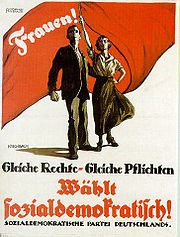 Women's suffrage
is the right of women to vote on the same terms as men. This was the goal of the suffragists and the suffragette
s. Limited voting rights were gained by some women in Sweden, Britain, and some western U.S. states in the 1860s. In 1893, the British colony of New Zealand
became the first self-governing nation to extend the right to vote to all adult women.
it was common in European countries for people of disfavored religious denominations to be denied civil and political rights, often including the right to vote, to stand for election or to sit in parliament. In the United Kingdom and Ireland, Roman Catholics were denied the right to vote from 1728 to 1793, and the right to sit in parliament until 1829. The anti-Catholic policy was justified on the grounds that the loyalty of Catholics supposedly lay with the Pope
rather than the national monarch.
In England
and Ireland
, several Acts practically disenfranchised non-Anglicans or non-Protestants by imposing an oath before admission to vote or to run for office. The 1672 and 1678 Test Act
s forbade non-Anglicans to hold public offices, the 1727 Disenfranchising Act
took away Catholics' (Papists) voting rights in Ireland, which were restored only in 1788. Jews could not even be naturalized. An attempt was made to change this situation, but the Jewish Naturalization Act 1753 provoked such reactions that it was repealed the next year. Nonconformists (Methodists and Presbyterians) were only allowed to run for elections to the British House of Commons
in 1828, Catholics in 1829 (following the Catholic Relief Act 1829
), and Jews in 1858 (with the Emancipation of the Jews in England
). Benjamin Disraeli could only begin his political career in 1837 because he had been converted to Anglicanism at the age of 12.
In several states in the U.S. after the Declaration of Independence
, Jews, Quakers or Catholics were denied voting rights and/or forbidden to run for office. The Delaware Constitution of 1776
stated that "Every person who shall be chosen a member of either house, or appointed to any office or place of trust, before taking his seat, or entering upon the execution of his office, shall (…) also make and subscribe the following declaration, to wit: I, A B. do profess faith in God the Father, and in Jesus Christ His only Son, and in the Holy Ghost, one God, blessed for evermore; and I do acknowledge the holy scriptures of the Old and New Testament to be given by divine inspiration.". This was repealed by article I, section 2 of the 1792 Constitution
: "No religious test shall be required as a qualification to any office, or public trust, under this State.". The 1778 Constitution of the State of South Carolina
stated that "No person shall be eligible to sit in the house of representatives unless he be of the Protestant religion", the 1777 Constitution of the State of Georgia
(art. VI) that "The representatives shall be chosen out of the residents in each county (…) and they shall be of the Protestent (sic) religion". In Maryland
, voting rights and eligibility were extended to Jews in 1828.
In Canada
, several religious groups (Mennonites, Hutterites, Doukhobors) were disenfranchised by the wartime Elections Act of 1917, mainly because they opposed military service. This disenfranchisement ended with the end of the First World War, but was renewed for Doukhobors from 1934 (Dominion Elections Act) to 1955.
The first Constitution of modern Romania
in 1866 provided in article 7 that only Christians could become Romanian citizens. Jews native to Romania
were declared stateless persons. In 1879, under pressure of the Berlin Peace Conference, this article was amended granting non-Christians the right to become Romanian citizens, but naturalization was granted on a case-by-case basis and was subject to Parliamentary approval. An application took over ten years to process. Only in 1923 was a new constitution adopted, whose article 133 extended Romanian citizenship to all Jewish residents and equality of rights to all Romanian citizens.
In the Republic of Maldives
, only Muslim
citizens have voting rights and are eligible for parliamentary elections. On 25 November 2011, the UN human rights chief called on Maldivian authorities to remove the discriminatory constitutional provision that requires every citizen to be a Muslim.
). Most countries abolished the property qualification for national elections in the late nineteenth century, but retained it for local government elections for several decades. Today these laws have largely been abolished, although the homeless
may not be able to register because they lack regular addresses.
In the United Kingdom
, until the House of Lords Act 1999
, peer
s who were members of the House of Lords
were excluded from voting for the House of Commons
because they were not commoners. The sovereign is also ineligible to vote in British parliamentary elections.
In practice, the composition and application of these tests were frequently manipulated so as to functionally limit the electorate on the basis of other characteristics like wealth or race.
would extend voting rights to everyone including children regardless of age.
laws found in many U.S. state
s) the denial of the right to vote is automatic on a felony conviction; in other cases (e.g. France and Germany) deprivation of the vote is meted out separately, often limited to certain crimes such as those against the electoral system. In the Republic of Ireland
, prisoners are allowed the right to vote, following the Hirst v UK (No2) ruling, and this was granted in 2006. Canada
allowed only prisoners serving a term of less than 2 years the right to vote, but this was found unconstitutional in 2002 by the Supreme Court of Canada
in Sauvé v. Canada (Chief Electoral Officer)
, and all prisoners were allowed to vote as of the 2004 Canadian federal election
.
have neither.
Sometimes citizens become ineligible to vote because they are no longer resident in their country of citizenship. For example, Australian citizens who have been outside Australia more than one and less than six years may excuse themselves from the requirement to vote in Australian elections
while they remain outside Australia (voting in Australia is compulsory for resident citizens).
In some cases, a certain period of residence in a locality may required for the right to vote in that location. For example, in the United Kingdom up to 2001, each 15 February a new electoral register came into effect, based on registration as of the previous 10 October, with the effect of limiting voting to those resident five to seventeen months earlier depending on the timing of the election.
and the European Union have given voting rights to citizens of all countries within that organisation. Until the mid-twentieth century, many Commonwealth countries gave the vote to all British citizens in the country, regardless of whether they were normally resident there. In most cases this was because there was no distinction between British and local citizenship. Several countries qualified this with restrictions preventing non-white British citizens such as Indians and British Africans from voting. Under European Union law, citizens of European Union countries can vote in each other's local and European Parliament elections on the same basis as citizens of the country in question.
Article 5 of the 1831 Belgian Constitution
made a difference between ordinary naturalization, and grande naturalisation. Only (former) foreigners who had been granted grande naturalisation were entitled to vote or be candidate for parliamentary elections or to be appointed as minister. However, ordinary naturalized citizens could vote for municipal elections. Ordinary naturalized citizens and citizens who had acquired Belgian nationality through marriage were only admitted to vote, but not to be candidate, for parliamentary elections in 1976. The concepts of ordinary and grande naturalization were suppressed from the Constitution in 1991.
In France
, the 1889 Nationality Law barred those who had acquired the French nationality by naturalization or marriage from voting, eligibility and access to several public jobs. In 1938 the delay was reduced to 5 years. These discriminations, as well as others against naturalized citizens, were gradually abolished in 1973 (9 January 1973 law) and 1983.
In Morocco
, a former French protectorate
, and in Guinea, a former French colony, naturalized citizens are prohibited from voting for 5 years after their naturalization.
In the Federated States of Micronesia
, Micronesian citizenship for a minimum of 15 years is an eligibility condition to be elected to the parliament.
In Nicaragua
, Peru
and the Philippines
, only citizens by birth are eligible for being elected to parliament; naturalized citizens enjoy only voting rights.
In Uruguay
, naturalized citizens have the right of eligibility to the parliament after 5 years.
In the United States
, the President and Vice President
must be natural-born citizens. All other governmental offices may be held by any citizen.
, an 1872 law, rescinded only by a 1945 decree, prohibited all army personnel from voting.
In the United Kingdom
, public servants have to resign before running for an election.
The 1876 Constitution of Texas (article VI, section 1) stated that "The following classes of persons shall not be allowed to vote in this State, to wit: (…) Fifth--All soldiers, marines and seamen, employed in the service of the army or navy of the United States.".
Most countries that exercise separation of powers
forbid a person to be a legislator and government official at the same time. Such provisions are found, for example, in Article I of the U.S. Constitution.
until 1919.
established in 1432 that only male owners of property worth at least forty shillings
, a significant sum, were entitled to vote in a county. The rules for boroughs were complex, but also restrictive. Changes were made to the details of the system, but there was no major reform until the Reform Act 1832. Suffrage in Scotland, an independent state until 1707, was also restricted.
Suffrage in the United Kingdom was slowly changed over the course of the 19th and 20th centuries through the use of the Reform Act
s and the Representation of the People Act
s, culminating in universal suffrage, excluding children and convicted prisoners.
Suffrage is often conceived in terms of elections for representatives; however, suffrage applies equally to initiative
Initiative
In political science, an initiative is a means by which a petition signed by a certain minimum number of registered voters can force a public vote...
and referendum
Referendum
A referendum is a direct vote in which an entire electorate is asked to either accept or reject a particular proposal. This may result in the adoption of a new constitution, a constitutional amendment, a law, the recall of an elected official or simply a specific government policy. It is a form of...
. Suffrage describes not only the legal right to vote, but also the practical question of whether a question will be put to a vote. The utility of suffrage is reduced when important questions are decided unilaterally by elected or unelected representatives.
In most democracies, eligible voters can vote in elections of representatives. Voting on issues by initiative
Initiative
In political science, an initiative is a means by which a petition signed by a certain minimum number of registered voters can force a public vote...
may be available in some jurisdictions but not others. For example, Switzerland
Switzerland
Switzerland name of one of the Swiss cantons. ; ; ; or ), in its full name the Swiss Confederation , is a federal republic consisting of 26 cantons, with Bern as the seat of the federal authorities. The country is situated in Western Europe,Or Central Europe depending on the definition....
permits initiatives at all levels of government whereas the United States
United States
The United States of America is a federal constitutional republic comprising fifty states and a federal district...
does not offer initiatives at the federal level or in many states. That new constitutions must be approved by referendum is considered natural law
Natural law
Natural law, or the law of nature , is any system of law which is purportedly determined by nature, and thus universal. Classically, natural law refers to the use of reason to analyze human nature and deduce binding rules of moral behavior. Natural law is contrasted with the positive law Natural...
.
Typically citizens become eligible to vote after reaching the age of legal adulthood. Most democracies no longer extend different voting rights on the basis of sex or race. Resident aliens can vote in some countries and in others exceptions are made for citizens of countries with which they have close links (e.g. some members of the Commonwealth of Nations
Commonwealth of Nations
The Commonwealth of Nations, normally referred to as the Commonwealth and formerly known as the British Commonwealth, is an intergovernmental organisation of fifty-four independent member states...
, and the members of the European Union).
Universal suffrage
Where Universal suffrageUniversal suffrage
Universal suffrage consists of the extension of the right to vote to adult citizens as a whole, though it may also mean extending said right to minors and non-citizens...
exists, the right to vote is not restricted by race, sex, belief, sexual orientation, gender identity, wealth, or social status. It typically does not extend a right to vote to all residents of a region; distinctions are frequently made in regard to citizenship
Citizenship
Citizenship is the state of being a citizen of a particular social, political, national, or human resource community. Citizenship status, under social contract theory, carries with it both rights and responsibilities...
, age, and occasionally mental capacity or criminal convictions.
The short-lived Corsican Republic
Corsican Republic
In November 1755, Pasquale Paoli proclaimed Corsica a sovereign nation, the Corsican Republic, independent from the Republic of Genoa. He created the Corsican Constitution, which was the first constitution written under Enlightenment principles, including the first implementation of female...
(1755–1769) was the first country to grant limited universal suffrage for all inhabitants over the age of 25. This was followed by other experiments in the Paris Commune
Paris Commune
The Paris Commune was a government that briefly ruled Paris from March 18 to May 28, 1871. It existed before the split between anarchists and Marxists had taken place, and it is hailed by both groups as the first assumption of power by the working class during the Industrial Revolution...
of 1871 and the island republic of Franceville
Franceville, New Hebrides
The municipality of Franceville on Efate or Sandwich island was established during the period when the New Hebrides were a neutral territory under the loose jurisdiction of a joint Anglo-French naval commission...
(1889), and then by New Zealand
New Zealand
New Zealand is an island country in the south-western Pacific Ocean comprising two main landmasses and numerous smaller islands. The country is situated some east of Australia across the Tasman Sea, and roughly south of the Pacific island nations of New Caledonia, Fiji, and Tonga...
in 1893. Finland
Finland
Finland , officially the Republic of Finland, is a Nordic country situated in the Fennoscandian region of Northern Europe. It is bordered by Sweden in the west, Norway in the north and Russia in the east, while Estonia lies to its south across the Gulf of Finland.Around 5.4 million people reside...
was the first European country to grant universal suffrage to its citizens in its 1906 elections, and the first country in the world to make every citizen eligible to run for parliament.
Women's suffrage
Women's suffrage
Women's suffrage or woman suffrage is the right of women to vote and to run for office. The expression is also used for the economic and political reform movement aimed at extending these rights to women and without any restrictions or qualifications such as property ownership, payment of tax, or...
is the right of women to vote on the same terms as men. This was the goal of the suffragists and the suffragette
Suffragette
"Suffragette" is a term coined by the Daily Mail newspaper as a derogatory label for members of the late 19th and early 20th century movement for women's suffrage in the United Kingdom, in particular members of the Women's Social and Political Union...
s. Limited voting rights were gained by some women in Sweden, Britain, and some western U.S. states in the 1860s. In 1893, the British colony of New Zealand
New Zealand
New Zealand is an island country in the south-western Pacific Ocean comprising two main landmasses and numerous smaller islands. The country is situated some east of Australia across the Tasman Sea, and roughly south of the Pacific island nations of New Caledonia, Fiji, and Tonga...
became the first self-governing nation to extend the right to vote to all adult women.
Equal suffrage
Equal suffrage is sometimes confused with Universal suffrage, although its meaning is the removal of graded votes, where a voter could possess a number of votes in accordance with income, wealth or social status.Census suffrage
Also known as "censitary suffrage", the opposite of Equal suffrage, meaning that the votes cast by those eligible to vote are not equal, but are weighed differently according to the person's rank in the census (e.g., people with high income have more votes than those with a small income, or a stockholder in a company with more shares has more votes than someone with fewer shares). Suffrage may therefore be limited, usually to the propertied classes, but can still be universal, including, for instance, women or ethnic minorities, if they meet the census.Compulsory suffrage
Where Compulsory suffrage exists, those who are eligible to vote are required by law to do so. Thirty-two countries currently practice this form of suffrage.Religion
In the aftermath of the ReformationProtestant Reformation
The Protestant Reformation was a 16th-century split within Western Christianity initiated by Martin Luther, John Calvin and other early Protestants. The efforts of the self-described "reformers", who objected to the doctrines, rituals and ecclesiastical structure of the Roman Catholic Church, led...
it was common in European countries for people of disfavored religious denominations to be denied civil and political rights, often including the right to vote, to stand for election or to sit in parliament. In the United Kingdom and Ireland, Roman Catholics were denied the right to vote from 1728 to 1793, and the right to sit in parliament until 1829. The anti-Catholic policy was justified on the grounds that the loyalty of Catholics supposedly lay with the Pope
Pope
The Pope is the Bishop of Rome, a position that makes him the leader of the worldwide Catholic Church . In the Catholic Church, the Pope is regarded as the successor of Saint Peter, the Apostle...
rather than the national monarch.
In England
England
England is a country that is part of the United Kingdom. It shares land borders with Scotland to the north and Wales to the west; the Irish Sea is to the north west, the Celtic Sea to the south west, with the North Sea to the east and the English Channel to the south separating it from continental...
and Ireland
Ireland
Ireland is an island to the northwest of continental Europe. It is the third-largest island in Europe and the twentieth-largest island on Earth...
, several Acts practically disenfranchised non-Anglicans or non-Protestants by imposing an oath before admission to vote or to run for office. The 1672 and 1678 Test Act
Test Act
The Test Acts were a series of English penal laws that served as a religious test for public office and imposed various civil disabilities on Roman Catholics and Nonconformists...
s forbade non-Anglicans to hold public offices, the 1727 Disenfranchising Act
Disenfranchising Act
The Disenfranchising Act was an Act of Parliament of the Parliament of Ireland passed in 1727, one of a series of penal laws, prohibiting all Roman Catholics from voting...
took away Catholics' (Papists) voting rights in Ireland, which were restored only in 1788. Jews could not even be naturalized. An attempt was made to change this situation, but the Jewish Naturalization Act 1753 provoked such reactions that it was repealed the next year. Nonconformists (Methodists and Presbyterians) were only allowed to run for elections to the British House of Commons
British House of Commons
The House of Commons is the lower house of the Parliament of the United Kingdom, which also comprises the Sovereign and the House of Lords . Both Commons and Lords meet in the Palace of Westminster. The Commons is a democratically elected body, consisting of 650 members , who are known as Members...
in 1828, Catholics in 1829 (following the Catholic Relief Act 1829
Catholic Relief Act 1829
The Roman Catholic Relief Act 1829 was passed by the Parliament of the United Kingdom on 24 March 1829, and received Royal Assent on 13 April. It was the culmination of the process of Catholic Emancipation throughout the nation...
), and Jews in 1858 (with the Emancipation of the Jews in England
Emancipation of the Jews in England
The Emancipation of the Jews in England was the culmination of efforts in the 19th century over several hundred years to loosen the legal restrictions set in place on England's Jewish population...
). Benjamin Disraeli could only begin his political career in 1837 because he had been converted to Anglicanism at the age of 12.
In several states in the U.S. after the Declaration of Independence
Declaration of independence
A declaration of independence is an assertion of the independence of an aspiring state or states. Such places are usually declared from part or all of the territory of another nation or failed nation, or are breakaway territories from within the larger state...
, Jews, Quakers or Catholics were denied voting rights and/or forbidden to run for office. The Delaware Constitution of 1776
Delaware Constitution of 1776
The Delaware Constitution of 1776 was the first governing document for Delaware state government and was in effect from its adoption in September 1776 until replaced in 1792 by a new Constitution.-Background:...
stated that "Every person who shall be chosen a member of either house, or appointed to any office or place of trust, before taking his seat, or entering upon the execution of his office, shall (…) also make and subscribe the following declaration, to wit: I, A B. do profess faith in God the Father, and in Jesus Christ His only Son, and in the Holy Ghost, one God, blessed for evermore; and I do acknowledge the holy scriptures of the Old and New Testament to be given by divine inspiration.". This was repealed by article I, section 2 of the 1792 Constitution
Delaware Constitution of 1792
The Delaware Constitution of 1792 was the second governing document for Delaware state government and was in effect from its adoption on June 12, 1792 until replaced on December 2, 1831 by a new Constitution....
: "No religious test shall be required as a qualification to any office, or public trust, under this State.". The 1778 Constitution of the State of South Carolina
South Carolina Constitution
The Constitution of the State of South Carolina is the governing document of the U.S. state of South Carolina. It describes the structure and function of the state's government. The current constitution took effect on December 4, 1895...
stated that "No person shall be eligible to sit in the house of representatives unless he be of the Protestant religion", the 1777 Constitution of the State of Georgia
Georgia (U.S. state) Constitution
The Constitution of the State of Georgia is the governing document of the U.S. state of Georgia. The constitution outlines the three branches of government in Georgia. The legislative branch is embodied in the bicameral General Assembly. The executive branch is headed by the Governor. The judicial...
(art. VI) that "The representatives shall be chosen out of the residents in each county (…) and they shall be of the Protestent (sic) religion". In Maryland
Maryland
Maryland is a U.S. state located in the Mid Atlantic region of the United States, bordering Virginia, West Virginia, and the District of Columbia to its south and west; Pennsylvania to its north; and Delaware to its east...
, voting rights and eligibility were extended to Jews in 1828.
In Canada
Canada
Canada is a North American country consisting of ten provinces and three territories. Located in the northern part of the continent, it extends from the Atlantic Ocean in the east to the Pacific Ocean in the west, and northward into the Arctic Ocean...
, several religious groups (Mennonites, Hutterites, Doukhobors) were disenfranchised by the wartime Elections Act of 1917, mainly because they opposed military service. This disenfranchisement ended with the end of the First World War, but was renewed for Doukhobors from 1934 (Dominion Elections Act) to 1955.
The first Constitution of modern Romania
Romania
Romania is a country located at the crossroads of Central and Southeastern Europe, on the Lower Danube, within and outside the Carpathian arch, bordering on the Black Sea...
in 1866 provided in article 7 that only Christians could become Romanian citizens. Jews native to Romania
History of the Jews in Romania
The history of Jews in Romania concerns the Jews of Romania and of Romanian origins, from their first mention on what is nowadays Romanian territory....
were declared stateless persons. In 1879, under pressure of the Berlin Peace Conference, this article was amended granting non-Christians the right to become Romanian citizens, but naturalization was granted on a case-by-case basis and was subject to Parliamentary approval. An application took over ten years to process. Only in 1923 was a new constitution adopted, whose article 133 extended Romanian citizenship to all Jewish residents and equality of rights to all Romanian citizens.
In the Republic of Maldives
Maldives
The Maldives , , officially Republic of Maldives , also referred to as the Maldive Islands, is an island nation in the Indian Ocean formed by a double chain of twenty-six atolls oriented north-south off India's Lakshadweep islands, between Minicoy Island and...
, only Muslim
Muslim
A Muslim, also spelled Moslem, is an adherent of Islam, a monotheistic, Abrahamic religion based on the Quran, which Muslims consider the verbatim word of God as revealed to prophet Muhammad. "Muslim" is the Arabic term for "submitter" .Muslims believe that God is one and incomparable...
citizens have voting rights and are eligible for parliamentary elections. On 25 November 2011, the UN human rights chief called on Maldivian authorities to remove the discriminatory constitutional provision that requires every citizen to be a Muslim.
Wealth, tax class, social class
Until the nineteenth century, many Western democracies had property qualifications in their electoral laws; e.g. only landowners could vote (because the only tax for such countries was the property tax), or the voting rights were weighed according to the amount of taxes paid (as in the Prussian three-class franchisePrussian three-class franchise
After the 1848 revolutions in the German states, the Prussian three-class franchise system was introduced in 1849 by the Prussian king Friedrich Wilhelm IV for the election of the Lower House of the Prussian state parliament. It was completely abolished only in 1918...
). Most countries abolished the property qualification for national elections in the late nineteenth century, but retained it for local government elections for several decades. Today these laws have largely been abolished, although the homeless
Homelessness
Homelessness describes the condition of people without a regular dwelling. People who are homeless are unable or unwilling to acquire and maintain regular, safe, and adequate housing, or lack "fixed, regular, and adequate night-time residence." The legal definition of "homeless" varies from country...
may not be able to register because they lack regular addresses.
In the United Kingdom
United Kingdom
The United Kingdom of Great Britain and Northern IrelandIn the United Kingdom and Dependencies, other languages have been officially recognised as legitimate autochthonous languages under the European Charter for Regional or Minority Languages...
, until the House of Lords Act 1999
House of Lords Act 1999
The House of Lords Act 1999 was an Act of the Parliament of the United Kingdom that was given Royal Assent on 11 November 1999. The Act reformed the House of Lords, one of the chambers of Parliament. For centuries, the House of Lords had included several hundred members who inherited their seats;...
, peer
Peerage
The Peerage is a legal system of largely hereditary titles in the United Kingdom, which constitute the ranks of British nobility and is part of the British honours system...
s who were members of the House of Lords
House of Lords
The House of Lords is the upper house of the Parliament of the United Kingdom. Like the House of Commons, it meets in the Palace of Westminster....
were excluded from voting for the House of Commons
British House of Commons
The House of Commons is the lower house of the Parliament of the United Kingdom, which also comprises the Sovereign and the House of Lords . Both Commons and Lords meet in the Palace of Westminster. The Commons is a democratically elected body, consisting of 650 members , who are known as Members...
because they were not commoners. The sovereign is also ineligible to vote in British parliamentary elections.
Knowledge
Sometimes the right to vote has been limited to people who had achieved a certain level of education or passed a certain test, e.g. "literacy tests" in some states of the US.In practice, the composition and application of these tests were frequently manipulated so as to functionally limit the electorate on the basis of other characteristics like wealth or race.
Race
Various countries, usually with large non-white populations, have historically denied the vote to people of particular races or to non-whites in general. This has been achieved in a number of ways:- Official - laws and regulations passed specifically disenfranchising people of particular races (for example South Africa under apartheid).
- Indirect - nothing in law specifically prevents anyone from voting on account of their race, but other laws or regulations are used to exclude people of a particular race. In southern states of the U.S. before the passage of the Civil Rights Act of 1964Civil Rights Act of 1964The Civil Rights Act of 1964 was a landmark piece of legislation in the United States that outlawed major forms of discrimination against African Americans and women, including racial segregation...
and the Voting Rights Act of 1965, literacy and other tests were used to disenfranchise African-Americans. Property qualifications have tended to disenfranchise non-whites, particularly if tribally-owned land is not allowed to be taken into consideration. In some cases (such as early colonial New Zealand) property qualifications were deliberately used to disenfranchise non-whites; in other cases this was an unintended (but usually welcome) consequence. - Unofficial - nothing in law prevents anyone from voting on account of their race, but people of particular races are intimidated or otherwise prevented from exercising this right.
Age
All modern democracies require voters to meet age qualifications to vote. Worldwide voting ages are not consistent, differing between countries and even within counties, usually between 16 and 21 years. Demeny votingDemeny voting
Demeny voting refers to the idea of providing a political voice for children by allowing parents or guardians to vote on their behalf. The term was coined by Warren C. Sanderson in 2007. Under a Demeny voting system, each parent would cast a proxy vote, worth half a vote, for each of their...
would extend voting rights to everyone including children regardless of age.
Criminality
Many countries restrict the voting rights of convicted criminals. Some countries, and some U.S. states, also deny the right to vote to those convicted of serious crimes after they are released from prison. In some cases (e.g. the felony disenfranchisementFelony disenfranchisement
Felony disenfranchisement is the term used to describe the practice of prohibiting people from voting based on the fact that they have been convicted of a felony or other criminal offence...
laws found in many U.S. state
U.S. state
A U.S. state is any one of the 50 federated states of the United States of America that share sovereignty with the federal government. Because of this shared sovereignty, an American is a citizen both of the federal entity and of his or her state of domicile. Four states use the official title of...
s) the denial of the right to vote is automatic on a felony conviction; in other cases (e.g. France and Germany) deprivation of the vote is meted out separately, often limited to certain crimes such as those against the electoral system. In the Republic of Ireland
Republic of Ireland
Ireland , described as the Republic of Ireland , is a sovereign state in Europe occupying approximately five-sixths of the island of the same name. Its capital is Dublin. Ireland, which had a population of 4.58 million in 2011, is a constitutional republic governed as a parliamentary democracy,...
, prisoners are allowed the right to vote, following the Hirst v UK (No2) ruling, and this was granted in 2006. Canada
Canada
Canada is a North American country consisting of ten provinces and three territories. Located in the northern part of the continent, it extends from the Atlantic Ocean in the east to the Pacific Ocean in the west, and northward into the Arctic Ocean...
allowed only prisoners serving a term of less than 2 years the right to vote, but this was found unconstitutional in 2002 by the Supreme Court of Canada
Supreme Court of Canada
The Supreme Court of Canada is the highest court of Canada and is the final court of appeals in the Canadian justice system. The court grants permission to between 40 and 75 litigants each year to appeal decisions rendered by provincial, territorial and federal appellate courts, and its decisions...
in Sauvé v. Canada (Chief Electoral Officer)
Sauvé v. Canada (Chief Electoral Officer)
Sauvé v. Canada , [2002] 3 S.C.R. 519 is a leading Supreme Court of Canada decision where the Court held that prisoners have a right to vote under section 3 of the Canadian Charter of Rights and Freedoms. The Court overturned the prior decision of the Federal Court of Appeal and held that s...
, and all prisoners were allowed to vote as of the 2004 Canadian federal election
Canadian federal election, 2004
The Canadian federal election, 2004 , was held on June 28, 2004 to elect members of the Canadian House of Commons of the 38th Parliament of Canada. The Liberal government of Prime Minister Paul Martin lost its majority, but was able to form a minority government after the elections...
.
Residency
Under certain electoral systems elections are held within subnational jurisdictions, preventing persons who would otherwise be eligible from voting because they do not reside within such a jurisdiction, or because they live in an area which cannot participate. In the United States, residents of Washington, DC receive no voting representation in Congress, although they have (de facto) full representation in presidential elections. Residents of Puerto RicoPuerto Rico
Puerto Rico , officially the Commonwealth of Puerto Rico , is an unincorporated territory of the United States, located in the northeastern Caribbean, east of the Dominican Republic and west of both the United States Virgin Islands and the British Virgin Islands.Puerto Rico comprises an...
have neither.
Sometimes citizens become ineligible to vote because they are no longer resident in their country of citizenship. For example, Australian citizens who have been outside Australia more than one and less than six years may excuse themselves from the requirement to vote in Australian elections
Australian electoral system
The Australian electoral system has evolved over nearly 150 years of continuous democratic government, and has a number of distinctive features including compulsory voting, preferential voting and the use of proportional voting to elect the upper house, the Australian Senate.- Compulsory voting...
while they remain outside Australia (voting in Australia is compulsory for resident citizens).
In some cases, a certain period of residence in a locality may required for the right to vote in that location. For example, in the United Kingdom up to 2001, each 15 February a new electoral register came into effect, based on registration as of the previous 10 October, with the effect of limiting voting to those resident five to seventeen months earlier depending on the timing of the election.
Nationality
In most countries, suffrage is limited to citizens and, in many cases, permanent residents of that country. However, some members of supra-national organisations such as the Commonwealth of NationsCommonwealth of Nations
The Commonwealth of Nations, normally referred to as the Commonwealth and formerly known as the British Commonwealth, is an intergovernmental organisation of fifty-four independent member states...
and the European Union have given voting rights to citizens of all countries within that organisation. Until the mid-twentieth century, many Commonwealth countries gave the vote to all British citizens in the country, regardless of whether they were normally resident there. In most cases this was because there was no distinction between British and local citizenship. Several countries qualified this with restrictions preventing non-white British citizens such as Indians and British Africans from voting. Under European Union law, citizens of European Union countries can vote in each other's local and European Parliament elections on the same basis as citizens of the country in question.
Naturalization
In some countries, naturalized citizens do not enjoy the right of vote and/or to be candidate, either permanently or for a determined period.Article 5 of the 1831 Belgian Constitution
Constitution of Belgium
The Constitution of Belgium dates back to 1831. Since then Belgium has been a parliamentary monarchy that applies the principles of ministerial responsibility for the government policy and the Trias Politica. The Constitution established Belgium as a centralised unitary state...
made a difference between ordinary naturalization, and grande naturalisation. Only (former) foreigners who had been granted grande naturalisation were entitled to vote or be candidate for parliamentary elections or to be appointed as minister. However, ordinary naturalized citizens could vote for municipal elections. Ordinary naturalized citizens and citizens who had acquired Belgian nationality through marriage were only admitted to vote, but not to be candidate, for parliamentary elections in 1976. The concepts of ordinary and grande naturalization were suppressed from the Constitution in 1991.
In France
France
The French Republic , The French Republic , The French Republic , (commonly known as France , is a unitary semi-presidential republic in Western Europe with several overseas territories and islands located on other continents and in the Indian, Pacific, and Atlantic oceans. Metropolitan France...
, the 1889 Nationality Law barred those who had acquired the French nationality by naturalization or marriage from voting, eligibility and access to several public jobs. In 1938 the delay was reduced to 5 years. These discriminations, as well as others against naturalized citizens, were gradually abolished in 1973 (9 January 1973 law) and 1983.
In Morocco
Morocco
Morocco , officially the Kingdom of Morocco , is a country located in North Africa. It has a population of more than 32 million and an area of 710,850 km², and also primarily administers the disputed region of the Western Sahara...
, a former French protectorate
Protectorate
In history, the term protectorate has two different meanings. In its earliest inception, which has been adopted by modern international law, it is an autonomous territory that is protected diplomatically or militarily against third parties by a stronger state or entity...
, and in Guinea, a former French colony, naturalized citizens are prohibited from voting for 5 years after their naturalization.
In the Federated States of Micronesia
Federated States of Micronesia
The Federated States of Micronesia or FSM is an independent, sovereign island nation, made up of four states from west to east: Yap, Chuuk, Pohnpei and Kosrae. It comprises approximately 607 islands with c...
, Micronesian citizenship for a minimum of 15 years is an eligibility condition to be elected to the parliament.
In Nicaragua
Nicaragua
Nicaragua is the largest country in the Central American American isthmus, bordered by Honduras to the north and Costa Rica to the south. The country is situated between 11 and 14 degrees north of the Equator in the Northern Hemisphere, which places it entirely within the tropics. The Pacific Ocean...
, Peru
Peru
Peru , officially the Republic of Peru , is a country in western South America. It is bordered on the north by Ecuador and Colombia, on the east by Brazil, on the southeast by Bolivia, on the south by Chile, and on the west by the Pacific Ocean....
and the Philippines
Philippines
The Philippines , officially known as the Republic of the Philippines , is a country in Southeast Asia in the western Pacific Ocean. To its north across the Luzon Strait lies Taiwan. West across the South China Sea sits Vietnam...
, only citizens by birth are eligible for being elected to parliament; naturalized citizens enjoy only voting rights.
In Uruguay
Uruguay
Uruguay ,officially the Oriental Republic of Uruguay,sometimes the Eastern Republic of Uruguay; ) is a country in the southeastern part of South America. It is home to some 3.5 million people, of whom 1.8 million live in the capital Montevideo and its metropolitan area...
, naturalized citizens have the right of eligibility to the parliament after 5 years.
In the United States
United States
The United States of America is a federal constitutional republic comprising fifty states and a federal district...
, the President and Vice President
Vice President of the United States
The Vice President of the United States is the holder of a public office created by the United States Constitution. The Vice President, together with the President of the United States, is indirectly elected by the people, through the Electoral College, to a four-year term...
must be natural-born citizens. All other governmental offices may be held by any citizen.
Function
In FranceFrance
The French Republic , The French Republic , The French Republic , (commonly known as France , is a unitary semi-presidential republic in Western Europe with several overseas territories and islands located on other continents and in the Indian, Pacific, and Atlantic oceans. Metropolitan France...
, an 1872 law, rescinded only by a 1945 decree, prohibited all army personnel from voting.
In the United Kingdom
United Kingdom
The United Kingdom of Great Britain and Northern IrelandIn the United Kingdom and Dependencies, other languages have been officially recognised as legitimate autochthonous languages under the European Charter for Regional or Minority Languages...
, public servants have to resign before running for an election.
The 1876 Constitution of Texas (article VI, section 1) stated that "The following classes of persons shall not be allowed to vote in this State, to wit: (…) Fifth--All soldiers, marines and seamen, employed in the service of the army or navy of the United States.".
Most countries that exercise separation of powers
Separation of powers
The separation of powers, often imprecisely used interchangeably with the trias politica principle, is a model for the governance of a state. The model was first developed in ancient Greece and came into widespread use by the Roman Republic as part of the unmodified Constitution of the Roman Republic...
forbid a person to be a legislator and government official at the same time. Such provisions are found, for example, in Article I of the U.S. Constitution.
History of suffrage around the world
Finland was the first nation in the world to give all citizens full suffrage, in other words the right to vote and to run for office (in 1906). New Zealand was the first country in the world to grant all citizens the right to vote (in 1893), but women did not get the right to run for the New Zealand legislatureNew Zealand House of Representatives
The New Zealand House of Representatives is the sole chamber of the legislature of New Zealand. The House and the Queen of New Zealand form the New Zealand Parliament....
until 1919.
Australia
- 1884 - Henrietta Dugdale forms the first Australian women’s suffrage society in Melbourne.
- 1894 - South Australian women eligible to vote.
- 1899 - Western Australian women eligble to vote.
- 1902 - Women able to vote federally, and in the state of New South Wales.
- 1921 - Edith Cowan elected to the West Australian Legislative Assembly as member for West Perth, the first woman elected to any Australian Parliament.
- 1962 - Aboriginal peoples guaranteed the right to vote in Commonwealth elections
Canada
- 1916 - ManitobaManitobaManitoba is a Canadian prairie province with an area of . The province has over 110,000 lakes and has a largely continental climate because of its flat topography. Agriculture, mostly concentrated in the fertile southern and western parts of the province, is vital to the province's economy; other...
becomes the first province where women have the right to vote in provincial elections. - 1917 - Wartime Elections ActWartime Elections ActThe Wartime Elections Act was a bill passed on September 20, 1917 by the Conservative government of Robert Borden during the Conscription Crisis of 1917, and was instrumental in pushing Liberals to join the Conservatives in the formation of the Canadian Unionist government...
- Gives voting rights to women with relatives fighting overseas. Voting rights are stripped from all "enemy aliens" (those born in enemy countries who arrived in Canada after 1902; see also Ukrainian Canadian internmentUkrainian Canadian internmentThe Ukrainian Canadian internment was part of the confinement of "enemy aliens" in Canada during and for two years after the end of the First World War, lasting from 1914 to 1920, under the terms of the War Measures Act that would be used again, in the Second World War, against Japanese Canadians;...
). Military Voters ActMilitary Voters ActThe Military Voters Act was a World War I piece of Canadian legislation, giving the right to vote to all Canadian soldiers.With the Conscription Crisis of 1917 in full swing, Prime Minister Robert Borden was anxious to produce a solution to the manpower problem that Canada had been experiencing as...
- gave the vote to all soldiers, even non-citizens, and to females serving as nurses or clerks for the armed forces, but the votes are not for specific candidates but simply for or against the government. - 1918 - Women gain full voting rights in federal elections.
- 1919 - Women gain the right to run for federal office.
- 1940 - Quebec becomes the last province where women's right to vote is recognized.
- 1947 - Racial exclusions against Chinese and Indo-Canadians lifted.
- 1948 - Racial exclusions against Japanese Canadians lifted.
- 1955 - Religious exclusions are removed from election laws.
- 1960 - Right to vote is extended unconditionally to First NationsFirst NationsFirst Nations is a term that collectively refers to various Aboriginal peoples in Canada who are neither Inuit nor Métis. There are currently over 630 recognised First Nations governments or bands spread across Canada, roughly half of which are in the provinces of Ontario and British Columbia. The...
people. (Previously they could vote only by giving up their status as First Nations people; this requirement was removed.) - 1960 - Right to vote in advance is extended to all electors willing to swear they would be absent on election day.
- 1970 - Voting age lowered from 21 to 18.
- 1982 - Canadian Charter of Rights and FreedomsCanadian Charter of Rights and FreedomsThe Canadian Charter of Rights and Freedoms is a bill of rights entrenched in the Constitution of Canada. It forms the first part of the Constitution Act, 1982...
guarantees all adult citizens the right to vote. - 1988 - Supreme Court of Canada rules mentally ill patients have the right to vote.
- 1993 - Any elector can vote in advance.
- 2000 - legislation is introduced making it easier for people of no fixed addressNo Fixed AddressNo Fixed Address is an Australian Aboriginal reggae group formed in 1978. Led by Bart Willoughby, the band supported Peter Tosh on his 1982 Australian tour...
to vote - 2002 - Prisoners given the right to vote in the riding in which they received their conviction. All adult Canadians except the Chief and Deputy Returning Officers can now vote in Canada.
India
- Universal suffrage for all adults over 18 was achieved and became part of India’s 1950 Constitution.
- Women achieved suffrage in independent India in 1950; however, during the British raj period in India, women had achieved suffrage through the Government of India Act of 1935
New Zealand
- 1853 - British government passes the New Zealand Constitution Act 1852New Zealand Constitution Act 1852The New Zealand Constitution Act 1852 was an Act of the Parliament of the United Kingdom that granted self-government to the colony of New Zealand...
, granting limited self rule, including a bicameral parliament to the colony. The vote was limited to male British subjects aged 21 or over who owned or rented sufficient property, and were not imprisoned for a serious offence. Communally owned land was excluded from the property qualification, thus disenfranchising most Māori (indigenous) men. - 1860 - Franchise extended to holders of miner's licenses who met all voting qualifications except that of property.
- 1867 - Māori seatsMaori seatsIn New Zealand politics, Māori electorates, colloquially also called Māori seats, are a special category of electorate that gives reserved positions to representatives of Māori in the New Zealand Parliament...
established, giving Māori four reserved seats in the lower houseLower houseA lower house is one of two chambers of a bicameral legislature, the other chamber being the upper house.Despite its official position "below" the upper house, in many legislatures worldwide the lower house has come to wield more power...
. There was no property qualification; thus Māori men gained universal suffrage before other New Zealanders. The number of seats did not reflect the size of the Māori population, but Māori men who met the property requirement for general electorates were able to vote in them as well as in the Māori electorates. - 1879 - Property requirement abolished.
- 1893 - Women given equal voting rightsWomen's suffrage in New ZealandWomen's suffrage in New Zealand was an important political issue in the late 19th century. Of countries presently independent, New Zealand was the first to give women the vote in modern times....
with men, making New Zealand the first nation in the world to allow adult women to vote. - 1969 - Voting age lowered to 20.
- 1974 - Voting age lowered to 18.
- 1975 - Franchise extended to permanent residents of New Zealand, regardless of whether they have citizenship.
- 1996 - Number of Māori seats increased to reflect Māori population.
- 2010 - Prisoners stripped of all voting rights
United Kingdom
King Henry VI of EnglandHenry VI of England
Henry VI was King of England from 1422 to 1461 and again from 1470 to 1471, and disputed King of France from 1422 to 1453. Until 1437, his realm was governed by regents. Contemporaneous accounts described him as peaceful and pious, not suited for the violent dynastic civil wars, known as the Wars...
established in 1432 that only male owners of property worth at least forty shillings
Forty Shilling Freeholders
Forty shilling freeholders were a group of landowners who had the Parliamentary franchise to vote in county constituencies in various parts of the British Isles. In England it was the only such qualification from 1430 until 1832...
, a significant sum, were entitled to vote in a county. The rules for boroughs were complex, but also restrictive. Changes were made to the details of the system, but there was no major reform until the Reform Act 1832. Suffrage in Scotland, an independent state until 1707, was also restricted.
Suffrage in the United Kingdom was slowly changed over the course of the 19th and 20th centuries through the use of the Reform Act
Reform Act
In the United Kingdom, Reform Act is a generic term used for legislation concerning electoral matters. It is most commonly used for laws passed to enfranchise new groups of voters and to redistribute seats in the British House of Commons...
s and the Representation of the People Act
Representation of the People Act
Representation of the People Act is a short title for legislation of the Parliament of the United Kingdom dealing with the electoral system.-List:*The Representation of the People Act 1832*The Representation of the People Act 1832...
s, culminating in universal suffrage, excluding children and convicted prisoners.
- Reform Act 1832Reform Act 1832The Representation of the People Act 1832 was an Act of Parliament that introduced wide-ranging changes to the electoral system of England and Wales...
- extended voting rights to adult males who rented propertied land of a certain value, so allowing 1 in 7 males in the UK voting rights - Reform Act 1867Reform Act 1867The Representation of the People Act 1867, 30 & 31 Vict. c. 102 was a piece of British legislation that enfranchised the urban male working class in England and Wales....
- enfranchised all male householders, so increasing male suffrage to the United Kingdom - Representation of the People Act 1884Representation of the People Act 1884In the United Kingdom, the Representation of the People Act 1884 and the Redistribution Act of the following year were laws which further extended the suffrage in Britain after the Disraeli Government's Reform Act 1867...
- amended the Reform Act of 1867 so that it would apply equally to the countryside; this brought the voting population to 5,500,000, although 40% of males were still disenfranchised, whilst women could not vote - Between 1885-1918 moves were made by the suffrage movement to ensure votes for women. However, the duration of the First World War stopped this reform movement. See also The Parliamentary Franchise in the United Kingdom 1885-1918.
- Representation of the People Act 1918Representation of the People Act 1918The Representation of the People Act 1918 was an Act of Parliament passed to reform the electoral system in the United Kingdom. It is sometimes known as the Fourth Reform Act...
- the consequences of World War I persuaded the government to expand the right to vote, not only for the many men who fought in the war who were disenfranchised, but also for the women who helped in the factories and elsewhere as part of the war effort. Property restrictions for voting were lifted for men, who could vote at 21; however women's votes were given with these property restrictions, and were limited to those over 30 years old. This raised the electorate from 7.7 million to 21.4 million with women making up 40% of the electorate. Seven percent of the electorate had more than one vote. The first election with this system was the United Kingdom general election, 1918United Kingdom general election, 1918The United Kingdom general election of 1918 was the first to be held after the Representation of the People Act 1918, which meant it was the first United Kingdom general election in which nearly all adult men and some women could vote. Polling was held on 14 December 1918, although the count did... - Representation of the People Act 1928Representation of the People Act 1928The Representation of the People Act 1928 was an Act of the Parliament of the United Kingdom. This act expanded on the Representation of the People Act 1918 which had given some women the vote in Parliamentary elections for the first time after World War I. It widened suffrage by giving women...
- this made women's voting rights equal with men, with voting possible at 21 with no property restrictions - Representation of the People Act 1948Representation of the People Act 1948The Representation of the People Act 1948 was an Act of the Parliament of the United Kingdom that altered the law relating to parliamentary and local elections...
- the act was passed to prevent plural votingPlural votingPlural voting is the practice whereby one person might be able to vote multiple times in an election. It is not to be confused with a plurality voting system which does not necessarily involve plural voting... - Representation of the People Act 1969Representation of the People Act 1969The Representation of the People Act 1969 is an Act of the Parliament of the United Kingdom. It extended suffrage to 18-20 year olds. Previously, only those 21 or over were permitted to vote...
- extension of suffrage to those 18 and older - The Representation of the People ActRepresentation of the People ActRepresentation of the People Act is a short title for legislation of the Parliament of the United Kingdom dealing with the electoral system.-List:*The Representation of the People Act 1832*The Representation of the People Act 1832...
s of 1983Representation of the People Act 1983The Representation of the People Act 1983 is an Act of the Parliament of the United Kingdom. It changed the British electoral process in the following ways:* Amended the Representation of the People Act 1969....
, 1985Representation of the People Act 1985The Representation of the People Act 1985 is an Act of the Parliament of the United Kingdom concerning British electoral law.The Act allows British citizens who are resident outside the United Kingdom to qualify as "overseas electors" in the constituency for which they were last registered for a...
and 2000Representation of the People Act 2000The Representation of the People Act 2000 is an Act of the Parliament of the United Kingdom. It changed the British electoral process in the following ways:* It amended the Representation of the People Act 1983....
further modified voting - Electoral Administration Act 2006Electoral Administration Act 2006The Electoral Administration Act 2006 is an Act of the Parliament of the United Kingdom, passed on 11 July 2006. The Bill was amended during its passage through the House of Lords to require political parties to declare large loans; this followed the "Cash for Peerages" scandal...
- modified the ways in which people were able to vote and reduced the age of standing at a public election from 21 to 18.
United States
In the United States, suffrage is determined by the separate states, not federally (Wyoming being the first state to instill suffrage). However, the "right to vote" is expressly mentioned in five Amendments to the U.S. Constitution. These five Amendments limit the basis upon which the right to vote may be abridged or denied:- 14th AmendmentFourteenth Amendment to the United States ConstitutionThe Fourteenth Amendment to the United States Constitution was adopted on July 9, 1868, as one of the Reconstruction Amendments.Its Citizenship Clause provides a broad definition of citizenship that overruled the Dred Scott v...
(1868): Regarding apportionment of Representatives.
- 15th AmendmentFifteenth Amendment to the United States ConstitutionThe Fifteenth Amendment to the United States Constitution prohibits each government in the United States from denying a citizen the right to vote based on that citizen's "race, color, or previous condition of servitude"...
(1870): "The right of citizens of the United States to vote shall not be denied or abridged by the United States or by any State on account of race, color, or previous condition of servitude."
- 19th AmendmentNineteenth Amendment to the United States ConstitutionThe Nineteenth Amendment to the United States Constitution prohibits any United States citizen to be denied the right to vote based on sex. It was ratified on August 18, 1920....
(1920): "The right of citizens of the United States to vote shall not be denied or abridged by the United States or by any State on account of sex."
- 23rd AmendmentTwenty-third Amendment to the United States ConstitutionThe Twenty-third Amendment to the United States Constitution permits citizens in the District of Columbia to vote for Electors for President and Vice President. The amendment was proposed by Congress on June 17, 1960, and ratified by the states on March 29, 1961...
(1961): provides that residents of the District of Columbia can vote for the President and Vice-President.
- 24th AmendmentTwenty-fourth Amendment to the United States ConstitutionThe Twenty-fourth Amendment prohibits both Congress and the states from conditioning the right to vote in federal elections on payment of a poll tax or other types of tax...
(1964): "The right of citizens of the United States to vote in any primary or other election for President or Vice President, for electors for President or Vice President, or for Senator or Representative in Congress, shall not be denied or abridged by the United States or any State by reason of failure to pay any poll tax or other tax."
- 26th AmendmentTwenty-sixth Amendment to the United States ConstitutionThe Twenty-sixth Amendment to the United States Constitution limited the minimum voting age to no more than 18. It was adopted in response to student activism against the Vietnam War and to partially overrule the Supreme Court's decision in Oregon v. Mitchell...
(1971): "The right of citizens of the United States, who are eighteen years of age or older, to vote shall not be denied or abridged by the United States or by any State on account of age."
Etymology
The word suffrage comes from Latin suffragium, meaning "vote", "political support", and the right to vote. The etymology of the Latin word is uncertain, with some sources citing Latin suffragari "lend support, vote for someone", from sub "under" + fragor "crash, din, shouts (as of approval)", related to frangere "to break" (related to fraction). Other sources say that attempts to connect suffragium with fragor cannot be taken seriously. Some etymologists think that it may be related to suffrago and may have originally meant an ankle bone or knuckle bone.See also
- Constituency
- DemocracyDemocracyDemocracy is generally defined as a form of government in which all adult citizens have an equal say in the decisions that affect their lives. Ideally, this includes equal participation in the proposal, development and passage of legislation into law...
- Direct democracyDirect democracyDirect democracy is a form of government in which people vote on policy initiatives directly, as opposed to a representative democracy in which people vote for representatives who then vote on policy initiatives. Direct democracy is classically termed "pure democracy"...
- The Famous Five (Canada)The Famous Five (Canada)The Famous Five or The Valiant Five were five Canadian women who asked the Supreme Court of Canada to answer the question, "Does the word 'Persons' in Section 24 of the British North America Act, 1867, include female persons?" in the case Edwards v...
- Voting ageVoting ageA voting age is a minimum age established by law that a person must attain to be eligible to vote in a public election.The vast majority of countries in the world have established a voting age. Most governments consider that those of any age lower than the chosen threshold lack the necessary...
- Voting rights in the United StatesVoting rights in the United StatesThe issue of voting rights in the United States has been contentious throughout the country's history. Eligibility to vote in the U.S. is determined by both Federal and state law. Currently, only citizens can vote in U.S. elections . Who is a citizen is governed on a national basis by Federal law...
- Youth suffrageYouth suffrageYouth suffrage, or children's suffrage, is the right to vote for young people and forms part of the broader youth rights movement. Until recently Iran had a voting age of 15; Austria, Brazil, Cuba and Nicaragua have a voting age of 16; and Indonesia, East Timor, Sudan, and Seychelles have a voting...
External links
- National Youth Rights Association
- Votes at 16 Campaign to Lower the Voting Age in the UK
- Suffrage in Canada
- Vote sizing is different from the suffrage (vote counting) reform movements, in that each voter’s political voice can be altered; whereas vote counting usually maintains that each voter only gets one (or equal amounts) vote.
- Women´s suffrage in Germany - january 19, 1919 - first suffrage (active and passive) for women in Germany