
All Topics  
Bastille


   Email Print
   Bookmark   Link


Bastille


The Bastille was a fortress-prisonPrison

prison, penitentiary, or correctional facility is a place in which individuals are physically confined or intern...
 in ParisParis

native_name = Ville de Paris|common_name = Paris...
, known formally as Bastille Saint-Antoine—Number 232, Rue Saint-Antoine—best known today because of the storming of the BastilleStorming of the Bastille

The Storming of the Bastille on July 14, 1789 was an important symbolic development in the French Revolution....
 on 14 July 1789, which along with the Tennis Court OathTennis Court Oath

The Tennis Court Oath was a pledge signed by 577 members of France's Third Estate during the Estates-General of June 20, 178...
 is considered the beginning of the French RevolutionFrench Revolution Summary

The French Revolution was a pivotal period in the history of French, European and Western civilization....
. The event was commemorated one year later by the Fête de la FédérationFête de la Fédération

The F?te de la F?d?ration of the 14 July 1790 was a huge feast and official event to celebrate the establishment of the ...
. The French national holidayNational Day Overview

The National Day is a designated date on which celebrations mark the nationhood of a country....
, celebrated annually on 14 July is officially the Fête Nationale, and officially commemorates the Fête de la Fédération, but it is commonly known in English as Bastille DayBastille Day

Bastille Day is the French national holiday, celebrated on 14 July each year....
. Bastille is a FrenchFrench language

French is the third-largest of the Romance languages in terms of number of native speakers, after Spanish and Portuguese, b...
 word meaning "castleCastle

A castle is a structure that is fortified for defence against an enemy and generally serves as a military headquarters domi...
" or "stronghold", or "bastion"; used with a definite article (la Bastille in French, the Bastille in English), it refers to the prison.
Early history of the BastilleThe Bastille was built as the Bastion de Saint-Antoine during the Hundred Years' WarHundred Years' War

The Hundred Years' War was a conflict between England and France, lasting 116 years from 1337 to 1453....
.


Discussion
Ask a question about 'Bastille'
Start a new discussion about 'Bastille'
Answer questions from other users
Full Discussion Forum


Timeline

1369   Hugues Aubriot founds the Bastille in Paris.

1703   Unknown masked prisoner dies in Bastille.

1717   Voltaire is sentenced to Bastille for a year because of his satirical writings


Encyclopedia


The Bastille was a fortress-prisonPrison

prison, penitentiary, or correctional facility is a place in which individuals are physically confined or intern...
 in ParisParis

native_name = Ville de Paris|common_name = Paris...
, known formally as Bastille Saint-Antoine—Number 232, Rue Saint-Antoine—best known today because of the storming of the BastilleStorming of the Bastille

The Storming of the Bastille on July 14, 1789 was an important symbolic development in the French Revolution....
 on 14 July 1789, which along with the Tennis Court OathTennis Court Oath

The Tennis Court Oath was a pledge signed by 577 members of France's Third Estate during the Estates-General of June 20, 178...
 is considered the beginning of the French RevolutionFrench Revolution Summary

The French Revolution was a pivotal period in the history of French, European and Western civilization....
. The event was commemorated one year later by the Fête de la FédérationFête de la Fédération

The F?te de la F?d?ration of the 14 July 1790 was a huge feast and official event to celebrate the establishment of the ...
. The French national holidayNational Day Overview

The National Day is a designated date on which celebrations mark the nationhood of a country....
, celebrated annually on 14 July is officially the Fête Nationale, and officially commemorates the Fête de la Fédération, but it is commonly known in English as Bastille DayBastille Day

Bastille Day is the French national holiday, celebrated on 14 July each year....
. Bastille is a FrenchFrench language

French is the third-largest of the Romance languages in terms of number of native speakers, after Spanish and Portuguese, b...
 word meaning "castleCastle

A castle is a structure that is fortified for defence against an enemy and generally serves as a military headquarters domi...
" or "stronghold", or "bastion"; used with a definite article (la Bastille in French, the Bastille in English), it refers to the prison.

Early history of the Bastille

The Bastille was built as the Bastion de Saint-Antoine during the Hundred Years' WarHundred Years' War

The Hundred Years' War was a conflict between England and France, lasting 116 years from 1337 to 1453....
. The Bastille originated as the Saint-Antoine gate, but from 1370-1383, this gate was extended to create a fortess, to defend the east end of Paris and the Hôtel Saint-Pol royal palace. After the war, it was reused as a state prison, with Louis XIIILouis XIII of France

Louis XIII , called the Just , was King of France from 1610 to 1643. ...
 the first king to send prisoners there.

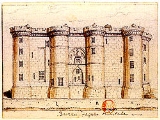
The Bastille was built as an irregular rectangle with 8 towers, 70 metres (220 feet) long, 30 metres (90 feet) wide, with towers and walls 25 metres (80 feet) high, surrounded by a broad moat. Originally there were two courtyards inside and residential buildings against the walls. Pairs of towers on the east and west facades served as gates through which the rue Saint-Antoine passed. In the 1400s, these were blocked up, and a new city gate was created to the north on the present day rue de la Bastille. A bastionFacts About Bastion

A bastion is a fortification work projecting outward from the main enclosure of a fortification, situated in both corners of...
 on the eastern approaches was built later. A significant military feature of the building was that the walls and towers were of the same height and connected by a broad terrace. This enabled soldiers on the wall head to rapidly move to a threatened sector of the fortress without having to descend inside the towers, as well as allowing placement of artillery. A similar provision can be seen today at Château de TarasconTarascon

Tarascon, sometimes referred to as Tarascon-sur-Rhne, is a town and commune in the Bouches-du-Rhne dpartement, in ...
.

Storming


The archives of the Bastille show that it largely held common criminals (forgers, embezzlers, swindlers, etc.), as well as people imprisoned for religious reasons (Protestants and Convulsionists) and those responsible for printing or writing forbidden pamphlets . People of high rank were sometimes held there too, and so the prison (which could only hold a little over 50 people) was far less sordid a place than most of the Parisian prisons. But
the secrecy maintained around the Bastille and its prisoners gave it a sinister reputation.

However the confrontation that led to the people of Paris storming the Bastille on 14 July 1789, following several days of disturbances, resulted from the fact that gunpowder and arms had been stored there, and the people (whose fears had been raised by a number of rumors) demanded access to these — the later idea that they wanted to free the prisoners (only 7 of whom remained) has been discounted. The regular garrison consisted of about 80 invalides (veteran soldiers no longer capable of service in the field) under Governor Bernard-René de LaunayBernard-René de Launay

Bernard Ren? Jourdan, marquis de Launay was a French governor of the Bastille, the son of a previous governor, and co...
. They had however been reinforced by a detachment of 32 grenadiers from one of the Swiss mercenary regiments summoned to Paris by the King shortly before 14 July.

A crowd of around 1,000 people gathered outside around mid-morning, calling for the surrender of the prison, the removal of the guns and the release of the arms and gunpowder. Two people chosen to represent those gathered were invited into the fortress and slow negotiations began.

In the early afternoon, the crowd broke into the undefended outer courtyard and the chains on the drawbridgeFacts About Drawbridge

A drawbridge is a type of movable bridge typically associated with the entrance of a castle, but the term is often used to d...
 to the inner courtyard were cut. A spasmodic exchange of gunfire began; in mid-afternoon the crowd was reinforced by mutinous Gardes FrançaisesGardes Françaises Overview

The Gardes Fran?aises was one of the two non-ceremonial infantry regiments in the "Maison du Roi" of the French Army under...
 of the Royal Army and two cannons. De Launay ordered a ceasefire; despite his surrender demands being refused, he capitulated and the vainqueurs swept in to liberate the fortress at around 5:30.

When the rioters had entered the Bastille, they collected cartridges and gunpowder for their weapons and then freed the seven prisoners (which they had to do by breaking down the doors, since the keys had already been taken off and paraded through the streets). Later, the governor and some of the guards of the Bastille were killed under chaotic circumstances, despite having surrendered under a flag of truce, and their heads paraded on pikes.

Demolition


The propagandaPropaganda

Propaganda is a specific type of message presentation directly aimed at influencing the opinions or behavior of people, rath...
 value of the Bastille was quickly seized upon, notably by the showy entrepreneur Pierre-François Palloy, "Patriote Palloy." The fate of the Bastille was uncertain, but Palloy was quick to establish a claim, organising a force of demolition men around the site on the 15th. Over the next few days many notables visited the Bastille and it seemed to be turning into a memorial. But Palloy secured a license for demolition from the Permanent Committee at the Hôtel de Ville and quickly took complete control.

Pierre-François Palloy secured a fair budget and his crew grew in number. He had control over all aspects of the work and the workers, even to the extent of having two hanged for murder. Palloy put much effort into continuing the site as a paying attraction and producing a huge range of souvenirs, including much of the rubble. The actual demolition proceeded apace — by November, 1789, the structure was largely demolished

The area today


The former location of the fort is currently called the Place de la BastillePlace de la Bastille

The Place de la Bastille is a square in Paris, where the Bastille prison stood until it was stormed and subsequently torn do...
. It is home to the Opéra BastilleOpéra Bastille

LOpra de la Bastille is a modern opera house in Paris, France....
. The large ditch (fossé) behind the fort has been transformed into a marinaMarina

----A marina is a port within a well-sheltered harbour where boats and yachts are kept in the water and where basic service...
 for pleasure boats, the Bassin de l'Arsenal, to the south, and a covered canalCanal

Canals are man-made waterways, usually connecting existing lakes, rivers, or oceans....
, the Canal Saint Martin, extending north from the marina beneath the vehicular roundabout that borders the location of the fort.

Some undemolished remains of one tower of the fort were discovered during excavation for the MétroMETRO

METRO may mean one of the following:...
 (rail mass-transit system) in 1899, and were moved to a park a few hundred meters away, where they are displayed today. The original outline of the fort is also marked on the pavement of streets and sidewalks that pass over its former location, in the form of special paving stones. A cafe and some other businesses largely occupy the location of the fort, and the rue Saint Antoine passes directly over it as it opens onto the roundabout of the Bastille.

In fiction

  • Comte de RochefortComte de Rochefort

    The Comte de Rochefort is a secondary, but important, character in Alexandre Dumas' d'Artagnan Romances....
     (The Three MusketeersThe Three Musketeers

    The Three Musketeers is a novel by Alexandre Dumas, pre....
    , Twenty Years AfterTwenty Years After

    Twenty Years After is a novel by Alexandre Dumas, pre....
    )
  • Doctor Alexander ManetteAlexandre Manette

    Doctor Manette is a character in Charles Dickens' novel, A Tale of Two Cities....
     (A Tale of Two CitiesA Tale of Two Cities

    A Tale of Two Cities is a historical novel by Charles Dickens; it is moreover a moral novel strongly concerned with them...
    )
  • Mr. ThénardierThénardiers

    The Th?nardiers are two of the primary villains in Victor Hugo's novel Les Mis?rables and the musical inspired by it....
     (Les MiserablesLes Misérables

    Les Misrables is a novel by French author Victor Hugo....
    )

In Popular Culture

  • The RushRush (band)

    Rush is a Canadian progressive rock band comprising bassist, keyboardist and vocalist Geddy Lee, guitarist Alex Lifeson, and...
     song, Bastille DayBastille Day (song)

    "Bastille Day" is the first song from Rush's third album Caress of Steel....
    , is about the storming of the Bastille.

External links

  • - fun facts, myths and more about the Bastille
  • - NOTE: The actual Bastille was not at the current Place, but slightly to the west of it (left in the photo), right where the rue Saint-Antoine ends.
  • - photo of the salvaged remains of one tower, with a brief description
  • : how the Encyclopædia Britannica has written about the Bastille in various editions since 1768.