

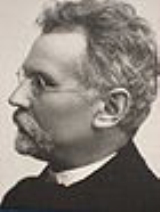
Boleslaw Prus

Encyclopedia
Bolesław Prus born Aleksander Głowacki, is one of the leading figures in the history of Polish literature and a distinctive voice in world literature
.
As a 15-year-old, he had joined the Polish 1863 Uprising
against Imperial Russia; shortly after his sixteenth birthday, in a battle against Russian forces, he suffered severe injuries. Five months later, he was imprisoned for his part in the Uprising. These early experiences may have precipitated the panic disorder
and agoraphobia
that would dog him through life, and shaped his opposition to attempts to regain Polish independence by force of arms.
In 1872 at age 25, in Warsaw
, he settled into a 40-year journalistic career that highlighted science, technology, education, and economic and cultural development. These societal enterprises were essential to the endurance of a people that had in the 18th century been partitioned out of political existence
by Russia, Prussia and Austria. Głowacki took his pen name
Prus from the appellation of his family's coat-of-arms.
As a sideline he wrote short stories
. Achieving success with these, he went on to employ a larger canvas. Over the decade between 1884 and 1895, he completed four major novel
s: The Outpost
, The Doll
, The New Woman and Pharaoh
.
The Doll
depicts the romantic infatuation of a man of action who is frustrated by his country's backwardness. Pharaoh
, Prus' only historical novel
, is a study of political power
and of the fates of nations, set in ancient Egypt
at the fall of the 20th Dynasty and New Kingdom
.
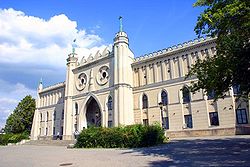 Aleksander Głowacki was born 20 August 1847 in Hrubieszów
, now in southeastern Poland
, very near the present-day border with Ukraine
. The town was then in the Russian sector of partitioned Poland. Głowacki was the younger son of Antoni Głowacki, an estate steward at the village of Żabcze
, in Hrubieszów County
, and Apolonia Głowacka, née
Trembińska. In 1850, when the future Bolesław Prus was three years old, his mother died; the child was placed in the care of his maternal grandmother, Marcjanna Trembińska of Puławy, and, four years later, in the care of his aunt, Domicela Olszewska of Lublin
. In 1856 Prus was orphan
ed by his father's death. In 1862 his brother Leon, a teacher who was thirteen years his senior, took him to Siedlce
, then to Kielce
.
Soon after the outbreak of the Polish January 1863 Uprising
against Imperial Russia, 15-year-old Prus ran away from school to join the insurgents. He may have been influenced by his brother Leon, who subsequently became one of the insurrection's leaders. During the Uprising, Leon developed a mental illness that he would suffer from until his death in 1907.
On 1 September 1863, twelve days after his sixteenth birthday, Prus took part in a battle against Russian forces at a village called Białka, four kilometers south of Siedlce
. He suffered contusions to the neck and gunpowder
injuries to his eyes, and was captured unconscious on the battlefield and taken to hospital in Siedlce. This experience may have caused his subsequent lifelong agoraphobia
.
 Five months later, in early February 1864, for his role in the Uprising Prus was arrested and imprisoned at Lublin Castle
. In early April a military court sentenced him to forfeiture of his nobleman's status and resettlement on imperial lands. On 30 April, however, the Lublin District military head credited Prus' time spent under arrest and, on account of the 16-year-old's youth, decided to place him in the custody of his uncle Klemens Olszewski. On 7 May Prus was released and entered the household of Katarzyna Trembińska, a relative and the mother of his future wife, Oktawia Trembińska.
Prus enrolled at a Lublin
gymnasium
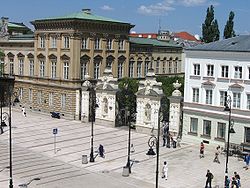
(where he was a student of Józef Skłodowski, grandfather of Maria Skłodowska-Curie). Graduating on 30 June 1866, he matriculated in the Warsaw University
Department of Mathematics and Physics. In 1868 his University studies were cut short by financial difficulties.
In 1869 he enrolled at the Agriculture and Forestry Institute in Puławy, a historic town where he had spent part of his childhood and which would be the setting for his striking 1884 micro-story
, "Mold of the Earth
." Soon, however, he was expelled after a classroom confrontation with a professor of Russian language.
Henceforth he studied on his own while supporting himself mainly as a tutor. As part of his program of self-education, he translated and summarized John Stuart Mill
's Logic. In 1872 he embarked on a career as a newspaper columnist
, while working several months at the Evans, Lilpop and Rau Machine and Agricultural Implement Works in Warsaw. Journalism
would become his school of writing.
In 1873 Prus delivered two public lectures whose subjects illustrate the breadth of his scientific interests: "On the Structure of the Universe," and "On Discoveries and Inventions."
, Prus commented on the achievements of scientists and scholars such as John Stuart Mill
, Charles Darwin
, Alexander Bain
, Herbert Spencer
and Henry Thomas Buckle
; urged Poles to study science and technology and to develop industry and commerce; encouraged the establishment of charitable institutions
to benefit the underprivileged; described the fiction and nonfiction works of fellow writers such as H.G. Wells; and extolled man-made and natural wonders such as the Wieliczka Salt Mine, the town of Nałęczów, and an 1887 solar eclipse
that he witnessed at Mława.
His "Weekly Chronicles" spanned forty years (they have since been reprinted in twenty volumes) and would help prepare the ground for the 20th-century blossoming of Polish science
and especially mathematics
. "Our national life," wrote Prus, "will take a normal course only when we have become a useful, indispensable element of civilization, when we have become able to give nothing for free and to demand nothing for free." The social importance of science and technology would recur as a theme in his novels The Doll
(1889) and Pharaoh
(1895).
Of contemporary thinkers, the one who most greatly influenced Prus and other writers of the Polish "Positivist
" period (roughly 1864–1900) was Herbert Spencer
, the English sociologist who coined the phrase, "survival of the fittest
." Prus would call Spencer "the Aristotle
of the 19th century" and would write: "I grew up under the influence of Spencerian evolution
ary philosophy
and heeded its counsels, not those of Idealist or Comtean
philosophy
." Prus interpreted "survival of the fittest," in the societal sphere, as involving not only competition but also cooperation; and he adopted Spencer's metaphor of society as organism. He would use this metaphor to striking effect in his 1884 micro-story
"Mold of the Earth
," and in the introduction to his 1895 historical novel
, Pharaoh.
After Prus began writing regular weekly newspaper columns, his finances stabilized, permitting him on January 14, 1875, to marry a distant cousin on his mother's side, Oktawia Trembińska. She was the daughter of Katarzyna Trembińska, in whose home he had lived, after his release from prison, for two years in 1864–66 while completing secondary school. The couple adopted a boy, Emil Trembiński (born September 11, 1886, the son of Prus' wife's brother Michał Trembiński, who had died on November 10, 1888). Emil would be the model for "Rascal" in chapter 48 of Prus' 1895 novel, Pharaoh
. On February 18, 1904, at age seventeen, Emil would fatally shoot himself in the chest on the doorstep of an unrequited love.
It has been alleged that in 1906, at age fifty-nine, Prus had a son, Jan Bogusz Sacewicz. The boy's mother was Alina Sacewicz, widow of Dr. Kazimierz Sacewicz, a socially-conscious physician whom Prus had known at Nałęczów. Dr. Sacewicz may have been the model for Stefan Żeromski
's Dr. Judym in the novel, Homeless People—a character resembling Dr. Stockman in Ibsen's play, An Enemy of the People
. Prus, known for his affection for children generally, took a lively interest in little Jan, as attested by a prolific correspondence with Jan's mother (whom Prus attempted to interest in becoming a writer). Jan Sacewicz would become one of Prus' major legatee
s and an engineer, and would die in a German camp after the suppression of the Warsaw Uprising
of August–October 1944.
 Though Prus was a gifted writer, initially best known for his humorist work, early on he thought little of his journalistic and literary productions. Hence at the inception of his career in 1872, at age 25, he adopted for his newspaper columns and fiction the pen name
"Prus"—"Prus I" being his family coat-of-arms—while reserving his actual name, Aleksander Głowacki, for "serious" writings.
In 1878 an incident occurred that illustrated the strong feelings that could be aroused in susceptible readers of newspaper columns. In one of his columns, Prus had criticized the loud and, in his view, inappropriate behavior of some youths at a lecture about the poet Wincenty Pol
. The University of Warsaw
students in question demanded that Prus retract what he had written. After he refused, on 26 March 1878 several of them surrounded him outside his home, to which he had just returned in the company of two fellow-writers, and one of the students, Jan Sawicki, slapped Prus in the face. Prus summoned police, but subsequently declined to press charges against the students. He remembered the incident, however; and seventeen years later, during his 1895 visit to Paris
, he refused, by some accounts, to meet with one of his erstwhile assailants, whom he blamed for having "ruined [his] life," perhaps by having caused or exacerbated his agoraphobia
.
In 1882, on the recommendation of an earlier editor-in-chief, the prophet of Polish Positivism
, Aleksander Świętochowski
, Prus succeeded to the editorship of the Warsaw
daily Nowiny (News). The newspaper had been bought in June 1882 by financier Stanisław Kronenberg. Prus resolved, in the best Positivist
fashion, to make it "an observatory of societal facts"—an instrument for advancing the development of his country. After less than a year, however, Nowiny—which had had a history of financial instability since changing in July 1878 from a Sunday paper to a daily—folded, and Prus resumed writing columns
.
He continued working as a journalist to the end of his life, well after he had achieved success as an author of short stories and novels.
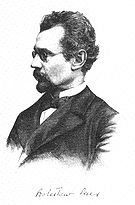 In time, Prus adopted the French Positivist critic Hippolyte Taine
's concept of the arts, including literature, as a second means, alongside the sciences, of studying reality, and he devoted more attention to his sideline of short-story writer
. Prus' stories, which met with great acclaim, owed much to the literary influence of Polish novelist Józef Ignacy Kraszewski
and, among English-language writers, to Charles Dickens
and Mark Twain
. His fiction would also be influenced by French writers Victor Hugo
, Gustave Flaubert
, Alphonse Daudet
and Émile Zola
.
Prus wrote several dozen stories, originally published in newspapers and ranging in length from micro-story
to novella
. Characteristic of Prus' stories are his keen observation of everyday life and his sense of humor, which he had honed early on as a contributor to humor magazines. The prevalence of themes from everyday life is consistent with the Polish Positivist artistic program, which sought to portray the circumstances of the general populace
rather than those of the erstwhile Romantic
heroes of an earlier generation of writers. The literary period in which Prus wrote was ostensibly a prosaic
age, by contrast with the poetry
of the Romantics; but Prus' prose is often a poetic prose
. His stories also often contain elements of fantasy
or whimsy. A fair number of his stories originally appeared in New Year
's issues of newspapers.
Prus long eschewed writing historical fiction
, arguing that it must inevitably distort history
. He criticized contemporary historical novel
ists for their lapses in historic accuracy, including Henryk Sienkiewicz
's failure, in the military scenes in his Trilogy
portraying 17th-century Polish history, to describe the logistics
of warfare. It would only be in 1888, when Prus was forty, that he would write his first historical fiction, the stunning short story, "A Legend of Old Egypt
." This story would, a few years later, serve as a preliminary sketch for his only historical novel, Pharaoh
(1895).
Eventually Prus would compose four novel
s on what he had referred to in an 1884 letter as "great questions of our age": The Outpost
(Placówka, 1886) on the Polish peasant; The Doll
(Lalka, 1889) on the aristocracy
and townspeople and on idealists
struggling to bring about social reforms; The New Woman
(Emancypantki, 1893) on feminist
concerns; and his only historical novel
, Pharaoh
(Faraon, 1895), on mechanisms of political power
. The work of greatest sweep and most universal appeal is Pharaoh. Prus' novels, like his stories, were originally published in newspaper serialization
.
After having sold Pharaoh to the publishing firm of Gebethner and Wolff, Prus embarked on May 16, 1895, on a four-month journey abroad. He visited Berlin
, Dresden
, Karlsbad
, Nuremberg
, Stuttgart
and Rapperswil
. At the latter Swiss
town he stayed two months (July–August), nursing his agoraphobia
and spending much time with his friends, the promising young writer Stefan Żeromski
and his wife Oktawia. The couple sought Prus' help for the Polish National Museum, housed in the Rapperswil Castle, where Żeromski was librarian.
The final stage of Prus's journey took him to Paris
, where he was prevented by his agoraphobia from crossing the Seine River to visit the city's southern Left Bank
. He was nevertheless pleased to find that his descriptions of Paris in The Doll had been on the mark (he had based them mainly on French-language publications). From Paris he hurried home to recuperate at Nałęczów from his journey, the last that he would make abroad.
 Over the years, Prus lent his name and support to many charitable and social causes. But there was one event that he would come to rue for the broad criticism that it brought him: it involved his helping to welcome Russia's Tsar
Nicholas II during an 1897 visit to Warsaw. As a rule, Prus held to the principle of not affiliating himself with political parties
, as such affiliation might compromise his journalistic objectivity. His associations, by design and temperament, were with individuals and with select worthy causes rather than with large groups.
Prus' experiences in the January 1863 Uprising
had persuaded him to urge society's advancement through learning, work and commerce rather than through potentially disastrous social upheavals. He departed from this stance, however, in 1905, when Imperial Russia experienced defeat in the Russo-Japanese War
and his compatriots demanded autonomy and reforms. On December 20, 1905, in the first issue of a short-lived periodical, Młodość (Youth), he published an article, "Oda do młodości" ("Ode to Youth"), whose title harked back to an 1820 poem by Adam Mickiewicz
. Prus wrote, in reference to his earlier position on revolution and strikes: "with the greatest pleasure, I admit it—I was wrong!"
In 1908 Prus serialized in the Warsaw Tygodnik Ilustrowany (Illustrated Weekly) his novel Dzieci (Children), describing the young revolutionaries, terrorists and anarchists of the day; it was an uncharacteristically humorless work. Three years later a final novel, Przemiany (Changes), was to have been, not unlike The Doll
, a panorama of the society and of its vital concerns. The novel's beginning, however, had barely been serialized in the Illustrated Weekly in 1911-12 when the book's composition was cut short by Prus' death.
Neither of the two late novels, Children or Changes, is generally regarded as part of the essential Prus canon, and Czesław Miłosz has called Children one of Prus' weakest works.
Prus' last novel to meet with popular acclaim was Pharaoh
, completed in 1895. Depicting the demise of ancient Egypt
's Twentieth Dynasty and New Kingdom
three thousand years earlier, Pharaoh had also reflected Poland
's loss of independence a century before in 1795—an independence whose post-World War I
restoration Prus would not live to see.
On May 19, 1912, in his Warsaw apartment at 12 Wolf Street (ulica Wilcza 12), Prus' forty-year journalistic and literary career came to an end.
The beloved agoraphobic
author was mourned by the nation that he had striven, as soldier, thinker and writer, to rescue from oblivion. Thousands attended his May 22, 1912, funeral service at St. Alexander's Church
on nearby Triple Cross Square
(Plac Trzech Krzyży) and his interment at Powązki Cemetery
.
Prus' tomb was designed by his nephew, the noted sculptor Stanisław Jackowski. On three sides it bears, respectively, the novelist's actual name, Aleksander Głowacki, his years of birth and death, and his pen name
, Bolesław Prus. On the fourth side is the Polish-language inscription "Serce serc" ("Heart of hearts"), borrowed from the Latin
inscription "Cor cordium" on the tomb of English Romantic poet Percy Bysshe Shelley
in Rome
's Protestant Cemetery
. Below that inscription is the figure of a little girl embracing Prus' tomb — a figure emblematic of his well-known empathy and affection for children.
, a city in eastern Poland. It was at Nałęczów that Prus had vacationed for thirty years from 1882 until his death, and that he had met the young Stefan Żeromski
. Prus had stood witness at Żeromski's 1892 wedding and had helped foster the younger man's writing career.
While Prus espoused a positivist and realist
outlook, much in his fiction shows qualities compatible with pre-1863-Uprising
Polish Romantic literature. Indeed, he held the Polish Romantic
poet Adam Mickiewicz
in high regard. Prus' novels in turn, especially The Doll
and Pharaoh
, with their innovative composition techniques, blazed the way for the 20th-century Polish novel.
Prus' novel The Doll
was considered by Czesław Miłosz to be the best Polish novel.
The New Woman
was pronounced by Joseph Conrad
to be "better than Dickens
"—Dickens being a favorite author of Conrad's. Czesław Miłosz, however, thought that the novel was "as a whole... an artistic failure..." Zygmunt Szweykowski
similarly faulted The New Womans loose, tangential construction; this, in his view, was partly redeemed by Prus' humor and by some superb episodes, while "The tragedy of Mrs. Latter and the picture of [the town of] Iksinów are among the peak achievements of [Polish] novel-writing."
Pharaoh
, a study of political power
, became the favorite novel of Soviet dictator Joseph Stalin
, prefigured the fate of U.S. President John F. Kennedy
, and continues to point analogies to more recent times. Pharaoh is often described as Prus' "best-composed novel"—indeed, "one of the best-composed [of all] Polish novels." This was due in part to Pharaoh having been composed complete prior to newspaper serialization, rather than being written in installments just before printing, as was the case with Prus' earlier major novels.
The Doll and Pharaoh, which made Prus a potential candidate for the Nobel Prize in literature
, are available in English versions. The Doll has been translated into sixteen languages, and Pharaoh into twenty. In addition, The Doll has been filmed several times and been produced as a late-1970s television miniseries, while Pharaoh was adapted into a 1966 feature film
.
In 1897-99 Prus serialized
in the Warsaw Daily Courier (Kurier Codzienny) a monograph
on The Most General Life Ideals (Najogólniejsze ideały życiowe), which systematized ethical ideas that he had developed over his career regarding happiness, utility and perfection in the lives of individuals and societies. In it he returned to the society-organizing (i.e., political) interests that had been frustrated during his Nowiny editorship fifteen years earlier. A book edition appeared in 1901 (2nd, revised edition, 1905). This work, rooted in Jeremy Bentham
's Utilitarian philosophy
and Herbert Spencer's view of society-as-organism, retains interest especially for philosophers
and social scientists.
Another of Prus' learned projects remained incomplete at his death. He had sought, over his writing career, to develop a coherent theory of literary composition. Notes of his from 1886-1912 were never put together into a finished book as he had intended. His precepts included the maxim, "Noun
s, nouns and more nouns." Some particularly intriguing fragments describe Prus' combinatorial calculation
s of the millions of potential "individual types" of human characters
, given a stated number of "individual traits
."
A curious comparative-literature
aspect has been noted to Prus' career, which paralleled that of his American contemporary, Ambrose Bierce
(1842–1914). Each was born and reared in a rural area and had a "Polish" connection (Bierce, born five years before Prus, was reared in Kosciusko County, Indiana
, and attended high school
at the county seat
, Warsaw, Indiana
. Each became a war
casualty
with combat
head trauma—Prus in 1863 in the Polish 1863-65 Uprising
; Bierce in 1864 in the American Civil War
. Each experienced false starts in other occupations, and at twenty-five became a journalist for the next forty years; failed to sustain a career as editor-in-chief; achieved celebrity as a short-story writer; lost a son in tragic circumstances (Prus, an adopted son; Bierce, both his sons); attained superb humorous effects by portraying human egoism (Prus especially in Pharaoh
, Bierce in The Devil's Dictionary
); was dogged from early adulthood by a health problem (Prus, agoraphobia
; Bierce, asthma
); and died within two years of the other (Prus in 1912; Bierce presumably in 1914). Prus, however, unlike Bierce, went on from short stories to write novels.
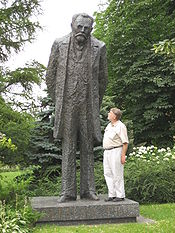
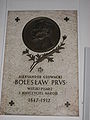 In Prus' lifetime and since, his contributions to Polish literature and culture have been memorialized without regard to the nature of the political system prevailing in Poland in the respective periods:
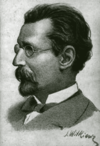 Prus' writings have been translated into many languages — his historical novel
Pharaoh
, into twenty; his contemporary novel The Doll
, into at least sixteen. Works by Prus have been rendered into Croatian
by a member of the Croatian Academy of Sciences and Arts
, Stjepan Musulin
.
Return to top of page.
World literature
World literature refers to literature from all over the world, including African literature, American literature, Arabic literature, Asian literature, Australasian literature, Caribbean Literature, English literature, European literature, Indian literature, Latin American literature, Persian...
.
As a 15-year-old, he had joined the Polish 1863 Uprising
January Uprising
The January Uprising was an uprising in the former Polish-Lithuanian Commonwealth against the Russian Empire...
against Imperial Russia; shortly after his sixteenth birthday, in a battle against Russian forces, he suffered severe injuries. Five months later, he was imprisoned for his part in the Uprising. These early experiences may have precipitated the panic disorder
Panic disorder
Panic disorder is an anxiety disorder characterized by recurring severe panic attacks. It may also include significant behavioral change lasting at least a month and of ongoing worry about the implications or concern about having other attacks. The latter are called anticipatory attacks...
and agoraphobia
Agoraphobia
Agoraphobia is an anxiety disorder defined as a morbid fear of having a panic attack or panic-like symptoms in a situation from which it is perceived to be difficult to escape. These situations can include, but are not limited to, wide-open spaces, crowds, or uncontrolled social conditions...
that would dog him through life, and shaped his opposition to attempts to regain Polish independence by force of arms.
In 1872 at age 25, in Warsaw
Warsaw
Warsaw is the capital and largest city of Poland. It is located on the Vistula River, roughly from the Baltic Sea and from the Carpathian Mountains. Its population in 2010 was estimated at 1,716,855 residents with a greater metropolitan area of 2,631,902 residents, making Warsaw the 10th most...
, he settled into a 40-year journalistic career that highlighted science, technology, education, and economic and cultural development. These societal enterprises were essential to the endurance of a people that had in the 18th century been partitioned out of political existence
Partitions of Poland
The Partitions of Poland or Partitions of the Polish–Lithuanian Commonwealth took place in the second half of the 18th century and ended the existence of the Polish–Lithuanian Commonwealth, resulting in the elimination of sovereign Poland for 123 years...
by Russia, Prussia and Austria. Głowacki took his pen name
Pen name
A pen name, nom de plume, or literary double, is a pseudonym adopted by an author. A pen name may be used to make the author's name more distinctive, to disguise his or her gender, to distance an author from some or all of his or her works, to protect the author from retribution for his or her...
Prus from the appellation of his family's coat-of-arms.
As a sideline he wrote short stories
Short Stories
Short Stories may refer to:*A plural for Short story*Short Stories , an American pulp magazine published from 1890-1959*Short Stories, a 1954 collection by O. E...
. Achieving success with these, he went on to employ a larger canvas. Over the decade between 1884 and 1895, he completed four major novel
Novel
A novel is a book of long narrative in literary prose. The genre has historical roots both in the fields of the medieval and early modern romance and in the tradition of the novella. The latter supplied the present generic term in the late 18th century....
s: The Outpost
The Outpost (novel)
The Outpost was the first of four major novels by the Polish writer Bolesław Prus. The author sought to bring attention to the plight of rural Poland, which had to contend with poverty, ignorance, neglect on the part of the country's upper crust, and colonization by German settlers backed by Otto...
, The Doll
The Doll (novel)
The Doll is the second of four major novels by the Polish writer Bolesław Prus. It was composed for periodical serialization in 1887-89 and appeared in book form in 1890....
, The New Woman and Pharaoh
Pharaoh (novel)
Pharaoh is the fourth and last major novel by the Polish writer Bolesław Prus . Composed over a year's time in 1894–95, it was the sole historical novel by an author who had earlier disapproved of historical novels on the ground that they inevitably distort history.Pharaoh has been described...
.
The Doll
The Doll (novel)
The Doll is the second of four major novels by the Polish writer Bolesław Prus. It was composed for periodical serialization in 1887-89 and appeared in book form in 1890....
depicts the romantic infatuation of a man of action who is frustrated by his country's backwardness. Pharaoh
Pharaoh (novel)
Pharaoh is the fourth and last major novel by the Polish writer Bolesław Prus . Composed over a year's time in 1894–95, it was the sole historical novel by an author who had earlier disapproved of historical novels on the ground that they inevitably distort history.Pharaoh has been described...
, Prus' only historical novel
Historical novel
According to Encyclopædia Britannica, a historical novel is-Development:An early example of historical prose fiction is Luó Guànzhōng's 14th century Romance of the Three Kingdoms, which covers one of the most important periods of Chinese history and left a lasting impact on Chinese culture.The...
, is a study of political power
Political power
Political power is a type of power held by a group in a society which allows administration of some or all of public resources, including labour, and wealth. There are many ways to obtain possession of such power. At the nation-state level political legitimacy for political power is held by the...
and of the fates of nations, set in ancient Egypt
Ancient Egypt
Ancient Egypt was an ancient civilization of Northeastern Africa, concentrated along the lower reaches of the Nile River in what is now the modern country of Egypt. Egyptian civilization coalesced around 3150 BC with the political unification of Upper and Lower Egypt under the first pharaoh...
at the fall of the 20th Dynasty and New Kingdom
New Kingdom
The New Kingdom of Egypt, also referred to as the Egyptian Empire is the period in ancient Egyptian history between the 16th century BC and the 11th century BC, covering the Eighteenth, Nineteenth, and Twentieth Dynasties of Egypt....
.
Early years
Hrubieszów
Hrubieszów is a town in southeastern Poland, with a population of 18,661 . It is the capital of Hrubieszów County. Since 1999 Hrubieszów has been part of Lublin Voivodeship . Earlier, 1975–98, it had been part of Zamość Province...
, now in southeastern Poland
Poland
Poland , officially the Republic of Poland , is a country in Central Europe bordered by Germany to the west; the Czech Republic and Slovakia to the south; Ukraine, Belarus and Lithuania to the east; and the Baltic Sea and Kaliningrad Oblast, a Russian exclave, to the north...
, very near the present-day border with Ukraine
Ukraine
Ukraine is a country in Eastern Europe. It has an area of 603,628 km², making it the second largest contiguous country on the European continent, after Russia...
. The town was then in the Russian sector of partitioned Poland. Głowacki was the younger son of Antoni Głowacki, an estate steward at the village of Żabcze
Zabcze
Żabcze is a village in the administrative district of Gmina Dołhobyczów, within Hrubieszów County, Lublin Voivodeship, in eastern Poland, close to the border with Ukraine. It lies some south of Dołhobyczów, south of Hrubieszów, and southeast of the regional capital, Lublin.The village has a...
, in Hrubieszów County
Hrubieszów County
Hrubieszów County is a unit of territorial administration and local government in Lublin Voivodeship, eastern Poland, on the border with Ukraine. It came into being on January 1, 1999, as a result of the Polish local government reforms passed in 1998...
, and Apolonia Głowacka, née
NEE
NEE is a political protest group whose goal was to provide an alternative for voters who are unhappy with all political parties at hand in Belgium, where voting is compulsory.The NEE party was founded in 2005 in Antwerp...
Trembińska. In 1850, when the future Bolesław Prus was three years old, his mother died; the child was placed in the care of his maternal grandmother, Marcjanna Trembińska of Puławy, and, four years later, in the care of his aunt, Domicela Olszewska of Lublin
Lublin
Lublin is the ninth largest city in Poland. It is the capital of Lublin Voivodeship with a population of 350,392 . Lublin is also the largest Polish city east of the Vistula river...
. In 1856 Prus was orphan
Orphan
An orphan is a child permanently bereaved of or abandoned by his or her parents. In common usage, only a child who has lost both parents is called an orphan...
ed by his father's death. In 1862 his brother Leon, a teacher who was thirteen years his senior, took him to Siedlce
Siedlce
Siedlce ) is a city in eastern Poland with 77,392 inhabitants . Situated in the Masovian Voivodeship , previously the city was the capital of a separate Siedlce Voivodeship ....
, then to Kielce
Kielce
Kielce ) is a city in central Poland with 204,891 inhabitants . It is also the capital city of the Świętokrzyskie Voivodeship since 1999, previously in Kielce Voivodeship...
.
Soon after the outbreak of the Polish January 1863 Uprising
January Uprising
The January Uprising was an uprising in the former Polish-Lithuanian Commonwealth against the Russian Empire...
against Imperial Russia, 15-year-old Prus ran away from school to join the insurgents. He may have been influenced by his brother Leon, who subsequently became one of the insurrection's leaders. During the Uprising, Leon developed a mental illness that he would suffer from until his death in 1907.
On 1 September 1863, twelve days after his sixteenth birthday, Prus took part in a battle against Russian forces at a village called Białka, four kilometers south of Siedlce
Siedlce
Siedlce ) is a city in eastern Poland with 77,392 inhabitants . Situated in the Masovian Voivodeship , previously the city was the capital of a separate Siedlce Voivodeship ....
. He suffered contusions to the neck and gunpowder
Gunpowder
Gunpowder, also known since in the late 19th century as black powder, was the first chemical explosive and the only one known until the mid 1800s. It is a mixture of sulfur, charcoal, and potassium nitrate - with the sulfur and charcoal acting as fuels, while the saltpeter works as an oxidizer...
injuries to his eyes, and was captured unconscious on the battlefield and taken to hospital in Siedlce. This experience may have caused his subsequent lifelong agoraphobia
Agoraphobia
Agoraphobia is an anxiety disorder defined as a morbid fear of having a panic attack or panic-like symptoms in a situation from which it is perceived to be difficult to escape. These situations can include, but are not limited to, wide-open spaces, crowds, or uncontrolled social conditions...
.
Lublin Castle
The Lublin Castle is a medieval castle situated in Lublin, Poland, adjacent to the Old Town district and close to the city center. It is one of the oldest preseved Royal residencies in Poland, established by king Casimir II the Just.-History:...
. In early April a military court sentenced him to forfeiture of his nobleman's status and resettlement on imperial lands. On 30 April, however, the Lublin District military head credited Prus' time spent under arrest and, on account of the 16-year-old's youth, decided to place him in the custody of his uncle Klemens Olszewski. On 7 May Prus was released and entered the household of Katarzyna Trembińska, a relative and the mother of his future wife, Oktawia Trembińska.
Prus enrolled at a Lublin
Lublin
Lublin is the ninth largest city in Poland. It is the capital of Lublin Voivodeship with a population of 350,392 . Lublin is also the largest Polish city east of the Vistula river...
gymnasium
Gymnasium (school)
A gymnasium is a type of school providing secondary education in some parts of Europe, comparable to English grammar schools or sixth form colleges and U.S. college preparatory high schools. The word γυμνάσιον was used in Ancient Greece, meaning a locality for both physical and intellectual...
(where he was a student of Józef Skłodowski, grandfather of Maria Skłodowska-Curie). Graduating on 30 June 1866, he matriculated in the Warsaw University
University of Warsaw
The University of Warsaw is the largest university in Poland and one of the most prestigious, ranked as best Polish university in 2010 and 2011...
Department of Mathematics and Physics. In 1868 his University studies were cut short by financial difficulties.
In 1869 he enrolled at the Agriculture and Forestry Institute in Puławy, a historic town where he had spent part of his childhood and which would be the setting for his striking 1884 micro-story
Flash fiction
Flash fiction is a style of fictional literature or fiction of extreme brevity. There is no widely accepted definition of the length of the category...
, "Mold of the Earth
Mold of the Earth
"Mold of the Earth" is one of the shortest micro-stories by the Polish writer Bolesław Prus.The story was published on 1 January 1884 in the News Year's Day issue of the Warsaw Courier . The story comes from a several years' period of pessimism in the author's life...
." Soon, however, he was expelled after a classroom confrontation with a professor of Russian language.
Henceforth he studied on his own while supporting himself mainly as a tutor. As part of his program of self-education, he translated and summarized John Stuart Mill
John Stuart Mill
John Stuart Mill was a British philosopher, economist and civil servant. An influential contributor to social theory, political theory, and political economy, his conception of liberty justified the freedom of the individual in opposition to unlimited state control. He was a proponent of...
's Logic. In 1872 he embarked on a career as a newspaper columnist
Columnist
A columnist is a journalist who writes for publication in a series, creating an article that usually offers commentary and opinions. Columns appear in newspapers, magazines and other publications, including blogs....
, while working several months at the Evans, Lilpop and Rau Machine and Agricultural Implement Works in Warsaw. Journalism
Journalism
Journalism is the practice of investigation and reporting of events, issues and trends to a broad audience in a timely fashion. Though there are many variations of journalism, the ideal is to inform the intended audience. Along with covering organizations and institutions such as government and...
would become his school of writing.
In 1873 Prus delivered two public lectures whose subjects illustrate the breadth of his scientific interests: "On the Structure of the Universe," and "On Discoveries and Inventions."
Columnist
As a newspaper columnistColumnist
A columnist is a journalist who writes for publication in a series, creating an article that usually offers commentary and opinions. Columns appear in newspapers, magazines and other publications, including blogs....
, Prus commented on the achievements of scientists and scholars such as John Stuart Mill
John Stuart Mill
John Stuart Mill was a British philosopher, economist and civil servant. An influential contributor to social theory, political theory, and political economy, his conception of liberty justified the freedom of the individual in opposition to unlimited state control. He was a proponent of...
, Charles Darwin
Charles Darwin
Charles Robert Darwin FRS was an English naturalist. He established that all species of life have descended over time from common ancestry, and proposed the scientific theory that this branching pattern of evolution resulted from a process that he called natural selection.He published his theory...
, Alexander Bain
Alexander Bain
Alexander Bain was a Scottish philosopher and educationalist in the British school of empiricism who was a prominent and innovative figure in the fields of psychology, linguistics, logic, moral philosophy and education reform...
, Herbert Spencer
Herbert Spencer
Herbert Spencer was an English philosopher, biologist, sociologist, and prominent classical liberal political theorist of the Victorian era....
and Henry Thomas Buckle
Henry Thomas Buckle
Henry Thomas Buckle was an English historian, author of an unfinished History of Civilization.- Biography :...
; urged Poles to study science and technology and to develop industry and commerce; encouraged the establishment of charitable institutions
Charitable organization
A charitable organization is a type of non-profit organization . It differs from other types of NPOs in that it centers on philanthropic goals A charitable organization is a type of non-profit organization (NPO). It differs from other types of NPOs in that it centers on philanthropic goals A...
to benefit the underprivileged; described the fiction and nonfiction works of fellow writers such as H.G. Wells; and extolled man-made and natural wonders such as the Wieliczka Salt Mine, the town of Nałęczów, and an 1887 solar eclipse
Solar eclipse
As seen from the Earth, a solar eclipse occurs when the Moon passes between the Sun and the Earth, and the Moon fully or partially blocks the Sun as viewed from a location on Earth. This can happen only during a new moon, when the Sun and the Moon are in conjunction as seen from Earth. At least...
that he witnessed at Mława.
His "Weekly Chronicles" spanned forty years (they have since been reprinted in twenty volumes) and would help prepare the ground for the 20th-century blossoming of Polish science
Timeline of Polish science and technology
Education has been of prime interest to Poland's rulers since the early 12th century. The catalog of the library of the Cathedral Chapter in Kraków dating from 1110 shows that Polish scholars already then had access to western European literature. In 1364, King Kazimierz the Great founded the...
and especially mathematics
Polish School of Mathematics
The Polish School of Mathematics refers to the mathematics community that flourished in Poland in the 20th century, particularly during the Interbellum between World Wars I and II.- Overview :The Polish School of Mathematics subsumed:...
. "Our national life," wrote Prus, "will take a normal course only when we have become a useful, indispensable element of civilization, when we have become able to give nothing for free and to demand nothing for free." The social importance of science and technology would recur as a theme in his novels The Doll
The Doll (novel)
The Doll is the second of four major novels by the Polish writer Bolesław Prus. It was composed for periodical serialization in 1887-89 and appeared in book form in 1890....
(1889) and Pharaoh
Pharaoh (novel)
Pharaoh is the fourth and last major novel by the Polish writer Bolesław Prus . Composed over a year's time in 1894–95, it was the sole historical novel by an author who had earlier disapproved of historical novels on the ground that they inevitably distort history.Pharaoh has been described...
(1895).
Of contemporary thinkers, the one who most greatly influenced Prus and other writers of the Polish "Positivist
Positivism in Poland
Positivism in Poland was a socio-cultural movement that defined progressive thought in literature and social sciences of Partitioned Poland following the suppression of the 1863 January Uprising against the occupying army of Imperial Russia...
" period (roughly 1864–1900) was Herbert Spencer
Herbert Spencer
Herbert Spencer was an English philosopher, biologist, sociologist, and prominent classical liberal political theorist of the Victorian era....
, the English sociologist who coined the phrase, "survival of the fittest
Survival of the fittest
"Survival of the fittest" is a phrase originating in evolutionary theory, as an alternative description of Natural selection. The phrase is today commonly used in contexts that are incompatible with the original meaning as intended by its first two proponents: British polymath philosopher Herbert...
." Prus would call Spencer "the Aristotle
Aristotle
Aristotle was a Greek philosopher and polymath, a student of Plato and teacher of Alexander the Great. His writings cover many subjects, including physics, metaphysics, poetry, theater, music, logic, rhetoric, linguistics, politics, government, ethics, biology, and zoology...
of the 19th century" and would write: "I grew up under the influence of Spencerian evolution
Evolution
Evolution is any change across successive generations in the heritable characteristics of biological populations. Evolutionary processes give rise to diversity at every level of biological organisation, including species, individual organisms and molecules such as DNA and proteins.Life on Earth...
ary philosophy
Philosophy
Philosophy is the study of general and fundamental problems, such as those connected with existence, knowledge, values, reason, mind, and language. Philosophy is distinguished from other ways of addressing such problems by its critical, generally systematic approach and its reliance on rational...
and heeded its counsels, not those of Idealist or Comtean
Auguste Comte
Isidore Auguste Marie François Xavier Comte , better known as Auguste Comte , was a French philosopher, a founder of the discipline of sociology and of the doctrine of positivism...
philosophy
Philosophy
Philosophy is the study of general and fundamental problems, such as those connected with existence, knowledge, values, reason, mind, and language. Philosophy is distinguished from other ways of addressing such problems by its critical, generally systematic approach and its reliance on rational...
." Prus interpreted "survival of the fittest," in the societal sphere, as involving not only competition but also cooperation; and he adopted Spencer's metaphor of society as organism. He would use this metaphor to striking effect in his 1884 micro-story
Flash fiction
Flash fiction is a style of fictional literature or fiction of extreme brevity. There is no widely accepted definition of the length of the category...
"Mold of the Earth
Mold of the Earth
"Mold of the Earth" is one of the shortest micro-stories by the Polish writer Bolesław Prus.The story was published on 1 January 1884 in the News Year's Day issue of the Warsaw Courier . The story comes from a several years' period of pessimism in the author's life...
," and in the introduction to his 1895 historical novel
Historical novel
According to Encyclopædia Britannica, a historical novel is-Development:An early example of historical prose fiction is Luó Guànzhōng's 14th century Romance of the Three Kingdoms, which covers one of the most important periods of Chinese history and left a lasting impact on Chinese culture.The...
, Pharaoh.
After Prus began writing regular weekly newspaper columns, his finances stabilized, permitting him on January 14, 1875, to marry a distant cousin on his mother's side, Oktawia Trembińska. She was the daughter of Katarzyna Trembińska, in whose home he had lived, after his release from prison, for two years in 1864–66 while completing secondary school. The couple adopted a boy, Emil Trembiński (born September 11, 1886, the son of Prus' wife's brother Michał Trembiński, who had died on November 10, 1888). Emil would be the model for "Rascal" in chapter 48 of Prus' 1895 novel, Pharaoh
Pharaoh (novel)
Pharaoh is the fourth and last major novel by the Polish writer Bolesław Prus . Composed over a year's time in 1894–95, it was the sole historical novel by an author who had earlier disapproved of historical novels on the ground that they inevitably distort history.Pharaoh has been described...
. On February 18, 1904, at age seventeen, Emil would fatally shoot himself in the chest on the doorstep of an unrequited love.
It has been alleged that in 1906, at age fifty-nine, Prus had a son, Jan Bogusz Sacewicz. The boy's mother was Alina Sacewicz, widow of Dr. Kazimierz Sacewicz, a socially-conscious physician whom Prus had known at Nałęczów. Dr. Sacewicz may have been the model for Stefan Żeromski
Stefan Zeromski
Stefan Żeromski was a Polish novelist and dramatist. He was called the "conscience of Polish literature". He also wrote under the pen names: Maurycy Zych, Józef Katerla and Stefan Iksmoreż.- Life :...
's Dr. Judym in the novel, Homeless People—a character resembling Dr. Stockman in Ibsen's play, An Enemy of the People
An Enemy of the People
An Enemy of the People is an 1882 play by Norwegian playwright Henrik Ibsen. Ibsen wrote it in response to the public outcry against his play Ghosts, which at that time was considered scandalous...
. Prus, known for his affection for children generally, took a lively interest in little Jan, as attested by a prolific correspondence with Jan's mother (whom Prus attempted to interest in becoming a writer). Jan Sacewicz would become one of Prus' major legatee
Legatee
A legatee, in the law of wills, is any individual or organization bequeathed any portion of a testator's estate.-Usage:Depending upon local custom, legatees may be called "devisees." Traditionally, "legatees" took personal property under will and "devisees" took land under will. Brooker v....
s and an engineer, and would die in a German camp after the suppression of the Warsaw Uprising
Warsaw Uprising
The Warsaw Uprising was a major World War II operation by the Polish resistance Home Army , to liberate Warsaw from Nazi Germany. The rebellion was timed to coincide with the Soviet Union's Red Army approaching the eastern suburbs of the city and the retreat of German forces...
of August–October 1944.
Pen name
A pen name, nom de plume, or literary double, is a pseudonym adopted by an author. A pen name may be used to make the author's name more distinctive, to disguise his or her gender, to distance an author from some or all of his or her works, to protect the author from retribution for his or her...
"Prus"—"Prus I" being his family coat-of-arms—while reserving his actual name, Aleksander Głowacki, for "serious" writings.
In 1878 an incident occurred that illustrated the strong feelings that could be aroused in susceptible readers of newspaper columns. In one of his columns, Prus had criticized the loud and, in his view, inappropriate behavior of some youths at a lecture about the poet Wincenty Pol
Wincenty Pol
Wincenty Pol was a Polish poet and geographer.-Life:Pol was born in Lublin , to Franz Pohl , a German in the Austrian service, and his wife Eleonora Longchamps de Berier, from a French family living in Poland. Pol fought in the Polish army in the November 1830 Uprising and participated in the 1848...
. The University of Warsaw
University of Warsaw
The University of Warsaw is the largest university in Poland and one of the most prestigious, ranked as best Polish university in 2010 and 2011...
students in question demanded that Prus retract what he had written. After he refused, on 26 March 1878 several of them surrounded him outside his home, to which he had just returned in the company of two fellow-writers, and one of the students, Jan Sawicki, slapped Prus in the face. Prus summoned police, but subsequently declined to press charges against the students. He remembered the incident, however; and seventeen years later, during his 1895 visit to Paris
Paris
Paris is the capital and largest city in France, situated on the river Seine, in northern France, at the heart of the Île-de-France region...
, he refused, by some accounts, to meet with one of his erstwhile assailants, whom he blamed for having "ruined [his] life," perhaps by having caused or exacerbated his agoraphobia
Agoraphobia
Agoraphobia is an anxiety disorder defined as a morbid fear of having a panic attack or panic-like symptoms in a situation from which it is perceived to be difficult to escape. These situations can include, but are not limited to, wide-open spaces, crowds, or uncontrolled social conditions...
.
In 1882, on the recommendation of an earlier editor-in-chief, the prophet of Polish Positivism
Positivism in Poland
Positivism in Poland was a socio-cultural movement that defined progressive thought in literature and social sciences of Partitioned Poland following the suppression of the 1863 January Uprising against the occupying army of Imperial Russia...
, Aleksander Świętochowski
Aleksander Swietochowski
Aleksander Świętochowski was a Polish writer, educator, and philosopher of the Positivist period that followed the January 1863 Uprising.He was widely regarded as the prophet of Polish Positivism, spreading in the Warsaw...
, Prus succeeded to the editorship of the Warsaw
Warsaw
Warsaw is the capital and largest city of Poland. It is located on the Vistula River, roughly from the Baltic Sea and from the Carpathian Mountains. Its population in 2010 was estimated at 1,716,855 residents with a greater metropolitan area of 2,631,902 residents, making Warsaw the 10th most...
daily Nowiny (News). The newspaper had been bought in June 1882 by financier Stanisław Kronenberg. Prus resolved, in the best Positivist
Positivism in Poland
Positivism in Poland was a socio-cultural movement that defined progressive thought in literature and social sciences of Partitioned Poland following the suppression of the 1863 January Uprising against the occupying army of Imperial Russia...
fashion, to make it "an observatory of societal facts"—an instrument for advancing the development of his country. After less than a year, however, Nowiny—which had had a history of financial instability since changing in July 1878 from a Sunday paper to a daily—folded, and Prus resumed writing columns
Column (newspaper)
A column is a recurring piece or article in a newspaper, magazine or other publication. Columns are written by columnists.What differentiates a column from other forms of journalism is that it meets each of the following criteria:...
.
He continued working as a journalist to the end of his life, well after he had achieved success as an author of short stories and novels.
Fiction
Hippolyte Taine
Hippolyte Adolphe Taine was a French critic and historian. He was the chief theoretical influence of French naturalism, a major proponent of sociological positivism, and one of the first practitioners of historicist criticism. Literary historicism as a critical movement has been said to originate...
's concept of the arts, including literature, as a second means, alongside the sciences, of studying reality, and he devoted more attention to his sideline of short-story writer
Short story
A short story is a work of fiction that is usually written in prose, often in narrative format. This format tends to be more pointed than longer works of fiction, such as novellas and novels. Short story definitions based on length differ somewhat, even among professional writers, in part because...
. Prus' stories, which met with great acclaim, owed much to the literary influence of Polish novelist Józef Ignacy Kraszewski
Józef Ignacy Kraszewski
Józef Ignacy Kraszewski was a Polish writer, historian and journalist who produced more than 200 novels and 150 novellas, short stories, and art reviews He is best known for his epic series on the history of Poland, comprising twenty-nine novels in seventy-nine parts.As a novelist writing about...
and, among English-language writers, to Charles Dickens
Charles Dickens
Charles John Huffam Dickens was an English novelist, generally considered the greatest of the Victorian period. Dickens enjoyed a wider popularity and fame than had any previous author during his lifetime, and he remains popular, having been responsible for some of English literature's most iconic...
and Mark Twain
Mark Twain
Samuel Langhorne Clemens , better known by his pen name Mark Twain, was an American author and humorist...
. His fiction would also be influenced by French writers Victor Hugo
Victor Hugo
Victor-Marie Hugo was a Frenchpoet, playwright, novelist, essayist, visual artist, statesman, human rights activist and exponent of the Romantic movement in France....
, Gustave Flaubert
Gustave Flaubert
Gustave Flaubert was a French writer who is counted among the greatest Western novelists. He is known especially for his first published novel, Madame Bovary , and for his scrupulous devotion to his art and style.-Early life and education:Flaubert was born on December 12, 1821, in Rouen,...
, Alphonse Daudet
Alphonse Daudet
Alphonse Daudet was a French novelist. He was the father of Léon Daudet and Lucien Daudet.- Early life :Alphonse Daudet was born in Nîmes, France. His family, on both sides, belonged to the bourgeoisie. The father, Vincent Daudet, was a silk manufacturer — a man dogged through life by misfortune...
and Émile Zola
Émile Zola
Émile François Zola was a French writer, the most important exemplar of the literary school of naturalism and an important contributor to the development of theatrical naturalism...
.
Prus wrote several dozen stories, originally published in newspapers and ranging in length from micro-story
Flash fiction
Flash fiction is a style of fictional literature or fiction of extreme brevity. There is no widely accepted definition of the length of the category...
to novella
Novella
A novella is a written, fictional, prose narrative usually longer than a novelette but shorter than a novel. The Science Fiction and Fantasy Writers of America Nebula Awards for science fiction define the novella as having a word count between 17,500 and 40,000...
. Characteristic of Prus' stories are his keen observation of everyday life and his sense of humor, which he had honed early on as a contributor to humor magazines. The prevalence of themes from everyday life is consistent with the Polish Positivist artistic program, which sought to portray the circumstances of the general populace
Populace
A populace is a group of people forming the total population of a certain place. It is taken from the Latin word populus, which means "people", but also in the sense of a race, nationality, or locality. This can be compared with the Spanish word pueblo, which derives from the same Latin...
rather than those of the erstwhile Romantic
Romantic poetry
Romanticism, a philosophical, literary, artistic and cultural era which began in the mid/late-1700s as a reaction against the prevailing Enlightenment ideals of the day , also influenced poetry...
heroes of an earlier generation of writers. The literary period in which Prus wrote was ostensibly a prosaic
Prose
Prose is the most typical form of written language, applying ordinary grammatical structure and natural flow of speech rather than rhythmic structure...
age, by contrast with the poetry
Poetry
Poetry is a form of literary art in which language is used for its aesthetic and evocative qualities in addition to, or in lieu of, its apparent meaning...
of the Romantics; but Prus' prose is often a poetic prose
Prose poetry
Prose poetry is poetry written in prose instead of using verse but preserving poetic qualities such as heightened imagery and emotional effects.-Characteristics:Prose poetry can be considered either primarily poetry or prose, or a separate genre altogether...
. His stories also often contain elements of fantasy
Fantasy
Fantasy is a genre of fiction that commonly uses magic and other supernatural phenomena as a primary element of plot, theme, or setting. Many works within the genre take place in imaginary worlds where magic is common...
or whimsy. A fair number of his stories originally appeared in New Year
New Year
The New Year is the day that marks the time of the beginning of a new calendar year, and is the day on which the year count of the specific calendar used is incremented. For many cultures, the event is celebrated in some manner....
's issues of newspapers.
Prus long eschewed writing historical fiction
Historical fiction
Historical fiction tells a story that is set in the past. That setting is usually real and drawn from history, and often contains actual historical persons, but the principal characters tend to be fictional...
, arguing that it must inevitably distort history
History
History is the discovery, collection, organization, and presentation of information about past events. History can also mean the period of time after writing was invented. Scholars who write about history are called historians...
. He criticized contemporary historical novel
Historical novel
According to Encyclopædia Britannica, a historical novel is-Development:An early example of historical prose fiction is Luó Guànzhōng's 14th century Romance of the Three Kingdoms, which covers one of the most important periods of Chinese history and left a lasting impact on Chinese culture.The...
ists for their lapses in historic accuracy, including Henryk Sienkiewicz
Henryk Sienkiewicz
Henryk Adam Aleksander Pius Sienkiewicz was a Polish journalist and Nobel Prize-winning novelist. A Polish szlachcic of the Oszyk coat of arms, he was one of the most popular Polish writers at the turn of the 19th and 20th centuries, and received the Nobel Prize in Literature in 1905 for his...
's failure, in the military scenes in his Trilogy
The Trilogy
In modern culture, The Trilogy may also refer to George Lucas' The Trilogy. For the general use of the term "trilogy", see Trilogy.The Trilogy is a series of three novels written by the Polish author Henryk Sienkiewicz. The series follows dramatized versions of famous events in Polish history,...
portraying 17th-century Polish history, to describe the logistics
Logistics
Logistics is the management of the flow of goods between the point of origin and the point of destination in order to meet the requirements of customers or corporations. Logistics involves the integration of information, transportation, inventory, warehousing, material handling, and packaging, and...
of warfare. It would only be in 1888, when Prus was forty, that he would write his first historical fiction, the stunning short story, "A Legend of Old Egypt
A Legend of Old Egypt
"A Legend of Old Egypt" is a short story by Bolesław Prus, originally published January 1, 1888, in New Year's supplements to the Warsaw Kurier Codzienny and Tygodnik Ilustrowany...
." This story would, a few years later, serve as a preliminary sketch for his only historical novel, Pharaoh
Pharaoh (novel)
Pharaoh is the fourth and last major novel by the Polish writer Bolesław Prus . Composed over a year's time in 1894–95, it was the sole historical novel by an author who had earlier disapproved of historical novels on the ground that they inevitably distort history.Pharaoh has been described...
(1895).
Eventually Prus would compose four novel
Novel
A novel is a book of long narrative in literary prose. The genre has historical roots both in the fields of the medieval and early modern romance and in the tradition of the novella. The latter supplied the present generic term in the late 18th century....
s on what he had referred to in an 1884 letter as "great questions of our age": The Outpost
The Outpost (novel)
The Outpost was the first of four major novels by the Polish writer Bolesław Prus. The author sought to bring attention to the plight of rural Poland, which had to contend with poverty, ignorance, neglect on the part of the country's upper crust, and colonization by German settlers backed by Otto...
(Placówka, 1886) on the Polish peasant; The Doll
The Doll (novel)
The Doll is the second of four major novels by the Polish writer Bolesław Prus. It was composed for periodical serialization in 1887-89 and appeared in book form in 1890....
(Lalka, 1889) on the aristocracy
Aristocracy
Aristocracy , is a form of government in which a few elite citizens rule. The term derives from the Greek aristokratia, meaning "rule of the best". In origin in Ancient Greece, it was conceived of as rule by the best qualified citizens, and contrasted with monarchy...
and townspeople and on idealists
Ideal (ethics)
An ideal is a principle or value that one actively pursues as a goal. Ideals are particularly important in ethics, as the order in which one places them tends to determine the degree to which one reveals them as real and sincere. It is the application, in ethics, of a universal...
struggling to bring about social reforms; The New Woman
The New Woman (novel)
The New Woman is the third of four major novels by the Polish writer Bolesław Prus. It was composed, and appeared in newspaper serialization, in 1890-93, and dealt with societal questions involving feminism.-History:...
(Emancypantki, 1893) on feminist
Feminism
Feminism is a collection of movements aimed at defining, establishing, and defending equal political, economic, and social rights and equal opportunities for women. Its concepts overlap with those of women's rights...
concerns; and his only historical novel
Historical novel
According to Encyclopædia Britannica, a historical novel is-Development:An early example of historical prose fiction is Luó Guànzhōng's 14th century Romance of the Three Kingdoms, which covers one of the most important periods of Chinese history and left a lasting impact on Chinese culture.The...
, Pharaoh
Pharaoh (novel)
Pharaoh is the fourth and last major novel by the Polish writer Bolesław Prus . Composed over a year's time in 1894–95, it was the sole historical novel by an author who had earlier disapproved of historical novels on the ground that they inevitably distort history.Pharaoh has been described...
(Faraon, 1895), on mechanisms of political power
Political power
Political power is a type of power held by a group in a society which allows administration of some or all of public resources, including labour, and wealth. There are many ways to obtain possession of such power. At the nation-state level political legitimacy for political power is held by the...
. The work of greatest sweep and most universal appeal is Pharaoh. Prus' novels, like his stories, were originally published in newspaper serialization
Serial (literature)
In literature, a serial is a publishing format by which a single large work, most often a work of narrative fiction, is presented in contiguous installments—also known as numbers, parts, or fascicles—either issued as separate publications or appearing in sequential issues of a single periodical...
.
After having sold Pharaoh to the publishing firm of Gebethner and Wolff, Prus embarked on May 16, 1895, on a four-month journey abroad. He visited Berlin
Berlin
Berlin is the capital city of Germany and is one of the 16 states of Germany. With a population of 3.45 million people, Berlin is Germany's largest city. It is the second most populous city proper and the seventh most populous urban area in the European Union...
, Dresden
Dresden
Dresden is the capital city of the Free State of Saxony in Germany. It is situated in a valley on the River Elbe, near the Czech border. The Dresden conurbation is part of the Saxon Triangle metropolitan area....
, Karlsbad
Karlovy Vary
Karlovy Vary is a spa city situated in western Bohemia, Czech Republic, on the confluence of the rivers Ohře and Teplá, approximately west of Prague . It is named after King of Bohemia and Holy Roman Emperor Charles IV, who founded the city in 1370...
, Nuremberg
Nuremberg
Nuremberg[p] is a city in the German state of Bavaria, in the administrative region of Middle Franconia. Situated on the Pegnitz river and the Rhine–Main–Danube Canal, it is located about north of Munich and is Franconia's largest city. The population is 505,664...
, Stuttgart
Stuttgart
Stuttgart is the capital of the state of Baden-Württemberg in southern Germany. The sixth-largest city in Germany, Stuttgart has a population of 600,038 while the metropolitan area has a population of 5.3 million ....
and Rapperswil
Rapperswil
Rapperswil-Jona is a municipality in the Wahlkreis of See-Gaster in the canton of St. Gallen in Switzerland.Besides Rapperswil and Jona, which were separate municipalities until 2006, the municipality includes Bollingen, Busskirch, Curtiberg, Kempraten-Lenggis, Wagen, and Wurmsbach.-Today:On...
. At the latter Swiss
Switzerland
Switzerland name of one of the Swiss cantons. ; ; ; or ), in its full name the Swiss Confederation , is a federal republic consisting of 26 cantons, with Bern as the seat of the federal authorities. The country is situated in Western Europe,Or Central Europe depending on the definition....
town he stayed two months (July–August), nursing his agoraphobia
Agoraphobia
Agoraphobia is an anxiety disorder defined as a morbid fear of having a panic attack or panic-like symptoms in a situation from which it is perceived to be difficult to escape. These situations can include, but are not limited to, wide-open spaces, crowds, or uncontrolled social conditions...
and spending much time with his friends, the promising young writer Stefan Żeromski
Stefan Zeromski
Stefan Żeromski was a Polish novelist and dramatist. He was called the "conscience of Polish literature". He also wrote under the pen names: Maurycy Zych, Józef Katerla and Stefan Iksmoreż.- Life :...
and his wife Oktawia. The couple sought Prus' help for the Polish National Museum, housed in the Rapperswil Castle, where Żeromski was librarian.
The final stage of Prus's journey took him to Paris
Paris
Paris is the capital and largest city in France, situated on the river Seine, in northern France, at the heart of the Île-de-France region...
, where he was prevented by his agoraphobia from crossing the Seine River to visit the city's southern Left Bank
Rive Gauche
La Rive Gauche is the southern bank of the river Seine in Paris. Here the river flows roughly westward, cutting the city in two: looking downstream, the southern bank is to the left, and the northern bank is to the right....
. He was nevertheless pleased to find that his descriptions of Paris in The Doll had been on the mark (he had based them mainly on French-language publications). From Paris he hurried home to recuperate at Nałęczów from his journey, the last that he would make abroad.
Later years
Tsar
Tsar is a title used to designate certain European Slavic monarchs or supreme rulers. As a system of government in the Tsardom of Russia and Russian Empire, it is known as Tsarist autocracy, or Tsarism...
Nicholas II during an 1897 visit to Warsaw. As a rule, Prus held to the principle of not affiliating himself with political parties
Political Parties
Political Parties: A Sociological Study of the Oligarchical Tendencies of Modern Democracy is a book by sociologist Robert Michels, published in 1911 , and first introducing the concept of iron law of oligarchy...
, as such affiliation might compromise his journalistic objectivity. His associations, by design and temperament, were with individuals and with select worthy causes rather than with large groups.
Prus' experiences in the January 1863 Uprising
January Uprising
The January Uprising was an uprising in the former Polish-Lithuanian Commonwealth against the Russian Empire...
had persuaded him to urge society's advancement through learning, work and commerce rather than through potentially disastrous social upheavals. He departed from this stance, however, in 1905, when Imperial Russia experienced defeat in the Russo-Japanese War
Russo-Japanese War
The Russo-Japanese War was "the first great war of the 20th century." It grew out of rival imperial ambitions of the Russian Empire and Japanese Empire over Manchuria and Korea...
and his compatriots demanded autonomy and reforms. On December 20, 1905, in the first issue of a short-lived periodical, Młodość (Youth), he published an article, "Oda do młodości" ("Ode to Youth"), whose title harked back to an 1820 poem by Adam Mickiewicz
Adam Mickiewicz
Adam Bernard Mickiewicz ) was a Polish poet, publisher and political writer of the Romantic period. One of the primary representatives of the Polish Romanticism era, a national poet of Poland, he is seen as one of Poland's Three Bards and the greatest poet in all of Polish literature...
. Prus wrote, in reference to his earlier position on revolution and strikes: "with the greatest pleasure, I admit it—I was wrong!"
In 1908 Prus serialized in the Warsaw Tygodnik Ilustrowany (Illustrated Weekly) his novel Dzieci (Children), describing the young revolutionaries, terrorists and anarchists of the day; it was an uncharacteristically humorless work. Three years later a final novel, Przemiany (Changes), was to have been, not unlike The Doll
The Doll (novel)
The Doll is the second of four major novels by the Polish writer Bolesław Prus. It was composed for periodical serialization in 1887-89 and appeared in book form in 1890....
, a panorama of the society and of its vital concerns. The novel's beginning, however, had barely been serialized in the Illustrated Weekly in 1911-12 when the book's composition was cut short by Prus' death.
Neither of the two late novels, Children or Changes, is generally regarded as part of the essential Prus canon, and Czesław Miłosz has called Children one of Prus' weakest works.
Prus' last novel to meet with popular acclaim was Pharaoh
Pharaoh (novel)
Pharaoh is the fourth and last major novel by the Polish writer Bolesław Prus . Composed over a year's time in 1894–95, it was the sole historical novel by an author who had earlier disapproved of historical novels on the ground that they inevitably distort history.Pharaoh has been described...
, completed in 1895. Depicting the demise of ancient Egypt
Ancient Egypt
Ancient Egypt was an ancient civilization of Northeastern Africa, concentrated along the lower reaches of the Nile River in what is now the modern country of Egypt. Egyptian civilization coalesced around 3150 BC with the political unification of Upper and Lower Egypt under the first pharaoh...
's Twentieth Dynasty and New Kingdom
New Kingdom
The New Kingdom of Egypt, also referred to as the Egyptian Empire is the period in ancient Egyptian history between the 16th century BC and the 11th century BC, covering the Eighteenth, Nineteenth, and Twentieth Dynasties of Egypt....
three thousand years earlier, Pharaoh had also reflected Poland
Poland
Poland , officially the Republic of Poland , is a country in Central Europe bordered by Germany to the west; the Czech Republic and Slovakia to the south; Ukraine, Belarus and Lithuania to the east; and the Baltic Sea and Kaliningrad Oblast, a Russian exclave, to the north...
's loss of independence a century before in 1795—an independence whose post-World War I
World War I
World War I , which was predominantly called the World War or the Great War from its occurrence until 1939, and the First World War or World War I thereafter, was a major war centred in Europe that began on 28 July 1914 and lasted until 11 November 1918...
restoration Prus would not live to see.
On May 19, 1912, in his Warsaw apartment at 12 Wolf Street (ulica Wilcza 12), Prus' forty-year journalistic and literary career came to an end.
The beloved agoraphobic
Agoraphobia
Agoraphobia is an anxiety disorder defined as a morbid fear of having a panic attack or panic-like symptoms in a situation from which it is perceived to be difficult to escape. These situations can include, but are not limited to, wide-open spaces, crowds, or uncontrolled social conditions...
author was mourned by the nation that he had striven, as soldier, thinker and writer, to rescue from oblivion. Thousands attended his May 22, 1912, funeral service at St. Alexander's Church
St. Alexander's Church
St. Alexander's Church is a Roman Catholic church on Plac Trzech Krzyży in Warsaw, Poland.-History:...
on nearby Triple Cross Square
Triple Cross Square
Three Crosses Square is an important square in the central district of Warsaw, Poland. It lies on that city's Royal Route and links Nowy Świat Street, to the north, with Ujazdów Avenue to the south....
(Plac Trzech Krzyży) and his interment at Powązki Cemetery
Powazki Cemetery
Powązki Cemetery , also known as the Stare Powązki is a historic cemetery located in the Wola district, western part of Warsaw, Poland. It is the most famous cemetery in the city, and one of the oldest...
.
Prus' tomb was designed by his nephew, the noted sculptor Stanisław Jackowski. On three sides it bears, respectively, the novelist's actual name, Aleksander Głowacki, his years of birth and death, and his pen name
Pen name
A pen name, nom de plume, or literary double, is a pseudonym adopted by an author. A pen name may be used to make the author's name more distinctive, to disguise his or her gender, to distance an author from some or all of his or her works, to protect the author from retribution for his or her...
, Bolesław Prus. On the fourth side is the Polish-language inscription "Serce serc" ("Heart of hearts"), borrowed from the Latin
Latin
Latin is an Italic language originally spoken in Latium and Ancient Rome. It, along with most European languages, is a descendant of the ancient Proto-Indo-European language. Although it is considered a dead language, a number of scholars and members of the Christian clergy speak it fluently, and...
inscription "Cor cordium" on the tomb of English Romantic poet Percy Bysshe Shelley
Percy Bysshe Shelley
Percy Bysshe Shelley was one of the major English Romantic poets and is critically regarded as among the finest lyric poets in the English language. Shelley was famous for his association with John Keats and Lord Byron...
in Rome
Rome
Rome is the capital of Italy and the country's largest and most populated city and comune, with over 2.7 million residents in . The city is located in the central-western portion of the Italian Peninsula, on the Tiber River within the Lazio region of Italy.Rome's history spans two and a half...
's Protestant Cemetery
Protestant Cemetery, Rome
The Protestant Cemetery , now officially called the Cimitero acattolico and often referred to as the Cimitero degli Inglesi is a cemetery in Rome, located near Porta San Paolo alongside the Pyramid of Cestius, a small-scale Egyptian-style pyramid built in 30 BC as a tomb and later incorporated...
. Below that inscription is the figure of a little girl embracing Prus' tomb — a figure emblematic of his well-known empathy and affection for children.
Legacy
On December 3, 1961, nearly half a century after Prus' death, a museum devoted to him was opened in the 18th-century Małachowski Palace at Nałęczów, near LublinLublin
Lublin is the ninth largest city in Poland. It is the capital of Lublin Voivodeship with a population of 350,392 . Lublin is also the largest Polish city east of the Vistula river...
, a city in eastern Poland. It was at Nałęczów that Prus had vacationed for thirty years from 1882 until his death, and that he had met the young Stefan Żeromski
Stefan Zeromski
Stefan Żeromski was a Polish novelist and dramatist. He was called the "conscience of Polish literature". He also wrote under the pen names: Maurycy Zych, Józef Katerla and Stefan Iksmoreż.- Life :...
. Prus had stood witness at Żeromski's 1892 wedding and had helped foster the younger man's writing career.
While Prus espoused a positivist and realist
Literary realism
Literary realism most often refers to the trend, beginning with certain works of nineteenth-century French literature and extending to late-nineteenth- and early-twentieth-century authors in various countries, towards depictions of contemporary life and society "as they were." In the spirit of...
outlook, much in his fiction shows qualities compatible with pre-1863-Uprising
January Uprising
The January Uprising was an uprising in the former Polish-Lithuanian Commonwealth against the Russian Empire...
Polish Romantic literature. Indeed, he held the Polish Romantic
Romanticism
Romanticism was an artistic, literary and intellectual movement that originated in the second half of the 18th century in Europe, and gained strength in reaction to the Industrial Revolution...
poet Adam Mickiewicz
Adam Mickiewicz
Adam Bernard Mickiewicz ) was a Polish poet, publisher and political writer of the Romantic period. One of the primary representatives of the Polish Romanticism era, a national poet of Poland, he is seen as one of Poland's Three Bards and the greatest poet in all of Polish literature...
in high regard. Prus' novels in turn, especially The Doll
The Doll (novel)
The Doll is the second of four major novels by the Polish writer Bolesław Prus. It was composed for periodical serialization in 1887-89 and appeared in book form in 1890....
and Pharaoh
Pharaoh (novel)
Pharaoh is the fourth and last major novel by the Polish writer Bolesław Prus . Composed over a year's time in 1894–95, it was the sole historical novel by an author who had earlier disapproved of historical novels on the ground that they inevitably distort history.Pharaoh has been described...
, with their innovative composition techniques, blazed the way for the 20th-century Polish novel.
Prus' novel The Doll
The Doll (novel)
The Doll is the second of four major novels by the Polish writer Bolesław Prus. It was composed for periodical serialization in 1887-89 and appeared in book form in 1890....
was considered by Czesław Miłosz to be the best Polish novel.
The New Woman
The New Woman (novel)
The New Woman is the third of four major novels by the Polish writer Bolesław Prus. It was composed, and appeared in newspaper serialization, in 1890-93, and dealt with societal questions involving feminism.-History:...
was pronounced by Joseph Conrad
Joseph Conrad
Joseph Conrad was a Polish-born English novelist.Conrad is regarded as one of the great novelists in English, although he did not speak the language fluently until he was in his twenties...
to be "better than Dickens
Charles Dickens
Charles John Huffam Dickens was an English novelist, generally considered the greatest of the Victorian period. Dickens enjoyed a wider popularity and fame than had any previous author during his lifetime, and he remains popular, having been responsible for some of English literature's most iconic...
"—Dickens being a favorite author of Conrad's. Czesław Miłosz, however, thought that the novel was "as a whole... an artistic failure..." Zygmunt Szweykowski
Zygmunt Szweykowski
Zygmunt Szweykowski was a historian of Polish literature who specialized in 19th-century Polish prose.-Life:...
similarly faulted The New Womans loose, tangential construction; this, in his view, was partly redeemed by Prus' humor and by some superb episodes, while "The tragedy of Mrs. Latter and the picture of [the town of] Iksinów are among the peak achievements of [Polish] novel-writing."
Pharaoh
Pharaoh (novel)
Pharaoh is the fourth and last major novel by the Polish writer Bolesław Prus . Composed over a year's time in 1894–95, it was the sole historical novel by an author who had earlier disapproved of historical novels on the ground that they inevitably distort history.Pharaoh has been described...
, a study of political power
Political power
Political power is a type of power held by a group in a society which allows administration of some or all of public resources, including labour, and wealth. There are many ways to obtain possession of such power. At the nation-state level political legitimacy for political power is held by the...
, became the favorite novel of Soviet dictator Joseph Stalin
Joseph Stalin
Joseph Vissarionovich Stalin was the Premier of the Soviet Union from 6 May 1941 to 5 March 1953. He was among the Bolshevik revolutionaries who brought about the October Revolution and had held the position of first General Secretary of the Communist Party of the Soviet Union's Central Committee...
, prefigured the fate of U.S. President John F. Kennedy
John F. Kennedy
John Fitzgerald "Jack" Kennedy , often referred to by his initials JFK, was the 35th President of the United States, serving from 1961 until his assassination in 1963....
, and continues to point analogies to more recent times. Pharaoh is often described as Prus' "best-composed novel"—indeed, "one of the best-composed [of all] Polish novels." This was due in part to Pharaoh having been composed complete prior to newspaper serialization, rather than being written in installments just before printing, as was the case with Prus' earlier major novels.
The Doll and Pharaoh, which made Prus a potential candidate for the Nobel Prize in literature
Nobel Prize in Literature
Since 1901, the Nobel Prize in Literature has been awarded annually to an author from any country who has, in the words from the will of Alfred Nobel, produced "in the field of literature the most outstanding work in an ideal direction"...
, are available in English versions. The Doll has been translated into sixteen languages, and Pharaoh into twenty. In addition, The Doll has been filmed several times and been produced as a late-1970s television miniseries, while Pharaoh was adapted into a 1966 feature film
Pharaoh (film)
Pharaoh is a 1966 Polish film directed by Jerzy Kawalerowicz and adapted from the eponymous novel by the Polish writer Bolesław Prus. In 1967 it was nominated for an Academy Award for Best Foreign Language Film...
.
In 1897-99 Prus serialized
Serial (literature)
In literature, a serial is a publishing format by which a single large work, most often a work of narrative fiction, is presented in contiguous installments—also known as numbers, parts, or fascicles—either issued as separate publications or appearing in sequential issues of a single periodical...
in the Warsaw Daily Courier (Kurier Codzienny) a monograph
Monograph
A monograph is a work of writing upon a single subject, usually by a single author.It is often a scholarly essay or learned treatise, and may be released in the manner of a book or journal article. It is by definition a single document that forms a complete text in itself...
on The Most General Life Ideals (Najogólniejsze ideały życiowe), which systematized ethical ideas that he had developed over his career regarding happiness, utility and perfection in the lives of individuals and societies. In it he returned to the society-organizing (i.e., political) interests that had been frustrated during his Nowiny editorship fifteen years earlier. A book edition appeared in 1901 (2nd, revised edition, 1905). This work, rooted in Jeremy Bentham
Jeremy Bentham
Jeremy Bentham was an English jurist, philosopher, and legal and social reformer. He became a leading theorist in Anglo-American philosophy of law, and a political radical whose ideas influenced the development of welfarism...
's Utilitarian philosophy
Utilitarianism
Utilitarianism is an ethical theory holding that the proper course of action is the one that maximizes the overall "happiness", by whatever means necessary. It is thus a form of consequentialism, meaning that the moral worth of an action is determined only by its resulting outcome, and that one can...
and Herbert Spencer's view of society-as-organism, retains interest especially for philosophers
Philosophy
Philosophy is the study of general and fundamental problems, such as those connected with existence, knowledge, values, reason, mind, and language. Philosophy is distinguished from other ways of addressing such problems by its critical, generally systematic approach and its reliance on rational...
and social scientists.
Another of Prus' learned projects remained incomplete at his death. He had sought, over his writing career, to develop a coherent theory of literary composition. Notes of his from 1886-1912 were never put together into a finished book as he had intended. His precepts included the maxim, "Noun
Noun
In linguistics, a noun is a member of a large, open lexical category whose members can occur as the main word in the subject of a clause, the object of a verb, or the object of a preposition .Lexical categories are defined in terms of how their members combine with other kinds of...
s, nouns and more nouns." Some particularly intriguing fragments describe Prus' combinatorial calculation
Calculation
A calculation is a deliberate process for transforming one or more inputs into one or more results, with variable change.The term is used in a variety of senses, from the very definite arithmetical calculation of using an algorithm to the vague heuristics of calculating a strategy in a competition...
s of the millions of potential "individual types" of human characters
Character structure
A character structure is a system of relatively permanent traits that are manifested in the specific ways that an individual relates and reacts to others, to various kinds of stimuli, and to the environment...
, given a stated number of "individual traits
Trait theory
In psychology, Trait theory is a major approach to the study of human personality. Trait theorists are primarily interested in the measurement of traits, which can be defined as habitual patterns of behavior, thought, and emotion. According to this perspective, traits are relatively stable over...
."
A curious comparative-literature
Comparative literature
Comparative literature is an academic field dealing with the literature of two or more different linguistic, cultural or national groups...
aspect has been noted to Prus' career, which paralleled that of his American contemporary, Ambrose Bierce
Ambrose Bierce
Ambrose Gwinnett Bierce was an American editorialist, journalist, short story writer, fabulist and satirist...
(1842–1914). Each was born and reared in a rural area and had a "Polish" connection (Bierce, born five years before Prus, was reared in Kosciusko County, Indiana
Kosciusko County, Indiana
Kosciusko County is a county located in the U.S. state of Indiana. Census 2010 recorded the population at 77,358. The county seat is Warsaw.The county was formed in 1836. It was named after the Polish general Tadeusz Kościuszko, who served in the American Revolutionary War, and then returned to...
, and attended high school
High school
High school is a term used in parts of the English speaking world to describe institutions which provide all or part of secondary education. The term is often incorporated into the name of such institutions....
at the county seat
County seat
A county seat is an administrative center, or seat of government, for a county or civil parish. The term is primarily used in the United States....
, Warsaw, Indiana
Warsaw, Indiana
Warsaw is a city in and the county seat of Kosciusko County, Indiana, United States. Cradled among Winona Lake, Pike Lake, Hidden Lake and Center Lake, Warsaw is nicknamed "Lake City," though other cities in the surrounding area are also referred to by that nickname...
. Each became a war
War
War is a state of organized, armed, and often prolonged conflict carried on between states, nations, or other parties typified by extreme aggression, social disruption, and usually high mortality. War should be understood as an actual, intentional and widespread armed conflict between political...
casualty
Casualty (person)
A casualty is a person who is the victim of an accident, injury, or trauma. The word casualties is most often used by the news media to describe deaths and injuries resulting from wars or disasters...
with combat
Combat
Combat, or fighting, is a purposeful violent conflict meant to establish dominance over the opposition, or to terminate the opposition forever, or drive the opposition away from a location where it is not wanted or needed....
head trauma—Prus in 1863 in the Polish 1863-65 Uprising
January Uprising
The January Uprising was an uprising in the former Polish-Lithuanian Commonwealth against the Russian Empire...
; Bierce in 1864 in the American Civil War
American Civil War
The American Civil War was a civil war fought in the United States of America. In response to the election of Abraham Lincoln as President of the United States, 11 southern slave states declared their secession from the United States and formed the Confederate States of America ; the other 25...
. Each experienced false starts in other occupations, and at twenty-five became a journalist for the next forty years; failed to sustain a career as editor-in-chief; achieved celebrity as a short-story writer; lost a son in tragic circumstances (Prus, an adopted son; Bierce, both his sons); attained superb humorous effects by portraying human egoism (Prus especially in Pharaoh
Pharaoh (novel)
Pharaoh is the fourth and last major novel by the Polish writer Bolesław Prus . Composed over a year's time in 1894–95, it was the sole historical novel by an author who had earlier disapproved of historical novels on the ground that they inevitably distort history.Pharaoh has been described...
, Bierce in The Devil's Dictionary
The Devil's Dictionary
The Devil's Dictionary is a satirical "reference" book written by Ambrose Bierce. The book offers reinterpretations of terms in the English language, lampooning cant and political doublespeak, as well as other aspects of human foolishness and frailty. It was originally published in 1906 as The...
); was dogged from early adulthood by a health problem (Prus, agoraphobia
Agoraphobia
Agoraphobia is an anxiety disorder defined as a morbid fear of having a panic attack or panic-like symptoms in a situation from which it is perceived to be difficult to escape. These situations can include, but are not limited to, wide-open spaces, crowds, or uncontrolled social conditions...
; Bierce, asthma
Asthma
Asthma is the common chronic inflammatory disease of the airways characterized by variable and recurring symptoms, reversible airflow obstruction, and bronchospasm. Symptoms include wheezing, coughing, chest tightness, and shortness of breath...
); and died within two years of the other (Prus in 1912; Bierce presumably in 1914). Prus, however, unlike Bierce, went on from short stories to write novels.
- His 50th birthday, in 1897, was marked by special newspaper issues celebrating his 25 years as a journalist and literary artist, and a portrait of him was commissioned from artist Antoni Kamieński.
- The town where Prus was born, HrubieszówHrubieszówHrubieszów is a town in southeastern Poland, with a population of 18,661 . It is the capital of Hrubieszów County. Since 1999 Hrubieszów has been part of Lublin Voivodeship . Earlier, 1975–98, it had been part of Zamość Province...
, near the present Polish-UkrainianUkraineUkraine is a country in Eastern Europe. It has an area of 603,628 km², making it the second largest contiguous country on the European continent, after Russia...
border, is graced by an outdoor sculpture of him. - A 1982 plaque on Warsaw University's administration building, the historic Kazimierz Palace, commemorates Prus' years at the University in 1866-68.
- Across the street (Krakowskie PrzedmieścieKrakowskie PrzedmiescieKrakowskie Przedmieście is one of the most impressive and prestigious streets of Poland's capital.Several other Polish cities also have streets named Krakowskie Przedmieście. In Lublin, it is the main and most elegant street...
) from the University, in the Holy Cross ChurchHoly Cross Church, WarsawThe Church of the Holy Cross is a Roman Catholic house of worship in downtown Warsaw, Poland. Located on Krakowskie Przedmieście opposite the main Warsaw University campus, it is one of the most notable Baroque churches in Poland's capital....
, a 1936 plaque by Prus' nephew Stanisław Jackowski, featuring Prus' profile, is dedicated to the memory of the "great writer and teacher of the nation." - At Nałęczów, Prus' favorite vacationing place, in the Małachowski Palace is a Prus Museum, opened in 1961, and outside it, a sculpture of Prus seated on a bench.
- Another statuary monument to Prus at Nałęczów, sculpted by Alina Ślesińska, was unveiled on 8 May 1966.
- On the front of Warsaw's present-day ulica Wilcza 12, the site of Prus' last home, is a plaque commemorating the earlier, now-nonexistent building's most famous resident.
- A few hundred meters from there, ulica Bolesława Prusa (Bolesław Prus Street) debouches into the southeast corner of Warsaw's Triple Cross SquareTriple Cross SquareThree Crosses Square is an important square in the central district of Warsaw, Poland. It lies on that city's Royal Route and links Nowy Świat Street, to the north, with Ujazdów Avenue to the south....
. In this square stands St. Alexander's ChurchSt. Alexander's ChurchSt. Alexander's Church is a Roman Catholic church on Plac Trzech Krzyży in Warsaw, Poland.-History:...
, where Prus' funeral was held. - In 1937, plaques were installed at Krakowskie PrzedmieścieKrakowskie PrzedmiescieKrakowskie Przedmieście is one of the most impressive and prestigious streets of Poland's capital.Several other Polish cities also have streets named Krakowskie Przedmieście. In Lublin, it is the main and most elegant street...
4 and 7, where the two chief characters of Prus' novel The DollThe Doll (novel)The Doll is the second of four major novels by the Polish writer Bolesław Prus. It was composed for periodical serialization in 1887-89 and appeared in book form in 1890....
, Stanisław Wokulski and Ignacy Rzecki, respectively, had been deduced to have resided. - From 1975 to 1984, Prus' compatriots honored his memory with a 10-złoty coin featuring his profile.
- Near the site of a newspaper for which Prus once wrote, in a park on Warsaw's Krakowskie PrzedmieścieKrakowskie PrzedmiescieKrakowskie Przedmieście is one of the most impressive and prestigious streets of Poland's capital.Several other Polish cities also have streets named Krakowskie Przedmieście. In Lublin, it is the main and most elegant street...
adjacent to the Hotel BristolHotel BristolThere are more than 200 hotels around the world called Bristol. Italy has the most, with more than 50, France has around 30. They range from the grand European hotels, such as Hôtel Le Bristol Paris and the Bristol in Vienna to budget hotels, such as the SRO Bristol in San Francisco...
, stands a twice-life-size statue of Prus, sculpted in 1977 by Anna Kamieńska-ŁapińskaAnna Kamieńska-ŁapińskaAnna Kamieńska-Łapińska was a Polish sculptor and animated-film scenarist.-Life:...
. It is some twelve feet tall, on a minimal pedestal as befits an author who walked the same ground with his compatriots and fellow humans. - Consonant with Prus' interest in the advancement of commerce and technology, there is a Polish Ocean Lines freighterCargo shipA cargo ship or freighter is any sort of ship or vessel that carries cargo, goods, and materials from one port to another. Thousands of cargo carriers ply the world's seas and oceans each year; they handle the bulk of international trade...
named for him.
Works
Following is a chronological list of notable works by Bolesław Prus. Translated titles are given, followed by original titles and dates of publication.Novels
- Souls in Bondage (Dusze w niewoli, written 1876, serializedSerial (literature)In literature, a serial is a publishing format by which a single large work, most often a work of narrative fiction, is presented in contiguous installments—also known as numbers, parts, or fascicles—either issued as separate publications or appearing in sequential issues of a single periodical...
1877) - Fame (Sława, begun 1885, never finished)
- The OutpostThe Outpost (novel)The Outpost was the first of four major novels by the Polish writer Bolesław Prus. The author sought to bring attention to the plight of rural Poland, which had to contend with poverty, ignorance, neglect on the part of the country's upper crust, and colonization by German settlers backed by Otto...
(Placówka, 1885–86) - The DollThe Doll (novel)The Doll is the second of four major novels by the Polish writer Bolesław Prus. It was composed for periodical serialization in 1887-89 and appeared in book form in 1890....
(Lalka, 1887–89) - The New WomanThe New Woman (novel)The New Woman is the third of four major novels by the Polish writer Bolesław Prus. It was composed, and appeared in newspaper serialization, in 1890-93, and dealt with societal questions involving feminism.-History:...
(Emancypantki, 1890–93) - PharaohPharaoh (novel)Pharaoh is the fourth and last major novel by the Polish writer Bolesław Prus . Composed over a year's time in 1894–95, it was the sole historical novel by an author who had earlier disapproved of historical novels on the ground that they inevitably distort history.Pharaoh has been described...
(Faraon, written 1894–95; serializedSerial (literature)In literature, a serial is a publishing format by which a single large work, most often a work of narrative fiction, is presented in contiguous installments—also known as numbers, parts, or fascicles—either issued as separate publications or appearing in sequential issues of a single periodical...
1895–96) - Children (Dzieci, 1908; approximately the first nine chapters had originally appeared, in a somewhat different form, in 1907 as Dawn [Świt])
- Changes (Przemiany, begun 1911–12; unfinished)
Stories
- "The Old Lady's Troubles" ("Kłopoty babuni," 1874)
- "The Palace and the Hovel" ("Pałac i rudera," 1875)
- "The Ball Gown" ("Sukienka balowa," 1876)
- "An Orphan's Lot" ("Sieroca dola," 1876)
- "Eddy's Adventures" ("Przygody Edzia," 1876)
- "Damned Luck" ("Przeklęte szczęście," 1876)
- "The Old Lady's Casket" ("Szkatułka babki," 1878)
- "Stan's Adventure" ("Przygoda Stasia," 1879)
- "New Year" ("Nowy rok," 1880)
- "The Returning Wave" ("Powracająca fala," 1880)
- "Michałko" (1880)
- "Antek" (1880)
- "The Convert" ("Nawrócony," 1880)
- "The Barrel Organ" ("Katarynka," 1880)
- "One of Many" ("Jeden z wielu," 1882)
- "The Waistcoat" ("Kamizelka," 1882)
- "Him" ("On," 1882)
- "Fading VoicesFading Voices"Fading Voices" is an 1883 short story by the Polish writer Bolesław Prus, the leading representative of Realism in 19th-century Polish literature.-Publication:...
" ("Milknące głosy," 1883) - "Sins of Childhood" ("Grzechy dzieciństwa," 1883)
- "Mold of the EarthMold of the Earth"Mold of the Earth" is one of the shortest micro-stories by the Polish writer Bolesław Prus.The story was published on 1 January 1884 in the News Year's Day issue of the Warsaw Courier . The story comes from a several years' period of pessimism in the author's life...
" ("Pleśń świata," 1884—a striking micro-storyFlash fictionFlash fiction is a style of fictional literature or fiction of extreme brevity. There is no widely accepted definition of the length of the category...
that portrays human historyHistory of the worldThe history of the world or human history is the history of humanity from the earliest times to the present, in all places on Earth, beginning with the Paleolithic Era. It excludes non-human natural history and geological history, except insofar as the natural world substantially affects human lives...
as an unending series of conflicts among mindless, blind colonies of moldMoldMolds are fungi that grow in the form of multicellular filaments called hyphae. Molds are not considered to be microbes but microscopic fungi that grow as single cells called yeasts...
s) - "The Living Telegraph" ("Żywy telegraf," 1884)
- "OrestesOrestes (mythology)In Greek mythology, Orestes was the son of Clytemnestra and Agamemnon. He is the subject of several Ancient Greek plays and of various myths connected with his madness and purification, which retain obscure threads of much older ones....
and PyladesPyladesIn Greek mythology, Pylades is the son of King Strophius of Phocis and of Anaxibia, daughter of Atreus and sister of Agamemnon and Menelaus. He is mostly known for his strong friendship with his cousin Orestes, son of Agamemnon.-Orestes and Pylades:...
" ("Orestes i Pylades," 1884) - "Loves—Loves Not?..." ("Kocha—nie kocha?..." 1884)
- "The Mirror" ("Zwierciadło," 1884)
- "On Vacation" ("Na wakacjach," 1884)
- "An Old Tale" ("Stara bajka," 1884)
- "In the Light of the Moon" ("Przy księżycu," 1884)
- "The Mistake" ("Omyłka," 1884)
- "Mr. Dutkowski and His Farm" ("Pan Dutkowski i jego folwark," 1884)
- "Musical Echoes" ("Echa muzyczne," 1884)
- "In the Mountains" ("W górach," 1885)
- "ShadesShades (story)"Shades" is one of Bolesław Prus' shortest micro-stories. Written in 1885, it comes from a several years' period of pessimism in the author's life caused partly by the 1883 failure of Nowiny , a Warsaw daily that he had been editing less than a year...
" ("Ciene," 1885—an evocative meditation on existentialExistentialismExistentialism is a term applied to a school of 19th- and 20th-century philosophers who, despite profound doctrinal differences, shared the belief that philosophical thinking begins with the human subject—not merely the thinking subject, but the acting, feeling, living human individual...
themes) - "Anielka" (1885)
- "A Strange Story" ("Dziwna historia," 1887)
- "A Legend of Old EgyptA Legend of Old Egypt"A Legend of Old Egypt" is a short story by Bolesław Prus, originally published January 1, 1888, in New Year's supplements to the Warsaw Kurier Codzienny and Tygodnik Ilustrowany...
" ("Z legend dawnego Egiptu," 1888—Prus' first piece of historical fictionHistorical fictionHistorical fiction tells a story that is set in the past. That setting is usually real and drawn from history, and often contains actual historical persons, but the principal characters tend to be fictional...
; a stunning debut, and a preliminary sketch for his only historical novelHistorical novelAccording to Encyclopædia Britannica, a historical novel is-Development:An early example of historical prose fiction is Luó Guànzhōng's 14th century Romance of the Three Kingdoms, which covers one of the most important periods of Chinese history and left a lasting impact on Chinese culture.The...
, PharaohPharaoh (novel)Pharaoh is the fourth and last major novel by the Polish writer Bolesław Prus . Composed over a year's time in 1894–95, it was the sole historical novel by an author who had earlier disapproved of historical novels on the ground that they inevitably distort history.Pharaoh has been described...
, which would be written in 1894–95) - "The Dream" ("Sen," 1890)
- "Lives of Saints" ("Z żywotów świętych," 1891–92)
- "Reconciled" ("Pojednani," 1892)
- "A Composition by Little Frank: About Mercy" ("Z wypracowań małego Frania. O miłosierdziu," 1898)
- "The Doctor's Story" ("Opowiadanie lekarza," 1902)
- "Memoirs of a Cyclist" ("Ze wspomnień cyklisty," 1903)
- "Revenge" ("Zemsta," 1908)
- "Phantoms" ("Widziadła," 1911, first published 1936)
Nonfiction
- "Travel Notes (Wieliczka)" ["Kartki z podróży (Wieliczka)," 1878—Prus' impressions of the Wieliczka Salt Mine; these would help inform the conception of the Egyptian Labyrinth in Prus's 1895 novel, Pharaoh]
- "A Word to the Public" ("Słówko do publiczności," June 11, 1882—Prus' inaugural address to readers as the new editor-in-chief of the daily, Nowiny [News], famously proposing to make it "an observatory of societal facts, just as there are observatories that study the movements of heavenly bodies, or—climatic changes.")
- "Sketch for a Program under the Conditions of the Present Development of Society" ("Szkic programu w warunkach obecnego rozwoju społeczeństwa," March 23–30, 1883—swan songSwan song"Swan song" is a metaphorical phrase for a final gesture, effort, or performance given just before death or retirement. The phrase refers to an ancient belief that the Mute Swan is completely silent during its lifetime until the moment just before death, when it sings one beautiful song...
of Prus' editorship of Nowiny) - "With Sword and Fire—Henryk Sienkiewicz's Novel of Olden Times" ("Ogniem i mieczem—powieść z dawnych lat Henryka Sienkiewicza," 1884—Prus' review of SienkiewiczHenryk SienkiewiczHenryk Adam Aleksander Pius Sienkiewicz was a Polish journalist and Nobel Prize-winning novelist. A Polish szlachcic of the Oszyk coat of arms, he was one of the most popular Polish writers at the turn of the 19th and 20th centuries, and received the Nobel Prize in Literature in 1905 for his...
's historical novel, and essay on historical novelHistorical novelAccording to Encyclopædia Britannica, a historical novel is-Development:An early example of historical prose fiction is Luó Guànzhōng's 14th century Romance of the Three Kingdoms, which covers one of the most important periods of Chinese history and left a lasting impact on Chinese culture.The...
s) - "The Paris Tower" ("Wieża paryska," 1887—whimsical divagations involving the Eiffel TowerEiffel TowerThe Eiffel Tower is a puddle iron lattice tower located on the Champ de Mars in Paris. Built in 1889, it has become both a global icon of France and one of the most recognizable structures in the world...
, the world's tallest structure, then yet to be constructed for the 1889 ParisParisParis is the capital and largest city in France, situated on the river Seine, in northern France, at the heart of the Île-de-France region...
Exposition UniverselleExposition Universelle (1889)The Exposition Universelle of 1889 was a World's Fair held in Paris, France from 6 May to 31 October 1889.It was held during the year of the 100th anniversary of the storming of the Bastille, an event traditionally considered as the symbol for the beginning of the French Revolution...
) - "Travels on Earth and in Heaven" ("Wędrówka po ziemi i niebie," 1887—Prus' impressions of a solar eclipseSolar eclipseAs seen from the Earth, a solar eclipse occurs when the Moon passes between the Sun and the Earth, and the Moon fully or partially blocks the Sun as viewed from a location on Earth. This can happen only during a new moon, when the Sun and the Moon are in conjunction as seen from Earth. At least...
that he observed at Mława; these would help inspire the solar-eclipse scenes in his 1895 novel, Pharaoh) - "A Word about Positive Criticism" ("Słówko o krytyce pozytywnej," 1890—Prus' part of a polemicPolemicA polemic is a variety of arguments or controversies made against one opinion, doctrine, or person. Other variations of argument are debate and discussion...
with PositivistPositivism in PolandPositivism in Poland was a socio-cultural movement that defined progressive thought in literature and social sciences of Partitioned Poland following the suppression of the 1863 January Uprising against the occupying army of Imperial Russia...
guruGuruA guru is one who is regarded as having great knowledge, wisdom, and authority in a certain area, and who uses it to guide others . Other forms of manifestation of this principle can include parents, school teachers, non-human objects and even one's own intellectual discipline, if the...
Aleksander ŚwiętochowskiAleksander SwietochowskiAleksander Świętochowski was a Polish writer, educator, and philosopher of the Positivist period that followed the January 1863 Uprising.He was widely regarded as the prophet of Polish Positivism, spreading in the Warsaw...
) - "Eusapia Palladino" (1893—newspaper column about mediumisticMediumshipMediumship is described as a form of communication with spirits. It is a practice in religious beliefs such as Spiritualism, Spiritism, Espiritismo, Candomblé, Voodoo and Umbanda.- Concept :...
séanceSéanceA séance is an attempt to communicate with spirits. The word "séance" comes from the French word for "seat," "session" or "sitting," from the Old French "seoir," "to sit." In French, the word's meaning is quite general: one may, for example, speak of "une séance de cinéma"...
s held in Warsaw by the Italian Spiritualist, Eusapia PalladinoEusapia PalladinoEusapia Palladino was a Spiritualist medium from Naples in the Kingdom of the Two Sicilies ....
; these would help inspire similar scenes in Prus' 1895 novel, Pharaoh) - "From Nałęczów" ("Z Nałęczowa," 1894—Prus' paean to the salubrious waters and natural and social environment of his favorite vacation spot, Nałęczów)
- The Most General Life Ideals (Najogólniejsze ideały życiowe, 1905—Prus's system of pragmatic ethicsEthicsEthics, also known as moral philosophy, is a branch of philosophy that addresses questions about morality—that is, concepts such as good and evil, right and wrong, virtue and vice, justice and crime, etc.Major branches of ethics include:...
) - "Ode to Youth" ("Oda do młodości," 1905—Prus' admission that, before the Russian EmpireRussian EmpireThe Russian Empire was a state that existed from 1721 until the Russian Revolution of 1917. It was the successor to the Tsardom of Russia and the predecessor of the Soviet Union...
's defeat in the Russo-Japanese WarRusso-Japanese WarThe Russo-Japanese War was "the first great war of the 20th century." It grew out of rival imperial ambitions of the Russian Empire and Japanese Empire over Manchuria and Korea...
, he had held too cautious a view of the chances for an improvement in Poland's political situation) - "Visions of the Future" ("Wizje przyszłości," 1909—a discussion of H.G. Wells' 1901 futurologicalFuturologyFutures studies is the study of postulating possible, probable, and preferable futures and the worldviews and myths that underlie them. There is a debate as to whether this discipline is an art or science. In general, it can be considered as a branch under the more general scope of the field of...
book, Anticipations, which predicted, among other things, the defeat of German imperialism, the ascendancy of the English language, and the existence, by the year 2000, of a "European UnionEuropean UnionThe European Union is an economic and political union of 27 independent member states which are located primarily in Europe. The EU traces its origins from the European Coal and Steel Community and the European Economic Community , formed by six countries in 1958...
" that would include the Slavic peoples of Central EuropeCentral EuropeCentral Europe or alternatively Middle Europe is a region of the European continent lying between the variously defined areas of Eastern and Western Europe...
) - "The Poet, Educator of the Nation" ("Poeta wychowawca narodu," 1910—a discussion of the cultural and political principles imparted by the Polish poet Adam MickiewiczAdam MickiewiczAdam Bernard Mickiewicz ) was a Polish poet, publisher and political writer of the Romantic period. One of the primary representatives of the Polish Romanticism era, a national poet of Poland, he is seen as one of Poland's Three Bards and the greatest poet in all of Polish literature...
) - "What We... Never Learned from the History of Napoleon" ("Czego nas... nie nauczyły dzieje Napoleona"—Prus's contribution to the December 16, 1911, issue of the Warsaw Illustrated Weekly, devoted entirely to Napoleon)
Translations
Historical novel
According to Encyclopædia Britannica, a historical novel is-Development:An early example of historical prose fiction is Luó Guànzhōng's 14th century Romance of the Three Kingdoms, which covers one of the most important periods of Chinese history and left a lasting impact on Chinese culture.The...
Pharaoh
Pharaoh (novel)
Pharaoh is the fourth and last major novel by the Polish writer Bolesław Prus . Composed over a year's time in 1894–95, it was the sole historical novel by an author who had earlier disapproved of historical novels on the ground that they inevitably distort history.Pharaoh has been described...
, into twenty; his contemporary novel The Doll
The Doll (novel)
The Doll is the second of four major novels by the Polish writer Bolesław Prus. It was composed for periodical serialization in 1887-89 and appeared in book form in 1890....
, into at least sixteen. Works by Prus have been rendered into Croatian
Croatian language
Croatian is the collective name for the standard language and dialects spoken by Croats, principally in Croatia, Bosnia and Herzegovina, the Serbian province of Vojvodina and other neighbouring countries...
by a member of the Croatian Academy of Sciences and Arts
Croatian Academy of Sciences and Arts
The Croatian Academy of Sciences and Arts is the national academy of Croatia. It was founded in 1866 as the Yugoslav Academy of Sciences and Arts , and was known by that name for most of its existence.- History :...
, Stjepan Musulin
Stjepan Musulin
Stjepan Musulin was a Croatian linguist, comparative Slavicist, philologist, lexicographer and translator.-Life:Musulin translated from the Polish and Czech languages...
.
Film versions
- 1966: Faraon (Pharaoh)Pharaoh (film)Pharaoh is a 1966 Polish film directed by Jerzy Kawalerowicz and adapted from the eponymous novel by the Polish writer Bolesław Prus. In 1967 it was nominated for an Academy Award for Best Foreign Language Film...
, adapted from the novel PharaohPharaoh (novel)Pharaoh is the fourth and last major novel by the Polish writer Bolesław Prus . Composed over a year's time in 1894–95, it was the sole historical novel by an author who had earlier disapproved of historical novels on the ground that they inevitably distort history.Pharaoh has been described...
, directed by Jerzy Kawalerowicz - 1968: Lalka (The Doll), adapted from the novel The DollThe Doll (novel)The Doll is the second of four major novels by the Polish writer Bolesław Prus. It was composed for periodical serialization in 1887-89 and appeared in book form in 1890....
, directed by Wojciech HasWojciech HasWojciech Jerzy Has was a Polish film director, screenwriter and film producer.-Early Life & Studies:... - 1978: Lalka (The Doll), adapted from the novel The DollThe Doll (novel)The Doll is the second of four major novels by the Polish writer Bolesław Prus. It was composed for periodical serialization in 1887-89 and appeared in book form in 1890....
, directed by Ryszard Ber - 1979: Placówka (The Outpost), adapted from the novel The OutpostThe Outpost (novel)The Outpost was the first of four major novels by the Polish writer Bolesław Prus. The author sought to bring attention to the plight of rural Poland, which had to contend with poverty, ignorance, neglect on the part of the country's upper crust, and colonization by German settlers backed by Otto...
, directed by Zygmunt Skonieczny - 1982: Pensja Pani Latter (Mrs. Latter's Boarding School), adapted from the novel The New Woman
See also
- History of philosophy in Poland
- Positivism in PolandPositivism in PolandPositivism in Poland was a socio-cultural movement that defined progressive thought in literature and social sciences of Partitioned Poland following the suppression of the 1863 January Uprising against the occupying army of Imperial Russia...
- List of Poles—Prose literature
- List of Poles—Philosophy
- List of newspaper columnists
- Zakopane
- Flash fictionFlash fictionFlash fiction is a style of fictional literature or fiction of extreme brevity. There is no widely accepted definition of the length of the category...
- List of coupled cousins
External links
- Boleslaw Prus at NewPoland.com
- Boleslaw Prus in Encyclopædia BritannicaEncyclopædia BritannicaThe Encyclopædia Britannica , published by Encyclopædia Britannica, Inc., is a general knowledge English-language encyclopaedia that is available in print, as a DVD, and on the Internet. It is written and continuously updated by about 100 full-time editors and more than 4,000 expert...
- Bolesław Prus in Columbia EncyclopediaColumbia EncyclopediaThe Columbia Encyclopedia is a one-volume encyclopedia produced by Columbia University Press and sold by the Gale Group. First published in 1935, and continuing its important relationship with Columbia University, the encyclopedia underwent major revisions in 1950 and 1963; the current edition is...
- Bolesław Prus (Archived 2009-10-31) in MSN Encarta
- Józef Bachórz, Bolesław Prus in the Virtual Library of Polish Literature
- "Mold of the Earth" by Bolesław Prus, translated by Christopher Kasparek Prus Bolesław in PWN Encyklopedia Prus Bolesław in Encyklopedia InternauticaEncyklopedia InternauticaEncyklopedia Internautica is a Polish Internet encyclopedia based on the Popularna Encyklopedia Powszechna of Pinnex. It is freely accessible on the pages of Interia, Poland's third largest internet portal. As of 2006 the Encyklopedia Internautica had more than 120,000 entries....
Prus Bolesław in WIEM EncyklopediaWIEM EncyklopediaWIEM Encyklopedia is a Polish Internet encyclopedia....
Return to top of page.