
All Topics  
Joseph Conrad

 
Joseph Conrad

   Email Print
   Bookmark   Link


Joseph Conrad


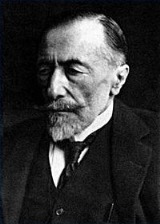
Joseph Conrad (born Józef Teodor Konrad Korzeniowski, 3 December 1857 – 3 August 1924) was a Polish novelist, writing in English. Many critics regard him as one of the greatest novelists in the English language, despite his not having learned to speak English fluently until he was in his twenties (and then always with a strong Polish accent). He became a naturalized British subject in 1886.


Discussion
Ask a question about 'Joseph Conrad'
Start a new discussion about 'Joseph Conrad'
Answer questions from other users
Full Discussion Forum


Quotations


A man's real life is that accorded to him in the thoughts of other men by reason of respect or natural love.

Pt. I

I had been six years at sea, but had only seen Melbourne and Sydney, very good places, charming places in their way — but Bankok! ~ Marlow

It's only those who do nothing that make no mistakes, I suppose.

An Outcast of the Islands (1896) Pt. 3, Ch. 2

Let a fool be made serviceable according to his folly.

Pt. I, ch. 3

Running all over the sea trying to get behind the weather.

Typhoon, ch. 2 (1902)

The air of the New World seems favorable to the art of declamation.

Part First: The Silver of the Mine, Ch. 6


Encyclopedia


Joseph Conrad (born Józef Teodor Konrad Korzeniowski, 3 December 1857 – 3 August 1924) was a Polish novelist, writing in English. Many critics regard him as one of the greatest novelists in the English language, despite his not having learned to speak English fluently until he was in his twenties (and then always with a strong Polish accent). He became a naturalized British subject in 1886. He wrote stories and novels, predominantly with a nautical setting, that depicted the heroism of faith before the imperatives of duty, social responsibility and honor.

Conrad is recognized as a master prose
Prose

Prose is writing that resembles everyday Speech communication. The word "prose" is derived from the Latin prosa, which literally translates to "straightforward"....
 stylist. Some of his works have a strain of romanticism
Romanticism

Romanticism is a complex artistic, literary, and intellectual movement that originated in the second half of the 18th century in Western Europe, and gained strength during the Industrial Revolution....
, but more importantly he is recognized as an important forerunner of modernist literature
Modernist literature

Modernist literature is the literary expression of the tendencies of Modernism, especially High modernism.Modernism as a literary movement reached its height in Europe between 1900 and the middle 1920s....
. His narrative style and anti-heroic characters have influenced many writers, including Ernest Hemingway
Ernest Hemingway

Ernest Miller Hemingway was an American novelist, short story author, and journalist. He was part of the 1920s expatriate community in Paris, France, and one of the veterans of World War I later known as "the Lost Generation"....
, D. H. Lawrence
D. H. Lawrence

David Herbert Richards Lawrence was an England author, poet, playwright, essayist and literary criticism. His collected works represent an extended reflection upon the dehumanizing effects of modernity and industrialization....
, F. Scott Fitzgerald
F. Scott Fitzgerald

Francis Scott Key Fitzgerald was an United States writer of novels and short stories, whose works are evocative of the Jazz Age, a term he coined himself....
, Graham Greene
Graham Greene

Henry Graham Greene Order of Merit, Order of the Companions of Honour was an English writer best known as a novelist, but who also produced short stories, plays, screenplays, travel writing and criticism....
, Malcolm Lowry
Malcolm Lowry

Malcolm Lowry was an England poet and novelist who was best known for his novel, Under the Volcano....
, William S. Burroughs
William S. Burroughs

William Seward Burroughs II was an United States novelist, essayist, social critic, Painting and spoken word performer.Much of Burroughs's work is semi-autobiographical, drawn from his experiences as an opiate addict, a condition that marked the last fifty years of his life....
, Joseph Heller
Joseph Heller

Joseph Heller was an American satirical novelist, short story writer and playwright. He wrote the influential novel Catch-22 about American servicemen during World War II....
, V.S. Naipaul, Italo Calvino
Italo Calvino

Italo Calvino was an Italy journalist and writer of short stories and novels. His best known works include the Our Ancestors trilogy , the Cosmicomics collection of short stories , and the novels Invisible Cities and If on a Winter's Night a Traveler ....
, Hunter S. Thompson
Hunter S. Thompson

Hunter Stockton Thompson was an United States journalist and author, most famous for his novel Fear and Loathing in Las Vegas . He is credited as the creator of Gonzo journalism, a style of journalism where reporters involve themselves in the action to such a degree that they become central figures of their stories....
, and J. M. Coetzee.

Conrad's novels and stories have also inspired such films as Sabotage
Sabotage (film)

Sabotage, also released as The Woman Alone, is a 1936 in film United Kingdom thriller film directed by Alfred Hitchcock. It was based on Joseph Conrad novel The Secret Agent....
 (1936, directed by Alfred Hitchcock
Alfred Hitchcock

Sir Alfred Joseph Hitchcock, Order of the British Empire was a British filmmaker and film producer who pioneered many techniques in the suspense and psychological thriller genres....
, adapted from Conrad's The Secret Agent
The Secret Agent

The Secret Agent: A Simple Tale is a novel by Joseph Conrad published in 1907. The story is set in London in 1886 and deals largely with the life of Mr....
); Francis Ford Coppola
Francis Ford Coppola

Francis Ford "Frank" Coppola is a five-time Academy Award-winning United States film director, Film producer and screenwriter. Away from showbusiness, Coppola is also a vintner, publisher and Hotel manager....
's Apocalypse Now
Apocalypse Now

Apocalypse Now is an Cinema of the United States 1979 in film epic film war film set during the Vietnam War. It tells the tale of United States Armed Forces Captain Benjamin L....
 (1979, adapted from Conrad's Heart of Darkness
Heart of Darkness

Heart of Darkness is a novella written by Poland writer Joseph Conrad. Before its 1902 publication, it appeared as a three-part series in Blackwood's Magazine....
); The Duellists
The Duellists

The Duellists is a 1977 in film film, which was Ridley Scott's first feature film as a director. It won the Best Debut Film award at Cannes....
 (a 1977 Ridley Scott
Ridley Scott

Sir Ridley Scott is a United Kingdom Academy Award nominated and Golden Globe Award, Emmy Award and British Academy of Film and Television Arts winning film director and film producer known for his stylish visuals and an obsession for detail....
 adaptation of Conrad's The Duel, from A Set of Six); and a 1996 film inspired by The Secret Agent
The Secret Agent

The Secret Agent: A Simple Tale is a novel by Joseph Conrad published in 1907. The story is set in London in 1886 and deals largely with the life of Mr....
, starring Bob Hoskins
Bob Hoskins

Robert William "Bob" Hoskins, Jr. is an England actor, known for playing Cockney rough diamonds and gangsters, and for his performances in family films such as Who Framed Roger Rabbit and Hook ....
, Patricia Arquette
Patricia Arquette

Patricia T. Arquette is an United Statesn actor, currently starring in the supernatural drama Medium ....
 and Gérard Depardieu
Gérard Depardieu

name = G?rard DepardieuNational Order of Quebec| image = G?rard Depardieu 2008.jpg| imagesize =| caption = G?rard Depardieu, 2008...
.

Writing during the apex of the British Empire
British Empire

The British Empire comprised the dominions, Crown colony, protectorates, League of Nations mandate, and other Dependent territory ruled or administered by the United Kingdom , that had originated with the overseas colonies and trading posts established by England in the late 16th and early 17th centuries....
, Conrad drew upon his experiences serving in the French and later the British Merchant Navy to create novels and short stories that reflected aspects of a world-wide empire while also plumbing the depths of the human soul.

Early life

Conradwarsaw
Joseph Conrad was born in Berdyczów (now Berdychiv
Berdychiv

Berdychiv is a historic city in the Zhytomyr Oblast of northern Ukraine. Serving as the Capital city of the Berdychivskyi Raion , the city itself is of direct oblast subordinance, and is located south of the oblast capital, Zhytomyr, at around ....
, Ukraine
Ukraine

Ukraine is a country in Eastern Europe. It is bordered by Russia to the east; Belarus to the north; Poland, Slovakia, and Hungary to the west; Romania and Moldova to the southwest; and the Black Sea and Sea of Azov to the south....
) into an impoverished, highly patriotic Polish noble
Szlachta

Szlachta refers to the nobility social class in the Kingdom of Poland , the Grand Duchy of Lithuania and the increasingly polonized territories under their control ....
 family bearing the Nalecz coat-of-arms. His father Apollo Korzeniowski
Apollo Korzeniowski

Apollo Korzeniowski was a Poland poet, playwright, clandestine political activist, and father of Polish-English novelist Joseph Conrad....
 was a writer of politically-themed plays and a translator of Alfred de Vigny
Alfred de Vigny

Alfred Victor de Vigny was a French poet, playwright, and novelist.LifeAlfred de Vigny was born in Loches into an aristocratic family....
, Victor Hugo
Victor Hugo

Victor-Marie Hugo was a France poet, playwright, novelist, essayist, visual artist, statesman, human rights activist and exponent of the Romanticism movement in France....
, Charles Dickens
Charles Dickens

Charles John Huffam Dickens, Royal Society of Arts , pen-name "Boz", was the most popular English people novelist of the Victorian era, as well as a vigorous Reform movement....
 and Shakespeare from the French and English. He encouraged his son Konrad to read widely in Polish and French. In 1861 the elder Korzeniowski was arrested by Imperial Russian authorities in Warsaw
Warsaw

Warsaw is the Capital and World's largest cities of Poland. It is located on the Vistula River roughly from both the Baltic Sea coast and the Carpathian Mountains....
 for helping organize what would become the January Uprising of 1863–64, and was exiled to Vologda
Vologda

Vologda is a city in Russia and the administrative center of Vologda Oblast. Population: 293,700 ; Vologda takes its name, of likely Finno-Ugrian origin, from the Vologda River which flows through the city....
, a city with a very harsh climate, some north of Moscow. His wife Ewelina Korzeniowska (née
Nee

Nee may refer to:* Married and maiden names or Nee, French for "born", indicates a woman's birth surname* NEE, a political party in Flanders, Belgium...
 Bobrowska) and four-year-old son followed him into exile. Due to Ewelina's weak health, Apollo
Apollo Korzeniowski

Apollo Korzeniowski was a Poland poet, playwright, clandestine political activist, and father of Polish-English novelist Joseph Conrad....
 was allowed in 1865 to move to Chernihiv
Chernihiv

Chernihiv, , is a historic city in northern Ukraine. It is the administrative center of the Chernihiv Oblast , as well as of the surrounding Chernihivskyi Raion within the oblast....
, Ukraine, where within a few weeks Ewelina died of tuberculosis
Tuberculosis

Tuberculosis is a common and often deadly infectious disease caused by mycobacterium, mainly Mycobacterium tuberculosis . Tuberculosis usually attacks the lungs but can also affect the central nervous system, the lymphatic system, the circulatory system, the genitourinary system, the gastrointestinal system, bones, joints, and even the...
. Apollo died four years later in Kraków
Kraków

Krak?w , in English also spelled Krakow or Cracow , is one of the largest and oldest cities in Poland, with a population of 756,336 in 2007 ....
, leaving Conrad orphaned at the age of eleven.

In Kraków, young Conrad was placed in the care of his maternal uncle, Tadeusz Bobrowski
Tadeusz Bobrowski

Tadeusz Bobrowski was a Poland memoirist and social activist, best known outside Poland as the maternal uncle, guardian and mentor of English novelist Joseph Conrad....
—a more cautious figure than his parents. Nevertheless, Bobrowski allowed Conrad to travel at the age of 16 to Marseille
Marseille

"Marseille" is the second-largest city of France and forms the third-largest aire urbaine, after those of Paris and Lyon, with a population recorded to be 1,516,340 at the 1999 census and estimated to be 1,605,000 in 2007....
 and begin a career as a seaman. This came after Conrad had been rejected for Austro-Hungarian citizenship, leaving him liable to conscription into the Russian Army.

Voyages

Conrad lived an adventurous life, dabbling in gunrunning
Gunrunning

Illegal arms trafficking, also known as Gunrunning, is trafficking in contraband weapons and ammunition.Arms trafficking is most widespread in regions of political turmoil, but is not limited to such areas....
 and political conspiracy, which he later fictionalized in his novel The Arrow of Gold. Apparently he experienced a disastrous love affair that plunged him into despair. A voyage down the coast of Venezuela
Venezuela

Venezuela , officially the Bolivarian Republic of Venezuela , is a country on the northern coast of South America.The country comprises a continental mainland and numerous islands located off the Venezuelan coastline in the Caribbean Sea....
 would provide material for Nostromo
Nostromo

Nostromo is a 1904 novel by Poland-born United Kingdom novelist Joseph Conrad, set in the fictitious South American republic of "Costaguana." It was originally published Serial ly in two volumes of T.P.'s Weekly....
; the first mate of Conrad's vessel became the model for that novel's hero.

In 1878, after a failed suicide attempt in Marseille
Marseille

"Marseille" is the second-largest city of France and forms the third-largest aire urbaine, after those of Paris and Lyon, with a population recorded to be 1,516,340 at the 1999 census and estimated to be 1,605,000 in 2007....
 by shooting himself in the chest, Conrad took service on his first British ship, bound for Constantinople
Constantinople

Constantinople was the empire capital of the Roman Empire , the Byzantine Empire , the Latin Empire , and the Ottoman Empire . Strategically located between the Golden Horn and the Sea of Marmara at the point where Europe meets Asia, Byzantine Constantinople had been the capital of a Christendom empire, successor to ancient ancient Greece...
 before its return to Lowestoft
Lowestoft

Lowestoft is a coastal town in Suffolk, East Anglia, England, lying between the eastern edge of The Broads National Park at Oulton Broad and the North Sea....
, his first landing in Britain.

Barely a month after reaching England, Conrad signed on for the first of six voyages between July and September 1878 from Lowestoft to Newcastle on a coaster
Coastal trading vessel

Coastal trading vessels, also known as coasters, are shallow-hulled ships used for trade between locations on the same island or continent....
 misleadingly named Skimmer of the Sea. Crucially for his future career, he "began to learn English from East Coast chaps, each built to last for ever and coloured like a Christmas card."

In London on 21 September 1881 Conrad set sail for Newcastle
Newcastle upon Tyne

Newcastle upon Tyne is a City status in the United Kingdom and metropolitan borough of Tyne and Wear, in North East England. Situated on the north bank of the River Tyne, the city developed from a Roman Empire settlement called Pons Aelius, though it owes its name to the Newcastle Castle built in 1080, by Robert Curthose, the eldest son of...
 as second mate on the small vessel Palestine (13 hands) to pick up a cargo of 557 tons of "West Hartley" coal bound for Bangkok. From the outset, things went wrong. A gale hampered progress (sixteen days to the Tyne), then the Palestine had to wait a month for a berth and was finally rammed by a steam vessel.

At the turn of the year, Palestine sailed from the Tyne. The ship sprang a leak in the English Channel
English Channel

The English Channel is an Arm of the Atlantic Ocean that separates England from northern France, and joins the North Sea to the Atlantic. It is about long and varies in width from at its widest, to only in the Strait of Dover....
 and was stuck in Falmouth, Cornwall
Falmouth, Cornwall

Falmouth is a town, civil parish and port in the Carrick, Cornwall District on the River Fal on the south coast of Cornwall, England, UK. It has a total resident population of 21,635....
, for a further nine months. After all these misfortunes, Conrad wrote, "Poor old Captain Beard looked like a ghost of a Geordie skipper." The ship set sail from Falmouth on 17 September 1882 and reached the Sunda Strait
Sunda Strait

The Sunda Strait is the strait between the Indonesian islands of Java island and Sumatra. It connects the Java Sea to the Indian Ocean. The name comes from the Indonesian term Pasundan, "West Java"....
 in March 1883. Finally, off Java Head, the cargo ignited and fire engulfed the ship. The crew, including Conrad, reached shore safely in open boats. The ship is re-named Judaea in Conrad's famous story Youth
Youth (Conrad story)

"Youth" is an autobiographical short story by Joseph Conrad. It was written in 1898 in literature and included as the first story in the 1902 volume Youth, a Narrative, and Two Other Stories....
, which covers all these events. This voyage from the Tyne was Conrad's first fateful contact with the exotic East, the setting for many of his later works.

In 1886 he gained both his Master Mariner's certificate and British citizenship, officially changing his name to "Joseph Conrad." Prior to his retirement from the sea in 1894, Conrad served a total of sixteen years in the merchant navy. In 1883 he joined the Narcissus in Bombay, a voyage that inspired his 1897 novel The Nigger of the Narcissus.

A childhood ambition to visit central Africa was realised in 1889, when Conrad contrived to reach the Congo Free State
Congo Free State

The Congo Free State was a corporate state privately controlled by Leopold II of Belgium through a dummy non-governmental organization, the Association Internationale Africaine....
. He became captain of a Congo steamboat
Steamboat

A steamboat or steamship, sometimes called a steamer, is a ship in which the primary method of propulsion is steam engine, typically driving propellers or paddlewheels....
, and the atrocities he witnessed and his experiences there not only informed his most acclaimed and ambiguous work, Heart of Darkness
Heart of Darkness

Heart of Darkness is a novella written by Poland writer Joseph Conrad. Before its 1902 publication, it appeared as a three-part series in Blackwood's Magazine....
, but served to crystalise his vision of human nature — and his beliefs about himself. These were in some measure affected by the emotional trauma and lifelong illness he contracted there. During his stay, he became acquainted with Roger Casement
Roger Casement

Roger David Casement , , was an Ireland patriot, poet, revolutionary and Irish nationalism. He was a United Kingdom consul by profession famous for his reports and activities against human rights abuses in the Congo Free State and Peru, but better known for his dealings with Germany before Ireland's Easter Rising in 1916....
, whose 1904 Congo Report
Casement Report

The Casement Report was a 1904 document by British diplomat Roger Casement detailing abuses in the Congo Free State which was under the private ownership of King Leopold II of Belgium....
 detailed the abuses suffered by the indigenous population.

The journey upriver that the book's protagonist, Charles Marlow
Charles Marlow

Charles Marlow is a recurring character in the work of Polish-born English novelist Joseph Conrad. Marlow is an alter ego of Conrad; both are sailors for the British Empire during the late-19th and early-20th century during the height of British imperialism....
, made closely follows Conrad's own, and he appears to have experienced a disturbing insight into the nature of evil
Evil

Evil, in many cultures, is a broad term used to describe intentional negative moral acts or thoughts that are cruel, unjust or selfish. Evil is usually good and evil, which describes acts that are kind, just or unselfish....
. Conrad's experience of loneliness
Loneliness

Loneliness is a feeling where people experience a powerful surge of emptiness and solitude. Loneliness is more than the feeling of wanting Interpersonal relationship or wanting to do something with another person....
 at sea, of corruption
Political corruption

Political corruption is the use of governmental powers by government officials for illegitimate private gain. Misuse of government power for other purposes, such as repression of political opponents and general police brutality, is not considered political corruption....
 and of the pitilessness of nature
Nature

File:Jungle in Punjab.JPGNature, in the broadest sense, is equivalent to the natural world, physical universe, material world or material universe....
 converged to form a coherent, if bleak, vision of the world. Isolation, self-deception
Self-deception

Self-deception is a process of denial or Rationalization away the relevance, significance, or importance of opposing evidence and logical argument....
, and the remorseless working out of the consequences of character flaw
Character flaw

A character flaw is a limitation, imperfection, problem, phobia, or deficiency present in a character who may be otherwise very functional. The flaw can be a problem that directly affects the character's actions and abilities, such as a violent temper....
s are threads running through much of his work. Conrad's own sense of loneliness throughout his exile's life would find memorable expression in the 1901 short story, "Amy Foster
Amy Foster

"Amy Foster" is a short story by Joseph Conrad written in 1901. It was first published in the Illustrated London News , and was collected in Typhoon and Other Stories ....
."

In 1891, Conrad stepped down in rank to sail as first mate on the Torrens, quite possibly the finest ship ever launched from a Sunderland
Sunderland

Sunderland is a city in Tyne and Wear, England. It was formerly a county borough but now forms part of the City of Sunderland. It is situated at the mouth of the River Wear....
 yard (James Laing's
James Laing (shipbuilder)

Sir James Laing, Justice of the Peace, Deputy Lieutenant , was a British shipbuilder....
 Deptford Yard, 1875). For fifteen years (1875–90), no ship approached her speed for the outward passage to Australia. On her record-breaking run to Adelaide, she covered 16,000 miles in 64 days. Conrad writes of her:

"A ship of brilliant qualities - the way the ship had of letting big seas slip under her did one's heart good to watch. It resembled so much an exhibition of intelligent grace and unerring skill that it could fascinate even the least seamanlike of our passengers."

Conrad made two voyages to Australia aboard her, but in 1894 he had parted from the sea for ever and embarked upon his literary career—having begun writing his first novel Almayer's Folly on board the Torrens.

In March 1896 Conrad married an Englishwoman, Jessie George, and together they moved into a small semi-detached villa in Victoria Road, Stanford-le-Hope
Stanford-le-Hope

Stanford-le-Hope is a town situated in the county of Essex, England. The town is within the unitary authority of Thurrock and located 23.8 miles east of Charing Cross in London....
 and later to a medieval lath-and-plaster
Lath and plaster

Lath and plaster is a building process used mainly for interior walls in Canada and the United States until the late 1950s. After the 1950s, drywall began to replace the lath and plaster process in the these countries....
 farmhouse, "Ivy Walls," in Billet Lane. He subsequently lived in London and near Canterbury
Canterbury

Canterbury lies at the heart of the City of Canterbury, a local government district of Kent, in South East England. It lies on the River Stour....
, Kent
Kent

Kent is a Counties of England in southeast England, and is one of the home counties. It borders East Sussex, Surrey and Greater London and has a defined boundary with Essex in the middle of the River Thames estuary....
. The couple had two sons, John and Borys.

Emotional development

A further insight into Conrad's emotional life is provided by an episode which inspired one of his strangest and least known stories, "A Smile of Fortune." In September 1888 he put into Mauritius
Mauritius

Mauritius , officially the Republic of Mauritius, , is an island nation off the coast of the African continent in the southwest Indian Ocean, about 900 kilometres east of Madagascar....
, as captain of the sailing barque Otago. His story likewise recounts the arrival of an unnamed English sea captain in a sailing vessel, come for sugar. He encounters “the old French families, descendants of the old colonists; all noble, all impoverished, and living a narrow domestic life in dull, dignified decay. . . . The girls are almost always pretty, ignorant of the world, kind and agreeable and generally bilingual. The emptiness of their existence passes belief.”

The tale describes Jacobus, an affable gentleman chandler beset by hidden shame. Extramarital passion for the bareback rider of a visiting circus had resulted in a child and scandal. For eighteen years this daughter, Alice, has been confined to Jacobus’s house, seeing no one but a governess. When Conrad’s captain is invited to the house of Jacobus, he is irresistibly drawn to the wild, beautiful Alice. "For quite a time she did not stir, staring straight before her as if watching the vision of some pageant passing through the garden in the deep, rich glow of light and the splendour of flowers."

The suffering of Alice Jacobus was true enough. A copy of the Dictionary of Mauritian Biography unearthed by the scholar Zdzislaw Najder
Zdzislaw Najder

Zdzislaw Najder is a Polish historian of literature, a former opponent of the government of the Polish People's Republic, and former director of the Polish section of Radio Free Europe....
 reveals that her character was a fictionalised version of seventeen-year-old Alice Shaw, whose father was a shipping agent and owned the only rose garden in the town. While it is evident that Conrad too fell in love while in Mauritius, it was not with Alice. His proposal to young Eugénie Renouf was declined, the lady being already engaged. Conrad left broken-hearted, vowing never to return.

Something of his feelings is considered to permeate the recollections of the captain. "I was seduced by the moody expression of her face, by her obstinate silences, her rare, scornful words; by the perpetual pout of her closed lips, the black depths of her fixed gaze turned slowly upon me as if in contemptuous provocation."

Later life and death

Herb Nalecz
In 1894, aged 36, Conrad reluctantly gave up the sea, partly because of poor health and partly because he had become so fascinated with writing that he decided on a literary career. His first novel, Almayer's Folly, set on the east coast of Borneo
Borneo

Borneo is the List of islands by area and is located at the centre of Maritime Southeast Asia. Administratively, this island is divided between Indonesia, Malaysia and Brunei....
, was published in 1895. Together with its successor, An Outcast of the Islands
An Outcast of the Islands

An Outcast of the Islands is the second novel by Joseph Conrad, published in 1896 in literature, inspired by Conrad's experience as mate of a steamer, the Vigar....
 (1896), it laid the foundation for Conrad's reputation as a romantic teller of exotic tales, a misunderstanding of his purpose that was to frustrate him for the rest of his career.

Except for several vacations in France and Italy, a 1914 journey to Poland, and a 1923 visit to the United States, he lived the rest of his life in England.

Financial success evaded Conrad, though a Civil List
Civil list

A civil list is a list of individuals to whom money is paid by the government....
 pension of £100 per annum stabilised his affairs, and collectors began to purchase his manuscript
Manuscript

A manuscript is any document that is written by hand, as opposed to being printed or reproduced in some other way. The term may also be used for information that is hand-recorded in other ways than writing, for example inscriptions that are chiselled upon a hard material or scratched as with a knife point in plaster or with a stylus on a wa...
s. Though his talent was recognized by the English intellectual elite, popular success eluded him until the 1913 publication of Chance
Chance (novel)

Chance is a novel by Joseph Conrad, published in 1913 following serial publication the previous year. Although the novel was not one upon which Conrad's later critical reputation was to depend, it was his greatest commercial success upon initial publication....
—paradoxically so, as it is not now regarded as one of his better novels. Thereafter, for the remaining years of his life, Conrad was the subject of more discussion and praise than any other English writer of the time. Although the quality of his work declined, he enjoyed increasing wealth and status. Conrad had a true genius for companionship, and his circle of friends included talented authors such as Stephen Crane
Stephen Crane

Stephen Crane was an United States novelist, short story writer, poet and journalist. Prolific throughout his short life, he wrote notable works in the literary realism tradition as well as early examples of American Naturalism and Impressionism ....
 and Henry James
Henry James

Henry James, Order of Merit , son of theologian Henry James Sr., brother of the philosopher and psychologist William James and diarist Alice James, was an United States author....
. In the early 1900s he composed a short series of novels in collaboration with Ford Madox Ford
Ford Madox Ford

Ford Madox Ford was an English people novelist, poet, critic and Literary editor whose journals, The English Review and The Transatlantic Review, were instrumental in the development of early 20th-century English literature....
.

In April 1924 Conrad, who possessed a hereditary Polish status of nobility and coat-of-arms
Coat of arms

A coat of arms, more properly called an armorial achievement, armorial bearings or often just arms for short, in European tradition, is a design belonging to a particular person and used by them in a wide variety of ways....
 (Nalecz), declined a (non-hereditary) British knighthood offered by Prime Minister Ramsay MacDonald
Ramsay MacDonald

James Ramsay MacDonald was a British politician and twice Prime Minister of the United Kingdom. He rose from humble origins to become the first Labour Party Prime Minister in 1924....
. Shortly after, on 3 August 1924, he died of a heart attack
Myocardial infarction

Myocardial infarction , commonly known as a heart attack, occurs when the Blood flow to part of the heart is interrupted. This is most commonly due to occlusion of a coronary artery following the rupture of a Vulnerable plaque, which is an unstable collection of lipids and white blood cells in the wall of an artery....
. He was interred at Canterbury Cemetery, Canterbury
Canterbury

Canterbury lies at the heart of the City of Canterbury, a local government district of Kent, in South East England. It lies on the River Stour....
, England, under his original Polish surname, Korzeniowski.

Legacy

Of Conrad's novels, Lord Jim
Lord Jim

Lord Jim is a novel by Joseph Conrad, originally published in Blackwood's Magazine from October 1899 to November 1900 in literature....
 and Nostromo
Nostromo

Nostromo is a 1904 novel by Poland-born United Kingdom novelist Joseph Conrad, set in the fictitious South American republic of "Costaguana." It was originally published Serial ly in two volumes of T.P.'s Weekly....
 continue to be widely read, as set texts and for pleasure. The Secret Agent
The Secret Agent

The Secret Agent: A Simple Tale is a novel by Joseph Conrad published in 1907. The story is set in London in 1886 and deals largely with the life of Mr....
 and Under Western Eyes
Under Western Eyes

Under Western Eyes is a novel by Joseph Conrad. The novel takes place in Saint Petersburg and Geneva and is viewed as Conrad's response to the themes explored in Crime and Punishment; Conrad being reputed to have detested Dostoevsky....
 are also considered to be among his finest books.

Arguably Conrad's most influential work remains Heart of Darkness
Heart of Darkness

Heart of Darkness is a novella written by Poland writer Joseph Conrad. Before its 1902 publication, it appeared as a three-part series in Blackwood's Magazine....
, to which many have been introduced by Francis Ford Coppola
Francis Ford Coppola

Francis Ford "Frank" Coppola is a five-time Academy Award-winning United States film director, Film producer and screenwriter. Away from showbusiness, Coppola is also a vintner, publisher and Hotel manager....
's film, Apocalypse Now
Apocalypse Now

Apocalypse Now is an Cinema of the United States 1979 in film epic film war film set during the Vietnam War. It tells the tale of United States Armed Forces Captain Benjamin L....
, inspired by Conrad's novella and set during the Vietnam War
Vietnam War

The Vietnam War, also known as the Second Indochina Wars, the Vietnam Conflict, or often in Vietnam the American War occurred in Vietnam, Laos and Cambodia from 1959 to April 30, 1975....
. The themes of Heart of Darkness, and the depiction of a journey into the darkness of the human psyche
Psyche (psychology)

In psychoanalysis, the psyche refers to the forces in an individual that influence cognition, behavior and Personality psychology. The word is borrowed from ancient Greek, and refers to the concept of the self, encompassing the modern ideas of soul, Self , and mind....
, still resonate with modern readers.

Style

Conrad, an emotional man subject to fits of depression, self-doubt and pessimism, disciplined his romantic
Romanticism

Romanticism is a complex artistic, literary, and intellectual movement that originated in the second half of the 18th century in Western Europe, and gained strength during the Industrial Revolution....
 temperament with an unsparing moral
Morality

Morality has three principal meanings.In its first, descriptive usage, morality means a code of conduct which is held to be authoritative in matters of right and wrong....
 judgment.

As an artist, he famously aspired, in his preface to The Nigger of the 'Narcissus'
The Nigger of the 'Narcissus'

The Nigger of the 'Narcissus': A Tale of the Sea is a novella by Joseph Conrad. Because of its quality compared to earlier works, some have described it as marking the start of Conrad's major period; others have placed it as the best work of his early period....
 (1897), "by the power of the written word to make you hear, to make you feel... before all, to make you see. That — and no more, and it is everything. If I succeed, you shall find there according to your deserts: encouragement, consolation, fear, charm — all you demand — and, perhaps, also that glimpse of truth for which you have forgotten to ask."

Writing in what to the visual arts
Visual arts

The visual arts are Art#Art forms that focus on the creation of works which are primarily visual in nature, such as drawing, painting, photography, printmaking, and filmmaking....
 was the age of Impressionism
Impressionism

Impressionism was a 19th-century art movement that began as a loose association of Paris-based artists art exhibition their art publicly in the 1860s....
, Conrad showed himself in many of his works a prose poet
Prose poetry

Prose poetry is usually considered a form of poetry written in prose that breaks some of the normal rules associated with prose discourse, for heightened imagery or emotional effect....
 of the highest order: thus, for instance, in the evocative Patna and courtroom scenes of Lord Jim
Lord Jim

Lord Jim is a novel by Joseph Conrad, originally published in Blackwood's Magazine from October 1899 to November 1900 in literature....
; in the "melancholy-mad elephant" and gunboat scenes of Heart of Darkness
Heart of Darkness

Heart of Darkness is a novella written by Poland writer Joseph Conrad. Before its 1902 publication, it appeared as a three-part series in Blackwood's Magazine....
; in the doubled protagonists
Doppelgänger

Doppelg?nger , or "Fetch", is the ghost double of a living person, a sinister form of bilocation.In the vernacular, "Doppelg?nger" has come to refer to any double or look-alike of a person....
 of The Secret Sharer
The Secret Sharer

"The Secret Sharer" is a short story by Joseph Conrad written in 1909, first published in Harper's Magazine in 1910, and as a book in the short-story collection Twixt Land and Sea ....
; and in the verbal and conceptual resonance
Resonance

In physics, resonance is the tendency of a system to oscillate at maximum amplitude at certain Frequency, known as the system's resonance frequencies ....
s of Nostromo
Nostromo

Nostromo is a 1904 novel by Poland-born United Kingdom novelist Joseph Conrad, set in the fictitious South American republic of "Costaguana." It was originally published Serial ly in two volumes of T.P.'s Weekly....
 and The Nigger of the 'Narcissus'
The Nigger of the 'Narcissus'

The Nigger of the 'Narcissus': A Tale of the Sea is a novella by Joseph Conrad. Because of its quality compared to earlier works, some have described it as marking the start of Conrad's major period; others have placed it as the best work of his early period....
.

The singularity of the universe depicted in Conrad's novels, especially compared to those of near-contemporaries like John Galsworthy
John Galsworthy

John Galsworthy Order of Merit was an England novelist and playwright. Notable works include The Forsyte Saga and its sequels, A Modern Comedy and End of the Chapter....
, is such as to open him to criticism similar to that later applied to Graham Greene
Graham Greene

Henry Graham Greene Order of Merit, Order of the Companions of Honour was an English writer best known as a novelist, but who also produced short stories, plays, screenplays, travel writing and criticism....
. But where "Greeneland" has been characterised as a recurring and recognisable atmosphere independent of setting, Conrad is at pains to create a sense of place
Sense of place

The term sense of place has been defined and utilized in different ways by different people. To some, it is a characteristic that some geographic places have and some do not, while to others it is a feeling or perception held by people ....
, be it aboard ship or in a remote village. Often he chose to have his characters play out their destinies in isolated or confined circumstances.

In the view of Evelyn Waugh
Evelyn Waugh

Arthur Evelyn St. John Waugh was a United Kingdom writer, best known for such darkly humorous and Satire novels as Decline and Fall, Vile Bodies, Scoop , A Handful of Dust, and The Loved One, as well as for serious works, such as Brideshead Revisited and the Sword of Honour trilogy that clearly manifest his Catho...
 and Kingsley Amis
Kingsley Amis

Sir Kingsley William Amis, Commander of Order of the British Empire was an English novelist, poet, critic and teacher. He wrote more than twenty novels, three collections of poetry, short stories, radio and television scripts, and books of social and literary criticism....
, it was not until the first volumes of Anthony Powell
Anthony Powell

Anthony Dymoke Powell, Companion of Honour, Order of the British Empire was an English novelist best known for his twelve-volume work A Dance to the Music of Time, published between 1951 and 1975....
's sequence, A Dance to the Music of Time
A Dance to the Music of Time

A Dance to the Music of Time is a twelve-volume cycle of novels by Anthony Powell, inspired by the painting of the same name by Nicolas Poussin....
, were published in the 1950s, that an English novelist achieved the same command of atmosphere and precision
Precision

Precision has the following meanings:Concepts* Accuracy and precision, measurement deviation from true value and its scatter* arithmetic precision, the number of digits from which a value is expressed...
 of language with consistency, a view supported by present-day critics like A. N. Wilson
A. N. Wilson

Andrew Norman Wilson , is an English writer, known for his critical biographies, novels and works of popular and cultural history. After ten years as a teacher he became a journalist and writer....
. This is the more remarkable, given that English was Conrad's third language. Powell acknowledged his debt to Conrad.

Conrad's third language remained inescapably under the influence of his first two — Polish and French. This makes his English seem unusual. It was perhaps from Polish and French prose
Prose

Prose is writing that resembles everyday Speech communication. The word "prose" is derived from the Latin prosa, which literally translates to "straightforward"....
 styles that he adopted a fondness for triple parallelism
Parallelism (rhetoric)

Parallelism means to give two or more parts of the sentences a similar form so as to give the whole a definite pattern.Parallelisms of various sorts are the chief rhetorical device of Biblical poetry in Hebrew language....
, especially in his early works ("all that mysterious life of the wilderness that stirs in the forest, in the jungles, in the hearts of wild men"), as well as for rhetoric
Rhetoric

Rhetoric is the art of using language as a means to persuade. Along with logic and dialectic, rhetoric is one of the three ancient arts of discourse....
al abstraction
Abstraction

Abstraction is the process or result of generalization by reducing the information content of a concept or an observable phenomenon, typically in order to retain only information which is relevant for a particular purpose....
 ("It was the stillness of an implacable force brooding over an inscrutable intention").

T. E. Lawrence
T. E. Lawrence

Lieutenant Colonel Thomas Edward Lawrence Order of the Bath, Distinguished Service Order , known professionally as T. E. Lawrence, was a British people soldier renowned especially for his liaison role during the Arab Revolt of 1916–18....
, one of many writers whom Conrad befriended, offered some perceptive observations about Conrad's writing:

He's absolutely the most haunting thing in prose that ever was: I wish I knew how every paragraph he writes (... they are all paragraphs: he seldom writes a single sentence...) goes on sounding in waves, like the note of a tenor bell, after it stops. It's not built in the rhythm of ordinary prose, but on something existing only in his head, and as he can never say what it is he wants to say, all his things end in a kind of hunger, a suggestion of something he can't say or do or think. So his books always look bigger than they are. He's as much a giant of the subjective
Subjectivity

Subjectivity refers to a subject's perspective or opinion, particularly feelings, beliefs, and desires. It is often used casually to refer to unjustified personal opinions, in contrast to knowledge and justified belief....
 as Kipling
Rudyard Kipling

Joseph Rudyard Kipling was an English author and poet. Born in Mumbai, British India , he is best known for his works of fiction The Jungle Book , Kim , many short stories, including The Man Who Would Be King ; and his poems, including Mandalay , Gunga Din , and If? ....
 is of the objective
Objective approach

Taking an objective approach to an issue means having due regard for the known valid evidence pertaining to that issue. If relevant valid evidence is denied or falsified, an objective approach is impossible....
. Do they hate one another?


In Conrad's time, literary critics, while usually commenting favourably on his works, often remarked that his exotic style, complex narration, profound
Profound

Sorry, no overview for this topic
 theme
Theme (literature)

A theme is a simile used to relate to idioms and or literary work a message or lesson conveyed by a written text. This message is usually about life, society or human nature....
s and pessimistic idea
Idea

An idea is a form formed by consciousness through the process of Ideation . Human capability to contemplate ideas is associated with the ability of reasoning, human self-reflection, and of the ability to acquire and apply intellect, intuition, inspiration, etc.....
s put many readers off. Yet as Conrad's ideas were borne out by 20th-century events, in due course he came to be admired for beliefs that seemed to accord with subsequent times more closely than with his own.

Conrad's was, indeed, a starkly lucid view of the human condition
Human condition

The human condition encompasses all of the experience of being human. As mortal entities, there are a series of biology determined events that are common to most human lives, and some that are inevitable for all....
 — a vision similar to that which had been offered in two micro-stories by his ten-years-older Polish compatriot, Boleslaw Prus
Boleslaw Prus

Boleslaw Prus , whose actual name was Aleksander Glowacki, was a Poland journalist and novelist who is known especially for his novels The Doll and Pharaoh ....
 (whose work Conrad admired): "Mold of the Earth
Mold of the Earth

"Mold of the Earth" is one of the shortest microfiction by the Poland journalist and novelist Boleslaw Prus.Written in 1884, the story comes from a several years' period of pessimism in the author's life caused by the situation of Poland and by the 1883 failure of Nowiny , a Warsaw newspaper that Prus had been editor-in-chief for le...
" (1884) and "Shades
Shades (story)

"Shades" is one of Boleslaw Prus' shortest microfiction. Written in 1885, it comes from a several years' period of pessimism in the author's life caused partly by the 1883 failure of Nowiny , a Warsaw newspaper that he had been editor-in-chief less than a year....
" (1885). Conrad wrote:

Faith is a myth and beliefs shift like mists on the shore; thoughts vanish; words, once pronounced, die; and the memory of yesterday is as shadow
Shadow

File:Shadow, Ronald Reagan Building - Washington, D.C..jpgA shadow is an area where direct light from a light source cannot reach due to obstruction by an object....
y as the hope of to-morrow....
In this world — as I have known it — we are made to suffer without the shadow of a reason, of a cause or of guilt....
There is no morality, no knowledge and no hope; there is only the consciousness of ourselves which drives us about a world
World

World is a common name for the planet Earth seen from a human worldview, as a place inhabited by human beings. It is often used to signify the sum of human experience and history, or the 'human condition' in general....
 that... is always but a vain and floating appearance....
A moment, a twinkling of an eye and nothing remains — but a clot of mud, of cold mud, of dead mud cast into black space, rolling around an extinguished sun
Sun

The Sun , a G V star, is the star at the center of the Solar System. The Earth and other matter orbit the Sun, which by itself accounts for about 98.6% of the Solar System's mass....
. Nothing. Neither thought, nor sound, nor soul. Nothing.


Conrad is the novelist of man in extreme situations. "Those who read me," he wrote in the preface to A Personal Record
A Personal Record

A Personal Record is an autobiographical work by Joseph Conrad, published in 1912.It has also been published under the titles A Personal Record: Some Reminiscences and Some Reminiscences....
, "know my conviction that the world, the temporal world, rests on a few very simple ideas; so simple that they must be as old as the hills. It rests, notably, among others, on the idea of Fidelity."

For Conrad fidelity is the barrier man erects against nothingness, against corruption, against the evil that is all about him, insidious, waiting to engulf him, and that in some sense is within him unacknowledged. But what happens when fidelity is submerged, the barrier broken down, and the evil without is acknowledged by the evil within? At his greatest, that is Conrad's theme.


Criticism

In 1975, Chinua Achebe
Chinua Achebe

Chinua Achebe , born Albert Chin?al?m?g? Achebe on 16 November 1930, is a Nigerian novelist, poet, professor and critic. He is best known for his first novel, Things Fall Apart , which is the most widely read book in modern African literature.....
 published an essay, "An Image of Africa: Racism in Conrad's 'Heart of Darkness'," wherein he labeled Conrad a "thoroughgoing racist." The essay set off a storm of controversy regarding Conrad's legacy. Achebe's point of view is that Heart of Darkness cannot be considered "a great work of art" because it is "a novel which celebrates... dehumanization, which depersonalizes a portion of the human race."

Referring to Conrad as a "talented, tormented man," Achebe drew on several instances of apparent racism in Conrad's writings in which the author derided "niggers" as variously "unreasoning," "savage" and "inscrutable." Conrad's advocates, however, in defending his reputation and the ongoing value of his work, have reproached Achebe with disregarding the "historical context" of Conrad's work.

Citing Heart of Darkness, Conrad's advocates have also noted that he refers to the rhetorically noble aims of European colonialists sardonically, thus illustrating his cynicism of the presumption that white men are inherently virtuous—the popular sentiment of his day. This is a central theme of the novel itself. The character Charles Marlow
Charles Marlow

Charles Marlow is a recurring character in the work of Polish-born English novelist Joseph Conrad. Marlow is an alter ego of Conrad; both are sailors for the British Empire during the late-19th and early-20th century during the height of British imperialism....
's experiences in Africa expose the brutal reality of colonialism and the falseness of the rationalisations given for it. Ending a passage describing the condition of chained, emaciated slave workers, Conrad remarks, "After all, I also was a part of the great cause of these high and just proceedings."

Memorials

Poland's Baltic Sea
Baltic Sea

The Baltic Sea is a brackish inland sea located in Northern Europe, from 53?N to 66?N latitude and from 20?E to 26?E longitude. It is bounded by the Scandinavian Peninsula, the mainland of Europe, and the Denmark islands....
 coast at Gdynia
Gdynia

Gdynia is a city in the Pomeranian Voivodeship of Poland and an important seaport at Gdansk Bay on the south coast of the Baltic Sea.Located in Kashubia in Eastern Pomerania, Gdynia is part of a conurbation with the spa town of Sopot, the city of Gdansk and suburban communities, which together form a metropolitan area called the Tricity...
 features an anchor
Anchor

An anchor is an object, often made out of metal, that is used to attach a ship to the bottom of a body of water at a specific point. There are two primary classes of anchors?temporary and permanent....
-shaped monument to Conrad.

In Circular Quay, Sydney, Australia a plaque is in a writers walk: image http://z.about.com/d/goaustralia/1/0/G/Y/josephconrad.jpg

In San Francisco, California
California

California is a U.S. state on the West Coast of the United States of the United States, along the Pacific Ocean. It is bordered by Oregon to the north, Nevada to the east, Arizona to the southeast, and to the south the Mexico state of Baja California....
, in 1979, a small triangular square at Columbus and Bay Streets, near Fisherman's Wharf
Fisherman's Wharf, San Francisco, California

Fisherman's Wharf is a neighborhood and popular tourist attraction in San Francisco, California, United StatesIt roughly encompasses the northern waterfront area of San Francisco from Ghirardelli Square or Van Ness Avenue east to Pier 35 or Kearny Street....
, was dedicated as "Joseph Conrad Square" after Conrad, who had twice visited San Francisco.

Notwithstanding the undoubted sufferings that Conrad endured on many of his voyages, he contrived to put up at the best lodgings at many of his destinations. Hotel
Hotel

----A hotel is an establishment that provides paid lodging on a short-term basis. The provision of basic accommodation, in times past, consisting only of a room with a bed, a cupboard, a small table and a washstand has largely been replaced by rooms with modern facilities, including Bathroom#Types of bathroomss and air conditioning or clima...
s across the Far East
Far East

The Far East is a term current in English language to refer to the countries of East Asia. The term is often expanded to also include Southeast Asia and South Asia, for economic and cultural reasons, for example because Buddhism is common to East Asia, Southeast Asia and South Asia....
 still lay claim to him as an honoured guest, often naming the rooms he stayed in after him: in the case of Singapore
Singapore

Singapore , officially the Republic of Singapore, is an island country microstate located at the southern tip of the Malay Peninsula. It lies 137 kilometres north of the equator, south of the Malaysian state of Johor and north of Indonesia's Riau Islands....
's Raffles Hotel
Raffles Hotel

Raffles Hotel is a colonial-style hotel in Singapore, dating from 1887, and named after Singapore's founder Stamford Raffles. Managed by Raffles International, it is known for its luxurious accommodation and superb restaurants....
, the wrong suite has been named in his honour, apparently for marketing reasons. His visits to Bangkok
Bangkok

The city of Bangkok is the Capital , largest urban area and primary city of Thailand. Known in Thai language as Krung Thep Maha Nakhon or Krung Thep for short, it was a small trading post at the mouth of the Chao Phraya River during the Ayutthaya Kingdom and came to the forefront of Thailand when it was given the status as the...
 are also lodged in that city's collective memory, and are recorded in the official history of the Oriental Hotel
The Oriental Bangkok

The Mandarin Oriental Hotel, Bangkok is a star hotel in Bangkok owned by the Mandarin Oriental Hotel Group. Located on the banks of the Chao Phraya River at 48 Oriental Avenue, the hotel is well-known for the excellence of its service, which consistently places it in surveys among the world's best hotels....
, along with that of a less well-behaved guest, Somerset Maugham, who pilloried the hotel in a short story in revenge for attempts to eject him.

Conrad is also reported to have stayed at Hong Kong's Peninsula Hotel. Later literary admirers, notably Graham Greene
Graham Greene

Henry Graham Greene Order of Merit, Order of the Companions of Honour was an English writer best known as a novelist, but who also produced short stories, plays, screenplays, travel writing and criticism....
, followed closely in his footsteps, sometimes requesting the same room. No Caribbean
Caribbean

The Caribbean is a region consisting of the Caribbean Sea, its islands , and the surrounding coasts. The region is located southeast of the Gulf of Mexico and Northern America, east of Central America, and to the north of South America....
 resort is yet known to have claimed Conrad's patronage, although he is believed to have stayed at a Fort-de-France
Fort-de-France

Fort-de-France is the Capital of France's Caribbean d?partement d'outre-mer of Martinique. With a population of 134,727 inhabitants in the urban area, 94,049 of whom live in the city of Fort-de-France proper, it is also one of the major cities in the Caribbean....
 pension upon arrival in Martinique
Martinique

Martinique is an island in the eastern Caribbean Sea, having a land area of 1,128 km?. It is an overseas department of France. To the northwest lies Dominica, to the south St Lucia....
 on his first voyage, in 1875, when he travelled as a passenger on the Mont Blanc.

Works


Novels

Joseph Conrad, Gdynia Ubt
*Almayer's Folly (1895)
  • An Outcast of the Islands
    An Outcast of the Islands

    An Outcast of the Islands is the second novel by Joseph Conrad, published in 1896 in literature, inspired by Conrad's experience as mate of a steamer, the Vigar....
     (1896)
  • The Nigger of the 'Narcissus'
    The Nigger of the 'Narcissus'

    The Nigger of the 'Narcissus': A Tale of the Sea is a novella by Joseph Conrad. Because of its quality compared to earlier works, some have described it as marking the start of Conrad's major period; others have placed it as the best work of his early period....
     (1897)
  • Heart of Darkness
    Heart of Darkness

    Heart of Darkness is a novella written by Poland writer Joseph Conrad. Before its 1902 publication, it appeared as a three-part series in Blackwood's Magazine....
     (1899)
  • Lord Jim
    Lord Jim

    Lord Jim is a novel by Joseph Conrad, originally published in Blackwood's Magazine from October 1899 to November 1900 in literature....
     (1900)
  • The Inheritors (with Ford Madox Ford
    Ford Madox Ford

    Ford Madox Ford was an English people novelist, poet, critic and Literary editor whose journals, The English Review and The Transatlantic Review, were instrumental in the development of early 20th-century English literature....
    ) (1901)
  • Typhoon
    Typhoon (novel)

    Typhoon is a novel by Joseph Conrad, begun in 1899 and serialized in Pall Mall Magazine January to March 1902. Its first book publication was in New York by Putnam in 1902 and was published in Britain in Typhoon and Other Stories by Heinemann in 1903....
     (1902, begun 1899)
  • Romance
    Romance (novel)

    Romance is a novel co-authored by Joseph Conrad and Ford Madox Ford. It was the second of their three collaborations. Romance was eventually published by George Bell and Sons in London and by McClure, Phillips in New York, in March 1904....
     (with Ford Madox Ford
    Ford Madox Ford

    Ford Madox Ford was an English people novelist, poet, critic and Literary editor whose journals, The English Review and The Transatlantic Review, were instrumental in the development of early 20th-century English literature....
    , 1903)
  • Nostromo
    Nostromo

    Nostromo is a 1904 novel by Poland-born United Kingdom novelist Joseph Conrad, set in the fictitious South American republic of "Costaguana." It was originally published Serial ly in two volumes of T.P.'s Weekly....
     (1904)
  • The Secret Agent
    The Secret Agent

    The Secret Agent: A Simple Tale is a novel by Joseph Conrad published in 1907. The story is set in London in 1886 and deals largely with the life of Mr....
     (1907)
  • Under Western Eyes
    Under Western Eyes

    Under Western Eyes is a novel by Joseph Conrad. The novel takes place in Saint Petersburg and Geneva and is viewed as Conrad's response to the themes explored in Crime and Punishment; Conrad being reputed to have detested Dostoevsky....
     (1911)
  • Chance
    Chance (novel)

    Chance is a novel by Joseph Conrad, published in 1913 following serial publication the previous year. Although the novel was not one upon which Conrad's later critical reputation was to depend, it was his greatest commercial success upon initial publication....
     (1913)
  • Victory
    Victory (novel)

    Victory: An Island Tale is a novel by Joseph Conrad first published in 1915.Once regarded as comparatively minor amongst Conrad's works, Victory has grown in reputation....
     (1915)
  • The Shadow Line
    The Shadow Line

    The Shadow Line is a short novel based at sea by Joseph Conrad, one of his later works, being published in 1917. The novella depicts the development of a young man upon taking a captaincy in the Orient, with the shadow-line of the title representing the threshold of this development....
     (1917)
  • The Arrow of Gold (1919)
  • The Rescue
    The Rescue (novel)

    The Rescue is a novel by Joseph Conrad, published in 1920 but begun in the 1890s and set aside by Conrad to write The Nigger of the Narcissus....
     (1920)
  • The Nature of a Crime (1923, with Ford Madox Ford
    Ford Madox Ford

    Ford Madox Ford was an English people novelist, poet, critic and Literary editor whose journals, The English Review and The Transatlantic Review, were instrumental in the development of early 20th-century English literature....
    )
  • The Rover
    The Rover (novel)

    The Rover is the last complete novel by Joseph Conrad, written between 1921 and 1922, The novel was first published in 1923....
     (1923)
  • Suspense: a Napoleonic Novel (1925; unfinished, published posthumously)


Novellas and short stories

  • "The Idiots" (Conrad's first short story; written during his honeymoon, published in Savo 1896 and collected in Tales of Unrest, 1898).
  • "The Black Mate" (written, according to Conrad, in 1886; published 1908; posthumously collected in Tales of Hearsay, 1925).
  • "The Lagoon
    The Lagoon

    "The Lagoon" is a short story by Joseph Conrad composed in 1896 and first published in Cornhill Magazine in 1897. The story is about a man that is referred to as 'Tuan' which is the equivalent of 'Lord' or 'Sir', a white man travelling through an Indonesian rainforest, who is forced to stop for the night with a distant Malay friend named Arsa...
    " (composed 1896; published in Cornhill Magazine 1897; collected in Tales of Unrest, 1898).
  • "An Outpost of Progress
    An Outpost of Progress

    "An Outpost of Progress" is a short story written in July 1896 by Joseph Conrad, drawing on his own experience at Congo. It was published in the magazine Cosmopolis in 1897 and was later collected in Tales of Unrest in 1898....
    " (written 1896 and named in 1906 by Conrad himself, long after the publication of Lord Jim and Heart of Darkness, as his 'best story'; published in Cosmopolis 1897 and collected in Tales of Unrest 1898; often compared to Heart of Darkness, with which it has numerous thematic affinities).
  • "The Return" (written circa early 1897; never published in magazine form; collected in Tales of Unrest, 1898; Conrad, presaging the sentiments of most readers, once remarked, "I hate it").
  • "Karain: A Memory" (written February–April 1897; published Nov. 1897 in Blackwood's and collected in Tales of Unrest, 1898).
  • "Youth
    Youth (Conrad story)

    "Youth" is an autobiographical short story by Joseph Conrad. It was written in 1898 in literature and included as the first story in the 1902 volume Youth, a Narrative, and Two Other Stories....
    " (written in 1898; collected in Youth, a Narrative and Two Other Stories, 1902)
  • "Falk" (novella/story, written in early 1901; collected only in Typhoon and Other Stories, 1903).
  • "Amy Foster
    Amy Foster

    "Amy Foster" is a short story by Joseph Conrad written in 1901. It was first published in the Illustrated London News , and was collected in Typhoon and Other Stories ....
    " (composed in 1901; published the Illustrated London News, Dec. 1901 and collected in Typhoon and Other Stories, 1903).
  • "To-morrow" (written early 1902; serialized in Pall Mall Magazine, 1902 and collected in Typhoon and Other Stories, 1903).
  • "The End of the Tether" (written in 1902; collected in Youth, a Narrative and Two Other Stories, 1902)
  • "Gaspar Ruiz" (written after "Nostromo" in 1904–05; published in Strand Magazine in 1906 and collected in A Set of Six, 1908 UK/1915 US. This story was the only piece of Conrad's fiction ever adapted by the author for cinema, as Gaspar the Strong Man, 1920).
  • "An Anarchist" (written in late 1905; serialized in Harper's in 1906; collected in A Set of Six, 1908 UK/1915 US.)
  • "The Informer" (written before January 1906; published in December 1906 in Harper's and collected in A Set of Six, 1908 UK/1915 US.)
  • "The Brute" (written in early 1906; published in The Daily Chronicle in December 1906; collected in A Set of Six, 1908 UK/1915 US.)
  • "The Duel" (aka "The Point of Honor": serialized in the UK in Pall Mall Magazine in early 1908 and in the US periodical Forum later that year; collected in A Set of Six in 1908 and published by Garden City Publishing in 1924. Joseph Fouché
    Joseph Fouché

    Joseph Fouch?, 1st Duc d'Otrante was a France statesman and List of Police Ministers of France under Napoleon I of France. In English texts his title is often translated as Duke of Otranto....
     makes a cameo appearance)
  • "Il Conde" (i.e., 'Conte' [count]: appeared in Cassell's [UK] 1908 and Hampton's [US] in 1909; collected in A Set of Six, 1908 UK/1915 US.)
  • "The Secret Sharer
    The Secret Sharer

    "The Secret Sharer" is a short story by Joseph Conrad written in 1909, first published in Harper's Magazine in 1910, and as a book in the short-story collection Twixt Land and Sea ....
    " (written December 1909; published in Harper's
    Harper's Magazine

    Harper's Magazine is a monthly, general-interest magazine of literature, politics, culture, finance, and the arts. It is the second-oldest, continuously-published monthly magazine in the U.S.; current circulation is more than 220,000 issues....
     in 1910 and collected in ’Twixt Land and Sea 1912)
  • "Prince Roman" (written 1910, published in 1911 in the Oxford and Cambridge Review; based upon the story of Prince Roman Sanguszko
    Roman Sanguszko

    Prince Roman Stanislaw Sanguszko was a Poland szlachta, patriot, political and social activist.Roman Sanguszko was born May 6, 1800 in his family manor in Volhynia....
     of Poland 1800–1881)
  • "A Smile of Fortune" (a long story, almost a novella, written in mid-1910; published in London Magazine in Feb. 1911; collected in ’Twixt Land and Sea 1912)
  • "Freya of the Seven Isles" (another near-novella, written late 1910–early 1911; published in Metropolitan Magazine and London Magazine in early 1912 and July 1912, respectively; collected in ’Twixt Land and Sea 1912)
  • "The Partner" (written in 1911; published in Within the Tides, 1915)
  • "The Inn of the Two Witches" (written in 1913; published in Within the Tides, 1915)
  • "Because of the Dollars" (written in 1914; published in Within the Tides, 1915)
  • "The Planter of Malata" (written in 1914; published in Within the Tides, 1915)
  • "The Warrior's Soul" (written late 1915–early 1916; published in Land and Water, in March 1917; collected in Tales of Hearsay, 1925)
  • "The Tale" (Conrad's only story about World War I
    World War I

    World War I, or the First World War , was a global military conflict which involved the Great powers, organized into two opposing military alliances: the Allies of World War I and the Central Powers....
    ; written 1916 and first published 1917 in Strand Magazine)


Memoirs and essays

  • The Mirror of the Sea (collection of autobiographical essays first published in various magazines 1904–6 ), 1906
  • A Personal Record
    A Personal Record

    A Personal Record is an autobiographical work by Joseph Conrad, published in 1912.It has also been published under the titles A Personal Record: Some Reminiscences and Some Reminiscences....
     (also published as Some Reminiscences), 1912
  • Notes on Life and Letters, 1921
  • Last Essays
    Last Essays

    Last Essays is a volume of essays by Joseph Conrad, edited with an introduction by Richard Curle, and published posthumously in 1926 .The volume includes nineteen shorter pieces, mainly written by Conrad for various newspapers and magazines after the publication of Notes on Life and Letters in 1921....
    , 1926


See also

  • List of works by Joseph Conrad
    List of works by Joseph Conrad

    A chronological list of Joseph Conrad's works....
  • Boleslaw Prus
    Boleslaw Prus

    Boleslaw Prus , whose actual name was Aleksander Glowacki, was a Poland journalist and novelist who is known especially for his novels The Doll and Pharaoh ....
  • ORP Conrad – a World War II
    World War II

    World War II, or the Second World War , was a global military conflict which involved a Participants in World War II, including all of the great powers, organised into two opposing military alliances: the Allies of World War II and the Axis powers....
     Polish Navy
    Polish Navy

    The Polish Navy is the branch of Polish Armed Forces responsible for naval operations. It has 60 ships and about 14,300 commissioned and enlisted personnel....
     cruiser
    Cruiser

    A cruiser is a large type of warship, which had its prime period from the late 19th century to the end of the Cold War. The first cruisers were intended for individual raiding and protection missions on the seas....
     named after Joseph Conrad.
  • King Leopold's Ghost
    King Leopold's Ghost

    King Leopold's Ghost is a best-selling popular history book by Adam Hochschild that explores the exploitation of the Congo Free State by King Leopold II of Belgium between 1885 and 1908....
  • Politics in fiction
    Politics in fiction

    This is a list of fictional stories in which politics features as an important Plot element. Passing mentions are omitted from this list....
  • List of Poles
    List of Poles

    This is a partial list of famous Poles or Polish language persons. In the interest of fairness and accuracy, a minority of persons of mixed heritage have their respective ancestries credited....


External links

Sources
  • at Internet Archive
    Internet Archive

    The Internet Archive is a nonprofit organization dedicated to building and maintaining a free and openly accessible online digital library, including an archive site of the World Wide Web....
     and Google Books (scanned books original editions color illustrated)
  • at The Online Books Page (various)
  • at LibriVox
    LibriVox

    LibriVox is an online digital library of free public domain audiobooks, read by volunteers. In January 2009, it had a catalog of 2,014 unabridged books and shorter works available to download....
     (audio books)
  • at Books In My Phone (cell phone)
  • at Conrad First, an archive of every newspaper and magazine in which the work of Joseph Conrad was first published.


Portals and biographies
  • , at The Joseph Conrad Centre of Poland
  • , at The Literature Network


Literary criticism
  • , a number of research articles on Conrad's work


Misc