
All Topics  
History of the world

 
History of the World

   Email Print
   Bookmark   Link


History of the world


The history of the world is the recorded
Recorded history

Recorded history can be defined as human history that has been written down or recorded by the use of language, whereas history is a more general term referring to any information about the past....
 memory of the experience, around the world, of Homo sapiens. Ancient human history
HIStory

HIStory: Past, Present and Future, Book I is a double album by Michael Jackson, released on June 20, 1995, and is Jackson's ninth. The first disc, named "HIStory Begins" consists of a selection of Jackson's greatest hits from the singer's past fifteen years, while the second, named "HIStory Continues" features new songs, with the...
 begins with the invention, independently at several sites on Earth, of writing
Writing

Writing is the representation of language in a textual Media through the use of a set of signs or symbols . It is distinguished from illustration, such as cave drawing and painting, and the recording of language via a non-textual medium such as Magnetic tape sound recording....
, which created the infrastructure for lasting, accurately transmitted memories and thus for the diffusion and growth of knowledge
Knowledge

Knowledge is defined in the Oxford English Dictionary as expertise, and skills acquired by a person through experience or education; the theoretical or practical understanding of a subject, what is known in a particular field or in total; facts and information or awareness or familiarity gained by experience of a fact or situation....
.

Human history is marked both by a gradual accretion of discoveries and inventions, as well as by quantum leap
Quantum leap

In physics, a quantum leap or quantum jump is a change of an electron from one quantum state to another within an atom. It is discontinuous; the electron jumps from one energy level to another instantaneously....
s—paradigm shift
Paradigm shift

Paradigm shift is the term first used by Thomas Samuel Kuhn in his influential book The Structure of Scientific Revolutions to describe a change in basic assumptions within the ruling theory of science....
s, revolution
Revolution

A revolution is a fundamental social change in power or organizational structures that takes place in a relatively short period of time....
s—that comprise epochs
Epoch (reference date)

In the fields of chronology and periodization, an epoch means an instant in time chosen as the origin of a particular era. The "epoch" then serves as a reference point from which time is measured....
 in the material and spiritual evolution of humankind.

One such epoch was the advent of the Agricultural Revolution
Neolithic Revolution

The Neolithic Revolution was the first agricultural revolution—the transition from hunter-gatherer communities and bands, to agriculture and settlement ....
.


Discussion
Ask a question about 'History of the world'
Start a new discussion about 'History of the world'
Answer questions from other users
Full Discussion Forum


Encyclopedia


The history of the world is the recorded
Recorded history

Recorded history can be defined as human history that has been written down or recorded by the use of language, whereas history is a more general term referring to any information about the past....
 memory of the experience, around the world, of Homo sapiens. Ancient human history
HIStory

HIStory: Past, Present and Future, Book I is a double album by Michael Jackson, released on June 20, 1995, and is Jackson's ninth. The first disc, named "HIStory Begins" consists of a selection of Jackson's greatest hits from the singer's past fifteen years, while the second, named "HIStory Continues" features new songs, with the...
 begins with the invention, independently at several sites on Earth, of writing
Writing

Writing is the representation of language in a textual Media through the use of a set of signs or symbols . It is distinguished from illustration, such as cave drawing and painting, and the recording of language via a non-textual medium such as Magnetic tape sound recording....
, which created the infrastructure for lasting, accurately transmitted memories and thus for the diffusion and growth of knowledge
Knowledge

Knowledge is defined in the Oxford English Dictionary as expertise, and skills acquired by a person through experience or education; the theoretical or practical understanding of a subject, what is known in a particular field or in total; facts and information or awareness or familiarity gained by experience of a fact or situation....
.

Human history is marked both by a gradual accretion of discoveries and inventions, as well as by quantum leap
Quantum leap

In physics, a quantum leap or quantum jump is a change of an electron from one quantum state to another within an atom. It is discontinuous; the electron jumps from one energy level to another instantaneously....
s—paradigm shift
Paradigm shift

Paradigm shift is the term first used by Thomas Samuel Kuhn in his influential book The Structure of Scientific Revolutions to describe a change in basic assumptions within the ruling theory of science....
s, revolution
Revolution

A revolution is a fundamental social change in power or organizational structures that takes place in a relatively short period of time....
s—that comprise epochs
Epoch (reference date)

In the fields of chronology and periodization, an epoch means an instant in time chosen as the origin of a particular era. The "epoch" then serves as a reference point from which time is measured....
 in the material and spiritual evolution of humankind.

One such epoch was the advent of the Agricultural Revolution
Neolithic Revolution

The Neolithic Revolution was the first agricultural revolution—the transition from hunter-gatherer communities and bands, to agriculture and settlement ....
. Between 8,500 and 7,000 BCE, in the Fertile Crescent
Fertile Crescent

The Fertile Crescent is a region in the Near East, incorporating the Levant and Mesopotamia, and often extended to Lower Egypt. Mesopotamia is considered the Cradle of civilization and saw the development of the earliest human civilizations and is the History_of_writing#Bronze_Age_writing and Wheel#History....
, humans began the systematic husbandry of plants and animals — agriculture
Agriculture

Agriculture refers to the production of food and goods through farming and forestry. Agriculture was the key development that led to the rise of civilization, with the animal husbandry of domestication animals and plants creating food surpluses that enabled the development of more Population density and Social stratification societies....
. This spread to neighboring regions, and also developed independently elsewhere, until most Homo sapiens lived sedentary lives in permanent settlements as farmers.

Not all societies abandoned nomad
Nomad

Nomadic people, , also known as nomads, are communities of people who move from one place to another, rather than Settler in one location....
ism, especially those in isolated regions that were poor in domesticable
Domestication

Domestication or taming refers to the process whereby a population of living things becomes accustomed to a controlled environment by other plants or animals through a process of Selective breeding....
 plant species. Those societies, however, that did abandon nomadism adopted settled life in scattered habitations centered about life-sustaining bodies of water
Water

Water is a common chemical substance that is essential for the survival of all known forms of life. In typical usage, water refers only to its liquid form or States of matter, but the substance also has a solid state, ice, and a gaseous state, water vapor or steam....
 — rivers and lakes. These communities coalesced over time into increasingly larger units, in parallel with the evolution of ever more efficient means of transport
Transport

Transport or transportation is the movement of passenger and cargo from one location to another. Transport is performed by various modes of transport, such as aviation, rail transport, road transport, ship transport, cable transport, pipeline transport and space transport....
.

The relative security and increased productivity provided by farming allowed these communities to expand. Surplus food made possible an increasing division of labor
Division of labour

Division of labour or specialization is the specialization of cooperative Labour in specific, circumscribed tasks and roles, intended to increase the productivity of labour....
, the rise of a leisured upper class
Upper class

The upper class is a concept in sociology that refers to the group of people at the top of a social hierarchy. Members of an upper class often have great power over the allocation of resources and governmental policy in their area....
, and the development of cities
City

A city is an urban area with a high population density and a particular administrative, legal, or historical status.Large industrialized cities generally have advanced systems for sanitation, utilities, land usage, house, and transportation and more....
 and thus of civilization
Civilization

A civilization is a society or culture group normally defined as a complex society characterized by the practice of agriculture and settlement in towns and city....
. The growing complexity of human societies necessitated systems of accounting; and from this evolved, beginning in the Bronze Age
Bronze Age

The Bronze Age is, with respect to a given prehistory, the period in that society when the most advanced metalworking included smelting copper and tin from naturally-occurring outcroppings of copper and tin ores, creating a bronze alloy by melting those metals together, and casting them into bronze artifact s....
, writing
Writing

Writing is the representation of language in a textual Media through the use of a set of signs or symbols . It is distinguished from illustration, such as cave drawing and painting, and the recording of language via a non-textual medium such as Magnetic tape sound recording....
. The independent invention of writing at several sites on Earth
Earth

Earth is the third planet from the Sun. Earth is the largest of the terrestrial planets in the Solar System in diameter, mass and density. It is also referred to as the World and Wiktionary:Terra.Note that by International Astronomical Union convention, the term "Terra" is used for naming extensive land masses, rather...
 allows a number of regions to claim to be cradles of civilization
Cradle of Civilization

The cradle of civilization is any of the possible locations for the emergence of civilization.It is usually applied to the Ancient Near Eastern Chalcolithic , especially in the Fertile Crescent , but also extended to sites in Anatolia and the Persian Plateau,...
.

Civilization
Civilization

A civilization is a society or culture group normally defined as a complex society characterized by the practice of agriculture and settlement in towns and city....
s developed perforce on the banks of rivers. One of the first civilizations to arise, between 4,000 and 3,000 BCE, was Sumer
Sumer

Sumer was a civilization and a historical region located in Southern Iraq , known as the Cradle of civilization. It lasted from the first settlement of Eridu in the Ubaid period through the Uruk period and the Dynastic periods until the rise of Babylon in the early 2nd millennium BC....
, in the Middle East
Middle East

File:GreaterMiddleEast1.pngThe Middle East is a region that spans southwestern Asia, western Asia, and northeastern Africa. It has no clear boundaries, often used as a synonym to Near East, in opposition to Far East....
's "land between the rivers"—Mesopotamia
Mesopotamia

Mesopotamia is the area of the Tigris-Euphrates river system, along the Tigris and Euphrates rivers, largely corresponding to modern Iraq, as well as some parts of northeastern Syria, some parts of southeastern Turkey, and some parts of the Khuzestan Province of southwestern Iran....
. Other civilizations soon developed on the banks of the Nile River in ancient Egypt
Ancient Egypt

Ancient Egypt was an Ancient history civilization in eastern North Africa, concentrated along the lower reaches of the Nile in what is now the modern nation of Egypt....
, at the Indus River valley
Indus Valley Civilization

The Indus Valley Civilization , abbreviated IVC, was an ancient civilization that flourished in the Indus River basin. Primarily centered along the Indus river, the civilization encompassed most of Pakistan, including its Sindh, Punjab and Balochistan provinces, and extending into modern day Indian states of Gujarat, Haryana, Punjab...
, and along the great rivers of China.

The history of the Old World
Old World

The Old World consists of those parts of Earth known to Europeans, Asians, and Africans in the 15th century....
 is commonly divided into:
  • Antiquity
    Ancient history

    Ancient history is the history from the History of writing until the Early Middle Ages in Europe, the Qin Dynasty in China, the Chola Empire in India, and some less defined point in the rest of the world ....
     — in the Ancient Near East
    Ancient Near East

    The Ancient Near East refers to early civilizations within a region roughly corresponding to the modern Middle East: Mesopotamia , Fars Province, Elam and Medes , Anatolia , the Levant , and Ancient Egypt, from the rise of Sumer in the 4th millennium BCE until the region's conquest by Alexander the Great in the 4th century BCE, or covering both th...
    , the Mediterranean basin of Classical Antiquity
    Classical antiquity

    Classical antiquity is a broad term for a long period of cultural history centered on the Mediterranean Sea, comprising the interlocking civilizations of Ancient Greece and Ancient Rome....
    , Ancient China, and Ancient India
    Ancient India

    Ancient India may refer to:*The ancient History of India, which generally includes the ancient history of the whole Indian subcontinent ...
    , up to about the 6th century;
  • the Middle Ages
    Middle Ages

    File:Karl 1 mit papst gelasius gregor1 sacramentar v karl d kahlen.jpgThe Middle Ages of European history are a period in history which lasted for roughly a millennium, commonly dated from the fall of the Roman Empire in the 5th century to the beginning of the Early Modern Period in the 16th century, marked by the division of Western Christi...
    , from the 6th through the 15th centuries;
  • the Early Modern period
    Early modern period

    The early modern period is a term used by historians to refer to the period roughly between 1500 to 1800 in Western Europe . It follows the Late Middle Ages period, and is marked by the first European colony, the rise of strong centralized governments, and the beginnings of recognizable nation states that are the direct antecedents of today'...
    , including the European Renaissance
    Renaissance

    The Renaissance was a cultural movement that spanned roughly the 14th to the 17th century, beginning in Italy in the late Middle Ages and later spreading to the rest of Europe....
    , from the 16th century to about 1750; and
  • the Modern period, from the Age of Enlightenment
    Age of Enlightenment

    The Age of Enlightenment or The Enlightenment is a term used to describe a time in Western philosophy and cultural life centered upon the eighteenth century, in which rationalism was advocated as the primary source and legitimacy for authority....
     and the Industrial Revolution
    Industrial Revolution

    The Industrial Revolution was a period in the late 18th and early 19th centuries when major changes in agriculture, manufacturing, production, and transportation had a profound effect on the socioeconomics and cultural conditions in United Kingdom....
    , beginning about 1750, to the present.


In Europe
Europe

Europe is, conventionally, one of the world's seven continents. Comprising the westernmost peninsula of Eurasia, Europe is generally divided from Asia to its east by the water divide of the Ural Mountains, the Ural , the Caspian Sea, and by the Caucasus Mountains to the southeast....
, the fall of the Western Roman Empire
Western Roman Empire

The Western Roman Empire refers to the western half of the Roman Empire, from its division by Diocletian in 285; the other half of the Roman Empire was the Eastern Roman Empire, today widely known as the Byzantine Empire....
 (476 CE) is commonly taken as signaling the end of antiquity
Ancient history

Ancient history is the history from the History of writing until the Early Middle Ages in Europe, the Qin Dynasty in China, the Chola Empire in India, and some less defined point in the rest of the world ....
 and the beginning of the Middle Ages
Middle Ages

File:Karl 1 mit papst gelasius gregor1 sacramentar v karl d kahlen.jpgThe Middle Ages of European history are a period in history which lasted for roughly a millennium, commonly dated from the fall of the Roman Empire in the 5th century to the beginning of the Early Modern Period in the 16th century, marked by the division of Western Christi...
. A thousand years later, in the mid-15th century, Johannes Gutenberg
Johannes Gutenberg

Johannes Gensfleisch zur Laden zum Gutenberg was a Germany goldsmith and printer who is credited with being the first European to use movable type printing, in around 1439, and the global inventor of the mechanical printing press....
's invention of modern printing
Printing

Printing is a process for reproducing text and image, typically with ink on paper using a printing press. It is often carried out as a large-scale industrial process, and is an essential part of publishing and transaction printing....
, employing movable type
Movable Type

Movable Type is a blog software developed by the company Six Apart. It was publicly announced on 3 September 2001, and version 1.0 was publicly released on 8 October 2001....
, revolutionized communication
Communication

Communication is commonly defined as "the imparting or interchange of thoughts, opinions, or information by speech, writing, or signs...",, 1: an act or instance of transmitting and 3 a: "a process by which information is exchanged between individuals through a common system of symbols, signs, or beha...
, helping end the Middle Ages
Middle Ages

File:Karl 1 mit papst gelasius gregor1 sacramentar v karl d kahlen.jpgThe Middle Ages of European history are a period in history which lasted for roughly a millennium, commonly dated from the fall of the Roman Empire in the 5th century to the beginning of the Early Modern Period in the 16th century, marked by the division of Western Christi...
 and usher in modern times, the European Renaissance and the Scientific Revolution
Scientific revolution

The period which many History of science call the Scientific Revolution is commonly viewed as the foundation and origin of modern science.It was a time roughly coinciding with the later part of the Middle Ages and through the Renaissance in which scientific ideas in physics, astronomy, and biology evolved rapidly....
.

By the 18th century, the accumulation of knowledge
Knowledge

Knowledge is defined in the Oxford English Dictionary as expertise, and skills acquired by a person through experience or education; the theoretical or practical understanding of a subject, what is known in a particular field or in total; facts and information or awareness or familiarity gained by experience of a fact or situation....
 and technology
Technology

Technology is a broad concept that deals with an animal species' usage and knowledge of tools and crafts, and how it affects an animal species' ability to control and adapt to its Natural environment....
, especially in Europe
Europe

Europe is, conventionally, one of the world's seven continents. Comprising the westernmost peninsula of Eurasia, Europe is generally divided from Asia to its east by the water divide of the Ural Mountains, the Ural , the Caspian Sea, and by the Caucasus Mountains to the southeast....
, had reached a critical mass
Critical Mass

Critical Mass is a bicycling event typically held on the last Friday of every month in over 300 city around the world. While the ride was originally founded in 1992 with the idea of drawing attention to how unfriendly the city was to bicyclists, the leaderless structure of Critical Mass makes it impossible to assign it any one specific goal...
 that sparked into existence the Industrial Revolution
Industrial Revolution

The Industrial Revolution was a period in the late 18th and early 19th centuries when major changes in agriculture, manufacturing, production, and transportation had a profound effect on the socioeconomics and cultural conditions in United Kingdom....
. Over the quarter-millennium
Millennium

A millennium is a period of time equal to one thousand years . The term may implicitly refer to calendar millenniums; periods tied numerically to a particular calendar, specifically ones that begin at the starting point of the calendar in question or in later years which are whole number multiples of a thousand years after it....
 since, the growth of knowledge
Knowledge

Knowledge is defined in the Oxford English Dictionary as expertise, and skills acquired by a person through experience or education; the theoretical or practical understanding of a subject, what is known in a particular field or in total; facts and information or awareness or familiarity gained by experience of a fact or situation....
, technology
Technology

Technology is a broad concept that deals with an animal species' usage and knowledge of tools and crafts, and how it affects an animal species' ability to control and adapt to its Natural environment....
, commerce
Commerce

Commerce is a division of trade or production, costs, and pricing which deals with the Trade of goods and service from production, costs, and pricing to final consumer....
, and — concomitantly with these — the potential destructiveness of war
War

...
 has accelerated geometrically (exponentially), creating the opportunities
Opportunity

Opportunity may refer to:*Opportunity NYC is the experimental Conditional Cash Transfer program being launched in New York City*Opportunity Asset Management, a Brazilian investment bank based in Rio de Janeiro...
 and perils that now confront the human communities that together inhabit the planet
Planet

A planet , as 2006 definition of planet by the International Astronomical Union , is a celestial body orbiting a star or Stellar evolution#Stellar remnants that is massive enough to be rounded by its own gravity, is not massive enough to cause thermonuclear fusion, and has cleared the neighbourhood of planetesimals....
.

Prehistory


Paleolithic

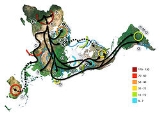
Map of Human Migrations
"Paleolithic" means "Old Stone Age." This was the earliest period of the Stone Age
Stone Age

The Stone Age is a broad prehistory time period during which humans widely used Rock for toolmaking.Stone tools were made from a variety of different kinds of stone....
. The Lower Paleolithic
Lower Paleolithic

The Lower Paleolithic is the earliest subdivision of the Paleolithic or Old Stone Age. It spans the time from around 1 E13 ss ago when the first evidence of craft and use of stone tools by Hominidaes appears in the current archaeological record, until around 1 E12 s ago when important evolutionary and technological changes ushered in the Mi...
 is the period in human evolution when humans first began using stone tools. The Lower Paleolithic began 2.5 million years ago with the emergence of the genus homo
Homo (genus)

Homo is the genus that includes anatomically modern humanss and their close relatives. The genus is estimated to be about 2.5 million years old, evolving from Australopithecine ancestors with the appearance of Homo habilis....
. Homo habilis
Homo habilis

Homo habilis is a species of the genus Homo , which lived from approximately 2.5 million to at least 1.6 million years ago at the beginning of the Pleistocene....
 is the earliest known species in the genus Homo. The Middle Paleolithic originated 300,000 years ago. The period is characterized by Prepared-core technique
Prepared-core technique

The prepared-core technique is means of producing stone tools by first preparing common lithic core that can then be shaped into the desired implement....
s for manufacturing stone tools. The term Archaic homo sapiens
Archaic Homo sapiens

The term Archaic Homo sapiens refers generally to the earliest members of the species Homo sapiens. Fossils categorized as archaic Homo sapiens have many of the same features as modern humans with general tendencies toward features of earlier Hominina species....
 is typically used to refer to the early hominids of the Middle Paleolithic
Middle Paleolithic

The Middle Paleolithic is the second subdivision of the Paleolithic or Old Stone Age as it is understood in Europe, Africa and Asia. The term Middle Stone Age is used as an equivalent or a synonym for the Middle Paleolithic in African archeology....
. Anatomically modern humans also emerged during the Middle Paleolithic.

Humans spread from East Africa to Asia some 100,000-50,000 years ago, and further to southern Asia
Asia

Asia is the world's largest and most populous continent. It covers 8.6% of the Earth's total surface area and, with over 4 billion people, it contains more than 60% of the world's current human population....
 and Australasia
Australasia

Australasia is a region of Oceania: New Zealand, Australia, Papua New Guinea, and neighbouring islands in the Pacific Ocean. The term was coined by Charles de Brosses in Histoire des navigations aux terres australes ....
 by at least 50 millennia ago, northwestwards into Europe
Europe

Europe is, conventionally, one of the world's seven continents. Comprising the westernmost peninsula of Eurasia, Europe is generally divided from Asia to its east by the water divide of the Ural Mountains, the Ural , the Caspian Sea, and by the Caucasus Mountains to the southeast....
 and eastwards into Central Asia
Central Asia

Central Asia is a region of Asia from the Caspian Sea in the west to central China in the east, and from southern Russia in the north to northern India in the south....
 some 40 millennia ago, and further east to the Americas from ca. 13 millennia ago. The Upper Paleolithic
Upper Paleolithic

The Upper Paleolithic is the third and last subdivision of the Paleolithic or Old Stone Age as it is understood in Europe, Africa and Asia. Very broadly it dates to between 40,000 and 9th millennium BC years ago, roughly coinciding with the appearance of "high" culture and before the advent of agriculture....
 is taken to begin some 40 millennia ago, with the appearance of wider variety of artifacts and a blossoming of symbolic culture. Expansion to North America
North America

North America is the northern continent of the Americas, situated in the Earth's northern hemisphere and almost totally in the western hemisphere....
 and Oceania
Oceania

Oceania is a geography, often geopolitics, region consisting of numerous lands—mostly islands in the Pacific Ocean and vicinity. The term "Oceania" was coined in 1831 by French explorer Jules Dumont d'Urville....
 took place at the climax of the most recent Ice Age
Ice age

The general term "ice age" or, more precisely, "glacial age" denotes a geological period of long-term reduction in the temperature of the Earth's surface and atmosphere, resulting in an expansion of continental ice sheets, polar ice sheets and alpine glaciers....
, when today's temperate regions were extremely inhospitable. By the end of the Ice Age some 12,000 BP
Before Present

Before Present years are a time scale used in archaeology, geology, and other science disciplines to specify when events in the past occurred. Because the "present" time changes, standard practice is to use 1950 Common_Era as the arbitrary origin of the age scale....
, humans had colonised nearly all the ice-free parts of the globe.

Throughout the Paleolithic, humans generally lived as nomad
Nomad

Nomadic people, , also known as nomads, are communities of people who move from one place to another, rather than Settler in one location....
ic hunter-gatherer
Hunter-gatherer

A hunter-gatherer society is one whose primary List of subsistence techniques involves the direct procurement of edible plants and animals from the wild, foraging and hunting without significant recourse to the domestication of either....
s. Hunter-gatherer
Hunter-gatherer

A hunter-gatherer society is one whose primary List of subsistence techniques involves the direct procurement of edible plants and animals from the wild, foraging and hunting without significant recourse to the domestication of either....
 societies have tended to be very small and egalitarian, though hunter-gatherer societies with abundant resources or advanced food-storage techniques have sometimes developed a sedentary lifestyle, complex social structures such as chiefdoms, and social stratification
Social stratification

In sociology and anthropology, social stratification is the hierarchy arrangement of social classes, castes and strata within a society. While these hierarchies are not universal to all societies, they are the norm among state-level cultures ....
; and long-distance contacts may be possible, as in the case of Indigenous Australian "highways."

Mesolithic

.]] The "Mesolithic," or "Middle Stone Age" (from the Greek
Greek language

Greek is an Indo-European languages native to the southern Balkan peninsula, the language of the Greek people. It forms an independent branch within Indo-European....
 "mesos," "middle," and "lithos," "stone") was a period in the development of human
Human

A human being, also human or man, is a member of a species of bipedalism primates in the family Hominidae . Mitochondrial DNA evidence indicates that modern humans originated in east Africa about 200,000 years ago....
 technology
Technology

Technology is a broad concept that deals with an animal species' usage and knowledge of tools and crafts, and how it affects an animal species' ability to control and adapt to its Natural environment....
 between the Paleolithic
Paleolithic

The Paleolithic or Palaeolithic or "Old Stone" era is a Prehistory era distinguished by the development of the first stone tools, and covers roughly 99% of human history....
 and Neolithic
Neolithic

The Neolithic period was a period in the development of human technology, beginning about 9500 Before the Christian Era in the Middle East that is traditionally considered the last part of the Stone Age....
 periods of the Stone Age
Stone Age

The Stone Age is a broad prehistory time period during which humans widely used Rock for toolmaking.Stone tools were made from a variety of different kinds of stone....
.

The Mesolithic period began at the end of the Pleistocene
Pleistocene

The Pleistocene is the epoch from 1.8 million to 10,000 years Before Present covering the world's recent period of repeated glaciations. The name pleistocene is derived from the Greek and ....
 epoch, some 10,000 BP, and ended with the introduction of agriculture
Agriculture

Agriculture refers to the production of food and goods through farming and forestry. Agriculture was the key development that led to the rise of civilization, with the animal husbandry of domestication animals and plants creating food surpluses that enabled the development of more Population density and Social stratification societies....
, the date of which varied by geographic region. In some areas, such as the Near East
Near East

Near East today is an ambiguous term that covers different countries for archeologists and historians, on one hand, and for political scientists, economists, and journalists, on the other....
, agriculture was already underway by the end of the Pleistocene
Pleistocene

The Pleistocene is the epoch from 1.8 million to 10,000 years Before Present covering the world's recent period of repeated glaciations. The name pleistocene is derived from the Greek and ....
, and there the Mesolithic is short and poorly defined. In areas with limited glacial impact, the term "Epipaleolithic
Epipaleolithic

The Epipaleolithic is a term used for the "final Upper Palaeolithic industries occurring at the end of the final last Ice Age which appear to merge technologically into the Mesolithic"....
" is sometimes preferred.

Regions that experienced greater environmental effects as the last ice age ended have a much more evident Mesolithic era, lasting millennia. In Northern Europe, societies were able to live well on rich food supplies from the marshlands fostered by the warmer climate. Such conditions produced distinctive human behaviours which are preserved in the material record, such as the Maglemosian and Azilian
Azilian

The Azilian is a name given by archaeologists to an archaeological industry of the Epipaleolithic in northern Spain and southern France.It probably dates to the period of the Aller?d Oscillation around 10,000 years ago and followed the Magdalenian culture....
 cultures. These conditions also delayed the coming of the Neolithic until as late as 4000 BCE (6,000 BP
Before Present

Before Present years are a time scale used in archaeology, geology, and other science disciplines to specify when events in the past occurred. Because the "present" time changes, standard practice is to use 1950 Common_Era as the arbitrary origin of the age scale....
) in northern Europe.

Remains from this period are few and far between, often limited to midden
Midden

A midden, also known as a kitchen midden, or a shell heap, is a landfill. The word is of Scandinavian via Middle English derivation, but is used by archaeology worldwide to describe any kind of feature containing waste products relating to day-to-day human life....
s. In forest
Forest

File:Stara planina suma.jpgA forest is an area with a high density of trees. There are many definitions of a forest, based on various criteria....
ed areas, the first signs of deforestation
Deforestation

Deforestation is the logging or burning of trees in forested areas. There are several reasons for doing so: trees or derived charcoal can be sold as a commodity and are used by humans while cleared land is used as pasture, plantations of commodities and human settlement....
 have been found, although this would only begin in earnest during the Neolithic
Neolithic

The Neolithic period was a period in the development of human technology, beginning about 9500 Before the Christian Era in the Middle East that is traditionally considered the last part of the Stone Age....
, when more space was needed for agriculture
Agriculture

Agriculture refers to the production of food and goods through farming and forestry. Agriculture was the key development that led to the rise of civilization, with the animal husbandry of domestication animals and plants creating food surpluses that enabled the development of more Population density and Social stratification societies....
.

The Mesolithic is characterized in most areas by small composite flint
Flint

Flint is a hard, sedimentary rock cryptocrystalline form of the mineral quartz, categorized as a variety of chert. It occurs chiefly as Nodule s and masses in sedimentary rocks, such as chalks and limestones....
 tools — microlith
Microlith

A microlith is a small Rock tool, typically knapped of flint or chert, usually about three centimetres long or less; They are typically one centimetre long and half a centimetre wide when finished....
s and microburin
Microburin

A microburin is the residual product of the creation of a microlith during flint tool manufacture in many different cultures, for instance the European Mesolithic....
s. Fishing tackle
Fishing tackle

Fishing tackle, also called fishing gear, is a general term that refers to the equipment used by fishermen while fishing.Almost any equipment or gear used for fishing can be called fishing tackle....
, stone adze
Adze

An adze or adz is a tool used for smoothing rough-cut wood in hand woodworking. Generally, the user stands astride a board or log and swings the adze downwards towards their feet, chipping off pieces of wood, moving backwards as they go and leaving a relatively smooth surface behind....
s and wooden objects, e.g. canoe
Canoe

A canoe is a small narrow boat, typically human-powered, though it may also be powered by sails or small electric or gas motors. Canoes usually are pointed at both bow and stern and are normally open on top, but can be covered....
s and bow
Bow (weapon)

A bow is a weapon that projects arrows powered by the elasticity of the bow. Essentially, it is a form of Spring . As the bow is drawn, energy is stored in the limbs of the bow and transformed into rapid motion when the string is released, with the string transferring this force to the arrow....
s, have been found at some sites. These technologies first occur in Africa
Africa

Africa is the world's second-largest and second most-populous continent, after Asia. At about 30.2 million km? including adjacent islands, it covers 6% of the Earth's total surface area and 20.4% of the total land area....
, associated with the Azilian
Azilian

The Azilian is a name given by archaeologists to an archaeological industry of the Epipaleolithic in northern Spain and southern France.It probably dates to the period of the Aller?d Oscillation around 10,000 years ago and followed the Magdalenian culture....
 cultures, before spreading to Europe
Europe

Europe is, conventionally, one of the world's seven continents. Comprising the westernmost peninsula of Eurasia, Europe is generally divided from Asia to its east by the water divide of the Ural Mountains, the Ural , the Caspian Sea, and by the Caucasus Mountains to the southeast....
 through the Ibero-Maurusian culture of Spain
Spain

Spain or the Kingdom of Spain , is a country located in Southern Europe on the Iberian Peninsula.The Spanish constitution does not establish any official denomination of the country, even though Espa?a , Estado espa?ol and Naci?n espa?ola are used interchangeably....
 and Portugal
Portugal

Portugal , officially the Portuguese Republic , is a country on the Iberian Peninsula. Located in southwestern Europe, Portugal is the westernmost country of mainland Europe and is bordered by the Atlantic Ocean to the west and south and by Spain to the north and east....
, and the Kebaran
Kebaran

The Kebaran was an archaeological culture that lived in the eastern Mediterranean area , named after the type site, Kebara Cave south of Haifa. The Kebaran were a highly mobile nomadic people of hunters and gatherers in the Levant and Sinai Peninsula areas who utilized microliths tools....
 culture of Palestine
Palestine

Palestine is a name which has been widely used since Roman times to refer to the region between the Mediterranean Sea and the Jordan River. It is derived from a name used already much earlier for a narrower geographical region, mainly along the coastal region....
. Independent discovery
List of multiple independent discoveries

Historians and sociologists have remarked on the occurrence, in science, of "multiple independent discovery." Robert K. Merton defined such "multiples" as instances in which similar Discovery are made by scientists working independently of each other....
 is not always ruled out.

During the Mesolithic
Mesolithic

The Mesolithic or Middle Stone Age was a period in the development of human technology in between the Paleolithic or Old Stone Age and the Neolithic or New Stone Age....
 as in the preceding Paleolithic
Paleolithic

The Paleolithic or Palaeolithic or "Old Stone" era is a Prehistory era distinguished by the development of the first stone tools, and covers roughly 99% of human history....
 period, people lived in small (mostly egalitarian) bands and tribes.

Neolithic

"Neolithic" means "New Stone Age." This was a period of primitive technological and social
Social

Social refers to a characteristic of living organisms . It always refers to the interaction of organisms with other organisms and to their collective co-existence, irrespective of whether they are aware of it or not, and irrespective of whether the interaction is voluntary or involuntary....
 development, toward the end of the "Stone Age
Stone Age

The Stone Age is a broad prehistory time period during which humans widely used Rock for toolmaking.Stone tools were made from a variety of different kinds of stone....
." Neolithic culture appeared in the Levant
Levant

The Levant describes, traditionally, the Eastern Mediterranean at large, but can be used as a geographical term that denotes a large area in Western Asia formed by the lands bordering the Eastern shores of the Mediterranean, roughly bounded on the north by the Taurus Mountains, on the south by the Arabian Desert, and on the west by the M...
, centering around Jericho
Jericho

Jericho is a city located near the Jordan River in the West Bank of the Palestinian territories. It is the capital of the Jericho Governorate, and has a population of over 20,000 Arabs....
 in the modern-day West Bank
West Bank

The West Bank is the eastern Part of the Palestinian territories on the west bank of the River Jordan in the Middle East. To the west, north, and south the West Bank shares borders with the state of Israel....
. It developed directly from the Epipaleolithic
Epipaleolithic

The Epipaleolithic is a term used for the "final Upper Palaeolithic industries occurring at the end of the final last Ice Age which appear to merge technologically into the Mesolithic"....
 Natufian culture
Natufian culture

The Natufian culture existed in the Mediterranean region of the Levant. It was a Mesolithic culture, but unusual in that it was sedentary, or semi-sedentary, before the introduction of agriculture....
 circa the 10th millennium BCE (12,000 BP) and was marked by the development of early village
Village

A village is a clustered human settlement or Residential community, larger than a hamlet , but smaller than a town or city. Though generally located in rural areas, the term urban village may be applied to certain urban area neighbourhoods, such as the West Village in Manhattan, New York City and the Saifi Village in Beirut, Lebanon....
s, agriculture
Agriculture

Agriculture refers to the production of food and goods through farming and forestry. Agriculture was the key development that led to the rise of civilization, with the animal husbandry of domestication animals and plants creating food surpluses that enabled the development of more Population density and Social stratification societies....
, animal
Animal

Animals are a major group of multicellular, eukaryotic organisms of the Kingdom Animalia or Metazoa. Their body plan eventually becomes fixed as they develop, although some undergo a process of metamorphosis later on in their life....
 domestication
Domestication

Domestication or taming refers to the process whereby a population of living things becomes accustomed to a controlled environment by other plants or animals through a process of Selective breeding....
 and tool
Tool

A broad definition of a tool is an entity used to interface between two or more domains that facilitates more effective action of one domain upon the other....
s.

Rise of agriculture
A major change, described by prehistorian Vere Gordon Childe
Vere Gordon Childe

Vere Gordon Childe was an Australian philologist by training who later specialised in archaeology. Usually known as just Gordon Childe, he was perhaps best known for his excavation of the unique Neolithic site of Skara Brae in Orkney and for his Marxism views which influenced his thinking about prehistory....
 as the "Agricultural Revolution
Neolithic Revolution

The Neolithic Revolution was the first agricultural revolution—the transition from hunter-gatherer communities and bands, to agriculture and settlement ....
," occurred about the 10th millennium BCE with the adoption of agriculture
Agriculture

Agriculture refers to the production of food and goods through farming and forestry. Agriculture was the key development that led to the rise of civilization, with the animal husbandry of domestication animals and plants creating food surpluses that enabled the development of more Population density and Social stratification societies....
. The Sumerians first began farming ca. 9500 BCE. By 7000 BCE, agriculture had spread to India
India

India, officially the Republic of India , is a country in South Asia. It is the List of countries and outlying territories by total area country by geographical area, the List of countries by population country, and the most populous liberal democracy in the world....
; by 6000 BCE, to Egypt; by 5000 BCE, to China. About 2700 BCE, agriculture had come to Mesoamerica
Mesoamerica

Mesoamerica or Meso-America is a region and cultural area in the Americas, extending approximately from central Mexico to Honduras and Nicaragua, within which a number of pre-Columbian society flourished before the Spanish colonization of the Americas in the 15th and 16th centuries....
.

Although attention has tended to concentrate on the Middle East
Middle East

File:GreaterMiddleEast1.pngThe Middle East is a region that spans southwestern Asia, western Asia, and northeastern Africa. It has no clear boundaries, often used as a synonym to Near East, in opposition to Far East....
's Fertile Crescent
Fertile Crescent

The Fertile Crescent is a region in the Near East, incorporating the Levant and Mesopotamia, and often extended to Lower Egypt. Mesopotamia is considered the Cradle of civilization and saw the development of the earliest human civilizations and is the History_of_writing#Bronze_Age_writing and Wheel#History....
, archaeology in the Americas
Americas

The Americas are the region of the Western hemisphere that consists of the continents of North America and South America with their associated islands and regions....
, East Asia
East Asia

East Asia is a subregion of Asia that can be defined in either Geography or cultural terms. Geography and geopolitically, it covers about 12,000,000 km?, or about 28 percent of the Asian continent, about 15 percent bigger than the area of Europe, though some categorize Tibet, Xinjiang, and Mongolia as Central Asia....
 and Southeast Asia
Southeast Asia

Southeast Asia or Southeastern Asia is a subregion of Asia, consisting of the countries that are geographically south of China, east of India and north of Australia....
 indicates that agricultural systems, using different crops and animals, may in some cases have developed there nearly as early. The development of organised irrigation
Irrigation

Irrigation is an artificial application of water to the soil usually for assisting in growing crops. In crop production it is mainly used in dry areas and in periods of rainfall shortfalls, but also to protect plants against frost....
, and the use of a specialised workforce
Workforce

The workforce is the labour pool in employment. It is generally used to describe those working for a single Types of companies or industry, but can also apply to a geographic region like a city, country, state, etc....
, by the Sumerians, began about 5500 BCE. Stone was supplanted by bronze and iron in implements of agriculture and warfare. Agricultural settlements had until then been almost completely dependent on stone
Rock (geology)

In geology, rock is a naturally occurring solid aggregate of minerals and/or mineraloids.The Earth's outer solid layer, the lithosphere, is made of rock....
 tools. In Eurasia
Eurasia

Eurasia is a large landmass covering about 53,990,000 km? or about 10.6% of the Earth's surface . Often considered a single continent, Eurasia comprises the traditional continents of Europe and Asia, concepts which date back to classical antiquity and the borders for which are somewhat arbitrary....
, copper
Copper

Copper is a chemical element with the symbol Cu and atomic number 29.It is a ductile metal with very high thermal and electrical conductivity....
 and bronze
Bronze

Bronze is a metal alloy consisting primarily of copper, usually with tin as the main additive, but sometimes with other chemical element such as phosphorus, manganese, aluminium, or silicon....
 tools, decorations and weapons began to be commonplace about 3000 BCE. After bronze, the Eastern Mediterranean region, Middle East
Middle East

File:GreaterMiddleEast1.pngThe Middle East is a region that spans southwestern Asia, western Asia, and northeastern Africa. It has no clear boundaries, often used as a synonym to Near East, in opposition to Far East....
 and China
China

China is a Culture of China, an ancient civilization, and, depending on perspective, a national or multinational entity extending over a large area in East Asia....
 saw the introduction of iron
Iron

Iron is a chemical element with the symbol Fe and atomic number 26. Iron is a Group 8 element and period 4 element. Iron is lustrous and silvery in color....
 tools and weapons.

The Americas may not have had metal tools until the Chavín
Chavín culture

The Chav?n were a civilization that developed in the northern Andean highlands of Peru from 900 BC to 200 BC. The Chavin were located in the Mosna Valley where the Mosna and Huachecsa rivers merge....
 horizon (900 BCE). The Moche
Moche

The 'Moche' civilization flourished in northern Peru from about 100 C.E. to 800 C.E., during the Cultural periods of Peru. While still the subject of some debate, many scholars contend that the Moche were not politically organized as a monolithic empire or state but rather as a group of autonomous polities that shared a common elite cu...
 did have metal armor, knives and tableware. Even the metal-poor Inca
Inca

The Inca civilization began as a tribe in the Cuzco area, where the legendary first Sapa Inca, Manco Capac founded the Kingdom of Cuzco around 1200....
 had metal-tipped plows, at least after the conquest of Chimor
Chimor

Chimor was the political grouping of the Chim? culture that ruled the northern coast of Peru, beginning around 850 AD and ending around 1470 AD....
. However, little archaeological research has so far been done in Peru
Peru

Peru , officially the Republic of Peru , is a country in western South America. It is bordered on the north by Ecuador and Colombia, on the east by Brazil, on the southeast by Bolivia, on the south by Chile, and on the west by the Pacific Ocean....
, and nearly all the khipus (recording devices, in the form of knots, used by the Incas) were burned in the Spanish conquest of Peru. As late as 2004, entire cities were still being unearthed. Some digs suggest that steel
Steel

Steel is an alloy consisting mostly of iron, with a carbon content between 0.2% and 2.14% by weight , depending on grade. Carbon is the most cost-effective alloying material for iron, but various other alloying elements are used such as manganese, chromium, vanadium, and tungsten....
 may have been produced there before it was developed in Europe.

The cradles of early civilization
Civilization

A civilization is a society or culture group normally defined as a complex society characterized by the practice of agriculture and settlement in towns and city....
s were river
River

A river is a natural stream of water, usually freshwater, flowing toward an ocean, a lake, or another stream. In some cases a river flows into the ground or dries up completely before reaching another body of water....
 valley
Valley

In geology, a valley is a Depression with predominant extent in one direction. A very deep river valley may be called a canyon or gorge....
s, such as the Euphrates
Euphrates

The Euphrates is the western of the two great rivers that define Mesopotamia which flows from Anatolia....
 and Tigris
Tigris

The Tigris is the eastern member of the two great rivers that define Mesopotamia, along with the Euphrates, which flows from the mountains of southeastern Turkey through Iraq....
 valleys in Mesopotamia
Mesopotamia

Mesopotamia is the area of the Tigris-Euphrates river system, along the Tigris and Euphrates rivers, largely corresponding to modern Iraq, as well as some parts of northeastern Syria, some parts of southeastern Turkey, and some parts of the Khuzestan Province of southwestern Iran....
, the Nile valley in Egypt
Egypt

Egypt is a country mainly in North Africa, with the Sinai Peninsula forming a land bridge in Western Asia. Covering an area of about , Egypt borders the Mediterranean Sea to the north, the Gaza Strip and Israel to the northeast, the Red Sea to the east, Sudan to the south and Libya to the west....
, the Indus
Indus River

File:Indian subcontinent CIA.pngThe Indus River is the longest river in Pakistan and the twenty-first largest river in the world, in terms of annual flow, on the Indian Subcontinent....
 valley in the Indian subcontinent
Indian subcontinent

The Indian subcontinent is a large section of the Asian continent consisting of the land lying substantially on the Indian Plate. The subcontinent includes parts of various countries in South Asia, including those on the continental crust , an Island#Continental islands country on the continental shelf , and an Island#Oceanic islands countr...
, and the Yangtze and Yellow River
Yellow River

The Yellow River or Huang He / Hwang Ho is the second-longest river in China and the List of rivers by length in the world at 4,845 kilometers ....
 valleys in China
China

China is a Culture of China, an ancient civilization, and, depending on perspective, a national or multinational entity extending over a large area in East Asia....
. Some nomadic peoples, such as the Indigenous Australians and the Bushmen
Bushmen

The Bushmen, San, Sho, Basarwa, Kung, or Khwe are indigenous people of southern Africa that spans most areas of South Africa, Zimbabwe, Lesotho, Mozambique, Swaziland, Botswana, Namibia, and Angola....
 of southern Africa, did not practice agriculture until relatively recent times.

Before 1800, many populations did not belong to state
State

A state is a political Social contract with effective sovereignty over a geographic area and representing a population. These may be nation states, State or multinational states....
s. Scientists disagree as to whether the term "tribe
Tribe

A tribe, viewed historically or developmentally, consists of a social group existing before the development of, or outside of, states.Many anthropologists use the term to refer to societies organized largely on the basis of kinship, especially corporate descent groups ....
" should be applied to the kinds of societies that these people lived in. Many tribal societies, in Europe and elsewhere, transformed into states when they were threatened, or otherwise impinged on, by existing states. Examples are the Marcomanni
Marcomanni

The Marcomanni were a Germanic tribe, probably related to the Buri , Suebi or Suevi....
, Poland
Poland

Poland , officially the Republic of Poland , is a country in Central Europe. Poland is bordered by Germany to the west; the Czech Republic and Slovakia to the south; Ukraine, Belarus and Lithuania to the east; and the Baltic Sea and Kaliningrad Oblast, a Russian Enclave and exclave, to the north....
 and Lithuania
Lithuania

Lithuania , officially the Republic of Lithuania is a country in Northern Europe, the southernmost of the three Baltic states. Situated along the southeastern shore of the Baltic Sea, it shares borders with Latvia to the north, Belarus to the southeast, Poland, and the Russian exclave of Kaliningrad Oblast to the southwest....
. Some "tribes," such as the Kassites
Kassites

The Kassites were an ancient Near Eastern tribe who gained control of Babylonia after the fall of the Old Babylonian Empire after ca. 1531 BC to ca....
 and the Manchus, conquered states and were absorbed by them.

Agriculture made possible complex societies — civilizations. States and markets emerged. Technologies enhanced people's ability to control nature
Nature

File:Jungle in Punjab.JPGNature, in the broadest sense, is equivalent to the natural world, physical universe, material world or material universe....
 and to develop transport
Transport

Transport or transportation is the movement of passenger and cargo from one location to another. Transport is performed by various modes of transport, such as aviation, rail transport, road transport, ship transport, cable transport, pipeline transport and space transport....
 and communication
Communication

Communication is commonly defined as "the imparting or interchange of thoughts, opinions, or information by speech, writing, or signs...",, 1: an act or instance of transmitting and 3 a: "a process by which information is exchanged between individuals through a common system of symbols, signs, or beha...
.

Rise of religion
It is to the Neolithic that most historians trace the beginnings of complex religion
Religion

A religion is an organized approach to human spirituality which usually encompasses a set of myth, symbols, beliefs and practices, often with a supernatural or transcendence quality, that give meaning to the practitioner's experiences of life through reference to a higher power or truth....
. Religious belief in this period commonly consisted in the worship of a Mother Goddess
Mother goddess

A mother goddess is a term used to refer to any goddess associated with motherhood, fertility, creation or the bountiful embodiment of the Earth....
, a Sky Father
Sky father

The sky father is a recurring theme in mythology. The sky father is the complement of the earth mother and appears in some creation myths, many of which are European or ancient Near Eastern....
, and of the Sun
Sun

The Sun , a G V star, is the star at the center of the Solar System. The Earth and other matter orbit the Sun, which by itself accounts for about 98.6% of the Solar System's mass....
 and Moon
Moon

The Moon is Earth's only natural satellite and the List of natural satellites by diameter satellite in the Solar System. The average centre-to-centre distance from the Earth to the Moon is km, about thirty times the diameter of the Earth....
 as deities. (see also Sun worship). Shrine
Shrine

A shrine, from the Latin scrinium is a holy or sacred place which is dedicated to a specific deity, ancestor veneration, hero, martyr, saint or similar figure of awe and respect, at which they are veneration or worshipped....
s developed, which over time evolved into temple
Temple

A temple is a structure reserved for religious or spiritual activities, such as prayer and sacrifice, or analogous rites. A ??templum?? constituted a sacred precinct as defined by a priest, or augur....
 establishments, complete with a complex hierarchy of priests and priestesses and other functionaries. Typical of the Neolithic was a tendency to worship anthropomorphic
Anthropomorphism

Anthropomorphism is the attribution of uniquely human characteristics to non-human creatures and beings, natural and supernatural phenomena, material states and objects or abstract concepts....
 deities. The earliest surviving religious scriptures are the Pyramid Texts
Pyramid Texts

The Pyramid Texts are a collection of Ancient Egypt religious text from the time of the Old Kingdom. The pyramid texts are the oldest known religious texts in the world....
, produced by the Egyptians (dating back to 3100 B.C.E).

Bronze Age

Pyramids of Egypt1
The Bronze Age
Bronze Age

The Bronze Age is, with respect to a given prehistory, the period in that society when the most advanced metalworking included smelting copper and tin from naturally-occurring outcroppings of copper and tin ores, creating a bronze alloy by melting those metals together, and casting them into bronze artifact s....
 forms part of the three-age system
Three-age system

The three-age system is the periodization of human prehistory into three consecutive time periods, named for their respective predominant tool-making technologies:...
. In this system, it follows the Neolithic in some areas of the world. In the 24th century BCE, Akkadian Empire In the 22nd century BCE, the First Intermediate Period of Egypt
First Intermediate Period of Egypt

The First Intermediate Period, often described as a ?dark period? in ancient Egyptian history, spanned approximately three hundred years after the end of the Old Kingdom from ca....
 occurred The time between the 21st to 17th centuries BCE around the Nile has been denoted as Middle Kingdom of Egypt
Middle Kingdom of Egypt

The middle kingdom is the period in the history of ancient Egypt stretching from the establishment of the Eleventh dynasty of Egypt to the end of the Fourteenth dynasty of Egypt, roughly between 2040 BC and 1640 BC....
. In the 21st century BCE, the Sumerian Renaissance occurs. By the 18th century, the Second Intermediate Period of Egypt
Second Intermediate Period of Egypt

The Second Intermediate Period marks a period when History of Ancient Egypt once again fell into disarray between the end of the Middle Kingdom of Egypt, and the start of the New Kingdom of Egypt....
 begins.

By 1600 BCE, Mycenaean Greece
Mycenaean Greece

Mycenaean Greece is a cultural period of ancient Greece taking its name from the archaeological site of Mycenae in northeastern Argolis, in the Peloponnese of southern Greece....
 begins to develop. Also by 1600 BCE, the beginning of Shang Dynasty
Shang Dynasty

The Shang Dynasty or Yin Dynasty was according to traditional sources the first Dynasties in Chinese history. They ruled in the northeastern region of the area known as "China proper", in the Yellow River valley....
 in China
China

China is a Culture of China, an ancient civilization, and, depending on perspective, a national or multinational entity extending over a large area in East Asia....
 emerges and there is evidence of a fully developed Chinese writing system. Around 1600 BCE, the beginning of Hittite
Hittites

The Hittites were an ancient Anatolian people who spoke a Hittite language of the Anatolian languages of the Indo-European languages family, and established a kingdom centered at Hattusa in north-central Anatolia ca....
 dominance of the Eastern Mediterranean region is seen. The time between the 16th to 11th centuries around the Nile is called the New Kingdom of Egypt. Between 1550 BCE and 1292 BCE, the Amarna period
Amarna Period

The first recorded formal relations of Egypt with foreign countries were under Amenhotep III. Under his reign, Egypt enjoyed an economic boom. He built many temples and monuments across Egypt to honor his favorite deity, Sobek, who always was depicted as a crocodile....
 occurs.

Early civilization

The first Agricultural Revolution
Neolithic Revolution

The Neolithic Revolution was the first agricultural revolution—the transition from hunter-gatherer communities and bands, to agriculture and settlement ....
 led to several major changes. It permitted far denser populations, which in time organised into states. There are several definitions for the term, "state." Max Weber
Max Weber

Maximilian Carl Emil Weber was one of the most profoundly influential thinkers of the twentieth century. Born in Germany, Weber became a lawyer, politician, scholar, political economy, and sociology....
 and Norbert Elias
Norbert Elias

Norbert Elias was a Germany sociology of Jewish descent, who later became a Great Britain citizen.His work focused on the relationship between power, behavior, emotion, and knowledge over time....
 defined a state as an organization of people that has a monopoly on the legitimate use of force in a particular geographic area.

Greatwall Sa3
In Bronze Age
Bronze Age

The Bronze Age is, with respect to a given prehistory, the period in that society when the most advanced metalworking included smelting copper and tin from naturally-occurring outcroppings of copper and tin ores, creating a bronze alloy by melting those metals together, and casting them into bronze artifact s....
 Mesopotamia
Mesopotamia

Mesopotamia is the area of the Tigris-Euphrates river system, along the Tigris and Euphrates rivers, largely corresponding to modern Iraq, as well as some parts of northeastern Syria, some parts of southeastern Turkey, and some parts of the Khuzestan Province of southwestern Iran....
 and Iran
Iran

Iran , officially the Islamic Republic of Iran and formerly known internationally as Persian Empire until 1935, is a country in Central Eurasia, located on the northeastern shore of the Persian Gulf and the southern shore of the Caspian Sea....
, there were several city-states. States appeared in Mesopotamia
Mesopotamia

Mesopotamia is the area of the Tigris-Euphrates river system, along the Tigris and Euphrates rivers, largely corresponding to modern Iraq, as well as some parts of northeastern Syria, some parts of southeastern Turkey, and some parts of the Khuzestan Province of southwestern Iran....
, western Iran
Iran

Iran , officially the Islamic Republic of Iran and formerly known internationally as Persian Empire until 1935, is a country in Central Eurasia, located on the northeastern shore of the Persian Gulf and the southern shore of the Caspian Sea....
, and Indus Valley. Ancient Egypt
Ancient Egypt

Ancient Egypt was an Ancient history civilization in eastern North Africa, concentrated along the lower reaches of the Nile in what is now the modern nation of Egypt....
 began as a state without cities, but soon developed them. States appeared in China
China

China is a Culture of China, an ancient civilization, and, depending on perspective, a national or multinational entity extending over a large area in East Asia....
 in the late 3rd and early 2nd millennia BCE.

A state ordinarily needs an army
Military history

Military history is a humanities List of academic disciplines within the scope of History recording of War in the Human history, and its impact on the societies, their cultures, economies and changing Politics and international relationships....
 for the legitimate exercise of force. An army needs a bureaucracy
Bureaucracy

Bureaucracy is the structure and set of regulations in place to control activity, usually in large organizations and government. As opposed to adhocracy, it is represented by standardized procedure that dictates the execution of most or all processes within the body, formal division of powers, hierarchy, and relationships....
 to maintain it. The only exception to this appears to have been the Indus Valley civilization
Indus Valley Civilization

The Indus Valley Civilization , abbreviated IVC, was an ancient civilization that flourished in the Indus River basin. Primarily centered along the Indus river, the civilization encompassed most of Pakistan, including its Sindh, Punjab and Balochistan provinces, and extending into modern day Indian states of Gujarat, Haryana, Punjab...
, for which there is no evidence of the existence of a military force.

Major wars were waged among states in the Middle East
Middle East

File:GreaterMiddleEast1.pngThe Middle East is a region that spans southwestern Asia, western Asia, and northeastern Africa. It has no clear boundaries, often used as a synonym to Near East, in opposition to Far East....
. About 1275 BCE, the Hittites
Hittites

The Hittites were an ancient Anatolian people who spoke a Hittite language of the Anatolian languages of the Indo-European languages family, and established a kingdom centered at Hattusa in north-central Anatolia ca....
 under Muwatalli II
Muwatalli II

Muwatalli II was a king of the New kingdom of the Hittite empire . The eldest surviving son of Mursili II, he is best known as the Hittite ruler who fought Ramesses II to a standstill at the Battle of Kadesh around 1274 BCE....
 and the Egypt
Ancient Egypt

Ancient Egypt was an Ancient history civilization in eastern North Africa, concentrated along the lower reaches of the Nile in what is now the modern nation of Egypt....
ians under Ramesses II
Ramesses II

Ramesses II was the third Egyptian pharaoh of the Nineteenth dynasty of Egypt. He is often regarded as Ancient Egypt's greatest, most celebrated, and most powerful pharaoh....
 concluded the treaty of Kadesh
Kadesh

This article is about Kadesh in the lands of the Amurru, bordering on Damascus Syria up to Hammath; see also Kadesh orKedesh Kadesh was an Cities of the Ancient Near East of the Levant, located on or near the headwaters or ford of the Orontes River It is surmised by Kenneth Kitchen to be the ruins at Tell Nebi Mend, about south...
, the world's oldest recorded peace treaty.

Empire
Empire

Empire derives from the Latin word imperium, denoting ?military command? in Roman. Politically, an empire is a geographically extensive group of states and peoples united and ruled either by a monarch or an oligarchy....
s came into being, with conquered areas ruled by central tribes, as in the Neo-Assyrian Empire
Neo-Assyrian Empire

The Neo-Assyrian Empire was a period of Mesopotamian history which began in 934 BC and ended in 609 BC. During this period, Assyria assumed a position as a great regional power, vying with Babylonia and other lesser powers for dominance of the region, though not until the reforms of Tiglath-Pileser III in the 8th century BC, did it become a p...
 (10th century BCE), the Achaemenid Persian Empire (6th century BCE), the Mauryan Empire (4th century BCE), Qin and Han China (3rd century BCE), and the Roman Empire
Roman Empire

The Roman Empire was the Roman Republic phase of the Ancient Rome, characterised by an autocracy form of government and large territorial holdings in Europe and around the Mediterranean....
 (1st century BCE).

Clashes among empires included those that took place in the 8th century, when the Islamic Caliphate
Islamic caliphate

The Islamic Caliphate may refer to the following Caliphates:*The Rashidun Empire*The Umayyad Caliphate**The Umayyad Caliphate of C?rdoba*The Abbasid Caliphate...
 of Arabia (ruling from Spain
Spain

Spain or the Kingdom of Spain , is a country located in Southern Europe on the Iberian Peninsula.The Spanish constitution does not establish any official denomination of the country, even though Espa?a , Estado espa?ol and Naci?n espa?ola are used interchangeably....
 to Iran
Iran

Iran , officially the Islamic Republic of Iran and formerly known internationally as Persian Empire until 1935, is a country in Central Eurasia, located on the northeastern shore of the Persian Gulf and the southern shore of the Caspian Sea....
) and China
China

China is a Culture of China, an ancient civilization, and, depending on perspective, a national or multinational entity extending over a large area in East Asia....
's Tang dynasty
Tang Dynasty

The Tang Dynasty was an Dynasties in Chinese history preceded by the Sui Dynasty and followed by the Five Dynasties and Ten Kingdoms Period. It was founded by the Li family, who seized power during the decline and collapse of the Sui Empire....
 (ruling from Xinjiang
Xinjiang

Xinjiang is an autonomous region of China of the People's Republic of China. It is a large, sparsely populated area, spanning over 1.6 million sq....
 to Dalian) fought for decades for control of Central Asia
Central Asia

Central Asia is a region of Asia from the Caspian Sea in the west to central China in the east, and from southern Russia in the north to northern India in the south....
.

Sumerian 26th C Adab
The largest contiguous land empire in history was the 13th-century Mongolian Empire. By then, most people in Europe, Asia and North Africa belonged to states. There were states as well in Mexico
Mexico

The United Mexican States , commonly known as Mexico , is a federalism constitutionalism republic in North America. It is bordered on the north by the United States; on the south and west by the Pacific Ocean; on the southeast by Guatemala, Belize, and the Caribbean Sea; and on the east by the Gulf of Mexico....
 and western South America
South America

South America is the southern continent of the Americas, situated entirely in the Western Hemisphere and mostly in the Southern Hemisphere, with a relatively small portion in the Northern Hemisphere....
. States controlled more and more of the world's territory and population; the last "empty" territories, with the exception of uninhabited Antarctica
Antarctica

Antarctica is Earth's southernmost continent, overlying the South Pole. It is situated in the Antarctica of the southern hemisphere, almost entirely south of the Antarctic Circle, and is surrounded by the Southern Ocean....
, would be divided up among states by the Berlin Conference
Berlin Conference

The Berlin Conference of 1884–85 regulated colonialism and trade in Africa during the New Imperialism period, and coincided with Germany's sudden emergence as an imperial power....
 (1884-1885).

City and trade
Agriculture
Agriculture

Agriculture refers to the production of food and goods through farming and forestry. Agriculture was the key development that led to the rise of civilization, with the animal husbandry of domestication animals and plants creating food surpluses that enabled the development of more Population density and Social stratification societies....
 also created, and allowed for the storage of, food
Food

Food is any substance, usually composed of carbohydrates, fats, proteins and water, that can be Eating or Drinking by an animal or human for nutrition or pleasure....
 surplus
Surplus

Surplus may refer to:always in need* budget surplus, the opposite of a deficit* in economics, economic surplus , and capital surplus* an excess of production or supply over demand ...
es that could support people not directly engaged in food production. The development of agriculture permitted the creation of the first cities
City

A city is an urban area with a high population density and a particular administrative, legal, or historical status.Large industrialized cities generally have advanced systems for sanitation, utilities, land usage, house, and transportation and more....
. These were centers of trade
Trade

Tradeis the willing exchange of goods, Service , or both. Trade is also called commerce. A mechanism that allows trade is called a market. The original form of trade was barter , the direct exchange of goods and services....
, manufacture and political power
Political power

Political power is a type of power held by a political organization in a society which allows administration of some or all of public resources, including labour, and wealth....
 with nearly no agricultural production of their own. Cities established a symbiosis
Symbiosis

The term symbiosis commonly describes close and often long-term interactions between different biological species. The term was first used in 1879 by the Germany mycology Heinrich Anton de Bary, who defined it as "the living together of unlike organisms"....
 with their surrounding countrysides, absorbing agricultural products and providing, in return, manufactures and varying degrees of military protection.

The development of cities equated, both etymologically and in fact, with the rise of civilization
Civilization

A civilization is a society or culture group normally defined as a complex society characterized by the practice of agriculture and settlement in towns and city....
 itself: first Sumerian civilization
Sumer

Sumer was a civilization and a historical region located in Southern Iraq , known as the Cradle of civilization. It lasted from the first settlement of Eridu in the Ubaid period through the Uruk period and the Dynastic periods until the rise of Babylon in the early 2nd millennium BC....
, in lower Mesopotamia
Mesopotamia

Mesopotamia is the area of the Tigris-Euphrates river system, along the Tigris and Euphrates rivers, largely corresponding to modern Iraq, as well as some parts of northeastern Syria, some parts of southeastern Turkey, and some parts of the Khuzestan Province of southwestern Iran....
 (3500 BCE), followed by Egyptian civilization
Ancient Egypt

Ancient Egypt was an Ancient history civilization in eastern North Africa, concentrated along the lower reaches of the Nile in what is now the modern nation of Egypt....
 along the Nile
Nile

The Nile is a major north-flowing river in Africa, generally regarded as the List of rivers by length in the world.The Nile has two major tributary, the White Nile and Blue Nile, the latter being the source of most of the Nile's water and silt, but the former being the longer of the two....
 (3300 BCE) and Harappan civilization
Indus Valley Civilization

The Indus Valley Civilization , abbreviated IVC, was an ancient civilization that flourished in the Indus River basin. Primarily centered along the Indus river, the civilization encompassed most of Pakistan, including its Sindh, Punjab and Balochistan provinces, and extending into modern day Indian states of Gujarat, Haryana, Punjab...
 in the Indus Valley
Indus River

File:Indian subcontinent CIA.pngThe Indus River is the longest river in Pakistan and the twenty-first largest river in the world, in terms of annual flow, on the Indian Subcontinent....
 (3300 BCE). Elaborate cities grew up, with high levels of social and economic complexity. Each of these civilizations was so different from the others that they almost certainly originated independently. It was at this time, and due to the needs of cities, that writing
Writing

Writing is the representation of language in a textual Media through the use of a set of signs or symbols . It is distinguished from illustration, such as cave drawing and painting, and the recording of language via a non-textual medium such as Magnetic tape sound recording....
 and extensive trade
Trade

Tradeis the willing exchange of goods, Service , or both. Trade is also called commerce. A mechanism that allows trade is called a market. The original form of trade was barter , the direct exchange of goods and services....
 were introduced.

The earliest known form of writing was cuneiform script
Cuneiform script

Cuneiform script is one of the earliest known forms of writing system. Emerging in Sumer around the 30th century BC, with predecessors reaching into the late 4th millennium , cuneiform writing began as a system of pictography....
, created by the Sumerians from ca. 3000 BCE
31st century BC

Events*c. 3100 BC: Narmer unifies Upper Egypt and Lower Egypt into one country; he rules this new country from Memphis.*c. 3100 BC: Narmer, pharaoh, rules .)...
. Cuneiform writing began as a system of pictographs. Over time, the pictorial representations became simplified and more abstract. Cuneiforms were written on clay tablet
Clay tablet

In ancient times, small tablets made out of clay were used as a writing medium.From the 4th millennium BCE in the Sumerian, Babylonian, Assyrian and Hittites civilisations of the Mesopotamia region, Cuneiform characters were imprinted on a wet clay tablet with a stylus often made of reed....
s, on which symbol
Symbol

A symbol is something such as an entity, picture, written word, sound, or particular mark that represents something else by association, resemblance, or convention....
s were drawn with a blunt reed
Phragmites

Phragmites australis, the common reed, is a large perennial plant Poaceae found in wetlands throughout temperate and tropical regions of the world....
 for a stylus
Stylus

A stylus is a writing utensil. The word is also used for a computer accessory . It usually refers to a narrow elongated staff, similar to a modern ballpoint pen....
. The first alphabets
Middle Bronze Age alphabets

The Middle Bronze Age alphabets are two similar undeciphered scripts, dated to be from the Middle Bronze Age , and believed to be ancestral to nearly all modern alphabets:...
 were used in the Middle Bronze Age
Bronze Age

The Bronze Age is, with respect to a given prehistory, the period in that society when the most advanced metalworking included smelting copper and tin from naturally-occurring outcroppings of copper and tin ores, creating a bronze alloy by melting those metals together, and casting them into bronze artifact s....
 (2000-1500 BCE). From them evolved the Phoenician alphabet
Phoenician alphabet

The Phoenician alphabet is a continuation of the Proto-Canaanite alphabet, by convention taken to originate around 1050 BC. It was used for the writing of Phoenician language, a Northern Semitic languages language, used by the civilization of Phoenicia....
, used for the writing of Phoenician
Phoenician languages

Phoenician was a language originally spoken in the coastal region then called Put in Ancient Egyptian, Canaan in Phoenician, Hebrew language, and Aramaic, and Phoenicia in Greek language and Latin....
. The Phoenician alphabet is the ancestor of many of the writing systems used today.

In China, proto-urban societies may have developed from 2500 BCE, but the first dynasty to be identified by archeology is the Shang Dynasty
Shang Dynasty

The Shang Dynasty or Yin Dynasty was according to traditional sources the first Dynasties in Chinese history. They ruled in the northeastern region of the area known as "China proper", in the Yellow River valley....
.

The 2nd millennium BCE saw the emergence of civilization in Canaan
Canaan

Canaan is an ancient term for a region encompassing modern-day Israel and Lebanon, the Palestinian Territories, plus adjoining coastal lands and parts of Jordan, Syria and northeastern Egypt....
, Crete
Crete

Crete is the largest of the Greek islands and the List of islands in the Mediterranean largest island in the Mediterranean Sea at 8,336 km? ....
, mainland Greece
Greece

Greece , officially the Hellenic Republic , is a country in southeastern Europe, situated on the southern end of the Balkans. It has borders with Albania, Bulgaria and the former Yugoslav Republic of Macedonia to the north, and Turkey to the east....
, and central Turkey
Turkey

Turkey , known officially as the Republic of Turkey , is a Eurasian country that stretches across the Anatolian peninsula in southwest Asia and Thrace in the Balkans region of Southern Europe....
.
Transasia Trade Routes 1stc Ce Gr2
In the Americas
Americas

The Americas are the region of the Western hemisphere that consists of the continents of North America and South America with their associated islands and regions....
, civilizations such as the Maya, Zapotec
Zapotec civilization

The Zapotec civilization was an indigenous pre-Columbian civilization that flourished in the Valley of Oaxaca of southern Mesoamerica. Archaeological evidence shows their culture goes back at least 2500 years....
, Moche
Moche

The 'Moche' civilization flourished in northern Peru from about 100 C.E. to 800 C.E., during the Cultural periods of Peru. While still the subject of some debate, many scholars contend that the Moche were not politically organized as a monolithic empire or state but rather as a group of autonomous polities that shared a common elite cu...
, and Nazca emerged in Mesoamerica
Mesoamerica

Mesoamerica or Meso-America is a region and cultural area in the Americas, extending approximately from central Mexico to Honduras and Nicaragua, within which a number of pre-Columbian society flourished before the Spanish colonization of the Americas in the 15th and 16th centuries....
 and Peru
Peru

Peru , officially the Republic of Peru , is a country in western South America. It is bordered on the north by Ecuador and Colombia, on the east by Brazil, on the southeast by Bolivia, on the south by Chile, and on the west by the Pacific Ocean....
 at the end of the 1st millennium BCE.

The world's first coinage
Currency

A currency is a Medium of exchange, facilitating the trade of goods and/or Service s. It is coins and paper bills used as money. It is one form of money, where money is anything that serves as a medium of exchange, a store of value, and a standard of value....
 was introduced around 625 BCE in Lydia
Lydia

Lydia was an Iron Age kingdom of western Asia Minor located generally east of ancient Ionia in the modern Turkey provinces of Manisa Province and inland Izmir Province....
 (western Anatolia
Anatolia

Anatolia or Asia Minor is a region of Western Asia, comprising most of the modern Republic of Turkey. It is a geographic region bounded by the Black Sea to the north, the Caucasus to the northeast, the Aegean Sea to the west, the Mediterranean Sea to the south, and the Iranian plateau to the east and southeast....
, in modern Turkey
Turkey

Turkey , known officially as the Republic of Turkey , is a Eurasian country that stretches across the Anatolian peninsula in southwest Asia and Thrace in the Balkans region of Southern Europe....
).

Trade route
Trade route

A trade route is a Logistics identified as a series of pathways and stoppages used for the commercial transport of cargo. Allowing Good s to reach distant markets, a single trade route contains long distance Arterial road which may further be connected to several smaller networks of commercial and non commercial transportation....
s appeared in the eastern Mediterranean
Mediterranean Sea

The Mediterranean Sea is a sea or Ocean off the Atlantic Ocean surrounded by the Mediterranean region and almost completely enclosed by land: on the north by Europe, on the south by Africa, and on the east by Asia....
 in the 4th millennium BCE. Long-range trade routes first appeared in the 3rd millennium BCE, when Sumer
Sumer

Sumer was a civilization and a historical region located in Southern Iraq , known as the Cradle of civilization. It lasted from the first settlement of Eridu in the Ubaid period through the Uruk period and the Dynastic periods until the rise of Babylon in the early 2nd millennium BC....
ians in Mesopotamia
Mesopotamia

Mesopotamia is the area of the Tigris-Euphrates river system, along the Tigris and Euphrates rivers, largely corresponding to modern Iraq, as well as some parts of northeastern Syria, some parts of southeastern Turkey, and some parts of the Khuzestan Province of southwestern Iran....
 traded with the Harappan civilization
Indus Valley Civilization

The Indus Valley Civilization , abbreviated IVC, was an ancient civilization that flourished in the Indus River basin. Primarily centered along the Indus river, the civilization encompassed most of Pakistan, including its Sindh, Punjab and Balochistan provinces, and extending into modern day Indian states of Gujarat, Haryana, Punjab...
 of the Indus Valley
Indus River

File:Indian subcontinent CIA.pngThe Indus River is the longest river in Pakistan and the twenty-first largest river in the world, in terms of annual flow, on the Indian Subcontinent....
. The Silk Road
Silk Road

The Silk Road is an extensive interconnected network of trade routes across the Asian continent connecting East, South, and Western Asia with the Mediterranean world, including North Africa and Europe....
 between China
China

China is a Culture of China, an ancient civilization, and, depending on perspective, a national or multinational entity extending over a large area in East Asia....
 and Syria
Syria

Syria , officially the Syrian Arab Republic , is an Arab-majority country in Southwest Asia, bordering Lebanon and the Mediterranean Sea to the west, Israel to the southwest, Jordan to the south, Iraq to the east, and Turkey to the north....
 began in the 2nd millennium BCE. Cities in Central Asia
Central Asia

Central Asia is a region of Asia from the Caspian Sea in the west to central China in the east, and from southern Russia in the north to northern India in the south....
 and Persia
Persian Empire

The 'Persian Empire' was a series of successive Iranian or Persianization empires that ruled over the Iranian plateau, the original Persian homeland, and beyond in Southwest Asia, South Asia, Central Asia and the Caucasus....
 were major crossroads of these trade routes. Silla
Silla

Silla was one of the Three Kingdoms of Korea, and the longest sustaining dynasty in Asian history. Although it was founded by King Bak Hyeokgeose of Silla, who is also known to be the originator of the Korean family name Park , the dynasty was to see the Kyungju Kim clan hold rule for most of its 992-year history....
 dynastic tombs have been found in Korea
Korea

Korea is a geographic area composed of two sovereign countries, a civilization, and a former state situated on the Korean Peninsula in East Asia....
, containing relics such as wine cups produced in Iran
Iran

Iran , officially the Islamic Republic of Iran and formerly known internationally as Persian Empire until 1935, is a country in Central Eurasia, located on the northeastern shore of the Persian Gulf and the southern shore of the Caspian Sea....
. The Phoenicia
Phoenicia

Phoenicia was an ancient civilization centered in the north of ancient Canaan, with its heartland along the coastal regions of modern day Lebanon, extending to parts of Israel, Syria and the Palestinian territories....
n and Greek
Ancient Greece

The term Ancient Greece refers to the period of History of Greece lasting from the Greek Dark Ages ca. 1100 BC and the Dorian invasion, to 146 BC and the Roman Republic conquest of Greece after the Battle of Corinth ....
 civilization
Civilization

A civilization is a society or culture group normally defined as a complex society characterized by the practice of agriculture and settlement in towns and city....
s founded trade-based empires in the Mediterranean basin in the 1st millennium BCE.

In the late 1st millennium CE and early 2nd millennium CE, the Arab
Arab

An Arab is a person who Identity as such on linguistic or cultural grounds. The plural form, Arabs , refers to the Ethnocultural group at large....
s dominated the trade routes in the Indian Ocean
Indian Ocean

The Indian Ocean is the third largest of the world's oceanic divisions, covering about 20% of the water on the Earth's surface. It is bounded on the north by Asia ; on the west by Africa; on the east by Indochina, the Sunda Islands, and Australia; and on the south by the Southern Ocean ....
, East Asia
East Asia

East Asia is a subregion of Asia that can be defined in either Geography or cultural terms. Geography and geopolitically, it covers about 12,000,000 km?, or about 28 percent of the Asian continent, about 15 percent bigger than the area of Europe, though some categorize Tibet, Xinjiang, and Mongolia as Central Asia....
, and the Sahara
Sahara

The Sahara is the world's largest hot desert. At over 9,000,000 square kilometers , it covers most of Northern Africa, making it almost as large as the United States or the continent of Europe....
. In the late 1st millennium, Arabs and Jew
Jew

A Jew is a member of the Jewish people, an ethnoreligious group that traces its ancestry to the Israelites or Hebrews of the Ancient Near East....
s dominated trade in the Mediterranean. In the early 2nd millennium, Italians
Italian people

The Italian people are a Southern European ethnic group located primarily in Italy and, by virtue of a wide-ranging Italian diaspora, throughout Western Europe, the Americas and Australia....
 took over this role, and Flemish
Flanders

Flanders is a geographical region located in parts of present-day Belgium, France, and the Netherlands. Over the course of history, the geographical territory that was called "Flanders" has varied....
 and German
Germany

Germany , officially the Federal Republic of Germany , is a country in Central Europe. It is bordered to the north by the North Sea, Denmark, and the Baltic Sea; to the east by Poland and the Czech Republic; to the south by Austria and Switzerland; and to the west by France, Luxembourg, Belgium, and the Netherlands....
 cities were at the center of trade routes in northern Europe
Northern Europe

Northern Europe is the northern part or region of Europe. The United Nations defines Northern Europe as including the following countries and dependent regions:...
 controlled by the Hanseatic League
Hanseatic League

The Hanseatic League was an Military alliance of Trade cities and their guilds that established and maintained trade monopoly along the coast of Northern Europe, from the Baltic Sea to the North Sea and inland, during the Late Middle Ages and Early modern period ....
. In all areas, major cities developed at crossroads
Crossroads (culture)

A crossroads is a road junction, where two or more roads meet . Crossroads is also an alternate name for a Hamlet located at such a junction....
 along trade route
Trade route

A trade route is a Logistics identified as a series of pathways and stoppages used for the commercial transport of cargo. Allowing Good s to reach distant markets, a single trade route contains long distance Arterial road which may further be connected to several smaller networks of commercial and non commercial transportation....
s.

Ancient history

Historiography
Historiography

Historiography is the aspect of semiotics that is the study of how knowledge of the past, recent or distant, is obtained and transmitted. Broadly speaking, historiography examines the writing of history and the use of historical methods, drawing upon such elements such as authorship, sourcing, interpretation, style, bias, and audience....
 proper emerges in antiquity — Chinese historiography
Chinese historiography

Chinese historiography refers to the study of methods and assumptions made in studying Chinese history....
, in the 6th century BCE with the Classic of History
Classic of History

The Classic of History is a compilation of documentary records related to events in ancient history of China. It is also commonly known as the Sh?ngshu , or simply Shu ....
 and the Spring and Autumn Annals
Spring and Autumn Annals

The Spring and Autumn Annals is the official chronicle of the State of Lu covering the period from 720s BC to 481 BCE. It is the earliest surviving Chinese historical text to be arranged on annals principles....
; and Greek historiography
Greek historiography

Historiography in Ancient Greece and Byzantine Greece.Classical Greece* Herodotus* Hellanicus of Lesbos* Ctesias* Callisthenes* Thucydides* Xenophon...
, in the 5th century BCE with Herodotus
Herodotus

Herodotus of Halicarnassus was a Greeks historian who lived in the 5th century BC and is regarded as the "Father of History" in Western culture....
. Earlier historical records, however, allow the piecing together of at least sketchy histories of the states of the Ancient Near East
Ancient Near East

The Ancient Near East refers to early civilizations within a region roughly corresponding to the modern Middle East: Mesopotamia , Fars Province, Elam and Medes , Anatolia , the Levant , and Ancient Egypt, from the rise of Sumer in the 4th millennium BCE until the region's conquest by Alexander the Great in the 4th century BCE, or covering both th...
 from as early as the 3rd millennium BCE.

In India
India

India, officially the Republic of India , is a country in South Asia. It is the List of countries and outlying territories by total area country by geographical area, the List of countries by population country, and the most populous liberal democracy in the world....
,stone Age
Stone Age

The Stone Age is a broad prehistory time period during which humans widely used Rock for toolmaking.Stone tools were made from a variety of different kinds of stone....
 rock shelters with paintings at the Bhimbetka rock shelters in Madhya Pradesh
Madhya Pradesh

Madhya Pradesh , often called the Heart of India, is a States and territories of India in central India. Its capital is Bhopal. Madhya Pradesh was originally the largest state in India until November 1, 2000 when the state of Chhattisgarh was carved out....
 are the earliest known traces of human life in India. The first known permanent settlements appeared over 9,000 years ago and gradually developed into the Indus Valley Civilisation, dating back to 3300 BCE in western India. It was followed by the Vedic period, which laid the foundations of Hinduism
Hinduism

'Hinduism' is the predominant religion of the Indian subcontinent. Hinduism is often referred to as , a Sanskrit phrase meaning "the eternal dharma", by its practitioners....
 and other cultural aspects of early Indian society, and ended in the 500s BCE. From around 550 BCE, many independent kingdoms and republics known as the Mahajanapadas
Mahajanapadas

Mahajanapadas literally "Great Kingdoms" . Ancient Buddhist texts like Anguttara Nikaya make frequent reference to sixteen great kingdoms and republics which had evolved and flourished in the northern/north-western parts of the Indian subcontinent prior to the rise of Buddhism in India....
 were established across the country.
Aurangabad   Ajanta Caves (13)
In the third century BCE, most of South Asia
South Asia

South Asia, also known as Southern Asia, is the southern region of the Asian continent, which comprises the sub-Himalayan countries and, for some authorities , also includes the adjoining countries on the west and the east....
 was united into the Maurya Empire
Maurya Empire

The Maurya Empire , ruled by the Mauryan dynasty, was geographically extensive, great power, and a political military empire in history of India....
 by Chandragupta Maurya
Chandragupta Maurya

Chandragupta Maurya , sometimes known simply as Chandragupta , was the founder of the Maurya Empire. Chandragupta succeeded in bringing together most of the Indian subcontinent....
 and flourished under Ashoka the Great. From the third century CE, the Gupta dynasty oversaw the period referred to as ancient India's Golden Age. Empires in Southern India included those of the Chalukyas, the Cholas and the Vijayanagara Empire
Vijayanagara Empire

The Vijayanagara Empire was a South Indian empire based in the Deccan Plateau. Established in 1336 by Harihara I and his brother Bukka Raya I, it lasted until 1646 although its power declined after a major military defeat in 1565 by the Deccan sultanates....
. Science
Science

In its broadest sense, science refers to any systematic knowledge or practice. In its more usual restricted sense, science refers to a system of acquiring knowledge based on scientific method, as well as to the organized body of knowledge gained through such research....
, engineering
Engineering

Engineering is the discipline and profession of applying Technology and science knowledge and utilizing natural laws and physical resources in order to design and implement materials, structures, machines, devices, systems, and process that safely realize a desired objective and meet specified criteria....
, art
Art

Art is the process or product of deliberately arranging elements in a way that appeals to the senses or emotions. It encompasses a diverse range of human activities, creations, and modes of expression, including music and literature....
, literature
Literature

Literature is the art of written works. Literally translated, the word means "acquaintance with letters" . In Western culture the most basic written literary types include fiction and non-fiction....
, astronomy
Astronomy

Astronomy is the science of Astronomical object and Phenomenon that originate outside the Earth's atmosphere . It is concerned with the evolution, physics, chemistry, meteorology, and motion of celestial objects, as well as the physical cosmology....
, and philosophy
Philosophy

Philosophy is the study of general problems concerning matters such as existence, knowledge, truth, beauty, justice, validity, mind, and language....
 flourished under the patronage of these kings.

Religion and philosophy

New philosophies
Philosophy

Philosophy is the study of general problems concerning matters such as existence, knowledge, truth, beauty, justice, validity, mind, and language....
  and religions arose in both east and west, particularly about the 6th century BCE. Over time, a great variety of religions developed around the world, with some of the earliest major ones being Hinduism
Hinduism

'Hinduism' is the predominant religion of the Indian subcontinent. Hinduism is often referred to as , a Sanskrit phrase meaning "the eternal dharma", by its practitioners....
, Buddhism
Buddhism

Buddhism is a family of beliefs and practices considered by most to be a religionand is based on the teachings attributed to Siddhartha Gautama, commonly known as "The Buddha" , who was born in what is today Nepal....
,Jainism
Jainism

Jainism is one of the oldest Indian religions that originated in India. Jains believe that every soul is divine and has the potential to achieve God-consciousness....
 in India
India

India, officially the Republic of India , is a country in South Asia. It is the List of countries and outlying territories by total area country by geographical area, the List of countries by population country, and the most populous liberal democracy in the world....
, and Zoroastrianism
Zoroastrianism

Zoroastrianism is the religion and philosophy based on the teachings ascribed to the prophet Zoroaster, after whom the religion is named. The term Zoroastrianism is in general usage, essentially synonymous with Mazdaism, i.e., the worship of Ahura Mazda, exalted by Zoroaster as the supreme divine authority....
 in Persia
Persian Empire

The 'Persian Empire' was a series of successive Iranian or Persianization empires that ruled over the Iranian plateau, the original Persian homeland, and beyond in Southwest Asia, South Asia, Central Asia and the Caucasus....
. The Abrahamic religions trace their origin to Judaism
Judaism

Judaism is a set of beliefs and practices originating in the Hebrew Bible , as later further explored and explained in the Talmud and other texts....
, around 1800 BCE.

In the east, three schools of thought were to dominate Chinese
China

China is a Culture of China, an ancient civilization, and, depending on perspective, a national or multinational entity extending over a large area in East Asia....
 thinking until the modern day. These were Taoism
Taoism

Taoism refers to a variety of related philosophical and religious traditions and concepts. These traditions have influenced East Asia for over two thousand years and some have spread to the West....
, Legalism and Confucianism
Confucianism

Confucianism is a China Ethics and Philosophy developed from the teachings of the Chinese philosopher Confucius . It focuses on human morality and right action....
. The Confucian tradition, which would attain dominance, looked for political morality
Morality

Morality has three principal meanings.In its first, descriptive usage, morality means a code of conduct which is held to be authoritative in matters of right and wrong....
 not to the force of law but to the power and example of tradition. Confucianism would later spread into the Korean peninsula
Korean Peninsula

The Korean Peninsula is a peninsula in East Asia. It extends southwards for about 684 miles from continental Asia into the Pacific Ocean and is surrounded by the Sea of Japan on the east, the East China Sea to the south, and the Yellow Sea to the west, the Korea Strait connecting the first two bodies of water....
 and Goguryeo
Goguryeo

Goguryeo or Koguryo was an ancient Koreans Empire located in the northern and central parts of the Korean peninsula, southern Manchuria, and southern Primorsky Krai....
 and toward Japan
Japan

Japan is an island country in East Asia. Located in the Pacific Ocean, it lies to the east of the Sea of Japan, People's Republic of China, North Korea, South Korea and Russia, stretching from the Sea of Okhotsk in the north to the East China Sea and Taiwan in the south....
.

In the west, the Greek
Ancient Greece

The term Ancient Greece refers to the period of History of Greece lasting from the Greek Dark Ages ca. 1100 BC and the Dorian invasion, to 146 BC and the Roman Republic conquest of Greece after the Battle of Corinth ....
 philosophical tradition, represented by Socrates
Socrates

Socrates was a Classical Greece Philosophy. Credited as one of the founders of Western philosophy, he is an enigmatic figure known only through the classical accounts of his students....
, Plato
Plato

Plato , was a Classical Greece Greeks philosopher, mathematician, writer of philosophical dialogues, and founder of the Platonic Academy in Ancient Athens, the first institution of higher learning in the western world....
, and Aristotle
Aristotle

Aristotle was a Greeks philosopher, a student of Plato and teacher of Alexander the Great. He wrote on many subjects, including physics, metaphysics, Poetics , theater, music, logic, rhetoric, politics, government, ethics, biology and zoology....
, was diffused throughout Europe
Europe

Europe is, conventionally, one of the world's seven continents. Comprising the westernmost peninsula of Eurasia, Europe is generally divided from Asia to its east by the water divide of the Ural Mountains, the Ural , the Caspian Sea, and by the Caucasus Mountains to the southeast....
 and the Middle East
Middle East

File:GreaterMiddleEast1.pngThe Middle East is a region that spans southwestern Asia, western Asia, and northeastern Africa. It has no clear boundaries, often used as a synonym to Near East, in opposition to Far East....
 in the 4th century BCE by the conquests of Alexander III of Macedon, more commonly known as Alexander the Great
Alexander the Great

Alexander the Great , also known as Alexander III of Macedon was an ancient Greeks King of Macedon . He was one of the most successful military commanders of all time and is presumed undefeated in battle....
.

Civilizations and regions

Ptolemyworldmap
By the last centuries BCE, the Mediterranean, the Ganges River
Ganges River

The 'Ganges' is one of the major rivers of the Indian subcontinent, flowing east through the Gangetic Plain of northern India into Bangladesh....
 and the Yellow River
Yellow River

The Yellow River or Huang He / Hwang Ho is the second-longest river in China and the List of rivers by length in the world at 4,845 kilometers ....
 had become seats of empire
Empire

Empire derives from the Latin word imperium, denoting ?military command? in Roman. Politically, an empire is a geographically extensive group of states and peoples united and ruled either by a monarch or an oligarchy....
s which future rulers would seek to emulate. In India
History of India

The known history of India begins with the Indus Valley Civilization, which spread and flourished in the north-western part of the Indian subcontinent, from c....
, the Mauryan Empire ruled most of southern Asia
South Asia

South Asia, also known as Southern Asia, is the southern region of the Asian continent, which comprises the sub-Himalayan countries and, for some authorities , also includes the adjoining countries on the west and the east....
, while the Pandyas ruled southern India
South India

South India is the area encompassing India's states of Andhra Pradesh, Karnataka, Kerala and Tamil Nadu as well as the Union territories of India of Lakshadweep and Pondicherry, occupying 19.31% of area....
. In China
History of China

China civilization originated in various city-states along the Yellow River valley in the Neolithic era. The written history of China begins with the Shang Dynasty ....
, the Qin
Qin Dynasty

The Qin Dynasty was preceded by the feudal Zhou Dynasty and followed by the Han Dynasty in China. The unification of China in 221 BCE under the Qin Shi Huang marked the beginning of Imperial China, a period which lasted until the fall of the Qing Dynasty in 1912 CE....
 and Han
Han Dynasty

The Han Dynasty followed the Qin Dynasty and preceded the Three Kingdoms in China. The Han Dynasty was ruled by the family known as the Liu clan who had peasant origins....
 dynasties extended their imperial governance
Governance

Governance relates to decisions that define expectations, grant power , or verify performance . It consists either of a separate process or of a specific part of management or leadership processes....
 through political unity, improved communications and Emperor Wu's establishment of state monopolies.

In the west, the ancient Greeks established a civilization that is considered by most historians to be the foundational culture of modern western civilization
Western culture

File:Clash of Civilizations map.pngWestern culture are terms which are used to refer to cultures of European origin. This terminology originated as a way of describing what was different about the Graeco-Roman culture and its descendants, in contrast to the older neighboring civilizations of the Middle East, which in many ways continued...
. Some centuries later, in the 3rd century BCE, the Romans
Ancient Rome

Ancient Rome was a civilization that grew out of a small agricultural community founded on the Italian Peninsula as early as the 10th century BC....
 began expanding their territory through conquest and colonisation. By the reign of Emperor Augustus (late 1st century BCE), Rome controlled all the lands surrounding the Mediterranean. By the reign of Emperor Trajan
Trajan

Marcus Ulpius Nerva Traianus, commonly known as Trajan , was a Roman Emperors who reigned from 98 until his death in 117. Born Marcus Ulpius Traianus into a nonpatrician family in the Hispania Baetica province , Trajan rose to prominence during the reign of emperor Domitian, serving as a general in the Roman army along the Limes G...
 (early 2nd century CE), Rome controlled much of the land from England
England

native_name =|conventional_long_name = England|common_name = England|image_flag = Flag of England.svg|image_coat = England COA.svg|symbol_type = Royal Coat of Arms...
 to Mesopotamia
Mesopotamia

Mesopotamia is the area of the Tigris-Euphrates river system, along the Tigris and Euphrates rivers, largely corresponding to modern Iraq, as well as some parts of northeastern Syria, some parts of southeastern Turkey, and some parts of the Khuzestan Province of southwestern Iran....
.

The great empire
Empire

Empire derives from the Latin word imperium, denoting ?military command? in Roman. Politically, an empire is a geographically extensive group of states and peoples united and ruled either by a monarch or an oligarchy....
s depended on military
Military

A military is an organization authorized by its nation to use force, usually including use of weapons, in defending its country by combating actual or Threat of force ....
 annexation
Annexation

Annexation is the legal incorporation of some territory into another geo-political entity . Usually, it is implied that the territory and population being annexed is the smaller, more peripheral, and weaker of the two merging entities....
 of territory and on the formation of defended settlements to become agricultural centres. The relative peace that the empires brought encouraged international trade
International trade

International trade is exchange of Capital , goods, and services across international borders or territories. In most countries, it represents a significant share of gross domestic product ....
, most notably the massive trade routes in the Mediterranean
Mediterranean Sea

The Mediterranean Sea is a sea or Ocean off the Atlantic Ocean surrounded by the Mediterranean region and almost completely enclosed by land: on the north by Europe, on the south by Africa, and on the east by Asia....
 that had been developed by the time of the Hellenistic Age, and the Silk Road
Silk Road

The Silk Road is an extensive interconnected network of trade routes across the Asian continent connecting East, South, and Western Asia with the Mediterranean world, including North Africa and Europe....
.

The empires faced common problems associated with maintaining huge armies and supporting a central bureaucracy. These costs fell most heavily on the peasant
Peasant

A peasant is an agriculture worker who subsists by working a small plot of ground. The word is derived from 15th century French language pa?sant meaning one from the pays, or rural, ultimately from the Latin pagus, or outlying administrative district ....
ry, while land-owning magnate
Magnate

Magnate, from the Late Latin magnas, a great man, itself from Latin magnus 'great', designates a noble or other man in a high social position, by birth, wealth or other qualities....
s were increasingly able to evade centralised control and its costs. The pressure of barbarians on the frontiers hastened the process of internal dissolution. China
China

China is a Culture of China, an ancient civilization, and, depending on perspective, a national or multinational entity extending over a large area in East Asia....
's Han Empire fell into civil war
Civil war

A civil war is a war between organized groups to take control of a nation or region, or to change government policies. It is high-intensity conflict, often involving Regular Army, that is sustained, organized and large-scale....
 in 220 CE, while its Roman
Roman Empire

The Roman Empire was the Roman Republic phase of the Ancient Rome, characterised by an autocracy form of government and large territorial holdings in Europe and around the Mediterranean....
 counterpart became increasingly decentralised and divided about the same time.

Throughout the temperate zones of Eurasia
Eurasia

Eurasia is a large landmass covering about 53,990,000 km? or about 10.6% of the Earth's surface . Often considered a single continent, Eurasia comprises the traditional continents of Europe and Asia, concepts which date back to classical antiquity and the borders for which are somewhat arbitrary....
, America
Americas

The Americas are the region of the Western hemisphere that consists of the continents of North America and South America with their associated islands and regions....
 and North Africa
North Africa

North Africa or Northern Africa is the northernmost region of the African continent, separated by the Sahara from Sub-Saharan Africa.Geopolitically, the United Nations subregion of Northern Africa includes the following seven countries or territories:...
, empires continued to rise and fall.

The gradual break-up of the Roman Empire
Roman Empire

The Roman Empire was the Roman Republic phase of the Ancient Rome, characterised by an autocracy form of government and large territorial holdings in Europe and around the Mediterranean....
, spanning several centuries after the 2nd century CE, coincided with the spread of Christianity
Christianity

Christianity is a Monotheistic religion #Christian view religion centered on the life and teachings of Jesus as New Testament view on Jesus' life....
 westward from the Middle East
Middle East

File:GreaterMiddleEast1.pngThe Middle East is a region that spans southwestern Asia, western Asia, and northeastern Africa. It has no clear boundaries, often used as a synonym to Near East, in opposition to Far East....
. The western Roman Empire fell under the domination of Germanic tribes in the 5th century, and these polities gradually developed into a number of warring states, all associated in one way or another with the Roman Catholic Church
Roman Catholic Church

The Roman Catholic Church, officially known as the Catholic Church is the world's largest Christianity Ecclesia , representing over half of all Christians and one-sixth of the world population....
. The remaining part of the Roman Empire, in the eastern Mediterranean, would henceforth be the Byzantine Empire
Byzantine Empire

Byzantine Empire and Eastern Roman Empire are conventional names used to describe the Roman Empire during the Middle Ages, centered on its capital of Constantinople....
. Centuries later, a limited unity would be restored to western Europe
Western Europe

Western Europe refers to the countries in the western most half of Europe. This concept has had different meanings, political and cultural as well as geographical issues have influenced the area....
 through the establishment of the Holy Roman Empire
Holy Roman Empire

The Holy Roman Empire was a union of territories in Central Europe during the Middle Ages and the Early modern Europe under a Holy Roman Emperor....
 in 962
962

Events...
, which comprised a number of states in what is now Germany
Germany

Germany , officially the Federal Republic of Germany , is a country in Central Europe. It is bordered to the north by the North Sea, Denmark, and the Baltic Sea; to the east by Poland and the Czech Republic; to the south by Austria and Switzerland; and to the west by France, Luxembourg, Belgium, and the Netherlands....
, Switzerland
Switzerland

Switzerland is a landlocked Swiss Alps country of roughly 7.7 million people in Western Europe with an area of 41,285 km?. Switzerland is a federal republic consisting of 26 states called Cantons of Switzerland....
, Belgium
Belgium

* A small German-speaking Community of Belgium exists in eastern Wallonia. Belgium's linguistic diversity and related political and cultural conflicts are reflected in the history of Belgium and a complex Communities and regions of Belgium....
, Italy
Italy

Italy , officially the Italian Republic , is a country located on the Italian Peninsula in Southern Europe and on the two largest islands in the Mediterranean Sea, Sicily and Sardinia....
, and France
France

France , officially the French Republic , is a country whose Metropolitan France is located in Western Europe and that also comprises various Overseas departments and territories of France....
.

In China, dynasties would similarly rise and fall. After the fall of the Eastern Han Dynasty and the demise of the Three Kingdoms
Three Kingdoms

The Three Kingdoms period is a period in the history of China, part of an era of disunity called the Six Dynasties following immediately the loss of de facto power of the Han Dynasty emperors....
, Nomad
Nomad

Nomadic people, , also known as nomads, are communities of people who move from one place to another, rather than Settler in one location....
ic tribes from the north began to invade in the 4th century CE, eventually conquering areas of Northern China and setting up many small kingdoms. The Sui Dynasty
Sui Dynasty

The Sui Dynasty followed the Southern and Northern Dynasties and preceded the Tang Dynasty in China. It ended nearly four centuries of division between rival regimes....
 reunified China in 581
581

Events...
, and under the succeeding Tang Dynasty
Tang Dynasty

The Tang Dynasty was an Dynasties in Chinese history preceded by the Sui Dynasty and followed by the Five Dynasties and Ten Kingdoms Period. It was founded by the Li family, who seized power during the decline and collapse of the Sui Empire....
 (618
618

Events...
-907
907

Events...
) China entered a second golden age
Golden age

The term Golden age in ancient Greece mythology and legend but can also be found in other ancient cultures . It refers either to the highest age in the Greek spectrum of Iron, Bronze, Silver and Golden ages, or to a time in the beginnings of Humanity which was perceived as an ideal state, or utopia, when mankind was pure and immortal....
. The Tang Dynasty also splintered, however, and after half a century of turmoil
Five Dynasties and Ten Kingdoms Period

Five Dynasties and Ten Kingdoms was an era of political upheaval in China, beginning in the Tang Dynasty and ending in the Song Dynasty . During this period, five dynasties quickly succeeded one another in the north, and more than 12 independent states were established, mainly in the south....
 the Northern Song Dynasty reunified China in 982
982

Events...
. Yet pressure from nomadic empires to the north became increasingly urgent. North China
North China

Northern China or North China is a geographical region of China. The heartland of North China is the North China Plain.It is defined by the People's Republic of China to include the Municipality of China of Beijing and Tianjin, the Provinces of China of Hebei and Shanxi, and Inner Mongolia....
 was lost to the Jurchens
Jurchens

The Jurchens were a Tungusic peoples who inhabited the region of Manchuria until the 17th century, when they adopted the name Manchu. They established the Jin Dynasty between 1115 and 1122; it lasted until 1234 when the Mongols arrived....
 in 1141, and the Mongol Empire
Mongol Empire

The Mongol Empire was the List of largest empires#Contiguous Empires empire and the largest bar none. It emerged from the unification of Mongols and Turkic peoples tribes in modern day Mongolia, and grew through Mongol invasions, after Genghis Khan had been proclaimed ruler of all Mongols in 1206....
 conquered all of China in 1279, as well as almost all of Eurasia
Eurasia

Eurasia is a large landmass covering about 53,990,000 km? or about 10.6% of the Earth's surface . Often considered a single continent, Eurasia comprises the traditional continents of Europe and Asia, concepts which date back to classical antiquity and the borders for which are somewhat arbitrary....
's landmass, missing only central
Central Europe

Central Europe is the region lying between the variously and vaguely defined areas of Eastern Europe and Western Europe Europe. In addition, Northern Europe, Southern Europe and Southeastern Europe may variously delimit or overlap into Central Europe....
 and western Europe
Western Europe

Western Europe refers to the countries in the western most half of Europe. This concept has had different meanings, political and cultural as well as geographical issues have influenced the area....
, and most of Southeast Asia
Southeast Asia

Southeast Asia or Southeastern Asia is a subregion of Asia, consisting of the countries that are geographically south of China, east of India and north of Australia....
 and Japan
Japan

Japan is an island country in East Asia. Located in the Pacific Ocean, it lies to the east of the Sea of Japan, People's Republic of China, North Korea, South Korea and Russia, stretching from the Sea of Okhotsk in the north to the East China Sea and Taiwan in the south....
.

In these times, northern India
India

India, officially the Republic of India , is a country in South Asia. It is the List of countries and outlying territories by total area country by geographical area, the List of countries by population country, and the most populous liberal democracy in the world....
 was ruled by the Guptas
Gupta Empire

The Gupta Empire was ruled by members of the Gupta dynasty from around 280 to 550 CE and covered most of Northern India, Southern and Eastern Pakistan, parts of Gujarat and Rajasthan and what is now western India and Bangladesh....
. In southern India, three prominent Dravidian kingdoms emerged: Chera
Chera dynasty

The Chera Dynasty was a Tamil people dynasty that ruled in Southern India from before the Sangam era until the twelfth century CE. The early Cheras ruled Kerala, Kongu Nadu and Salem District....
s, Cholas and Pandyas. The ensuing stability contributed to heralding in the golden age of Hindu culture in the 4th and 5th centuries CE. At this time also, in Central America
Central America

Central America is a central geography region of the Americas. It is the southernmost, isthmus portion of the North American continent, which connects with South America on the southeast....
, vast societies also began to be built, the most notable being the Maya and Aztecs of Mesoamerica
Mesoamerica

Mesoamerica or Meso-America is a region and cultural area in the Americas, extending approximately from central Mexico to Honduras and Nicaragua, within which a number of pre-Columbian society flourished before the Spanish colonization of the Americas in the 15th and 16th centuries....
. As the mother culture
Mother culture

A mother culture is a term for an early people and their culture, with great and widespread influence on later cultures and people. Though the original culture may fade, the mother culture's influence grows for ages in the future....
 of the Olmecs gradually declined, the great Mayan city-state
City-state

A city-state is an independent country whose territory consists solely of a single major city and the area immediately surrounding it. Examples include the city-states of ancient Greece , the Phoenician cities of Canaan , the Sumerian cities of Mesopotamia , the Mayans of pre-Columbian Mesoamerica , the central Asian cities along the Silk Roa...
s slowly rose in number and prominence, and Maya culture spread throughout Yucatán
Yucatán

Yucat?n is one of the States of Mexico of Mexico, located on the north of the Yucat?n Peninsula. The Yucatan peninsula includes three states: Yucat?n, Campeche, and Quintana Roo; all three modern states were formerly part of the larger historic state of Yucat?n in the 19th century....
 and surrounding areas. The later empire of the Aztecs was built on neighboring cultures and was influenced by conquered peoples such as the Toltec
Toltec

The word Toltec in Mesoamerican studies has been used in different ways by different scholars to refer to actual populations and polity of pre-Columbian central Mexico or to the mythical ancestors mentioned in the mythical/historical narratives of the Aztecs....
s.

In South America
South America

South America is the southern continent of the Americas, situated entirely in the Western Hemisphere and mostly in the Southern Hemisphere, with a relatively small portion in the Northern Hemisphere....
, the 14th
14th century

As a means of recording the passage of time, the 14th century was the century which lasted from 1301 to 1400....
 and 15th centuries
15th century

As a means of recording the passage of time, the 15th century was the century which lasted from 1401 to 1500....
 saw the rise of the Inca
Inca

The Inca civilization began as a tribe in the Cuzco area, where the legendary first Sapa Inca, Manco Capac founded the Kingdom of Cuzco around 1200....
. The Inca Empire
Inca Empire

The Inca Empire was the largest empire in pre-Columbian America. The administrative, political and military center of the empire was located in Cuzco in modern-day Peru....
 of Tawantinsuyu, with its capital at Cusco
Cusco

||}Cusco is a city in southeastern Peru, near the Urubamba Valley of the Andes mountain range. It is the capital of the Cusco Region as well as the Cusco Province....
, spanned the entire Andes
Andes

The Andes form the world's longest exposed mountain range. They lie as a continuous chain of highland along the western coast of South America. The range is over 7,000 km long, 200-700 km wide , and of an average height of about 4,000 m ....
 Mountain Range
Mountain range

A mountain range is a chain of mountains bordered by highlands or separated from other mountains by mountain pass or valleys. Individual mountains within the same mountain range do not necessarily have the same geology, though they often do; they may be a mix of different orogeny, for example volcanoes, uplifted mountains or Fold mountains...
. The Inca were prosperous and advanced, known for an excellent road system
Inca road system

Among the many roads and trails constructed in pre-Columbian South America, the Inca road system, or Qhapaq ?an was the most extensive and highly advanced for its time....
 and unrivaled masonry
Masonry

Masonry is the building of structures from individual units laid in and bound together by mortar , and the term "masonry" can also refer to the units themselves....
.

Islam
Islam

Islam is a Monotheism, Abrahamic religion originating with the teachings of the Prophets of Islam Muhammad, a 7th century Arab religious and political figure....
, which began in 7th century
7th century

The 7th century is the period from 601 to 700 in accordance with the Julian calendar in the Christian Era/Common Era....
 Arabia, was also one of the most remarkable forces in world history, growing from a handful of adherents to become the foundation of a series of empire
Empire

Empire derives from the Latin word imperium, denoting ?military command? in Roman. Politically, an empire is a geographically extensive group of states and peoples united and ruled either by a monarch or an oligarchy....
s in the Middle East
Middle East

File:GreaterMiddleEast1.pngThe Middle East is a region that spans southwestern Asia, western Asia, and northeastern Africa. It has no clear boundaries, often used as a synonym to Near East, in opposition to Far East....
, North Africa
North Africa

North Africa or Northern Africa is the northernmost region of the African continent, separated by the Sahara from Sub-Saharan Africa.Geopolitically, the United Nations subregion of Northern Africa includes the following seven countries or territories:...
, Central Asia
Central Asia

Central Asia is a region of Asia from the Caspian Sea in the west to central China in the east, and from southern Russia in the north to northern India in the south....
, India
India

India, officially the Republic of India , is a country in South Asia. It is the List of countries and outlying territories by total area country by geographical area, the List of countries by population country, and the most populous liberal democracy in the world....
 and present-day Indonesia
Indonesia

The Republic of Indonesia , is a transcontinental country in Southeast Asia and Oceania. Comprising Islands of Indonesia, it is the world's largest Archipelago state....
.

In northeastern Africa, Nubia
Nubia

Nubia is a region in Southern Egypt along the Nile and in what is now northern Sudan. Most of Nubia is situated in Sudan with about a quarter of its territory in Egypt....
 and Ethiopia
Ethiopia

Ethiopia , officially the Federal Democratic Republic of Ethiopia, is a landlocked country situated in the Horn of Africa. Ethiopia is bordered by Eritrea to the north, Sudan to the west, Kenya to the south, Somalia to the east and Djibouti to the northeast....
 remained Christian
Christian

A Christian is a person who adheres to Christianity, a Monotheism#Christian view religion centered on the life and teachings of Jesus and interpreted by Christians to have been prophesied in the Hebrew Bible/Old Testament....
 enclaves while the rest of Africa north of the equator
Equator

The equator is the intersection of the Earth's surface with the Plane perpendicular to the Earth's rotation and containing the Earth's center of mass....
 converted to Islam
Islam

Islam is a Monotheism, Abrahamic religion originating with the teachings of the Prophets of Islam Muhammad, a 7th century Arab religious and political figure....
. With Islam came new technologies that, for the first time, allowed substantial trade to cross the Sahara
Sahara

The Sahara is the world's largest hot desert. At over 9,000,000 square kilometers , it covers most of Northern Africa, making it almost as large as the United States or the continent of Europe....
. Taxes on this trade brought prosperity to North Africa
North Africa

North Africa or Northern Africa is the northernmost region of the African continent, separated by the Sahara from Sub-Saharan Africa.Geopolitically, the United Nations subregion of Northern Africa includes the following seven countries or territories:...
, and the rise of a series of kingdoms in the Sahel
Sahelian kingdom

The Sahelian kingdoms were a series of kingdoms or empires that were centered on the sahel, the area of grasslands south of the Sahara. The wealth of the states came from controlling the trade routes across the desert....
.

This period in the history of the world was marked by slow but steady technological advances, with important developments such as the stirrup
Stirrup

The stirrup is a ring with a flat bottom fixed on a leather strap, usually hung from each side of a saddle by an adjustable strap to create a footrest for a person using a riding animal , used as a support for the foot of a rider when seated in the saddle and as an aid in mounting....
 and moldboard plow arriving every few centuries. There were, however, in some regions, periods of rapid technological progress. Most important, perhaps, was the Mediterranean
Mediterranean Sea

The Mediterranean Sea is a sea or Ocean off the Atlantic Ocean surrounded by the Mediterranean region and almost completely enclosed by land: on the north by Europe, on the south by Africa, and on the east by Asia....
 area during the Hellenistic period
Hellenistic period

The Hellenistic period describes the era which followed the conquests of Alexander the Great. During this time, Greek cultural influence and power was at its zenith in Europe and Asia....
, when hundreds of technologies were invented. Such periods were followed by periods of technological decay, as during the Roman Empire
Roman Empire

The Roman Empire was the Roman Republic phase of the Ancient Rome, characterised by an autocracy form of government and large territorial holdings in Europe and around the Mediterranean....
's decline and fall and the ensuing early medieval period.

The Plague of Justinian
Plague of Justinian

The Plague of Justinian was a pandemic that afflicted the Byzantine Empire, including its capital Constantinople, in the years 541?542 AD. The most commonly accepted cause of the pandemic is bubonic plague, which later became infamous for either causing or contributing to the Black Death of the 14th century....
 was a pandemic
Pandemic

A pandemic is an epidemic of infectious disease that spreads through populations across a large region; for instance a continent, or even worldwide....
 that afflicted the Byzantine Empire
Byzantine Empire

Byzantine Empire and Eastern Roman Empire are conventional names used to describe the Roman Empire during the Middle Ages, centered on its capital of Constantinople....
, including its capital Constantinople
Constantinople

Constantinople was the empire capital of the Roman Empire , the Byzantine Empire , the Latin Empire , and the Ottoman Empire . Strategically located between the Golden Horn and the Sea of Marmara at the point where Europe meets Asia, Byzantine Constantinople had been the capital of a Christendom empire, successor to ancient ancient Greece...
, in the years 541
541

Events...
542
542

Events...
 AD. It is estimated that the Plague of Justinian killed as many as 100 million people across the world. It caused Europe's population
Medieval demography

Medieval demography is the study of human demography in Europe during the Middle Ages. It is an estimate of the number of people who were alive during the Medieval period, population trends and movements....
 to drop by around 50% between 541 and 700. It also may have contributed to the success of the Arab conquests.

Middle Ages


The Middle Ages are commonly dated from the fall of the Western Roman Empire (or by some scholars, before that) in the 5th century
5th century

The 5th century is the period from 401 to 500 in accordance with the Julian calendar in Anno Domini/Common Era....
 to the beginning of the Early Modern Period
Early modern period

The early modern period is a term used by historians to refer to the period roughly between 1500 to 1800 in Western Europe . It follows the Late Middle Ages period, and is marked by the first European colony, the rise of strong centralized governments, and the beginnings of recognizable nation states that are the direct antecedents of today'...
 in the 16th century
16th century

As a means of recording the passage of time, the 16th century lasted from 1501 through 1600....
, marked by the rise of nation-states, the division of Western Christianity
Christianity

Christianity is a Monotheistic religion #Christian view religion centered on the life and teachings of Jesus as New Testament view on Jesus' life....
 in the Reformation
Protestant Reformation

The Protestant Reformation was a Christian reform movement in Europe. It is thought to have begun in 1517 with Martin Luther's Ninety-Five Theses and may be considered to have ended with the Peace of Westphalia in 1648....
, the rise of humanism
Humanism

Humanism is a broad category of ethics that affirm the dignity and worth of all people, based on the ability to determine right and wrong by appealing to universal human qualities, particularly rationalism, without resorting to the supernatural or alleged divine authority from religious texts....
 in the Italian Renaissance
Italian Renaissance

The Italian Renaissance began the opening phase of the Renaissance, a period of great cultural change and achievement in Europe that spanned the period from the end of the 13th century to about 1600, marking the transition between Medieval and Early Modern Europe....
, and the beginnings of European overseas expansion which allowed for the Columbian Exchange
Columbian Exchange

The Columbian Exchange has been one of the most significant events in the history of world ecology, agriculture, and culture. The term is used to describe the enormous widespread exchange of plants, animals, foods, human populations , communicable diseases, and ideas between the Eastern Hemisphere and Western Hemisphere hemispheres that oc...
.

The period corresponds to the Islamic conquests and the Islamic golden age
Islamic Golden Age

The Islamic Golden Age, also sometimes known as the Islamic Renaissance, was traditionally dated from the 700 A.D. to 1200 A.D.Common Era, but has been extended to the 15th and 16th centuries by some scholars....
, followed by the Mongol invasions
Mongol invasions

The Mongol invasions progressed throughout the 13th century, resulting in the vast Mongol Empire covering much of Asia by 1300.The Mongol Empire emerged in the course of the 13th century by a series of conquests and invasions throughout Central Asia and Western Asia, reaching Eastern Europe by the 1240s....
 in the Middle East and Central Asia. South Asia sees a series of "Middle kingdoms
Middle kingdoms of India

Middle kingdoms of India refers to the political entities in India from the 2nd century BC since the decline of the Maurya Empire, and the corresponding rise of the Satavahana dynasty, beginning with Simuka, from 230 BC....
" followed by the establishment of Islamic empires
Islamic empires in India

During the late Middle Ages, several Islamic empires were established in South Asia....
. The Chinese Empire
Mid-Imperial China

Mid-Imperial China begins with the reunification of China by the short-lived Sui dynasty in 589. The Sui replaced the nine-rank system with the imperial examination and embarked on major public works....
 sees the succession of the Sui
Sui Dynasty

The Sui Dynasty followed the Southern and Northern Dynasties and preceded the Tang Dynasty in China. It ended nearly four centuries of division between rival regimes....
, Tang
Tang Dynasty

The Tang Dynasty was an Dynasties in Chinese history preceded by the Sui Dynasty and followed by the Five Dynasties and Ten Kingdoms Period. It was founded by the Li family, who seized power during the decline and collapse of the Sui Empire....
, Liao
Liao Dynasty

The Liao Dynasty , 907-1125, also known as the Khitan Empire , was an empire in East Asia that ruled over the regions of Manchuria, Mongolia, and parts of northern China proper....
, Yuan
Yuan Dynasty

The Yuan Dynasty , or Great Yuan Empire was both the continuation of the Mongol Empire and the Mongol founded historical state in Mongolia and China, lasting officially from 1271 to 1368....
 and Ming
Ming Dynasty

The Ming Dynasty , or Empire of the Great Ming , was the ruling Dynasties in Chinese history of China from 1368 to 1644, following the collapse of the Mongol-led Yuan Dynasty....
 Dynasties.

The Middle Ages witnessed the first sustained urbanization
Urbanization

Urbanization is the physical growth of rural or natural land into urban areas as a result of population im-migration to an existing urban area....
 of northern and western Europe
Europe

Europe is, conventionally, one of the world's seven continents. Comprising the westernmost peninsula of Eurasia, Europe is generally divided from Asia to its east by the water divide of the Ural Mountains, the Ural , the Caspian Sea, and by the Caucasus Mountains to the southeast....
. Many modern European states owe their origins to events unfolding in the Middle Ages; present European political boundaries are, in many regards, the result of the military and dynastic achievements during this tumultuous period.

Early Modern period


The early modern period
Early modern period

The early modern period is a term used by historians to refer to the period roughly between 1500 to 1800 in Western Europe . It follows the Late Middle Ages period, and is marked by the first European colony, the rise of strong centralized governments, and the beginnings of recognizable nation states that are the direct antecedents of today'...
 is a term used by historians to refer to the period in Western Europe
Western Europe

Western Europe refers to the countries in the western most half of Europe. This concept has had different meanings, political and cultural as well as geographical issues have influenced the area....
 and its first colonies
Colony

In politics and in history, a colony is a Territory under the immediate political control of a state. For colonies in antiquity, city-states would often found their own colonies....
 which spans the centuries between the Middle Ages
Middle Ages

File:Karl 1 mit papst gelasius gregor1 sacramentar v karl d kahlen.jpgThe Middle Ages of European history are a period in history which lasted for roughly a millennium, commonly dated from the fall of the Roman Empire in the 5th century to the beginning of the Early Modern Period in the 16th century, marked by the division of Western Christi...
 and the Industrial Revolution
Industrial Revolution

The Industrial Revolution was a period in the late 18th and early 19th centuries when major changes in agriculture, manufacturing, production, and transportation had a profound effect on the socioeconomics and cultural conditions in United Kingdom....
. The early modern period is characterized by the rise to importance of science
Science

In its broadest sense, science refers to any systematic knowledge or practice. In its more usual restricted sense, science refers to a system of acquiring knowledge based on scientific method, as well as to the organized body of knowledge gained through such research....
 and increasingly rapid technological progress
History of technology

The history of technology is the history of the invention of tools and techniques. Background knowledge has enabled people to create new things, and conversely, many scientific endeavors have become possible through technologies which assist humans to travel to places we could not otherwise go, and probe the nature of the universe in more d...
, secularized civic politics
Politics

Politics is the process by which groups of people make decisions. The term is generally applied to behaviour within civil governments, but politics has been observed in all human group interactions, including corporation, academia, and religion institutions....
 and the nation state. Capitalist economies began their rise, beginning in northern Italian
Italy

Italy , officially the Italian Republic , is a country located on the Italian Peninsula in Southern Europe and on the two largest islands in the Mediterranean Sea, Sicily and Sardinia....
 republic
Republic

A republic is a state or country that is not led by a hereditary monarch but in which the people have an impact on its government. The word originates from the Latin term res publica....
s such as Genoa
Genoa

Genoa is a city and an important seaport in northern Italy, the capital of the Province of Genoa and of the region of Liguria. The city has a population of about 610,000 and the urban area has a population of about 900,000....
. The early modern period also saw the rise and dominance of the economic theory of mercantilism
Mercantilism

Mercantilism is an economic theory that holds that the prosperity of a nation is dependent upon its supply of Capital , and that the world economy of international trade is "unchangeable"....
. As such, the early modern period represents the decline and eventual disappearance, in much of the European sphere, of feudalism
Feudalism

Feudalism, a term first used in the early modern period , in its most classic sense refers to a Middle Ages European political system composed of a set of reciprocal law and military obligations among the warrior nobility, revolving around the three key concepts of lords, vassals, and fiefs....
, serfdom and the power of the Catholic Church
Roman Catholic Church

The Roman Catholic Church, officially known as the Catholic Church is the world's largest Christianity Ecclesia , representing over half of all Christians and one-sixth of the world population....
. The period includes the Protestant Reformation
Protestant Reformation

The Protestant Reformation was a Christian reform movement in Europe. It is thought to have begun in 1517 with Martin Luther's Ninety-Five Theses and may be considered to have ended with the Peace of Westphalia in 1648....
, the disastrous Thirty Years' War
Thirty Years' War

The Thirty Years' War was one of the most destructive conflicts in European history. The war was fought primarily in Germany and at various points involved most of the countries of Europe....
, the European colonization of the Americas
European colonization of the Americas

The start of the European colonization of the Americas is typically dated to 1492, although there was at least one earlier colonization effort....
 and the peak of the European witch-hunt
Witch-hunt

A witch hunt is a search for witches or evidence of witchcraft, often involving moral panic, mass hysteria and mob lynching, but in historical instances also legally sanctioned and involving official witchcraft trials....
 phenomenon.

Rise of Europe

Gutenburg Bible
Nearly all the agricultural civilizations were heavily constrained by their environments
Natural environment

The natural environment, commonly referred to simply as the environment, is a term that encompasses all life and non-living things occurring nature on Earth or some region thereof....
. Productivity remained low, and climatic changes easily instigated boom and bust
Boom and bust

File:California Gold Rush handbill.jpgThe term boom and bust refers to a great buildup in the price of a particular commodity or, alternately, the localized rise in an economy, often based upon the value of a single commodity, followed by a downturn as the commodity price falls due to a change in economic circumstances or the collapse o...
 cycle
Cycle

Cycle or Cyclic may refer to:* Motorcycle* Bicycle* Cycling, the act of riding a bicycle or tricycle* Tricycle...
s that brought about civilizations' rise and fall. By about 1500, however, there was a qualitative change in world history. Technological advance and the wealth
Wealth

Wealth is an abundance of valuable material possessions or resources. The word is derived from the old English wela, which is from an Indo-European word stem....
 generated by trade
Trade

Tradeis the willing exchange of goods, Service , or both. Trade is also called commerce. A mechanism that allows trade is called a market. The original form of trade was barter , the direct exchange of goods and services....
 gradually brought about a widening of possibilities.

Even before the 16th century
16th century

As a means of recording the passage of time, the 16th century lasted from 1501 through 1600....
, some civilizations had developed advanced societies. In ancient times, the Greek
Archaic period in Greece

The archaic period in Greece is a period of Ancient Greece history. The term originated in the 18th century and has been standard since. This term arose from the study of Greek art, where it refers to styles mainly of Decorative art and Plastic arts, falling in time between Geometric Art and the art of Classical Greece....
s and Romans
Ancient Rome

Ancient Rome was a civilization that grew out of a small agricultural community founded on the Italian Peninsula as early as the 10th century BC....
 had produced societies supported by a developed monetary economy
Monetary economy

The monetary economy is that part of a society's economic system where products and services are traded in exchange for money.A monetary economy stands in contrast to an economy based on bartering or to an economy where goods are not traded, i.e....
, with financial market
Financial market

In economics, a financial market is a mechanism that allows people to easily buy and sell financial securities , commodity , and other fungible items of value at low transaction costs and at prices that reflect the efficient-market hypothesis....
s and private-property rights. These institutions created the conditions for continuous capital accumulation
Capital accumulation

Most generally, the accumulation of capital refers simply to the gathering or amassment of objects of value; the increase in wealth; or the creation of wealth....
, with increased productivity
Productivity

Productivity in economics refers to metrics and measures of output from production processes, per unit of input. Labor productivity, for example, is typically measured as a ratio of output per labor-hour, an input....
. By some estimates, the per-capita income of Roman Italy, one of the most advanced regions of the Roman Empire
Roman Empire

The Roman Empire was the Roman Republic phase of the Ancient Rome, characterised by an autocracy form of government and large territorial holdings in Europe and around the Mediterranean....
, was comparable to the per-capita incomes of the most advanced economies in the 18th century. The most developed regions of classical
Classical antiquity

Classical antiquity is a broad term for a long period of cultural history centered on the Mediterranean Sea, comprising the interlocking civilizations of Ancient Greece and Ancient Rome....
 civilization were more urbanized
Urban area

An urban area is an area with an increased Population density of human-created structures in comparison to the areas surrounding it. Urban areas may be city, towns or conurbations, but the term is not commonly extended to rural settlements such as villages and hamlet ....
 than any other region of the world until early modern times. This civilization had, however, gradually declined and collapsed; historians still debate the causes.

China
China

China is a Culture of China, an ancient civilization, and, depending on perspective, a national or multinational entity extending over a large area in East Asia....
 had developed an advanced monetary economy
Monetary economy

The monetary economy is that part of a society's economic system where products and services are traded in exchange for money.A monetary economy stands in contrast to an economy based on bartering or to an economy where goods are not traded, i.e....
 by 1,000 CE. China had a free peasantry who were no longer subsistence farmers, and could sell their produce and actively participate in the market. The agriculture was highly productive and China's society was highly urbanized. The country was technologically advanced as it enjoyed a monopoly in piston bellows
Piston

A piston is a component of reciprocating engines, pumps and gas compressors. It is located in a Cylinder and is made gas-tight by piston rings....
 and printing
Printing

Printing is a process for reproducing text and image, typically with ink on paper using a printing press. It is often carried out as a large-scale industrial process, and is an essential part of publishing and transaction printing....
. (see ). But, after earlier onslaughts by the Jurchens
Jurchens

The Jurchens were a Tungusic peoples who inhabited the region of Manchuria until the 17th century, when they adopted the name Manchu. They established the Jin Dynasty between 1115 and 1122; it lasted until 1234 when the Mongols arrived....
, in 1279 the remnants of the Sung empire
Empire

Empire derives from the Latin word imperium, denoting ?military command? in Roman. Politically, an empire is a geographically extensive group of states and peoples united and ruled either by a monarch or an oligarchy....
 were conquered by the Mongols
Mongols

The name Mongol specifies one or several ethnic groups, now mainly located in Mongolia, China, and Russia....
.

Outwardly, Europe
Europe

Europe is, conventionally, one of the world's seven continents. Comprising the westernmost peninsula of Eurasia, Europe is generally divided from Asia to its east by the water divide of the Ural Mountains, the Ural , the Caspian Sea, and by the Caucasus Mountains to the southeast....
's Renaissance
Renaissance

The Renaissance was a cultural movement that spanned roughly the 14th to the 17th century, beginning in Italy in the late Middle Ages and later spreading to the rest of Europe....
, beginning in the 14th century, consisted in the rediscovery of the classical
Classical antiquity

Classical antiquity is a broad term for a long period of cultural history centered on the Mediterranean Sea, comprising the interlocking civilizations of Ancient Greece and Ancient Rome....
 world's scientific contributions, and in the economic and social
Social

Social refers to a characteristic of living organisms . It always refers to the interaction of organisms with other organisms and to their collective co-existence, irrespective of whether they are aware of it or not, and irrespective of whether the interaction is voluntary or involuntary....
 rise of Europe
Europe

Europe is, conventionally, one of the world's seven continents. Comprising the westernmost peninsula of Eurasia, Europe is generally divided from Asia to its east by the water divide of the Ural Mountains, the Ural , the Caspian Sea, and by the Caucasus Mountains to the southeast....
. But the Renaissance also engendered a culture of inquisitiveness
Curiosity

Curiosity is an emotion that causes natural inquisitive behaviour such as exploration, investigation, and learning, evident by observation in human and many animal species....
 which ultimately led to Humanism
Humanism

Humanism is a broad category of ethics that affirm the dignity and worth of all people, based on the ability to determine right and wrong by appealing to universal human qualities, particularly rationalism, without resorting to the supernatural or alleged divine authority from religious texts....
, the Scientific Revolution
Scientific revolution

The period which many History of science call the Scientific Revolution is commonly viewed as the foundation and origin of modern science.It was a time roughly coinciding with the later part of the Middle Ages and through the Renaissance in which scientific ideas in physics, astronomy, and biology evolved rapidly....
, and finally the great transformation of the Industrial Revolution
Industrial Revolution

The Industrial Revolution was a period in the late 18th and early 19th centuries when major changes in agriculture, manufacturing, production, and transportation had a profound effect on the socioeconomics and cultural conditions in United Kingdom....
. The Scientific Revolution
Scientific revolution

The period which many History of science call the Scientific Revolution is commonly viewed as the foundation and origin of modern science.It was a time roughly coinciding with the later part of the Middle Ages and through the Renaissance in which scientific ideas in physics, astronomy, and biology evolved rapidly....
 in the 17th century, however, had no immediate impact on technology
Technology

Technology is a broad concept that deals with an animal species' usage and knowledge of tools and crafts, and how it affects an animal species' ability to control and adapt to its Natural environment....
; only in the second half of the 18th century did scientific advances begin to be applied to practical invention
Invention

An invention is the creation of a new configuration, composition of matter, device, or process. Some inventions are based on pre-existing models or ideas....
.

The advantages that Europe
Europe

Europe is, conventionally, one of the world's seven continents. Comprising the westernmost peninsula of Eurasia, Europe is generally divided from Asia to its east by the water divide of the Ural Mountains, the Ural , the Caspian Sea, and by the Caucasus Mountains to the southeast....
 had developed by the mid-18th century
18th century

The 18th century lasted from 1701 to 1800 in the Gregorian calendar, in accordance with the Anno Domini/Common Era numbering system.However, historians sometimes specifically define the 18th century otherwise for the purposes of their work....
 were two: an entrepreneurial culture, and the wealth generated by the Atlantic trade (including the African slave trade
African slave trade

The slave trade in Africa existed for thousands of years. The first main route passed through the Sahara, tying in to the Arab slave trade. After the European Age of Exploration, African slaves became part of the Atlantic slave trade, from which comes the modern, Western conception of slavery as an institution of African-descended slaves and...
). By the late 16th century
16th century

As a means of recording the passage of time, the 16th century lasted from 1501 through 1600....
, American silver
Silver

Silver is a chemical element with the chemical symbol Ag and atomic number 47. A soft, white, lustrous transition metal, it has the highest electrical conductivity of any element and the highest thermal conductivity of any metal....
 accounted for one-fifth of Spain's total budget. The profits of the slave trade and of West Indian plantations amounted to 5% of the British economy at the time of the Industrial Revolution
Industrial Revolution

The Industrial Revolution was a period in the late 18th and early 19th centuries when major changes in agriculture, manufacturing, production, and transportation had a profound effect on the socioeconomics and cultural conditions in United Kingdom....
. While some historians conclude that, in 1750, labour productivity
Productivity

Productivity in economics refers to metrics and measures of output from production processes, per unit of input. Labor productivity, for example, is typically measured as a ratio of output per labor-hour, an input....
 in the most developed regions of China
China

China is a Culture of China, an ancient civilization, and, depending on perspective, a national or multinational entity extending over a large area in East Asia....
 was still on a par with that of Europe's Atlantic economy (see ), other historians like Angus Maddison
Angus Maddison

Angus Maddison, Emeritus Professor at the Faculty of Economics at the University of Groningen.Born in 1926 in Newcastle-on-Tyne, England, Maddison attended the University of Cambridge as an undergraduate....
 hold that the per-capita productivity of western Europe
Western Europe

Western Europe refers to the countries in the western most half of Europe. This concept has had different meanings, political and cultural as well as geographical issues have influenced the area....
 had by the late Middle Ages
Middle Ages

File:Karl 1 mit papst gelasius gregor1 sacramentar v karl d kahlen.jpgThe Middle Ages of European history are a period in history which lasted for roughly a millennium, commonly dated from the fall of the Roman Empire in the 5th century to the beginning of the Early Modern Period in the 16th century, marked by the division of Western Christi...
 surpassed that of all other regions.

A number of explanations are proffered as to why, from the late Middle Ages on, Europe rose to surpass other civilizations, become the home of the Industrial Revolution
Industrial Revolution

The Industrial Revolution was a period in the late 18th and early 19th centuries when major changes in agriculture, manufacturing, production, and transportation had a profound effect on the socioeconomics and cultural conditions in United Kingdom....
, and dominate the world. Max Weber
Max Weber

Maximilian Carl Emil Weber was one of the most profoundly influential thinkers of the twentieth century. Born in Germany, Weber became a lawyer, politician, scholar, political economy, and sociology....
 argued that it was due to a Protestant work ethic
Protestant work ethic

The Protestant work ethic, sometimes called the Puritan work ethic, is a sociological, theoretical concept. It is based upon the notion that the Calvinism emphasis on the necessity for hard work is proponent of a person's calling and worldly success is a sign of personal salvation....
 that encouraged Europeans to work harder and longer than others. Another socioeconomic explanation looks to demographics
Medieval demography

Medieval demography is the study of human demography in Europe during the Middle Ages. It is an estimate of the number of people who were alive during the Medieval period, population trends and movements....
: Europe, with its celibate clergy, colonial emigration, high-mortality
Smallpox

Smallpox is an infectious disease unique to humans, caused by either of two virus variants, Variola major and Variola minor. The disease is also known by the Latin names Variola or Variola vera, which is a derivative of the Latin varius, meaning spotted, or varus, meaning "pimple"....
 urban centers, periodic famines
List of famines

This is an incomplete list of known major famines, ordered by date....
 and outbreaks of the Black Death
Black Death

The Black Death, was one of the deadliest pandemics in human history, widely thought to have been caused by a bacterium named Yersinia pestis , but recently attributed by some factors to other diseases....
, continual warfare
List of wars

This is a listing of lists of wars, sorted by country, date, region, and type of conflict.This list is incomplete and, quite possibly, will never be completed....
, and late age of marriage had far more restrained population growth
Population growth

Population growth is the change in population over time, and can be quantified as the change in the number of individuals in a population using "per unit time" for measurement....
, compared to Asian cultures. A relative shortage of labour meant that surpluses could be invested in labour-saving technological advances such as water-wheels and mills, spinner
Spinning (textiles)

Spinning is an ancient textile arts in which fiber crop, animal fiber or synthetic fiber fibers are twisted together to form yarn . For thousands of years, fiber was spun by hand using simple tools, the Spindle and distaff....
s and loom
Loom

A loom is a machine or device for weaving thread or yarn into textiles. Looms can range from very small hand-held frames, to large free-standing hand looms, to huge automatic mechanical devices....
s, steam engine
Steam engine

File:Steam-powered fire engine.jpgA steam engine is a heat engine that performs mechanical work using steam as its working fluid.Steam engines have a long history, going back at least 2000 years....
s and shipping
Shipping

Shipping is physical process of transporting product and cargo. Virtually every product ever made, bought, or sold has been affected by shipping....
, rather than fueling population growth.

Many have also argued that Europe's institutions were superior, that property rights and free-market
Free market

A free market is a market that is free of government intervention and regulation, besides the minimal function of maintaining the legal system and protecting property rights, and is also free of private force and fraud....
 economics were stronger than elsewhere due to an ideal of freedom
Freedom (political)

Political freedom is the absence of interference with the sovereignty of an individual by the use of coercion or aggression. The members of a free society would have full dominion over their public and private lives....
 peculiar to Europe. In recent years, however, scholars such as Kenneth Pomeranz
Kenneth Pomeranz

Kenneth Pomeranz is a professor in the history department at the University of California, Irvine in the United States. He received his Doctor of Philosophy from Yale University in 1988....
 have challenged this view, although the revisionist approach to world history has also met with criticism for systematically "downplaying" European achievements.

Europe's geography
Geography

Geography is the study of the Earth and its lands, features, inhabitants, and phenomena. A literal translation would be "to describe or write about the Earth"....
 may also have played an important role. The Middle East
Middle East

File:GreaterMiddleEast1.pngThe Middle East is a region that spans southwestern Asia, western Asia, and northeastern Africa. It has no clear boundaries, often used as a synonym to Near East, in opposition to Far East....
, India
India

India, officially the Republic of India , is a country in South Asia. It is the List of countries and outlying territories by total area country by geographical area, the List of countries by population country, and the most populous liberal democracy in the world....
 and China
China

China is a Culture of China, an ancient civilization, and, depending on perspective, a national or multinational entity extending over a large area in East Asia....
 are all ringed by mountain
Mountain

A mountain is a landform that stretches above the surrounding land in a limited area usually in the form of a peak. A mountain is generally steeper than a hill....
s but, once past these outer barriers, are relatively flat. By contrast, the Pyrenees
Pyrenees

The Pyrenees are a mountain range in southwest Europe that form a natural border between France and Spain. They separate the Iberian Peninsula from the rest of continental Europe, and extend for about from the Bay of Biscay to the Mediterranean Sea ....
, Alps
Alps

The Alps is the name for one of the great mountain range systems of Europe, stretching from Austria and Slovenia in the east; through Italy, Switzerland, Liechtenstein and Germany; to France in the west....
, Apennines
Apennine mountains

The Apennines or Apennine Mountains is a mountain range stretching 1000 km from the north to the south of Italy along its east coast, traversing the entire peninsula, and forming the backbone of the country....
, Carpathians
Carpathian Mountains

The Carpathian Mountains or Carpathians are a range of mountains forming an arc of roughly 1,500 km across Central Europe and Eastern Europe, making them the largest mountain range in Europe....
 and other mountain ranges run through Europe
Europe

Europe is, conventionally, one of the world's seven continents. Comprising the westernmost peninsula of Eurasia, Europe is generally divided from Asia to its east by the water divide of the Ural Mountains, the Ural , the Caspian Sea, and by the Caucasus Mountains to the southeast....
, and the continent is also divided by several sea
SEA

See also: Sea and seasThe three-letter acronym SEA may refer to:People/organizations/businesses*Scientists and Engineers for America, a pro-science political advocacy group....
s. This gave Europe some degree of protection from the peril of Central Asia
Central Asia

Central Asia is a region of Asia from the Caspian Sea in the west to central China in the east, and from southern Russia in the north to northern India in the south....
n invaders. Before the era of firearms, these nomads were militarily superior to the agricultural states on the periphery of the Eurasia
Eurasia

Eurasia is a large landmass covering about 53,990,000 km? or about 10.6% of the Earth's surface . Often considered a single continent, Eurasia comprises the traditional continents of Europe and Asia, concepts which date back to classical antiquity and the borders for which are somewhat arbitrary....
n continent and, if they broke out into the plains of northern India or the valleys of China, were all but unstoppable. These invasions were often devastating. The Golden Age of Islam
Islamic Golden Age

The Islamic Golden Age, also sometimes known as the Islamic Renaissance, was traditionally dated from the 700 A.D. to 1200 A.D.Common Era, but has been extended to the 15th and 16th centuries by some scholars....
 was ended by the Mongol
Mongol invasions

The Mongol invasions progressed throughout the 13th century, resulting in the vast Mongol Empire covering much of Asia by 1300.The Mongol Empire emerged in the course of the 13th century by a series of conquests and invasions throughout Central Asia and Western Asia, reaching Eastern Europe by the 1240s....
 sack of Baghdad
Baghdad

Baghdad is the Capital of Iraq and of Baghdad Governorate, with which it is also coterminous. With a municipal population estimated at 6.5 million, it is the largest city in Iraq, and the second largest city in the Arab World....
 in 1258. India
India

India, officially the Republic of India , is a country in South Asia. It is the List of countries and outlying territories by total area country by geographical area, the List of countries by population country, and the most populous liberal democracy in the world....
 and China
China

China is a Culture of China, an ancient civilization, and, depending on perspective, a national or multinational entity extending over a large area in East Asia....
 were subject to periodic invasion
Invasion

An invasion is a Offensive consisting of all, or large parts of the armed forces of one geopolitics entity aggressively entering territory controlled by another such entity, generally with the objective of either conquering, liberating or re-establishing control or authority over a territory, altering the established government or gaining c...
s, and Russia
Russia

Russia , or the Russian Federation , is a list of countries spanning more than one continent country extending over much of northern Eurasia....
 spent a couple of centuries under the Mongol-Tatar
Tatar invasions

The Mongol invasion of Europe from the east took place over the course of three centuries, from the Middle Ages to the early modern period.The terms Tatars or Tartars are applied to nomadic Turkic peoples who, themselves, were conquered by Mongols and incorporated to their horde....
 Yoke. Central
Central Europe

Central Europe is the region lying between the variously and vaguely defined areas of Eastern Europe and Western Europe Europe. In addition, Northern Europe, Southern Europe and Southeastern Europe may variously delimit or overlap into Central Europe....
 and western Europe
Western Europe

Western Europe refers to the countries in the western most half of Europe. This concept has had different meanings, political and cultural as well as geographical issues have influenced the area....
, logistic
Logistic

* Logistics is the management of resources and their distribution.** Logistic engineering is the scientific study of logistics.** Military logistics is the study of logistics at the service of military units and operations....
ally more distant from the Central Asia
Central Asia

Central Asia is a region of Asia from the Caspian Sea in the west to central China in the east, and from southern Russia in the north to northern India in the south....
n heartland, proved less vulnerable to these threats.

Geography also contributed to important geopolitical differences. For most of their histories, China, India and the Middle East were each unified under a single dominant power that expanded until it reached the surrounding mountains and deserts. In 1600 the Ottoman Empire
Ottoman Empire

The Ottoman Empire , also known by its contemporaries as the Turkish Empire or Turkey , was an empire that lasted from 1299?1923. It was Treaty of Lausanne by the Republic of Turkey, which was officially proclaimed on October 29, 1923....
 controlled almost all the Middle East, the Ming Dynasty
Ming Dynasty

The Ming Dynasty , or Empire of the Great Ming , was the ruling Dynasties in Chinese history of China from 1368 to 1644, following the collapse of the Mongol-led Yuan Dynasty....
 ruled China, and the Mughal Empire
Mughal Empire

The Mughal Empire was a Muslim imperial power of the Indian subcontinent which began in 1526, ruled most of the Indian Subcontinent by the late 17th and early 18th centuries, and ended in the mid-19th century....
 held sway over India. By contrast, Europe was almost always divided into a number of warring states. Pan-European empires, with the notable exception of the Roman Empire
Roman Empire

The Roman Empire was the Roman Republic phase of the Ancient Rome, characterised by an autocracy form of government and large territorial holdings in Europe and around the Mediterranean....
, tended to collapse soon after they arose.
Vascodagama
One source of Europe's success is often said to be the intense competition
Competition

Competition is a rivalry between individuals, groups, nations, or animals, for territory, a niche, or allocation of resources. It arises whenever two or more parties strive for a goal which cannot be shared....
 among rival Europe
Europe

Europe is, conventionally, one of the world's seven continents. Comprising the westernmost peninsula of Eurasia, Europe is generally divided from Asia to its east by the water divide of the Ural Mountains, the Ural , the Caspian Sea, and by the Caucasus Mountains to the southeast....
an states. In other regions, stability
Stability

Stability may refer to:...
 was often a higher priority than growth
Growth

Growth refers to an increase in some quantity over time. The quantity can be physical or abstract . It can also refer to the mode of growth, i.e....
. China
China

China is a Culture of China, an ancient civilization, and, depending on perspective, a national or multinational entity extending over a large area in East Asia....
's growth as a maritime power was halted by the Ming Dynasty
Ming Dynasty

The Ming Dynasty , or Empire of the Great Ming , was the ruling Dynasties in Chinese history of China from 1368 to 1644, following the collapse of the Mongol-led Yuan Dynasty....
's Hai jin
Hai jin

Hai jin was a ban on maritime activities during China's Ming Dynasty and again during the Qing Dynasty. It is commonly referred to as "Sea Ban"....
 ban on ocean-going commerce. In Europe, due to political disunity, a blanket ban of this kind would have been impossible; had any one state imposed it, that state would quickly have fallen behind its competitors.

Another doubtless important geographic factor in the rise of Europe was the Mediterranean Sea
Mediterranean Sea

The Mediterranean Sea is a sea or Ocean off the Atlantic Ocean surrounded by the Mediterranean region and almost completely enclosed by land: on the north by Europe, on the south by Africa, and on the east by Asia....
, which, for millennia, had functioned as a maritime superhighway fostering the exchange of goods, people, ideas and inventions.

By contrast to Europe, in tropical lands
Tropics

The Tropics, seated in the equatorial regions of the world, are limited in latitude by the Tropic of Cancer in the northern hemisphere at approximately 23?26' N latitude, and the Tropic of Capricorn in the southern hemisphere at 23?26' S latitude....
 the still more ubiquitous diseases
Tropical disease

Tropical diseases are Infectious diseases that are prevalent in or unique to tropics and subtropics regions. These diseases are less prevalent in temperate climates, due in part to the occurrence of a cold season, which controls the insect population by forcing hibernation during the cold season....
 and parasites
Human parasitic diseases

This is a list of topics related to human parasitic diseases. See also the categories shown below....
, sapping the strength and health of humans, and of their animals and crops, were socially-disorganizing factors that impeded progress
Progress

Progress indicates generally forward moving and may refer to:...
.

Age of Discovery

In the fourteenth century, the Renaissance
Renaissance

The Renaissance was a cultural movement that spanned roughly the 14th to the 17th century, beginning in Italy in the late Middle Ages and later spreading to the rest of Europe....
 began in Europe. Some modern scholars have questioned whether this flowering of art
Art

Art is the process or product of deliberately arranging elements in a way that appeals to the senses or emotions. It encompasses a diverse range of human activities, creations, and modes of expression, including music and literature....
 and Humanism
Humanism

Humanism is a broad category of ethics that affirm the dignity and worth of all people, based on the ability to determine right and wrong by appealing to universal human qualities, particularly rationalism, without resorting to the supernatural or alleged divine authority from religious texts....
 was a benefit to science, but the era did see an important fusion of Arab and European knowledge. One of the most important developments was the caravel
Caravel

This article is about the Caravel boat type. For the carvel type of boat building, see Carvel .A caravel is a small, highly maneuverable, two- or three-mast lateen-rigging ship, created by the Portugal and used also by them and by the Spain for long voyages of exploration from the 15th century....
, which combined the Arab lateen sail with European square rig
Square rig

Square rig is a generic type of Sail-plan in which the primary driving sails are carried on horizontal spars which are perpendicular, or , to the keel of the vessel and to the masts....
ging to create the first vessels that could safely sail the Atlantic Ocean
Atlantic Ocean

The Atlantic Ocean is the second-largest of the world's oceanic divisions; with a total area of about 106.4 million square kilometres . It covers approximately one-fifth of the Earth's surface....
. Along with important developments in navigation
Navigation

Navigation is the process of reading, and controlling the movement of a craft or vehicle from one place to another. It is also the term of art used for the specialized knowledge used by navigators to perform navigation tasks....
, this technology allowed Christopher Columbus
Christopher Columbus

Christopher Columbus was a Republic of Genoa navigator, colonialist and explorer whose voyages across the Atlantic Ocean?funded by Queen Isabella of Spain?led to general European awareness of the America in the Western Hemisphere....
 in 1492 to journey across the Atlantic Ocean
Atlantic Ocean

The Atlantic Ocean is the second-largest of the world's oceanic divisions; with a total area of about 106.4 million square kilometres . It covers approximately one-fifth of the Earth's surface....
 and bridge the gap between Afro-Eurasia
Afro-Eurasia

Afro-Eurasia or less commonly Afrasia or Eurafrasia are terms used to describe Eurasia and Africa as one continent. The constituent landmasses contain around 5.7 billion people, or roughly 85% of the world population....
 and the Americas.

This had dramatic effects on both continents. The Europeans brought with them viral
Viral

The term viral is used to describe anything related to virus.Viral may also mean:*See Virality,*Viral phenomenon, such as viral marketing and viral video....
 diseases that American natives had never encountered, and uncertain numbers of natives died in a series of devastating epidemic
Epidemic

In epidemiology, an infection that is epidemic appears as new cases in a given human population, during a given period, at a rate that substantially exceeds what is "expected," based on recent experience ....
s. The Europeans also had the technological advantage of horse
Horse

The horse is a hoofed mammal, a subspecies of one of seven extant species of the family Equidae. The horse has evolution of the horse over the past 45 to 55 million years from a small multi-toed creature into the large, odd-toed ungulate animal of today....
s, steel
Steel

Steel is an alloy consisting mostly of iron, with a carbon content between 0.2% and 2.14% by weight , depending on grade. Carbon is the most cost-effective alloying material for iron, but various other alloying elements are used such as manganese, chromium, vanadium, and tungsten....
 and gun
GUN

Gun is a Revisionist Western-themed video game developed by Neversoft. It was published by Activision for the Xbox, Xbox 360, Nintendo GameCube, Microsoft Windows and PlayStation 2....
s that helped them overpower the Aztec
Aztec

Aztec is a term used to refer to certain ethnic groups of central Mexico, particularly those groups who spoke the Nahuatl and who achieved political and military dominance over large parts of Mesoamerica in the 14th, 15th and 16th centuries, a period referred to as the Late post-Classic period in Mesoamerican chronology....
 and Incan empires as well as North America
North America

North America is the northern continent of the Americas, situated in the Earth's northern hemisphere and almost totally in the western hemisphere....
n cultures.

Gold and resources from the Americas began to be stripped from the land and people and shipped to Europe, while at the same time large numbers of European colonists began to emigrate to the Americas. To meet the great demand for labor in the new colonies, the mass import of Africa
Africa

Africa is the world's second-largest and second most-populous continent, after Asia. At about 30.2 million km? including adjacent islands, it covers 6% of the Earth's total surface area and 20.4% of the total land area....
ns as slave
Slavery

Slavery is a form of forced labor where a person is compelled to Labor for another . Slaves are held against their will from the time of their capture, purchase, or birth, and are deprived of the right to leave, to refuse to work, or to receive Remuneration in return for their labor....
s began. Soon much of the Americas had a large racial underclass of slaves. In West Africa, a series of thriving states developed along the coast
Slave Coast

The Slave Coast is the name of the coastal areas of present Togo, Benin and western Nigeria, a fertile region of coastal Western Africa along the Bight of Benin....
, becoming prosperous from the exploitation of suffering interior African peoples.

Eertvelt, Santa Maria
Europe's maritime expansion unsurprisingly — given that continent's geography — was largely the work of its Atlantic seaboard states: Portugal
Portugal

Portugal , officially the Portuguese Republic , is a country on the Iberian Peninsula. Located in southwestern Europe, Portugal is the westernmost country of mainland Europe and is bordered by the Atlantic Ocean to the west and south and by Spain to the north and east....
, Spain
Spain

Spain or the Kingdom of Spain , is a country located in Southern Europe on the Iberian Peninsula.The Spanish constitution does not establish any official denomination of the country, even though Espa?a , Estado espa?ol and Naci?n espa?ola are used interchangeably....
, England
England

native_name =|conventional_long_name = England|common_name = England|image_flag = Flag of England.svg|image_coat = England COA.svg|symbol_type = Royal Coat of Arms...
, France
France

France , officially the French Republic , is a country whose Metropolitan France is located in Western Europe and that also comprises various Overseas departments and territories of France....
, and the Netherlands. The Portuguese
Portuguese Empire

The Portuguese Empire was the first global empire in history and also the earliest and longest lived of the modern European Colonialism empires, spanning almost six centuries, from the capture of Ceuta in 1415 to the handover of Macau in 1999....
 and Spanish Empire
Spanish Empire

The Spanish Empire was one of the largest empires in world history, and one of the first global empires. It included territories and colonies ruled by Spain in Europe, the Americas, Africa, Asia and Oceania between the 15th and late 19th centuries....
s were at first the predominant conquerors and source of influence, but soon the more northern English
England

native_name =|conventional_long_name = England|common_name = England|image_flag = Flag of England.svg|image_coat = England COA.svg|symbol_type = Royal Coat of Arms...
, French
France

France , officially the French Republic , is a country whose Metropolitan France is located in Western Europe and that also comprises various Overseas departments and territories of France....
 and Dutch
Netherlands

The Netherlands is a country that is part of the Kingdom of the Netherlands. It is a parliamentary democratic constitutional monarchy. The Netherlands is located in North-West Europe, and bordered by the North Sea to the north and west, Belgium to the south, and Germany to the east....
 began to dominate the Atlantic. In a series of wars fought in the 17th
17th century

As a means of recording the passage of time, the 17th Century was that century which lasted from 1601-1700 in the Gregorian calendar.The 17th Century falls into the Early Modern period of Europe and was characterized by the Baroque cultural movement, the French Grand Si?cle dominated by Louis XIV, and the Scientific Revolution, includ...
 and 18th centuries, culminating with the Napoleonic Wars
Napoleonic Wars

The Napoleonic Wars were a series of conflicts involving Napoleon I of France First French Empire and changing sets of European allies and opposing coalitions that ran from 1803 to 1815....
, Britain emerged as the first world power. It accumulated an empire that spanned the globe, controlling, at its peak, approximately one-quarter of the world's land surface, on which the "sun never set
The empire on which the sun never sets

The phrase "The Empire on which the sun never sets" is used to describe an empire of such a large extent that, at any one time, at least part of its territory is in daylight....
".

Meanwhile the voyages of Admiral Zheng He
Zheng He

Zheng He , was a Hui people China mariner, exploration, diplomat and fleet admiral, who made the voyages collectively referred to as the travels of "Eunuch Sanbao to the Western Ocean" or "Zheng He to the Western Ocean", from 1405 to 1433....
 were halted by China's Ming Dynasty
Ming Dynasty

The Ming Dynasty , or Empire of the Great Ming , was the ruling Dynasties in Chinese history of China from 1368 to 1644, following the collapse of the Mongol-led Yuan Dynasty....
 (1368-1644), established after the expulsion of the Mongols
Mongols

The name Mongol specifies one or several ethnic groups, now mainly located in Mongolia, China, and Russia....
. A Chinese commercial revolution, sometimes described as "incipient capitalism
Capitalism

Capitalism is an economic system in which wealth, and the means of producing wealth, are private property and controlled rather than commonly, publicly, or state-owned and controlled....
," was also abortive. The Ming Dynasty
Ming Dynasty

The Ming Dynasty , or Empire of the Great Ming , was the ruling Dynasties in Chinese history of China from 1368 to 1644, following the collapse of the Mongol-led Yuan Dynasty....
 would eventually fall to the Manchu
Manchu

The Manchu people are a Tungusic peoples who originated in Manchuria . During their rise in the seventeenth century, with the help of Ming rebels , they conquered the Ming Dynasty and founded the Qing Dynasty, which ruled China until its abolition in 1911 after the Xinhai Revolution, which established Republic of China in its place....
s, whose Qing Dynasty
Qing Dynasty

The Qing Dynasty , also known as the Manchu Dynasty, followed the Ming Dynasty in History of China, and was the last ruling Chinese Dynasties of China, ruling from 1644 to 1912 ....
 at first oversaw a period of calm and prosperity but would increasingly fall prey to Western encroachment.

19th century

Soon after the expansion into the Americas, Europeans had exerted their technological advantage as well over the peoples of Asia. In the early 19th century
19th century

The 19th century began on January 1, 1801 and ended on December 31, 1900, according to the Gregorian calendar.During the 19th century, the Spanish Empire, Portuguese Empire, Late Imperial China, and Ottoman Empire empires began to crumble, the Holy Roman Empire was dissolved, and the Mughal Empire empire collapsed....
, Britain gained control of the Indian subcontinent
Indian subcontinent

The Indian subcontinent is a large section of the Asian continent consisting of the land lying substantially on the Indian Plate. The subcontinent includes parts of various countries in South Asia, including those on the continental crust , an Island#Continental islands country on the continental shelf , and an Island#Oceanic islands countr...
, Egypt
Egypt

Egypt is a country mainly in North Africa, with the Sinai Peninsula forming a land bridge in Western Asia. Covering an area of about , Egypt borders the Mediterranean Sea to the north, the Gaza Strip and Israel to the northeast, the Red Sea to the east, Sudan to the south and Libya to the west....
 and the Malay Peninsula
Peninsular Malaysia

Peninsular Malaysia , also known as Malaya or West Malaysia, is the part of Malaysia which lies on the Malay Peninsula, and shares a land border with Thailand in the north....
; the French took Indochina
French Indochina

French Indochina was the part of the French colonial empire in Indochina in southeast Asia. A federation of the three Vietnamese regions, Tonkin, Annam, and Cochinchina, as well as Cambodia, was formed in 1887....
; while the Dutch occupied the Dutch East Indies
Dutch East Indies

The Dutch East Indies, or Netherlands East Indies, was the Dutch colony that became modern Indonesia following World War II.It was formed from the nationalised colony of the former Dutch East India Company that came under the administration of the Netherlands in 1800....
. The British also took over several areas still populated by Neolithic
Neolithic

The Neolithic period was a period in the development of human technology, beginning about 9500 Before the Christian Era in the Middle East that is traditionally considered the last part of the Stone Age....
 peoples, including Australia
Australia

Australia, officially the Commonwealth of Australia, is a country in the southern hemisphere comprising the Australia of the world's smallest continent, the major island of Tasmania, and numerous list of islands of Australia in the Indian Ocean and Pacific Oceans....
, New Zealand
New Zealand

New Zealand is an island country in the south-western Pacific Ocean comprising two main landmasses , and numerous Islands of New Zealand, most notably Stewart Island/Rakiura and the Chatham Islands....
 and South Africa
South Africa

The Republic of South Africa, also known by Official names of South Africa, is a country located at the southern tip of the continent of Africa....
, and, as in the Americas, large numbers of British colonists began to emigrate there. In the late 19th century, the European powers divided
Scramble for Africa

The Scramble for Africa, also known as the Race for Africa, was the proliferation of conflicting European claims to African territory during the New Imperialism period, between the 1880s and the World War I in 1914....
 the remaining areas of Africa
Africa

Africa is the world's second-largest and second most-populous continent, after Asia. At about 30.2 million km? including adjacent islands, it covers 6% of the Earth's total surface area and 20.4% of the total land area....
.

This era in Europe saw the Age of Reason
Age of reason

Age of reason may refer to the following:* 17th-century philosophy, as a successor of the Renaissance and a predecessor to the Age of Enlightenment...
 lead to the Scientific Revolution
Scientific revolution

The period which many History of science call the Scientific Revolution is commonly viewed as the foundation and origin of modern science.It was a time roughly coinciding with the later part of the Middle Ages and through the Renaissance in which scientific ideas in physics, astronomy, and biology evolved rapidly....
, which changed man's understanding of the world and made possible the Industrial Revolution
Industrial Revolution

The Industrial Revolution was a period in the late 18th and early 19th centuries when major changes in agriculture, manufacturing, production, and transportation had a profound effect on the socioeconomics and cultural conditions in United Kingdom....
, a major transformation of the world’s economies. The Industrial Revolution began in Great Britain
United Kingdom of Great Britain and Ireland

The United Kingdom of Great Britain and Ireland was the formal name and the state form of the United Kingdom from 1 January 1801 until 12 April 1927....
 and used new modes of production — the factory
Factory

A factory or manufacturing plant is an industry building where workers manufacturing Good or supervise machines Process Manufacturing one product into another....
, mass production
Mass production

Mass production is the production of large amounts of standardized products, including and especially on assembly lines. The concepts of mass production are applied to various kinds of products, from fluids and particulates handled in bulk to discrete solid parts to assemblies of such parts ....
, and mechanisation — to manufacture a wide array of goods faster and for less labour than previously.

The Age of Reason also led to the beginnings of modern democracy
Democracy

Democracy is a form of government in which power is held directly or indirectly by citizens under a free electoral system. It is derived from the Greek language d?????at?a , "popular government" which was coined from d???? , "people" and ???t?? , "rule, strength" in the middle of the 5th-4th century BC to denote the political syst...
 in the late-18th century American
American Revolution

The American Revolution refers to the political upheaval during the last half of the 18th century in which the Thirteen Colonies of North America overthrew the governance of the British Empire and then rejected the British monarchy to become the sovereign United States of America....
 and French Revolution
French Revolution

The French Revolution was a period of political and social upheaval and radical change in the history of France, during which the French governmental structure, previously an absolute monarchy with feudalism for the aristocracy and Roman Catholic Church clergy, underwent radical change to forms based on Age of Enlightenment principles of cit...
s. Democracy would grow to have a profound effect on world events and on quality of life
Quality of life

Quality of life is the degree of well-being felt by an individual or group of people.Quality of life cannot be measured directly, however the perception of QOL is made up of of two components: the physical and the psychological....
.

During the Industrial Revolution, the world economy was soon based on coal
Coal

Coal is a readily combustion black or brownish-black sedimentary rock. The harder forms, such as anthracite, can be regarded as metamorphic rock because of later exposure to elevated temperature and pressure....
, as new methods of transport
Transport

Transport or transportation is the movement of passenger and cargo from one location to another. Transport is performed by various modes of transport, such as aviation, rail transport, road transport, ship transport, cable transport, pipeline transport and space transport....
, such as railways and steamships, effectively shrank the world. Meanwhile, industrial pollution
Pollution

Pollution is the introduction of contaminants into an environment that causes instability, disorder, harm or discomfort to the ecosystem i.e. physical systems or living organisms ....
 and environment
Natural environment

The natural environment, commonly referred to simply as the environment, is a term that encompasses all life and non-living things occurring nature on Earth or some region thereof....
al damage, present since the discovery of fire and the beginning of civilization, accelerated drastically.

20th century to present


Early 20th century

The 20th century
20th century

The twentieth century of the Common Era began on January 1, 1901 and ended on December 31, 2000, according to the Gregorian calendar. The century saw a remarkable shift in the way that vast numbers of people lived, as a result of technological, medical, social, ideological, and political innovation....
 opened with Europe
Europe

Europe is, conventionally, one of the world's seven continents. Comprising the westernmost peninsula of Eurasia, Europe is generally divided from Asia to its east by the water divide of the Ural Mountains, the Ural , the Caspian Sea, and by the Caucasus Mountains to the southeast....
 at an apex of wealth and power, and with much of the world under its direct colonial
Colonialism

Colonialism is the extension of a nation's sovereignty over Territory beyond its borders by the establishment of either settler or exploitation colony in which Indigenous people populations are direct rule, Population transfers, or Genocide....
 control or its indirect domination. Much of the rest of the world was influenced by heavily Europeanized nations: the United States
United States

The United States of America is a Federal government constitutional republic comprising U.S. state and a federal district. The country is situated mostly in central North America, where its Contiguous United States and Washington, D.C., the Capital districts and territories, lie between the Pacific Ocean and Atlantic Oceans, Borders of the U...
 and Japan
Japan

Japan is an island country in East Asia. Located in the Pacific Ocean, it lies to the east of the Sea of Japan, People's Republic of China, North Korea, South Korea and Russia, stretching from the Sea of Okhotsk in the north to the East China Sea and Taiwan in the south....
. As the century unfolded, however, the global system dominated by rival powers was subjected to severe strains, and ultimately yielded to a more fluid structure of independent nations organized on Western models.

Wwi
This transformation was catalyzed
Catalysis

Catalysis is the process in which the reaction rate of a chemical reaction is either increased or decreased by means of a chemical substance known as a catalyst....
 by war
War

...
s of unparalleled scope and devastation. World War I
World War I

World War I, or the First World War , was a global military conflict which involved the Great powers, organized into two opposing military alliances: the Allies of World War I and the Central Powers....
 destroyed many of Europe's empires and monarchies, and weakened France
France

France , officially the French Republic , is a country whose Metropolitan France is located in Western Europe and that also comprises various Overseas departments and territories of France....
 and Britain
United Kingdom of Great Britain and Ireland

The United Kingdom of Great Britain and Ireland was the formal name and the state form of the United Kingdom from 1 January 1801 until 12 April 1927....
. In its aftermath, powerful ideologies arose. The Russian Revolution of 1917 created the first communist
Communism

Communism is a socioeconomic structure and political ideology that promotes the establishment of an egalitarianism, classlessness, stateless society based on common ownership and control of the means of production and property in general....
 state, while the 1920s
1920s

The 1920s is sometimes referred to as the "Jazz Age" or the "Roaring Twenties", when speaking about the United States and Canada. In Europe the decade is sometimes referred to as the "Golden Twenties"....
 and 1930s
1930s

In Western Europe, Australia and the United States, more progressive reforms occurred as opposed to the extreme measures sought elsewhere. Roosevelt's New Deal attempted to use government spending to combat large-scale unemployment and severely negative growth....
 saw militaristic
Militarism

File:CaptainJ.R.Jellicoe.jpgMilitarism is the belief or desire of a government or people that a country should maintain a strong military capability and be prepared to use it aggressively to defend or promote national interests....
 fascist
Fascism

Fascism is a Political radicalism, Authoritarianism Nationalism ideology that aims to create a single-party state with a government led by a dictator who seeks national unity and development by requiring individuals to subordinate self-interest to the collective interest of the nation or Race ....
 dictatorships gain control in Italy
Italy

Italy , officially the Italian Republic , is a country located on the Italian Peninsula in Southern Europe and on the two largest islands in the Mediterranean Sea, Sicily and Sardinia....
, Germany
Germany

Germany , officially the Federal Republic of Germany , is a country in Central Europe. It is bordered to the north by the North Sea, Denmark, and the Baltic Sea; to the east by Poland and the Czech Republic; to the south by Austria and Switzerland; and to the west by France, Luxembourg, Belgium, and the Netherlands....
, Spain
Spain

Spain or the Kingdom of Spain , is a country located in Southern Europe on the Iberian Peninsula.The Spanish constitution does not establish any official denomination of the country, even though Espa?a , Estado espa?ol and Naci?n espa?ola are used interchangeably....
 and elsewhere.

Ongoing national rivalries, exacerbated by the economic turmoil of the Great Depression
Great Depression

File:International depression.pngThe Great Depression was a worldwide economic Recession starting in most places in 1929 and ending at different times in the 1930s or early 1940s for different countries....
, helped precipitate World War II
World War II

World War II, or the Second World War , was a global military conflict which involved a Participants in World War II, including all of the great powers, organised into two opposing military alliances: the Allies of World War II and the Axis powers....
. The militaristic dictatorship
Dictatorship

A dictatorship is usually defined as an Autocracy form of government in which the government is ruled by an individual, the dictator, without hereditary ascension....
s of Europe
Europe

Europe is, conventionally, one of the world's seven continents. Comprising the westernmost peninsula of Eurasia, Europe is generally divided from Asia to its east by the water divide of the Ural Mountains, the Ural , the Caspian Sea, and by the Caucasus Mountains to the southeast....
 and Japan
Japan

Japan is an island country in East Asia. Located in the Pacific Ocean, it lies to the east of the Sea of Japan, People's Republic of China, North Korea, South Korea and Russia, stretching from the Sea of Okhotsk in the north to the East China Sea and Taiwan in the south....
 pursued an ultimately doomed course of imperialist expansionism
Expansionism

In general, expansionism consists of expansionist policies of government. While some have linked the term to promoting economic growth , more commonly expansionism refers to the doctrine of a nation's expanding its territorial base usually by means of military aggression....
. Their defeat opened the way for the advance of communism
Communism

Communism is a socioeconomic structure and political ideology that promotes the establishment of an egalitarianism, classlessness, stateless society based on common ownership and control of the means of production and property in general....
 into Central Europe
Central Europe

Central Europe is the region lying between the variously and vaguely defined areas of Eastern Europe and Western Europe Europe. In addition, Northern Europe, Southern Europe and Southeastern Europe may variously delimit or overlap into Central Europe....
, Yugoslavia
Yugoslavia

File:LocationYugoslavia2.pngYugoslavia is a term that describes three political entities that existed successively on the Balkan Peninsula in Europe, during most of the 20th century....
, Bulgaria
Bulgaria

The state of Bulgaria , Scientific transliteration Balgarija, officially the Republic of Bulgaria has played a significant role in the Balkans in south-eastern Europe for over fourteen centuries....
, Romania
Romania

Romania is a country located in Southeastern Europe Central Europe, North of the Balkan Peninsula, on the Lower Danube, within and outside the Carpathian Mountains, bordering on the Black Sea....
, Albania
Albania

Albania , officially the Republic of Albania , is a country in Balkans. It is bordered by Greece to the south-east, Montenegro to the north, Kosovo to the northeast, and the Republic of Macedonia to the east....
, China
China

China is a Culture of China, an ancient civilization, and, depending on perspective, a national or multinational entity extending over a large area in East Asia....
, North Vietnam
North Vietnam

The Democratic Republic of Vietnam , or less commonly, Vietnamese Democratic Republic was an effective state all over Vietnam from 1945 until the partition of Vietnam in 1954....
 and North Korea
North Korea

North Korea, officially the Democratic People's Republic of Korea , is a state in East Asia, occupying the northern half of the Korean Peninsula....
.

Nagasakibomb
Following World War II, in 1945, the United Nations
United Nations

The United Nations is an international organization whose stated aims are to facilitate cooperation in international law, international security, economic development, Social change, human rights and achieving world peace....
 was founded in the hope of allaying conflicts among nations and preventing future wars. The war had, however, left two nations, the United States
United States

The United States of America is a Federal government constitutional republic comprising U.S. state and a federal district. The country is situated mostly in central North America, where its Contiguous United States and Washington, D.C., the Capital districts and territories, lie between the Pacific Ocean and Atlantic Oceans, Borders of the U...
 and the Soviet Union
Soviet Union

The Union of Soviet Socialist Republics was a Constitution of the Soviet Union socialist state that existed in Eurasia from 1922 to 1991.The name is a translation of the , romanization of Russian Soyuz Sovetskikh Sotsialisticheskikh Respublik, abbreviated ????, SSSR....
, with principal power to guide international affairs. Each was suspicious of the other and feared a global spread of the other's political-economic model. This led to the Cold War
Cold War

The Cold War was the continuing state of conflict, tension and competition that existed between a number of world powers, including the United States, the Soviet Union, People's Republic of China, France, United Kingdom and those countries' respective allies from the mid-1940s to the early 1990s....
, a forty-year stand-off between the United States, the Soviet Union, and their respective allies. With the development of nuclear weapons and the subsequent arms race
Arms race

The term arms race, in its original usage, describes a competition between two or more parties for real or apparent military supremacy. Each party competes to produce larger numbers of weapons, greater armies, or superior military technology in a technological escalation....
, all of humanity were put at risk of nuclear war
Nuclear warfare

Nuclear warfare, or atomic warfare refers to the strategy for fighting or deterring military conflicts and terrorism when nuclear weapons are present....
 between the two superpowers. Such war being viewed as impractical, proxy war
Proxy war

A proxy war is a war that results when two powers use third parties as substitutes for fighting each other directly.While powers have sometimes used whole governments as proxies, terrorism groups, mercenaries, or other third parties are more often employed....
s were instead waged, at the expense of non-nuclear-armed Third World
Third World

Third World is a categorical label used to describe states that are considered to be developed in terms of their economy or level of industrialization, globalization, standard of living, health, education or other criteria for 'advancements'....
 countries.

Late 20th century

The Cold War lasted through to the ninth decade of the twentieth century, when the Soviet Union's communist system began to collapse, unable to compete economically with the United States and western Europe; the Soviets' Central Europe
Central Europe

Central Europe is the region lying between the variously and vaguely defined areas of Eastern Europe and Western Europe Europe. In addition, Northern Europe, Southern Europe and Southeastern Europe may variously delimit or overlap into Central Europe....
an "satellites
Satellite state

Satellite state is a political term that refers to a country which is formally independent, but under heavy influence or control by another country....
" reasserted their national sovereignty, and in 1991 the Soviet Union
Soviet Union

The Union of Soviet Socialist Republics was a Constitution of the Soviet Union socialist state that existed in Eurasia from 1922 to 1991.The name is a translation of the , romanization of Russian Soyuz Sovetskikh Sotsialisticheskikh Respublik, abbreviated ????, SSSR....
 itself disintegrated. The United States for the time being was left as the "sole remaining superpower".

In the early postwar decades, the Africa
Africa

Africa is the world's second-largest and second most-populous continent, after Asia. At about 30.2 million km? including adjacent islands, it covers 6% of the Earth's total surface area and 20.4% of the total land area....
n and Asia
Asia

Asia is the world's largest and most populous continent. It covers 8.6% of the Earth's total surface area and, with over 4 billion people, it contains more than 60% of the world's current human population....
n colonies of the Belgian, British, Dutch, French and other west European empires won their formal independence but faced challenges in the form of neocolonialism
Neocolonialism

Neocolonialism is a term used by post-colonial critics of developed countries' involvement in the developing world. Critics of neocolonialism argue that existing or past international economic arrangements created by former colonial powers were or are used to maintain control of their former colonies and dependencies after the decoloniza...
, poverty, illiteracy and endemic
Endemic (epidemiology)

In epidemiology, an infection is said to be endemic in a population when that infection is maintained in the population without the need for external inputs....
 tropical disease
Tropical disease

Tropical diseases are Infectious diseases that are prevalent in or unique to tropics and subtropics regions. These diseases are less prevalent in temperate climates, due in part to the occurrence of a cold season, which controls the insect population by forcing hibernation during the cold season....
s. Many of the Western
Western Europe

Western Europe refers to the countries in the western most half of Europe. This concept has had different meanings, political and cultural as well as geographical issues have influenced the area....
 and Central Europe
Central Europe

Central Europe is the region lying between the variously and vaguely defined areas of Eastern Europe and Western Europe Europe. In addition, Northern Europe, Southern Europe and Southeastern Europe may variously delimit or overlap into Central Europe....
an nations gradually formed a political and economic community, the European Union
European Union

The European Union is an economic and political union of 27 European Union member state, located primarily in Europe. It was established by the Treaty of Maastricht on 1 November 1993 upon the foundations of the pre-existing European Economic Community....
, which subsequently expanded eastward to include former Soviet satellites.

As17 140 21391c1
The twentieth century saw exponential progress in science
Science

In its broadest sense, science refers to any systematic knowledge or practice. In its more usual restricted sense, science refers to a system of acquiring knowledge based on scientific method, as well as to the organized body of knowledge gained through such research....
 and technology
Technology

Technology is a broad concept that deals with an animal species' usage and knowledge of tools and crafts, and how it affects an animal species' ability to control and adapt to its Natural environment....
, and increased life expectancy
Life expectancy

Life expectancy is the average number of years of life remaining at a given age. It is the average expected lifespan of an individual. Life expectancy is heavily dependent on the criteria used to select the group....
 and standard of living
Standard of living

The standard of living refers to the quality and quantity of goods and services available to people, and the way these goods and services are distributed within a population....
 for much of humanity. As the developed world shifted from a coal
Coal

Coal is a readily combustion black or brownish-black sedimentary rock. The harder forms, such as anthracite, can be regarded as metamorphic rock because of later exposure to elevated temperature and pressure....
-based to a petroleum
Petroleum

Petroleum or crude oil is a naturally occurring, flammable liquid found in rock formations in the Earth consisting of a complex mixture of hydrocarbons of various molecular weights, plus other organic compounds....
-based economy, new transport technologies, along with the dawn of the Information Age
Information Age

The Information Age is an idea that the current age will be characterised by the ability of individuals to transfer information freely, and to have instant access to knowledge that would have previously have been difficult or impossible to find....
, led to increased globalization
Globalization

Globalization in its literal sense is the process of transformation of local or regional phenomena into global ones. It can be described as a process by which the people of the world are unified into a single society and function together....
. Space exploration
Space exploration

Space exploration is the use of astronomy and space technology to explore outer space. Physical exploration of space is conducted both by human spaceflights and by robotic spacecraft....
 reached throughout the solar system
Solar System

The Solar System consists of the Sun and those Astronomical object bound to it by gravity: the eight planets and five dwarf planets, their 173 known Natural satellite, and billions of Small Solar System body....
. The structure of DNA
DNA

Deoxyribonucleic acid is a nucleic acid that contains the genetics instructions used in the development and functioning of all known living organisms and some viruses....
, the very template of life
Life

Life is a characteristic of organisms that exhibit certain biological processes such as chemical reactions or other events that results in a transformation....
, was discovered, and the human genome
Human genome

The human genome is the genome of Homo sapiens, which is stored on 23 chromosome pairs. Twenty-two of these are autosome, while the remaining pair is XY sex-determination system....
 was sequenced, a major milestone in the understanding of human biology and the treatment of disease
Disease

A disease or medical condition is an abnormal condition of an organism that impairs bodily functions, associated with specific symptoms and Medical signs....
. Global literacy
Literacy

The traditional definition of literacy is considered to be the ability to read and write, or the ability to use language to Reading , Writing, Listening, and Speech communication....
 rates continued to rise, and the percentage of the world's labor pool needed to produce humankind's food
Agriculture

Agriculture refers to the production of food and goods through farming and forestry. Agriculture was the key development that led to the rise of civilization, with the animal husbandry of domestication animals and plants creating food surpluses that enabled the development of more Population density and Social stratification societies....
 supply continued to drop.

The century saw the development of new global threats, such as nuclear proliferation
Nuclear proliferation

Nuclear proliferation is a term now used to describe the spread of nuclear weapons, fissile material, and weapons-applicable nuclear technology and information, to nations which are not recognized as "nuclear weapon States" by the Treaty on the Nonproliferation of Nuclear Weapons, also known as the Nuclear Nonproliferation Treaty or NPT....
, worldwide epidemic
Epidemic

In epidemiology, an infection that is epidemic appears as new cases in a given human population, during a given period, at a rate that substantially exceeds what is "expected," based on recent experience ....
s of diseases, global climate change, geomagnetic reversal
Geomagnetic reversal

A geomagnetic reversal is a change in the orientation of Earth's magnetic field such that the positions of magnetic north and magnetic south become interchanged....
, massive deforestation
Deforestation

Deforestation is the logging or burning of trees in forested areas. There are several reasons for doing so: trees or derived charcoal can be sold as a commodity and are used by humans while cleared land is used as pasture, plantations of commodities and human settlement....
, and the dwindling of global resources
Natural resource

Renewable resources Renewable resources are sometimes living resources,, which can restock themselves if used sustainably and not over- harvested....
. It witnessed, as well, a dawning awareness of ancient hazards that had probably previously caused mass extinctions of lifeforms on the planet, such as near-earth asteroid
Asteroid

Asteroids, sometimes called minor planets or planetoids, are small Solar System bodies in orbit around the Sun, smaller than planets but larger than meteoroids....
s and comet
Comet

A comet is a Small Solar System body that orbits the Sun and, when close enough to the Sun, exhibits a visible coma or a tail?both primarily from the effects of solar radiation upon the Comet nucleus....
s, supervolcano
Supervolcano

A supervolcano or super volcanic eruption is a volcanic eruption which is substantially larger than any volcano in historic times . Supervolcanoes occur when magma in the Earth rises into the Crust from a Hotspot but is unable to break through the crust....
 eruptions, and gamma-ray bursts.

21st century

As the 20th century
20th century

The twentieth century of the Common Era began on January 1, 1901 and ended on December 31, 2000, according to the Gregorian calendar. The century saw a remarkable shift in the way that vast numbers of people lived, as a result of technological, medical, social, ideological, and political innovation....
 yielded to the 21st
21st century

The 21st century is the current century of the Christian Era or Common Era in accordance with the Gregorian calendar. It began on January 1, 2001 and will end December 31, 2100....
, worldwide demand
Demand

Economics*Demand ,the desire to own something and the ability to pay for it*Demand curve,a graphic representation of a demand schedule *Demand deposit, the money in checking accounts...
 and competition
Competition

Competition is a rivalry between individuals, groups, nations, or animals, for territory, a niche, or allocation of resources. It arises whenever two or more parties strive for a goal which cannot be shared....
 for resources
Natural resource

Renewable resources Renewable resources are sometimes living resources,, which can restock themselves if used sustainably and not over- harvested....
 rose due to growing populations and industrialization, with resulting increased levels of environmental degradation. A matter of particular urgency was the development of more plentiful and safer sources of energy
Energy

In physics, energy is a scalar physical quantity that describes the amount of Work_ that can be performed by a force. Energy is an attribute of objects and systems that is subject to a conservation law....
 such as solar and other renewable energy varieties
Renewable energy

Renewable energy is energy generated from natural resources—such as sunlight, wind, rain, tidal energy and geothermal energy—which are Renewable resource ....
, and perhaps expanded use of nuclear energy
Nuclear energy

Nuclear energy is released by the splitting or merging together of the Atomic nucleus of atom. The conversion of nuclear mass to energy is consistent with the mass-energy equivalence formula ?E = ?m.c?, in which ?E = energy release, ?m = mass defect, and c = the speed of light in a vacuum ....
 and of "clean" fossil-fuel technologies.

Older industrial regions competed with rapidly-industrializing economies, including those of China
China

China is a Culture of China, an ancient civilization, and, depending on perspective, a national or multinational entity extending over a large area in East Asia....
 and India
India

India, officially the Republic of India , is a country in South Asia. It is the List of countries and outlying territories by total area country by geographical area, the List of countries by population country, and the most populous liberal democracy in the world....
, for the world's resources, including petroleum
Petroleum

Petroleum or crude oil is a naturally occurring, flammable liquid found in rock formations in the Earth consisting of a complex mixture of hydrocarbons of various molecular weights, plus other organic compounds....
. Smaller polities
Polity

Polity was originally a term used by Aristotle to describe a political system that is a combination of an aristocracy and a democracy. Aristotle theorized that the problems of democracy such as rule of the ignorant masses would be kept in check by the wealthy....
, too, made their contributions to global competition and strife. The life courses of many states continued to be accompanied by wars, with resulting loss of life, economic devastation, disease, famine and genocide. As of 2009, some 30 ongoing armed conflicts raged in various parts of the world.

Lessons

Ever since the invention of history
HIStory

HIStory: Past, Present and Future, Book I is a double album by Michael Jackson, released on June 20, 1995, and is Jackson's ninth. The first disc, named "HIStory Begins" consists of a selection of Jackson's greatest hits from the singer's past fifteen years, while the second, named "HIStory Continues" features new songs, with the...
, people have searched for "lessons" that might be drawn from its study, on the principle that to understand the past is potentially to control the future
Future

The future is a time period commonly understood to contain all events that have yet to occur. It is the opposite of the past, and is the time after the present....
. Arnold J. Toynbee
Arnold J. Toynbee

Arnold Joseph Toynbee Order of the Companions of Honour was a British historian whose twelve-volume analysis of the rise and fall of civilizations, A Study of History, 1934-1961, was a synthesis of world history, a metahistory based on universal rhythms of rise, flowering and decline, which examined history from a global perspective....
, in his monumental Study of History
A Study of History

A Study of History is the 12-volume magnum opus of United Kingdom historian Arnold J. Toynbee, finished in 1961. In this immensely detailed and complex work, Toynbee traces the birth, growth and decay of some 21 to 23 major civilizations in the world....
, sought regularities in the rise and fall of civilization
Civilization

A civilization is a society or culture group normally defined as a complex society characterized by the practice of agriculture and settlement in towns and city....
s. In a more popular vein, Will and Ariel Durant
Will Durant

William James Durant was a prolific United States writer, historian, and philosopher. He is best known for the 11-volume The Story of Civilization, written in collaboration with his wife Ariel Durant and published between 1935 and 1975....
 devoted a 1968 book, The Lessons of History
The Lessons of History

The Lessons of History is a book by historians Will Durant and Ariel Durant.In The Lessons of History the authors provided a summary of periods and trends in history they had noted upon completion of their momentous eleven volume The Story of Civilization....
, to a discussion of "events and comments that might illuminate present affairs, future possibilities... and the conduct of states."

Discussions of history's lessons often tend to an excessive focus on historic detail or, conversely, on sweeping historiographic generalizations. Yet some conclusions may be profitably drawn from the study of history. Some of these lie embedded in foregoing parts of this article and relate to the physical requisites for the sustenance and development of human communities—to soil, water, climate, geography, and biogenic and mineral resources—as well as to mankind's accumulation of discoveries and inventions, including the Agricultural Revolution
Agricultural revolution

Agricultural revolution can refer to the:*Neolithic Revolution also the 'First Agricultural Revolution' , which formed the basis for human civilization to develop...
, literacy
Literacy

The traditional definition of literacy is considered to be the ability to read and write, or the ability to use language to Reading , Writing, Listening, and Speech communication....
 and the Industrial Revolution
Industrial Revolution

The Industrial Revolution was a period in the late 18th and early 19th centuries when major changes in agriculture, manufacturing, production, and transportation had a profound effect on the socioeconomics and cultural conditions in United Kingdom....
.

It may be emblematic of history's traditional concerns that what is regarded as the first work of history in Western literature
Western literature

Western literature refers to the literature written in the languages of Europe, including the ones belonging to the Indo-European languages as well as several geographically or historically related languages such as Basque language, Hungarian language, and so forth....
, Herodotus
Herodotus

Herodotus of Halicarnassus was a Greeks historian who lived in the 5th century BC and is regarded as the "Father of History" in Western culture....
's The Histories written about 440 BCE, tells the story of the Greco-Persian Wars
Greco-Persian Wars

For other Persian wars, see Roman-Persian Wars, Islamic conquest of Persia, Iraq war , and Military history of Iran.The Greco-Persian Wars were a series of conflicts between several ancient Greece city-states and the Achaemenid Empire that started in 499 BC and lasted until 448 BC....
 in the 5th century BCE. For much of what has been regarded until recently as human history is indeed the story of gradual, ongoing nation-building and -maintenance via internal struggles for dominance and external struggles to defend one's polity
Polity

Polity was originally a term used by Aristotle to describe a political system that is a combination of an aristocracy and a democracy. Aristotle theorized that the problems of democracy such as rule of the ignorant masses would be kept in check by the wealthy....
 against other polities.

Another notable phenomenon is the recurrence of the concept of "exceptionalism
Exceptionalism

Exceptionalism is the perception that a country, society, institution, movement, or time period is "wiktionary:exceptional" in some way and thus does not conform to normal rules, general principles or the like....
," whereby successive civilization
Civilization

A civilization is a society or culture group normally defined as a complex society characterized by the practice of agriculture and settlement in towns and city....
s, imperfectly aware of their predecessors in history's archeological layering, tend to see their own ascendance as an exceptional event in history—perhaps the final event. Yet if history demonstrates anything, it is that history stands still for no community—that there are no final events. This has been expressed nowhere so poetically
Poetry

Poetry is a form of literature art in which language is used for its aesthetics and evocative qualities in addition to, or in lieu of, its apparent meaning ....
 as in the following 1807 quotation from British author William Playfair
William Playfair

William Playfair was a Scottish engineer and political economist, who is considered the founder of statistical graphics.William Playfair invented four types of diagrams: in 1786 the line chart and bar chart of economic data, and in 1801 the pie chart and circle graph, used to show part-whole relations....
, and known as the "Playfair cycle":

See also


History topics

  • Economic history of the world
    Economic history of the world

    Economic history as it relates to economic growth in the modern sense first occurred during the industrial revolution in the West, due to high amounts of energy conversion taking place....
  • Medieval demography
    Medieval demography

    Medieval demography is the study of human demography in Europe during the Middle Ages. It is an estimate of the number of people who were alive during the Medieval period, population trends and movements....
  • History of science
    History of science

    Science is a body of empirical knowledge, theory, and Procedural knowledge knowledge about the Nature, produced by a global community of researchers making use of scientific methods, which emphasize the observation, experimentation and scientific explanation of real world phenomenon....
  • History of technology
    History of technology

    The history of technology is the history of the invention of tools and techniques. Background knowledge has enabled people to create new things, and conversely, many scientific endeavors have become possible through technologies which assist humans to travel to places we could not otherwise go, and probe the nature of the universe in more d...
  • Technological singularity
    Technological singularity

    The technological singularity is a theoretical future point of unprecedented technological progress?typically associated with advancements in computer hardware or the ability of machines to improve themselves using artificial intelligence....
  • Historiography
    Historiography

    Historiography is the aspect of semiotics that is the study of how knowledge of the past, recent or distant, is obtained and transmitted. Broadly speaking, historiography examines the writing of history and the use of historical methods, drawing upon such elements such as authorship, sourcing, interpretation, style, bias, and audience....
  • Development criticism
    Development criticism

    Development criticism refers to criticisms of modern technology, industrialization, capitalism and economic globalization . A closely related, overlapping concept is anti-modernism....
  • Deluge (mythology)


History by period

  • List of archaeological periods
    List of archaeological periods

    Names for archaeological periods vary enormously from region to region. This is a list of the main divisions by continent and region. Dating also varies considerably and those given are broad approximations across wide areas....
  • List of time periods
    List of time periods

    The categorization of time into discrete named blocks is called periodization. This is a list of such named time periods as defined in various fields of study....


History by region

  • History of Africa
    History of Africa

    The history of Africa begins with the first emergence of archaic Homo sapiens in East Africa, continuing into its modern present as a patchwork of diverse and politically developing nation states...
  • History of Asia
    History of Asia

    The history of Asia can be seen as the collective history of several distinct peripheral coastal regions, East Asia, South Asia, and the Middle East linked by the interior mass of the Eurasian steppe....
    • History of East Asia
      History of East Asia

      Sorry, no overview for this topic
    • History of South Asia
      History of South Asia

      The term South Asia usually refers to the political entities of the Sub-Himalayan region - namely Pakistan, India, Bangladesh, Nepal, Bhutan and the island nations of Sri Lanka and the Maldives - which is also known as the Indian subcontinent....
    • History of Southeast Asia
      History of Southeast Asia

      The history of Southeast Asia has been characterized as interaction between regional players and foreign powers. Though 11 countries currently make up the region, the history of each country is intertwined with all the others....
    • History of Southwest Asia
  • History of Europe
    History of Europe

    The history of Europe describes the passage of time from humans inhabiting the European Continental Europe to the present day. For convenience sake, historians divide long periods into more manageable eras....
  • History of Oceania
    History of Oceania

    *History of Australia*History of New Zealand*History of the Pacific IslandsSee also History History of present-day nations and states....
    • History of Australia
      History of Australia

      The written history of Australia began when Netherlands explorers first sighted the landmass in the 17th century. The interpretation of the history of Australia is currently a matter of History Wars, particularly regarding the British Empire settlement and early treatment of Indigenous Australians....
    • History of New Zealand
      History of New Zealand

      The history of New Zealand dates back at least 700 years to when it was discovered and settled by Polynesians, who developed a distinct Maori culture centred on kinship links and land....
    • History of the Pacific Islands
      History of the Pacific Islands

      History of the Pacific Islands covers the history of the islands in the Pacific Ocean....
  • History of the Americas
    History of the Americas

    The history of the Americas is the collective history of North America and South America, including Central America and the Caribbean. It begins with people migrating to these areas from Asia during the height of an Ice Age....
    • History of Central America
      History of Central America

      This is the history of Central America is the study of the history, particularly the document, oral history, and oral tradition, passed down from generation to generation on the continent in the Earth's western hemisphere....
    • History of South America
      History of South America

      The history of South America is the study of the history, particularly the document, oral history, and oral tradition, passed down from generation to generation on the continent in the Earth's southern hemisphere and western hemisphere....
    • History of North America
      History of North America

      The history of North America is the study of the history, particularly the document, oral history, and oral tradition, passed down from generation to generation on the continent in the Earth's northern hemisphere and western hemisphere....
    • History of the Caribbean
      History of the Caribbean

      The history of the Caribbean reveals the significant role the region played in the colonial struggles of the European powers since the fifteenth century....
  • History of Antarctica
    History of Antarctica

    The history of Antarctica emerges from early Western theories of a vast continent, known as Terra Australis, believed to exist in the far south of the globe....


Further reading

  • David Landes
    David Landes

    David S. Landes is a professor emeritus of economics at Harvard University and retired professor of history at George Washington University. He is the author of Revolution in Time, The Unbound Prometheus, The Wealth and Poverty of Nations, and Dynasties ....
    , "The Wealth and Poverty of Nations
    The Wealth and Poverty of Nations

    The Wealth and Poverty of Nations , published in 1998 , is a book by David Landes, currently Emeritus Professor of Economics and former Coolidge Professor of History at Harvard University....
    : Why Some Are So Rich and Some So Poor", New York, W. W. Norton & Company (1999) ISBN 978-0393318883
  • David Landes
    David Landes

    David S. Landes is a professor emeritus of economics at Harvard University and retired professor of history at George Washington University. He is the author of Revolution in Time, The Unbound Prometheus, The Wealth and Poverty of Nations, and Dynasties ....
    , "Why Europe and the West? Why Not China?," Journal of Economic Perspectives, 20:2, 3, 2006.
  • (PDF)
  • William H. McNeill
    William H. McNeill

    William Hardy McNeill is a noted World History. He is among the world's most respected historians and was Professor Emeritus of History at the University of Chicago....
    , The Rise of the West: A History of the Human Community, Chicago, University of Chicago Press, 1963.
  • Larry Gonick
    Larry Gonick

    Larry Gonick is a cartoonist best known for The Cartoon History of the Universe, a history of the world in comic book form, which he has been publishing in installments since 1977....
    , The Cartoon History of the Universe, Volume One, Main Street Books, 1997, ISBN 978-0385265201, Volume Two, Main Street Books, 1994, ISBN 978-0385420938, Volume Three, W. W. Norton, 2002, ISBN 978-0393324037.


External links

  • Full text, free to read, American book on the history of the world with the intriguing perspective of 1832 America.
  • at European University Institute
  • . This web site is based on concepts in a book, Five Epochs of Civilization, by William McGaughey.
  • : Prehistory to the 21st Century. A narrative on trends, successes and failures across the ages in power conflicts, religion, philosophy, and political institutions. Also, monthly commentaries with a historical perspective.
  • : From Adam to Atom. Lecture notes from retired history professor, Dr. Raymond Jirran.
  • . Travel back to 10,000 years.
  • - University of Oregon
    University of Oregon

    The University of Oregon is a State university, coeducational research university in Eugene, Oregon, United States. The second oldest public university in the state, and the flagship school of the Oregon public university system, UO was founded in 1876, and graduated its first class two years later....


   Return to top of page