
"
Survival of the fittest" is a
phraseIn everyday speech, a phrase may refer to any group of words. In linguistics, a phrase is a group of words which form a constituent and so function as a single unit in the syntax of a sentence. A phrase is lower on the grammatical hierarchy than a clause....
originating in evolutionary theory, as an alternative description of
Natural selectionNatural selection is the nonrandom process by which biologic traits become either more or less common in a population as a function of differential reproduction of their bearers. It is a key mechanism of evolution....
. The phrase is today commonly used in contexts that are incompatible with the original meaning as intended by its first two proponents: British
polymathA polymath is a person whose expertise spans a significant number of different subject areas. In less formal terms, a polymath may simply be someone who is very knowledgeable...
philosopher
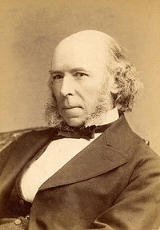
Herbert SpencerHerbert Spencer was an English philosopher, biologist, sociologist, and prominent classical liberal political theorist of the Victorian era....
(who coined the term) and
Charles DarwinCharles Robert Darwin FRS was an English naturalist. He established that all species of life have descended over time from common ancestry, and proposed the scientific theory that this branching pattern of evolution resulted from a process that he called natural selection.He published his theory...
.
Herbert Spencer first used the phrase – after reading Charles Darwin's
On the Origin of Species – in his
Principles of Biology (1864), in which he drew parallels between his own economic theories and Darwin's biological ones, writing, "This survival of the fittest, which I have here sought to express in mechanical terms, is that which Mr. Darwin has called 'natural selection', or the preservation of favoured races in the struggle for life."
^ "Herbert Spencer in his
Principles of Biology of 1864, vol. 1, p. 444, wrote: 'This survival of the fittest, which I have here sought to express in mechanical terms, is that which Mr. Darwin has called "natural selection", or the preservation of favoured races in the struggle for life.'" , citing HERBERT SPENCER, THE PRINCIPLES OF BIOLOGY 444 (Univ. Press
of the Pac. 2002.)
Darwin first used Spencer's new phrase "survival of the fittest" as a synonym for
natural selectionNatural selection is the nonrandom process by which biologic traits become either more or less common in a population as a function of differential reproduction of their bearers. It is a key mechanism of evolution....
in the fifth edition of
On the Origin of Species, published in 1869. Darwin meant it as a
metaphorA metaphor is a literary figure of speech that uses an image, story or tangible thing to represent a less tangible thing or some intangible quality or idea; e.g., "Her eyes were glistening jewels." Metaphor may also be used for any rhetorical figures of speech that achieve their effects via...
for "better adapted for immediate, local environment", not the common inference of "in the best physical shape". Hence, it is not a scientific description.
The phrase "survival of the fittest" is not generally used by modern biologists as the term does not accurately convey the meaning of
natural selectionNatural selection is the nonrandom process by which biologic traits become either more or less common in a population as a function of differential reproduction of their bearers. It is a key mechanism of evolution....
, the term biologists use and prefer. Natural selection refers to differential reproduction as a function of traits that have a genetic basis. "Survival of the fittest" is inaccurate for two important reasons. First, survival is merely a normal prerequisite to reproduction. Second, fitness has specialized meaning in biology different from how the word is used in popular culture. In
population geneticsPopulation genetics is the study of allele frequency distribution and change under the influence of the four main evolutionary processes: natural selection, genetic drift, mutation and gene flow. It also takes into account the factors of recombination, population subdivision and population...
,
fitnessFitness is a central idea in evolutionary theory. It can be defined either with respect to a genotype or to a phenotype in a given environment...
refers to differential reproduction. "Fitness" does not refer to whether an individual is "physically fit" – bigger, faster or stronger – or "better" in any subjective sense. It refers to a difference in reproductive rate from one generation to the next.
An interpretation of the phrase "survival of the fittest" to mean "only the fittest organisms will prevail" (a view sometimes derided as "
Social DarwinismSocial Darwinism is a term commonly used for theories of society that emerged in England and the United States in the 1870s, seeking to apply the principles of Darwinian evolution to sociology and politics...
") is not consistent with the actual theory of evolution. Any individual organism which succeeds in reproducing itself is "fit" and will contribute to survival of its species, not just the "physically fittest" ones, though some of the population will be better adapted to the circumstances than others. A more accurate characterization of evolution would be "survival of the fit enough".
"Survival of the fit enough" is also emphasized by the fact that while direct competition has been observed between individuals, populations and species, there is little evidence that competition has been the driving force in the evolution of large groups. For example, between amphibians, reptiles and mammals; rather these animals have evolved by expanding into empty ecological niches.
Moreover, to misunderstand or misapply the phrase to simply mean "survival of those who are better equipped for surviving" is
rhetorical tautologyTautology is an unnecessary or unessential repetition of meaning, using different and dissimilar words that effectively say the same thing...
. What Darwin meant was "better adapted for immediate, local environment" by differential preservation of organisms that are better adapted to live in changing environments. The concept is not
tautologicalIn logic, a tautology is a formula which is true in every possible interpretation. Philosopher Ludwig Wittgenstein first applied the term to redundancies of propositional logic in 1921; it had been used earlier to refer to rhetorical tautologies, and continues to be used in that alternate sense...
as it contains an independent criterion of fitness.
History of the phrase
Herbert SpencerHerbert Spencer was an English philosopher, biologist, sociologist, and prominent classical liberal political theorist of the Victorian era....
first used the phrase — after reading
Charles DarwinCharles Robert Darwin FRS was an English naturalist. He established that all species of life have descended over time from common ancestry, and proposed the scientific theory that this branching pattern of evolution resulted from a process that he called natural selection.He published his theory...
's
On the Origin of SpeciesCharles Darwin's On the Origin of Species, published on 24 November 1859, is a work of scientific literature which is considered to be the foundation of evolutionary biology. Its full title was On the Origin of Species by Means of Natural Selection, or the Preservation of Favoured Races in the...
— in his
Principles of Biology of 1864 in which he drew parallels between his economic theories and Darwin's biological, evolutionary ones, writing, “This survival of the fittest, which I have here sought to express in mechanical terms, is that which Mr. Darwin has called 'natural selection', or the preservation of favoured races in the struggle for life."
In the first four editions of
On the Origin of Species, Darwin used the phrase "
natural selectionNatural selection is the nonrandom process by which biologic traits become either more or less common in a population as a function of differential reproduction of their bearers. It is a key mechanism of evolution....
". Darwin wrote on page 6 of
The Variation of Animals and Plants under DomesticationThe Variation of Animals and Plants under Domestication is a book written by Charles Darwin that was first published in January 1868.A large proportion of the book contains detailed information on the domestication of animals and plants but it also contains in Chapter XXVII a description of...
published in 1868, "This preservation, during the battle for life, of varieties which possess any advantage in structure, constitution, or instinct, I have called Natural Selection; and Mr. Herbert Spencer has well expressed the same idea by the Survival of the Fittest. The term "natural selection" is in some respects a bad one, as it seems to imply conscious choice; but this will be disregarded after a little familiarity". Darwin agreed with
Alfred Russel WallaceAlfred Russel Wallace, OM, FRS was a British naturalist, explorer, geographer, anthropologist and biologist...
that this new phrase — "survival of the fittest" — avoided the troublesome anthropomorphism of "selecting", though it "lost the analogy between nature's selection and the fanciers'". In Chapter 4 of the 5th edition of
The Origin published in 1869, Darwin implies again the synonym: "Natural Selection, or the Survival of the Fittest". By the word "fittest" Darwin meant "better adapted for immediate, local environment", not the common modern meaning of "in the best physical shape". In the introduction he gave full credit to Spencer, writing "I have called this principle, by which each slight variation, if useful, is preserved, by the term Natural Selection, in order to mark its relation to man's power of selection. But the expression often used by Mr. Herbert Spencer of the Survival of the Fittest is more accurate, and is sometimes equally convenient."
In
The Man Versus The State, Spencer used the phrase in a postscript to justify a plausible explanation for why his theories would not be adopted by "societies of militant type". He uses the term in the context of societies at war, and the form of his reference suggests that he is applying a general principle.
"Thus by survival of the fittest, the militant type of society becomes characterized by profound confidence in the governing power, joined with a loyalty causing submission to it in all matters whatever".
Herbert SpencerHerbert Spencer was an English philosopher, biologist, sociologist, and prominent classical liberal political theorist of the Victorian era....
is credited with starting the concept of
Social DarwinismSocial Darwinism is a term commonly used for theories of society that emerged in England and the United States in the 1870s, seeking to apply the principles of Darwinian evolution to sociology and politics...
. The phrase "survival of the fittest" has become widely used in popular literature as a catchphrase for any topic related or analogous to evolution and natural selection. It has thus been applied to principles of unrestrained
competitionCompetition is a contest between individuals, groups, animals, etc. for territory, a niche, or a location of resources. It arises whenever two and only two strive for a goal which cannot be shared. Competition occurs naturally between living organisms which co-exist in the same environment. For...
, and it has been used extensively by both proponents and opponents of
Social DarwinismSocial Darwinism is a term commonly used for theories of society that emerged in England and the United States in the 1870s, seeking to apply the principles of Darwinian evolution to sociology and politics...
. Its shortcomings as a description of Darwinian evolution have also become more apparent (see below).
Evolutionary
biologistA biologist is a scientist devoted to and producing results in biology through the study of life. Typically biologists study organisms and their relationship to their environment. Biologists involved in basic research attempt to discover underlying mechanisms that govern how organisms work...
s criticize how the term is used by non-scientists and the connotations that have grown around the term in popular culture. The phrase also does not help in conveying the complex nature of natural selection, so modern biologists prefer and almost exclusively use the term
natural selectionNatural selection is the nonrandom process by which biologic traits become either more or less common in a population as a function of differential reproduction of their bearers. It is a key mechanism of evolution....
. Indeed, in modern biology, the term
fitnessFitness is a central idea in evolutionary theory. It can be defined either with respect to a genotype or to a phenotype in a given environment...
mostly refers to
reproductive successReproductive success is defined as the passing of genes onto the next generation in a way that they too can pass those genes on. In practice, this is often a tally of the number of offspring produced by an individual. A more correct definition, which incorporates inclusive fitness, is the...
, and is not explicit about the specific ways in which organisms can be "fit" as in "having
phenotypicA phenotype is an organism's observable characteristics or traits: such as its morphology, development, biochemical or physiological properties, behavior, and products of behavior...
characteristics which enhance survival and reproduction" (which was the meaning that Spencer had in mind).
Biological Validity
In 2010 Sahney et al. argued that there is little evidence that intrinsic, biological factors such as competition have been the driving force in the evolution of large groups. Instead, they cited extrinsic, abiotic factors such as expansion as the driving factor on a large evolutionary scale. The rise of dominant groups such as amphibians, reptiles, mammals and birds occurred by opportunistic expansion into empty ecological niches and the extinction of groups happened due to large shifts in the abiotic environment.
Is "survival of the fittest" a tautology?
"Survival of the fittest" is sometimes claimed to be a
tautologyTautology is an unnecessary or unessential repetition of meaning, using different and dissimilar words that effectively say the same thing...
. The reasoning is that if one takes the term "fit" to mean "endowed with phenotypic characteristics which improve chances of survival and reproduction" (which is roughly how Spencer understood it), then "survival of the fittest" can simply be rewritten as "survival of those who are better equipped for surviving". Furthermore, the expression
does become a tautology if one uses the most widely accepted definition of "fitness" in modern biology, namely reproductive success itself (rather than any set of characters conducive to this reproductive success). This reasoning is sometimes used to claim that Darwin's entire theory of evolution by natural selection is fundamentally tautological, and therefore devoid of any explanatory power.
However, the expression "survival of the fittest" (taken on its own and out of context) gives a very incomplete account of the mechanism of natural selection. The reason is that it does not mention a key requirement for natural selection, namely the requirement of
heritability. It is true that the phrase "survival of the fittest", in and by itself, is a tautology if fitness is defined by survival and reproduction. Natural selection is the portion of variation in reproductive success that is caused by
heritable characters (see the article on
natural selectionNatural selection is the nonrandom process by which biologic traits become either more or less common in a population as a function of differential reproduction of their bearers. It is a key mechanism of evolution....
).
If certain heritable characters increase or decrease the chances of survival and reproduction of their bearers, then it follows mechanically (by definition of "heritable") that those characters that improve survival and reproduction will increase in frequency over generations. This is precisely what is called "
evolutionEvolution is any change across successive generations in the heritable characteristics of biological populations. Evolutionary processes give rise to diversity at every level of biological organisation, including species, individual organisms and molecules such as DNA and proteins.Life on Earth...
by
natural selectionNatural selection is the nonrandom process by which biologic traits become either more or less common in a population as a function of differential reproduction of their bearers. It is a key mechanism of evolution....
." On the other hand, if the characters which lead to differential reproductive success are not heritable, then no meaningful evolution will occur, "survival of the fittest" or not: if improvement in reproductive success is caused by traits that are not heritable, then there is no reason why these traits should increase in frequency over generations. In other words, natural selection does not simply state that "survivors survive" or "reproducers reproduce"; rather, it states that "survivors survive, reproduce and
therefore propagate any
heritable characters which have affected their survival and reproductive success". This statement is not tautological: it hinges on the testable hypothesis that such fitness-impacting heritable variations actually exist (a hypothesis that has been amply confirmed.)
Skeptic Society founder and
SkepticSkeptic is a quarterly science education and science advocacy magazine published internationally by The Skeptics Society, a nonprofit organization devoted to promoting scientific skepticism and resisting the spread of pseudoscience, superstition, and irrational beliefs...
magazine publisher Dr.
Michael ShermerMichael Brant Shermer is an American science writer, historian of science, founder of The Skeptics Society, and Editor in Chief of its magazine Skeptic, which is largely devoted to investigating pseudoscientific and supernatural claims. The Skeptics Society currently has over 55,000 members...
addresses this argument in his 1997 book,
Why People Believe Weird Things, in which he points out that although tautologies are sometimes the beginning of science, they are never the end, and that scientific principles like natural selection are testable and falsifiable by virtue of their predictive power. Shermer points out, as an example, that population genetics accurately demonstrate when natural selection will and will not effect change on a population. Shermer hypothesizes that if hominid fossils were found in the same geological strata as
trilobiteTrilobites are a well-known fossil group of extinct marine arthropods that form the class Trilobita. The first appearance of trilobites in the fossil record defines the base of the Atdabanian stage of the Early Cambrian period , and they flourished throughout the lower Paleozoic era before...
s, it would be evidence against natural selection.
Morality
Critics of
evolutionEvolution is any change across successive generations in the heritable characteristics of biological populations. Evolutionary processes give rise to diversity at every level of biological organisation, including species, individual organisms and molecules such as DNA and proteins.Life on Earth...
have argued that "survival of the fittest" provides a justification for behaviour that undermines
moral standardsMorality is the differentiation among intentions, decisions, and actions between those that are good and bad . A moral code is a system of morality and a moral is any one practice or teaching within a moral code...
by letting the strong set standards of justice to the detriment of the weak. However, any use of evolutionary descriptions to set moral standards would be a
naturalistic fallacyThe naturalistic fallacy is often claimed to be a formal fallacy. It was described and named by British philosopher G. E. Moore in his 1903 book Principia Ethica...
(or more specifically the
is-ought problemThe is–ought problem in meta-ethics as articulated by Scottish philosopher and historian, David Hume , is that many writers make claims about what ought to be on the basis of statements about what is...
), as prescriptive moral statements cannot be derived from purely descriptive premises. Describing how things are does not imply that things ought to be that way. It is also suggested that "survival of the fittest" implies treating the weak badly, even though in some cases of good social behaviour — cooperating with others and treating them well — might improve evolutionary fitness. This however does not resolve the is-ought problem.
It has also been claimed that "the survival of the fittest" theory in biology was interpreted by late 19th century
capitalistsCapitalism is an economic system that became dominant in the Western world following the demise of feudalism. There is no consensus on the precise definition nor on how the term should be used as a historical category...
as "an ethical precept that sanctioned cut-throat economic competition" and led to "
social DarwinismSocial Darwinism is a term commonly used for theories of society that emerged in England and the United States in the 1870s, seeking to apply the principles of Darwinian evolution to sociology and politics...
" which at times were used to justify
laissez-faireIn economics, laissez-faire describes an environment in which transactions between private parties are free from state intervention, including restrictive regulations, taxes, tariffs and enforced monopolies....
economicsEconomics is the social science that analyzes the production, distribution, and consumption of goods and services. The term economics comes from the Ancient Greek from + , hence "rules of the house"...
, war and
racismRacism is the belief that inherent different traits in human racial groups justify discrimination. In the modern English language, the term "racism" is used predominantly as a pejorative epithet. It is applied especially to the practice or advocacy of racial discrimination of a pernicious nature...
. However these ideas predate and commonly contradict Darwin's ideas, and indeed their proponents rarely invoked Darwin in support, while commonly claiming justification from religion and
Horatio AlgerHoratio Alger, Jr. was a prolific 19th-century American author, best known for his many formulaic juvenile novels about impoverished boys and their rise from humble backgrounds to lives of middle-class security and comfort through hard work, determination, courage, and honesty...
mythology. The term "social Darwinism" referring to capitalist ideologies was introduced as a term of abuse by
Richard HofstadterRichard Hofstadter was an American public intellectual of the 1950s, a historian and DeWitt Clinton Professor of American History at Columbia University...
's
Social Darwinism in American Thought published in 1944.
Human Cooperation
Russian anarchist
Peter KropotkinPrince Pyotr Alexeyevich Kropotkin was a Russian zoologist, evolutionary theorist, philosopher, economist, geographer, author and one of the world's foremost anarcho-communists. Kropotkin advocated a communist society free from central government and based on voluntary associations between...
viewed the concept of "survival of the fittest" as supporting co-operation rather than competition. In his book
Mutual Aid: A Factor of EvolutionMutual Aid: A Factor of Evolution is a book by Peter Kropotkin on the subject of mutual aid, written while he was living in exile in England. It was first published by William Heinemann in London in October 1902...
he set out his analysis leading to the conclusion that the fittest was not necessarily the best at competing individually, but often the community made up of those best at working together. He concluded that
In the animal world we have seen that the vast majority of species live in societies, and that they find in association the best arms for the struggle for life: understood, of course, in its wide Darwinian sense — not as a struggle for the sheer means of existence, but as a struggle against all natural conditions unfavourable to the species. The animal species, in which individual struggle has been reduced to its narrowest limits, and the practice of mutual aid has attained the greatest development, are invariably the most numerous, the most prosperous, and the most open to further progress.
Applying this concept to human society, Kropotkin presented mutual aid as one of the dominant factors of evolution, the other being self assertion, and concluded that
In the practice of mutual aid, which we can retrace to the earliest beginnings of evolution, we thus find the positive and undoubted origin of our ethical conceptions; and we can affirm that in the ethical progress of man, mutual support not mutual struggle – has had the leading part. In its wide extension, even at the present time, we also see the best guarantee of a still loftier evolution of our race.
See also
- Age of the earth
The age of the Earth is 4.54 billion years This age is based on evidence from radiometric age dating of meteorite material and is consistent with the ages of the oldest-known terrestrial and lunar samples...
- Altruism
Altruism is a concern for the welfare of others. It is a traditional virtue in many cultures, and a core aspect of various religious traditions, though the concept of 'others' toward whom concern should be directed can vary among cultures and religions. Altruism is the opposite of...
- Robert Boyle
Robert Boyle FRS was a 17th century natural philosopher, chemist, physicist, and inventor, also noted for his writings in theology. He has been variously described as English, Irish, or Anglo-Irish, his father having come to Ireland from England during the time of the English plantations of...
- Darwinian puzzle
A Darwinian puzzle is a trait that appears to reduce the fitness of individuals that possess it. Such traits attract the attention of evolutionary biologists...
- Ethical relativism
- Evolution of societies
- Freedom of thought
Freedom of thought is the freedom of an individual to hold or consider a fact, viewpoint, or thought, independent of others' viewpoints....
- Freethought
Freethought is a philosophical viewpoint that holds that opinions should be formed on the basis of science, logic, and reason, and should not be influenced by authority, tradition, or other dogmas...
- Garden of Eden
The Garden of Eden is in the Bible's Book of Genesis as being the place where the first man, Adam, and his wife, Eve, lived after they were created by God. Literally, the Bible speaks about a garden in Eden...
- Mutation
In molecular biology and genetics, mutations are changes in a genomic sequence: the DNA sequence of a cell's genome or the DNA or RNA sequence of a virus. They can be defined as sudden and spontaneous changes in the cell. Mutations are caused by radiation, viruses, transposons and mutagenic...
- Natural philosophy
Natural philosophy or the philosophy of nature , is a term applied to the study of nature and the physical universe that was dominant before the development of modern science...
- Neo-Creationism
Neo-creationism is a movement whose goal is to restate creationism in terms more likely to be well received by the public, policy makers, educators, and the scientific community. It aims to re-frame the debate over the origins of life in non-religious terms and without appeals to scripture. This...
- John Ruskin
John Ruskin was the leading English art critic of the Victorian era, also an art patron, draughtsman, watercolourist, a prominent social thinker and philanthropist. He wrote on subjects ranging from geology to architecture, myth to ornithology, literature to education, and botany to political...
- Scientific skepticism
Scientific skepticism is the practice of questioning the veracity of claims lacking empirical evidence or reproducibility, as part of a methodological norm pursuing "the extension of certified knowledge". For example, Robert K...
- Social Darwinism
Social Darwinism is a term commonly used for theories of society that emerged in England and the United States in the 1870s, seeking to apply the principles of Darwinian evolution to sociology and politics...
- Social ecology
Social ecology is a philosophy developed by Murray Bookchin in the 1960s.It holds that present ecological problems are rooted in deep-seated social problems, particularly in dominatory hierarchical political and social systems. These have resulted in an uncritical acceptance of an overly...
- Social evolutionism
- Social implications of the theory of evolution
- Universal Darwinism
Universal Darwinism refers to a variety of approaches that extend the theory of Darwinism beyond its original domain of biological evolution on Earth...
Origins of the phrase
Tautology links
Morality link
Kropotkin: Mutual Aid
- Mutual Aid: A Factor of Evolution — HTML version at the Anarchy Archives
The Anarchy Archives project is a self-described online research center on the history and theory of anarchism. It was created in September 1995 by Dana Ward, a Professor of Political Studies at Pitzer College...