

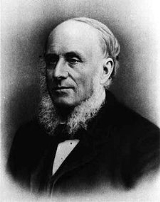
Alexander Bain

Encyclopedia
Alexander Bain was a Scottish
philosopher
and educationalist in the British school of empiricism who was a prominent and innovative figure in the fields of psychology
, linguistics
, logic
, moral philosophy and education reform
. He founded Mind
, the first ever journal of psychology and analytical philosophy, and was the leading figure in establishing and applying applying the scientific method
to psychology
. Bain was the inaugural Regius Chair
in Logic and Professor of Logic at the University of Aberdeen
, where he also held Professorships in Moral Philosophy and English Literature
and was twice elected Lord Rector of the University of Aberdeen.
to George Bain, a weaver and veteran soldier, and Margaret Paul. At age eleven he left school to work as a weaver hence the description of him as Weevir, rex philosophorum. He also took to lectures at the Mechanics' Institutes of Aberdeen
and the Aberdeen Public Library
.
In 1836 he entered Marischal College
where he came under the influence of Professor of Mathematics
John Cruickshank, Professor of Chemistry
Thomas Clark and Professor of Natural Philosophy
William Knight. Towards the end of his undergraduate degree he became a contributor to the Westminster Review
with his first article entitled "Electrotype and Daguerreotype," published in September 1840. This was the beginning of his connection with John Stuart Mill
, which led to a lifelong friendship. He was awarded the Blue Ribbon and also the Gray Mathematical Bursary. His college career and studies was distinguished especially in mental philosophy
, mathematics
and physics
and he graduated with a Master of Arts with Highest Honours
In 1841, Bain substituted for Dr. Glennie the Professor of Moral Philosophy, who, due to ill-health, was unable to discharge his academic duties. He continued to do this three successive terms, during which he continued writing for the Westminster, and also helped John Stuart Mill
with the revision of the manuscript of his System of Logic (1842). In 1843 he contributed the first review of the book to the London and Westminster.
in Glasgow
. A year later, preferring a wider field, he resigned the position and devoted himself to writing. In 1848 he moved to London to fill a post in the Board of Health
under Sir Edwin Chadwick where he worked for social reform and became a prominent member of the intellectual
circle which included George Grote
and John Stuart Mill
. In 1855 he published his first major work, The Senses and the Intellect, followed in 1859 by The Emotions and the Will. These treatises won him a position among independent thinkers. Bain was also Examiner in Logic
and Moral Philosophy from 1857–1862 and 1864–1869 for the University of London
and also an Instructor in Moral Science for the Indian Civil Service examinations.
In 1860 he was appointed by the British Crown
to the inaugural Regius Chair of Logic
and the Regius Chair of English Literature at the University of Aberdeen
, which was newly formed after the amalgamation of King's College, Aberdeen
and Marischal College
by the Scottish Universities Commission
of 1858.
, but also in establishing a School of Philosophy at the University of Aberdeen, and in widely influencing the teaching of English grammar
and composition
in the United Kingdom
. His efforts were first directed to the preparation of textbooks: Higher English Grammar and An English Grammar were both published in 1863, followed in 1866 by the Manual of Rhetoric, in 1872 by A First English Grammar, and in 1874 by the Companion to the Higher Grammar. These works were wide-ranging and their original views and methods met with wide acceptance.
, but differed from him in many particulars, and was distinctive for its treatment of the doctrine of the conservation of energy in connection with causation and the detailed application of the principles of logic to the various sciences with a section on the classification of the all sciences. Next came two publications in the "International Scientific Series", namely, Mind and Body (1872), and Education as a Science (1879). All these works, from the Higher English Grammar downwards, were written by Bain during his twenty years as a Professor at the University of Aberdeen. He also started the philosophical journal, Mind; the first number appeared in January 1876, under the editorship of a former pupil, George Croom Robertson
, of University College London
. To this journal Bain contributed many important articles and discussions; and in fact he bore the whole expenses of it till Robertson, owing to ill-health, resigned the editorship in 1891 and George Stout
took up the baton.
. At one with the German physiologist and comparative anatomist Johannes Peter Müller
in the conviction psychologus nemo nisi physiologus, he was the first in Great Britain during the 19th century to apply physiology in a thoroughgoing fashion to the elucidation of mental states. In discussing the will, he favoured physiological over metaphysical explanations, pointing to reflexes as evidence that a form of will, independent of consciousness, inheres in a person's limbs. He sought to chart physiological correlates of mental states but refused to make any materialistic assumptions. He was the originator of the theory of psychophysical parallelism
which is used so widely as a working basis by modern psychologists. His idea of applying the scientific method
of classification to psychical phenomena gave scientific character to his work, the value of which was enhanced by his methodical exposition and his command of illustration. In line with this, too, is his demand that psychology
should be cleared of metaphysics
; and to his lead is no doubt due in great measure the position that psychology has now acquired as a distinct positive science. Bain established psychology, as influenced by David Hume
and Auguste Comte
, as a more distinct discipline of science through applying the scientific method
. Bain proposed that physiological and psychological processes were linked, and that traditional psychology could be explained in terms of this association. Moreover he proposed that all knowledge and all mental processes had to be based on actual physical sensations, and not on spontaneous thoughts and ideas, and attempted to identify the link between the mind and the body and to discover the correlations between mental and behavioral phenomena.
William James
calls his work the "last word" of the earlier stage of psychology, but he was in reality the pioneer of the new. Subsequent psycho-physical investigations "have all been in" the spirit of his work; and although he consistently advocated the introspective method in psychological investigation, he was among the first to appreciate the help that may be given to it by social psychology
, comparative psychology
and developmental psychology
. He may justly claim the merit of having guided the awakened psychological interest of British thinkers of the second half of the 19th century into fruitful channels. Bain emphasised the importance of our active experiences of movement and effort, and though his theory of a central innervation sense is no longer held as he propounded it, its value as a suggestion to later psychologists is great. His thought that a belief is but a preparation for action is respected by both pragmatism
and functionalism
.
's Moral Philosophy (1852); Education as a Science (1879); Dissertations on leading philosophical topics (1903, mainly reprints of papers in Mind); he collaborated with JS Mill and Grote in editing James Mill's Analysis of the Phenomena of the Human Mind (1869), and assisted in editing Grote's Aristotle and Minor Works; he also wrote a memoir prefixed to G Croom Robertson's Philosophical Remains (1894).
and development and was frequently an active part in the political
and social movement
s of the day; after his retirement from the Chair of Logic, he was twice elected Lord Rector of the University of Aberdeen each term of office extending over three years. He was a strenuous advocate of reform, especially in the teaching of sciences
, and supported the claims of modern languages to a place in the curriculum. Moreover, he as an avid supporter for Student rights
and in 1884 the Aberdeen University Debating Society took the first steps towards the introduction of a Students' Representative Council
and later Aberdeen University Students' Association
under his support.
Bain was a member of the Committee of the Aberdeen Public Library
throughout his life as well as the School Board of Aberdeen
. Furthermore, Professor Bain gave lectures and wrote papers for the Mechanics' Institutes of Aberdeen
and served as the Secretary of its Committee.
His services to education and social reform in Scotland
were now recognised by the conferment of the honorary degree of Doctor of Law
by the University of Edinburgh
in 1871. A marble bust of him stands in the public library and his portrait hangs in the Marischal College.
, one of his most brilliant pupils. Nevertheless his interest in thought, and his desire to complete the scheme of work mapped out in earlier years, remained as keen as ever. Accordingly, in 1882 appeared the Biography of James Mill
, and accompanying it John Stuart Mill: a Criticism, with Personal Recollections. Next came (1884) a collection of articles and papers, most of which had appeared in magazines, under the title of Practical Essays. This was succeeded (1887, 1888) by a new edition of the Rhetoric, and along with it, a book On Teaching English, being an exhaustive application of the principles of rhetoric to the criticism of style, for the use of teachers; and in 1894 he published a revised edition of The Senses and the Intellect, which contain his last word on psychology. In 1894 also appeared his last contribution to Mind. His last years were spent in privacy at Aberdeen, where he died on 18 September 1903. He married twice but left no children. His last request was that "no stone should be placed upon his grave: his books, he said, would be his monument."
The University of Aberdeen Philosophy Department established the Bain Medal in 1883. It is awarded annually to the best candidate who gains First Class Honours in Mental Philosophy.
As Professor William L. Davidson wrote in Bain's obituary in Mind "In Dr. Bain’s death, psychology has sustained a great loss; but so too has education and practical reform. It is rare to find a philosopher who combines philosophical with educational and practical interests, and who is also an active force in the community in which he dwells. Such a combination was here. Let us not fail to appreciate it."
Scotland
Scotland is a country that is part of the United Kingdom. Occupying the northern third of the island of Great Britain, it shares a border with England to the south and is bounded by the North Sea to the east, the Atlantic Ocean to the north and west, and the North Channel and Irish Sea to the...
philosopher
Philosophy
Philosophy is the study of general and fundamental problems, such as those connected with existence, knowledge, values, reason, mind, and language. Philosophy is distinguished from other ways of addressing such problems by its critical, generally systematic approach and its reliance on rational...
and educationalist in the British school of empiricism who was a prominent and innovative figure in the fields of psychology
Psychology
Psychology is the study of the mind and behavior. Its immediate goal is to understand individuals and groups by both establishing general principles and researching specific cases. For many, the ultimate goal of psychology is to benefit society...
, linguistics
Linguistics
Linguistics is the scientific study of human language. Linguistics can be broadly broken into three categories or subfields of study: language form, language meaning, and language in context....
, logic
Logic
In philosophy, Logic is the formal systematic study of the principles of valid inference and correct reasoning. Logic is used in most intellectual activities, but is studied primarily in the disciplines of philosophy, mathematics, semantics, and computer science...
, moral philosophy and education reform
Education reform
Education reform is the process of improving public education. Small improvements in education theoretically have large social returns, in health, wealth and well-being. Historically, reforms have taken different forms because the motivations of reformers have differed.A continuing motivation has...
. He founded Mind
Mind (journal)
Mind is a British journal, currently published by Oxford University Press on behalf of the Mind Association, which deals with philosophy in the analytic tradition...
, the first ever journal of psychology and analytical philosophy, and was the leading figure in establishing and applying applying the scientific method
Scientific method
Scientific method refers to a body of techniques for investigating phenomena, acquiring new knowledge, or correcting and integrating previous knowledge. To be termed scientific, a method of inquiry must be based on gathering empirical and measurable evidence subject to specific principles of...
to psychology
Psychology
Psychology is the study of the mind and behavior. Its immediate goal is to understand individuals and groups by both establishing general principles and researching specific cases. For many, the ultimate goal of psychology is to benefit society...
. Bain was the inaugural Regius Chair
Regius Professor
Regius Professorships are "royal" professorships at the ancient universities of the United Kingdom and Ireland - namely Oxford, Cambridge, St Andrews, Glasgow, Aberdeen, Edinburgh and Dublin. Each of the chairs was created by a monarch, and each appointment, save those at Dublin, is approved by the...
in Logic and Professor of Logic at the University of Aberdeen
University of Aberdeen
The University of Aberdeen, an ancient university founded in 1495, in Aberdeen, Scotland, is a British university. It is the third oldest university in Scotland, and the fifth oldest in the United Kingdom and wider English-speaking world...
, where he also held Professorships in Moral Philosophy and English Literature
English literature
English literature is the literature written in the English language, including literature composed in English by writers not necessarily from England; for example, Robert Burns was Scottish, James Joyce was Irish, Joseph Conrad was Polish, Dylan Thomas was Welsh, Edgar Allan Poe was American, J....
and was twice elected Lord Rector of the University of Aberdeen.
Early life and education
Alexander Bain was born in Aberdeen, ScotlandAberdeen
Aberdeen is Scotland's third most populous city, one of Scotland's 32 local government council areas and the United Kingdom's 25th most populous city, with an official population estimate of ....
to George Bain, a weaver and veteran soldier, and Margaret Paul. At age eleven he left school to work as a weaver hence the description of him as Weevir, rex philosophorum. He also took to lectures at the Mechanics' Institutes of Aberdeen
Mechanics' Institutes
Historically, Mechanics' Institutes were educational establishments formed to provide adult education, particularly in technical subjects, to working men...
and the Aberdeen Public Library
Central Library, Aberdeen
The Central Library of Aberdeen in Scotland is located on Rosemount Viaduct and is the main library for the city.The library is housed in a listed building.It cost £10,000 to build and was publicly funded through local campaigning that began in 1889...
.
In 1836 he entered Marischal College
Marischal College
Marischal College is a building and former university in the centre of the city of Aberdeen in north-east Scotland. The building is owned by the University of Aberdeen and used for ceremonial events...
where he came under the influence of Professor of Mathematics
Mathematics
Mathematics is the study of quantity, space, structure, and change. Mathematicians seek out patterns and formulate new conjectures. Mathematicians resolve the truth or falsity of conjectures by mathematical proofs, which are arguments sufficient to convince other mathematicians of their validity...
John Cruickshank, Professor of Chemistry
Chemistry
Chemistry is the science of matter, especially its chemical reactions, but also its composition, structure and properties. Chemistry is concerned with atoms and their interactions with other atoms, and particularly with the properties of chemical bonds....
Thomas Clark and Professor of Natural Philosophy
Natural philosophy
Natural philosophy or the philosophy of nature , is a term applied to the study of nature and the physical universe that was dominant before the development of modern science...
William Knight. Towards the end of his undergraduate degree he became a contributor to the Westminster Review
Westminster Review
The Westminster Review was a quarterly British publication. Established in 1823 as the official organ of the Philosophical Radicals, it was published from 1824 to 1914. James Mill was one of the driving forces behind the liberal journal until 1828....
with his first article entitled "Electrotype and Daguerreotype," published in September 1840. This was the beginning of his connection with John Stuart Mill
John Stuart Mill
John Stuart Mill was a British philosopher, economist and civil servant. An influential contributor to social theory, political theory, and political economy, his conception of liberty justified the freedom of the individual in opposition to unlimited state control. He was a proponent of...
, which led to a lifelong friendship. He was awarded the Blue Ribbon and also the Gray Mathematical Bursary. His college career and studies was distinguished especially in mental philosophy
Philosophy of mind
Philosophy of mind is a branch of philosophy that studies the nature of the mind, mental events, mental functions, mental properties, consciousness and their relationship to the physical body, particularly the brain. The mind-body problem, i.e...
, mathematics
Mathematics
Mathematics is the study of quantity, space, structure, and change. Mathematicians seek out patterns and formulate new conjectures. Mathematicians resolve the truth or falsity of conjectures by mathematical proofs, which are arguments sufficient to convince other mathematicians of their validity...
and physics
Physics
Physics is a natural science that involves the study of matter and its motion through spacetime, along with related concepts such as energy and force. More broadly, it is the general analysis of nature, conducted in order to understand how the universe behaves.Physics is one of the oldest academic...
and he graduated with a Master of Arts with Highest Honours
Master of Arts (Scotland)
A Master of Arts in Scotland can refer to an undergraduate academic degree in humanities and social sciences awarded by the ancient universities of Scotland – the University of St Andrews, the University of Glasgow, the University of Aberdeen and the University of Edinburgh, while the University of...
In 1841, Bain substituted for Dr. Glennie the Professor of Moral Philosophy, who, due to ill-health, was unable to discharge his academic duties. He continued to do this three successive terms, during which he continued writing for the Westminster, and also helped John Stuart Mill
John Stuart Mill
John Stuart Mill was a British philosopher, economist and civil servant. An influential contributor to social theory, political theory, and political economy, his conception of liberty justified the freedom of the individual in opposition to unlimited state control. He was a proponent of...
with the revision of the manuscript of his System of Logic (1842). In 1843 he contributed the first review of the book to the London and Westminster.
Academic career
In 1845 he was appointed Professor of Mathematics and Natural Philosophy at Anderson's UniversityUniversity of Strathclyde
The University of Strathclyde , Glasgow, Scotland, is Glasgow's second university by age, founded in 1796, and receiving its Royal Charter in 1964 as the UK's first technological university...
in Glasgow
Glasgow
Glasgow is the largest city in Scotland and third most populous in the United Kingdom. The city is situated on the River Clyde in the country's west central lowlands...
. A year later, preferring a wider field, he resigned the position and devoted himself to writing. In 1848 he moved to London to fill a post in the Board of Health
Department of Health (United Kingdom)
The Department of Health is a department of the United Kingdom government with responsibility for government policy for health and social care matters and for the National Health Service in England along with a few elements of the same matters which are not otherwise devolved to the Scottish,...
under Sir Edwin Chadwick where he worked for social reform and became a prominent member of the intellectual
Intellectual
An intellectual is a person who uses intelligence and critical or analytical reasoning in either a professional or a personal capacity.- Terminology and endeavours :"Intellectual" can denote four types of persons:...
circle which included George Grote
George Grote
George Grote was an English classical historian, best known in the field for a major work, the voluminous History of Greece, still read.-Early life:He was born at Clay Hill near Beckenham in Kent...
and John Stuart Mill
John Stuart Mill
John Stuart Mill was a British philosopher, economist and civil servant. An influential contributor to social theory, political theory, and political economy, his conception of liberty justified the freedom of the individual in opposition to unlimited state control. He was a proponent of...
. In 1855 he published his first major work, The Senses and the Intellect, followed in 1859 by The Emotions and the Will. These treatises won him a position among independent thinkers. Bain was also Examiner in Logic
Logic
In philosophy, Logic is the formal systematic study of the principles of valid inference and correct reasoning. Logic is used in most intellectual activities, but is studied primarily in the disciplines of philosophy, mathematics, semantics, and computer science...
and Moral Philosophy from 1857–1862 and 1864–1869 for the University of London
University of London
-20th century:Shortly after 6 Burlington Gardens was vacated, the University went through a period of rapid expansion. Bedford College, Royal Holloway and the London School of Economics all joined in 1900, Regent's Park College, which had affiliated in 1841 became an official divinity school of the...
and also an Instructor in Moral Science for the Indian Civil Service examinations.
In 1860 he was appointed by the British Crown
Monarchy of the United Kingdom
The monarchy of the United Kingdom is the constitutional monarchy of the United Kingdom and its overseas territories. The present monarch, Queen Elizabeth II, has reigned since 6 February 1952. She and her immediate family undertake various official, ceremonial and representational duties...
to the inaugural Regius Chair of Logic
Logic
In philosophy, Logic is the formal systematic study of the principles of valid inference and correct reasoning. Logic is used in most intellectual activities, but is studied primarily in the disciplines of philosophy, mathematics, semantics, and computer science...
and the Regius Chair of English Literature at the University of Aberdeen
University of Aberdeen
The University of Aberdeen, an ancient university founded in 1495, in Aberdeen, Scotland, is a British university. It is the third oldest university in Scotland, and the fifth oldest in the United Kingdom and wider English-speaking world...
, which was newly formed after the amalgamation of King's College, Aberdeen
King's College, Aberdeen
King's College in Old Aberdeen, Scotland is a formerly independent university founded in 1495 and an integral part of the University of Aberdeen...
and Marischal College
Marischal College
Marischal College is a building and former university in the centre of the city of Aberdeen in north-east Scotland. The building is owned by the University of Aberdeen and used for ceremonial events...
by the Scottish Universities Commission
Ancient universities of Scotland
The ancient universities of Scotland are medieval and renaissance universities which continue to exist until the present day. The majority of the ancient universities of the British Isles are located within Scotland, and have a number of distinctive features in common, being governed by a series of...
of 1858.
Linguistics
Until 1858 neither logic nor English had received adequate attention in Aberdeen, and Bain devoted himself to supplying these deficiencies. He succeeded not only in raising the standard of education generally in the North of ScotlandEducation in Scotland
Scotland has a long history of universal provision of public education, and the Scottish education system is distinctly different from the other countries of the United Kingdom...
, but also in establishing a School of Philosophy at the University of Aberdeen, and in widely influencing the teaching of English grammar
Grammar
In linguistics, grammar is the set of structural rules that govern the composition of clauses, phrases, and words in any given natural language. The term refers also to the study of such rules, and this field includes morphology, syntax, and phonology, often complemented by phonetics, semantics,...
and composition
Composition (language)
The term composition , in written language, refers to the collective body of important features established by the author in their creation of literature...
in the United Kingdom
United Kingdom
The United Kingdom of Great Britain and Northern IrelandIn the United Kingdom and Dependencies, other languages have been officially recognised as legitimate autochthonous languages under the European Charter for Regional or Minority Languages...
. His efforts were first directed to the preparation of textbooks: Higher English Grammar and An English Grammar were both published in 1863, followed in 1866 by the Manual of Rhetoric, in 1872 by A First English Grammar, and in 1874 by the Companion to the Higher Grammar. These works were wide-ranging and their original views and methods met with wide acceptance.
Philosophy
Bain's philosophical writings already published, especially The Senses and the Intellect to which was added in 1861 The Study of Character including an Estimate of Phrenology, were too large for effective use in the classroom. Accordingly in 1868, he published his Manual of Mental and Moral Science, mainly a condensed form of his treatises, with the doctrines re-stated, and in many instances freshly illustrated, and with many important additions. The year 1870 saw the publication of the Logic. This, too, was a work designed for the use of students; it was based on John Stuart MillJohn Stuart Mill
John Stuart Mill was a British philosopher, economist and civil servant. An influential contributor to social theory, political theory, and political economy, his conception of liberty justified the freedom of the individual in opposition to unlimited state control. He was a proponent of...
, but differed from him in many particulars, and was distinctive for its treatment of the doctrine of the conservation of energy in connection with causation and the detailed application of the principles of logic to the various sciences with a section on the classification of the all sciences. Next came two publications in the "International Scientific Series", namely, Mind and Body (1872), and Education as a Science (1879). All these works, from the Higher English Grammar downwards, were written by Bain during his twenty years as a Professor at the University of Aberdeen. He also started the philosophical journal, Mind; the first number appeared in January 1876, under the editorship of a former pupil, George Croom Robertson
George Croom Robertson
George Croom Robertson was a Scottish philosopher.He was born in Aberdeen. In 1857 he gained a bursary at Marischal College, and graduated MA in 1861, with the highest honours in classics and philosophy. In the same year he won a Fergusson scholarship of £100 a year for two years, which enabled...
, of University College London
University College London
University College London is a public research university located in London, United Kingdom and the oldest and largest constituent college of the federal University of London...
. To this journal Bain contributed many important articles and discussions; and in fact he bore the whole expenses of it till Robertson, owing to ill-health, resigned the editorship in 1891 and George Stout
George Stout
George Frederick Stout was a leading English philosopher and psychologist.Born in South Shields, he studied and later taught philosophy and psychology at Cambridge University....
took up the baton.
Psychology
Although his influence as a logician and linguist in grammar and rhetoric was considerable, his reputation rests on his works of psychologyPsychology
Psychology is the study of the mind and behavior. Its immediate goal is to understand individuals and groups by both establishing general principles and researching specific cases. For many, the ultimate goal of psychology is to benefit society...
. At one with the German physiologist and comparative anatomist Johannes Peter Müller
Johannes Peter Müller
Johannes Peter Müller , was a German physiologist, comparative anatomist, and ichthyologist not only known for his discoveries but also for his ability to synthesize knowledge.-Early years and education:...
in the conviction psychologus nemo nisi physiologus, he was the first in Great Britain during the 19th century to apply physiology in a thoroughgoing fashion to the elucidation of mental states. In discussing the will, he favoured physiological over metaphysical explanations, pointing to reflexes as evidence that a form of will, independent of consciousness, inheres in a person's limbs. He sought to chart physiological correlates of mental states but refused to make any materialistic assumptions. He was the originator of the theory of psychophysical parallelism
Psychophysical parallelism
Psychophysical parallelism, in philosophy, is the theory that mental and bodily experiences occur in tandem with each other, but without any type of causal interaction; it denies the interaction between the body and the mind. In other words, the mind and body are two independent phenomena but...
which is used so widely as a working basis by modern psychologists. His idea of applying the scientific method
Scientific method
Scientific method refers to a body of techniques for investigating phenomena, acquiring new knowledge, or correcting and integrating previous knowledge. To be termed scientific, a method of inquiry must be based on gathering empirical and measurable evidence subject to specific principles of...
of classification to psychical phenomena gave scientific character to his work, the value of which was enhanced by his methodical exposition and his command of illustration. In line with this, too, is his demand that psychology
Psychology
Psychology is the study of the mind and behavior. Its immediate goal is to understand individuals and groups by both establishing general principles and researching specific cases. For many, the ultimate goal of psychology is to benefit society...
should be cleared of metaphysics
Metaphysics
Metaphysics is a branch of philosophy concerned with explaining the fundamental nature of being and the world, although the term is not easily defined. Traditionally, metaphysics attempts to answer two basic questions in the broadest possible terms:...
; and to his lead is no doubt due in great measure the position that psychology has now acquired as a distinct positive science. Bain established psychology, as influenced by David Hume
David Hume
David Hume was a Scottish philosopher, historian, economist, and essayist, known especially for his philosophical empiricism and skepticism. He was one of the most important figures in the history of Western philosophy and the Scottish Enlightenment...
and Auguste Comte
Auguste Comte
Isidore Auguste Marie François Xavier Comte , better known as Auguste Comte , was a French philosopher, a founder of the discipline of sociology and of the doctrine of positivism...
, as a more distinct discipline of science through applying the scientific method
Scientific method
Scientific method refers to a body of techniques for investigating phenomena, acquiring new knowledge, or correcting and integrating previous knowledge. To be termed scientific, a method of inquiry must be based on gathering empirical and measurable evidence subject to specific principles of...
. Bain proposed that physiological and psychological processes were linked, and that traditional psychology could be explained in terms of this association. Moreover he proposed that all knowledge and all mental processes had to be based on actual physical sensations, and not on spontaneous thoughts and ideas, and attempted to identify the link between the mind and the body and to discover the correlations between mental and behavioral phenomena.
William James
William James
William James was a pioneering American psychologist and philosopher who was trained as a physician. He wrote influential books on the young science of psychology, educational psychology, psychology of religious experience and mysticism, and on the philosophy of pragmatism...
calls his work the "last word" of the earlier stage of psychology, but he was in reality the pioneer of the new. Subsequent psycho-physical investigations "have all been in" the spirit of his work; and although he consistently advocated the introspective method in psychological investigation, he was among the first to appreciate the help that may be given to it by social psychology
Social psychology
Social psychology is the scientific study of how people's thoughts, feelings, and behaviors are influenced by the actual, imagined, or implied presence of others. By this definition, scientific refers to the empirical method of investigation. The terms thoughts, feelings, and behaviors include all...
, comparative psychology
Comparative psychology
Comparative psychology generally refers to the scientific study of the behavior and mental processes of non-human animals. However, scientists from different disciplines do not always agree on this definition...
and developmental psychology
Developmental psychology
Developmental psychology, also known as human development, is the scientific study of systematic psychological changes, emotional changes, and perception changes that occur in human beings over the course of their life span. Originally concerned with infants and children, the field has expanded to...
. He may justly claim the merit of having guided the awakened psychological interest of British thinkers of the second half of the 19th century into fruitful channels. Bain emphasised the importance of our active experiences of movement and effort, and though his theory of a central innervation sense is no longer held as he propounded it, its value as a suggestion to later psychologists is great. His thought that a belief is but a preparation for action is respected by both pragmatism
Pragmatism
Pragmatism is a philosophical tradition centered on the linking of practice and theory. It describes a process where theory is extracted from practice, and applied back to practice to form what is called intelligent practice...
and functionalism
Functionalism
Functionalism may refer to:* Functionalism , or structural functionalism, a theoretical tradition within sociology and anthropology* Functionalism * Functionalism...
.
Other works
Bain's autobiography, published in 1904, contains a full list of his works, and also the history of the last thirteen years of his life by Professor W. L. Davidson of the University of Aberdeen, who further contributed to Mind (April 1904) a review of Bain's services to philosophy. Further works include editions with notes of PaleyWilliam Paley
William Paley was a British Christian apologist, philosopher, and utilitarian. He is best known for his exposition of the teleological argument for the existence of God in his work Natural Theology, which made use of the watchmaker analogy .-Life:Paley was Born in Peterborough, England, and was...
's Moral Philosophy (1852); Education as a Science (1879); Dissertations on leading philosophical topics (1903, mainly reprints of papers in Mind); he collaborated with JS Mill and Grote in editing James Mill's Analysis of the Phenomena of the Human Mind (1869), and assisted in editing Grote's Aristotle and Minor Works; he also wrote a memoir prefixed to G Croom Robertson's Philosophical Remains (1894).
Social Reform
Bain took a keen interest in social justiceSocial justice
Social justice generally refers to the idea of creating a society or institution that is based on the principles of equality and solidarity, that understands and values human rights, and that recognizes the dignity of every human being. The term and modern concept of "social justice" was coined by...
and development and was frequently an active part in the political
Political movement
A political movement is a social movement in the area of politics. A political movement may be organized around a single issue or set of issues, or around a set of shared concerns of a social group...
and social movement
Social movement
Social movements are a type of group action. They are large informal groupings of individuals or organizations focused on specific political or social issues, in other words, on carrying out, resisting or undoing a social change....
s of the day; after his retirement from the Chair of Logic, he was twice elected Lord Rector of the University of Aberdeen each term of office extending over three years. He was a strenuous advocate of reform, especially in the teaching of sciences
Science education
Science education is the field concerned with sharing science content and process with individuals not traditionally considered part of the scientific community. The target individuals may be children, college students, or adults within the general public. The field of science education comprises...
, and supported the claims of modern languages to a place in the curriculum. Moreover, he as an avid supporter for Student rights
Student rights
Student rights are those rights which protect students, here meaning those persons attending schools, universities and other educational institutions...
and in 1884 the Aberdeen University Debating Society took the first steps towards the introduction of a Students' Representative Council
Students' Representative Council
A Students' Representative Council represents student interests in the government of a university, school or other educational institution. Generally the SRC forms part of a broader Students' Association which may include other functions such as societies, entertainments and sports Universities...
and later Aberdeen University Students' Association
Aberdeen University Students' Association
Aberdeen University Students' Association is the students' association of the University of Aberdeen, an ancient university in the city of Aberdeen in north east Scotland...
under his support.
Bain was a member of the Committee of the Aberdeen Public Library
Central Library, Aberdeen
The Central Library of Aberdeen in Scotland is located on Rosemount Viaduct and is the main library for the city.The library is housed in a listed building.It cost £10,000 to build and was publicly funded through local campaigning that began in 1889...
throughout his life as well as the School Board of Aberdeen
Education in Aberdeen
Education in Aberdeen, Scotland has a strong tradition with two Universities and Scotland's largest further education college.-Universities:...
. Furthermore, Professor Bain gave lectures and wrote papers for the Mechanics' Institutes of Aberdeen
Mechanics' Institutes
Historically, Mechanics' Institutes were educational establishments formed to provide adult education, particularly in technical subjects, to working men...
and served as the Secretary of its Committee.
His services to education and social reform in Scotland
Scotland
Scotland is a country that is part of the United Kingdom. Occupying the northern third of the island of Great Britain, it shares a border with England to the south and is bounded by the North Sea to the east, the Atlantic Ocean to the north and west, and the North Channel and Irish Sea to the...
were now recognised by the conferment of the honorary degree of Doctor of Law
Doctor of law
Doctor of Law or Doctor of Laws is a doctoral degree in law. The application of the term varies from country to country, and includes degrees such as the LL.D., Ph.D., J.D., J.S.D., and Dr. iur.-Argentina:...
by the University of Edinburgh
University of Edinburgh
The University of Edinburgh, founded in 1583, is a public research university located in Edinburgh, the capital of Scotland, and a UNESCO World Heritage Site. The university is deeply embedded in the fabric of the city, with many of the buildings in the historic Old Town belonging to the university...
in 1871. A marble bust of him stands in the public library and his portrait hangs in the Marischal College.
Later life and death
Bain retired from his Chair and Professorship from the University of Aberdeen and was succeeded by William MintoWilliam Minto
William Minto , Scottish man of letters, was born at Auchintoul, Aberdeenshire.He was educated at the University of Aberdeen, and spent a year at Merton College, Oxford...
, one of his most brilliant pupils. Nevertheless his interest in thought, and his desire to complete the scheme of work mapped out in earlier years, remained as keen as ever. Accordingly, in 1882 appeared the Biography of James Mill
James Mill
James Mill was a Scottish historian, economist, political theorist, and philosopher. He was a founder of classical economics, together with David Ricardo, and the father of influential philosopher of classical liberalism, John Stuart Mill.-Life:Mill was born at Northwater Bridge, in the parish of...
, and accompanying it John Stuart Mill: a Criticism, with Personal Recollections. Next came (1884) a collection of articles and papers, most of which had appeared in magazines, under the title of Practical Essays. This was succeeded (1887, 1888) by a new edition of the Rhetoric, and along with it, a book On Teaching English, being an exhaustive application of the principles of rhetoric to the criticism of style, for the use of teachers; and in 1894 he published a revised edition of The Senses and the Intellect, which contain his last word on psychology. In 1894 also appeared his last contribution to Mind. His last years were spent in privacy at Aberdeen, where he died on 18 September 1903. He married twice but left no children. His last request was that "no stone should be placed upon his grave: his books, he said, would be his monument."
The University of Aberdeen Philosophy Department established the Bain Medal in 1883. It is awarded annually to the best candidate who gains First Class Honours in Mental Philosophy.
As Professor William L. Davidson wrote in Bain's obituary in Mind "In Dr. Bain’s death, psychology has sustained a great loss; but so too has education and practical reform. It is rare to find a philosopher who combines philosophical with educational and practical interests, and who is also an active force in the community in which he dwells. Such a combination was here. Let us not fail to appreciate it."
See also
- Association of IdeasAssociation of IdeasAssociation of Ideas, or Mental association, is a term used principally in the history of philosophy and of psychology to refer to explanations about the conditions under which representations arise in consciousness, and also for a principle put forward by an important historical school of thinkers...
- Psychophysical parallelismPsychophysical parallelismPsychophysical parallelism, in philosophy, is the theory that mental and bodily experiences occur in tandem with each other, but without any type of causal interaction; it denies the interaction between the body and the mind. In other words, the mind and body are two independent phenomena but...
- MindMind (journal)Mind is a British journal, currently published by Oxford University Press on behalf of the Mind Association, which deals with philosophy in the analytic tradition...
Further reading
- Bain, Alexander, English Composition and Rhetoric, 1871 (facsimile ed., 1996, Scholars' Facsimiles & Reprints, ISBN 978-0-8201-1497-2).
- B. R. Hergenhahn, An Introduction to the History of Psychology, Sixth Edition
- Kunitz, StanleyStanley KunitzStanley Jasspon Kunitz was an American poet. He was appointed Poet Laureate Consultant in Poetry to the Library of Congress twice, first in 1974 and then again in 2000.-Biography:...
, and Howard Haycraft. "Bain, Alexander." British Authors of the Nineteenth Century. H. W. Wilson Company, New York, 1936.
External links
- William L. Davidson, Professor Bain, an obituary from Mind (Jan. 1904)
- Moral Science: A Compendium of Ethics by Alexander Bain
- Stanford Encyclopedia of Philosophy entry on Alexander Bain