


Ancient Estonia

Encyclopedia
History of Estonia
Estonia was settled near the end of the last glacial era, beginning from around 8500 BC. Before the German invasions in the 13th century proto-Estonians of the Ancient Estonia worshipped the spirits of nature...
from the middle of the 8th millennium BC
8th millennium BC
In the 8th millennium BC, agriculture became widely practised in the Fertile Crescent and Anatolia.Pottery became widespread and animal husbandry spread to Africa and Eurasia. World population was approximately 5 million.-Events:*c. 8000 BC—The last glacial period ends.*c...
until the conquest and subjugation of the Estonian people in the first quarter of the 13th century during the Northern Crusades
Northern Crusades
The Northern Crusades or Baltic Crusades were crusades undertaken by the Christian kings of Denmark and Sweden, the German Livonian and Teutonic military orders, and their allies against the pagan peoples of Northern Europe around the southern and eastern shores of the Baltic Sea...
.
The Mesolithic Period
Kunda culture
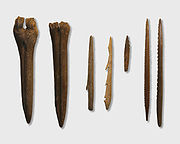
Kunda Culture, with its roots in Swiderian culture is a mesolithic hunter-gatherer communities of the Baltic forest zone extending eastwards through Latvia into northern Russia dating to the period 8000–5000 BC by calibrated radiocarbon dating...
. The oldest known settlement in Estonia is the Pulli settlement
Pulli settlement
Pulli settlement, located on the right bank of the Pärnu River, is the oldest known human settlement in Estonia. It is located two kilometers from the town of Sindi, which is 14 kilometers from Pärnu...
, which was located on the banks of the river Pärnu
Pärnu River
The Pärnu is a river in Estonia that drains into the Gulf of Riga at Pärnu. It is a one of the longest rivers in Estonia - 144 km long. It has the basin area of 6,920 km² and average discharge is 64.4 m³/s.- References :...
, near the town of Sindi, in South-western Estonia. It has been dated to the beginning of the 9th millennium BC
9th millennium BC
The 9th millennium BC marks the beginning of the Neolithic period.Agriculture spread throughout the Fertile Crescent and use of pottery became more widespread. Larger settlements like Jericho arose along salt and flint trade routes. Northern Eurasia was resettled as the glaciers of the last glacial...
. The Kunda Culture received its name from the Lammasmäe settlement site in northern Estonia, which dates from earlier than 8500. Bone and stone artifacts similar to those found at Kunda have been discovered elsewhere in Estonia, as well as in Latvia
Latvia
Latvia , officially the Republic of Latvia , is a country in the Baltic region of Northern Europe. It is bordered to the north by Estonia , to the south by Lithuania , to the east by the Russian Federation , to the southeast by Belarus and shares maritime borders to the west with Sweden...
, northern Lithuania
Lithuania
Lithuania , officially the Republic of Lithuania is a country in Northern Europe, the biggest of the three Baltic states. It is situated along the southeastern shore of the Baltic Sea, whereby to the west lie Sweden and Denmark...
and southern Finland
Finland
Finland , officially the Republic of Finland, is a Nordic country situated in the Fennoscandian region of Northern Europe. It is bordered by Sweden in the west, Norway in the north and Russia in the east, while Estonia lies to its south across the Gulf of Finland.Around 5.4 million people reside...
. Among minerals flint
Flint
Flint is a hard, sedimentary cryptocrystalline form of the mineral quartz, categorized as a variety of chert. It occurs chiefly as nodules and masses in sedimentary rocks, such as chalks and limestones. Inside the nodule, flint is usually dark grey, black, green, white, or brown in colour, and...
and quartz
Quartz
Quartz is the second-most-abundant mineral in the Earth's continental crust, after feldspar. It is made up of a continuous framework of SiO4 silicon–oxygen tetrahedra, with each oxygen being shared between two tetrahedra, giving an overall formula SiO2. There are many different varieties of quartz,...
was used the most for making cutting tools.
The Neolithic Period
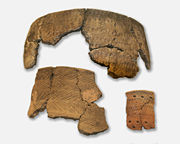
The beginning of the Neolithic period is marked by the ceramics of the Narva cultureNarva culture
Narva culture or eastern Baltic was a European Neolithic archaeological culture found in present-day Estonia, Latvia, Lithuania, Kaliningrad Oblast , and adjacent portions of Poland and Russia. A successor of the Mesolithic Kunda culture, Narva culture continued up to the start of the Bronze Age....
, which appears in Estonia at the beginning of the 5th millennium BC
5th millennium BC
The 5th millennium BC saw the spread of agriculture from the Near East throughout southern and central Europe.Urban cultures in Mesopotamia and Anatolia flourished, developing the wheel. Copper ornaments became more common, marking the Chalcolithic. Animal husbandry spread throughout Eurasia,...
. The oldest finds date from around 4900 BC. The first pottery was made of thick clay mixed with pebbles, shells or plants. The Narva type ceramics are found throughout almost the entire Estonian coastal region and on the islands. The stone and bone tools of the era have a notable similarity with the artifacts of the Kunda culture.
4th millennium BC
The 4th millennium BC saw major changes in human culture. It marked the beginning of the Bronze Age and of writing.The city states of Sumer and the kingdom of Egypt were established and grew to prominence. Agriculture spread widely across Eurasia...
Comb Ceramic Culture arrived in Estonia. Until the early 1980s the arrival of Finnic peoples
Finnic peoples
The Finnic or Fennic peoples were historic ethnic groups who spoke various languages traditionally classified as Finno-Permic...
, the ancestors of the Estonians
Estonians
Estonians are a Finnic people closely related to the Finns and inhabiting, primarily, the country of Estonia. They speak a Finnic language known as Estonian...
, Finns, Livonians
Livonian people
The Livonians or Livs are the indigenous inhabitants of Livonia, a large part of what is today northwestern Latvia and southwestern Estonia. They spoke the Uralic Livonian language, a language which is closely related to Estonian and Finnish...
on the shores of Baltic sea
Baltic Sea
The Baltic Sea is a brackish mediterranean sea located in Northern Europe, from 53°N to 66°N latitude and from 20°E to 26°E longitude. It is bounded by the Scandinavian Peninsula, the mainland of Europe, and the Danish islands. It drains into the Kattegat by way of the Øresund, the Great Belt and...
around was associated with the Comb Ceramic Culture. However, such a linking of archaeologically defined cultural entities with linguistic ones cannot be proven and it has been suggested that the increase of settlement finds in the period is more likely to have been associated with an economic boom related to the warming of climate. Some researchers have even argued that a Uralic form of language may have been spoken in Estonia and Finland since the end of the last glaciation.
Amber
Amber is fossilized tree resin , which has been appreciated for its color and natural beauty since Neolithic times. Amber is used as an ingredient in perfumes, as a healing agent in folk medicine, and as jewelry. There are five classes of amber, defined on the basis of their chemical constituents...
. Antiquities from comb pottery culture are found from Northern Finland to Eastern Prussia.
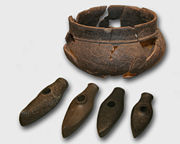
The beginning of the Late Neolithic Period about 2200 BC is characterized by the appearance of the Corded Ware culture
Corded Ware culture
The Corded Ware culture , alternatively characterized as the Battle Axe culture or Single Grave culture, is an enormous European archaeological horizon that begins in the late Neolithic , flourishes through the Copper Age and culminates in the early Bronze Age.Corded Ware culture is associated with...
, pottery with corded decoration and well-polished stone axes (s.c. boat-shape axes). Evidence of agriculture is provided by charred grain of wheat on the wall of a corded-ware vessel found in Iru settlement. Osteological analysis show an attempt was made to domesticate the wild boar.
Specific burial customs were characterized the dead laid on their sides with their knees pressed against their breast, one hand under the head. Objects placed into the graves were made of bones of domesticated animals.
The Bronze Age
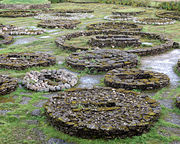
Bronze Age
The Bronze Age is a period characterized by the use of copper and its alloy bronze as the chief hard materials in the manufacture of some implements and weapons. Chronologically, it stands between the Stone Age and Iron Age...
in Estonia is dated to approximately 1800 BC. The development of the borders between the Finnic peoples
Finnic peoples
The Finnic or Fennic peoples were historic ethnic groups who spoke various languages traditionally classified as Finno-Permic...
and the Balts
Balts
The Balts or Baltic peoples , defined as speakers of one of the Baltic languages, a branch of the Indo-European language family, are descended from a group of Indo-European tribes who settled the area between the Jutland peninsula in the west and Moscow, Oka and Volga rivers basins in the east...
was under way. The first fortified settlements, Asva and Ridala on the island of Saaremaa
Saaremaa
Saaremaa is the largest island in Estonia, measuring 2,673 km². The main island of Saare County, it is located in the Baltic Sea, south of Hiiumaa island, and belongs to the West Estonian Archipelago...
and Iru in the Northern Estonia began to be built. The development of shipbuilding facilitated the spread of bronze. Changes took place in burial customs, a new type of burial ground spread from Germanic to Estonian areas, stone cist graves and cremation burials became increasingly common aside small number of boat-shaped stone graves.
The Iron Age
The Pre-Roman Iron AgePre-Roman Iron Age
The Pre-Roman Iron Age of Northern Europe designates the earliest part of the Iron Age in Scandinavia, northern Germany, and the Netherlands north of the Rhine River. These regions feature many extensive archaeological excavation sites, which have yielded a wealth of artifacts...
began in Estonia about 500 BC and lasted until the middle of the 1st century BC. The oldest iron items were imported, although since the 1st century iron was smelted from local marsh and lake ore. Settlement sites were located mostly in places that offered natural protection. Fortresses were built, although used temporarily. The appearance of square Celtic fields
Celtic fields
Celtic field is a popular name for the traces of early agricultural field systems found in North-West Europe, e.g. Belgium, Britain, Germany, Ireland and the Netherlands. The name was given by O.G.S. Crawford. They are sometimes preserved in areas where industrial farming has not been adopted and...
surrounded by enclosures in Estonia date from the Pre-Roman Iron Age. The majority of stones with man-made indents, which presumably were connected with magic designed to increase crop fertility, date from this period. A new type of grave, quadrangular burial mounds began to develop. Burial traditions show the clear beginning of social stratification.
The Roman Iron Age
Roman Iron Age
The Roman Iron Age is the name that Swedish archaeologist Oscar Montelius gave to a part of the Iron Age in Scandinavia, Northern Germany and the Netherlands....
in Estonia is roughly dated to between 50 and 450 AD, the era that was affected by the influence of the Roman Empire
Roman Empire
The Roman Empire was the post-Republican period of the ancient Roman civilization, characterised by an autocratic form of government and large territorial holdings in Europe and around the Mediterranean....
. In material culture this is reflected by few Roman coins, some jewellery
Jewellery
Jewellery or jewelry is a form of personal adornment, such as brooches, rings, necklaces, earrings, and bracelets.With some exceptions, such as medical alert bracelets or military dog tags, jewellery normally differs from other items of personal adornment in that it has no other purpose than to...
and artefacts. The abundance of iron artifacts in Southern Estonia speaks of closer mainland ties with southern areas while the islands of western and northern Estonia communicated with their neighbors mainly by sea. By the end of the period three clearly defined tribal dialectical areas: Northern Estonia, Southern Estonia, and Western Estonia including the islands had emerged, the population of each having formed its own understanding of identity.
Early Middle Ages
The name of Estonia occurs first in a form of Aestii in the 1st century AD by TacitusTacitus
Publius Cornelius Tacitus was a senator and a historian of the Roman Empire. The surviving portions of his two major works—the Annals and the Histories—examine the reigns of the Roman Emperors Tiberius, Claudius, Nero and those who reigned in the Year of the Four Emperors...
. However, at this stage it probably indicated Baltic tribes
Balts
The Balts or Baltic peoples , defined as speakers of one of the Baltic languages, a branch of the Indo-European language family, are descended from a group of Indo-European tribes who settled the area between the Jutland peninsula in the west and Moscow, Oka and Volga rivers basins in the east...
living in the area of Western LIthuania and the present-day Kaliningrad. In the Norse sagas (13th century) the term apparently was used to indicate the Estonians.
According to one interpretation, Ptolemy
Ptolemy
Claudius Ptolemy , was a Roman citizen of Egypt who wrote in Greek. He was a mathematician, astronomer, geographer, astrologer, and poet of a single epigram in the Greek Anthology. He lived in Egypt under Roman rule, and is believed to have been born in the town of Ptolemais Hermiou in the...
in his Geography III
Geographia (Ptolemy)
The Geography is Ptolemy's main work besides the Almagest...
in the middle of the 2nd century AD mentions the Osilians among other dwellers on the Baltic shore.
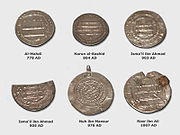
Cassiodorus
Flavius Magnus Aurelius Cassiodorus Senator , commonly known as Cassiodorus, was a Roman statesman and writer, serving in the administration of Theodoric the Great, king of the Ostrogoths. Senator was part of his surname, not his rank.- Life :Cassiodorus was born at Scylletium, near Catanzaro in...
in his book V. Letters 1–2 dating from the 6th century.
Saxo Grammaticus
Saxo Grammaticus
Saxo Grammaticus also known as Saxo cognomine Longus was a Danish historian, thought to have been a secular clerk or secretary to Absalon, Archbishop of Lund, foremost advisor to Valdemar I of Denmark. He is the author of the first full history of Denmark.- Life :The Jutland Chronicle gives...
describes the Curonians
Curonians
The Curonians or Kurs were a Baltic tribe living on the shores of the Baltic sea in what are now the western parts of Latvia and Lithuania from the 5th to the 16th centuries, when they merged with other Baltic tribes. They gave their name to the region of Courland , and they spoke the Old...
and Estonians as participating in the Battle of Bråvalla on the side of the Swedes against the Danes, who were aided by the Livonians and the Wends
Wends
Wends is a historic name for West Slavs living near Germanic settlement areas. It does not refer to a homogeneous people, but to various peoples, tribes or groups depending on where and when it is used...
of Pomerania
Pomerania
Pomerania is a historical region on the south shore of the Baltic Sea. Divided between Germany and Poland, it stretches roughly from the Recknitz River near Stralsund in the West, via the Oder River delta near Szczecin, to the mouth of the Vistula River near Gdańsk in the East...
. It is notable that other Baltic
Balts
The Balts or Baltic peoples , defined as speakers of one of the Baltic languages, a branch of the Indo-European language family, are descended from a group of Indo-European tribes who settled the area between the Jutland peninsula in the west and Moscow, Oka and Volga rivers basins in the east...
tribes — i.e., the Letts and Lithuanians
Lithuanians
Lithuanians are the Baltic ethnic group native to Lithuania, where they number around 2,765,600 people. Another million or more make up the Lithuanian diaspora, largely found in countries such as the United States, Brazil, Canada, Colombia, Russia, United Kingdom and Ireland. Their native language...
— are not mentioned by Saxo as participating in the fight.
Snorri Sturluson
Snorri Sturluson
Snorri Sturluson was an Icelandic historian, poet, and politician. He was twice elected lawspeaker at the Icelandic parliament, the Althing...
relates in his Ynglinga saga
Ynglinga saga
Ynglinga saga is a legendary saga, originally written in Old Norse by the Icelandic poet Snorri Sturluson about 1225. It was first translated into English and published in 1844....
how the Swedish king Ingvar
Ingvar
Yngvar Harra Proto-Norse *Ingu-Hariz was the son of Östen and reclaimed the Swedish throne for the House of Yngling after the Swedes had rebelled against Sölvi....
(7th century), the son of Östen
Östen
Eysteinn was the son of Eadgils and Yrsa of Saxony. He was the father of Ingvar. The Eysteinn tumulus in Västerås near Östanbro has been linked to King Eysteinn by some popular historians...
and a great warrior, who was forced to patrol the shores of his kingdom fighting Estonian pirates. The saga speaks of his invasion of Estonia where he fell in a battle against the men of Estland who had come down with a great army. After the battle, King Ingvar
Ingvar
Yngvar Harra Proto-Norse *Ingu-Hariz was the son of Östen and reclaimed the Swedish throne for the House of Yngling after the Swedes had rebelled against Sölvi....
was buried close to the seashore in Estonia and the Swedes returned home.
According to Heimskringla
Heimskringla
Heimskringla is the best known of the Old Norse kings' sagas. It was written in Old Norse in Iceland by the poet and historian Snorri Sturluson ca. 1230...
sagas, in the year 967 the Norwegian
Norway
Norway , officially the Kingdom of Norway, is a Nordic unitary constitutional monarchy whose territory comprises the western portion of the Scandinavian Peninsula, Jan Mayen, and the Arctic archipelago of Svalbard and Bouvet Island. Norway has a total area of and a population of about 4.9 million...
Queen Astrid escaped with her son, in future king of Norway Olaf Tryggvason from her homeland to Novgorod, where her brother Sigurd held an honoured position at the court of Prince Vladimir. On their journey, Oeselian Vikings raided the ship, killing some of the crew and taking others into slavery. Six years later, when Sigurd Eirikson traveled to Estonia to collect taxes on behalf of Valdemar, he spotted Olaf in a market on Saaremaa
Saaremaa
Saaremaa is the largest island in Estonia, measuring 2,673 km². The main island of Saare County, it is located in the Baltic Sea, south of Hiiumaa island, and belongs to the West Estonian Archipelago...
and paid for his freedom.
A battle between Oeselian
Oeselians
The Oeselians were a historical Finnic people inhabiting Saaremaa , an Estonian island in the Baltic Sea. They are first thought to be mentioned as early as the 2nd century BC in Ptolemy's Geography III. The Oeselians along with Curonians were known in the Old Norse Icelandic Sagas and in...
and Iceland
Iceland
Iceland , described as the Republic of Iceland, is a Nordic and European island country in the North Atlantic Ocean, on the Mid-Atlantic Ridge. Iceland also refers to the main island of the country, which contains almost all the population and almost all the land area. The country has a population...
ic Vikings off Saaremaa
Saaremaa
Saaremaa is the largest island in Estonia, measuring 2,673 km². The main island of Saare County, it is located in the Baltic Sea, south of Hiiumaa island, and belongs to the West Estonian Archipelago...
is described in Njál's saga
Njál's saga
Njáls saga is one of the sagas of Icelanders. The most prominent characters are the friends Njáll Þorgeirsson, a lawyer and a sage, and Gunnarr Hámundarson, a formidable warrior...
as occurring in 972 AD.
About 1008, Olaf the Holy, later king of Norway
Norway
Norway , officially the Kingdom of Norway, is a Nordic unitary constitutional monarchy whose territory comprises the western portion of the Scandinavian Peninsula, Jan Mayen, and the Arctic archipelago of Svalbard and Bouvet Island. Norway has a total area of and a population of about 4.9 million...
, landed on Saaremaa
Saaremaa
Saaremaa is the largest island in Estonia, measuring 2,673 km². The main island of Saare County, it is located in the Baltic Sea, south of Hiiumaa island, and belongs to the West Estonian Archipelago...
. The Osilians, taken by surprise, had at first agreed to pay the demands made by Olaf, but then gathered an army during the negotiations and attacked the Norwegians. Olaf nevertheless won the battle.
The Chudes as mentioned by a monk Nestor in the earliest Russian chronicles, were the Ests or Esthonians. According to Nestor
Nestor the Chronicler
Saint Nestor the Chronicler was the reputed author of the Primary Chronicle, , Life of the Venerable Theodosius of the Kiev Caves, Life of the Holy Passion Bearers, Boris and Gleb, and of the so-called Reading.Nestor was a monk of the Monastery of the Caves in Kiev from 1073...
in 1030 Yaroslav I the Wise
Yaroslav I the Wise
Yaroslav I, Grand Prince of Rus, known as Yaroslav the Wise Yaroslav I, Grand Prince of Rus, known as Yaroslav the Wise Yaroslav I, Grand Prince of Rus, known as Yaroslav the Wise (Old Norse: Jarizleifr; ; Old East Slavic and Russian: Ярослав Мудрый; Ukrainian: Ярослав Мудрий; c...
invaded the country of the Chuds and laid the foundations of Yuriev, (the historical Russian name of Tartu
Tartu
Tartu is the second largest city of Estonia. In contrast to Estonia's political and financial capital Tallinn, Tartu is often considered the intellectual and cultural hub, especially since it is home to Estonia's oldest and most renowned university. Situated 186 km southeast of Tallinn, the...
, Estonia
Estonia
Estonia , officially the Republic of Estonia , is a state in the Baltic region of Northern Europe. It is bordered to the north by the Gulf of Finland, to the west by the Baltic Sea, to the south by Latvia , and to the east by Lake Peipsi and the Russian Federation . Across the Baltic Sea lies...
). According to Old East Slavic chronicles the Chudes where one of the founders of the Rus' state
Kievan Rus'
Kievan Rus was a medieval polity in Eastern Europe, from the late 9th to the mid 13th century, when it disintegrated under the pressure of the Mongol invasion of 1237–1240....
.
According to the Novgorod Chronicle, Varyag
Varyag
-People:*Varangians, ancestors of the Rus' sometimes called "Vikings" in English publications*Variags of Khand, a people of J. R. R. Tolkien's Middle-earth legendarium- Ships :...
Ulf (Uleb) from Novgorod was crushed by Estonians in a sea battle close to the town of Lindanise in 1032.
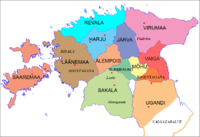
In the 1st centuries AD political and administrative subdivisions began to emerge in Estonia. Two larger subdivisions appeared: the parish (kihelkond) and the county (maakond). The parish consisted of several villages. Nearly all parishes had at least one fortress. The defense of the local area was directed by the highest official, the parish elder. The county was composed of several parishes, also headed by an elder. By the 13th century the following major counties had developed in Estonia: Saaremaa
Saare County
Saare County , or Saaremaa, is one of 15 counties of Estonia. It consists of Saaremaa , the largest island of Estonia, and several smaller islands near it. The county borders Lääne County to the east and Hiiu County to the north...
(Osilia), Läänemaa (Rotalia or Maritima), Harjumaa
Harjumaa
Harjumaa, , was an ancient Estonian county. It corresponded roughly to the present territory of Rapla County.- See also :*Danish Estonia*Harju County*Rapla County*History of Estonia*Livonian Crusade*Rulers of Estonia...
(Harria), Rävala (Revalia), Virumaa
Virumaa
Virumaa is a former independent county in Ancient Estonia. Now it is divided into Ida-Viru County or Eastern Vironia and Lääne-Viru County or Western Vironia...
(Vironia), Järvamaa (Jervia), Sakala
Sakala
Sakala may refer to:* Sagala, a city of ancient India* Sakala County, an ancient county in Estonia * Sakala , an Estonian academic corporation* Sakala , an Estonian newspaper...
(Saccala), and Ugandi (Ugaunia).
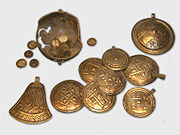
Dirham
Dirham or dirhem is a unit of currency in several Arab or Berber nations, and formerly the related unit of mass in the Ottoman Empire and Persian states...
s from the 8th century. The largest Viking Age
Viking Age
Viking Age is the term for the period in European history, especially Northern European and Scandinavian history, spanning the late 8th to 11th centuries. Scandinavian Vikings explored Europe by its oceans and rivers through trade and warfare. The Vikings also reached Iceland, Greenland,...
hoards found in Estonia have been at Maidla
Maidla Parish
Maidla Parish is an Estonian municipality located in Ida-Viru County. It has a population of 772 and an area of 332.3 km².- Villages :...
and Kose. Out of the 1500 coins published in catalogues, 1000 are Anglo-Saxon
Anglo-Saxons
Anglo-Saxon is a term used by historians to designate the Germanic tribes who invaded and settled the south and east of Great Britain beginning in the early 5th century AD, and the period from their creation of the English nation to the Norman conquest. The Anglo-Saxon Era denotes the period of...
.
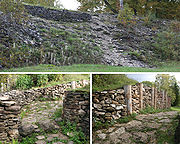
Varbola Stronghold
The Varbola Stronghold was the largest circular rampart fortress and trading centre built in Estonia, in Harju County in the 10th – 12th centuries. Parts of the ruins of the 580 metre long and 8-10 metre high limestone wall of the fortress stand til this day. The long gateways with...
was one of the largest circular rampart
Circular rampart
A circular rampart is an embankment built in the shape of a circle that was used as part of the defences for a military fortification, hill fort or refuge, or was built for religious purposes or as a place of gathering....
fortress and trading center built in Estonia
Estonia
Estonia , officially the Republic of Estonia , is a state in the Baltic region of Northern Europe. It is bordered to the north by the Gulf of Finland, to the west by the Baltic Sea, to the south by Latvia , and to the east by Lake Peipsi and the Russian Federation . Across the Baltic Sea lies...
, Harju County
Harju County
Harju County , or Harjumaa , nowadays one of 15 counties of Estonia. It is situated in northern Estonia, on the south coast of the Gulf of Finland, and borders Lääne-Viru County to the east, Järva County to the south-east, Rapla County to the south, and Lääne County to the south-west.528,468 people...
at the time.
In the 11th century the Scandinavians are frequently chronicled as combating the Vikings from the eastern shores of the Baltic Sea.
With the rise of Christianity
Christianity
Christianity is a monotheistic religion based on the life and teachings of Jesus as presented in canonical gospels and other New Testament writings...
, centralized authority in Scandinavia and Germany
Germany
Germany , officially the Federal Republic of Germany , is a federal parliamentary republic in Europe. The country consists of 16 states while the capital and largest city is Berlin. Germany covers an area of 357,021 km2 and has a largely temperate seasonal climate...
eventually lead to Baltic crusades.
The east Baltic world was transformed by military conquest: First the Livs, Letts
Letts
Letts may refer to the following people:*Arthur Letts, English-born millionaire developer of Holmby Hills, Los Angeles, California*Barry Letts , British actor, television director and producer...
and Estonians
Estonians
Estonians are a Finnic people closely related to the Finns and inhabiting, primarily, the country of Estonia. They speak a Finnic language known as Estonian...
, then the Prussians and the Finns underwent defeat, baptism
Baptism
In Christianity, baptism is for the majority the rite of admission , almost invariably with the use of water, into the Christian Church generally and also membership of a particular church tradition...
, military occupation
Military occupation
Military occupation occurs when the control and authority over a territory passes to a hostile army. The territory then becomes occupied territory.-Military occupation and the laws of war:...
and sometimes extermination by groups of Germans
Germans
The Germans are a Germanic ethnic group native to Central Europe. The English term Germans has referred to the German-speaking population of the Holy Roman Empire since the Late Middle Ages....
, Danes and Swedes.
Sources
- History of Estonia 2nd Edition. Tõnu Tannberg, Ain Mäesalu, Tõnis Lukas, Mati Laur and Ago Pajur, ISBN 9985-2-0606-1, A/S BIT, Tallinn, 2002;