

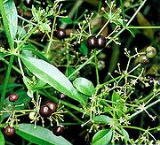
Madder

Encyclopedia
Rubia is a genus
of the madder family Rubiaceae
, which contains about 60 species of perennial scrambling or climbing herb
s and sub-shrubs native to the Old World
, Africa, temperate Asia and America. The genus and its best known species are also known as Madder, Rubia tinctorum
(Common Madder), Rubia peregrina
(Wild Madder), and Rubia cordifolia
(Munjeet or Indian Madder).
The Common Madder can grow to 1.5 m in height. The evergreen
leaves
are 5–10 cm long and 2–3 cm broad, produced in whorls of 4–7 starlike around the central stem. It climbs with tiny hooks at the leaves and stems. The flowers are small (3–5 mm across), with five pale yellow petals, in dense raceme
s, and appear from June to August, followed by small (4–6 mm diameter) red to black berries
. The root
s can be over a metre long, up to 12 mm thick and the source of red dye
s known as rose madder
and Turkey red. It prefers loamy soils with a constant level of moisture. Madders are used as food plants for the larva
e of some Lepidoptera
species including the Hummingbird Hawk Moth.
for leather, wool, cotton and silk. For dye production, the roots are harvested in the first year. The outer brown layer gives the common variety of the dye, the lower yellow layer the refined variety. The dye is fixed to the cloth with help of a mordant
, most commonly alum
. Madder can be fermented for dyeing as well (Fleurs de garance). In France
, the remains were used to produce a spirit as well.
The roots contain the acid ruberthyrin. By drying, fermenting or a treatment with acids, this is changed to sugar, alizarin
and purpurin, which were first isolated by the French chemist Pierre Jean Robiquet
in 1826. Purpurin is normally not coloured, but is red when dissolved in alkaline solutions. Mixed with clay and treated with alum
and ammonia
, it gives a brilliant red colourant (madder lake).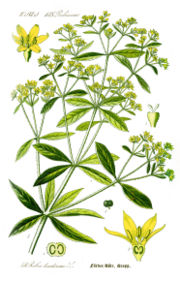 The pulverised roots can be dissolved in sulfuric acid
, which leaves a dye called garance (the French
name for madder) after drying. Another method of increasing the yield consisted of dissolving the roots in sulfuric acid after they had been used for dyeing. This produces a dye called garanceux. By treating the pulverized roots with alcohol, colorin was produced. It contained 40–50 times the amount of alizarin
of the roots.
The chemical name for the pigment
is alizarin
, of the anthraquinone
-group. In 1869, the German chemists Graebe and Liebermann synthesised artificial alizarin, which was produced industrially from 1871 onwards, which effectively put an end to the cultivation of madder. In the 20th century, madder was only grown in some areas of France.
comes from India
where a piece of cotton dyed with madder has been recovered from the archaeological site at Mohenjo-daro
(3rd millennium BCE). In Sanskrit, this plant is known by the name Manjishtha. It was used by hermits to dye their clothes saffron. Dioscorides
and Pliny the Elder
(De Re Natura) mention the plant (Rubia passiva). In Viking age
levels of York
, remains of both woad
and madder have been excavated. The oldest European textiles dyed with madder come from the grave of the Merovingian queen Arnegundis in St. Denis near Paris
(between 565 and 570 AD). In the "Capitulare de villis" of Charlemagne
, madder is mentioned as "warentiam". The herbal
of Hildegard of Bingen
mentions the plant as well. The red coats of the British Redcoats
were dyed with madder, after earlier being dyed with cochineal
.
Turkey red was a strong, very fast red dye for cotton obtained from madder root via a complicated multistep process involving "sumac
and oak galls, calf's blood, sheep's dung, oil, soda, alum, and a solution of tin." Turkey red was developed in India and spread to Turkey. Greek workers familiar with the methods of its production were brought to France in 1747, and Dutch and English spies soon discovered the secret. A sanitized version of Turkey red was being produced in Manchester by 1784, and roller-printed dress cottons with a Turkey red ground were fashionable in England by the 1820s.
According to Culpeper
's herbal
, the plant is ruled by Mars
and has an opening quality, and will bind and strengthen afterwards. It was used in the treatment of jaundice
, obstruction of the spleen
, melancholy, palsy
, haemorrhoids
, sciatica
, and of bruises. The root should be boiled in wine, and sugar or honey added. The seed of madder, drunk with vinegar and honey is used for the swelling of the spleen. Leaves and stems are used when the monthly female menstrual bleeding is late. Leaves and roots are squashed and put on freckles and other discolorations of the skin.
Genus
In biology, a genus is a low-level taxonomic rank used in the biological classification of living and fossil organisms, which is an example of definition by genus and differentia...
of the madder family Rubiaceae
Rubiaceae
The Rubiaceae is a family of flowering plants, variously called the coffee family, madder family, or bedstraw family. The group contains many commonly known plants, including the economically important coffee , quinine , and gambier , and the horticulturally valuable madder , west indian jasmine ,...
, which contains about 60 species of perennial scrambling or climbing herb
Herb
Except in botanical usage, an herb is "any plant with leaves, seeds, or flowers used for flavoring, food, medicine, or perfume" or "a part of such a plant as used in cooking"...
s and sub-shrubs native to the Old World
Old World
The Old World consists of those parts of the world known to classical antiquity and the European Middle Ages. It is used in the context of, and contrast with, the "New World" ....
, Africa, temperate Asia and America. The genus and its best known species are also known as Madder, Rubia tinctorum
Rubia tinctorum
Rubia tinctorum, the common madder or dyer's madder, is a plant species in the genus Rubia.The plant's roots contain several polyphenolic compounds like 1,3-Dihydroxyanthraquinone , 1,4-Dihydroxyanthraquinone , 1,2,4-Trihydroxyanthraquinone and 1,2-dihydroxyanthraquinone...
(Common Madder), Rubia peregrina
Rubia peregrina
Rubia peregrina, the common Wild Madder, is a herbaceous perennial plant species in the genus Rubia belonging to the Rubiaceae family.-Etymology:...
(Wild Madder), and Rubia cordifolia
Rubia cordifolia
Rubia cordifolia, often known as Common Madder or Indian Madder, is a species of flowering plant in the coffee family, Rubiaceae...
(Munjeet or Indian Madder).
The Common Madder can grow to 1.5 m in height. The evergreen
Evergreen
In botany, an evergreen plant is a plant that has leaves in all seasons. This contrasts with deciduous plants, which completely lose their foliage during the winter or dry season.There are many different kinds of evergreen plants, both trees and shrubs...
leaves
Leaf
A leaf is an organ of a vascular plant, as defined in botanical terms, and in particular in plant morphology. Foliage is a mass noun that refers to leaves as a feature of plants....
are 5–10 cm long and 2–3 cm broad, produced in whorls of 4–7 starlike around the central stem. It climbs with tiny hooks at the leaves and stems. The flowers are small (3–5 mm across), with five pale yellow petals, in dense raceme
Raceme
A raceme is a type of inflorescence that is unbranched and indeterminate and bears pedicellate flowers — flowers having short floral stalks called pedicels — along the axis. In botany, axis means a shoot, in this case one bearing the flowers. In a raceme, the oldest flowers are borne...
s, and appear from June to August, followed by small (4–6 mm diameter) red to black berries
Berry
The botanical definition of a berry is a fleshy fruit produced from a single ovary. Grapes are an example. The berry is the most common type of fleshy fruit in which the entire ovary wall ripens into an edible pericarp. They may have one or more carpels with a thin covering and fleshy interiors....
. The root
Root
In vascular plants, the root is the organ of a plant that typically lies below the surface of the soil. This is not always the case, however, since a root can also be aerial or aerating . Furthermore, a stem normally occurring below ground is not exceptional either...
s can be over a metre long, up to 12 mm thick and the source of red dye
Dye
A dye is a colored substance that has an affinity to the substrate to which it is being applied. The dye is generally applied in an aqueous solution, and requires a mordant to improve the fastness of the dye on the fiber....
s known as rose madder
Rose madder
Rose Madder is the commercial name sometimes used to designate a paint made from the pigment Madder Lake - a traditional lake pigment, extracted from the common madder plant ....
and Turkey red. It prefers loamy soils with a constant level of moisture. Madders are used as food plants for the larva
Larva
A larva is a distinct juvenile form many animals undergo before metamorphosis into adults. Animals with indirect development such as insects, amphibians, or cnidarians typically have a larval phase of their life cycle...
e of some Lepidoptera
Lepidoptera
Lepidoptera is a large order of insects that includes moths and butterflies . It is one of the most widespread and widely recognizable insect orders in the world, encompassing moths and the three superfamilies of butterflies, skipper butterflies, and moth-butterflies...
species including the Hummingbird Hawk Moth.
Species
- Rubia agostinhoi Dans. & P.Silva
- Rubia aitchisonii Deb & Malick
- Rubia alaica Pachom.
- Rubia albicaulis Boiss.
- Rubia angustisissima Wall. ex G.Don
- Rubia argyi (H.Lév. & Vaniot) Hara ex Lauener
- Rubia atropurpurea Decne.
- Rubia balearica (Willk.) Porta
- Rubia caramanica Bornm.
- Rubia charifolia Wall. ex G.Don
- Rubia chinensis Regel & Maack
- Rubia chitralensis Ehrend.
- Rubia clematidifolia Blume ex Decne.
- Rubia cordifoliaRubia cordifoliaRubia cordifolia, often known as Common Madder or Indian Madder, is a species of flowering plant in the coffee family, Rubiaceae...
L. – Indian Madder - Rubia crassipes Collett & Hemsl.
- Rubia cretacea Pojark.
- Rubia danaensis Danin
- Rubia davisiana Ehrend.
- Rubia deserticola Pojark.
- Rubia discolor Turcz.
- Rubia dolichophylla Schrenk
- Rubia edgeworthii Hook.f.
- Rubia falciformis H.S.Lo
- Rubia filiformis F.C.How ex H.S.Lo
- Rubia florida Boiss.
- Rubia fruticosa Aiton
- Rubia garrettii Craib
- Rubia gedrosiaca Bornm.
- Rubia haematantha Ary Shaw
- Rubia hexaphylla (Makino) Makino
- Rubia himalayensis Klotzsch
- Rubia hispidicaulis D.G.Long
- Rubia horrida (Thunb.) Puff
- Rubia infundibularis Hemsl. & Lace
- Rubia jesoensis (Miq.) Miyabe & Kudo
- Rubia komarovii Pojark.
- Rubia krascheninnikovii Pojark.
- Rubia laevissima Tschern.
- Rubia latipetala H.S.Lo
- Rubia laurae (Holmboe) Airy Shaw
- Rubia laxiflora Gontsch.
- Rubia linii J.M.Chao
- Rubia magna P.G.Xiao
- Rubia mandersii Collett & Hemsl.
- Rubia manjith Roxb. ex Fleming
- Rubia maymanensis Ehrend. & Schönb.-Tem.
- Rubia membranacea Diels
- Rubia oncotricha Hand.-Mazz.
- Rubia oppositifolia Griff.
- Rubia ovatifolia Z.Ying Zhang ex Q.Lin
- Rubia pallida Diels
- Rubia pauciflora Boiss.
- Rubia pavlovii Bajtenov & Myrz.
- Rubia peregrinaRubia peregrinaRubia peregrina, the common Wild Madder, is a herbaceous perennial plant species in the genus Rubia belonging to the Rubiaceae family.-Etymology:...
L. – Wild Madder - Rubia petiolaris DC.
- Rubia philippinensis Elmer
- Rubia podantha Diels
- Rubia polyphlebia H.S.Lo
- Rubia pterygocaulis H.S.Lo
- Rubia rechingeri Ehrend.
- Rubia regelii Pojark.
- Rubia rezniczenkoana Litv.
- Rubia rigidifolia Pojark.
- Rubia rotundifolia Banks & Sol.
- Rubia salicifolia H.S.Lo
- Rubia schugnanica B.Fedtsch. ex Pojark.
- Rubia schumanniana E.Pritz.
- Rubia siamensis Craib
- Rubia sikkimensis Kurz
- Rubia tatarica (Trevir.) F.Schmidt
- Rubia tenuifolia d'Urv.
- Rubia thunbergii DC.
- Rubia tibetica Hook.f.
- Rubia tinctorumRubia tinctorumRubia tinctorum, the common madder or dyer's madder, is a plant species in the genus Rubia.The plant's roots contain several polyphenolic compounds like 1,3-Dihydroxyanthraquinone , 1,4-Dihydroxyanthraquinone , 1,2,4-Trihydroxyanthraquinone and 1,2-dihydroxyanthraquinone...
L. – Common Madder - Rubia transcaucasica Grossh.
- Rubia trichocarpa H.S.Lo
- Rubia truppeliana Loes.
- Rubia wallichiana Decne.
- Rubia yunnanensis Diels
Uses
It has been used since ancient times as a vegetable red dyeDye
A dye is a colored substance that has an affinity to the substrate to which it is being applied. The dye is generally applied in an aqueous solution, and requires a mordant to improve the fastness of the dye on the fiber....
for leather, wool, cotton and silk. For dye production, the roots are harvested in the first year. The outer brown layer gives the common variety of the dye, the lower yellow layer the refined variety. The dye is fixed to the cloth with help of a mordant
Mordant
A mordant is a substance used to set dyes on fabrics or tissue sections by forming a coordination complex with the dye which then attaches to the fabric or tissue. It may be used for dyeing fabrics, or for intensifying stains in cell or tissue preparations. The term mordant comes from the Latin...
, most commonly alum
Alum
Alum is both a specific chemical compound and a class of chemical compounds. The specific compound is the hydrated potassium aluminium sulfate with the formula KAl2.12H2O. The wider class of compounds known as alums have the related empirical formula, AB2.12H2O.-Chemical properties:Alums are...
. Madder can be fermented for dyeing as well (Fleurs de garance). In France
France
The French Republic , The French Republic , The French Republic , (commonly known as France , is a unitary semi-presidential republic in Western Europe with several overseas territories and islands located on other continents and in the Indian, Pacific, and Atlantic oceans. Metropolitan France...
, the remains were used to produce a spirit as well.
The roots contain the acid ruberthyrin. By drying, fermenting or a treatment with acids, this is changed to sugar, alizarin
Alizarin
Alizarin or 1,2-dihydroxyanthraquinone is an organic compound with formula that has been used throughout history as a prominent dye, originally derived from the roots of plants of the madder genus.Alizarin was used as a red dye for the English parliamentary "new model" army...
and purpurin, which were first isolated by the French chemist Pierre Jean Robiquet
Pierre Jean Robiquet
Pierre Jean Robiquet was a French chemist, who laid founding work in identifying amino acids, the fundamental bricks of proteins, through recognizing the first of them, asparagin, in 1806, in the take up of the industry of industrial dyes, with the identification of alizarin in 1826, and in the...
in 1826. Purpurin is normally not coloured, but is red when dissolved in alkaline solutions. Mixed with clay and treated with alum
Alum
Alum is both a specific chemical compound and a class of chemical compounds. The specific compound is the hydrated potassium aluminium sulfate with the formula KAl2.12H2O. The wider class of compounds known as alums have the related empirical formula, AB2.12H2O.-Chemical properties:Alums are...
and ammonia
Ammonia
Ammonia is a compound of nitrogen and hydrogen with the formula . It is a colourless gas with a characteristic pungent odour. Ammonia contributes significantly to the nutritional needs of terrestrial organisms by serving as a precursor to food and fertilizers. Ammonia, either directly or...
, it gives a brilliant red colourant (madder lake).
Sulfuric acid
Sulfuric acid is a strong mineral acid with the molecular formula . Its historical name is oil of vitriol. Pure sulfuric acid is a highly corrosive, colorless, viscous liquid. The salts of sulfuric acid are called sulfates...
, which leaves a dye called garance (the French
French language
French is a Romance language spoken as a first language in France, the Romandy region in Switzerland, Wallonia and Brussels in Belgium, Monaco, the regions of Quebec and Acadia in Canada, and by various communities elsewhere. Second-language speakers of French are distributed throughout many parts...
name for madder) after drying. Another method of increasing the yield consisted of dissolving the roots in sulfuric acid after they had been used for dyeing. This produces a dye called garanceux. By treating the pulverized roots with alcohol, colorin was produced. It contained 40–50 times the amount of alizarin
Alizarin
Alizarin or 1,2-dihydroxyanthraquinone is an organic compound with formula that has been used throughout history as a prominent dye, originally derived from the roots of plants of the madder genus.Alizarin was used as a red dye for the English parliamentary "new model" army...
of the roots.
The chemical name for the pigment
Pigment
A pigment is a material that changes the color of reflected or transmitted light as the result of wavelength-selective absorption. This physical process differs from fluorescence, phosphorescence, and other forms of luminescence, in which a material emits light.Many materials selectively absorb...
is alizarin
Alizarin
Alizarin or 1,2-dihydroxyanthraquinone is an organic compound with formula that has been used throughout history as a prominent dye, originally derived from the roots of plants of the madder genus.Alizarin was used as a red dye for the English parliamentary "new model" army...
, of the anthraquinone
Anthraquinone
Anthraquinone, also called anthracenedione or dioxoanthracene is an aromatic organic compound with formula . Several isomers are possible, each of which can be viewed as a quinone derivative...
-group. In 1869, the German chemists Graebe and Liebermann synthesised artificial alizarin, which was produced industrially from 1871 onwards, which effectively put an end to the cultivation of madder. In the 20th century, madder was only grown in some areas of France.
History
Early evidence of dyeingDyeing
Dyeing is the process of adding color to textile products like fibers, yarns, and fabrics. Dyeing is normally done in a special solution containing dyes and particular chemical material. After dyeing, dye molecules have uncut Chemical bond with fiber molecules. The temperature and time controlling...
comes from India
India
India , officially the Republic of India , is a country in South Asia. It is the seventh-largest country by geographical area, the second-most populous country with over 1.2 billion people, and the most populous democracy in the world...
where a piece of cotton dyed with madder has been recovered from the archaeological site at Mohenjo-daro
Mohenjo-daro
Mohenjo-daro is an archeological site situated in what is now the province of Sindh, Pakistan. Built around 2600 BC, it was one of the largest settlements of the ancient Indus Valley Civilization, and one of the world's earliest major urban settlements, existing at the same time as the...
(3rd millennium BCE). In Sanskrit, this plant is known by the name Manjishtha. It was used by hermits to dye their clothes saffron. Dioscorides
Pedanius Dioscorides
Pedanius Dioscorides was a Greek physician, pharmacologist and botanist, the author of a 5-volume encyclopedia about herbal medicine and related medicinal substances , that was widely read for more than 1,500 years.-Life:...
and Pliny the Elder
Pliny the Elder
Gaius Plinius Secundus , better known as Pliny the Elder, was a Roman author, naturalist, and natural philosopher, as well as naval and army commander of the early Roman Empire, and personal friend of the emperor Vespasian...
(De Re Natura) mention the plant (Rubia passiva). In Viking age
Viking Age
Viking Age is the term for the period in European history, especially Northern European and Scandinavian history, spanning the late 8th to 11th centuries. Scandinavian Vikings explored Europe by its oceans and rivers through trade and warfare. The Vikings also reached Iceland, Greenland,...
levels of York
York
York is a walled city, situated at the confluence of the Rivers Ouse and Foss in North Yorkshire, England. The city has a rich heritage and has provided the backdrop to major political events throughout much of its two millennia of existence...
, remains of both woad
Woad
Isatis tinctoria, with Woad as the common name, is a flowering plant in the family Brassicaceae. It is commonly called dyer's woad, and sometimes incorrectly listed as Isatis indigotica . It is occasionally known as Asp of Jerusalem...
and madder have been excavated. The oldest European textiles dyed with madder come from the grave of the Merovingian queen Arnegundis in St. Denis near Paris
Paris
Paris is the capital and largest city in France, situated on the river Seine, in northern France, at the heart of the Île-de-France region...
(between 565 and 570 AD). In the "Capitulare de villis" of Charlemagne
Charlemagne
Charlemagne was King of the Franks from 768 and Emperor of the Romans from 800 to his death in 814. He expanded the Frankish kingdom into an empire that incorporated much of Western and Central Europe. During his reign, he conquered Italy and was crowned by Pope Leo III on 25 December 800...
, madder is mentioned as "warentiam". The herbal
Herbal
AThe use of a or an depends on whether or not herbal is pronounced with a silent h. herbal is "a collection of descriptions of plants put together for medicinal purposes." Expressed more elaborately — it is a book containing the names and descriptions of plants, usually with information on their...
of Hildegard of Bingen
Hildegard of Bingen
Blessed Hildegard of Bingen , also known as Saint Hildegard, and Sibyl of the Rhine, was a German writer, composer, philosopher, Christian mystic, Benedictine abbess, visionary, and polymath. Elected a magistra by her fellow nuns in 1136, she founded the monasteries of Rupertsberg in 1150 and...
mentions the plant as well. The red coats of the British Redcoats
Red coat (British army)
Red coat or Redcoat is a historical term used to refer to soldiers of the British Army because of the red uniforms formerly worn by the majority of regiments. From the late 17th century to the early 20th century, the uniform of most British soldiers, , included a madder red coat or coatee...
were dyed with madder, after earlier being dyed with cochineal
Cochineal
The cochineal is a scale insect in the suborder Sternorrhyncha, from which the crimson-colour dye carmine is derived. A primarily sessile parasite native to tropical and subtropical South America and Mexico, this insect lives on cacti from the genus Opuntia, feeding on plant moisture and...
.
Turkey red was a strong, very fast red dye for cotton obtained from madder root via a complicated multistep process involving "sumac
Sumac
Sumac is any one of approximately 250 species of flowering plants in the genus Rhus and related genera, in the family Anacardiaceae. Sumacs grow in subtropical and temperate regions throughout the world, especially in Africa and North America....
and oak galls, calf's blood, sheep's dung, oil, soda, alum, and a solution of tin." Turkey red was developed in India and spread to Turkey. Greek workers familiar with the methods of its production were brought to France in 1747, and Dutch and English spies soon discovered the secret. A sanitized version of Turkey red was being produced in Manchester by 1784, and roller-printed dress cottons with a Turkey red ground were fashionable in England by the 1820s.
According to Culpeper
Nicholas Culpeper
Nicholas Culpeper was an English botanist, herbalist, physician, and astrologer. His published books include The English Physician and the Complete Herbal , which contain a rich store of pharmaceutical and herbal knowledge, and Astrological Judgement of Diseases from the Decumbiture of the Sick ,...
's herbal
Herbal
AThe use of a or an depends on whether or not herbal is pronounced with a silent h. herbal is "a collection of descriptions of plants put together for medicinal purposes." Expressed more elaborately — it is a book containing the names and descriptions of plants, usually with information on their...
, the plant is ruled by Mars
Mars
Mars is the fourth planet from the Sun in the Solar System. The planet is named after the Roman god of war, Mars. It is often described as the "Red Planet", as the iron oxide prevalent on its surface gives it a reddish appearance...
and has an opening quality, and will bind and strengthen afterwards. It was used in the treatment of jaundice
Jaundice
Jaundice is a yellowish pigmentation of the skin, the conjunctival membranes over the sclerae , and other mucous membranes caused by hyperbilirubinemia . This hyperbilirubinemia subsequently causes increased levels of bilirubin in the extracellular fluid...
, obstruction of the spleen
Spleen
The spleen is an organ found in virtually all vertebrate animals with important roles in regard to red blood cells and the immune system. In humans, it is located in the left upper quadrant of the abdomen. It removes old red blood cells and holds a reserve of blood in case of hemorrhagic shock...
, melancholy, palsy
Palsy
In medicine, palsy is the paralysis of a body part, often accompanied by loss of sensation and by uncontrolled body movements, such as shaking. Medical conditions involving palsy include cerebral palsy , brachial palsy , and Bell's palsy ....
, haemorrhoids
Hemorrhoid
Hemorrhoids or haemorrhoids , are vascular structures in the anal canal which help with stool control. They become pathological or piles when swollen or inflamed. In their physiological state they act as a cushion composed of arterio-venous channels and connective tissue that aid the passage of...
, sciatica
Sciatica
Sciatica is a set of symptoms including pain that may be caused by general compression or irritation of one of five spinal nerve roots that give rise to each sciatic nerve, or by compression or irritation of the left or right or both sciatic nerves. The pain is felt in the lower back, buttock, or...
, and of bruises. The root should be boiled in wine, and sugar or honey added. The seed of madder, drunk with vinegar and honey is used for the swelling of the spleen. Leaves and stems are used when the monthly female menstrual bleeding is late. Leaves and roots are squashed and put on freckles and other discolorations of the skin.