

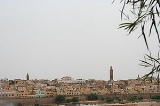
Meknes

Encyclopedia
Meknes is a city in northern Morocco
, located 130 kilometres (80.8 mi) from the capital Rabat
and 60 kilometres (37.3 mi) from Fes
. It is served by the A2 expressway between those two cities and by the corresponding railway. Meknes was the capital of Morocco under the reign of Moulay Ismail
(1672–1727), before it was relocated to Marrakech
. The population is 985,000 (2010 census). It is the capital of the Meknes-Tafilalet
region. Meknes is named after a Berber
tribe which was known as Miknasa
(native Berber name: Imeknasen) in the medieval North African sources.
. A Berber
tribe called the Miknasa
, originated from the Tunisia
n south, settled there in the 9th century, and a town consequently grew around the previous borough.
The Almoravids
founded here a fortress in the 9th century. It resisted to the Almohads rise, and was thus destroyed by them, only to be rebuilt in larger size with mosques and large fortifications. Under the Merinids it received further madrasas, kasbahs and mosques in the early 14th century, and continued to thrive under the Wattasid dynasty. Meknes saw its golden age as the imperial capital of Moulay Ismail following his accession to the Sultanate of Morocco (1672–1727). He installed under the old city a large prison to house Christian sailors captured on the sea, and also constructed numerous edifices, gardens, monumental gates, mosques (whence the city's nickname of "City of the Hundred Minaret
s") and the large line of wall, having a length of 40 km.
According to the ICOMOS Heritage at Risk report of 2000, the historic city of Meknes contains insufficient drainage systems, and as a result suffers from inundation and leakage in certain areas.
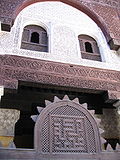 Neighboring cities to the south: Azrou
, connecting via the N13 road
, is a cedar region with the noted "College d'Azrou" where many members of the post-independence elite derived); and Ifrane
(Al Akhawayn University
).
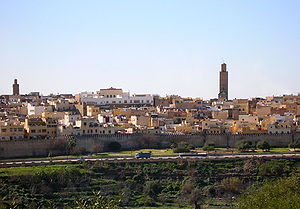
The ruins of the Roman town of Volubilis
(Oualili) are about half an hour to the north.
The chief industries are food processing, textile manufacturing, chemical and para-chemical industry, and metallic and mechanical industry.
ordered the minaret be rebuilt according to historical specifications.
Morocco
Morocco , officially the Kingdom of Morocco , is a country located in North Africa. It has a population of more than 32 million and an area of 710,850 km², and also primarily administers the disputed region of the Western Sahara...
, located 130 kilometres (80.8 mi) from the capital Rabat
Rabat
Rabat , is the capital and third largest city of the Kingdom of Morocco with a population of approximately 650,000...
and 60 kilometres (37.3 mi) from Fes
Fes
Fes or Fez is the second largest city of Morocco, after Casablanca, with a population of approximately 1 million . It is the capital of the Fès-Boulemane region....
. It is served by the A2 expressway between those two cities and by the corresponding railway. Meknes was the capital of Morocco under the reign of Moulay Ismail
Ismail Ibn Sharif
Moulay Ismaïl Ibn Sharif was the second ruler of the Moroccan Alaouite dynasty. Like others of the dynasty, Ismaïl claimed to be a descendant of Muhammad through his roots to Hassan ibn Ali...
(1672–1727), before it was relocated to Marrakech
Marrakech
Marrakech or Marrakesh , known as the "Ochre city", is the most important former imperial city in Morocco's history...
. The population is 985,000 (2010 census). It is the capital of the Meknes-Tafilalet
Meknès-Tafilalet
Meknès-Tafilalet is one of the sixteen regions of Morocco. It is situated in north-central Morocco, bordering Algeria. It covers an area of 79,210 km² and has a population of 2,141,527...
region. Meknes is named after a Berber
Berber mythology
The traditional Berber mythology is the ancient and native set of beliefs and deities developed by the Berber people in their historical land of North Africa...
tribe which was known as Miknasa
Miknasa
The Miknasa were a Berber tribe in Morocco and western Algeria.The Miknasa Berbers originated in southern Tunisia, but migrated westwards into central Morocco and western Algeria in pre-Islamic times. The modern Moroccan city of Meknes bears witness to their presence.After defeat by the Muslims...
(native Berber name: Imeknasen) in the medieval North African sources.
History
The original community from which Meknes can be traced was an 8th century KasbahKasbah
A kasbah or qassabah is a type of medina, Islamic city, or fortress .It was a place for the local leader to live and a defense when a city was under attack. A kasbah has high walls, usually without windows. Sometimes, they were built on hilltops so that they could be more easily defended...
. A Berber
Berber people
Berbers are the indigenous peoples of North Africa west of the Nile Valley. They are continuously distributed from the Atlantic to the Siwa oasis, in Egypt, and from the Mediterranean to the Niger River. Historically they spoke the Berber language or varieties of it, which together form a branch...
tribe called the Miknasa
Miknasa
The Miknasa were a Berber tribe in Morocco and western Algeria.The Miknasa Berbers originated in southern Tunisia, but migrated westwards into central Morocco and western Algeria in pre-Islamic times. The modern Moroccan city of Meknes bears witness to their presence.After defeat by the Muslims...
, originated from the Tunisia
Tunisia
Tunisia , officially the Tunisian RepublicThe long name of Tunisia in other languages used in the country is: , is the northernmost country in Africa. It is a Maghreb country and is bordered by Algeria to the west, Libya to the southeast, and the Mediterranean Sea to the north and east. Its area...
n south, settled there in the 9th century, and a town consequently grew around the previous borough.
The Almoravids
Almoravids
The Almoravids were a Berber dynasty of Morocco, who formed an empire in the 11th-century that stretched over the western Maghreb and Al-Andalus. Their capital was Marrakesh, a city which they founded in 1062 C.E...
founded here a fortress in the 9th century. It resisted to the Almohads rise, and was thus destroyed by them, only to be rebuilt in larger size with mosques and large fortifications. Under the Merinids it received further madrasas, kasbahs and mosques in the early 14th century, and continued to thrive under the Wattasid dynasty. Meknes saw its golden age as the imperial capital of Moulay Ismail following his accession to the Sultanate of Morocco (1672–1727). He installed under the old city a large prison to house Christian sailors captured on the sea, and also constructed numerous edifices, gardens, monumental gates, mosques (whence the city's nickname of "City of the Hundred Minaret
Minaret
A minaret مناره , sometimes مئذنه) is a distinctive architectural feature of Islamic mosques, generally a tall spire with an onion-shaped or conical crown, usually either free standing or taller than any associated support structure. The basic form of a minaret includes a base, shaft, and gallery....
s") and the large line of wall, having a length of 40 km.
According to the ICOMOS Heritage at Risk report of 2000, the historic city of Meknes contains insufficient drainage systems, and as a result suffers from inundation and leakage in certain areas.
Geography
Azrou
Azrou is a small Moroccan city 89 kilometers south of Fez, in the Meknès-Tafilalet region.-Geography:Azrou, which means rock in the indigenous Tamazight Berber language, is located in the heart of The Middle Atlas region of Morocco between Meknes, Fez, Ifrane, Midelt and Khenifra. The N13 road...
, connecting via the N13 road
N13 road (Morocco)
The N13 road is a national motorway in Morocco which connects Azrou and points south with Meknes and northerly locations. North of Meknes there are views of the Zerhoun Mountains. Along the N13 with a view of the Zerhoun Mountains is the ancient Roman and Carthaginian settlement of Volubilis,...
, is a cedar region with the noted "College d'Azrou" where many members of the post-independence elite derived); and Ifrane
Ifrane
Ifrane [p] is a town and ski resort in the Middle Atlas region of Morocco .Ifrane is 1665 metres in altitude and is part of the Meknès-Tafilalet region...
(Al Akhawayn University
Al Akhawayn University
Al Akhawayn University is a university located in Ifrane, Morocco, just 60 kilometers away from the imperial city of Fez, in the midst of the Middle Atlas Mountains. The creation of Al Akhawayn University was largely funded by the King of Saudi Arabia from a large endowment intended for the...
).
Climate
Located near the Atlas Mountains, Meknes has a seasonal climate, shifting from cool in winter to hot days in the summer months of July–September. The nights are always cool (or colder in winter), with daytime temperatures generally rising about 10–14 °C (50–57.2 F) every day. The winter highs typically reach only 15.5 °C (60 °F) in December–January (see weather-table below).Quarters
|
|
Meknès Al Ismaïlia
- Aïn Jemâa
- Aïn Karma
- Aïn Orma
- Aït Ouallal
- Al Ismaïlia
- Al Machouar Stinia
- Dar Oum Soltane
- Maknassat Azzaytoun
- Oued Rommane
- Toulal
Meknès El Menzeh
- Boufakrane
- Charqaoua
- Dkhissa
- Hamrya
- Karmet Ben Salem
- M'haya
- Majjate
- Mergassiyine
- Moulay Idriss Zerhoun
- N'zalat Bni Amar
- Oualili (Volubilis)
- Oued Jdida
- Ouislane
- Sidi Abdellah el Khayat
- Sidi Slimane Moul Al Kifane
- Ztouten
Main sights
- Dar El Makhzen palace, located in El Mechouar Stinia. It is sided by a 2 km-long corridor formed by two large walls. It was Moulay Ismaïl's official palace.
- Bab Mansour gate, named after the architect, El-Mansour. It was completed 5 years after Moulay Ismail's death, in 1732. The design of the gate plays with Almohad patterns. It has zellij mosaics of excellent quality. The marble columns were taken from the Roman ruins of VolubilisVolubilisVolubilis is an archaeological site in Morocco situated near Meknes between Fez and Rabat along the N13 road. The nearest town is Moulay Idriss. Volubilis features the best preserved Roman ruins in this part of northern Africa...
. When the structure was finished completed, Moulay Ismail inspected the gate, asking El-Mansur if he could do better. El-Mansur felt complied to answer yes, making the sultan so furious he had him executed. Still, according to historical records, the gate was finished after Moulay Ismail's death. The gate itself is now used as an arts and crafts gallery; entry is by a side gate. - Lahboul gardens. It houses a zoological garden and an open-air theatre.
- Mausoleum of Moulay Ismail, built in 1703 by Ahmed Eddahbi
- Néjjarine Mosque (10th century), located in the old city.
- The Grand Mosque, founded in the 11th century by the Almoravids. It has 11 gates and 143 arcades.
- Koubat Al Khayatin ("Ambassador's Hall"): a pavilion in which sultan Moulay Ismaïl received foreign ambassadors.
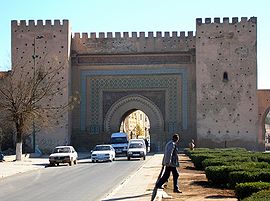
- Bab Lakhmis: a large decorated gate from the 17th century.
- Bab Berdaïne: a majestic gate built by Moulay Ismaïl in the 17th century.
- Dar El Beida, a 19th century palace built by sultan Mohammed ben Abdallah. It is currently home to the Royal Military Academy.
- Royal stables
- Agdal reservoir, built by Moulay Ismail. It measures 319 x 149 meters, with a depth of 2 m.
- Cara subterranean prison.
The ruins of the Roman town of Volubilis
Volubilis
Volubilis is an archaeological site in Morocco situated near Meknes between Fez and Rabat along the N13 road. The nearest town is Moulay Idriss. Volubilis features the best preserved Roman ruins in this part of northern Africa...
(Oualili) are about half an hour to the north.
Industry
There are 171 industrial units in Meknes, employing 10,358 people.The chief industries are food processing, textile manufacturing, chemical and para-chemical industry, and metallic and mechanical industry.
Bab Berdieyinne mosque
The Bab Berdieyinne mosque (Arab: بردعين, French: Berdaïne), constructed in the 17th century, is located in the historical city center. On 19 February 2010, its minaret collapsed during Friday prayers, causing at least 41 fatalities and many injuries. The area had received heavy rain over the preceding days. King Mohammed VIMohammed VI of Morocco
Mohammed VI is the present King of Morocco and Amir al-Mu'minin . He ascended to the throne on 23 July 1999 upon the death of his father.-Education:...
ordered the minaret be rebuilt according to historical specifications.