
|
|
|
|
Macaroon
|
| |
|
| |
Macaroons are cookies or confections, or crosses between the two, depending on where they are made.
They are often confused (due to the very similar spelling) with the French Macarons which are entirely different in appearance.
The English word macaroon comes from the French macaron, from the word maccarone, regionally used in Italy to refer to maccherone (kind of pasta, with a hole and a larger diameter than bucatini) - because almond macaroon paste is the same colour as macaroni pasta.
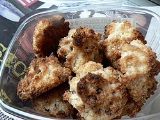
Macaroon cookies biscuits often use egg whites (usually whipped to stiff peaks), with ground or powdered nuts, most commonly coconut but sometimes almond.

Discussion
Ask a question about 'Macaroon'
Start a new discussion about 'Macaroon'
Answer questions from other users
|
Encyclopedia
Macaroons are cookies or confections, or crosses between the two, depending on where they are made.
They are often confused (due to the very similar spelling) with the French Macarons which are entirely different in appearance.
The English word macaroon comes from the French macaron, from the word maccarone, regionally used in Italy to refer to maccherone (kind of pasta, with a hole and a larger diameter than bucatini) - because almond macaroon paste is the same colour as macaroni pasta.
Macaroon cookies biscuits often use egg whites (usually whipped to stiff peaks), with ground or powdered nuts, most commonly coconut but sometimes almond. Almost all recipes call for sugar, which caramelizes and provides body and a smooth, moist texture to the macaroon. If the coconut or other fabric used is very sweet, however, the sugar may be omitted.
Regional varieties
Scottish
In Scotland: the macaroon bar, is a sweet confection made of fondant, boiled sugar and/or cold cooked potatoes, dipped in chocolate and rolled in roasted coconut.
The macaroon biscuit, which is the cookie-type macaroon and almost always almond-flavored bar.
North American
In North America, the coconut macaroon is the best known variety. Commercially made coconut macaroons are generally dense, moist and sweet, and often dipped in chocolate. Homemade macaroons and varieties produced by smaller bakeries are commonly light and fluffy, as though they were a cross between macaroons, meringues and nougat. Macaroons made with coconuts are often piped out with a star shaped tip, whereas macaroons made with nuts are more likely shaped individually due to the stiffness of the dough.
Spanish
In Asturias, Spain, there is a macaroon variety made with hazelnuts and honey called "carajitos."
Indian
In Tuticorin, a major port city inTamilnadu, India, there is a macaroon variety made with Cashewnuts and egg white called macaroon. Tuticorin is now ,undeniably the Macaroon capital of India. Admitted, there are a few competitors in Mangalore, but the Tuticorin Macaroon is in a league of its own."
Origins
According to legend, the macaroon was invented in an Italian monastery in 1792. Later, two Carmelite nuns, hiding in the town of Nancy during the French Revolution, baked and sold macaroons to cover their expenses. They became known as the "Macaroon Sisters." The cookie recipe was supposedly passed on to the Jewish community in France, who subsequently made it a staple of Passover baking.
However, recipes for macaroons (also spelled "mackaroon" "maccaroon" and "mackaroom") appear in recipe books at least as early as 1725 (Robert Smith's Court Cookery, or the Complete English Cook)
Macaroons remain a common treat during the Jewish holiday of Passover, because they are unleavened and can be made freshly without Chametz (leavened flour). Potato starch is sometimes included in the recipe, to give the macaroons more body.
In popular culture
- In Henrik Ibsen's A Doll's House, main character Nora delights herself with macaroons, despite her infantilizing husband's (Torvald) prohibition.
- In the Viva Piņata game and TV series, one of the piņata species is known as "macaraccoon", a cross between two words, macaroon and raccoon.
|
| |
|
|