
All Topics  
Beekeeper


   Email Print
   Bookmark   Link


Beekeeper


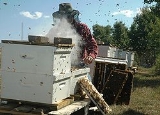
A beekeeper is a person who keeps honey bee
Honey bee

Honey bees are a subset of bees, primarily distinguished by the production and storage of honey and the construction of wiktionary:perennial, Colony nests out of beeswax....
s for the purposes of securing commodities such as honey
Honey

Honey is a sweet fluid produced by honey bees , and derived from the nectar of flowers. According to the United States National Honey Board and various international food regulations, "honey stipulates a pure product that does not allow for the addition of any other substance?this includes, but is not limited to, water or other sweeteners...
, beeswax
Beeswax

Beeswax is a natural wax produced in the Beehive of honey bees of the genus Apis. Worker bees have eight wax-producing mirror glands on the inner sides of the sternites on abdominal segments 4 to 7....
, pollen
Pollen

Pollen is a fine to coarse powder consisting of Gametophyte , which produce the male gametes of spermatophyta. A hard coat covering the pollen grain protects the sperm cells during the process of their movement between the stamens of the flower to the pistil of the next flower....
; pollinating
Pollination

Pollination in flowering plants and gymnosperms is the process that transfers pollen, which contain the male gametes to where the female gamete are contained within the carpel; in gymnosperms the pollen is directly applied to the ovule itself....
 fruits and vegetables; raising queens and bees for sale to other farmers; and/or for purposes satisfying natural scientific curiosity. Persons who keep bees
Beekeeping

Beekeeping is the maintenance of honey bee colonies, commonly in beehives, by humans. A beekeeper keeps bees in order to collect honey and beeswax, for the purpose of pollination agriculture, or to produce bees for sale to other beekeepers....
 are usually classified as hobby beekeepers, sideliners, or commercial operators, depending on the number of colonies maintained.

eepers are also called honey farmers or apiarists (from Latin
Latin

Latin is an Italic language, historically spoken in Latium and Ancient Rome. Through the Military history of the Roman Empire, Latin spread throughout the Mediterranean and a large part of Europe....
 apis, bee
Bee

Bees are flying insects closely related to wasps and ants. Bees are a monophyly lineage within the superfamily Apoidea, presently classified by the unranked taxon name Anthophila....
; cf.


Discussion
Ask a question about 'Beekeeper'
Start a new discussion about 'Beekeeper'
Answer questions from other users
Full Discussion Forum


Recent Posts


Encyclopedia


A beekeeper is a person who keeps honey bee
Honey bee

Honey bees are a subset of bees, primarily distinguished by the production and storage of honey and the construction of wiktionary:perennial, Colony nests out of beeswax....
s for the purposes of securing commodities such as honey
Honey

Honey is a sweet fluid produced by honey bees , and derived from the nectar of flowers. According to the United States National Honey Board and various international food regulations, "honey stipulates a pure product that does not allow for the addition of any other substance?this includes, but is not limited to, water or other sweeteners...
, beeswax
Beeswax

Beeswax is a natural wax produced in the Beehive of honey bees of the genus Apis. Worker bees have eight wax-producing mirror glands on the inner sides of the sternites on abdominal segments 4 to 7....
, pollen
Pollen

Pollen is a fine to coarse powder consisting of Gametophyte , which produce the male gametes of spermatophyta. A hard coat covering the pollen grain protects the sperm cells during the process of their movement between the stamens of the flower to the pistil of the next flower....
; pollinating
Pollination

Pollination in flowering plants and gymnosperms is the process that transfers pollen, which contain the male gametes to where the female gamete are contained within the carpel; in gymnosperms the pollen is directly applied to the ovule itself....
 fruits and vegetables; raising queens and bees for sale to other farmers; and/or for purposes satisfying natural scientific curiosity. Persons who keep bees
Beekeeping

Beekeeping is the maintenance of honey bee colonies, commonly in beehives, by humans. A beekeeper keeps bees in order to collect honey and beeswax, for the purpose of pollination agriculture, or to produce bees for sale to other beekeepers....
 are usually classified as hobby beekeepers, sideliners, or commercial operators, depending on the number of colonies maintained.

Definition

Beekeepers are also called honey farmers or apiarists (from Latin
Latin

Latin is an Italic language, historically spoken in Latium and Ancient Rome. Through the Military history of the Roman Empire, Latin spread throughout the Mediterranean and a large part of Europe....
 apis, bee
Bee

Bees are flying insects closely related to wasps and ants. Bees are a monophyly lineage within the superfamily Apoidea, presently classified by the unranked taxon name Anthophila....
; cf. apiary
Apiary

An apiary is a place where beehive of honey bees are kept. Traditionally beekeepers paid land rent in honey for the use of small parcels. Some farmers will provide free apiary sites, because they need pollination, and farmers who need many hives often pay for them to be moved to the crops when they bloom....
). The term beekeeper usually refers to a person who keeps honey bees in hives, boxes, or other receptacles. It should be noted that honey bees are not domesticated and the beekeeper does not control the creatures. The beekeeper owns the hives or boxes and associated equipment. The bees are free to forage or leave (swarm
Swarm

The term swarm is applied to fish, insects, birds and microorganisms, such as bacteria, and describes a behavior of an aggregation of animals of similar size and body orientation, generally cruising in the same direction....
) as they desire. Bees usually return to the beekeeper's hive as the hive presents a clean, dark, sheltered abode.

Classifications of beekeepers

Most beekeepers are hobby beekeepers. These people typically work or own only a few hives. Their main attraction is an interest in ecology and natural science. Honey is a by-product of this hobby. As it typically costs several hundred American dollars to establish a small apiary and dozens of hours of manipulation and work with hives and honey equipment, hobby beekeeping is seldom profitable, however not largely in Europe, where the lack of organic bee products sometimes causes buoyant demand for privately produced honey, therefore maintaining this hobby greatly profitable.

A sideline beekeeper attempts to make a profit keeping bees, but relies on another source of income. Sideliners may operate up to 300 colonies of bees, producing 10 - 20 metric tons of honey worth a few tens of thousands of dollars each year.

Commercial beekeepers control hundreds or thousands of colonies of bees. The most extensive own and operate up to 50,000 colonies of bees and produce millions of pounds of honey. The first major commercial beekeeper was probably Petro Prokopovych
Petro Prokopovych

Petro Prokopovych was the founder of commercial beekeeping. He introduced a number of novelties in traditional beekeeping that allowed significant progress in the practice....
 of the Ukraine, operating 6600 colonies in the early 1800s. Moses Quinby
Moses Quinby

Moses Quinby was one of the first commercial beekeepers in the United States, a native of St. Johnsville, New York.Quinby established his business in his early 20s and expanded it to own about 1,200 hives in the Mohawk Valley, New York....
 was the first commercial beekeeper in the USA, with 1200 colonies by the 1840s. Later (1960s-1970s), Jim Powers of Idaho, USA, had 30,000 honey producing hives. Miel Carlota operated by partners Arturo Wulfrath and Juan Speck of Mexico operated at least 50,000 hives of honey bees from 1920 to 1960. Today, Adee Honey Farm in South Dakota
South Dakota

South Dakota is a U.S. state located in the Midwestern United States of the United States of America. It is named after the Lakota people and Sioux Sioux Native Americans in the United States tribes....
, USA, (40,000 colonies) and Scandia Honey Company in Alberta
Alberta

Alberta is one of Canada Canadian Prairies Provinces and territories of Canada. It became a province on September 1, 1905.Alberta is located in western Canada, bounded by the provinces of British Columbia to the west and Saskatchewan to the east, the Northwest Territories to the north, and the U.S....
, Canada (12,000 colonies) are among the world's largest beekeeping enterprises. Worldwide, commercial beekeepers number about 5% of the individuals with bees but produce about 60% of the world's honey crop.

Types of beekeepers

Most beekeepers produce commodities (farm products) for sale. Honey is the most valuable commodity sold by beekeepers. Honey producer beekeepers try to maintain maximum strength colonies of bees in areas with dense nectar sources. They produce and sell liquid (extracted) and sometimes comb honey
Comb honey

Comb honey is produced by honeybees in a hive. The bees fill the hexagon shaped wax cells of the honeycomb with honey and cap it with beeswax....
. Beekeepers may sell their commodities retail, as self-brokers, or through commercial packers and distributors. Beeswax
Beeswax

Beeswax is a natural wax produced in the Beehive of honey bees of the genus Apis. Worker bees have eight wax-producing mirror glands on the inner sides of the sternites on abdominal segments 4 to 7....
, pollen
Pollen

Pollen is a fine to coarse powder consisting of Gametophyte , which produce the male gametes of spermatophyta. A hard coat covering the pollen grain protects the sperm cells during the process of their movement between the stamens of the flower to the pistil of the next flower....
, royal jelly
Royal jelly

Royal jelly is a honey bee secretion that is used in the nutrition of the larvae. It is secreted from the hypopharyngeal glands in the heads of young workers and used to feed all of the larvae in the colony, including those destined to become workers....
, and propolis
Propolis

Propolis is a resinous mixture that honey bees collect from tree buds, sap flows, or other botanical sources. It is used as a sealant for unwanted open spaces in the beehive ....
 may also be significant revenue generators. Taiwan beekeepers, for example, export tonnes of royal jelly, the high-nutrition food supplement fed to queen honeybees. Modern beekeepers seldom keep honey bees exclusively for beeswax production. Beeswax is harvested along with honey and separated for sale.

Some beekeepers provide a pollination service to other farmers. These beekeepers might not produce any honey for sale. Pollination beekeepers move honey bee hives at night in vast quantities so fruits and vegetables have enough pollinating insects available for maximum levels of production. For the service of maintaining strong colonies of bees and moving them into crops such as almonds, apples, cherries, blueberries, melons, and squash, these beekeepers are usually paid a cash fee.

Queen breeders are specialist beekeepers who raise queen bees
Queen bee

The term queen bee is typically used to refer to an adult, mated female that lives in a honey bee colony or hive; she is usually the mother of all the bees in the hive....
 for other beekeepers. The breeders maintain select stock with superior qualities and tend to raise their bees in geographic regions with early springs. These beekeepers may also provide extra bees to beekeepers (honey producers, pollinators, or hobby beekeepers) who want to start new operations or expand their farms. Queen breeders use Jenter kits in order to produce large numbers of Queen bees quickly and efficiently.

Occupational information

The income for beekeepers varies considerably. In the USA, the average beekeeper earns about $40,000 per year. There are few benefits - beekeepers in the USA must provide their own retirement savings and health benefits, though in most other advanced countries of the world, beekeepers are eligible for medical benefits.

Almost all beekeepers received on-the-job training as apprentices to established beekeepers. Some vocational schools offer courses in beekeeping and most universities provide entomology and biology programs for those interested in honey bee research. Beekeepers must be good managers, independent workers, and must accept a high level of risk and frequent periods of low income. A good beekeeper can invariably earn more money in almost any other occupation, so beekeeping must be a passion as well as a vocation.

External links


See also

  • Agriculture
    Agriculture

    Agriculture refers to the production of food and goods through farming and forestry. Agriculture was the key development that led to the rise of civilization, with the animal husbandry of domestication animals and plants creating food surpluses that enabled the development of more Population density and Social stratification societies....
  • Beekeeping
    Beekeeping

    Beekeeping is the maintenance of honey bee colonies, commonly in beehives, by humans. A beekeeper keeps bees in order to collect honey and beeswax, for the purpose of pollination agriculture, or to produce bees for sale to other beekeepers....
  • Gardening
    Gardening

    Gardening is the practice of growing ornamental or useful plants. Ornamental plants are normally grown for their flowers, foliage, or overall appearance....
  • Organic farming
    Organic farming

    Organic farming is a form of agriculture that relies on crop rotation, green manure, compost, biological pest control, and mechanical cultivation to maintain soil productivity and control pest s, excluding or strictly limiting the use of synthetic fertilizers and synthetic pesticides, plant growth regulators, livestock feed additives, and gen...
  • Sustainable agriculture
    Sustainable agriculture

    Sustainable agriculture integrates three main goals: natural environment stewardship, farm profitability, and prosperous farming community. These goals have been defined by a variety of List of academic disciplines and may be looked at from the vantage point of the farmer or the consumer....