
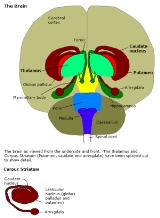
The
are almond-shaped groups of
nucleiIn neuroanatomy, a nucleus is a brain structure consisting of a relatively compact cluster of neurons. It is one of the two most common forms of nerve cell organization, the other being layered structures such as the cerebral cortex or cerebellar cortex. In anatomical sections, a nucleus shows up...
located deep within the medial temporal lobes of the
brainThe brain is the center of the nervous system in all vertebrate and most invertebrate animals—only a few primitive invertebrates such as sponges, jellyfish, sea squirts and starfishes do not have one. It is located in the head, usually close to primary sensory apparatus such as vision, hearing,...
in complex vertebrates, including humans. Shown in research to perform a primary role in the processing and
memoryIn psychology, memory is an organism's ability to store, retain, and recall information and experiences. Traditional studies of memory began in the fields of philosophy, including techniques of artificially enhancing memory....
of emotional reactions, the amygdalae are considered part of the
limbic systemThe limbic system is a set of brain structures including the hippocampus, amygdala, anterior thalamic nuclei, septum, limbic cortex and fornix, which seemingly support a variety of functions including emotion, behavior, long term memory, and olfaction. The term "limbic" comes from the Latin...
.
Anatomical subdivisions
The regions described as amygdala
nucleiIn neuroanatomy, a nucleus is a brain structure consisting of a relatively compact cluster of neurons. It is one of the two most common forms of nerve cell organization, the other being layered structures such as the cerebral cortex or cerebellar cortex. In anatomical sections, a nucleus shows up...
encompass several structures with distinct functional traits. Among these nuclei are the basolateral complex, the cortical nucleus, the medial nucleus, and the central nucleus. The basolateral complex can be further subdivided into the lateral, the basal, and the accessory basal nuclei.
Anatomically, the amygdala and more particularly, its central and medial nuclei,
have sometimes been classified as a part of the
basal gangliaThe basal ganglia are a group of nuclei of varied origin in the brains of vertebrates that act as a cohesive functional unit. They are situated at the base of the forebrain and are strongly connected with the cerebral cortex, thalamus and other brain areas...
.
Connections
The amygdala sends impulses to the
hypothalamusThe Hypothalamus is a portion of the brain that contains a number of small nuclei with a variety of functions...
for activation of the
sympathetic nervous systemThe sympathetic nervous system is one of the three parts of the autonomic nervous system, along with the enteric and parasympathetic systems. Its general action is to mobilize the body's nervous system fight-or-flight response...
, to the
thalamic reticular nucleus for increased reflexes, to the nuclei of the
trigeminal nerveThe trigeminal nerve contains both sensory and motor fibres. It is responsible for sensation in the face and certain motor functions such as biting, chewing, and swallowing. Sensory information from the face and body is processed by parallel pathways in the central nervous system...
and the
facial nerveThe facial nerve is the seventh of twelve paired cranial nerves. It emerges from the brainstem between the pons and the medulla, and controls the muscles of facial expression, and functions in the conveyance of taste sensations from the anterior two-thirds of the tongue and oral cavity...
, and to the ventral tegmental area, locus coeruleus, and
laterodorsal tegmental nucleusThe laterodorsal tegmental nucleus is a nucleus situated in the brainstem, spanning the midbrain tegmentum and the pontine tegmentum...
for activation of
dopamineDopamine is a catecholamine neurotransmitter present in a wide variety of animals, including both vertebrates and invertebrates. In the brain, this substituted phenethylamine functions as a neurotransmitter, activating the five known types of dopamine receptors—D1, D2, D3, D4, and D5—and their...
,
norepinephrineNorepinephrine is the US name for noradrenaline , a catecholamine with multiple roles including as a hormone and a neurotransmitter...
and
epinephrineEpinephrine is a hormone and a neurotransmitter. It increases heart rate, constricts blood vessels, dilates air passages and participates in the fight-or-flight response of the sympathetic nervous system. In chemical terms, adrenaline is one of a group of monoamines called the catecholamines...
.
The cortical nucleus is involved in the sense of smell and
pheromoneA pheromone is a secreted or excreted chemical factor that triggers a social response in members of the same species. Pheromones are chemicals capable of acting outside the body of the secreting individual to impact the behavior of the receiving individual...
-processing. It receives input from the
olfactory bulbThe olfactory bulb is a structure of the vertebrate forebrain involved in olfaction, the perception of odors.-Anatomy:In most vertebrates, the olfactory bulb is the most rostral part of the brain. In humans, however, the olfactory bulb is on the inferior side of the brain...
and olfactory cortex. The lateral amygdalae, which send impulses to the rest of the basolateral complexes and to the centromedial nuclei, receive input from the sensory systems. The centromedial nuclei are the main outputs for the basolateral complexes, and are involved in emotional arousal in rats and cats.
Emotional learning
In complex vertebrates, including humans, the amygdalae perform primary roles in the formation and storage of memories associated with emotional events. Research indicates that, during
fear conditioningFear conditioning is a behavioral paradigm in which organisms learn to predict aversive events. It is a form of learning in which an aversive stimulus is associated with a particular neutral context or neutral stimulus , resulting in the expression of fear responses to the originally neutral...
, sensory stimuli reach the basolateral complexes of the amygdalae, particularly the lateral nuclei, where they form associations with memories of the stimuli. The association between stimuli and the aversive events they predict may be mediated by
long-term potentiationIn neuroscience, long-term potentiation is a long-lasting enhancement in signal transmission between two neurons that results from stimulating them synchronously. It is one of several phenomena underlying synaptic plasticity, the ability of chemical synapses to change their strength...
, a sustained enhancement of signalling between affected neurons.
Memories of emotional experiences imprinted in reactions of synapses in the lateral nuclei elicit fear behavior through connections with the central nucleus of the amygdalae and the bed nuclei of the stria terminalis (BNST). The central nuclei are involved in the genesis of many fear responses, including freezing (immobility), tachycardia (rapid heartbeat), increased respiration, and stress-hormone release. Damage to the amygdalae impairs both the acquisition and expression of Pavlovian fear conditioning, a form of
classical conditioningClassical conditioning is a form of conditioning that was first demonstrated by Ivan Pavlov...
of emotional responses.
The amygdalae are also involved in appetitive (positive) conditioning. It seems that distinct neurons respond to positive and negative stimuli, but there is no clustering of these distinct neurons into clear anatomical nuclei. However, lesions of the central nucleus in the amygdala have been shown to reduce appetitive learning in rats. Lesions of the basolateral regions do not exhibit the same effect. Research like this indicates that different nuclei within the amygdala have different functions in appetitive conditioning.
Memory modulation
The amygdala is also involved in the modulation of
memory consolidationMemory consolidation is a category of processes that stabilize a memory trace after the initial acquisition. Consolidation is distinguished into two specific processes, synaptic consolidation, which occurs within the first few hours after learning, and system consolidation, where...
. Following any learning event, the
long-term memoryLong-term memory is memory in which associations among items are stored, as part of the theory of a dual-store memory model. According to the theory, long term memory differs structurally and functionally from working memory or short-term memory, which ostensibly stores items for only around 20–30...
for the event is not formed instantaneously. Rather, information regarding the event is slowly assimilated into long-term (potentially life-long) storage over time, possibly via
long-term potentiationIn neuroscience, long-term potentiation is a long-lasting enhancement in signal transmission between two neurons that results from stimulating them synchronously. It is one of several phenomena underlying synaptic plasticity, the ability of chemical synapses to change their strength...
. Recent studies suggest that, while the amygdala is not itself a long-term memory storage site, and learning can occur without it, one of its roles is to regulate memory consolidation in other brain regions. Also,
fear conditioningFear conditioning is a behavioral paradigm in which organisms learn to predict aversive events. It is a form of learning in which an aversive stimulus is associated with a particular neutral context or neutral stimulus , resulting in the expression of fear responses to the originally neutral...
, a type of memory that is impaired following amygdala damage, is mediated in part by long-term potentiation.
During the consolidation period, the memory can be modulated. In particular, it appears that emotional arousal following the learning event influences the strength of the subsequent memory for that event. Greater emotional arousal following a learning event enhances a person's retention of that event. Experiments have shown that administration of stress hormones to mice immediately after they learn something enhances their retention when they are tested two days later.
The amygdalae, especially the basolateral nuclei, are involved in mediating the effects of emotional arousal on the strength of the memory for the event, as shown by many laboratories including that of
James McGaughJames L. McGaugh is an American neurobiologist working in the field of learning and memory. He is currently a Research Professor at the University of California, Irvine....
. These laboratories have trained animals on a variety of learning tasks and found that drugs injected into the amygdala after training affect the animals' subsequent retention of the task. These tasks include basic
classical conditioningClassical conditioning is a form of conditioning that was first demonstrated by Ivan Pavlov...
tasks such as inhibitory avoidance, where a rat learns to associate a mild footshock with a particular compartment of an apparatus, and more complex tasks such as spatial or cued water maze, where a rat learns to swim to a platform to escape the water. If a drug that activates the amygdalae is injected into the amygdalae, the animals had better memory for the training in the task. If a drug that inactivates the amygdalae is injected, the animals had impaired memory for the task.
Buddhist monks who do
compassion meditationMettā or maitrī is loving-kindness, friendliness, benevolence, amity, friendship, good will, kindness, love, sympathy, close mental union , and active interest in others. It is one of the ten pāramīs of the Theravāda school of Buddhism, and the first of the four sublime states...
have been shown to modulate their amygdala, along with their temporoparietal junction and insula, during their practice. In an
fMRIFunctional magnetic resonance imaging or functional MRI is a type of specialized MRI scan used to measure the hemodynamic response related to neural activity in the brain or spinal cord of humans or other animals. It is one of the most recently developed forms of neuroimaging...
study, more intensive insula activity was found in expert meditators than in novices. Increased activity in the amygdala following compassion-oriented meditation may contribute to social connectedness.
Amygdala activity at the time of encoding information correlates with retention for that information. However, this correlation depends on the relative "emotionalness" of the information. More emotionally-arousing information increases amygdalar activity, and that activity correlates with retention. Amygdala neurons show various types of oscillation during emotional arousal, such as
theta activityA theta rhythm is an oscillatory pattern in EEG signals recorded either from inside the brain or from electrodes glued to the scalp. Two types of theta rhythm have been described...
. These synchronized neuronal events could promote
synaptic plasticityIn neuroscience, synaptic plasticity is the ability of the connection, or synapse, between two neurons to change in strength in response to either use or disuse of transmission over synaptic pathways. Plastic change also results from the alteration of the number of receptors located on a synapse...
(which is involved in memory retention) by increasing interactions between neocortical storage sites and temporal lobe structures involved in
declarative memoryDeclarative memory is one of two types of long term human memory. It refers to memories which can be consciously recalled such as facts and knowledge. Its counterpart is known as non-declarative or Procedural memory, which refers to unconscious memories such as skills...
.
Research using
Rorschach testThe Rorschach test is a psychological test in which subjects' perceptions of inkblots are recorded and then analyzed using psychological interpretation, complex algorithms, or both. Some psychologists use this test to examine a person's personality characteristics and emotional functioning...
blot 03 finds that the number of ‘‘unique responses’’ to this random figure links to larger sized amygdalae. The researchers note, "Since previous reports have indicated that unique responses were observed at higher frequency in the artistic population than in the nonartistic normal population, this positive correlation suggests that amygdalar enlargement in the normal population might be related to creative mental activity."
Neuropsychological correlates of amygdala activity
Early research on primates provided explanations as to the functions of the amygdala, as well as a basis for further research. As early as 1888, rhesus monkeys with a lesioned temporal cortex (including the amygdala) were observed to have significant social and emotional deficits.
Heinrich KlüverHeinrich Klüver was a German-American psychologist born in Holstein, Germany.After having served in the Imperial Germany Army during World War I, he studied at both the University of Hamburg and the University of Berlin from 1920-23. In the latter year, he arrived in the United States to attend...
and Paul Bucy later expanded upon this same observation by showing that large lesions to the anterior temporal lobe produced noticeable changes, including overreaction to all objects, hypoemotionality, loss of fear,
hypersexualityHypersexuality is extremely frequent or suddenly increased sexual urges or sexual activity. Hypersexuality is typically associated with lowered sexual inhibitions. Although hypersexuality can be caused by some medical conditions or medications, in most cases the cause is unknown...
, and hyperorality, a condition in which inappropriate objects are placed in the mouth. Some monkeys also displayed an
inability to recognize familiar objectsVisual agnosia is the inability of the brain to make sense of or make use of some part of otherwise normal visual stimulus and is typified by the inability to recognize familiar objects or faces...
and would approach animate and inanimate objects indiscriminately, exhibiting a loss of fear towards the experimenters. This behavioral disorder was later named
Klüver-Bucy syndromeKlüver-Bucy syndrome is a behavioral disorder that occurs when both the right and left medial temporal lobes of the brain malfunction. The amygdala has been a particularly implicated brain region in the pathogenesis of this syndrome. The syndrome is named for Heinrich Klüver and Paul...
accordingly. Later studies served to focus on the amygdala specifically, as the temporal cortex encompasses a broad set of brain structures, making it difficult to find which ones specifically may have correlated with certain symptoms. Monkey mothers who had amygdala damage showed a reduction in maternal behaviors towards their infants, often physically abusing or neglecting them. In 1981, researchers found that selective
radio frequency lesionsRadio frequency lesioning is an outpatient procedure using a specialized machine to interrupt nerve conduction on a semi-permanent basis. The nerves are usually blocked for 6-9 months. The procedure is typically used to treat pain of joints in the spine....
of the whole amygdala caused Klüver-Bucy Syndrome.
With advances in
neuroimagingNeuroimaging includes the use of various techniques to either directly or indirectly image the structure, function/pharmacology of the brain...
technology such as MRI, neuroscientists have made significant findings concerning the amygdala in the human brain. A variety of data shows the amygdala has a substantial role in mental states, and is related to many
psychological disordersA mental disorder or mental illness is a psychological or behavioral pattern generally associated with subjective distress or disability that occurs in an individual, and which is not a part of normal development or culture. Such a disorder may consist of a combination of affective, behavioural,...
. Some studies have shown children with anxiety disorders tend to have a smaller left amygdala. In the majority of the cases, there was an association between an increase in the size of the left amygdala with the use of SSRI's (antidepressant medication) or psychotherapy. The left amygdala has been linked to social anxiety, obsessive and compulsive disorders, and post traumatic stress, as well as more broadly to separation and general anxiety. In a 2003 study, subjects with
borderline personality disorderBorderline personality disorder is a personality disorder described as a prolonged disturbance of personality function in a person , characterized by depth and variability of moods.The disorder typically involves unusual levels of instability in mood; black and white thinking, or splitting; the...
showed significantly greater left amygdala activity than normal control subjects. Some borderline patients even had difficulties classifying neutral faces or saw them as threatening. Individuals with
psychopathyPsychopathy is a mental disorder characterized primarily by a lack of empathy and remorse, shallow emotions, egocentricity, and deceptiveness. Psychopaths are highly prone to antisocial behavior and abusive treatment of others, and are very disproportionately responsible for violent crime...
show reduced autonomic responses, relative to comparison individuals, to instructed fear cues. In 2006, researchers observed
hyperactivity in the amygdala when patients were shown threatening faces or confronted with frightening situations. Patients with more severe
social phobiaSocial anxiety disorder , also known as social phobia, is an anxiety disorder characterized by intense fear in social situations causing considerable distress and impaired ability to function in at least some parts of daily life...
showed a correlation with increased response in the amygdala. Similarly, depressed patients showed exaggerated left amygdala activity when interpreting emotions for all faces, and especially for fearful faces. Interestingly, this hyperactivity was normalized when patients went on
antidepressantAn antidepressant is a psychiatric medication used to alleviate mood disorders, such as major depression and dysthymia and anxiety disorders such as social anxiety disorder. According to Gelder, Mayou &*Geddes people with a depressive illness will experience a therapeutic effect to their mood;...
s. By contrast, the amygdala has been observed to respond differently in people with
bipolar disorderBipolar disorder or bipolar affective disorder, historically known as manic–depressive disorder, is a psychiatric diagnosis that describes a category of mood disorders defined by the presence of one or more episodes of abnormally elevated energy levels, cognition, and mood with or without one or...
. A 2003 study found that adult and adolescent bipolar patients tended to have considerably smaller amygdala volumes and somewhat smaller
hippocampalThe hippocampus is a major component of the brains of humans and other vertebrates. It belongs to the limbic system and plays important roles in the consolidation of information from short-term memory to long-term memory and spatial navigation. Humans and other mammals have two hippocampi, one in...
volumes. Many studies have focused on the connections between the amygdala and
autismAutism is a disorder of neural development characterized by impaired social interaction and communication, and by restricted and repetitive behavior. These signs all begin before a child is three years old. Autism affects information processing in the brain by altering how nerve cells and their...
.
Studies in 2004 and 2006 showed that normal subjects exposed to images of frightened faces or faces of people from another race will show increased activity of the amygdala, even if that exposure is subliminal. However, the amygdala is not necessary for the processing of fear-related stimuli, since persons in whom it is bilaterally damaged show rapid reactions to fearful faces, even in the absence of a functional amygdala.
Recent research suggests that parasites, in particular toxoplasma, form cysts in the brain of rats, often taking up residence in the amygdala. This may provide clues as to how specific parasites may contribute to the development of disorders, including paranoia.
Sexual orientation
Recent studies have suggested possible correlations between brain structure, including differences in hemispheric ratios and connection patterns in the amygdala, and sexual orientation. Homosexual men tend to exhibit more female-like patterns in the amygdala than do heterosexual males, just as homosexual females tend to show more male-like patterns in the amygdala than do heterosexual women.
It is evident in humans that gender identity is programmed during fetal and neonatal development; however an individual's sexual orientation development in these early stages has not yet been determined. It was observed that amygdala connections were more widespread from the left amygdala in homosexual males, as is also found in heterosexual females. Amygdala connections were more widespread from the right amygdala in homosexual females, as in heterosexual males.
Social interaction
Amygdala volume correlates positively with both the size (the number of contacts a person has) and the complexity (the number of different groups to which a person belongs) of
social networkA social network is a social structure made up of individuals called "nodes", which are tied by one or more specific types of interdependency, such as friendship, kinship, common interest, financial exchange, dislike, sexual relationships, or relationships of beliefs, knowledge or prestige.Social...
s. Individuals with larger amygdalae had larger and more complex social networks. They were also better able to make accurate social judgments about other persons' faces. It is hypothesized that larger amygdalae allow for greater emotional intelligence, enabling greater societal integration and cooperation with others.
The amygdala processes reactions to violations concerning
personal spacePersonal space is the region surrounding a person which they regard as psychologically theirs. Most people value their personal space and feel discomfort, anger, or anxiety when their personal space is encroached. Permitting a person to enter personal space and entering somebody else's personal...
. These reactions are absent in persons in whom the amygdala is damaged bilaterally. Furthermore, the amygdala is found to be activated in fMRI when people observe that others are physically close to them, such as when a person being scanned knows that an experimenter is standing immediately next to the scanner, versus standing at a distance.
Alcoholism and binge drinking
The amygdala appears to play a role in
binge drinkingBinge drinking or heavy episodic drinking is the modern epithet for drinking alcoholic beverages with the primary intention of becoming intoxicated by heavy consumption of alcohol over a short period of time. It is a kind of purposeful drinking style that is popular in several countries worldwide,...
, being damaged by repeated episodes of intoxication and withdrawal. Alcoholism is associated with dampened activation in brain networks responsible for emotional processing, including the amygdala.
Protein kinase C-epsilonProtein kinase C epsilon type is an enzyme that in humans is encoded by the PRKCE gene.- Function :Protein kinase C is a family of serine- and threonine-specific protein kinases that can be activated by calcium and the second messenger diacylglycerol...
in the amygdala is important for regulating behavioral responses to
morphineMorphine is a potent opiate analgesic medication and is considered to be the prototypical opioid. It was first isolated in 1804 by Friedrich Sertürner, first distributed by same in 1817, and first commercially sold by Merck in 1827, which at the time was a single small chemists' shop. It was more...
,
ethanolEthanol, also called ethyl alcohol, pure alcohol, grain alcohol, or drinking alcohol, is a volatile, flammable, colorless liquid. It is a psychoactive drug and one of the oldest recreational drugs. Best known as the type of alcohol found in alcoholic beverages, it is also used in thermometers, as a...
, and controlling anxiety-like behavior. The protein is involved in controlling the function of other proteins and plays a role in development of the ability to consume a large amount of ethanol.
Future studies
Future studies have been proposed to address the role of the amygdala in positive emotions, and the ways in which the amygdala networks with other brain regions.
External links