

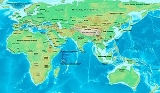
3rd century BC

Encyclopedia
Era
An era is a commonly used word for long period of time. When used in science, for example geology, eras denote clearly defined periods of time of arbitrary but well defined length, such as for example the Mesozoic era from 252 Ma–66 Ma, delimited by a start event and an end event. When used in...
, epoch
Epoch (reference date)
In the fields of chronology and periodization, an epoch is an instance in time chosen as the origin of a particular era. The "epoch" then serves as a reference point from which time is measured...
, or historical period.
Overview
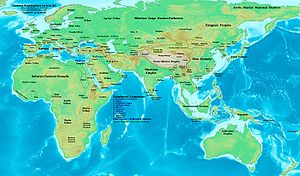
The first few decades of this century were characterized by a balance of power between the GreekGreeks
The Greeks, also known as the Hellenes , are a nation and ethnic group native to Greece, Cyprus and neighboring regions. They also form a significant diaspora, with Greek communities established around the world....
Hellenistic kingdoms in the east, and the great mercantile power of Carthage
Carthage
Carthage , implying it was a 'new Tyre') is a major urban centre that has existed for nearly 3,000 years on the Gulf of Tunis, developing from a Phoenician colony of the 1st millennium BC...
in the west. This balance was shattered when conflict arose between Carthage
Carthage
Carthage , implying it was a 'new Tyre') is a major urban centre that has existed for nearly 3,000 years on the Gulf of Tunis, developing from a Phoenician colony of the 1st millennium BC...
and the Roman Republic
Roman Republic
The Roman Republic was the period of the ancient Roman civilization where the government operated as a republic. It began with the overthrow of the Roman monarchy, traditionally dated around 508 BC, and its replacement by a government headed by two consuls, elected annually by the citizens and...
. In the following decades, the Carthaginian Republic
Carthaginian Republic
Ancient Carthage was a civilization centered on the Phoenician city-state of Carthage, located in North Africa on the Gulf of Tunis, outside what is now Tunis, Tunisia. It was founded in 814 BC...
was first humbled and then destroyed by the Romans in the first and second Punic wars. Following the Second Punic War
Second Punic War
The Second Punic War, also referred to as The Hannibalic War and The War Against Hannibal, lasted from 218 to 201 BC and involved combatants in the western and eastern Mediterranean. This was the second major war between Carthage and the Roman Republic, with the participation of the Berbers on...
, Rome became the most important power in the western Mediterranean.
India
India , officially the Republic of India , is a country in South Asia. It is the seventh-largest country by geographical area, the second-most populous country with over 1.2 billion people, and the most populous democracy in the world...
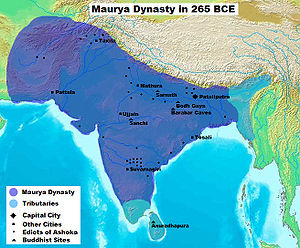
, Ashoka the Great ruled the Maurya Empire
Maurya Empire
The Maurya Empire was a geographically extensive Iron Age historical power in ancient India, ruled by the Mauryan dynasty from 321 to 185 BC...
. The Pandya
Early Pandyan Kingdom
The Early Pandyas of the Sangam period were one of the three main kingdoms of the ancient Tamil country, the other two being the Cholas and the Cheras. As with many other kingdoms around this period , most of the information about the Early Pandyas come to us mainly through literary sources and...
, Chola
Early Cholas
The Early Cholas of the pre and post Sangam period were one of the three main kingdoms of the ancient Tamil country. Their early capitals were Urayur and Kaveripattinam...
and Chera
Chera dynasty
Chera Dynasty in South India is one of the most ancient ruling dynasties in India. Together with the Cholas and the Pandyas, they formed the three principle warring Iron Age Tamil kingdoms in southern India...
dynasties of the classical age rule and flourish in the ancient Tamil country
Ancient Tamil country
The Sangam period is the classical period in the history of Tamil Nadu, Kerala and other parts of South India, spanning about the 3rd century BCE to the 3rd century CE...
. The Xiong Nu were at the height of their power in Mongolia
Mongolia
Mongolia is a landlocked country in East and Central Asia. It is bordered by Russia to the north and China to the south, east and west. Although Mongolia does not share a border with Kazakhstan, its western-most point is only from Kazakhstan's eastern tip. Ulan Bator, the capital and largest...
. The Warring States period in China
China
Chinese civilization may refer to:* China for more general discussion of the country.* Chinese culture* Greater China, the transnational community of ethnic Chinese.* History of China* Sinosphere, the area historically affected by Chinese culture...
drew to a close, with Qin Shihuang conquering other nation-states and establishing the short-lived Qin dynasty
Qin Dynasty
The Qin Dynasty was the first imperial dynasty of China, lasting from 221 to 207 BC. The Qin state derived its name from its heartland of Qin, in modern-day Shaanxi. The strength of the Qin state was greatly increased by the legalist reforms of Shang Yang in the 4th century BC, during the Warring...
, the first empire of China, which was followed in the same century by the long-lasting Han dynasty
Han Dynasty
The Han Dynasty was the second imperial dynasty of China, preceded by the Qin Dynasty and succeeded by the Three Kingdoms . It was founded by the rebel leader Liu Bang, known posthumously as Emperor Gaozu of Han. It was briefly interrupted by the Xin Dynasty of the former regent Wang Mang...
. The Protohistoric Period began in the Korean peninsula
Korean Peninsula
The Korean Peninsula is a peninsula in East Asia. It extends southwards for about 684 miles from continental Asia into the Pacific Ocean and is surrounded by the Sea of Japan to the south, and the Yellow Sea to the west, the Korea Strait connecting the first two bodies of water.Until the end of...
.
Events
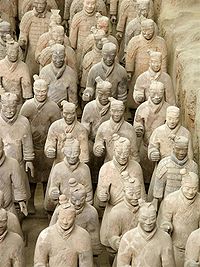
290s BC
- 299 BC: The Samnites, seizing their chance when Rome is engaged on the LombardLombardyLombardy is one of the 20 regions of Italy. The capital is Milan. One-sixth of Italy's population lives in Lombardy and about one fifth of Italy's GDP is produced in this region, making it the most populous and richest region in the country and one of the richest in the whole of Europe...
plain, start the third Samnite War with a collection of mercenaries from GaulGaulGaul was a region of Western Europe during the Iron Age and Roman era, encompassing present day France, Luxembourg and Belgium, most of Switzerland, the western part of Northern Italy, as well as the parts of the Netherlands and Germany on the left bank of the Rhine. The Gauls were the speakers of...
and SabineSabineThe Sabines were an Italic tribe that lived in the central Appennines of ancient Italy, also inhabiting Latium north of the Anio before the founding of Rome...
and EtruscanEtruscan civilizationEtruscan civilization is the modern English name given to a civilization of ancient Italy in the area corresponding roughly to Tuscany. The ancient Romans called its creators the Tusci or Etrusci...
allies to help them. - 298 BC: The Samnites defeat the RomansRoman RepublicThe Roman Republic was the period of the ancient Roman civilization where the government operated as a republic. It began with the overthrow of the Roman monarchy, traditionally dated around 508 BC, and its replacement by a government headed by two consuls, elected annually by the citizens and...
under Lucius Cornelius Scipio BarbatusLucius Cornelius Scipio BarbatusLucius Cornelius Scipio Barbatus was one of the two elected Roman consuls in 298 BC. He led the Roman army to victory against the Etruscans near Volterra...
in the Battle of CamerinumBattle of CamerinumThe Battle of Camerinum in 298 BC was the first battle of the Third Samnite War. In the battle, the Samnites defeated the Romans, who were commanded by Lucius Cornelius Scipio Barbatus....
, first battle of the Third Samnite War. - 293 BC: The Chinese State of QinQin (state)The State of Qin was a Chinese feudal state that existed during the Spring and Autumn and Warring States Periods of Chinese history...
reduced the threat of the State of WeiWei (state)The State of Wei was a Zhou Dynasty vassal state during the Warring States Period of Chinese history. Its territory lay between the states of Qin and Qi and included parts of modern day Henan, Hebei, Shanxi and Shandong...
and the State of HanHan (state)Han was a kingdom during the Warring States Period in China, located in modern-day Shanxi and Henan. Not to be confused with South Korea which shares the same character....
with the Qin victory in the Battle of YiqueBattle of YiqueBattle of Yique 293 BC, fought by King Zhaoxiang of Qin against the alliance of Wei and Han at Yique . For background see Warring States Period#The period of Qi . The Qin commander was general Bai Qi. With half of the alliance force, Bai Qi's army took the alliance's strongholds one by one...
. - Roman armies penetrate into the heart of the Samnite territory and then capture the Samnite cities of Taurasia, Bovianum Vetus and Aufidena.
- AgathoclesAgathoclesAgathocles , , was tyrant of Syracuse and king of Sicily .-Biography:...
, king of Syracuse, assists the Italian Greeks against the Bruttians and supported the Greeks against the Romans. - PtolemyPtolemy I SoterPtolemy I Soter I , also known as Ptolemy Lagides, c. 367 BC – c. 283 BC, was a Macedonian general under Alexander the Great, who became ruler of Egypt and founder of both the Ptolemaic Kingdom and the Ptolemaic Dynasty...
gives his stepdaughter Theoxena in marriage to Agathocles, the tyrant of Syracuse (in south-eastern SicilySicilySicily is a region of Italy, and is the largest island in the Mediterranean Sea. Along with the surrounding minor islands, it constitutes an autonomous region of Italy, the Regione Autonoma Siciliana Sicily has a rich and unique culture, especially with regard to the arts, music, literature,...
). - Ptolemy finally brings the rebellious region of Cyrene under his control. He places the region under the rule of his stepson Magas.
- BindusaraBindusaraBindusara was the second Mauryan emperor after Chandragupta Maurya. During his reign, the empire expanded southwards. He had two well-known sons, Susima and Ashoka, who were the viceroys of Taxila and Ujjain...
succeeds his father Chandragupta MauryaChandragupta MauryaChandragupta Maurya , was the founder of the Maurya Empire. Chandragupta succeeded in conquering most of the Indian subcontinent. Chandragupta is considered the first unifier of India and its first genuine emperor...
as emperor of the Mauryan Empire. - Theater, Epidauros, is built with later additions.
280s BC
- 281 BC: Antiochus I SoterAntiochus I SoterAntiochus I Soter , was a king of the Hellenistic Seleucid Empire. He reigned from 281 BC - 261 BC....
, on the assassination of his father SeleucusSeleucus I NicatorSeleucus I was a Macedonian officer of Alexander the Great and one of the Diadochi. In the Wars of the Diadochi that took place after Alexander's death, Seleucus established the Seleucid dynasty and the Seleucid Empire...
becomes emperor of the Seleucid empireSeleucid EmpireThe Seleucid Empire was a Greek-Macedonian state that was created out of the eastern conquests of Alexander the Great. At the height of its power, it included central Anatolia, the Levant, Mesopotamia, Persia, today's Turkmenistan, Pamir and parts of Pakistan.The Seleucid Empire was a major centre...
. - 280 BC: King Pyrrhus of EpirusPyrrhus of EpirusPyrrhus or Pyrrhos was a Greek general and statesman of the Hellenistic era. He was king of the Greek tribe of Molossians, of the royal Aeacid house , and later he became king of Epirus and Macedon . He was one of the strongest opponents of early Rome...
invades Italy in an attempt to subjugate the RomansAncient RomeAncient Rome was a thriving civilization that grew on the Italian Peninsula as early as the 8th century BC. Located along the Mediterranean Sea and centered on the city of Rome, it expanded to one of the largest empires in the ancient world....
and bring ItalyItalyItaly , officially the Italian Republic languages]] under the European Charter for Regional or Minority Languages. In each of these, Italy's official name is as follows:;;;;;;;;), is a unitary parliamentary republic in South-Central Europe. To the north it borders France, Switzerland, Austria and...
under a new empire ruled by himself. - 280 BC: Construction of the Colossus of RhodesColossus of RhodesThe Colossus of Rhodes was a statue of the Greek Titan Helios, erected in the city of Rhodes on the Greek island of Rhodes by Chares of Lindos between 292 and 280 BC. It is considered one of the Seven Wonders of the Ancient World. It was constructed to celebrate Rhodes' victory over the ruler of...
is completed
270s BC
- 279 BC: SingidunumSingidunumSingidunum is the name for the ancient city in Serbia which became Belgrade, the capital of Serbia. It was recorded that a Celtic tribe Scordisci settled the area in the 3rd century BC following the Gallic invasion of the Balkans. The Roman Empire conquered the area in 75 BC and later garrisoned...
and Taurunum, today's BelgradeBelgradeBelgrade is the capital and largest city of Serbia. It is located at the confluence of the Sava and Danube rivers, where the Pannonian Plain meets the Balkans. According to official results of Census 2011, the city has a population of 1,639,121. It is one of the 15 largest cities in Europe...
and ZemunZemunZemun is a historical town and one of the 17 municipalities which constitute the City of Belgrade, the capital of Serbia...
, is founded by ScordisciScordisciThe Scordisci were an Iron Age tribe centered in the territory of present-day Serbia, at the confluence of the Savus , Dravus and Danube rivers. They were historically notable from the beginning of the third century BC until the turn of the common era...
Celts. - 275 BC: end of history of Babylon.
- After failing to decisively defeat the Romans, Pyrrhus of EpirusPyrrhus of EpirusPyrrhus or Pyrrhos was a Greek general and statesman of the Hellenistic era. He was king of the Greek tribe of Molossians, of the royal Aeacid house , and later he became king of Epirus and Macedon . He was one of the strongest opponents of early Rome...
withdraws from Italy. - GallicGaulsThe Gauls were a Celtic people living in Gaul, the region roughly corresponding to what is now France, Belgium, Switzerland and Northern Italy, from the Iron Age through the Roman period. They mostly spoke the Continental Celtic language called Gaulish....
migration to MacedonMacedonMacedonia or Macedon was an ancient kingdom, centered in the northeastern part of the Greek peninsula, bordered by Epirus to the west, Paeonia to the north, the region of Thrace to the east and Thessaly to the south....
, ThraceThraceThrace is a historical and geographic area in southeast Europe. As a geographical concept, Thrace designates a region bounded by the Balkan Mountains on the north, Rhodope Mountains and the Aegean Sea on the south, and by the Black Sea and the Sea of Marmara on the east...
and GalatiaGalatiaAncient Galatia was an area in the highlands of central Anatolia in modern Turkey. Galatia was named for the immigrant Gauls from Thrace , who settled here and became its ruling caste in the 3rd century BC, following the Gallic invasion of the Balkans in 279 BC. It has been called the "Gallia" of...
. - 273 BC – 252E BC: Ashoka the Great ruled the Mauryan Empire.
260s BC
- 264 BC: First Punic WarFirst Punic WarThe First Punic War was the first of three wars fought between Ancient Carthage and the Roman Republic. For 23 years, the two powers struggled for supremacy in the western Mediterranean Sea, primarily on the Mediterranean island of Sicily and its surrounding waters but also to a lesser extent in...
breaks out between the Carthaginian Empire and the Roman RepublicRoman RepublicThe Roman Republic was the period of the ancient Roman civilization where the government operated as a republic. It began with the overthrow of the Roman monarchy, traditionally dated around 508 BC, and its replacement by a government headed by two consuls, elected annually by the citizens and...
. - 261 BC: Antiochus II TheosAntiochus II TheosAntiochus II Theos was a king of the Hellenistic Seleucid Kingdom who reigned 261 BC – 246 BC). He succeeded his father Antiochus I Soter in the winter of 262–61 BC...
, 2nd son, at the death of his father becomes emperor of the Seleucid empireSeleucid EmpireThe Seleucid Empire was a Greek-Macedonian state that was created out of the eastern conquests of Alexander the Great. At the height of its power, it included central Anatolia, the Levant, Mesopotamia, Persia, today's Turkmenistan, Pamir and parts of Pakistan.The Seleucid Empire was a major centre...
. - 260 BC: Battle of ChangpingBattle of ChangpingThe Battle of Changping was a military campaign that took place during the Warring States Period in China. It concluded in 260 BC with a decisive victory by the State of Qin over the State of Zhao, and ultimately allowed Qin to conquer and unify China decades later...
between the State of QinQin (state)The State of Qin was a Chinese feudal state that existed during the Spring and Autumn and Warring States Periods of Chinese history...
and the State of ZhaoZhao (state)Zhao was a significant Chinese state during the Warring States Period, along with six others...
in China; a decisive Qin victory.
250s BC
- 258 BC: An Dương VươngAn Duong VuongAn Dương Vương is the title of Thục Phán , who ruled over the ancient kingdom of Âu Lạc from 257 to 207 BCE, after defeating the state of Văn Lang and uniting the two tribes Âu Việt and Lạc Việt...
overthrows the Hồng Bàng Dynasty in Viet Nam. - 257 BC: Thục Dynasty takes over Viet Nam.
240s BC
- 241 BC: First Punic WarFirst Punic WarThe First Punic War was the first of three wars fought between Ancient Carthage and the Roman Republic. For 23 years, the two powers struggled for supremacy in the western Mediterranean Sea, primarily on the Mediterranean island of Sicily and its surrounding waters but also to a lesser extent in...
ends in Carthaginian defeat. Rome demands large reparations, and annexes SicilySicilySicily is a region of Italy, and is the largest island in the Mediterranean Sea. Along with the surrounding minor islands, it constitutes an autonomous region of Italy, the Regione Autonoma Siciliana Sicily has a rich and unique culture, especially with regard to the arts, music, literature,...
and CorsicaCorsicaCorsica is an island in the Mediterranean Sea. It is located west of Italy, southeast of the French mainland, and north of the island of Sardinia....
.
220s BC
- 227 BC: The assassination against Ying Zheng, king of Qin State, by Jing KeJing KeJing Ke was a guest residing in the estates of Dan, crown prince of Yan and renowned for his failed assassination attempt of Ying Zheng, King of Qin state, who later became China's first emperor...
from Yan failed. - 225 BC: A large Gallic army is defeated by the Romans at the Battle of TelamonBattle of TelamonThe Battle of Telamon was fought between the Roman Republic and an alliance of Gauls in 225 BC. The Romans, led by the consuls Gaius Atilius Regulus and Lucius Aemilius Papus, defeated the Gauls, thus extending their influence over northern Italy....
. - 225 BC: The Chinese Qin State conquers Wei.
- 223 BC: The Chinese Qin State conquers Chu.
- 222 BC: The Chinese Qin State conquers Yan and Zhao.
- 221 BC: With the conquest of the State of QiQi (state)Qi was a powerful state during the Spring and Autumn Period and Period of the Warring States in ancient China. Its capital was Linzi, now part of the modern day city of Zibo in Shandong Province....
, Qin Shihuang unifies the whole of China into one empire that also included northern Vietnam, forming the Qin DynastyQin DynastyThe Qin Dynasty was the first imperial dynasty of China, lasting from 221 to 207 BC. The Qin state derived its name from its heartland of Qin, in modern-day Shaanxi. The strength of the Qin state was greatly increased by the legalist reforms of Shang Yang in the 4th century BC, during the Warring...
.
210s BC
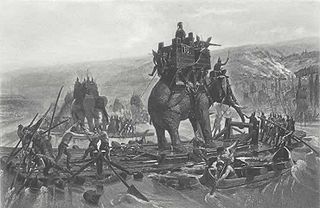
- 218 BC: Second Punic WarSecond Punic WarThe Second Punic War, also referred to as The Hannibalic War and The War Against Hannibal, lasted from 218 to 201 BC and involved combatants in the western and eastern Mediterranean. This was the second major war between Carthage and the Roman Republic, with the participation of the Berbers on...
begins. Hannibal makes his famous AlpineAlpsThe Alps is one of the great mountain range systems of Europe, stretching from Austria and Slovenia in the east through Italy, Switzerland, Liechtenstein and Germany to France in the west....
crossing to invade ItalyItalyItaly , officially the Italian Republic languages]] under the European Charter for Regional or Minority Languages. In each of these, Italy's official name is as follows:;;;;;;;;), is a unitary parliamentary republic in South-Central Europe. To the north it borders France, Switzerland, Austria and...
, the Roman heartland. - 216 BC: Hannibal famously crushed the Roman legions at the Battle of CannaeBattle of CannaeThe Battle of Cannae was a major battle of the Second Punic War, which took place on August 2, 216 BC near the town of Cannae in Apulia in southeast Italy. The army of Carthage under Hannibal decisively defeated a numerically superior army of the Roman Republic under command of the consuls Lucius...
. - 214 BC: Qin Shi HuangQin Shi HuangQin Shi Huang , personal name Ying Zheng , was king of the Chinese State of Qin from 246 BC to 221 BC during the Warring States Period. He became the first emperor of a unified China in 221 BC...
of the Chinese Qin DynastyQin DynastyThe Qin Dynasty was the first imperial dynasty of China, lasting from 221 to 207 BC. The Qin state derived its name from its heartland of Qin, in modern-day Shaanxi. The strength of the Qin state was greatly increased by the legalist reforms of Shang Yang in the 4th century BC, during the Warring...
ordered construction of the Great Wall of ChinaGreat Wall of ChinaThe Great Wall of China is a series of stone and earthen fortifications in northern China, built originally to protect the northern borders of the Chinese Empire against intrusions by various nomadic groups...
.
200s BC
- 208 BC: Zhao TuoZhao TuoZhao Tuo , was the founder of the kingdom of Nanyue |Zhao]]. The state of Zhao was defeated and absorbed by the state of Qin in 222 BC, whereupon Zhao Tuo became a citizen of the state of Qin. He later served in a Qin expeditionary force that was sent south...
(Triệu Đà) defeats the VietnamVietnamVietnam – sometimes spelled Viet Nam , officially the Socialist Republic of Vietnam – is the easternmost country on the Indochina Peninsula in Southeast Asia. It is bordered by China to the north, Laos to the northwest, Cambodia to the southwest, and the South China Sea –...
ese king An Dương VươngAn Duong VuongAn Dương Vương is the title of Thục Phán , who ruled over the ancient kingdom of Âu Lạc from 257 to 207 BCE, after defeating the state of Văn Lang and uniting the two tribes Âu Việt and Lạc Việt...
. - 207 BC: Triệu Dynasty of Viet Nam is inaugurated.
- 206 BC – 202 BC: Civil war of the Chu-Han contentionChu-Han contentionThe Chu–Han Contention was a post-Qin Dynasty interregnum period in Chinese history. Following the collapse of the Qin Dynasty, Xiang Yu split the former Qin Empire into the Eighteen Kingdoms. Two prominent contending powers, Western Chu and Han, emerged from these principalities and engaged in a...
in China after the fall of the Qin Dynasty. - 202 BC: Romans defeat Carthaginians, ending the Second Punic WarSecond Punic WarThe Second Punic War, also referred to as The Hannibalic War and The War Against Hannibal, lasted from 218 to 201 BC and involved combatants in the western and eastern Mediterranean. This was the second major war between Carthage and the Roman Republic, with the participation of the Berbers on...
. Carthage's territories are reduced to the city itself, and crippling reparations are demanded by Rome. - IndiaIndiaIndia , officially the Republic of India , is a country in South Asia. It is the seventh-largest country by geographical area, the second-most populous country with over 1.2 billion people, and the most populous democracy in the world...
n traders regularly visited Arabia. - ScythiaScythiaIn antiquity, Scythian or Scyths were terms used by the Greeks to refer to certain Iranian groups of horse-riding nomadic pastoralists who dwelt on the Pontic-Caspian steppe...
ns occupy SogdianaSogdianaSogdiana or Sogdia was the ancient civilization of an Iranian people and a province of the Achaemenid Empire, eighteenth in the list on the Behistun Inscription of Darius the Great . Sogdiana is "listed" as the second of the "good lands and countries" that Ahura Mazda created...
, in modern-day UzbekistanUzbekistanUzbekistan , officially the Republic of Uzbekistan is a doubly landlocked country in Central Asia and one of the six independent Turkic states. It shares borders with Kazakhstan to the west and to the north, Kyrgyzstan and Tajikistan to the east, and Afghanistan and Turkmenistan to the south....
. - Han DynastyHan DynastyThe Han Dynasty was the second imperial dynasty of China, preceded by the Qin Dynasty and succeeded by the Three Kingdoms . It was founded by the rebel leader Liu Bang, known posthumously as Emperor Gaozu of Han. It was briefly interrupted by the Xin Dynasty of the former regent Wang Mang...
of China was founded (202 BC–220 AD). - The Pharos of Alexandria is built.
- Appearance of the Hopewell cultureHopewell cultureThe Hopewell tradition is the term used to describe common aspects of the Native American culture that flourished along rivers in the northeastern and midwestern United States from 200 BCE to 500 CE. The Hopewell tradition was not a single culture or society, but a widely dispersed set of related...
in OhioOhioOhio is a Midwestern state in the United States. The 34th largest state by area in the U.S.,it is the 7th‑most populous with over 11.5 million residents, containing several major American cities and seven metropolitan areas with populations of 500,000 or more.The state's capital is Columbus...
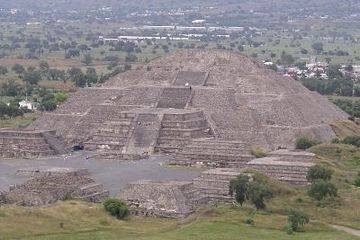
, USA. - TeotihuacánTeotihuacánTeotihuacan – also written Teotihuacán, with a Spanish orthographic accent on the last syllable – is an enormous archaeological site in the Basin of Mexico, just 30 miles northeast of Mexico City, containing some of the largest pyramidal structures built in the pre-Columbian Americas...
, Mexico begun.
Significant persons
- MenciusMenciusMencius was a Chinese philosopher who was arguably the most famous Confucian after Confucius himself.-Life:Mencius, also known by his birth name Meng Ke or Ko, was born in the State of Zou, now forming the territory of the county-level city of Zoucheng , Shandong province, only thirty kilometres ...
, ChineseChinaChinese civilization may refer to:* China for more general discussion of the country.* Chinese culture* Greater China, the transnational community of ethnic Chinese.* History of China* Sinosphere, the area historically affected by Chinese culture...
philosopher and sage (371–289 BC) - EuclidEuclidEuclid , fl. 300 BC, also known as Euclid of Alexandria, was a Greek mathematician, often referred to as the "Father of Geometry". He was active in Alexandria during the reign of Ptolemy I...
, geometer (c. 365–275 BC) - Qu YuanQu YuanQu Yuan was a Chinese poet who lived during the Warring States Period in ancient China. He is famous for his contributions to the poetry collection known as the Chu-ci...
, ChineseChinaChinese civilization may refer to:* China for more general discussion of the country.* Chinese culture* Greater China, the transnational community of ethnic Chinese.* History of China* Sinosphere, the area historically affected by Chinese culture...
poetPoetA poet is a person who writes poetry. A poet's work can be literal, meaning that his work is derived from a specific event, or metaphorical, meaning that his work can take on many meanings and forms. Poets have existed since antiquity, in nearly all languages, and have produced works that vary...
and scholar from State of Chu (340–278 BC) - IlamcetcenniIlamcetcenniIlamcetcenni was an early Tamil king of the Chola dynasty during the Sangam period.He was a great warrior and ruled the Chola kingdom with Puhar as the capital. He married a Velir Princess and the child born to the Royal couple was called Karikala Cholan. Cholas overpowered Cheras and Pandiyas...
, Cholas ruler of South IndiaSouth IndiaSouth India is the area encompassing India's states of Andhra Pradesh, Karnataka, Kerala and Tamil Nadu as well as the union territories of Lakshadweep and Pondicherry, occupying 19.31% of India's area...
in Sangam Age around 301 BC. - Han FeiHan FeiHan Fei was a Chinese philosopher who, along with Li Si, Gongsun Yang, Shen Dao and Shen Buhai, developed the doctrine of the School of Law or Legalism...
, ChineseChinaChinese civilization may refer to:* China for more general discussion of the country.* Chinese culture* Greater China, the transnational community of ethnic Chinese.* History of China* Sinosphere, the area historically affected by Chinese culture...
philosopher from State of Han (280–233 BC) - Ashoka, Mauryan ruler of IndiaIndiaIndia , officially the Republic of India , is a country in South Asia. It is the seventh-largest country by geographical area, the second-most populous country with over 1.2 billion people, and the most populous democracy in the world...
(273 BC–232 BC) - Archimedes of SyracuseArchimedesArchimedes of Syracuse was a Greek mathematician, physicist, engineer, inventor, and astronomer. Although few details of his life are known, he is regarded as one of the leading scientists in classical antiquity. Among his advances in physics are the foundations of hydrostatics, statics and an...
, mathematician, physicist, and engineer (c. 287287 BCYear 287 BC was a year of the pre-Julian Roman calendar. At the time it was known as the Year of the Consulship of Marcellus and Rutilus...
–212 BC) - EratosthenesEratosthenesEratosthenes of Cyrene was a Greek mathematician, poet, athlete, geographer, astronomer, and music theorist.He was the first person to use the word "geography" and invented the discipline of geography as we understand it...
(c. 276–194 BC), Greek mathematician, geographer and astronomer - Apollonius of PergaApollonius of PergaApollonius of Perga [Pergaeus] was a Greek geometer and astronomer noted for his writings on conic sections. His innovative methodology and terminology, especially in the field of conics, influenced many later scholars including Ptolemy, Francesco Maurolico, Isaac Newton, and René Descartes...
, mathematician (c. 262–190 BC) - Qin Shi HuangQin Shi HuangQin Shi Huang , personal name Ying Zheng , was king of the Chinese State of Qin from 246 BC to 221 BC during the Warring States Period. He became the first emperor of a unified China in 221 BC...
, ChineseChinaChinese civilization may refer to:* China for more general discussion of the country.* Chinese culture* Greater China, the transnational community of ethnic Chinese.* History of China* Sinosphere, the area historically affected by Chinese culture...
Emperor (259–210 BC, reigned 246–210 BC) - Emperor Gaozu of Han, founder of the Han DynastyHan DynastyThe Han Dynasty was the second imperial dynasty of China, preceded by the Qin Dynasty and succeeded by the Three Kingdoms . It was founded by the rebel leader Liu Bang, known posthumously as Emperor Gaozu of Han. It was briefly interrupted by the Xin Dynasty of the former regent Wang Mang...
in China, (256 BC–195 BC, reigned 202 BC–195 BC) - Xiang YuXiang YuXiang Yu was a prominent military leader and political figure during the late Qin Dynasty. His given name was Ji while his style name was Yu ....
(232 BC–202 BC), Chinese rebel general against the Qin Dynasty and arch nemesis of Liu Bang in the Chu-Han contentionChu-Han contentionThe Chu–Han Contention was a post-Qin Dynasty interregnum period in Chinese history. Following the collapse of the Qin Dynasty, Xiang Yu split the former Qin Empire into the Eighteen Kingdoms. Two prominent contending powers, Western Chu and Han, emerged from these principalities and engaged in a...
. - Hannibal, military leader of CarthageCarthageCarthage , implying it was a 'new Tyre') is a major urban centre that has existed for nearly 3,000 years on the Gulf of Tunis, developing from a Phoenician colony of the 1st millennium BC...
(247–182 BC) - the "second" Brennus, Gaulish chieftain, invades Macedonia in 279 BC
- The Ptolemaic dynastyPtolemaic dynastyThe Ptolemaic dynasty, was a Macedonian Greek royal family which ruled the Ptolemaic Empire in Egypt during the Hellenistic period. Their rule lasted for 275 years, from 305 BC to 30 BC...
rules EgyptEgyptEgypt , officially the Arab Republic of Egypt, Arabic: , is a country mainly in North Africa, with the Sinai Peninsula forming a land bridge in Southwest Asia. Egypt is thus a transcontinental country, and a major power in Africa, the Mediterranean Basin, the Middle East and the Muslim world...
- Ptolemy I Soter (305 BC–282 BC) and his wives EurydiceEurydice of EgyptEurydice was daughter of Antipater and wife of Ptolemy, the son of Lagus. The period of her marriage is not mentioned by any ancient writer, but it is probable that it took place shortly after the partition of Triparadisus, and the appointment of Antipater to the regency, 321 BC. She was the...
and - Ptolemy II Philadelphos (284 BC–246 BC) and his wives Arsinoe IArsinoe I of EgyptArsinoe I was a Greek Princess who was of Macedonian and Thessalian descent. She was the second daughter and youngest child born to the diadochus who was King of Thrace, Asia Minor and Macedonia Lysimachus from his first wife the Queen consort, Nicaea of Macedon...
and Arsinoe IIArsinoe II of EgyptFor other uses see, ArsinoeArsinoë II was a Ptolemaic Greek Princess of Ancient Egypt and through marriage was of Queen Thrace, Asia Minor and Macedonia as wife of King Lysimachus and later co-ruler of Egypt with her brother-husband Ptolemy II Philadelphus For other uses see, ArsinoeArsinoë II...
Philadelphos - Ptolemy III Euergetes I (246 BC–222 BC) and his wife Berenice II
- Ptolemy IV Philopater (222 BC–204 BC) and his wife Arsinoe IIIArsinoe III of EgyptArsinoe III was Queen of Egypt . She was a daughter of Ptolemy III and Berenice II.Between late October and early November 220 BC she was married to her brother, Ptolemy IV. She took active part in the government of the country, at least in the measure that it was tolerated by the all-powerful...
- Ptolemy V Epiphanes (204 BC–180 BC) and his wife Cleopatra ICleopatra I of EgyptCleopatra I Syra , c. 204–176 BC was a princess of the Seleucid Empire and by marriage, Queen of Ptolemaic Egypt.-Family:...
- Ptolemy I Soter (305 BC–282 BC) and his wives Eurydice
- Appius Claudius CaecusAppius Claudius CaecusAppius Claudius Caecus was a Roman politician from a wealthy patrician family. He was dictator himself and the son of Gaius Claudius Crassus, dictator in 337 BC.-Life:...
, Aqua AppiaAqua AppiaThe Aqua Appia was the first Roman aqueduct. It was constructed in 312 BC by Appius Claudius Caecus, the same Roman censor who also built the important Via Appia...
, Via Appia, invented letter GGG is the seventh letter in the basic modern Latin alphabet.-History:The letter 'G' was introduced in the Old Latin period as a variant of ⟨c⟩ to distinguish voiced, from voiceless, . The recorded originator of ⟨g⟩ is freedman Spurius Carvilius Ruga, the first Roman to open a fee-paying school,... - ArcesilausArcesilausArcesilaus was a Greek philosopher and founder of the Second or Middle Academy—the phase of Academic skepticism. Arcesilaus succeeded Crates as the sixth head of the Academy c. 264 BC. He did not preserve his thoughts in writing, so his opinions can only be gleaned second-hand from what is...
, founder of new AcademyAcademyAn academy is an institution of higher learning, research, or honorary membership.The name traces back to Plato's school of philosophy, founded approximately 385 BC at Akademia, a sanctuary of Athena, the goddess of wisdom and skill, north of Athens, Greece. In the western world academia is the... - ManethoManethoManetho was an Egyptian historian and priest from Sebennytos who lived during the Ptolemaic era, approximately during the 3rd century BC. Manetho wrote the Aegyptiaca...
, wrote History of Egypt - Xun ZiXun ZiXun Zi was a Chinese Confucian philosopher who lived during the Warring States Period and contributed to one of the Hundred Schools of Thought. Xun Zi believed man's inborn tendencies need to be curbed through education and ritual, counter to Mencius's view that man is innately good...
, founder of Legalism (philosophy) - Zeno of CitiumZeno of CitiumZeno of Citium was a Greek philosopher from Citium . Zeno was the founder of the Stoic school of philosophy, which he taught in Athens from about 300 BC. Based on the moral ideas of the Cynics, Stoicism laid great emphasis on goodness and peace of mind gained from living a life of virtue in...
, founder of StoicismStoicismStoicism is a school of Hellenistic philosophy founded in Athens by Zeno of Citium in the early . The Stoics taught that destructive emotions resulted from errors in judgment, and that a sage, or person of "moral and intellectual perfection," would not suffer such emotions.Stoics were concerned... - Bai QiBai QiBái Qǐ was an outstanding military leader of the State of Qin during the Warring States Period of Chinese history. Born in Mei , as commander of the Qin army for more than 30 years, Bai Qi was responsible for the deaths of a total over 890,000 enemy soldiers, earning him the nickname Ren Tu...
, Chinese general - Song YuSong YuSong Yu was a well-known Chinese poet in the State of Chu. He is commonly said to have been a nephew of Qu Yuan, but no reliable biographical information is available...
, Chinese poet - Apollonius of RhodesApollonius of RhodesApollonius Rhodius, also known as Apollonius of Rhodes , early 3rd century BCE – after 246 BCE, was a poet, and a librarian at the Library of Alexandria...
, author of Jason and the ArgonautsJasonJason was a late ancient Greek mythological hero from the late 10th Century BC, famous as the leader of the Argonauts and their quest for the Golden Fleece. He was the son of Aeson, the rightful king of Iolcus...
Inventions, discoveries, introductions
- EratosthenesEratosthenesEratosthenes of Cyrene was a Greek mathematician, poet, athlete, geographer, astronomer, and music theorist.He was the first person to use the word "geography" and invented the discipline of geography as we understand it...
accurately calculates diameter of the EarthEarthEarth is the third planet from the Sun, and the densest and fifth-largest of the eight planets in the Solar System. It is also the largest of the Solar System's four terrestrial planets...
. - WeiqiGo (board game)Go , is an ancient board game for two players that originated in China more than 2,000 years ago...
well-established in ChinaChinaChinese civilization may refer to:* China for more general discussion of the country.* Chinese culture* Greater China, the transnational community of ethnic Chinese.* History of China* Sinosphere, the area historically affected by Chinese culture...
, and may date back to the 2nd millennium BC2nd millennium BCThe 2nd millennium BC marks the transition from the Middle to the Late Bronze Age.Its first half is dominated by the Middle Kingdom of Egypt and Babylonia. The alphabet develops. Indo-Iranian migration onto the Iranian plateau and onto the Indian subcontinent propagates the use of the chariot...
. - Stone of Canopus (for Ptolemy III), No. 1, in Rosetta Stone Series of 3 stones. Implements Leap year in Egypt. Leap year not formally recognized until Caesar in 55 BC.
- 293 BC: first Roman SundialSundialA sundial is a device that measures time by the position of the Sun. In common designs such as the horizontal sundial, the sun casts a shadow from its style onto a surface marked with lines indicating the hours of the day. The style is the time-telling edge of the gnomon, often a thin rod or a...
[Pliny (79ce): Natural History 7.213]. - Water screwArchimedes' screwThe Archimedes' screw, also called the Archimedean screw or screwpump, is a machine historically used for transferring water from a low-lying body of water into irrigation ditches...
invented by ArchimedesArchimedesArchimedes of Syracuse was a Greek mathematician, physicist, engineer, inventor, and astronomer. Although few details of his life are known, he is regarded as one of the leading scientists in classical antiquity. Among his advances in physics are the foundations of hydrostatics, statics and an...
. - Invention of the musical instrumentMusical instrumentA musical instrument is a device created or adapted for the purpose of making musical sounds. In principle, any object that produces sound can serve as a musical instrument—it is through purpose that the object becomes a musical instrument. The history of musical instruments dates back to the...
hydraulis, the precursory to the Pipe organPipe organThe pipe organ is a musical instrument that produces sound by driving pressurized air through pipes selected via a keyboard. Because each organ pipe produces a single pitch, the pipes are provided in sets called ranks, each of which has a common timbre and volume throughout the keyboard compass...
by CtesibiusCtesibiusCtesibius or Ktesibios or Tesibius was a Greek inventor and mathematician in Alexandria, Ptolemaic Egypt. He wrote the first treatises on the science of compressed air and its uses in pumps...
, a Greek engineer working in AlexandriaAlexandriaAlexandria is the second-largest city of Egypt, with a population of 4.1 million, extending about along the coast of the Mediterranean Sea in the north central part of the country; it is also the largest city lying directly on the Mediterranean coast. It is Egypt's largest seaport, serving...
. - Emperor Gaozu of Han China discovers an elaborate mechanical puppet theater in the treasury of the previous ruler Qin Shihuang.
- The enormous Du Jiang Yan Irrigation System of China is engineered and constructed by Li Bing in 256 BC256 BCYear 256 BC was a year of the pre-Julian Roman calendar. At the time it was known as the Year of the Consulship of Longus and Caedicius/Regulus...
. - Burial chamber, Tomb of the Reliefs, CerveteriCerveteriCerveteri is a town and comune of the northern Lazio, in the province of Rome. Originally known as Caere , it is famous for a number of Etruscan necropolis that include some of the best Etruscan tombs anywhere....
, is made. - Great Stupa, SanchiSanchiSanchi is a small village in Raisen District of the state of Madhya Pradesh, India, it is located 46 km north east of Bhopal, and 10 km from Besnagar and Vidisha in the central part of the state of Madhya Pradesh. It is the location of several Buddhist monuments dating from the 3rd...
, Madhya PradeshMadhya PradeshMadhya Pradesh , often called the Heart of India, is a state in central India. Its capital is Bhopal and Indore is the largest city....
, IndiaIndiaIndia , officially the Republic of India , is a country in South Asia. It is the seventh-largest country by geographical area, the second-most populous country with over 1.2 billion people, and the most populous democracy in the world...
, Maurya period, is founded by King AshokaAshokaAshok Maurya or Ashoka , popularly known as Ashoka the Great, was an Indian emperor of the Maurya Dynasty who ruled almost all of the Indian subcontinent from ca. 269 BC to 232 BC. One of India's greatest emperors, Ashoka reigned over most of present-day India after a number of military conquests...
. - SilkSilkSilk is a natural protein fiber, some forms of which can be woven into textiles. The best-known type of silk is obtained from the cocoons of the larvae of the mulberry silkworm Bombyx mori reared in captivity...
is exported to EuropeEuropeEurope is, by convention, one of the world's seven continents. Comprising the westernmost peninsula of Eurasia, Europe is generally 'divided' from Asia to its east by the watershed divides of the Ural and Caucasus Mountains, the Ural River, the Caspian and Black Seas, and the waterways connecting...
from China. - Armillary sphereArmillary sphereAn armillary sphere is a model of objects in the sky , consisting of a spherical framework of rings, centred on Earth, that represent lines of celestial longitude and latitude and other astronomically important features such as the ecliptic...
s, models of objects in the sky developed by the Greeks, are in use as teaching tools.
Evidence
Much of what is known of this century comes from the works of the Roman historian PolybiusPolybius
Polybius , Greek ) was a Greek historian of the Hellenistic Period noted for his work, The Histories, which covered the period of 220–146 BC in detail. The work describes in part the rise of the Roman Republic and its gradual domination over Greece...
, whose main concern is the story of how Rome comes to dominate the known world.