


Coordinated Universal Time

Encyclopedia
Coordinated Universal Time (abbreviated UTC) is the primary time standard
by which the world regulates clocks and time. It is one of several closely related successors to Greenwich Mean Time
. Computer servers, online services and other entities that rely on having a universally accepted time use UTC for that purpose. If only limited precision is needed, clients can obtain the current UTC time from a number of official internet UTC servers. For sub-microsecond precision, clients can obtain the time from satellite signals. Time zone
s around the world are expressed as positive or negative offsets from UTC, as in this list.
Coordinated Universal Time is based on International Atomic Time
(TAI), a time standard calculated using a weighted average of signals from atomic clocks located in nearly 70 national laboratories around the world. The only difference between the two is that UTC is occasionally adjusted by adding a leap second
in order to keep it within one second of UT1, which is defined by the Earth's rotation. In the 50 years up to and including 2011, a total of 34 leap seconds have been added.
The UTC standard was officially standardized in 1961 by the International Radio Consultative Committee, after having been initiated by several national time laboratories. The system was changed several times over the following years, until leap seconds were adopted in 1972. A number of proposals have been made to replace it with a new system, which would eliminate leap seconds, but no consensus has yet been reached to do so.
and World Wide Web
standards. The Network Time Protocol
, designed to synchronise the clocks of computers over the internet, encodes times using the UTC system.
UTC is also the time standard used in aviation
. Weather forecasts
, flight plan
s, air traffic control
clearances, and maps all use UTC to avoid confusion about time zones and daylight saving time
.
Amateur radio
operators often schedule their radio contacts in UTC, because transmissions on some frequencies can be picked up by many timezones.
(TAI) with leap second
s added at irregular intervals to compensate for the Earth
's slowing rotation. Leap seconds are used to allow UTC to closely track Universal Time
(UT1), as explained later in this article.
The difference between UTC and UT1 is not allowed to exceed 0.9 seconds, so if high precision is not required, the general term Universal Time (UT) may be used. The term Greenwich Mean Time
(GMT) does not have a precise definition at the subsecond level, but it is often considered equivalent to UTC or UT1. Saying "GMT" often implies either UTC or UT1 when used within informal or casual contexts. In technical contexts, usage of "GMT" is avoided; the unambiguous terminology "UTC" or "UT1" is preferred.
The official notation for Coordinated Universal Time is UTC. This notation arose from a desire by the International Telecommunication Union
and the International Astronomical Union
to use the same notation in all languages. English
speakers originally proposed "CUT" (for "coordinated universal time"), while French
speakers proposed "TUC" (for "temps universel coordonné"). The compromise that emerged was UTC, which conforms to the pattern for the notations of the variants of Universal Time
(UT0, UT1, UT2, UT1R etc.).
, but Julian day numbers
can also be used. Each day contains 24 hours and each hour contains 60 minutes. The number of seconds in a minute is usually 60, but may very rarely be 61 or 59. Thus, in the UTC time scale, the second and all smaller time units (millisecond, microsecond etc.) are of constant duration, but the minute and all larger time units (hour, day, week etc.) are of variable duration. Decisions to introduce a leap second are announced at least 8 weeks in advance in "Bulletin C" produced by the International Earth Rotation and Reference Systems Service
.. The leap seconds cannot be predicted far in advance due to the unpredictable rate of rotation of the earth.
Nearly all UTC days contain exactly 86,400 SI
second
s, with exactly 60 seconds in each minute. However, because the mean solar day is slightly longer than 86,400 SI seconds, occasionally the last minute of a UTC day is adjusted to have 61 seconds. The extra second is called a leap second
. It accounts for the grand total of the extra length (about 2 milliseconds each) of all the mean solar days since the previous leap second. The last minute of a UTC day is permitted to contain 59 seconds to cover the remote possibility of the Earth rotating faster, but that has not yet been necessary since UTC was introduced. The irregular day lengths mean that fractional Julian day
s do not work properly with UTC.
Since 1972, UTC is calculated by subtracting the accumulated leap seconds from International Atomic Time (TAI), which is a coordinate time
scale tracking notional proper time
on the rotating surface of the Earth
(the geoid
). In order to maintain a close approximation to UT1
(equivalent to GMT
before 1960), UTC occasionally has discontinuities
where it changes from one linear function of TAI to another. These discontinuities take the form of leap seconds implemented by a UTC day of irregular length. Discontinuities in UTC have occurred only at the end of a Gregorian
month.
The International Earth Rotation and Reference Systems Service
(IERS) tracks and publishes the difference between UTC and Universal Time, DUT1
= UT1 - UTC, and introduces discontinuities into UTC to keep DUT1 in the interval
(-0.9 s, +0.9 s). Since 1972 the discontinuities have consisted only of a leap of one second at the end of 30 June or 31 December.
As with TAI, UTC is only known with the highest precision in retrospect. Users who require an approximation in real time must obtain it from a time laboratory, which disseminates an approximation using techniques such as GPS or radio time signal
s. Such approximations are designated UTC(k), where k is an abbreviation for the time laboratory. The time of events may be provisionally recorded against one of these approximations; later corrections may be applied using the International Bureau of Weights and Measures
(BIPM) monthly publication of tables of differences between canonical TAI/UTC and TAI(k)/UTC(k) as estimated in real time by participating laboratories. (See the article on International Atomic Time
for details.)
Because of time dilation
, a standard clock not on the geoid
, or in rapid motion, will not maintain synchronicity with UTC. Therefore, telemetry
from clocks with a known relation to the geoid is used to provide UTC when required, on locations such as those of spacecraft.
UTC is a discontinuous timescale, so it is not possible to compute the exact time interval
elapsed between two UTC timestamps without consulting a table that describes how many leap seconds occurred during that interval. Therefore, many scientific applications that require precise measurement of long (multi-year) intervals use TAI
instead. TAI is also commonly used by systems that cannot handle leap seconds. A fixed 19-second offset from TAI also gives GPS time.
For most common and legal-trade purposes, the fractional second difference between UTC and UT (GMT) is inconsequentially small, so UTC is often called GMT (for instance, by the BBC
).
The UTC time zone is sometimes denoted by the letter Z—a reference to the equivalent nautical time zone (GMT), which has been denoted by a Z since about 1950. The letter also refers to the "zone description" of zero hours, which has been used since 1920 (see time zone history). Since the NATO phonetic alphabet and amateur radio
word for Z is "Zulu", UTC is sometimes known as Zulu time. This is especially true in aviation, where Zulu is the universal standard. This ensures all pilots regardless of location are using the same 24-hour clock
, thus avoiding confusion when flying between time zones. See list of military time zones for letters used in addition to Z in qualifying time zones other than Greenwich.
On electronic devices that only allow the current time zone to be configured using maps or city names, UTC can be selected indirectly by selecting Reykjavík
, Iceland
, which is always on UTC time and does not use daylight saving.
may change if a time zone jurisdiction observes daylight saving time
or summer time
. For example, UTC is 5 hours ahead of (that is, later than) local time on the east coast of the United States during winter, but 4 hours ahead while daylight saving is observed.
held in Washington D. C., the local mean solar time at the Royal Observatory, Greenwich
in England
was chosen to define the Universal day, counted from 0 hours at mean midnight. This agreed with civil Greenwich Mean Time
(GMT), used on the island of Great Britain since 1847. In contrast, astronomical GMT began at mean noon, 12 hours after mean midnight of the same date until 1 January 1925, whereas nautical GMT began at mean noon, 12 hours before mean midnight of the same date, at least until 1805 in the British Navy, but persisted much later elsewhere because it was mentioned at the 1884 conference. In 1884, the Greenwich Meridian was used for two-thirds of all charts and maps as their Prime Meridian
. In 1928, the term Universal Time (UT) was introduced by the International Astronomical Union
to refer to GMT with the day starting at midnight. Until the 1950s, broadcast time signal
s were based on UT, and hence on the rotation of the Earth.
In 1955, the caesium
atomic clock
was invented. This provided a form of timekeeping that was both more stable and more convenient than astronomical observations. In 1956, the U.S. National Bureau of Standards and U.S. Naval Observatory started to develop atomic frequency time scales; by 1959 these time scales were used in generating the WWV time signals, named for the shortwave radio station that broadcasts them. In 1960 the U.S. Naval Observatory, the Royal Greenwich Observatory, and the U.K. National Physical Laboratory coordinated their radio broadcasts so time steps and frequency changes were coordinated, and the resulting time scale was informally referred to as "Coordinated Universal Time".
In a controversial decision, the frequency of the signals was initially set to match the rate of UT, but then kept at the same frequency by the use of atomic clocks and deliberately allowed to drift away from UT. When the divergence grew significantly, the signal was phase shifted (stepped) by 20 ms
to bring it back into agreement with UT. Twenty-nine such steps were used before 1960. The signal frequency was changed less often.
In 1958, data was published linking the frequency for the caesium transition, newly established, with the ephemeris second. The ephemeris second is the duration of time that, when used as the independent variable in the laws of motion that govern the movement of the planets and moons in the solar system, cause the laws of motion to accurately predict the observed positions of solar system bodies. Within the limits of observing accuracy, ephemeris seconds are of constant length, as are atomic seconds. This publication allowed a value to be chosen for the length of the atomic second that would work properly with the celestial laws of motion..
UTC was officially initiated at the start of 1961 (but the name Coordinated Universal Time was not adopted by the International Astronomical Union
until 1967). The TAI instant 1 January 1961 00:00:01.422818 exactly was identified as UTC instant 1 January 1961 00:00:00.000000 exactly, and UTC ticked exactly one second for every 1.000000015 s of TAI. Time steps occurred every few months thereafter, and frequency changes at the end of each year. The jumps increased in size to 100 ms, with only one 50 ms jump having ever occurred. This UTC was intended to permit a very close approximation of UT2, within around 0.1 s.
In 1967, the SI
second was redefined in terms of the frequency supplied by a caesium atomic clock. The length of second so defined was practically equal to the second of ephemeris time
. This was the frequency that had been provisionally used in TAI since 1958. It was soon recognised that having two types of second with different lengths, namely the UTC second and the SI second used in TAI, was a bad idea. It was thought that it would be better for time signals to maintain a consistent frequency, and that that frequency should match the SI second. Thus it would be necessary to rely on time steps alone to maintain the approximation of UT. This was tried experimentally in a service known as "Stepped Atomic Time" (SAT), which ticked at the same rate as TAI and used jumps of 200 ms to stay synchronised with UT2.
There was also dissatisfaction with the frequent jumps in UTC (and SAT). In 1968, Louis Essen
, the inventor of the caesium atomic clock, and G. M. R. Winkler both independently proposed that steps should be of 1 s only. This system was eventually approved, along with the idea of maintaining the UTC second equal to the TAI second. At the end of 1971, there was a final irregular jump of exactly 0.107758 TAI seconds, so that 1 January 1972 00:00:00 UTC was 1 January 1972 00:00:10 TAI exactly, making the difference between UTC and TAI an integer number
of seconds. At the same time, the tick rate of UTC was changed to exactly match TAI. UTC also started to track UT1 rather than UT2. Some time signals started to broadcast the DUT1 correction (UT1 − UTC) for applications requiring a closer approximation of UT1 than UTC now provided.
The first leap second
occurred on 30 June 1972. Since then, leap seconds have occurred on average about once every 19 months, always on 30 June or 31 December. As of 1 January 2010, 00:00:00 UTC, there have been 24 leap seconds in total, all positive, putting UTC 34 seconds behind TAI (this is the case since 1 January 2009).
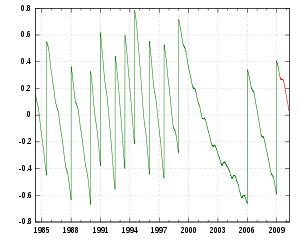 The Earth's rotational speed
is very slowly decreasing due to tidal deceleration
, causing the mean solar day
to increase in length. The length of the SI second was calibrated on the basis of the second of ephemeris time
and can now be seen to have a relationship with the mean solar day observed between 1750 and 1892, analysed by Simon Newcomb
. As a result, the SI second is close to 1/86400 of a mean solar day in around 1820. In earlier centuries the mean solar day was shorter than 86400 SI seconds, and in later centuries it is longer than 86400 seconds. At the end of the 20th century the length of the mean solar day (also known simply as "length of day" or "LOD") was approximately 86,400.002 s. For this reason, UT is now "slower" than TAI.
The excess of the LOD over the nominal 86,400 s accumulates over time, causing the UTC day, initially synchronised with the mean sun, to become desynchronised and run ahead of it. At the end of the 20th century, with the LOD at 2 ms above the nominal value, UTC ran faster than UT by 2 ms per day, getting a second ahead roughly every 500 days. Thus, leap seconds were inserted at approximately this interval, retarding UTC to keep it synchronised in the long term. Note that the actual rotational period
varies on unpredictable factors such as tectonic motion
and has to be observed, rather than computed.
The insertion of a leap second every 500 days does not indicate that the mean solar day is getting longer by a second every 500 days (just as a leap day every four years does not mean the year is getting longer by one day every four years): it will take approximately 50,000 years for a mean solar day to lengthen by one second (at a rate of 2 ms/cy). This is a mean rate within the range of 1.7–2.3 ms/cy. The rate due to tidal friction alone is about 2.3 ms/cy, but the uplift of Canada
and Scandinavia
by several metres since the last Ice Age
has temporarily reduced this to 1.7 ms/cy over the last 2700 years. The correct reason for leap seconds is not the current difference between actual and nominal LOD, but rather the accumulation of this difference over a period of time: in the late twentieth century, this difference was about 1/500 of a second per day, so it accumulated to 1 second after about 500 days.
For example, assume you start counting the seconds from the Unix epoch
of 1970-01-01T00:00:00 UTC with an atomic clock. At midnight on that day (as measured on UTC), your counter registers 0 s. After Earth has made one full rotation with respect to the mean Sun, your counter will register approximately 86400.002 s (the precise value will vary depending on plate tectonic
conditions). Based on your counter, you can calculate that the date is 1970-01-02T00:00:00 UT1. After 500 rotations, your counter will register 43,200,001 s. Since 86,400 s × 500 is 43,200,000 s, you will calculate that the date is 1971-05-16T00:00:01 UTC, while it is only 1971-05-16T00:00:00 UT1. If you had added a leap second on December 31, 1970, retarding your counter by 1 s, then the counter would have a value of 43,200,000 s at 1971-05-16T00:00:00 UT1, and allow you to calculate the correct date.
In the graph of DUT1
above, the excess of LOD above the nominal 86,400 s corresponds to the downward slope of the graph between vertical segments. (Note that the slope became shallower in the 2000s, due to a slight acceleration of the Earth's crust temporarily shortening the day.) Vertical position on the graph corresponds to the accumulation of this difference over time, and the vertical segments correspond to leap seconds introduced to match this accumulated difference. Leap seconds are timed to keep DUT1 within the vertical range depicted by this graph. The frequency of leap seconds therefore corresponds to the slope of the diagonal graph segments, and thus to the excess LOD.
of LOD is approximately +1.7 ms per century. At the end of the 21st century LOD will be roughly 86,400.004 s, requiring leap seconds every 250 days. Over several centuries, the frequency of leap seconds will become problematic.
Some time in the 22nd century, two leap seconds will be required every year. The current use of only the leap second opportunities in June and December will be insufficient, and the March and September options will have to be used. In the 25th century, four leap seconds will be required every year, so the current quarterly options will be insufficient. Thereafter there will need to be the possibility of leap seconds at the end of any month. In about two thousand years even that will become insufficient, and there will have to be leap seconds that are not at the end of a month.
In a few tens of thousands of years (the timing is uncertain) LOD will exceed 86,401 s, causing the current form of UTC to break down due to requiring more than one leap second per day. It would be possible to then continue with double leaps, but this becomes increasingly untenable.
Both the one-leap-second-per-month and one-leap-second-per-day milestones are considered (by different theorists) to mark the theoretical limit of the applicability of UTC. The actual number of leap seconds to keep track of time would become unwieldy by current standards well before these, but presumably if UTC were to continue then horological systems would be redesigned to cope with regular leap seconds much better than current systems do.
There is a proposal to redefine UTC and abolish leap seconds, such that sundial
s would slowly get further out of sync with civil time
. The resulting gradual shift of the sun's movements relative to civil time is analogous to the shift of season
s relative to the yearly calendar that results from the calendar year not precisely matching the tropical year
length. This would be a major practical change in civil timekeeping, but would take effect slowly over several centuries. ITU-R
Study Group 7 and Working Party 7A were unable to reach consensus on whether to advance the proposal to the 2012 Radiocommunications Assembly, so the chairman of Study Group 7 elected to advance the question to the 2012 Radiocommunications Assembly (which is scheduled for Geneva
16–20 January).
There is also a proposal that the present form of UTC could be improved to track UT1 more closely, by allowing greater freedom in scheduling leap seconds.
Time standard
A time standard is a specification for measuring time: either the rate at which time passes; or points in time; or both. In modern times, several time specifications have been officially recognized as standards, where formerly they were matters of custom and practice. An example of a kind of time...
by which the world regulates clocks and time. It is one of several closely related successors to Greenwich Mean Time
Greenwich Mean Time
Greenwich Mean Time is a term originally referring to mean solar time at the Royal Observatory in Greenwich, London. It is arguably the same as Coordinated Universal Time and when this is viewed as a time zone the name Greenwich Mean Time is especially used by bodies connected with the United...
. Computer servers, online services and other entities that rely on having a universally accepted time use UTC for that purpose. If only limited precision is needed, clients can obtain the current UTC time from a number of official internet UTC servers. For sub-microsecond precision, clients can obtain the time from satellite signals. Time zone
Time zone
A time zone is a region on Earth that has a uniform standard time for legal, commercial, and social purposes. In order for the same clock time to always correspond to the same portion of the day as the Earth rotates , different places on the Earth need to have different clock times...
s around the world are expressed as positive or negative offsets from UTC, as in this list.
Coordinated Universal Time is based on International Atomic Time
International Atomic Time
International Atomic Time is a high-precision atomic coordinate time standard based on the notional passage of proper time on Earth's geoid...
(TAI), a time standard calculated using a weighted average of signals from atomic clocks located in nearly 70 national laboratories around the world. The only difference between the two is that UTC is occasionally adjusted by adding a leap second
Leap second
A leap second is a positive or negative one-second adjustment to the Coordinated Universal Time time scale that keeps it close to mean solar time. UTC, which is used as the basis for official time-of-day radio broadcasts for civil time, is maintained using extremely precise atomic clocks...
in order to keep it within one second of UT1, which is defined by the Earth's rotation. In the 50 years up to and including 2011, a total of 34 leap seconds have been added.
The UTC standard was officially standardized in 1961 by the International Radio Consultative Committee, after having been initiated by several national time laboratories. The system was changed several times over the following years, until leap seconds were adopted in 1972. A number of proposals have been made to replace it with a new system, which would eliminate leap seconds, but no consensus has yet been reached to do so.
Uses
UTC is the time standard used for many InternetInternet
The Internet is a global system of interconnected computer networks that use the standard Internet protocol suite to serve billions of users worldwide...
and World Wide Web
World Wide Web
The World Wide Web is a system of interlinked hypertext documents accessed via the Internet...
standards. The Network Time Protocol
Network Time Protocol
The Network Time Protocol is a protocol and software implementation for synchronizing the clocks of computer systems over packet-switched, variable-latency data networks. Originally designed by David L...
, designed to synchronise the clocks of computers over the internet, encodes times using the UTC system.
UTC is also the time standard used in aviation
Aviation
Aviation is the design, development, production, operation, and use of aircraft, especially heavier-than-air aircraft. Aviation is derived from avis, the Latin word for bird.-History:...
. Weather forecasts
Weather forecasting
Weather forecasting is the application of science and technology to predict the state of the atmosphere for a given location. Human beings have attempted to predict the weather informally for millennia, and formally since the nineteenth century...
, flight plan
Flight plan
Flight plans are documents filed by pilots or a Flight Dispatcher with the local Civil Aviation Authority prior to departure...
s, air traffic control
Air traffic control
Air traffic control is a service provided by ground-based controllers who direct aircraft on the ground and in the air. The primary purpose of ATC systems worldwide is to separate aircraft to prevent collisions, to organize and expedite the flow of traffic, and to provide information and other...
clearances, and maps all use UTC to avoid confusion about time zones and daylight saving time
Daylight saving time
Daylight saving time —also summer time in several countries including in British English and European official terminology —is the practice of temporarily advancing clocks during the summertime so that afternoons have more daylight and mornings have less...
.
Amateur radio
Amateur radio
Amateur radio is the use of designated radio frequency spectrum for purposes of private recreation, non-commercial exchange of messages, wireless experimentation, self-training, and emergency communication...
operators often schedule their radio contacts in UTC, because transmissions on some frequencies can be picked up by many timezones.
Definition and relationship to other standards
The current version of UTC is defined by International Telecommunications Union Recommendation ITU-R TF.460-6, Standard-frequency and time-signal emissions. UTC is based on International Atomic TimeInternational Atomic Time
International Atomic Time is a high-precision atomic coordinate time standard based on the notional passage of proper time on Earth's geoid...
(TAI) with leap second
Leap second
A leap second is a positive or negative one-second adjustment to the Coordinated Universal Time time scale that keeps it close to mean solar time. UTC, which is used as the basis for official time-of-day radio broadcasts for civil time, is maintained using extremely precise atomic clocks...
s added at irregular intervals to compensate for the Earth
Earth
Earth is the third planet from the Sun, and the densest and fifth-largest of the eight planets in the Solar System. It is also the largest of the Solar System's four terrestrial planets...
's slowing rotation. Leap seconds are used to allow UTC to closely track Universal Time
Universal Time
Universal Time is a time scale based on the rotation of the Earth. It is a modern continuation of Greenwich Mean Time , i.e., the mean solar time on the Prime Meridian at Greenwich, and GMT is sometimes used loosely as a synonym for UTC...
(UT1), as explained later in this article.
The difference between UTC and UT1 is not allowed to exceed 0.9 seconds, so if high precision is not required, the general term Universal Time (UT) may be used. The term Greenwich Mean Time
Greenwich Mean Time
Greenwich Mean Time is a term originally referring to mean solar time at the Royal Observatory in Greenwich, London. It is arguably the same as Coordinated Universal Time and when this is viewed as a time zone the name Greenwich Mean Time is especially used by bodies connected with the United...
(GMT) does not have a precise definition at the subsecond level, but it is often considered equivalent to UTC or UT1. Saying "GMT" often implies either UTC or UT1 when used within informal or casual contexts. In technical contexts, usage of "GMT" is avoided; the unambiguous terminology "UTC" or "UT1" is preferred.
Notation
| Source | Initials | Words |
|---|---|---|
| English | CUT | Coordinated Universal Time |
| French | TUC | Temps Universel Coordonné |
| compromise | UTC | unofficial English: "Universal Time, Coordinated"; unofficial French: "Universel Temps Coordonné" |
The official notation for Coordinated Universal Time is UTC. This notation arose from a desire by the International Telecommunication Union
International Telecommunication Union
The International Telecommunication Union is the specialized agency of the United Nations which is responsible for information and communication technologies...
and the International Astronomical Union
International Astronomical Union
The International Astronomical Union IAU is a collection of professional astronomers, at the Ph.D. level and beyond, active in professional research and education in astronomy...
to use the same notation in all languages. English
English language
English is a West Germanic language that arose in the Anglo-Saxon kingdoms of England and spread into what was to become south-east Scotland under the influence of the Anglian medieval kingdom of Northumbria...
speakers originally proposed "CUT" (for "coordinated universal time"), while French
French language
French is a Romance language spoken as a first language in France, the Romandy region in Switzerland, Wallonia and Brussels in Belgium, Monaco, the regions of Quebec and Acadia in Canada, and by various communities elsewhere. Second-language speakers of French are distributed throughout many parts...
speakers proposed "TUC" (for "temps universel coordonné"). The compromise that emerged was UTC, which conforms to the pattern for the notations of the variants of Universal Time
Universal Time
Universal Time is a time scale based on the rotation of the Earth. It is a modern continuation of Greenwich Mean Time , i.e., the mean solar time on the Prime Meridian at Greenwich, and GMT is sometimes used loosely as a synonym for UTC...
(UT0, UT1, UT2, UT1R etc.).
Mechanism
UTC divides time into days, hours, minutes and seconds. Days are conventionally identified using the Gregorian calendarGregorian calendar
The Gregorian calendar, also known as the Western calendar, or Christian calendar, is the internationally accepted civil calendar. It was introduced by Pope Gregory XIII, after whom the calendar was named, by a decree signed on 24 February 1582, a papal bull known by its opening words Inter...
, but Julian day numbers
Julian day
Julian day is used in the Julian date system of time measurement for scientific use by the astronomy community, presenting the interval of time in days and fractions of a day since January 1, 4713 BC Greenwich noon...
can also be used. Each day contains 24 hours and each hour contains 60 minutes. The number of seconds in a minute is usually 60, but may very rarely be 61 or 59. Thus, in the UTC time scale, the second and all smaller time units (millisecond, microsecond etc.) are of constant duration, but the minute and all larger time units (hour, day, week etc.) are of variable duration. Decisions to introduce a leap second are announced at least 8 weeks in advance in "Bulletin C" produced by the International Earth Rotation and Reference Systems Service
International Earth Rotation and Reference Systems Service
The International Earth Rotation and Reference Systems Service , formerly the International Earth Rotation Service, is the body responsible for maintaining global time and reference frame standards, notably through its Earth Orientation Parameter and International Celestial Reference System ...
.. The leap seconds cannot be predicted far in advance due to the unpredictable rate of rotation of the earth.
Nearly all UTC days contain exactly 86,400 SI
International System of Units
The International System of Units is the modern form of the metric system and is generally a system of units of measurement devised around seven base units and the convenience of the number ten. The older metric system included several groups of units...
second
Second
The second is a unit of measurement of time, and is the International System of Units base unit of time. It may be measured using a clock....
s, with exactly 60 seconds in each minute. However, because the mean solar day is slightly longer than 86,400 SI seconds, occasionally the last minute of a UTC day is adjusted to have 61 seconds. The extra second is called a leap second
Leap second
A leap second is a positive or negative one-second adjustment to the Coordinated Universal Time time scale that keeps it close to mean solar time. UTC, which is used as the basis for official time-of-day radio broadcasts for civil time, is maintained using extremely precise atomic clocks...
. It accounts for the grand total of the extra length (about 2 milliseconds each) of all the mean solar days since the previous leap second. The last minute of a UTC day is permitted to contain 59 seconds to cover the remote possibility of the Earth rotating faster, but that has not yet been necessary since UTC was introduced. The irregular day lengths mean that fractional Julian day
Julian day
Julian day is used in the Julian date system of time measurement for scientific use by the astronomy community, presenting the interval of time in days and fractions of a day since January 1, 4713 BC Greenwich noon...
s do not work properly with UTC.
Since 1972, UTC is calculated by subtracting the accumulated leap seconds from International Atomic Time (TAI), which is a coordinate time
Coordinate time
In the theory of relativity, it is convenient to express results in terms of a spacetime coordinate system relative to an implied observer. In many coordinate systems, an event is specified by one time coordinate and three spatial coordinates...
scale tracking notional proper time
Proper time
In relativity, proper time is the elapsed time between two events as measured by a clock that passes through both events. The proper time depends not only on the events but also on the motion of the clock between the events. An accelerated clock will measure a smaller elapsed time between two...
on the rotating surface of the Earth
Earth
Earth is the third planet from the Sun, and the densest and fifth-largest of the eight planets in the Solar System. It is also the largest of the Solar System's four terrestrial planets...
(the geoid
Geoid
The geoid is that equipotential surface which would coincide exactly with the mean ocean surface of the Earth, if the oceans were in equilibrium, at rest , and extended through the continents . According to C.F...
). In order to maintain a close approximation to UT1
Universal Time
Universal Time is a time scale based on the rotation of the Earth. It is a modern continuation of Greenwich Mean Time , i.e., the mean solar time on the Prime Meridian at Greenwich, and GMT is sometimes used loosely as a synonym for UTC...
(equivalent to GMT
Greenwich Mean Time
Greenwich Mean Time is a term originally referring to mean solar time at the Royal Observatory in Greenwich, London. It is arguably the same as Coordinated Universal Time and when this is viewed as a time zone the name Greenwich Mean Time is especially used by bodies connected with the United...
before 1960), UTC occasionally has discontinuities
Classification of discontinuities
Continuous functions are of utmost importance in mathematics and applications. However, not all functions are continuous. If a function is not continuous at a point in its domain, one says that it has a discontinuity there...
where it changes from one linear function of TAI to another. These discontinuities take the form of leap seconds implemented by a UTC day of irregular length. Discontinuities in UTC have occurred only at the end of a Gregorian
Gregorian calendar
The Gregorian calendar, also known as the Western calendar, or Christian calendar, is the internationally accepted civil calendar. It was introduced by Pope Gregory XIII, after whom the calendar was named, by a decree signed on 24 February 1582, a papal bull known by its opening words Inter...
month.
The International Earth Rotation and Reference Systems Service
International Earth Rotation and Reference Systems Service
The International Earth Rotation and Reference Systems Service , formerly the International Earth Rotation Service, is the body responsible for maintaining global time and reference frame standards, notably through its Earth Orientation Parameter and International Celestial Reference System ...
(IERS) tracks and publishes the difference between UTC and Universal Time, DUT1
DUT1
The time correction DUT1 is the difference between Universal Time , which is defined by Earth's rotation, and Coordinated Universal Time , which is defined by a network of precision clocks....
= UT1 - UTC, and introduces discontinuities into UTC to keep DUT1 in the interval
Interval (mathematics)
In mathematics, a interval is a set of real numbers with the property that any number that lies between two numbers in the set is also included in the set. For example, the set of all numbers satisfying is an interval which contains and , as well as all numbers between them...
(-0.9 s, +0.9 s). Since 1972 the discontinuities have consisted only of a leap of one second at the end of 30 June or 31 December.
As with TAI, UTC is only known with the highest precision in retrospect. Users who require an approximation in real time must obtain it from a time laboratory, which disseminates an approximation using techniques such as GPS or radio time signal
Time signal
A time signal is a visible, audible, mechanical, or electronic signal used as a reference to determine the time of day.-Audible and visible time signals:...
s. Such approximations are designated UTC(k), where k is an abbreviation for the time laboratory. The time of events may be provisionally recorded against one of these approximations; later corrections may be applied using the International Bureau of Weights and Measures
International Bureau of Weights and Measures
The International Bureau of Weights and Measures , is an international standards organisation, one of three such organisations established to maintain the International System of Units under the terms of the Metre Convention...
(BIPM) monthly publication of tables of differences between canonical TAI/UTC and TAI(k)/UTC(k) as estimated in real time by participating laboratories. (See the article on International Atomic Time
International Atomic Time
International Atomic Time is a high-precision atomic coordinate time standard based on the notional passage of proper time on Earth's geoid...
for details.)
Because of time dilation
Time dilation
In the theory of relativity, time dilation is an observed difference of elapsed time between two events as measured by observers either moving relative to each other or differently situated from gravitational masses. An accurate clock at rest with respect to one observer may be measured to tick at...
, a standard clock not on the geoid
Geoid
The geoid is that equipotential surface which would coincide exactly with the mean ocean surface of the Earth, if the oceans were in equilibrium, at rest , and extended through the continents . According to C.F...
, or in rapid motion, will not maintain synchronicity with UTC. Therefore, telemetry
Telemetry
Telemetry is a technology that allows measurements to be made at a distance, usually via radio wave transmission and reception of the information. The word is derived from Greek roots: tele = remote, and metron = measure...
from clocks with a known relation to the geoid is used to provide UTC when required, on locations such as those of spacecraft.
UTC is a discontinuous timescale, so it is not possible to compute the exact time interval
Time
Time is a part of the measuring system used to sequence events, to compare the durations of events and the intervals between them, and to quantify rates of change such as the motions of objects....
elapsed between two UTC timestamps without consulting a table that describes how many leap seconds occurred during that interval. Therefore, many scientific applications that require precise measurement of long (multi-year) intervals use TAI
International Atomic Time
International Atomic Time is a high-precision atomic coordinate time standard based on the notional passage of proper time on Earth's geoid...
instead. TAI is also commonly used by systems that cannot handle leap seconds. A fixed 19-second offset from TAI also gives GPS time.
For most common and legal-trade purposes, the fractional second difference between UTC and UT (GMT) is inconsequentially small, so UTC is often called GMT (for instance, by the BBC
BBC
The British Broadcasting Corporation is a British public service broadcaster. Its headquarters is at Broadcasting House in the City of Westminster, London. It is the largest broadcaster in the world, with about 23,000 staff...
).
Time zones
Time zones are usually defined to differ from UTC by an integral number of hours, although the laws of each jurisdiction would have to be consulted if sub-second accuracy was required. Several jurisdictions have established time zones that differ by an integer number of half-hours or quarter-hours from UT1 or UTC.The UTC time zone is sometimes denoted by the letter Z—a reference to the equivalent nautical time zone (GMT), which has been denoted by a Z since about 1950. The letter also refers to the "zone description" of zero hours, which has been used since 1920 (see time zone history). Since the NATO phonetic alphabet and amateur radio
Amateur radio
Amateur radio is the use of designated radio frequency spectrum for purposes of private recreation, non-commercial exchange of messages, wireless experimentation, self-training, and emergency communication...
word for Z is "Zulu", UTC is sometimes known as Zulu time. This is especially true in aviation, where Zulu is the universal standard. This ensures all pilots regardless of location are using the same 24-hour clock
24-hour clock
The 24-hour clock is a convention of time keeping in which the day runs from midnight to midnight and is divided into 24 hours, indicated by the hours passed since midnight, from 0 to 23. This system is the most commonly used time notation in the world today...
, thus avoiding confusion when flying between time zones. See list of military time zones for letters used in addition to Z in qualifying time zones other than Greenwich.
On electronic devices that only allow the current time zone to be configured using maps or city names, UTC can be selected indirectly by selecting Reykjavík
Reykjavík
Reykjavík is the capital and largest city in Iceland.Its latitude at 64°08' N makes it the world's northernmost capital of a sovereign state. It is located in southwestern Iceland, on the southern shore of Faxaflói Bay...
, Iceland
Iceland
Iceland , described as the Republic of Iceland, is a Nordic and European island country in the North Atlantic Ocean, on the Mid-Atlantic Ridge. Iceland also refers to the main island of the country, which contains almost all the population and almost all the land area. The country has a population...
, which is always on UTC time and does not use daylight saving.
Daylight saving
UTC does not change with a change of seasons, but local time or civil timeCivil time
In modern usage, civil time refers to statutory time scales designated by civilian authorities, or to local time indicated by clocks. Modern civil time is generally standard time in a time zone at a fixed offset from Coordinated Universal Time or from Greenwich Mean Time , possibly adjusted by...
may change if a time zone jurisdiction observes daylight saving time
Daylight saving time
Daylight saving time —also summer time in several countries including in British English and European official terminology —is the practice of temporarily advancing clocks during the summertime so that afternoons have more daylight and mornings have less...
or summer time
Summer time
Summertime may refer to:* Summer, one of the temperate seasons* Daylight saving time , advancing the clock one hour during summer...
. For example, UTC is 5 hours ahead of (that is, later than) local time on the east coast of the United States during winter, but 4 hours ahead while daylight saving is observed.
History
At the 1884 International Meridian ConferenceInternational Meridian Conference
The International Meridian Conference was a conference held in October 1884 in Washington, D.C., in the United States to determine the Prime Meridian of the world. The conference was held at the request of U.S. President Chester A...
held in Washington D. C., the local mean solar time at the Royal Observatory, Greenwich
Royal Observatory, Greenwich
The Royal Observatory, Greenwich , in London, England played a major role in the history of astronomy and navigation, and is best known as the location of the prime meridian...
in England
England
England is a country that is part of the United Kingdom. It shares land borders with Scotland to the north and Wales to the west; the Irish Sea is to the north west, the Celtic Sea to the south west, with the North Sea to the east and the English Channel to the south separating it from continental...
was chosen to define the Universal day, counted from 0 hours at mean midnight. This agreed with civil Greenwich Mean Time
Greenwich Mean Time
Greenwich Mean Time is a term originally referring to mean solar time at the Royal Observatory in Greenwich, London. It is arguably the same as Coordinated Universal Time and when this is viewed as a time zone the name Greenwich Mean Time is especially used by bodies connected with the United...
(GMT), used on the island of Great Britain since 1847. In contrast, astronomical GMT began at mean noon, 12 hours after mean midnight of the same date until 1 January 1925, whereas nautical GMT began at mean noon, 12 hours before mean midnight of the same date, at least until 1805 in the British Navy, but persisted much later elsewhere because it was mentioned at the 1884 conference. In 1884, the Greenwich Meridian was used for two-thirds of all charts and maps as their Prime Meridian
Prime Meridian
The Prime Meridian is the meridian at which the longitude is defined to be 0°.The Prime Meridian and its opposite the 180th meridian , which the International Date Line generally follows, form a great circle that divides the Earth into the Eastern and Western Hemispheres.An international...
. In 1928, the term Universal Time (UT) was introduced by the International Astronomical Union
International Astronomical Union
The International Astronomical Union IAU is a collection of professional astronomers, at the Ph.D. level and beyond, active in professional research and education in astronomy...
to refer to GMT with the day starting at midnight. Until the 1950s, broadcast time signal
Time signal
A time signal is a visible, audible, mechanical, or electronic signal used as a reference to determine the time of day.-Audible and visible time signals:...
s were based on UT, and hence on the rotation of the Earth.
In 1955, the caesium
Caesium
Caesium or cesium is the chemical element with the symbol Cs and atomic number 55. It is a soft, silvery-gold alkali metal with a melting point of 28 °C , which makes it one of only five elemental metals that are liquid at room temperature...
atomic clock
Atomic clock
An atomic clock is a clock that uses an electronic transition frequency in the microwave, optical, or ultraviolet region of the electromagnetic spectrum of atoms as a frequency standard for its timekeeping element...
was invented. This provided a form of timekeeping that was both more stable and more convenient than astronomical observations. In 1956, the U.S. National Bureau of Standards and U.S. Naval Observatory started to develop atomic frequency time scales; by 1959 these time scales were used in generating the WWV time signals, named for the shortwave radio station that broadcasts them. In 1960 the U.S. Naval Observatory, the Royal Greenwich Observatory, and the U.K. National Physical Laboratory coordinated their radio broadcasts so time steps and frequency changes were coordinated, and the resulting time scale was informally referred to as "Coordinated Universal Time".
In a controversial decision, the frequency of the signals was initially set to match the rate of UT, but then kept at the same frequency by the use of atomic clocks and deliberately allowed to drift away from UT. When the divergence grew significantly, the signal was phase shifted (stepped) by 20 ms
Millisecond
A millisecond is a thousandth of a second.10 milliseconds are called a centisecond....
to bring it back into agreement with UT. Twenty-nine such steps were used before 1960. The signal frequency was changed less often.
In 1958, data was published linking the frequency for the caesium transition, newly established, with the ephemeris second. The ephemeris second is the duration of time that, when used as the independent variable in the laws of motion that govern the movement of the planets and moons in the solar system, cause the laws of motion to accurately predict the observed positions of solar system bodies. Within the limits of observing accuracy, ephemeris seconds are of constant length, as are atomic seconds. This publication allowed a value to be chosen for the length of the atomic second that would work properly with the celestial laws of motion..
UTC was officially initiated at the start of 1961 (but the name Coordinated Universal Time was not adopted by the International Astronomical Union
International Astronomical Union
The International Astronomical Union IAU is a collection of professional astronomers, at the Ph.D. level and beyond, active in professional research and education in astronomy...
until 1967). The TAI instant 1 January 1961 00:00:01.422818 exactly was identified as UTC instant 1 January 1961 00:00:00.000000 exactly, and UTC ticked exactly one second for every 1.000000015 s of TAI. Time steps occurred every few months thereafter, and frequency changes at the end of each year. The jumps increased in size to 100 ms, with only one 50 ms jump having ever occurred. This UTC was intended to permit a very close approximation of UT2, within around 0.1 s.
In 1967, the SI
Si
Si, si, or SI may refer to :- Measurement, mathematics and science :* International System of Units , the modern international standard version of the metric system...
second was redefined in terms of the frequency supplied by a caesium atomic clock. The length of second so defined was practically equal to the second of ephemeris time
Ephemeris time
The term ephemeris time can in principle refer to time in connection with any astronomical ephemeris. In practice it has been used more specifically to refer to:...
. This was the frequency that had been provisionally used in TAI since 1958. It was soon recognised that having two types of second with different lengths, namely the UTC second and the SI second used in TAI, was a bad idea. It was thought that it would be better for time signals to maintain a consistent frequency, and that that frequency should match the SI second. Thus it would be necessary to rely on time steps alone to maintain the approximation of UT. This was tried experimentally in a service known as "Stepped Atomic Time" (SAT), which ticked at the same rate as TAI and used jumps of 200 ms to stay synchronised with UT2.
There was also dissatisfaction with the frequent jumps in UTC (and SAT). In 1968, Louis Essen
Louis Essen
Louis Essen FRS O.B.E. was an English physicist whose most notable achievements were in the precise measurement of time and the determination of the speed of light...
, the inventor of the caesium atomic clock, and G. M. R. Winkler both independently proposed that steps should be of 1 s only. This system was eventually approved, along with the idea of maintaining the UTC second equal to the TAI second. At the end of 1971, there was a final irregular jump of exactly 0.107758 TAI seconds, so that 1 January 1972 00:00:00 UTC was 1 January 1972 00:00:10 TAI exactly, making the difference between UTC and TAI an integer number
Integer
The integers are formed by the natural numbers together with the negatives of the non-zero natural numbers .They are known as Positive and Negative Integers respectively...
of seconds. At the same time, the tick rate of UTC was changed to exactly match TAI. UTC also started to track UT1 rather than UT2. Some time signals started to broadcast the DUT1 correction (UT1 − UTC) for applications requiring a closer approximation of UT1 than UTC now provided.
The first leap second
Leap second
A leap second is a positive or negative one-second adjustment to the Coordinated Universal Time time scale that keeps it close to mean solar time. UTC, which is used as the basis for official time-of-day radio broadcasts for civil time, is maintained using extremely precise atomic clocks...
occurred on 30 June 1972. Since then, leap seconds have occurred on average about once every 19 months, always on 30 June or 31 December. As of 1 January 2010, 00:00:00 UTC, there have been 24 leap seconds in total, all positive, putting UTC 34 seconds behind TAI (this is the case since 1 January 2009).
Rationale
Rotational speed
Rotational speed tells how many complete rotations there are per time unit. It is therefore a cyclic frequency, measured in hertz in the SI System...
is very slowly decreasing due to tidal deceleration
Tidal acceleration
Tidal acceleration is an effect of the tidal forces between an orbiting natural satellite , and the primary planet that it orbits . The "acceleration" is usually negative, as it causes a gradual slowing and recession of a satellite in a prograde orbit away from the primary, and a corresponding...
, causing the mean solar day
Solar time
Solar time is a reckoning of the passage of time based on the Sun's position in the sky. The fundamental unit of solar time is the day. Two types of solar time are apparent solar time and mean solar time .-Introduction:...
to increase in length. The length of the SI second was calibrated on the basis of the second of ephemeris time
Ephemeris time
The term ephemeris time can in principle refer to time in connection with any astronomical ephemeris. In practice it has been used more specifically to refer to:...
and can now be seen to have a relationship with the mean solar day observed between 1750 and 1892, analysed by Simon Newcomb
Simon Newcomb
Simon Newcomb was a Canadian-American astronomer and mathematician. Though he had little conventional schooling, he made important contributions to timekeeping as well as writing on economics and statistics and authoring a science fiction novel.-Early life:Simon Newcomb was born in the town of...
. As a result, the SI second is close to 1/86400 of a mean solar day in around 1820. In earlier centuries the mean solar day was shorter than 86400 SI seconds, and in later centuries it is longer than 86400 seconds. At the end of the 20th century the length of the mean solar day (also known simply as "length of day" or "LOD") was approximately 86,400.002 s. For this reason, UT is now "slower" than TAI.
The excess of the LOD over the nominal 86,400 s accumulates over time, causing the UTC day, initially synchronised with the mean sun, to become desynchronised and run ahead of it. At the end of the 20th century, with the LOD at 2 ms above the nominal value, UTC ran faster than UT by 2 ms per day, getting a second ahead roughly every 500 days. Thus, leap seconds were inserted at approximately this interval, retarding UTC to keep it synchronised in the long term. Note that the actual rotational period
Rotation period
The rotation period of an astronomical object is the time it takes to complete one revolution around its axis of rotation relative to the background stars...
varies on unpredictable factors such as tectonic motion
Plate tectonics
Plate tectonics is a scientific theory that describes the large scale motions of Earth's lithosphere...
and has to be observed, rather than computed.
The insertion of a leap second every 500 days does not indicate that the mean solar day is getting longer by a second every 500 days (just as a leap day every four years does not mean the year is getting longer by one day every four years): it will take approximately 50,000 years for a mean solar day to lengthen by one second (at a rate of 2 ms/cy). This is a mean rate within the range of 1.7–2.3 ms/cy. The rate due to tidal friction alone is about 2.3 ms/cy, but the uplift of Canada
Canada
Canada is a North American country consisting of ten provinces and three territories. Located in the northern part of the continent, it extends from the Atlantic Ocean in the east to the Pacific Ocean in the west, and northward into the Arctic Ocean...
and Scandinavia
Scandinavia
Scandinavia is a cultural, historical and ethno-linguistic region in northern Europe that includes the three kingdoms of Denmark, Norway and Sweden, characterized by their common ethno-cultural heritage and language. Modern Norway and Sweden proper are situated on the Scandinavian Peninsula,...
by several metres since the last Ice Age
Ice age
An ice age or, more precisely, glacial age, is a generic geological period of long-term reduction in the temperature of the Earth's surface and atmosphere, resulting in the presence or expansion of continental ice sheets, polar ice sheets and alpine glaciers...
has temporarily reduced this to 1.7 ms/cy over the last 2700 years. The correct reason for leap seconds is not the current difference between actual and nominal LOD, but rather the accumulation of this difference over a period of time: in the late twentieth century, this difference was about 1/500 of a second per day, so it accumulated to 1 second after about 500 days.
For example, assume you start counting the seconds from the Unix epoch
Unix time
Unix time, or POSIX time, is a system for describing instants in time, defined as the number of seconds elapsed since midnight Coordinated Universal Time of Thursday, January 1, 1970 , not counting leap seconds, which are declared by the International Earth Rotation and Reference Systems Service...
of 1970-01-01T00:00:00 UTC with an atomic clock. At midnight on that day (as measured on UTC), your counter registers 0 s. After Earth has made one full rotation with respect to the mean Sun, your counter will register approximately 86400.002 s (the precise value will vary depending on plate tectonic
Plate tectonics
Plate tectonics is a scientific theory that describes the large scale motions of Earth's lithosphere...
conditions). Based on your counter, you can calculate that the date is 1970-01-02T00:00:00 UT1. After 500 rotations, your counter will register 43,200,001 s. Since 86,400 s × 500 is 43,200,000 s, you will calculate that the date is 1971-05-16T00:00:01 UTC, while it is only 1971-05-16T00:00:00 UT1. If you had added a leap second on December 31, 1970, retarding your counter by 1 s, then the counter would have a value of 43,200,000 s at 1971-05-16T00:00:00 UT1, and allow you to calculate the correct date.
In the graph of DUT1
DUT1
The time correction DUT1 is the difference between Universal Time , which is defined by Earth's rotation, and Coordinated Universal Time , which is defined by a network of precision clocks....
above, the excess of LOD above the nominal 86,400 s corresponds to the downward slope of the graph between vertical segments. (Note that the slope became shallower in the 2000s, due to a slight acceleration of the Earth's crust temporarily shortening the day.) Vertical position on the graph corresponds to the accumulation of this difference over time, and the vertical segments correspond to leap seconds introduced to match this accumulated difference. Leap seconds are timed to keep DUT1 within the vertical range depicted by this graph. The frequency of leap seconds therefore corresponds to the slope of the diagonal graph segments, and thus to the excess LOD.
Future
As the Earth's rotation continues to slow, positive leap seconds will be required more frequently. The long-term rate of changeDerivative
In calculus, a branch of mathematics, the derivative is a measure of how a function changes as its input changes. Loosely speaking, a derivative can be thought of as how much one quantity is changing in response to changes in some other quantity; for example, the derivative of the position of a...
of LOD is approximately +1.7 ms per century. At the end of the 21st century LOD will be roughly 86,400.004 s, requiring leap seconds every 250 days. Over several centuries, the frequency of leap seconds will become problematic.
Some time in the 22nd century, two leap seconds will be required every year. The current use of only the leap second opportunities in June and December will be insufficient, and the March and September options will have to be used. In the 25th century, four leap seconds will be required every year, so the current quarterly options will be insufficient. Thereafter there will need to be the possibility of leap seconds at the end of any month. In about two thousand years even that will become insufficient, and there will have to be leap seconds that are not at the end of a month.
In a few tens of thousands of years (the timing is uncertain) LOD will exceed 86,401 s, causing the current form of UTC to break down due to requiring more than one leap second per day. It would be possible to then continue with double leaps, but this becomes increasingly untenable.
Both the one-leap-second-per-month and one-leap-second-per-day milestones are considered (by different theorists) to mark the theoretical limit of the applicability of UTC. The actual number of leap seconds to keep track of time would become unwieldy by current standards well before these, but presumably if UTC were to continue then horological systems would be redesigned to cope with regular leap seconds much better than current systems do.
There is a proposal to redefine UTC and abolish leap seconds, such that sundial
Sundial
A sundial is a device that measures time by the position of the Sun. In common designs such as the horizontal sundial, the sun casts a shadow from its style onto a surface marked with lines indicating the hours of the day. The style is the time-telling edge of the gnomon, often a thin rod or a...
s would slowly get further out of sync with civil time
Civil time
In modern usage, civil time refers to statutory time scales designated by civilian authorities, or to local time indicated by clocks. Modern civil time is generally standard time in a time zone at a fixed offset from Coordinated Universal Time or from Greenwich Mean Time , possibly adjusted by...
. The resulting gradual shift of the sun's movements relative to civil time is analogous to the shift of season
Season
A season is a division of the year, marked by changes in weather, ecology, and hours of daylight.Seasons result from the yearly revolution of the Earth around the Sun and the tilt of the Earth's axis relative to the plane of revolution...
s relative to the yearly calendar that results from the calendar year not precisely matching the tropical year
Tropical year
A tropical year , for general purposes, is the length of time that the Sun takes to return to the same position in the cycle of seasons, as seen from Earth; for example, the time from vernal equinox to vernal equinox, or from summer solstice to summer solstice...
length. This would be a major practical change in civil timekeeping, but would take effect slowly over several centuries. ITU-R
ITU-R
The ITU Radiocommunication Sector is one of the three sectors of the International Telecommunication Union and is responsible for radio communication....
Study Group 7 and Working Party 7A were unable to reach consensus on whether to advance the proposal to the 2012 Radiocommunications Assembly, so the chairman of Study Group 7 elected to advance the question to the 2012 Radiocommunications Assembly (which is scheduled for Geneva
Geneva
Geneva In the national languages of Switzerland the city is known as Genf , Ginevra and Genevra is the second-most-populous city in Switzerland and is the most populous city of Romandie, the French-speaking part of Switzerland...
16–20 January).
There is also a proposal that the present form of UTC could be improved to track UT1 more closely, by allowing greater freedom in scheduling leap seconds.
See also
- Ephemeris timeEphemeris timeThe term ephemeris time can in principle refer to time in connection with any astronomical ephemeris. In practice it has been used more specifically to refer to:...
- ISO 8601ISO 8601ISO 8601 Data elements and interchange formats – Information interchange – Representation of dates and times is an international standard covering the exchange of date and time-related data. It was issued by the International Organization for Standardization and was first published in 1988...
- Terrestrial TimeTerrestrial TimeTerrestrial Time is a modern astronomical time standard defined by the International Astronomical Union, primarily for time-measurements of astronomical observations made from the surface of the Earth....
- World Radiocommunication ConferenceWorld Radiocommunication ConferenceWorld Radiocommunication Conference is organized by ITU to review, and, as necessary, revise the Radio Regulations, the international treaty governing the use of the radio-frequency spectrum and the geostationary-satellite and non-geostationary-satellite orbits. It is held every three to four years...
External links
- Definition of Coordinated Universal Time in German law–ZeitG §1 (3)
- Hong Kong Time by Hong Kong Observatory
- International Earth Rotation Service; list of differences between TAI and UTC from 1961 to present
- The official U.S. time in UTC zone using Java.
- U.S. Naval Observatory: Systems of Time
- W3C Specification about UTC Date and Time and IETF Internet standardInternet standardIn computer network engineering, an Internet Standard is a normative specification of a technology or methodology applicable to the Internet. Internet Standards are created and published by the Internet Engineering Task Force .-Overview:...
RFC 3339, based on ISO 8601ISO 8601ISO 8601 Data elements and interchange formats – Information interchange – Representation of dates and times is an international standard covering the exchange of date and time-related data. It was issued by the International Organization for Standardization and was first published in 1988... - Time and Date
- Current, exact UTC clock at Time.is
- Standard of time definition: UTC, GPS, LORAN and TAI