


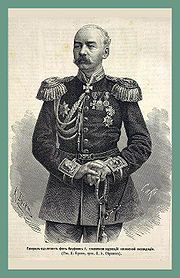
Konstantin Petrovich Von Kaufman

Encyclopedia
Governor-General
A Governor-General, is a vice-regal person of a monarch in an independent realm or a major colonial circonscription. Depending on the political arrangement of the territory, a Governor General can be a governor of high rank, or a principal governor ranking above "ordinary" governors.- Current uses...
of Russian Turkestan
Russian Turkestan
Russian Turkestan was the western part of Turkestan within the Russian Empire , comprising the oasis region to the south of the Kazakh steppes, but not the protectorates of the Emirate of Bukhara and the Khanate of Khiva.-History:-Establishment:Although Russia had been pushing south into the...
.
Early life
His family was AustriaAustria
Austria , officially the Republic of Austria , is a landlocked country of roughly 8.4 million people in Central Europe. It is bordered by the Czech Republic and Germany to the north, Slovakia and Hungary to the east, Slovenia and Italy to the south, and Switzerland and Liechtenstein to the...
n in origin, but had been in the service of the Tsars for over 100 years, and had long since converted to Orthodoxy
Orthodoxy
The word orthodox, from Greek orthos + doxa , is generally used to mean the adherence to accepted norms, more specifically to creeds, especially in religion...
. Kaufman graduated from Nikolayev Engineering Institute as a military engineer
Military engineer
In military science, engineering refers to the practice of designing, building, maintaining and dismantling military works, including offensive, defensive and logistical structures, to shape the physical operating environment in war...
, now Military engineering-technical university
Military Engineering-Technical University
The Saint Petersburg Military Engineering-Technical University , previously known as the Saint Petersburg Nikolaevsky Engineering Academy, was established in 1810 under Alexander I...
(Russian Военный инженерно-технический университет). Von Kaufman entered the military engineering field in 1838, served in the campaigns in the Caucasus
Caucasus
The Caucasus, also Caucas or Caucasia , is a geopolitical region at the border of Europe and Asia, and situated between the Black and the Caspian sea...
, was promoted to the rank of colonel
Colonel
Colonel , abbreviated Col or COL, is a military rank of a senior commissioned officer. It or a corresponding rank exists in most armies and in many air forces; the naval equivalent rank is generally "Captain". It is also used in some police forces and other paramilitary rank structures...
, and commanded the sappers at the siege of Kars
Siege of Kars
The Siege of Kars was the last major operation of the Crimean War. On June 1855, in an attempt to alleviate pressure on the troops at Sevastopol, Emperor Alexander II ordered General Nikolay Muravyov to lead his troops against areas of Ottoman interest in Asia Minor...
in 1855. On the capitulation
Capitulation (surrender)
Capitulation , an agreement in time of war for the surrender to a hostile armed force of a particular body of troops, a town or a territory....
of Kars he was deputed to settle the terms with General William Fenwick Williams
William Fenwick Williams
General Sir William Fenwick Williams, 1st Baronet GCB was a British military leader of the Victorian era.-Early life:...
.
In 1861, he became director-general of engineers at the War Office, assisting Count Dmitry Milyutin
Dmitry Milyutin
Count Dmitry Alekseyevich Milyutin was Minister of War and the last Field Marshal of Imperial Russia...
, the Minister of War, in the reorganization of the army. Promoted lieutenant general in 1864, he was nominated adjutant-general and Governor of the military conscription
Conscription
Conscription is the compulsory enlistment of people in some sort of national service, most often military service. Conscription dates back to antiquity and continues in some countries to the present day under various names...
of Vilna, where at that time the Tsarist state had begun a policy of expropriating the Polish aristocracy in an attempt to break its influence in the countryside.
Conquest of Turkestan
In 1867, he became Governor-General of TurkestanRussian Turkestan
Russian Turkestan was the western part of Turkestan within the Russian Empire , comprising the oasis region to the south of the Kazakh steppes, but not the protectorates of the Emirate of Bukhara and the Khanate of Khiva.-History:-Establishment:Although Russia had been pushing south into the...
, and held the post until his death, making himself a name in the expansion of the empire in Central Asia
Central Asia
Central Asia is a core region of the Asian continent from the Caspian Sea in the west, China in the east, Afghanistan in the south, and Russia in the north...
. The Khanate of Kokand
Khanate of Kokand
The Khanate of Kokand was a state in Central Asia that existed from 1709–1883 within the territory of modern eastern Uzbekistan, southern Kazakhstan, Tajikistan and Kyrgyzstan...
north of the Syr Darya
Syr Darya
The Syr Darya , also transliterated Syrdarya or Sirdaryo, is a river in Central Asia, sometimes known as the Jaxartes or Yaxartes from its Ancient Greek name . The Greek name is derived from Old Persian, Yakhsha Arta , a reference to the color of the river's water...
had already been annexed to Russia, and the independence of the rest of that country became merely nominal. He accomplished a successful campaign in 1868 against the Emirate of Bukhara
Emirate of Bukhara
The Emirate of Bukhara was a Central Asian state that existed from 1785 to 1920. It occupied the land between the Amu Darya and Syr Darya rivers, known formerly as Transoxiana. Its core territory was the land along the lower Zarafshan River, and its urban centres were the ancient cities of...
, capturing Samarkand
Samarkand
Although a Persian-speaking region, it was not united politically with Iran most of the times between the disintegration of the Seleucid Empire and the Arab conquest . In the 6th century it was within the domain of the Turkic kingdom of the Göktürks.At the start of the 8th century Samarkand came...
and gradually subjugating the whole country.
In 1872-1873, he attacked Khanate of Khiva
Khanate of Khiva
The Khanate of Khiva was the name of a Uzbek state that existed in the historical region of Khwarezm from 1511 to 1920, except for a period of Persian occupation by Nadir Shah between 1740–1746. It was the patrilineal descendants of Shayban , the fifth son of Jochi and grandson of Genghis Khan...
, took the capital, and forced the khan
Khan (title)
Khan is an originally Altaic and subsequently Central Asian title for a sovereign or military ruler, widely used by medieval nomadic Turko-Mongol tribes living to the north of China. 'Khan' is also seen as a title in the Xianbei confederation for their chief between 283 and 289...
to become a vassal of Russia
Russia
Russia or , officially known as both Russia and the Russian Federation , is a country in northern Eurasia. It is a federal semi-presidential republic, comprising 83 federal subjects...
. Then followed in 1875 by the campaign against Kokand, in which Kaufmann defeated the usurping khan, Nasreddin, after an anti-Russian uprising against the previous ruler, Khudoyar. The fiction of Kokand's independence was ended, and the remaining rump of the Khanate in the Ferghana Valley was annexed. This rapid absorption of these khanates brought Russia into proximity to Afghanistan, and the reception of Kaufman's emissaries by the Sher Ali Khan
Sher Ali Khan
Sher Ali Khan was Amir of Afghanistan from 1863 to 1866 and from 1868 until his death in 1879. He was the third son of Dost Mohammed Khan, founder of the Barakzai Dynasty in Afghanistan....
was a main cause of the British war with Afghanistan
Afghanistan
Afghanistan , officially the Islamic Republic of Afghanistan, is a landlocked country located in the centre of Asia, forming South Asia, Central Asia and the Middle East. With a population of about 29 million, it has an area of , making it the 42nd most populous and 41st largest nation in the world...
in 1878.
Administration
The various temporary statutes under which Turkestan was administered from 1867-1886 gave Von Kaufman a great deal of latitude in policy. Initially he was allowed to carry out negotiations with neighbouring states on his own account, to establish and oversee the expenditure of the budget, set taxes and establish the privileges of Russian subjects in the General-Gubernatorstvo: he also had the power to confirm and revoke death sentences passed in the Russian military courts. Nowhere else in the Russian Empire did a Military Governor-General have this kind of independence from central control, and nowhere else was there such obvious pessimism about the region’s potential for integration into the main body of the Empire. Isolated geographically from European Russia by an expanse of SteppeSteppe
In physical geography, steppe is an ecoregion, in the montane grasslands and shrublands and temperate grasslands, savannas, and shrublands biomes, characterized by grassland plains without trees apart from those near rivers and lakes...
that took two months to cross, it was isolated still more decisively in the minds of Tsarist officials by its dense, ancient and settled Islamic culture. In its early years under Von Kaufman, Turkestan was thus also administratively isolated, with many distinctive institutions within the military bureaucracy
Bureaucracy
A bureaucracy is an organization of non-elected officials of a governmental or organization who implement the rules, laws, and functions of their institution, and are occasionally characterized by officialism and red tape.-Weberian bureaucracy:...
, that was loosely superimposed on a largely unreformed native administration.
Although Kaufmann was unable to induce his government to support all his ambitious schemes of further conquest, he was still in office when General Mikhail Skobelev
Mikhail Skobelev
Mikhail Dmitrievich Skobelev was a Russian general famous for his conquest of Central Asia and heroism during the Russo-Turkish War of 1877-78. Dressed in white uniform and mounted on a white horse, and always in the thickest of the fray, he was known and adored by his soldiers as the "White...
was despatched from Tiflis in 1880 and 1881 against the Turkomans
Turkmen people
The Turkmen are a Turkic people located primarily in the Central Asian states of Turkmenistan, Afghanistan, and northeastern Iran. They speak the Turkmen language, which is classified as a part of the Western Oghuz branch of the Turkic languages family together with Turkish, Azerbaijani, Qashqai,...
of the Akhal-Teke Oasis, but died suddenly at Tashkent
Tashkent
Tashkent is the capital of Uzbekistan and of the Tashkent Province. The officially registered population of the city in 2008 was about 2.2 million. Unofficial sources estimate the actual population may be as much as 4.45 million.-Early Islamic History:...
in May 1882, shortly before the annexation of Merv
Merv
Merv , formerly Achaemenid Satrapy of Margiana, and later Alexandria and Antiochia in Margiana , was a major oasis-city in Central Asia, on the historical Silk Road, located near today's Mary in Turkmenistan. Several cities have existed on this site, which is significant for the interchange of...
. General Cherniaev, the conqueror of Tashkent in 1865, was appointed as his successor.
Further reading
- «Кауфман» in the Русский Биографический Словарь. Ибак – Ключарев (С.Пб.) 1897.
- Евгений Глущенко "Герои Империи" (Москва) 2001.
- Jean-Marie ThiebaudFRFR may stand for:* FR Fireball, a fighter aircraft of the US Navy* Farbrausch, a German demogroup* Federal Register, the official journal of the Federal Government of the United States* First responder...
, Personnages marquants d'Asie centrale, du Turkestan et de l'Ouzbékistan, Paris, L'Harmattan, 2004. ISBN 2-7475-7017-7