


Salyut

Encyclopedia
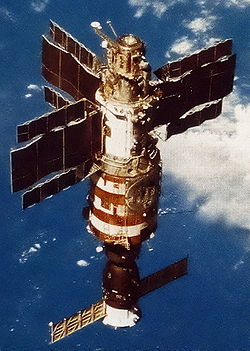

Space station
A space station is a spacecraft capable of supporting a crew which is designed to remain in space for an extended period of time, and to which other spacecraft can dock. A space station is distinguished from other spacecraft used for human spaceflight by its lack of major propulsion or landing...
program undertaken by the Soviet Union
Soviet Union
The Soviet Union , officially the Union of Soviet Socialist Republics , was a constitutionally socialist state that existed in Eurasia between 1922 and 1991....
, which consisted of a series of nine space stations launched over a period of eleven years from 1971 to 1982. Intended as a project to carry out long-term research into the problems of living in space and a variety of astronomical, biological and Earth-resources experiments, the program allowed space station technology to evolve from the engineering development stage to long-term research outposts in space. Ultimately, experience gained from the Salyut stations went on to pave the way for multimodular space stations such as Mir
Mir
Mir was a space station operated in low Earth orbit from 1986 to 2001, at first by the Soviet Union and then by Russia. Assembled in orbit from 1986 to 1996, Mir was the first modular space station and had a greater mass than that of any previous spacecraft, holding the record for the...
and the International Space Station
International Space Station
The International Space Station is a habitable, artificial satellite in low Earth orbit. The ISS follows the Salyut, Almaz, Cosmos, Skylab, and Mir space stations, as the 11th space station launched, not including the Genesis I and II prototypes...
, with each of those stations possessing a Salyut-derived core module at its heart.
The program consisted of a series of six scientific research stations and three military reconnaissance stations, the latter being launched as part of the highly secretive Almaz
Almaz
The Almaz program was a series of military space stations launched by the Soviet Union under cover of the civilian Salyut DOS-17K program after 1971....
program. Salyut broke several spaceflight records
Spaceflight records
This is a list of spaceflight records. Most of these records relate to human spaceflights, but some unmanned and canine records are included.-First independent human spaceflight by country:-Ten longest human space flights:...
, including several mission duration records, the first ever orbital handover of a space station from one crew to another, and various spacewalk records. By the time the program concluded, in 1991, it had seen space station technology evolve from basic, single-docking port stations to complex, multi-ported orbital outposts with impressive scientific capabilities, whose technological legacy continues to the present day.
Stations
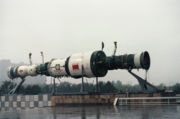
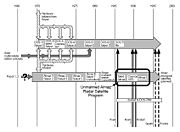
Vladimir Chelomei
Vladimir Nikolayevich Chelomey was a Soviet mechanics scientist and rocket engineer from Ukraine.-Early life:Chelomey was born in Siedlce, Russian Empire into a Ukrainian family...
's original Almaz OPS spaceframe.
For the military Orbital Piloted Stations modifications were small, and related to the rear docking port for Soyuz spacecraft
Soyuz spacecraft
Soyuz , Union) is a series of spacecraft initially designed for the Soviet space programme by the Korolyov Design Bureau in the 1960s, and still in service today...
.
For the civilian DOS Orbital Space Station changes were great, with extra solar panels, rear and front docking ports for Soyuz spacecraft
Soyuz spacecraft
Soyuz , Union) is a series of spacecraft initially designed for the Soviet space programme by the Korolyov Design Bureau in the 1960s, and still in service today...
, TKS spacecraft
TKS spacecraft
TKS spacecraft was a Soviet spacecraft design in the late 1960s intended to supply the military Almaz space station. The spacecraft was designed for manned or autonomous cargo resupply use...
and modules.
Salyut 1
Salyut 1 (DOS-1) was launched April 19, 1971. It was the first space station to orbit Earth. Its first crew launched in Soyuz 10Soyuz 10
Soyuz 10 was a 1971 Soviet manned mission to the world's first space station, Salyut 1. The docking was not successful and the crew returned to Earth without having entered the station.-Mission highlights:Soyuz 10 was launched 23 April 1971...
but were unable to board it due to a failure in the docking mechanism; its second crew launched in Soyuz 11
Soyuz 11
Soyuz 11 was the first manned mission to arrive at the world's first space station, Salyut 1. The mission arrived at the space station on June 7, 1971 and departed on June 30, 1971. The mission ended in disaster when the crew capsule depressurized during preparations for re-entry, killing the...
and remained on board for 23 productive days. A pressure-equalization valve in the Soyuz 11 reentry capsule opened prematurely when the crew returned to Earth, killing all three. Salyut 1 reentered Earth's atmosphere October 11, 1971.
DOS-2
DOS-2 was launched on July 29, 1972. It was similar in design to Salyut 1. The second stage of its Proton rocket failed, which meant that it never reached orbit. It crashed into the Pacific Ocean.Salyut 2
Salyut 2 (OPS-1) was launched April 4, 1973. Despite its name, the space station was part of the highly classified prototype military space station program AlmazAlmaz
The Almaz program was a series of military space stations launched by the Soviet Union under cover of the civilian Salyut DOS-17K program after 1971....
. It was given the designation Salyut 2 to conceal its true nature. Although it launched successfully, within two days the as-yet-unmanned Salyut 2 began losing pressure and its flight control failed; the cause of the failure was likely due to shrapnel piercing the station when the discarded Proton rocket upper stage that had placed it in orbit later exploded nearby. On April 11, 1973, 11 days after launch, an unexplainable accident caused four solar panels to be torn loose from the space station cutting off all power to the space station. Salyut 2 re-entered on May 28, 1973.
Cosmos 557 / DOS-3
Under the designation DOS-3, this Salyut space station launched on May 11, 1973, three days before the launch of SkylabSkylab
Skylab was a space station launched and operated by NASA, the space agency of the United States. Skylab orbited the Earth from 1973 to 1979, and included a workshop, a solar observatory, and other systems. It was launched unmanned by a modified Saturn V rocket, with a mass of...
, as part of the Almaz
Almaz
The Almaz program was a series of military space stations launched by the Soviet Union under cover of the civilian Salyut DOS-17K program after 1971....
program. Due to errors in the flight control system while out of the range of ground control, the station fired its orbit-correction engines until it consumed all of its fuel. Since the spacecraft was already in orbit and had been registered by Western radar, the Soviets disguised the launch as "Cosmos 557
Cosmos 557
Kosmos 557 was the designation given to DOS-3, the next space station in the Salyut program. It was originally intended to be launched as Salyut-2, but due to its failure to achieve orbit on May 11, 1973, three days before the launch of Skylab, it was renamed Kosmos-557.Due to errors in the flight...
" and quietly allowed it to re-enter Earth's atmosphere and burn up a week later. It was revealed to have been a Salyut station only much later.
Salyut 3
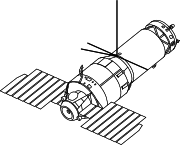
Salyut 3 (OPS-2) was launched on June 25, 1974. It was another Almaz military space station, this one launched successfully. It tested a wide variety of reconnaissance sensors, returning a canister of film for analysis. On January 24, 1975, after the station had been ordered to deorbit, trials of the on-board 23 mm Nudelman aircraft cannon
Nudelman-Rikhter NR-23
The Nudelman-Rikhter NR-23 is a Soviet cannon widely used in military aircraft of the Soviet Union and Warsaw Pact. It was designed by A. E. Nudelman and A.A. Rikhter to replace the wartime Nudelman-Suranov NS-23 and VYa cannon, entering service in 1949....
(other sources say it was a Nudelman NR-30 30 mm gun) were conducted with positive results at ranges from 3000 m to 500 m. Cosmonauts have confirmed that a target satellite was destroyed in the test. The next day, the station was ordered to deorbit. Only one of the three intended crews successfully boarded and crewed the station, brought by Soyuz 14
Soyuz 14
Soyuz 14 was a 1974 manned spaceflight to the Salyut 3 space station. Soyuz 14 is also the name given to the Soyuz spacecraft which was used to bring the cosmonauts to and from the station. The mission was part of the Soviet Union's Almaz program to evaluate the military applications of human...
; Soyuz 15
Soyuz 15
Soyuz 15 was a 1974 manned space flight which was to have been the second mission to the Soviet Union's Salyut 3 space station with presumably military objectives....
attempted to bring a second crew but failed to dock. Nevertheless, it was an overall success. The station's orbit decayed, and it re-entered the atmosphere on January 24, 1975.
Salyut 4
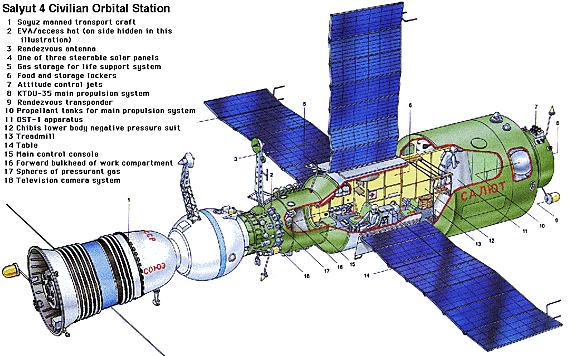
Salyut 4 (DOS-4) was launched on December 26, 1974. It was essentially a copy of the DOS-3, and unlike its ill-fated sibling it was a complete success. Two crews made stays aboard Salyut 4 (Soyuz 17
Soyuz 17
Soyuz 17 was the first of two long-duration missions to the Soviet Union's Salyut 4 space station in 1975. The flight set a Soviet mission-duration record of 29 days, surpassing the 23-day record set by the ill-fated Soyuz 11 crew aboard Salyut 1 in 1971....
and Soyuz 18
Soyuz 18
Soyuz 18 was a 1975 Soviet manned mission to Salyut 4, the second and final crew to man the space station. Pyotr Klimuk and Vitali Sevastyanov set a new Soviet space endurance record of 63 days and the mark for most people in space simultaneously was tied during the mission.-Crew:-Backup...
), including one of 63 days duration, and an unmanned Soyuz capsule (Soyuz 20
Soyuz 20
Soyuz 20 was an unmanned spacecraft launched by the Soviet Union. It was a long-duration test of the Soyuz spacecraft that docked with the Salyut 4 space station. Soyuz 20 performed comprehensive checking of improved on-board systems of the spacecraft under various flight conditions. It also...
) remained docked to the station for three months, proving the systems' long-term durability. Salyut 4 was deorbited February 2, 1977, and re-entered the Earth's atmosphere on February 3.
Salyut 5
Salyut 5 (OPS-3) ' onMouseout='HidePop("48714")' href="/topics/English_language">EnglishEnglish language
English is a West Germanic language that arose in the Anglo-Saxon kingdoms of England and spread into what was to become south-east Scotland under the influence of the Anglian medieval kingdom of Northumbria...
translation Salute 5) was launched on June 22, 1976. It was the third and last Almaz military space station. Its launch and subsequent mission were both completed successfully, with three crews launching and two (Soyuz 21
Soyuz 21
Soyuz 21 was a 1976 Soviet manned mission to the Salyut 5 space station, the first of three flights to the station. The mission's objectives were mainly military in scope, but included other scientific work. The mission ended abruptly with cosmonauts Boris Volynov and Vitaly Zholobov returning to...
and Soyuz 24
Soyuz 24
Soyuz 24 was a 1977 Soviet mission to the Salyut 5 space station, the third and final mission to the station, the last purely military crew for the Soviets and the final mission to a military Salyut...
) successfully boarding the craft for lengthy stays (the second crew on Soyuz 23
Soyuz 23
Soyuz 23 was a 1976 Soviet manned space flight, the second to the Salyut 5 space station. Cosmonauts Vyacheslav Zudov and Valery Rozhdestvensky arrived at the station, but an equipment malfunction did not allow docking and the mission had to be aborted....
was unable to dock and had to abort). Salyut 5 reentered on August 8, 1977. Following Salyut 5 the Soviet Military decided that the tactical advantages were not worth the expense of the program and withdrew. The focus for the later missions was research and prestige.
Salyut 6
Salyut 6 (DOS-5) was launched on September 29, 1977. Although it resembled the previous Salyut stations in overall design, it featured several revolutionary advances including a second docking port where an unmanned Progress cargo spacecraftProgress spacecraft
The Progress is a Russian expendable freighter spacecraft. The spacecraft is an unmanned resupply spacecraft during its flight but upon docking with a space station, it allows astronauts inside, hence it is classified manned by the manufacturer. It was derived from the Soyuz spacecraft, and is...
could dock and refuel the station. From 1977 until 1982 Salyut 6 was visited by five long-duration crews and 11 short-term crews, including cosmonauts from Warsaw Pact
Warsaw Pact
The Warsaw Treaty Organization of Friendship, Cooperation, and Mutual Assistance , or more commonly referred to as the Warsaw Pact, was a mutual defense treaty subscribed to by eight communist states in Eastern Europe...
countries. Some unconfirmed reports say the station was functionally capable of even more missions and years, but combating the ever-increasing mold in living quarters was becoming impossible, and in practice caused the retirement decision. The very first long-duration crew on Salyut 6 broke a record set on board Skylab
Skylab
Skylab was a space station launched and operated by NASA, the space agency of the United States. Skylab orbited the Earth from 1973 to 1979, and included a workshop, a solar observatory, and other systems. It was launched unmanned by a modified Saturn V rocket, with a mass of...
, staying 96 days in orbit. The longest flight on board Salyut 6 lasted 185 days. The fourth Salyut 6 expedition deployed a 10-meter radio-telescope antenna delivered by a cargo ship. After Salyut 6 manned operations were discontinued in 1981, a heavy unmanned spacecraft called TKS
TKS spacecraft
TKS spacecraft was a Soviet spacecraft design in the late 1960s intended to supply the military Almaz space station. The spacecraft was designed for manned or autonomous cargo resupply use...
and developed using hardware left from the canceled Almaz program was docked to the station as a hardware test. Salyut 6 was deorbited July 29, 1982.
Salyut 7
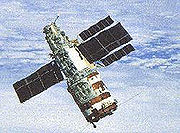
Salyut 7 (DOS-6) was launched on April 19, 1982. It was the back-up vehicle for Salyut 6 and very similar in equipment and capabilities, though several more advanced features were included. It was aloft for eight years and ten months, during which time it was visited by 10 crews constituting 6 main expeditions and 4 secondary flights (including French and Indian cosmonauts). Aside from the many experiments and observations made on Salyut 7, the station also tested the docking and use of large modules with an orbiting space station. The modules were called "Heavy Cosmos modules." They helped engineers develop technology necessary to build Mir
Mir
Mir was a space station operated in low Earth orbit from 1986 to 2001, at first by the Soviet Union and then by Russia. Assembled in orbit from 1986 to 1996, Mir was the first modular space station and had a greater mass than that of any previous spacecraft, holding the record for the...
. Salyut 7 deorbited on February 7, 1991.
DOS-7
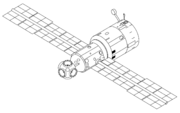
It was planned that two other stations (DOS-7 and DOS-8) would follow. These would be equipped with a total of four docking ports; two at either end of the station and an additional two ports on either side of docking sphere at the front of the station. DOS-7 continued to be developed, becoming the Mir Core Module
Mir Core Module
Mir , DOS-7, was the first module of the Soviet/Russian Mir space station complex, in low Earth orbit from 1986 to 2001. Generally referred to as either the core module or base block, the module was launched on 20 February 1986 on a Proton-K rocket from LC-200/39 at the Baikonur Cosmodrome...
, featuring upgraded computers and solar arrays, accommodations for two cosmonauts each having their own cabin and six docking ports.
DOS-8

DOS-8 evolved into the Mir-2
Mir-2
Mir-2 was a space station project begun in February 1976. Some of the modules built for Mir-2 have been incorporated into the International Space Station . The project underwent many changes, but was always based on the DOS-8 base block space station core module, built as a back-up to the DOS-7...
project, intended to replace the Mir
Mir
Mir was a space station operated in low Earth orbit from 1986 to 2001, at first by the Soviet Union and then by Russia. Assembled in orbit from 1986 to 1996, Mir was the first modular space station and had a greater mass than that of any previous spacecraft, holding the record for the...
space station. Finally, it became the International Space Station
International Space Station
The International Space Station is a habitable, artificial satellite in low Earth orbit. The ISS follows the Salyut, Almaz, Cosmos, Skylab, and Mir space stations, as the 11th space station launched, not including the Genesis I and II prototypes...
Zvezda Service Module.
Data table
| Space Station |
Launched | Reentered | Days in orbit |
Days occupied |
Total crew and visitors |
Visiting manned spacecraft |
Visiting unmanned spacecraft |
Mass kg |
|---|---|---|---|---|---|---|---|---|
| Salyut 1 Salyut 1 Salyut 1 was the first space station of any kind, launched by the USSR on April 19, 1971. It was launched unmanned using a Proton-K rocket. Its first crew came later in Soyuz 10, but was unable to dock completely; its second crew launched in Soyuz 11 and remained on board for 23 days... |
April 19, 1971 01:40:00 UTC |
October 11, 1971 00:00:00 UTC |
175 | 24 | 3 | 2 | 0 | 18,500 |
| DOS-2 DOS-2 DOS-2 designation given to a space station, launched as part of the Salyut programme, which was lost in a launch failure on 29 July 1972, when the failure of the second stage of its Proton-K launch vehicle prevented the station from achieving orbit, it instead fell into the Pacific Ocean... |
July 29, 1972 | July 29, 1972 | 0 | 0 | 0 | 0 | 0 | 18,000 |
| Salyut 2 Salyut 2 Salyut 2 was a Soviet space station which was launched in 1973 as part of the Salyut programme. It was the first Almaz military space station to fly. Within two weeks of launch the station had lost attitude control and depressurised, leaving it unusable... |
April 4, 1973 09:00:00 UTC |
May 28, 1973 00:00:00 UTC |
54 | 0 | 0 | 0 | 0 | 18,500 |
| Kosmos 557 | May 11, 1973 00:20:00 UTC |
May 22, 1973 00:00:00 UTC |
11 | 0 | 0 | 0 | 0 | 19,400 |
| Salyut 3 Salyut 3 Salyut 3 was a Soviet space station launched on June 25, 1974. It was the second Almaz military space station, and the first such station to be launched successfully. It was included in the Salyut program to disguise its true military nature... |
June 25, 1974 22:38:00 UTC |
January 24, 1975 00:00:00 UTC |
213 | 15 | 2 | 1 | 0 | 18,500 |
| Salyut 4 Salyut 4 Salyut 4 was a Salyut space station launched on December 26, 1974 into an orbit with an apogee of 355 km, a perigee of 343 km and an orbital inclination of 51.6 degrees. It was essentially a copy of the DOS 3, and unlike its ill-fated sibling it was a complete success... |
December 26, 1974 04:15:00 UTC |
February 3, 1977 00:00:00 UTC |
770 | 92 | 4 | 2 | 1 | 18,500 |
| Salyut 5 Salyut 5 Salyut 5 , also known as OPS-3, was a Soviet space station. Launched in 1976 as part of the Salyut programme, it was the third and last Almaz space station to be launched for the Soviet military. Two Soyuz missions visited the station, each manned by two cosmonauts... |
June 22, 1976 18:04:00 UTC |
August 8, 1977 00:00:00 UTC |
412 | 67 | 4 | 2 | 0 | 19,000 |
| Salyut 6 Salyut 6 Salyut 6 , DOS-5, was a Soviet orbital space station, the eighth flown as part of the Salyut programme. Launched on 29 September 1977 by a Proton rocket, the station was the first of the 'second-generation' type of space station. Salyut 6 possessed several revolutionary advances over the earlier... |
September 29, 1977 06:50:00 UTC |
July 29, 1982 00:00:00 UTC |
1,764 | 683 | 33 | 16 | 14 | 19,824 |
| Salyut 7 Salyut 7 Salyut 7 was a space station in low Earth orbit from April 1982 to February 1991. It was first manned in May 1982 with two crew via Soyuz T-5, and last visited in June 1986, by Soyuz T-15. Various crew and modules were used over its lifetime, including a total of 12 manned and 15 unmanned launches... |
April 19, 1982 19:45:00 UTC |
February 7, 1991 00:00:00 UTC |
3,216 | 816 | 26 | 12 | 15 | 18,900 |
See also
- AlmazAlmazThe Almaz program was a series of military space stations launched by the Soviet Union under cover of the civilian Salyut DOS-17K program after 1971....
- MirMirMir was a space station operated in low Earth orbit from 1986 to 2001, at first by the Soviet Union and then by Russia. Assembled in orbit from 1986 to 1996, Mir was the first modular space station and had a greater mass than that of any previous spacecraft, holding the record for the...
- Proton (rocket) launch vehicle
- SkylabSkylabSkylab was a space station launched and operated by NASA, the space agency of the United States. Skylab orbited the Earth from 1973 to 1979, and included a workshop, a solar observatory, and other systems. It was launched unmanned by a modified Saturn V rocket, with a mass of...
- International Space StationInternational Space StationThe International Space Station is a habitable, artificial satellite in low Earth orbit. The ISS follows the Salyut, Almaz, Cosmos, Skylab, and Mir space stations, as the 11th space station launched, not including the Genesis I and II prototypes...
- Space stationSpace stationA space station is a spacecraft capable of supporting a crew which is designed to remain in space for an extended period of time, and to which other spacecraft can dock. A space station is distinguished from other spacecraft used for human spaceflight by its lack of major propulsion or landing...
for statistics of occupied space stations